Math Missile Project By Adam Poff, Calvin Nelson, Nathan Weaver and Justin Johnson
Group Member Jobs Adam Poff: Equations/ PowerPoint Calvin Nelson: Equations/ Checked work Nathan Weaver: Checked Work Justin Johnson: Line of best fit/ Equations
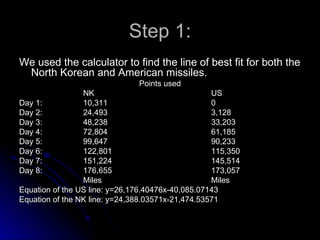
Step 1: We used the calculator to find the line of best fit for both the North Korean and American missiles.  Points used NK US Day 1: 10,311 0 Day 2: 24,493 3,128 Day 3: 48,238 33,203 Day 4: 72,804 61,185 Day 5: 99,647 90,233 Day 6: 122,801 115,350 Day 7: 151,224 145,514 Day 8: 176,655 173,057 Miles Miles Equation of the US line: y=26,176.40476x-40,085.07143 Equation of the NK line: y=24,388.03571x-21,474.53571
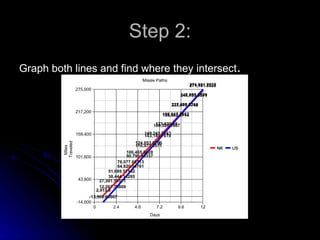
Step 2: Graph both lines and find where they intersect .
Step 3: Find where the lines intersect algebraically. y=26,176.40476x-40085.07143 y=24,388.03571x-21,474.53571 Set equations equal: 26,176.40476x-40085.07143=24,388.03571x-21,474.53571 Simplify: 1,788.46905x=18,610.53572 Divide to solve for x: x=10.4064291 Input x into the original equation: y=24,388.03571(10.4064291)-21,474.53571 Simplify: y=232,317.8288
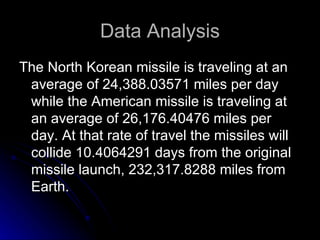
Data Analysis The North Korean missile is traveling at an average of 24,388.03571 miles per day while the American missile is traveling at an average of 26,176.40476 miles per day. At that rate of travel the missiles will collide 10.4064291 days from the original missile launch, 232,317.8288 miles from Earth.
Conclusion The missiles will collide 232,317.8288 miles from Earth. The moon is about 238,897 miles from earth. This means the missiles will collide 6579.1712 miles from the moon leading to no damage to the moon. This means that the mission is successful. There is the possibility of error but it was likely in the entering of numbers into the TI-84 when trying to find the line of best fit.

Math Missile Project

  • 1.
    Math Missile ProjectBy Adam Poff, Calvin Nelson, Nathan Weaver and Justin Johnson
  • 2.
    Group Member JobsAdam Poff: Equations/ PowerPoint Calvin Nelson: Equations/ Checked work Nathan Weaver: Checked Work Justin Johnson: Line of best fit/ Equations
  • 3.
    Step 1: Weused the calculator to find the line of best fit for both the North Korean and American missiles. Points used NK US Day 1: 10,311 0 Day 2: 24,493 3,128 Day 3: 48,238 33,203 Day 4: 72,804 61,185 Day 5: 99,647 90,233 Day 6: 122,801 115,350 Day 7: 151,224 145,514 Day 8: 176,655 173,057 Miles Miles Equation of the US line: y=26,176.40476x-40,085.07143 Equation of the NK line: y=24,388.03571x-21,474.53571
  • 4.
    Step 2: Graphboth lines and find where they intersect .
  • 5.
    Step 3: Findwhere the lines intersect algebraically. y=26,176.40476x-40085.07143 y=24,388.03571x-21,474.53571 Set equations equal: 26,176.40476x-40085.07143=24,388.03571x-21,474.53571 Simplify: 1,788.46905x=18,610.53572 Divide to solve for x: x=10.4064291 Input x into the original equation: y=24,388.03571(10.4064291)-21,474.53571 Simplify: y=232,317.8288
  • 6.
    Data Analysis TheNorth Korean missile is traveling at an average of 24,388.03571 miles per day while the American missile is traveling at an average of 26,176.40476 miles per day. At that rate of travel the missiles will collide 10.4064291 days from the original missile launch, 232,317.8288 miles from Earth.
  • 7.
    Conclusion The missileswill collide 232,317.8288 miles from Earth. The moon is about 238,897 miles from earth. This means the missiles will collide 6579.1712 miles from the moon leading to no damage to the moon. This means that the mission is successful. There is the possibility of error but it was likely in the entering of numbers into the TI-84 when trying to find the line of best fit.