Outline
CHS rollout–Commitment into practice ( Contextualizing for application)
Clarifying the application of CHS in the context of humanitarian program
cycle in Afar (needs assessment.
CHS in relation to other commitments (DCA code of conduct , Child
Safeguarding, ACT code of conduct and staff behaviour, Complaints
systems and safeguarding policy and PSEA)
Discussion On complaints and response mechanisms
Discussion on GRF outcome indicators
Data quality issues-
Discussing on beneficiary counting strategies
3.
The launch ofthe Core Humanitarian Standard
20 years before 2014
Code of conduct for disaster relief (IRCC and NGOs)
It contained 10 principles, starting with (amended versions of) the classical principles of
humanity, impartiality, neutrality and independence. 6 principles were added regarding the
quality of implementation.
Strengths
The good news was that the principles were widely supported by workers and
stakeholders of humanitarian action.
Limitations
On the other hand, the Code also seemed forlorn and orphaned.
The International Federation of the Red Cross held the registrar of signatories but had
otherwise no responsibility towards the Code.
4.
The launch ofthe Core Humanitarian Standard
Limitations
On the other hand, the Code also seemed forlorn and orphaned.
The International Federation of the Red Cross held the registrar of signatories but had
otherwise no responsibility towards the Code.
There was no steering, no guidelines for implementation, no training, let alone a
mechanism to monitor compliance.
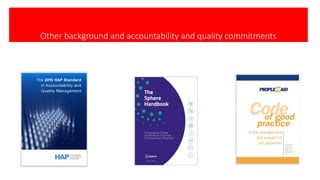
In the meantime, there have also been new Standard initiatives, including
1. Sphere Standards,
2. People in Aid and
3. the Humanitarian Accountability Partnership.
5.
The launch ofthe Core Humanitarian Standard
The Core Humanitarian Standard is the result of a collaborative process between
Groupe URD,
the Humanitarian Accountability Partnership (HAP) International,
People In Aid and
The Sphere Project.
It sets out nine commitments that organisations and individuals involved in
humanitarian intervention can use to improve the quality and effectiveness of aid
delivered. Communities and individuals affected by a disaster or conflict can also
rely on it to hold organizations to account.
The Core Humanitarian Standard on Quality and Accountability (CHS) is a direct
result of the Joint Standards Initiative (JSI) in which the Humanitarian Accountability
Partnership (HAP) International, People In Aid and the Sphere Project joined forces
to seek greater coherence for users of humanitarian standards.
6.
The launch ofthe Core Humanitarian Standard
The Standard brings together the main elements of :-
the Sphere and HAP 2010 standards, the Red Cross and Red Crescent Code
of Conduct,
the People in Aid Code of Good Practice and
criteria from the OECD’s DAC and
from the Quality Compass developed by Groupe URD.
It has been developed due to the need to improve the coherence between the
numerous different standards that exist.
The launch ofthe Core Humanitarian Standard
A few years ago, a process was started to bring about a new, shared standard that would
combine the best of existing standards and be more embedded. The result was launched
today: the Core Humanitarian Standard .
The classic principles underpin the CHS, which sets out 9 commitments. They are
accompanied by pointers for actionand pointers for the responsibility of organizations.
A major difference with the Code of Conduct is the people-centred nature of the CHS. The CHS
is written from the point of view of crisis-affected communities and people.
When the Code is applied, crisis-affected communities and people
1. will receive appropriate and relevant assistance;
2. have access to the assistance they need at the right time;
3. are not negatively affected and are more prepared, resilient and less-at-risk as a result of
assistance;
4. know their rights and entitlements;
9.
The launch ofthe Core Humanitarian Standard
5. have access to safe and responsive complaint mechanisms;
6. can expect improved assistance of learning organisations;
7. Receive a humanitarian response that is coordinatedand complementary among
stakehodlers
8. receive assistance from competent and well-managed staff and volunteers; and
9. can expect that assisting organizations' manage resources effectively, efficiently and
ethically.
The people-centredness of the CHS empowers communities. It also results in an
inclusive standard that can be equally adopted by humanitarian agencies, as well as any
other development, peace-building, rights-based or otherorganisations responding to
crises.
10.
Humanitarian principles
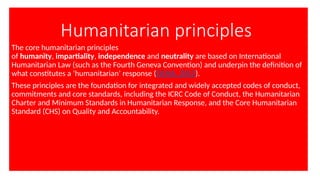
The corehumanitarian principles
of humanity, impartiality, independence and neutrality are based on International
Humanitarian Law (such as the Fourth Geneva Convention) and underpin the definition of
what constitutes a ‘humanitarian’ response (OCHA, 2012).
These principles are the foundation for integrated and widely accepted codes of conduct,
commitments and core standards, including the ICRC Code of Conduct, the Humanitarian
Charter and Minimum Standards in Humanitarian Response, and the Core Humanitarian
Standard (CHS) on Quality and Accountability.
11.
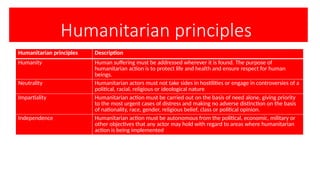
Humanitarian principles
Humanitarian principlesDescription
Humanity Human suffering must be addressed wherever it is found. The purpose of
humanitarian action is to protect life and health and ensure respect for human
beings.
Neutrality Humanitarian actors must not take sides in hostilities or engage in controversies of a
political, racial, religious or ideological nature
Impartiality Humanitarian action must be carried out on the basis of need alone, giving priority
to the most urgent cases of distress and making no adverse distinction on the basis
of nationality, race, gender, religious belief, class or political opinion.
Independence Humanitarian action must be autonomous from the political, economic, military or
other objectives that any actor may hold with regard to areas where humanitarian
action is being implemented
12.
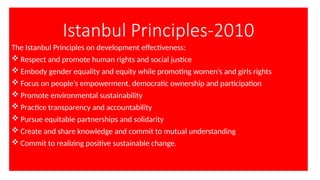
Istanbul Principles-2010
The IstanbulPrinciples on development effectiveness:
Respect and promote human rights and social justice
Embody gender equality and equity while promoting women’s and girls rights
Focus on people’s empowerment, democratic ownership and participation
Promote environmental sustainability
Practice transparency and accountability
Pursue equitable partnerships and solidarity
Create and share knowledge and commit to mutual understanding
Commit to realizing positive sustainable change.
13.
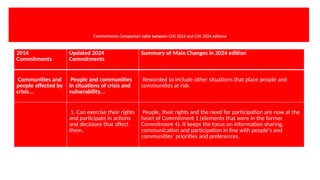
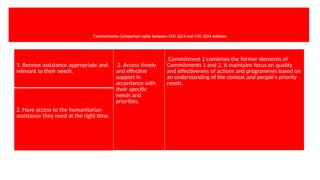
Commitments Comparison tablebetween CHS 2014 and CHS 2024 editions
2014
Commitments
Updated 2024
Commitments
Summary of Main Changes in 2024 edition
Communities and
people affected by
crisis...
People and communities
in situations of crisis and
vulnerability...
Reworded to include other situations that place people and
communities at risk.
1. Can exercise their rights
and participate in actions
and decisions that affect
them.
People, their rights and the need for participation are now at the
heart of Commitment 1 (elements that were in the former
Commitment 4). It keeps the focus on information sharing,
communication and participation in line with people’s and
communities’ priorities and preferences.
14.
Commitments Comparison tablebetween CHS 2014 and CHS 2024 editions
1. Receive assistance appropriate and
relevant to their needs.
2. Access timely
and effective
support in
accordance with
their specific
needs and
priorities.
Commitment 2 combines the former elements of
Commitments 1 and 2. It maintains focus on quality
and effectiveness of actions and programmes based on
an understanding of the context and people's priority
needs.
2. Have access to the humanitarian
assistance they need at the right time.
15.
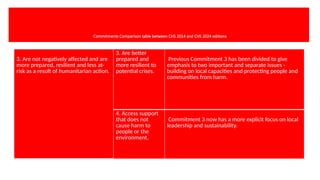
Commitments Comparison tablebetween CHS 2014 and CHS 2024 editions
3. Are not negatively affected and are
more prepared, resilient and less at-
risk as a result of humanitarian action.
3. Are better
prepared and
more resilient to
potential crises.
Previous Commitment 3 has been divided to give
emphasis to two important and separate issues -
building on local capacities and protecting people and
communities from harm.
4. Access support
that does not
cause harm to
people or the
environment.
Commitment 3 now has a more explicit focus on local
leadership and sustainability.
16.
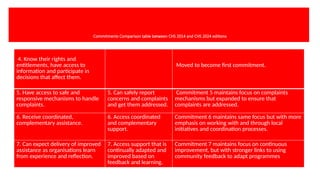
Commitments Comparison tablebetween CHS 2014 and CHS 2024 editions
4. Know their rights and
entitlements, have access to
information and participate in
decisions that affect them.
Moved to become first commitment.
5. Have access to safe and
responsive mechanisms to handle
complaints.
5. Can safely report
concerns and complaints
and get them addressed.
Commitment 5 maintains focus on complaints
mechanisms but expanded to ensure that
complaints are addressed.
6. Receive coordinated,
complementary assistance.
6. Access coordinated
and complementary
support.
Commitment 6 maintains same focus but with more
emphasis on working with and through local
initiatives and coordination processes.
7. Can expect delivery of improved
assistance as organisations learn
from experience and reflection.
7. Access support that is
continually adapted and
improved based on
feedback and learning.
Commitment 7 maintains focus on continuous
improvement, but with stronger links to using
community feedback to adapt programmes
17.
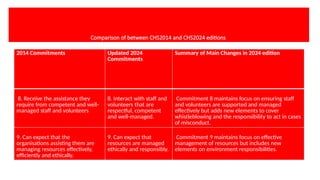
Comparison of betweenCHS2014 and CHS2024 editions
2014 Commitments Updated 2024
Commitments
Summary of Main Changes in 2024 edition
8. Receive the assistance they
require from competent and well-
managed staff and volunteers
8. Interact with staff and
volunteers that are
respectful, competent
and well-managed.
Commitment 8 maintains focus on ensuring staff
and volunteers are supported and managed
effectively but adds new elements to cover
whistleblowing and the responsibility to act in cases
of misconduct.
9. Can expect that the
organisations assisting them are
managing resources effectively,
efficiently and ethically.
9. Can expect that
resources are managed
ethically and responsibly.
Commitment 9 maintains focus on effective
management of resources but includes new
elements on environment responsibilities.
18.
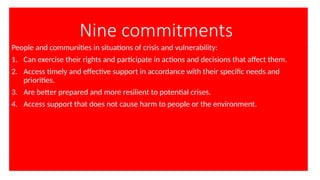
Nine commitments
People andcommunities in situations of crisis and vulnerability:
1. Can exercise their rights and participate in actions and decisions that affect them.
2. Access timely and effective support in accordance with their specific needs and
priorities.
3. Are better prepared and more resilient to potential crises.
4. Access support that does not cause harm to people or the environment.
19.
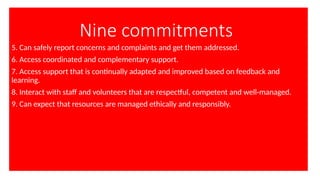
Nine commitments
5. Cansafely report concerns and complaints and get them addressed.
6. Access coordinated and complementary support.
7. Access support that is continually adapted and improved based on feedback and
learning.
8. Interact with staff and volunteers that are respectful, competent and well-managed.
9. Can expect that resources are managed ethically and responsibly.
20.
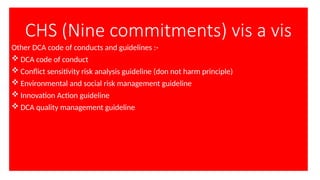
CHS (Nine commitments)vis a vis
Other DCA code of conducts and guidelines :-
DCA code of conduct
Conflict sensitivity risk analysis guideline (don not harm principle)
Environmental and social risk management guideline
Innovation Action guideline
DCA quality management guideline
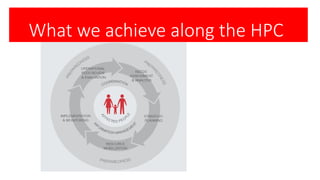
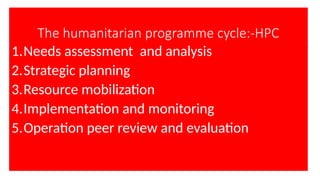
The humanitarian programmecycle:-HPC
1.Needs assessment and analysis
2.Strategic planning
3.Resource mobilization
4.Implementation and monitoring
5.Operation peer review and evaluation
23.
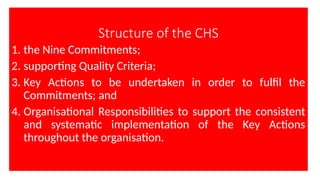
Structure of theCHS
1. the Nine Commitments;
2. supporting Quality Criteria;
3. Key Actions to be undertaken in order to fulfil the
Commitments; and
4. Organisational Responsibilities to support the consistent
and systematic implementation of the Key Actions
throughout the organisation.
24.
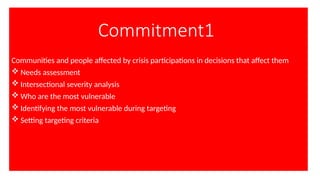
Commitment1
Communities and peopleaffected by crisis participations in decisions that affect them
Needs assessment
Intersectional severity analysis
Who are the most vulnerable
Identifying the most vulnerable during targeting
Setting targeting criteria
25.
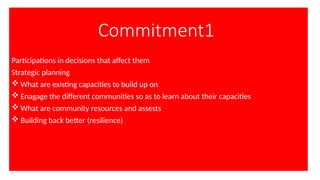
Commitment1
Participations in decisionsthat affect them
Strategic planning
What are existing capacities to build up on
Enagage the different communities so as to learn about their capacities
What are community resources and assests
Building back better (resilience)
26.
Commitment1
Participations in decisionsthat affect them
Implementation and monitoring
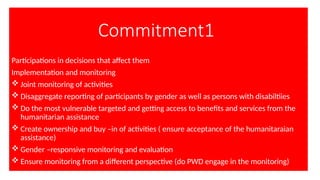
Joint monitoring of activities
Disaggregate reporting of participants by gender as well as persons with disabiltiies
Do the most vulnerable targeted and getting access to benefits and services from the
humanitarian assistance
Create ownership and buy –in of activities ( ensure acceptance of the humanitaraian
assistance)
Gender –responsive monitoring and evaluation
Ensure monitoring from a different perspective (do PWD engage in the monitoring)
27.
Commitment1
Participations in decisionsthat affect them
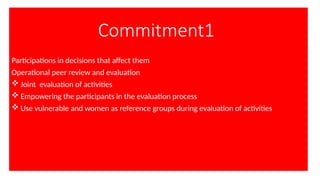
Operational peer review and evaluation
Joint evaluation of activities
Empowering the participants in the evaluation process
Use vulnerable and women as reference groups during evaluation of activities
28.
Commitment2
Communities and peopleaffected by crisis access timely and effective support in accordance with
their specific needs and priorities.
What else ? Discussion with in the participants
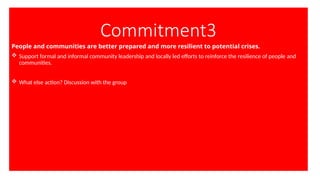
Commitment3
People and communitiesare better prepared and more resilient to potential crises.
Support formal and informal community leadership and locally led efforts to reinforce the resilience of people and
communities.
What else action? Discussion with the group
31.
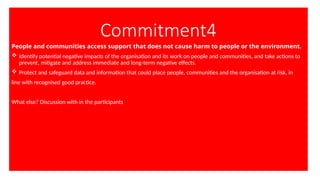
Commitment4
People and communitiesaccess support that does not cause harm to people or the environment.
Identify potential negative impacts of the organisation and its work on people and communities, and take actions to
prevent, mitigate and address immediate and long-term negative effects.
Protect and safeguard data and information that could place people, communities and the organisation at risk, in
line with recognised good practice.
What else? Discussion with in the participants
32.
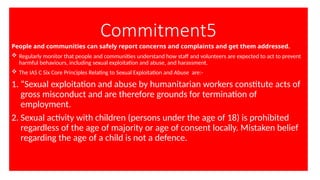
Commitment5
People and communitiescan safely report concerns and complaints and get them addressed.
Regularly monitor that people and communities understand how staff and volunteers are expected to act to prevent
harmful behaviours, including sexual exploitation and abuse, and harassment.
The IAS C Six Core Principles Relating to Sexual Exploitation and Abuse are:-
1. “Sexual exploitation and abuse by humanitarian workers constitute acts of
gross misconduct and are therefore grounds for termination of
employment.
2. Sexual activity with children (persons under the age of 18) is prohibited
regardless of the age of majority or age of consent locally. Mistaken belief
regarding the age of a child is not a defence.
33.
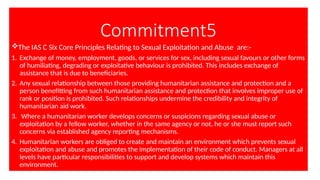
Commitment5
The IAS CSix Core Principles Relating to Sexual Exploitation and Abuse are:-
1. Exchange of money, employment, goods, or services for sex, including sexual favours or other forms
of humiliating, degrading or exploitative behaviour is prohibited. This includes exchange of
assistance that is due to beneficiaries.
2. Any sexual relationship between those providing humanitarian assistance and protection and a
person benefitting from such humanitarian assistance and protection that involves improper use of
rank or position is prohibited. Such relationships undermine the credibility and integrity of
humanitarian aid work.
3. Where a humanitarian worker develops concerns or suspicions regarding sexual abuse or
exploitation by a fellow worker, whether in the same agency or not, he or she must report such
concerns via established agency reporting mechanisms.
4. Humanitarian workers are obliged to create and maintain an environment which prevents sexual
exploitation and abuse and promotes the implementation of their code of conduct. Managers at all
levels have particular responsibilities to support and develop systems which maintain this
environment.
34.
Commitment5
People and communitiescan safely report concerns and complaints and get them addressed.
What else? Discussion with in the participants
35.
Commitment5
What are thepillars , CFRM principles and processes of establishing a
functional CFRM?
What are the key components of establishing CFRM
a) Information to beneficiaries and communities,
b) Receiving feedbacks and documenting it systematically, and
c) Responding to feedbacks.
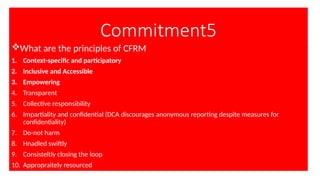
36.
Commitment5
What are theprinciples of CFRM
1. Context-specific and participatory
2. Inclusive and Accessible
3. Empowering
4. Transparent
5. Collective responsibility
6. Impartiality and confidential (DCA discourages anonymous reporting despite measures for
confidentiality)
7. Do-not harm
8. Hnadled swiftly
9. Consisteltly closing the loop
10. Appropraitely resourced
37.
Commitment5
What are thesteps /processes of establishing a functional CFRM ?
Discussion with the participants?
38.
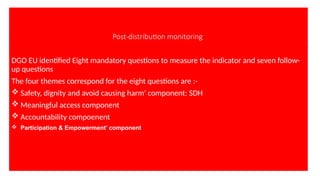
Post-distribution monitoring
DGO EUidentified Eight mandatory questions to measure the indicator and seven follow-
up questions
The four themes correspond for the eight questions are :-
Safety, dignity and avoid causing harm' component: SDH
Meaningful access component
Accountability compoenent
Participation & Empowerment’ component
39.
Post-distribution monitoring
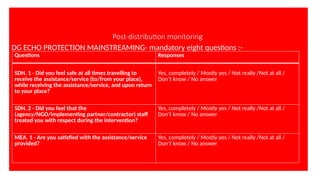
DG ECHOPROTECTION MAINSTREAMING- mandatory eight questions :-
Questions Responses
SDH. 1 - Did you feel safe at all times travelling to
receive the assistance/service (to/from your place),
while receiving the assistance/service, and upon return
to your place?
Yes, completely / Mostly yes / Not really /Not at all /
Don’t know / No answer
SDH. 2 - Did you feel that the
(agency/NGO/implementing partner/contractor) staff
treated you with respect during the intervention?
Yes, completely / Mostly yes / Not really /Not at all /
Don’t know / No answer
MEA. 1 - Are you satisfied with the assistance/service
provided?
Yes, completely / Mostly yes / Not really /Not at all /
Don’t know / No answer
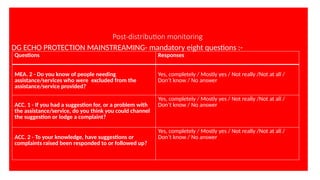
40.
Post-distribution monitoring
DG ECHOPROTECTION MAINSTREAMING- mandatory eight questions :-
Questions Responses
MEA. 2 - Do you know of people needing
assistance/services who were excluded from the
assistance/service provided?
Yes, completely / Mostly yes / Not really /Not at all /
Don’t know / No answer
ACC. 1 - If you had a suggestion for, or a problem with
the assistance/service, do you think you could channel
the suggestion or lodge a complaint?
Yes, completely / Mostly yes / Not really /Not at all /
Don’t know / No answer
ACC. 2 - To your knowledge, have suggestions or
complaints raised been responded to or followed up?
Yes, completely / Mostly yes / Not really /Not at all /
Don’t know / No answer
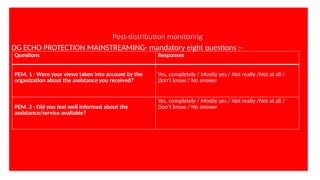
41.
Post-distribution monitoring
DG ECHOPROTECTION MAINSTREAMING- mandatory eight questions :-
Questions Responses
PEM. 1 - Were your views taken into account by the
organization about the assistance you received?
Yes, completely / Mostly yes / Not really /Not at all /
Don’t know / No answer
PEM. 2 - Did you feel well informed about the
assistance/service available?
Yes, completely / Mostly yes / Not really /Not at all /
Don’t know / No answer
Commitment6
People and communitiesaccess coordinated and complementary support.
Ensure the work of the organisation is coordinated with and complementary to locally led and community-based
actions, and those of relevant stakeholders.
45.
Commitment7
People and communitiesaccess support that is continually adapted and improved based on
feedback
and learning.
7.1 Regularly listen and respond to feedback and inputs from people and communities on the organisation and its
work.
Commitment8
People and communitiesinteract with staff and volunteers that are respectful, competent and
wellmanaged.
Leadership, staff and volunteers promote and demonstrate an organisational culture of quality and accountability.
Commitment9
People and communitiescan expect that resources are managed ethically and responsibly.
Ensure adequate capacity and resources to meet the organisation’s commitments.
50.
Benficiary counting
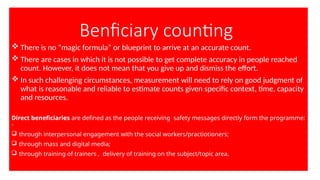
Thereis no “magic formula” or blueprint to arrive at an accurate count.
There are cases in which it is not possible to get complete accuracy in people reached
count. However, it does not mean that you give up and dismiss the effort.
In such challenging circumstances, measurement will need to rely on good judgment of
what is reasonable and reliable to estimate counts given specific context, time, capacity
and resources.
Direct beneficiaries are defined as the people receiving safety messages directly form the programme:
-
through interpersonal engagement with the social workers/practiotioners;
through mass and digital media;
through training of trainers , delivery of training on the subject/topic area.
51.
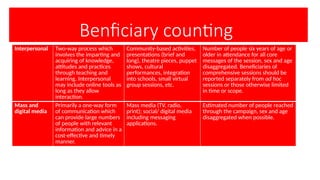
Benficiary counting
Interpersonal Two-wayprocess which
involves the imparting and
acquiring of knowledge,
attitudes and practices
through teaching and
learning. Interpersonal
may include online tools as
long as they allow
interaction.
Community-based activities,
presentations (brief and
long), theatre pieces, puppet
shows, cultural
performances, integration
into schools, small virtual
group sessions, etc.
Number of people six years of age or
older in attendance for all core
messages of the session, sex and age
disaggregated. Beneficiaries of
comprehensive sessions should be
reported separately from ad hoc
sessions or those otherwise limited
in time or scope.
Mass and
digital media
Primarily a one-way form
of communication which
can provide large numbers
of people with relevant
information and advice in a
cost-effective and timely
manner.
Mass media (TV, radio,
print); social/ digital media
including messaging
applications.
Estimated number of people reached
through the campaign, sex and age
disaggregated when possible.
52.
Benficiary counting
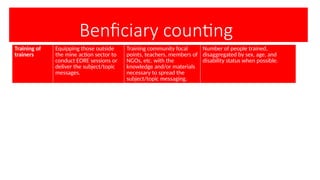
Training of
trainers
Equippingthose outside
the mine action sector to
conduct EORE sessions or
deliver the subject/topic
messages.
Training community focal
points, teachers, members of
NGOs, etc. with the
knowledge and/or materials
necessary to spread the
subject/topic messaging.
Number of people trained,
disaggregated by sex, age, and
disability status when possible.
53.
Beneficiary counting
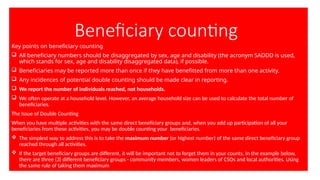
Key pointson beneficiary counting
All beneficiary numbers should be disaggregated by sex, age and disability (the acronym SADDD is used,
which stands for sex, age and disability disaggregated data), if possible.
Beneficiaries may be reported more than once if they have benefitted from more than one activity.
Any incidences of potential double counting should be made clear in reporting.
We report the number of individuals reached, not households.
We often operate at a household level. However, an average household size can be used to calculate the total number of
beneficiaries.
The Issue of Double Counting
When you have multiple activities with the same direct beneficiary groups and, when you add up participation of all your
beneficiaries from these activities, you may be double counting your beneficiaries.
The simplest way to address this is to take the maximum number (or highest number) of the same direct beneficiary group
reached through all activities.
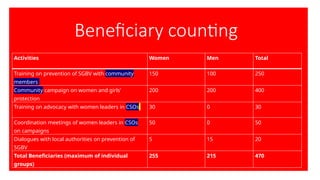
If the target beneficiary groups are different, it will be important not to forget them in your counts. In the example below,
there are three (3) different beneficiary groups - community members, women leaders of CSOs and local authorities. Using
the same rule of taking them maximum
54.
Benficiary counting
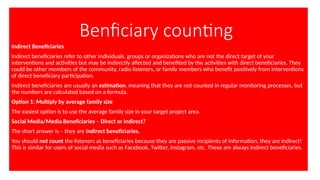
Indirect Beneficiaries
Indirectbeneficiaries refer to other individuals, groups or organizations who are not the direct target of your
interventions and activities but may be indirectly affected and benefited by the activities with direct beneficiaries. They
could be other members of the community, radio listeners, or family members who benefit positively from interventions
of direct beneficiary participation.
Indirect beneficiaries are usually an estimation, meaning that they are not counted in regular monitoring processes, but
the numbers are calculated based on a formula.
Option 1: Multiply by average family size
The easiest option is to use the average family size in your target project area.
Social Media/Media Beneficiaries – Direct or Indirect?
The short answer is – they are indirect beneficiaries.
You should not count the listeners as beneficiaries because they are passive recipients of information, they are indirect!
This is similar for users of social media such as Facebook, Twitter, Instagram, etc. These are always indirect beneficiaries.
55.
Benficiary counting
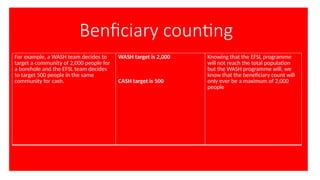
For example,a WASH team decides to
target a community of 2,000 people for
a borehole and the EFSL team decides
to target 500 people in the same
community for cash.
WASH target is 2,000
CASH target is 500
Knowing that the EFSL programme
will not reach the total population
but the WASH programme will, we
know that the beneficiary count will
only ever be a maximum of 2,000
people
56.
Beneficiary counting
Activities WomenMen Total
Training on prevention of SGBV with community
members
150 100 250
Community campaign on women and girls’
protection
200 200 400
Training on advocacy with women leaders in CSOs 30 0 30
Coordination meetings of women leaders in CSOs
on campaigns
50 0 50
Dialogues with local authorities on prevention of
SGBV
5 15 20
Total Beneficiaries (maximum of individual
groups)
255 215 470





![[DSC Europe 25] Milovan Jovicic - Beyond AI's Reach: The Enduring Value of Ev...](https://cdn.slidesharecdn.com/ss_thumbnails/pyeij0hurgwq5jugmtnv-2-milovan-jovicic-beyond-ais-reach-the-enduring-value-of-evergreen-design-v2-260120105856-d6ee57e5-thumbnail.jpg?width=640&height=640&fit=bounds)


![[DSC Europe 25] Gordana Milutinovic Dumbelovic - From Insight to Oversight: A...](https://cdn.slidesharecdn.com/ss_thumbnails/t7dkjsfxqwwzceropjv4-gordana-milutinovicdumbelovic-from-insight-to-oversight-ai-driven-power-bi-moni-260119121559-9e0bf11b-thumbnail.jpg?width=640&height=640&fit=bounds)

![[DSC Europe 25] Tali Fulman - Guild Meetings, Then What? Building Data Commun...](https://cdn.slidesharecdn.com/ss_thumbnails/fgohhi33rwmhqdowdj5k-tali-fulman-guild-meetings-then-what-building-data-communities-that-actually-ch-260120105855-528492c3-thumbnail.jpg?width=640&height=640&fit=bounds)


![[DSC Europe 25] Jovan Sumarac - Real-World Applications of Computer Vision in...](https://cdn.slidesharecdn.com/ss_thumbnails/fiksms22smcpopvvld03-jovan-sumarac-real-life-applications-of-computer-vision-in-automotive-systems-260120105855-de622abb-thumbnail.jpg?width=640&height=640&fit=bounds)
![[DSC Europe 25] Laila Kakar - Leveraging AI for Strategic Excellence: Enhanci...](https://cdn.slidesharecdn.com/ss_thumbnails/eykmhrtsqmaaftwkexh7-dsc-lailakakar-1-260119101520-5f3b5616-thumbnail.jpg?width=640&height=640&fit=bounds)
![[DSC Europe 25] Bojan Djuricic - Predictive Design Process.pdf](https://cdn.slidesharecdn.com/ss_thumbnails/5awdrbedqdek3gqu2ezy-4-the-predictive-design-bojan-djuricic-260120105856-6c399e9b-thumbnail.jpg?width=640&height=640&fit=bounds)