CHRONIC RENAL FAILURE
CHRONIC KIDNEY DISEASE
Dr. Virendra Kumar Gupta
MD Pediatrics
Fellowship In pediatric Gastroentero-Hepatology & Liver Transplantation
Assistant Professor
Department Of pediatrics
NIMS Medical College & Hospital , Jaipur
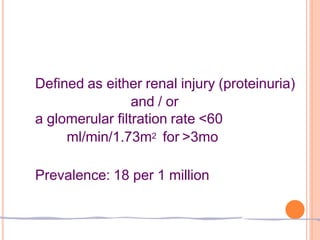
Defined as either renal injury (proteinuria)
and / or
a glomerular filtration rate <60
ml/min/1.73m2 for >3mo
Prevalence: 18 per 1 million
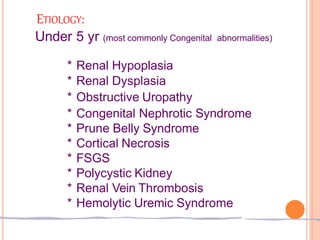
ETIOLOGY:
Under 5 yr (most commonly Congenital abnormalities)
* Renal Hypoplasia
* Renal Dysplasia
* Obstructive Uropathy
* Congenital Nephrotic Syndrome
* Prune Belly Syndrome
* Cortical Necrosis
* FSGS
* Polycystic Kidney
* Renal Vein Thrombosis
* Hemolytic Uremic Syndrome
AFTER 5 YRS (ACQUIRED AND INHERITED DISORDERS)
 Glomerulonephritis
 Nephronophthisis
 Alport Syndrome
Throughout Childhood years
 Cystinosis
 Hyperoxaluria
 Polycystic Kidney Disease
PATHOGENESIS
Hyperfiltration Injury
* Final common pathway of glomerular destruction
* Hypertrophy of remaining nephrons
* Increase glomerular blood flow
* ↑
glomerular filtration in surviving nephrons
* Progressive damage to surviving nephrons (due to
elevated hydrostatic pressure / toxic effect)
* ↑
excretory burden on surviving Nephrons
* Sclerosis of nephrons
Proteinuria:
* Exerts a direct toxic effect
* Infiltration of monocytes / macrophages
* Enhancing glomerular sclerosis
Hypertension:
* Exacerbate disease progression
* Arteriolar nephrosclerosis
* Hyperfiltartion injury
Hyperphosphatemia :
* Calcium phosphate deposition
Hyperlipidemia:
* Oxidant medicated injury
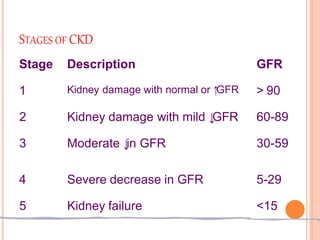
STAGES OF CKD
Stage Description GFR
1 Kidney damage with normal or ↑
GFR > 90
2 Kidney damage with mild ↓
GFR 60-89
3 Moderate ↓
in GFR 30-59
4 Severe decrease in GFR 5-29
5 Kidney failure <15
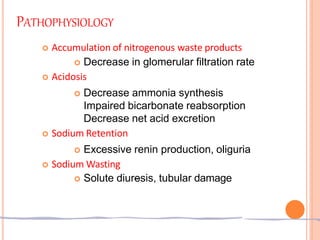
PATHOPHYSIOLOGY
 Accumulation of nitrogenous waste products
 Decrease in glomerular filtration rate
 Acidosis
 Decrease ammonia synthesis
Impaired bicarbonate reabsorption
Decrease net acid excretion
 Sodium Retention
 Excessive renin production, oliguria
 Sodium Wasting
 Solute diuresis, tubular damage
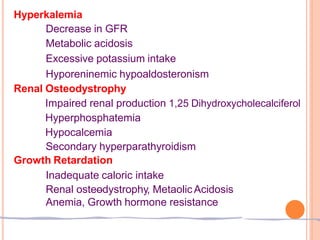
Hyperkalemia
Decrease in GFR
Metabolic acidosis
Excessive potassium intake
Hyporeninemic hypoaldosteronism
Renal Osteodystrophy
Impaired renal production 1,25 Dihydroxycholecalciferol
Hyperphosphatemia
Hypocalcemia
Secondary hyperparathyroidism
Growth Retardation
Inadequate caloric intake
Renal osteodystrophy, MetaolicAcidosis
Anemia, Growth hormone resistance
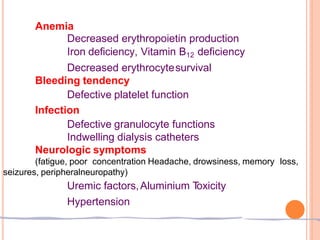
Anemia
Decreased erythropoietin production
Iron deficiency, Vitamin B12 deficiency
Decreased erythrocytesurvival
Bleeding tendency
Defective platelet function
Infection
Defective granulocyte functions
Indwelling dialysis catheters
Neurologic symptoms
(fatigue, poor concentration Headache, drowsiness, memory loss,
seizures, peripheralneuropathy)
Uremic factors,Aluminium T
oxicity
Hypertension
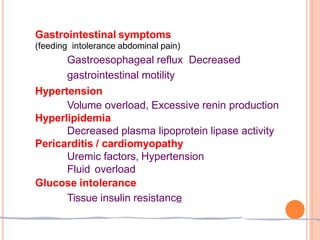
Gastrointestinal symptoms
(feeding intolerance abdominal pain)
Gastroesophageal reflux Decreased
gastrointestinal motility
Hypertension
Volume overload, Excessive renin production
Hyperlipidemia
Decreased plasma lipoprotein lipase activity
Pericarditis / cardiomyopathy
Uremic factors, Hypertension
Fluid overload
Glucose intolerance
Tissue insulin resistance
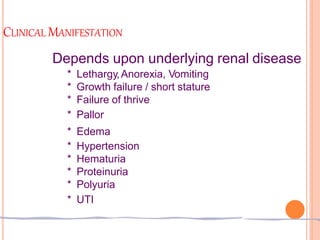
CLINICAL MANIFESTATION
Depends upon underlying renal disease
* Lethargy,Anorexia, Vomiting
* Growth failure / short stature
* Failure of thrive
* Pallor
* Edema
* Hypertension
* Hematuria
* Proteinuria
* Polyuria
* UTI
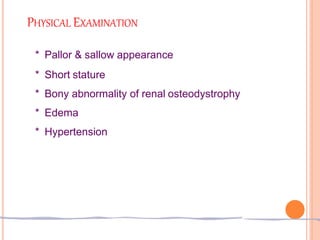
PHYSICAL EXAMINATION
* Pallor & sallow appearance
* Short stature
* Bony abnormality of renal osteodystrophy
* Edema
* Hypertension
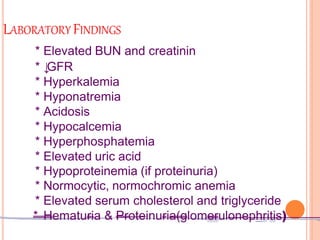
LABORATORY FINDINGS
* Elevated BUN and creatinin
* ↓
GFR
* Hyperkalemia
* Hyponatremia
* Acidosis
* Hypocalcemia
* Hyperphosphatemia
* Elevated uric acid
* Hypoproteinemia (if proteinuria)
* Normocytic, normochromic anemia
* Elevated serum cholesterol and triglyceride
* Hematuria & Proteinuria(glomerulonephritis)
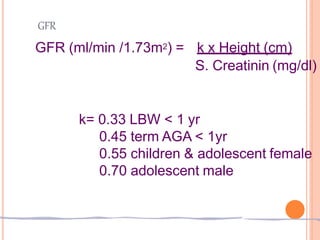
GFR
GFR (ml/min /1.73m2) = k x Height (cm)
S. Creatinin (mg/dl)
k= 0.33 LBW < 1 yr
0.45 term AGA < 1yr
0.55 children & adolescent female
0.70 adolescent male
TREATMENT
Aims
* Replacing absent / diminished renal function
* Slowing progression of renal dysfunction
FLUID & ELECTROLYTE MANAGEMENT
* Most patients maintain normal sodium & water balance
* Polyuric with urinary sodium loss:
give high volume, low caloric density feeding with
sodium supplements
* High BP, edema or heart failure:
require sodium restriction & diuretic therapy
* Fluid restriction is rarely necessary untill ESRD
* Hyperkalemia:
restriction of dietary K+ intake oral alkalinizing agent
kayexalate
ACIDOSIS
Sodium bicarbonate tab.( 650mg =8 mEq base)
Bacitra ((1mEq sodium citrate / ml)
Maintain serum bicarbonate > 22 mEq/L
NUTRITION
* Progressive restriction of various dietary components
* Dietary restriction of phosphorus, potassium and sodium
* RDA of caloric intake for age
* Protein intake 2.5g/kg/day
* High biologic value protein (egg, milk, meat, fish, fowl)
* Supplement carbohydrate (polycose), fat (MCT) and
protein (pro-Mod)
* Nasogastric, gastrostomy, or gastrojunal tube feeding
* Continuous overnight infusions
* Water soluble vitamins, routinely supplied
* Zinc and iron only if deficiency
* Supplement with fat soluble vitamins – usually not required
GROWTH
* Short stature is long term Squeal
* Growth Hormone resistance (GH↑
, IGF↓)
* Abnormality of IGF binding protein
* Recombinant human GH (0.05mg/kg/24hrs)
Continue until 50th percentile for MPH or achieves a final
adult height or undergoes renal transplantation
RENALOSTEODYSTROPHY
Spectrum Of bone Disorders in CKD
High Turnover Bone disease
Secondary Hyperparathyroidism
Osteitis Fibrosa Cystica
PATHOPHYSIOLOGY(RENALOSTEODYSTROPHY)
* When GFR Decline to 50 % of Normal
* Decline in 1 α
αHydroxylase
* Decrease production of activated Vit. D
* ↓
intestinal absorption of calcium
* Hypocalcaemia
* Secondary hyperparathyroidism ( to Correct
hypocalcaemia)
* Increase bone resorption when GFR decline to 25% of
normal
* Hyperphosphatemia- Further promotes hypocalcaemia
and increase PTH
CLINICALMANIFESTATIONSOFRENALOSTEODYDTROPHY
* Muscle weakness
* Bone pain
* Fractures with minor trauma
* Rickitic changes- varus or valgus deformity
* Ca ↓ ,Ph ↑, alkaline phosphate ↑, PTH normal
* Subperiosteal resorption of bone with widening of
metaphysis
TREATMENT OF RENAL OSTEODYSTROPHY
* Low phosphorus diet
* Phosphate binders
* Calcium carbonate & calcium acetate
* Sevelamer (Renagel) non calcium binder
* Avoid aluminum based binder
* Vitamin D therapy
* Maintain calcium / phosphorus product
(Cax PO4)at < 55
ANEMIA
* Inadequate erythropoitin production
* Iron deficiency
* Folic acid , Vitamin B12 deficiency
* Decreased erythrocyte survival
* Keep Hb between 12-13 g/dl
* Erythropoitin if Hb < 10g/dl -Dose 50-150 mg/kg/dose
S/C 1-3 times/wk
* Darbopoeitin alfa (longer acting)- Dose 0.45μg/kg/wk
HYPERTENSION
* Salt-restriction
* Diuretic therapy
* Hydrochlorothiazide 2 mg/kg/24hrs
* Furosemide 1-2 mg/kg/dose
* ACE inhibitors - angiotensin II blockers for
proteinuric renal disease (Enalapril, lisiopril,
losartin)
* Calcium channel blockers (Amlodipin)
* β-Blockers (propranolol, atenolol)
IMMUNIZATIONS
* Immunization according to the schedule
* Avoid live vaccine if on immunosuppressive drugs
* Give live vaccine before renal transplantation
* Yearly influenza vaccine
* Suboptimal response
ADJUSTMENT IN DRUG DOSE
Adjust doses as per GFR
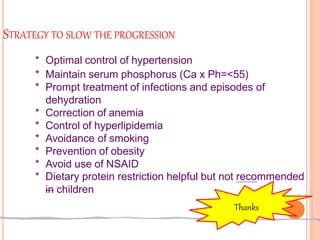
STRATEGY TO SLOW THE PROGRESSION
* Optimal control of hypertension
* Maintain serum phosphorus (Ca x Ph=<55)
* Prompt treatment of infections and episodes of
dehydration
* Correction of anemia
* Control of hyperlipidemia
* Avoidance of smoking
* Prevention of obesity
* Avoid use of NSAID
* Dietary protein restriction helpful but not recommended
in children
Thanks

CHRONIC RENAL FAILURE.pptx

  • 1.
    CHRONIC RENAL FAILURE CHRONICKIDNEY DISEASE Dr. Virendra Kumar Gupta MD Pediatrics Fellowship In pediatric Gastroentero-Hepatology & Liver Transplantation Assistant Professor Department Of pediatrics NIMS Medical College & Hospital , Jaipur
  • 2.
    Defined as eitherrenal injury (proteinuria) and / or a glomerular filtration rate <60 ml/min/1.73m2 for >3mo Prevalence: 18 per 1 million
  • 3.
    ETIOLOGY: Under 5 yr(most commonly Congenital abnormalities) * Renal Hypoplasia * Renal Dysplasia * Obstructive Uropathy * Congenital Nephrotic Syndrome * Prune Belly Syndrome * Cortical Necrosis * FSGS * Polycystic Kidney * Renal Vein Thrombosis * Hemolytic Uremic Syndrome
  • 4.
    AFTER 5 YRS(ACQUIRED AND INHERITED DISORDERS)  Glomerulonephritis  Nephronophthisis  Alport Syndrome Throughout Childhood years  Cystinosis  Hyperoxaluria  Polycystic Kidney Disease
  • 5.
    PATHOGENESIS Hyperfiltration Injury * Finalcommon pathway of glomerular destruction * Hypertrophy of remaining nephrons * Increase glomerular blood flow * ↑ glomerular filtration in surviving nephrons * Progressive damage to surviving nephrons (due to elevated hydrostatic pressure / toxic effect) * ↑ excretory burden on surviving Nephrons * Sclerosis of nephrons
  • 6.
    Proteinuria: * Exerts adirect toxic effect * Infiltration of monocytes / macrophages * Enhancing glomerular sclerosis Hypertension: * Exacerbate disease progression * Arteriolar nephrosclerosis * Hyperfiltartion injury Hyperphosphatemia : * Calcium phosphate deposition Hyperlipidemia: * Oxidant medicated injury
  • 7.
    STAGES OF CKD StageDescription GFR 1 Kidney damage with normal or ↑ GFR > 90 2 Kidney damage with mild ↓ GFR 60-89 3 Moderate ↓ in GFR 30-59 4 Severe decrease in GFR 5-29 5 Kidney failure <15
  • 8.
    PATHOPHYSIOLOGY  Accumulation ofnitrogenous waste products  Decrease in glomerular filtration rate  Acidosis  Decrease ammonia synthesis Impaired bicarbonate reabsorption Decrease net acid excretion  Sodium Retention  Excessive renin production, oliguria  Sodium Wasting  Solute diuresis, tubular damage
  • 9.
    Hyperkalemia Decrease in GFR Metabolicacidosis Excessive potassium intake Hyporeninemic hypoaldosteronism Renal Osteodystrophy Impaired renal production 1,25 Dihydroxycholecalciferol Hyperphosphatemia Hypocalcemia Secondary hyperparathyroidism Growth Retardation Inadequate caloric intake Renal osteodystrophy, MetaolicAcidosis Anemia, Growth hormone resistance
  • 10.
    Anemia Decreased erythropoietin production Irondeficiency, Vitamin B12 deficiency Decreased erythrocytesurvival Bleeding tendency Defective platelet function Infection Defective granulocyte functions Indwelling dialysis catheters Neurologic symptoms (fatigue, poor concentration Headache, drowsiness, memory loss, seizures, peripheralneuropathy) Uremic factors,Aluminium T oxicity Hypertension
  • 11.
    Gastrointestinal symptoms (feeding intoleranceabdominal pain) Gastroesophageal reflux Decreased gastrointestinal motility Hypertension Volume overload, Excessive renin production Hyperlipidemia Decreased plasma lipoprotein lipase activity Pericarditis / cardiomyopathy Uremic factors, Hypertension Fluid overload Glucose intolerance Tissue insulin resistance
  • 12.
    CLINICAL MANIFESTATION Depends uponunderlying renal disease * Lethargy,Anorexia, Vomiting * Growth failure / short stature * Failure of thrive * Pallor * Edema * Hypertension * Hematuria * Proteinuria * Polyuria * UTI
  • 13.
    PHYSICAL EXAMINATION * Pallor& sallow appearance * Short stature * Bony abnormality of renal osteodystrophy * Edema * Hypertension
  • 14.
    LABORATORY FINDINGS * ElevatedBUN and creatinin * ↓ GFR * Hyperkalemia * Hyponatremia * Acidosis * Hypocalcemia * Hyperphosphatemia * Elevated uric acid * Hypoproteinemia (if proteinuria) * Normocytic, normochromic anemia * Elevated serum cholesterol and triglyceride * Hematuria & Proteinuria(glomerulonephritis)
  • 15.
    GFR GFR (ml/min /1.73m2)= k x Height (cm) S. Creatinin (mg/dl) k= 0.33 LBW < 1 yr 0.45 term AGA < 1yr 0.55 children & adolescent female 0.70 adolescent male
  • 16.
    TREATMENT Aims * Replacing absent/ diminished renal function * Slowing progression of renal dysfunction
  • 17.
    FLUID & ELECTROLYTEMANAGEMENT * Most patients maintain normal sodium & water balance * Polyuric with urinary sodium loss: give high volume, low caloric density feeding with sodium supplements * High BP, edema or heart failure: require sodium restriction & diuretic therapy * Fluid restriction is rarely necessary untill ESRD * Hyperkalemia: restriction of dietary K+ intake oral alkalinizing agent kayexalate
  • 18.
    ACIDOSIS Sodium bicarbonate tab.(650mg =8 mEq base) Bacitra ((1mEq sodium citrate / ml) Maintain serum bicarbonate > 22 mEq/L
  • 19.
    NUTRITION * Progressive restrictionof various dietary components * Dietary restriction of phosphorus, potassium and sodium * RDA of caloric intake for age * Protein intake 2.5g/kg/day * High biologic value protein (egg, milk, meat, fish, fowl) * Supplement carbohydrate (polycose), fat (MCT) and protein (pro-Mod) * Nasogastric, gastrostomy, or gastrojunal tube feeding * Continuous overnight infusions * Water soluble vitamins, routinely supplied * Zinc and iron only if deficiency * Supplement with fat soluble vitamins – usually not required
  • 20.
    GROWTH * Short statureis long term Squeal * Growth Hormone resistance (GH↑ , IGF↓) * Abnormality of IGF binding protein * Recombinant human GH (0.05mg/kg/24hrs) Continue until 50th percentile for MPH or achieves a final adult height or undergoes renal transplantation
  • 21.
    RENALOSTEODYSTROPHY Spectrum Of boneDisorders in CKD High Turnover Bone disease Secondary Hyperparathyroidism Osteitis Fibrosa Cystica
  • 22.
    PATHOPHYSIOLOGY(RENALOSTEODYSTROPHY) * When GFRDecline to 50 % of Normal * Decline in 1 α αHydroxylase * Decrease production of activated Vit. D * ↓ intestinal absorption of calcium * Hypocalcaemia * Secondary hyperparathyroidism ( to Correct hypocalcaemia) * Increase bone resorption when GFR decline to 25% of normal * Hyperphosphatemia- Further promotes hypocalcaemia and increase PTH
  • 23.
    CLINICALMANIFESTATIONSOFRENALOSTEODYDTROPHY * Muscle weakness *Bone pain * Fractures with minor trauma * Rickitic changes- varus or valgus deformity * Ca ↓ ,Ph ↑, alkaline phosphate ↑, PTH normal * Subperiosteal resorption of bone with widening of metaphysis
  • 24.
    TREATMENT OF RENALOSTEODYSTROPHY * Low phosphorus diet * Phosphate binders * Calcium carbonate & calcium acetate * Sevelamer (Renagel) non calcium binder * Avoid aluminum based binder * Vitamin D therapy * Maintain calcium / phosphorus product (Cax PO4)at < 55
  • 25.
    ANEMIA * Inadequate erythropoitinproduction * Iron deficiency * Folic acid , Vitamin B12 deficiency * Decreased erythrocyte survival * Keep Hb between 12-13 g/dl * Erythropoitin if Hb < 10g/dl -Dose 50-150 mg/kg/dose S/C 1-3 times/wk * Darbopoeitin alfa (longer acting)- Dose 0.45μg/kg/wk
  • 26.
    HYPERTENSION * Salt-restriction * Diuretictherapy * Hydrochlorothiazide 2 mg/kg/24hrs * Furosemide 1-2 mg/kg/dose * ACE inhibitors - angiotensin II blockers for proteinuric renal disease (Enalapril, lisiopril, losartin) * Calcium channel blockers (Amlodipin) * β-Blockers (propranolol, atenolol)
  • 27.
    IMMUNIZATIONS * Immunization accordingto the schedule * Avoid live vaccine if on immunosuppressive drugs * Give live vaccine before renal transplantation * Yearly influenza vaccine * Suboptimal response
  • 28.
    ADJUSTMENT IN DRUGDOSE Adjust doses as per GFR
  • 29.
    STRATEGY TO SLOWTHE PROGRESSION * Optimal control of hypertension * Maintain serum phosphorus (Ca x Ph=<55) * Prompt treatment of infections and episodes of dehydration * Correction of anemia * Control of hyperlipidemia * Avoidance of smoking * Prevention of obesity * Avoid use of NSAID * Dietary protein restriction helpful but not recommended in children Thanks