Chronic Coronary
Syndrome DrRichardArmstrongMD
ConsultantCardiologistTUH
Introduction
▪ Coronary Artery Disease(CAD) is a pathological process
characterized by atherosclerotic plaque accumulation in the
epicardial arteries, whether obstructive or non-obstructive.
▪ Ischemic Heart Disease(IHD) is a condition in which there is an
inadequate supply of blood and oxygen to a portion of the
myocardium
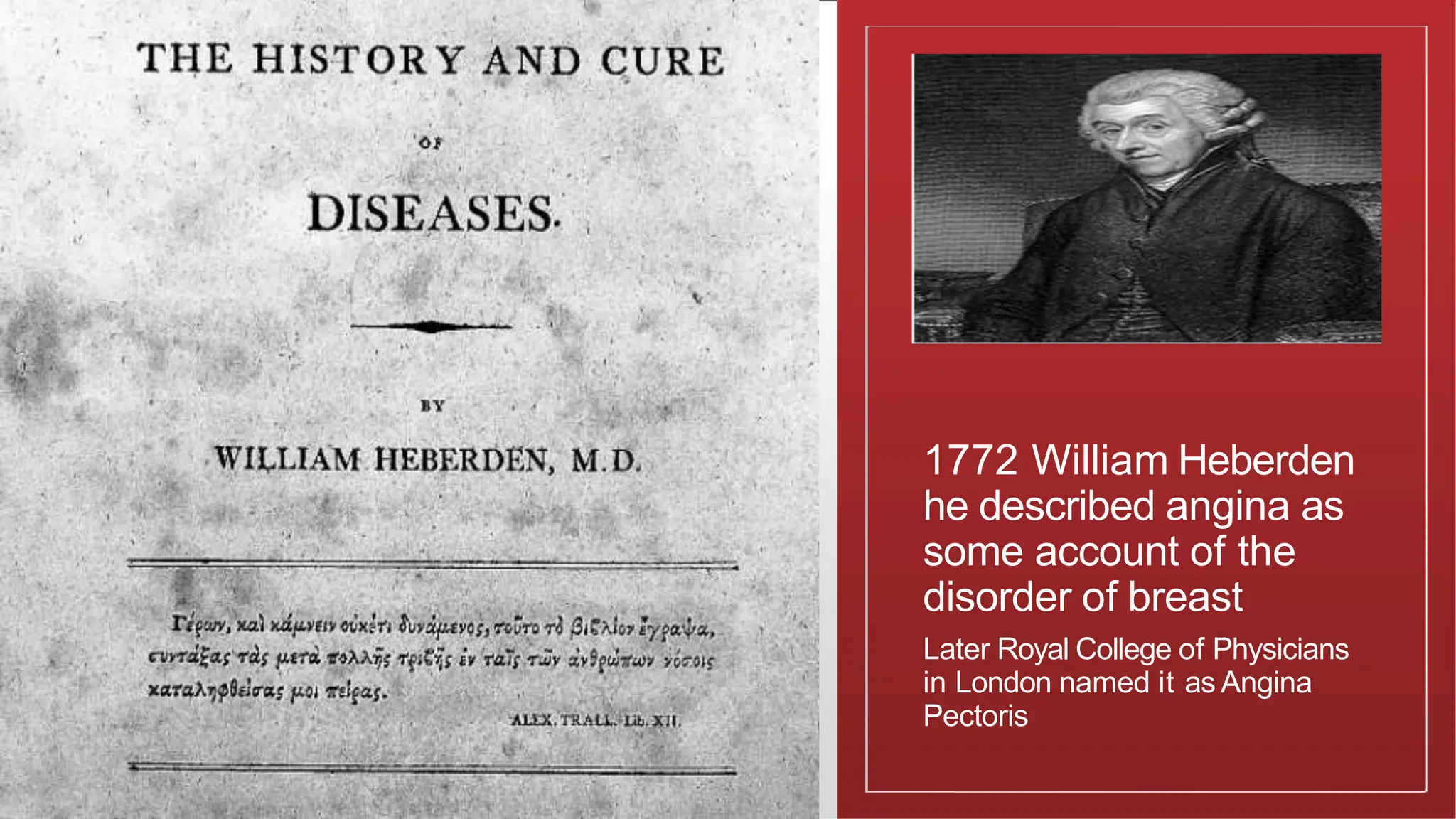
1772 William Heberden
he described angina as
some account of the
disorder of breast
Later Royal College of Physicians
in London named it as Angina
Pectoris
Angina Pectoris
▪Angina pectoris is a symptom
complex caused by transient
myocardial ischemia, which occurs
whenever there is an imbalance
between myocardial oxygen supply
and demand.
Natural History of
Chronic Coronary
Syndrome
Chronic Coronary Syndrome
▪ The 2019 ESCGuidelines replace the term
“Stable CAD” with Chronic Coronary Syndrome.
▪ This implies that CADis a dynamic process, the
clinical presentation of which can be eitheracute
or chronic
Pathophysiology
▪ Narrowing of Coronary arteries
▪ Insufficient blood flow
▪ Myocardial oxygen demands exceed supply
▪ Anaerobic metabolism with lactic acid accumulation
▪ Myocardial nerve fibres irritated
▪ Pain message transmitted to cardiac nerves and upper posterior
nerve root
Aetiology
▪ Atheroma(90% cases)
▪ Congenital
▪ Valvular disease
▪ Hypertension
▪ Cardiomyopathy
▪ Vasculitis or Aortitis
▪ Anemia
▪ Thyrotoxicosis
History and risk factors
Family history of CAD
Dyslipidemia
Diabetes
Hypertension
Smoking
Other lifestyle factors
The characteristics of Angina
Location Chest, near the sternum, but may be felt anywhere from the
epigastrium to the lower jaw or teeth, between the shoulder
blades, or in either arm to the wrist and fingers.
Character The discomfort is often described as pressure, tightness or
heaviness; sometimes strangling, constricting or burning.
Duration The duration of the discomfort is brief less than 10 mins in
the majority of cases, and more commonly just a few
minutes or less and chest pain lasting for seconds isunlikely
to be due to CAD.
Relationship to exertion
and other exacerbating
or relieving factors
Become more severe with increased levels of exertion.
Clinical Classification of SuspectedAnginal
Symptoms
Typical Angina
Meets the following three characteristics:
1.Constricting discomfort in the front of the chest or in
the neck, jaw, shoulder or arm.
2.Precipitated by physical exertion
3. Relieved by rest or nitrated within 5mins
Atypical
angina
Meets two of these characteristics.
Non-anginal
chest pain
Meets only one or none of these characteristics
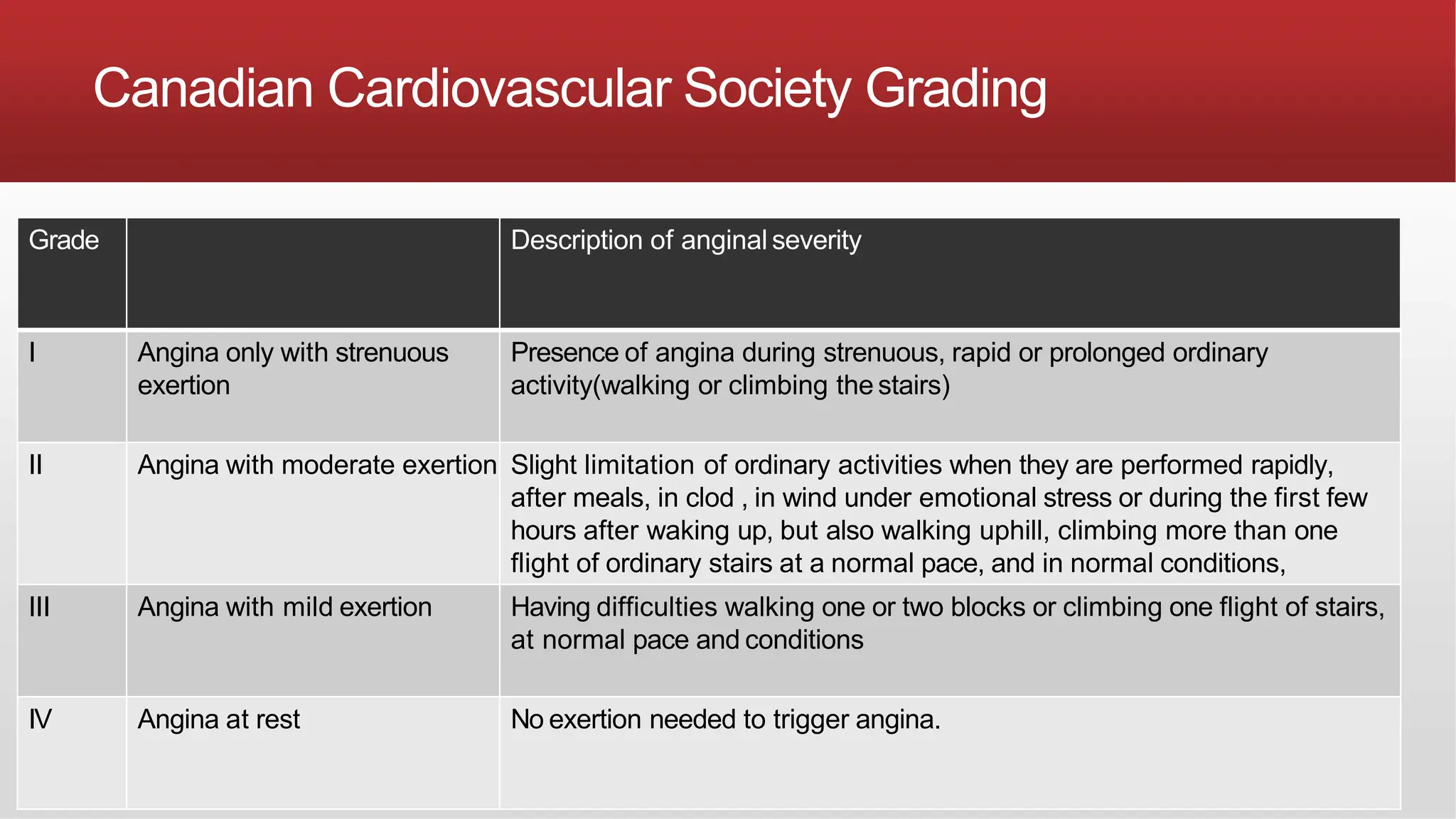
Canadian Cardiovascular Society Grading
Grade Description of anginal severity
I Angina only with strenuous
exertion
Presence of angina during strenuous, rapid or prolonged ordinary
activity(walking or climbing the stairs)
II Angina with moderate exertion Slight limitation of ordinary activities when they are performed rapidly,
after meals, in clod , in wind under emotional stress or during the first few
hours after waking up, but also walking uphill, climbing more than one
flight of ordinary stairs at a normal pace, and in normal conditions,
III Angina with mild exertion Having difficulties walking one or two blocks or climbing one flight of stairs,
at normal pace and conditions
IV Angina at rest No exertion needed to trigger angina.
Activities precipitating angina
Common
Physical exertion
Cold exposure
Heavy meals
Intense emotion
Uncommon
Vivid dreams (Nocturnal)
Lying flat(Decubitus)
Physical Examination
T
oaccess the presenceof-
▪ Hypertension
▪ Valvular Heart Disease
▪ Peripheral Vascular Disease
▪ HOCM
▪ BMI
▪ Waist circumference
Investigations(Class I)
Biochemical Test:
▪ FBC
▪ Fasting plasma glucose and HbA1c
▪ Lipid profile
▪ Serum creatinine and eGFR
▪ Serum uric acid test
▪ Thyroid function test
Resting ECG
▪ Usually normal
▪ Aresting 12 lead ECGis recommended in all patients with chest pain without
an obvious non-cardiac cause (Class I Level C).
▪ Aresting 12 lead ECGis recommended in all patients during or immediately
after an episode of angina suspected to be indicative of clinical instability of
CAD(Class I LevelC).
▪ Ambulatory ECGmonitoring is recommended in patients with chest painand
suspected arrhythmias(Class I Level C).
Chest X-Ray
▪Chest X-ray is recommended for
patients with a typical presentation,
signs and symptoms of HF
,or suspicion
of pulmonary disease(Class I level C).
Exercise ECG
▪ Exercise ECGis recommended for the assessment of exercise
tolerance, symptoms, arrhythmias, BPresponse, and event risk in
selected patients(class I level C)–NOTFORDIAGNOSISORFOR
RULINGOUTCORONARYARTERYDISEASE
▪ Exercise ECGis not recommended for diagnostic purpose in
patients with ≥ 0.1 mV St- segment depression on resting ECG
or who are being treated with digitalis(class III level C)
Functional non invasive tests
▪ Stress Echocardiography
▪ Single photon emission CT(SPECT)
▪ Positron emission tomography (PET)
▪ Myocardial contrast echocardiography
▪ contrast CMR
Anatomical Assessment
Non-invasive – coronary CT
Invasive – coronary angiogram
Clinical likelihood
of Obstructive CAD
Main diagnostic pathways
in symptomatic patients
with suspected obstructive
CAD
Approach for the initial diagnostic management of
patients with angina and suspected coronaryartery
disease
Pre-test probability scores
Management
▪Lifestyle modification and control of risk
factors
▪Pharmacological management
▪Revascularization
Lifestyle recommendations for patients with
chronic coronary syndromes
Smoking cessation Use pharmacological and behavioural strategies to help patients quit smoking. Avoid
passive smoking
Healthy diet Diet high in vegetables, fruit, and wholegrains. Limit saturated fat to ,10% of total intake.
Limit alcohol to ,100 g/wk or 15 g/day
Physical activity 30 -60min moderate physical activity most days, but even irregular activity is beneficial.
Healthy weight Obtain and maintain a healthy weight (<25kg/m2), or reduce weightthrough
recommended energy intake and increased physical activity.
Other Take medications as prescribed. Sexual activity is low risk for stable patients not
symptomatic at low-to-moderate activity levels
Recommendations
on lifestyle
management
Pharmacological
Management
Nitrates:
▪ Nitrates act directly on vascular smooth muscle to producevenous
and arteriolar dilatation.
▪ They help angina by lowering preload and afterload, which reduces
myocardial oxygen demand and by increasing myocardial oxygen
supply through coronary vasodilatation.
▪ No mortality benefit or cannot prevent heart attack.
▪ Short acting nitrates for acute effort angina: Sublingual and spray
nitroglycerin formulations provide immediate relief of effort angina
▪ Long acting nitrates for angina prophylaxis.
Beta Blockers
▪ These lower myocardial oxygen demand by
reducing heart rate, BPand myocardial
contractility.
▪ Discontinuation should be tapered and not
abrupt.
▪ The principal side effects of beat blockers are
fatigue, depression, bradycardia, heart block,
bronchospasm, peripheral vasoconstriction,
postural hypotension, impotence and masking of
hypoglycemia symptoms.
Calcium Channel Antagonists
▪These drugs lower myocardial oxygen
demand by reducing BPand myocardial
contraction.
Potassium Channel Activator
▪Nicorandil(10-30 mg twice daily orally) isa
nitrate derivatives of nicotinamide, with
antianginal effects similar to those of
nitrates or beta blockers.
▪Side effects include nausea, vomiting and
potentially severe oral, intestinal and
mucosal ulcerations
If channel antagonists
▪Ivabradine
▪It does not inhibit myocardial contractility
▪ Works specifically on the sinus node
(wont work in AF).
Ranolazine
▪Is a selective inhibitor of the late inward
sodium current in coronary artery smooth
muscle cell, with a secondary effect on
calcium flux and vascular tone, reducing
anginal symptoms.
▪Side effects include dizziness,nausea,
constipation, Qt prolongation.
▪375BD is the starter dose, always
uptitrate
Trimetazidine
▪ Trimetazidine is an anti-ischemic(anti-anginal)
metabolic agent, which improves myocardial
glucose utilization through inhibition of fatty acid
metabolism, also known as fatty acid oxidation
inhibitor.
▪ It is contraindicated in Parkinson`s disease and
motion disorders, such as tremor(shaking),
muscle rigidity, walking disorders and restlessleg
syndrome.
Event Prevention
Recommendations Class level
Aspirin 75-100 mg daily is recommended in patients with a previous MI or
revascularization
I A
Clopidogrel 75 mg daily is recommended as an alternative to aspirin in patients with
aspirin intolerance
I B
Anticoagulant Drugs
▪Anticoagulation therapy is
recommended in patients with AFand
CCS for reduction of ischemic stroke
and other ischemic events.
ACEinhibitors
▪ACEinhibitors or ARBsare
recommended if a patient has
other conditions (e.g. Heart
failure, Hypertension or diabetes)
Statins
Recommendation Class Level
Statins are recommended in all patients withCCS. I A
If a patient`s goal is not achieved with the maximum tolerated dose of statin, combination
with ezetimibe is recommended.
I B
For patients at very high risk who do not achieved their goal on a maximumtolerated dose
of statin and ezetimibe, combination with PCSK9 inhibitor is recommended.
I A
Antithrombotic therapy in patients with CCS
Suggested stepwise strategy for long term anti-
ischaemic drug therapy in CSS
Revascularization
▪ In patients with CCS,optimal medical therapy is key for reducing
symptoms, halting the progression of atherosclerosis and
preventing atherothrombotic events,
▪ Myocardial revascularization plays a central role in the
management of CCSon top of medical treatment, but always as
an adjunct to medical therapy without supplanting it.
▪ Revascularization by PCIor CABGmay effectively relieve angina,
reduce the use of antianginal drugs and improve exercisecapacity
and quality of life compared with a strategy of medical therapy
alone.
Thank You

chronic coronary syndrome.pptx

  • 1.
  • 2.
    Introduction ▪ Coronary ArteryDisease(CAD) is a pathological process characterized by atherosclerotic plaque accumulation in the epicardial arteries, whether obstructive or non-obstructive. ▪ Ischemic Heart Disease(IHD) is a condition in which there is an inadequate supply of blood and oxygen to a portion of the myocardium
  • 4.
    1772 William Heberden hedescribed angina as some account of the disorder of breast Later Royal College of Physicians in London named it as Angina Pectoris
  • 5.
    Angina Pectoris ▪Angina pectorisis a symptom complex caused by transient myocardial ischemia, which occurs whenever there is an imbalance between myocardial oxygen supply and demand.
  • 6.
    Natural History of ChronicCoronary Syndrome
  • 7.
    Chronic Coronary Syndrome ▪The 2019 ESCGuidelines replace the term “Stable CAD” with Chronic Coronary Syndrome. ▪ This implies that CADis a dynamic process, the clinical presentation of which can be eitheracute or chronic
  • 8.
    Pathophysiology ▪ Narrowing ofCoronary arteries ▪ Insufficient blood flow ▪ Myocardial oxygen demands exceed supply ▪ Anaerobic metabolism with lactic acid accumulation ▪ Myocardial nerve fibres irritated ▪ Pain message transmitted to cardiac nerves and upper posterior nerve root
  • 9.
    Aetiology ▪ Atheroma(90% cases) ▪Congenital ▪ Valvular disease ▪ Hypertension ▪ Cardiomyopathy ▪ Vasculitis or Aortitis ▪ Anemia ▪ Thyrotoxicosis
  • 10.
    History and riskfactors Family history of CAD Dyslipidemia Diabetes Hypertension Smoking Other lifestyle factors
  • 11.
    The characteristics ofAngina Location Chest, near the sternum, but may be felt anywhere from the epigastrium to the lower jaw or teeth, between the shoulder blades, or in either arm to the wrist and fingers. Character The discomfort is often described as pressure, tightness or heaviness; sometimes strangling, constricting or burning. Duration The duration of the discomfort is brief less than 10 mins in the majority of cases, and more commonly just a few minutes or less and chest pain lasting for seconds isunlikely to be due to CAD. Relationship to exertion and other exacerbating or relieving factors Become more severe with increased levels of exertion.
  • 12.
    Clinical Classification ofSuspectedAnginal Symptoms Typical Angina Meets the following three characteristics: 1.Constricting discomfort in the front of the chest or in the neck, jaw, shoulder or arm. 2.Precipitated by physical exertion 3. Relieved by rest or nitrated within 5mins Atypical angina Meets two of these characteristics. Non-anginal chest pain Meets only one or none of these characteristics
  • 13.
    Canadian Cardiovascular SocietyGrading Grade Description of anginal severity I Angina only with strenuous exertion Presence of angina during strenuous, rapid or prolonged ordinary activity(walking or climbing the stairs) II Angina with moderate exertion Slight limitation of ordinary activities when they are performed rapidly, after meals, in clod , in wind under emotional stress or during the first few hours after waking up, but also walking uphill, climbing more than one flight of ordinary stairs at a normal pace, and in normal conditions, III Angina with mild exertion Having difficulties walking one or two blocks or climbing one flight of stairs, at normal pace and conditions IV Angina at rest No exertion needed to trigger angina.
  • 14.
    Activities precipitating angina Common Physicalexertion Cold exposure Heavy meals Intense emotion Uncommon Vivid dreams (Nocturnal) Lying flat(Decubitus)
  • 15.
    Physical Examination T oaccess thepresenceof- ▪ Hypertension ▪ Valvular Heart Disease ▪ Peripheral Vascular Disease ▪ HOCM ▪ BMI ▪ Waist circumference
  • 16.
    Investigations(Class I) Biochemical Test: ▪FBC ▪ Fasting plasma glucose and HbA1c ▪ Lipid profile ▪ Serum creatinine and eGFR ▪ Serum uric acid test ▪ Thyroid function test
  • 17.
    Resting ECG ▪ Usuallynormal ▪ Aresting 12 lead ECGis recommended in all patients with chest pain without an obvious non-cardiac cause (Class I Level C). ▪ Aresting 12 lead ECGis recommended in all patients during or immediately after an episode of angina suspected to be indicative of clinical instability of CAD(Class I LevelC). ▪ Ambulatory ECGmonitoring is recommended in patients with chest painand suspected arrhythmias(Class I Level C).
  • 18.
    Chest X-Ray ▪Chest X-rayis recommended for patients with a typical presentation, signs and symptoms of HF ,or suspicion of pulmonary disease(Class I level C).
  • 19.
    Exercise ECG ▪ ExerciseECGis recommended for the assessment of exercise tolerance, symptoms, arrhythmias, BPresponse, and event risk in selected patients(class I level C)–NOTFORDIAGNOSISORFOR RULINGOUTCORONARYARTERYDISEASE ▪ Exercise ECGis not recommended for diagnostic purpose in patients with ≥ 0.1 mV St- segment depression on resting ECG or who are being treated with digitalis(class III level C)
  • 20.
    Functional non invasivetests ▪ Stress Echocardiography ▪ Single photon emission CT(SPECT) ▪ Positron emission tomography (PET) ▪ Myocardial contrast echocardiography ▪ contrast CMR
  • 21.
    Anatomical Assessment Non-invasive –coronary CT Invasive – coronary angiogram
  • 22.
  • 23.
    Main diagnostic pathways insymptomatic patients with suspected obstructive CAD
  • 24.
    Approach for theinitial diagnostic management of patients with angina and suspected coronaryartery disease
  • 25.
  • 26.
    Management ▪Lifestyle modification andcontrol of risk factors ▪Pharmacological management ▪Revascularization
  • 27.
    Lifestyle recommendations forpatients with chronic coronary syndromes Smoking cessation Use pharmacological and behavioural strategies to help patients quit smoking. Avoid passive smoking Healthy diet Diet high in vegetables, fruit, and wholegrains. Limit saturated fat to ,10% of total intake. Limit alcohol to ,100 g/wk or 15 g/day Physical activity 30 -60min moderate physical activity most days, but even irregular activity is beneficial. Healthy weight Obtain and maintain a healthy weight (<25kg/m2), or reduce weightthrough recommended energy intake and increased physical activity. Other Take medications as prescribed. Sexual activity is low risk for stable patients not symptomatic at low-to-moderate activity levels
  • 28.
  • 29.
  • 30.
    Nitrates: ▪ Nitrates actdirectly on vascular smooth muscle to producevenous and arteriolar dilatation. ▪ They help angina by lowering preload and afterload, which reduces myocardial oxygen demand and by increasing myocardial oxygen supply through coronary vasodilatation. ▪ No mortality benefit or cannot prevent heart attack. ▪ Short acting nitrates for acute effort angina: Sublingual and spray nitroglycerin formulations provide immediate relief of effort angina ▪ Long acting nitrates for angina prophylaxis.
  • 31.
    Beta Blockers ▪ Theselower myocardial oxygen demand by reducing heart rate, BPand myocardial contractility. ▪ Discontinuation should be tapered and not abrupt. ▪ The principal side effects of beat blockers are fatigue, depression, bradycardia, heart block, bronchospasm, peripheral vasoconstriction, postural hypotension, impotence and masking of hypoglycemia symptoms.
  • 32.
    Calcium Channel Antagonists ▪Thesedrugs lower myocardial oxygen demand by reducing BPand myocardial contraction.
  • 33.
    Potassium Channel Activator ▪Nicorandil(10-30mg twice daily orally) isa nitrate derivatives of nicotinamide, with antianginal effects similar to those of nitrates or beta blockers. ▪Side effects include nausea, vomiting and potentially severe oral, intestinal and mucosal ulcerations
  • 34.
    If channel antagonists ▪Ivabradine ▪Itdoes not inhibit myocardial contractility ▪ Works specifically on the sinus node (wont work in AF).
  • 35.
    Ranolazine ▪Is a selectiveinhibitor of the late inward sodium current in coronary artery smooth muscle cell, with a secondary effect on calcium flux and vascular tone, reducing anginal symptoms. ▪Side effects include dizziness,nausea, constipation, Qt prolongation. ▪375BD is the starter dose, always uptitrate
  • 36.
    Trimetazidine ▪ Trimetazidine isan anti-ischemic(anti-anginal) metabolic agent, which improves myocardial glucose utilization through inhibition of fatty acid metabolism, also known as fatty acid oxidation inhibitor. ▪ It is contraindicated in Parkinson`s disease and motion disorders, such as tremor(shaking), muscle rigidity, walking disorders and restlessleg syndrome.
  • 37.
    Event Prevention Recommendations Classlevel Aspirin 75-100 mg daily is recommended in patients with a previous MI or revascularization I A Clopidogrel 75 mg daily is recommended as an alternative to aspirin in patients with aspirin intolerance I B
  • 38.
    Anticoagulant Drugs ▪Anticoagulation therapyis recommended in patients with AFand CCS for reduction of ischemic stroke and other ischemic events.
  • 39.
    ACEinhibitors ▪ACEinhibitors or ARBsare recommendedif a patient has other conditions (e.g. Heart failure, Hypertension or diabetes)
  • 40.
    Statins Recommendation Class Level Statinsare recommended in all patients withCCS. I A If a patient`s goal is not achieved with the maximum tolerated dose of statin, combination with ezetimibe is recommended. I B For patients at very high risk who do not achieved their goal on a maximumtolerated dose of statin and ezetimibe, combination with PCSK9 inhibitor is recommended. I A
  • 41.
    Antithrombotic therapy inpatients with CCS
  • 42.
    Suggested stepwise strategyfor long term anti- ischaemic drug therapy in CSS
  • 43.
    Revascularization ▪ In patientswith CCS,optimal medical therapy is key for reducing symptoms, halting the progression of atherosclerosis and preventing atherothrombotic events, ▪ Myocardial revascularization plays a central role in the management of CCSon top of medical treatment, but always as an adjunct to medical therapy without supplanting it. ▪ Revascularization by PCIor CABGmay effectively relieve angina, reduce the use of antianginal drugs and improve exercisecapacity and quality of life compared with a strategy of medical therapy alone.
  • 44.