LESSON
CHEMICAL TOXICOLOGY
Chemical toxicologyis the study of toxic chemicals and how they act.
Toxic means poisonous.
A toxic substance absorbed by a living organism injures its health or destroys it.
A hazardous substance is anything which because of its physical or chemical
healthy may cause illness or significantly contribute to destruction of life.
2.
• Some toxicchemicals in water include As, Cd, Be, B, Cu, F, Pb, Hg, Mo, Se, Zn and
pesticides, cyanides, solvent hydrocarbons, benzene etc.
3.
Effect of metaltoxicant on enzymes
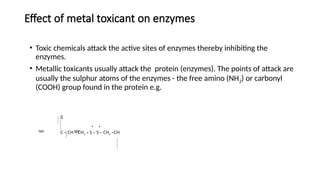
• Toxic chemicals attack the active sites of enzymes thereby inhibiting the
enzymes.
• Metallic toxicants usually attack the protein (enzymes). The points of attack are
usually the sulphur atoms of the enzymes - the free amino (NH2) or carbonyl
(COOH) group found in the protein e.g.
NH NH
0
* *
C – CH – CH2
– S – S – CH2
–CH
4.
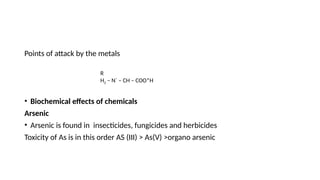
Points of attackby the metals
• Biochemical effects of chemicals
Arsenic
• Arsenic is found in insecticides, fungicides and herbicides
Toxicity of As is in this order AS (III) > As(V) >organo arsenic
R
H2 – N*
– CH – COO*H
5.
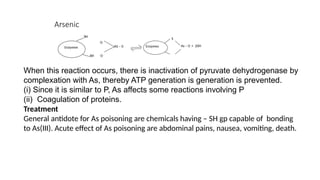
Arsenic
SH
SH
Enzyme AS –0
O
O
Enzymes
SH
SH
Enzymee
S
As – 0-
+ 20H
When this reaction occurs, there is inactivation of pyruvate dehydrogenase by
complexation with As, thereby ATP generation is generation is prevented.
(i) Since it is similar to P, As affects some reactions involving P
(ii) Coagulation of proteins.
Treatment
General antidote for As poisoning are chemicals having – SH gp capable of bonding
to As(III). Acute effect of As poisoning are abdominal pains, nausea, vomiting, death.
6.
Hg
• Toxicity ofHg varies with the chemical form of Hg.
• Alkyl mercury (esp (CH3Hg) > mercury metal >mercury vapor > Hg (II) salts.
• Poisoning reported in Japan (Miniamata disease),45 people died after eating mercury
contaminated fish from miniamata bay.
• Hg - used in the chloro alkali industry for production of electrical apparatus and
fungicide.
• Hg vapor when inhaled enters the brain through the blood stream leading to damage
of the CNS.
7.
• Organomercury -solublein fat ie lipid fraction of membrane & brain
• - retained in cells for a long time, can move through the placenta barrier.
• retention of Hg, inhibits transport of sugars across the membrane, allows K to pass
to the membrane , results in disorders in transmission of nerve impulses.
• Methyl mercury poisoning also lead to segregation of chromosomes.
Treatment – formation of mercury complex with a ligand , allow the metal to be
excreted.
• trapping the metal in GIT
8.
Cadmium
• Cd2+
occurs withZn2+
can replace Zn in biochemical rxn in plants or animals.
• Disease caused- itai –itai, causes softening of bones, body shrinkage and
patients die painful death.
• Major portion of Cd ingested, absorbed in kidneys, excreted.
• Small amount bound to metallothioneins of protein. When large amounts of Cd2+
are ingested, replaces Zn2+
in enzyme causing disorders.
• Causes high blood pressure. Therapy not known.
9.
Lead
• Major sources-combustionof petrol.
• Interferes with synthesis of heamoglobin, inhibits enzymes of heme synthesis and
accumulates intermediates.
• Inhibits delta aminolevunilic acid enzyme so porphobilinogen not formed.
• Poisoning - cumulative.
• It accumulated in the body soft tissues viz kidney, liver and brain, disease -
plumbism,
• Symptoms of acute lead poison- weariness, nausea, abdominal pain, convulsions,
coma and eventually death.
Treatment: addn of a reagent to blood stream, intravenously or under the skin,
treatment with chelating agents which bind Pb2+
e.g. calcium chelate.