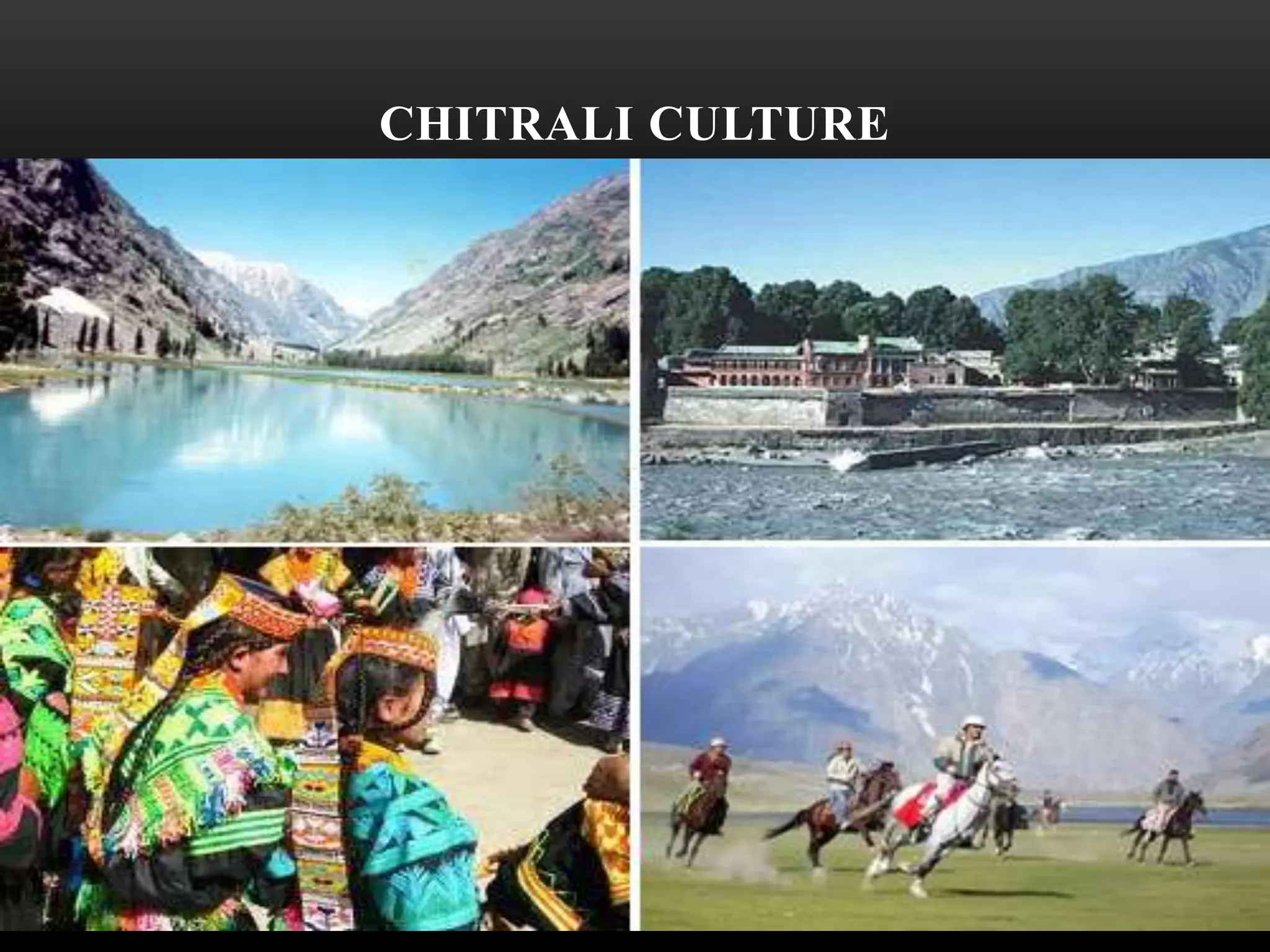
CHITRALI CULTURE
Alamzeb Shahzad
University of Engineering & Technology Peshawar
INTRODUCTION
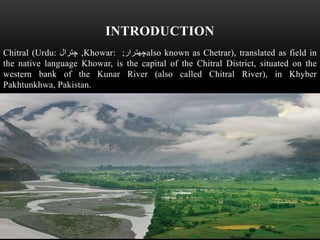
Chitral (Urdu: ‫چترال‬ ,Khowar: ‫چھترار‬; also known as Chetrar), translated as field in
the native language Khowar, is the capital of the Chitral District, situated on the
western bank of the Kunar River (also called Chitral River), in Khyber
Pakhtunkhwa, Pakistan.
HISTORY
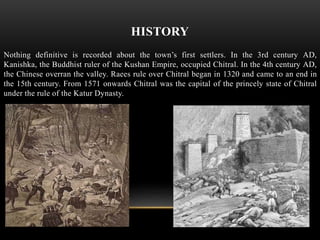
Nothing definitive is recorded about the town’s first settlers. In the 3rd century AD,
Kanishka, the Buddhist ruler of the Kushan Empire, occupied Chitral. In the 4th century AD,
the Chinese overran the valley. Raees rule over Chitral began in 1320 and came to an end in
the 15th century. From 1571 onwards Chitral was the capital of the princely state of Chitral
under the rule of the Katur Dynasty.
LOCATION
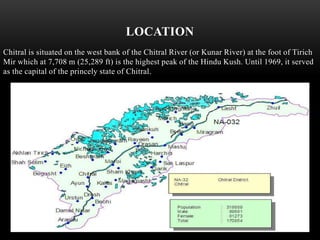
Chitral is situated on the west bank of the Chitral River (or Kunar River) at the foot of Tirich
Mir which at 7,708 m (25,289 ft) is the highest peak of the Hindu Kush. Until 1969, it served
as the capital of the princely state of Chitral.
GEOGRAPHY AND ACCESS
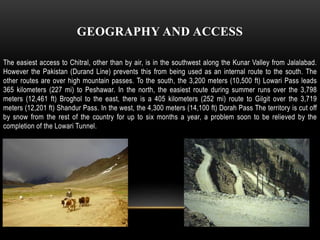
The easiest access to Chitral, other than by air, is in the southwest along the Kunar Valley from Jalalabad.
However the Pakistan (Durand Line) prevents this from being used as an internal route to the south. The
other routes are over high mountain passes. To the south, the 3,200 meters (10,500 ft) Lowari Pass leads
365 kilometers (227 mi) to Peshawar. In the north, the easiest route during summer runs over the 3,798
meters (12,461 ft) Broghol to the east, there is a 405 kilometers (252 mi) route to Gilgit over the 3,719
meters (12,201 ft) Shandur Pass. In the west, the 4,300 meters (14,100 ft) Dorah Pass The territory is cut off
by snow from the rest of the country for up to six months a year, a problem soon to be relieved by the
completion of the Lowari Tunnel.
CLIMATE
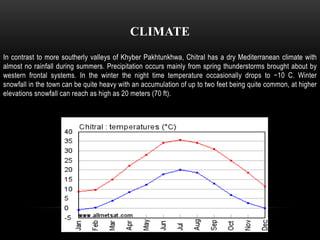
In contrast to more southerly valleys of Khyber Pakhtunkhwa, Chitral has a dry Mediterranean climate with
almost no rainfall during summers. Precipitation occurs mainly from spring thunderstorms brought about by
western frontal systems. In the winter the night time temperature occasionally drops to −10 C. Winter
snowfall in the town can be quite heavy with an accumulation of up to two feet being quite common, at higher
elevations snowfall can reach as high as 20 meters (70 ft).
Languages
The general population mainly speaks the Khowar language and Chitrali language which is
also spoken in parts of Swat. The Norwegian linguist Georg Morgenstierne wrote that Chitral
is the area of the greatest linguistic diversity in the world. Although Khowar is the
predominant language of Chitral, more than ten other languages are spoken here.
Sport
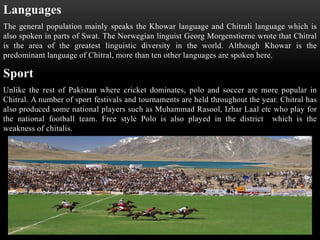
Unlike the rest of Pakistan where cricket dominates, polo and soccer are more popular in
Chitral. A number of sport festivals and tournaments are held throughout the year. Chitral has
also produced some national players such as Muhammad Rasool, Izhar Laal etc who play for
the national football team. Free style Polo is also played in the district which is the
weakness of chitalis.
KAFIR-KALASH TRIBE
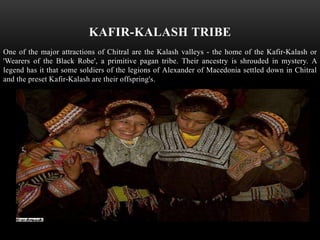
One of the major attractions of Chitral are the Kalash valleys - the home of the Kafir-Kalash or
'Wearers of the Black Robe', a primitive pagan tribe. Their ancestry is shrouded in mystery. A
legend has it that some soldiers of the legions of Alexander of Macedonia settled down in Chitral
and the preset Kafir-Kalash are their offspring's.
MUSIC
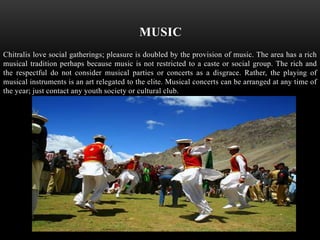
Chitralis love social gatherings; pleasure is doubled by the provision of music. The area has a rich
musical tradition perhaps because music is not restricted to a caste or social group. The rich and
the respectful do not consider musical parties or concerts as a disgrace. Rather, the playing of
musical instruments is an art relegated to the elite. Musical concerts can be arranged at any time of
the year; just contact any youth society or cultural club.
CUISINES
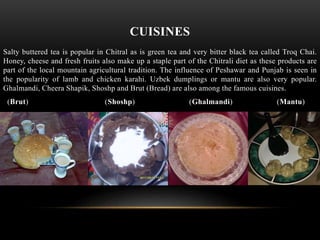
Salty buttered tea is popular in Chitral as is green tea and very bitter black tea called Troq Chai.
Honey, cheese and fresh fruits also make up a staple part of the Chitrali diet as these products are
part of the local mountain agricultural tradition. The influence of Peshawar and Punjab is seen in
the popularity of lamb and chicken karahi. Uzbek dumplings or mantu are also very popular.
Ghalmandi, Cheera Shapik, Shoshp and Brut (Bread) are also among the famous cuisines.
(Brut) (Shoshp) (Ghalmandi) (Mantu)
Thanks For your
Attention
Any Question!

Chitraliculture 150618182455-lva1-app6891

  • 1.
  • 2.
    Alamzeb Shahzad University ofEngineering & Technology Peshawar
  • 3.
    INTRODUCTION Chitral (Urdu: ‫چترال‬,Khowar: ‫چھترار‬; also known as Chetrar), translated as field in the native language Khowar, is the capital of the Chitral District, situated on the western bank of the Kunar River (also called Chitral River), in Khyber Pakhtunkhwa, Pakistan.
  • 4.
    HISTORY Nothing definitive isrecorded about the town’s first settlers. In the 3rd century AD, Kanishka, the Buddhist ruler of the Kushan Empire, occupied Chitral. In the 4th century AD, the Chinese overran the valley. Raees rule over Chitral began in 1320 and came to an end in the 15th century. From 1571 onwards Chitral was the capital of the princely state of Chitral under the rule of the Katur Dynasty.
  • 5.
    LOCATION Chitral is situatedon the west bank of the Chitral River (or Kunar River) at the foot of Tirich Mir which at 7,708 m (25,289 ft) is the highest peak of the Hindu Kush. Until 1969, it served as the capital of the princely state of Chitral.
  • 6.
    GEOGRAPHY AND ACCESS Theeasiest access to Chitral, other than by air, is in the southwest along the Kunar Valley from Jalalabad. However the Pakistan (Durand Line) prevents this from being used as an internal route to the south. The other routes are over high mountain passes. To the south, the 3,200 meters (10,500 ft) Lowari Pass leads 365 kilometers (227 mi) to Peshawar. In the north, the easiest route during summer runs over the 3,798 meters (12,461 ft) Broghol to the east, there is a 405 kilometers (252 mi) route to Gilgit over the 3,719 meters (12,201 ft) Shandur Pass. In the west, the 4,300 meters (14,100 ft) Dorah Pass The territory is cut off by snow from the rest of the country for up to six months a year, a problem soon to be relieved by the completion of the Lowari Tunnel.
  • 7.
    CLIMATE In contrast tomore southerly valleys of Khyber Pakhtunkhwa, Chitral has a dry Mediterranean climate with almost no rainfall during summers. Precipitation occurs mainly from spring thunderstorms brought about by western frontal systems. In the winter the night time temperature occasionally drops to −10 C. Winter snowfall in the town can be quite heavy with an accumulation of up to two feet being quite common, at higher elevations snowfall can reach as high as 20 meters (70 ft).
  • 8.
    Languages The general populationmainly speaks the Khowar language and Chitrali language which is also spoken in parts of Swat. The Norwegian linguist Georg Morgenstierne wrote that Chitral is the area of the greatest linguistic diversity in the world. Although Khowar is the predominant language of Chitral, more than ten other languages are spoken here. Sport Unlike the rest of Pakistan where cricket dominates, polo and soccer are more popular in Chitral. A number of sport festivals and tournaments are held throughout the year. Chitral has also produced some national players such as Muhammad Rasool, Izhar Laal etc who play for the national football team. Free style Polo is also played in the district which is the weakness of chitalis.
  • 9.
    KAFIR-KALASH TRIBE One ofthe major attractions of Chitral are the Kalash valleys - the home of the Kafir-Kalash or 'Wearers of the Black Robe', a primitive pagan tribe. Their ancestry is shrouded in mystery. A legend has it that some soldiers of the legions of Alexander of Macedonia settled down in Chitral and the preset Kafir-Kalash are their offspring's.
  • 10.
    MUSIC Chitralis love socialgatherings; pleasure is doubled by the provision of music. The area has a rich musical tradition perhaps because music is not restricted to a caste or social group. The rich and the respectful do not consider musical parties or concerts as a disgrace. Rather, the playing of musical instruments is an art relegated to the elite. Musical concerts can be arranged at any time of the year; just contact any youth society or cultural club.
  • 11.
    CUISINES Salty buttered teais popular in Chitral as is green tea and very bitter black tea called Troq Chai. Honey, cheese and fresh fruits also make up a staple part of the Chitrali diet as these products are part of the local mountain agricultural tradition. The influence of Peshawar and Punjab is seen in the popularity of lamb and chicken karahi. Uzbek dumplings or mantu are also very popular. Ghalmandi, Cheera Shapik, Shoshp and Brut (Bread) are also among the famous cuisines. (Brut) (Shoshp) (Ghalmandi) (Mantu)
  • 12.