Challenges  behind the development of  Chinese Software Industry Nadeem Jahangir, Kamal Ahmed, Wahab Aamir, Salah  27 August 2009  Institute of Science & Technology Development, Mehran University of Engineering & Technology, Jamshoro-Pakistan.
Contents  General Challenges  Technical Challenges  Role of Government Outcome of Governmental role  Conclusion
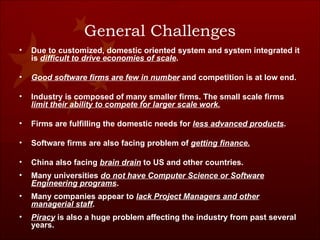
General Challenges Due to customized, domestic oriented system and system integrated it is  difficult to drive economies of scale . Good software firms are few in number  and competition is at low end. Industry is composed of many smaller firms. The small scale firms  limit their ability to compete for larger scale work. Firms are fulfilling the domestic needs for  less advanced products . Software firms are also facing problem of  getting finance. China also facing  brain drain  to US and other countries. Many universities  do not have Computer Science or Software Engineering programs . Many companies appear to  lack Project Managers and other managerial staff .  Piracy  is also a huge problem affecting the industry from past several years.
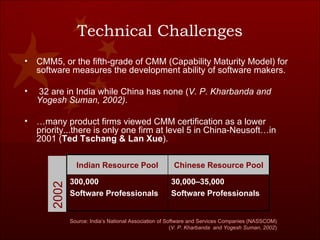
Technical Challenges CMM5, or the fifth-grade of CMM (Capability Maturity Model) for software measures the development ability of software makers. 32 are in India while China has none ( V. P. Kharbanda and Yogesh Suman, 2002) . … many product firms viewed CMM certification as a lower priority...there is only one firm at level 5 in China-Neusoft…in 2001 ( Ted Tschang & Lan Xue ). Source: India’s National Association of Software and Services Companies (NASSCOM)    ( V. P. Kharbanda  and Yogesh Suman, 2002 ) 2002 30,000–35,000 Software Professionals 300,000  Software Professionals Chinese Resource Pool Indian Resource Pool
Role of Government State-controlled role of government evolved from1978-85 Focused on more advanced R&D 1985-91 Market-oriented reforms in 1992. Weak R&D  Poor Technical Skills Inefficiency Focus on defense & heavy Technologies 1978 1992 Market Reforms begin. Role of Govt. reduced. Foreign Investment accelerated. Onward
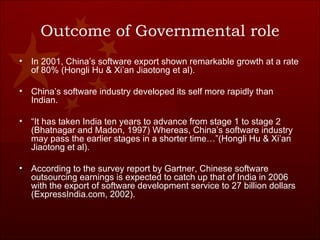
Outcome of Governmental role In 2001, China’s software export shown remarkable growth at a rate of 80% (Hongli Hu & Xi’an Jiaotong et al). China’s software industry developed its self more rapidly than Indian. “ It has taken India ten years to advance from stage 1 to stage 2 (Bhatnagar and Madon, 1997) Whereas, China’s software industry may pass the earlier stages in a shorter time…”(Hongli Hu & Xi’an Jiaotong et al). According to the survey report by Gartner, Chinese software outsourcing earnings is expected to catch up that of India in 2006 with the export of software development service to 27 billion dollars (ExpressIndia.com, 2002).
Conclusion Industry is heavily influenced by government and dominated by small firms.  They are weak in managing complex programming tasks required to invest more in computer related technical training. Competition is at low end due to domestic small level firms which needs to be change by inviting multinational firms (which ongoing according some writers). Domestic level competition limits the ability of the firms to compete at the global level. They need to increase the quality and maturity in software professionals. They need to encourage consistent legal environment to counter piracy. Chinese firms need to give priority to the Credibility Maturity Model levels (CMM5) to encourage standards.
References Chinese initiative in the software industry – Quest to leap,  V. P. Kharbanda and Yogesh Suman,  CURRENT SCIENCE, VOL. 83, NO. 12, 25 DECEMBER 2002. CHINA’S SOFTWARE INDUSTRY – CURRENT STATUS AND DEVELOPMENT STRATEIES, Hongli Hu, and Zhangxi Lin from Jiaotong University & Texas Tech University 2006. The Chinese Software Industry, Ted Tschang & Lan Xue, 2002

Chinese Software Industry

  • 1.
    Challenges behindthe development of Chinese Software Industry Nadeem Jahangir, Kamal Ahmed, Wahab Aamir, Salah 27 August 2009  Institute of Science & Technology Development, Mehran University of Engineering & Technology, Jamshoro-Pakistan.
  • 2.
    Contents GeneralChallenges Technical Challenges Role of Government Outcome of Governmental role Conclusion
  • 3.
    General Challenges Dueto customized, domestic oriented system and system integrated it is difficult to drive economies of scale . Good software firms are few in number and competition is at low end. Industry is composed of many smaller firms. The small scale firms limit their ability to compete for larger scale work. Firms are fulfilling the domestic needs for less advanced products . Software firms are also facing problem of getting finance. China also facing brain drain to US and other countries. Many universities do not have Computer Science or Software Engineering programs . Many companies appear to lack Project Managers and other managerial staff . Piracy is also a huge problem affecting the industry from past several years.
  • 4.
    Technical Challenges CMM5,or the fifth-grade of CMM (Capability Maturity Model) for software measures the development ability of software makers. 32 are in India while China has none ( V. P. Kharbanda and Yogesh Suman, 2002) . … many product firms viewed CMM certification as a lower priority...there is only one firm at level 5 in China-Neusoft…in 2001 ( Ted Tschang & Lan Xue ). Source: India’s National Association of Software and Services Companies (NASSCOM) ( V. P. Kharbanda and Yogesh Suman, 2002 ) 2002 30,000–35,000 Software Professionals 300,000 Software Professionals Chinese Resource Pool Indian Resource Pool
  • 5.
    Role of GovernmentState-controlled role of government evolved from1978-85 Focused on more advanced R&D 1985-91 Market-oriented reforms in 1992. Weak R&D Poor Technical Skills Inefficiency Focus on defense & heavy Technologies 1978 1992 Market Reforms begin. Role of Govt. reduced. Foreign Investment accelerated. Onward
  • 6.
    Outcome of Governmentalrole In 2001, China’s software export shown remarkable growth at a rate of 80% (Hongli Hu & Xi’an Jiaotong et al). China’s software industry developed its self more rapidly than Indian. “ It has taken India ten years to advance from stage 1 to stage 2 (Bhatnagar and Madon, 1997) Whereas, China’s software industry may pass the earlier stages in a shorter time…”(Hongli Hu & Xi’an Jiaotong et al). According to the survey report by Gartner, Chinese software outsourcing earnings is expected to catch up that of India in 2006 with the export of software development service to 27 billion dollars (ExpressIndia.com, 2002).
  • 7.
    Conclusion Industry isheavily influenced by government and dominated by small firms. They are weak in managing complex programming tasks required to invest more in computer related technical training. Competition is at low end due to domestic small level firms which needs to be change by inviting multinational firms (which ongoing according some writers). Domestic level competition limits the ability of the firms to compete at the global level. They need to increase the quality and maturity in software professionals. They need to encourage consistent legal environment to counter piracy. Chinese firms need to give priority to the Credibility Maturity Model levels (CMM5) to encourage standards.
  • 8.
    References Chinese initiativein the software industry – Quest to leap, V. P. Kharbanda and Yogesh Suman, CURRENT SCIENCE, VOL. 83, NO. 12, 25 DECEMBER 2002. CHINA’S SOFTWARE INDUSTRY – CURRENT STATUS AND DEVELOPMENT STRATEIES, Hongli Hu, and Zhangxi Lin from Jiaotong University & Texas Tech University 2006. The Chinese Software Industry, Ted Tschang & Lan Xue, 2002