ver the past 30 years, China has made great
progress in its pursuit of economic growth and
development. These economic achievements,Ocombined with progress in science and technology have also
enabled China to embark on a comprehensive transformation
of its military. The pace and scope of China's military
modernisation has increased over the past decade, enabling
Beijing'srisein theglobal order.
As the 2010 Quadrennial Defense Review Report
published by the Pentagon notes, “China is developing and
fielding large numbers of advanced medium-range ballistic
and cruise missiles, new attack submarines equipped with
advanced weapons, increasingly capable long-range air defense
systems, electronic warfare and computer network attack
capabilities, advanced fighter aircraft, and counter-space
systems.”
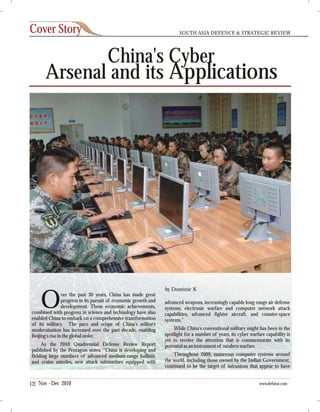
While China's conventional military might has been in the
spotlight for a number of years, its cyber warfare capability is
yet to receive the attention that is commensurate with its
potentialas an instrumentof modern warfare.
Throughout 2009, numerous computer systems around
the world, including those owned by the Indian Government,
continued to be the target of intrusions that appear to have
China's Cyber
Arsenal and its Applications
The next dimension
by Dominic K
Cover Story SOUTH ASIA DEFENCE & STRATEGIC REVIEW
Nov - Dec 201012 www.defstrat.com
originated from the People’s Republic of China (PRC). These
intrusions focused on exfiltrating information, some of which
was of strategic/military utility. The access and skills required
for these intrusions are similar to those necessary to conduct
computer network attacks. It remains unclear if these intrusions
were conducted by, or with the endorsement of, elements within
theChinesegovernment.
However, developing capabilities for cyber warfare is
consistent with authoritative PLA military writings. These
writings highlight the seizure of the electromagnetic spectrum
in the early phases of a campaign as amongst the foremost tasks
to ensure battlefield success. PLA theorists have coined the
term “integrated network electronic warfare” or wangdian
yitizhan to describe the use of electronic warfare, computer
network operations, and kinetic strikes to disrupt battlefield
information systems that support an adversary's war fighting
capabilities. PLA writings on future models of joint operations
identify “integrated network electronic warfare” as one of the
basic forms of “integrated joint operations,” suggesting the
centrality of seizing and dominating the electromagnetic
spectrumin PLAcampaign theory.
Cyber warfare fits with China's established patterns of
asymmetrical engagement and technology exploitation. In
order to grasp why Beijing would pursue cyber warfare as a
means of leapfrogging, it is essential to acknowledge the skills
and methods behind hacking. Hackers utilize a wide range of
tools that coupled with highly sophisticated computer
manipulation techniques, the scope of which is beyond this
article;howeversomebasicunderstandingisnecessary.
What makes hacking a potent tool in the art of warfare is
the ability of an attack that requires little funding, is difficult to
detect and defend against, to cause massive damage. Unleashed
over the maze of wires and cables that wrap the globe, it
provides a high level of deniability and eliminates the problem
of geographical distance.
Information Operations
Information Operations or IOs seek to put out a political
message in coordination with any traditional military assault. It
places an emphasis on finding and clandestinely promoting,
favourable media from third parties, so as to appear more
credible. IOs also seek to establish a legal framework to defend
against cyber attacks and cyber reconnaissance, as well as
establish rules of engagement for conducting cyber attack. For
example, how much certainty is required in identifying the
source of an attack before responding? If an attack is being
routed through multiple computers, is it acceptable to attack the
intermediary computer? This would halt the attack but it would
harm or destroy a computer, which may have been infected
without the owner's knowledge or consent. Additionally, an
intangible computer attack can result in significant tangible loss,
but does this warrant the use of traditional military weapons as a
response?
Identifying a Hacker
The primary means to identify computers used in cyber
warfare is the Internet Protocol (IP) address. An IP address is a
numerical identification that a network management service
assigns to devices that are a part of any computer network
utilizing the Internet Protocol. In essence, each computer has its
own unique IP address similar to the postal address of a house.
The Internet Corporation for Assigned Names and Numbers
(ICANN) is responsible for global IP address allocation.
ICANN, a non-profit organisation operating in the US, is under
contract with US Department of Commerce and was previously
withUSDepartmentof Defense.
Despite this identification tool, hackers can mask their
identitybyusingproxyservers.
Information is routed through multiple computers, only
showing each computer's identity to the next in line. For
example, a Chinese hacker could route his or her activity through
a computer in Brazil, which routes its activity through Russia.
The computer in Russia could be used to attack a computer in
theUS,and theUSwould seeitasan attackfromRussia.
Though it is theoretically possible to trace the routing of a
cyber attack, practically the amount of effort spent on moving
upthechain isprohibitiveand attimesinconclusive.
So if in the above case, investigators do reach the Chinese
link, they are still unsure whether China was the originator or
simply another link in the chain. Proxy servers can be rented or
obtained through compromised systems. Additionally, free
software such as the onion router, encryption, tunneling
protocol, and wireless access points exponentially increase the
numberof possiblelinks.
Cyber Reconnaissance
A common method used in cyber reconnaissance and attack
is the security exploit. A security exploit is a prepared application
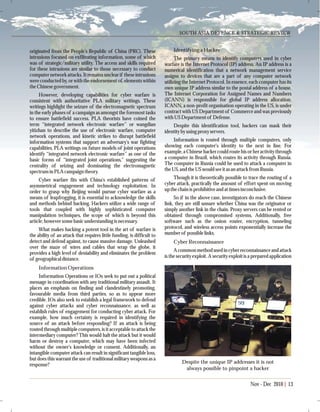
Despite the unique IP addresses it is not
always possible to pinpoint a hacker
SOUTH ASIA DEFENCE & STRATEGIC REVIEW
13Nov - Dec 2010
that takes advantage of a known weakness. It is a piece of
software, data, or commands that utilize a bug, glitch, or
vulnerability in the software of an electronic device to cause an
unintended or unanticipated behaviour. This can allow the
attacker to take control of the computer, permitting its use for
other tactics, such as Distributed Denial of Service (DDoS). An
exploit is used to gain low-level entrance to a computer.
However low-level exploits do not permit substantial control
over an electronic device. Therefore after gaining low-level
access to a system the hacker searches for further exploits to
attain high-level access. This tactic is known as privilege
escalation. Once security experts have identified exploit
vulnerability, a patch will be issued. For this reason hackers try to
keep known exploits secret. These are known as zero day
exploits and hackers may catalogue large numbers of them for
their own use or to be sold on the black market. In 2006, Taiwan
was hit with “13 PLA zero-day attacks”, for which it took
Microsoft178daystodevelop patches.
Trojan Horses
Attackers may also compromise a computer or network by
using a Trojan horse, often known simply as a Trojan. A Trojan
appears to perform a desirable function, while secretly
performing malicious activities. Trojans can be used to gain
remote access, destroy data, download data, serve as a proxy,
falsify records or shut down the target computer at will. The
Pentagon, defence-related think tanks, and defence-related
contractors were the target of a combined spoofing and Trojan
attack in 2008. Trojans were hidden in email attachments
designed to look as if they were sent from a reliable source. The
Trojan was designed to bury itself into the system, covertly
gather data, and send it to an internet address in China. Due to
the ability of hackers to route their activity through foreign
computers, security experts were unable to determine if China
wasthefinal destinationorif itwasan attemptatframingChina.
This was not the first time US research facilities received
spoofed emails with Trojans purportedly from China. In 2005
the Oak Ridge National Laboratory and Los Alamos National
Laboratory became infected. No classified information was
believed to have been obtained; however personal information
of visitors from the years 1990 to 2004 was compromised. This
included names, date of birth, and social security numbers.
These two research facilities were originally constructed for
sensitive nuclear weapons research during WWII. However they
are still used for governmental research in areas that include
national security, nanotechnology, advanced materials, and
energy.
Denial of Service Attacks
A Denial-of-Service (DoS) attack or distributed Denial-of-
Service (DDoS) attack is an attempt to make a computer
resource unavailable to its intended users. This is accomplished
by flooding the target with data requests, so that it cannot
respond to legitimate traffic, or so that it responds so slowly that
it is rendered useless. DDoS attacks may be conducted by a
collective of individuals, often co-coordinating their efforts, or
by a network of computers under the control of a single
attacker. Such networks are called botnets, with each computer
in the botnet being known as a bot, or a zombie. These
computers have been taken control of by malicious users
without the knowledge of the owner, usually through a rootkit,
Trojan, or virus. Sobig and Mydoom are examples of worms,
which createzombies.
A botnet's originator, known as a bot herder, can control the
group remotely, usually for nefarious purposes. Infected zombie
computers are used to send email spam, to host contraband data
such as child pornography, or to engage in distributed denial-of-
service attacks as a form of extortion. The services of a bot
herder can be rented on the black market. One estimate in 2007
suggested that Chinese hackers have 750,000 zombie computers
in the US alone. DoS attacks can also lead to problems in the
network branches around the actual computer being attacked.
Consequently the bandwidth of a router that caters to the target
servershall also beseverelyhampered.
In general, cyber reconnaissance may be an attempt to attain
victory conditions before battle. This is exactly what the Chinese
have been attempting across the globe for a number of years.
These intrusions, if undetected, allow hackers to identify
vulnerabilities for future cyber attacks. The cost of probing
computer networks can be extremely low, given the low
manpowerand infrastructurerequirements.
The examples above only serve as an introduction to the
level of sophistication with which computers can be
compromised and the difficulty in establishing effective defence
mechanisms. They also demonstrate the high level of damage
that can be caused by a small group of individuals who either
workingon theirownorasproxiesformorelegitimateentities.
Cyber attacks against the United States
In 2006, Chinese hackers allegedly infiltrated the
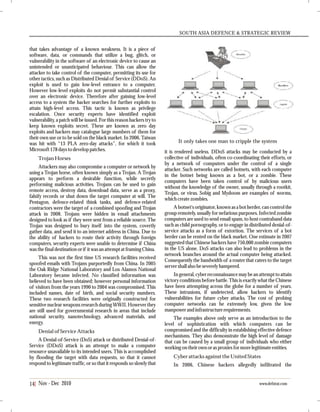
It only takes one man to cripple the system
SOUTH ASIA DEFENCE & STRATEGIC REVIEW
Nov - Dec 201014 www.defstrat.com
Department of Commerce's Bureau of Industry and
Security, which manages export licensing of military-
use products and information, using rootkits to allow
privilege escalation. Once the rootkits were detected
the agency had to spend millions of dollars on new,
clean, hardware and software, because they could not
restoretheintegrityof thecompromisednetwork.
The Code Red and Code Red II worms were one
of the most successful worms in internet history,
causing nearly $2 billion in damages and infecting over
6,00,000 computers. The worms, which may have
originated from a university in Guangdong, China,
attacked computers running Microsoft's IIS web server
and exploited a buffer overflow. The worms created
slow downs in internet speed, knocked websites and
networks offline, and defaced websites with the phrase
“Hacked by Chinese!” - although Chinese involvement
was never confirmed. Home computers were largely
unaffected. However any attempt at removing the
infectioncausedthemtocrash.
The attacks may have been states sponsored, they may have
been underground hackers and script kiddies, or they may have
been a combination of the two. A script kiddie is not an expert in
computer security. They use pre-packaged automated tools
written by others and found online, such as WinNuke
applications, Back Orifice, NetBus, Sub7, Metasploit, and
ProRat. Even though script kiddies lack sophistication and they
are looked down upon by the hacker culture, they still pose a
significant security risk. When media attention is drawn to
internet incidents, it is often followed by individuals seeking to
participate without any coordinated effort or instructions to do
so. Code Red II had a slightly different payload that could open a
backdoor, leaving the computers vulnerable to further
exploitation.
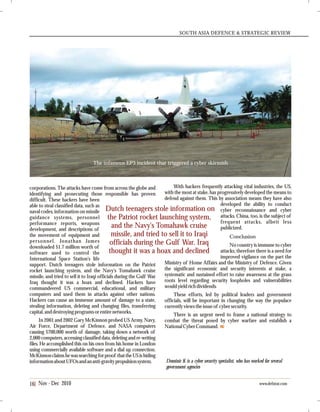
The wave of Code Red infections coincided with the
collision of a US reconnaissance plane and a Chinese fighter jet,
in which the Chinese pilot died, and known as the Hainan or EP-
3 incident. Patriotic Chinese hackers defaced dozens of US
military and computer industry websites. Patriotic US hackers
responded with inflammatory web
page defacements, comment
spamming, posting of photo shopped
derogatory pictures, and probably
were the source of the Code Blue
Worm.
The Code Blue worm sought out
systems infected by Code Red worm
and reprogrammed them to launch
attacks against targets based in Mainland China. In particular, it
launched DDoS attacks against the Chinese security firm NS
Focus. These type of attacks could be used clandestinely against
one's own country to spur nationalism or cyber attacks could be
used by a third party state, or organization, to create conflict
between external states to further some masked goal. For
example, Iran could benefit by creating tension between the US
and China through an attack prior to a US proposed UN
resolution,in which China has vetopower.
In 2004, the Myfip worm probably originated from IP
addresses in the Chinese municipality of Tianjin. This worm
stole pdf files, with later variants targeting Microsoft Word
documents, schematics, and circuit board layouts. Among the
victims were Bank of America, BJ's Wholesale Club, and Lexis-
Nexis. The worm not only stole intellectual property, such as
product designs, but also took customer lists and databases.
Identifying the number of companies affectedposes difficulties,
as they do not wish to further damage their reputations by
coming forward. For most companies acknowledging a security
breach can damage consumer confidence and require the
implementationof costlysecuritymeasures.
Military Applications of Hacking
Compared to India, the United State's paramount position
and its heavy reliance on computers
have made it a prime target. For this
reason it has some of the most extensive
information on cyber attacks. The
United States has had millions of
computers infected, the monetary value
of the losses caused by such infections
runs into billions of dollars. Hackers
may be lone teenagers or state-
sponsoredintelligenceoperatives.
Frequently hit targets include the US Department of
Defense, the Pentagon, NASA, Los Alamos Laboratories,
leading American defence companies, think tanks, defence
contractors, military installations, and high profile commercial
SOUTH ASIA DEFENCE & STRATEGIC REVIEW
15Nov - Dec 2010
The Code Red and Code Red II
worms were one of the most
successful worms in internet
history, causing nearly $2 billion
in damages and infecting over
6,00,000 computers
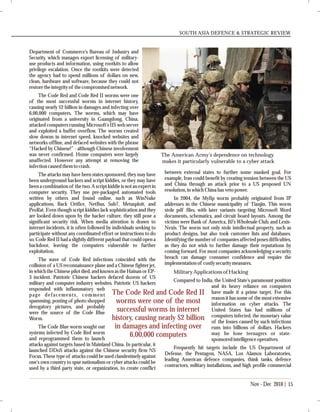
The American Army’s dependence on technology
makes it particularly vulnerable to a cyber attack
SOUTH ASIA DEFENCE & STRATEGIC REVIEW
Nov - Dec 201016 www.defstrat.com
corporations. The attacks have come from across the globe and
identifying and prosecuting those responsible has proven
difficult. These hackers have been
able to steal classified data, such as
naval codes, information on missile
guidance systems, personnel
performance reports, weapons
development, and descriptions of
the movement of equipment and
personnel. Jonathan James
downloaded $1.7 million worth of
software used to control the
International Space Station's life
support. Dutch teenagers stole information on the Patriot
rocket launching system, and the Navy's Tomahawk cruise
missile, and tried to sell it to Iraqi officials during the Gulf War
Iraq thought it was a hoax and declined. Hackers have
commandeered US commercial, educational, and military
computers and used them in attacks against other nations.
Hackers can cause an immense amount of damage to a state,
stealing information, deleting and changing files, transferring
capital,and destroyingprogramsorentirenetworks.
In 2001 and 2002 Gary McKinnon probed US Army, Navy,
Air Force, Department of Defence, and NASA computers
causing $700,000 worth of damage, taking down a network of
2,000 computers, accessing classified data, deleting and re-writing
files. He accomplished this on his own from his home in London
using commercially available software and a dial up connection.
McKinnonclaimshewassearchingforproof thattheUSishiding
informationaboutUFOsandananti-gravitypropulsionsystem.
With hackers frequently attacking vital industries, the US,
with the most at stake, has progressively developed the means to
defend against them. This by association means they have also
developed the ability to conduct
cyber reconnaissance and cyber
attacks. China, too, is the subject of
frequent attacks, albeit less
publicized.
Conclusion
No country is immune to cyber
attacks; therefore there is a need for
improved vigilance on the part the
Ministry of Home Affairs and the Ministry of Defence. Given
the significant economic and security interests at stake, a
systematic and sustained effort to raise awareness at the grass
roots level regarding security loopholes and vulnerabilities
would yieldrich dividends.
These efforts, led by political leaders and government
officials, will be important in changing the way the populace
currentlyviewstheissueof cybersecurity.
There is an urgent need to frame a national strategy to
combat the threat posed by cyber warfare and establish a
National CyberCommand.
The infamous EP3 incident that triggered a cyber skirmish
Dominic K is a cyber security specialist, who has worked for several
government agencies
Dutch teenagers stole information on
the Patriot rocket launching system,
and the Navy's Tomahawk cruise
missile, and tried to sell it to Iraqi
officials during the Gulf War. Iraq
thought it was a hoax and declined
SA

China Cyber

  • 1.
    ver the past30 years, China has made great progress in its pursuit of economic growth and development. These economic achievements,Ocombined with progress in science and technology have also enabled China to embark on a comprehensive transformation of its military. The pace and scope of China's military modernisation has increased over the past decade, enabling Beijing'srisein theglobal order. As the 2010 Quadrennial Defense Review Report published by the Pentagon notes, “China is developing and fielding large numbers of advanced medium-range ballistic and cruise missiles, new attack submarines equipped with advanced weapons, increasingly capable long-range air defense systems, electronic warfare and computer network attack capabilities, advanced fighter aircraft, and counter-space systems.” While China's conventional military might has been in the spotlight for a number of years, its cyber warfare capability is yet to receive the attention that is commensurate with its potentialas an instrumentof modern warfare. Throughout 2009, numerous computer systems around the world, including those owned by the Indian Government, continued to be the target of intrusions that appear to have China's Cyber Arsenal and its Applications The next dimension by Dominic K Cover Story SOUTH ASIA DEFENCE & STRATEGIC REVIEW Nov - Dec 201012 www.defstrat.com
  • 2.
    originated from thePeople’s Republic of China (PRC). These intrusions focused on exfiltrating information, some of which was of strategic/military utility. The access and skills required for these intrusions are similar to those necessary to conduct computer network attacks. It remains unclear if these intrusions were conducted by, or with the endorsement of, elements within theChinesegovernment. However, developing capabilities for cyber warfare is consistent with authoritative PLA military writings. These writings highlight the seizure of the electromagnetic spectrum in the early phases of a campaign as amongst the foremost tasks to ensure battlefield success. PLA theorists have coined the term “integrated network electronic warfare” or wangdian yitizhan to describe the use of electronic warfare, computer network operations, and kinetic strikes to disrupt battlefield information systems that support an adversary's war fighting capabilities. PLA writings on future models of joint operations identify “integrated network electronic warfare” as one of the basic forms of “integrated joint operations,” suggesting the centrality of seizing and dominating the electromagnetic spectrumin PLAcampaign theory. Cyber warfare fits with China's established patterns of asymmetrical engagement and technology exploitation. In order to grasp why Beijing would pursue cyber warfare as a means of leapfrogging, it is essential to acknowledge the skills and methods behind hacking. Hackers utilize a wide range of tools that coupled with highly sophisticated computer manipulation techniques, the scope of which is beyond this article;howeversomebasicunderstandingisnecessary. What makes hacking a potent tool in the art of warfare is the ability of an attack that requires little funding, is difficult to detect and defend against, to cause massive damage. Unleashed over the maze of wires and cables that wrap the globe, it provides a high level of deniability and eliminates the problem of geographical distance. Information Operations Information Operations or IOs seek to put out a political message in coordination with any traditional military assault. It places an emphasis on finding and clandestinely promoting, favourable media from third parties, so as to appear more credible. IOs also seek to establish a legal framework to defend against cyber attacks and cyber reconnaissance, as well as establish rules of engagement for conducting cyber attack. For example, how much certainty is required in identifying the source of an attack before responding? If an attack is being routed through multiple computers, is it acceptable to attack the intermediary computer? This would halt the attack but it would harm or destroy a computer, which may have been infected without the owner's knowledge or consent. Additionally, an intangible computer attack can result in significant tangible loss, but does this warrant the use of traditional military weapons as a response? Identifying a Hacker The primary means to identify computers used in cyber warfare is the Internet Protocol (IP) address. An IP address is a numerical identification that a network management service assigns to devices that are a part of any computer network utilizing the Internet Protocol. In essence, each computer has its own unique IP address similar to the postal address of a house. The Internet Corporation for Assigned Names and Numbers (ICANN) is responsible for global IP address allocation. ICANN, a non-profit organisation operating in the US, is under contract with US Department of Commerce and was previously withUSDepartmentof Defense. Despite this identification tool, hackers can mask their identitybyusingproxyservers. Information is routed through multiple computers, only showing each computer's identity to the next in line. For example, a Chinese hacker could route his or her activity through a computer in Brazil, which routes its activity through Russia. The computer in Russia could be used to attack a computer in theUS,and theUSwould seeitasan attackfromRussia. Though it is theoretically possible to trace the routing of a cyber attack, practically the amount of effort spent on moving upthechain isprohibitiveand attimesinconclusive. So if in the above case, investigators do reach the Chinese link, they are still unsure whether China was the originator or simply another link in the chain. Proxy servers can be rented or obtained through compromised systems. Additionally, free software such as the onion router, encryption, tunneling protocol, and wireless access points exponentially increase the numberof possiblelinks. Cyber Reconnaissance A common method used in cyber reconnaissance and attack is the security exploit. A security exploit is a prepared application Despite the unique IP addresses it is not always possible to pinpoint a hacker SOUTH ASIA DEFENCE & STRATEGIC REVIEW 13Nov - Dec 2010
  • 3.
    that takes advantageof a known weakness. It is a piece of software, data, or commands that utilize a bug, glitch, or vulnerability in the software of an electronic device to cause an unintended or unanticipated behaviour. This can allow the attacker to take control of the computer, permitting its use for other tactics, such as Distributed Denial of Service (DDoS). An exploit is used to gain low-level entrance to a computer. However low-level exploits do not permit substantial control over an electronic device. Therefore after gaining low-level access to a system the hacker searches for further exploits to attain high-level access. This tactic is known as privilege escalation. Once security experts have identified exploit vulnerability, a patch will be issued. For this reason hackers try to keep known exploits secret. These are known as zero day exploits and hackers may catalogue large numbers of them for their own use or to be sold on the black market. In 2006, Taiwan was hit with “13 PLA zero-day attacks”, for which it took Microsoft178daystodevelop patches. Trojan Horses Attackers may also compromise a computer or network by using a Trojan horse, often known simply as a Trojan. A Trojan appears to perform a desirable function, while secretly performing malicious activities. Trojans can be used to gain remote access, destroy data, download data, serve as a proxy, falsify records or shut down the target computer at will. The Pentagon, defence-related think tanks, and defence-related contractors were the target of a combined spoofing and Trojan attack in 2008. Trojans were hidden in email attachments designed to look as if they were sent from a reliable source. The Trojan was designed to bury itself into the system, covertly gather data, and send it to an internet address in China. Due to the ability of hackers to route their activity through foreign computers, security experts were unable to determine if China wasthefinal destinationorif itwasan attemptatframingChina. This was not the first time US research facilities received spoofed emails with Trojans purportedly from China. In 2005 the Oak Ridge National Laboratory and Los Alamos National Laboratory became infected. No classified information was believed to have been obtained; however personal information of visitors from the years 1990 to 2004 was compromised. This included names, date of birth, and social security numbers. These two research facilities were originally constructed for sensitive nuclear weapons research during WWII. However they are still used for governmental research in areas that include national security, nanotechnology, advanced materials, and energy. Denial of Service Attacks A Denial-of-Service (DoS) attack or distributed Denial-of- Service (DDoS) attack is an attempt to make a computer resource unavailable to its intended users. This is accomplished by flooding the target with data requests, so that it cannot respond to legitimate traffic, or so that it responds so slowly that it is rendered useless. DDoS attacks may be conducted by a collective of individuals, often co-coordinating their efforts, or by a network of computers under the control of a single attacker. Such networks are called botnets, with each computer in the botnet being known as a bot, or a zombie. These computers have been taken control of by malicious users without the knowledge of the owner, usually through a rootkit, Trojan, or virus. Sobig and Mydoom are examples of worms, which createzombies. A botnet's originator, known as a bot herder, can control the group remotely, usually for nefarious purposes. Infected zombie computers are used to send email spam, to host contraband data such as child pornography, or to engage in distributed denial-of- service attacks as a form of extortion. The services of a bot herder can be rented on the black market. One estimate in 2007 suggested that Chinese hackers have 750,000 zombie computers in the US alone. DoS attacks can also lead to problems in the network branches around the actual computer being attacked. Consequently the bandwidth of a router that caters to the target servershall also beseverelyhampered. In general, cyber reconnaissance may be an attempt to attain victory conditions before battle. This is exactly what the Chinese have been attempting across the globe for a number of years. These intrusions, if undetected, allow hackers to identify vulnerabilities for future cyber attacks. The cost of probing computer networks can be extremely low, given the low manpowerand infrastructurerequirements. The examples above only serve as an introduction to the level of sophistication with which computers can be compromised and the difficulty in establishing effective defence mechanisms. They also demonstrate the high level of damage that can be caused by a small group of individuals who either workingon theirownorasproxiesformorelegitimateentities. Cyber attacks against the United States In 2006, Chinese hackers allegedly infiltrated the It only takes one man to cripple the system SOUTH ASIA DEFENCE & STRATEGIC REVIEW Nov - Dec 201014 www.defstrat.com
  • 4.
    Department of Commerce'sBureau of Industry and Security, which manages export licensing of military- use products and information, using rootkits to allow privilege escalation. Once the rootkits were detected the agency had to spend millions of dollars on new, clean, hardware and software, because they could not restoretheintegrityof thecompromisednetwork. The Code Red and Code Red II worms were one of the most successful worms in internet history, causing nearly $2 billion in damages and infecting over 6,00,000 computers. The worms, which may have originated from a university in Guangdong, China, attacked computers running Microsoft's IIS web server and exploited a buffer overflow. The worms created slow downs in internet speed, knocked websites and networks offline, and defaced websites with the phrase “Hacked by Chinese!” - although Chinese involvement was never confirmed. Home computers were largely unaffected. However any attempt at removing the infectioncausedthemtocrash. The attacks may have been states sponsored, they may have been underground hackers and script kiddies, or they may have been a combination of the two. A script kiddie is not an expert in computer security. They use pre-packaged automated tools written by others and found online, such as WinNuke applications, Back Orifice, NetBus, Sub7, Metasploit, and ProRat. Even though script kiddies lack sophistication and they are looked down upon by the hacker culture, they still pose a significant security risk. When media attention is drawn to internet incidents, it is often followed by individuals seeking to participate without any coordinated effort or instructions to do so. Code Red II had a slightly different payload that could open a backdoor, leaving the computers vulnerable to further exploitation. The wave of Code Red infections coincided with the collision of a US reconnaissance plane and a Chinese fighter jet, in which the Chinese pilot died, and known as the Hainan or EP- 3 incident. Patriotic Chinese hackers defaced dozens of US military and computer industry websites. Patriotic US hackers responded with inflammatory web page defacements, comment spamming, posting of photo shopped derogatory pictures, and probably were the source of the Code Blue Worm. The Code Blue worm sought out systems infected by Code Red worm and reprogrammed them to launch attacks against targets based in Mainland China. In particular, it launched DDoS attacks against the Chinese security firm NS Focus. These type of attacks could be used clandestinely against one's own country to spur nationalism or cyber attacks could be used by a third party state, or organization, to create conflict between external states to further some masked goal. For example, Iran could benefit by creating tension between the US and China through an attack prior to a US proposed UN resolution,in which China has vetopower. In 2004, the Myfip worm probably originated from IP addresses in the Chinese municipality of Tianjin. This worm stole pdf files, with later variants targeting Microsoft Word documents, schematics, and circuit board layouts. Among the victims were Bank of America, BJ's Wholesale Club, and Lexis- Nexis. The worm not only stole intellectual property, such as product designs, but also took customer lists and databases. Identifying the number of companies affectedposes difficulties, as they do not wish to further damage their reputations by coming forward. For most companies acknowledging a security breach can damage consumer confidence and require the implementationof costlysecuritymeasures. Military Applications of Hacking Compared to India, the United State's paramount position and its heavy reliance on computers have made it a prime target. For this reason it has some of the most extensive information on cyber attacks. The United States has had millions of computers infected, the monetary value of the losses caused by such infections runs into billions of dollars. Hackers may be lone teenagers or state- sponsoredintelligenceoperatives. Frequently hit targets include the US Department of Defense, the Pentagon, NASA, Los Alamos Laboratories, leading American defence companies, think tanks, defence contractors, military installations, and high profile commercial SOUTH ASIA DEFENCE & STRATEGIC REVIEW 15Nov - Dec 2010 The Code Red and Code Red II worms were one of the most successful worms in internet history, causing nearly $2 billion in damages and infecting over 6,00,000 computers The American Army’s dependence on technology makes it particularly vulnerable to a cyber attack
  • 5.
    SOUTH ASIA DEFENCE& STRATEGIC REVIEW Nov - Dec 201016 www.defstrat.com corporations. The attacks have come from across the globe and identifying and prosecuting those responsible has proven difficult. These hackers have been able to steal classified data, such as naval codes, information on missile guidance systems, personnel performance reports, weapons development, and descriptions of the movement of equipment and personnel. Jonathan James downloaded $1.7 million worth of software used to control the International Space Station's life support. Dutch teenagers stole information on the Patriot rocket launching system, and the Navy's Tomahawk cruise missile, and tried to sell it to Iraqi officials during the Gulf War Iraq thought it was a hoax and declined. Hackers have commandeered US commercial, educational, and military computers and used them in attacks against other nations. Hackers can cause an immense amount of damage to a state, stealing information, deleting and changing files, transferring capital,and destroyingprogramsorentirenetworks. In 2001 and 2002 Gary McKinnon probed US Army, Navy, Air Force, Department of Defence, and NASA computers causing $700,000 worth of damage, taking down a network of 2,000 computers, accessing classified data, deleting and re-writing files. He accomplished this on his own from his home in London using commercially available software and a dial up connection. McKinnonclaimshewassearchingforproof thattheUSishiding informationaboutUFOsandananti-gravitypropulsionsystem. With hackers frequently attacking vital industries, the US, with the most at stake, has progressively developed the means to defend against them. This by association means they have also developed the ability to conduct cyber reconnaissance and cyber attacks. China, too, is the subject of frequent attacks, albeit less publicized. Conclusion No country is immune to cyber attacks; therefore there is a need for improved vigilance on the part the Ministry of Home Affairs and the Ministry of Defence. Given the significant economic and security interests at stake, a systematic and sustained effort to raise awareness at the grass roots level regarding security loopholes and vulnerabilities would yieldrich dividends. These efforts, led by political leaders and government officials, will be important in changing the way the populace currentlyviewstheissueof cybersecurity. There is an urgent need to frame a national strategy to combat the threat posed by cyber warfare and establish a National CyberCommand. The infamous EP3 incident that triggered a cyber skirmish Dominic K is a cyber security specialist, who has worked for several government agencies Dutch teenagers stole information on the Patriot rocket launching system, and the Navy's Tomahawk cruise missile, and tried to sell it to Iraqi officials during the Gulf War. Iraq thought it was a hoax and declined SA