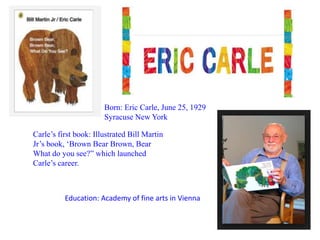
Born: Eric Carle, June 25, 1929 
Syracuse New York 
Carle’s first book: Illustrated Bill Martin 
Jr’s book, ‘Brown Bear Brown, Bear 
What do you see?” which launched 
Carle’s career. 
Education: Academy of fine arts in Vienna
The style of writing Eric Carle uses 
covers the domains of numeracy, 
literacy, repetitive language, coinciding 
with children’s experiences in their 
every day lives. 
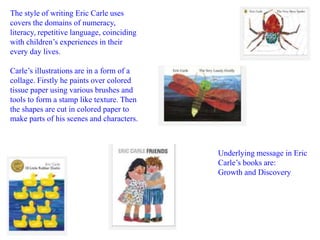
Carle’s illustrations are in a form of a 
collage. Firstly he paints over colored 
tissue paper using various brushes and 
tools to form a stamp like texture. Then 
the shapes are cut in colored paper to 
make parts of his scenes and characters. 
Underlying message in Eric 
Carle’s books are: 
Growth and Discovery
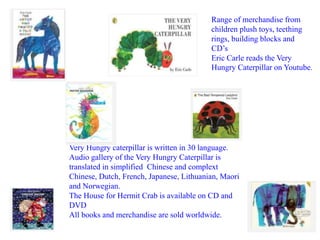
Range of merchandise from 
children plush toys, teething 
rings, building blocks and 
CD’s 
Eric Carle reads the Very 
Hungry Caterpillar on Youtube. 
Very Hungry caterpillar is written in 30 language. 
Audio gallery of the Very Hungry Caterpillar is 
translated in simplified Chinese and complext 
Chinese, Dutch, French, Japanese, Lithuanian, Maori 
and Norwegian. 
The House for Hermit Crab is available on CD and 
DVD 
All books and merchandise are sold worldwide.
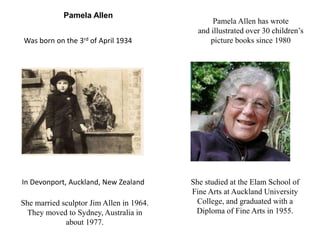
Pamela Allen 
Was born on the 3rd of April 1934 
In Devonport, Auckland, New Zealand 
Pamela Allen has wrote 
and illustrated over 30 children’s 
picture books since 1980 
She studied at the Elam School of 
Fine Arts at Auckland University 
College, and graduated with a 
Diploma of Fine Arts in 1955. 
She married sculptor Jim Allen in 1964. 
They moved to Sydney, Australia in 
about 1977.
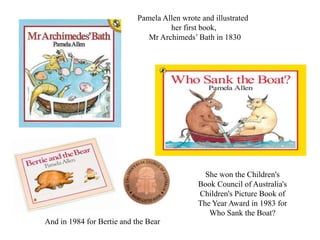
Pamela Allen wrote and illustrated 
her first book, 
Mr Archimeds’ Bath in 1830 
She won the Children's 
Book Council of Australia's 
Children's Picture Book of 
The Year Award in 1983 for 
Who Sank the Boat? 
And in 1984 for Bertie and the Bear
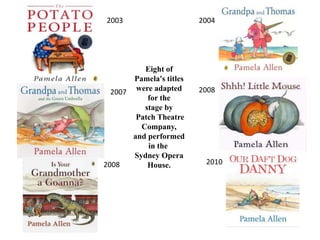
2003 2004 
Eight of 
Pamela's titles 
were adapted 
2007 2008 
for the 
stage by 
Patch Theatre 
Company, 
and performed 
in the 
Sydney Opera 
2008 2010 
House.
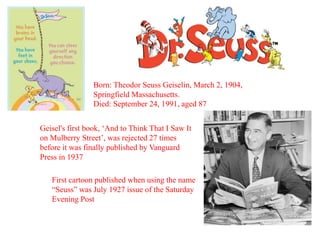
Born: Theodor Seuss Geiselin, March 2, 1904, 
Springfield Massachusetts. 
Died: September 24, 1991, aged 87 
Geisel's first book, ‘And to Think That I Saw It 
on Mulberry Street’, was rejected 27 times 
before it was finally published by Vanguard 
Press in 1937 
First cartoon published when using the name 
“Seuss” was July 1927 issue of the Saturday 
Evening Post
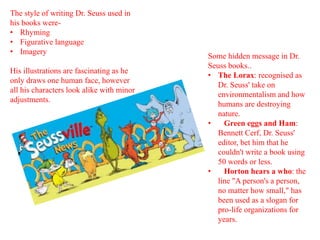
The style of writing Dr. Seuss used in 
his books were- 
• Rhyming 
• Figurative language 
• Imagery 
His illustrations are fascinating as he 
only draws one human face, however 
all his characters look alike with minor 
adjustments. 
Some hidden message in Dr. 
Seuss books.. 
• The Lorax: recognised as 
Dr. Seuss' take on 
environmentalism and how 
humans are destroying 
nature. 
• Green eggs and Ham: 
Bennett Cerf, Dr. Seuss' 
editor, bet him that he 
couldn't write a book using 
50 words or less. 
• Horton hears a who: the 
line "A person's a person, 
no matter how small," has 
been used as a slogan for 
pro-life organizations for 
years.
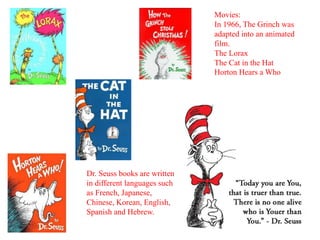
Movies: 
In 1966, The Grinch was 
adapted into an animated 
film. 
The Lorax 
The Cat in the Hat 
Horton Hears a Who 
Dr. Seuss books are written 
in different languages such 
as French, Japanese, 
Chinese, Korean, English, 
Spanish and Hebrew.
Maurice Sendak 
Born : Maurice Bernard Sendak, June 10, 1928 
Brooklyn, New York, USA 
Died: May 8, 2012, aged 83 
Danbury, Connecticut USA 
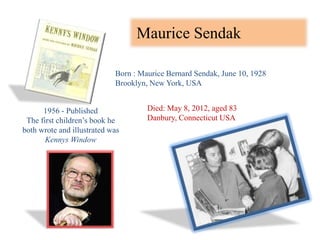
1956 - Published 
The first children’s book he 
both wrote and illustrated was 
Kennys Window
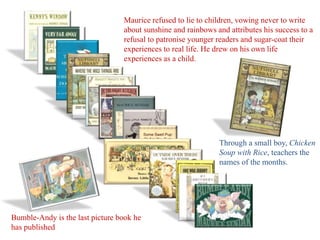
Maurice refused to lie to children, vowing never to write 
about sunshine and rainbows and attributes his success to a 
refusal to patronise younger readers and sugar-coat their 
experiences to real life. He drew on his own life 
experiences as a child. 
Through a small boy, Chicken 
Soup with Rice, teachers the 
names of the months. 
Bumble-Andy is the last picture book he 
has published
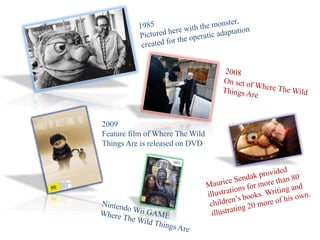
2009 
Feature film of Where The Wild 
Things Are is released on DVD
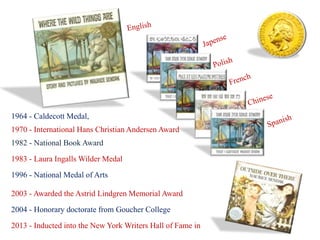
1964 - Caldecott Medal, 
1970 - International Hans Christian Andersen Award 
1982 - National Book Award 
1983 - Laura Ingalls Wilder Medal 
1996 - National Medal of Arts 
2003 - Awarded the Astrid Lindgren Memorial Award 
2004 - Honorary doctorate from Goucher College 
2013 - Inducted into the New York Writers Hall of Fame in
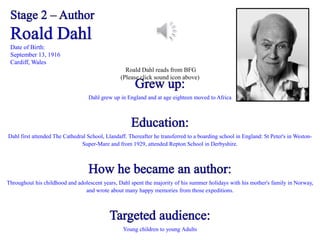
Dahl grew up in England and at age eighteen moved to Africa 
Dahl first attended The Cathedral School, Llandaff. Thereafter he transferred to a boarding school in England: St Peter's in Weston- 
Super-Mare and from 1929, attended Repton School in Derbyshire. 
Throughout his childhood and adolescent years, Dahl spent the majority of his summer holidays with his mother's family in Norway, 
and wrote about many happy memories from those expeditions. 
Young children to young Adults 
Date of Birth: 
September 13, 1916 
Cardiff, Wales 
Roald Dahl reads from BFG 
(Please click sound icon above)
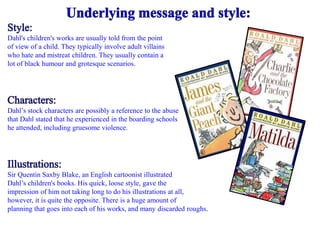
Dahl's children's works are usually told from the point 
of view of a child. They typically involve adult villains 
who hate and mistreat children. They usually contain a 
lot of black humour and grotesque scenarios. 
Dahl’s stock characters are possibly a reference to the abuse 
that Dahl stated that he experienced in the boarding schools 
he attended, including gruesome violence. 
Sir Quentin Saxby Blake, an English cartoonist illustrated 
Dahl’s children's books. His quick, loose style, gave the 
impression of him not taking long to do his illustrations at all, 
however, it is quite the opposite. There is a huge amount of 
planning that goes into each of his works, and many discarded roughs.
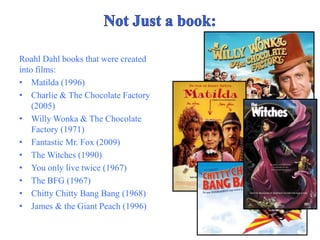
Roahl Dahl books that were created 
into films: 
• Matilda (1996) 
• Charlie & The Chocolate Factory 
(2005) 
• Willy Wonka & The Chocolate 
Factory (1971) 
• Fantastic Mr. Fox (2009) 
• The Witches (1990) 
• You only live twice (1967) 
• The BFG (1967) 
• Chitty Chitty Bang Bang (1968) 
• James & the Giant Peach (1996)
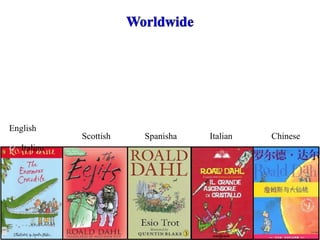
Scottish Italian Chinese 
English 
Italian 
Spanisha
………

Children's Authors

  • 3.
    Born: Eric Carle,June 25, 1929 Syracuse New York Carle’s first book: Illustrated Bill Martin Jr’s book, ‘Brown Bear Brown, Bear What do you see?” which launched Carle’s career. Education: Academy of fine arts in Vienna
  • 4.
    The style ofwriting Eric Carle uses covers the domains of numeracy, literacy, repetitive language, coinciding with children’s experiences in their every day lives. Carle’s illustrations are in a form of a collage. Firstly he paints over colored tissue paper using various brushes and tools to form a stamp like texture. Then the shapes are cut in colored paper to make parts of his scenes and characters. Underlying message in Eric Carle’s books are: Growth and Discovery
  • 5.
    Range of merchandisefrom children plush toys, teething rings, building blocks and CD’s Eric Carle reads the Very Hungry Caterpillar on Youtube. Very Hungry caterpillar is written in 30 language. Audio gallery of the Very Hungry Caterpillar is translated in simplified Chinese and complext Chinese, Dutch, French, Japanese, Lithuanian, Maori and Norwegian. The House for Hermit Crab is available on CD and DVD All books and merchandise are sold worldwide.
  • 6.
    Pamela Allen Wasborn on the 3rd of April 1934 In Devonport, Auckland, New Zealand Pamela Allen has wrote and illustrated over 30 children’s picture books since 1980 She studied at the Elam School of Fine Arts at Auckland University College, and graduated with a Diploma of Fine Arts in 1955. She married sculptor Jim Allen in 1964. They moved to Sydney, Australia in about 1977.
  • 7.
    Pamela Allen wroteand illustrated her first book, Mr Archimeds’ Bath in 1830 She won the Children's Book Council of Australia's Children's Picture Book of The Year Award in 1983 for Who Sank the Boat? And in 1984 for Bertie and the Bear
  • 8.
    2003 2004 Eightof Pamela's titles were adapted 2007 2008 for the stage by Patch Theatre Company, and performed in the Sydney Opera 2008 2010 House.
  • 9.
    Born: Theodor SeussGeiselin, March 2, 1904, Springfield Massachusetts. Died: September 24, 1991, aged 87 Geisel's first book, ‘And to Think That I Saw It on Mulberry Street’, was rejected 27 times before it was finally published by Vanguard Press in 1937 First cartoon published when using the name “Seuss” was July 1927 issue of the Saturday Evening Post
  • 10.
    The style ofwriting Dr. Seuss used in his books were- • Rhyming • Figurative language • Imagery His illustrations are fascinating as he only draws one human face, however all his characters look alike with minor adjustments. Some hidden message in Dr. Seuss books.. • The Lorax: recognised as Dr. Seuss' take on environmentalism and how humans are destroying nature. • Green eggs and Ham: Bennett Cerf, Dr. Seuss' editor, bet him that he couldn't write a book using 50 words or less. • Horton hears a who: the line "A person's a person, no matter how small," has been used as a slogan for pro-life organizations for years.
  • 11.
    Movies: In 1966,The Grinch was adapted into an animated film. The Lorax The Cat in the Hat Horton Hears a Who Dr. Seuss books are written in different languages such as French, Japanese, Chinese, Korean, English, Spanish and Hebrew.
  • 12.
    Maurice Sendak Born: Maurice Bernard Sendak, June 10, 1928 Brooklyn, New York, USA Died: May 8, 2012, aged 83 Danbury, Connecticut USA 1956 - Published The first children’s book he both wrote and illustrated was Kennys Window
  • 13.
    Maurice refused tolie to children, vowing never to write about sunshine and rainbows and attributes his success to a refusal to patronise younger readers and sugar-coat their experiences to real life. He drew on his own life experiences as a child. Through a small boy, Chicken Soup with Rice, teachers the names of the months. Bumble-Andy is the last picture book he has published
  • 14.
    2009 Feature filmof Where The Wild Things Are is released on DVD
  • 15.
    1964 - CaldecottMedal, 1970 - International Hans Christian Andersen Award 1982 - National Book Award 1983 - Laura Ingalls Wilder Medal 1996 - National Medal of Arts 2003 - Awarded the Astrid Lindgren Memorial Award 2004 - Honorary doctorate from Goucher College 2013 - Inducted into the New York Writers Hall of Fame in
  • 16.
    Dahl grew upin England and at age eighteen moved to Africa Dahl first attended The Cathedral School, Llandaff. Thereafter he transferred to a boarding school in England: St Peter's in Weston- Super-Mare and from 1929, attended Repton School in Derbyshire. Throughout his childhood and adolescent years, Dahl spent the majority of his summer holidays with his mother's family in Norway, and wrote about many happy memories from those expeditions. Young children to young Adults Date of Birth: September 13, 1916 Cardiff, Wales Roald Dahl reads from BFG (Please click sound icon above)
  • 17.
    Dahl's children's worksare usually told from the point of view of a child. They typically involve adult villains who hate and mistreat children. They usually contain a lot of black humour and grotesque scenarios. Dahl’s stock characters are possibly a reference to the abuse that Dahl stated that he experienced in the boarding schools he attended, including gruesome violence. Sir Quentin Saxby Blake, an English cartoonist illustrated Dahl’s children's books. His quick, loose style, gave the impression of him not taking long to do his illustrations at all, however, it is quite the opposite. There is a huge amount of planning that goes into each of his works, and many discarded roughs.
  • 18.
    Roahl Dahl booksthat were created into films: • Matilda (1996) • Charlie & The Chocolate Factory (2005) • Willy Wonka & The Chocolate Factory (1971) • Fantastic Mr. Fox (2009) • The Witches (1990) • You only live twice (1967) • The BFG (1967) • Chitty Chitty Bang Bang (1968) • James & the Giant Peach (1996)
  • 19.
    Scottish Italian Chinese English Italian Spanisha
  • 20.