Beaconhouse School System
Child Protection Awareness Campaign
(CPAC)
❖Orientation to the BSS Child Protection Policy
❖Understanding what child abuse means in
schools
❖Roles and Responsibilities of the
➢Child Protection Committee (CPC);
➢School Management;
Agenda
CHILD PROTECTION
POLICY
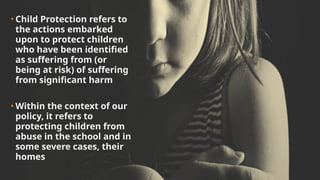
• Child Protection refers to
the actions embarked
upon to protect children
who have been identified
as suffering from (or
being at risk) of suffering
from significant harm
• Within the context of our
policy, it refers to
protecting children from
abuse in the school and in
some severe cases, their
homes
Importance of Child
Protection Policy
What contributes towards
creating a safe and supportive
environment for children in
schools?
Policy Statement
The Beaconhouse School System (BSS) is committed to providing a safe and secure
environment for all students enrolled at BSS schools. As a responsible organisation
we actively seek to promote the welfare of all students in our charge and ensure
that they are protected from harm.
The Beaconhouse School System believes that every member of the organisation has
a role to play and endeavours to provide an environment where all members of the
school community i.e. students, parents, teachers, administrators and support staff
are confident in sharing concerns either about their own safety or the safety and
wellbeing of others.
The BSS Child Protection Policy has been developed in accordance with the
principles established by the ‘Child Protection System Bill, 2014’ passed
by the Pakistan National Assembly.
BSS Child Protection Policy is in line with the following:
• Child Protection Policy, Pakistan Centre
• ‘Convention on the Rights of Children’ (United Nations Human Rights
Office of the High Commissioner)
To foster security and confidence in the school, the staff and in BSS policies and procedures.
To raise the awareness of both teaching and non-teaching staff of the need to safeguard students
and of their responsibilities in identifying and reporting possible cases of abuse.
To provide a systematic means of monitoring and supporting students known or thought to be at
risk of harm.
To emphasise the need for good levels of communication between all parents and members of
school staff.
To develop a structured procedure within the school to be followed by all members of the school
community in cases of suspected abuse.
To ensure that background checks are carried out on all adults who work with or intend to work
with students.
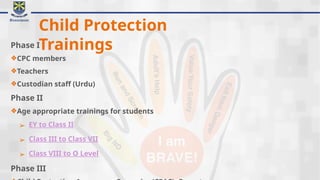
Child Protection
Trainings
Phase I
❖CPC members
❖Teachers
❖Custodian staff (Urdu)
Phase II
❖Age appropriate trainings for students
➢ EY to Class II
➢ Class III to Class VII
➢ Class VIII to O Level
Phase III
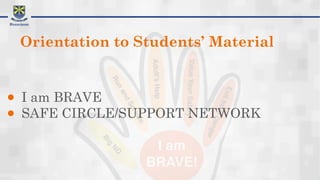
Orientation to Students’ Material
● I am BRAVE
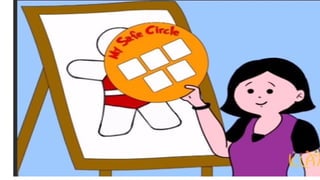
● SAFE CIRCLE/SUPPORT NETWORK
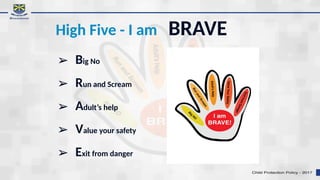
➢ Big No
➢ Run and Scream
➢ Adult’s help
➢ Value your safety
➢ Exit from danger
High Five - I am BRAVE
What is child
abuse?
What is child abuse?
Abuse is defined as
any action that
intentionally harms or
injures another
person.
Types of Abuse
• Physical abuse
• Emotional abuse
• Neglect
• Sexual abuse
Physical abuse
• Hitting
• Shaking
• Throwing
• Burning/scalding
• Poisoning (including inappropriate use of drugs or alcohol)
• Suffocating
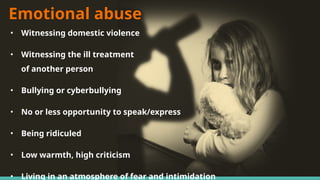
Emotional abuse
• Witnessing domestic violence
• Witnessing the ill treatment
of another person
• Bullying or cyberbullying
• No or less opportunity to speak/express
• Being ridiculed
• Low warmth, high criticism
• Living in an atmosphere of fear and intimidation
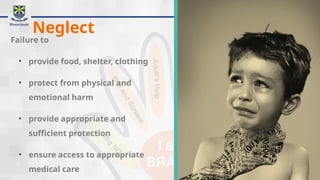
Neglect
Failure to
• provide food, shelter, clothing
• protect from physical and
emotional harm
• provide appropriate and
sufficient protection
• ensure access to appropriate
medical care
Sexual Abuse
• Forcing children or misleading them into engaging in
sexual activities
• Exposure to inappropriate material
• Being touched or talked to in inappropriate ways -
directly or indirectly
Who are the
abusers?
Abusers can be:
• of any age
• male or female (including sexual abusers)
• from any social class
• ‘Nice and trusted people’
• working in “helpful” professions
• related to the child or not
• damaged individuals but convincing liars
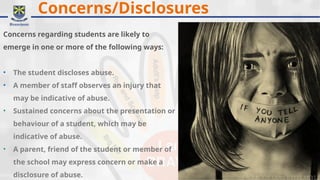
Concerns/Disclosures
Concerns regarding students are likely to
emerge in one or more of the following ways:
• The student discloses abuse.
• A member of staff observes an injury that
may be indicative of abuse.
• Sustained concerns about the presentation or
behaviour of a student, which may be
indicative of abuse.
• A parent, friend of the student or member of
the school may express concern or make a
disclosure of abuse.
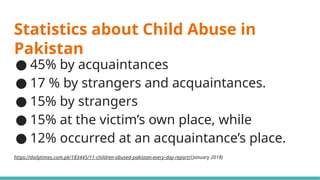
Statistics about Child Abuse in
Pakistan
● 45% by acquaintances
● 17 % by strangers and acquaintances.
● 15% by strangers
● 15% at the victim’s own place, while
● 12% occurred at an acquaintance’s place.
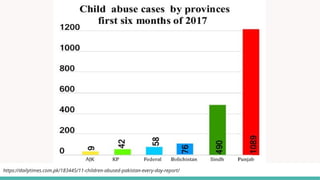
https://dailytimes.com.pk/183445/11-children-abused-pakistan-every-day-report/(January 2018)
https://dailytimes.com.pk/183445/11-children-abused-pakistan-every-day-report/
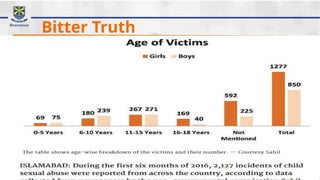
Bitter Truth
What can we do to help
as parents?
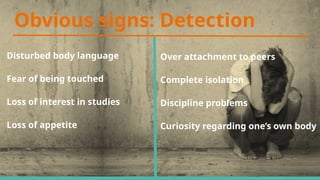
Obvious signs: Detection
Disturbed body language
Fear of being touched
Loss of interest in studies
Loss of appetite
Over attachment to peers
Complete isolation
Discipline problems
Curiosity regarding one’s own body
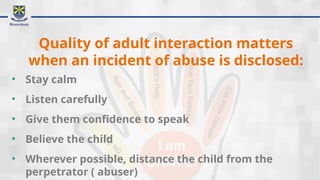
Quality of adult interaction matters
when an incident of abuse is disclosed:
• Stay calm
• Listen carefully
• Give them confidence to speak
• Believe the child
• Wherever possible, distance the child from the
perpetrator ( abuser)
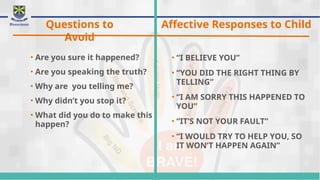
• Are you sure it happened?
• Are you speaking the truth?
• Why are you telling me?
• Why didn’t you stop it?
• What did you do to make this
happen?
• “I BELIEVE YOU”
• “YOU DID THE RIGHT THING BY
TELLING”
• “I AM SORRY THIS HAPPENED TO
YOU”
• “IT’S NOT YOUR FAULT”
• “I WOULD TRY TO HELP YOU, SO
IT WON’T HAPPEN AGAIN”
Questions to
Avoid
Affective Responses to Child
https://www.youtube.com/watch?v=VrAwP79Dmn8
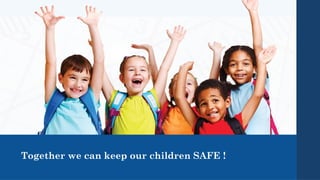
Together we can keep our children SAFE !

Child_Protection_Training_for_Parents.pptx

  • 1.
    Beaconhouse School System ChildProtection Awareness Campaign (CPAC)
  • 2.
    ❖Orientation to theBSS Child Protection Policy ❖Understanding what child abuse means in schools ❖Roles and Responsibilities of the ➢Child Protection Committee (CPC); ➢School Management; Agenda
  • 3.
  • 4.
    • Child Protectionrefers to the actions embarked upon to protect children who have been identified as suffering from (or being at risk) of suffering from significant harm • Within the context of our policy, it refers to protecting children from abuse in the school and in some severe cases, their homes
  • 5.
    Importance of Child ProtectionPolicy What contributes towards creating a safe and supportive environment for children in schools?
  • 6.
    Policy Statement The BeaconhouseSchool System (BSS) is committed to providing a safe and secure environment for all students enrolled at BSS schools. As a responsible organisation we actively seek to promote the welfare of all students in our charge and ensure that they are protected from harm. The Beaconhouse School System believes that every member of the organisation has a role to play and endeavours to provide an environment where all members of the school community i.e. students, parents, teachers, administrators and support staff are confident in sharing concerns either about their own safety or the safety and wellbeing of others.
  • 7.
    The BSS ChildProtection Policy has been developed in accordance with the principles established by the ‘Child Protection System Bill, 2014’ passed by the Pakistan National Assembly. BSS Child Protection Policy is in line with the following: • Child Protection Policy, Pakistan Centre • ‘Convention on the Rights of Children’ (United Nations Human Rights Office of the High Commissioner)
  • 8.
    To foster securityand confidence in the school, the staff and in BSS policies and procedures. To raise the awareness of both teaching and non-teaching staff of the need to safeguard students and of their responsibilities in identifying and reporting possible cases of abuse. To provide a systematic means of monitoring and supporting students known or thought to be at risk of harm. To emphasise the need for good levels of communication between all parents and members of school staff. To develop a structured procedure within the school to be followed by all members of the school community in cases of suspected abuse. To ensure that background checks are carried out on all adults who work with or intend to work with students.
  • 9.
    Child Protection Trainings Phase I ❖CPCmembers ❖Teachers ❖Custodian staff (Urdu) Phase II ❖Age appropriate trainings for students ➢ EY to Class II ➢ Class III to Class VII ➢ Class VIII to O Level Phase III
  • 10.
    Orientation to Students’Material ● I am BRAVE ● SAFE CIRCLE/SUPPORT NETWORK
  • 11.
    ➢ Big No ➢Run and Scream ➢ Adult’s help ➢ Value your safety ➢ Exit from danger High Five - I am BRAVE
  • 13.
  • 14.
    What is childabuse? Abuse is defined as any action that intentionally harms or injures another person.
  • 15.
    Types of Abuse •Physical abuse • Emotional abuse • Neglect • Sexual abuse
  • 16.
    Physical abuse • Hitting •Shaking • Throwing • Burning/scalding • Poisoning (including inappropriate use of drugs or alcohol) • Suffocating
  • 17.
    Emotional abuse • Witnessingdomestic violence • Witnessing the ill treatment of another person • Bullying or cyberbullying • No or less opportunity to speak/express • Being ridiculed • Low warmth, high criticism • Living in an atmosphere of fear and intimidation
  • 18.
    Neglect Failure to • providefood, shelter, clothing • protect from physical and emotional harm • provide appropriate and sufficient protection • ensure access to appropriate medical care
  • 19.
    Sexual Abuse • Forcingchildren or misleading them into engaging in sexual activities • Exposure to inappropriate material • Being touched or talked to in inappropriate ways - directly or indirectly
  • 21.
  • 22.
    Abusers can be: •of any age • male or female (including sexual abusers) • from any social class • ‘Nice and trusted people’ • working in “helpful” professions • related to the child or not • damaged individuals but convincing liars
  • 23.
    Concerns/Disclosures Concerns regarding studentsare likely to emerge in one or more of the following ways: • The student discloses abuse. • A member of staff observes an injury that may be indicative of abuse. • Sustained concerns about the presentation or behaviour of a student, which may be indicative of abuse. • A parent, friend of the student or member of the school may express concern or make a disclosure of abuse.
  • 24.
    Statistics about ChildAbuse in Pakistan ● 45% by acquaintances ● 17 % by strangers and acquaintances. ● 15% by strangers ● 15% at the victim’s own place, while ● 12% occurred at an acquaintance’s place. https://dailytimes.com.pk/183445/11-children-abused-pakistan-every-day-report/(January 2018)
  • 25.
  • 26.
  • 27.
    What can wedo to help as parents?
  • 28.
    Obvious signs: Detection Disturbedbody language Fear of being touched Loss of interest in studies Loss of appetite Over attachment to peers Complete isolation Discipline problems Curiosity regarding one’s own body
  • 29.
    Quality of adultinteraction matters when an incident of abuse is disclosed: • Stay calm • Listen carefully • Give them confidence to speak • Believe the child • Wherever possible, distance the child from the perpetrator ( abuser)
  • 30.
    • Are yousure it happened? • Are you speaking the truth? • Why are you telling me? • Why didn’t you stop it? • What did you do to make this happen? • “I BELIEVE YOU” • “YOU DID THE RIGHT THING BY TELLING” • “I AM SORRY THIS HAPPENED TO YOU” • “IT’S NOT YOUR FAULT” • “I WOULD TRY TO HELP YOU, SO IT WON’T HAPPEN AGAIN” Questions to Avoid Affective Responses to Child
  • 31.
  • 32.
    Together we cankeep our children SAFE !

Editor's Notes

  • #3 The title is hyperlinked with https://www.beaconhouse.net/child-protection/ and will show the page with the video with the child protection policy details of BSS. Please access the video and show it at this point to give a flavour of the policy before going into details later.
  • #4 Trainer to read the slide and not engage in discussion
  • #5 Brainstorm the factors that contribute towards creating a safe and supportive environment for children in schools. 5-7 minutes. This can be linked to the next slide.
  • #6 Mention that BSS has developed a child protection policy to safeguard students while they are at school. Extensive trainings have been conducted to create awareness of the same. Emphasize on the key words. What is a safe and secure environment? How can we promote welfare of all students? What steps can be taken to protect the students from harm? the trainer will not attempt to answer these questions at this point but will ask them as teasers to be answered as we move on. tell parents that we will attempt to answer these qs. later in the session. CPP can be found on Manuala
  • #8 Emphasize on the Aims the company beholds.
  • #9 Parents will be informed of all the trainings that were conducted. All of them end with 2 important similarities/commonalities. I am BRAVE and a safe circle. Trainer might want to show some material from the students’ ppts. or perhaps the Sahil videos which were used for junior classes.
  • #11 The trainer will share what BRAVE stands for with parents. Five points to react immediately and will encourage them to remember as High Five. Encourage parents to mention this at home too, as a reminder for their children.
  • #13 Elicit from parents what is the meaning of abuse. Take all responses. No need to get into a discussion at this point. The next slide will explain this further
  • #14 Abuse is defined as any action that intentionally harms or injures another person.
  • #15 These are the types of abuse
  • #16 Definition: The deliberate infliction of physical harm or the failure to prevent physical harm to a student Bruises commonly on the head but also on the ear or neck or soft areas - the abdomen, back and buttocks defensive wounds commonly on the forearm, upper arm, back of the leg, hands or feet clusters of bruises on the upper arm, outside of the thigh or on the body. Burns and scalds can be from hot liquids, hot objects, flames, chemicals or electricity on the hands, back, shoulders or buttocks; scalds may be on lower limbs, both arms and/or both legs a clear edge to the burn or scald sometimes in the shape or an implement for example, a circular cigarette burn multiple burns or scalds. bruises with dots of blood under the skin a bruised scalp and swollen eyes from hair being pulled violently bruises in the shape of a hand or object. Other injuries and health issues scarring, effects of poisoning such as vomiting, drowsiness or seizures respiratory problems from drowning, suffocation or poisoning. when parents use drugs to sedate their children that is also a part of physical abuse( phenergan etc in travelling or at night)
  • #17 Discuss different conditions where the CPC members think that the child is being emotionally abused. Children who are emotionally abused suffer emotional maltreatment or neglect. It's sometimes called psychological abuse and can cause children serious harm. Emotional abuse includes: humiliating or constantly criticizing a child threatening, shouting at a child or calling them names making the child the subject of jokes, or using sarcasm to hurt a child blaming, scapegoating making a child perform degrading acts not recognizing a child's own individuality, trying to control their lives pushing a child too hard or not recognizing their limitations exposing a child to distressing events or interactions such as domestic abuse or drug taking failing to promote a child's social development not allowing them to have friends persistently ignoring them being absent manipulating a child never saying anything kind, expressing positive feelings or congratulating a child on successes never showing any emotions in interactions with a child, also known as emotional neglect.
  • #18 Definition Persistent failure or deliberate denial to meet a child’s or student’s basic physical and /or psychological needs Abuse through neglect results in the serious impairment of the students’ health and development Poor appearance and Hygiene They may: be smelly or dirty have unwashed clothes have inadequate clothing, e.g. not having a winter coat seem hungry or turn up to school without having breakfast or any lunch money have frequent and untreated nappy rash in infants. Health and development issues untreated injuries, medical and dental issues repeated accidental injuries caused by lack of supervision recurring illnesses or infections not been given appropriate medicines missed medical appointments such as vaccinations poor muscle tone or prominent joints skin sores, rashes, flea bites, scabies or ringworm thin or swollen tummy anaemia tiredness faltering weight or growth and not reaching developmental milestones (known as failure to thrive) poor language, communication or social skills. Housing and family issues They may be: living in an unsuitable home environment for example dog mess being left or not having any heating left alone for a long time taking on the role of carer for other family members.
  • #19 Check with their information about what’s going on around in the world. What’s their knowledge of current children suffering from this trauma.
  • #20 Ask them if they think this statement is still really valid or not. Obviously it is to some extent but the idea is to emphasise that abusers are not always strangers. The next few slides explain further.
  • #21 Ask the participants who they think the abusers are?
  • #23 The last point is where the other concerned people talk about the child’s abuse to people in authority. Bringing it to notice.
  • #25 a total of 1,764 cases of child abuse were reported from across the country in the first six months of 2017. the numbers do not indicate that Punjab is full of bad people as this number is proportional.
  • #26 Discuss the age type. The ratio, the most vulnerable age, the difference of age where the boys/girls are targeted is equally dangerous for boys and girls. and when we need to equally be careful when they are growing up into teenager.
  • #27 ask them! wrap up by reinforcing their role as being prime stakeholders in keeping children safe and informed and helping sort out any reported issue. Their support is crucial in creating awareness and providing a safe environment. We (school and parents) must work together to achieve this!
  • #28 Things you may notice If you're worried that a child is being abused, watch out for any unusual behaviour.  withdrawn  suddenly behaves differently  anxious  clingy  depressed  aggressive  problems sleeping  eating disorders  wets the bed  soils clothes  takes risks  misses school  changes in eating habits  obsessive behaviour  nightmares  drugs  alcohol  self-harm  thoughts about suicide
  • #31 show this video to end the presentation and wrap up by saying that we must work together to create a safe a healthy environment for children. and then show the last slide.