INVESTIGATING
SELF-REPORTING BEHAVIOR
IN LONG-TERM STUDIES
Andreas Möller ✽, Matthias Kranz ❖,
Barbara Schmid ✽, Stefan Diewald ✽, Luis Roalter ✽
✽ Technische Universität München, Germany
❖ Universität Passau, Germany
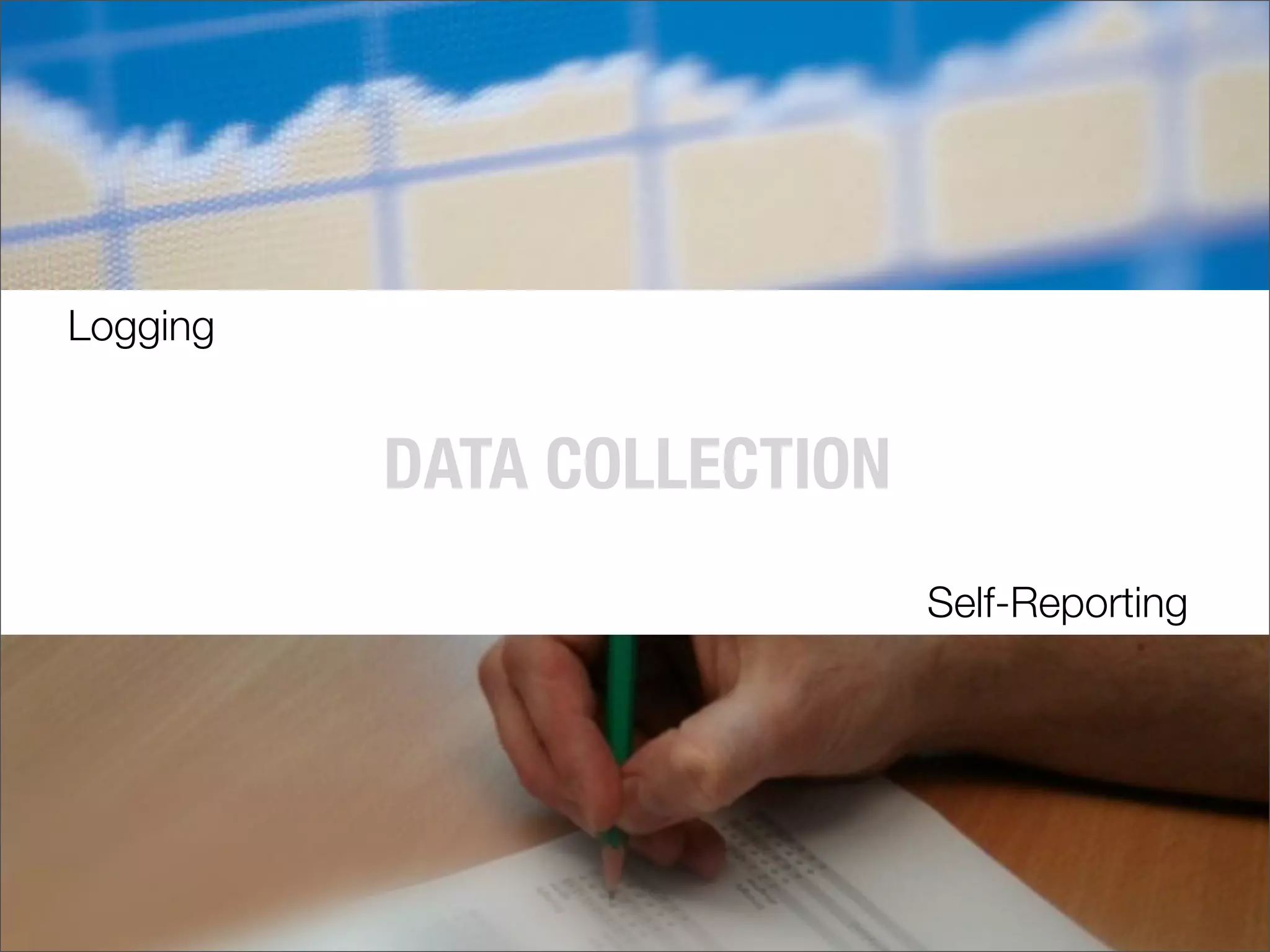
Logging
Self-Reporting
DATA COLLECTION
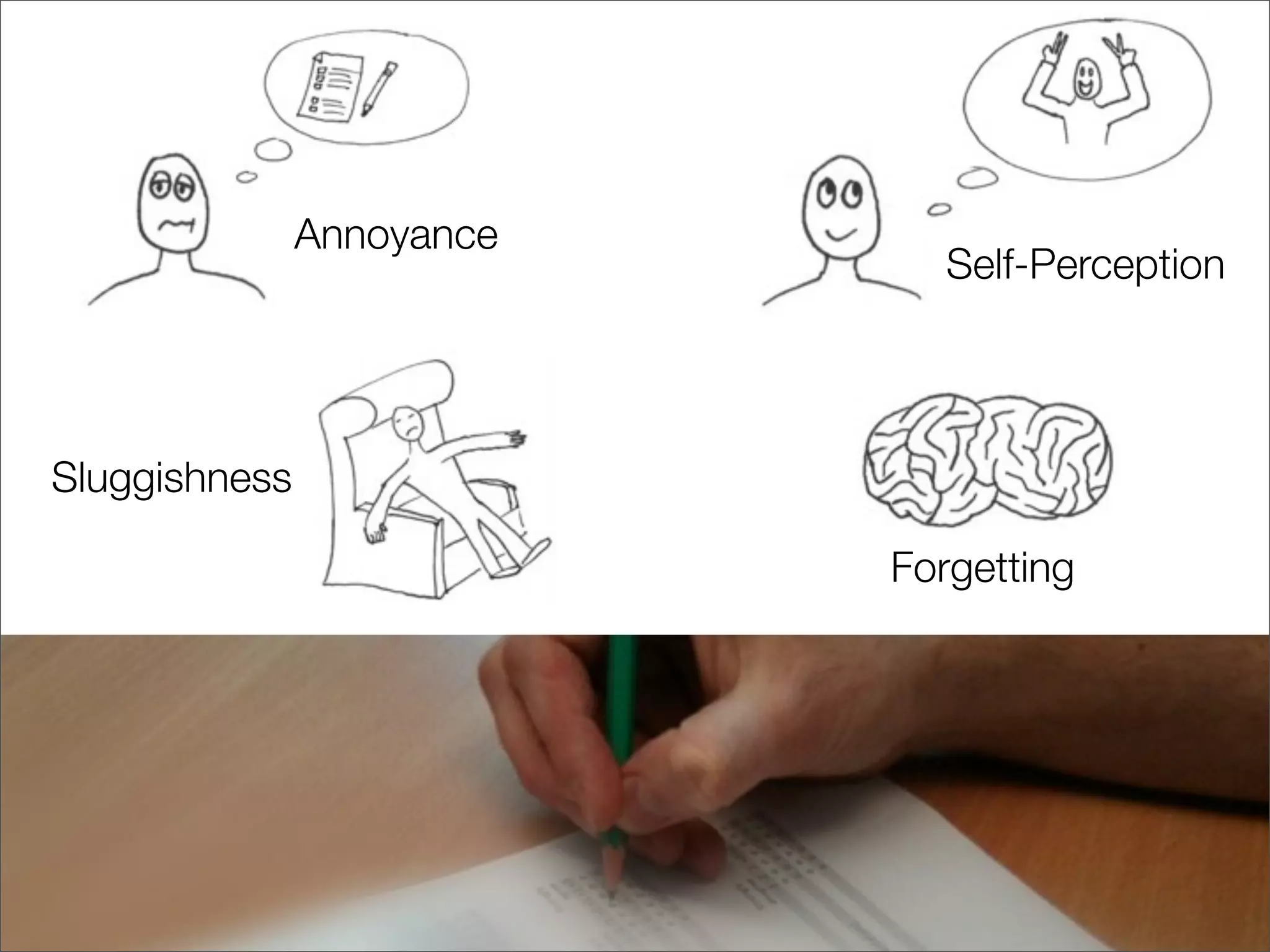
Forgetting
Annoyance
Sluggishness
Self-Perception
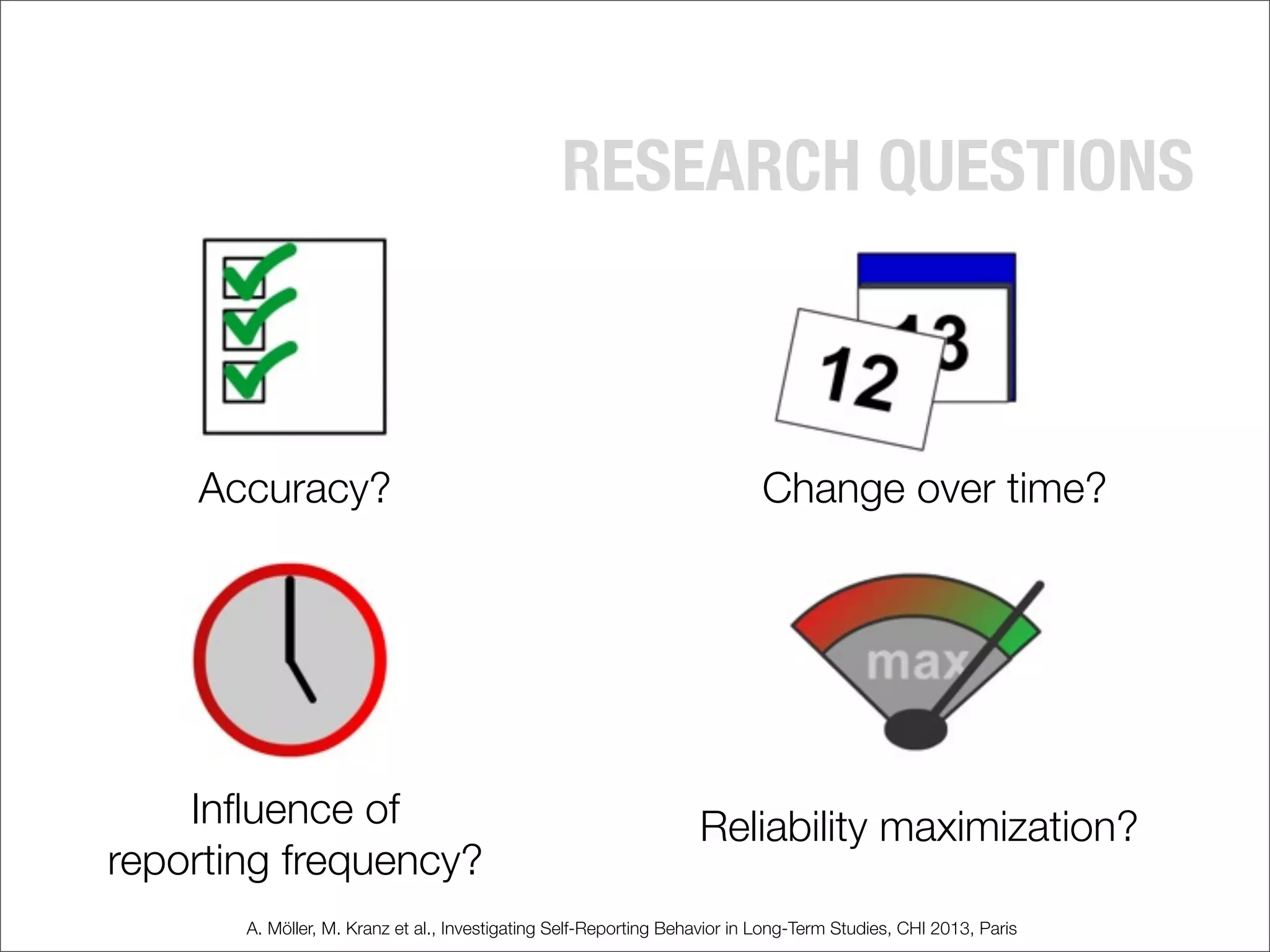
RESEARCH QUESTIONS
Accuracy? Change over time?
Influence of
reporting frequency?
Reliability maximization?
A. Möller, M. Kranz et al., Investigating Self-Reporting Behavior in Long-Term Studies, CHI 2013, Paris
BACKGROUND
■ Electronic diaries show higher
compliance
(Hufford & Shields, 2002)
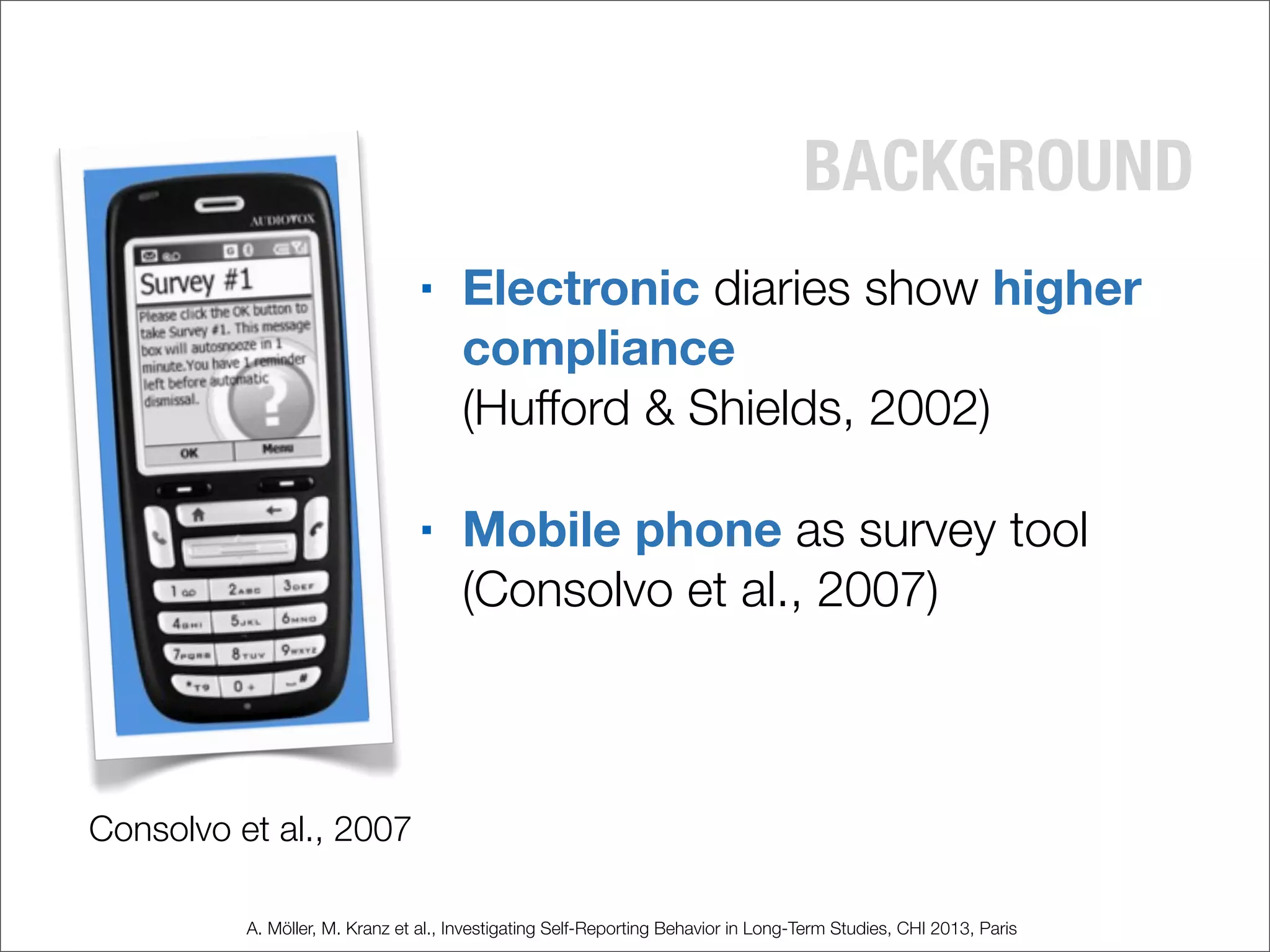
■ Mobile phone as survey tool
(Consolvo et al., 2007)
Consolvo et al., 2007
A. Möller, M. Kranz et al., Investigating Self-Reporting Behavior in Long-Term Studies, CHI 2013, Paris
CONTRIBUTIONS
■ Empirical quantitative long-term data
on reliability of information
collected with mobile devices
■ Recommendations for maximizing
result reliability
A. Möller, M. Kranz et al., Investigating Self-Reporting Behavior in Long-Term Studies, CHI 2013, Paris
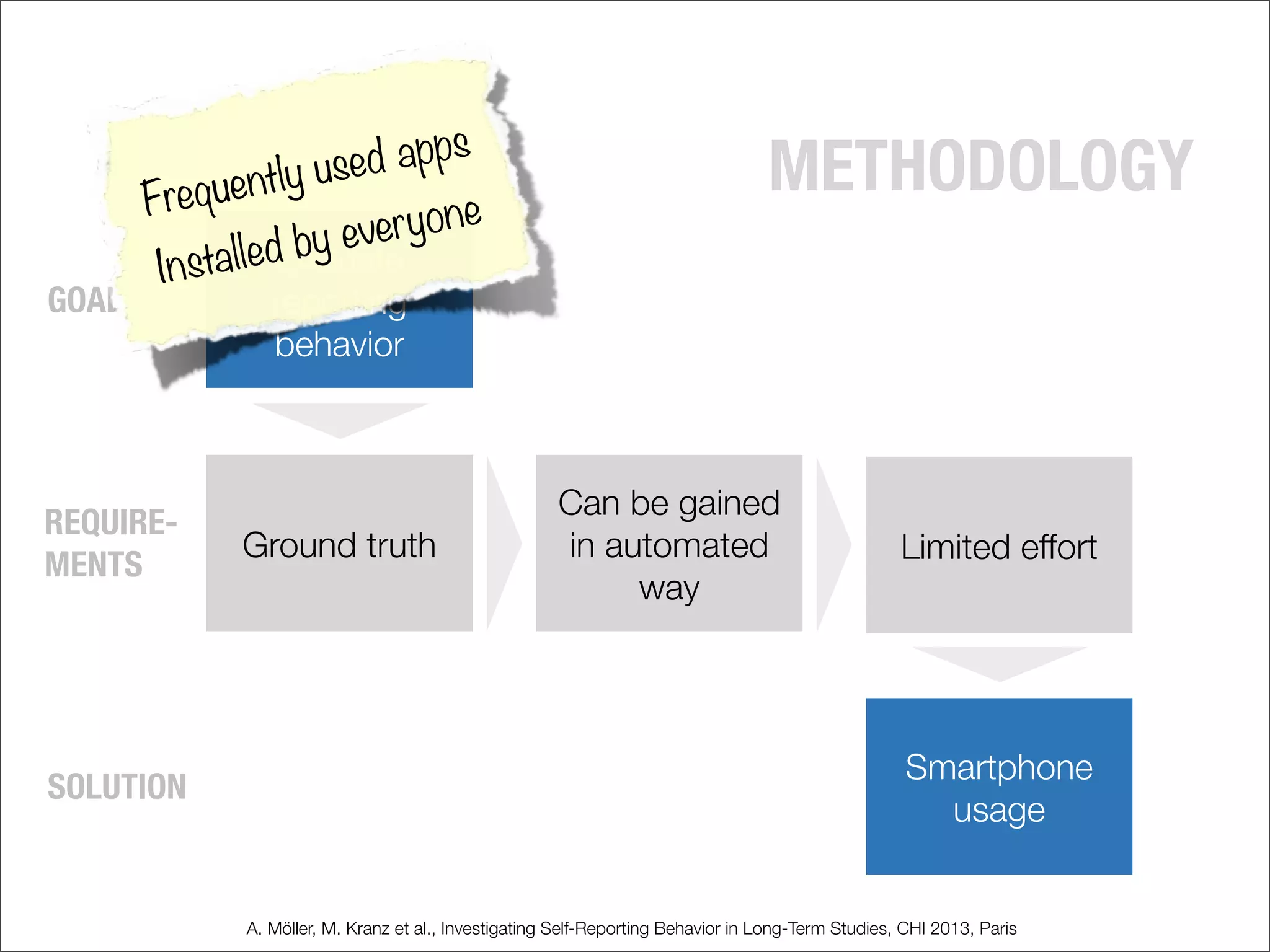
METHODOLOGY
Evaluate
reporting
behavior
Ground truth
Can be gained
in automated
way
Limited effort
Smartphone
usage
GOAL
REQUIRE-
MENTS
SOLUTION
Frequently used apps
Installed by everyone
Mail Facebook
Frequently used apps
Installed by everyone
A. Möller, M. Kranz et al., Investigating Self-Reporting Behavior in Long-Term Studies, CHI 2013, Paris
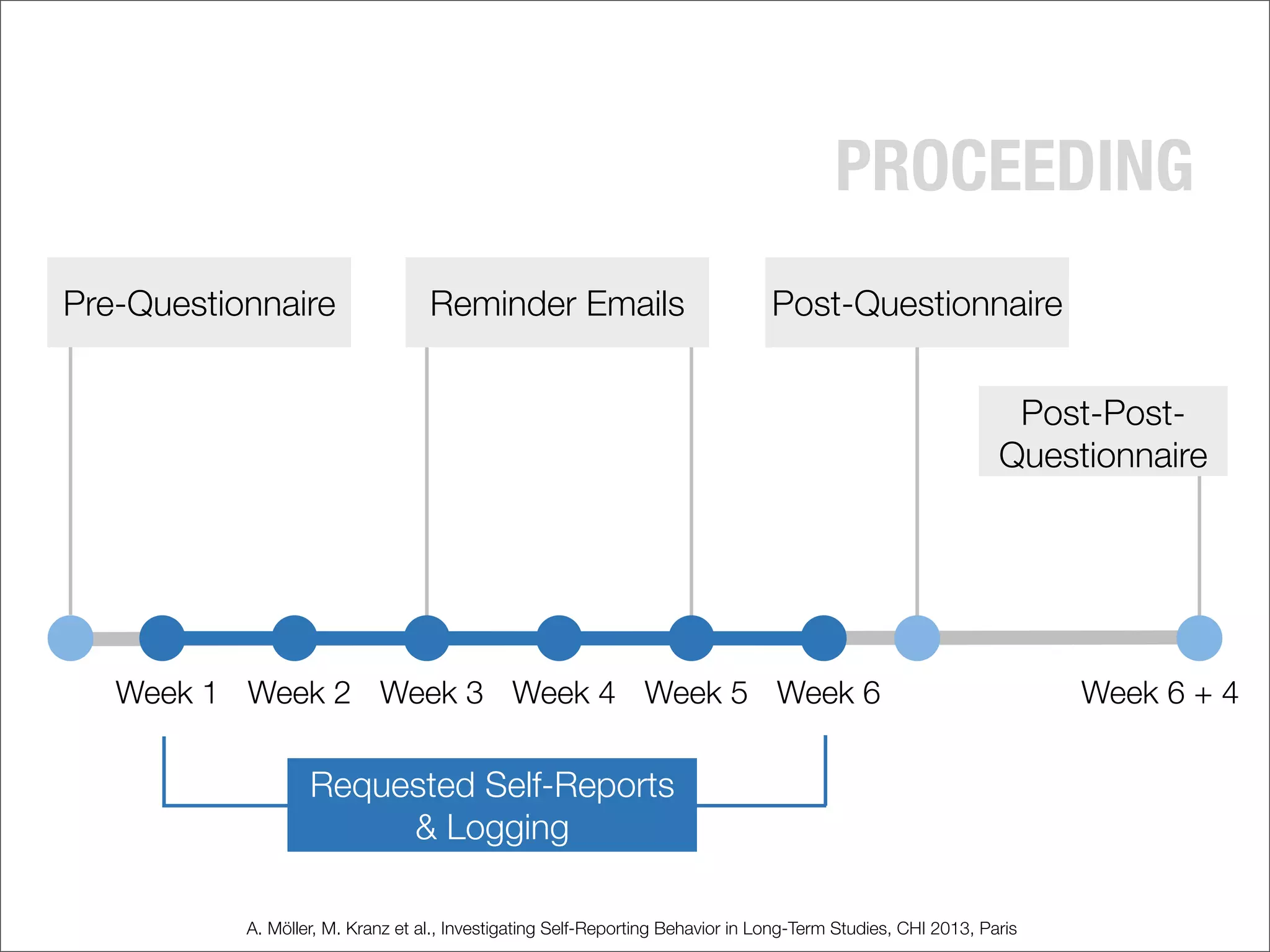
PROCEEDING
Week 1 Week 2 Week 3 Week 4 Week 5 Week 6 Week 6 + 4
Pre-Questionnaire Reminder Emails Post-Questionnaire
Post-Post-
Questionnaire
Requested Self-Reports
& Logging
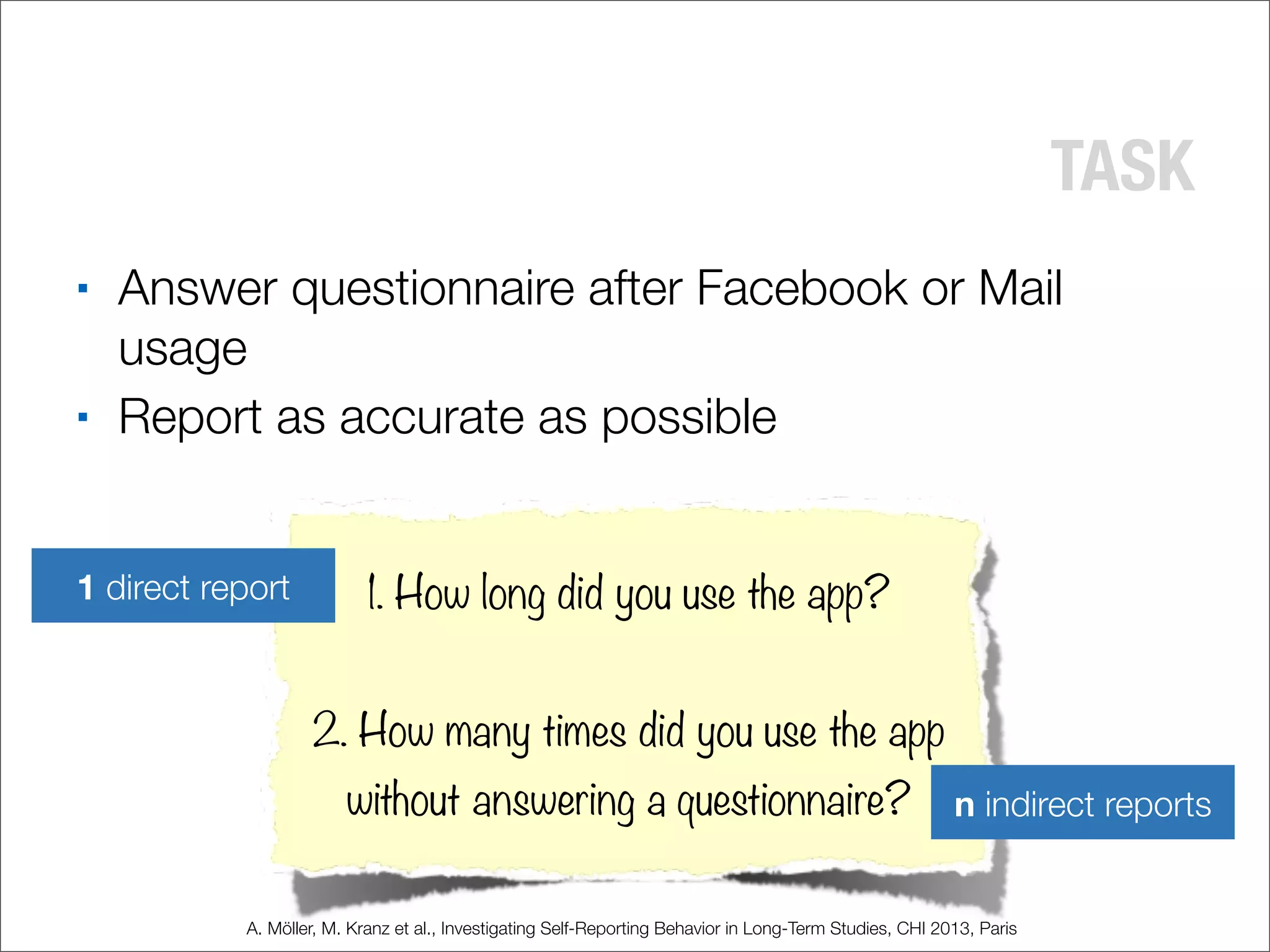
TASK
■ Answer questionnaire after Facebook or Mail
usage
■ Report as accurate as possible
1. How long did you use the app?
2. How many times did you use the app
without answering a questionnaire?
1 direct report
n indirect reports
A. Möller, M. Kranz et al., Investigating Self-Reporting Behavior in Long-Term Studies, CHI 2013, Paris
SELF-REPORTING AND EXPERIENCE
SAMPLING ASSISTANT
A. Möller, M. Kranz et al., Investigating Self-Reporting Behavior in Long-Term Studies, CHI 2013, Paris
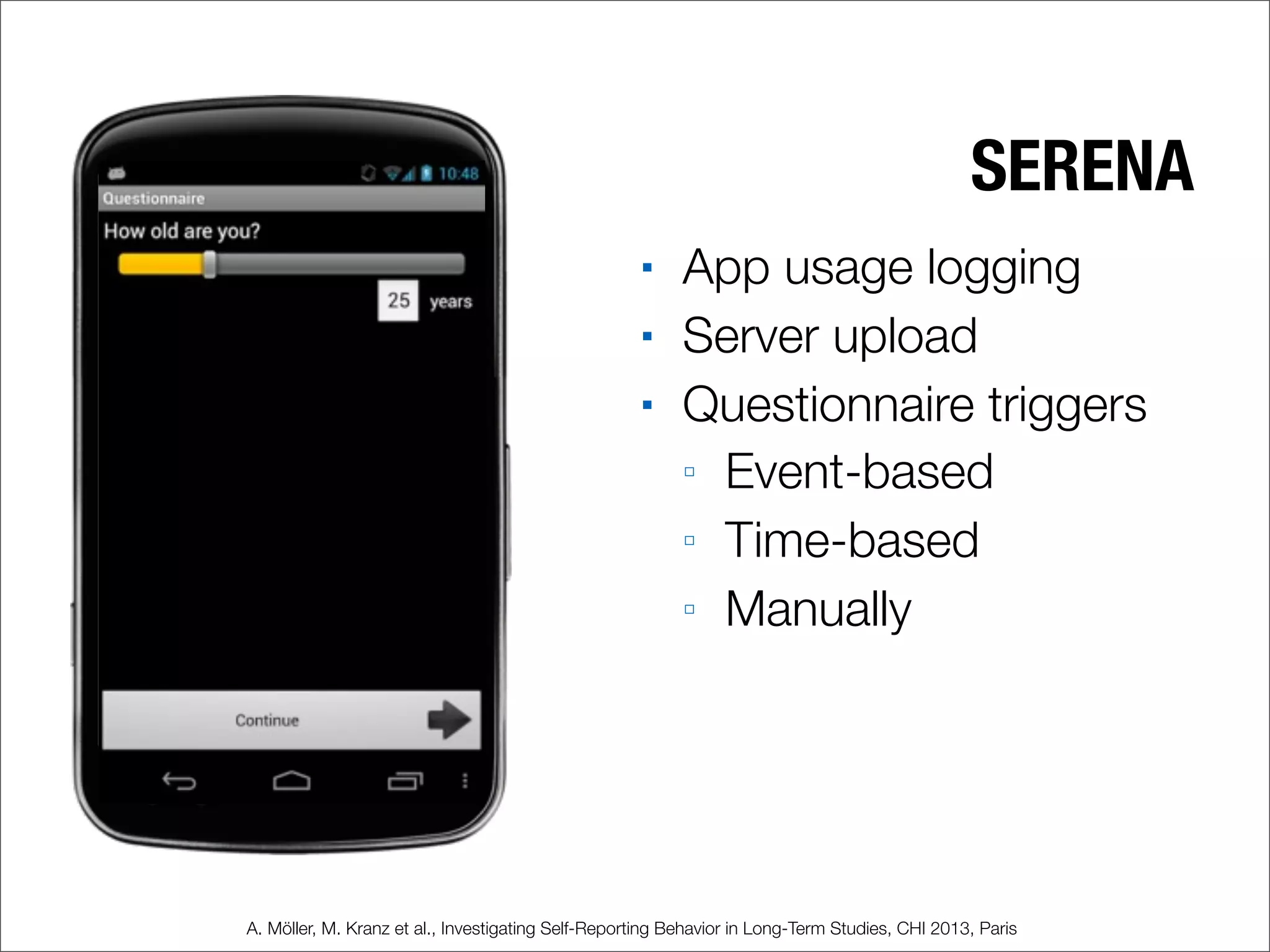
SERENA
■ App usage logging
■ Server upload
■ Questionnaire triggers
□ Event-based
□ Time-based
□ Manually
A. Möller, M. Kranz et al., Investigating Self-Reporting Behavior in Long-Term Studies, CHI 2013, Paris
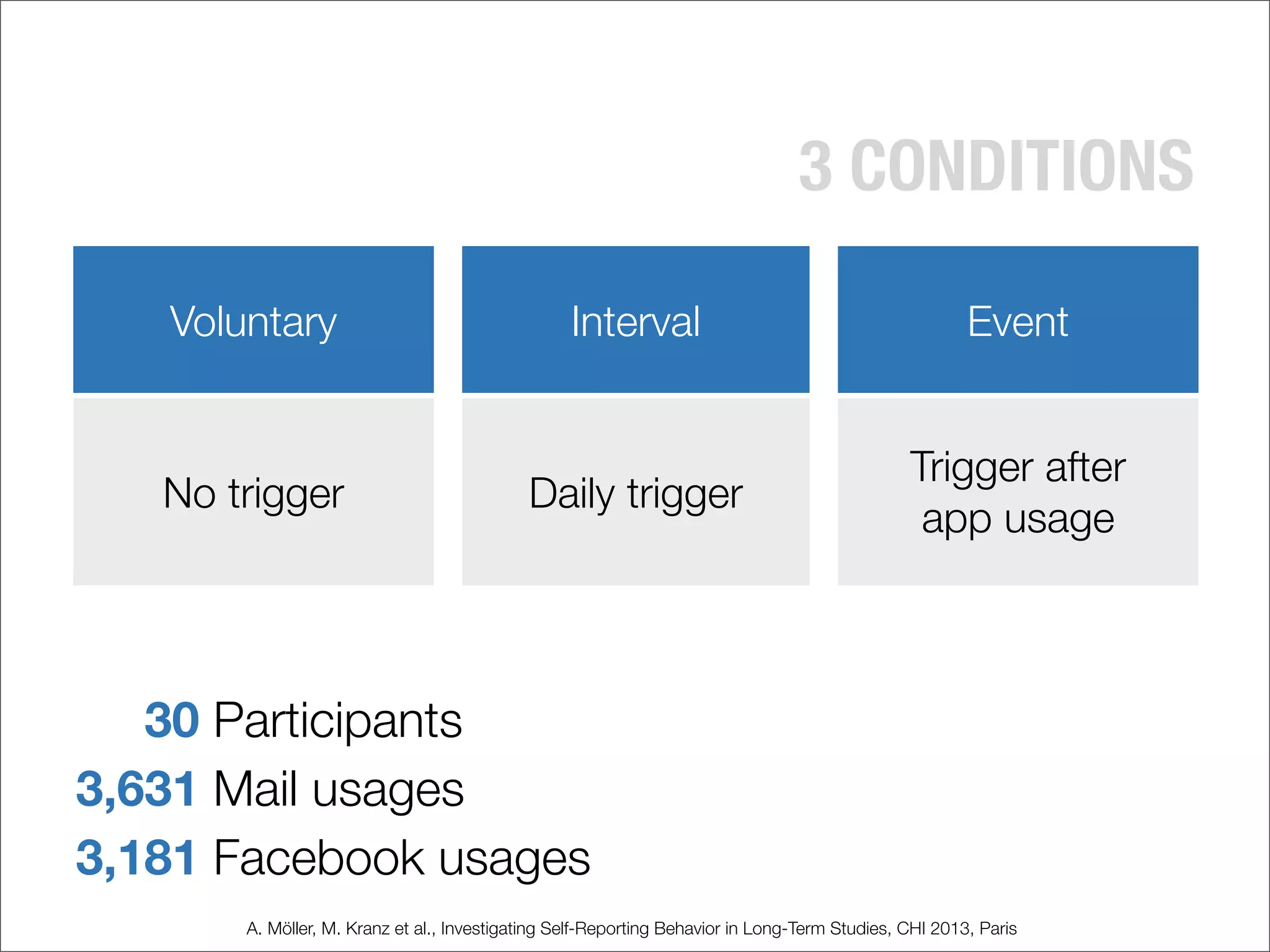
3 CONDITIONS
Voluntary Interval Event
No trigger Daily trigger
Trigger after
app usage
30 Participants
3,631 Mail usages
3,181 Facebook usages
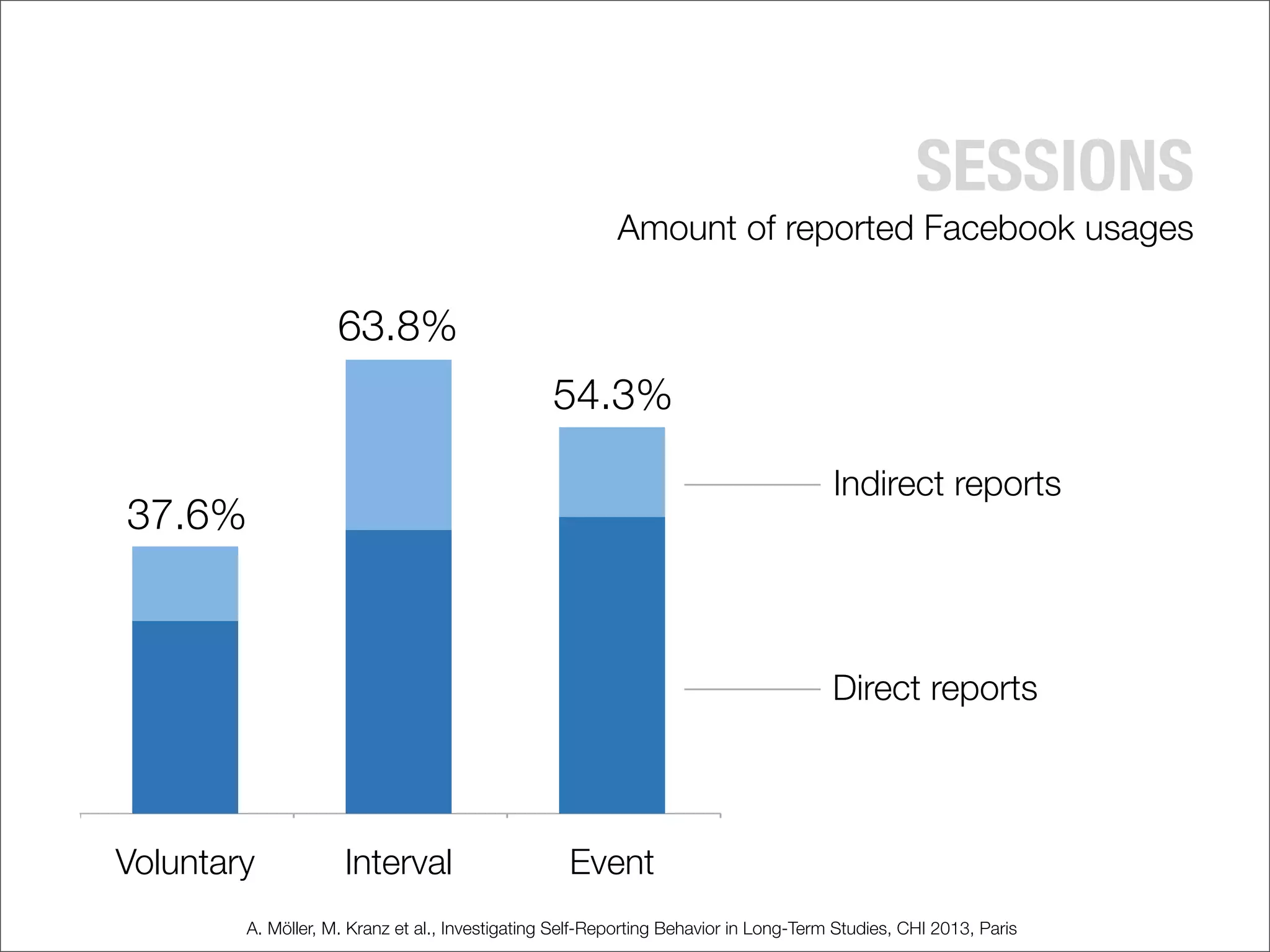
SESSIONS
Voluntary Interval Event
Amount of reported Facebook usages
37.6%
63.8%
54.3%
Indirect reports
Direct reports
A. Möller, M. Kranz et al., Investigating Self-Reporting Behavior in Long-Term Studies, CHI 2013, Paris
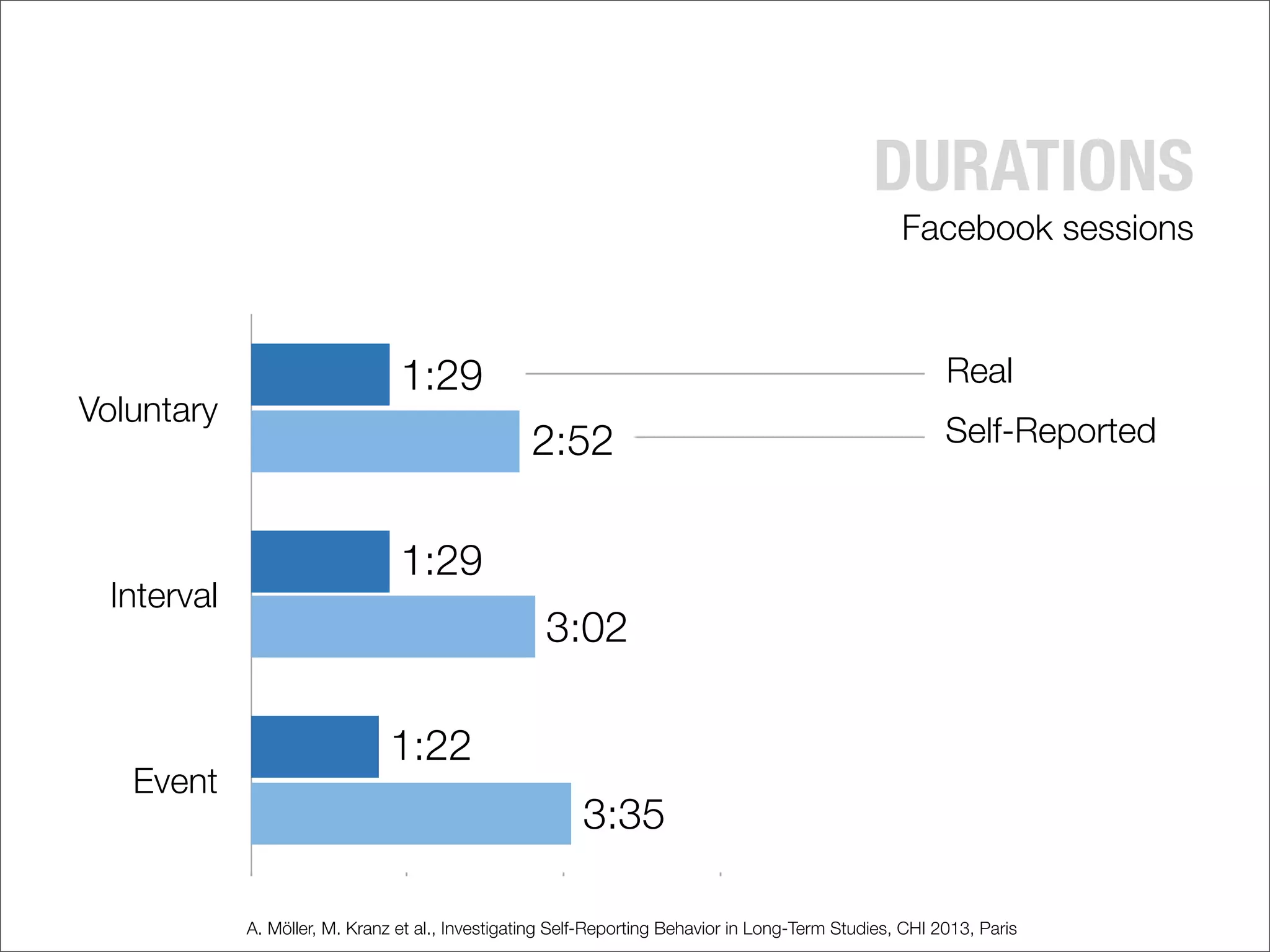
DURATIONS
Voluntary
Interval
Event
1:29
1:29
1:22
2:52
3:02
3:35
Facebook sessions
Real
Self-Reported
A. Möller, M. Kranz et al., Investigating Self-Reporting Behavior in Long-Term Studies, CHI 2013, Paris
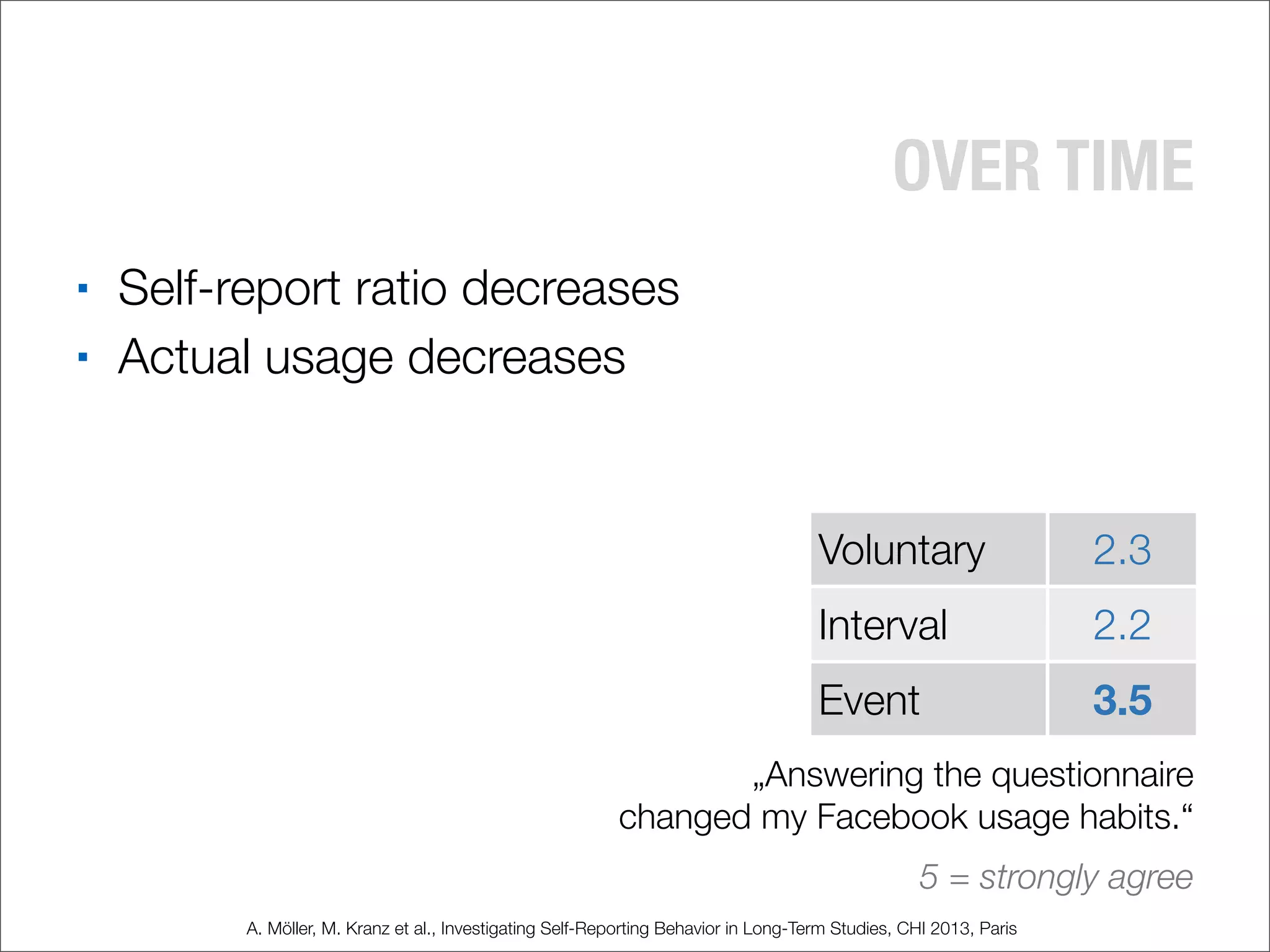
OVER TIME
■ Self-report ratio decreases
■ Actual usage decreases
„Answering the questionnaire
changed my Facebook usage habits.“
Voluntary 2.3
Interval 2.2
Event 3.5
5 = strongly agree
A. Möller, M. Kranz et al., Investigating Self-Reporting Behavior in Long-Term Studies, CHI 2013, Paris
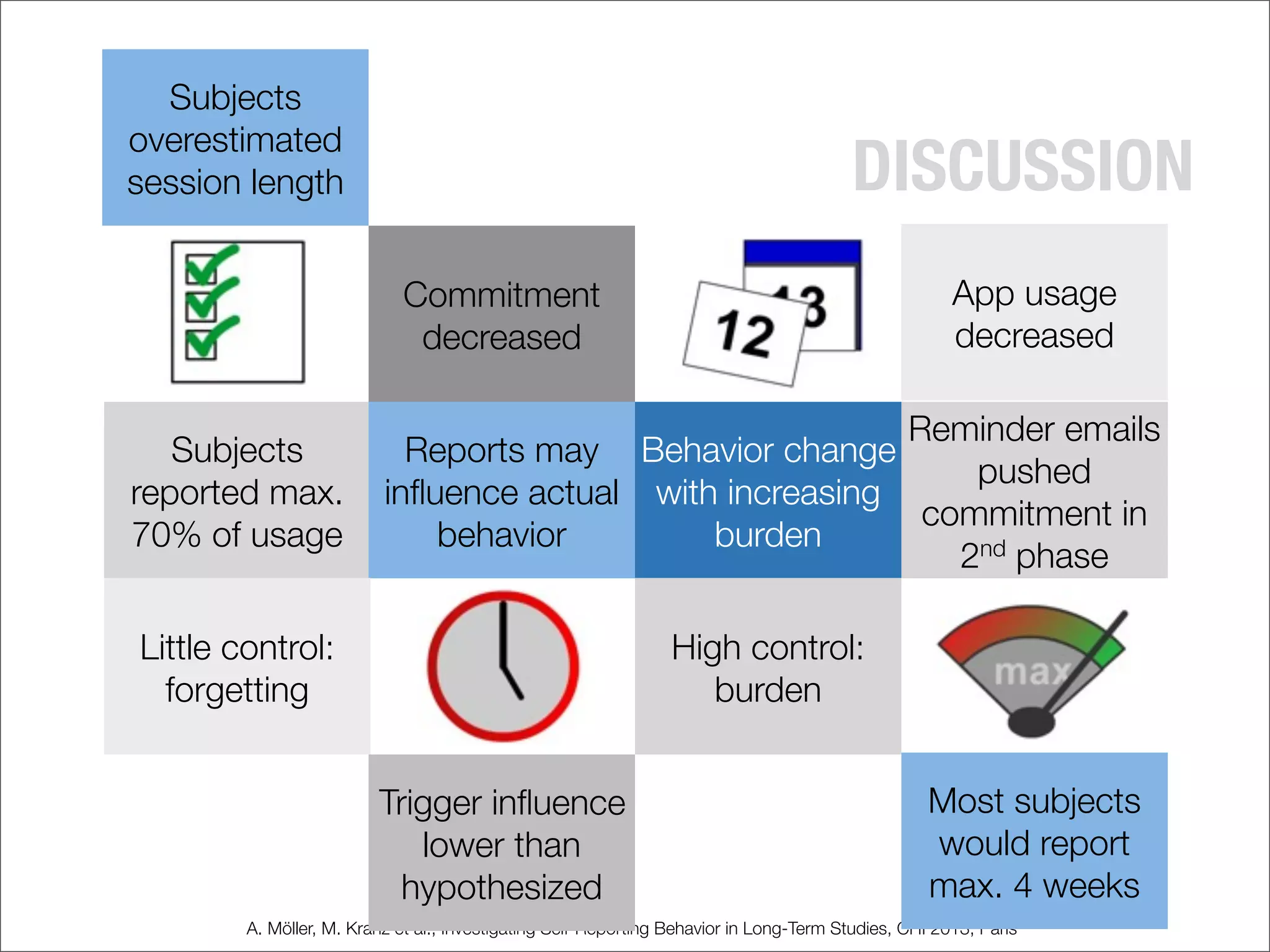
DISCUSSION
Subjects
reported max.
70% of usage
Commitment
decreased
Reports may
influence actual
behavior
Subjects
overestimated
session length
Reminder emails
pushed
commitment in
2nd phase
Behavior change
with increasing
burden
Little control:
forgetting
High control:
burden
Trigger influence
lower than
hypothesized
App usage
decreased
Most subjects
would report
max. 4 weeks
andreas.moeller@tum.de
https://vmi.lmt.ei.tum.de/serena
Please cite this work as follows:
A. Möller, M. Kranz, B. Schmid, L. Roalter, S. Diewald
Investigating Self-Reporting Behavior In Long-Term Studies
In: Proceedings of the SIGCHI Conference on Human Factors in Computing
Systems (CHI 2013), pp. 2931-2940, Paris, France, April-May 2013.
If you use BibTex, please use the following entry:
@inproceedings{chi2013selfreport,
author = {Andreas M"{o}ller and Matthias Kranz and Barbara Schmid and Luis
Roalter and Stefan Diewald},
title = {Investigating Self-Reporting Behavior In Long-Term Studies},
booktitle = {Proceedings of the 2013 ACM annual conference on Human Factors in
Computing Systems},
pages = {2931--2940},
series = {CHI '13},
year = {2013},
isbn = {978-1-4503-1899-0},
location = {Paris, France},
numpages = {10},
publisher = {ACM},
address = {New York, NY, USA},
}

Investigating Self-Reporting Behavior in Long-Term Studies

  • 1.
    INVESTIGATING SELF-REPORTING BEHAVIOR IN LONG-TERMSTUDIES Andreas Möller ✽, Matthias Kranz ❖, Barbara Schmid ✽, Stefan Diewald ✽, Luis Roalter ✽ ✽ Technische Universität München, Germany ❖ Universität Passau, Germany
  • 2.
  • 3.
  • 4.
    RESEARCH QUESTIONS Accuracy? Changeover time? Influence of reporting frequency? Reliability maximization? A. Möller, M. Kranz et al., Investigating Self-Reporting Behavior in Long-Term Studies, CHI 2013, Paris
  • 5.
    BACKGROUND ■ Electronic diariesshow higher compliance (Hufford & Shields, 2002) ■ Mobile phone as survey tool (Consolvo et al., 2007) Consolvo et al., 2007 A. Möller, M. Kranz et al., Investigating Self-Reporting Behavior in Long-Term Studies, CHI 2013, Paris
  • 6.
    CONTRIBUTIONS ■ Empirical quantitativelong-term data on reliability of information collected with mobile devices ■ Recommendations for maximizing result reliability A. Möller, M. Kranz et al., Investigating Self-Reporting Behavior in Long-Term Studies, CHI 2013, Paris
  • 7.
    A. Möller, M.Kranz et al., Investigating Self-Reporting Behavior in Long-Term Studies, CHI 2013, Paris METHODOLOGY Evaluate reporting behavior Ground truth Can be gained in automated way Limited effort Smartphone usage GOAL REQUIRE- MENTS SOLUTION Frequently used apps Installed by everyone
  • 8.
    Mail Facebook Frequently usedapps Installed by everyone A. Möller, M. Kranz et al., Investigating Self-Reporting Behavior in Long-Term Studies, CHI 2013, Paris
  • 9.
    A. Möller, M.Kranz et al., Investigating Self-Reporting Behavior in Long-Term Studies, CHI 2013, Paris PROCEEDING Week 1 Week 2 Week 3 Week 4 Week 5 Week 6 Week 6 + 4 Pre-Questionnaire Reminder Emails Post-Questionnaire Post-Post- Questionnaire Requested Self-Reports & Logging
  • 10.
    TASK ■ Answer questionnaireafter Facebook or Mail usage ■ Report as accurate as possible 1. How long did you use the app? 2. How many times did you use the app without answering a questionnaire? 1 direct report n indirect reports A. Möller, M. Kranz et al., Investigating Self-Reporting Behavior in Long-Term Studies, CHI 2013, Paris
  • 11.
    SELF-REPORTING AND EXPERIENCE SAMPLINGASSISTANT A. Möller, M. Kranz et al., Investigating Self-Reporting Behavior in Long-Term Studies, CHI 2013, Paris
  • 12.
    SERENA ■ App usagelogging ■ Server upload ■ Questionnaire triggers □ Event-based □ Time-based □ Manually A. Möller, M. Kranz et al., Investigating Self-Reporting Behavior in Long-Term Studies, CHI 2013, Paris
  • 13.
    A. Möller, M.Kranz et al., Investigating Self-Reporting Behavior in Long-Term Studies, CHI 2013, Paris 3 CONDITIONS Voluntary Interval Event No trigger Daily trigger Trigger after app usage 30 Participants 3,631 Mail usages 3,181 Facebook usages
  • 14.
    SESSIONS Voluntary Interval Event Amountof reported Facebook usages 37.6% 63.8% 54.3% Indirect reports Direct reports A. Möller, M. Kranz et al., Investigating Self-Reporting Behavior in Long-Term Studies, CHI 2013, Paris
  • 15.
    DURATIONS Voluntary Interval Event 1:29 1:29 1:22 2:52 3:02 3:35 Facebook sessions Real Self-Reported A. Möller,M. Kranz et al., Investigating Self-Reporting Behavior in Long-Term Studies, CHI 2013, Paris
  • 16.
    OVER TIME ■ Self-reportratio decreases ■ Actual usage decreases „Answering the questionnaire changed my Facebook usage habits.“ Voluntary 2.3 Interval 2.2 Event 3.5 5 = strongly agree A. Möller, M. Kranz et al., Investigating Self-Reporting Behavior in Long-Term Studies, CHI 2013, Paris
  • 17.
    A. Möller, M.Kranz et al., Investigating Self-Reporting Behavior in Long-Term Studies, CHI 2013, Paris DISCUSSION Subjects reported max. 70% of usage Commitment decreased Reports may influence actual behavior Subjects overestimated session length Reminder emails pushed commitment in 2nd phase Behavior change with increasing burden Little control: forgetting High control: burden Trigger influence lower than hypothesized App usage decreased Most subjects would report max. 4 weeks
  • 18.
  • 19.
    Please cite thiswork as follows: A. Möller, M. Kranz, B. Schmid, L. Roalter, S. Diewald Investigating Self-Reporting Behavior In Long-Term Studies In: Proceedings of the SIGCHI Conference on Human Factors in Computing Systems (CHI 2013), pp. 2931-2940, Paris, France, April-May 2013. If you use BibTex, please use the following entry: @inproceedings{chi2013selfreport, author = {Andreas M"{o}ller and Matthias Kranz and Barbara Schmid and Luis Roalter and Stefan Diewald}, title = {Investigating Self-Reporting Behavior In Long-Term Studies}, booktitle = {Proceedings of the 2013 ACM annual conference on Human Factors in Computing Systems}, pages = {2931--2940}, series = {CHI '13}, year = {2013}, isbn = {978-1-4503-1899-0}, location = {Paris, France}, numpages = {10}, publisher = {ACM}, address = {New York, NY, USA}, }