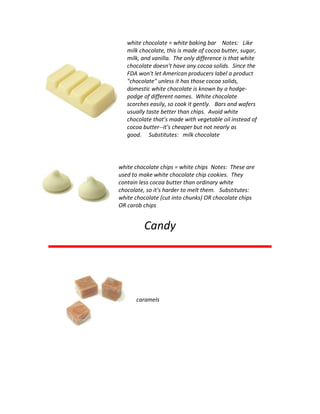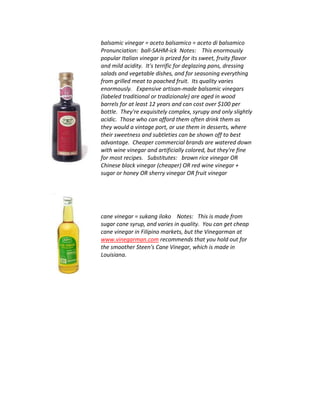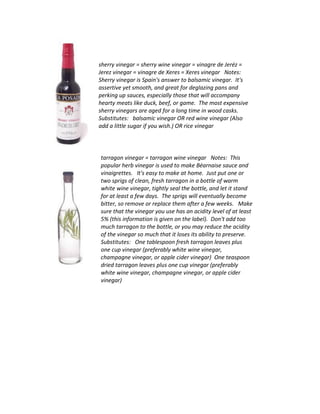
Roots
Synonyms: root vegetables
Root vegetables are rich in nutrients, low in fat
and calories, inexpensive and usually available
throughout the year. Beyond that, they have
wildly varying characteristics. Radishes are
pungent, carrots sweet, beets earthy. Others,
like parsnips, turnips, and rutabagas, have
more subtle flavors. Root vegetables will last
awhile in your pantry, and even longer in your
refrigerator.
Substitutes: tubers
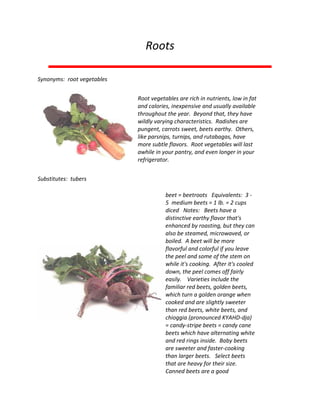
beet = beetroots Equivalents: 3 -
5 medium beets = 1 lb. = 2 cups
diced Notes: Beets have a
distinctive earthy flavor that's
enhanced by roasting, but they can
also be steamed, microwaved, or
boiled. A beet will be more
flavorful and colorful if you leave
the peel and some of the stem on
while it's cooking. After it's cooled
down, the peel comes off fairly
easily. Varieties include the
familiar red beets, golden beets,
which turn a golden orange when
cooked and are slightly sweeter
than red beets, white beets, and
chioggia (pronounced KYAHD-dja)
= candy-stripe beets = candy cane
beets which have alternating white
and red rings inside. Baby beets
are sweeter and faster-cooking
than larger beets. Select beets
that are heavy for their size.
Canned beets are a good
substitute for fresh. Substitutes:
carrots OR (in salads) slicing
tomatoes
beggar's button
black oyster plant
black radish Notes: These large, pungent radishes
are better known in Eastern Europe than in the United
States. With their black peels and white interiors,
they can be fashioned into attractive garnishes, or you
can peel and cook them like turnips. You can also
serve them raw, though it helps to tame them down
first by salting and rinsing them. Substitutes:
rutabaga (much milder flavor) OR turnip (much milder
flavor)
black salsify
burdock = gobo root = great
burdock = beggar's button
Notes: Burdock is becoming
increasingly popular in the
United States, but it's already
an important vegetable in Asia.
It lends an interesting, earthy
flavor to soups, stews, or stir-
fried dishes. Select small, firm
roots. Substitutes: salsify OR
asparagus OR artichoke
hearts
carrot Notes: Raw or cooked, carrots add
sweetness and color to stews, soups, stir-
fries, slaws, cakes, and crudité platters,
plus they're a great source of Vitamin A.
Try to buy them with the greens still
attached, they're usually fresher and
sweeter that way. Equivalents: 1 large
carrot = 1 cup grated Substitutes: parsnip
(don't serve raw) OR jicama OR daikon
(especially if served raw) OR celery (good
raw or cooked) OR celeriac (consider
blanching first if using in a raw salad) OR
turnip (if cooked) OR kohlrabi (great
cooked or raw) OR broccoli OR rutabagas
(if cooked) OR cauliflower OR salsify (dip in
acidulated water after peeling to prevent
them from turning black)
celeriac = celery root = celery knob =
turnip-rooted celery = knob celery =
Germany celery = soup celery = turnip
celery = céleri-rave Pronunciation: suh-
LAIR-ee-yak Notes: This underrated
vegetable is a relative of celery that's been
developed for its root, which has a
pleasant celery flavor. It's popular in
France and Northern Europe, where it's
usually peeled and cooked in stews or
grated and served raw. Many large
supermarkets carry celeriac; select smallish
roots that are heavy for their size.
Substitutes: turnips OR celery ribs (weaker
flavor) OR parsley root OR (in salads of
grated vegetables) carrots + dash celery
seeds
celeri-rave
celery knob
celery root
Chinese radish
Chinese turnip See jicama OR lo bok.
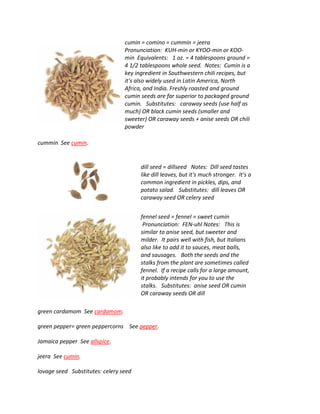
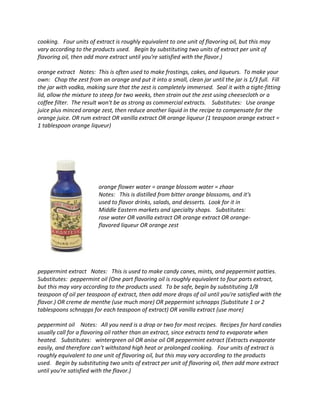
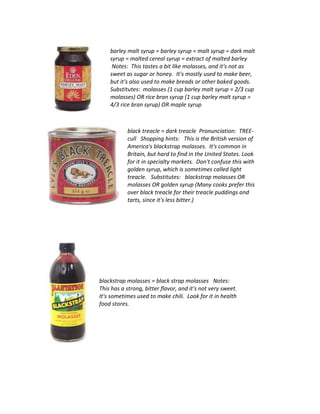
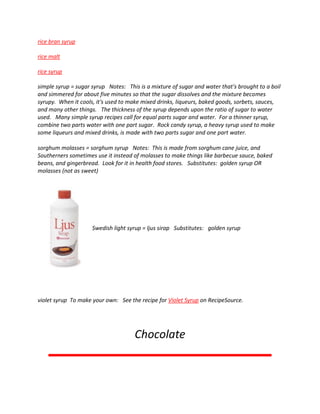
coriander root = cilantro root Notes: Thai recipes sometimes call for these roots, but they're
hard to find in markets. The best source is to pull out a cilantro plant in your garden, or you can
use cilantro stems instead. Substitutes: cilantro stems (use two stems for each root)
daikon = white radish = Japanese radish = Chinese radish =
icicle radish = lo bak = loh baak = loh buk = mooli =
Oriental radish = lo pak Pronuncation: DIE-kon Notes:
Daikon is larger and milder than its relative, the red
radish. The Japanese like to grate it and serve it with sushi
or sashimi, but you can also pickle it, stir-fry it, or slice it
into salads. Japanese daikons tend to be longer and
skinnier than their Chinese counterparts, but the two
varieties can be used interchangeably. Choose specimens
that are firm and shiny. They don't store well, so try to
use them right away. Substitutes: jicama (This is
especially good in recipes that call for daikon to be
grated.) OR young turnip (for pickling) OR radish (not as
hot) OR black radish (much more pungent) OR pickled
ginger (as a garnish) OR parsnips (in soups or stews) OR
turnips (in soups or stews)
Dutch parsley
Germany celery
German mustard
goatsbeard
gobo root
great burdock
Hamburg parsley
heimischer
horseradish (root) = German mustard
Notes: This is a very pungent brown root
that's usually peeled and grated to make
a condiment for meats. Its intense flavor
and aroma dissipate quickly when
exposed to air, so it should be grated just
before serving or mixed with something
sour (like vinegar, lemon juice, or beet
juice) to lock in the heat. It's easiest to use
a blender or food processor to grate it.
Fresh horseradish is surprisingly potent, so
make sure your kitchen is well ventilated,
wear rubber gloves, and don't rub your
eyes. Substitutes: wasabi OR horseradish
sauce (not as potent as freshly grated
horseradish, so use more.) OR black radish
(salt, let stand for an hour, then rinse if
serving raw)
icicle radish
Japanese radish
knob celery
lo bak
loh baak
loh buk
lotus root Notes: Slices of the lotus root have a
beautiful pattern. The fresh version is available
sporadically; if not, the canned version is almost
as good. Rinse and drain before using. Look for
it in Asian markets. Substitutes: water
chestnuts OR sunchokes OR jicama (This is
cheaper, but has a less delicate flavor.)
mooli
Oriental radish
oyster plant
parsley root = parsnip-rooted parsley =
turnip-rooted parsley = Hamburg parsley
= Dutch parsley = heimischer =
padrushka Notes: This is hard to find in
the United States, but it's a popular root
vegetable in Central Europe. Substitutes:
celeriac OR carrots OR parsnips OR
turnips Notes: For more information, see
the Wegman's Food Market's page on
Parsley Root.
parsnip Notes: These are like carrots, except
that they're cream-colored and never served
raw. Northern Europeans like to add them to
stews, but they can also be puréed or served as
a side dish. Choose small, crisp ones.
Substitutes: carrot OR salsify OR turnip OR
celeriac OR parsley root OR sweet potato
parsnip-rooted parsley
radish Notes: With their crisp
texture and peppery flavor, raw
radishes are great in salads and
on crudité platters. They can also
be cut into attractive garnishes.
Select firm, fresh-looking radishes
and store them in your
refrigerator for no more than a
week. Substitutes: daikon
(slightly hotter) OR jicama (for
snacking)
rutabaga = Swede turnip = Swede
= yellow turnip Pronunciation:
roo-tuh-BAY-guh Notes:
Rutabagas look like turnips, only
they're a bit larger and have a
yellow complexion. Use them just
as you would turnips.
Substitutes: turnip (smaller, not
as sweet; takes less time to cook)
OR celeriac OR kohlrabi
salsify = goatsbeard = oyster plant
= vegetable oyster
Pronunciation: SAL-suh-fee OR
SAL-suh-fie Notes: When cooked,
salsify has the taste and texture of
an artichoke heart. There are two
types: white salsify (pictured at
left) and the more highly regarded
black salsify = scorzonera = black
oyster plant = viper grass. After
peeling salsify, put it into
acidulated water right away to
prevent it from turning brown.
Canned salsify is a good substitute
for fresh, but it's hard to find.
Substitutes: parsnip OR burdock
OR Jerusalem artichoke OR
artichoke heart OR asparagus OR
turnip OR carrot
scorzonera
soup celery
Swede
Swede turnip
turnip Notes: Turnips can be
roasted, boiled, steamed, or stir-fried.
Select small turnips that feel heavy for
their size. Substitutes: rutabaga
(larger and sweeter than turnips;
takes longer to cook) OR kohlrabi
bulbs (similar flavor) OR black radish
(more pungent) OR celeriac OR
parsnip OR carrot OR salsify OR
daikon
turnip celery
turnip-rooted celery
turnip-rooted parsley
vegetable oyster
viper grass
white radish
white salsify
yellow turnip
Tubers & Corms
Technically, tubers and corms are swollen
underground plant stems, but it's easier to
think of them as the "family of potato-like
vegetables." They're used worldwide as a
source of carbohydrates, often taking a
back seat to more flavorful and colorful
ingredients.
Pronunciation: TOO-ber OR TYOO-ber and KORM
Varieties:
ahipa
apio
arracacha = apio Shopping hints: These come from South America. According to the FAO, they
taste like a cross between celery, cabbage, and chestnuts. Substitutes: potatoes
arrowhead
arrowroot = arrow root = Chinese
potato (this name also is used for
jicama) = goo = seegoo =
arrowhead = Chinese arrowhead =
tse goo = ci gu = tsu goo Notes:
The name arrowroot is more
commonly associated with a
thickener that's made from the
plant. A fresh arrowroot tuber
looks like a small onion, only
without the layers. It should be
peeled, and then it can be boiled or
stir-fried. Look for it in Chinese
markets during the winter.
Substitutes: water chestnuts
OR jicama
baddo
bitter casava
Brazilian arrowroot
casava
cassava = casava = manioc = mandioca =
tapioca root = yucca = yucca root = yuca
root = Brazilian arrowroot
Pronunciation: kuh-SAH-vuh Notes:
People in Hispanic countries use
cassavas much like Americans use
potatoes. There's both a sweet and a
bitter variety of cassava. The sweet one
can be eaten raw, but the bitter one
requires cooking to destroy the harmful
prussic acid it contains. It's often best to
buy frozen cassava, since the fresh kind
is hard to peel. Look for it in Hispanic
markets. It doesn't store well, so use it
within a day or two of purchase.
Substitutes: malanga OR dasheen OR
potato (not as gluey)
Chinese artichoke = crosne = Japanese artichoke = chorogi Notes: These look a bit like
caterpillars, and they taste like Jerusalem artichokes. They're popular in France but hard to find
in the U.S. Your best bet would be an Asian market. Substitutes: Jerusalem artichoke OR
salsify
Chinese potato See arrow root or jicama.
Chinese water chestnut
coco
cocoyam
dasheen
eddo
elephant's ear
girasole
goo
Japanese artichoke
Japanese potato
Jerusalem artichoke = sunchoke =
sunroot = topinambour = girasole
Equivalents: One cup sliced = 150
grams Notes: These look like
small, knobby potatoes, but they
have a crisp texture and an
interesting earthy flavor. You can
eat them raw, stir-fry them, or bake
them like potatoes. It's best not to
peel them, but you'll want to scrub
off the dirt. If you slice them, dunk
them immediately in acidulated
water to keep them from
discoloring. Substitutes: artichoke
hearts (Artichoke hearts are less
crunchy, but their flavor is
somewhat similar flavor to
Jerusalem artichokes.) OR potatoes
(This is a good substitute if the
recipe calls for the Jerusalem
artichokes to be baked.) OR water
chestnuts ( These have a similar
texture to Jerusalem artichokes.)
OR jicama ( This is less expensive
than Jerusalem artichokes. The
texture is similar, but the flavor is
completely different.)
jicama = jícama = yam bean =
Mexican yam bean = ahipa = saa
got = Chinese potato (this name
also is used for arrow root) =
Mexican potato = Chinese turnip
(this name also is used for lo bok)
Pronunciation: HIH-kuh-ma
Equivalents: One jicama, cubed = 2
cups Notes: This tan-skinned
tuber has a mild, nondescript
flavor, but a nice crunchy texture.
It's a good, cheap substitute for
water chestnuts in stir-fries. Since
it doesn't discolor, it's also a great
vegetable to serve raw on a crudité
platter. Peel it before using.
Substitutes: water chestnuts (These
are more expensive and sweeter
than jicama. Like jicama, water
chestnuts retain their crispiness
when stir-fried.) OR Jerusalem
artichoke ( Like jicama, these can
be eaten raw and they stay crunchy
even when stir-fried. They're more
expensive than jicama, but they
have an earthier, nuttier flavor.) OR
tart apples OR turnips OR daikon
radish
lilly root
ling gaw
malanga = tanier = tannier = tannia =
yautia Notes: Like taro and cassava,
malanga is used in tropical countries in
much the same way that potatoes are
used in more temperate climates.
Substitutes: dasheen OR sweet potato OR
potato OR yam OR plantain
mandioca
manioc
Mexican potato
Mexican yam bean
old cocoyam
potatoes
saa got
sato-imo
seegoo
sunchoke
sunroot
sweet casava
sweet potatoes
tanier
tannia
tannier
tapioca root
taro = taro root = dasheen = coco = cocoyam
= eddo = Japanese potato = baddo =
elephant's ear = old cocoyam = sato-imo
Pronunciation: TAHR-oh Notes: If you've
sampled poi at a Hawaiian luau, then you're
already familiar with taro. Many people
don't think much of poi, but taro can be
served far more advantageously. It has an
interesting, nutty flavor, and it's quite good
in stews or soups, or deep-fat fried or
roasted. In its raw state, it can be toxic and
harsh on the skin, so wear gloves or oil your
hands when handling it, and always cook it
before serving it. Substitutes: malanga OR
parsnip OR sweet potato OR yam OR new
potatoes
topinambour
water chestnut = Chinese water chestnut
Notes: Water chestnuts are delightfully
sweet and crisp--if you buy them fresh.
Though canned water chestnuts are more
easily available, they're not nearly as good.
Look for fresh water chestnuts in Asian
markets. You need to peel off their brown
jackets and simmer them for five minutes
before stir-frying. If you must use canned
water chestnuts, blanch them first in boiling
water for thirty seconds. Substitutes: jicama
(less expensive, but less flavorful) OR
Jerusalem artichokes OR lotus roots
(especially if you don't have access to fresh
water chestnuts; canned lotus roots are more
crisp and flavorful than canned water
chestnuts)
water lily root
yam bean
yam
yautia
yuca root Pronunciation: YOO-kuh See cassava.
yucca root Pronunciation: YOO-kuh See cassava.
Stalk Vegetables
anise
asparagus
Pronunciation: uh-SPARE-uh-gus
Asparagus has a wonderfully distinctive
flavor and a meaty texture. It's often
served as a side dish, after being steamed
or briefly boiled. Better cooks insist that it
be peeled first, but many people skip this
step. To remove the tough base, simply
snap the asparagus in half with your
hands. The stalk should break right about
at the point where it starts getting too
tough to serve to company.
There's a purple variety, but it turns green when it's cooked and so loses its novelty.
White asparagus, on the other hand, is more tender than green, and more
expensive. Asparagus is often available year-round, but the best time to buy it is in
the spring.
Substitutes: white asparagus OR leeks OR okra OR fiddlehead fern OR broccoli
bamboo shoots = takenoko = take-noko =
tung sun = choke-sun = chun-sun Notes:
You can buy fresh shoots at some Chinese
markets, but you must boil them first to
rid them of hydrocyanic acid, a toxin that
causes cyanide poisoning. Canned shoots
are safer and more widely available.
Rinse them well before using. Submerge
any unused shoots in fresh water and
store them in a sealed container in the
refrigerator, changing the water daily.
Substitutes: asparagus OR coconut shoots
(sweeter)
bulb fennel
cardoon = cardoni = cardi = Texas celery
= chardoon Pronunciation: kar-DOON
Notes: This vegetable is very likely an
early ancester of the artichoke. Its large,
grayish-green stalks are somewhat
bitter, but they remain popular in Italy
and North Africa. You can find them in
large produce markets in late fall.
Substitutes: artichoke hearts OR celery
(not as bitter) OR salsify
celery Equivalents: 1 rib
= 1/2 cup sliced Notes:
Raw celery is flavorful
and wonderfully crunchy,
and it's a great vehicle for
dips or fillings like peanut
butter or cream cheese.
Celery can also be
sautéed and used to
flavor soups, stews, and
sauces. A bunch or stalk
of celery consists of a
dozen or so individual
ribs, with the tender
innermost ribs called the
celery heart.
Substitutes: carrots (for
snacking) OR fennel
stalks (takes longer to
cook) OR Chinese celery
(This is a good substitute
if the celery is to be
cooked; Chinese celery
has a more intense flavor
than conventional celery.)
OR bok choy (raw or
cooked) OR cardoon (for
cooking) OR jicama (for
snacking or crudités)
Chinese celery = khuen
chai = kinchay Notes:
This has a stronger flavor
than ordinary celery, and
it's often used in stir-fries
and soups. Look for it in
Asian markets.
Substitutes: celery
coconut shoots Substitutes: bamboo shoots (not as sweet)
fennel = finocchio = Florence fennel =bulb
fennel = garden fennel = sweet fennel =
(incorrectly) sweet anise = (incorrectly)
anise Equivalents: 1 cup sliced = 87 grams;
1 bulb = 2 1/2 cups Notes: Fennel tastes
like licorice or anise, and it's commonly used
in Italian dishes. It's very versatile; you can
sauté it and add it to sauces, braise it as a
side dish, or serve it raw as a crudité.
Substitutes (for fennel bulb): Belgian endive
+ 1 teaspoon crushed fennel or anise seed
OR celery + 1 teaspoon crushed fennel or
anise seed (celery takes less time to cook)
OR celery + chopped onion + crushed fennel
or anise seed (celery takes less time to cook)
OR celery + Pernod, Ricard, or anisette
(celery takes less time to cook) OR udo OR
celery (celery takes less time to cook)
Substitutes (for fennel leaves = fennel
feathers): unsprayed avocado leaves OR
hoja santa leaves OR parsley Notes: For
more information, see the Wegman's Food
Market's page on Fennel.
fern
fiddlehead fern = pohole = fiddlehead greens = fern
Notes: When a fern first emerges from the
ground, its uncoiled frond is called a fiddlehead.
Edible varieties of fiddleheads include those from
the ostrich fern and the less common wood fern.
They're available in the late spring and early
summer. Select the smallest, freshest-looking
fiddleheads you can find. Warning: Fiddleheads
from bracken ferns resemble those from ostrich
ferns, but are believed to be carcinogenic. Be very
careful if you're gathering fiddleheads from the
wild. Undercooked ostrich fern fiddleheads also
have been linked to some cases of food poisoning.
Substitutes: asparagus OR green beans OR
spinach
finocchio
Florence fennel
garden fennel
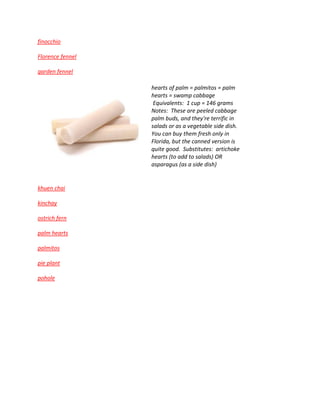
hearts of palm = palmitos = palm
hearts = swamp cabbage
Equivalents: 1 cup = 146 grams
Notes: These are peeled cabbage
palm buds, and they're terrific in
salads or as a vegetable side dish.
You can buy them fresh only in
Florida, but the canned version is
quite good. Substitutes: artichoke
hearts (to add to salads) OR
asparagus (as a side dish)
khuen chai
kinchay
ostrich fern
palm hearts
palmitos
pie plant
pohole
rhubarb = pie plant Pronunciation:
ROO-barb Notes: Though a
vegetable, rhubarb is treated more
like a fruit, and it's typically made into
such things as pies, tarts, preserves,
and wine. It's very tart, and at its best
when combined with berries.
Varieties includes cherry rhubarb and
the more delicate strawberry
rhubarb. Fresh rhubarb shows up in
markets in the spring. If you can't find
it fresh, frozen rhubarb is a fine
substitute. Don't eat rhubarb leaves;
they contain high levels of oxalic acid,
a toxin. Substitutes: cranberries OR
quinces
swamp cabbage
sweet anise
sweet fennel
udo Substitutes: fennel
white asparagus Notes: Growers make asparagus
white by shielding it from the sun, thus stifling the
production of chlorophyll. The result is daintier
looking and a bit more tender than green
asparagus. Substitutes: asparagus
wild asparagus
Onions
green onions and leeks
dry onions and shallots
Garlic
Synonyms: stinky rose
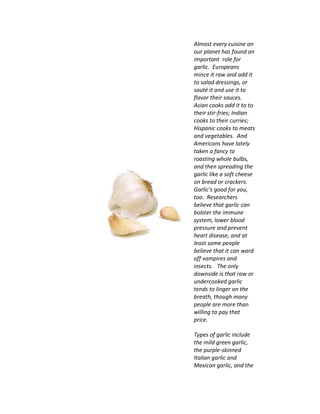
Almost every cuisine on
our planet has found an
important role for
garlic. Europeans
mince it raw and add it
to salad dressings, or
sauté it and use it to
flavor their sauces.
Asian cooks add it to to
their stir-fries; Indian
cooks to their curries;
Hispanic cooks to meats
and vegetables. And
Americans have lately
taken a fancy to
roasting whole bulbs,
and then spreading the
garlic like a soft cheese
on bread or crackers.
Garlic's good for you,
too. Researchers
believe that garlic can
bolster the immune
system, lower blood
pressure and prevent
heart disease, and at
least some people
believe that it can ward
off vampires and
insects. The only
downside is that raw or
undercooked garlic
tends to linger on the
breath, though many
people are more than
willing to pay that
price.
Types of garlic include
the mild green garlic,
the purple-skinned
Italian garlic and
Mexican garlic, and the
common white-skinned
garlic = California
garlic, which is the most
pungent of all.
Equivalents:
A head or bulb of garlic usually contains about 10 cloves. 1 clove = 1
teaspoon chopped garlic = 1/2 teaspoon minced garlic = 1/8 teaspoon
garlic powder = 1/2 teaspoon garlic flakes = 1/4 teaspoon granulated
garlic = 1/2 teaspoon garlic juice
Substitutes:
 granulated garlic (provides flavor, but not texture) OR
 garlic flakes (Substitute 1/2 teaspoon garlic flakes for
every clove of garlic) OR
 garlic powder (Substitute 1/8 teaspoon powder for every
clove of garlic called for in recipe.) OR
 garlic salt (Substitute 1/2 teaspoon garlic salt for every
clove of fresh garlic called for in recipe. Reduce salt in
recipe.) OR
 asafetida (powder) OR
 rocambole OR
 garlic juice (especially when you want the flavor, but not
the pungency, of garlic) OR
 shallots OR
 onions OR
 garlic chives
Varieties:
dehydrated minced garlic See garlic flakes.
dried garlic flakes See garlic flakes.
elephant garlic = great-
headed garlic = Oriental
garlic Notes: This looks
like an overgrown garlic, but
it's more closely related to a
leek. It's much milder than
ordinary garlic, so it's a
good choice if you want to
impart the flavor of garlic to
a delicately flavored dish.
It's often sold in a mesh
stocking to keep the cloves
together. Substitutes: garlic
(smaller and more potent)
garlic flakes = dehydrated
minced garlic = dried garlic
flakes Notes: When
rehydrated in water, garlic
flakes provide much of the
flavor and texture of fresh
garlic. Substitutes: garlic
(1 clove of garlic = 1/2
teaspoon of garlic flakes)
OR garlic powder (1/8
teaspoon garlic powder =
1/2 teaspoon garlic flakes)
garlic greens = garlic
sprouts Substitutes: greens
onions + minced garlic
garlic juice Notes: These are sold in spray
bottles or in small jars. Look for them in
the spice section of larger supermarkets.
To make your own: Strain the juice from a
jar of minced or pressed garlic.
Substitutes: granulated garlic (1/4
teaspoon granulated garlic = 1/2 teaspoon
garlic juice) OR garlic powder (1/8
teaspoon garlic powder = 1/2 teaspoon
garlic juice)
infused garlic oil To make your own: Add whole cloves of garlic to olive
oil and heat gently, then discard cloves. Use immediately or refrigerate
and use within 24 hours. OR Combine one cup vegetable oil and one
teaspoon minced garlic. Use immediately or refrigerate and use within
24 hours.
garlic powder = powdered
garlic Notes: Garlic powder
provides some of the flavor,
but not the texture, of fresh
garlic. It disperses well in
liquids, so it's a good choice
for marinades. Substitutes:
fresh garlic (Substitute 1 clove
for every 1/8 teaspoon garlic
powder.) OR garlic salt
(Substitute 4 teaspoons garlic
salt for every teaspoon garlic
powder, then reduce salt in
recipe by 3 teaspoons.) OR
garlic juice (1/8 teaspoon
garlic powder = 1/2 teaspoon
garlic juice) OR garlic flakes
(1/8 teaspoon garlic powder =
1/2 teaspoon garlic flakes) OR
granulated garlic (1/8
teaspoon garlic powder = 1/4
teaspoon granulated garlic )
garlic salt To make your own:
Combine 3 parts salt and 1 part
garlic powder.
granulated garlic Notes: Like
garlic powder, granulated
garlic provides the flavor, but
not the texture, of fresh garlic.
It disperses well in liquids.
Substitutes: garlic powder (1
teaspoon granulated garlic =
1/2 teaspoon garlic powder)
great-headed garlic See elephant garlic.
green garlic See garlic.
Italian garlic See garlic.
Mexican garlic See garlic.
Oriental garlic See elephant garlic.
white-skinned garlic See garlic.
Ginger & Other Rhizomes
Rhizomes are knobby underground stems
that have pungent and flavorful flesh.
Ginger is the most familiar example, other
rhizomes include turmeric, galangal, lesser
galangal, and fingerroot.
Pronunciation: RYE-zome
Varieties:
baby ginger See green ginger.
Chinese ginger See fingerroot.
Chinese key See fingerroot.
fingerroot = Chinese ginger = Chinese key = ka
chai = kra chai = krachai Latin name:
Kaempferia galanga Notes: This ginger
relative is popular in Thailand. It resembles
long fingers jutting from a hand. Substitutes:
lesser galangal OR galangal (sharper flavor) OR
ginger
fresh ginger See ginger root.
fresh turmeric See turmeric.
galanga (ginger) See galangal.
galangal = galanga (ginger) = greater
galangal = (greater) galingale = (greater)
galangale = Java root = Java galangal =
kha = khaa = languas = lengkuas = laos
(root or ginger) = Thai ginger = Siamese
ginger Latin name: Alpinia galanga
Notes: Look for this in Asian markets. It's
sold fresh, frozen, dried, or powdered, but
use the dried or powdered versions only in
a pinch. Substitutes: ginger (not as
pungent as galangal)
galangale See galangal.
galingale See galangal.
geung See ginger root.
ginger root = gingerroot = ginger = fresh
ginger = geung = khing = shoga
Equivalents: 1/4 cup, sliced = 1 ounce
Notes: With its sweet yet pungent flavor,
ginger has become a mainstay of many of
the world's cuisines. European cooks like to
use dried, ground ginger to flavor
gingerbread and other baked goods. Asian
and Indian cooks prefer their ginger fresh,
and they use it in spicy sauces and stir-fries.
Ginger not only tastes good, it's also believed
to have medicinal properties, and people
sometimes use it to soothe their upset
stomachs and boost their energy. Ground
ginger isn't a good substitute for fresh, but
dried whole ginger will work in a pinch, as
will the minced or puréed ginger that's sold
in jars. Equivalents: 1 tablespoon fresh =
¼ teaspoon ground Substitutes: green
ginger (not as flavorful) OR galangal (More
pungent than ginger, but works well in many
spicy Asian dishes.) OR crystallized ginger
(Substitute 1/4 cup minced crystallized
ginger for every tablespoon of minced fresh
ginger called for in recipe. Rinse off sugar
before using.)
gingerroot See ginger root.
green ginger = spring ginger = new ginger =
young ginger = stem ginger = pink ginger =
baby ginger Notes: These pink-tipped, shiny
pieces of young ginger are mild and usually
don't need to be peeled. They're easy to find
in Asian markets. Substitutes: ginger (more
pungent)
greater galangal See galangal.
greater galangale See galangal.
greater
Indian ginger See turmeric.
Java root See galangal.
Java galangal See galangal.
ka chai See fingerroot.
kencur root See lesser galangal.
kentjur root See lesser galangal.
kha See galangal.
khaa See galangal.
khing See ginger root.
kra chai = krachai See fingerroot.
languas See galangal.
laos (root or ginger) See galangal.
lengkuas See galangal.
lesser galangal = lesser galangale = kencur root = kentjur root = zedoary Notes: This
Indonesian rhizome looks a bit like ginger, only it's smaller and darker. It's hard to find in the
U.S., but your best bet is to look in Asian markets. It's sold fresh, frozen, pickled, dried, or
powdered. Used the dried or powdered versions only in a pinch. One teaspoon powdered = two
teaspoons fresh minced. Substitutes: fingerroot OR galangal (sharper flavor) OR ginger
lesser galangale See lesser galangal.
mango ginger See turmeric.
miyoga = miyoga ginger Notes: These are
flower buds that emerge from a variety of
ginger. They're quite mild. Look for them in
Japanese markets. Substitutes: green ginger
new ginger See green ginger.
pink ginger See green ginger.
shoga See ginger root.
Siamese ginger See galangal.
spring ginger See green ginger.
stem ginger See green ginger.
Thai ginger See galangal.
turmeric = fresh turmeric = Indian
ginger = yellow ginger = mango
ginger Pronunciation: TUR-muhr-ik
Shopping hints: Turmeric has a
pungent flavor, but it's more widely
known for it's brilliant yellow color.
You can find fresh roots in Southeast
Asian and Indian markets, but dried
ground turmeric is far more
commonly used. Be careful when
handling fresh turmeric--it can stain
your hands and clothes.
Equivalents: 1 piece fresh turmeric =
1 teaspoon powdered turmeric.
Substitutes: ground turmeric OR
saffron (much more expensive, and
more flavorful) OR Steep annatto
seeds in boiling water for 20
minutes, then discard the seeds.
yellow ginger See turmeric.
young ginger See green ginger.
Cabbages
The many varieties of cabbage can be wildly
dissimilar, but most have a short, broad stem and
leaves or flowers that form a compact head. The
most common cabbages are green and red
cabbage, collards, kohlrabi, broccoli, Brussels
sprouts, cauliflower, and kale. They're loaded
with vitamin C, fiber, and possibly cancer-fighting
compounds to boot.
baak choi See bok choy.
baby bok choy See bok choy.
bok choy = Chinese chard = Chinese white cabbage
= Chinese cabbage = Chinese mustard cabbage =
pak choy = pak choi = baak choi = white mustard
cabbage = white celery mustard = taisai = bai cai
Pronunciation: BAHK-choy Notes: Bok choy has
crunchy stems and crinkled, spinach-like leaves. It's
usually stir-fried with other ingredients, but it can
also be steamed or sautéed and served as a side
dish. Small heads of bok choy are called baby bok
choy (left), and they're more tender than the larger
variety. Of the baby bok choys, bok choy sum =
Canton bok choy has small yellow flowers (sum is
the Chinese word for flower), while Shanghai bok
choy is a uniform light green, doesn't have flowers,
and isn't as sweet. Substitutes: Chinese broccoli
OR yau choy OR napa cabbage (for stir-frying only;
don't boil) OR broccoli OR Swiss chard OR celery
(especially in stir-fry dishes) OR collard greens OR
beet greens
bok choy sum See bok choy.
Brussels sprouts Notes: These look like small
cabbages, and they're most often boiled or
steamed and served as a side dish. They have a
rather strong flavor, so it's best not to pair
them with anything that's delicately flavored.
They don't store well, so use them within a day
or two after purchasing. Substitutes: broccoli
flowerets (cooks more quickly)
cabbage See green cabbage and red cabbage.
cabbage turnip See kohlrabi
Canton bok choy See bok choy.
celery cabbage See napa cabbage.
Chinese cabbage This name is used for both napa cabbage and bok choy.
Chinese celery cabbage See napa cabbage.
Chinese chard See bok choy.
Chinese leaf See napa cabbage.
Chinese mustard cabbage See bok choy.
Chinese white cabbage See bok choy.
choy sum This is a general term in Chinese for the tender inner stalks and flowers of green
vegetables. White choy sum usually refers to bok choy, while green choy sum refers to yau
choy.
flowering cabbage See flowering kale.
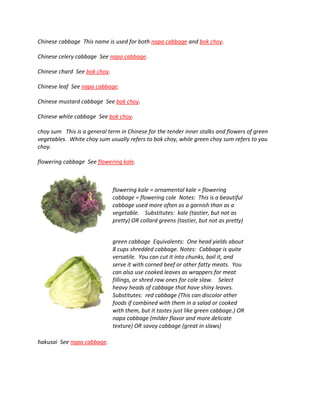
flowering kale = ornamental kale = flowering
cabbage = flowering cole Notes: This is a beautiful
cabbage used more often as a garnish than as a
vegetable. Substitutes: kale (tastier, but not as
pretty) OR collard greens (tastier, but not as pretty)
green cabbage Equivalents: One head yields about
8 cups shredded cabbage. Notes: Cabbage is quite
versatile. You can cut it into chunks, boil it, and
serve it with corned beef or other fatty meats. You
can also use cooked leaves as wrappers for meat
fillings, or shred raw ones for cole slaw. Select
heavy heads of cabbage that have shiny leaves.
Substitutes: red cabbage (This can discolor other
foods if combined with them in a salad or cooked
with them, but it tastes just like green cabbage.) OR
napa cabbage (milder flavor and more delicate
texture) OR savoy cabbage (great in slaws)
hakusai See napa cabbage.
kohlrabi = cabbage turnip = stem
cabbage = turnip cabbage
Pronunciation: kohl-RAHB-ee or
kohl-RAH-bee Notes: A kohlrabi
resembles a turnip, only it's
sweeter and more delicately
flavored. It's light green and
sometimes sold with its edible
greens attached. It can be eaten
raw or cooked. Choose small ones,
and peel before using.
Substitutes: broccoli stems OR
celeriac (especially in
remoulades) OR turnips OR
parsnips
michihli See napa cabbage.
napa cabbage = nappa cabbage = celery
cabbage = Chinese celery cabbage = Peking
cabbage = Chinese cabbage = wong bok =
petsai = shantung cabbage = hakusai =
Chinese leaf (leaves) = michihli Notes:
Like bok choy, napa cabbage is a common
ingredient in Asian stir-fries. It can also be
used as a milder and more delicate
alternative to green cabbage in slaws and
other recipes. Substitutes: bok choy OR
cabbage (stronger flavor, takes longer to
cook) OR savoy cabbage (stronger flavor,
takes longer to cook)
nappa cabbage See napa cabbage.
ornamental kale See flowering kale.
pak choi See bok choy.
pak choy See bok choy.
Peking cabbage See napa cabbage.
petsai See napa cabbage.
red cabbage Equivalents: One head yields
about 8 cups shredded cabbage. Notes:
Red cabbage tastes just like green cabbage,
so your choice between them depends
largely on which color you prefer. One
problem with red cabbage, though, is that
the color tends to bleed and discolor
surrounding foods. Select heavy heads of
cabbage that have shiny leaves.
Substitutes: green cabbage (This tastes just
like red cabbage.) OR napa cabbage (milder
flavor, more delicate texture) OR savoy
cabbage (great in slaws)
savoy cabbage Notes: Savoy cabbage is
like ordinary cabbage, but with a milder
flavor. It can often be used in place of
green cabbage, and your dish will probably
be the better for it. Substitutes: cabbage
(This has a stronger flavor and isn't as
tender as savoy cabbage.) OR napa
cabbage (This has a milder flavor.)
Shanghai bok choy. See bok choy.
shantung cabbage See napa cabbage.
stem cabbage See kohlrabi
su choy Notes: This is just like napa
cabbage, only elongated. Substitutes: napa
cabbage
taisai See bok choy.
turnip cabbage See kohlrabi
white celery mustard See bok choy.
white mustard cabbage See bok choy.
wong bok See napa cabbage.
yau choy = yao choy = yow choy = yu choy
= edible rape = flowering edible rape =
green choy sum = you cai Notes: Yau
choy is more tender and delicately flavored
than other Asian cabbages. Substitutes:
bok choy
Salad Greens
arrugola
arugula [uh-REW-guh-la] = arrugola = (in
Britain ) rocket (salad) = tira = Italian cress =
Mediterranean rocket = rugola = rugula =
roquette = rucola With its peppery and slightly
bitter flavor, arugula is a terrific green to throw
into an otherwise boring salad. It can be
gently braised, too. Some supermarkets sell it
in small bunches, but you're more likely to find
it combined with other greens in a spring salad
mix. Equivalents: 1 cup = 1 ounce Substitutes:
WATERCRESS OR tender SPINACH leaves plus dash
of ground PEPPER OR BELGIAN ENDIVE OR ESCAROLE
OR young DANDELION GREENS (more bitter) OR
young MUSTARD GREENS OR CHICORY OR RADICCHIO
Belgian endive = French endive = witloof =
witloof chicory = chicory (in Britain) = Belgium
chicory = blanching chicory = Dutch chicory =
green-leaved blanching chicory = chicon
Notes: These crunchy, slightly bitter leaves are
often used to make hors d'oeuvres, but they can
also be chopped and added to salads, or braised
to make an exquisite (and expensive) side dish.
Select heads with yellow tips; those with green
tips are more bitter. Their peak season is the
late fall and winter. Substitutes:
radicchio (similar flavor) OR arugula OR
watercress
Bibb lettuce = limestone lettuce Notes: This
butterhead lettuce has delicate, loose leaves and lots
of flavor. The only downside is that it's usually
expensive. Substitutes: Boston lettuce (larger) OR
corn salad OR leaf lettuce OR celery leaves
Boston lettuce Notes: This is a type of butterhead
lettuce, with soft, tender leaves. It's terrific in salads
and sandwiches, or the leaves can be used as a bed for
other dishes. Substitutes: Bibb lettuce (smaller,
more flavorful, and more expensive) OR corn salad OR
leaf lettuce OR iceberg lettuce OR celery leaves
butterhead lettuce = butter lettuce Notes: This category includes Bibb lettuce and Boston
lettuce.
chicory
chioggia
claytonia
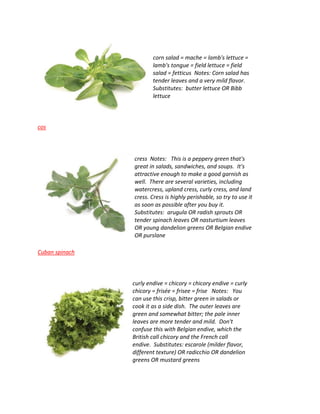
corn salad = mache = lamb's lettuce =
lamb's tongue = field lettuce = field
salad = fetticus Notes: Corn salad has
tender leaves and a very mild flavor.
Substitutes: butter lettuce OR Bibb
lettuce
cos
cress Notes: This is a peppery green that's
great in salads, sandwiches, and soups. It's
attractive enough to make a good garnish as
well. There are several varieties, including
watercress, upland cress, curly cress, and land
cress. Cress is highly perishable, so try to use it
as soon as possible after you buy it.
Substitutes: arugula OR radish sprouts OR
tender spinach leaves OR nasturtium leaves
OR young dandelion greens OR Belgian endive
OR purslane
Cuban spinach
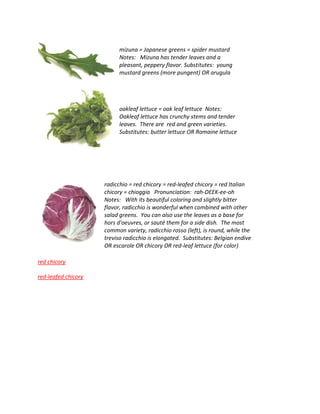
curly endive = chicory = chicory endive = curly
chicory = frisée = frisee = frise Notes: You
can use this crisp, bitter green in salads or
cook it as a side dish. The outer leaves are
green and somewhat bitter; the pale inner
leaves are more tender and mild. Don't
confuse this with Belgian endive, which the
British call chicory and the French call
endive. Substitutes: escarole (milder flavor,
different texture) OR radicchio OR dandelion
greens OR mustard greens
dandelions = dandelion greens Notes:
Dandelions have a somewhat bitter flavor,
which Europeans appreciate more than
Americans. Older dandelion greens should
be cooked; younger ones can be cooked or
served raw as a salad green. They're
available year-round, but they're best in the
spring. Substitutes: watercress (not as
bitter) OR curly endive OR escarole OR
arugula OR collard greens (if cooked)
endigia = red endive Notes: This crunchy
new French variety blends sweet and bitter
flavors. Substitutes: Belgian endive OR
radicchio
endive Notes: This category includes Belgian endive, curly endive, frisee, and escarole.
escarole = Batavian endive = Batavia =
scarole Notes: Escarole has sturdy leaves and
a slightly bitter flavor. Young escarole leaves
are tender enough to add to salads, otherwise
escarole is best cooked as a side dish or used
in soups. Substitutes: curly endive (stronger
flavor, different flavor) OR radicchio OR
borage OR mustard greens OR arugula OR
spinach
fetticus
field greens
field lettuce
field salad
French endive
green-leaf lettuce Substitutes: red-leaf
lettuce (different color, but otherwise similar)
OR bibb lettuce
iceberg lettuce = head lettuce = cabbage
lettuce = crisphead lettuce Notes: This is
prized for its crispness and longevity in the
refrigerator, but it's a bit short on flavor
and nutrients. Substitutes: romaine
lettuce (also crunchy, and more flavorful)
OR leaf lettuce
Italian cress
Japanese greens
lamb's lettuce
lamb's tongue
leaf lettuce = looseleaf lettuce = bunching lettuce = cutting lettuce = salad-bowl lettuce =
lechuga Notes: With their crispness and mild flavor, these lettuces are great in salads and
sandwiches. Substitutes: butterhead lettuce OR Romaine lettuce
lettuce Notes: These are mild salad
greens that are always served fresh,
either in salads or as garnishes. There
are four basic categories: iceberg lettuce,
with leaves that grow in a dense "head,"
leaf lettuce, with loosely gathered
leaves, butterhead lettuce, with tender
leaves that form a soft head, and
romaine lettuce, with closely packed
leaves in an elongated head. Select
lettuce that has rich color and crisp,
fresh-looking leaves. Substitutes:
spinach (use only young leaves for
salads) OR spring salad mix OR radicchio
OR cress OR corn salad OR arugula
limestone lettuce
lollo rosso Notes: This mild, tender
lettuce has ruffled red edges, Substitutes:
red-leaf lettuce
mache
Mediterranean rocket
miner's lettuce
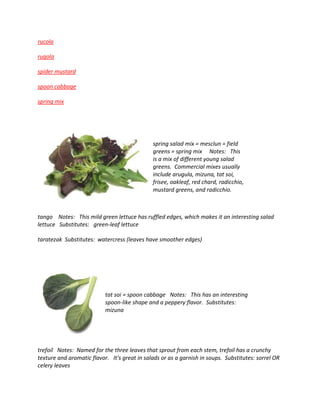
mizuna = Japanese greens = spider mustard
Notes: Mizuna has tender leaves and a
pleasant, peppery flavor. Substitutes: young
mustard greens (more pungent) OR arugula
oakleaf lettuce = oak leaf lettuce Notes:
Oakleaf lettuce has crunchy stems and tender
leaves. There are red and green varieties.
Substitutes: butter lettuce OR Romaine lettuce
radicchio = red chicory = red-leafed chicory = red Italian
chicory = chioggia Pronunciation: rah-DEEK-ee-oh
Notes: With its beautiful coloring and slightly bitter
flavor, radicchio is wonderful when combined with other
salad greens. You can also use the leaves as a base for
hors d'oeuvres, or sauté them for a side dish. The most
common variety, radicchio rosso (left), is round, while the
treviso radicchio is elongated. Substitutes: Belgian endive
OR escarole OR chicory OR red-leaf lettuce (for color)
red chicory
red-leafed chicory
red-leaf lettuce Substitutes: green-leaf
lettuce (different color, but otherwise similar)
OR radicchio (for color)
red orach
red mustard Notes: This has a pungent,
peppery flavor that adds zip to salads. You
can cook it, too. Substitutes: mizuna OR
arugula
rocket
romaine lettuce = cos Notes: Romaine
combines good flavor and crunch, plus it has
a decent shelf life in the refrigerator. It's the
preferred green for Caesar salad. Green
romaine is the most common variety, but you
can sometimes find red romaine, which is
more tender. Substitutes: iceberg lettuce OR
Boston lettuce
roquette
rucola
rugola
spider mustard
spoon cabbage
spring mix
spring salad mix = mesclun = field
greens = spring mix Notes: This
is a mix of different young salad
greens. Commercial mixes usually
include arugula, mizuna, tat soi,
frisee, oakleaf, red chard, radicchio,
mustard greens, and radicchio.
tango Notes: This mild green lettuce has ruffled edges, which makes it an interesting salad
lettuce Substitutes: green-leaf lettuce
taratezak Substitutes: watercress (leaves have smoother edges)
tat soi = spoon cabbage Notes: This has an interesting
spoon-like shape and a peppery flavor. Substitutes:
mizuna
trefoil Notes: Named for the three leaves that sprout from each stem, trefoil has a crunchy
texture and aromatic flavor. It's great in salads or as a garnish in soups. Substitutes: sorrel OR
celery leaves
treviso radicchio
winter purslane = Cuban spinach = miner's
lettuce = claytonia Notes: This resembles
ordinary purslane, only the leaves and stems are
smaller and more delicate.
witloof
witloof chicory
Cooking Greens
African spinach
alogbati See Malabar spinach.
amaranth (There is also a grain called amaranth.)
beet greens Notes: Like their close relative,
Swiss chard, beet greens have lots of flavor and
a good, sturdy texture. The best ones are
young and tender, and sometimes come with
small beets attached. Substitutes: Swiss chard
(a very close substitute) OR turnip greens OR
spinach (cooks more quickly)
borecole Pronunciation: BORE-cole See kale.
broccoli de rabe
broccoli de rape
broccoli raab = broccolirab = broccoli de
rape = broccoli de rabe = brocoletti di rape =
brocoletto = rappi = rape = raab = rapini =
cima di rapa = cima di rabe = choy sum =
Chinese flowering cabbage Notes: This
slightly bitter cooking green has long been
popular in Italy and is now catching on in
America. It's best to just eat the florets and
leaves; the stems are quite bitter.
Substitutes: Chinese broccoli (similar, but
not as bitter) OR dandelion greens OR Swiss
chard OR mustard greens OR turnip greens
OR kale OR broccoli (milder, takes longer to
cook) OR cauliflower OR watercress
broccolirab
calalou
callaloo = callilu = calalou = callau = taro
leaf = bhaji = elephant's ear = sag =
sagaloo Notes: These huge leaves are
about a foot and a half long, and they're a
popular vegetable among Pacific islanders
and some Asians. Many Western cooks
steer clear of them, though, since they
must be cooked for at least 45 minutes to
an hour to rid them of calcium oxalate, a
toxin that irritates the throat if
swallowed. Substitutes: Chinese spinach
(very close substitute) OR Swiss chard OR
sorrel OR spinach OR mustard greens OR
turnip greens (Discard the stems first. This
may take longer to cook than callaloo.) OR
collard greens OR meloukhia
callau
callilu
celtuce = asparagus lettuce = stem lettuce Notes: This
is a kind of lettuce that's grown for its stalk, which can
be peeled, sliced, and stir-fried. Look for it in Asian
markets. Substitutes: celery
Ceylon spinach See Malabar spinach.
chard
chaya Substitutes: spinach
Chinese broccoli = Chinese kale =
gai lan = gai lum = kai lan
Notes: Like rapini, Chinese
broccoli has small stems and green
heads (which actually are flowers)
and lots of leaves. But Chinese
broccoli is leafier and less bitter
than rapini. It's a great vegetable
to stir-fry, but you can also steam
or boil it, as you would broccoli.
Substitutes: rapini OR broccoli OR
bok choy
Chinese flowering cabbage
Chinese kale
Chinese mustard cabbage
Chinese mustard greens
Chinese spinach = hiyu = hon-toi-moi = yin choy =
een choy = amaranth = hsien tsai Notes: This is
similar to spinach, only it's prettier, tastier, and
more nutritious. Look for it in Asian markets.
Substitutes: spinach (This isn't as delicate as
Chinese spinach) OR callaloo
chop suey greens
choy sum
chrysanthemum leaves = chop suey greens =
tong ho = tung ho = garland chrysanthemum =
shungiku Notes: This Asian potherb is used to
flavor salads, soups, sukiyaki and other dishes.
The leaves are usually blanched briefly to soften
them and deepen their color, but young leaves
can be served raw. Add them to cooked dishes
at the last minute, as they become bitter if
overcooked. Substitutes: spinach
cima di rabe
cima di rapa
collard greens = collards Notes: This is a favorite
of Southern cooks, who often cook them with salt
pork or smoked ham hocks. Frozen collards are
an acceptable substitute for fresh. Substitutes:
kale (crinkled leaves) OR kohlrabi leaves OR bok
choy (milder flavor) OR turnip greens OR mustard
greens (spicier flavor)
cow cabbage See kale.
curled mustard
dock
een choy
gai choy = kai choy = Chinese mustard cabbage =
Chinese mustard greens = Indian mustard = leaf
mustard Notes: Asian cooks like to pickle this, or
else use it in soups or stir-fries. If you find gai choy
too pungent to stir-fry, blanch it first in salted
water. Substitutes: mustard greens (more
pungent) OR broccoli raab
gai lan
gai lum
garland chrysanthemum
hiyu
hon-toi-moi
jam leaf
jute leaf = West Africa sorrel = krin-krin =
saluyot = rau day = Jew mallow Notes: These
are tossed into stews in Africa, the Philippines,
and Southeast Asia. Substitutes: spinach
kai choy
kail See kale.
kale = borecole = cow cabbage = kail
Pronunciation: KAYL Notes: Kale is a kind of
cabbage with dark green, wrinkled leaves.
It's prized more for its hardiness than its
flavor or delicacy, but it continues to be
popular in the South, where it's often cooked
as a side dish. Remove and discard the tough
center stalks before cooking. Varieties
include curly kale, dinosaur kale = black
cabbage = lacinato kale, and the popular Red
Russian kale = ragged jack kale. Substitutes:
collard greens (smooth leaves) OR rapini OR
Swiss chard (This cooks more quickly than
kale.) OR flowering kale OR cabbage OR napa
cabbage OR kohlrabi leaves OR mustard
greens OR spinach (in casseroles and
souffles)
kangkong
kohlrabi greens Notes: These can be cooked
just like Swiss chard. Remove the stems first if
they're too thick. Substitutes: Swiss chard OR
collard greens OR kale
kontomire = African spinach Shopping hints: This African green is very hard to find fresh in the
United States, and the canned version is terrible. Substitutes: Swiss chard OR spinach
leaf beet
long green
Malabar spinach = Ceylon spinach = saan
choy = slippery vegetable = alogbati =
mong toi = Vietnamese spinach Notes:
This is cooked much like spinach, but it's a
bit slimy like okra. It occasionally shows up
in Asian markets. Substitutes: spinach OR
okra
mustard greens = curled mustard Notes:
These are more popular in the South than
in the rest of the country. There are red
and green varieties, and both have a
peppery bite. If the greens are too
pungent for your taste, you can tame them
by blanching them in salted water.
Substitutes: gai choy (less pungent) OR
escarole (less pungent) OR kale (less
pungent) OR Swiss chard (less pungent) OR
spinach (less pungent; cooks more quickly)
OR radish greens
nettles = nettle leaves Shopping hints:
Nettles have long been used in Europe as a
substitute for spinach or kale, but they're
tricky to use. The tips contain formic acid,
a nasty irritant that can give you a serious
rash on the outside and cause even more
damage on the inside. You can remove the
formic acid by cooking and/or soaking the
nettles, but don't try this unless you know
what you're doing. If you're harvesting
your own nettle leaves, select young
ones. Substitutes: escarole OR beet
greens OR spinach
pumpkin leaves = pumpkin greens Substitutes: Swiss chard OR turnip greens OR chicory OR
spinach
purslane = verdolaga Shopping
hints: Hispanic cooks especially like
these crunchy, mild tasting greens.
You can use them raw in salads, or
cook them as a side dish. Look for
them in Hispanic markets.
Substitutes: watercress (milder flavor)
OR spinach (milder flavor) OR okra
quail grass Substitutes: spinach
raab
radish greens Notes: These have a peppery
flavor, and they're great raw in salads and
sandwiches, or you can cook them as you would
other leafy greens. The leaves are fairly
pungent, though, so a little goes a long way.
The greens from young plants are best.
Substitutes: mustard greens
rape
rapini
rappi
rosella
saan choy See Malabar spinach.
seakale beet
silver beet
slippery vegetable See Malabar spinach.
sorrel = rosella = sour grass = dock = sour
dock Pronunciation: SORE-uhl Notes: This sour
herb is quite popular in France. They like to cook it
briefly and make a purée out of it, which they ladle
over eggs, fish, meat, and other dishes. It can also
be served raw in salads. Substitutes: spinach +
lemon zest OR arugula
sour grass
spinach Equivalents: One pound fresh = 1 cup
cooked = 5 ounces frozen Notes: Spinach is
packed with nutrients, and it's quite versatile. You
can toss it raw into salads, or cook it briefly to
make a side dish or soup. Of the two main
varieties, smooth leaf spinach = flat leaf spinach =
salad spinach is more delicate and better suited to
salads than curly leaf spinach. Look for spinach
with small, narrow stems--they're younger and
more tender. And always use fresh spinach if you
can; it's much more palatable than frozen or
canned spinach. Substitutes: Chinese spinach
(more delicate) OR Swiss chard (more flavorful,
but takes longer to cook) OR beet greens (more
flavorful, but takes longer to cook) OR sorrel (color
fades when cooked; consider adding parsley for
color) OR kale (especially in casseroles; takes
longer to cook) OR turnip greens (discard stems;
takes longer to cook) OR escarole (especially with
hot bacon dressings)
spinach beet
swamp spinach
Swiss chard = chard = spinach
beet = leaf beet = seakale beet =
silver beet = white beet Notes:
Swiss chard is used much like
spinach, except that it has an
appealing beet-like flavor and a
heavier texture, which requires
longer cooking. Many cooks
simply sauté it in olive oil and
serve it as a side dish. Red chard
= rhubarb chard = ruby chard,
with green leaves and red stalks,
is slightly more tender and
flavorful than white chard =
green chard, with white stalks
and green leaves, but the two
are interchangeable in most
recipes. Substitutes: beet
greens OR spinach OR turnip
greens OR bok choy OR escarole
OR mustard greens
tangkong
taro leaves
tong ho
turnip greens = turnip tops = turnip salad = Hanover
greens Notes: A staple of Southern cuisine,
turnips greens are traditionally served with salt
pork or ham hocks. The leaves are pungent and
slightly bitter, especially older ones, but they
become milder when cooked. Don't prepare them
with aluminum cookware, as it will affect their
flavor and appearance. Substitutes: dandelion
greens OR mustard greens OR kale (takes longer to
cook) OR collard greens (takes longer to cook,
consider blanching first to reduce bitterness) OR
Swiss chard (milder flavor) OR spinach (milder
flavor)
turnip salad
turnip tops
ung choy
verdolaga See purslane.
water spinach = swamp spinach = ung choy = long green =
kangkong = tangkong Notes: This cooking green is very
common in the Philippines. Some varieties have purple
stems. Substitutes: spinach OR watercress
white beet
yin choy
Inflorescent Vegetables
artichoke = globe artichoke Notes:
Artichokes are the unopened flowers
and stems of a kind of thistle. You
cook them, then peel off and eat the
bases of the thick green petals (called
leaves). At the center is the heart, the
choicest portion of the artichoke,
covered by the choke, a hairy pad that
should be peeled off and discarded.
Their peak season is early summer.
Substitutes: Jerusalem artichokes
(crisper; consider blanching or roasting
first) OR salsify OR burdock OR hearts
of palm
banana blossom = banana flower
Notes: These are popular in Southeast
Asia and India, where they're boiled in
water or coconut milk, then eaten like
artichokes. Substitutes: artichokes
broccoflower = green cauliflower
Notes: This is a green variety of
cauliflower. Substitutes: cauliflower
OR broccoli
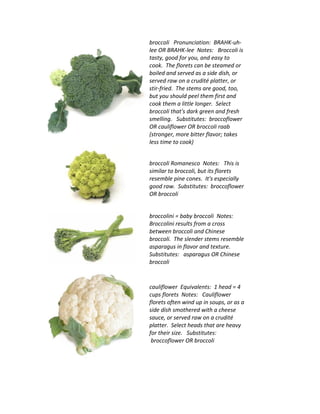
broccoli Pronunciation: BRAHK-uh-
lee OR BRAHK-lee Notes: Broccoli is
tasty, good for you, and easy to
cook. The florets can be steamed or
boiled and served as a side dish, or
served raw on a crudité platter, or
stir-fried. The stems are good, too,
but you should peel them first and
cook them a little longer. Select
broccoli that's dark green and fresh
smelling. Substitutes: broccoflower
OR cauliflower OR broccoli raab
(stronger, more bitter flavor; takes
less time to cook)
broccoli Romanesco Notes: This is
similar to broccoli, but its florets
resemble pine cones. It's especially
good raw. Substitutes: broccoflower
OR broccoli
broccolini = baby broccoli Notes:
Broccolini results from a cross
between broccoli and Chinese
broccoli. The slender stems resemble
asparagus in flavor and texture.
Substitutes: asparagus OR Chinese
broccoli
cauliflower Equivalents: 1 head = 4
cups florets Notes: Cauliflower
florets often wind up in soups, or as a
side dish smothered with a cheese
sauce, or served raw on a crudité
platter. Select heads that are heavy
for their size. Substitutes:
broccoflower OR broccoli
globe artichoke
green cauliflower
Snap Beans
Synonyms: string beans
With most beans, you eat only the seeds, usually
after they've been dried. But you can eat snap beans
pod and all. Until a century ago, the pods had tough
strings that cooks had to pull off before cooking
(hence the name "string beans") but the snap beans
you'll find in markets today are almost all stringless.
Substitutes: asparagus OR broccoli OR okra
Varieties:
asparagus bean See yard-long bean or winged bean.
chepil Shopping hints: Look for this in the produce section of Hispanic markets. Substitutes:
green beans
Chinese long bean
dau gok
dow gok
dragon tongue bean Notes: You
can eat these, pods and all, just like
green beans. Substitutes: green
beans
French bean
four-angled bean
goa bean
green bean = string bean = snap bean
Equivalents: One pound = 3 to 3.5
cups Notes: These are meant to be
cooked and eaten, pods and all. They're
best if they're steamed or stir-fried just
until they're tender but still crisp. Select
bright green beans that snap when
broken in half. Their peak season is in
the summer. Substitutes: wax bean
(different color; wax bean is yellow) OR
Italian flat bean (flatter pods, excellent
flavor) OR dragon tongue bean OR
winged bean (less flavorful)
haricot verts = French bean = French
green bean = French filet bean Notes:
This is a very thin variety of green bean
that's crisp, tender, and expensive.
Don't confuse this with the haricot
bean, which is a dry bean. Substitutes:
green beans (as thin as possible;
consider cutting thicker green beans in
half lengthwise)
Italian flat bean = Romano bean =
runner bean Notes: These green or
yellow beans are like ordinary green
beans, but they're flatter. Select small,
brightly colored beans that snap when
you break them in half. Substitutes:
green bean (Green beans have a
rounder pod than Italian flat beans, but
they can be used interchangeably in
most recipes.)
long bean
Manila bean
princess pea
Romano bean
sator Notes: Thai cooks like to add these
squat green beans to stir-fries. They have a
strong, somewhat bitter flavor.
Substitutes: green bean OR asparagus
snap bean
string bean
Thailand long bean Substitutes: yard-long beans
wax bean Notes: These are similar
to green beans except for the color,
which can be yellow or purple. Don't
confuse these with lima beans, which
are sometimes called wax beans.
Substitutes: green bean (different
color)
winged bean = winged pea = goa bean = asparagus pea = asparagus bean = four-angled bean =
manila bean = princess pea Notes: This pods have deep ridges, and attached leaves that open
up like wings. Young ones are best. Don't confuse this with the yard-long bean, which is also
sometimes called an asparagus bean. Substitutes: asparagus OR green beans (more flavorful)
yard-long bean = asparagus
bean = dow gok = dau gok =
Chinese long bean = long bean
= bodi = boonchi Notes:
These beans usually aren't a
yard long--half a yard is more
typical. Asians like to cut them
into smaller pieces and add
them to their stir-fried dishes.
You can also boil or steam
them like green beans, though
they're not as sweet and juicy.
They don't store well, so use
them within a few days of
purchase. Substitutes:
Thailand long bean OR green
bean (smaller and sweeter)
Edible Pods
Chinese pea pod
Chinese pea
Chinese snow pea
edible-podded pea
mange-tout pea
ochro
okra = ochro = okro = bamia
= bamie = bhindi = bindi =
gumbo = gombo = ladies'
fingers = ladyfingers =
quingombo = quiabo
Notes: When cooked, okra
exudes a slimy substance,
which serves as a wonderful
thickener in stews.
Unfortunately, that sliminess puts off many diners, but you can minimize it by
buying small, fresh okra and by cooking it very briefly. Okra's popular in the South,
where they fry it in cornmeal, pickle it (this also gets rid of the sliminess), and use it
to thicken their gumbos. Substitutes: gumbo filé (This is also used a thickener in
gumbos. Substitute one tablespoon gumbo filé for every three cups okra, but don't
add the gumbo filé until after the gumbo has been completely cooked.) OR nopales
(also serves as a thickener) OR asparagus (takes longer to cook) OR eggplant (takes
longer to cook) OR purslane
okro
snow pea = Chinese snow pea = Chinese pea =
Chinese pea pod = sugar pea = mange-tout pea =
edible-podded pea Equivalents: 2 cups fresh =
6 ounces frozen Notes: You eat these whole,
pod and all. They're often stir-fried very briefly
(no more than a minute), but they're also good
raw. They're easy to prepare, just wash and trim
the ends. Some people string them as well, but
that's not necessary. Select crisp, flat snow peas
that snap when you break them. Substitutes:
sugar snaps (rounder, sweeter, and crisper) OR
asparagus OR (for stir-fry dishes) bean sprouts
sugar pea
sugar snap = snap pea = sugar snap pea =
sugar pea Notes: This cross between an
English pea and a snow pea is sweet and
crisp, and is eaten whole, pod and all.
Sugar snaps can be served raw, briefly stir-
fried, pickled, or steamed as a side dish.
Substitutes: snow pea (flatter, not as
sweet) OR asparagus OR carrots (for a
crudité platter)
Fresh Beans
Synonyms: shelly beans = shellies = shuckies = shellouts
Fresh beans appear in the summer and fall,
and they're sweeter and more tender than
dry beans. They're also easier to prepare,
since you don't need to soak them or cook
them very long.
Varieties:
beer bean See edamame.
fresh cannellini bean = fresh white
kidney bean = fresh fazolia bean
Substitutes: cannellini bean
(dried)
fresh cranberry bean = fresh
borlotti bean = fresh saluggia =
fresh shell bean = salugia bean =
fresh crab eye bean = fresh
rosecoco bean = fresh Roman
bean = fresh fagiolo romano
Notes: These are available in the
summer months. Substitutes:
cranberry bean (dried)
edamame = sweet bean =
vegetable soybean = beer bean =
edible soybean = garden soybean
= immature soybean = green
soybean Pronunication: ed-duh-
MAH-may Notes: These are fresh
soybeans, often sold in the pod.
Steam them, then split the pod
open and eat the beans inside.
They're also great in soups.
Substitutes: garden pea OR fresh
black-eyed pea
edible soybean See edamame.
fresh fava bean = fresh broad
bean = fresh butter bean =
fresh Windsor bean = fresh
horse bean = fresh English
bean Pronunciation: FAH-
vah Notes: Tender fresh fava
beans are available in the fall
and are much better tasting
than canned, dried, or frozen
ones. Fresh young fava beans
need only be shelled, but more
mature beans should also be
peeled to rid them of their
tough, waxy skins.
Substitutes: fava bean (dried)
OR fresh lima beans (These are
sweeter, and more delicately
flavored.) OR chickpeas
garden soybean See edamame.
green soybean See edamame.
immature soybean See edamame.
fresh lima bean = fresh butter bean =
fresh Madagascar bean = fresh wax
bean Notes: These are exquisitely
sweet and tender, as long as you get to
them soon after they're picked. The
freshest pods are brightly colored and
snap crisply when you bend them.
Fresh lima beans don't need to be
soaked and you need only cook them
about 15 minutes. Substitutes: garden
peas OR lima beans (dried)
sweet bean See edamame.
vegetable soybean See edamame.
Mushrooms
Markets stock a variety of cultivated
mushrooms, but many people prefer
wild mushrooms, which are often
more flavorful. Be careful when
picking wild mushrooms--some species
are poisonous--and always cook them
thoroughly, both to release their
flavors and to convert their proteins
into a more usable form. To prepare
fresh mushrooms, first trim off the
bottoms of the stems, then wipe them
off. Don't rinse them or soak them,
for they'll absorb water and turn
mushy when you cook them. Dried
mushrooms are often excellent
substitutes for fresh, though some
species don't dry well. You can
reconstitute dried mushrooms by
soaking or simmering them. Don't
throw out the soaking liquid--it can
add more flavor to your sauce than
the mushrooms themselves. You can
also pulverize dried mushrooms with a
food processor or blender, then use
the mushroom powder to flavor
sauces and stews.
Substitutes: tempeh OR eggplant OR asparagus (Like mushrooms, this works well in a cream
soup.) OR bell peppers (in a pasta sauce) OR zucchini
Equivalents: 1 pound fresh mushrooms = 6 cups sliced fresh mushrooms = 3 ounces dried
mushrooms
Varieties:
abalone cap mushroom
bear's head mushroom = satyr's beard
mushroom = bearded tooth mushroom Latin:
Hericium erinaceus Notes: These grow yellow
and sour-tasting with age, so buy only white
ones. They're best sautéed or gently boiled.
black forest mushroom
black mushroom
black trumpet mushroom = black chanterelle
Notes: This is a very choice, flavorful
mushroom. Dried black trumpets are excellent,
too. Substitutes: chanterelle OR hedgehog
mushroom
black winter mushroom
blewit mushrooms = blewitt mushrooms = blue-
leg mushrooms = blue foot mushrooms = bluette
mushrooms Pronunciation: BLEW-it Latin
name: Clitocybe nuda Notes: These are prized
more for their beauty than their flavor, which is
pleasant but somewhat mild. Dried blewits are
even less flavorful than fresh. Substitutes:
white mushrooms OR shiitakes
bolete
borowik
brown mushroom
brown oak mushroom
button mushroom
cauliflower mushroom Notes: These
are very flavorful, but a bit chewy.
They're good fried, or in soups or
stews. Select small, young-looking
heads.
chanterelle = egg mushroom = girole =
pfifferling Equivalents: 1 pound fresh =
3 ounces dried. Notes: Chanterelles are
a whole family of mushrooms, most of
which are quite choice, but the name is
most often applied to the golden
chanterelle = yellow chanterelle. These
yellow mushrooms are highly prized for
their exquisite flavor, color, and
texture. Other tasty chanterelle
varieties include the yellow foot
chanterelle, which is less meaty and less
flavorful than other varieties, the black
trumpet mushroom, and the white
chanterelle, which is similar to the
golden chanterelle, but lighter in color.
Fresh chanterelles are best; dried or
canned chanterelles are less flavorful
and tend to have a rubbery texture.
Substitutes: hedgehog mushroom
OR white mushroom OR oyster
mushroom OR ear mushroom OR morel
chestnut mushroom
chicken-of-the-woods mushroom =
sulfur mushroom Notes: This got its
name because it has the texture of
cooked chicken. You can sauté it or, if
you want to make mock chicken, simmer
it in chicken stock. Substitutes:
portobello mushrooms OR cremini
mushrooms OR shiitake mushrooms OR
porcini mushrooms
Chinese black mushroom
cinnamon cap mushroom Notes:
Cinnamon cap mushrooms have a firm
texture and an earthy flavor.
Substitutes: shiitake
clamshell mushroom = clam shell
mushroom Notes: Varieties include the
brown clamshell mushroom (left). This
mushroom goes well with seafood or
meats. Cook them before eating.
cloud ear mushroom = cloud ear fungus
= mo-er mushroom Notes: It's hard to
find these fresh, but dried cloud ears are
an excellent substitute. Reconstitute
them by soaking or simmering them in
lots of water for a few hours.
Substitutes: wood ear mushrooms
cremini mushroom = crimini mushroom = Italian brown
mushroom = Italian mushroom = brown mushroom
Notes: These are closely related to common white
mushrooms, but they're a bit more flavorful. Large
cremini mushrooms are called portobello mushrooms.
Substitutes: white mushroom OR portobello (larger
and more flavorful) OR shiitake
egg mushroom
enok
enoki mushroom = enok = enokidake =
enokitake = golden needle mushroom =
golden mushroom = snow puff mushroom =
velvet foot mushroom = velvet stem
mushroom = winter mushroom
Pronunciation: eh-NO-kee Notes: Enoki
mushrooms have a delicate fruity flavor.
They're usually served raw. Substitutes:
oyster mushroom OR white mushroom
enokidake
enokitake
eryngii mushroom = eringii mushroom =
king oyster mushroom Substitutes:
matsutake
fairy-ring mushroom Substitutes: white
mushrooms OR chanterelles
forest mushroom
funnel chanterelle
gamboni mushroom = big leg mushroom
girole
golden chanterelle
golden mushroom
golden needle mushroom
golden oak mushroom
hawk's wing mushroom
hedgehog mushroom = sweet tooth mushroom
Notes: Hedgehog mushrooms are similar to
chanterelles in color and flavor. Substitutes:
chanterelles OR porcini
honey mushroom Substitutes: shiitake OR hedgehog mushroom
huitlacoche = cuitlacoche = corn smut
= maize mushroom = maizteca
mushroom = Mexican truffle Notes:
This is a fungus that forms black
kernels on ears of corn in damp
weather. It's a prized delicacy in
Mexico, and tastes a bit like wild
mushrooms. You can get it fresh or
frozen by mail order, or canned in
some Hispanic markets. WARNING:
May cause contractions in pregnant
women. Substitutes: morel
mushrooms OR squash blossoms
Italian brown mushroom
Italian mushroom
king bolete
lobster mushroom Notes: These are
actually white mushrooms that have been
coated by a red fungus.
maitake mushroom = hen-of-the-woods
mushroom = ram's head mushroom =
sheep's head mushroom = kumotake
mushroom Notes: This Japanese
mushroom is reputed to have numerous
health benefits. It also has a nice, earthy
flavor. Substitutes: oyster mushrooms (a
close relative)
matsutake mushroom = pine mushroom
Notes: These are popular in Japan, but
they're hard to find fresh in the United
States and dried matsutakes aren't nearly
as flavorful. Avoid canned matsutakes,
they're even worse than dried. Substitutes:
portobello (especially for grilling) OR
shiitake
mo-er mushroom
morels Equivalents: 1 pound =
2 - 3 ounces dried Notes:
Morels are highly prized for
their rich, earthy flavor, and
also because their caps are
hollow, which allows them to be
stuffed. Dried morels are very
flavorful, and they're an
excellent substitute for fresh in
sauces and stews. Substitutes:
shiitake OR chanterelles
nameko mushroom Pronunciation: NAH-
meh-koh Notes: Nameko mushrooms are
hard to find fresh, but Asian markets
sometimes stock cans or plastic bags of it.
They have a gelatinous texture and the
Japanese like to add them to miso soup.
Substitutes: shiitake
Oriental black mushroom
oyster mushroom = tree oyster mushroom =
pleurotus mushroom = pleurotte = abalone
mushroom Notes: Oyster mushrooms are
prized for their smooth texture and subtle,
oyster-like flavor. They can also be grown
commercially, so they're widely available
and fairly inexpensive. Substitutes: white
trumpet OR enoki OR chanterelle OR white
mushroom (takes longer to cook)
paddy straw mushroom
pfifferling
pine mushroom
pleurotte
pleurotus mushroom
pom pom mushroom = lion's mane mushroom =
beard mushroom Notes: The flavor of this
mushroom has been likened to that of lobster and
crab. Substitutes: porcini
Polish mushroom
puff ball mushroom = puffball mushroom
porcino = cepe = cep = bolete = king bolete = borowik =
Polish mushroom = steinpilze = stensopp Plural: porcini
Pronunciation: singular: pore-CHEE-noh; plural: pore-
CHEE-nee Equivalents: One pound fresh = 3 ounces
dried Notes: Porcini mushrooms are well appreciated
in Europe for their meaty texture and interesting flavor.
If you can find them fresh, pick the largest caps you can
find (or afford). Just wipe them clean before using; if
you wash them, they'll soak up the water like a sponge.
Dried porcini are also excellent. Substitutes: hedgehog
OR chanterelle (fruitier flavor) OR portobello OR oyster
mushrooms OR truffles
portobello mushroom =
portabello mushroom = giant
cremini Notes: These are just
large cremini mushrooms, and
their size (about the same as a
hamburger patty) makes them
perfect for grilling or roasting.
They're also more flavorful
than younger, smaller creminis.
Substitutes: cremini (smaller)
OR matsutake (for grilling) OR
porcini (for grilling)
red oyster mushroom Notes:
This beautiful mushroom,
unfortunately, loses its red
coloring when cooked.
Substitutes: oyster mushrooms
OR button mushrooms OR
shiitake mushrooms
shiitake mushroom = shitake mushroom = black
forest mushroom = black mushroom = black
winter mushroom = brown oak mushroom =
Chinese black mushroom = Oriental black
mushroom = forest mushroom = golden oak
mushroom = donko Equivalents: 1 pound = 3
ounces dried. Pronunciation: she-TAH-kay
Plural: shiitake Notes: Though shiitake
mushrooms are now cultivated, they have the
earthiness and flavor of wild mushrooms.
They're large and meaty, and they work well in
stir-fries, soups, and side dishes, or as a meat
substitute. Dried shiitakes are excellent, and
often preferable to fresh due to their more
intense flavor. Soak them in water for about
thirty minutes to reconstitute them, then use the
water they soaked in to enhance your sauce.
Substitutes: crimini mushrooms OR enoki
mushrooms OR straw mushrooms OR
chanterelles OR porcini mushrooms OR white
mushrooms OR oyster mushrooms
shimeji mushroom = pioppini mushroom
Notes: Like matsutake mushrooms, these grow
on trees. They're very tasty, with a peppery
flavor. They're great in stir-fries. Substitutes:
matsutake mushrooms
shitake mushroom
silver ear mushroom = snow mushroom = white fungus = white jelly fungus = white tree fungus
Substitutes: cloud ear mushroom OR wood ear mushroom (less expensive)
snow mushroom
snow puff mushroom
steinpilze
stensopp
St. George's mushroom
straw mushrooms = paddy straw
mushrooms Notes: These are a common
ingredient in Chinese stir-fries. They're hard
to find fresh, but canned straw mushrooms
work well and are sold in many
supermarkets. Better yet, but harder to
find, are dried straw mushrooms, which
have a more intense flavor than canned.
Substitutes: enoki mushrooms OR white
mushrooms
sweet tooth mushroom
tree ear mushroom See wood ear mushroom.
tree oyster mushroom
truffles Notes: Truffles are one of the most
expensive of the fungi (technically, they're not
mushrooms), but they're packed with flavor. You can
grate raw truffles into salads, or chop and sauté
them and use them to flavor sauces. Their flavor is
complex, so truffles work best in delicately flavored
dishes like cream sauces. Truffles are highly
perishable, so you should plan to use them within a
few days after buying them. To preserve them, add
slices of them to bourbon, then use the bourbon and
truffle pieces to flavor sauces. Fresh truffles are
often sold in containers filled with rice. Don't throw
out the rice--it was put there to absorb some of the
truffle's exquisite flavor. Substitutes: morels
OR porcini
trumpet royale mushroom Notes: This is a tasty,
meaty mushroom. Substitutes: shiitake OR porcini
velvet foot mushroom
velvet stem mushroom
white button mushroom
white chanterelle mushroom Notes: White
chanterelles are very similar to golden
chanterelles, except for their color and relative
rarity. Fresh chanterelles are best; dried or
canned chanterelles are less flavorful and tend to
have a rubbery texture. Substitutes: chanterelle
OR hedgehog mushroom
white fungus
white jelly fungus
white mushroom = button mushroom = white
button mushroom = supermarket mushroom
Notes: These are the mushrooms you're most
likely to find in supermarkets. They're good raw,
but more flavorful if cooked. Substitutes: cremini
mushrooms (more flavorful than white) OR oyster
mushroom (cooks faster)
white tree fungus
winecap mushroom = wine-cap mushroom
winter chanterelle
winter mushroom
wood ear mushroom = woodear mushroom =
black fungus = tree ear mushroom Notes:
Chinese markets carry fresh or dried pieces of
this tree mushroom. You're supposed to soak
or simmer the dried chips until they soften, and
then rinse them carefully to remove any dirt.
They're not very flavorful, but they have an
interesting texture and are believed to have
medicinal benefits. Substitutes: cloud ear
mushroom (thinner) OR silver ear (more
expensive) OR shiitake
yellow chanterelle
yellow foot chanterelle
yellow foot mushroom = yellow foot
chanterelle = funnel chanterelle = winter
chanterelle Notes: Though not as flavorful
as golden chanterelles, these mushrooms
work well in most chanterelle recipes.
Substitutes: chanterelle OR hedgehog
mushroom
Fruit Vegetables
Asian squash
avocados
chile peppers (dried)
chile peppers (fresh)
cucumbers
eggplants
olives
summer squash
sweet peppers
tomatillo = ground tomato = husk tomato =
jamberry = Mexican green tomato = Spanish
tomato = tomate verde = Mexican husk
tomato = Chinese lantern plants = fresadilla =
miltomate Pronunciation: toh-mah-TEE-yoh
Plural: tomatillos
Tomatillos look like small green tomatoes
encased in a papery husk. They're pleasantly
tart, and principally used to make Mexican
salsas, particularly salsa verde. They're good
raw, but many cooks cook them briefly in
order to enhance their flavor. Frozen
tomatillos are good substitutes for fresh.
Store fresh ones in the refrigerator for up to
a month, or cook them and freeze them.
Substitutes: green tomatoes + dash lemon
juice OR plum tomatoes + dash lemon juice
OR cape gooseberries
tomatoes
winter squash
Tomatoes
With their rich flavor and mild acidity,
tomatoes have worked their way into
thousands of recipes. You can eat
them raw in salads, salsas, or
sandwiches, cook them to make
sauces, stuff them and bake them, or
grill them on skewers with other
vegetables. Summertime is the the
best season for tomatoes; those sold
at other times of the year are often
bland. Indeed, better cooks often
prefer canned tomatoes for their
sauces over fresh out-of-season
tomatoes. Select tomatoes that are
brightly colored, smooth skinned, and
heavy for their size. Don't refrigerate
tomatoes--it ruins their flavor.
Equivalents: 1 large tomato = 1 cup, chopped
Substitutes: sun-dried tomatoes (reconstitute first in water) OR tomato paste (1 medium
tomato, peeled, seeded, and chopped = 1 tablespoon tomato paste ) OR roasted red peppers OR
tomatillos OR mangos (in salsas) OR papayas (in salsas)
Varieties:
beefstake tomato
cherry tomato Notes: These are less than an inch
in diameter, perfect for adding to salads or crudité
platters, or grilling on skewers. There are both red
and yellow varieties. Substitutes: teardrop
tomato OR slicing tomato (for salads)
Chinese lantern plants
currant tomato Notes: These are about half the size of cherry tomatoes. Substitutes: cherry
tomato (larger) OR teardrop tomatoes OR grape tomatoes
fresadilla
grape tomatoes Substitutes: teardrop
tomatoes OR currant tomatoes OR
cherry tomatoes
green tomato Notes: These are picked
before they turn green. Southerners like
to fry them. Substitutes: tomatillos OR
slicing tomatoes (especially underripe
ones) OR bell peppers
ground tomato
husk tomato
jamberry
Italian tomato
Mexican green tomato
Mexican husk tomato
miltomate
paste tomato
pear tomato See teardrop tomato
plum tomato
poire-joli
sauce tomato = paste tomato = plum tomato
Notes: This tomato isn't as juicy as other
tomatoes, which gives it a more concentrated
flavor that works well in sauces and stews.
These are also the best tomatoes for drying.
You may want to remove the bitter seeds before
cooking these tomatoes, but save the gel that
surrounds the seeds--it's rich in flavor. Varieties
include the roma tomato = Italian tomato =
Italian plum tomato and saladette tomato.
Sauce tomatoes are most flavorful in the
summer. During the rest of the year, many
cooks prefer canned tomatoes over the bland
and mealy fresh tomatoes they usually find in
markets. Substitutes: slicing tomato (This has
a higher water content, so you'll need to cook it
longer to concentrate its flavor.)
slicing tomato = globe tomato Notes: These
large tomatoes are best for sandwiches and
grilling. Varieties include the beefstake
tomato and oxheart tomato. The red varieties
tend to be more acidic than the yellow.
Substitutes: cherry tomato (for salads) OR
vine tomato OR Belgian tomato OR beets (for
salads)
teardrop tomato = poire-joli = pear tomato
Notes: Like cherry tomatoes, these are great
in salads and on crudité platters. Substitutes:
cherry tomatoes OR grape tomatoes
tomate verde
vine tomato = vine-ripened tomato Notes: For best
flavor, tomatoes should stay on the vine until they're fully
ripened. This is a tall order for growers, who prefer to
pick tomatoes while they're still green and sturdy, and
then gas them with ethylene until they turn red. Vine
tomatoes, on the other hand, are picked after they begin
to "break" or turn red, which allows them to develop
fuller flavor. Expect to pay more for the special handling
required to bring these to market.
Eggplants
Synonyms:
aubergine = berenjena = brinjal = garden egg = egg apple = patlican = melongene = melanzane =
Guinea squash
This is a spongy, mild-tasting vegetable that's
meaty yet low in calories. It's never eaten raw,
but it can be baked, grilled, or sautéed. The
best eggplants are firm and shiny eggplants
with unbroken skin. Male eggplants tend to
have fewer seeds, and are therefore less bitter
than female eggplants. To sex an eggplant,
look at the indentation at bottom. If it's deep
and shaped like a dash, it's a female. If it's
shallow and round, it's a male. Smaller
eggplants also tend to be less bitter. Freshness
is important, so don't store them for very long.
Substitutes:
zucchini OR cocozelle OR okra OR portobello mushrooms
Varieties:
American eggplant = globe eggplant
This is the familiar large, dark purple,
pear-shaped variety.
1 medium = 1 pound = 4.5 cups of peeled
and cubed eggplant
Substitutes: Italian eggplant (this is
smaller but similar) OR Japanese eggplant
(1 American eggplant = 3 Japanese
eggplants)
apple green eggplant = green apple eggplant
Asian eggplants = Oriental eggplants, which include Japanese eggplants and Chinese eggplants,
have thinner skins and a more delicate flavor than American eggplants, and not as many of the
seeds that tend to make eggplants bitter. They're usually more slender than American
eggplants, but they vary in size and shape. They range in color from lavender to pink, green, and
white.
baby eggplants These are small versions of American eggplants, with sweeter flesh and thinner
skins. If substituting larger eggplants for these, try peeling and salting them before cooking.
Chinese eggplant
Compared to the familiar American
eggplant, Chinese eggplants have thinner
skins, a more delicate flavor, and not as
many of the seeds that tend to make
eggplants bitter.
Substitutes: Japanese eggplant (This is
similar, but it tends to be a bit more bitter
than the Chinese eggplant.) OR small
Italian eggplant
dried eggplant Notes: Look for these in
Middle Eastern markets.
Filipino eggplant
garden eggs These are tiny eggplants, the size of an egg or smaller. Their color ranges from
white to greenish-yellow.
green goddess eggplant Notes:
This has a very mild flavor.
Hawaiian eggplant
Holland eggplant
Indian eggplant
Substitutes: Japanese eggplants
Italian eggplant
These are smaller than American
eggplants, but they're otherwise
very similar.
Substitutes: American eggplant
(preferably smaller ones)
Japanese eggplant
Like other Asian eggplants,
Japanese eggplants have thin
skins, and a sweet, delicate
flavor.
Substitutes: Chinese eggplant
(This is similar, but it's quite as
bitter as the Japanese
eggplant.) OR small Italian
eggplant
pea eggplants = baby Thai eggplants
makua puong = makheau phuang Notes:
These tiny Thai eggplants are quite bitter.
They're sold in clusters and look like large
green peas. You can find them fresh in Thai
markets, or buy them pickled in jars.
Substitutes: Thai eggplant (larger, not as
bitter) OR English peas (For looks only;
these have a completely different flavor.)
Rosa Bianca eggplant Notes: This Italian
hierloom eggplant has very sweet, mild flesh
and a creamy texture.
Sicilian eggplants These are large with purple stripes. They have thin skins and a subtle flavor.
Thai eggplants
These golf-ball sized eggplants are more
bitter than American eggplants. They
come in different colors, but they're
usually green mixed with yellow or
white. They're often used in hot chile or
curry dishes. Remove the bitter seeds
before using. Substitutes: pea eggplants
(smaller, more bitter)
white eggplant This eggplant has a
tough skin but a more delicate flavor and
firmer flesh than the American
eggplant.
Winter Squash
Winter squash come in many sizes and shapes, but
all have hard outer rinds that surround sweet,
often orange flesh. Winter squash arrive late in the
growing season and they have a long shelf life, so
they've long been a staple in winter and spring,
when other vegetables are harder to come by.
Unlike summer squash, winter squash must be
cooked. They're usually baked or steamed, and
then sometimes puréed. Select squash that are
heavy for their size.
Varieties:
acorn squash Notes: These are popular because of their
small size--one squash can be cut in half and baked to
make two generous servings. The biggest drawback to
this variety is that the rind is quite hard, and therefore
difficult to cut. Select acorn squash with as much green
on the rind as possible. Substitutes: buttercup squash
(drier) OR butternut squash (nuttier flavor; easier to peel
when raw) OR banana squash (much larger) OR turban
squash (sweeter) OR Hubbard squash (much larger) OR
pumpkin (much larger) OR green papayas OR golden
nuggest squash (hard to cut open; consider baking first)
baby acorn squash Substitutes: summer squash
banana squash Notes: This variety is so
large that grocers usually cut into smaller
chunks before putting it out. It's tasty, but its
biggest virtue is the beautiful golden color of
its flesh. Substitutes: butternut squash OR
buttercup squash OR acorn squash
OR Hubbard squash OR pumpkin
buttercup squash Notes: With sweet and
creamy orange flesh, the buttercup is one of
the more highly regarded winter squashes.
The biggest shortcoming is that it tends to be
a bit dry. Choose specimens that are heavy
for their size. Substitutes: butternut squash
(nuttier, sweeter flavor; easier to peel when
raw) OR acorn squash (less flavorful, moister)
OR Hubbard squash OR delicata squash OR
kabocha squash OR pumpkin OR green
papaya
butternut squash Notes: This variety is very popular because
it's so easy to use. It's small enough to serve a normal family
without leftovers, and the rind is thin enough to peel off with a
vegetable peeler. As an added bonus, the flavor is sweet,
moist, and pleasantly nutty. Substitutes: buttercup squash
(not as sweet and moist; harder to peel when raw; consider
baking with skin on) OR acorn squash (not as sweet; harder to
peel when raw, consider baking with skin on) OR calabaza OR
delicata squash OR kabocha squash OR Hubbard squash
(harder to peel when raw, consider baking with skin on)
OR green papaya
calabash 1. spaghetti squash 2. cucuzza
calabaza = green pumpkin = West Indian pumpkin = Cuban squash = toadback = Jamaican
pumpkin = crapaudback = ahuyama = zapallo = abóbora = giraumon Pronunciation: kah-luh-
BAH-zuh Equivalents: 1 pound yields 2 cups cooked squash Notes: These are popular in
Hispanic countries and throughout the Caribbean. They're large, so markets often cut them up
before selling them. Substitutes: sugar pumpkin OR butternut squash OR buttercup squash OR
Hubbard squash OR acorn squash
delicata squash = sweet potato squash =
Bohemian squash Pronunciation: de-lee-CAH-
tuh Notes: This is one of the tastier winter
squashes, with creamy pulp that tastes a bit like
sweet potatoes. Choose squash that are heavy for
their size. Substitutes: butternut squash OR
buttercup squash OR sweet potato
golden delicious squash Substitutes: hubbard squash
golden nugget squash = Oriental pumpkin = gold
nugget squash Notes: This has a pleasant
flavor, but it doesn't have as much flesh as other
squashes and the heavy rind makes it hard to cut
before cooking. Select specimens that are heavy
for their size, and that have a dull finish. Those
with shiny rinds were probably picked too young,
and won't be as sweet. Substitutes: acorn squash
green pumpkin
Hubbard squash Notes: This variety has tasty
flesh, but it's too large for many families to hand
and the rind is hard to cut though. Some grocers
cut them into smaller pieces before putting them
out. Substitutes: pumpkin OR golden delicious
squash OR buttercup squash OR butternut squash
(easier to peel when raw, sweet flavor) OR
banana squash OR acorn squash OR green papaya
Japanese pumpkin
Japanese squash
kabocha squash = Japanese squash = Japanese
pumpkin = nam gwa = sweet mama = kabachi
Pronunciation: kuh-BOW-tchah Equivalents: 1 cup
cubed raw squash = 116 grams Notes: This
orange-fleshed winter squash has a striated green
rind. It's sweeter, drier, and less fibrous than other
winter squash, and it tastes a bit like sweet
potatoes. Substitutes: butternut squash OR acorn
squash OR turban squash OR other winter squash
kin nam gwa
nam gwa
Oriental pumpkin
pumpkin Notes: Use the small sugar
pumpkin = pie pumpkin for pies; the larger
jack o'lantern pumpkin is too watery.
Canned pumpkin purée is convenient and
a good substitute for fresh. Substitutes:
autumn squash OR Hubbard squash
(especially in pies) OR calabaza
OR butternut squash (good in pies) OR
buttercup squash OR acorn squash
OR sweet potato (especially for pies)
spaghetti squash = calabash = vegetable spaghetti
Notes: After it's cooked, you can dig a fork into the
flesh of a spaghetti squash and pull out long yellow
strands that resemble spaghetti. Though they taste
like squash, the "noodles" can serve as a low-calorie
substitute for pasta. Substitutes: spaghetti OR
butternut squash OR banana squash
sweet dumpling squash Notes: Sweet dumpling
squash are fairly small, so you can cut them in half,
bake them, and serve each half as an individual
portion. The flesh is sweeter and drier than that of
other winter squash, and the peel is soft enough to
be eaten. Substitutes: butternut squash OR
kabocha squash OR acorn squash
sweet mama
sweet potato squash
toadback
turban squash Notes: This squash has a
gorgeous rind, but ho-hum flavor. It makes a
good centerpiece, or you can hollow it out and
use it as a spectacular soup tureen.
Substitutes: butternut squash OR acorn squash
OR green papaya
vegetable spaghetti
West Indian pumpkin
Summer Squash
Unlike winter squash, summer
squash can be eaten rind, seeds,
and all. The different varieties
vary in size, shape, and color, but
they can be used interchangeably
in recipes. Select summer squash
that's small and firm.
Substitutes: eggplant (this must be cooked) OR bok choy (in stir-fries) OR cucumbers (if served
raw) OR winter squash
Varieties:
bottle gourd
calabash 1. spaghetti squash 2. cucuzza
chayote = cho-cho = chocho =
christophene = christophine = chuchu =
mango squash = mirliton (in the South)
= pear squash = vegetable pear =
sousous = choko = custard marrow =
pepinella = pepinello = xuxu = xoxo
Pronunciation: chi-YOH-tay or chi-
YOH-tee Notes: This mild-flavored
squash looks like a wrinkled, pale green
pear. It needs to be cooked before
serving, and for a longer time than
other summer squash. You should peel
a chayote before cooking it, but don't
take the seed out--it's edible and tasty.
Cooked chayotes make good low-fat
substitutes for avocados. Substitutes:
zucchini (stonger flavor, cooks more
quickly) OR kohlrabi OR other summer
squash OR carrots OR bell peppers (for
stuffing)
cho-cho
choko
christophene
chuchu
courgette
cucuzza = cucuzzi = bottle gourd = calabash = zucca = suzza melon = Tasmania bean = New
Guinea bean = Italian squash Substitutes: zucchini OR yellow squash
cucuzzi
custard marrow
custard squash
cymling
globe squash = Ronde de Nice Notes: You can
stuff these and bake them, or slice and sauté
them. Substitutes: zucchini OR baby acorn
squash
Italian marrow
Italian squash
mango squash
marrow squash
mirliton
New Guinea bean
pattypan squash = scalloped squash =
scallop = custard squash = white bush
squash = cymling = white squash
Notes: These have a pleasant, nutty
flavor, and they're easy to hollow out,
stuff, and bake. There are green and
yellow varieties; yellow ones are
sometimes called sunburst squash.
Substitutes: scallopini (darker and
rounder) OR zucchini OR yellow squash
OR baby acorn squash
pear squash
pepinella
scallop
scalloped squash
scallopini Notes: This is like a
pattypan squash, only it's greener
and rounder. Substitutes: pattypan
squash (ligher and flatter)
OR zucchini OR baby acorn squash
snake gourd Substitutes: zucchini (smaller) OR other summer squash
sousous
sunburst squash
suzza melon
Tasmania bean
tinda = Indian baby pumpkin =
Punjabi tinda
vegetable marrow = marrow squash Substitutes: zucchini (smaller)
vegetable pear
white bush squash
xuxu
yellow crookneck squash
yellow squash Notes: This category
includes yellow straightneck squash and
yellow crookneck squash (left).
Substitutes: zucchini (This is more
flavorful, and there's a yellow variety.)
OR pattypan squash OR cucuzza
yellow straightneck squash
zucca
zucchini = courgette =
Italian marrow squash
Pronunciation: zoo-KEE-
nee Equivalents: 1 medium
zucchini = 1 cup sliced
Notes: America's most
popular summer squash,
zucchini can be served raw,
sautéed, baked, grilled, and
even shredded and baked in
a cake. Green zucchini is
the most popular, but some
grocers also carry a bright
yellow variety.
Substitutes: cocozelle OR yellow squash OR pattypan squash (especially for
stuffing) OR chayote squash (not raw; takes longer to cook; excellent for stuffing;
peel first) OR eggplant OR cucuzza OR carrots OR pumpkin (This is a great
substitute for grated zucchini in breads and cakes)
Asian Squash
ampalaya
angled loofa
ash pumpkin
balsam pear
bitter cucumber
bitter gourd
bitter melon = balsam pear = bitter
cucumber = bitter gourd =
ampalaya = Chinese bitter melon =
foo gwa = karela Notes: This
bitter vegetable is believed to have
medicinal properties and is widely
used throughout Asia. Substitutes:
winter melon (larger, needn't be
salted before cooking to remove
bitterness)
Chinese bitter melon
Chinese okra = silk squash = silk melon =
Taiwanese okra Notes: There can either
have a smooth surface or one with deep
ridges. The ridged version is sometimes
called angled luffa = angled loofa = angled
loofah. Substitutes: zucchini
Chinese winter melon
foo gwa
fuzzy melon = hairy melon = hairy cucumber =
moqua Notes: This sweet and mild squash
has a fuzzy feel to it. Substitutes: zucchini
hairy cucumber
hairy melon
Indian bitter melon
karela
opo squash
silk melon
silk squash
wax gourd
winter gourd
winter melon = ash pumpkin = winter
gourd = Chinese winter melon = wax
gourd Substitutes: bitter melon (much
smaller; salt and let stand for 30 minutes
before cooking to reduce bitterness)
Cucumbers
cucumber = cuke These gourd relatives are
crisp, cool, and juicy, but get only so-so
marks for flavor and nutritional content. A
slicing cucumber = table cucumber is usually
served raw in salads, sandwiches, drinks,
sushi, and hors d'oeuvres to add crunch, but
they can also be cooked like
zucchini. Pickling cucumbers are usually
smaller than slicing cucumbers, and often
have thick, warty skins. They're hard to find
in supermarkets, but you can often find them
during the summer months in farmers'
markets.
Select firm, unblemished cucumbers that are rounded at the tips and heavy for their
size. Reject those with soft spots or withered ends. Within each variety, try to pick
cucumbers that are relatively small and slender--they'll often have better flavor and
fewer seeds.
Supermarket cucumbers are often waxed to seal in moisture; unwaxed cucumbers
can be sealed by wrapping them tightly in plastic wrap. Store cucumbers unwashed
in the refrigerator crisper, where the higher humidity will help keep them crisp.
Don't freeze cucumbers--they get mushy if they're too cold. Use them within a
week or so of purchase.
Many cooks remove the tips, peels and seeds, which are tough and bitter in some
varieties. To seed a cucumber, cut it lengthwise and scrape the seeds out with a
spoon or knife.
Varieties:
Best for slicing: garden cucumber, English cucumber, Japanese cucumber,
Armenian cucumber, lemon cucumber
Best for pickling: gherkin, cornichon, Kirby cucumber, lemon cucumber
Equivalents: One pound yields about 2 cups sliced.
Substitutes: zucchini OR beets
Complements: dill OR mint OR vinegar OR yogurt OR salt OR sugar OR fish OR
cream OR celery seed OR tarragon
Varieties:
American dill Substitutes: gherkin (smaller) OR cornichon (smaller)
Armenian cucumber = snake
melon = snake cucumber = uri
This is hard to find, but one of the
best-regarded slicing cucumbers.
It's crisp, thin-skinned, and mild-
flavored, and it has soft seeds.
Like the English cucumber, it
doesn't need to be peeled or
seeded. It's not good for pickling.
Substitutes: English cucumber
cornichon This is a small pickling cucumber. Substitutes: gherkin
cuke
English cucumber = burpless
cucumber = English cucumber =
European cucumber = hothouse
cucumber = seedless cucumber =
gourmet cucumber = greenhouse
cucumber This foot-long slicing
cucumber is pricier and less
flavorful than other varieties, but it
has less conspicuous seeds, a
thinner skin, and a plastic wrapper-
-instead of a wax coating--to
improve shelf life. All of this saves
preparation time, since there's no
need to peel or seed the cucumber
before slicing it. This is a good
variety if you focused on looks--you
can cut it into round, green
trimmed slices. Substitutes:
Japanese cucumber OR garden
cucumber, peeled and seeded
gherkin These are very small pickling cucumbers. Substitutes: cornichon OR American dill
(larger)
Japanese cucumber These are just
like English cucumbers, only with
bumps. Like English cucumbers, they
don't have to be peeled or seeded.
Substitutes: English cucumber
Kirby cucumber This short, versatile cucumber is
used for both slicing and pickling. It's small, with
bumpy yellow or green skin. Like the English
cucumber, it has a thin skin and inconspicuous
seeds. Substitutes: burpless cucumber (much
larger)
lemon cucumber This versatile cucumber
is sweet and flavorful, and doesn't have
much of the chemical that makes other
cucumbers bitter and hard to digest.
Though it's often served raw, it's also a
good pickling cucumber. Substitutes:
green cucumber (not as delicately
flavored)
garden cucumber = market cucumber =
common cucumber = regular cucumber =
outdoor cucumber = field-grown
cucumbers You can find these throughout
the year at all but the most poorly stocked
markets. The ones you find in
supermarkets are usually waxed to hold in
moisture and improve shelf-life--these
should be peeled or at least scrubbed well
before serving. Unwaxed cucumbers don't
need to be peeled, but better cooks often
do so since the peels tend to be thick and
bitter. It's also a good idea to remove the
seeds from these kinds of cucumbers; just
cut them in half lengthwise and scrape
them out. Select cukes that are firm, dark
green, and rounded at the tips.
Substitutes: English cucumber (Less
flavorful, but doesn't need to be peeled or
seeded.) OR Japanese cucumber OR
Armenian cucumber OR lemon cucumber
Mediterranean cucumber
Persian cucumber Notes: This is very similar to
a Japanese cucumber.
Sweet Peppers
aji dulce
bell pepper = capsicum = sweet pepper
Equivalents: One tablespoon dried = 3
tablespoon chopped fresh Notes: Red
and yellow peppers are riper, more
flavorful, and pricier than the more
common green ones. You can
occasionally find bell peppers in other
colors as well, like brown, white, pink,
orange, and purple. Substitutes:
Holland bell peppers (thicker walls) OR
Italian frying peppers OR cubanelle
(more flavorful) OR poblano pepper
(hotter than bell) OR Anaheim pepper
(hotter than bell) OR pimiento OR dried
bell pepper flakes
bull's horn Substitutes: green bell pepper
cachucha pepper = rocatillo = aji dulce Substitutes: bell pepper
cubanelle = Cuban pepper Notes: These
turn from green to red as they mature.
Substitutes: red or yellow bell pepper (less
flavorful)
Cuban pepper
European sweet pepper
Holland bell pepper Notes: These are like bell
peppers, only with thicker walls. Substitutes:
other bell peppers (may have thinner walls
than Holland bell)
lamuyo = European sweet pepper = rouge royal Substitutes: bell pepper (not as sweet or large)
pimento Notes: Pimentos are often sold roasted
and peeled in cans or jars, or used to stuff green
olives. Substitutes: red bell pepper (thinner walls)
rocatillo
rouge royal
sweet banana Substitutes: yellow bell
Fresh Chile Peppers
Synonyms: chili pepper, chile, hot pepper, chilli pepper
Plural: chilies, chiles, chillies, or (chile, chili, chilli) peppers
Varieties:
Mild Moderately hot Hot Very hot Extremely hot
Anaheim chile = California green chile = long green pepper = chile
verde [CHEE-lay VER-day] These large, mild chiles are perfect for
chiles rellenos. Mexican cooks also like to dice or purée them, and
then add them to sauces, soups, and casseroles. They have a tough
skin, but it peels off easily if you first char the chiles over a flame and
then steam them in a paper bag for several minutes. Anaheims are
available year-round, but they're best in the summer. When mature
and red, an Anaheim is called a chile colorado = California red chile.
Substitutes: NEW MEXICO GREEN CHILE (very similar, but hotter) OR
POBLANO CHILE (Poblanos are sweeter and a bit hotter than Anaheims,
and their skin isn't as tough. They’re especially good for stuffing.)
OR BIG JIM CHILE (hotter) OR canned GREEN CHILIES (preferably fire-
roasted)
ancho chile See ancho chile (dried) or poblano pepper (fresh).
banana chile See banana pepper.
banana pepper = banana chile = sweet banana pepper Notes:
These are easily confused with hotter yellow wax peppers.
Sample before using. Substitutes: yellow wax (hotter)
bird cherry pepper See cherry pepper.
bird pepper 1. cayenne pepper 2. Thai chili
California green chile See Anaheim chile.
California red chile See Anaheim chile.
caloro See guero.
caribe See guero.
cayenne pepper = finger chili = ginnie pepper = bird
pepper Equivalents: One pepper = 1/8 teaspoon ground
Notes: These are often used in Cajun recipes. Green
cayennes appear in the summer, while hotter red
cayennes come out in the fall. Substitutes: chile de arbol
OR Thai pepper OR habanero OR jalapeno OR serrano OR
cascabel OR pequin OR tepin OR Holland OR cherry
pepper
cherry pepper = hot cherry pepper = Hungarian cherry
pepper = bird cherry pepper = Creole cherry pepper = wiri-
wiri Notes: Along with pepperoncini, this is a good
pickling pepper. Substitutes: cayenne pepper OR
pepperoncini
chilaca =chile chilaca = pasilla chile pepper Substitutes:
poblano pepper
chile chilaca See chilaca.
chile colorado See Anaheim chile.
chile guero See guero.
chile verde See Anaheim chile.
Creole cherry pepper See cherry pepper.
cuaresmeno Substitutes: jalapeno pepper (very similar) OR serrano pepper
Dutch chile See Holland chile.
finger chili See cayenne pepper.
Fresno pepper Pronunciation: FREZ-noh Notes: These
are similar to jalapeno peppers, but with thinner walls.
They're great in salsas. Green Fresnos are available in the
summer. the hotter red ones come out in the fall.
Substitutes: jalapeno pepper OR Serrano pepper
ginnie pepper See cayenne pepper.
goldspike See guero.
guero = chile guero = yellow hot chile = caribe = Sante Fe
grande = caloro = goldspike Substitutes: Hungarian wax chile
peppers OR Fresno pepper OR jalapeno pepper OR serrano
pepper
habanero chile Notes: These extremely hot chiles have a
fruity flavor. They're best in the summertime. Substitutes:
Scotch bonnet chiles (very close) OR manzana chile OR fresh
cayenne peppers OR jalapenos OR Serrano peppers (use twice
as many)
Holland chile = Dutch chile Substitutes: fresh cayenne
pepper OR Fresno chile
hontaka pepper Substitutes: mirasol chile pepper
hot cherry pepper See cherry pepper.
hot Hungarian wax pepper See yellow wax pepper.
Hungarian cherry pepper See cherry pepper.
Hungarian wax pepper See yellow wax pepper.
jalapeno pepper Shopping hints: These popular chiles
have a good amount of heat and rich flavor. Green jalapenos
are best in the late summer, while red jalapenos appear in the
fall. Canned jalapenos aren't as fiery as fresh. Substitutes:
cuaresmeno (very similar) OR Fresno chile OR guero chile OR
malagueta (hotter) OR serrano pepper OR yellow wax chile
pepper OR fresh cayenne pepper
long green pepper See Anaheim chile.
malagueta pepper Substitutes: jalapeno (not as hot) OR tabasco sauce
manzana chile Notes: This habanero relative is often used in
salsas. It has black seeds. Substitutes: habanero pepper OR
Scotch bonnet chile
mirasol pepper Notes: Mirasol peppers have a distinctive
fruity flavor. Substitutes: hontaka chili OR serrano pepper
New Mexico green chile = New Mexico chile = New Mexico red
chile (when mature) Notes: These large chiles are similar in size
to Anaheims, but they're hotter. New Mexico green chiles peak
in the late summer, while the hotter New Mexico red chiles
appear in the fall. Substitutes: Anaheim chile (milder) OR a
combination of Anaheim chiles and jalapenos.
pasilla chile pepper See chilaca or ancho chile or poblano pepper.
piquant pepper = sport pepper Substitutes: poblano peppers
poblano pepper (fresh) = (incorrectly) ancho chile =
(incorrectly) pasilla pepper Pronunciation: puh-BLAH-noh
Notes: These mild, heart-shaped peppers are large and have
very thick walls, which make them great for stuffing. They're
best in the summer. Substitutes: Anaheim (Like poblanos,
these are great for stuffing. Since they have a tougher skin,
you may want to char, steam, and peel them first.) OR bell
pepper (for stuffing, milder) OR canned chile peppers
(preferably fire-roasted) OR Serrano pepper (hotter)
prik chi fa See Thai chile.
rocotillo Substitutes: another small, mild pepper
rocoto chile Notes: These hot chiles look like tiny
bell peppers and have black seeds. They have an
interesting fruity flavor. Substitutes: manzana chile
(very similar) OR habanero (similar heat)
Sante Fe grande See guero.
Scotch bonnet chile Notes: This chile is almost
indistinguishable from the habanero, except that it's a bit
smaller. It's popular in the Caribbean. Substitutes:
habañero chile OR Serrano chilies (use twice as many) OR
jalapeno peppers (use twice as many)
Serrano pepper Pronunciation: seh-RAH-noh
Notes: These have thin walls, so they don't need to
be charred, steamed, and peeled before using.
Substitutes: jalapeno (not as hot) OR Fresno chile
(not as hot) or guero chile (not as hot)
shishito chile Notes: This Japanese chile is very
sweet and mild. It's about two inches long.
sport pepper See piquant pepper.
sweet banana pepper See banana pepper.
Thai bird chile See Thai chile.
Thai chile = bird pepper = Thai bird chile = prik chi fa
= Thai jalapeno Substitutes: chile de Arbol OR fresh
cayenne pepper OR jalapeno peppers (not as hot) OR
Serrano peppers (not as hot)
Thai jalapeno See Thai chile.
Turkish pepper Substitutes: Anaheim pepper
xcatic chile Substitutes: yellow wax pepper OR guero pepper
yellow hot chile See guero.
yellow wax pepper = Hungarian wax pepper = hot
Hungarian wax pepper Notes: These are easily
confused with milder banana peppers. Sample before
using. Substitutes: banana pepper (milder) OR guero
Dried Chile Peppers
Mild Moderately hot Hot Very hot Extremely hot
dried chiles = dried chilies =
dried peppers
ají panca chile = aji panca chile Notes: This reddish-
brown chile is fruity and mild.
ancho chile pepper = (incorrectly) pasilla chile
Pronunciation: AHN-choh Notes: These are dried poblano
peppers, and very commonly used in Mexican cuisine.
They're brownish-black and wrinkled. Substitutes: mulato
(darker with earthier, more pungent flavor) OR pasilla chile
OR California chile OR dried New Mexico chile peppers
arbol chile See chile de arbol.
bola chile See cascabel pepper.
California chile Notes: These are dried
Anaheim chiles, very mild. Substitutes: dried
New Mexico chile peppers (a bit hotter)
cascabel pepper = rattle chile = bola chile =
chile bola These are nicknamed rattle chiles
because the seeds rattle when you shake
them. They're a rich brown color and
moderately hot. Substitutes: GUAJILLO CHILE
OR PEQUIN PEPPER (much hotter) OR TEPIN
PEPPER (much hotter) OR CAYENNE PEPPER
(hotter)
Catarina chile = Catarina pepper Notes:
This Mexican chile is used to make tamales,
marinades, stews and soups.
cayenne pepper = Ginnie pepper Notes: These are very hot, bright red chiles. Recipes that
call for cayenne pepper may be referring to a ground powder that goes by the same name, or to
the fresh version of the pepper. Substitutes: chile de Arbol OR guajillo
Chilhuacle negro chile Notes: This excellent Mexican
chile is loaded with flavor but hard to find. It's used to
make mole negro and bean dishes.
Chilcostle chile This Mexican chile is used in soups, stews,
tamales, and mole sauces.
chile bola See cascabel pepper.
chile de arbol = arbol chile = red chile Pronunciation: ARE-bowl
Notes: Unlike many chiles, these remain bright red even after drying.
They're fairly hot. Don't confuse the dried version with the fresh, which
goes by the same name. Substitutes: cayenne pepper OR pequin chiles
chile negro See pasilla chile.
chiles de ristra See New Mexico red chile.
chile seco See chipotle pepper
chiltecpin See tepin.
chiltepin See tepin.
chiltpin See tepin.
chipotle pepper (chile) = smoked jalapeno pepper = chile seco
Pronunciation: chuh-POT-lay Notes: These lend a wonderful smoky
flavor to sauces. They're usually canned in adobo sauce, but you can
also buy the dried peppers in cellophane bags. Substitutes: (for
chipotles in adobo sauce) 1 tablespoon catsup + 1/2 teaspoon liquid
smoke + 1 jalapeno pepper OR morita (smaller) OR mora OR ancho
(larger and milder)
Costeño Amarillo chile This Mexican chile is used to make soups,
stews, and mole sauces.
Ginnie pepper See cayenne pepper.
guajillo chile Pronunciation: gwah-HEE-yoh Notes:
These moderately hot chiles are smooth, shiny, and
reddish-brown. They have a tough skin, so they need to
be soaked longer than other chiles. Substitutes:
cascabels (rounder and shorter) OR New Mexico chiles OR
California chiles (milder)
habanero (habañero) chile (or pepper)
Pronunciation: hah-bah-NYAIR-oh Notes: Don't confuse
dried habaneros with the fresh version, which goes by the
same name. These extremely hot chiles are wrinkled and
orange. Substitutes: chile de Arbol
Japanese dried chile
mirasol chile (dried) Substitutes: chile de Arbol
mora chile Notes: This is a smoked and dried red jalapeno pepper. Substitutes: chipotle
chile OR morita chile (smaller)
morita pepper Notes: Like the larger mora chile, this is a
smoked and dried red jalapeno. Substitutes: chipotle
(larger) OR mora chile (larger)
mulato chile = mulatto chile Pronunciation: moo-LAH-toe
Notes: This very popular chile looks like the ancho, but it's
darker and sweeter. It's fairly mild and has an earthy flavor.
Substitutes: ancho chile (sweeter)
New Mexico red chile = New Mexican chile = chiles de
ristra Notes: These chiles have an earthy flavor and
resemble the California chile, only they're hotter and more
flavorful. Substitutes: California chile OR ancho chile
Onza roja chile This is used in sauces and soups.
pasilla chile = chile negro = pasilla negro Pronunciation:
puh-SEE-yuh Notes: This is the dried version of the chilaca
chile. It's long, black, and wrinkled, and a standard
ingredient in mole sauces. Ancho chiles are sometimes
mislabeled as pasillas. Substitutes: ancho chile (sweeter)
OR mulato chile (stronger, earthier flavor)
pequin pepper = piquin
pepper Pronunciation: pay-KEEN Notes:
These small red peppers are fairly hot.
Substitutes: chile de Arbol OR tepin OR
cayenne OR cascabel
piri piri pepper Substitutes: malagueta peppers
piquin pepper See pequin pepper.
puya chile = pulla chile Pronunciation: POO-yuh Notes:
This is similar to the guajillo chile, only smaller and more
potent. It has a fruity flavor that's good in salsas and stews.
rattle chile See cascabel pepper.
red chile See chile de arbol.
smoked jalapeno peppers See cayenne pepper.
tepin (tepín) = chiltpin (chiltpín) = chiltepin
(chiltepín) = chiltecpin (chiltecpín) Notes: These
look a bit like large dried cranberries. They're also
sold fresh. Substitutes: pequin OR cascabel OR
cayenne
Olives
A staple of Mediterranean cuisines, olives are
most often eaten out of hand, though cooks also
use them to flavor everything from pizzas to
martinis. Raw olives must be cured before they
can be eaten, and the curing medium--usually
lye, brine, or salt--affects their flavor and
texture. So too does the olive's degree of
ripeness when it's picked. Green olives are
picked while unripe, which makes them denser
and more bitter than brown or black olives,
which stay on the tree until fully ripened. Olives
become bitter if they're cooked too long, so
always add them to hot dishes at the last
minute. Opened cans or jars of olives should be
refrigerated, but some olives can be stored at
room temperature if they're submerged in brine
or olive oil.
Substitutes: caper berries (as a garnish for martinis) OR cocktail onions (this turns a martini into
a Gibson) OR chopped sun-dried tomatoes OR capers
Varieties:
Agrinion olive Notes: This is a large, green Greek olive with very tender flesh.
Aleppo olive Notes: This is a black, dry-cured Middle Eastern olive that's hard to find in the
United States. Substitutes:
Alphonso olive Notes: This large Chilean olive is
cured in a wine or wine vinegar solution, which
gives it a beautiful dark purple color and tart
flavor. Its flesh is very tender and slightly bitter.
Substitutes: Kalamata olives OR Gaeta olives
Amphissa olive = Amfisa olive Notes: These are
dark purple Greek olives that are hard to find in
the U.S. They're great for snacking.
Substitutes: Kalamata olives OR Gaeta olives
Arauco olive Notes: These are large green Spanish olives flavored with rosemary. Substitutes:
Manzanilla olives
Arbequina olive Notes: These are tiny green
Spanish olives with a mild, smoky flavor. They're
hard to find in the U.S. Substitutes: Manzanilla
olives (much larger)
Atalanta olive = Atalanti olive Notes: This is a
muddy-green Greek olive with soft flesh.
Substitutes: Royal olive
Bella di Cerignola
black olives = ripe olives Notes: These are olives that have been allowed to ripen on the tree.
American recipes that call for black olives are probably referring to the Mission olive. Other
varieties of black olives are the Aleppo, Alphonso, Amphissa, black Cerignola, Gaeta, black
Greek, Kalamata, Ligurian, Lugano, Moroccan dry-cured, Niçoise, Nyons, Ponentine, and Royal.
Calamata olive
Cerignola = Bella di Cerignola Notes: These
Italian olives are very large and have a sweet
flavor. Black Cerignolas are softer than green
Cerignolas.
cracked Provencal = cracked Provençal Pronunciation: proh-vahn-SAL Notes: These aromatic
green olives are marinated in a solution with herbes de Provence.
empeltre olive Notes: These Spanish black olives
are soaked in sherry.
Gaeta olive = Gyeta olive Notes: These are
small, black Italian olives are either dry-cured
(making them black and wrinkled) or brine-cured
(making them dark purple and smooth-skinned).
Substitutes: Kalamata olives (as a substitute for
brine-cured Gaetas)
Greek black olives Notes: A generic black Greek olive is large, dark purple and brine-cured.
Popular varieties include Kalamata, Amphissa, and Royal.
Greek green olives Notes: Napfilion and Ionian olives are the most common types of green
Greek olives.
green olives Notes: Green olives are picked from the tree before they're completely ripened.
The most common variety is the Manzanilla olive, which is often pitted and stuffed. Other green
olives varieties include the Agrinion, Arauco, Arbequina, Atalanta, green Cerignola, cracked
Provençal, Kura, Lucque, Nafplion, Picholine, Sevillano, and Sicilian. Substitutes: black olives
(usually softer in texture) OR caper berries (as a garnish for martinis) OR cocktail onions (This
turns a martini into a Gibson.)
Greek royal olive
Gyeta olive
Hondroelia olive Notes: This is a juicy, meaty
olive.
Kalamata olive = Calamata olive Notes: You
can find these popular Greek black olives in
most large supermarkets. They're salty and
very flavorful. Substitutes: Gaeta olive (This is
smaller than a Kalamata.) OR Amphissa
Kura olive Notes: This Middle Eastern cracked green olive is hard to find in the U.S.
Substitutes: Nafplion olives (not as bitter)
Ligurian olive Notes: These small Italian black
olives are brine-cured. Substitutes: Niçoise
olives (very similar)
Lucque olive Notes: These green olives are brine-
cured.
Lugano olive Notes: These are salty Italian black olives.
Manzanilla olive = Spanish olive Notes: These
green olives are available in most supermarkets.
They're often pitted and stuffed with pimento or
garlic. These are the olives that are often put into
martinis. Substitutes: caper berries (These are also
used to garnish martinis.)
Marche olive
Mission olive Notes: These are the common black
ones that are ubiquitous in supermarkets, pizza
parlors, and salad bars. They don't have as much
character as European black olives. Substitutes:
Kalamatas (more flavorful)
Moroccan dry-cured olive = Moroccan oil-cured olive =
Moroccan salt-cured olive Notes: These are shriveled
black olives that are somewhat bitter. They're best used
for cooking rather than snacking.
Moroccan green olive Substitutes: green olives (rinse off the vinegar brine first)
Nafplion green olive = Nafphlion = Nafpelion =
Naphlion Notes: These are green, brine-cured
Greek olives. They're somewhat salty.
Substitutes: Greek green olives
Nicoise olive = Niçoise olive Pronunciation:
nee-SWAHZ Notes: A key ingredient in Salade
Niçoise, these small purplish-black olives have
a distinctive sour flavor. Substitutes:
Kalamata (This works well in a tapenade) OR
Gaeta (This also works well in a tapenade)
Nyons olive Notes: These black, slightly
wrinkled olives from France are salt-cured.
Picholine olive Notes: Picholines are green, torpedo-
shaped olives that are brine-cured. Those made in
Provence are marinated with coriander and herbes de
Provence, while American picholines are soaked in citric
acid. They're great martini olives. Substitutes: green
olives OR caper berries (as a garnish for martinis) OR
cocktail onions (This turns a martini into a Gibson.)
Ponentine olive Notes: These are mild Italian brine-cured black olives.
raw green olive Notes: These are for the rare
cook who's intrepid enough to cure olives from
scratch.
ripe olives
Royal olive = Victoria olive = Royal Victoria olive = Greek royal olive Notes: This is large brown
Greek olive is brine-cured. Substitutes: Atalanta olive OR Kalamata olive
Seracena olive
Sevillano olive = Queen olive Notes: This is a large, green, brine-cured olive. Substitutes:
Manzanillas (not as large and easier to pit than Sevillanos)
Sicilian olive Notes: These are large, green, sour
olives that are usually marinated with herbs.
They sometimes pitted and stuffed with pimento,
garlic, or jalapeño pepper. Substitutes:
Manzanillas
Spanish pitted olive
Toscanelle olive
Victoria olive
Avocados
avocado = alligator pear = midshipman's butter
Pronunciation: AV-uh-KAD-oh
Rich and creamy avocados are quite versatile. You
can dice them into salads, stuff them with fillings, or
mash them to make guacamole or sandwich spreads.
Their only big drawback is that they're also high in
calories and fat, though the fat is mostly
monounsaturated, which isn't as bad as other kinds.
Since they bruise easily, grocers want customers to buy
them while they're still hard and then take them home
to ripen at room temperature for a few days. They’ll
ripen more quickly if you put them in a paper bag along
with an apple or banana. They're ripe when they yield
to a gentle squeeze.
To open an avocado, just cut it in half lengthwise around the seed, twist the two halves
apart, and then pop the seed out with a spoon or knife. Avocados darken soon after
being cut, so serve them right away or sprinkle them with lemon or lime juice to slow
the discoloration. Don't ever refrigerate, freeze, or cook avocados.
Varieties: The Hass = California avocado is available year-round and has a rich flavor
and creamy texture. This is the best variety for guacamole, but it turns a bit mushy in
salads. The skin turns almost black when the avocado is ripe—this, unfortunately, can
camouflage bad bruises. The Pinkerton peels easily and has excellent flavor. The Reed
is a large, round avocado that slips easily from the peel, and has very good flavor and
texture. It will stay firm even when ripe, so it's great in salads, but not a good choice if
you're making guacamole. The Fuerte = Florida avocado is in season from late fall
through spring. It's not quite as buttery as the Hass avocado, but its flavor is
excellent. The bacon avocado is a sweet, smooth-skinned variety that shows up in the
middle of winter, but isn’t as flavorful as other avocados. Mexican avocados are small
and have shiny black edible skins.
Substitutes: CHAYOTE SQUASH (Once cooked, this works as an excellent low-calorie
substitute for avocados in many dishes.) OR puréed raw PEAS (to make a fake
guacamole) OR puréed cooked and chilled ASPARAGUS (to make a fake guacamole)
OR puréed cooked and chilled BROCCOLI (to make a fake guacamole) OR ARTICHOKE HEARTS
(for salads)
Substitutes:
 chayote squash (Once cooked, this works as an excellent low-calorie substitute
for avocados in many dishes.)
 (for guacamole) peas (Purée raw peas in a blender.) OR
 (for guacamole) asparagus (Cook until tender, chill, then purée.) OR
 (for guacamole) broccoli (Cook until tender, chill, then purée.) OR
 (for salads) artichoke hearts
Varieties:
avocadito Pronunciation: AV-uh-kah-DEE-toh See cocktail avocado.
bacon avocado
This sweet, smooth-skinned variety shows up in the
middle of winter. It's not as flavorful as other
avocados.
cocktail avocado = avocadito Notes: This is a very small variety.
Fuerte avocado = Florida avocado
This is in season from late fall through spring. It's
not quite as buttery as the Hass avocado, but its
flavor is excellent.
Hass avocado = California avocado
This is available year-round and has a rich flavor
and creamy texture. The skin turns almost black
when the avocado is ripe, which can camouflage
bad bruises. This is the best variety by far for
guacamole, but it turns a bit mushy in salads.
Mexican avocado
With their small size and shiny black skins, these
look like elongated plums. You can eat them,
skin and all.
Pinkerton avocado
These peel easily and their flavor is excellent.
One of the best varieties.
Reed avocado
This large, roundish avocado slips easily from
the peel, and has excellent flavor and texture. It
will stay firm even when ripe, so it's not a good
choice if you're making guacamole.
Links:
The California Avocado Commission is a great source of information about avocados.
Sea Vegetables
Synonyms: seaweeds = algae = marine algae
Most of us unknowingly eat processed
sea vegetables every day. Manufacturers
use them as thickeners and stabilizers in
such products as ice cream, instant
pudding, whipped toppings, salad
dressings, and even toothpaste. But
unprocessed sea vegetables haven't
caught on much outside of Asia. It's a
shame, since they're dense with vitamins,
minerals, and protein, yet low in calories.
You can usually find plastic bags of
dehydrated sea vegetables in health food
stores, or in the Asian foods section of
larger supermarkets. After rehydrating,
chop them up and add them to salads,
soups, stews, or stir-fries.
Varieties:
arame Notes: This popular seaweed is
very sweet and mild, and it's loaded with
iron, calcium, and iodine. Substitutes:
hijiki (similar, but not as sweet or mild)
OR wakame OR kombu OR dulse
dulse Notes: This is a salty seaweed, so it makes a
great salt substitute in soups and stews. Some people
eat it raw, like beef jerky. It's rich in iron. Substitutes:
wakame OR arame OR hijiki OR sea lettuce
glasswort
hair vegetable = black moss = hair seaweed
= hair-like vegetable = fat choy Notes: The
Chinese add this to soups and use it as a
garnish. Look for it in Chinese markets and
pharmacies.
hijiki = hiziki Notes: Hijiki has a mild flavor,
so it's a good choice if you want to slip a sea
vegetable unobtrusively into your soups and
stews in order to fortify them with calcium,
iron, and other nutrients. When rehydrated,
it roughly quadruples in size, so a little goes
a long way. Substitutes: arame (This is
milder than hijiki, and it doesn't expand as
much when rehydrated.) OR dulse
katsuo bushi
kombu
konbu = kombu = tangle = sea tangle =
oarweed = sea cabbage = kelp
Pronunciation: KOM-boo Notes: Like
other sea vegetables, konbu is rich in
minerals. It's very popular in Japan, where
it's used to flavor dashi, a soup stock.
Konbu is usually sold dried, in strips or
sheets. Choose konbu that's very dark,
almost black, and don't wipe off the white
residue that often appears on the surface;
it's very flavorful. Substitutes:
monosodium glutamate (as a flavor-
booster; use just a dash)
laver
marsh samphire
sushi nori = seaweed sheets = nori Pronunciation:
SUE-she NOH-ree OR SUE-she NOR-ee Notes: These
thin dark sheets are used to make sushi. They're
usually a dark purplish-black, but they turn green
and acquire a pleasant, nutty flavor when toasted.
You can make your own toasted nori sheets by
passing nori sheets over a flame a few times. Yaki
means cooked in Japanese, so pretoasted nori sheets
are labeled yaki-nori or yaki sushi nori. Look for
toasted and untoasted sushi nori in the Asian foods
section of large supermarkets. The name nori is
also used for laver, the plant that sushi nori is made
from. Unlike sushi nori, laver should be rehydrated
before use. If you can't find sushi nori, one option is
to make sushi without a wrapper. It helps to use
plastic wrap to shape the roll. Substitutes:
soybean paper (This also makes a good wrapper for
sushi.)
laver = purple laver = purple seaweed = nori =
redware Pronunciation: LAY-ver Notes: This
protein-rich seaweed is popular in Britain and
Japan. To rehydrate, soak it in water for about an
hour, then add it to soups and salads. Laver is
sometimes called nori, but that name is more
commonly used for the dark sheets that the
Japanese use to wrap sushi, which are made from
the same plant. Substitutes: sushi nori
salted seaweed = nama wakame Notes:
Nama wakame is Japanese for "raw seaweed."
Look for bags of this heavily salted seaweed in
Japanese or Korean markets.
passe-pierre
pousse-pierre
purple laver
purple seaweed
rock samphire Shopping hints: This is more commonly found in Europe than in the United
States. Substitutes: seabean
salicornia
samphire
seabean = sea green bean =
pousse-pierre = passe-pierre =
pousse-pied = salicornia =
glasswort = samphire = marsh
samphire = sea pickle Notes:
These crisp, salty sprigs make
terrific garnishes. They're
sometimes available fresh in the
summer. If not, look for a pickled
version in specialty food shops.
Substitutes: rock samphire
(available in Europe) OR capers
(not as crunchy)
sea green bean
sea lettuce Substitutes: wakame OR dulse
sea pickle
sea vegetables = seaweeds
wakame = alaria
Pronunciation: wah-KAH-may
Notes: This has a sweet flavor,
and it's rich in calcium. It's often
rehydrated and then added to
miso soup or sautéed as a side
dish. Dry wakame can also be
toasted and crumbled over
salads and other dishes. It's very
high in calcium. Substitutes:
sea lettuce OR dulse OR arame
Sprouts
Sprouts spring from newly germinated
peas and beans. They won't add much in
the way of nutrients--or calories--to your
diet, but they're tasty and inexpensive.
There are many varieties, ranging from
mild and crunchy mung bean sprouts to
spicy and delicate radish sprouts. Raw
sprouts are great in salads and
sandwiches, and the sturdier varieties can
also be stir-fried briefly.
Substitutes: lettuce OR carrots (grated) OR green onions (minced)
Varieties:
alfalfa sprouts Notes: These are
too wispy to cook, but they're great
raw in salads and sandwiches.
Substitutes: sunflower sprouts OR
mung bean sprouts (thicker shoots,
crunchier, less sweet) OR soybean
sprouts (more of a bean flavor)
OR fenugreek sprouts (more bitter)
bean sprouts
broccoli sprouts Notes: These are
rich in sulforaphane, a cancer-
fighting compound. They also have
a pleasant, peppery flavor.
Substitutes: daikon sprouts OR
alfalfa sprouts
buckwheat sprouts Substitutes:
alfalfa sprouts
daikon sprouts = kaiware = radish
sprouts = tsumamina = clover
radish Notes: These have a
pungent, peppery flavor that works
wonders for otherwise bland salads
and sandwiches. They're too
delicate to cook, so always serve
them raw. Substitutes: onion
sprouts
fenugreek sprouts Substitutes:
mung bean sprouts (thicker,
sweeter) OR alfalfa sprouts
(sweeter)
kaiware Pronunciation: ki-WAHR-ay See daikon sprouts.
mung bean sprouts = bean sprouts
Notes: These are the large sprouts
that are common in supermarkets.
They're crisp and nutty, and they're the
best sprouts for stir-frying, though they
can also be served raw. Select bean
sprouts that are crisp and white with
just a tinge of yellow. To keep them
fresh, rinse them off and immerse them
in cold water, then store them in the
refrigerator. They're very perishable, so
try to use them within a day or two.
Canned bean sprouts are a very poor
substitute for fresh. Substitutes: snow
peas (sturdy enough to cook) OR
sunflower sprouts (sturdy enough to
cook) OR soybean sprouts (bigger, bean-
like flavor)
onion sprouts Notes: These have a
distinct onion flavor. Substitutes:
daikon sprouts
radish sprouts
snow pea shoots Notes: Look
for these in Asian markets.
Substitutes: mung bean
sprouts
soybean sprouts Notes:
These sturdy, crunchy sprouts
are good in salads or stir-
fries. They become bitter
when the tails get too long, so
eat them soon after they
sprout. Substitutes: mung
bean sprouts (smaller, less
bean-like flavor)
sunflower sprouts Notes: These are sweet and crunchy. Substitutes: mung bean sprouts OR
alfalfa sprouts OR soybean sprouts
tsumamina
Other Vegetables
nopale = prickly pear cactus pad = prickly
pear cactus leaf = prickly pear cactus paddle =
nopal Notes: The canned version is
acceptable substitute for fresh, but it has an
inferior texture. Substitutes: okra OR green
beans OR green peppers
nopalitos Substitutes: chopped nopales
Citrus Fruit
Citrus fruits have stippled rinds that surround
pulp that's tart, juicy, and rich in vitamin C and
other nutrients. Most citrus fruits are first
peeled, then the pulp is either eaten out of hand
or squeezed to make juice, but some, like the
kumquat, are eaten peel and all. The peels
contain fragrant oils, and their zest is often used
to flavor foods. When buying citrus fruit, select
specimens that are smaller, thin-skinned, and
heavy for their size. They keep longer if you
store them in the refrigerator.
Pronunciation: SIH-truss
Varieties:
bergamot = bergamot orange
Pronunciation: BUHR-gah-mot Notes:
This is a small acidic orange, used mostly
for its peel. Don't confuse it with the herb
that goes by the same name.
Substitutes: limes
blood orange = pigmented orange Notes: These
red-fleshed oranges are more popular in Europe
than in the United States. Look for them in the
winter and spring. Substitutes: orange (flesh
orange, not red, more acidic) OR tangerines
(sweeter)
Buddha's hand citron = Buddha's fingers citron =
fingered citron Notes: This fragrant fruit has
hardly any flesh, but the peel can be candied.
Substitutes: citron OR lemon
calamansi (lime) See kalamansi (lime).
calamondin = calamondin orange = China orange = Panama orange Substitutes: kumquats
(slightly smaller) OR kalamansi
cedro See citron.
China orange See calamondin (orange).
Chinese grapefruit See pomelo.
citron = cedro = yuzu Pronunciation: SIHT-
ruhn Substitutes: lemon
clementine orange See mandarin orange.
fingered citron See Buddha's hand citron.
Florida key lime See lime.
grapefruit Notes: A grapefruit is a large,
slightly tart kind of citrus fruit. The rind is
mostly yellow, and often tinged with
green or red. Grapefruits are categorized
by the color of their pulp: red, pink, or
white (which is more honey-colored than
white). The color of the pulp doesn't
affect the flavor. When buying
grapefruit, select specimens that are
smaller, thin-skinned, and heavy for their
size. Some varieties are seedless.
They're best in the winter and spring.
Substitutes: ugli fruit (more flavorful,
but don't cook it) OR pomelo (less acidic
and less bitter) OR tangelo (tangerine-
grapefruit cross)
jeruk purut See kaffir lime.
kabosu = kabosu lime Substitutes: lime
kaffir lime = jeruk purut = leech lime = limau purut =
magrood = makroot = makrut Notes: Thai cooks use
these golf ball-sized limes to give their dishes a unique
aromatic flavor. Kaffir limes have very little juice,
usually just the zest is used. Substitutes: citron OR lime
OR kaffir lime leaves (One tablespoon of zest from a
kaffir lime is equivalent to about six kaffir lime leaves.)
kalamansi = kalamansi lime = calamansi = calamansi lime = musk lime = musklime Notes: The
very sour kalamansi looks like a small round lime and tastes like a cross between a lemon and a
mandarin orange. It's very popular in the Philippines. Substitutes: calamondin (This is very
similar to the kalamansi.) OR lemons OR mandarin oranges
key lime = Florida key lime = Mexican lime Notes: These are
smaller and more acidic than the more common Persian limes.
Substitutes: limes (Many cooks prefer freshly squeezed Persian
lime juice over bottled key lime juice for key lime pies.)
kumquat Pronunciation: KUHM-kwaht Notes: These look
like grape-sized oranges, and they can be eaten whole. The
flavor is a bit sour and very intense. They peak in the winter
months. Substitutes: limequats OR calamondin oranges OR
Seville oranges (for marmalade)
leech lime See kaffir lime.
lemon Equivalents: One lemon yields about 2-3
tablespoons lemon juice. Notes: This very sour citrus
fruit is rarely eaten out of hand, but it's widely used for its
juice, rind, and zest. Varieties include the Eureka lemon,
which is what you're most likely to find in markets, the
Lisbon lemon, which shows up in the winter and is smaller
and smoother than the Eureka, and the trendy Meyer
lemon, which is much sweeter and pricier than an
ordinary lemon. When buying lemons, select specimens
that are smaller, thin-skinned, and heavy for their size.
Substitutes: grapefruits (These make an interesting
meringue pie.) OR limes OR citrons (These are used only
for their peels.) OR lemongrass (in soups and marinades)
limau purut See kaffir lime.
lime Notes: These tart green fruits are similar to
lemons, but they're more acidic and have their own
unique flavor. Varieties include the common Persian
lime = Tahiti lime and the smaller, less juicy, and more
acidic Florida key lime = key lime = Mexican lime. When
buying limes, select specimens that are dark green,
smaller, thin-skinned, and heavy for their size.
Equivalents: 1 lime yields about 2 tablespoons lime
juice Substitutes: lemon (Lemons have a weaker
flavor and are less acidic, so use a bit more to
compensate.) OR kalamansi
limequat Notes: This is a cross between a lime and a
kumquat. It's similar in size and shape to a kumquat,
but with a green or yellow-green skin. It has a strong
lime flavor. Substitutes: kumquats (very similar in
appearance, different flavor)
magrood See kaffir lime.
makroot See kaffir lime.
makrut See kaffir lime.
mandarin orange Notes: These have a pleasant
enough flavor, but their big asset is that they
come out of their peels and segment easily, so
you can eat them in your good clothes. Varieties
include the popular tangerine, the seedy but juicy
honey tangerine = Murcott, the satsuma orange,
the sweet and tiny clementine orange, and the
seedy and orange-flavored temple orange.
Substitutes: orange
Mexican lime See lime.
Meyer lemon Notes: This is sweeter than an
ordinary lemon, and highly prized by gourmet
chefs. It's a bit hard to find in supermarkets.
Substitutes: ordinary lemons
musk lime See kalamansi (lime).
orange = sweet orange Notes: Most American oranges are
produced in Florida and California. Florida oranges are
juicier, and better suited to squeezing, while California
oranges segment more easily and are better for eating out of
hand. The best oranges are smaller, thin-skinned, and heavy
for their size. Substitutes: blood orange (less acidic, red
flesh) OR mandarin orange Or kumquats OR ugli fruit OR
grapefruit OR pomelo (especially for marmalade)
Panama orange See calamondin (orange).
Persian lime See lime.
pigmented orange See blood orange.
pomelo = pummelo = Chinese grapefruit =
shaddock Pronunciation: PUHM-uh-low Notes:
This has a very thick peel, so you have to work
hard to eat it. Many people think it's worth the
trouble, for the pulp is milder and sweeter than its
closest substitute, the grapefruit. Substitutes:
grapefruit (more acidic and more bitter)
pummelo See pomelo.
rangpur lime Notes: This is similar to a mandarin
orange, only more acidic. Substitutes: mandarin
orange
satsuma orange See mandarin orange.
Seville orange = bitter orange = bigarade orange =
sour orange Notes: These are too bitter for eating
out of hand, but they make a wonderful orange
marmalade and the sour juice is perfect for certain
mixed drinks. Substitutes: (for the juice) Mix 1 part
lime or lemon juice + 2 parts orange juice OR 2 parts
grapefruit juice + 1 part lime juice + dash orange zest
OR 2 parts lime juice + 1 page orange juice OR (for
marmalade) kumquats OR (for marmalade) oranges
shaddock See pomelo.
Tahiti lime See lime.
tangelo Notes: There are several different varieties of
tangelos, each a cross between a tangerine and another
citrus fruit. The Mineola, a tangerine-grapefruit cross, is
especially popular. Look for them in markets from late fall
through winter. Substitutes: mandarin orange OR grapefruit
OR orange
tangerine See mandarin orange.
temple orange See mandarin orange.
ugli fruit = Uniq fruit®
This grapefruit-mandarin cross looks like a
grapefruit in an ill-fitting suit. It's sweet and juicy,
though, and simple to eat since the peel comes off
easily and the fruit pulls apart into tidy segments
that are virtually seedless.
Americans pronounce the name "ugly," but in
Jamaica, where it's grown, it's pronounced "HOO-
glee." Some marketers have tried calling it "Uniq
fruit®," but the name hasn't caught on much.
Ugli fruit are available from December through
April. Most specimens are much uglier than the
one pictured here, but don't let that deter you.
Select fruits that are heavy for their size, and that
give a little when you press them.
Substitutes: grapefruit (not as sweet) OR orange
(smaller)
uniq fruit® See ugli fruit.
yuzu See citron.
Berries
Berries are the delicious and often fragile
fruits that grow on vines, bushes, and
runners. They have many virtues--they're
colorful, easy to prepare, good for you, and
so delicious that you can serve them for
dessert all by themselves. The only
downside is that they're often pricey, since
it's a Herculean challenge to get them to
market before they spoil. Many don't make
it, so check them over carefully for mold
before putting them in your shopping cart.
Berries don't ripen once they're picked, so
the deeply colored ones tend to be the
sweetest and most flavorful. When you get
them home, store them in the refrigerator
and use them as soon as possible. Don't
wash them until you're ready to use them,
and freeze any that you can't get to right
away.
alkekengi See Cape gooseberry.
baby kiwifruit Notes: You can eat this tiny
kiwifruit hybrid skin and all. Substitutes:
grapes
bilberry = whortleberry = blaeberry = whinberry Notes: This small, tart berry is the European
counterpart to the American blueberry. Bilberries are usually made into preserves.
Pronunciation: BILL-beh-ree Substitutes: juneberries OR huckleberries OR cranberries (tarter
than bilberries) OR blueberries (larger and sweeter) OR currants
blackberry = bramble Notes: These
would be excellent berries were it not for
their rather large seeds. They're still
great for eating out of hand, but cooks
often strain out the seeds when making
pies and preserves. Select berries that
are free of mold, and as black as
possible. They arrive in markets in the
summer. Substitutes: loganberry OR
boysenberry OR mulberry (larger, more
fragile) OR raspberry OR youngberry OR
olallieberry OR dewberry OR red currant
black currant = cassis Pronunciation:
KER-unt Notes: These are too tart to
eat out of hand, but they're often used to
make syrups, preserves, and the liqueur
cassis. Frozen are a good substitute for
fresh. Substitutes: elderberries OR
blueberries OR red currants OR
gooseberries
blaeberry See bilberry.
blueberry Equivalents: 1 pint = 3 cups
Notes: Blueberries are small and sturdy, so
they're perfect for tossing into cakes, muffins,
cereal bowls, and fruit salads. Like other
berries, they also make good preserves and
tarts. Select firm, dark berries that have a
whitish bloom on them. You can find fresh
blueberries in the summer, but frozen
blueberries are available year-round and work
well in many recipes. They're very perishable,
so keep them refrigerated and use them as
soon as possible. You can also buy blueberries
frozen, dried, or canned. Frozen berries get a
little mushy after they're defrosted, but they'll
work well in many recipes. Substitutes:
huckleberry (larger seeds and tarter,
otherwise very close substitute) OR juneberry
OR red currant OR raisins (in baked goods) OR
dates (in baked goods) OR bananas (in baked
goods)
boysenberry Notes: A boysenberry is a
cross between a blackberry, a raspberry,
and a loganberry. It's more fragile than a
blackberry, but it also lacks the
blackberry's conspicuous seeds. Select
boysenberries that are dark in color and
free of mold. Substitutes: loganberry OR
blackberry (This has larger, more
noticeable seeds.) OR raspberry OR
olallieberry OR dewberry OR youngberry
bramble See blackberry.
Cape gooseberry = Chinese lantern = physalis
= golden gooseberry = alkekengi =
strawberry tomato = ground cherry = husk
tomato = golden berry = golden husk = poha
Notes: Like its relative the tomatillo, the
Cape gooseberry is covered with a papery
husk. The fruit inside looks a bit like a yellow
cherry, and tastes like a sweet tomato. You
can eat Cape gooseberries whole, minus the
husk, or use them to make very tasty
preserves. They're hard to find in the United
States; your best bet is a specialty produce
market in the spring. Substitutes: tomatillos
OR gooseberries OR cherry tomatoes
champagne grapes See Zante grapes.
Chinese gooseberry See kiwi fruit.
Chinese lantern See Cape gooseberry.
cloudberry Notes: Both the color and flavor of these Scandinavian berries pale in comparison
to the raspberry. Substitutes: raspberries
cranberry = bounceberry Shopping hints: These
tart berries are traditionally used to makes sauces
and garnishes for Thanksgiving and Christmas
dinners. It's best to buy them at their peak in
October and November, and freeze any that you
don't use right away. Substitutes: lingonberry
(smaller, better flavor) OR carissa (especially for
jellies) OR rhubarb
currant Pronunciation: KER-unt
Notes: These berries are too tart for
most people to eat out of hand, but they
make terrific preserves and garnishes.
They come in three colors: red, white,
and black. If color's not important, you
can use them interchangeably in most
recipes, though red and white currants
aren't as tart as black. Don't confuse
these berries with the dried fruit of the
same name that looks like a small raisin.
You can sometimes find fresh currants in
specialty produce markets in the
summer. If not, frozen currants are a
good substitute. Substitutes:
gooseberries OR raspberries
dewberry Notes: These are similar to blackberries, only they're smaller. Substitutes:
youngberry OR blackberry OR raspberry OR loganberry OR boysenberry OR olallieberry
elderberry Equivalents: 1 cup = 145 grams Notes: These are too tart for most people to eat
out of hand, but they make terrific preserves and wine. Substitutes: black currants OR
cranberries
frais des bois = wild strawberry =
wood strawberry Plural: fraises des
bois Pronunciation: (singular) FRAY-
day-BWAH (plural) FREHZ-day-BWAH
Notes: These small, wild strawberries
are either white or red, and have a
very intense flavor. Substitutes:
strawberries
golden raspberry Notes: This is a
blonder version of the red raspberry.
Substitutes: raspberries
golden berry See Cape gooseberry.
golden gooseberry See Cape gooseberry.
golden husk See Cape gooseberry.
gooseberry Equivalents: 1 cup = 150
grams Notes: These large, tart berries
are in season only in June and July, but
canned gooseberries work well in pies and
fools. American gooseberries are round
and about 1/2 inch in diameter, while
European gooseberries are oblong, and
about twice the size of American
gooseberries. They're very acidic, and so
they're great with roasted meats, like
goose. The freshest gooseberries are
covered with fuzz. Substitutes: rhubarb
(excellent in fools) OR kiwi fruit (These are
much larger than gooseberries, but they're
excellent in fools.) OR currants (preferably
red currants)
grapes = table grapes Notes: Many
varieties of grapes are turned into wine,
vinegar, jelly, and raisins, but table grapes
are for eating out of hand. They're
classified by their color--red, green, and
blue--and by whether they have seeds or
not. Seedless varieties are popular
because they're easy to eat, but often the
seeded varieties offer more flavor and
better value. Substitutes: kiwi fruit OR
blueberries (in fruit salad)
ground cherry See Cape gooseberry.
huckleberry Notes: These are similar to
blueberries, and they're great for making
preserves and syrups. Some specialty
markets carry them in the summer.
Substitutes: blueberry (inconspicuous
seeds and less tart, otherwise very close
substitute) OR bilberries
husk tomato See Cape gooseberry.
jaboticaba Pronunciation: zhuh-BOO-ti-KAH-buh Notes: These resemble large, dark purple
grapes, and they're very popular in Brazil. You can eat them like grapes, though you might want
to first remove the seeds and thick skin. You can also make delicious jams, jellies, and wines
from them. Substitutes: grapes
juneberry = saskatoon = serviceberry = shadberry Notes: These are very similar to blueberries.
Substitutes: blueberry OR huckleberry
keriberry
kiwi See kiwi fruit.
kiwi fruit = kiwi = kiwifruit = Chinese
gooseberry = monkey peach = yang-tao
Pronunciation: KEE-wee Notes: This
small, oblong fruit is has fuzzy brown skin
and beautiful green flesh dotted with
edible black seeds. It tastes like a cross
between gooseberries and strawberries.
It's very versatile--you can eat it as a
snack, blend it into sauces or sorbets, or
peel and slice it as a garnish. It also
contains an enzyme that tenderizes meat.
Select kiwis that are hard, allowing them
to ripen at room temperature for a few
days. Substitutes: pitaya (very similar,
but sweeter) OR gooseberry (much
smaller berries) OR strawberry OR papaya
(as meat tenderizer) OR pear (different
flavor)
lingonberry Notes: These tart relatives of
the cranberry grow only in cold climates.
Substitutes: cranberry (larger, tarter, inferior
flavor) OR red currants
loganberry Notes: These are like
blackberries, only they're dark red
when ripe and more acidic. They're
especially good in pies and
preserves. Substitutes: raspberry OR
blackberry OR boysenberry OR
olallieberry OR youngberry OR
dewberry
marion berry Notes: After Washington, D.C., mayor Marion Barry was arrested for possessing
cocaine in 1989, marion berry jam enjoyed brief popularity as a novelty item. Substitutes:
blackberry (smaller)
monkey peach See kiwi fruit.
mulberry Notes: These are so fragile that almost no markets carry them. Substitutes:
blackberry (smaller, not as fragile)
olallieberry = olallie berry Notes: This
cross between a youngberry and a
loganberry is black and fairly sweet.
Substitutes: loganberry OR youngberry
OR raspberry OR boysenberry OR
dewberry OR blackberry
physalis See Cape gooseberry.
poha See Cape gooseberry.
raspberry Notes: It's a real
challenge to get these hollow, fragile
berries to consumers before they
spoil, so you'll have to pay a high
price for those that make it. Many
don't, so check them carefully for
mildew before you buy them. A
good alternative is to buy them
frozen. Substitutes: loganberry OR
strawberry OR blackberry OR
boysenberry OR olallieberry OR
youngberry OR dewberry OR
thimbleberry OR carissa (especially
for preserves)
red currant Pronunciation: KER-
unt Notes: With their brilliant
coloring, red currants make terrific
garnishes. They're also pleasantly
tart, and often used to make jellies,
syrups, and wine. Fresh ones are
available in some markets during the
summer, but frozen currants are
acceptable substitutes for fresh in
many recipes. Substitutes:
blueberry OR black currant (for
preserves) OR white currant (for
eating raw) OR gooseberry (tarter)
OR cranberry (as a garnish) OR
blackberries OR red currant jelly (for
sauces; sweeter than whole fruit)
saskatoon See juneberry.
serviceberry See juneberry.
shadberry See juneberry.
strawberry Notes: Strawberries aren't as fragile as
other berries, so they don't need the special handling
that makes most berries so expensive. The best time
to buy them is in the spring, but you can find them
throughout the year, though the price might be
higher and the quality lower. Select berries that have
fully ripened to a dark red. Substitutes: raspberry
OR guava (especially for shortcakes) OR kiwi
strawberry tomato See Cape gooseberry.
sweet gooseberry Notes: These are similar to
gooseberries, but they have a red blush and are
much sweeter. Substitutes: gooseberries
tay berry Substitutes: blackberry
thimbleberry Substitutes: raspberry
whinberry See bilberry.
white currant Pronunciation: KER-unt
Substitutes: red currant
whortleberry See bilberry.
yang-tao See kiwi fruit.
youngberry Notes: This is closely related to the blackberry. Substitutes: blackberry OR
olallieberry OR loganberry OR raspberry OR dewberry OR boysenberry
Zante grapes = champagne grapes
Notes: These clusters of tiny grapes are
often used as a garnish. Substitutes:
other garnish
Stone Fruit
Synonyms: drupes = summer fruit
The family of stone fruits includes cherries, plums,
apricots, nectarines, and peaches. They all arrive
in the summer, though you can sometimes find
pricey imports during the off-season. Stone fruits
don't become sweeter after they're picked, but
growers often harvest them while they're still a bit
underripe so that they won't bruise during transit.
At the market, select specimens that have the
color, if not the softness, of fully ripened fruit,
then take them home and let them soften at room
temperature for a few days.
Varieties:
acerola = Barbados cherry = Puerto Rican cherry = West Indian cherry Pronunciation: ass-ah-
ROH-lah Notes: These are very rich in vitamin C, and somewhat acidic. You can eat them out
of hand, but they're probably better suited for making preserves. Equivalents: 1 cup = 98
grams, 1 pitted acerola = 4.8 grams Substitutes: cherries
apricot Notes: Like other stone fruit, apricots are
sweetest--and most prone to bruising--when they're
allowed to ripen on the tree. But unless you can pick
your own, you'll probably have to make do with the
slightly underripe, more durable apricots sold in
markets. Allow them to soften at room temperature
for a few days before eating them. They're best in
the summer. Substitutes: apriums OR pluots OR
peaches OR nectarines
aprium Notes: This is an apricot/plum cross, with
apricot dominating. Substitutes: pluots OR apricots
OR plums
Barbados cherry See acerola.
cherry Notes: There are three main categories of
cherries: sweet cherries, which are for eating out
of hand, sour cherries, which are best suited for
making pies, preserves, and sauces, and tart
chokecherries. Substitutes: stone fruit
chokecherry Notes: These are too tart for most people to eat out of hand, but they make
delicious preserves. Substitutes: sour cherries OR cranberries
donut peach = saucer peach Notes: These
squat peaches have white flesh, and a very
good flavor. Use them as you would ordinary
peaches. Substitutes: peaches
green almonds Notes: Middle Eastern cooks
use these in stews and desserts.
nectarine Pronunciation: nek-tuh-
REEN Notes: Nectarines resemble
peaches, but they're sweeter and more
nutritious. They're best if they're
allowed to ripen on the tree.
Unfortunately, tree-ripened nectarines
bruise easily, so most growers scrimp on
flavor and pick and market them while
they're still slightly underripe. After
buying nectarines, you're supposed to
let them ripen for a couple of days at
room temperature before eating them.
This makes them softer and juicier, but
not sweeter. Avoid buying nectarines
that are too hard or that have green
spots--a sign they were picked way too
soon--or those that are bruised. The
superior freestone varieties arrive in
June and July; the cling varieties that
come later aren't as good. Substitutes:
peaches (not as sweet) OR apricots
peach Notes: Most of the peaches
that are sold in markets are freestone,
and de-fuzzed by the grower. Select
peaches that are colorful and free of
bruises. After you get them home, let
them ripen at room temperature for a
day or so until they become softer.
They're best and cheapest in the
summer. Substitutes: nectarines
(sweeter) OR apricots OR papaya OR
mango
pie cherry See sour cherry.
plum = fresh prune Notes: Plums are
juicier than other stone fruits, and have a
longer growing season. There are many
varieties, some sweet, some acidic, and
some best suited for drying into prunes.
They're often eaten out of hand, but they
also work well in cobblers, compotes, and
tarts. Substitutes: pluot (plum/apricot
cross, with plum dominating) OR aprium
(apricot/plum cross, with apricot
dominating) OR loquat OR prunes
(rehydrate first in water)
pluot = plumcot Notes: This is a
plum/apricot cross, with plum
dominating. Substitutes: apriots OR
plums OR apricots
Puerto Rican cherry See acerola.
saucer peach See peach.
sour cherry = pie cherry = tart
cherry = red cherry Notes:
While sweet cherries are best
for eating out of hand, knowing
cooks turn to sour cherries for
pie fillings, sauces, soups, and
jams. Popular varieties include
the Montmorency, Morello, and
Early Richmond. Sour cherries
don't transport well, so they're
difficult to find fresh. Canned
sour cherries, though, are
almost as good. If you want,
boost their flavor a bit by adding
one tablespoon of Kirschwasser
per cup. Substitutes:
chokecherries (for preserves) OR
sweet cherries (use less sugar)
OR loquats (similar flavor, good
in pies and preserves) OR sweet
cherries OR dried cherries (Soak
these in cherry liqueur before
using.)
sweet cherry Notes: These appear in the
summer, with the popular and exquisite Bing
cherries arriving in June and July. Other varieties
have the virtue of arriving before or after the
Bings, but they're often not nearly as tasty. Select
cherries that are large, deeply colored, and firm.
Substitutes: sour cherries (These are the preferred
cherries for preserves, sauces, pie fillings, and
many desserts because they're more flavorful than
sweet cherries when cooked. Add sugar to taste.)
OR dried cherries (Soak these in cherry liqueur
before using.)
tart cherry See sour cherry.
West Indian cherry See acerola.
Common Tropical Fruit
banana Varieties: Most of the bananas you and I
have eaten in our lifetimes are the yellow
Cavendish bananas. The burro banana = chunkey =
chunky is shorter than the Cavendish, and has an
interesting lemony flavor. The manzano banana is
smaller yet and a bit drier, but it fits nicely into
lunch boxes. The red banana has a purple peel and
is best used for baking. The plantain is larger than
other banana varieties, and is usually fried, baked,
or mashed before eating. Yellow bananas are ripe
and ready to eat, while green ones will ripen at
room temperature in just a few days. Refrigerating
ripe bananas will keep them from getting softy and
mushy, though the peels will darken. Substitutes:
plantain (for baking, mashing, and frying) OR
mango (different flavor)
burro banana See banana.
carambola Pronunciation: kah-rahm-BOH-luh See star fruit.
Cavendish banana See banana.
Chinese apple See pomegranate.
Chinese star fruit See star fruit.
chunkey See banana.
chunky See banana.
coconut Equivalents: 1 whole = 3-4 cups
grated; 1 tablespoon grated dry = 1 ½
tablespoons fresh grated; 6 cups grated = 1
pound. Notes: The most common form of
coconut in markets is the dry coconut, with a
hard brown shell surrounding firm coconut
meat with liquid in the center. Green coconuts
= water coconuts are young coconuts with very
soft meat inside. They're more often found in
the tropics. Select coconuts that are free of
cracks or mold, that are heavy for their size,
and that have lots of water in them when you
shake them. To crack one, hit it along its
equator with a blunt instrument, pouring off
the water when the first crack appears.
Substitutes: Brazil nuts OR macadamia nuts
cooking papaya See green papaya.
dates (fresh) Notes: Fresh dates are
sometimes available at farmer's markets
in the late summer. They're crunchy, and
not as sweet as dried dates.
Substitutes: dried dates
dry coconut See coconut.
fig Notes: Varieties include Calimyrna
= Smyrna and Kadota, both with green
skin and pinkish-white flesh, and the
most popular variety, and the Mission
fig = black Mission fig, with dark purple
skin and pink flesh. Dried figs are not
good substitutes for fresh.
Substitutes: pears (especially as a
dessert served with cheese or
prosciutto)
five-angled fruit See star fruit.
five corners See star fruit.
fruta bomba See papaya.
green papaya = cooking papaya Notes:
Southeast Asian cooks like to shred these
into salads. Substitutes: chayote squash
green coconut See coconut.
Kadota fig Notes: This has green skin
and pinkish-white flesh.
lechosa See papaya.
mango Equivalents: The pulp from one large mango
will yield one cup of purée. Notes: It's always a
challenge to eat a mango. The pulp clings desperately to
both peel and seed, and it usually turns into a mushy
mess by the time you free it. Despite this, the mango is
one of the most popular fruits in the world. It's sweet
and juicy, and it has a wonderful, distinctive flavor.
Select richly colored, firm mangoes, then let them ripen
at home for a few days. Frozen mangoes are good
substitutes for fresh. Substitutes: peaches OR nectarines
OR papayas
manzano banana See banana.
papaya = fruta bomba = lechosa = tree melon =
(in Australia) pawpaw = papaw Notes: With
their subtle tropical flavor, papayas are
wonderful in fruit salads, puréed fruit drinks, or
even shish kabobs. They're also good for you and
easy to peel and seed. Papayas from Hawaii are
more common and more flavorful than those
from Mexico. Yellow ones that yield to gentle
pressure are ready to eat, and should be
refrigerated. Green ones will ripen at room
temperature in just a few days. Substitutes:
mango OR peaches (use twice as many) OR
nectarines (use twice as many) OR cantaloupe
OR honeydew melon OR kiwifruit (as a meat
tenderizer) OR tomatoes (in salsas) OR
pineapples (Like papayas, these hold their shape
when cooked, so they work well on shish
kabobs.)
persimmon Notes: There are two varieties: the
dark orange, acorn-shaped Hachiya and the light
orange, tomato-shaped Fuyu. Many people have
sworn off persimmons for life after biting into an
underripe, astringent Hachiya. But if you wait
until it's ripened to a soft, shriveled mess, you
can spoon out its exquisitely sweet and delicate
pulp. Fuyus aren't as flavorful, but they're more
idiot-proof in that you can eat them while they're
still firm and not get your mouth in a pucker.
Substitutes: plums OR pumpkin (Mashed
pumpkin is a good substitute for persimmons in
many baked good recipes.)
pineapple Notes: Pineapples are juicy,
mildly acidic, and very versatile. They can be
squeezed for juice, sliced on cakes, skewered
and grilled, or eaten raw without adornment.
Select only ripe pineapples; they stop
becoming sweeter once they're picked. A new
variety, the golden pineapple, is sweeter,
juicier, and richer in vitamin C than ordinary
pineapples. A white pineapple also has been
developed. Canned pineapple is an acceptable
substitute for fresh in many recipes.
Substitutes: papaya (Like a pineapple, it
holds its shape when cooked.)
pomegranate = Chinese apple Notes: Cut
through the pomegranate's leathery skin, and
you'll find hundreds of pretty kernels, each
with a tiny seed surrounded by ruby red pulp.
You can eat the kernels, seeds and all, and
they're great as garnishes or sprinkled in
salads. You can also press the kernels for
juice and strain out the seeds. Wear an apron
when working with pomegranates; the juice
can stain your clothes. They arrive in markets
in the late summer and early fall.
Substitutes: grenadine (for the juice)
red banana See banana.
star fruit = starfruit = carambola = five-angled
fruit = five corners = Chinese star fruit = tree
melon Notes: Star fruit have a clean, crisp
texture, and they make terrific star-shaped
garnishes when sliced. They're also easy to use,
since they don't need to be peeled or seeded, and
they're slow to discolor. Some varieties are
sweet, some are sour. Try to avoid ones that
have brown spots or streaks. Substitutes:
melons OR lemon slices (as garnish)
tree melon See papaya.
water coconut See coconut.
Exotic Tropical Fruit
ababai Pronunciation: ABBA-bye Notes: Ababais are similar to papayas, only they have their
own unique flavor. They're good raw, but they can also be cooked or grilled without losing their
shape. The biggest drawback is that they're as yet hard to find in markets. Substitutes:
papaya (This also holds its shape when cooked.) OR mango
achee See ackee.
ackee = achee = akee = vegetable brains =
vegetable egg Pronunciation: uh-KEE Notes:
The pulp of this fruit looks and tastes like scrambled
eggs when cooked, and Jamaicans like to serve it
with salt cod. Look for cans of it in Caribbean
markets. Warning: Only the yellow pulp on ripe
ackees is edible. Eating underripe ackees that
haven't opened on their own, or eating the pink
portion of ripe ackees, can cause vomiting and
death.
Adam's fig See plantain.
akee See ackee.
apple cactus See pitaya.
asam gelugor Substitutes: tamarind
asam jawa See tamarind.
atemoya Notes: This cherimoya-sweetsop cross has sweet custard-like pulp. Look for it in
specialty produce markets during the fall. Substitutes: cherimoya OR sweetsop OR mango
barbary fig See prickly pear.
bilimbi Substitutes: star fruit
black sapote See sapote.
breadfruit = panapen = pana de pepita
Notes: This is the plant that the H.M.S.
Bounty was carrying in the South Pacific when
its crew mutinied. Captain Bligh's goal had
been to transport the seedlings from Tahiti to
the Caribbean, so that slaves there would
have a ready source of starch and calories.
Breadfruit is highly perishable, so fresh ones
are hard to find outside the tropics. The
canned version is a good substitute. A seeded
version is called a breadnut. Substitutes:
jackfruit (larger than breadfruit) OR plantain
(especially for tostones) OR potatoes
breadnut See breadfruit.
cactus fruit See pitaya.
cactus pear See prickly pear.
caimito See star apple.
canistel = egg fruit Shopping hints: This is a very sweet fruit, roughly the size of an egg, with a
shell the color of an egg yolk. Substitutes: black sapote (not as sweet) OR mamey sapote (not
as sweet) OR sapodilla (not as sweet) OR cherimoya (not as sweet) OR persimmon (not as
sweet) OR yams (if the recipe calls for the canistel to be cooked)
Capuli See Capulin (cherry).
Capulin cherry = Capulin = Panama berry = Capuli = tropic cherry = tropical cherry Substitutes:
sweet cherries
carissa = natal plum Notes: You won't find these in markets, but these tart plums are great for
making preserves. Substitutes: cranberries (for jellies) OR raspberries (for jellies and
preserves)
cashew apple = cashew fruit = marañon =
merey = caju = cajueiro Notes: This Brazilian
fruit looks like a squishy apple with an odd-
looking stem growing out of it. According to
botanists, though, the grayish "stem" is
actually the fruit, and it encloses the kidney-
shaped cashew nut that we're familiar with.
The cashew apple is the yellowish-orange part
that's attached to the fruit. Cashew apples
are juicy but somewhat astringent due to a
high concentration of tannin. Be careful of the
grayish fruit that encloses the nut. It contains
toxic oils.
ceriman See monstera.
cheremai See Otaheite gooseberry.
cherimoya = custard apple = sherbet fruit
= chirimolla = chirimoya = (incorrectly)
pawpaw Pronunciation: chair-uh-MOY-
yuh Notes: This South American tropical
fruit is shaped like a pine cone and has a
gray-green, scaly skin. The soft white
pulp inside has large black (inedible)
seeds and tastes like a creamy blend of
tropical flavors. Hard cherimoyas should
be stored at room temperature until they
give a little when squeezed, then they
should be refrigerated until they're ready
to serve. Substitutes: atemoya OR
sweetsop OR soursop (larger) OR llama
OR combine equal parts strawberries,
bananas, and pineapple
Chinese date (fresh) = jujube (fresh)
Notes: These are usually dried, but you
can sometimes find fresh dates in late
summer and fall. When you get them
home, let them ripen on the counter for
awhile until they become soft and
sweet. Substitutes: apples OR prunes
chirimolla See cherimoya.
chirimoya See cherimoya.
chocolate pudding fruit See sapote.
cooking banana See plantain.
custard apple See cherimoya.
dragon fruit = strawberry pear
dragon's eyes See longan.
duku See langsat.
durian = stinky fruit Notes: The weird and
smelly durian has attracted a cult-like following.
It's called the King of Fruits by aficionados in
Southeast Asia, but Westerners usually don't
care much for its mild oniony flavor. Once cut
open, the durian gives off such a strong and foul
odor that it's banned on Singaporean subways.
Look for it in Asian markets. The boiled seeds of
the durian are called betons.
egg fruit See canistel.
feijoa = feijoda = pineapple guava
Pronunciation: feh-JO-uh Notes: To eat feijoas,
just cut them in half and scoop out the pulp with a
spoon. They also make terrific preserves and
syrups. Look for them in large supermarkets. If
they're hard when you buy them, allow them to
ripen at room temperature until they give a bit
when you squeeze them, then store them in the
refrigerator. Substitutes: kiwi fruit OR pineapple
OR strawberries OR guava
feijoda See feijoa.
goyave See guava.
granadilla See passionfruit.
grosella See Otaheite gooseberry.
guanabana See soursop.
guava = guayaba = goyave = guyava Equivalents: One
guava yields about 1/2 cup pulp. Notes: These bruise
easily, so markets usually sell them while they're still
hard and green. Allow them to ripen at room
temperature until they become yellow and very
aromatic, then either eat or refrigerate them. Don't
peel them, just remove the seeds. Substitutes:
pineapple OR strawberries
guayaba See guava.
guyava See guava.
illama Notes: These are hard to find outside of Mexico or Guatamala. Substitutes: sweetsop
OR cherimoya
Indian date See tamarind.
Indian fig See prickly pear.
Indian pear See prickly pear.
jackfruit = jakfruit = jak = nankga Notes: This is the
largest tree-borne fruit in the world--it weighs up to
100 pounds. It's hard to find fresh in the United States,
but Asian markets sometimes stock canned jackfruit.
The yellowish pulp tastes a bit like banana. The seeds
can be boiled and eaten. Watch out for the sap--it can
stain your clothes. Substitutes: breadfruit (smaller
than jackfruit) OR papaya OR pineapple OR lychee
jak See jackfruit.
jakfruit See jackfruit.
laichee See litchi.
langsat = lanzone = duku = lansek = lanson = lanzon Notes: This sweet and sour fruit from
Southeast Asia looks like a small potato. Don't eat the bitter seed inside.
lansek See langsat.
lanson See langsat.
lanzon See langsat.
lanzone See langsat.
leechee See litchi.
lichee See litchi.
lichi See litchi.
litchi = lychee = lichee = lichi = leechee
= laichee Notes: This popular
Chinese fruit is about the size of a
walnut, with a bumpy red shell
encasing white translucent pulp that's
similar in texture to a grape. The
flavor is sweet, exotic, and very juicy.
Don't eat the shell or the seed. Fresh
litchis are available from May to July.
If you can't find them, canned litchis
are a good substitute. Don't confuse
fresh litchis with litchi nuts, which are
sun-dried litchis that have a much
different texture. Substitutes:
rambutans (slightly larger) OR
longans (smaller and sweeter, but not
as juicy) OR grapes
longan = lungan = dragon's eyes Notes:
Longans are very similar to lychees and
rambutans. You can buy them fresh (in the
summer), dried or canned. Substitutes: lychees
(larger and juicier, but not as sweet) OR
rambutans
lungan See longan.
lychee See litchi.
mabolo = velvet apple Shopping hints: These look like rust-colored fuzzy apples. Substitutes:
peach
mamey See mamey sapote.
mamey sapote = mammee = mamey
Notes: These are about the size of a
large sweet potato. The flesh is
salmon-colored, with a sweet, berry-
like flavor. They're great for eating
out of hand, or for making fruit salads
or smoothies. Markets often sell them
while they're still hard and underripe,
so you need to set them on the
counter for a few days until they yield
when gently squeezed. Peel them and
remove the seeds before serving.
Substitutes: white sapote OR black
sapote
mammee See mamey sapote.
mangostan See mangosteen.
mangosteen = mangostan Notes: Some claim
that this is the most delicious fruit on the
planet. It's hard to find outside of the tropics,
but I've seen some in Amsterdam. It's about the
size of a tomato, and has a leathery, mottled
skin. Substitutes: strawberries OR mango
maracudja See passionfruit.
maracuja See passionfruit.
marmalade plum See sapote.
maypop
mellowfruit See pepino.
melon pear See pepino.
Mexican custard apple See sapote.
monstera = ceriman = Mexican breadfruit Notes: You'll probably have to go to Florida to find
this bizarre tropical fruit. It looks like a banana covered with green scales, which buckle and
separate as the fruit ripens. Beneath the scales are kernels of pulp, which you scrape off like
corn from a cob. The kernels have a pleasant tropical flavor and creamy texture. Wait until the
scales separate before eating the kernels--unripe monsteras can irritate your mouth.
Substitutes: bananas OR pineapple
moya Notes: The family of moyas includes atemoya, cherimoya, soursop, and sweetsop, all of
which can be used interchangeably. All these fruits have scaly peels and hard black seeds, which
you need to remove before eating. Substitutes: mango
nankga See jackfruit.
naseberry See sapodilla.
natal plum See carissa.
Otaheite gooseberry = grosella = cheremai Notes: This tart fruit looks and tastes like a
gooseberry. Substitutes: gooseberries
pana de pepita See breadfruit.
Panama berry See Capulin (cherry).
panapen See breadfruit.
papaw See papaya or pawpaw.
passionfruit = passion fruit = granadilla = maracudja =
maracuja Equivalents: Pulp from 12 passionfruits will
yield 1 cup of purée. Notes: This aromatic fruit has a
tart, tropical flavor. The red granadilla is more highly
esteemed than the more acidic yellow granadilla or
sweeter purple granadilla. They're ripe when their skins
are wrinkled. The seeds are small and edible, so leave
them in if you like. Substitutes: guava OR pineapple
(especially for juice)
pawpaw = papaw Notes: Australians use this name for the papaya, while others use it for the
cherimoya. A real pawpaw has a dark brown peel and orange flesh. Eat only after it's
completely ripe. Substitutes: bananas
pepino = pepino melon = mellowfruit = treemelon = melon
pear = sweet cucumber = melon shrub = pear melon
Pronunciation: pah-PEE-no Notes: These are juicy and
have a mild melon flavor. You can eat the peel if you
like. Substitutes: tamarillo OR pear OR cantaloupe OR
prickly pear OR papaya OR cantaloupe
pepino melon See pepino.
pineapple guava See feijoa.
pitahaya See pitaya.
pitaya = pitahaya = cactus fruit = apple cactus Notes: A few companies are starting to import
this yellow cactus fruit from South America. Substitutes: kiwi (similar, but not as sweet)
pitomba Substitutes: apricots
plantain = cooking banana = platano = platano
macho = Adam's fig = macho banana Shopping
hints: These look just like large green bananas,
and they're usually cooked before eating. Hispanic
and Caribbean use them like potatoes, either
frying them or boiling them in stews. Different
recipes may call for plantains in varying stages of
ripeness, with their skins either green, yellow, or
black. A green plantain will first turn yellow and
then black if allowed to ripen at room
temperature. As it ripens, the pulp becomes
sweeter and less starchy. Substitutes: bananas
(preferably underripe ones) OR sweet potatoes OR
breadfruit (especially for tostones) OR potatoes
(especially if fried)
platano See plantain.
platano macho See plantain.
prickly pear = Indian fig = Indian pear =
barbary fig = tuna = cactus pear Notes: The
pulp of these cactus fruits is a brilliant red or,
occasionally, a yellowish green, and it tastes a
bit like watered-down watermelon. Cooks
exploit the color by adding slices of the pulp to
fruit salads, or by puréeing it and straining out
the seeds. They're quite popular in Hispanic
countries and around the Mediterranean.
Substitutes: pepino melon OR watermelon
(much larger)
rambutan Notes: These are similar to
litchees and longans, but they're covered with
soft spines. Substitutes: lychees (smaller) OR
longans (smaller yet) Cooking hints: Peel
before using.
rose apple Notes: These rose or green fruits are pear-shaped and are said to taste like rose
water. The seeds are poisonous. Substitutes: apples (not as acidic)
roselle Shopping hints: This is grown in Africa. Substitutes: cranberries
salak Shopping hints: These are about the size of a plum and are covered with brown scales.
sapodilla = naseberry Shopping hints: This fruit looks like a bald, brown kiwi fruit.
Substitutes: pear OR black sapote OR mamey sapote OR canistel (sweeter) OR cherimoya OR
persimmon OR apricot
sapota See sapote.
sapote = sapota = zapote = Mexican custard apple = marmalade plum Pronunciation: sah-
POH-tay OR sah-POH-tee Notes: This is a family of sweet, tropical fruits. Varieties include the
black sapote = chocolate pudding fruit, the brown-skinned, pink-fleshed mamey sapote =
mammee = mamey, and the white sapote = zapote blanco. Substitutes: sapodilla OR canistel
OR soursop OR cherimoya OR persimmon OR plum OR peach OR mango
sherbet fruit See cherimoya.
soursop = guanabana Pronunciation: sow-
ER-sop Notes: This large, dark green fruit is
covered with soft prickles. The pulp has a
slightly acidic, tropical flavor. Don't eat the
seeds or peel. Substitutes: cherimoya
(smaller)
star apple = caimito Notes: These are similar to star fruit, only with purple skins. Substitutes:
star fruit
stinky fruit See durian.
sugar apple See sweetsop.
sweet cucumber See pepino.
sweetsop = sugar apple Notes: This sweet tropical fruit looks a bit like a small cherimoya. It's
great for eating of hand or for making shakes. It's available in the fall, but it's hard to find
outside of Florida. Substitutes: atemoya (this is a cross between the sweetsop and cherimoya)
OR cherimoya
tamarind = asam jawa = Indian date =
tamarindo Notes: The pulp from the
tamarind pod is used as a souring agent
in Latin America, India, the Middle East,
Africa, and Asia. To extract the pulp,
shell the pods, put them in a saucepan,
then add enough water to completely
cover the pulp. Simmer for about half an
hour, then strain out and discard the
seeds. It's a nuisance to do this, so many
cooks simply buy the extracted pulp in
bricks, jars, cans, powders, or bottles.
There's also a sweet tamarind, which
looks like the sour variety and is used
primarily to make drinks. Substitutes:
asam gelugor OR lime juice OR lemon
juice OR vinegar mixed with some sugar
OR amchoor
tamarindo See tamarind.
tamarillo = tree tomato = tomate de árbol
Pronunciation: tam-uh-RIHL-oh Notes: This
fruit is notable more for its ravishing beauty
than its flavor. It's about the size of a oblong
plum, with a smooth peel that can be purple,
red, orange, or yellow, with the yellow variety
tending to be a bit sweeter. Slicing it in half
reveals black or orange flesh (the darker the
peel, the darker the flesh) surrounding a nest of
seeds. It's more acidic than sweet, and tastes a
bit like a tomato. It's best if it's peeled and
cooked before eating. Substitutes: papaya
(sweeter, not as acidic)
toddy palm seeds = loog than (Thai) =
tad gola Notes: These are seeds from
the toddy or jaggery palm. Sap from the
same tree is used to make jaggery (a
kind of sugar), wine, and vinegar. You
have to cook them before you can eat
them. People in Indian and Southeast
Asia roast and split the seeds, then suck
out the yellow gelatinous pulp inside.
It's available frozen or canned in Indian
and Southeast Asian markets. Be careful
if you pick your own: the red fruit
surrounding the seeds contains oxalic
acid, which can burn your skin and do
even more damage if eaten.
treemelon See pepino.
tree tomato See tamarillo.
tropical cherry See Capulin (cherry).
tropic cherry See Capulin (cherry).
tuna See prickly pear.
vegetable brains See ackee.
vegetable egg See ackee.
velvet apple See mabolo.
white sapote = zapote blanco = matasano = casimiroa
= custard apple Notes: This tropical fruit has sweet,
creamy pulp that's wonderful in fruit salads or shakes.
They arrive in the summer. Since they bruise easily
when ripe, they're usually sold while they're still hard.
Take them home and let them ripen on the counter for
a few days until they yield to a gentle squeeze.
Remove the peel and seeds before serving.
Substitutes: sapote
zapote See sapote.
zapote blanco See white sapote.
Melons
Melons are great all by themselves, though some
people like to perk up their flavor by sprinkling
lemon juice, salt, or liqueur on them. Look for
three things when selecting a melon: (1) Was it
picked too soon? Each variety turns a certain
color at maturity. If your melon isn't the right
color, reject it. (2) Is it damaged? If it has soft
spots, cracks, or mold, reject it. (3) Is it ripe?
Even mature melons may need a few days to
ripen fully.
If a melon flunks either of the first two tests, don't
buy it. If it passes those tests, but isn't ripe, just
leave it on your kitchen counter for a few days
until it reaches full flavor. All melons should also
be heavy for their size.
Substitutes: starfruit OR papayas (these also work in salsas)
Equivalents: One pound = one cup, cubes
Varieties:
African horned cucumber See kiwano (melon).
African horned melon See kiwano (melon).
ambrosia melon Notes: This looks and
tastes like a cantaloupe, but the flesh is a
brighter orange. Substitutes: cantaloupe
Canary melon = Juan Canary melon Notes:
These tend to vary in quality, so unless
you're good at selecting melons, stick with
more idiot-proof varieties like the honeydew
or cantaloupe. Canaries should, at a
minimum, have bright yellow rinds. They're
in season in the fall. Substitutes: honeydew
OR cantaloupe
cantaloupe = nutmeg melon = muskmelon =
netted melon = rockmelon Notes: These
are popular because they're easy to select
and very sweet. Ripe cantaloupes have dull
yellow backgrounds with raised netting.
Avoid those with protruding stems, or tears
in the rind at the stem end--it's a tell-tale
sign that the melon was picked too soon.
When ripe melons are picked, the stem falls
off easily, leaving a small, clean depression.
After checking the stem end, flip the melon
over and check the blossom end. It should
be fragrant and yield a bit when pressed.
Cantaloupes are cheapest in the summer.
Substitutes: Cranshaw melon OR honeydew
melon OR Persian melon (larger)
casaba melon Notes: These aren't as
flavorful as other melons, but they have a
fairly long shelf life. Since they have thick
rinds, it's useless to smell them as a test for
ripeness. Look instead at the color (it should
be bright yellow), and then check to see if
the blossom end yields to gentle pressure.
Substitutes: Santa Claus melon (These also
have a long shelf life.) OR Crenshaw melon
OR Spanish melon OR Sharlyn melon OR
cantaloupe
Charantais melon = French Charantais
melon Notes: This is reputed to be one of
the best melon varieties of all. Substitutes:
honeydew melon OR cantaloupe
Christmas melon See Santa Claus melon.
Crane melon Notes: This melon-cantaloupe
cross is exceptionally juicy and flavorful, but
it's hard to find outside of Sonoma County,
California. Substitutes: cantaloupe
Cranshaw melon = Crenshaw melon Notes:
This large, popular melon is a cross between
the Persian and Casaba melons. The rinds
come in two colors: yellow and creamy
white. The yellow ones taste better. You can
buy Cranshaws while they're still a little
underripe and let them sit on the counter for
a few days. When fully ripe, a Cranshaw will
be fragrant and yield slightly to gentle
pressure at its blossom end. They're best in
the fall. Substitutes: casaba melon OR
Persian melon OR Sharlyn melon OR Spanish
melon OR cantaloupe OR honeydew melon
Crenshaw melon See Cranshaw melon.
English tomato See kiwano (melon).
Galia melon Notes: This sweet, juicy melon
is a honeydew-cantaloupe cross. Its biggest
drawback is its relatively high price.
Substitutes: honeydew OR cantaloupe
hedged gourd See kiwano (melon).
honeyball melon = honey ball melon Notes: This is just like a honeydew melon, only it's smaller,
rounder, and covered with netting. Substitutes: honeydew melon (larger) OR cantaloupe
honeydew melon = honey dew melon Notes:
These large, choice melons have either green or
orange flesh. As honeydews ripen, they turn from
green to creamy white to yellow. Avoid green ones,
but a creamy white one will (unlike other melons)
ripen on your counter in a few days. A perfectly ripe
honeydew will yield just a bit to pressure at the
blossom end and have a sticky, velvety rind.
Substitutes: cantaloupe OR Cranshaw melon
horned melon See kiwano (melon).
jelly melon See kiwano (melon).
kharbouza melon Notes: This is a very crunchy,
mildly sweet melon.
kiwano = kiwano melon = horned melon = African
horned cucumber = African horned melon =
English tomato = hedged gourd = jelly melon =
melano Pronunciation: kee-WAH-noh Notes:
This melon has a gorgeous orange rind with
spikes--poke a stick in it and you'd have a
medieval mace for a Halloween costume. The
yellow-green flesh has the consistency of jello,
and tastes a bit like cucumbers. Substitutes:
cucumber (the flesh lacks the brilliant chartreuse
color of the kiwano's flesh.) OR other melon
melano See kiwano (melon).
muskmelon See cantaloupe.
netted melon See cantaloupe.
nutmeg melon See cantaloupe.
Ogen melon Notes: This melon hails from
Israel, and it's very highly regarded by melon
fans. Substitutes: honeydew melon OR
cantaloupe
Persian melon Notes: These are large,
round melons. They're excellent when
vine-ripened, but mediocre when not.
Avoid Persian melons that have green
backgrounds below the netting--they were
picked too early. Also avoid those with
protruding stems, or tears in the rind at
the stem end--it's a tell-tale sign that the
melon was picked too soon. When ripe
melons are picked, the stem falls off
easily, leaving a small, clean depression.
They peak in the summer months.
Substitutes: Cranshaw (a cross between
the Persian and casaba melons) OR
Sharlyn melon (white flesh instead of
orange) OR cantaloupe (smaller)
rockmelon See cantaloupe.
Santa Claus melon = Christmas melon Notes:
This is distinguished mostly by its long shelf life--
you can store an uncut Santa Claus melon for
several months. They have thick rinds, so don't
bother smelling them for ripeness--they don't
give off much of an aroma. Substitutes:
honeydew (better flavor) OR cantaloupe (better
flavor) OR casaba melons (These also have a
long shelf life.)
Sharlyn melon Notes: When ripe, this has an
orange background with green netting. It's very
perishable, so don't wait more than two days
after getting it home to eat it. Substitutes:
Persian melon (This has orange, not white, flesh)
OR Cranshaw melon OR Spanish melon OR
cantaloupe
Spanish melon = Green Tendral melon = Elche honeydew Notes: These are delicious melons,
but it's hard to know when they're fully ripe. Unlike most other melons, a ripe Spanish melon
will have a green rind and be firm at the blossom end. Substitutes: cranshaw melon OR casaba
melon
watermelon Notes: There are about 50
varieties of watermelon on the market. They
all taste about the same, but they vary in size,
flesh color, and in whether they are seeded or
seedless. Picnic melons are largest, while
icebox melons are round and compact. Many
stores also carry yellow-fleshed, white-fleshed,
and seedless melons. The rind should be heavy
for its size, and free of bruises, soft spots, or
cuts. To check for ripeness, look at the pale
side of the melon (where it rested while it was
growing)--it should be yellow, not white. If
your market sells halved watermelons, inspect
the flesh--it should be firm, brightly colored,
and free of white streaks. Seeded
watermelons should have dark brown or black
seeds. To store, wrap watermelon slices
loosely in plastic and refrigerate for up to two
days. Uncut watermelon can be stored at
room temperature (preferably in a cool spot)
for up to two weeks. Substitutes: honeydew
melon
yellow melon = dua gan = Korean melon
Notes: These melons are small, about the size
of medium papaya. They taste like cantaloupe,
but with firmer flesh. Substitutes: cantaloupe
Dried Fruit
Dried fruit is a terrific snack, but cooks
also use it in everything from muffins to
stews. Drying has the obvious advantage
of letting us enjoy our favorite fruit when
it's out of season, but it also serves to
concentrate the fruit's flavor and sugar.
Since high concentrations of sugar ward
off bacteria, dried fruit can last up to a
year without refrigeration. If you live in a
hot, dry climate, you can dry fruit just by
leaving it out in the sun for a few days. If
not, you can use an oven or dehydrator.
Sulfur dioxide is sometimes added to the
fruit to improve its shelf life and color. If
you're allergic to it, you can usually find
unsulfured dried fruit at health food
stores. In a pinch, you can remove some
of the sulfur by boiling treated dried fruit
for a minute or so, then draining off the
liquid.
Substitutes: nuts
apple, dried Notes: These are popular
additions to trail mixes. They're often
treated with sulfur to improve their
color and shelf life. Substitutes: dried
pear
apricot, dried Notes: Turkish dried
apricots are lighter in color and milder
in flavor than other varieties. They're
often treated with sulfur to improve
their color and shelf life. Substitutes:
dried peach OR dried nectarines OR
dried tomatoes
dried apricot paste = qamar el-deen =
ameerdine Notes: People in the
Middle East usually make a drink out of
this fruit leather by putting it into
boiling water. During Ramadan, it's
often served before and after the day-
long fast. Look for it in Middle Eastern
markets.
banana, dried Notes: These usually
come in two forms: long spears, which
are very sweet and best for cooking,
and chips, which are fried in oil,
crunchy, and best suited for trail mixes.
Substitutes: dried coconut OR other
dried fruit
cantaloupe, dried Notes: These are
very sweet and have an intense
cantaloupe flavor. Substitutes: dried
papaya
carrots, dried Notes: These are used to make
muffins and cakes.
cherry, dried Notes: These are large and
sweet, and they can serve as a refreshing
alternative to raisins in many recipes.
Substitutes: dried cranberries (not as
sweet) OR raisins OR dried apricots OR
currants
Chinese date = Chinese red date = red date = senjed
= Chinese jujube (dried) = jujube (dried)
Pronunciation: JEW-jewb Notes: When fresh,
these fruits are crisp like apples and have a mild,
sweet flavor. In the United States, they're most
often available dried. Substitutes: dates (sweeter)
OR dried apples OR prunes OR raisins
Chinese jujube See Chinese date.
Chinese red date See Chinese date.
citrus peel, dried = fruit peel, dried To make your own: Begin with orange, lemon, tangerine,
or grapefruit peels, scrape off and discard as much of the bitter white pith as possible, and dry
what's left in the sun until hard. Substitutes: grated zest from a fresh peel (Fresh peels are
better than dried peels since they have more aromatic oils.)
coconut, grated Notes: Bags of grated
coconuts are usually stored among the baking
supplies in larger markets. Varieties include
dried or desiccated coconut, flaked, angel flake,
moist, sweetened and unsweetened, toasted
and untoasted, and macaroon coconut. To
make your own: To grate, peel off the brown
skin, then grate the white flesh with a grater,
food processor, or vegetable peeler. To toast,
spread unsweetened grated coconut on a baking
sheet and bake in a 350°F oven until coconut is
golden (about 5 minutes) Substitutes: chopped
nuts
Craisins See cranberries, dried.
cranberries, dried Notes: With their
flashy color and tangy flavor, dried
cranberries are a good alternative to
raisins in many recipes. Craisins is a
well-known brand. Substitutes: raisins
(not as tart) OR dried cherries OR
currants
currants = Zante currants = Zante
raisins = dried Corinth grapes Notes:
These dried Zante grapes look like tiny
raisins. Don't confuse them with the
fresh sour berry that also called a
currant. Substitutes: raisins (larger)
OR golden raisins (for baking)
date, dried Notes: If you plan to chop
them, look for cooking dates, date
pieces, or pressed dates--they're a lot
cheaper than the exquisite dessert
dates that are intended to be eaten
whole. Substitutes: dried figs OR
raisins OR fresh dates (crunchier and
not as sweet)
fig, dried Notes: These are a great source
of calcium. Varieties include the black
mission fig, the highly regarded Calimyrna
fig (pictured at right), and the juicy green
fig. Substitutes: raisins (milder) OR prunes
ghora angur See sumac berries.
golden raisin = Sultana Notes: These are more
tart than ordinary raisins. Substitutes: raisins
(Ordinary raisins are darker, but very similar to
golden raisins.) OR muscat raisins (These are
larger and sweeter than golden raisins.) OR
currants (smaller) OR dried apricots
jujube See Chinese date.
kokum = kokum ful = cocum Notes: This
Indian souring agent is made from dried
mangosteen peels. It's often used in fish
dishes. Look for it in Indian markets.
Substitutes: tamarind paste (Substitute one
teaspoon for every piece of kokum call for in
recipe.)
leechee nut See litchi nut.
lichee nut See litchi nut.
lichi nut See litchi nut.
litchi nut = lychee nut = lichee nut = lichi
nut = leechee nut Notes: These are sun-
dried litchis. The outer shells are brown
and the meat inside looks like a large
raisin. Look for them in Asian markets.
Substitutes: prunes (not as crunchy) OR
cashews
lychee nut See litchi nut.
mango, dried Notes: These are
sometimes coated with sugar.
Substitutes: dried papaya
mulberries, dried = toot Notes: These
are the size of large raisins, and they
taste like very dry figs. Look for them in
Middle Eastern markets.
muscat raisins Notes: These are large and very sweet. Substitutes: raisins (smaller and less
sweet) OR golden raisins (golden color, smaller, more tart) OR dried dates
nectarines, dried Notes: These are
similar to dried peaches, but often a
bit more expensive. They're often
treated with sulfur. Substitutes:
dried peaches OR dried apricots
papaya, dried Notes: These are
sometimes coated with sugar.
Substitutes: dried cantaloupe OR
dried mango
peach, dried Notes: These are
similar to dried apricots, only larger
and milder. They're often treated
with sulfur. Substitutes: dried
nectarines OR dried apricots
pear, dried Notes: These don't have
the cloying sweetness of some dried
fruits. They're often gassed with
sulfur dioxide in the drying process in
order to improve their color and shelf
life. Substitutes: dried apples
persimmon, dried Substitutes: other
dried fruit
pineapple, dried Notes: These are sometimes
coated with sugar. Substitutes: dried papaya OR
dried mango
plum, dried See prune.
prune = dried plum Notes: In a
marketing makeover, producers are
starting to call these dried plums
instead of prunes. Whatever you
call them, they're sweet and just
loaded with dietary fiber, iron, and
other nutrients. You can eat them
whole, chop them into sauces and
stews, or make a compote out of
them. Substitutes: raisins OR dried
figs
raisins = dried grapes Notes: The
common raisins we see on
supermarket shelves are usually
dried Thompson seedless grapes.
Golden raisins are amber in color
and somewhat tart--many cooks
prefer them over ordinary raisins for
baking and cooking. Muscat raisins
are dark and very sweet, and they
work well in fruitcakes. Currants are
about one-quarter the size of
ordinary raisins, and are typically
used in baked goods. Store raisins in
the refrigerator after you open the
package. Substitutes: prunes OR
dried cranberries OR dried apricots
OR dried dates OR dried cherries OR
chocolate chips OR nuts OR dried
figs (stronger flavor)
red date See Chinese date.
senjed See Chinese date.
somagh See sumac berries.
sour prunes Notes: Look for these in Middle
Eastern markets. Substitutes: Soak ordinary
prunes in vinegar overnight. OR tamarind paste
strawberries, dried Notes: These are sweet and
chewy, and they're great in trail mixes or
granola. Substitutes: dried cherries
sun-dried tomatoes = dried tomatoes
Notes: Dried tomatoes have a richer,
more concentrated flavor than ordinary
tomatoes. They're great for snacking,
or tossing in salads or sauces or on
pizzas. Dried tomatoes usually come
either dry or packed in oil. If they're
hard and dry, steep them in boiling
water for about 5 minutes before using
them. Substitutes: tomato paste (in
sauces)
Zante currants See currant.
Zante raisins See currant.
Pome Fruit
Synonyms: pomes = false fruit
Pronunciation: Rhymes with home.
The family of pome fruits include apples, pears,
quinces, Asian pears, and loquats.
Varieties:
apples
apple pear See Asian pear.
Asian pear = apple pear = Japanese pear = Chinese pear =
Oriental pear = sand pear = nashi = nashi pear = salad pear
Notes: Asian pears are crunchy, juicy, and very fragrant.
Growers produce over twenty different varieties in an
assortment of sizes and colors. They're often served raw,
but they can also be cooked, though they never become as
soft as cooked pears. Substitutes: Bosc pear (not as crisp
and firm, nor as flowery in flavor) OR apple (different flavor,
similar texture) OR quince (for stews or baked dishes)
Chinese pear See Asian pear.
crab apple = crabapple Notes:
These small apples are too tart to
eat raw, but they're loaded with
pectin and make great jams and
jellies. Substitutes: quince
golden apple See quince.
Japanese pear See Asian pear.
loquat = Japanese plum = Japanese
medlar Pronunciation: LOW-kwat
Notes: These are popular in Asia,
where they're eaten raw and cooked
into sauces that accompany meat.
They bruise very easily, which may
explain their rarity in American
markets. Substitutes: sour cherry
(especially for preserves and baked
desserts) OR quince OR mango OR
plum OR tart apple OR pear (not as
tart)
nashi See Asian pear.
Oriental pear See Asian pear.
pear
quince = golden apple Notes: This pleasantly
tart fruit needs to be cooked before eating.
Quinces are high in pectin, so they're commonly
used to make jams and jellies. Some cooks
simply bake them like apples. They come into
season from August to December. Substitutes:
Asian pears (Like quince, these hold their shape
when cooked for long periods.) OR crab apples
OR Granny Smith apples OR pippin apples OR
Rhode Island Greening apples
salad pear See Asian pear.
sand pear See Asian pear.
Apples
Crisp, juicy apples are great in lunchboxes, but they can also
be made into pies and tarts, pressed into cider, or baked
with sugar and spices. Select apples that are firm, deeply
colored, and of average size. Reject those that have soft
spots or broken skins. They're available throughout the year,
but they're usually better and cheaper in the fall.
Equivalents
Three medium apples weigh about one pound. One medium apple yields about one cup of
slices.
Substitutes
 Asian pear OR
 pear OR
 quince (A good choice for baking. It's pleasantly tart, and the fruit holds its shape
very well.) OR
 chayote squash (This makes a terrific "apple" pie.)
Varieties
Softer apples are best for applesauce, while firmer apples are best for baking and making pies.
You can increase the sweetness or acidity of the product by adding sugar or a few drops of
lemon juice to the recipe.
Best for eating out of hand: Gala, Fuji, Mutsu, Jonathan, Cameo, Golden Delicious, Cortland,
Empire, Red Delicious, McIntosh, Braeburn, Winesap, Pink Lady, Sundowner
Best for pies: Northern Spy, Golden Delicious, Rhode Island Greening, Pippin, Granny Smith, Pink
Lady, Gravenstein
Best for applesauce: Pippin, Rhode Island Greening, McIntosh, Elstar, Cortland, Fuji, Gala,
Gravenstein
Best for baking: Rome, Jonagold, Granny Smith, Pippin, Gala, Braeburn, Northern Spy,
Gravenstein, Rhode Island Greening, York Imperial, Cortland, Winesap
Best for making salads: Cortland, Golden Delicious, Empire, Gala, Red Delicious, Fuji, Winesap,
Criterion, Pink Lady
ambrosia apple Notes: Crisp and juicy, this is a great
apple for snacking.
Arkansas Black apple Notes: This apple is renown
for its long shelf life. It's good for making sauce and
baking.
Baldwin apple Notes: This is a fairly sweet, all-purpose apple, but it's hard to find.
Braeburn apple
This firm and juicy apple is good for eating out of hand
or for baking.
Cameo apple
This firm, mildly tart apple is quite versatile. Use
Cameos in pies, applesauce, salads, or just eat them
out of hand.
Cortland apple Notes: These are all-purpose apples. Since their flesh is slow to brown after it's
cut, Cortland apples are especially good in salads. If substituting another variety in a salad, dip
it in acidulated water first to keep it from darkening.
Criterion apple Notes: This is a good apple for eating out of hand, or for making applesauce or
pies. Its flesh is slow to brown after it's cut.
Elstar apple
This firm apple is especially good for making
applesauce.
Empire apple
This is a Red Delicious-McIntosh cross that's great
for baking or eating out of hand.
Enterprise apple
Fuji apple
This variety is good for eating out of hand, or for
making applesauce or pies.
Gala apple
This apple is outstanding for eating out of hand or
for baking or making applesauce.
Golden Delicious apple
This sweet apple is good for eating out of hand, baking,
and for making pies. The yellower the better.
Granny Smith apple
This is a firm, tart apple that's good for baking, making
pies, and eating out of hand. They tend to have thick
skins, so you might want to peel them before serving.
Gravenstein apple Notes: This is a good, all-purpose
apple, but it's best suited for making applesauce and
pies.
Jonagold apple
This crisp, juicy apple is a Jonathan-Golden
Delicious cross. It's a bit tart and good for
eating out of hand.
Jonathan apple
This tart apple is good for eating out of
hand, though it has a fairly thick peel.
Lady apple
These are very small apples, and usually
used for decoration.
Macoun apple Pronunciation: muh-KOON Notes: This juicy apple is good for eating out of
hand.
McIntosh apple
These soft apples are great for snacking or for making
applesauce, but don't bake them or put them in pies.
Mutsu apple = Crispin apple
Pronunciation: MUTT-sue
This is a very juicy, crisp, all-purpose apple.
Northern Spy apple Notes: These tart, firm apples are
terrific in pies, but they're hard to find.
Pink Lady apple
This is a cross between a Golden Delicious and a Lady
William. It's sweet and crisp, and good in salads and
pies.
Pippin apple = Newtown Pippin apple
This is a firm, tart apple that's great for pies, baking,
and applesauce.
Red Delicious apple
These sweet, soft apples are good for eating out of
hand, but don't bake them or use them in pies. Avoid
buying them in the summer; they sometimes get
mushy.
Rhode Island Greening
These are especially good for baking.
Rome apple = Rome Beauty apple
These are best used for baking and for making
applesauce. They don't work well in pies.
Sierra Beauty apple
This is a juicy, crisp and somewhat tart apple. It doesn't
hold its shape well when cooked, but it's great for
eating out of hand.
Spartan apple
This is a cross between the McIntosh and Pippin apples.
It's a good all-purpose apple.
Sundowner apple Notes: Like the Pink Lady apple, this
is a a cross between a Golden Delicious and a Lady
Williams. It's very good for eating out of hand.
Winesap = Stayman Winesap
This tart apple is great for eating out of hand or for
making cider. It keeps for a relatively long time.
York Imperial
These are especially good for baking.
Southern rose apple
This is a good apple for eating out of hand.
Pears
It's hard to improve on the flavor of a soft,
juicy raw pear, but combine it with blue
cheese or prosciutto, and you'll have
something truly divine. You can also bake or
poach pears, or use them to make tarts. They
become soft and fragile when they're ripe, so
grocers want you to buy them while they're
still hard and then ripen them at home for a
few days. Putting them in a paper bag speeds
up the process. They're ready to eat when the
base yields slightly to pressure from your
thumb.
Substitutes
 apples (Like pears, these are good for baking or eating out of hand.) OR
 Asian pears (These are crunchier and take longer to cook.) OR
 quinces (These have a tarter flavor; they're great baked.) OR
 figs OR
 pepinos
Equivalents: 1 pound = 3 pears
Varieties
Anjou pear = d'Anjou pear
Pronunciation: AWN-jew
These economical pears aren't as tasty as some of the
other varieties, but they're still good for both eating
and cooking. The peel stays light green even when
the pear is ripe.
Bartlett pear = Williams pear
These are very juicy and great for eating out of
hand. They turn yellow when ripe.
Bosc pear
This firm and crunchy pear is the best choice for
cooking, because it holds its shape nicely. Bosc
pears can also be eaten out of hand.
California sugar pear
This small pear is the same size as a Seckel pear, but
it's not as juicy and sweet.
Comice pear
Pronunciation: kuh-MEES
These juicy pears are considered to be the best for
eating out of hand, but they're very expensive.
d'Anjou pear See Anjou pear.
French butter pear
red Anjou pear
Very similar to a green Anjou pear.
red Bartlett pear
This tastes just like a yellow Bartlett, but it's more
attractive and more expensive.
red cascade pear
Seckel pear = sugar pear
These are small pears with red and green skins.
They're very sweet and juicy and they'd be
absolutely perfect if only the skins weren't a bit
too thick.
Starkrimson pear
Taylor's Gold pear
Williams pear See Bartlett pear.
Winter Nellis pear
These are especially good for baking.
Preserves & Fruit Butters
apple butter To make your own: Bring 2 cups sliced
apples, 1/4 cup sugar, and 1/4 cup apple juice or
cider to a boil, then simmer gently for one hour,
stirring occasionally. Remove from heat, add 1/2
teaspoon cinnamon, then mix in a blender or food
processor until smooth.
applesauce Substitutes: pumpkin puree OR
plum puree
apricot jam
black currant jelly See currant jelly.
blueberry jam
cloudberry preserves Notes: These
preserves are sweet and somewhat mild.
Look for them in Scandinavian markets.
cranberry sauce
currant jelly Notes: There are two types: black currant jelly and the far more common red
currant jelly. Substitutes: grape jelly OR 3 parts apple jelly plus 1 part lemon juice OR
muscadine jelly
ginger jam Where to find: Asian grocery stores Substitutes: chopped candied ginger
gooseberry preserves
grape jelly Substitutes: muscadine jelly OR red
currant jelly
kumquats in syrup. Substitutes: preserved figs
lekvar See pureed prunes.
loganberry jam
maraschino cherry Pronunciation: mare-
uh-CHEE-noh OR mare-uh-SKEE-noh
Notes: These sugar-soaked and dyed
cherries come in two colors: red (almond
flavored) or green (mint flavored). Cooks
usually use them to garnish desserts and
drinks.
marmalade
membrillo = quince paste Notes: This is a
Spanish delicacy.
mincemeat
mint-flavored apple jelly
muscadine jelly Substitutes: grape jelly OR red currant jelly
prune butter See pureed prunes.
prune lekvar See pureed prunes.
prune puree See pureed prunes.
pureed prunes = prune puree = prune lekvar =
lekvar = prune butter To make your own:
Simmer for ten minutes one cup pitted prunes
plus one cup water, then puree strained
prunes plus1/4 cup cooking liquid OR mix in
blender or food processor 1 1/3 cup pitted
prunes and 6 tablespoons water until prunes
are finely chopped. Substitutes: apple butter
OR Lighter Bake (a mixture of pureed prunes
and apples)
quince paste
raspberry preserves
red currant jelly See currant jelly.
strawberry preserves
Candied Foods
candied angelica Notes: These are
used to make decorative flour stems on
cakes. Substitutes: Make stems out of
green marzipan. Allow them to harden
for a few days before using.
candied apricot = glacéed apricot = abricot
glacé = glace apricot
candied citron peel To make your own:
See the candied citrus peel entry.
candied citrus peel To make your own: Peel two grapefruits or three oranges, citrons, or
lemons. Scrape the bitter white pith from the peels and discard. Cut the peel into narrow strips
and simmer the strips in boiling water until they're tender, then drain off the water from the
saucepan. In a separate saucepan, prepare a sugar syrup by combining one cup each of
granulated sugar and water, and simmering until the sugar is dissolved. Add enough syrup to
the peels so that they are completely covered, and then simmer the mixture until the peels are
translucent. Drain, cool, and store in the refrigerator.
candied flowers To make your own: Use clean, dry, edible, pesticide-free flowers. With a fork,
beat together egg white from one egg and a teaspoon of water. Using a brush, paint the petals
with the egg white, then set them on a plate covered with superfine sugar. Sprinkle some of the
sugar on top of the petals and shake off the excess. Lay the petals on waxed paper and allow
them to dry overnight.
candied fruit = glace fruits = glacé fruits
Pronunciation: glah-SAY Substitutes: chopped
dried apricots
candied ginger See crystallized ginger.
candied grapefruit peel To make your own: See the candied citrus peel entry.
candied lemon peel To make your own: See
the candied citrus peel entry.
candied orange peel To make your own: See
the candied citrus peel entry.
candied pineapple
crystallized ginger = candied ginger To
make your own: Bring to a boil 1 1/3 C
sugar + 1 C water, add 1 C peeled and
chopped ginger pieces, and simmer for 20
minutes. Strain and dry, then sprinkle with
sugar. Substitutes: ginger root (Substitute
1 tablespoon grated ginger root plus sugar
to taste for 1/4 cup minced crystallized
ginger called for in recipe.) OR ground
ginger (Substitute 1 teaspoon ground
ginger for every 1/2 cup minced crystallized
ginger called for in recipe.) OR chopped
nuts
glace cherries = glacé cherries
Pronunciation: glah-SAY Includes: red and
green versions Substitutes: dried cherries
OR dried cranberries
glace fruits See candied fruit.
Juices
apple cider Notes: Apple juice and apple cider are very
similar, except that all of the apple pulp is filtered out
of the juice, while some remains in the cider.
Substitutes: apple juice
apple juice Notes: Apple juice and apple cider are very
similar, except that all of the apple pulp is filtered out
of the juice, while some remains in the cider.
Substitutes: apple cider
bayberry juice
bigarade orange juice
bitter orange juice = bigarade orange juice = Seville
orange juice = sour orange juice Substitutes: Mix 1
part lime or lemon juice + 2 parts orange juice OR 2
parts grapefruit juice + 1 part lime juice + dash orange
zest OR 2 parts lime juice + 1 page orange juice
calamansi juice
calamondin juice Substitutes: kalamansi juice OR key lime juice
carrot juice
clam juice = clam nectar Substitutes: equal parts chicken
broth and water OR fish stock
coconut juice = nam katee To make your own: In a pan, combine grated unsweetened coconut
and 1 cup water. Simmer briefly, then use strained liquid.
cranberry juice To make your own: See the recipe for
Cranberry Juice posted by Veggies Unite!
grape juice Notes: This category includes red grape
juice, white grape juice, and sparkling grape juice.
Substitutes: de-alcoholized wine (Not as sweet as grape
juice; may contain small amounts of alcohol.)
grapefruit juice Notes: This comes either sweetened or
unsweetened. Substitutes: orange juice (not as sour) OR
pineapple juice
kalamansi juice = calamansi juice = musk lime juice =
musklime juice Substitutes: Mix together 3 parts lemon
juice and 1 part mandarin orange juice OR calamondin
juice OR lemon juice
key lime juice = Mexican lime juice Notes:
Freshly squeezed lime juice is vastly superior to
what you'll find in bottles. Key limes and bottled
key lime juice are widely available in the
Southeast, and in specialty markets elsewhere.
Liquor stores sometimes carry Rose's lime juice,
which is sweetened key lime juice. Substitutes:
regular (Persian) lime juice (This is less potent, so
use more. Some cooks prefer freshly squeezed
Persian limes over bottled key lime juice for key
lime pies.) OR passion fruit juice (This has a
different flavor, but works well in key lime pie
recipes.) OR calamondin juice (Also works well in
key lime pies) OR Rose's lime juice (this is
sweetened key lime juice)
lemon juice Shopping hints: Freshly squeezed
lemon juice tastes much better than bottled
juice. Equivalents: One lemon yields about 2-3
tablespoons of lemon juice. Substitutes: lime
juice (This is more acidic and has a different and
more pronounced flavor. Substitute 3/4 cup
ordinary (Persian) lime juice or 2/3 cup key lime
juice for one cup lemon juice.) OR vinegar
(Especially malt vinegar. Substitute ½ cup
vinegar for every cup of lemon juice. Products
made with vinegar tend to keep longer than
those made with lemon juice.) OR crushed
vitamin C tablets dissolved in water (This works
well to prevent fruit from discoloring.)
lime juice = Persian lime juice Equivalents: One
lime yields about 2 tablespoons lime juice.
Substitutes: key lime juice (3/4 C (Persian) lime
juice = 2/3 C key lime juice) OR lemon juice (3/4
C lime juice = 1 C lemon juice)
musk lime juice = musklime juice
nam katee
orange juice Substitutes: grapefruit juice OR pineapple
juice
passion fruit juice Substitutes: key lime juice
Persian lime juice
pineapple juice Substitutes: grapefruit juice OR orange
juice
pomegranate juice Shopping hints: Don't confuse this
unsweetened juice with grenadine, which is a heavy,
sweet syrup. Look for it in health food stores and
Middle Eastern markets. Knudsen is a well-regarded
brand.
prune juice To make your own: Simmer a mixture of 5
parts water to 1 part prunes for about three hours (if
prunes are pitted) or four hours (if prunes have pits),
stirring occasionally. Remove the pits, then puree
what's left in a blender or food processor.
Seville orange juice
sour orange juice
tamarind juice = tamarind water = tamarind sauce = tamarind nectar To make your own: Soak
one part tamarind pulp in four parts warm water, stir, then strain to obtain the juice.
Substitutes: Blend 1 part molasses and 3 parts lime juice OR Combine 4 parts dark brown
sugar and 3 parts lemon juice OR 4 parts dark brown sugar and 3 parts malt vinegar OR lime
juice
tomato juice Substitutes: equal parts tomato sauce
and water OR equal parts tomato purée and water To
make your own: See the Tomato Juice Recipe posted on
Recipesource.com.
V-8 Juice To make your own: See the Mitch's V-6
Vegetable Juice Cocktail Recipe posted on
Fabulousfoods.com.
Milk & Cream
breakfast cream = qaimaaq Substitutes: clotted cream
clotted cream = Devonshire cream = Devon cream
To make your own: See the Making Your Own
Devonshire or Clotted Cream or Mock Devonshire
Clotted Cream postings on RecipeSource.com.
Substitutes: breakfast cream
coffee cream See light cream.
concentrated milk See evaporated milk.
condensed milk See evaporated milk.
cow's milk See milk.
cream Varieties: Creams vary according to the amount of butterfat they have. Lightest of all is
half & half, which is half milk, half cream and weighs in with a butterfat content between 10.5 -
18%. It can't be whipped, but it's nice with coffee, or on cereal. Light cream = coffee cream =
table cream is richer at 18 - 30% fat, but it still can't be whipped. Light whipping cream =
whipping cream (with a butterfat content of 30 - 36%) and heavy cream = heavy whipping
cream (with at least 36% fat) are heavy enough to whip, and aren't as prone as lower-fat
creams to curdling in sauces. The higher the butterfat content, the less beating is required to get
whipped cream. Europeans go for even heavier creams, like double cream (with a butterfat
content of 42%), extra-thick double cream, and clotted cream = Devonshire cream, which is
often spread like butter over scones. Look for clotted cream in large supermarkets, but (perhaps
luckily) the double creams are very hard to find. You can buy ultra-pasteurized versions of these
creams, but they tend to have a burnt milk taste and don't whip as well. Substitutes:
evaporated milk (This is lower in fat, and it's hard to whip. It also has a slight burnt milk taste.)
OR yogurt (This tends to curdle in hot sauces or soups, but it works well in cold soups.)
Devonshire cream See clotted cream.
double cream (42% fat) Notes: This isn't available in the United States. Substitutes: heavy
cream (this has a butterfat content of at least 36%) OR créme fraîche (as a dessert topping) OR
egg custard (as a dessert topping)
evaporated milk = condensed milk = concentrated
milk Notes: This is sold in cans, and comes either
whole or nonfat. Don't confuse it with sweetened
condensed milk, which has lots of sugar and is not a
good substitute. While evaporated milk is sometimes
called condensed milk, most recipes that call for
condensed milk are referring to sweetened condensed
milk. Evaporated milk is sold with varying amounts of
butterfat, ranging from whole evaporated milk with
about 8% to skim evaporated milk with about 0.5%.
To reconstitute evaporated milk, combine it with an
equal amount of water. Substitutes: half & half OR
milnot (available in Britain; whips better than
evaporated milk) OR cream (higher in fat, but works
well in pumpkin pies) See also: milk
goat's milk Varieties: This comes with varying
percentages of butterfat. You can buy it fresh, or as
powdered milk, canned evaporated milk, or UHT milk
packed in aseptic containers. Fresh is best for drinking
and delicate desserts, the other kinds pick up an
unpleasant caramelized flavor when they're heated for
packaging. Substitutes: cow's milk (This is less
expensive and milder-tasting, but harder to digest than
goat's milk.) OR oat milk (This is more expensive and
less nutritious, but a good all-purpose substitute for
milk in cooking. This is a good choice for vegetarians
who object to the animal exploitation involved in the
production of goat's or cow's milk.) OR buttermilk
(Especially good in pancakes or waffles. If using in
baked goods, 1C milk = 1 C buttermilk - 2 teaspoons
baking powder + 1/2 teaspoon baking soda) OR soy
milk (This is more expensive and, unless fortified, less
nutritious than goat's milk. It has a nutty flavor and
turns beige when cooked. It works well in most baked
goods, but it's a risky substitute in savory dishes.) OR
rice milk (This is more expensive and, unless fortified,
less nutritious. It's great for making desserts, but it's
too sweet for savory dishes) OR almond milk (This is
also more expensive and, unless fortified, less
nutritious. It's very sweet, so use it in desserts only) OR
water (This makes eggs creamier in scrambled eggs
and gives breads a coarser texture and a lighter crust.)
half-and-half = half & half (10.5 - 18% fat) Substitutes:
equal parts cream and milk OR evaporated milk OR 7/8
C milk + 1 ½ tablespoons butter or margarine
heavy cream = heavy whipping cream (at least 36% fat)
Substitutes: creme fraiche (for making cream sauces) OR
1 C heavy cream = ¾ C milk + 1/3 C butter (will not whip)
OR light cream (will not whip) OR evaporated milk
(especially in cream sauces) OR milk (will not whip; makes
cream sauces much less flavorful) OR blend equal parts
milk and cottage cheese (Warning: Substituting light
cream or milk for heavy cream lowers the amount of fat in
a dish, but it makes ice cream and sauces less rich and
creamy.) OR pureed cottage cheese OR pureed ricotta
cheese OR silken tofu (especially for ice cream--for
directions, see the Tofu Ice Cream recipe posted by Veggie
Unite!) Notes: Unlike heavy cream, lower-fat substitutes
like half-and-half and evaporated milk tend to "break" or
curdle when added to sauces. To prevent this from
happening, heat the sauce over low or medium heat, or
reduce the cream substitute before adding it to the sauce.
Don't let the sauce boil. Cream sauces made with lower-
fat cream substitutes also tend to have less body; to
correct for that, consider adding 1 tablespoon flour or 2
teaspoons cornstarch to the sauce for every cup of
evaporated milk substituted. Stir the thickener into a
paste first to prevent lumps. Ultra-pasteurized whipping
cream is harder to whip and has some unpleasant flavor
notes.
heavy whipping cream See heavy cream.
light cream = coffee cream = table cream (18 - 30% fat) Substitutes: evaporated milk OR half
and half OR 1 C = 7/8 C milk + 3 tablespoons butter OR blend equal parts milk and cottage
cheese Notes: Unlike heavy cream, lower-fat substitutes like light cream, half-and-half, and
evaporated milk tend to "break" or curdle when added to sauces. To prevent this from
happening, heat the sauce over low or medium heat, or reduce the cream substitute before
adding it to the sauce. Don't let the sauce boil. Cream sauces made with lower-fat cream
substitutes also tend to have less body; to correct for that, consider adding 1 tablespoon flour or
2 teaspoons cornstarch to the sauce for every cup of evaporated milk substituted. Stir the
thickener into a paste first to prevent lumps.
light whipping cream = whipping cream (30 - 36% fat) Substitutes: heavy whipping cream OR
evaporated milk Notes: Unlike heavy cream or whipping cream, lower-fat substitutes like half-
and-half and evaporated milk tend to "break" or curdle when added to sauces. To prevent this
from happening, heat the sauce over low or medium heat, or reduce the cream substitute
before adding it to the sauce. Don't let the sauce boil. Cream sauces made with lower-fat cream
substitutes also tend to have less body; to correct for that, consider adding 1 tablespoon flour or
2 teaspoons cornstarch to the sauce for every cup of evaporated milk substituted. Stir the
thickener into a paste first to prevent lumps.
low-fat milk See milk.
milk = cow's milk Varieties: skim milk = nonfat
milk (0.5% fat), low-fat milk (2% fat), and
whole milk (3.5% fat). You can buy it fresh, or
as powdered milk, canned evaporated milk, or
UHT milk packed in aseptic containers. Fresh is
best for drinking and delicate desserts, the
other kinds pick up an unpleasant caramelized
flavor when they're heated for packaging.
Acidophilus milk tastes much the same as
ordinary milk, but it includes the beneficial
acidophilus bacteria that are destroyed during
pasteurization.
Substitutes: goat's milk (This is easier to digest that cow's milk. Fresh goat's milk
is a good all-purpose substitute for cow's milk, but non-refrigerated forms have an
unpleasant tangy, barnyard flavor that overpowers subtly-flavored dishes.) OR oat
milk (This is more expensive and less nutritious, but a good all-purpose substitute
for milk in cooking. A good choice for vegetarians who object to the animal
exploitation involved in the production of cow's or goat's milk.) OR buttermilk (This
is especially good in pancakes or waffles. If using in a baked good, 1C milk = 1 C
buttermilk - 2 teaspoons baking powder + 1/2 teaspoon baking soda) OR soy milk
(This is more expensive and (unless fortified) less nutritious than ordinary milk. It
has a nutty flavor and turns beige when cooked. It works well in most baked goods,
but it's a risky substitute in savory dishes.) OR rice milk (This is more expensive and,
unless fortified, less nutritious. It's great for making desserts, but it's too sweet for
savory dishes) OR almond milk (This also is more expensive and, unless fortified,
less nutritious. It's very sweet; use it in desserts only) OR water (makes eggs
creamier in scrambled eggs, gives breads a coarser texture and a lighter crust) OR
(in baked goods) sour cream (This makes baked goods more tender and moist. For
each cup of milk you replace, subtract one teaspoon of baking powder and up to
three tablespoons of fat from the recipe and add one cup of sour cream plus 1/2
teaspoon of baking soda.)
milnot Shopping hints: This is easier to find in Great Britain than in the United States.
Substitutes: evaporated milk (This doesn't whip as well as milnot. To compensate for this, make
sure the milk, beaters, and bowl are all very cold before whipping.)
nonfat milk See milk.
powdered milk Cooking notes: To
reconstitute, combine one part milk powder
with three parts water. See also: milk
qaimaaq See breakfast cream.
raw milk = real milk = fresh milk A few decades ago, the cream in milk would rise to the top and
a glass of milk sitting on the counter would gradually turn sour. No more. Most commercial
milk today is homogenized so that the fat is broken into small particles which remain suspended
in the milk, and pasteurized to kill bacteria, including the friendly varieties that gave milk a sour
tang. Raw milk isn't pasteurized; producers instead keep their cows and dairies clean in order to
reduce the risk of bacterial contamination. Some people insist raw milk is more healthful than
commercial milk since it contains active enzymes that help with digestion and absorption of
nutrients. Many cheesemakers prefer it since pasteurization diminishes the cheese's flavor
potential and homogenization gives it a waxy texture. Unfortunately, it's illegal to sell raw milk
in many states. Substitutes: Nonfat milk mixed with whipping cream (When making cheese,
this corrects the texture problem resulting from homogenization.) OR powdered lowfat milk
mixed with whipping cream (Also corrects texture problem when making cheese.) OR acidophilis
milk (Friendly bacteria is reintroduced into this milk after pasteurization.)
skim milk See milk.
sweetened condensed milk To make your own:
Visit the Illinois Cooperative Extension Service's
Sweetened Condensed Milk--Homemade page.
table cream See light cream.
ultra-pasteurized cream Substitutes: whipping cream (better taste, whips better, spoils faster)
whipped cream To make your own: Beat chilled
heavy cream in a chilled narrow bowl with chilled
beaters until the cream forms soft peaks. To
sweeten, add two tablespoons of powdered sugar.
One cup heavy cream yields two cups whipped
cream. To make Chantilly cream = crème Chantilly,
beat one cup chilled whipping cream until thick, add
two tablespoons powdered sugar plus 1/2 teaspoon
vanilla extract, then continue beating until peaks
form.
Substitutes: With chilled beaters and a chilled bowl, whip 12 ounces of very well-
chilled evaporated milk and serve immediately. If you wish, add up to 2 tablespoons
chilled lemon juice to milk before beating. (This substitute doesn't taste as rich, but
is lower in fat and calories.) OR pressurized whipped cream topping (more
convenient, but it's more expensive and doesn't taste as good) OR frozen yogurt
(lower in fat) OR well-drained vanilla yogurt (lower in fat) OR (as topping for hot
chocolate) marshmallows (lower in fat) OR nondairy whipped cream substitute
(Check the labels. A popular brand of this is very high in saturated fat.) Links: See
the Recipesource.com posting for Mock Whipped Cream.
whipping cream See light whipping cream.
whole milk See milk.
Cultured Milk Products
buttermilk Notes: Despite its name and creamy
consistency, buttermilk is relatively low in fat. It's
sometimes tolerated by people with lactose
intolerance since some of the lactose is fermented
by bacteria. Most of the buttermilk found in
supermarkets is cultured buttermilk, made by
adding a bacterial culture to low-fat or nonfat milk.
More authentic and tasty, though, is churn
buttermilk, which is the liquid that remains after
milk is churned into butter. Since recipes often call
for just small amounts of buttermilk, many cooks
use reconstituted powdered buttermilk.
Substitutes: Combine one cup of milk (or soymilk)
plus one tablespoon of lemon juice or vinegar, and
allow to stand for ten minutes OR Combine one cup
of milk plus two teaspoons cream of tartar, and
allow to stand for ten minutes OR Combine two
parts plain yogurt plus one part milk OR plain, low-
fat yogurt OR sour cream OR molasses (in batters
that also call for baking soda) Cooking hints: Churn
buttermilk may require longer baking times than
ordinary commercial buttermilk.
clabber cream = clabber = clabbered cream Substitutes: créme fraîche (thinner consistency) OR
ricotta cheese (especially suitable as a pasta filling) OR buttermilk cheese (as a pasta filling)
crema Notes: Cremas are the Hispanic version of sour
cream. This category includes crema Mexicana, which is
similar to crème fraîche, crema Centroamericana, which
is a bit thicker and sweeter than crema Mexicana, crema
media, which is like whipping cream, crema Mexicana
agria, which is thicker and more acidic than crema
Mexicana and often used for savory dishes, and crema
Salvadoreña, which is thick like sour cream. Where to
find: Mexican grocery stores Substitutes: crème fraîche
(not as sweet or creamy) OR sour cream (more likely to
curdle when cooked in a sauce)
crema Centroamericana See crema.
crema media See crema.
crema Mexicana See crema.
crema Mexicana agria See crema.
crema Salvadoreña See crema.
créme fraîche (creme fraiche) Pronunciation:
CREM FRESH Notes: This slightly sour thick
cream doesn't curdle when it's heated, so it's
ideal for making cream sauces. It's also used for
appetizers and as a dessert topping. To make
your own: Warm one cup heavy cream to
about 100°, then add one or two tablespoons of
sour cream, cultured buttermilk, or plain yogurt
(make sure you buy a brand that contains active
cultures). Allow the mixture to sit at room
temperature for at least nine hours before
refrigerating. Substitutes: crema Mexicana OR
equal parts sour cream and heavy cream OR
clabber cream (thicker consistency) OR sour
cream (This has a lower fat content, and so it's
more likely to curdle if boiled with an acidic
ingredient.) OR yogurt (This will definitely curdle
when boiled.)
jocoque = labin Notes: This is a Mexican product that's
halfway between buttermilk and sour cream. Substitutes:
salted buttermilk OR sour cream OR yogurt OR crema
kaimaki See kaymak.
kashk See qurut.
kaymak = kaimaki Substitutes: clotted cream OR creme fraiche
kefir Pronunciation: keh-FEER Notes: Kefir is like
a thin, drinkable yogurt. It was originally made in
Turkey out of camel's milk. It comes plain or
flavored. To make your own: Add a tablespoon of
plain kefir (with active cultures) to milk and keep it
at roughly 110° for several hours, then refrigerate.
Substitutes: yogurt (tarter and thicker) OR kumiss
koumis See kumiss.
koumiss See kumiss.
koumyss See kumiss.
kumiss = koumis = koumiss = koumyss = arjan Pronunciation: KOO-miss Notes: Like kefir,
kumiss is a beverage made from milk cultured with bacteria. Asian nomads originally made it
with the milk of camels or mares, but commercial producers now use cow's milk. Substitutes:
kefir
labin See jocoque.
prostokvasha Substitutes: yogurt
quroot See qurut.
qurut = quroot = kashk = yazdie Notes: Reconstituted dry
qurut (bottom picture) is an acceptable substitute for fresh
(top picture). Where to find it: Middle Eastern markets
Substitutes: yogurt (not as salty)
smetana = smitane = smatana = slivki Shopping hints: This
is very hard to find in the United States, but some Eastern
European markets carry it. Substitutes: sour cream (higher
in calories)
sour cream To make your own: See
Homemade Sour Cream posted on Kurma.net,
or see the recipe for Vegan Sour Cream posted
on the Veggie Table. Substitutes for one
cup: Blend one cup cottage cheese plus two
or three tablespoons milk or buttermilk plus
two tablespoons lemon juice OR blend equal
parts cottage cheese and plain yogurt OR
blend one cup cottage cheese plus one-third of
a cup buttermilk plus one tablespoon lemon
juice. (Adapted from directions in the Joy of
Cooking by Marion Rombauer Becker and Irma
Rombauer. See my sources.) OR blend one cup
cottage cheese plus two tablespoons lemon
juice plus two tablespoons fat-free
mayonnaise plus one-fourth cup nonfat
buttermilk (adapted from a recipe in the New
Laurel's Kitchen Cookbook) OR Combine 7/8
cup buttermilk or yogurt plus three
tablespoons butter or margarine (From a
Gateway Virginia recipe. See my sources.) OR
one cup buttermilk OR one cup well-drained
yogurt (if making cheesecake, use whole milk
yogurt) OR one cup sour milk OR let stand for
5 minutes: one cup evaporated milk plus one
tablespoon lemon juice or vinegar OR jocoque
OR smetana (lower calories)
sour milk Substitutes: buttermilk OR Mix one tablespoon lemon juice or distilled white vinegar
with one cup of milk, let stand for 5 minutes.
yogurt = yoghurt Notes: This is milk that's
cultured with bacteria to make it thick and
tangy. Ready-made yogurts are made from
whole milk (with up to 4% butterfat), lowfat
milk (with up to 2% butterfat), and skim milk
(with up to .5% butterfat). Health buffs
prefer brands that contain active cultures,
which help keep their intestines populated
with friendly bacteria. Many brands are
heat-treated to destroy these cultures and
increase shelf life. Yogurt often comes with
added flavorings and thickeners. "Light"
flavored yogurts are made with artificial
sweeteners to reduce calories. Lactaid
makes a lactose-reduced yogurt, but many
people with lactose intolerance can tolerate
ordinary yogurt, especially brands that
contains active yogurt cultures. Larger
markets also carry yogurt made from soy
milk and goat's milk, but these don't work
well in delicate desserts. Organic yogurts
also are available.
To make your own: Add a tablespoon of plain yogurt (with active cultures) to
milk and keep it at roughly 110° for several hours, then refrigerate. Where to
find it: Dairy case of most markets Substitutes: sour cream (This is higher in
fat and calories, but less likely to curdle if boiled with an acidic ingredient.) OR
buttermilk (This substitution usually works well in baked goods, dressings, and
sauces.) OR blend cottage cheese until smooth (not as tart) OR silky tofu (not as
tart; doesn't work well in delicate desserts)
Non-dairy Milks & Creams
almond milk Shopping hints: Look for this in aseptic
containers. To make your own: Put 1 cup blanched
almonds into a blender and grind into a fine meal. Add 3
tablespoons honey or maple syrup and 1 teaspoon
vanilla, then gradually add 2 cups water while blender is
running. Strain out and discard almond pulp. See also
the recipe for Almond Milk posted on
www.vegweb.com. Substitutes: rice milk Cooking
notes: Shake well before using!
coconut butter To make your own: Toast grated coconut over low heat in a frying pan until
lightly browned, then whirl it (while still hot) in a blender until it has the consistency of a smooth
paste.
coconut cream (Don't confuse this with cream of coconut) Where to find: Asian markets To
make your own: Squeeze liquid from freshly grated coconut through a damp cloth, let cream
rise to the top OR let canned (thick, not artificially emulsified) coconut milk stand and separate,
use thicker cream at top Substitutes: coconut milk OR light coconut milk OR 1 C cream + ¼
teaspoon coconut extract OR cream
coconut milk Notes: This is available in liquid form (in
cans or aseptic containers), frozen, and as a powder.
Don't confuse coconut milk with coconut water, which is
the liquid found in the center of a fresh coconut, or with
the sweetened cream of coconut powder used in mixed
drinks. Varieties: Light (or "lite") coconut milk has less fat
and about a quarter of the calories of the regular version,
but doesn't taste nearly as rich. You can reduce the fat
(and calories) in a can of regular coconut milk by letting
it settle, and then skimming and discarding some of the
thick coconut cream off the top. Lighten what's left even
more by diluting it with water or chicken broth. Where to
find it: Asian foods section of many supermarkets
To make your own: Combine equal parts boiling water and chopped coconut, allow
to sit for one hour, then strain through cheesecloth or a kitchen towel. Discard
coconut pulp. Substitutes: coconut cream (richer-tasting, but higher in highly
saturated coconut oil) OR one cup milk plus ¼ teaspoon coconut extract (This
substitution works fairly well in heavily seasoned Southeast Asian dishes and is much
lower in fat.) OR Mix in a blender at high speed: One cup chopped coconut plus one
cup hot water or milk OR Bring to a boil one cup dried coconut plus one cup water,
cool, mix in a blender at high speed, then strain to desired consistency OR Combine
one part powdered coconut cream plus four parts hot milk OR Combine one part
powdered coconut cream plus four parts hot water.
coconut water = coconut juice To make your own: Drain liquid from the center of a whole fresh
coconut.
cream of coconut Notes: Don't confuse this with coconut
cream, which is used in Asian dishes. Cream of coconut is
thick and very sweet, and commonly used in mixed drinks.
Where to find it: liquor stores, available in liquid and
powdered forms. Substitutes: sweetened condensed milk
with coconut extract to taste
horchata Notes: This is a Spanish beverage made with
rice, almonds, or chufa. Horchatas sold in markets are
often flavored with chocolate, cinnamon, or fruit.
Varieties: Hispanic stores often carry almond horchata
= horchata de almendra, chufa horchata = horchata de
chufa, the traditional Spanish version, and rice
horchata = horchata de arroz. To make your own:
Soak one cup uncooked rice in 6 cups hot water for at
least 2 hours, then simmer for 20 minutes. Puree in a
blender, then strain. Add one teaspoon vanilla and 1/2
cup sugar. See also this recipe for horchata.
light coconut milk = lite coconut milk Substitutes: equal parts coconut milk and water OR
regular coconut milk (higher in highly saturated coconut oil)
nondairy topping Notes: Cool Whip and Dream
Whip are popular brands. Some of these
products may include casein.
oat milk Shopping notes: This comes in aseptic containers.
A fortified version is available that supplies many of the
nutrients normally found in cow's milk. Substitutes: cow's
milk (less expensive and more nutritious, but its production
involves the exploitation of animals) OR goat's milk (less
expensive, more nutritious, exploits animals) OR soy milk
(best used in baked goods; doesn't work well in many savory
dishes) OR rice milk (sweeter than oat milk, best used in
desserts) OR almond milk (also sweeter; use it only in
desserts) Cooking notes: Shake well before using! Links:
Here's a recipe for oat milk.
rice milk Shopping hints: Look for this in aseptic containers.
Some varieties are gluten-free; others are not. A common
brand is Rice Dream. To make your own: See the recipe for
Rice Milk posted on www.vegweb.com. Substitutes:
almond milk (Like rice milk, this works well in most
desserts.) OR horchata OR cow's milk (less expensive and
more nutritious, but its production involves the exploitation
of animals) OR goat's milk (less expensive, more nutritious,
exploits animals) OR oat milk (more versatile that rice milk;
works well in both sweet and savory dishes) OR soy milk
(best used in baked goods; doesn't work well in many savory
dishes) Cooking notes: Shake well before using!
soy milk = soymilk = soy beverage = soya milk = soya
beverage Notes: Made from soybeans, soy milk is
sweeter and darker than dairy milk, and it has a
distinctive beanlike flavor. It comes refrigerated, or in
aseptic containers (either full strength or concentrated),
or in powdered form, with varying percentages of fat. A
fortified version is available that supplies many of the
nutrients normally found in cow's milk. Flavored versions
are best for drinking, unflavored for cooking. Shake well
before using. To make your own: Here's a recipe for soy
milk. Substitutes: cow's milk (less expensive and more
nutritious, but its production involves the exploitation of
animals) OR goat's milk (less expensive, more nutritious,
exploits animals) OR oat milk (more versatile that soy
milk; works well in both sweet and savory dishes) OR rice
milk (sweeter than soy milk, best used in desserts) OR
almond milk (also sweeter; use it only in desserts)
Cheese
Our early ancestors probably discovered cheese
when they first used animal stomachs to carry milk.
An enzyme in the stomachs called rennet would
have caused the milk to curdle and separate into
cheese and a watery liquid called whey.
People have been tinkering with that basic recipe
ever since then, and there are now hundreds of
different kinds of cheeses. Cheese-makers impart
different flavors and textures into their cheeses by
using different milks, adding various bacteria and
molds, aging for different lengths of time, and so
forth.
The pâte, or inner portion, of a cheese is normally encased in a rind. Natural rinds
can be covered or mottled with mold, and they're often edible, though many people
find them bitter and salty. Waxy rinds shouldn't be eaten.
Tips:
 Always bring a table cheese to room temperature before serving it--the flavor
is much better.
 Younger cheeses tend to be mild, soft, and moist. As cheeses age, they
become more pungent, hard, and crumbly.
 Many cheeses become rubbery when cooked too long or at too high a
temperature. If you plan to cook with a cheese, select a heat-tolerant one
like mozzarella or Emmental.
 It's usually best to keep cheese in its original packaging. If the cheese has
been cut, wrap it tightly in plastic wrap to hold in the moisture. If it hasn't
been cut, wrap it first with waxed paper and then with plastic wrap--this
allows the cheese to breathe.
 Store cheese near the bottom of the refrigerator, where temperature
fluctuations are minimal.
 Harder cheeses have a longer shelf life than soft, moist ones.
 Don't freeze cheese--it ruins the flavor.
 Just as you'd ask your fishmonger "What's fresh today?" ask your
cheesemonger "What's ripe today?"
 Under-ripe cheeses haven't fully developed their flavor, while overripe cheeses
become acidic and unpleasantly pungent. Some overripe cheeses develop a
strong ammonia smell.
 If a small amount of mold forms on the surface of the cheese, cut it off along
with a half an inch of cheese on all sides of it. If there's a lot of mold, throw
the cheese out.
 Many lactose-intolerant people find that they can tolerate low-lactose
cheeses like cream cheese, cottage cheese, Mozzarella, and Provolone.
 Don't serve cheese with citrus or tropical fruits.
 Cheese is usually made with pasteurized milk, which has been heated to
remove harmful bacteria. Unfortunately, pasteurization also destroys friendly
bacteria and enzymes, though some of these can be added back artificially
once the milk is pasteurized. Some producers insist on making cheese with
raw (unpasteurized) milk, believing that this gives their cheese richer
microflora and better flavor and textures.
Substitutes: cheese alternatives OR nutritional yeast OR tofu OR white miso
Complements: baguette OR crackers OR wine OR olives OR fruits OR nuts
Varieties
Classified by consistency:
soft cheese
semi-soft cheese
semi-firm cheese = semi-hard cheese
firm cheese = hard cheese = grating cheese
Classified by production method:
blue cheese
fresh cheese = unripened cheese
pressed cheese Notes: These are cheeses
which are pressed to remove moisture
during their production, and then soaked
in a salt bath and aged. This broad
category includes most semi-firm and firm
cheeses.
During the production of some pressed
cheeses, the curds are cooked to expel
even more moisture. These firmer
cheeses usually have hard rinds, which are
sometimes coated with wax. Cooked
pressed cheeses include Gruyère,
Emmental, Gouda, and Parmesan.
Uncooked pressed cheeses aren't as firm.
They're often sweet and fruity when
young, and they develop a more earthy
and grassy flavor as they age. Examples
include Cantal, Tommes de Savoie, and
Morbier.
soft-ripened cheese = bloomy rind cheese = soft
paste cheese = surface-ripened with mold cheese
= soft rind cheese The rinds of these cheeses are
exposed to mold, which moves into the pâte as
they ripen. As they do, they become softer and
maybe even slightly runny.
It's important to eat soft-ripened cheeses when
they're perfectly ripe--if under-ripe, they're pasty
and bland, if overripe, they become runny and
ammoniated.
To fully appreciate their subtle and complex
flavors, be sure to bring them to room
temperature before serving them.
These are great table cheeses, and they're often
served with bread, crackers, or fruit. They're not
usually cooked. Most are covered with a felt-like
white mold which is edible, but not to everyone's
taste. This category includes Brie, Camembert,
Toma, Coulommiers, Chaource, and Brillat-
Savarin. See also: soft cheese
washed-rind cheese = washed rind cheese = monastery
cheese = stinky cheese As they ripen, these cheeses are
washed with a liquid. The moisture encourages the
growth of bacteria, giving the cheese a strong odor and
flavor. Many of these cheeses are soft or semi-soft and
have sticky, reddish-orange rinds, which most people
consider too pungent to eat. It takes a strong wine like
a Burgundy or Pinot Gris to stand up to most of the
cheeses in this category. Beer works, too.
This category includes Limburger, Muenster, Maroilles,
Langres, Epoisses, Tallegio, Abondance, Urgelia,
Epoisses, Pont l'Evêque, Mahon, Reblochon, Port Salut,
and Livarot.
Classified by source of milk:
cow's milk cheese Cow's milk cheeses are creamier than
goat or sheep's milk cheeses.
sheep's milk cheese = ewe's milk cheese
Sheep's milk is higher in fat than cow's
milk, so these cheeses are rich and
creamy. Like goat cheeses, they're also a
bit tangy. Examples include Pecorino
Romano (pecora is the Italian word for
sheep), Roquefort, Manchego, Idiazábal,
and Manouri.
goat cheese = goat's milk cheese Notes: Goat's milk
lends cheese a tangy, earthy, and sometimes barnyard
flavor. Varieties include chèvre, Montrachet, Mizithra,
Chaubier, Humboldt Fog, Chabichou, Banon, and
Bucheron.
Other classifications:
cheese substitutes
double-crème cheese = double-cream cheese These
soft and semi-soft cheeses contain 60-74% butterfat,
making them rich and creamy. They're not quite as
decadent as tripe-crème cheeses, which have at
least 75% butterfat.
processed cheese = process cheese
reduced-fat cheese = low-fat cheese Notes: These can be gummy and insipid, and
they usually have a shorter shelf life than their fattier counterparts. Reduced-fat
cheeses become rubbery if they're allowed to dry out during cooking, so keep the
cheese moist by adding extra liquid or by sealing in the dish's moisture with a pot lid
or aluminum foil.
triple-crème cheese = triple-cream cheese Notes:
These cheeses are the gelatos of the cheese word--
incredibly creamy and decadent, thanks to a high
butterfat content that comes from tripling the
cream. They have roughly twice the fat as a typical
Brie or Camembert, but they're much more buttery
and rich. Some triple-crèmes are fresh, like
mascarpone. Others are soft-ripened, like Boursault,
Castello Blue, Brillat Savarin, and Explorateur.
vegetarian cheese When making cheese, milk is curdled with the help of rennet, an
enzyme that occurs naturally in the stomach of animals. Many vegetarians object to
eating cheese made with natural rennet, since its production involves the slaughter of
animals. Fortunately, a lot of fine cheese is now made with vegetable rennet, which
is derived from fungi, bacteria, or plants. Unfortunately, the type of rennet used isn't
always marked on the cheese label. Some stores help out by adding their own
labels.
Fresh Cheeses
fresh cheese = unripened cheese = curd cheeses = curd-
style cheeses
Most fresh cheese is made by curdling milk with an
enzyme, and then draining off the whey. The curds that
remain are molded into cheese. Fresh cheeses tend to be
bland, so they're often used as vehicles for other
flavorings. Some, like cream cheese, are used to make
dips or cheesecakes. Others, like ricotta cheese, are used
as fillings for dumplings, pasta, crepes, or pastries. Still
others, like cottage cheese, can be a meal all by
themselves once they're perked up with herbs, fruit, or
other flavorings.
Fresh cheeses have a higher moisture content and are
usually lower in fat and sodium than other cheeses. Most
are highly perishable, so check the expiration date when
you buy them and keep them tightly wrapped or covered
in the refrigerator. Moist fresh cheeses like cottage
cheese and ricotta should be eaten within a week of
purchase; firmer cheeses like cream cheese and farmer's
cheese can usually be stored for about two weeks. Don't
eat fresh cheese if mold appears on it.
Tips:
 Fresh cheese work best in cold dishes.
 Fresh cheeses tend to break when added to hot
sauces, so add them at the last minute.
 Lactose-intolerant people may prefer aged cheese
over fresh, since aged cheese contains less lactose.
Varieties:
Alouette Pronunciation: ah-loo-WET Notes: This is one of several spreadable cheeses that
combine cream cheese with various flavorings, like herbs, garlic, pesto, and sun-dried
tomatoes. You can set them out with crackers for guests, but your gourmet friends probably
won't indulge. Substitutes: Boursin (considered better) OR Rondelé
Boursin [boor-SAN] This creamy cheese from France
is usually flavored with herbs, garlic or coarse ground
pepper. It's mild and delicate, and goes well with fresh
bread and dry white wine. Boursin is considered better
than some other flavored spreadable cheeses, like
Alouette or Rondelé, but none of these cheeses are
well regarded by gourmets. Store Boursin in the
refrigerator but bring it to room temperature before
serving. Eat it within a few days of purchase.
Substitutes: RONDELÉ (a cheaper domestic imitation) OR ALOUETTE (also a cheaper
domestic imitation) OR Mix together in a food processor using a steel blade: 8 ounces
of CREAM CHEESE, 4 tablespoons BUTTER, 1 teaspoon minced PARSLEY, 1 teaspoon ITALIAN
SEASONING, 1/2 teaspoon minced GARLIC, 1/4 teaspoon GROUND PEPPER. Chill for several
hours before serving. OR CHÈVRE FRAIS
buttermilk cheese Notes: You won't find this
tangy, creamy cheese in supermarkets, but it's easy
to make at home. To make your own: Line a
colander with several folds of cheesecloth or a
kitchen towel. Pour buttermilk into the cloth, then
put the colander into a larger container and let it
drain overnight in the refrigerator until it's reduced
to a cheeselike consistency. Substitutes: ricotta
cheese (especially as a pasta filling) OR cream
cheese (especially in cheesecakes)
Caprini Pronunciation: cuh-PREE-nee Notes: This is an excellent Italian fresh cheese that's
hard to find in the U.S. Substitutes:
chaka See yogurt cheese.
chevre frais See goat cheese (fresh).
cottage cheese = smierkase Notes:
This simple, mild cheese was
traditionally produced in Europe's
"cottages" from the milk left over from
butter making. It's versatile, easy to
digest, and a good source of protein. It's
sold with either large or small curds, and
with fruit or chives sometimes added.
Use it within a few days after purchasing
and discard if mold appears. It's best
served chilled. To make your own: To
make 2 cups (one pound), heat a gallon
of skim milk to 80ºF (27ºC) using a
double boiler (don't use aluminum or
cast iron). Dissolve 1/4 tablet of rennet
in a few tablespoons of cold water, then
stir it into the milk using a whisk for a
few minutes. Turn off the heat, cover,
and let the mixture sit for about five
hours at room temperature. Use a knife
to cut the curds into half-inch cubes,
then let them sit for about 15 minutes
more.
Put the double boiler on the stove and gradually bring the temperature of the
cheese to 100ºF (38ºC) (it should take about 30 minutes to reach that
temperature), and then up to 115ºF (46ºC) (this should take another 15
minutes). Hold it at this temperature for another 30 minutes. Be sure to raise the
temperature gradually, or the curds will be hard and rubbery. Stir the mixture
while it cooks, more if want small curds, less if you want big curds. Pour the
mixture into a cheesecloth-lined colander and drain off the whey for a few
minutes. Fill a sink with ice cold water. Pulling together the edges of the
cheesecloth, dunk the curds in the water for a few minutes, then put the
cheesecloth-wrapped curds back in the colander to drain. (Don't rinse the curds
as long if you want your cottage cheese to have a sharper flavor.) If you like, stir
in a teaspoon salt and 1/3 cup of cream, milk, or sour cream. Substitutes: ricotta
(higher in fat) OR pot cheese (drier) OR fromage blanc (lower in fat) OR
buttermilk cheese OR yogurt cheese OR tofu (firm silken)
cream cheese = (in Europe) white cheese
= queso crema Equivalents: 2 cups
cream cheese = 1 pound Notes: An
American favorite, cream cheese is a
terrific spread for bagels and nut breads
and a key ingredient in cheesecake and
other desserts. It comes in low-fat and
nonfat versions; these work well as
spreads but compromise the flavor and
texture of cheesecakes. Cream cheese
made without stabilizers is also
disappointing in cheesecakes, though it
makes for a more acidic and flavorful
spread. Store in the refrigerator.
Unopened foil-wrapped commercial
cream cheese is good for about a month
after the "Best when used by" date on
the carton. Once opened, you should
use it within 10 days. Throw it out if
mold appears. Substitutes: Neufchâtel
(lower in fat and moister than regular
cream cheese) OR equal parts ricotta
and yogurt OR soy cream cheese OR tofu
(use 3/4 cup tofu + 1/4 cup margarine +
1 tablespoon lemon juice to replace one
cup cream cheese). OR yogurt cheese
(usually lower in fat than cream cheese)
OR buttermilk cheese (usually lower in
fat than cream cheese) OR tofu cream
cheese To make your own: Combine 2
cups milk and 2 cups whipping cream
and heat the mixture in a double boiler
(not aluminum or cast iron) until it's
about 90ºF (32ºC). Remove from heat
and stir in 2 tablespoons cultured
buttermilk, cover, and let rest in a warm
place for one or two days until it has the
consistency of yogurt. Pour the mixture
through a colander lined with butter
muslin (or several layers of cheesecloth)
and drain for several minutes. Replace
the muslin or cheesecloth and nest the
colander in a deep bowl, wrap tightly
with plastic wrap, and put the bowl into
the refrigerator and let it continue to
drain for a day or so until the cream
cheese has the desired consistency. Add
salt to taste.
farm cheese See farmer cheese.
farmer cheese = farmer's cheese = farm cheese =
pressed cheese = hoop cheese = baker's cheese
Notes: This mildly acidic fresh cheese is made by
pressing much of the moisture out of cottage
cheese. Some varieties resemble a very dry,
crumbly cottage cheese, while others have can be
sliced. It's primarily used for cooking. To make
your own: Wrap cottage cheese in cheesecloth
and place in a colander or strainer nested inside a
bowl. Place in the refrigerator until much of the
liquid has drained into the bowl. Substitutes:
queso fresco OR queso blanco OR jack OR
Muenster
fresh chevre See goat cheese (fresh).
fresh goat cheese See goat cheese (fresh).
fresh Hispanic cheese = fresh Hispanic-style cheese = fresh
Mexican cheese
Hispanic cooks like their cheese bland and salty, the better
to complement their spicy sauces. They also want cheese to
hold its shape when heated. Monterey jack, the standard
substitute for Hispanic cheeses, tends to ooze out of chiles
rellenos and enchiladas when baked. Authentic recipes call
for panela or queso blanco, which soften but don't melt
when heated.
Hispanic fresh cheeses often keep better than other fresh
cheeses--some can be stored for months in the refrigerator.
Varieties:
Best for topping casseroles or bean dishes: queso fresco
Best for fried cheese recipes: queso para freir, queso
blanco, queso panela
Best for filling casserole dishes like enchiladas: queso
panela, queso blanco
Best for salads: queso panela
Best for tacos and burritos: queso panela
Best for refried beans: queso panela
fromage blanc Pronunciation: froh-MAHZH BLAHN
Notes: This usually has the consistency of thick
yogurt. It's expensive and hard to find, but very tasty
and relatively low in fat. It makes a great topping for
desserts. Substitutes: quark (very similar) OR yogurt
cheese OR buttermilk cheese OR blend equal parts
cottage cheese and yogurt until smooth OR cream
cheese whipped with cream
fromage de chèvre frais See goat cheese (fresh).
fromage frais Pronunciation: froh-MAHZH FRAY Notes: This is the French term for "fresh
cheese." This category includes fromage blanc, Petit-Suisse, and chevre frais.
gervais Pronunciation: zher-VAY Notes: Use within a few days after purchasing. For best
flavor, serve at room temperature. Substitutes: cream cheese
goat cheese (fresh) =chevre frais =
chèvre frais = fromage de chèvre frais
Pronunciation: SHEHV-ruh FRAY
Notes: Don't confuse this mild fresh
cheese with aged goat cheese, which is
less common and more flavorful. Fresh
goat cheese is like fromage blanc, only
made with goat's milk. There are several
varieties, including Montrachet and
cabecou, which is soaked in brandy.
Goat cheese is usually vacuum-packed,
though many connoisseurs seek out the
more perishable but tastier paper-
wrapped cheeses at specialty shops.
Substitutes: fromage blanc OR bucheron
Complements: white wine
hoop cheese Substitutes: pot cheese
Indian curd cheese See paneer cheese.
kefir cheese Pronunciation: keh-FEER To make your
own: Line a colander with several folds of
cheesecloth or a kitchen towel. Pour unflavored kefir
into the cloth, then put the colander into a larger
container and let it drain overnight in the
refrigerator until it's reduced to half its volume.
Substitutes: Neufchâtel OR yogurt cheese OR cream
cheese
labanah See yogurt cheese.
labne See yogurt cheese.
labneh See yogurt cheese.
lebna See yogurt cheese.
mascarpone = mascherpone = Italian cream cheese
Pronunciation: mas-car-POH-nay Notes: A key
ingredient in tiramisu and zabaglione, mascarpone is
velvety soft, slightly acidic, and expensive. Although
Italian in origin, the name is said to come from the
Spanish mas que bueno, "better than good." It's
usually sold in tubs. Use it soon after you purchase it
since it's highly perishable. Substitutes: Blend 8
ounces softened cream cheese with 1/4 cup whipping
cream. OR Blend 8 ounces softened cream cheese
with 1/4 cup butter and 1/4 cup cream OR Blend 8
ounces softened cream cheese with 1/8 cup whipping
cream and 1/8 cup sour cream. OR Whip ricotta
cheese in a blender until smooth (lower in fat)
Mizithra cheese (soft) = myzithra Notes: Don't
confuse this with aged Mizithra, which is a hard
grating cheese. Substitutes: cottage cheese
Neufchatel = Neufchâtel Pronunciation: new-
shuh-TELL OR NEW-shuh-tell Notes:
Neufchâtel is very similar in taste and
appearance to cream cheese, but it's made from
milk instead of cream so it contains less fat and
more moisture. Cheesecakes made with it cook
more quickly and are more prone to cracking.
Use it within a few days after purchasing, and
throw it out if mold appears. For best results,
serve chilled. Substitutes: cream cheese
(typically higher in fat) OR Boursin
paneer cheese = panir cheese = Indian
curd cheese Notes: Indians like to serve
this bland fresh cheese with spinach or
peas. Use within a few days. Substitutes:
cubes of firm tofu OR feta cheese (much
saltier) To make your own: Bring one
gallon of whole milk to a boil, stirring
regularly. (It's best to use a double boiler
to avoid scalding the milk. Don't use an
aluminum or cast iron pan.) Remove from
heat, then gradually add lemon or lime
juice until the mixture curdles (about 3-4
tablespoons). Cover, and let the mixture
sit for a few minutes. Pour the mixture
into a cheesecloth-lined colander and
allow the curds to drain. Rinse the curds
with water and allow to drain some more,
then fold the cloth around the cheese and
use a weighted plate to press more
moisture out of it for a few hours or until
it becomes firm.
panir cheese See paneer cheese.
petit gervais
Petit-Suisse = Petit Suisse Pronunciation: puh-TEE SWEES Notes: You can buy small six-packs
of this rich fresh cheese all over France, but they're hard to find in the U.S. Gervais is a popular
brand. Substitutes: fromage blanc OR quark OR cream cheese
Philadelphia See cream cheese.
pressed cheese See farmer cheese.
quark = quark-curd = topfen = quarg = curd-cheese
Notes: This versatile fresh cheese resembles soft
cream cheese. Germans (who call is quark) and
Austrians (who call it topfen) use it to make
everything from cheesecake to gravy. To make your
own: Combine one quart whole milk with 1/2 cup
buttermilk in a clean container, cover, and let the
mixture stand at room temperature for two days.
Gently cook the mixture for about 30 minutes. It's
done when the curd has thickened slightly and
begun to separate from the whey. Let it cool and
pour it into a colander lined with several folds of
cheesecloth. Put the colander into a larger
container, wrap with plastic, and let it drain
overnight in the refrigerator until the quark is
reduced to the consistency of yogurt. Makes about
1 cup. Substitutes: fromage frais (very similar) OR
yogurt cheese (more acidic) OR two parts ricotta
cheese and one part sour cream OR strained cottage
cheese OR mascarpone
queso blanco Notes: This popular Hispanic fresh cheese is often added to casserole or bean
dishes, since it holds its shape well when when heated. It's a good cheese for frying or grilling,
though queso para freir is a better choice if you can find it. Substitutes: queso para freir OR
queso panela OR farmer cheese OR Monterey jack
queso de metate See queso fresco.
queso fresco = queso de metate Notes: Mexican
cooks like to crumble this mild grainy cheese onto
soups, salads, casseroles, and bean dishes. It
softens but doesn't melt when heated. Where to
find: Mexican grocery stores Substitutes: Mix
equal parts cottage cheese and feta cheese OR
farmer cheese OR cotija cheese OR feta cheese
(similar texture but saltier) OR queso anejo OR
mild goat cheese OR paneer OR ricotta cheese OR
jack cheese
queso para freir Notes: This fresh Hispanic cheese
is salty and crumbly. It's terrific for making the
Caribbean specialty queso frito (fried cheese) since
it holds its shape when when heated. Substitutes:
queso blanco (Not as salty but also holds its shape
well when heated) OR mozzarella (also fries well)
OR queso panela (also fries well)
queso panela = panela = queso de canasta Notes:
This popular Mexican cheese is mild and crumbly, and
it doesn't lose its shape when heated. It's often mixed
into bean dishes or casserole fillings or crumbled over
salads and tacos. It can be fried, though queso para
freir or queso blanco hold their shapes better. Queso
panela is sometimes served with tropical fruit as a
snack or appetizer. Substitutes: queso blanco OR high
moisture mozzarella OR queso para freir OR feta OR
ricotta OR drained cottage cheese OR Requeson
cheese
Requeson cheese = Requesón Notes: This fresh Hispanic cheese resembles ricotta cheese, and
is used to make dips and desserts. Substitutes: ricotta cheese OR Mix equal parts ricotta and
cottage cheese, then place in a cheesecloth-lined colander until some of the liquid has drained
off.
ricotta cheese Pronunciation: rih-KAH-tuh
Notes: This Italian fresh cheese is made from
the watery whey that's drained off in the
production of mozzarella, provolone, and
other cheeses. Ricotta cheese is sweeter and
smoother than cottage cheese, and it's much
richer in calcium. You can eat it straight from
the tub with fresh fruit, but it's more
commonly used as an ingredient in pasta
dishes and desserts. Italian ricotta cheeses are
made exclusively with whey, while American
versions add milk as a stretcher. Low-fat
versions are available, and they work quite
well in cheesecakes. Use the cheese within a
few days after purchasing, and throw it out if
mold appears or if it tastes too acidic. To
make your own: (Note: This recipe won't
work with whey from milk that has been
curdled with an acid.) Heat whey until it
reaches 200ºF (93ºC), stir in a small amount of
vinegar, then pour the whey into a colander
lined with butter muslin or a cotton
pillowcase. After it's drained to the desired
consistency, salt to taste. Substitutes: queso
fresco OR goat cheese (fresh) OR cottage
cheese (lower in fat) OR pot cheese (drier) OR
Requeson cheese OR clabber cream (especially
as a pasta filling) OR buttermilk cheese
(especially as a pasta filling) OR fromage blanc
(lower in fat) OR tofu (firm silken tofu is best;
mix with Italian herbs and olive oil if using in
pasta dishes)
robiola Piemonte Pronunciation: roh-bee-OH-lah pia-MAWN-tay Notes: This creamy fresh
cheese from the Piedmond region of Italy is often used for cooking, and it's great on pizza. It's
also served as an antipasto along with olive oil and/or fresh herbs. Piedmont robiolas include
Langhe Robiola = Robiola delle Langhe, Robiola di Roccaverano, Robiola di Murazzano, and
Robiolina di Bosconero. These cheeses are hard to find in the U.S. Don't confuse this with
robiola Lombardia, a soft cheese. Substitutes: equal parts ricotta and mascarpone OR ricotta
OR mascarpone OR chevre OR Caprini
Rondelé = Rondele Notes: This flavored cream
cheese is an inexpensive domestic version of
Boursin. Substitutes: Boursin
whey cheeses Most cheese is made from curdled milk that has been drained of the watery
whey. Not wanting to waste the nutrient-rich whey, our ancestors discovered that they could
extract more cheese from it by cooking it until the remaining proteins coagulated. Examples of
modern-day whey cheeses include ricotta, Gjetost, Manouri, Mizithra, and Requeson.
white cheese See cream cheese.
yogurt cheese = chaka = labneh = lebna = labne =
labanah Notes: This is a soft, tangy, and
nutritious cream cheese substitute. To make your
own: Line a colander with several folds of
cheesecloth, a kitchen towel, or commercial
yogurt strainer. Pour stabilizer-free yogurt into
the cloth, then put the colander into a larger
container, wrap with plastic, and let it drain
overnight in the refrigerator until it's reduced to
half its volume. If you like, add herbs or other
flavorings. Substitutes: cream cheese (thicker
consistency, not as tart, higher in calories) OR
buttermilk cheese
Soft Cheeses
soft cheese = soft paste cheese Cheeses in this
category are often spread on bread or crackers to
be served as snacks. They're usually not used for
cooking. Most soft cheeses should be used within
a few days of purchase--they spoil faster than
firmer cheeses.
Varieties:
Boursault Pronunciation: boor-SOH Notes: This is
a soft-ripened, triple crème French cheese that very
rich and mild. For best flavor, serve at room
temperature. Substitutes: Brillat-Savarin OR Caprice
des Dieux OR St. Andre OR Excelsior OR Brie OR
Camembert
Brie Pronunciation: BREE Notes: This French
cheese is rich, mild, and creamy, and it's soft enough
to spread easily on crackers or bread. As with
Camembert cheese, the Brie name isn't protected so
there are lots of mediocre knock-offs on the market.
Look for French Bries--they're much better than their
American counterparts. The rind is edible. For best
flavor, wait until it's perfectly ripe and warmed to
room temperature before serving it. Substitutes:
Camembert OR Explorateur OR Paglietta OR Carre
de l'Est OR Coulommiers OR Reblochon
Brillat Savarin cheese Pronunciation: bree-YAH
sah-vah-RAHN Notes: This soft triple crème French
cheese is rich, buttery, and mild, though some find it
a bit sour and salty. Substitutes: Boursault OR
Caprice des Dieux OR St. Andre OR Excelsior
Brinza cheese = Brynza cheese = Bryndza cheese
Pronunciation: BRIN-zuh Notes: Look for this salty
sheep's milk cheese in Eastern European markets.
It's spreadable when young, but becomes crumbly as
it ages. Like Feta, it's good in salads or melted on
pizza. Substitutes: feta (saltier)
bryndza See brinza.
brynza See brinza.
Camembert Pronunciation: CAH-muhn-BARE
Notes: This popular soft-ripened cheese is buttery
rich and wonderful to spread on hot French bread.
The name's not protected, so there are lots of
Camemberts of varying quality on the market. Try
to get a French raw milk Camembert--our
pasteurized domestic versions are bland in
comparison. Use within a few days after
purchasing. For best flavor, serve at room
temperature. Substitutes: Brie OR Explorateur OR
Paglietta
Caprice des Dieux Pronunciation: cah-PREES-day-DYOO Notes: This oval French cheese
resembles Camembert and Brie. Substitutes: Camembert OR Brie OR Brillat-Savarin OR St.
Andre OR Boursault
Carré de l'est = Carre de l'Est Pronunciation: kar-RAY-duh-LEST Notes: This is a square washed
rind, moderately stinky cheese from France. Substitutes: Epoisses OR Pont-l'Evêque OR
Maroilles OR Brie OR Camembert
Chaource cheese Pronunciation: shah-OORSE Notes:
This French cheese is similar to Brie and Camembert, but
creamier and more acidic. It's good with champagne.
Substitutes: Camembert OR Brie
Coulommiers Pronunciation: koo-lum-YAY
Notes: This soft-ripened French cheese resembles
Brie and Camembert. Substitutes: Brie OR
Camembert OR Chaource
Crema Danica = Crema Dania Pronunciation: CREHM-uh DAHN-ik-uh Substitutes: Camembert
OR Brie
Crescenza See Stracchino.
Epoisses = Epoisses de Bourgogne Pronunciation: ay-PWAHZ Notes: This well-regarded French
cheese is a member of the washed-rind or "stinky" family of cheeses, but it's a bit more subtle
than Limburger, Livarot, or other siblings. It's a little runny when ripe. The rind is edible--taste it
to see if you like it. Substitutes: Pont-l'Evêque OR Maroilles OR Muenster
Excelsior Substitutes: Boursault OR Brillat-Savarin
Explorateur = l'Explorateur Pronunciation: ex-
plor-ah-TUR Notes: This soft, creamy French
cheese is rich and complex. Substitutes: Brie
OR Camembert
feta Pronunciation: FEH-tuh Notes: This salty,
crumbly cheese is common in Greek cuisine. It's
often stored in brine; if so, you might want to
rinse it before using to remove some of the
saltiness. Use within a few days after
purchasing. For best flavor, serve at room
temperature. Substitutes: Brinza (similar but
hard to find) OR Haloumi OR cotija OR ricotta
salata (better than feta) OR aged chevre
hand = handkäse = handkase = harzer kase =
harzer käse Notes: This German washed rind
cheese is pungent and stinky. It's good with beer,
but it would over-power most wines. Substitutes:
Mainz OR Harz OR Limburger
Harz Substitutes: Mainz OR Hand OR Limburger OR Maroilles OR Livarot OR Brick (milder) OR
Liederkranz (milder) Notes: Use within a few days after purchasing. For best flavor, serve at
room temperature.
Humboldt fog cheese Notes: This
excellent soft-ripened goat cheese has a
layer of vegetable ash running down the
middle. It's an excellent table cheese.
The rind is edible, and fairly good.
Substitutes: Morbier OR Brie
kochkäse = kochkase Notes: This German
cheese is easy to spread. It's great on
crackers and rye bread.
Liederkranz Pronunciation: LEE-der-krantz Notes: This cheese was invented by German-
American Emil Frey, who wanted to make a domestic version of Limburger cheese. Borden
acquired the brand after Frey died, and later sold the brand to a New Zealand outfit. It's hard,
and perhaps impossible, to find in the United States. Substitutes: Schloss (very similar) OR Brick
OR Limburger (sharper) OR Maroilles OR Livarot OR Harz OR Mainz OR Hand Notes: Use within
a few days after purchasing. For best flavor, serve at room temperature.
Livarot Pronunciation: LEE-vah-roh Notes:
This excellent French cheese is in the washed-
rind or "stinky" family. Though pungent, it's not
as overpowering as Limburger. The rind is
edible, but it's not for faint-hearted.
Substitutes: Maroilles OR Limburger OR Harz OR
Mainz OR Hand OR Brick (milder) OR Liederkranz
(milder)
Mainz Substitutes: Harz OR Hand OR Limburger OR Brick (milder) OR Schloss (milder) Notes:
Use within a few days after purchasing. For best flavor, serve at room temperature.
Manouri cheese Notes: This Greek sheep's and
goat's milk cheese is similar to feta, only creamier
and less salty. Substitutes: feta OR ricotta salata
Maroilles Pronunciation: mahr-WAHL Notes: This is
a stinky washed-rind cheese from France that smells
worse than it tastes. You probably don't want to eat
the pungent rind. Use within a few days after
purchasing. For best flavor, serve at room
temperature. Substitutes: Livarot OR Pont-l'Evêque
OR Reblochon OR Harz OR Mainz OR Hand OR
Limburger
Paglietta Notes: This soft Italian cheese resembles Brie and Camembert. Use it within a few
days after purchasing. For best flavor, serve at room temperature. Substitutes: Camembert OR
Brie
Pont-l'Evêque = Pont l'Eveque Pronunciation:
POHN-luh-VEK Notes: This ancient and well-
regarded French cheese isn't as stinky as other
washed rind cheeses. It's best not to eat the
rind. Substitutes: Reblochon OR Camembert
(not as stinky) OR Maroilles (stinkier)
Reblochon cheese Pronunciation: reh-bloh-
SHOHN Notes: This rich and creamy French
cheese is quite mild for a washed rind cheese, but
it's complex enough to be popular with gourmets.
The rind is edible, but too pungent for many
people. Substitutes: Pont-l'Evêque OR Brie OR
Beaumont OR Esrom OR Beaufort OR tomme
(nuttier taste) OR raclette OR Port Salut OR
fontina
ricotta salata Pronunciation: rih-COH-tah sah-
LAH-tah Notes: This mild sheep's milk cheese is
used more for cooking than snacking. It's great in
salads or in pasta dishes. Look for it in Italian
markets. Substitutes: feta (more pungent) OR
Manouri
robiola Pronunciation: roh-bee-OH-lah Notes: Two distinctly different cheeses go
by the name robiola: Robiola Piemonte is a fresh cheese that's often used on pizza,
while robiola Lombardia is an aged, tan-colored soft cheese used for snacking.
robiola Lombardia cheese = robiola cheese (aged)
Pronunciation: roh-bee-OH-lah Notes: There are
different kinds of robiola cheeses; those made in
the Lombardy region are washed-rind soft cheeses
that are rich and mildly pungent. Don't confuse
this with robiola Piemonte, a fresh robiola cheese
from the Piedmont region that's often used to top
pizzas or melt into fondues. Lombardy robiolas
include Robiola Valsassina = Robiola della
Valsassina and Substitutes: taleggio OR
Reblochon
Schloss = Schlosskäse = Schlosskase =
castle cheese Notes: This Austrian
cheese is a marvelous choice for people
who like strong "stinky" cheeses. It's
good with beer, but it would overpower
most wines. Substitutes: Limburger OR
Brie (not as stinky)
Saint André cheese = St. Andre cheese
Substitutes: Boursault OR Brillat-Savarin
OR Caprice des Dieux Notes: Use within a
few days after purchasing. For best flavor,
serve at room temperature.
Saint Marcellin cheese = St. Marcellin
cheese Notes: A young version of this
French cheese is so runny it's sold in small
pots; a more aged version is wrapped in
leaves. Both are rich and exquisite on
French bread. Substitutes: Banon OR
Stracchino = Crescenza = Stracchino di
Crescenza Pronunciation: strah-KEE-noh
Notes: This soft Italian cheese is mild and
spreadable. It's great on pizza. Use
within a few days after purchasing and,
for best flavor, serve at room
temperature. Substitutes: Taleggio
(unripened version of Stracchino)
Teleme Pronunciation: TELL-uh-may
Notes: This is a California cheese with a
mild, nutty flavor. The rind is edible.
Substitutes: Camembert OR jack
Semi-Firm Cheeses
semi-firm cheese = semi-hard
cheese Most semi-firm cheeses
are pressed during production
to remove moisture. As they
age, they become even firmer
and more pungent and
crumbly.
Most of these cheeses are
great for snacks and
sandwiches, and many can be
cooked without becoming
rubbery or oily.
Semi-firm cheese tend to have
a longer shelf life than softer
cheeses. Many can last about
1-2 months in the refrigerator
if the package isn't opened, 3-4
weeks if opened, and 2 weeks if
sliced.
Substitutes: cheese substitutes
Varieties:
Abondance = Tomme
d'Abondance Pronunciation: ah-
bone-DAHNS Notes: This French
raw milk cheese has a subtle, nutty
flavor. It's a good melting cheese.
Substitutes: Gruyere OR Fontina
OR Appenzell
Appenzell = Appenzeller Notes: This is a
creamy and pleasantly stinky cheese.
Pronunciation: AP-en-zel Substitutes:
Emmentaler OR Gruyère OR raclette OR
Fontina
Asiago (fresh) Pronunciation: ah-zee-AH-
go Notes: Don't confuse this with aged
Asiago, which is a firm grating cheese.
Substitutes: Provolone OR other semi-firm
cheese
Beaufort Pronunciation: BOH-furt Notes:
This semi-firm cheese is slightly sweet and
has a nice texture. It's a great melting
cheese, so it's often used in fondues.
Substitutes: Emmenthal OR Gruyère OR
Fontina OR Tomme OR Reblochon
Caciotta = Casciotta Pronunciation: kah-
CHOH-tah Notes: This mild Italian cheese is
made with a blend of sheep's milk and cow's
milk cheese.
Caerphilly Pronunciation: kar-FILL-ee
Notes: This Welsh cow's milk cheese is
crumbly and a good melter. Substitutes:
Cheddar
Cantal Pronunciation: kahn-TAHL Notes:
This French cheese is sweet when young but
earthy and grassy when aged. It's a reliable
party-pleaser--mild but complex.
Substitutes: Cheddar OR Gruyère OR
Monterey jack OR Lancashire
Cheddar Notes: The curds of many English
cheeses are "cheddared" or cut them into slabs and
stacked to allow whey to drain off. Some cheddars
have more lactose in them, making them "sharp" or
acidic. Less sharp cheddars are often labeled "mild"
or "medium." England supplies many fine
Cheddars, as does Vermont and Tillamook,
Oregon. Substitutes: Colby OR Cheshire OR
American cheese OR "Tofu Rella" Amber (a soy-
based cheese substitute; use in melted cheese
dishes) OR nutritional yeast OR white miso OR
cheese substitutes
Cheshire Pronunciation: CHESH-er Notes: Said to
be England's oldest cheese, is a good cooking
cheese. Blue Cheshire is a blue-veined version.
Substitutes: Cheddar OR cheese substitutes
chevre (aged) = chèvre Pronunciation: SHEH-vruh Notes: Don't confuse this aged goat cheese
with the far more common chevre frais (fresh chevre). Use within a few days after purchasing.
For best flavor, serve at room temperature. Substitutes: feta
Colby Notes: This Wisconsin cheese resembles a mild Cheddar. Substitutes: Cheddar (sharper
flavor) OR Tillamook OR American OR cheese substitutes
Comte = Comté = Gruyère du Comté =
Comte Gruyere Pronunciation: kohm-TAY
Notes: This excellent French cow's milk
cheese dates from the time of
Charlemagne. It has a mildly sweet, nutty
flavor, much like Gruyère. It's a very good
melting cheese. Substitutes: Gruyère OR
Fontina OR Beaufort OR Emmentaler
Coon Substitutes: Cheddar (not as sharp as Coon)
Danbo Pronunciation: DAN-boh
Substitutes: Samsoe OR Cheddar
Derby cheese = Derbyshire cheese Includes:
Derby Sage cheese (pictured), which is
flavored with sage. Substitutes: Cheddar
OR Vermont Sage (for Derby Sage)
Edam Pronunciation: EE-dum Notes: This
has a red wax coating. Substitutes: Gouda
(similar, but with a higher milkfat content) OR
fontina OR Leyden cheese OR cheese
substitutes
Emmental = Emmentaler = Emmenthaler =
Emmenthal = Bavarian Swiss cheese
Pronunciation: EM-uhn-tall Notes: This
Swiss cheese is riddled with holes and has a
mild, nutty flavor. It's an excellent melting
cheese, and a key ingredient in many
fondues. Substitutes: Jarlsberg (similar) OR
Beaufort OR Gruyère OR Swiss OR raclette
OR cheese substitutes
fontina Pronunciation: fon-TEE-nuh Notes:
This well-regarded cheese is mild but interesting,
and it's a good melter. Substitutes: Gruyère OR
Emmental OR Beaufort OR Edam OR Gouda OR
Bel Paese OR Appenzell OR provolone OR
rablochon
gamonedo = queso gamonedo = gamoneú
Pronunciation: gah-moh-NAY-doh Notes: This
expensive Spanish cheese is made from the milks
of cows, sheep, and goats. It's smoked, giving it a
very complex flavor. Substitutes: Cabrales (very
similar)
Gjetost Pronunciation: YET-ohst Notes: This
tastes a bit like caramelized American cheese.
Substitutes: Mysost (very similar)
Gloucester Pronunciation: GLOSS-ter
Notes: This orange cheddar-like cheese
comes from England. Varieties include
Single Gloucester, which is ripened for
only two months, and Double
Gloucester, which is more highly
regarded and flavorful. Huntsman
cheese contains layers of Gloucester and
Stilton. Substitutes: Cheshire OR
Cheddar
Graviera Substitutes: Jarlsberg OR Gruyère
Greve Substitutes: Swiss
Gruyere = Gruyère Pronunciation: grew-
YARE Notes: Gruyères are excellent
melting cheeses, and they're commonly
used to make fondues, soufflés, gratins,
and hot sandwiches. Varieties include
Swiss Gruyère, Beaufort, and Comté.
Substitutes: Emmentaler OR Jarlsberg OR
Appenzell OR raclette OR Swiss cheese
Gruyère du Comté See Compté.
Idiazabal cheese = Idiazábal cheese =
queso vasco Pronunciation: ih-dee-
ah-ZAH-bol Notes: This salty, sharp
and crumbly Basque cheese is made
with raw sheep's milk. It's usually
smoked and aged before it hits the
stores. It's a good cheese to grate in
salads, melt on meats, or eat with
crackers. Try serving it with sherry.
Jarlsberg Pronunciation: YARLZ-berg Notes:
This is a Norwegian knock-off of Emmentaler.
It's mild, creamy yellow, and has large holes.
Substitutes: Emmentaler OR Gruyère OR
Swiss OR raclette
Kaser Substitutes: Kasseri OR Kashkaval OR Provolone
Kashkaval = Kachkeval Notes: This is a
Bulgarian version of Italy's Caciocavallo
cheese. It becomes much firmer as it ages and
turns into a good grating cheese. Substitutes:
Caciocavallo OR Provolone OR Scarmorza OR
mozzarella OR Kashkaval OR Kaser
kasseri Pronunciation: kuh-SAIR-ee Notes:
This salty and tangy Greek cheese is made from
sheep's milk. It's great on pizza. Substitutes:
Kefalotyri (in fried cheese recipes) OR
Caciocavallo OR Provolone OR Scarmorza OR
mozzarella OR Kashkaval OR Kaser
Lancashire Pronunciation: LANG-kuh-sheer
Notes: This is a rich, tangy, and crumbly
cow's milk cheese produced in Britain. It's a
good melting cheese. Substitutes: Cheddar
Leerdammer Notes: This Dutch cheese is
similar to Emmental or Jarlberg, only milder.
Leicester = Red Leicester Pronunciation: LESS-ter Notes: This is an English cheese that's very
similar to cheddar. Substitutes: Cheddar cheese (Not as moist as Leicester.)
Leyden = Leiden Notes: This Dutch cheese is flavored
with cumin and caraway seeds. Pronunciation: LIE-dehn
Substitutes: Gouda OR Edam
Mahón cheese = Mahon cheese Pronunciation:
mah-HONE Notes: This well-regarded Spanish
cheese is a terrific snacking cheese, but it's also
incorporated into casseroles. Try it with sherry.
Substitutes: Gouda
Manchego cheese Notes: Don't confuse this with
aged Manchego cheese, which is firm and yellow,
and typically used for grating. Younger Manchego
cheese is sweet and nutty. It melts nicely and is
often used in quesadillas. Substitutes: Monterey
jack OR mozzarella OR cheddar
Mysost = Primost Substitutes: Gjetost (very similar)
Nøkkelost = Nokkelost Notes: This
Norwegian cheese is seasoned with caraway
seeds, cumin, and cloves. Substitutes: Leyden
(a very similar Dutch cheese)
Primost See Mysost.
raclette Pronunciation: rah-KLET
Notes: People often melt this Swiss
cheese and dip new potatoes into it.
Substitutes: Emmental OR Morbier OR
Gruyère OR Swiss OR Jarlsberg OR
Reblochon
Saint Nectaire cheese = St. Nectaire
cheese Pronunciation: SAHN neck-
TARE Notes: This French cheese has a
rich, nutty flavor. Substitutes: Tomme
de Savoie OR Tomme Crayeuse
Swiss cheese = American Swiss cheese
Notes: This popular cheese is an
American knock-off of Switzerland's
Emmentaler cheese. This difference is
that our domestic version usually has
smaller eyes (making it easier to slice)
and is made from pasteurized milk.
Emmentaler has a richer, nuttier flavor.
Substitutes: Emmentaler OR Gruyère
OR Jarlsberg OR raclette OR cheese
substitutes
Tete de Moine = Tête de Moine Notes: This
is a very pungent Swiss cow's milk cheese.
Vasterboten cheese
Wensleydale Pronunciation: WENZ-lee-
dale Notes: This is a fairly mild English
cheese. Substitutes: Cheddar
yak cheese Substitutes: Swiss cheese
Semi-Firm Cheeses
semi-firm cheese = semi-hard
cheese Most semi-firm cheeses
are pressed during production
to remove moisture. As they
age, they become even firmer
and more pungent and
crumbly.
Most of these cheeses are
great for snacks and
sandwiches, and many can be
cooked without becoming
rubbery or oily.
Semi-firm cheese tend to have
a longer shelf life than softer
cheeses. Many can last about
1-2 months in the refrigerator
if the package isn't opened, 3-4
weeks if opened, and 2 weeks if
sliced.
Substitutes: cheese substitutes
Varieties:
Abondance = Tomme
d'Abondance Pronunciation: ah-
bone-DAHNS Notes: This French
raw milk cheese has a subtle, nutty
flavor. It's a good melting cheese.
Substitutes: Gruyere OR Fontina
OR Appenzell
Appenzell = Appenzeller Notes: This is a
creamy and pleasantly stinky cheese.
Pronunciation: AP-en-zel Substitutes:
Emmentaler OR Gruyère OR raclette OR
Fontina
Asiago (fresh) Pronunciation: ah-zee-AH-
go Notes: Don't confuse this with aged
Asiago, which is a firm grating cheese.
Substitutes: Provolone OR other semi-firm
cheese
Beaufort Pronunciation: BOH-furt Notes:
This semi-firm cheese is slightly sweet and
has a nice texture. It's a great melting
cheese, so it's often used in fondues.
Substitutes: Emmenthal OR Gruyère OR
Fontina OR Tomme OR Reblochon
Caciotta = Casciotta Pronunciation: kah-
CHOH-tah Notes: This mild Italian cheese is
made with a blend of sheep's milk and cow's
milk cheese.
Caerphilly Pronunciation: kar-FILL-ee
Notes: This Welsh cow's milk cheese is
crumbly and a good melter. Substitutes:
Cheddar
Cantal Pronunciation: kahn-TAHL Notes:
This French cheese is sweet when young but
earthy and grassy when aged. It's a reliable
party-pleaser--mild but complex.
Substitutes: Cheddar OR Gruyère OR
Monterey jack OR Lancashire
Cheddar Notes: The curds of many English
cheeses are "cheddared" or cut them into slabs and
stacked to allow whey to drain off. Some cheddars
have more lactose in them, making them "sharp" or
acidic. Less sharp cheddars are often labeled "mild"
or "medium." England supplies many fine
Cheddars, as does Vermont and Tillamook,
Oregon. Substitutes: Colby OR Cheshire OR
American cheese OR "Tofu Rella" Amber (a soy-
based cheese substitute; use in melted cheese
dishes) OR nutritional yeast OR white miso OR
cheese substitutes
Cheshire Pronunciation: CHESH-er Notes: Said to
be England's oldest cheese, is a good cooking
cheese. Blue Cheshire is a blue-veined version.
Substitutes: Cheddar OR cheese substitutes
chevre (aged) = chèvre Pronunciation: SHEH-vruh Notes: Don't confuse this aged goat cheese
with the far more common chevre frais (fresh chevre). Use within a few days after purchasing.
For best flavor, serve at room temperature. Substitutes: feta
Colby Notes: This Wisconsin cheese resembles a mild Cheddar. Substitutes: Cheddar (sharper
flavor) OR Tillamook OR American OR cheese substitutes
Comte = Comté = Gruyère du Comté =
Comte Gruyere Pronunciation: kohm-TAY
Notes: This excellent French cow's milk
cheese dates from the time of
Charlemagne. It has a mildly sweet, nutty
flavor, much like Gruyère. It's a very good
melting cheese. Substitutes: Gruyère OR
Fontina OR Beaufort OR Emmentaler
Coon Substitutes: Cheddar (not as sharp as Coon)
Danbo Pronunciation: DAN-boh
Substitutes: Samsoe OR Cheddar
Derby cheese = Derbyshire cheese Includes:
Derby Sage cheese (pictured), which is
flavored with sage. Substitutes: Cheddar
OR Vermont Sage (for Derby Sage)
Edam Pronunciation: EE-dum Notes: This
has a red wax coating. Substitutes: Gouda
(similar, but with a higher milkfat content) OR
fontina OR Leyden cheese OR cheese
substitutes
Emmental = Emmentaler = Emmenthaler =
Emmenthal = Bavarian Swiss cheese
Pronunciation: EM-uhn-tall Notes: This
Swiss cheese is riddled with holes and has a
mild, nutty flavor. It's an excellent melting
cheese, and a key ingredient in many
fondues. Substitutes: Jarlsberg (similar) OR
Beaufort OR Gruyère OR Swiss OR raclette
OR cheese substitutes
fontina Pronunciation: fon-TEE-nuh Notes:
This well-regarded cheese is mild but interesting,
and it's a good melter. Substitutes: Gruyère OR
Emmental OR Beaufort OR Edam OR Gouda OR
Bel Paese OR Appenzell OR provolone OR
rablochon
gamonedo = queso gamonedo = gamoneú
Pronunciation: gah-moh-NAY-doh Notes: This
expensive Spanish cheese is made from the milks
of cows, sheep, and goats. It's smoked, giving it a
very complex flavor. Substitutes: Cabrales (very
similar)
Gjetost Pronunciation: YET-ohst Notes: This
tastes a bit like caramelized American cheese.
Substitutes: Mysost (very similar)
Gloucester Pronunciation: GLOSS-ter
Notes: This orange cheddar-like cheese
comes from England. Varieties include
Single Gloucester, which is ripened for
only two months, and Double
Gloucester, which is more highly
regarded and flavorful. Huntsman
cheese contains layers of Gloucester and
Stilton. Substitutes: Cheshire OR
Cheddar
Graviera Substitutes: Jarlsberg OR Gruyère
Greve Substitutes: Swiss
Gruyere = Gruyère Pronunciation: grew-
YARE Notes: Gruyères are excellent
melting cheeses, and they're commonly
used to make fondues, soufflés, gratins,
and hot sandwiches. Varieties include
Swiss Gruyère, Beaufort, and Comté.
Substitutes: Emmentaler OR Jarlsberg OR
Appenzell OR raclette OR Swiss cheese
Gruyère du Comté See Compté.
Idiazabal cheese = Idiazábal cheese =
queso vasco Pronunciation: ih-dee-
ah-ZAH-bol Notes: This salty, sharp
and crumbly Basque cheese is made
with raw sheep's milk. It's usually
smoked and aged before it hits the
stores. It's a good cheese to grate in
salads, melt on meats, or eat with
crackers. Try serving it with sherry.
Jarlsberg Pronunciation: YARLZ-berg Notes:
This is a Norwegian knock-off of Emmentaler.
It's mild, creamy yellow, and has large holes.
Substitutes: Emmentaler OR Gruyère OR
Swiss OR raclette
Kaser Substitutes: Kasseri OR Kashkaval OR Provolone
Kashkaval = Kachkeval Notes: This is a
Bulgarian version of Italy's Caciocavallo
cheese. It becomes much firmer as it ages and
turns into a good grating cheese. Substitutes:
Caciocavallo OR Provolone OR Scarmorza OR
mozzarella OR Kashkaval OR Kaser
kasseri Pronunciation: kuh-SAIR-ee Notes:
This salty and tangy Greek cheese is made from
sheep's milk. It's great on pizza. Substitutes:
Kefalotyri (in fried cheese recipes) OR
Caciocavallo OR Provolone OR Scarmorza OR
mozzarella OR Kashkaval OR Kaser
Lancashire Pronunciation: LANG-kuh-sheer
Notes: This is a rich, tangy, and crumbly
cow's milk cheese produced in Britain. It's a
good melting cheese. Substitutes: Cheddar
Leerdammer Notes: This Dutch cheese is
similar to Emmental or Jarlberg, only milder.
Leicester = Red Leicester Pronunciation: LESS-ter Notes: This is an English cheese that's very
similar to cheddar. Substitutes: Cheddar cheese (Not as moist as Leicester.)
Leyden = Leiden Notes: This Dutch cheese is flavored
with cumin and caraway seeds. Pronunciation: LIE-dehn
Substitutes: Gouda OR Edam
Mahón cheese = Mahon cheese Pronunciation:
mah-HONE Notes: This well-regarded Spanish
cheese is a terrific snacking cheese, but it's also
incorporated into casseroles. Try it with sherry.
Substitutes: Gouda
Manchego cheese Notes: Don't confuse this with
aged Manchego cheese, which is firm and yellow,
and typically used for grating. Younger Manchego
cheese is sweet and nutty. It melts nicely and is
often used in quesadillas. Substitutes: Monterey
jack OR mozzarella OR cheddar
Mysost = Primost Substitutes: Gjetost (very similar)
Nøkkelost = Nokkelost Notes: This
Norwegian cheese is seasoned with caraway
seeds, cumin, and cloves. Substitutes: Leyden
(a very similar Dutch cheese)
Primost See Mysost.
raclette Pronunciation: rah-KLET
Notes: People often melt this Swiss
cheese and dip new potatoes into it.
Substitutes: Emmental OR Morbier OR
Gruyère OR Swiss OR Jarlsberg OR
Reblochon
Saint Nectaire cheese = St. Nectaire
cheese Pronunciation: SAHN neck-
TARE Notes: This French cheese has a
rich, nutty flavor. Substitutes: Tomme
de Savoie OR Tomme Crayeuse
Swiss cheese = American Swiss cheese
Notes: This popular cheese is an
American knock-off of Switzerland's
Emmentaler cheese. This difference is
that our domestic version usually has
smaller eyes (making it easier to slice)
and is made from pasteurized milk.
Emmentaler has a richer, nuttier flavor.
Substitutes: Emmentaler OR Gruyère
OR Jarlsberg OR raclette OR cheese
substitutes
Tete de Moine = Tête de Moine Notes: This
is a very pungent Swiss cow's milk cheese.
Vasterboten cheese
Wensleydale Pronunciation: WENZ-lee-
dale Notes: This is a fairly mild English
cheese. Substitutes: Cheddar
yak cheese Substitutes: Swiss cheese
Firm Cheeses
firm cheeses = hard cheeses = grating cheeses =
grana Notes: Cheeses usually become not only
firmer but more pungent as they age, so most of the
cheeses in this category pack a lot of flavor. They're
often grated onto pasta dishes. Firm cheeses have a
much longer shelf life than their softer counterparts.
Varieties:
Asiago (aged) Pronuncation: ah-zee-AH-go
Notes: This grating cheese is similar to Parmesan
and Romano, but it's sweeter. It's good on pizza.
There's no need to spring for a pricy Italian Asiago-
-our domestic knock-offs are pretty good. Don't
confuse aged Asiago with the relatively obscure
fresh Asiago cheese, which is semi-soft.
Substitutes: Parmesan (a little sharper) OR
Romano (much sharper) OR dry jack cheese OR
Sapsago (low in fat) OR nutritional yeast (This
substitution works best if recipe calls for cheese to
be sprinkled over a dish. Nutritional yeast is low in
fat, high in protein and B vitamins, and it's not
made with any animal products.) OR oil-cured
black olives (as a pizza topping) OR seasoned
breadcrumbs (as a pizza topping)
Cacique See cotija.
cotija = queso anejado Notes: This is a sharp,
salty white grating cheese that softens but
doesn't melt when heated. Cacique is a well-
known brand. Look for it in Hispanic markets.
Substitutes: Parmesan OR Romano OR anejo
cheese OR feta cheese OR nutritional yeast
(This substitution works best if recipe calls for
cheese to be sprinkled over a dish. Nutritional
yeast is low in fat, high in protein and B
vitamins, and it's not made with any animal
products.)
dry jack = dry Monterey Notes: This is aged
jack cheese. Substitutes: Parmesan
Grana Padano Notes: This is just like
Parmesan, except that it's made in a different
part of Italy. Substitutes: Parmesan OR Asiago
OR Romano OR nutritional yeast (This
substitution works best if recipe calls for
cheese to be sprinkled over a dish. Nutritional
yeast is low in fat, high in protein and B
vitamins, and it's not made with any animal
products.) OR oil-cured black olives (as a pizza
topping) OR seasoned breadcrumbs (as a pizza
topping)
Kashkaval (aged) = Kachkeval (aged) Notes:
Don't confuse this with ordinary Kashkaval,
which is a semi-firm cheese. Substitutes:
Parmesan OR nutritional yeast (This substitution
works best if recipe calls for cheese to be
sprinkled over a dish. Nutritional yeast is low in
fat, high in protein and B vitamins, and it's not
made with any animal products.)
Kefalotyri = Kefalotiri Pronunciation: KEE-fah-
loh-TEER-ee Notes: This tangy hard Greek
cheese is often grated over dishes. Substitutes:
Romano OR Parmesan OR nutritional yeast
(This substitution works best if recipe calls for
cheese to be sprinkled over a dish. Nutritional
yeast is low in fat, high in protein and B
vitamins, and it's not made with any animal
products.)
Locatelli See Romano.
Manchego (aged) = queso Manchego viejo Notes:
Aged Manchego cheese is yellow and a terrific
grating cheese. Don't confuse it with unaged
Manchego cheese, which is almost white, semi-
firm, and typically used as a melting cheese.
Substitutes: pecorino Romano OR other firm cheese
OR nutritional yeast (This substitution works best if
recipe calls for cheese to be sprinkled over a dish.
Nutritional yeast is low in fat, high in protein and B
vitamins, and it's not made with any animal
products.)
mimolette cheese = boule de Lille Pronunciation:
mee-moh-LET Notes: This French cheese is similar
to Parmesan cheese, only it's a brilliant orange.
Substitutes: Parmesan cheese
Mizithra (aged) = Mytzithra (aged) Notes: Don't
confuse this salty grating cheese with fresh
Mizithra, which is similar to feta. This cheese is
dry, crumbly, and very salty. Substitutes: ricotta
salata OR Romano OR Parmesan OR nutritional
yeast (This substitution works best if recipe calls for
cheese to be sprinkled over a dish. Nutritional yeast
is low in fat, high in protein and B vitamins, and it's
not made with any animal products.)
Parmesan cheese = Parmigiano Notes:
This firm cheese is pungent and salty,
and it's terrific grated on salads, pasta,
or pizzas, or served simply with figs,
pears, or crusty bread. The best
parmesan is the Northern Italian
Parmigiano-Reggiano, but less pricy
domestic Parmesans are also well
regarded. Substitutes: grana Padano OR
Romano (higher in fat; sharper flavor)
OR aged Asiago (saltier) OR Sapsago
(low in fat) OR Swiss Sbrinz OR Fontina
OR Monterey jack OR nutritional yeast
(This substitution works best if recipe
calls for cheese to be sprinkled over a
dish. Nutritional yeast is low in fat, high
in protein and B vitamins, and it's not
made with any animal products.) OR
"Soyco" grated parmesan (a soy-based
cheese substitute) OR See the Parmesan
Sprinkle recipe (made with yeast flakes
and almonds) posted on
www.vegweb.com. OR oil-cured black
olives (as a pizza topping) OR seasoned
breadcrumbs (as a pizza topping)
Parmigiano-Reggiano See Parmesan.
pecorino Romano See Romano.
Pecorino Tuscano Pronunciation: peh-koh-
REE-noh Notes: This is a firm Italian sheep's
milk cheese.
queso anejado See cotija.
queso enchilada = anejo enchilado = queso anejo
Notes: This is a hard Mexican grating cheese
that's coated with red chile paste. Substitutes:
cotija (sharper tasting) OR Romano OR Parmesan
OR nutritional yeast (This substitution works best
if recipe calls for cheese to be sprinkled over a
dish. Nutritional yeast is low in fat, high in protein
and B vitamins, and it's not made with any animal
products.)
queso Manchego See Manchego.
Romano Notes: Romano is similar to
Parmesan and Asiago, only it has a nuttier,
sharper, and saltier flavor. It's often grated
onto pizzas and pasta dishes to add flavor.
Pecorino Romano is made from sheep's milk,
Caprino Romano from goat's milk, and
Vacchino Romano from cow's milk. Domestic
Romanos aren't as well-regarded as Italian
Romanos. Substitutes: Parmesan (not as
sharp and salty) OR Asiago (sweeter) OR
Sapsago (low-fat) OR Manchego OR
nutritional yeast (This substitution works best
if recipe calls for cheese to be sprinkled over a
dish. Nutritional yeast is low in fat, high in
protein and B vitamins, and it's not made with
any animal products.) OR cheese substitute
OR oil-cured black olives (as a pizza topping)
OR seasoned breadcrumbs (as a pizza
topping)
Saanen Substitutes: other firm cheese OR nutritional yeast (This substitution works best if
recipe calls for cheese to be sprinkled over a dish. Nutritional yeast is low in fat, high in protein
and B vitamins, and it's not made with any animal products.)
Saenkanter cheese Notes: This aged
Gouda has a very complex, rich flavor.
Sapsago = Sap sago = Schabziger Notes: This Swiss grating
cheese is colored and flavored by a clover-like herb. It's hard
to find, but many seek it out as a low-fat substitute for
Parmesan and Romano. Substitutes: Romano OR Parmesan
OR nutritional yeast (This substitution works best if recipe
calls for cheese to be sprinkled over a dish. Nutritional yeast
is low in fat, high in protein and B vitamins, and it's not made
with any animal products.)
Sbrinz = Swiss Sbrinz Notes: This hard Swiss
cheese resembles Parmesan. Substitutes:
Emmentaler (softer) OR Gruyere (softer) OR
Parmesan OR Romano OR nutritional yeast
(This substitution works best if recipe calls for
cheese to be sprinkled over a dish. Nutritional
yeast is low in fat, high in protein and B
vitamins, and it's not made with any animal
products.)
Sierra Substitutes: Romano OR Parmesan OR other firm cheese OR nutritional yeast (This
substitution works best if recipe calls for cheese to be sprinkled over a dish. Nutritional yeast is
low in fat, high in protein and B vitamins, and it's not made with any animal products.)
Swiss Sbrinz See Sbrinz.
Tzfati Substitutes: Parmesan OR other firm cheese OR nutritional yeast (This substitution works
best if recipe calls for cheese to be sprinkled over a dish. Nutritional yeast is low in fat, high in
protein and B vitamins, and it's not made with any animal products.)
Blue Cheeses
blue cheese = blue-veined cheese Notes: Many
centuries ago, cheese was left to age in some
moldy cave and became streaked with bluish-green
mold. But rather than spoiling the cheese, the
mold gave it a pungent and distinctive flavor, and
blue cheese was born.
Since then, cheese-makers learned to inject or stir
mold spores into different cheeses, and many still
use caves to age them.
Blue cheese--either crumbled or in a dressing--nicely balances bitter greens in salads.
You can also pair it with bread, crackers, or fruit for an appetizer, or let it melt on
pasta or grilled meats. Blue cheeses vary in pungency--I'd serve a mild blue cheese
like Cambozola at a neighborhood get-together, and a more pungent blue like Saint
Agur or Cabrales to fellow foodies that I'm trying to impress. Stilton is the most
renown blue cheese, and a reliable party-pleaser.
Blue cheeses grow more pungent with age or mishandling, and it's best to use them
within a few days of purchase. Like almost all cheeses, blues should be brought to
room temperature before serving. Substitutes: feta cheese Complements: bitter
salad greens OR port wine OR dried fruit OR robust red wine OR apples OR pears OR
melons OR stone fruit OR honey OR nuts OR figs
Varieties that are best for:
Dressing salads: Stilton OR Roquefort OR Bavarian blue OR Gorgonzola OR Cabrales
Snacking: Gorgonzola OR Saga blue OR Stilton OR Bleu d'Auvergne
Melting on meats: Cabrales OR Gorgonzola OR Picon
Dressing pasta: Roquefort OR Maytag Blue OR Gorgonzola OR Danish Blue
Dessert: Saga blue OR Stilton OR Roquefort OR Gorgonzola
Varieties:
Bavarian blue Notes: This is a mild and creamy German blue cheese. It's good for crumbling on
salads and snacking. Paladin Bavarian Blue is a popular brand. Substitutes: Blue Castello
Bleu d'Auvergne Pronunciation: BLUH-doh-
VAIRN Notes: A moist, crumbly, and somewhat
salty blue cheese from France. It's milder and
cheaper than Roquefort, and it works well in
salad dressings or as a snacking cheese.
Substitutes: Roquefort OR Maytag Blue OR
Fourme d'Ambert
Bleu de Bresse Pronunciation: BLUH-duh-BRESS Notes: This blue cheese from France is
made with cow's milk, and is buttery and mild. It's a safe but unexciting cheese to serve
company. An American version called Bresse bleu is milder still. Substitutes: Cambozola OR
Blue Castello OR Brie OR Gorgonzola
Bleu des Causses
Bleu de Chevre = Bleuet Notes: This French blue cheese is made with goat's milk. It's shaped as
a pyramid, and has a distinctive country (or barnyard, some would say) flavor.
Bleu de Gex (Pronunciation: BLUH-duh-ZHECKS) = Bleu de Septmoncel (Pronunciation: BLUH-
duh-SET-mohn-SELL) Notes: The French have been producing this excellent but hard-to-find
blue cheese since the 13th century. Made with cow's milk, it's pungent without being
overpowering. Substitutes: Stilton
Blue Castello Notes: This is a rich,
moist, and creamy blue cheese. It's
fairly mild and a good choice for
unadventurous guests. Substitutes:
Cambozola OR Bleu de Bresse OR
Bavarian blue cheese
Cabrales = queso de Cabrales
Pronunciation: cuh-BRAW-lays Notes:
This is a crumbly and very pungent blue
cheese from Spain. Substitutes:
Picon OR Valdeon OR Roquefort
Cambozola Notes: This German cheese
combines the moist, rich creaminess of
Camembert with the sharpness of blue
Gorgonzola. It's one of the mildest blue
cheeses. Substitutes: Blue Castello (also
creamy and mild) OR Bleu de Bresse (also
creamy and mild) OR Brie OR Camembert
OR Saga blue (considered much better) OR
Gorgonzola dolce
Cashel Bleu = Cashel Blue = Irish Cashel
Notes: This creamy yet crumbly blue cheese
from Ireland has a tangy but mellow flavor.
It's cheaper than Stilton but not quite as
good. Substitutes: Stilton OR Gorgonzola
OR Roquefort
Danablu See Danish blue.
Danish blue = Danablu Notes: Danish blue is
rich and creamy, but it's considered inferior to
Roquefort, Gorgonzola, or Stilton. Substitutes:
Another blue cheese
Fourme d'Ambert Pronunciation: FOORM-
dom-BARE Notes: The French claim to have
been making this moist blue cheese since the
time of the Ancient Romans. It's cheaper and
milder than many blue cheeses. Substitutes:
Saint Agur cheese OR Cambozola OR Cashel
Blue OR Stilton OR Bleu d'Auverne OR Bleu de
Gex
Gorgonzola Pronunciation: gore-gun-ZOE-lah
Notes: Italian Gorgonzolas are creamy and
mild, while domestic versions are sharper and
more crumbly. A Gorgonzola dolce (DOLE-
chay) is young, creamy, and mild, while a
Gorgonzola naturale = mountain Gorgonzola is
aged until it's firmer and more pungent. Use
within a few days after purchasing. For best
flavor, serve at room temperature. Some
Gorgonzola cheeses can be frozen successfully,
others become crumbly (but still usable in
salads). For best results, first cut the cheese
into small (1/2 pound) chunks, and wrap each
chunk in an airtight package. Thaw in the
refrigerator, and use the cheese soon after it's
thawed. Substitutes: Roquefort (has a less fatty
texture) OR Stilton (much firmer) OR Saga Blue
cheese
Maytag Blue Notes: This American blue
cheese is pungent and crumbly. Use it within a
few days after purchasing. For best flavor,
serve at room temperature. Substitutes:
Roquefort
Montbriac = Montbriac Rochebaron Notes: This French
cow's milk cheese is a mild blue cheese that's soft and
creamy like a Brie. It's coated with ash. Substitutes:
Cambozola OR Bleu de Bresse OR Bavarian blue cheese OR
Blue Castello
picon = picón = picos de Europa = Picon
cabrales Pronunciation: pee-CONE
Notes: This excellent Spanish blue
cheese comes wrapped in maple
leaves. It's moist, crumbly, and
pungent. Substitutes: Cabrales OR
Valdeon OR Roquefort
Roquefort Pronunciation: ROKE-uh-
furt (Americanized) or roke-
FOOR (French) Notes: This French
sheep's milk cheese is considered to be
one of the finest of the blue
cheeses. Some Roquefort cheeses can be
frozen successfully, others become
crumbly (but still usable in salads). For
best results, first cut the cheese into
small (1/2 pound) chunks, and wrap
each chunk in an airtight package. Thaw
in the refrigerator, and use the cheese
soon after it's thawed. Substitutes:
Maytag Blue OR Gorgonzola (creamier)
OR Stilton (firmer) OR Bleu d'Auvergne
Saga blue Notes: This well-regarded
Danish blue cheese is soft, rich, and
creamy. It's mild enough to be served to
unadventurous guests, yet pungent
enough to be interesting. Substitutes:
Cambozola OR Brie OR Blue Castello
Saint Agur cheese Notes: This superb
blue cheese is creamy, spicy, and rich.
Substitutes: Fourme d'Ambert OR
Cambozola OR Cashel Blue OR Stilton
Shropshire blue cheese (Pronunciation:
SHROP-sure) Notes: This crumbly British
blue cheese is very similar to Stilton, but
it's dyed a yellowish orange.
Substitutes: Stilton
Stilton cheese Pronunciation: STILL-
tuhn Notes: This is perhaps the most
highly regarded of all the blue cheeses.
Made in England, it's firmer and milder
than Roquefort or Gorgonzola. It's
excellent with pears. Don't eat the
rind. Substitutes: Roquefort (sharper,
softer) OR Gorgonzola (sharper,
creamier) OR Shropshire blue cheese
(sharper)
Valdeon Notes: This Spanish blue
cheese is pungent enough to be
interesting without being overpowering.
It's a good snacking cheese for
adventurous guests. Substitutes:
Cabrales (more pungent) OR Picone
Processed Cheeses
American cheese = American cheese food =
American pasteurized process cheese food
Notes: These are often sold in individually
wrapped sandwich slices. Substitutes:
Cheddar cheese (much more flavorful) OR Swiss
cheese (more flavorful)
Cheez Whiz See pasteurized process cheese sauce.
Gourmandise Pronunciation: goor-mahn-DEEZ Notes: This is a creamy, mild French cheese.
Laughing Cow See Vache Qui Rit.
La Vache Qui Rit See Vache Qui Rit.
pasteurized process cheese Shopping hints: Look for this in deli counters and in holiday gift
packs. This cheese is a blend of fresh and aged cheeses, and it's pasteurized to stop the ripening
process. This improves shelf life but impairs flavor. Nuts, fruits, and other seasoning are often
added. Substitutes: pasteurized process cheese food (moister, lower in fat)
pasteurized process cheese food Shopping
hints: Velveeta is a popular brand. This
cheese is similar to pasteurized process
cheese, but it contains more milk solids and
water. Substitutes: pasteurized process
cheese (less moist, higher in fat) OR
pasteurized process cheese spread
(moister, lower in fat)
pasteurized process cheese sauce or
spread Shopping hints: Cheez Whiz is a
popular brand. This cheese is similar to
pasteurized process cheese, but it's
moister. To make your own: Melt in a
double boiler 2 pounds Velveeta cheese + 1
C milk + 1 teaspoon sugar + 1/2 C
margarine. Recipe from the Cookbooks
On/Line recipe database. Substitutes:
pasteurized process cheese food (less
moist, higher in fat) OR vegetarian cheese
substitute (To make your own, try the
Melty Cheese recipe posted on
www.vegweb.com, or the Mock Cheese
Sauce recipe posted on pastrywiz.com.)
processed cheese = process cheese These products combine cheese with gums and stabilizers
that improve shelf life but compromise flavor and texture.
Vache Qui Rit = La Vache Qui Rit = Laughing Cow
Pronunciation: VAHSH-kee-ree Notes: This French
cheese comes in wedges or squares.
Velveeta See pasteurized process cheese food.
Cheese Substitutes
cheese substitutes = cheese alternatives =
artificial cheese = cheeze = cheese
analogues = cheese analogs = fake
cheese = phony cheese = nondairy
cheese Notes: Many vegetarians eat
cheeses made with milk, though many
insist on vegetarian cheeses made
without animal rennet. Cheese
substitutes, on the other hand, are
designed either for people who, because
of moral scruples or dietary restrictions,
don't wish to consume anything made
with milk, or for cost-cutters who want to
scrimp on real cheese.
There are many brands of cheese
substitutes on the market today, and
most are made with soybeans, rice,
almonds and/or hemp seed. Most are
made to taste something like popular
milk-based cheeses like Cheddar,
Mozzarella, Gouda, American, Provolone,
and Jack.
Cheese substitutes are blander and more rubbery than real cheeses, but many brands
melt fairly well in cooked dishes, especially if grated first. Fake mozzarella comes
closest in flavor and texture to the real deal.
Fake cheese often contains casein or caseinates, which are derived from milk. These
kinds of cheeses won't pass muster with many vegans, but they're a good choice for
people trying to restrict their consumption of cholesterol and lactose. Strict vegans
should seek out cheeses labeled "vegan" or "dairy-free." Unfortunately, casein is
what makes cheese (real and fake alike) more elastic, so non-dairy cheeses won't pull
and stretch properly when melted.
Eggs
chicken egg See egg.
duck egg Notes: Compared to chicken eggs, these
are larger, higher in fat, more colorful, and more
flavorful. They're sometimes contaminated with
bacteria, so make sure you cook them thoroughly.
Substitutes: chicken egg (smaller and not as oily,
colorful, and flavorful)
egg = chicken egg Equivalents: One egg contains
about one tablespoon of egg yolk and two
tablespoons of egg white and weighs about two
ounces without the shell. Varieties: Eggs come in
different sizes. Most recipes assume that you're using
large eggs. To substitute larger or smaller eggs in
recipes, visit the Basic Egg Facts page. Also available
are reduced cholesterol eggs (sold in the shell),
powdered eggs, and liquid pasteurized eggs (sold in
cartons). Equivalents: 1 whole egg = 2 egg whites (to
reduce fat; may make baked goods less tender) = 2
egg yolks (in sauces, custards, and cream fillings). One
egg contains about one tablespoon of egg yolk and
two tablespoons of egg white.
Substitutes:
All- purpose
duck egg (larger, and oilier, more colorful, and more flavorful)
For scrambling and making omelets
silken tofu (This works best with crumbled firm or extra firm tofu. It helps to add lots of
seasonings like onions, mushrooms, nutritional yeast or cheese, and herbs. One egg = 1/4 cup
tofu.) ) See also the recipe for Tofu Omelette posted by Veggies Unite!)
OR egg substitute (Substitute 1/4 cup egg substitute for each egg.)
OR egg whites (A good combination is two egg whites for every egg yolk.)
For baking
1 egg = 2 tablespoons liquid + 2 tablespoons flour + ½ tablespoon shortening + ½ teaspoon
baking powder (Recipe from Substituting Ingredients by Becky Sue Epstein and Hilary Dole
Klein. See my sources. Add one or two drops of yellow food coloring if desired.)
OR egg substitute (Substitute 1/4 cup egg substitute for each egg. Using egg substitute in place
of eggs tends to make baked goods rubbery, because egg substitute has no fat. To improve the
product's texture, add one teaspoon of canola oil for each egg replaced. Egg substitute can't be
whipped and is much more expensive than regular eggs. It doesn't work well in cheesecakes.
For more information, visit the Illinois Cooperative Extension Service's Egg Substitutes page; for
a recipe, visit its Homemade Egg Substitute page)
OR egg whites (Substitute 2 egg whites for each whole egg. This substitution may make baked
goods less tender. To compensate, try adding 1 teaspoon of oil per egg called for in recipe.)
OR flaxmeal (Make flaxmeal by grinding flaxseed in a blender until it has the consistency of
cornmeal. Use two tablespoons flaxmeal plus 1/8 teaspoon baking powder plus 3 tablespoons
water for each egg called for in recipe.
OR egg yolks (Higher in fat, but increasing the egg yolks in a baked good often makes it moister
and more flavorful.)
OR gelatin (To replace each egg: Dissolve 1 tablespoon unflavored gelatin in 1 tablespoon cold
water, then add 2 tablespoons boiling water. Beat vigorously until frothy.)
OR cornstarch (Substitute 1 tablespoon cornstarch plus 3 tablespoons water for each egg called
for in recipe.
OR mayonnaise (Substitute 3 tablespoons mayonnaise for each egg called for in recipe.)
OR Ener-G Egg Replacer (Substitute 1 1/2 teaspoons Egg Replacer plus 2 tablespoons water for
each egg called for in recipe.)
OR bananas (Substitute 1/2 of a mashed ripe banana plus 1/4 teaspoon baking powder for each
egg.)
OR silken tofu (Substitute 1/4 cup tofu for each egg.)
OR fruit-based fat substitutes (Substitute 2 tablespoons fat substitute for each egg in recipe.)
As a glue for breading
milk (crumbs won't stick as well; consider refrigerating the breaded food for about an hour
before cooking to improve adhesion)
Custards and cream fillings
egg yolks (Substitute 2 egg yolks for each whole egg. This is higher in fat, but works wonders in
sauces, custards, and cream fillings.)
For coating pie crusts
omit (note: crust may become soggier) OR cold milk (to add gloss) OR cream (to add gloss)
To bind ingredients
Ener-G Egg Replacer (Substitute 1 1/2 teaspoons Egg Replacer plus 2 tablespoons water for each
egg called for in recipe.)
If recipe calls for raw eggs (and you wish to reduce the risk of salmonella poisoning)
pasteurized eggs (for whole eggs; available in the frozen foods section) OR powdered egg-white
substitutes (for egg whites) OR meringue powder (for egg whites; may contain sugar)
egg substitute Substitutes: 1 egg = 1/4 C egg substitute
OR 1 egg = 3 tablespoons egg substitute + 1 tablespoon
oil (especially in recipes for baked goods)
Just Whites See powdered egg white.
meringue powder Shopping hints: Look for this in
stores that sell cake decorating supplies. Substitutes:
powdered egg whites Links: For information on how
to make meringues safely using raw egg whites, visit
the Other Safety Factors section of the American Egg
Board web site.
powdered egg white Shopping hints: Look for this in stores that sell cake decorating supplies.
Just Whites is a popular brand. Substitutes: meringue powder OR For information on how to
make meringues safely using raw egg whites, visit the Other Safety Factors section of the
American Egg Board web site.
quail egg Substitutes: chicken egg (larger, but taste is
similar)
salted duck egg To make your own: See the
Recipesource.com recipe for Salted Eggs.
thousand-year egg To make your own: See the RecipeSource.com recipe for Thousand-year
Eggs.
Global Herbs
Chinese parsley
cilantro = coriander leaf = Chinese parsley =
culantrillo = koyendoro = Mexican parsley = pak
chee = yuen-sai = green coriander = coriander
green Pronunciation: sih-LAN-troh Notes:
Cilantro leaves are used throughout the world as
a fragrant herb. Hispanic cooks use it in salsas,
Asians in stir-fries, and Indians in curries. The
seeds (called coriander seeds), stems, and roots of
the plant are also used. Cilantro doesn't cook
very well, so always add it to hot dishes at the last
minute. Don't confuse cilantro with Italian
parsley, which looks just like it but isn't nearly as
fragrant. Substitutes: Italian parsley (If you like,
add some mint or lemon juice or a dash of ground
coriander.) OR equal parts parsley and mint OR
parsley + dash lemon juice OR papalo (similar
flavor, but more pungent) OR parsley + dash
ground coriander OR celery leaves OR dill
(especially in Thai seafood dishes) OR basil
coriander leaf
culantrillo
koyendoro
Mexican parsley
mint Equivalents: 1 tablespoon fresh = 1 teaspoon
dried Notes: Mint is used throughout the world to
flavor everything from lamb to candy. It's also a great
garnish and breath freshener. Spearmint is the variety
you're most likely to encounter in markets, and it's the
best choice for savory dishes. Peppermint = brandy
mint has a stronger flavor and is best suited to dessert
recipes. Used dried mint only in a pinch--it's not nearly
as flavorful as fresh. Substitutes: fresh parsley + pinch
of dried mint OR basil (especially in Thai cuisine) OR
shiso
pak chee
yuen-sai
African Herbs
baobab leaves Notes: African cooks use leaves from the massive baobab tree to thicken their
stews. Like okra, the leaves give the dish a slimy texture that's characteristic of West African
stews. Substitutes: okra OR file gumbo OR ogbono
kuka Notes: This African herb is a powder made from the leaves of a baobab trees.
Substitutes: file powder
American Herbs
filé powder = filé = gumbo file = gumbo filé = ground
sassafras leaves = sassafras leaves = file powder = file =
fil powder = fil Pronunciation: FEE-lay or fih-LAY Notes:
This powder is made from the same leaves that used to
give root beer its distinctive flavor, back in the days
before artificial flavorings. Southerners add filé to their
gumbos to thicken and flavor them. The powder gets
stringy when it's heated, so add it only after you've
removed the gumbo from the heat source. Filé also
doesn't reheat well, so add it only to the gumbo that
you're planning to eat right away. Substitutes: okra
(Cooking this vegetable in your gumbo is another
traditional way to thicken it.) OR cornstarch (This is
another thickener, but it lacks filé's distinctive root beer-
like flavor.)
Asian Herbs
anise basil Notes: This is used in Southeast
Asia. Substitutes: holy basil OR basil + mint
Asian basil
bai gaprao
bai kraprao
bai makrut
bai-toey = bai toey = bai touy Notes: This
name is also used for screwpine leaves.
Bai-toey leaves are about four inches in
diameter, and smell a bit like a dentist's
office. Look for them in Southeast Asian
markets.
betel leaf = pupulu Notes: The
Vietnamese wrap beef in these leaves,
while others chew them like gum.
Substitutes: shiso OR grape leaves
chile leaf = chilli leaf = chili leaf = la ot =
rau ot Notes: This herb isn't nearly as hot
as the chile that comes from the same
plant. It's sometimes used as a cooking
green in Southeast Asia. Substitutes:
spinach (not as pungent)
Chinese chives = gow choy = garlic chives =
ku chai Notes: Unlike regular chives, these
have flat leaves and a distinct garlicky
flavor. Substitutes: garlic shoots OR chives
(not as pungent as Chinese chives) OR
flowering chives
daun kesom
daun pandan
daun salam
flowering chives = flowering Chinese chives = flowering
garlic chives Notes: These come from the same plant as
Chinese chives. They're usually marketed and cooked before
the buds open. Substitutes: garlic shoots OR Chinese chives
(not as pungent)
gow choy
hairy basil
holy basil = bai kaprao = bai kaprow =
bai gaprao = bai kraprao Notes:
This has jagged leaves. It's fairly
pungent, so it's rarely eaten raw.
Substitutes: basil (This isn't as spicy as
holy basil.) OR basil + mint OR basil +
ground pepper OR basil + crushed red
chili peppers
Indonesian bay leaf = daun salam =
salam leaf Substitutes: curry leaves
OR bay leaves
Indonesian lime leaves
kaffir lime leaf = makroot leaf = makrut lime leaf
= magrood leaf =daun jeruk purut = daun limau
purut = bai makrut = Indonesian lime leaves
Notes: A kaffir lime leaf look as if two glossy,
dark green leaves were joined together end to
end, forming a figure-eight pattern. Most Thai
recipes count each double leaf as two separate
leaves. Frozen kaffir lime leaves are a good
substitute for fresh. Dried leaves are much less
flavorful, so use twice as many as the recipe calls
for if you're substituting them for fresh leaves.
Substitutes: lime leaves OR kaffir lime (One
tablespoon of zest from a kaffir lime is equivalent
to about 6 kaffir lime leaves.) OR lime zest (One
tablespoon of zest from a lime is equivalent to
about 6 kaffir lime leaves.) OR lemon leaves OR
lemons (One tablespoon of zest from a lemon is
equivalent to about 6 kaffir lime leaves.)
ketumbar = daun ketumbar Notes: This is hard to find, but Asian markets sometimes carry
them. Substitutes: cilantro
kewra
laksa leaf = daun kesom = rau ram =
Vietnamese mint = water pepper =
Vietnamese coriander Notes: Vietnamese
sprinkle this herb on their laksa soups. It has a
strong, minty, peppery flavor. It's sold in
bunches with lots of pointy leaves on each
stem. Substitutes: mint OR equal parts mint
and cilantro
la-lot leaf = la lot leaf = pepper leaf Notes:
These are used as meat wrappers in Vietnam.
Substitutes: shiso leaves OR grape leaves
lemon basil = bai maengluk = bai manglak =
kemangi Notes: This has a lemony flavor,
and small, pointed, fuzzy leaves. Thai cooks
toss it into soups, salads, and noodle dishes.
Substitutes: basil + mint OR sweet basil
lemongrass = lemon grass = citronella = fever
grass = serai = sereh = takrai Equivalents: 1
small, trimmed stalk = 1 teaspoon sereh
powder = 1 tablespoon dried lemon grass
Notes: Thai cooks use these grayish green
stalks to impart a lemony flavor to their
dishes. Remove the outer leaves, then use
about six inches of the base, discarding the
top and the very bottom. It's best to cut
lemongrass into large pieces that can be
easily removed after the dish is cooked.
Frozen lemongrass is a good substitute for
fresh, but dried lemongrass (soaked in hot
water) is only a fair substitute. Use powdered
version (called sereh powder) only in a pinch.
Substitutes: lemon zest (zest from 1 lemon =
2 stalks lemon grass) OR lemon verbena OR
lemon balm OR lemon leaves
licorice basil
ma grood leaf
makroot leaf
makrut lime leaf
mitsuba = trefoil = honewort Notes: The
Japanese use this to flavor soups and salads.
Substitutes: watercress
rice paddy herb = ngo om Notes:
Vietnamese and Thai cooks use this herb in
soups and curry dishes. Substitutes: sawleaf
herb OR cilantro
pandan leaf
pandanus leaf
perilla
rampe leaf
rau ram
salam leaves
sawleaf herb = ngo gai Substitutes: cilantro (very
similar flavor) OR mint OR basil
screw pine leaf = screwpine leaf = bai toey =bai
touy = pandanus leaf = daun pandan = pandan
leaf = kewra = rampe leaf Notes: These sword-
shaped leaves are about two feet long. Look for
plastic bags of folded leaves among the frozen
foods in Asian markets. Substitutes: green food
coloring (for color, not flavor) OR vanilla + green
food coloring (different flavor)
serai powder = sereh powder See: lemon grass
sesame leaf Notes: This comes from
the same plant that gives us sesame
seeds. Koreans use them to wrap
packets of meat or as a fresh herb.
Substitutes: romaine lettuce (as a
wrapper)
shiso = perilla = beefsteak plant
Notes: The Japanese mostly use this
pungent herb to flavor pickled plums.
It comes in two colors: red and
green. Substitutes: mint
sweet Asian basil = sweet basil = bai
horapha = bai horapa Notes: This
has a pleasant anise flavor, and is the
most commonly used basil in
Thailand. Substitutes: holy basil
OR ordinary basil OR basil + mint
Thai basil = licorice basil Notes:
Thai basil has purple stems and
flowers. It has a milder flavor than
holy basil. Substitutes: basil OR mint
tia to = tia tô Notes: These leaves are purple
on one side and green on the other. They have
a pleasant, peppery flavor that tastes a bit like
cinnamon. Vietnamese cooks often add them
to soups at the last minute. Substitutes: shiso
OR sweet Asian basil
Thai basil
Vietnamese mint
water pepper
yellow Chinese chives = yellow
garlic chives = yellow chives
Notes: These are Chinese
chives that have been shielded
from the sun in order to stifle
the production of chlorophyll.
Use them just like ordinary
Chinese chives. Substitutes:
Chinese chives
European Herbs
angelica = archangel = ground ash =
masterwort Pronunciation: an-JEL-ih-ca
Notes: Angelica is prized for its crunchy
stems, which are often candied and used to
decorate baked goods. You can also use the
leaves and stems to add a celery flavor to
liqueurs, sauces, and vegetable side dishes.
Substitutes: lovage (This also tastes like
celery, and the stems can be candied like
angelica.) OR tarragon
archangel
bai holapha
bai manglak
balm
basil Pronunciation: BAY-zuhl or BAHZ-
uhl Equivalents: 1 tablespoon fresh = 1
teaspoon dried. Notes: Basil is widely
used in Mediterranean countries, where
it flavors everything from pasta sauces to
pesto, and in Southeast Asia, where it's
often stir-fried with other ingredients.
There are numerous varieties, ranging
from the more pungent Asian basils to
the sweeter and milder European
varieties. Use dried basil only in a pinch-
-it's not nearly as flavorful as fresh.
Substitutes: oregano OR thyme OR
tarragon OR summer savory OR equal
parts parsley and celery leaves OR
cilantro (This works well in pesto.) OR
mint (especially in Thai cuisine)
bay leaf = bay laurel leaf = laurel leaf =
sweet bay laurel leaf Equivalents: One
whole leaf = 1/4 teaspoon crushed.
Substitute one fresh leaf for every two
dried leaves, and one California bay leaf
for every two Turkish bay leaves.
Notes: Bay leaves are a staple of
Mediterranean cuisines, lending a
woodsy flavor to sauces, stews, and
grilled meats. It's best to add whole
leaves, then remove them before serving
the dish. The Turkish bay leaf is smaller
and less potent than the California bay
leaf, but more highly prized due to the
complexity of its flavor. Dried leaves are
a good substitute for fresh. Substitutes:
Indian bay leaves OR boldo leaves
(stronger flavor) OR juniper berries (to
flavor meat)
bergamot Substitutes: mint
borage Pronunciation: BORE-idge or BURR-
idge or BAHR-idge Notes: Borage is best
known for its attractive blue flowers, but
Europeans sometimes use the leaves as an herb
in salads and soups. Borage has a mild flavor
that's been likened to that of cucumbers. The
leaves are covered with prickly, throat-catching
hairs, so it's best to either blanch them or chop
them finely before serving them. Substitutes:
spinach OR escarole OR burnet
chervil = French parsley Pronunciation: CHUR-
vil Notes: This feathery green herb tastes like a
subtle blend of parsley and anise. It's far more
plentiful in Europe than in America. Avoid the
dried version--it has very little flavor.
Substitutes: cicely OR parsley + tarragon OR
fennel leaves + parsley OR fines herbes (This is a
blend of herbs that usually includes chervil,
parsley, chives, and tarragon.) OR parsley + dill
OR tarragon (Like chervil, this is good for
flavoring vinegars.) OR chives (especially with
eggs) OR dill weed (good for flavoring vinegars)
chives Notes: These slender, hollow shoots have
a mild onion flavor. Many cooks use scissors to
cut fresh chives, sprinkling them like confetti on
potatoes, eggs, and salads. Always use fresh
chives--they lose much of their flavor when they're
frozen or freeze-dried. Substitutes: green onion
tops (These have a stronger flavor and wider
shoots. If using them as a substitute for minced
chives, slice them lengthwise several times before
mincing.) OR Chinese chives (more flavorful)
cicely = sweet cicely = Spanish chervil = sweet chervil Notes: This fern-like herb has a strong
anise flavor. It's not well known in the United States, but it's popular in Scandinavia, where it's
often used to flavor desserts. Substitutes: fennel leaves OR chervil (milder anise flavor)
citronella
curly parsley = curly-leaf parsley Notes: This has
less flavor than Italian parsley, but it makes a
terrific garnish. Don't bother buying dried
parsley--it has very little flavor. Substitutes:
Italian parsley OR chervil OR celery tops OR
cilantro
curly parsley
dill leaf = dillweed = dill weed Notes: You
can find soft, feathery sprigs of dill leaves in
markets throughout the year. Chopped dill is
often paired with fish, cucumbers, potatoes,
or it's added to dips, salad dressings, or
cream sauces. Dill loses flavor when it's
heated, so always add it to cooked dishes at
the last minute. Avoid dried dill; it has very
little flavor. And don't confuse dill leaves
with dill seeds--though they come from the
same plant, they're not good substitutes for
one another. Substitutes: tarragon
(especially in sauces that accompany fish or
eggs) OR fennel leaves (as a garnish; looks
very similar)
fever grass
French parsley
ground ash
hyssop Pronunciation: HISS-up Notes: The
leaves and small blue flowers of this plant
are used as a garnish or to impart a mild,
slightly bitter flavor to salads, soups, and
liqueurs. Don't waste your time drying the
leaves--they'll lose almost all of their flavor.
Substitutes: sage
Italian basil
Italian parsley Notes: This is the best parsley to use
for cooking--it has more flavor than the more common
curly parsley. Avoid dried parsley; it has very little
flavor. Substitutes: curly parsley OR chervil OR celery
tops OR cilantro
kemangi
laurel leaf
lemon balm = balm = melissa = bee balm
Notes: Cooks use this herb in teas, salads,
jams, and soups. The fresh leaves also make
an attractive garnish. Substitutes: bergamot
(herb) OR lemon zest
lemon thyme Notes: This variety of thyme has a lemony flavor. Substitutes: thyme + dash
lemon zest
lemon verbena = verbena Pronunciation: ver-BEE-
nuh Notes: This has a strong lemon flavor that
works especially well in teas and vegetable dishes.
If you can't find it in the spice section, cut open
lemon verbena teabags. Substitutes: lemongrass
OR lemon zest
lovage = wild celery = smallage = smellage
Pronunciation: LOVE-age Notes: Lovage tastes
like celery, but it's even more pungent and
flavorful. The only drawback but it can't withstand
long cooking like celery can. Use it in any recipe
that calls for celery, but use less and add it to
cooked dishes at the last minute. Substitutes:
equal parts parsley and celery leaves OR Chinese
celery OR celery leaves (milder) OR parsley OR
chervil
marjoram = sweet marjoram = knot
marjoram = knotted marjoram
Pronunciation: MAR-jer-um Notes:
Marjoram is sweeter and milder than
its close relative, oregano. It's often
used to season meats and fish, and
works best when its added near the
end of the cooking period. Fresh is
best, but frozen or dried marjoram
are acceptable substitutes. Don't
confuse this with wild marjoram,
which is better known as oregano.
Equivalents: 1 tablespoon fresh = 1
teaspoon dried. Substitutes: oregano
(This is very similar, but not as sweet
and mild as marjoram. Substitute two
parts of oregano for three parts of
marjoram.) OR thyme OR sage OR
basil OR summer savory
masterwort
melissa
opal basil Notes: Opal basil has purple
leaves and a longer shelf life than sweet
basil, but the two can be used
interchangeably in most recipes.
Substitutes: sweet basil
oregano = wild marjoram = pot
marjoram Pronunciation: uh-REG-uh-
no Equivalents: 1 tablespoon fresh = 1
teaspoon dried Notes: Oregano is a
popular herb in Mediterranean
countries, where it's often used to
season tomato sauces, meat dishes, and
pizzas. Mexican oregano has a mintier
taste than ordinary oregano. If you can't
find it fresh, dried oregano is a good
substitute. Substitutes: marjoram (This
is very similar, but milder and sweeter.
Substitute two parts of oregano for three
parts of marjoram.) OR thyme OR basil
OR summer savory
parsley Notes: Parsley is prized both
for its looks and for its fresh, grassy
flavor. There are two common
varieties: the mild curly parsley and the
more flavorful Italian parsley. Use curly
parsley if you want looks and Italian
parsley if you want flavor. Parsley
doesn't hold up well to cooking, so add
it to cooked dishes at the very last
minute. Frozen parsley is a good
substitute for fresh, but dried parsley
adds only color. Substitutes: chervil OR
celery tops OR cilantro
rosemary Equivalents: 1 tablespoon
fresh = 1 teaspoon dried Notes: The
Italians are particularly fond of this
pungent herb with its needle-like
leaves. They often use it to flavor
meats and tomato sauces. Rosemary
stems, stripped of their leaves, can also
be used as skewers for kabobs. Dried
rosemary is an excellent substitute for
fresh. Substitutes: sage OR savory OR
thyme
sage Equivalents: 1 tablespoon fresh =
1 teaspoon dried. Notes: Sage is often
combined with other strong herbs to
flavor meat dishes and poultry
stuffings. Use it sparingly; a little goes
a long way. Dried sage is an excellent
substitute for fresh. Substitutes:
poultry seasoning OR rosemary OR
thyme
savory Notes: This herb has a strong,
peppery flavor, and it's often used in
Mediterranean countries to flavor beans,
mushrooms, vegetables, and meats. There
are two varieties: winter savory and the
milder summer savory. Winter savory is
best suited to slowly cooked dishes like
stews. Substitutes: thyme (stronger flavor)
OR thyme + dash of sage or mint
smallage
smellage
Spanish chervil
spearmint
summer savory Notes: Summer savory is
milder than winter savory. Substitutes: thyme
(stronger flavor) OR thyme + dash of sage or
mint
sweet basil = Italian basil Pronunciation:
BAY-zuhl or BAHZ-uhl Equivalents: 1
tablespoon fresh = 1 teaspoon
dried. Notes: This is widely used
throughout the Mediterranean region to
make tomato sauces, pesto, and other
dishes. Substitutes: sweet Asian basil (Use
twice as many leaves. Sweet Asian basil is
more flavorful, and doesn't wilt as easily
when cooked.) OR pesto (Basil is an
important ingredient in most pestos.) OR
oregano OR thyme OR tarragon OR
summer savory OR equal parts parsley and
celery leaves OR cilantro (This works well in
pesto.) OR mint (especially in Thai dishes)
sweet chervil
sweet cicely
sweet marjoram
tarragon Notes: The French are especially fond
of this aromatic, anise-like herb. They often use it
to flavor delicately flavored foods like eggs, fish,
cheese, and chicken, and it's an indispensable
ingredient in sauce béarnaise and in the herb
mixture the French call fines herbes. Use it
sparingly--a little goes a long way. Frozen
tarragon is an excellent substitute for fresh, but
use the dried version only in a pinch. Substitutes:
dill OR basil OR marjoram OR fennel seed OR anise
seed OR angelica
thyme Pronunciation: TIME Equivalents: 1
tablespoon fresh = 3/4 teaspoon dried Notes:
This herb is widely used in Mediterranean
countries to flavor stews and meat sauces. It's
often used in combination with other herbs, like
rosemary, parsley, and oregano. Use dried thyme
only in a pinch--fresh thyme is far more flavorful.
Substitutes: omit from recipe OR herbes de
Provence (This blend contains thyme.) OR poultry
seasoning (This blend contains thyme.) OR Italian
seasoning (This blend contains thyme.) OR savory
OR marjoram OR oregano
verbena
wild celery
wild marjoram
winter savory Notes: This perennial herb
has a stronger flavor than its annual
relative, summer savory. Substitutes:
summer savory (milder) OR thyme (stronger
flavor) OR thyme + dash of sage or mint
Hispanic Herbs
avocado leaves = hoja de aguacate Notes:
Mexican cooks use these to impart an anise-like
aroma to foods. They're often used as wrappers,
or crumbled into stews. Toast the leaves before
using. Substitutes: banana leaves (as a
wrapper) OR hoja santa OR fennel (if chopped
leaves are called for) OR maguey leaves (as a
wrapper)
boldo leaves Notes: These small leaves have a
strong woodsy aroma. They're hard to find, but
Hispanic markets sometimes carry dried leaves in
cellophane bags. Substitutes: Indian bay leaves
(also hard to find) OR ordinary bay leaves
culantro = culentro = recao = spirit weed = long coriander = false coriander = Mexican
coriander Latin: Eryngium foetidum Notes: This herb is popular throughout the Caribbean.
It's similar to cilantro, but more bitter. Substitutes: cilantro (not as bitter)
epazote = goosefoot = Jerusalem oak = lamb's
quarters = Mexican tea = wormseed =
stinkweed Pronunciation: eh-pa-ZOH-teh
Notes: This strongly-flavored herb is commonly
used in Mexican bean dishes, partly because it's
supposed to reduce flatulence. Fresh epazote
has dark green leaves with serrated edges. If
you can't find it, the dried version is an
acceptable substitute. Substitutes: savory (Like
epazote, savory pairs well with beans.) OR omit
it from the recipe OR ajwain seeds OR parsley
(not as bitter) OR cilantro (not as bitter)
goosefoot
guajes = cuajes Notes: These green or
purple flat pods contain seeds that impart an
unusual, garlicky flavor to Mexican dishes.
The seeds are terrific with scrambled eggs or
beans, but they have a reputation for
causing flatulence. Substitutes: garlic
hoja santa leaves = hierba santa = rootbeer plant leaves
Notes: These heart-shaped leaves impart a root beer
flavor to dishes, and they're great for wrapping tamales
and other foods. They're hard to find; your best bet is a
Hispanic market. Substitutes: unsprayed avocado leaves
OR chopped fennel (if recipe calls for leaves to be
chopped) OR Swiss chard (if recipe calls for leaves to be
chopped) OR banana leaves (as a food wrapper) OR corn
husks (for wrapping tamales) OR epazote (Large leaves
are great for wrapping tamales.) OR Swiss chard (If recipe
calls for hoja santa leaves to be chopped.)
huauzontle Notes: This Mexican vegetable
looks like a long, skinny broccoli stick.
Mexican cooks dip them in batter and deep-
fat fry them. Substitutes: broccoli
Jerusalem oak
lamb's quarters
safflower = Mexican saffron = saffron flower = American
saffron Notes: Marketers often call safflower "saffron,"
but it bears little resemblance to the real thing, except
that it imparts a weak, saffron-like color to food. It has
very little flavor. Substitutes: saffron (use just a pinch;
better flavor but more expensive) OR annatto seeds
Mexican tea
papalo = pápalo = papaloquelite Notes: This
Mexican herb is similar to cilantro. It's often
added raw to tacos, sandwiches, salads, and
guacamole. It doesn't handle heat well, so add it
to cooked dishes at the last minute. Substitutes:
cilantro
pipicha = pepicha Notes: This Mexican herb
tastes a bit like cilantro and mint.
Substitutes: cilantro
romeritos Notes: This Mexican herb has
succulent leaves and is used as a seasoning or
cooking green, especially during Lent.
Substitutes: nopalitos OR purslane
wild spearmint
wormseed
yerba buena = wild spearmint = hierba
buena Pronunciation: YER-buh BWAY-
nuh Notes: The Spanish name "yerba
buena" ("good herb") is used to describe
several varieties of mint, including Satureja
douglasii, Satureja chamissonis, and
Mentha spicata (spearmint). Substitutes:
spearmint
Indian Herbs
curry leaf = meetha neem = kari
patta Notes: These look like small
bay leaves and smell like limes.
Dried leaves are easier to find than
fresh, but they aren't very good.
Substitutes: bay leaf (different
flavor) OR basil (different flavor) OR
kaffir lime leaves (different flavor)
fenugreek leaves = holba = methi
leaves Pronunciation: FEHN-yoo-
greek Notes: This mildly bitter
herb is believed to have medicinal
properties. Dried leaves, either
whole or ground, are called kasuri
methi, and they're a good substitute
for fresh. Look for fresh or dried
leaves in Indian markets.
Substitutes: celery leaves
holba
Indian bay leaf Notes: Dried leaves are very good substitutes for fresh. Don't confuse these
with Indonesian bay leaves. Substitutes: bay leaf (Bay laurel leaves are larger and more
flavorful than Indian bay leaves. Substitute one bay laurel leaf for every two Indian bay leaves.)
meetha neem
methi leaves
turmeric leaves Notes: These are used in Indian and Southeast Asian dishes. Substitutes: No
acceptable substitutes, just omit this from the recipe
Middle Eastern Herbs
meloukhia = Jew's mallow = jute = molukhia
Notes: Middle Eastern cooks use this as an herb
in their soups. In other regions, fresh meloukhia is
used as a cooking green, much like spinach.
Substitutes: spinach
Global Spices
allspice = toute-epice = Jamaica pepper = myrtle
pepper = pimiento = pimento = clove pepper =
newspice Notes: Allspice comes from a single tree, but
it tastes like a mixture of cinnamon, cloves, and
nutmeg. You can buy it already ground, but for better
flavor and a longer shelf life, buy the berries and grind
them yourself. Equivalents: 5 whole berries yield 1
teaspoon ground Substitutes: equal parts cinnamon,
cloves, and nutmeg, all ground OR equal parts
cinnamon and cloves, all ground OR equal parts
cinnamon, cloves, nutmeg, and black pepper, all
ground
anise See anise seed or star anise.
anise seed = aniseed = anis Pronunciation: ANN-us
Notes: Cooks use anise seed to impart a licorice flavor to
baked goods, liqueurs, and candies. Substitutes: fennel
seed (This has a milder flavor and is sweeter than anise.)
OR star anise (stronger flavor; 1 crushed star anise = 1/2
teaspoon crushed anise seed) OR caraway seed OR
tarragon
benne seed See sesame seed.
black pepper = black peppercorns See pepper.
canela See cinnamon.
cardamom = cardamon = green
cardamom Notes: Cardamom figures
prominently into the cuisines of India,
the Middle East, North Africa, and
Scandinavia. It best to buy cardamom
seeds still encased in their natural
flavor-protecting pods, which you
discard after you remove the seeds.
You can also buy cardamom without the
pods, called cardamom seeds =
decorticated cardamom, but the
unprotected seeds lose flavor
quickly. Ground cardamom seeds are
even less flavorful. Recipes that call for
cardamom usually intend for you to use
green cardamom, named for the green
pods that encase the seeds. Some
producers bleach the green hulls to a
pale tan, but this makes them less
aromatic. Brown cardamom is a similar
spice that Indians use in savory dishes.
Equivalents: One pod yields 1/6
teaspoon cardamom. Substitutes:
brown cardamom OR equal parts
ground nutmeg and cinnamon OR equal
parts ground cloves and cinnamon OR
nutmeg OR cinnamon
cardamon See cardamom.
cassia cinnamon = cassia = Chinese cinnamon
= Chinese cassia = false cinnamon Notes:
Most of the cinnamon that's sold in America is
cassia, which is cheaper and more bitter than
the choice Ceylon cinnamon. Substitutes:
cinnamon OR nutmeg OR allspice
cinnamon Equivalents: One cinnamon stick
yields 1/2 teaspoon ground cinnamon.
Notes: With its warm, sweet flavor, cinnamon
is one of the biggest workhorses on the spice
shelf. Cooks often use it to flavor baked goods
and drinks, but cinnamon also works wonders
in stews and sauces. The best cinnamon is
Ceylon cinnamon = canela = Sri Lanka
cinnamon = true cinnamon. Indonesian
cinnamon has a similar taste, but larger quills.
Much of the cinnamon sold in the United States
is cassia cinnamon, which isn't as well
regarded. Substitutes: nutmeg OR allspice
clove pepper See allspice.
clove Notes: Cloves are nail-shaped dried flower
buds that have a sweet, penetrating flavor. They
can be ground and used to flavor baked goods or
sauces, or left whole and poked into roasted
hams or pork. Use cloves sparingly--a little goes
a long way. Substitutes: allspice (as a substitute
for ground cloves)
comino See cumin.
coriander seeds Pronunciation: CORE-ee-an-
dehr Notes: Coriander seeds are a common
ingredient in the cuisines of India, the Middle
East, Latin America, North Africa, and Southeast
Asia. The popular herb cilantro comes from the
same plant, but it's not a good substitute for the
seeds. You can buy the seeds already ground, but
for better flavor and shelf life, buy coriander seeds
and grind them yourself. To enhance the flavor,
toast the seeds in a pan for a few minutes first.
Substitutes: caraway seeds OR cumin
cumin = comino = cummin = jeera
Pronunciation: KUH-min or KYOO-min or KOO-
min Equivalents: 1 oz. = 4 tablespoons ground =
4 1/2 tablespoons whole seed. Notes: Cumin is a
key ingredient in Southwestern chili recipes, but
it's also widely used in Latin America, North
Africa, and India. Freshly roasted and ground
cumin seeds are far superior to packaged ground
cumin. Substitutes: caraway seeds (use half as
much) OR black cumin seeds (smaller and
sweeter) OR caraway seeds + anise seeds OR chili
powder
cummin See cumin.
dill seed = dillseed Notes: Dill seed tastes
like dill leaves, but it's much stronger. It's a
common ingredient in pickles, dips, and
potato salad. Substitutes: dill leaves OR
caraway seed OR celery seed
fennel seed = fennel = sweet cumin
Pronunciation: FEN-uhl Notes: This is
similar to anise seed, but sweeter and
milder. It pairs well with fish, but Italians
also like to add it to sauces, meat balls,
and sausages. Both the seeds and the
stalks from the plant are sometimes called
fennel. If a recipe calls for a large amount,
it probably intends for you to use the
stalks. Substitutes: anise seed OR cumin
OR caraway seeds OR dill
green cardamom See cardamom.
green pepper= green peppercorns See pepper.
Jamaica pepper See allspice.
jeera See cumin.
lovage seed Substitutes: celery seed
mace Notes: This is the lacy wrapping
that covers nutmeg when it's plucked
from the tree. Its flavor is similar to
nutmeg, but slightly more bitter. It's
usually sold already ground, but you
can sometimes find blades of mace that
you can grind yourself. Substitutes:
nutmeg (sweeter and milder than
mace) OR allspice OR pumpkin pie spice
OR cinnamon OR ginger
mustard seeds Notes: Mustard seeds
have a hot, pungent flavor. Yellow
mustard seeds are the ones you'll most
likely find in American and European
kitchens. They're often ground and
made into prepared mustard or added
to stews and sauces to give them some
zip. Indian cooks usually prefer the
smaller and more pungent brown
mustard seeds or black mustard seeds.
When recipes call simply for mustard,
they may be referring to prepared
mustard, the condiment we like to put
on hot dogs. When crushed, mustard
seeds are very pungent, but Indian
cooks fry them in oil, which makes them
sweet and mild. Substitutes: wasabi
powder OR horseradish
myrtle pepper See allspice.
newspice See allspice.
pepper See separate web page for pepper.
pimento See allspice.
pimiento See allspice.
pink peppercorns See pepper.
poppy seeds Pronunciation: POP-ee
Equivalents: One cup ground poppy
seeds = 2 ounces. Notes: These tiny,
nutty seeds are typically used in baked
goods, but some cuisines also use them in
savory dishes. Europeans prefer black
poppy seeds, while Indians prefer white,
but the two kinds can be substituted for
one another. Since poppy seeds are high
in fat, they tend to go rancid quickly, so
buy small amounts and store them in the
refrigerator. Consuming poppy seeds can
result in a false positive on a drug test.
Substitutes: sesame seeds
saffron Equivalents: 1 teaspoon
threads = 1/8 teaspoon powder Notes:
To make a pound of saffron, over two
hundred thousand stigmas from crocus
sativus flowers must be harvested by
hand. That's why saffron is the world's
most expensive spice, and also why so
there are so many fakes on the market.
Fortunately, a little of the good stuff
goes a long way--it only takes a few
threads to add saffron's distinct yellow
color and earthy aroma to a family meal
of paella or bouillabaisse. You can buy
saffron either as as unprocessed stigmas
(called saffron threads) or powdered.
The threads should be red with orange
tips. Threads lacking orange tips may be
dyed, so avoid them. The quality of
powdered saffron is measured by its
Minimum Coloring Strength. The higher
the Minimum Coloring Strength, the less
saffron you need to use. A typical level
is 180, and a level of 220 or higher is
quite good. Some cooks prefer the
threads to the powder, since it's hard to
detect if the powder has been
adulterated. Powdered saffron, though,
is easier to use, since it can be added
directly to a dish, while the threads need
to be steeped in hot water first.
Substitutes: turmeric (for color, not
flavor; use 4 times as much) OR
safflower (use 8 times as much; less
expensive and imparts similar color, but
taste is decidedly inferior) OR marigold
blossoms (for color, not flavor; use twice
as much) OR annatto seeds (Steep 1
teaspoon annatto seeds in 1/4 cup of
boiling water for 30 minutes, discard
seeds. Reduce liquid in recipe by 1/4
cup.) OR red and yellow food coloring
sesame seed = benne seed = goma
Notes: These nutritious seeds have a
mild, nutty flavor. They're commonly
used in baked goods, Asian stir-fries, and
Middle-Eastern candies. European
recipes for sesame seeds are usually
referring to white sesame seeds, but
Indian and Asian recipes sometimes
intend for you to use the more pungent
black sesame seeds. Substitutes:
pumpkin seeds
sweet cumin See fennel seed.
toute-epice See allspice.
ground turmeric = powdered turmeric = Indian saffron
= eastern saffron. Pronunciation: TURR-mer-ick
Notes: Turmeric has a pleasant enough flavor, but
it's prized more for the brilliant yellow color it imparts
to whatever it's cooked with. It's a standard
ingredient in curry powders, pickles, and prepared
mustards. Be careful--turmeric can stain your
clothes. Substitutes: turmeric (1 piece fresh turmeric
= 1 teaspoon ground turmeric) OR mustard powder
OR mustard powder + pinch of saffron
vanilla bean = vanilla pod Notes:
Vanilla is used to flavor everything
from baked goods to ice cream.
Most recipes call for vanilla extract,
but some argue that vanilla beans
lend a more potent flavor. Select
beans that are shiny, moist, and
pliable--dried out beans aren't
nearly as potent. If a recipe calls for
just for the seeds, split the bean
open and scrape the seeds out, and
save the outer pod to flavor sugar or
hot drinks. Substitutes: vanilla
extract (One inch of vanilla bean = 1
teaspoon extract)
white pepper = white peppercorns See pepper.
yellow mustard seeds = white mustard
seeds Notes: Whole mustard seeds
are most commonly used to make
pickles or relish. Most cooks prefer
their mustard either ground, called
ground mustard = dry mustard =
mustard powder, or ready-made as a
condiment, called prepared mustard.
Substitutes: powdered mustard OR
brown mustard seeds OR black mustard
seeds
African Spices
African bird pepper Notes: This is the North African
equivalent of our cayenne pepper. Substitutes:
cayenne pepper
grains of paradise See melegueta pepper.
Guinea pepper See melegueta pepper.
korerima Notes: Look for this in Ethiopian markets. Substitutes: cardamom
malagueta pepper See melegueta pepper.
malaguetta pepper See melegueta pepper.
melegueta pepper = malaguetta pepper = malagueta pepper = grains of paradise = Guinea
pepper Notes: This West African spice is very hard to find in the West. It's similar to
cardamom. Substitutes: cardamom OR black peppercorns
osho sho Pronunciation: uh-SHOW-show
ukpo
Asian Spices
asem candis Notes: This is a souring agent used in Indonesia. It's very hard to find.
Substitutes: kokum
basil seed = sweet basil seed Notes: Look for it in
Southeast Asian markets.
black sesame seeds Notes: Look for
this in Asian markets Substitutes:
white sesame seeds (Toast them
before using. They're not as pungent
as black sesame seeds.)
brown peppercorn See Szechwan peppercorn.
Chinese aromatic pepper See Szechwan peppercorn.
Chinese pepper See Szechwan peppercorn.
Chinese star anise See star anise.
flower pepper See Szechwan peppercorn.
Japanese pepper See Szechwan peppercorn.
long pepper Notes: Look for this in Indian or Southeast Asian markets. The seeds come in
clumps that look like tiny pine cones. Substitutes: black pepper (milder) OR crushed red pepper
sansho See Szechwan peppercorn.
Sichuan peppercorn See Szechwan peppercorn.
star anise = anise = whole anise =
Chinese star anise = Chinese anise
Pronunciation: ANN-us Notes: Asian
cooks use star anise to give a licorice
flavor to savory dishes, particularly
those with pork and poultry. It's
available whole or ground. Use it
sparingly--a little goes a long way.
Substitutes: anise seed + pinch of
allspice (weaker flavor; 1 crushed star
anise = 1/2 teaspoon crushed anise
seed) OR Chinese five-spice powder
(contains star anise and other spices)
OR anise extract (use just a few drops)
Szechwan peppercorn = Sichuan
peppercorn = Szechuan peppercorn =
anise pepper = brown peppercorn =
Chinese aromatic pepper = Chinese
pepper = flower pepper = sancho =
Japanese pepper = Japan pepper = wild
pepper = fagara pepper Notes: These
aren't true peppercorns, but rather
dried flower buds. You're most likely to
encounter them as part of a mixture,
like the Chinese five-spice powder or the
Japanese shichimi togarashi. Toast
Szechwan peppercorns briefly in a hot
pan before using. Pronunciation:
SITCH-wan OR SITCH-oo-an PEP-er-
corn Substitutes: lemon pepper OR
black peppercorns OR equal parts black
peppercorns and aniseed
whole anise See star anise.
European Spices
caraway seed Notes: These are widely used in
Eastern Europe, especially for flavoring rye
bread, cheeses, and sauerkraut. Toast them
first over low heat in a frying pan for a few
minutes to bring out the aroma. Substitutes:
dill seed (milder) OR anise seed OR cumin seed
celery seed Notes: Celery seed is used to
impart a celery flavor to stews, pickles, and
other dishes. Use it sparingly--a little goes a
long way. Ground celery seed is sometimes
called celery powder. Substitutes: celery (One
teaspoon = 2 tablespoons minced celery tops)
OR dill seed OR celery salt (reduce the salt
elsewhere in the recipe)
ginger = ground ginger = powdered ginger
Notes: Recipes for baked goods often call for
ground ginger. Don't confuse this with fresh
ginger root, which is used mostly in Asian
dishes. Substitutes: crystallized ginger
(Substitute 1/2 cup minced crystallized ginger
for every 1 teaspoon ground ginger called for in
recipe. Rinse sugar off ginger first. This is an
excellent substitution in many baked goods.) OR
ginger root (Substitute 2 tablespoons grated
ginger root for every teaspoon ground ginger
called for in recipe. For best results, substitute
only half the ground ginger in recipe with fresh
ginger.) OR cardamom OR allspice OR
cinnamon OR mace OR nutmeg
ground ginger See ginger.
Hungarian pepper See paprika.
juniper berries Pronunciation: JEW-
nih-per BEHR-eez Notes: This dark
blue spice is used to make gin, and to
flavor game and sauerkraut. Crush the
berries before using. Substitutes: gin
(This substitution works well in sauces
that accompany game. Substitute one
teaspoon gin for every two berries
called for in the recipe.) OR equal parts
crushed bay leaves and caraway seeds
lemon peel, dried To make your own:
Take a lemon peel, scrape off and
discard as much of the bitter white pith
as possible, and dry what's left in the
sun until hard. Substitutes: lemon zest
(Fresh zest is often better than dried
peel since it has more aromatic oil.)
nutmeg Notes: Freshly grated whole nutmeg tastes
far better than packaged ground nutmeg, and has a
much longer shelf life. Substitutes: mace OR allspice
OR cinnamon OR ginger
orange peel, dried To make your own: Take an
orange peel, scrape off and discard as much of the
bitter white pith as possible, and dry what's left in the
sun until hard. Substitutes: orange zest (Fresh zest is
often better than dried peel since it has more
aromatic oil.)
paprika Notes: Paprika is made from special kinds of
sweet red peppers, which are dried and ground.
Varieties include the highly regarded and sweet
Hungarian paprika = rose paprika = sweet paprika =
Hungarian pepper and the cheaper and more pungent
Spanish paprika = Spanish pepper = pimentón =
pimenton. Cookbooks that call for paprika are usually
referring to Hungarian paprika. Substitutes: cayenne
pepper (much hotter)
pimenton See paprika.
powdered ginger See ginger.
Spanish pepper See paprika.
Hispanic Spices
achiote seed See annatto seed.
achote seed See annatto seed.
achuete seed See annatto seed.
annatto seed = achiote seed = annotto
seed = achote seed = achuete seed =
atsuete seed = bija = bijol = roucou
Notes: Annatto seeds don't have a lot of
flavor, but they impart a rich yellowish-
orange color to stews and sauces. Look
for the seeds, either whole or ground, in
Latin American or Caribbean markets.
To extract the color, steep the seeds in
boiling water for about 20 minutes, then
discard the seeds. Substitutes: yellow
food coloring OR hot paprika OR equal
parts turmeric and paprika
annotto seed See annatto seed.
atsuete seed See annatto seed.
bija See annatto seed.
bijol See annatto seed.
cayenne pepper = ground red pepper = red pepper
Pronunciation: ki-YEN Notes: Dried cayenne peppers are
sold either whole, crushed (called red pepper flakes), or
ground into a powder called cayenne pepper. Cayenne
pepper is fairly hot and has a smoky flavor. Substitutes:
red chile powder (don't confuse with chili powder, a mixed
seasoning) OR paprika (milder) OR red pepper flakes OR
chili powder (contains other spices)
chile powder See red chile powder.
ground red pepper See cayenne pepper.
New Mexican red chile powder See red chile powder.
palillo Substitutes: turmeric (use half as much)
pizza pepper See red pepper flakes.
red chile powder = chile powder = New Mexican red
chile powder Notes: Red chile powder is made from
hot red chiles that have been dried and ground. Don't
confuse chile powder with chili powder, a mixed spice
for making chili. Substitutes: cayenne pepper OR
paprika (milder) OR chile oil
red pepper See cayenne pepper.
red pepper flakes = crushed red pepper = pizza pepper Notes:
These are dried cayenne peppers that have been crushed.
They're often sprinkled on pizza to add heat. Substitutes:
cayenne pepper (use less) OR chili paste (use twice as much)
roucou See annatto seed.
Indian Spices
ajwain = ajwain seed = carom seed =
bishop's weed = ajowan = ajowan seed =
ajwon = ajwan Pronunciation: AHJ-a-
wahn Notes: These look like small
caraway seeds, but they taste like a
pungent version of thyme. Indian cooks
like to sprinkle them on breads. Look for
them in Indian markets. Substitutes: dried
thyme (use more) OR cumin OR caraway
ajowan (seed) See ajwain.
amchoor = amchur = umchoor = green mango powder
= aamchur = amchor = dried green mango = dried
mango powder Notes: This is made from sun-dried
mangoes, and it's used as a souring agent or to
tenderize meats. Indian or Middle Eastern grocery
stores carry it. Substitutes: lemon juice OR lime juice
OR tamarind OR chopped fresh mango (use more) OR
chopped fresh papaya (use more)
amchur See amchoor.
asafetida [ah-sah-FEH-teh-dah] = asafoetida
powder = asafoetida = hing = devil's dung =
ferula = foetida = food of the gods = heeng =
imguva This powdered gum resin imparts a
very strong onion-garlic flavor to Indian
dishes. Use it sparingly—a little goes a long
way. Look for it in Indian or health food stores
or in the spice section of larger supermarkets.
Substitutes: omit it from the recipe OR GARLIC
POWDER OR ONION POWDER
asfetida See asafetida (powder).
bishop's weed See ajwain.
black cardamom See brown cardamom.
black cumin seeds = royal cumin seeds = kala jeera =
shahi jeera = saah jeera Pronunciation: KUH-min
Notes: Indian cooks use this spice in many of their
curries and tandoori dishes. It's darker and sweeter
than ordinary cumin. To bring out its nutty flavor, it
helps to toast the seeds briefly before using them.
Substitutes: cumin (Not as sweet as black cumin.) OR
nigella
black mustard seeds Notes: Indian cooks prefer these
over the larger yellow mustard seeds that are more
common in the west. Look for this in Indian markets or
health food stores. Substitutes: brown mustard seeds
(very close) OR yellow mustard seeds
black onion seeds See nigella.
brown cardamom = black cardamom
Notes: Pods of this spice are sold in
Indian markets. Some recipes call for
the entire pod to be used, others call for
the ground seeds. Don't confuse this
with the more common (green)
cardamom, which comes in round
green or tan pods. Substitutes:
cardamom
brown mustard seeds Notes: These are smaller
and hotter than the yellow mustard seeds that
most western cooks are familiar with. Look for this
in Indian markets. Substitutes: black mustard
seeds (very close) OR yellow mustard seeds
carom seed See ajwain.
curcuma = Indian saffron Substitutes: saffron
devil's dung See asafetida (powder).
fenugreek = fenugreek seeds = methi = halba
Pronunciation: FEN-you-greek Notes: This adds an
earthy flavor to curries, chutneys, and sauces. It's
available as seeds or powder, and you can usually
find it in Indian and Middle Eastern markets. If it's
not available, just leave it out of the recipe.
ferula See asafetida (powder).
foetida See asafetida (powder).
food of the gods See asafetida (powder).
habasoda See nigella.
halba See fenugreek.
heeng See asafetida (powder).
hing (powder) See asafetida (powder).
imguva See asafetida (powder).
Indian saffron See curcuma.
kala jeera See black cumin seeds.
kalonji See nigella.
ketza See nigella.
methi See fenugreek.
nigella = black onion seeds = kalonji =
calonji = habasoda = ketza = black
caraway Pronunciation: ni-JELL-uh
Notes: This has a subtle flavor that's
often used to enhance vegetable dishes.
To bring out the flavor, it helps to toast
the seeds briefly before using them.
Substitutes: cumin seeds OR sesame
seeds OR oregano
pomegranate seeds = anardana Notes:
Bits of pomegranate pulp remain on the
seeds as they dry, so they're a bit sticky
and serve as a souring agent in Indian
cuisine. The seeds also come ground.
royal cumin seeds See black cumin seeds.
shahi jeera See black cumin seeds.
white poppy seeds = kas-kas Notes: Indian
cooks use these as a thickener in their
curries and as a filling in baked goods.
Substitutes: poppy seeds (black)
Middle Eastern Spices
Aleppo pepper = Near Eastern pepper Pronunciation:
uh-LEP-oh Substitutes: Four parts sweet paprika plus
one part cayenne pepper.
mahlab = mahlepi = mahleb (ground kernels of cherry
stones) Where to find: Middle Eastern grocery
stores Substitutes: Chinese almonds, ground OR grind
together: 1 2" stick of cinnamon + 3 cloves + 1 bay leaf
(Source: Von Welanetz Guide to Ethnic Ingredients) OR
ground fennel seeds OR cardamom.
sumac berries = ghora angur Shopping hints:
Look for this in Middle Eastern markets. Crushed
dried sumac is called somagh. Substitutes: lemon
zest + salt OR (in salads) lemon juice OR (in salads)
vinegar
African Herb & Spice Mixes
berbere = Ethiopian spice mix To make your own:
See the RecipeSource.com posting for Berbere.
Substitutes: cayenne pepper
ras el hanout Notes: A traditional Moroccan
spice mix, the name means "head of the shop,"
suggesting that it was the master of the spice
shop who prepared this complex blend. It's
often cooked with rice and couscous dishes.
Look for it in Middle Eastern markets or African
markets. To make your own: Grind together 4
teaspoons each cumin seed and ground ginger,
5 teaspoons coriander seeds, 2 tablespoons
each black peppercorns and ground cinnamon, 1
teaspoon cayenne pepper, 16 whole cloves, and
20 allspice berries (adapted from a recipe in
Paula Wolfert's World of Food.
American Herb & Spice Mixes
apple pie spice To make your own: 4 parts
cinnamon + 2 parts nutmeg + 1 part cardamom,
all ground
Cajun spice mix = Cajun seasoning mix To
make your own: See the Cajun Spice Mix
posting on RecipeSource.com. Substitutes:
creole spice mix
celery salt Substitutes: ground celery seed +
salt OR ground celery seed OR Beau Monde
seasoning OR Bon Appetit seasoning
chili powder To make your own: See the Chili
Powder recipe posted on SOAR. Substitutes:
chili seasoning (not as hot) OR paprika Notes:
Don't confuse chili powder, a spice blend, with
chile powder, a close relative of cayenne.
chili seasoning Substitutes: 2 parts chili powder
+ 1 part paprika OR chili powder
crab boil = shrimp spice To make your own:
Tie the following spices in a muslin bag or in
cheesecloth: 3 bay leaves, a small piece of dried
ginger, and 1 teaspoon each of black
peppercorns, mustard seeds, dill seeds,
coriander seeds, whole cloves, and whole
allspice. (Recipe taken from Polly Clingerman's
excellent Kitchen Companion. Please see my
sources.) Substitutes: Old Bay Seasoning OR
pickling spice Links: See the recipe for Crab
Boil & Fish Seasoning (American) posted on
RecipeSource.com.
creole spice mix = creole seasoning mix
Substitutes: Cajun spice mix
lemon pepper Substitutes: Combine lemon zest,
black pepper, and a bit of salt.
Old Bay seasoning Notes: This is a mixture that combines celery seed, black pepper, salt,
paprika, mustard seed, red pepper, bay leaves, cloves, allspice, ginger, mace, cardamom, and
cinnamon. To make your own: See the recipe for Old Bay seasoning posted on
RecipeSource.com.
onion salt Substitutes: salt + onion OR Beau
Monde seasoning
onion soup mix To make your own: A 1 3/8 ounce
package = 1/4 C instant minced onion + 2
tablespoons bouillon + 1/2 teaspoon onion powder
(In uncooked recipes, refrigerate a little longer
than usual. Recipe from the Cookbooks On/Line
Recipe Database)
pickling spice To make your own: Combine 1/4 C
each mustard seeds, dill seeds, and coriander seeds,
2 tablespoons each crushed chili peppers and bay
leaves, and 1 tablespoon each celery seeds and
white peppercorns. (Adapted from a recipe in Polly
Clingerman's excellent Kitchen Companion. Please
see my sources.)
pizza spice = pizza pepper Substitutes: Italian
seasoning
poultry seasoning To make your own: Combine
equal parts dried sage, thyme, and marjoram or
oregano.
pumpkin pie spice To make your own: Combine 4
parts cinnamon + 2 parts ginger + 1 part allspice +
1 part nutmeg, all ground OR equal parts
cinnamon, ginger, nutmeg, mace, and cloves, all
ground
seasoned salt To make your own: Combine 1 C salt, 2 1/2 teaspoons paprika, 2 teaspoons dry
mustard, 1 1/2 teaspoons dried oregano, 1 teaspoon garlic powder, and 1/2 teaspoon onion
powder. (Recipe taken from Polly Clingerman's excellent Kitchen Companion. Please see my
sources.)
shrimp spice
Spike Substitutes: seasoned salt OR parsley OR
herbs
Asian Herb & Spice Mixes
basa genep To make your own: See the Basa Genep posting on RecipeSource.com.
Chinese five-spice powder = five-spice powder = five-
fragrance powder = five heavenly spices = five
perfumes = five-flavored powder Notes: Don't
confuse this with panch phoron, a Bengali spice mix
that's sometimes called "five spice." To make your
own: Combine equal parts Szechwan (or black)
pepper, star anise (or anise), cinnamon, cloves, and
fennel, all ground Links: For a more detailed
recipe, visit the Five Spice Powder posting on
RecipeSource.com.
five-fragrance powder
five-spice See: 1. Chinese five-spice powder 2. panch phoron
furikake Notes: This Japanese salt substitute combines black and white sesame seeds, nori, red
shiso leaves, and additional flavorings.
Hunan spices To make your own: See the Hunan Blended Spices posting on RecipeSource.com.
sesame salt = gomashio = goma shio = gomasio
To make your own: Toast 1 cup sesame seeds,
grind with a mortar and pestle, then add 1/4 cup
salt. See also the Korean Sesame Salt recipe posted
on RecipeSource.com.
shichimi togarashi Pronunciation: shee-CHEE-
mee toh-guh-RAH-shee Notes: Shichimi togarashi
is a mix of seven spices that's often sprinkled on
soups and noodles. To make your own: Combine
equal parts szechuan peppercorns, sesame seed,
hemp seed, poppy seed, dried orange peel, crushed
roasted nori, and crushed dried hot chile peppers.
Substitutes: nanami togarashi
Sichuan pepper salt
Szechuan pepper salt = Sichuan pepper salt To make your own: See the Chinese Salt and Pepper
Recipe posted on RecipeSource.com.
togarashi Pronunciation: toh-guh-RAH-shee To make your own: See the Togarashi Recipe
posted on RecipeSource.com. Substitutes: cayenne pepper OR crushed red chile peppers
European Herb & Spice Mixes
Beau Monde seasoning Notes: This is a
seasoning mix manufactured by Spices Islands
that combines salt, onion, and celery flavors.
Substitutes: equal parts onion powder and
celery salt OR Bon Appetit seasoning (similar,
but also hard to find) OR onion salt OR celery
salt OR Penzey's English Prime Rib Rub
bouquet garni Pronunciation: boo-KAY gahr-
NEE To make your own: Tie together with a
string or wrap securely in cheesecloth: 4 sprigs
fresh parsley or chervil, 1 sprig fresh thyme,
and 1 bay leaf. Variations if you're using
cheesecloth: Add one or more of the
following: orange peel, cloves, peppercorns,
marjoram, fennel leaves, celery leaves
Substitutes: equal parts parsley, thyme, and
crushed bay leaf OR equal parts chervil,
thyme, and crushed bay leaf OR equal parts
basil, marjoram, and summer savory
British mixed spice
epices Parisiennes
fines herbes Pronunciation: feen-ZAIRB
Substitutes: equal parts chervil, tarragon,
chives, and parsley OR equal parts chervil and
chives (For more variations, visit the Illinois
Cooperative Extension Service's Fines Herbes--
Homemade page.)
Greek seasoning Shopping hints: Cavender's is
a popular brand. To make your own: See the
recipe for Greek Seasoning posted on
RecipeSource.com. Substitutes: equal parts
rosemary and paprika
herbes de Provence
Pronunciation: AIRB duh proh-
VAHNS Notes: Dried is an
acceptable substitute for fresh.
To make your own: Combine four
parts thyme plus four parts
summer savory, two parts
lavender, and one part rosemary.
Italian seasoning Substitutes:
equal parts basil, marjoram,
oregano, rosemary, sage, and
thyme. For a more elaborate
recipe, consult the Italian
Seasoning posting on
RecipeSource.com.
mixed spice = British mixed spice =
pudding spice To make your own:
Grind together 1 small cinnamon
stick and 1 tablespoon each cloves,
mace, ground nutmeg, coriander
seeds, and allspice berries
Substitutes: pumpkin pie spice OR
allspice
mulling spice mix To make your own: See the recipe
for Apple Mulling Spice Mix posted by Veggies Unite!
pudding spice
quatre epices (épices) = epices Parisiennes To
make your own: Combine 1 part ground nutmeg
+ 1 part ground ginger + 1 part ground cloves +
2 parts ground white pepper Substitutes:
Chinese five-spice powder (especially in pates)
OR nutmeg
spaghetti sauce seasoning mix To make your own: See the RecipeSource.com posting
Homemade Spaghetti Seasoning Mix
Hispanic Herb & Spice Mixes
menudo mix = menudo spices Notes:
Menudo is a Mexican soup made with
tripe and hominy. This is the seasoning
mix that helps it go down. To make your
own: Combine two parts oregano, two
parts onion flakes, one part coriander
seed, one part cumin, and one part
crushed red chili pepper.
taco seasoning To make your own: To
make enough for 1 pound of beef,
combine 1 teaspoon salt, 1/2 teaspoon
chili powder, 1/4 teaspoon each pepper,
cumin, and oregano, and a pinch of
crushed red pepper. (Recipe taken from
Polly Clingerman's excellent Kitchen
Companion. Please see my sources.) See
also the Taco Seasoning recipe posted on
Recipesource.com.
Indian Herb & Spice Mixes
chat masala = chaat masala To make your own:
Roast in a pan one tablespoon coriander seeds and
two tablespoons cumin seeds, then grind them along
with two tablespoons black peppercorns, one
tablespoon crushed dried red chile peppers, one
tablespoon amchoor powder, and one tablespoon
salt. Substitutes: garam masala
curry powder To make your own: Combine equal
parts ground coriander, ground cumin, ground
pepper, turmeric, and ground ginger OR 4 parts
ground coriander + 2 parts ground cumin + 2 parts
ground tumeric + 1 part ground ginger (For more
variations, visit the Illinois Cooperative Extension
Service's Curry--Ingredients page, or the recipe for
Curry Powder posted on RecipeSource.com.)
five-spice See: 1. Chinese five-spice powder 2. panch phoron
garam masala = Indian sweet spice mix = sweet
spice mix Notes: You can buy this either whole or
ground. Durban is a well-regarded brand. To make
your own: 2 parts ground cardamom + 5 parts
ground coriander + 4 parts ground cumin + 2 parts
ground black pepper + 1 part ground cloves + 1 part
ground cinnamon + 1 part ground nutmeg
(Adapted from a recipe in Substituting Ingredients
by Becky Sue Epstein and Hilary Dole Klein. See my
sources.) or see the recipe for Garam Masala posted
on RecipeSource.com. Substitutes: equals parts
cumin, pepper, cloves, and nutmeg, all ground OR
curry powder (spicier, different flavor)
Indian sweet spice mix
masala Notes: This is the catch-all Hindi term for a spice mixture. Popular masalas include
garam masala, chat masala, and sambar masala.
panch phoron = panch pharon = panchphoran = five
spice Notes: This is a Bengali spice mix that combines
aniseed, cumin, fenugreek, mustard and nigella. Don't
confuse it with Chinese five spice powder, which is
completely different. Substitutes: garam masala OR
curry powder
sweet spice mix
tandoori seasoning To make your own: See
the Tandoori Rub posting on
RecipeSource.com.
Middle Eastern Herb & Spice Mixes
baharat Notes: This is mixture of ginger, rose buds,
and numerous spices. It's often used to season
meats.
chemen Shopping hints: Look for this in Middle Eastern markets. Substitutes: Combine
fenugreek, garlic, and crushed red pepper.
hawaij = hawaiij To make your own: See the recipe for Hawaiij posted on RecipeSource.com.
Substitutes: Garam Masala
zahter = zaatar = zatar Pronunciation: ZAT-ahr To
make your own: See the recipe for Zaatar posted on
RecipeCottage.com. Substitutes: Combine hyssop,
sumac berries, and roasted sesame seeds OR combine
sumac, thyme, marjoram, salt, and sesame seeds
Seeds
The category "seeds" includes not just
the familiar sunflower and pumpkin
seeds, but also legumes, nuts, and
grains, as well as many spices.
Varieties:
egusi seeds = agushi seeds = agushie seeds = agusi
seeds Pronunciation: eh-GOO-see Notes: West
Africans grind these melon seeds into a meal, which
they use to thicken and flavor stews. Substitutes: pine
nuts OR pumpkin seeds OR ogbono OR cornstarch (if
used as a thickener)
ehuru seeds Pronunciation: EH-hoo-roo Notes: Look
for these in African markets.
flax seed = flaxseed Notes: This is a good source of
valuable omega-3 fatty acids.
grains
hemp seed = hemp seed nut Notes:
Hemp seeds are a terrific source of
protein and other nutrients. Hemp
devotees claim that the seeds are as
versatile as soybeans, and that they can
be made into oil, milk, tofu, and many
other goods. Look for the seeds
(shelled of their hard green husks) in
health foods stores.
jackfruit seed Notes: Jackfruits are immense
and some contain hundreds of nutritious seeds,
which resemble chestnuts. Before eating the
seeds, boil them for about five minutes, then
roast them. Substitutes: breadnut seeds
OR chestnuts
legumes
lotus seeds Notes: Look for fresh and dried lotus seeds in Asian markets. Substitutes:
blanched almonds
nuts
ogbono = apon = agbono Pronunciation: OH-
bow-noh Notes: You can buy these seeds
either whole or ground at African markets.
Nigerians grind them and use them to thicken
stews, to which they add a distinctive flavor and
a slimy texture. Substitutes: okra (also imparts
a slimy texture) OR file gumbo OR egusi seeds
OR baobab leaves
pepitas See pumpkin seeds.
psyllium seeds = isabgul seeds
pumpkin seeds Notes: Pumpkin seeds are terrific
snacks. Unlike sunflower seeds, they're usually eaten
whole, though hulled pumpkin seeds, called pepitas,
are commonly used in Mexican dishes. To roast
fresh pumpkin seeds, wash them and blot them dry,
then toss them with salt and melted butter or
margarine and bake on a cookie sheet in a 325° oven
for about 15 minutes. To dry fresh seeds, wash and
blot them dry as before, but bake them in a warm
(150°) oven for 1 to 2 hours. Substitutes: squash
seeds OR sesame seeds OR sunflower seeds
squash seeds Notes: The seeds of various squashes,
like pumpkin and acorn squash, make terrific snacks.
To prepare, wash the seeds, then blot them dry, and
mix them with salt and butter. Spread the seeds on a
baking tray and bake them in a preheated 325° oven
for about 15 minutes. Substitutes: pumpkin seeds
OR sesame seeds OR sunflower seeds
sunflower seeds Notes: Sunflower seeds are
nutritious snacks. They're often sold in their shells,
which you're supposed to crack open in your teeth
and spit out after you've eaten the kernel within.
Shelled sunflower seeds are also available for the
more fastidious, and for cooks who want to add
the seeds to breads, salads, casseroles, and trail
mixes. Substitutes: pumpkin seeds OR peanuts (for
snacking) OR pine nuts
uda seeds Pronunciation: OO-duh Notes: Look
for these in African markets.
watermelon seeds = bizeer batehh Notes: These are
much larger than the black watermelon seeds that
we're familiar with. They're usually cracked open and
eaten like sunflower seeds. Look for them in Middle
Eastern markets. Substitutes: pumpkin seeds OR
sunflower seeds
Extracts and Flavoring Oils
almond extract Notes: This is made with almond oil and
alcohol, and it's especially good in cookies and cakes. It's
potent, so recipes usually call for no more than a teaspoon.
Bitter almond extract is even stronger. Substitutes: vanilla
extract (use a bit more) OR almond liqueur (use 4-8 times as
much) OR bitter almond oil (One part flavoring oil is roughly
equivalent to four parts extract, but this may vary according
to the products used. To be safe, begin by substituting 1/8
teaspoon of oil per teaspoon of extract, then add more
drops of oil until you're satisfied with the flavor.)
anise extract Pronunciation: ANN-us Notes: This tastes like licorice, and it's typically used to
flavor cakes and cookies. Substitutes: anise oil (One part flavoring oil is roughly equivalent to
four parts extract, but this may vary according to the products used. To be safe, begin by
substituting 1/8 teaspoon of oil per teaspoon of extract, then add more drops of oil until you're
satisfied with the flavor.) OR anise-flavored liqueur (Substitute 1 or 2 tablespoons liqueur for
each teaspoon of anise extract) OR aniseed (Substitute 2 teaspoons ground aniseed for each
teaspoon of anise extract.) OR vanilla extract
anise oil Notes: This imparts a licorice flavor to foods.
Look for it near the spices in large supermarkets or in candy
supply stores or pharmacies. You can store flavoring oils
indefinitely in a cool, dark place. Substitutes: anise extract
(Extracts evaporate easily, and therefore can't withstand
high heat or prolonged cooking. Four units of extract is
roughly equivalent to one unit of flavoring oil, but this may
vary according to the products used. Begin by substituting
two units of extract per unit of flavoring oil, then add more
extract until you're satisfied with the flavor.)
brandy extract Notes: People use this to impart the flavor of brandy without the alcohol.
Though brandy extracts are made with alcohol, such a small amount is needed in any recipe
that the end product is virtually non-alcoholic. Substitutes: brandy (1 tablespoon brandy
extract = 5 tablespoons brandy) OR vanilla extract OR rum extract
cherry flavoring Substitutes: juice from a jar of maraschino cherries plus some vanilla extract
cinnamon extract Substitutes: cinnamon oil (One part flavoring oil is roughly equivalent to
four parts extract, but this may vary according to the products used. To be safe, begin by
substituting 1/8 teaspoon of oil per teaspoon of extract, then add more drops of oil until you're
satisfied with the flavor.)
cinnamon oil Notes: This is sometimes used as a home remedy for toothaches, but cooks also
use it to make hard candies and cinnamon apples. Substitutes: cinnamon extract (Extracts
evaporate easily, and therefore can't withstand high heat or prolonged cooking. Four units of
extract is roughly equivalent to one unit of flavoring oil, but this may vary according to the
products used. Begin by substituting two units of extract per unit of flavoring oil, then add
more extract until you're satisfied with the flavor.)
extracts = flavoring extracts = liquid flavor essences Notes: Extracts are concentrated
flavoring agents. Some, like beef extract or wine essence, are made by reducing a liquid until it's
a syrup. Others, like vanilla and peppermint extract, are made by dissolving a spice or flavoring
oil in alcohol. Store extracts in a cool, dark place, and keep the lids screwed on tight. Properly
stored, they'll keep for a long time, though the flavor will gradually lose potency. Substitutes:
flavoring oil (One part flavoring oil is roughly equivalent to four parts extract, but this may vary
according to the products used. To be safe, begin by substituting 1/8 teaspoon of oil per
teaspoon of extract, then add more drops of oil until you're satisfied with the flavor.)
flavoring oils = essential oils = flavored oils = flavor oils Notes: These are highly concentrated
essences of a wide variety of flavors, like cinnamon, anise, bitter almonds, and peppermint.
They're often used to make hard candies and lip glosses, but they also make excellent
substitutes for extracts--just use much less than the recipe calls for. Look for flavoring oils near
the spices in large supermarkets or in candy supply stores or pharmacies. You can store them
indefinitely in a cool, dark place. Substitutes: extract (Extracts evaporate easily, and therefore
can't withstand high heat or prolonged cooking. Four units of extract is roughly equivalent to
one unit of flavoring oil, but this may vary according to the products used. Begin by
substituting two units of extract per unit of flavoring oil, then add more extract until you're
satisfied with the flavor.)
ginger juice Notes: Cooks use this when they want the flavor,
but not the bulk, of fresh ginger. To make your own: Put
minced, chopped, or coarsely grated ginger in a garlic press and
squeeze out the juice. (One ounce of ginger yields two
teaspoons juice.)
imitation vanilla extract = artificial vanilla extract =
imitation vanilla flavor = artificial vanilla flavor = imitation
vanilla flavoring = artificial vanilla flavoring = vanilla
essence = vanilla flavoring Notes: This inexpensive
substitute for pure vanilla extract is made with synthetic
vanillin and other flavorings. Many brands are quite good,
since chemists know how to produce an exact copy of
natural vanillin, the dominant flavor in vanilla. The
problem is that vanillin isn't the only flavor component in
vanilla, so even the best imitation vanilla extracts aren't
quite as full-flavored and complex as the real deal. Food
gurus are always saying that cooks should never, ever use
imitation vanilla extract, but at least one taste test has
shown that many people prefer a high quality imitation
vanilla extract to pure extract. Avoid imitation vanilla
from Mexico--it may contain a toxic food additive.
Substitutes: vanilla extract (more expensive, more
complex flavor) OR vanilla powder (Some sources suggest
substituting this measure for measure. Others suggest
using half as powder as extract.)
kewra essence = kewra oil = attar of kewra = kewra ittar Notes: This concentrated oil is made
from pandanus flowers, and it's used to flavor meats, desserts, and beverages in India and
Southeast Asia. Look for tiny bottles of it in Indian and Asian markets. Don't confuse it with
kewra water, which isn't nearly as potent. Substitutes: kewra water (use more) OR rose water
(use more)
kewra water = screwpine essence = pandan essence
Notes: This is an extract that's distilled from pandanus
flowers, and used to flavor meats, drinks, and desserts in
India and Southeast Asia. Some brands of kewra water are
artificially flavored, so check the label. Substitutes:
kewra essence (more concentrated, so use less) OR rose
water
lemon extract Notes: This is often used in cakes, muffins, frostings, and pies. To make your
own: Chop the zest from one or two lemons and put it into a small, clean jar until the jar is 1/3
full. Fill the jar with vodka, making sure that the zest is completely immersed. Seal it with a
tight-fitting lid, allow the mixture to steep for two weeks, then strain out the zest using
cheesecloth or a coffee filter. The result won't be as strong as commercial extracts.
Substitutes: lemon zest (1 teaspoon extract = 2 teaspoons zest) OR oil of lemon (One part
flavoring oil is roughly equivalent to four parts extract, but this may vary according to the
products used. To be safe, begin by substituting 1/8 teaspoon of oil per teaspoon of extract,
then add more drops of oil until you're satisfied with the flavor.) OR orange extract OR vanilla
extract OR lemon-flavored liqueur (Substitute 1 or 2 tablespoons liqueur for each teaspoon of
extract)
liquid smoke Notes: This is a very potent seasoning that
imparts a smoky flavor to meat, fish, and vegetarian mock
meat products. A little goes a long way. Substitutes:
smoked ham hocks (in a stew or sauce) OR omit from
recipe OR chipotle pepper (hotter) OR bacon
oil of bitter almonds = almond oil Notes: This is a very potent
flavoring oil that's sold in small bottles and measured by the
drop. Natural bitter almond oil isn't available in the United
States since it's slightly toxic, but you can buy a synthetic
version in bakers' supply shops or through mail order
companies. Don't confuse this with the mildly flavored almond
oil that's used in savory dishes. Substitutes: almond extract
(Extracts evaporate easily, and therefore can't withstand high
heat or prolonged cooking. Four units of extract is roughly
equivalent to one unit of flavoring oil, but this may vary
according to the products used. Begin by substituting two units
of extract per unit of flavoring oil, then add more extract until
you're satisfied with the flavor.)
oil of lemon Notes: This comes from lemon peels, and it's so concentrated that it's usually
measured by the drop. Don't confuse it with lemon extract, which is diluted with alcohol and
not nearly as concentrated as the oil. Recipes for hard candies usually call for a flavoring oil
rather than an extract, since extracts tend to evaporate when heated. Substitutes: lemon
extract (Extracts evaporate easily, and therefore can't withstand high heat or prolonged
cooking. Four units of extract is roughly equivalent to one unit of flavoring oil, but this may
vary according to the products used. Begin by substituting two units of extract per unit of
flavoring oil, then add more extract until you're satisfied with the flavor.)
oil of orange Notes: This comes from orange peels, and is so concentrated that it's usually
measured by the drop. Don't confuse it with orange extract, which is diluted with alcohol and
not nearly as concentrated as the oil. Recipes for hard candies usually call for a flavoring oil
rather than an extract, since extracts tend to evaporate when heated. Substitutes: orange
extract (Extracts evaporate easily, and therefore can't withstand high heat or prolonged
cooking. Four units of extract is roughly equivalent to one unit of flavoring oil, but this may
vary according to the products used. Begin by substituting two units of extract per unit of
flavoring oil, then add more extract until you're satisfied with the flavor.)
orange extract Notes: This is often used to make frostings, cakes, and liqueurs. To make your
own: Chop the zest from an orange and put it into a small, clean jar until the jar is 1/3 full. Fill
the jar with vodka, making sure that the zest is completely immersed. Seal it with a tight-fitting
lid, allow the mixture to steep for two weeks, then strain out the zest using cheesecloth or a
coffee filter. The result won't be as strong as commercial extracts. Substitutes: Use orange
juice plus minced orange zest, then reduce another liquid in the recipe to compensate for the
orange juice. OR rum extract OR vanilla extract OR orange liqueur (1 teaspoon orange extract =
1 tablespoon orange liqueur)
orange flower water = orange blossom water = zhaar
Notes: This is distilled from bitter orange blossoms, and it's
used to flavor drinks, salads, and desserts. Look for it in
Middle Eastern markets and specialty shops. Substitutes:
rose water OR vanilla extract OR orange extract OR orange-
flavored liqueur OR orange zest
peppermint extract Notes: This is used to make candy canes, mints, and peppermint patties.
Substitutes: peppermint oil (One part flavoring oil is roughly equivalent to four parts extract,
but this may vary according to the products used. To be safe, begin by substituting 1/8
teaspoon of oil per teaspoon of extract, then add more drops of oil until you're satisfied with the
flavor.) OR creme de menthe (use much more) OR peppermint schnapps (Substitute 1 or 2
tablespoons schnapps for each teaspoon of extract) OR vanilla extract (use more)
peppermint oil Notes: All you need is a drop or two for most recipes. Recipes for hard candies
usually call for a flavoring oil rather than an extract, since extracts tend to evaporate when
heated. Substitutes: wintergreen oil OR anise oil OR peppermint extract (Extracts evaporate
easily, and therefore can't withstand high heat or prolonged cooking. Four units of extract is
roughly equivalent to one unit of flavoring oil, but this may vary according to the products
used. Begin by substituting two units of extract per unit of flavoring oil, then add more extract
until you're satisfied with the flavor.)
rose essence Notes: This is similar to rose water, only it's far more concentrated. Indian cooks
use it to flavor beverages and desserts. Substitutes: rose syrup OR rose water (1 part rose
essence = 4-8 parts rose water) OR saffron (different flavor)
rose syrup = rose-scented syrup Notes: This is used in the Middle East, India, Persia, and
Southeast Asia to flavor desserts and beverages. Substitutes: rose essence OR rose water
rose water = rosewater = ma ward Notes: This is distilled
from rose petals, and used in the Middle East, North Africa,
and India to flavor desserts. Don't confuse this with rose
essence, which is more concentrated. Substitutes: orange
flower water OR rose syrup (use just a few drops) OR rose
essence (use just a few drops) OR almond extract (use less)
OR vanilla extract (use less) OR kewra water
rum extract Notes: This is used to impart the flavor of rum without the alcohol. Though rum
extracts are made with alcohol, such a small amount is needed in any recipe that the end
product is virtually non-alcoholic. If you're a stickler, though, non-alcoholic rum extracts are
also available, as are Passover rum extracts. Substitutes: rum (1 teaspoon rum extract = 3
tablespoons rum) OR orange extract (use less)
truffle oil Notes: This is a secret ingredient of many chefs,
who use it to impart the earthy taste and aroma of truffles to
their dishes. There are two varieties: the mild white truffle oil
and the more pungent black truffle oil. Both are delicious
sprinkled on pasta, but the black truffle oil is better suited to
meats and heavy sauces while the white is the best choice for
fish dishes, cream sauces, and vinaigrettes. If you're cooking
with it, add it at the very end to prevent the flavor from
dissipating. Truffle oil is expensive, but a little goes a long
way. To make your own: Finely chop a very dry, fresh truffle,
and place in a clean jar with enough olive oil to completely fill
it. Allow the truffle to steep for a few days, then store the jar
in the refrigerator. Substitutes: truffles OR truffles preserved
in brandy
vanilla essence Notes: This has two meanings. In Britain, vanilla essence is the same as
America's imitation vanilla extract. Elsewhere, vanilla essence may mean a highly concentrated
and pricey form of pure vanilla extract.
vanilla extract = pure vanilla extract = natural vanilla extract
Pronunciation: vah-NILL-uh Notes: Vanilla extract is made
from vanilla beans that have been steeped in alcohol. It's
widely used throughout the world to flavor desserts, like baked
goods, ice cream, beverages, and custards, but some chefs use
it as a secret ingredient in savory dishes as well. Pure extracts
made with vanilla from the Bourbon Islands, which include
Madagascar, is especially well-regarded. Mexican vanilla
extract is also excellent, and even more potent, but it's
sometimes adulterated with a dangerous food additive that's
banned by the FDA. Look for vanilla extract among the baking
supplies in your supermarket. To make your own: Cut two
fresh (moist and pliable) vanilla beans into small pieces and
put them in a small, clean jar. Pour vodka, brandy, or light
rum into the jar until the vanilla is completely covered. Seal
the jar with a tight-fitting lid, allow the mixture to steep for
about at least a month, then strain out the beans using
cheesecloth or a coffee filter. The result won't be as strong as
commercial extracts, so use more. Substitutes: vanilla powder
(use half as much) OR vanilla bean (Extract the flavor by
scraping out the seeds and putting them and the vanilla pod
into a liquid that's used in the recipe and let it simmer awhile.
When the liquid has been infused with vanilla flavor, remove
the pod. One inch of fresh vanilla bean = one teaspoon
extract. Use a longer piece of vanilla if it's not fresh.) OR
imitation vanilla extract (This may be less potent than pure
vanilla extract, so you may need to use more.) OR Kosher
vanilla sugar (for Passover) OR vanilla-flavored liqueur (1
teaspoon extract = 1 tablespoon liqueur) OR almond liqueur (1
teaspoon extract = 1 tablespoon liqueur) OR rum (1 teaspoon
extract = 1 tablespoon rum) OR almond extract (use less) OR
peppermint extract (use 1/8 as much)
vanilla powder Notes: This alcohol-free powder is made from vanilla beans that have been
dried and pulverized. Unlike vanilla extract, it doesn't evaporate when heated, so it's well suited
to making custards and other cooked desserts. It's also good for making dry mixes and for
sprinkling onto drinks and dishes. Some brands have sweeteners added. Look for it in larger
supermarkets and specialty shops. Substitutes: vanilla extract (Some sources suggest
substituting this measure for measure. Others suggest using twice as much extract as powder.)
OR imitation vanilla extract (Some sources suggest substituting this measure for measure.
Others suggest using twice as much extract as powder.)
wine essence = wine extract = wine syrup Notes: This is wine that's been reduced to a syrup,
which de-alcoholizes it and allows it to be stored for a longer period of time. Professional chefs
sometimes make this to use up half-empty bottles of wine that would otherwise go bad in a few
days. The syrup can be used in sauces or other dishes that call for wine. To make your own:
Reduce wine by slowly simmering it in a non-reactive pan (i.e., avoid aluminum or iron) to a
thick, syrupy consistency, then refrigerate it and use small amounts to flavor dishes. One bottle
of wine makes about one cup.
Salt
salt = sodium chloride Notes: Most
recipes that call for salt are referring to
table salt, which has additives like iodine (to
prevent a thyroid disease), and an anti-
caking agent so the salt won't get lumpy in
humid weather. Salt connoisseurs, though,
often prefer to use Kosher salt for cooking,
and sea salt for table use. They claim that
both have a softer flavor than table salt.
Exotic salts include the expensive French
and Hawaiian sea salts, the smoky, sulfuric
Indian black salt, and the intensely salty
Korean bamboo salt. Specialized salts
include pickling salt, which is free of the
additives that turn pickles dark and the
pickling liquid cloudy, and rock salt, used
primarily to de-ice driveways and make ice
cream.
Tips:
 Adding salt to water will raise the temperature at which it boils and lower the
temperature at which it freezes.
 Though we need some salt in our diet, most Americans consume much more than
necessary. Too much salt can lead to high blood pressure.
 Salt is a terrific flavor enhancer, helping to reduce bitterness and acidity, and
bringing out other flavors in the food.
 Adding salt to bread dough controls the action of the yeast and improves the
flavor. Bread made without salt will have a coarser texture and a blander flavor
than bread made with salt.
 Try sprinkling salt on citrus fruit, melons, tomatoes, and even wine to enhance
flavor.
 Adding a little salt balances the flavor of sweets like cakes, cookies, and candies.
 Boiling eggs in salted water makes them easier to peel.
 Adding a pinch of salt (preferably non-iodized) to cream or egg whites before
they're whipped increases their volume and serves as a stabilizer.
 Salt is a mineral, so it can be stored indefinitely without going stale. It won't
taste any fresher if you grind it with a salt mill.
 Salt has been used for millennia as a preservative for meats, fish, cheese, and
other foods. It works by absorbing moisture from the cells of bacteria and mold
through osmosis, which kills them or leaves them unable to reproduce.
 Salting slices of eggplants helps draw out the bitter juices.
 Sprinkling salt on meat before broiling or grilling it draws moisture from the
center, making it browner on the outside, but less juicy on the inside.
Substitutes: citrus zest (for seasoning) OR pepper (for seasoning) OR herbs (for seasoning) OR
soy sauce (for seasoning) OR hatcho miso (especially in hearty soups and stews; 1 teaspoon salt
= 2 tablespoons hatcho miso) OR salt substitute OR kelp powder OR omit (Reducing salt in a
recipe reduces sodium, but doing so may impair flavor and, in the case of baked goods, texture.
Since salt enhances flavorings, use more of them if you reduce salt in a recipe.) OR marinades
(marinating meats enhances their flavor)
Varieties:
bamboo salt = parched salt = jukyom =
jook yeom Notes: This is made by
roasting sea salt in bamboo cylinders
plugged with yellow mud. The salt
absorbs minerals from the bamboo and
mud, which in turn leach the salt of
impurities. Look for plastic bags of it in
Korean markets. Substitutes: sea salt
bay salt
black salt = kala namak = sanchal Notes: Look for
this in Indian markets, either ground or in lumps. It's
more tan than black, and has a very strong, sulfuric
flavor. Substitutes: table salt
butter salt Notes: This salt has extremely fine grains. It's used to salt butter.
canning salt
coarse salt = coarsely-ground salt = coarse-
grain salt = gros sel Notes: Most recipes
calling for salt intend for you to use finely
ground salt, though coarse salt is better for
certain things, like making beds for oysters
and salt crusts on meat or fish, or for lining
baking dishes or the rims of margarita
glasses. Many professional chefs like to cook
with it because they can measure it more
easily with their fingers. Kosher salt and sea
salt often come coarsely ground.
fine salt = finely-ground salt = fine-grain salt
= fin sel Notes: This is salt that's been
ground into small grains. Most recipes
calling for salt intend for you to use finely
ground salt, though coarse salt is better for
certain things, like making beds for oysters
and salt crusts on meat or fish, or for lining
baking dishes or the rims of margarita
glasses. Table salt usually comes finely
ground. Substitutes: coarse salt (Grind it
using a salt mill, mortar & pestle, or rolling
pin.)
cooking salt
curing salt = tinted curing mixture = TCM = Prague Powder #1 Notes: This is used to cure
meats and fish. It's usually dyed pink so that it won't be mistaken for ordinary salt. It consists
of 93.75% table salt and 6.25% sodium nitrate.
French sea salt = sel marin
This expensive French salt comes from sea
water that's pooled into basins and then
evaporated. Unlike most American sea
salts, it's unrefined, so it retains more of
the minerals that naturally occur in
seawater. There are several varieties.
Gray salt = grey salt = sel gris gets its color
from the clay lining the basins. La fleur de
sel (the flower of the salt) is whiter, but
has a similar flavor.
That trendy gourmets are willing to shell
out $5 for a small packet of French sea salt
drives chemists crazy, since almost all of it
is just plain salt, sodium chloride, NaCl.
Salt aficionados counter that French sea
salt has a much softer and fresher flavor
than ordinary table salt, and that the
difference is worth it.
These salts comes either coarsely or finely
ground. Since salt is an inorganic mineral,
there's no point in grinding large crystals
with a salt mill so they'll be "fresh." Salt,
unlike pepper and spices, never goes stale.
It's best to use these salts after the food is
cooked, or their subtleties will be lost.
Substitutes: sea salt OR kosher salt OR
sea vegetables (even richer in minerals)
Hawaiian salt = alaea salt = Hawaiian sea
salt = 'alaea sea salt Notes: This
unrefined sea salt gets its pinkish-brown
color from Hawaiian clay, called 'alaea,
which is rich in iron oxide. The clay also
imparts a subtle flavor to the salt. The
salt is expensive, and hard to find on the
mainland. Substitutes: French sea salt
OR sea salt OR kosher salt
iodized salt
kala namak
kosher salt Notes: This salt was
developed for the preparation of kosher
meats, but many cooks prefer it over
table salt. It has coarser grains, so it's
easier to use if you, like professional
chefs, toss salt into pots with your
fingers, measuring by touch. Most
kosher salt is also flaked, giving each
grain a larger surface area. This helps
the salt adhere better, so it's great for
lining margarita glasses, and for making
a salt crust on meats or fish. Kosher salt
also is preferred over table salt for
canning and pickling. Like pickling salt,
kosher salt is free of iodine, which can
react adversely with certain foods. Some
brands of kosher salt contain yellow
prussiate of soda, an anti-caking agent,
but unlike the anti-caking additive in
table salt, it doesn't cloud pickling
liquids. The only drawback to using
kosher salt for pickling or canning is that
the grains are coarser and flakier, and
can't be packed as tightly into a
measuring cup as pickling salt. This
raises the risk that the salt won't be
properly measured. To get around this
problem, measure by weight instead of
volume. With its large grains, kosher salt
isn't a good choice for baking. Look for
boxes of it in the spice section of your
supermarket. Substitutes: pickling salt
OR Margarita salt OR table salt (smaller
grains, use half as much; doesn't cling as
well to food; iodized salt can cause
pickles to cloud.)
Margarita salt Notes: This is used to salt
the rims of Margarita glasses. To apply, fill a
saucer with the salt, then moisten the rim of
an empty glass with lime juice and dip it into
the saucer. Substitutes: kosher salt OR sea
salt OR table salt OR sugar (This is the
preferred rim liner for fruit Margaritas.)
non-iodized salt
pickling salt = canning salt = canning and
pickling salt Notes: This is similar to table
salt, but lacks the iodine and anti-caking
additives that turn pickles dark and the
pickling liquid cloudy. Pickles made with
table salt would still be good to eat, but they
wouldn't look as appetizing. Pickling salt is
available in large bags or boxes in
supermarkets, but it's hard to find in cities.
In addition to pickling or canning with it, you
can also use pickling salt just as you would
ordinary table salt, though without the anti-
caking agents it may get lumpy if exposed to
moisture. To prevent lumps, put a few grains
of rice in your salt shaker. To get rid of
lumps, spread the salt on a cookie sheet and
bake in an oven. Don't substitute reduced-
sodium salt for pickling salt when making
pickles. Substitutes: kosher salt (Since it's
not as dense as pickling salt, you'll need to
use more, but how much more varies by
brand. 1 cup + 2 tablespoons of Morton
Kosher
Salt = 1 cup Morton Canning & Pickling Salt.
For other brands, it's best to measure by
weight rather than volume.) OR table salt
(The iodine in table salt may turn your pickles
dark, and the anti-caking agents may turn
the pickling liquid cloudy.)
popcorn salt Notes: This table salt has very fine grains, which adhere better to popcorn,
potato chips, and French fries. Substitutes: table salt
pretzel salt Notes: These opaque salt crystals
are used to coat pretzels. Substitutes: kosher
salt OR sesame seeds
rock salt = ice cream salt = halite =
sidewalk salt = land salt Notes: This is
the cheap, non-food grade salt that we
throw onto icy walkways and use to make
ice cream. It doesn't actually go into the
ice cream, as some have learned the hard
way, but rather into the wooden ice-filled
tub that surrounds the bucket of ice
cream. The salt lowers the freezing point
of the ice, which causes it to melt. As it
melts, it absorbs heat from the ice cream,
helping it to freeze more quickly. Use a
ratio of one part rock salt for every five
parts of ice. If you're out of rock salt,
other kinds of salt will also work, though
you should use less since finer grains of
salt can can be packed more densely into a
cup than large chunks of rock salt. The
biggest danger is that you'll use too much
salt, which will make your ice cream freeze
too fast and become crusty. When using
salt other than rock salt, start with a
modest amount and check the ice cream
after you've churned it for ten minutes. If
the ice cream is just beginning to firm up,
you have the right amount of salt. If it's
not yet firming up, you need to add more
salt. If it's crusty along the sides of the
bucket, then you've added too much salt.
Substitutes: kosher salt (more expensive)
OR table salt (more expensive)
salt substitute Notes: Some salt substitutes are herbal blends, which enhance the flavor of
food without salt. You can buy these in the spice section of your supermarket or make your
own--the Internet abounds with recipes for homemade salt substitutes. Other commercial salt
substitutes, like No Salt®, Salt Substitute®, Cardia®, and Lite Salt®, replace some or all of the
sodium chloride (ordinary salt) with potassium chloride, which has a slightly bitter taste. These
substitutes are sometimes recommended for people on sodium-restricted diets. It's
recommended that you consult a physician before using these products, especially if you have
diabetes or kidney disease, or if you're taking diuretics or potassium supplements, or if you're on
a potassium restricted diet. Look for them in the spice section of your supermarket, or in
pharmacies.
sea salt = bay salt
This salt comes from evaporated sea
water, and contains minute amounts
of magnesium, calcium, and other
minerals. Since the government
requires that salt sold for table use in
the United States contain at least
97.5% pure salt, these minerals don't
amount to much, though some pricey
French sea salts have higher
concentrations.
While tossing a teaspoon of sea salt
into a half gallon of marinara sauce
isn't going to have an appreciable
effect on its nutritional value, some
gourmets say that they can taste the
difference and that sea salt has a
cleaner, saltier flavor compared to
table salt. Don't use sea salt for
canning or pickling--the trace minerals
may discolor the food. It's also not
the best choice for baking--the grains
are too large.
Substitutes: kosher salt (cheaper)
OR table salt (cheaper)
table salt = cooking salt = granular salt
Notes: Varieties include iodized salt, which
contains the flavorless additive potassium
iodide to prevent goiter (an enlargement of
the thyroid gland), and non-iodized salt.
Some recipes call for non-iodized salt, since
iodine can impart a bitter taste and
adversely react with certain foods. For
example, iodine darkens pickles and inhibits
the bacterial fermentation needed to make
sauerkraut. Table salt also contains small
amounts of calcium silicate, an anti-caking
agent, and dextrose, a stabilizer. The anti-
caking agent in both iodized and non-
iodized salt doesn't dissolve in water, so if
you pickle or can with it, it will turn the
liquid cloudy or else settle on the bottom of
the jar. The preserved food will taste the
same, mind you, but it won't look as
appealing. This is more of a problem for
pickles, which are immersed in lots of liquid,
than for other canned goods. To prevent the
cloudiness, use pickling salt, which contains
no additives. Substitutes: Kosher salt (This
is more flavorful, and great for cooking.
Since it's less dense, grind it first or use up
to twice as much.) OR sea salt (more
expensive)
Sugars
baker's special
bar sugar
beet sugar
berry sugar
brown sugar See light brown sugar or dark brown sugar Substitutes: brown sugar substitute
cane sugar
caster sugar
castor sugar
Chinese sugar = Chinese rock sugar =
rock sugar Notes: This includes yellow
rock sugar = yellow lump sugar
(pictured) or clear rock sugar.
Substitutes: granulated sugar (sweeter;
substitute 1 tablespoon for each Chinese
sugar crystal)
cinnamon sugar To make your own:
Mix together 7 parts granulated sugar
and 1 part cinnamon.
coconut sugar
confectioner's sugar
custard powder Notes: Bird's is a popular brand.
Look for this in British specialty markets.
Substitutes: instant vanilla pudding mix
(Substitute measure for measure)
dark brown sugar (1 C = 6 ounces) Substitutes: 1
C light brown sugar + 1 tablespoon molasses OR 1
C granulated sugar + 2 tablespoons molasses
date sugar = dehydrated date pieces Substitutes: granulated sugar (not as nutritious)
dehydrated date pieces
dehydrated sugar cane juice
demerara sugar = demerera sugar
Substitutes: turbinado sugar OR granulated
sugar OR light brown sugar
doughnut sugar = snow sugar = non-melting sugar Notes: This is similar to powdered sugar,
only it doesn't melt as easily. Commercial bakers use this on doughnuts and other pastries.
extra-fine granulated sugar
fine granulated sugar
fructose = granulated fructose = fruit sugar =
levulose Pronunciation: FROOK-tose Notes:
A teaspoon of granulated fructose has about
the same number of calories as a teaspoon of
granulated sugar, but fructose is roughly twice
as sweet. Many diabetics use it since it doesn't
affect their blood sugar as dramatically as
granulated sugar. Look for it among the
dietary foods or among the sugars in your
supermarket. Substitutes: honey (not as
sweet) OR granulated sugar (sugar isn't as
sweet as fructose--use 3 parts sugar to replace
2 parts fructose; sugar makes product drier
and lighter)
fruit sugar
genuine maltose
golden brown sugar See light brown sugar.
granulated fructose
granulated sugar = sugar = white sugar = sucrose =
refined sugar = table sugar
Equivalents: 1 pound = 2 1/3 Cups
Varieties: Regular sugar = fine granulated sugar = table sugar = standard granulated sugar =
extra-fine granulated sugar is the standard table sugar we're all familiar with. Superfine sugar
= ultrafine sugar = bar sugar = instant dissolving sugar = berry sugar = castor sugar = caster
sugar dissolves more quickly, and is recommended for sweetening beverages, and for making
meringues, cakes, soufflés, and mousses. To make your own, grind standard granulated sugar in
a food processor or blender for about a minute. Baker's special has a grain size between
standard granulated and superfine. Bakers use it in cakes because the fine granules improve the
texture. Sanding sugar has larger granules that sparkle when spinkled on baked goods and
candies. Coarse sugar has a larger grain size than regular granulated sugar. It tends not to
change color or break down at high temperatures. It's similar to (and often mistaken for)
sanding sugar. colored sugar Beet sugar is derived from sugar beets, while cane sugar is derived
from sugar cane. Both beet and cane sugars are 99.95% sucrose, but many bakers claim that
the remaining .05% of trace minerals and proteins makes a difference, and that cane sugar
performs better. Some cane sugar is processed using a by-product of animal bones, so some
vegetarians prefer beet sugar to cane. Some manufacturers don't specify whether their product
is beet sugar or cane sugar.
Substitutes:
all-purpose:
 reduce (Up to one-third of the sugar in most recipes can be eliminated without
replacement This will reduce calories in a recipe, but the flavor will be less sweet;
cakes and quick breads will be paler, tougher, and drier; cookies will be tougher,
paler, and smaller. Reducing sugar in yeast breads makes loaves less tender, less
moist, and less brown. Don't reduce sugar when making pickles--sugar might
play a role in retarding spoilage. Reducing sugar in ice cream will give it a
coarser texture. Don't reduce sugar when making candy) OR
 turbinado sugar (Substitute one cup turbinado sugar for each cup granulated
sugar.) OR
 date sugar (Substitute one cup date sugar for each cup granulated sugar.) OR
 Sucanat (Substitute one cup sucanat for each cup granulated sugar.) OR
 light brown sugar (Substitute one cup firmly packed brown sugar for every cup of
granulated sugar. This substitution affects the texture and reduces the volume of
baked goods; for example, it makes cookies darker and chewier. Don't make this
substitution in white or sponge cakes.) OR
 honey (Warning: Don't feed honey to babies who are less than one year old--it
may cause infant botulism. Substitute 3/4 cup honey for each cup of granulated
syrup called for in recipe, then reduce another liquid in the recipe by 1/4 cup and
add 1/4 teaspoon baking soda (to neutralized the acid in the honey). Reduce
oven temperature by 25 degrees--substituting honey for sugar alters the flavor
and tends to make baked goods moister, chewier and darker.) OR
 fructose (Fructose sometimes doesn't work well in recipes for baked goods. If you
wish to experiment, substitute 2/3 cup granulated fructose for every cup of
granulated sugar. Baking with fructose tends to make baked goods moister and
darker.) OR
 artificial sweeteners (For equivalencies, visit the Illinois Cooperative Extension
Service's Sugar Substitutes Table of Equivalency page.)
for baking:
 powdered milk (Substitute up to 1/4 of the granulated sugar in the recipe with
powdered milk.) OR
 maple syrup (Substitute 3/4 cup maple syrup plus 1/4 teaspoon baking soda for
each cup of granulated sugar, and reduce another liquid in the recipe by 3
tablespoons.) OR
maple sugar OR
 barley malt syrup (Substitute 3/4 cup barley malt syrup for each cup of
granulated syrup called for in recipe, then reduce another liquid in the recipe by
1/4 cup.) OR
 powdered sugar (Substitute 1 3/4 cup packed powdered sugar for each cup of
granulated sugar called for in recipe. This substitution tends to make cookies less
crispy.) OR
 corn syrup (Don't replace more than half of sugar in any recipe with corn syrup.
Substitute 1 1/2 cups corn syrup for each cup granulated sugar, since corn syrup
isn't as sweet as sugar, then reduce a liquid in the recipe by 1/4 cup. Will affect
appearance and flavor slightly.) OR
 rice syrup (Substitute 1 3/4 cup rice syrup for each cup of granulated syrup called
for in recipe, then reduce another liquid in the recipe by 1/4 cup.) OR
 molasses (Substitute 1 1/3 cup molasses plus 1 teaspoon baking soda for one cup
of granulated sugar, then reduce another liquid in the recipe by 1/3 cup and
reduce the oven temperature by 25 degrees. This substitution will impart a strong
molasses flavor to the product. Replace no more than half of the sugar in the
recipe with molasses.)
In hot cereals:
 brown sugar OR
 maple syrup OR
 maple sugar OR
 brown rice syrup (Substitute 1 cup rice syrup for every cup of white granulated
sugar) OR
 barley malt syrup OR
 molasses OR
 fruit juice (Use fruit juice concentrates for greater sweetening power.) OR
 rice syrup (Substitute 1 3/4 cup rice syrup for each cup of granulated syrup called
for in recipe, then reduce another liquid in the recipe by 1/4 cup.)
Links: For tips on how to reduce sugar in recipes, visit Preparing Healthy Food: How to Modify a
Recipe. See also the Sweeteners for Vegans posting on RecipeSource.com, and the North
Dakota State University Extension Service's Sweetener Substitutions page. For tips on cooking
and baking with artificial sweeteners, visit Sweet'n Low's FAQ page.
granulated sugar cane juice
icing sugar
instant dissolving sugar
invert sugar Notes: This is used by commercial bakers to keep baked goods moist or by candy
makers to make more finely grained candies. Look for it in candy making supply shops.
jaggery Pronunciation: JAG-uh-ree Notes: This is a
tan, unrefined sugar that is common in India. It's made
from the sap of palm trees or sugar cane and is much
more flavorful than granulated sugar. It's often sold in
solid cakes, but it should crumble when you squeeze it.
Look for it in Indian markets. Substitutes: Mix 1 C dark
brown sugar + 2 teaspoons molasses OR palm sugar OR
piloncillo OR brown sugar OR maple sugar OR date sugar
Java sugar
jus de canne
levulose
light brown sugar = golden brown sugar (1C =
6 ounces) Substitutes: 2/3 C dark brown sugar
+ 1/3 C granulated sugar OR turbinado sugar
malt Notes: This mild sweetener is sold as a syrup or powder. Diastatis malt is used by bread
makers to feed the yeast and improve the texture. Nondiastatic malt is used in bread as a
flavoring and preservative.
maltose
malt sugar = maltose = genuine maltose
Notes: Look for this in Asian markets.
Substitutes: honey (much sweeter)
maple sugar = maple sprinkles Notes:
This is made from maple syrup which has
been dried and granulated. It's often
sprinkled on cereal and toast.
Substitutes: date sugar = granulated
sugar OR sucanat
marshmallow Equivalents: Ten large
marshmallows = 1 C miniature
marshmallows. To make your own: See
the Marshmallows recipe posted on
Recipesource.com. Substitutes:
marshmallow creme (moister and
sweeter) OR whipped cream (as topping
on hot chocolate)
marshmallow creme = marshmallow
fluff Shopping hints: Kraft is a well-
known brand. To make your own:
Gently heat 16 ounces of marshmallows
plus 1/4 cup corn syrup in a double
boiler, stirring constantly.
misri Notes: Look for bags of these
sugar crystals in Indian markets.
muscovado sugar Substitutes: dark brown sugar
palm sugar = coconut sugar = Java sugar Notes:
Look for this is Indian or Asian markets. It should
crumble when you squeeze it. Substitutes: Mix 1 C
dark brown sugar + 2 teaspoons molasses OR
jaggery OR piloncillo OR brown sugar OR maple
sugar OR date sugar
panela
panocha
piloncillo = panela = panocha Shopping hints: Look
for cones of this in Mexican markets. Substitutes:
Combine 1 C dark brown sugar with 2 tablespoons
molasses (very close substitute)
powdered sugar = confectioner's sugar = icing sugar
Substitutes: Mix 1 cup granulated sugar + 1
tablespoon corn starch in blender until powdery,
stirring often OR (to sweeten whipped cream)
artificial sweeteners (add after cream is completely
whipped) Links: See also Powdered Sugar
Replacement page for diabetics, and the Powdered
Sugar Replacement page on www.vegweb.com.
raw sugar Substitutes: turbinado sugar
refined sugar
regular sugar
sanding sugar
standard granulated sugar
sucanat = unrefined natural sugar = granulated sugar
cane juice = dehydrated sugar cane juice Substitutes:
granulated sugar (fewer nutrients) OR brown sugar OR
turbinado sugar
sucrose
sugar
sugar cane Notes: These are fun to chew on.
They're available in the produce section either
peeled (left) or unpeeled.
superfine sugar
table sugar
turbinado sugar Substitutes: demerara sugar OR light
brown sugar OR raw sugar
ultrafine sugar
unrefined natural sugar
vanilla sugar To make your own: Put a vanilla bean in a pound of granulated sugar for a week.
white sugar
zucker hut = zuckerhut = sugar hat Notes: Look for this in
German markets. During the Christmas and New Year's
holidays, Germans pour rum over the cones and ignite
them to make feuerzangebowle, or fire tong punch.
Liquid Sweeteners
liquid sweeteners Notes: This category includes
various syrups, honey, and molasses.
Varieties:
almond syrup
barley malt syrup = barley syrup = malt syrup = dark malt
syrup = malted cereal syrup = extract of malted barley
Notes: This tastes a bit like molasses, and it's not as
sweet as sugar or honey. It's mostly used to make beer,
but it's also used to make breads or other baked goods.
Substitutes: molasses (1 cup barley malt syrup = 2/3 cup
molasses) OR rice bran syrup (1 cup barley malt syrup =
4/3 rice bran syrup) OR maple syrup
black treacle = dark treacle Pronunciation: TREE-
cull Shopping hints: This is the British version of
America's blackstrap molasses. It's common in
Britain, but hard to find in the United States. Look
for it in specialty markets. Don't confuse this with
golden syrup, which is sometimes called light
treacle. Substitutes: blackstrap molasses OR
molasses OR golden syrup (Many cooks prefer this
over black treacle for their treacle puddings and
tarts, since it's less bitter.)
blackstrap molasses = black strap molasses Notes:
This has a strong, bitter flavor, and it's not very sweet.
It's sometimes used to make chili. Look for it in health
food stores.
brown rice syrup = rice syrup = rice bran syrup = rice malt = yinnie
syrup Notes: Health buffs like this because it contains complex
sugars, which are absorbed more slowly into the bloodstream.
It's about half as sweet as ordinary table sugar. Some rice syrups
include barley malt, and may pose a problem for people with
gluten allergies. Substitutes: maple syrup (substitute 3/4 cup
plus 2 tablespoons liquid for each cup of brown rice syrup) OR
molasses (substitute 1/2 cup for each cup of brown rice syrup) OR
barley malt syrup (substitute 3/4 cup for each cup of brown rice
syrup) OR honey (substitute 3/4 C honey plus 2 tablespoons liquid
for every cup of brown rice syrup)
coconut syrup Notes: Hawaiians like to pour this syrup on pancakes, but it's also used in
several mixed drinks. To make your own: See the recipe for coconut syrup posted on
kitchenmixes.com. Substitutes: cream of coconut (for mixed drinks)
corn syrup Notes: This is a thick, sweet syrup that's
popular in America, but hard to find in other countries.
Unlike other sweeteners, corn syrup doesn't crystallize and
turn grainy when it's cold, so it's a good choice for
frostings, fudge sauces, and candies. Baked goods made
with corn syrup are moister and stay fresher longer than
those made with sugar. There are two types: dark corn
syrup is dark brown and has a slight molasses flavor, while
light corn syrup is almost clear and has a more delicate
flavor. The two can be used interchangeably in many
recipes. Karo is a well-known brand. Store corn syrup at
room temperature. Substitutes: golden syrup (Substitute
measure for measure) OR honey (This is sweeter than corn
syrup, but substitute it measure for measure.) OR molasses
(Substitute measure for measure.)
dark corn syrup = dark Karo syrup Notes: This corn
syrup has a mild molasses flavor, and it's a common
ingredient in barbecue sauce, pecan pie, Substitutes:
simple syrup (make with 2 parts sugar and 1 part water)
OR Combine 3 parts light corn syrup plus 1 part molasses
OR golden syrup
Falernum Notes: This is a Caribbean cane syrup that's delicately flavored and slightly alcoholic.
It's sometimes used in rum-based cocktails. Substitutes: simple syrup (less expensive)
flavored syrups Notes: These are often used to flavor Italian sodas or coffee. They come in
dozens of flavors, but some of the most popular are vanilla, almond, raspberry, Irish cream, and
hazelnut. Popular brands include d'Arbo, Monin, and Torani. To make your own: Make a
simple syrup with equal parts sugar and water, then add flavored extract to taste. Store in the
refrigerator. Substitutes: liqueur OR fruit syrup OR syrup from cans of fruit packed in heavy
syrup
fruit syrups
golden syrup = cane juice = jus de canne =
cane syrup = sugar cane juice = light treacle
Notes: This amber-colored liquid
sweetener is popular among British,
Caribbean, and Creole cooks. It's made by
evaporating sugar cane juice until it's thick
and syrupy. Lyle's Golden Syrup and Steen's
Pure Cane Syrup are popular brands.
Substitutes: Combine two parts light corn
syrup plus one part molasses OR equal
parts honey and corn syrup OR maple syrup
(This is thinner, and not as sweet.) OR dark
corn syrup (This is thnner and not as sweet
as golden syrup. If you like, try reducing the
corn syrup in a saucepan to thicken it.) OR
light corn syrup (This is thnner and not as
sweet or flavorful as golden syrup. If you
like, try reducing the corn syrup in a
saucepan to thicken it.)
honey
Karo syrup
khus syrup Notes: Indians use this to make desserts and drinks. Substitutes: rose syrup
light corn syrup = light Karo syrup Equivalents: One cup = 8
ounces) Notes: Light corn syrup is used to make everything
from candy to fake blood at Halloween. Substitutes: dark corn
syrup (more pronounced flavor) OR simple syrup (make with 2
parts sugar and 1 part water) OR golden syrup OR honey
maple syrup Notes: Made from the sap of sugar
maples, maple syrup is a traditional topping for
pancakes, waffles, and French toast. It's also used
to make candies, frostings, candied yams, meat
glazes, and baked beans. Lighter syrups usually
have a more delicate flavor. Refrigerate after
opening. Don't confuse authentic maple syrup with
the cheaper and more commonly used pancake
syrup, which are based on corn syrup. Substitutes:
pancake syrup OR berry syrup (on pancakes)
OR brown rice syrup OR brown sugar (on hot
cereals) OR light molasses (on pancakes or hot
cereals) OR honey thinned with apple juice OR
granulated sugar (If you're baking, substitute 1 cup
sugar for every 3/4 cup of maple syrup, then
increase the liquid in the recipe by 3 tablespoons per
cup of sugar. If baking soda is used, decrease the
amount by 1/4 teaspoon per cup of sugar
substituted, since sugar is less acidic than maple
syrup.)
mint syrup To make your own: See the Mint Syrup recipe on CooksRecipes.com.
molasses = treacle Pronunciation: muh-
LASS-sis Equivalents: One cup = 8 ounces
Notes: Sugar is made by extracting juice
from sugar cane or sugar beets, boiling
them, and then extracting the sugar
crystals. Molasses is the thick, syrupy
residue that's left behind in the vats. It
has a sweet, distinctive flavor, and it's a
traditional ingredient in such things as
gingerbread, baked beans, rye bread, and
shoofly pie. There are several different
varieties. Light molasses = sweet
molasses = mild molasses = Barbados
molasses is taken from the first boiling.
It's the sweetest and mildest, and is often
used as a pancake syrup or a sweetener
for beverages. Dark molasses = full
molasses = full-flavored molasses is left
behind after the juices are boiled a second
time. It's less sweet but more flavorful
than light molasses, and it's a good choice
if a recipe simply calls for molasses.
Blackstrap molasses comes from the third
and final boiling. It's too strong and bitter
for most recipes, and it's mostly
consumed for its alleged nutritional
benefits. Most of the molasses sold in
supermarkets is unsulfured. Sulfured
molasses has sulfur dioxide added as a
preservative, and isn't as mild and sweet
as unsulfured molasses. Food grade
molasses is almost always made from
sugar cane. Sugar beet molasses is very
bitter and is mostly used as cattle feed or
as a medium for growing yeast. When
measuring molasses, grease the cup and
utensils to keep molasses from sticking. If
your molasses crystallizes while being
stored, heat it gently to dissolve the
crystals. After opening, you can store
molasses in your cupboard. Substitutes:
dark corn syrup OR maple syrup (works
well in gingerbread cookies) OR honey OR
barley malt syrup (weaker flavor; use 1/3
less) OR brown sugar (Substitute 1.5 cups
brown sugar for every 1 cup molasses)
orgeat = orzata = almond syrup Pronunciation: OR-zhat
Notes: This sweet almond-flavored syrup is used in many
mixed drinks. Look for it in liquor stores. To make your
own: See the Almond Syrup recipe on the ichef website.
orzata
palm syrup To make your own: melt palm sugar, then strain
pancake syrup = maple-flavored syrup Notes: This is the
inexpensive version of maple syrup that Americans love to
pour on pancakes and waffles. It's usually based on corn
syrup, and flavored either with artificial flavoring or real
maple syrup. To make your own: See the recipe for Mock
Maple Syrup on RecipeSource. Substitutes: maple syrup
OR berry syrup (on pancakes) OR brown rice syrup OR
brown sugar (on hot cereals) OR light molasses (on
pancakes or hot cereals) OR honey thinned with apple juice
OR granulated sugar (If you're baking, substitute 1 cup
sugar for every 3/4 cup of maple syrup, then increase the
liquid in the recipe by 3 tablespoons per cup of sugar. If
baking soda is used, decrease the amount by 1/4 teaspoon
per cup of sugar substituted, since sugar is less acidic than
maple syrup.)
rice bran syrup
rice malt
rice syrup
simple syrup = sugar syrup Notes: This is a mixture of sugar and water that's brought to a boil
and simmered for about five minutes so that the sugar dissolves and the mixture becomes
syrupy. When it cools, it's used to make mixed drinks, liqueurs, baked goods, sorbets, sauces,
and many other things. The thickness of the syrup depends upon the ratio of sugar to water
used. Many simple syrup recipes call for equal parts sugar and water. For a thinner syrup,
combine two parts water with one part sugar. Rock candy syrup, a heavy syrup used to make
some liqueurs and mixed drinks, is made with two parts sugar and one part water.
sorghum molasses = sorghum syrup Notes: This is made from sorghum cane juice, and
Southerners sometimes use it instead of molasses to make things like barbecue sauce, baked
beans, and gingerbread. Look for it in health food stores. Substitutes: golden syrup OR
molasses (not as sweet)
Swedish light syrup = ljus sirap Substitutes: golden syrup
violet syrup To make your own: See the recipe for Violet Syrup on RecipeSource.
Chocolate
Chocolate is made from tropical cacao beans,
which are transformed by machines and an
inveterate spelling error into a bitter, brown paste
of cocoa butter and cocoa solids. When this
unsweetened chocolate is combined with sugar,
vanilla, and other ingredients, the result, of
course, is heavenly.
Chocolate's notoriously hard to work with. If you don't store it properly (preferably at
65° or so), the cocoa butter can separate slightly from the solids, causing the
chocolate to "bloom." This leaves a telltale gray residue on the surface and impairs
the taste and texture slightly. Chocolate will scorch if you melt it at too high a
temperature, or "seize" and become thick and grainy if you add even a drop of cold
liquid to it as it's melting. You can prevent it from seizing by adding hot liquids (like
cream) to chopped chocolate in order to melt it, or by making sure that anything
you're dipping into the melted chocolate (like a strawberry or whisk) is perfectly dry. If
your chocolate has seized, you can still use it in any recipe that calls for chocolate to
be blended with a liquid. Just add the liquid to the chocolate and melt it again.
If you plan to melt chocolate, it's best to buy it in bars. Chips contain less cocoa butter
so that they can better hold their shape in cookies, but this makes them harder to melt
and less tasty. It's easiest to melt chocolate in a microwave oven. Just break the
chocolate into small pieces, heat it for 30 seconds at 50% power, stir, then repeat a
few times. Take it out of the microwave when the chocolate is almost completely
melted, then continue stirring until the melting is complete. If you don't have a
microwave, use a double boiler.
Varieties:
American cocoa See cocoa.
baking chocolate See unsweetened chocolate.
bitter chocolate See unsweetened chocolate.
bittersweet chocolate Notes: This is a
sweetened chocolate that's heavy on the
cocoa solids and light on the sugar, giving
it a rich, intense chocolate flavor. Many
pastry chefs prefer bittersweet to semi-
sweet or sweet chocolate, but the three
can be used interchangeably in most
recipes. The best bittersweet chocolates
contain at least 50% cocoa solids.
Substitutes: semi-sweet chocolate (Very
similar, but bittersweet chocolate usually
has more chocolate liquor. To make
semisweet chocolate more like bittersweet
chocolate, add some unsweetened
chocolate or cocoa powder to it.) OR sweet
chocolate
carob = St. John's bread = honey locust =
locust bean Pronunciation: CARE-ub
Notes: Carob is sometimes used as a
substitute by those unfortunates who are
allergic to chocolate, since its flavor is
vaguely similar. Others use it as a healthy
alternative to chocolate, since it contains
less fat and no caffeine. It's available as
raw pods, chips, and either as toasted or
untoasted powder (toasting helps bring
out the flavor). Look for it in health food
stores. Substitutes: cocoa powder (Most
cookbooks call for cocoa to be substituted
for carob measure for measure, but since
cocoa has a stronger flavor, you should use
less. Cocoa powder has more fat than
carob powder, and some caffeine. Since
carob burns more easily than cocoa, the
recipe may call for a lower oven
temperature than is necessary with cocoa
powder.)
carob chips Notes: You can use these in place of
chocolate chips in cookies or trail mix. Substitutes:
chocolate chips
chocolate chips = chocolate morsels Notes: These are
designed to go into chocolate chip cookies, muffins, and
trail mixes. Chocolate chips often have less cocoa butter
than chocolate bars, which helps them retain their shape
better when they're baked in the oven. Avoid chips that
contain vegetable oil instead of cocoa butter--they have a
waxy flavor. Substitutes: chocolate bars chopped into
chunks OR M&M candies (in cookies) OR nuts (in cookies)
OR carob chips OR raisins OR chocolate-covered raisins OR
butterscotch chips (If you're using these in place of
chocolate chips to make fudge, use less fat in the recipe.)
OR peanut butter chips (If you're using these in place of
chocolate chips to make fudge, use less fat in the recipe.)
OR white chocolate chips (If you're using these in place of
chocolate chips to make fudge, use less fat in the recipe.)
chocolate curls = chocolate shavings = shaved
chocolate Notes: This is a pretty and easily-
made garnish for desserts. The curls are fragile,
so it's best to move them around with a
toothpick. To make your own: Warm a square
of sweet, semi-sweet, bittersweet, white, or milk
chocolate in the microwave at 50% power for
about 30 seconds, then shave curls from it using
a vegetable peeler. If the chocolate crumbles,
it's too cold. Substitutes: Use a grater to grate
chocolate onto the dessert you're garnishing. OR
dust with cocoa
chocolate-hazelnut spread = chocolate-hazelnut
paste = chocolate-hazelnut butter = gianduja paste
= gianduia paste = pasta gianduja = gianduja pâté =
gianduia pâté Notes: This is a mixture of chocolate
and hazelnut paste that Europeans use like peanut
butter. Nutella is a popular brand. Substitutes:
peanut butter
cocoa = cocoa powder = unsweetened
cocoa powder Equivalents: 1/4 cup cocoa
powder = 1 ounce Pronunciation: KOH-
koh Notes: Cocoa is similar to
unsweetened chocolate, only it's in
powdered form and has less cocoa butter.
Cooks like it because it allows them to make
low-fat goodies, or to use fats other than
cocoa butter. Cocoa's also used to dust
candies and cakes. Dutched cocoa = Dutch
process cocoa = European process cocoa is
treated with an alkali, making it milder yet
richer-tasting. It's the preferred cocoa for
beverages and frozen desserts, and for
dusting baked goods. Recipes for baked
goods usually intend for you to use natural
cocoa = American cocoa = regular cocoa =
nonalkalized cocoa, which is more acidic
than Dutched cocoa. You can often
substitute one type of cocoa for the other,
but if the recipe includes baking soda, it
may be counting on the acid in natural
cocoa in order to react. Don't confuse
cocoa powder, which is bitter, with instant
cocoa mixes, which are sweetened.
Substitutes: carob powder (Most cookbooks
call for carob to be substituted for cocoa
measure for measure, but since carob has a
milder flavor, you might want to use more.
Carob powder tends to lump, so mix it into
a paste first with a bit of liquid. It also
burns more easily than cocoa powder, so
reduce the oven temperature by 25
degrees.) OR unsweetened baking
chocolate (One ounce of unsweetened
baking chocolate = 3 tablespoons cocoa
plus 1 tablespoon butter or oil.)
cocoa butter Notes: Pastry chefs add this to chocolate to
thin it, usually so that they can pour a thinner coating on
a cake.
compound chocolate coating = compound
chocolate = chocolate summer coating =
decorator's chocolate = confectioners' chocolate =
confectionery coating = chocolate flavored
coating = confectioners’ coating chocolate
Notes: This is an inexpensive chocolate that's
melted and used for dipping and molding. Since
it's made with vegetable oils instead of cocoa
butter, it's much easier to work with than
ordinary chocolate. It also melts at a higher
temperature, so it doesn't get all over your hands
when you eat it. The downside is that it doesn't
have the rich taste and texture of regular
chocolate. Though it's considered to be a
beginner's chocolate, it's still a bit fussy. It can
scorch if you cook it at too high a temperature, or
seize if you add even a drop of cold liquid to it
after it's melted. Substitutes: couverture
chocolate (This has luscious cocoa butter, which
makes it tastier but harder to work with.) OR
compound coating (other than chocolate) OR
chocolate hazelnut spread (This makes a good
chocolate dip for strawberries. Thin it with a little
cream and warm it in a double boiler before
dipping.)
couverture chocolate = couverture-grade chocolate = coating chocolate = commercial coating
chocolate Pronunciation: KOO-ver-chure Notes: Couverture means covering in French, and
professionals use this type of chocolate to coat candies and glaze cakes. It has a higher
percentage of cocoa butter than ordinary chocolate, which makes for glossier coatings and a
richer flavor. Available in bittersweet, semi-sweet, white, and milk chocolate. It's expensive,
and you may need to go to a specialty store to find it. Substitutes: compound chocolate
coating (Not as rich and tasty, but easier to work with) OR ordinary chocolate
dark chocolate = plain chocolate =
continental chocolate = luxury chocolate
Notes: This refers to sweetened chocolate
other than milk or white chocolate. It
includes bittersweet, semi-sweet, and sweet
chocolates, all of which can be used
interchangeably in most recipes.
Dutched cocoa See cocoa.
Dutch process cocoa See cocoa.
European process cocoa See cocoa.
gianduja = gianduia = hazelnut-flavored
chocolate Pronunciation: zhahn-DOO-yuh
Notes: This Italian specialty is made with
chocolate and hazelnut paste. It's unbelievably
good. Substitutes: milk chocolate
honey locust Substitutes: carob.
hot chocolate mix See hot cocoa mix.
hot cocoa mix = hot chocolate mix = instant
cocoa mix Notes: You need only add boiling
water to this powdered mix and stir to make hot
chocolate. To make your own: Combine 2 cups
powdered milk, 1 1/2 cups powdered sugar, 1/2
cup cocoa, and 1/2 cup powdered nondairy
creamer. To make hot chocolate, mix one part
cocoa mix with three parts boiling water.
Substitutes: Mexican chocolate
instant cocoa mix See hot cocoa mix.
locust bean Substitutes: carob.
Mexican chocolate = Mexican style sweet
chocolate Equivalents: 1 tablet = 3.1 ounces
Notes: This grainy chocolate is flavored with
sugar, almonds, and cinnamon, and used to
make hot chocolate and mole sauce. You can
buy boxes containing large tablets of this in
the Mexican foods aisle of larger
supermarkets. Ibarra is a well-respected
brand. Substitutes: 1 ounce = 1 ounce semi-
sweet chocolate + 1/2 teaspoon ground
cinnamon OR (in mole sauces) cocoa powder
(Substitute one tablespoon cocoa powder for
every ounce of Mexican chocolate called for in
the recipe.)
milk chocolate Notes: If you're looking for a
plain chocolate candy bar, this is your best
bet. It's like sweet chocolate, only it contains
dried milk solids, which gives it a mellow
flavor. It's not a good choice for baking,
though, since it's sweeter and not as
chocolatey as other chocolates. Despite this,
many cooks prefer to use milk chocolate chips
instead of semi-sweet chocolate chips in their
cookies. Be very careful if melting milk
chocolate, it scorches very easily.
Substitutes: sweet chocolate OR semi-sweet
chocolate
natural cocoa See cocoa.
nonalkalized cocoa, See cocoa.
Nutella See gianduja.
regular cocoa See cocoa.
semi-sweet chocolate = semisweet chocolate
Equivalents: One cup of chips = 6 ounces; if
melting the chocolate, chips and squares are
interchangeable. Squares can be chopped up
to make chips for cookies. Notes: Americans
like this best for their cookies and brownies.
It's available in bars, chunks, and chips. Mint-
flavored semi-sweet chips are also available.
Substitutes: bittersweet chocolate (very
similar, but bittersweet chocolate usually has
more chocolate liquor.) OR unsweetened
chocolate (1 ounce = 1 ounce unsweetened
chocolate + 1 tablespoon sugar) OR 1
tablespoon unsweetened cocoa + 1 tablespoon
sugar + 1 teaspoon unsalted butter or
vegetable oil (may leave a powdery taste, but
makes product moister and more flavorful.) OR
1 tablespoon peanut butter chips OR white
chocolate (especially in chocolate chip cookies;
more delicate flavor, burns more easily,
contains more sugar.) OR milk chocolate
St. John's bread Substitutes: carob.
sweet chocolate = sweet dark chocolate = sweet
baking chocolate Equivalents: One cup of chips
= 6 ounces; if melting the chocolate, chips and
squares are interchangeable. Notes: This is
similar to semi-sweet chocolate, only it has a bit
more sugar. It can be used interchangeably with
bittersweet and semi-sweet chocolate in most
recipes. Baker's Chocolate calls its sweet
chocolate German chocolate. Substitutes: semi-
sweet chocolate OR bittersweet chocolate OR 1
ounce sweet chocolate = 1 ounce unsweetened
baking chocolate + 4 teaspoons sugar OR 1 ounce
sweet chocolate = 1 tablespoon unsweetened
cocoa + 4 teaspoons sugar + 2 teaspoons
unsalted butter (may leave a powdery taste, but
makes product moister and more flavorful.)
unsweetened chocolate = bitter chocolate =
baking chocolate = pure chocolate = chocolate
liquor Equivalents: One cup of chips = 6
ounces Notes: What kid hasn't sneaked a bar
of this out of the kitchen, only to discover that
unadulterated chocolate is bitter and
unpalatable. Some cooks prefer to use it over
sweetened chocolate because it gives them
better control of the sweetness and flavor of the
product. Substitutes: cocoa (One ounce
unsweetened chocolate = 3 tablespoons
unsweetened cocoa plus 1 tablespoon unsalted
butter or margarine or shortening or vegetable
oil. Using cocoa may leave a powdery taste, but
it usually makes the product moister and more
flavorful.) OR 3 tablespoons carob powder + 2
tablespoons water + 1 tablespoon butter or
margarine or vegetable oil (lower oven
temperature by 25 degrees) OR semi-sweet
chocolate (1 ounce semi-sweet chocolate = 1
ounce unsweetened chocolate + 1 tablespoon
sugar, so decrease the sugar in the recipe
accordingly.)
unsweetened cocoa powder See cocoa.
white chocolate = white baking bar Notes: Like
milk chocolate, this is made of cocoa butter, sugar,
milk, and vanilla. The only difference is that white
chocolate doesn't have any cocoa solids. Since the
FDA won't let American producers label a product
"chocolate" unless it has those cocoa solids,
domestic white chocolate is known by a hodge-
podge of different names. White chocolate
scorches easily, so cook it gently. Bars and wafers
usually taste better than chips. Avoid white
chocolate that's made with vegetable oil instead of
cocoa butter--it's cheaper but not nearly as
good. Substitutes: milk chocolate
white chocolate chips = white chips Notes: These are
used to make white chocolate chip cookies. They
contain less cocoa butter than ordinary white
chocolate, so it's harder to melt them. Substitutes:
white chocolate (cut into chunks) OR chocolate chips
OR carob chips
Candy
caramels
decorator's sugar = coarse sugar = decorating sugar
To make your own: To color, put a few drops of
food coloring into a jar, then add 4 or 5 tablespoons
of white decorator's sugar. Seal the jar and shake.
Substitutes: demerara sugar OR nonpareils OR
turbinado sugar
dragees (dragées) Pronunciation: drah-ZHAY
Notes: These comes in gold or silver. Substitutes:
nonpareils OR jimmies OR glitter
English toffee
halvah = halva = halavah Pronunciation:
hall-VAH OR HALL-vah Notes: This is a
Turkish candy made with ground sesame
seeds and honey, often with fruit and nuts
added. Look for it in the deli section of large
supermarkets, or in Middle Eastern or Jewish
markets.
jelly beans
jimmies
nonpareils Notes: non-pah-REHLS Notes:
These small colored balls are used to decorate
cakes and cookies. Substitutes: jimmies OR
dragées
peanut butter chips Substitutes: chocolate
chips OR butterscotch chips
red hots = cinnamon red hots = cinnamon
imperials
snowflakes
sparkling sugar
sprinkles Notes: These are small candies that are sprinkled on cakes and cookies. Varieties
includes nonpareils, dragées, snowflakes, and jimmies.
varak = vark = gold leaf Notes: Indians use these ultra-thin sheets of gold leaf to decorate
dishes. Look for it in Indian groceries and cake decorating stores.
Nut Pastes
almond butter Notes: Almond butter is
grittier and more expensive than peanut
butter, but it can substitute for peanut butter
in many recipes. To make your own:
Process two cups of blanched and toasted
whole almonds in a food processor for a few
minutes, add up to one teaspoon of salt, then
process for a few minutes more. Yields a bit
more than one cup. Substitutes: peanut
butter OR cashew butter
almond paste Notes: This is a paste made
with finely ground blanched almonds, sugar,
glycerin, and sometimes almond extract.
Bakers use it to make cakes and cookies.
Bitter almond paste is flavored with oil of
bitter almonds, and is worth seeking out if
you plan to make amaretti. Look for tubes or
cans of it among the baking supplies at your
supermarket. Substitutes: marzipan
(sweeter and more pliable than almond
paste)
almond filling Notes: This sweet filling is
used to make pastries and cakes.
candied chestnuts = marrons glacés Notes: A French specialty, these are whole chestnuts that
are candied in a sugar syrup. They're used to make various desserts. Substitutes: chestnut
cream
cashew butter Notes: This is an interesting
alternative to peanut butter, though it's a bit pricey.
To make your own: Blend in food processor two cups
roasted cashews plus one to two tablespoons
vegetable oil. Store it in the refrigerator.
Substitutes: peanut butter OR almond butter
chestnut cream = crème de marron Notes: This is made with puréed chestnuts, brown sugar,
and vanilla. It's used as an ingredient in several desserts, including Mont Blanc. Refrigerate
after opening.
chestnut purée = chestnut puree = purée de
marron Notes: Europeans use this to
make everything from soups to stuffings to
desserts. You can buy it either sweetened
or unsweetened. If you're not sure which
one your recipe is calling for, get
unsweetened purée and add sugar later if
needed. To make your own: Simmer
shelled and peeled chestnuts in milk or
water over low heat for an hour (adding
more liquid as necessary), then purée and
press through a sieve.
hazelnut butter Notes: This is similar to
peanut butter, only it's made with roasted
hazelnuts. To make your own: Combine one
cup roasted and skinned hazelnuts and one or
two tablespoons vegetable oil and salt and
sugar to taste in a food processor or blender
and mix until it has a spreadable
consistency. Substitutes: chocolate-hazelnut
spread
hazelnut paste = pasta nocciola Notes: This is used as a filling in candies and baked goods.
Look for it in specialty shops or Middle Eastern markets. To make your own: Coarsely chop
one pound roasted hazelnuts. In a food processor or blender, finely grind about 1/3 of the nuts
at a time, until mealy. Add egg whites from 3 large eggs, 2 cups powdered sugar and 2
teaspoons hazelnut liqueur. Blend until paste forms. Wrap and store in a covered container, up
to 2 weeks. Makes 2-3 cups. Recipe courtesy of the Oregon Hazelnut Commission, and
reprinted with their permission. Substitutes: chocolate-hazelnut spread
marzipan = marchpane = almond modeling
paste Pronunciation: MAHR-zuh-pan
Notes: Marzipan is made from ground
almonds and sugar, and it's used to make
colorful and edible decorations and
confections. Look for tubes or cans of it
among the baking supplies in your
supermarket. To make your own: Knead
together 8 ounces of almond paste, one egg
white, one tablespoon light corn syrup, and a
few drops of flavoring extract. Gradually
add in 3 cups powdered sugar until the
marzipan can be easily worked.
nut butter = nut spread Notes: If you mix
roasted nuts, vegetable oil, salt, and maybe
some sugar in a blender or food processor for
awhile, you'll get a smooth, spreadable paste
called nut butter. Nut butters can be spread
on bread or crackers, blended into savory
sauces, or teamed up with chocolate to make
desserts. Substitutes: hummus (as a spread)
OR cream cheese (as a spread)
peanut butter = peanut paste Notes: High in protein
and low in cost, peanut butter is a sandwich staple. It's
often teamed with jelly, but honey, bananas, onions, and
even pickles work well too. Natural peanut butter is
made simply of peanuts, oil, and sometimes salt. It's not
very popular with consumers, though, since it needs to
be refrigerated after opening, and the oil tends to
separate and rise to the top. Most shoppers turn instead
to commercial peanut butters, which don't need to be
refrigerated and don't separate. Unfortunately, these
products are made with hydrogenated oils, which are
bad for you. Since many people are allergic to peanuts,
it's important to alert guests if you're serving something
that's made with peanut butter. To make your own:
Blend in food processor two cups roasted peanuts plus
one to two tablespoons peanut oil. Store it in the
refrigerator. Substitutes: cashew butter OR almond
butter OR sesame paste (in savory Asian dishes) OR
hummus OR chocolate-hazelnut spread
poppy seed filling Notes: Eastern
European cooks like to put this into their
pastries and cakes.
praline paste = praliné Notes: This paste is made
with almond or hazelnut butter and sugar, and it's
used to make candy and other desserts. It's hard to
make yourself, since homemade nut butters tend to
be gritty. Unfortunately, it's also hard to find
commercially prepared praline paste, though you
can order it online at www.kingarthurflour.com.
The oil sometimes separates and rises to the top, so
stir before using. Substitutes: chestnut puree OR
chopped nuts
sesame butter Notes: This is a paste made from toasted black (i.e., unhulled) sesame seeds.
It's similar to sesame paste, but thicker and darker. Once you've opened it, store it in the
refrigerator unless you plan to use it up within a week or so. To make your own: In a blender,
mix toasted, unhulled sesame seeds with a small amount of peanut oil (or other oil) until creamy
Substitutes: sesame paste (thinner) OR 3 parts creamy peanut butter + 1 part sesame oil
OR peanut butter
sesame paste = sesame seed paste = tahini =
tahina Pronunciation: tuh-HEE-nee Notes:
This is a paste made from ordinary white sesame
seeds. It's used in the Middle East to make
hummus, baba ghanouj, and sauces. The oil tends
to rise to the top, so stir before using. Once you've
opened it, store it in the refrigerator unless you
plan to use it up within a week or so. To make
your own: In a blender, mix white sesame seeds
with a small amount of peanut oil (or other oil)
until creamy Substitutes: sesame butter (thicker)
OR 3 parts creamy peanut butter + 1 part sesame
oil OR toasted sesame seeds (for hummus) OR
toasted sesame oil (for hummus) OR peanut butter
(for sauces)
sesame seed paste
sunflower butter Substitutes: sesame seed
paste
tahina
tahini
Vinegars
vinegar Cooks use vinegar to make pickles, deglaze
pans, marinate meats, and add tang to vinaigrettes,
sauces, and even desserts. Vinegars are made by adding
a bacteria called Acetobacter aceti to diluted wine, ale,
or fermented fruits or grains. This creates acetic acid,
which gives the liquid a sour flavor. Unopened, most
vinegars will last for about two years in a cool, dark
pantry. Once opened, vinegar should be used within
three to six months.
Tips:
 Vinegar breaks down protein fibers, so adding it to marinades or braising
liquids will help tenderize meat.
 To cut calories, make vinaigrettes from milder vinegars like balsamic,
champagne, fruit, or rice wine vinegar. Since they're less pungent, you can
use a higher ratio of vinegar to oil.
 Vinegar will dissolve reactive metals like aluminum, iron, and copper. When
cooking with vinegar, use pots and utensils made of stainless steel, glass,
enamel, plastic, or wood.
 It's easier to peel hard-boiled eggs if you add a teaspoon of vinegar and a
tablespoon of salt to the water they cook in.
 Vinegar can reduce bitterness and balance flavors in a dish.
 Adding vinegar to a pot of water improves the color of any vegetables you're
cooking.
Varieties: There are many different kinds of vinegars, most of them associated with
regional cuisines. The French like RED WINE VINEGAR and WHITE WINE VINEGAR, which are
tangy and great for vinaigrettes and marinades. Italians prefer BALSAMIC VINEGAR,
which is dark, complex, and slightly sweet, while Spaniards often reach for their
smooth yet potent SHERRY VINEGAR. Asians use RICE VINEGAR, which is relatively
mild. Americans favor CIDER VINEGAR, which is tangy and fruity, which British and
Canadian cooks prefer MALT VINEGAR, which has a distinctive, lemony flavor. The
biggest seller of all is WHITE VINEGAR, which is distilled from ethyl alcohol. It's cheap
but somewhat harsh-tasting, so while it's great for making pickles, acidulating water,
and cleaning out coffee pots, it's not a good choice for most recipes.
Substitutes: LEMON JUICE (as a flavoring or for acidulating water) OR LIME JUICE (as a
flavoring or for acidulating water) OR BRANDY (for deglazing pans) OR FORTIFIED WINE
(for deglazing pans and perking up sauces) OR WINE (for deglazing pans and perking
up sauces) OR ASCORBIC ACID (mixed with water) OR AMCHOOR OR TAMARIND PASTE
aceto balsamico
acidulated water Pronunciation: uh-SIJ-uh-lay-tid Notes: This is water that's been mixed
with a small amount of lemon juice or vinegar to make it slightly acidic. If you put freshly sliced
fruits or vegetables in acidulated water, they won't darken. To make your own: Mix one or
two tablespoons of lemon juice or vinegar with one quart of water.
apple cider vinegar
balsamic vinegar = aceto balsamico = aceto di balsamico
Pronunciation: ball-SAHM-ick Notes: This enormously
popular Italian vinegar is prized for its sweet, fruity flavor
and mild acidity. It's terrific for deglazing pans, dressing
salads and vegetable dishes, and for seasoning everything
from grilled meat to poached fruit. Its quality varies
enormously. Expensive artisan-made balsamic vinegars
(labeled traditional or tradizionale) are aged in wood
barrels for at least 12 years and can cost over $100 per
bottle. They're exquisitely complex, syrupy and only slightly
acidic. Those who can afford them often drink them as
they would a vintage port, or use them in desserts, where
their sweetness and subtleties can be shown off to best
advantage. Cheaper commercial brands are watered down
with wine vinegar and artificially colored, but they're fine
for most recipes. Substitutes: brown rice vinegar OR
Chinese black vinegar (cheaper) OR red wine vinegar +
sugar or honey OR sherry vinegar OR fruit vinegar
cane vinegar = sukang iloko Notes: This is made from
sugar cane syrup, and varies in quality. You can get cheap
cane vinegar in Filipino markets, but the Vinegarman at
www.vinegarman.com recommends that you hold out for
the smoother Steen's Cane Vinegar, which is made in
Louisiana.
champagne vinegar Notes: This light and mild vinegar is
a good choice if you're want to dress delicately flavored
salads or vegetables. Mix it with nut or truffle oil to make a
sublime vinaigrette. Substitutes: white wine vinegar (not
as mild) OR rice vinegar (not as mild) OR raspberry vinegar
(not as mild) OR apple cider vinegar (not as mild)
Chekiang vinegar
Chenkong vinegar
Chinese black vinegar = black vinegar = black rice vinegar
= Chinese brown rice vinegar = brown rice vinegar =
Chinkiang vinegar = Chekiang vinegar = Chenkong vinegar
= Zhejiang vinegar Notes: The best Chinese black
vinegars are produced in the province of Chinkiang (or
Chekiang or Zhejiang--there are many spellings). Black
vinegar is more assertive than white rice vinegar, and it's
often used in stir-fries, shark's fin soup, and as a dipping
sauce. Gold Plum is a well-regarded brand. Substitutes:
balsamic vinegar (similar, but more expensive) OR red
rice vinegar (Add a bit of sugar to sweeten it.) OR apple
cider vinegar OR wine vinegar OR Worcestershire sauce
(as a dipping sauce)
Chinkiang vinegar
cider vinegar = apple cider vinegar Notes: Made from
fermented apples, this fruity vinegar is inexpensive and
tangy. While it's not the best choice for vinaigrettes or
delicate sauces, it works well in chutneys, hearty stews, and
marinades. It's also used to make pickles, though it will
darken light-colored fruits and vegetables. Substitutes:
malt vinegar OR white vinegar (a good choice for pickles)
OR wine vinegar (not for pickles)
coconut vinegar = suka ng niyog Notes: This is a somewhat
harsh and potent vinegar that's common in the Philippines,
Southeast Asia, and southern India. Substitutes: cane
vinegar OR 3 parts white vinegar plus 1 part water OR white
wine vinegar OR cider vinegar
cranberry vinegar Substitutes: raspberry vinegar OR red wine vinegar (sweetened, if you like,
with some sugar)
distilled vinegar
flavored vinegar = infused vinegar Notes: These
are vinegars that have been flavored, usually with
herbs, fruit, garlic, or peppercorns. They're handy
if you want to whip up a flavorful salad dressing or
sauce in a hurry.
fruit vinegar Notes: Fruit vinegars are assertive without
being pungent, so they make terrific salad dressings.
More healthful ones, too--since they're not as pungent as
other vinegars, you can cut calories by using less oil.
They're also good in marinades and in sauces for roasted
meats, especially poultry, ham, pork, and veal. Popular
commercial vinegars include raspberry vinegar, blueberry
vinegar, and mango vinegar. They're easy enough to
make at home, but seek out a trustworthy recipe. If too
much fruit is added to the vinegar, it may not be
sufficiently acidic to ward off harmful microbes.
Substitutes: vinegar plus fresh fruit OR champagne
vinegar OR cider vinegar (sweetened, if you like, with
some sugar) OR wine vinegar (sweetened, if you like, with
some sugar)
herb vinegar Notes: Herb vinegars are a convenient
way to preserve fresh herbs and to incorporate their
flavor into salad dressings, marinades, and sauces.
They're easy to make at home. Just put one or two
sprigs of clean, fresh herbs in a bottle of warm vinegar,
tightly seal the bottle, and let it stand for at least a few
days. The sprigs will eventually become bitter, so
remove or replace them after a few weeks. Make sure
that the vinegar you use has an acidity level of at least
5% (this information is given on the label). Wine, rice, or
cider vinegars are good bases for most herb vinegars.
Don't add too many herbs to the bottle, or you may
reduce the acidity of the vinegar so much that it loses its
ability to preserve. Substitutes: vinegar plus fresh
herbs
malt vinegar = alegar Notes: Most of us know malt
vinegar as the condiment that's always put on the table
wherever British fish and chips are served. It's made from
malted barley, and has a pungent, lemony flavor. It's a good
choice for pickling (assuming it contains at least 5% acetic
acid), though it will darken light-colored fruits and
vegetables. It's also the vinegar of choice for making
chutneys. Since it's so assertive, it's not a good choice for
vinaigrettes or delicate sauces. Varieties include brown malt
vinegar and distilled malt vinegar, which is clear. Substitutes:
lemon juice (with fish and chips) OR cider vinegar OR white
wine vinegar
palm vinegar = toddy vinegar Notes: This cloudy white
vinegar is popular in the Philippines. It's milder than wine or
cider vinegars. Substitutes: coconut vinegar OR other
vinegar (use less to compensate for the mildness of palm
vinegar)
pickled plum vinegar
pineapple vinegar Notes: This is used in Mexico, but hard to find in the United States. Grab a
bottle if you can find it, for it's reputed to be quite good. Substitutes: apple cider vinegar
plum vinegar
raspberry vinegar Notes: This is a mild and fruity
vinegar that makes a terrific salad dressing.
Substitutes: sherry vinegar (especially with poultry) OR
champagne vinegar (milder) OR blueberry vinegar OR
red wine vinegar OR black currant vinegar OR rice
vinegar OR apple cider vinegar OR balsamic vinegar
red rice vinegar = red vinegar = Chinese red vinegar =
Chinese red rice vinegar Notes: This Asian vinegar is a
bit salty. It's sometimes used in seafood or sweet and
sour dishes, or as a dipping sauce. Substitutes: Chinese
black vinegar (sweeter) OR cider vinegar OR red wine
vinegar
red wine vinegar Notes: This assertive vinegar is a
staple in French households. It's used in vinaigrettes
and for making marinades, stews, and sauces. It's a
good choice if you're trying to balance strong flavors
in a hearty dish. Substitutes: white wine vinegar
(very similar) OR balsamic vinegar OR sherry vinegar
OR apple cider vinegar OR rice vinegar
rice vinegar = rice wine vinegar Notes: Rice vinegars
are popular in Asian and they're sweeter, milder, and
less acidic than Western vinegars. They're sometimes
called "rice wine vinegars," but they're made from
rice, not rice wine. Most recipes that call for rice
vinegar intend for you to use white rice vinegar, which
is used in both China and Japan. The Chinese also use
red rice vinegar with seafood or in sweet and sour
dishes, and black rice vinegar in stir-fries and dipping
sauces. Substitutes: apple cider vinegar (also add a
pinch of sugar if you like) OR white wine vinegar OR 3
parts white vinegar + 1 part water
seasoned rice vinegar = seasoned rice wine vinegar =
sushi vinegar Notes: Accomplished Asian cooks who
find this in your pantry are likely to purse their lips, just
as Italian cooks would over a packet of spaghetti sauce
mix. So keep it well hidden. It's lightly flavored with
sugar and salt, and saves time when making sushi. You
can also use it to dress salads, vegetables, and other
dishes. Substitutes: 3/4 cup white rice vinegar plus 1/4
cup sugar plus 2 teaspoons salt.
sherry vinegar = sherry wine vinegar = vinagre de Jeréz =
Jerez vinegar = vinagre de Xeres = Xeres vinegar Notes:
Sherry vinegar is Spain's answer to balsamic vinegar. It's
assertive yet smooth, and great for deglazing pans and
perking up sauces, especially those that will accompany
hearty meats like duck, beef, or game. The most expensive
sherry vinegars are aged for a long time in wood casks.
Substitutes: balsamic vinegar OR red wine vinegar (Also
add a little sugar if you wish.) OR rice vinegar
tarragon vinegar = tarragon wine vinegar Notes: This
popular herb vinegar is used to make Béarnaise sauce and
vinaigrettes. It's easy to make at home. Just put one or
two sprigs of clean, fresh tarragon in a bottle of warm
white wine vinegar, tightly seal the bottle, and let it stand
for at least a few days. The sprigs will eventually become
bitter, so remove or replace them after a few weeks. Make
sure that the vinegar you use has an acidity level of at least
5% (this information is given on the label). Don't add too
much tarragon to the bottle, or you may reduce the acidity
of the vinegar so much that it loses its ability to preserve.
Substitutes: One tablespoon fresh tarragon leaves plus
one cup vinegar (preferably white wine vinegar,
champagne vinegar, or apple cider vinegar) One teaspoon
dried tarragon leaves plus one cup vinegar (preferably
white wine vinegar, champagne vinegar, or apple cider
vinegar)
umeboshi vinegar = umeboshi plum vinegar = ume vinegar
= ume plum vinegar = pickled plum vinegar = plum vinegar
Notes: This Japanese vinegar is quite salty, and it has a
distinctive, slightly fruity flavor. It's typically used in dips
and salad dressings. Substitutes: red wine vinegar (Since
this isn't as salty as umeboshi vinegar, you may want to
add salt or soy sauce to the dish.)
umeboshi plum vinegar
ume vinegar
verjus = verjuice Pronunciation: vehr-ZHOO or VER-juice
Notes: A medieval ingredient that's making a comeback, verjus
is a sour juice made from unripened red or white grapes.
Vinegars in salad dressings sometimes create off-tastes in the
wines that accompany a meal. Verjus doesn't, so it's a good
substitute for vinegar if you're planning to serve an expensive
wine with dinner. Some people also mix it with sparkling water
and ice to make a sophisticated non-alcoholic drink. After the
bottle is opened, store verjus in the refrigerator, where it will
keep for about a month. If you can't use it that fast, pour it into
ice cube trays, freeze, then store the cubes in a plastic bag in the
freezer. Though becoming more popular, verjus is still hard to
find. Look for it in gourmet specialty shops. Substitutes: lemon
juice (a very good and much cheaper substitute) OR white wine
vinegar
white rice vinegar = su Notes: This Asian vinegar is
milder and sweeter than Western vinegars. It's used in
Japan to make sushi rice and salads, and in China to flavor
stir-fries and soups. Western cooks often use it to flavor
delicate chicken or fish dishes, or to dress salads or
vegetables. Japanese brands tend to be milder than
Chinese, but they can be used interchangeably.
Substitutes: champagne vinegar OR seasoned rice vinegar
OR white wine vinegar
white vinegar = distilled vinegar = distilled white vinegar =
white distilled vinegar Notes: This cheap vinegar gets all
the mundane jobs, like making pickles, cleaning out coffee
pots, and washing windows. Distilled from ethyl alcohol,
it's a bit too harsh for most recipes, but it does a great job
with pickles. Be careful if you're substituting another
vinegar in a pickle recipe--to adequately preserve, vinegar
should have an acidity level of at least 5%. Substitutes:
cider vinegar (This can be used for pickling if the acidity is
at least 5%--check the label. Cider vinegar may darken
light-colored fruits and vegetables.) OR malt vinegar (If
you're pickling with it, check the label to make sure it has at
least 5% acidity. This may discolor light-colored fruits and
vegetables.)
white wine vinegar Notes: This is a moderately
tangy vinegar that French cooks use to make
Hollandaise and Béarnaise sauces, vinaigrettes,
soups, and stews. It's also an excellent base for
homemade fruit or herb vinegars. Substitutes: red
wine vinegar (This has a stronger flavor, and it may
discolor a light sauce.) OR champagne vinegar OR
rice vinegar OR cider vinegar
wine vinegar Notes: Wine vinegars are milder and
less acidic than cider or white distilled vinegar, so
they're a good choice for salad dressings, sauces, and
marinades. There are several varieties, ranging from
mild champagne vinegar to the tangy white and red
wine vinegars to the dark and assertive balsamic and
sherry vinegars. The milder vinegars go best with more
delicate dishes, like salads, which stronger ones are
best for deglazing pans, marinating meats, and adding
tang to sauces. Rice vinegar, though it's sometimes
called rice wine vinegar, is made from fermented rice,
not rice wine. Substitutes: cider vinegar OR rice
vinegar (milder) OR malt vinegar
Liqueurs
liqueur = cordial Pronunciation: lih-CURR OR lih-CURE OR
lee-CURR Notes: Liqueurs are mixtures of spirits,
sweeteners, and flavorings like herbs, fruits, nuts, and
flowers. They're sometimes served as after-dinner drinks, but
they're more often poured on desserts or mixed into cocktails,
milk, or coffee. Some cooks buy miniature bottles of liqueurs
to conserve on money and cabinet space. Substitutes: fruit
syrups OR Boil the juice that canned fruit comes in until it's
reduced to a thick syrup. OR Bourbon OR rum OR Marsala OR
vanilla extract (1 teaspoon extract = 1 tablespoon liqueur)
Varieties:
anise liqueurs
bitter liqueurs
chocolate liqueurs
crème liqueurs = crèmes Pronunciation: KREM Notes: Despite the name, crème liqueurs
contain no cream. Instead, they're liqueurs that have been heavily sweetened and have a thick,
syrupy consistency. Don't confuse them with Irish cream liqueurs, which really are made with
cream.
fruit liqueurs
herbal liqueurs
miscellaneous liqueurs
nut liqueurs
schnapps = schnaps Pronunciation: SHNAPS Notes: In the United States, schnapps are
flavored liqueurs based on neutral spirits. The flavorings vary widely, and include peppermint
schnapps, root beer schnapps, peach schnapps, and cinnamon schnapps. These flavored
schnapps can be sweet or dry, but most are sweeter and lighter than a typical liqueur. In
Germany and Scandinavia, schnapps refers to any spirit that's dry and potent, like kirsch and
aquavit.
Fortified Wine
fortified wine Notes: These are wines that have been fortified
with brandy and sometimes flavored with herbs, roots, peels, and
spices. The most popular examples are sherry, Madeira, Marsala,
port, and vermouth. Fortified wines are often used in cooking, or
they're served as apéritifs or dessert wines. Substitutes:
sparkling wine (as an apéritif) OR dessert wine
Varieties:
cooking sherry See sherry.
dry vermouth = French vermouth = white vermouth Notes:
Dry means "not sweet", and this popular style of vermouth is
used to make many cocktails, including the martini.
Substitutes: sweet vermouth OR omit (Many people make
martinis with just gin and olives.) OR Punt e Mes (This bitter
vermouth cousin turns a martini into a red martini.) OR dry
sherry OR dry white wine OR Madeira (works in many
cocktails) OR white grape juice OR sake (This works well in a
martini. Combine three parts gin with one part sake.)
Madeira Pronunciation: mah-DEER-uh Notes: This
fortified wine is named for its birthplace, an island off the
coast of Africa. Madeira wines first became popular
back in the days of cross-Atlantic sailing ships, because
they were able to survive long, hot trips in rolling ships.
And they didn't just survive, they actually improved, so
much so that sending them off on long round-trip sea
voyages eventually became an integral part of their
production, though the practice has since been
abandoned. Madeiras are used both for cooking, and as
after-dinner drinks. Varieties of Madeira (in order from
driest to sweetest) include the Sercial Madeira,
Rainwater Madeira, Verdelho Madeira, Bual Madeira =
Boal Madeira, and Malvasia Madeira = Malmsey
Madeira. "Reserve" Madeiras are aged at least five
years, "special reserve" for at least ten, and "extra
reserve" for at least fifteen. Madeiras from Portugal are
considered to be far superior to domestic brands. Once
opened, Madeira should be consumed within a week or
so and stored in the refrigerator. Substitutes: port
(especially a dry port) OR Marsala OR dry vermouth OR
sherry (especially a dry sherry) OR stock (Either beef or
chicken stock works well in meat-based sauces.)
Marsala Notes: This popular Sicilian fortified wine is
Italy's answer to sherry and Madeira. It's mostly used as a
cooking wine and is a key ingredient in many Italian dishes,
including zabaglione, tiramisu, and veal scaloppini.
Marsalas are graded according to their sweetness and age.
The sweetest Marsalas are called "dolce," followed by
"demisecco," and then "secco," which are the driest.
Ranked from youngest to oldest, the age grades are "fine,"
"superiore," "superiore riserva," "vergine," and
"stravecchio." Substitutes: Madeira OR equal parts sherry
and sweet vermouth OR sherry
port = port wine Notes: This is a sweet Portuguese
fortified wine that's sipped as an after-dinner drink, or
used as a cooking ingredient. Vintage ports are the best,
but they are very expensive. The sediment at the bottom
of the bottle is a sign of quality. Crusted or late-bottled
vintage ports are both less expensive and less elegant.
Cheaper yet are the lighter and fruitier wood ports, which
include the tawny ports and the lowly ruby ports. Wood
ports don't age well in the bottle, so try to drink them
within a year or two of purchase. Once opened, port
should be consumed within a week or so and stored in the
refrigerator. Substitutes: Madeira OR dry vermouth OR
black muscat wine (like port, this goes well with
chocolate) OR Banyuls (like port, this goes well with
chocolate) OR unsweetened fruit juice OR (in meat-based
sauces) beef or chicken stock
sack See sherry.
sherry = sack Notes: This fortified Spanish wine is
typically served in small glasses before dinner, but many
cooks also keep a bottle handy in the kitchen to perk up
sauces, soups, and desserts. There are two categories of
sherry: fino and oloroso. Fino sherry = Palma sherry is dry,
fruity, and expensive. Examples of fino include the exquisite
Manzanilla and the potent and nutty Amontillado. Oloroso
sherry is more heavily fortified than fino. Examples include
Amoroso and cream sherry, both of which are sweetened
and especially popular in Britain. Once bottled, sherry
doesn't age well, so you should plan to use it no more than
a year or two after you buy it. Once opened, fino sherries
should be consumed within a few days and stored in the
refrigerator. Oloroso sherries can be stored a bit longer, say
a week. Cooking sherry usually has added salt, and is
shunned by more experienced cooks. Substitutes: Port OR
Madeira OR Mirin OR red wine + 1 teaspoon sugar (per cup
of wine) OR white wine (for cream soups and sauces,
poultry, or game) OR dry vermouth (for cream soups and
sauces, fish, or poultry) OR muscatel (for desserts, fruits,
baked ham) OR vanilla extract (use much less) OR coffee
(when making baked goods with chocolate or nuts) OR fruit
juice (when making baked goods with fruit)
sweet vermouth = Italian vermouth Notes: This comes as
either red vermouth (rosso) or sweet white vermouth
(bianco). It's used to make many cocktails, including
Manhattans and Negronis. If you're planning to make
martinis, you probably want dry vermouth. Substitutes: dry
vermouth OR Punt e Mes (This bitter vermouth cousin turns a
martini into a red martini.) OR sherry OR white wine OR
Madeira (works in many cocktails) OR white grape juice OR
sake
vermouth Notes: This is a fortified wine that's heavily
flavored with sugar, herbs, roots, flowers, and spices. It's
sometimes served as an apéritif, but it's better known as a
key ingredient in many cocktails, including martinis and
Manhattans. It's also used to perk up sauces, especially
those that accompany seafood. There are two main
types: dry vermouth and sweet vermouth. Noilly Prat and
Martini & Rossi are well-respected brands. Substitutes:
omit (Many people make martinis with just gin and olives.)
OR Punt e Mes (This bitter vermouth cousin turns a martini
into a red martini.) OR dry sherry OR dry white wine OR
Madeira (works in many cocktails) OR white grape juice OR
sake (This works well in a martini. Combine three parts gin
with one part sake.)
Wine
Wine is an alcoholic beverage made from the fermented juice of
fruit, usually grapes. There are four broad categories: table
wines, sparkling wines, fortified wines, and fruit wines. Table
wines are the most common, and they're grouped by color--red,
white, and blush, which is sometimes called rosé. A red wine
should be served at room temperature, and it goes well with
hearty, meat-based dishes like steak and spaghetti. White and
blush wines should be served chilled, and they go best with
lighter fare, like fish and chicken. Many wines, called varietals,
are named after the variety of grape used to make them.
Cabernet Sauvignon, Zinfandel, and Pinot Noir are popular red
varietals, while Chardonnay, Chenin Blanc, and Johannisberg
Riesling are popular white ones. In Europe, some wines, often
blends of different varietals, are named after the place where
the wine is produced, like Bordeaux, Burgundy, Chablis, Rhine,
and Rhône. These European wines are often superb, but
American wines that have borrowed these regional names, like
California Chablis, are almost always mediocre. If you're buying
a domestic wine, it's often better to go with a varietal, like a
California Cabernet Sauvignon. Substitutes: equal parts grape
juice and broth (in stews and sauces) OR wine essence OR coffee
(in baked chocolate or nut dishes) OR fruit juice (in baked fruit
dishes) OR vinegar (in marinades) OR broth OR verjus (in salad
dressings) OR lemon juice (in salad dressings)
Varieties:
red wines
white wines
blush wines
sparkling wines
dessert wines
fruit wines
fortified wines
rice wines
Other classifications:
aromatized wine = flavored wine Notes: These are wines, like vermouth and retsina, that have
been flavored, usually with herbs and spices.
cooking wine Notes: You should never cook with a wine you wouldn't drink, but some "cooking
wines" sold at stores violate this maxim. Avoid them and instead cook with inexpensive, but
drinkable, table wines. Avoid putting wine in aluminum or iron pans for prolonged periods.
de-alcoholized wine = dealcoholized wine Notes: These
aren't as flavorful as ordinary wine, but they're a good choice
for people who want to drink wine without consuming
alcohol. Sparkling wines are the most popular de-alcoholized
wines, but other varieties are also available. Many brands
contain small amounts of alcohol. Substitutes: wine essence
OR sparkling grape juice OR sparkling cider OR equal parts
verjus and club soda, sweetened to taste with simple syrup. OR
wine (Alcohol evaporates at a lower temperature than water,
so cooking with wine will eliminate some or even most of the
alcohol, but not all of it.)
Kosher wine = Passover wine Notes: This is wine that's been
made in accordance with Rabbinical law. Most people think of
them as syrupy-sweet screw-top wines made with Concord
grapes, but some kosher wines are now being produced that are
indistinguishable from quality non-kosher wines. Unless
pasteurized, a wine can only remain kosher if it's poured by an
observant Jew. Bottles of pasteurized wine sport the label
"mevushal."
table wine = still wine Notes: Table wines are intended to be served with meals, and they're
often classified by color: red, white or rosé.
Alcohol
Synonyms: alcoholic beverages
Liquor, including Brandy
Liqueurs
Wines, including Fortified Wines
Beer
Bitters
Other classifications:
apéritif = aperitif = apertivo Pronunciation: ah-pair-ee-TEEF Notes: Apéritifs are alcoholic
drinks that, like appetizers, are served before dinner to perk up the appetite and wake up the
taste buds. Examples include fortified wines, herbal and bitter liqueurs, and sparkling wines.
Europeans often prefer these over cocktails.

Chef thesaurus

  • 1.
    Roots Synonyms: root vegetables Rootvegetables are rich in nutrients, low in fat and calories, inexpensive and usually available throughout the year. Beyond that, they have wildly varying characteristics. Radishes are pungent, carrots sweet, beets earthy. Others, like parsnips, turnips, and rutabagas, have more subtle flavors. Root vegetables will last awhile in your pantry, and even longer in your refrigerator. Substitutes: tubers beet = beetroots Equivalents: 3 - 5 medium beets = 1 lb. = 2 cups diced Notes: Beets have a distinctive earthy flavor that's enhanced by roasting, but they can also be steamed, microwaved, or boiled. A beet will be more flavorful and colorful if you leave the peel and some of the stem on while it's cooking. After it's cooled down, the peel comes off fairly easily. Varieties include the familiar red beets, golden beets, which turn a golden orange when cooked and are slightly sweeter than red beets, white beets, and chioggia (pronounced KYAHD-dja) = candy-stripe beets = candy cane beets which have alternating white and red rings inside. Baby beets are sweeter and faster-cooking than larger beets. Select beets that are heavy for their size. Canned beets are a good
  • 2.
    substitute for fresh.Substitutes: carrots OR (in salads) slicing tomatoes beggar's button black oyster plant black radish Notes: These large, pungent radishes are better known in Eastern Europe than in the United States. With their black peels and white interiors, they can be fashioned into attractive garnishes, or you can peel and cook them like turnips. You can also serve them raw, though it helps to tame them down first by salting and rinsing them. Substitutes: rutabaga (much milder flavor) OR turnip (much milder flavor) black salsify burdock = gobo root = great burdock = beggar's button Notes: Burdock is becoming increasingly popular in the United States, but it's already an important vegetable in Asia. It lends an interesting, earthy flavor to soups, stews, or stir- fried dishes. Select small, firm roots. Substitutes: salsify OR asparagus OR artichoke hearts
  • 3.
    carrot Notes: Rawor cooked, carrots add sweetness and color to stews, soups, stir- fries, slaws, cakes, and crudité platters, plus they're a great source of Vitamin A. Try to buy them with the greens still attached, they're usually fresher and sweeter that way. Equivalents: 1 large carrot = 1 cup grated Substitutes: parsnip (don't serve raw) OR jicama OR daikon (especially if served raw) OR celery (good raw or cooked) OR celeriac (consider blanching first if using in a raw salad) OR turnip (if cooked) OR kohlrabi (great cooked or raw) OR broccoli OR rutabagas (if cooked) OR cauliflower OR salsify (dip in acidulated water after peeling to prevent them from turning black) celeriac = celery root = celery knob = turnip-rooted celery = knob celery = Germany celery = soup celery = turnip celery = céleri-rave Pronunciation: suh- LAIR-ee-yak Notes: This underrated vegetable is a relative of celery that's been developed for its root, which has a pleasant celery flavor. It's popular in France and Northern Europe, where it's usually peeled and cooked in stews or grated and served raw. Many large supermarkets carry celeriac; select smallish roots that are heavy for their size. Substitutes: turnips OR celery ribs (weaker flavor) OR parsley root OR (in salads of grated vegetables) carrots + dash celery seeds celeri-rave celery knob celery root
  • 4.
    Chinese radish Chinese turnipSee jicama OR lo bok. coriander root = cilantro root Notes: Thai recipes sometimes call for these roots, but they're hard to find in markets. The best source is to pull out a cilantro plant in your garden, or you can use cilantro stems instead. Substitutes: cilantro stems (use two stems for each root) daikon = white radish = Japanese radish = Chinese radish = icicle radish = lo bak = loh baak = loh buk = mooli = Oriental radish = lo pak Pronuncation: DIE-kon Notes: Daikon is larger and milder than its relative, the red radish. The Japanese like to grate it and serve it with sushi or sashimi, but you can also pickle it, stir-fry it, or slice it into salads. Japanese daikons tend to be longer and skinnier than their Chinese counterparts, but the two varieties can be used interchangeably. Choose specimens that are firm and shiny. They don't store well, so try to use them right away. Substitutes: jicama (This is especially good in recipes that call for daikon to be grated.) OR young turnip (for pickling) OR radish (not as hot) OR black radish (much more pungent) OR pickled ginger (as a garnish) OR parsnips (in soups or stews) OR turnips (in soups or stews) Dutch parsley Germany celery German mustard goatsbeard gobo root great burdock Hamburg parsley heimischer
  • 5.
    horseradish (root) =German mustard Notes: This is a very pungent brown root that's usually peeled and grated to make a condiment for meats. Its intense flavor and aroma dissipate quickly when exposed to air, so it should be grated just before serving or mixed with something sour (like vinegar, lemon juice, or beet juice) to lock in the heat. It's easiest to use a blender or food processor to grate it. Fresh horseradish is surprisingly potent, so make sure your kitchen is well ventilated, wear rubber gloves, and don't rub your eyes. Substitutes: wasabi OR horseradish sauce (not as potent as freshly grated horseradish, so use more.) OR black radish (salt, let stand for an hour, then rinse if serving raw) icicle radish Japanese radish knob celery lo bak loh baak loh buk lotus root Notes: Slices of the lotus root have a beautiful pattern. The fresh version is available sporadically; if not, the canned version is almost as good. Rinse and drain before using. Look for it in Asian markets. Substitutes: water chestnuts OR sunchokes OR jicama (This is cheaper, but has a less delicate flavor.) mooli Oriental radish
  • 6.
    oyster plant parsley root= parsnip-rooted parsley = turnip-rooted parsley = Hamburg parsley = Dutch parsley = heimischer = padrushka Notes: This is hard to find in the United States, but it's a popular root vegetable in Central Europe. Substitutes: celeriac OR carrots OR parsnips OR turnips Notes: For more information, see the Wegman's Food Market's page on Parsley Root. parsnip Notes: These are like carrots, except that they're cream-colored and never served raw. Northern Europeans like to add them to stews, but they can also be puréed or served as a side dish. Choose small, crisp ones. Substitutes: carrot OR salsify OR turnip OR celeriac OR parsley root OR sweet potato parsnip-rooted parsley radish Notes: With their crisp texture and peppery flavor, raw radishes are great in salads and on crudité platters. They can also be cut into attractive garnishes. Select firm, fresh-looking radishes and store them in your refrigerator for no more than a week. Substitutes: daikon (slightly hotter) OR jicama (for snacking)
  • 7.
    rutabaga = Swedeturnip = Swede = yellow turnip Pronunciation: roo-tuh-BAY-guh Notes: Rutabagas look like turnips, only they're a bit larger and have a yellow complexion. Use them just as you would turnips. Substitutes: turnip (smaller, not as sweet; takes less time to cook) OR celeriac OR kohlrabi salsify = goatsbeard = oyster plant = vegetable oyster Pronunciation: SAL-suh-fee OR SAL-suh-fie Notes: When cooked, salsify has the taste and texture of an artichoke heart. There are two types: white salsify (pictured at left) and the more highly regarded black salsify = scorzonera = black oyster plant = viper grass. After peeling salsify, put it into acidulated water right away to prevent it from turning brown. Canned salsify is a good substitute for fresh, but it's hard to find. Substitutes: parsnip OR burdock OR Jerusalem artichoke OR artichoke heart OR asparagus OR turnip OR carrot scorzonera soup celery Swede Swede turnip
  • 8.
    turnip Notes: Turnipscan be roasted, boiled, steamed, or stir-fried. Select small turnips that feel heavy for their size. Substitutes: rutabaga (larger and sweeter than turnips; takes longer to cook) OR kohlrabi bulbs (similar flavor) OR black radish (more pungent) OR celeriac OR parsnip OR carrot OR salsify OR daikon turnip celery turnip-rooted celery turnip-rooted parsley vegetable oyster viper grass white radish white salsify yellow turnip Tubers & Corms
  • 9.
    Technically, tubers andcorms are swollen underground plant stems, but it's easier to think of them as the "family of potato-like vegetables." They're used worldwide as a source of carbohydrates, often taking a back seat to more flavorful and colorful ingredients. Pronunciation: TOO-ber OR TYOO-ber and KORM Varieties: ahipa apio arracacha = apio Shopping hints: These come from South America. According to the FAO, they taste like a cross between celery, cabbage, and chestnuts. Substitutes: potatoes arrowhead arrowroot = arrow root = Chinese potato (this name also is used for jicama) = goo = seegoo = arrowhead = Chinese arrowhead = tse goo = ci gu = tsu goo Notes: The name arrowroot is more commonly associated with a thickener that's made from the plant. A fresh arrowroot tuber looks like a small onion, only without the layers. It should be peeled, and then it can be boiled or stir-fried. Look for it in Chinese markets during the winter. Substitutes: water chestnuts OR jicama
  • 10.
    baddo bitter casava Brazilian arrowroot casava cassava= casava = manioc = mandioca = tapioca root = yucca = yucca root = yuca root = Brazilian arrowroot Pronunciation: kuh-SAH-vuh Notes: People in Hispanic countries use cassavas much like Americans use potatoes. There's both a sweet and a bitter variety of cassava. The sweet one can be eaten raw, but the bitter one requires cooking to destroy the harmful prussic acid it contains. It's often best to buy frozen cassava, since the fresh kind is hard to peel. Look for it in Hispanic markets. It doesn't store well, so use it within a day or two of purchase. Substitutes: malanga OR dasheen OR potato (not as gluey) Chinese artichoke = crosne = Japanese artichoke = chorogi Notes: These look a bit like caterpillars, and they taste like Jerusalem artichokes. They're popular in France but hard to find in the U.S. Your best bet would be an Asian market. Substitutes: Jerusalem artichoke OR salsify Chinese potato See arrow root or jicama. Chinese water chestnut coco cocoyam dasheen eddo elephant's ear
  • 11.
    girasole goo Japanese artichoke Japanese potato Jerusalemartichoke = sunchoke = sunroot = topinambour = girasole Equivalents: One cup sliced = 150 grams Notes: These look like small, knobby potatoes, but they have a crisp texture and an interesting earthy flavor. You can eat them raw, stir-fry them, or bake them like potatoes. It's best not to peel them, but you'll want to scrub off the dirt. If you slice them, dunk them immediately in acidulated water to keep them from discoloring. Substitutes: artichoke hearts (Artichoke hearts are less crunchy, but their flavor is somewhat similar flavor to Jerusalem artichokes.) OR potatoes (This is a good substitute if the recipe calls for the Jerusalem artichokes to be baked.) OR water chestnuts ( These have a similar texture to Jerusalem artichokes.) OR jicama ( This is less expensive than Jerusalem artichokes. The texture is similar, but the flavor is completely different.)
  • 12.
    jicama = jícama= yam bean = Mexican yam bean = ahipa = saa got = Chinese potato (this name also is used for arrow root) = Mexican potato = Chinese turnip (this name also is used for lo bok) Pronunciation: HIH-kuh-ma Equivalents: One jicama, cubed = 2 cups Notes: This tan-skinned tuber has a mild, nondescript flavor, but a nice crunchy texture. It's a good, cheap substitute for water chestnuts in stir-fries. Since it doesn't discolor, it's also a great vegetable to serve raw on a crudité platter. Peel it before using. Substitutes: water chestnuts (These are more expensive and sweeter than jicama. Like jicama, water chestnuts retain their crispiness when stir-fried.) OR Jerusalem artichoke ( Like jicama, these can be eaten raw and they stay crunchy even when stir-fried. They're more expensive than jicama, but they have an earthier, nuttier flavor.) OR tart apples OR turnips OR daikon radish lilly root ling gaw malanga = tanier = tannier = tannia = yautia Notes: Like taro and cassava, malanga is used in tropical countries in much the same way that potatoes are used in more temperate climates. Substitutes: dasheen OR sweet potato OR potato OR yam OR plantain mandioca
  • 13.
    manioc Mexican potato Mexican yambean old cocoyam potatoes saa got sato-imo seegoo sunchoke sunroot sweet casava sweet potatoes tanier
  • 14.
    tannia tannier tapioca root taro =taro root = dasheen = coco = cocoyam = eddo = Japanese potato = baddo = elephant's ear = old cocoyam = sato-imo Pronunciation: TAHR-oh Notes: If you've sampled poi at a Hawaiian luau, then you're already familiar with taro. Many people don't think much of poi, but taro can be served far more advantageously. It has an interesting, nutty flavor, and it's quite good in stews or soups, or deep-fat fried or roasted. In its raw state, it can be toxic and harsh on the skin, so wear gloves or oil your hands when handling it, and always cook it before serving it. Substitutes: malanga OR parsnip OR sweet potato OR yam OR new potatoes topinambour water chestnut = Chinese water chestnut Notes: Water chestnuts are delightfully sweet and crisp--if you buy them fresh. Though canned water chestnuts are more easily available, they're not nearly as good. Look for fresh water chestnuts in Asian markets. You need to peel off their brown jackets and simmer them for five minutes before stir-frying. If you must use canned water chestnuts, blanch them first in boiling water for thirty seconds. Substitutes: jicama (less expensive, but less flavorful) OR Jerusalem artichokes OR lotus roots (especially if you don't have access to fresh water chestnuts; canned lotus roots are more crisp and flavorful than canned water chestnuts)
  • 15.
    water lily root yambean yam yautia yuca root Pronunciation: YOO-kuh See cassava. yucca root Pronunciation: YOO-kuh See cassava. Stalk Vegetables anise asparagus Pronunciation: uh-SPARE-uh-gus Asparagus has a wonderfully distinctive flavor and a meaty texture. It's often served as a side dish, after being steamed or briefly boiled. Better cooks insist that it be peeled first, but many people skip this step. To remove the tough base, simply snap the asparagus in half with your hands. The stalk should break right about at the point where it starts getting too tough to serve to company. There's a purple variety, but it turns green when it's cooked and so loses its novelty. White asparagus, on the other hand, is more tender than green, and more expensive. Asparagus is often available year-round, but the best time to buy it is in the spring. Substitutes: white asparagus OR leeks OR okra OR fiddlehead fern OR broccoli
  • 16.
    bamboo shoots =takenoko = take-noko = tung sun = choke-sun = chun-sun Notes: You can buy fresh shoots at some Chinese markets, but you must boil them first to rid them of hydrocyanic acid, a toxin that causes cyanide poisoning. Canned shoots are safer and more widely available. Rinse them well before using. Submerge any unused shoots in fresh water and store them in a sealed container in the refrigerator, changing the water daily. Substitutes: asparagus OR coconut shoots (sweeter) bulb fennel cardoon = cardoni = cardi = Texas celery = chardoon Pronunciation: kar-DOON Notes: This vegetable is very likely an early ancester of the artichoke. Its large, grayish-green stalks are somewhat bitter, but they remain popular in Italy and North Africa. You can find them in large produce markets in late fall. Substitutes: artichoke hearts OR celery (not as bitter) OR salsify celery Equivalents: 1 rib = 1/2 cup sliced Notes: Raw celery is flavorful and wonderfully crunchy, and it's a great vehicle for dips or fillings like peanut butter or cream cheese. Celery can also be sautéed and used to flavor soups, stews, and sauces. A bunch or stalk of celery consists of a dozen or so individual ribs, with the tender
  • 17.
    innermost ribs calledthe celery heart. Substitutes: carrots (for snacking) OR fennel stalks (takes longer to cook) OR Chinese celery (This is a good substitute if the celery is to be cooked; Chinese celery has a more intense flavor than conventional celery.) OR bok choy (raw or cooked) OR cardoon (for cooking) OR jicama (for snacking or crudités) Chinese celery = khuen chai = kinchay Notes: This has a stronger flavor than ordinary celery, and it's often used in stir-fries and soups. Look for it in Asian markets. Substitutes: celery coconut shoots Substitutes: bamboo shoots (not as sweet)
  • 18.
    fennel = finocchio= Florence fennel =bulb fennel = garden fennel = sweet fennel = (incorrectly) sweet anise = (incorrectly) anise Equivalents: 1 cup sliced = 87 grams; 1 bulb = 2 1/2 cups Notes: Fennel tastes like licorice or anise, and it's commonly used in Italian dishes. It's very versatile; you can sauté it and add it to sauces, braise it as a side dish, or serve it raw as a crudité. Substitutes (for fennel bulb): Belgian endive + 1 teaspoon crushed fennel or anise seed OR celery + 1 teaspoon crushed fennel or anise seed (celery takes less time to cook) OR celery + chopped onion + crushed fennel or anise seed (celery takes less time to cook) OR celery + Pernod, Ricard, or anisette (celery takes less time to cook) OR udo OR celery (celery takes less time to cook) Substitutes (for fennel leaves = fennel feathers): unsprayed avocado leaves OR hoja santa leaves OR parsley Notes: For more information, see the Wegman's Food Market's page on Fennel. fern fiddlehead fern = pohole = fiddlehead greens = fern Notes: When a fern first emerges from the ground, its uncoiled frond is called a fiddlehead. Edible varieties of fiddleheads include those from the ostrich fern and the less common wood fern. They're available in the late spring and early summer. Select the smallest, freshest-looking fiddleheads you can find. Warning: Fiddleheads from bracken ferns resemble those from ostrich ferns, but are believed to be carcinogenic. Be very careful if you're gathering fiddleheads from the wild. Undercooked ostrich fern fiddleheads also have been linked to some cases of food poisoning. Substitutes: asparagus OR green beans OR spinach
  • 19.
    finocchio Florence fennel garden fennel heartsof palm = palmitos = palm hearts = swamp cabbage Equivalents: 1 cup = 146 grams Notes: These are peeled cabbage palm buds, and they're terrific in salads or as a vegetable side dish. You can buy them fresh only in Florida, but the canned version is quite good. Substitutes: artichoke hearts (to add to salads) OR asparagus (as a side dish) khuen chai kinchay ostrich fern palm hearts palmitos pie plant pohole
  • 20.
    rhubarb = pieplant Pronunciation: ROO-barb Notes: Though a vegetable, rhubarb is treated more like a fruit, and it's typically made into such things as pies, tarts, preserves, and wine. It's very tart, and at its best when combined with berries. Varieties includes cherry rhubarb and the more delicate strawberry rhubarb. Fresh rhubarb shows up in markets in the spring. If you can't find it fresh, frozen rhubarb is a fine substitute. Don't eat rhubarb leaves; they contain high levels of oxalic acid, a toxin. Substitutes: cranberries OR quinces swamp cabbage sweet anise sweet fennel udo Substitutes: fennel white asparagus Notes: Growers make asparagus white by shielding it from the sun, thus stifling the production of chlorophyll. The result is daintier looking and a bit more tender than green asparagus. Substitutes: asparagus
  • 21.
    wild asparagus Onions green onionsand leeks dry onions and shallots Garlic Synonyms: stinky rose
  • 22.
    Almost every cuisineon our planet has found an important role for garlic. Europeans mince it raw and add it to salad dressings, or sauté it and use it to flavor their sauces. Asian cooks add it to to their stir-fries; Indian cooks to their curries; Hispanic cooks to meats and vegetables. And Americans have lately taken a fancy to roasting whole bulbs, and then spreading the garlic like a soft cheese on bread or crackers. Garlic's good for you, too. Researchers believe that garlic can bolster the immune system, lower blood pressure and prevent heart disease, and at least some people believe that it can ward off vampires and insects. The only downside is that raw or undercooked garlic tends to linger on the breath, though many people are more than willing to pay that price. Types of garlic include the mild green garlic, the purple-skinned Italian garlic and Mexican garlic, and the
  • 23.
    common white-skinned garlic =California garlic, which is the most pungent of all. Equivalents: A head or bulb of garlic usually contains about 10 cloves. 1 clove = 1 teaspoon chopped garlic = 1/2 teaspoon minced garlic = 1/8 teaspoon garlic powder = 1/2 teaspoon garlic flakes = 1/4 teaspoon granulated garlic = 1/2 teaspoon garlic juice Substitutes:  granulated garlic (provides flavor, but not texture) OR  garlic flakes (Substitute 1/2 teaspoon garlic flakes for every clove of garlic) OR  garlic powder (Substitute 1/8 teaspoon powder for every clove of garlic called for in recipe.) OR  garlic salt (Substitute 1/2 teaspoon garlic salt for every clove of fresh garlic called for in recipe. Reduce salt in recipe.) OR  asafetida (powder) OR  rocambole OR  garlic juice (especially when you want the flavor, but not the pungency, of garlic) OR  shallots OR  onions OR  garlic chives Varieties: dehydrated minced garlic See garlic flakes. dried garlic flakes See garlic flakes.
  • 24.
    elephant garlic =great- headed garlic = Oriental garlic Notes: This looks like an overgrown garlic, but it's more closely related to a leek. It's much milder than ordinary garlic, so it's a good choice if you want to impart the flavor of garlic to a delicately flavored dish. It's often sold in a mesh stocking to keep the cloves together. Substitutes: garlic (smaller and more potent) garlic flakes = dehydrated minced garlic = dried garlic flakes Notes: When rehydrated in water, garlic flakes provide much of the flavor and texture of fresh garlic. Substitutes: garlic (1 clove of garlic = 1/2 teaspoon of garlic flakes) OR garlic powder (1/8 teaspoon garlic powder = 1/2 teaspoon garlic flakes) garlic greens = garlic sprouts Substitutes: greens onions + minced garlic
  • 25.
    garlic juice Notes:These are sold in spray bottles or in small jars. Look for them in the spice section of larger supermarkets. To make your own: Strain the juice from a jar of minced or pressed garlic. Substitutes: granulated garlic (1/4 teaspoon granulated garlic = 1/2 teaspoon garlic juice) OR garlic powder (1/8 teaspoon garlic powder = 1/2 teaspoon garlic juice) infused garlic oil To make your own: Add whole cloves of garlic to olive oil and heat gently, then discard cloves. Use immediately or refrigerate and use within 24 hours. OR Combine one cup vegetable oil and one teaspoon minced garlic. Use immediately or refrigerate and use within 24 hours. garlic powder = powdered garlic Notes: Garlic powder provides some of the flavor, but not the texture, of fresh garlic. It disperses well in liquids, so it's a good choice for marinades. Substitutes: fresh garlic (Substitute 1 clove for every 1/8 teaspoon garlic powder.) OR garlic salt (Substitute 4 teaspoons garlic salt for every teaspoon garlic powder, then reduce salt in recipe by 3 teaspoons.) OR garlic juice (1/8 teaspoon garlic powder = 1/2 teaspoon garlic juice) OR garlic flakes (1/8 teaspoon garlic powder = 1/2 teaspoon garlic flakes) OR granulated garlic (1/8 teaspoon garlic powder = 1/4
  • 26.
    teaspoon granulated garlic) garlic salt To make your own: Combine 3 parts salt and 1 part garlic powder. granulated garlic Notes: Like garlic powder, granulated garlic provides the flavor, but not the texture, of fresh garlic. It disperses well in liquids. Substitutes: garlic powder (1 teaspoon granulated garlic = 1/2 teaspoon garlic powder) great-headed garlic See elephant garlic. green garlic See garlic. Italian garlic See garlic. Mexican garlic See garlic. Oriental garlic See elephant garlic. white-skinned garlic See garlic. Ginger & Other Rhizomes
  • 27.
    Rhizomes are knobbyunderground stems that have pungent and flavorful flesh. Ginger is the most familiar example, other rhizomes include turmeric, galangal, lesser galangal, and fingerroot. Pronunciation: RYE-zome Varieties: baby ginger See green ginger. Chinese ginger See fingerroot. Chinese key See fingerroot. fingerroot = Chinese ginger = Chinese key = ka chai = kra chai = krachai Latin name: Kaempferia galanga Notes: This ginger relative is popular in Thailand. It resembles long fingers jutting from a hand. Substitutes: lesser galangal OR galangal (sharper flavor) OR ginger fresh ginger See ginger root. fresh turmeric See turmeric. galanga (ginger) See galangal.
  • 28.
    galangal = galanga(ginger) = greater galangal = (greater) galingale = (greater) galangale = Java root = Java galangal = kha = khaa = languas = lengkuas = laos (root or ginger) = Thai ginger = Siamese ginger Latin name: Alpinia galanga Notes: Look for this in Asian markets. It's sold fresh, frozen, dried, or powdered, but use the dried or powdered versions only in a pinch. Substitutes: ginger (not as pungent as galangal) galangale See galangal. galingale See galangal. geung See ginger root. ginger root = gingerroot = ginger = fresh ginger = geung = khing = shoga Equivalents: 1/4 cup, sliced = 1 ounce Notes: With its sweet yet pungent flavor, ginger has become a mainstay of many of the world's cuisines. European cooks like to use dried, ground ginger to flavor gingerbread and other baked goods. Asian and Indian cooks prefer their ginger fresh, and they use it in spicy sauces and stir-fries. Ginger not only tastes good, it's also believed to have medicinal properties, and people sometimes use it to soothe their upset stomachs and boost their energy. Ground ginger isn't a good substitute for fresh, but dried whole ginger will work in a pinch, as will the minced or puréed ginger that's sold in jars. Equivalents: 1 tablespoon fresh = ¼ teaspoon ground Substitutes: green ginger (not as flavorful) OR galangal (More pungent than ginger, but works well in many spicy Asian dishes.) OR crystallized ginger (Substitute 1/4 cup minced crystallized
  • 29.
    ginger for everytablespoon of minced fresh ginger called for in recipe. Rinse off sugar before using.) gingerroot See ginger root. green ginger = spring ginger = new ginger = young ginger = stem ginger = pink ginger = baby ginger Notes: These pink-tipped, shiny pieces of young ginger are mild and usually don't need to be peeled. They're easy to find in Asian markets. Substitutes: ginger (more pungent) greater galangal See galangal. greater galangale See galangal. greater Indian ginger See turmeric. Java root See galangal. Java galangal See galangal. ka chai See fingerroot. kencur root See lesser galangal. kentjur root See lesser galangal. kha See galangal. khaa See galangal. khing See ginger root. kra chai = krachai See fingerroot.
  • 30.
    languas See galangal. laos(root or ginger) See galangal. lengkuas See galangal. lesser galangal = lesser galangale = kencur root = kentjur root = zedoary Notes: This Indonesian rhizome looks a bit like ginger, only it's smaller and darker. It's hard to find in the U.S., but your best bet is to look in Asian markets. It's sold fresh, frozen, pickled, dried, or powdered. Used the dried or powdered versions only in a pinch. One teaspoon powdered = two teaspoons fresh minced. Substitutes: fingerroot OR galangal (sharper flavor) OR ginger lesser galangale See lesser galangal. mango ginger See turmeric. miyoga = miyoga ginger Notes: These are flower buds that emerge from a variety of ginger. They're quite mild. Look for them in Japanese markets. Substitutes: green ginger new ginger See green ginger. pink ginger See green ginger. shoga See ginger root. Siamese ginger See galangal. spring ginger See green ginger. stem ginger See green ginger. Thai ginger See galangal.
  • 31.
    turmeric = freshturmeric = Indian ginger = yellow ginger = mango ginger Pronunciation: TUR-muhr-ik Shopping hints: Turmeric has a pungent flavor, but it's more widely known for it's brilliant yellow color. You can find fresh roots in Southeast Asian and Indian markets, but dried ground turmeric is far more commonly used. Be careful when handling fresh turmeric--it can stain your hands and clothes. Equivalents: 1 piece fresh turmeric = 1 teaspoon powdered turmeric. Substitutes: ground turmeric OR saffron (much more expensive, and more flavorful) OR Steep annatto seeds in boiling water for 20 minutes, then discard the seeds. yellow ginger See turmeric. young ginger See green ginger. Cabbages The many varieties of cabbage can be wildly dissimilar, but most have a short, broad stem and leaves or flowers that form a compact head. The most common cabbages are green and red cabbage, collards, kohlrabi, broccoli, Brussels sprouts, cauliflower, and kale. They're loaded with vitamin C, fiber, and possibly cancer-fighting compounds to boot. baak choi See bok choy.
  • 32.
    baby bok choySee bok choy. bok choy = Chinese chard = Chinese white cabbage = Chinese cabbage = Chinese mustard cabbage = pak choy = pak choi = baak choi = white mustard cabbage = white celery mustard = taisai = bai cai Pronunciation: BAHK-choy Notes: Bok choy has crunchy stems and crinkled, spinach-like leaves. It's usually stir-fried with other ingredients, but it can also be steamed or sautéed and served as a side dish. Small heads of bok choy are called baby bok choy (left), and they're more tender than the larger variety. Of the baby bok choys, bok choy sum = Canton bok choy has small yellow flowers (sum is the Chinese word for flower), while Shanghai bok choy is a uniform light green, doesn't have flowers, and isn't as sweet. Substitutes: Chinese broccoli OR yau choy OR napa cabbage (for stir-frying only; don't boil) OR broccoli OR Swiss chard OR celery (especially in stir-fry dishes) OR collard greens OR beet greens bok choy sum See bok choy. Brussels sprouts Notes: These look like small cabbages, and they're most often boiled or steamed and served as a side dish. They have a rather strong flavor, so it's best not to pair them with anything that's delicately flavored. They don't store well, so use them within a day or two after purchasing. Substitutes: broccoli flowerets (cooks more quickly) cabbage See green cabbage and red cabbage. cabbage turnip See kohlrabi Canton bok choy See bok choy. celery cabbage See napa cabbage.
  • 33.
    Chinese cabbage Thisname is used for both napa cabbage and bok choy. Chinese celery cabbage See napa cabbage. Chinese chard See bok choy. Chinese leaf See napa cabbage. Chinese mustard cabbage See bok choy. Chinese white cabbage See bok choy. choy sum This is a general term in Chinese for the tender inner stalks and flowers of green vegetables. White choy sum usually refers to bok choy, while green choy sum refers to yau choy. flowering cabbage See flowering kale. flowering kale = ornamental kale = flowering cabbage = flowering cole Notes: This is a beautiful cabbage used more often as a garnish than as a vegetable. Substitutes: kale (tastier, but not as pretty) OR collard greens (tastier, but not as pretty) green cabbage Equivalents: One head yields about 8 cups shredded cabbage. Notes: Cabbage is quite versatile. You can cut it into chunks, boil it, and serve it with corned beef or other fatty meats. You can also use cooked leaves as wrappers for meat fillings, or shred raw ones for cole slaw. Select heavy heads of cabbage that have shiny leaves. Substitutes: red cabbage (This can discolor other foods if combined with them in a salad or cooked with them, but it tastes just like green cabbage.) OR napa cabbage (milder flavor and more delicate texture) OR savoy cabbage (great in slaws) hakusai See napa cabbage.
  • 34.
    kohlrabi = cabbageturnip = stem cabbage = turnip cabbage Pronunciation: kohl-RAHB-ee or kohl-RAH-bee Notes: A kohlrabi resembles a turnip, only it's sweeter and more delicately flavored. It's light green and sometimes sold with its edible greens attached. It can be eaten raw or cooked. Choose small ones, and peel before using. Substitutes: broccoli stems OR celeriac (especially in remoulades) OR turnips OR parsnips michihli See napa cabbage. napa cabbage = nappa cabbage = celery cabbage = Chinese celery cabbage = Peking cabbage = Chinese cabbage = wong bok = petsai = shantung cabbage = hakusai = Chinese leaf (leaves) = michihli Notes: Like bok choy, napa cabbage is a common ingredient in Asian stir-fries. It can also be used as a milder and more delicate alternative to green cabbage in slaws and other recipes. Substitutes: bok choy OR cabbage (stronger flavor, takes longer to cook) OR savoy cabbage (stronger flavor, takes longer to cook) nappa cabbage See napa cabbage. ornamental kale See flowering kale. pak choi See bok choy. pak choy See bok choy. Peking cabbage See napa cabbage. petsai See napa cabbage.
  • 35.
    red cabbage Equivalents:One head yields about 8 cups shredded cabbage. Notes: Red cabbage tastes just like green cabbage, so your choice between them depends largely on which color you prefer. One problem with red cabbage, though, is that the color tends to bleed and discolor surrounding foods. Select heavy heads of cabbage that have shiny leaves. Substitutes: green cabbage (This tastes just like red cabbage.) OR napa cabbage (milder flavor, more delicate texture) OR savoy cabbage (great in slaws) savoy cabbage Notes: Savoy cabbage is like ordinary cabbage, but with a milder flavor. It can often be used in place of green cabbage, and your dish will probably be the better for it. Substitutes: cabbage (This has a stronger flavor and isn't as tender as savoy cabbage.) OR napa cabbage (This has a milder flavor.) Shanghai bok choy. See bok choy. shantung cabbage See napa cabbage. stem cabbage See kohlrabi su choy Notes: This is just like napa cabbage, only elongated. Substitutes: napa cabbage taisai See bok choy. turnip cabbage See kohlrabi
  • 36.
    white celery mustardSee bok choy. white mustard cabbage See bok choy. wong bok See napa cabbage. yau choy = yao choy = yow choy = yu choy = edible rape = flowering edible rape = green choy sum = you cai Notes: Yau choy is more tender and delicately flavored than other Asian cabbages. Substitutes: bok choy Salad Greens arrugola arugula [uh-REW-guh-la] = arrugola = (in Britain ) rocket (salad) = tira = Italian cress = Mediterranean rocket = rugola = rugula = roquette = rucola With its peppery and slightly bitter flavor, arugula is a terrific green to throw into an otherwise boring salad. It can be gently braised, too. Some supermarkets sell it in small bunches, but you're more likely to find it combined with other greens in a spring salad mix. Equivalents: 1 cup = 1 ounce Substitutes: WATERCRESS OR tender SPINACH leaves plus dash of ground PEPPER OR BELGIAN ENDIVE OR ESCAROLE OR young DANDELION GREENS (more bitter) OR young MUSTARD GREENS OR CHICORY OR RADICCHIO
  • 37.
    Belgian endive =French endive = witloof = witloof chicory = chicory (in Britain) = Belgium chicory = blanching chicory = Dutch chicory = green-leaved blanching chicory = chicon Notes: These crunchy, slightly bitter leaves are often used to make hors d'oeuvres, but they can also be chopped and added to salads, or braised to make an exquisite (and expensive) side dish. Select heads with yellow tips; those with green tips are more bitter. Their peak season is the late fall and winter. Substitutes: radicchio (similar flavor) OR arugula OR watercress Bibb lettuce = limestone lettuce Notes: This butterhead lettuce has delicate, loose leaves and lots of flavor. The only downside is that it's usually expensive. Substitutes: Boston lettuce (larger) OR corn salad OR leaf lettuce OR celery leaves Boston lettuce Notes: This is a type of butterhead lettuce, with soft, tender leaves. It's terrific in salads and sandwiches, or the leaves can be used as a bed for other dishes. Substitutes: Bibb lettuce (smaller, more flavorful, and more expensive) OR corn salad OR leaf lettuce OR iceberg lettuce OR celery leaves butterhead lettuce = butter lettuce Notes: This category includes Bibb lettuce and Boston lettuce. chicory chioggia claytonia
  • 38.
    corn salad =mache = lamb's lettuce = lamb's tongue = field lettuce = field salad = fetticus Notes: Corn salad has tender leaves and a very mild flavor. Substitutes: butter lettuce OR Bibb lettuce cos cress Notes: This is a peppery green that's great in salads, sandwiches, and soups. It's attractive enough to make a good garnish as well. There are several varieties, including watercress, upland cress, curly cress, and land cress. Cress is highly perishable, so try to use it as soon as possible after you buy it. Substitutes: arugula OR radish sprouts OR tender spinach leaves OR nasturtium leaves OR young dandelion greens OR Belgian endive OR purslane Cuban spinach curly endive = chicory = chicory endive = curly chicory = frisée = frisee = frise Notes: You can use this crisp, bitter green in salads or cook it as a side dish. The outer leaves are green and somewhat bitter; the pale inner leaves are more tender and mild. Don't confuse this with Belgian endive, which the British call chicory and the French call endive. Substitutes: escarole (milder flavor, different texture) OR radicchio OR dandelion greens OR mustard greens
  • 39.
    dandelions = dandeliongreens Notes: Dandelions have a somewhat bitter flavor, which Europeans appreciate more than Americans. Older dandelion greens should be cooked; younger ones can be cooked or served raw as a salad green. They're available year-round, but they're best in the spring. Substitutes: watercress (not as bitter) OR curly endive OR escarole OR arugula OR collard greens (if cooked) endigia = red endive Notes: This crunchy new French variety blends sweet and bitter flavors. Substitutes: Belgian endive OR radicchio endive Notes: This category includes Belgian endive, curly endive, frisee, and escarole. escarole = Batavian endive = Batavia = scarole Notes: Escarole has sturdy leaves and a slightly bitter flavor. Young escarole leaves are tender enough to add to salads, otherwise escarole is best cooked as a side dish or used in soups. Substitutes: curly endive (stronger flavor, different flavor) OR radicchio OR borage OR mustard greens OR arugula OR spinach fetticus field greens
  • 40.
    field lettuce field salad Frenchendive green-leaf lettuce Substitutes: red-leaf lettuce (different color, but otherwise similar) OR bibb lettuce iceberg lettuce = head lettuce = cabbage lettuce = crisphead lettuce Notes: This is prized for its crispness and longevity in the refrigerator, but it's a bit short on flavor and nutrients. Substitutes: romaine lettuce (also crunchy, and more flavorful) OR leaf lettuce Italian cress Japanese greens lamb's lettuce lamb's tongue leaf lettuce = looseleaf lettuce = bunching lettuce = cutting lettuce = salad-bowl lettuce = lechuga Notes: With their crispness and mild flavor, these lettuces are great in salads and sandwiches. Substitutes: butterhead lettuce OR Romaine lettuce
  • 41.
    lettuce Notes: Theseare mild salad greens that are always served fresh, either in salads or as garnishes. There are four basic categories: iceberg lettuce, with leaves that grow in a dense "head," leaf lettuce, with loosely gathered leaves, butterhead lettuce, with tender leaves that form a soft head, and romaine lettuce, with closely packed leaves in an elongated head. Select lettuce that has rich color and crisp, fresh-looking leaves. Substitutes: spinach (use only young leaves for salads) OR spring salad mix OR radicchio OR cress OR corn salad OR arugula limestone lettuce lollo rosso Notes: This mild, tender lettuce has ruffled red edges, Substitutes: red-leaf lettuce mache Mediterranean rocket miner's lettuce
  • 42.
    mizuna = Japanesegreens = spider mustard Notes: Mizuna has tender leaves and a pleasant, peppery flavor. Substitutes: young mustard greens (more pungent) OR arugula oakleaf lettuce = oak leaf lettuce Notes: Oakleaf lettuce has crunchy stems and tender leaves. There are red and green varieties. Substitutes: butter lettuce OR Romaine lettuce radicchio = red chicory = red-leafed chicory = red Italian chicory = chioggia Pronunciation: rah-DEEK-ee-oh Notes: With its beautiful coloring and slightly bitter flavor, radicchio is wonderful when combined with other salad greens. You can also use the leaves as a base for hors d'oeuvres, or sauté them for a side dish. The most common variety, radicchio rosso (left), is round, while the treviso radicchio is elongated. Substitutes: Belgian endive OR escarole OR chicory OR red-leaf lettuce (for color) red chicory red-leafed chicory
  • 43.
    red-leaf lettuce Substitutes:green-leaf lettuce (different color, but otherwise similar) OR radicchio (for color) red orach red mustard Notes: This has a pungent, peppery flavor that adds zip to salads. You can cook it, too. Substitutes: mizuna OR arugula rocket romaine lettuce = cos Notes: Romaine combines good flavor and crunch, plus it has a decent shelf life in the refrigerator. It's the preferred green for Caesar salad. Green romaine is the most common variety, but you can sometimes find red romaine, which is more tender. Substitutes: iceberg lettuce OR Boston lettuce roquette
  • 44.
    rucola rugola spider mustard spoon cabbage springmix spring salad mix = mesclun = field greens = spring mix Notes: This is a mix of different young salad greens. Commercial mixes usually include arugula, mizuna, tat soi, frisee, oakleaf, red chard, radicchio, mustard greens, and radicchio. tango Notes: This mild green lettuce has ruffled edges, which makes it an interesting salad lettuce Substitutes: green-leaf lettuce taratezak Substitutes: watercress (leaves have smoother edges) tat soi = spoon cabbage Notes: This has an interesting spoon-like shape and a peppery flavor. Substitutes: mizuna trefoil Notes: Named for the three leaves that sprout from each stem, trefoil has a crunchy texture and aromatic flavor. It's great in salads or as a garnish in soups. Substitutes: sorrel OR celery leaves
  • 45.
    treviso radicchio winter purslane= Cuban spinach = miner's lettuce = claytonia Notes: This resembles ordinary purslane, only the leaves and stems are smaller and more delicate. witloof witloof chicory Cooking Greens African spinach alogbati See Malabar spinach. amaranth (There is also a grain called amaranth.) beet greens Notes: Like their close relative, Swiss chard, beet greens have lots of flavor and a good, sturdy texture. The best ones are young and tender, and sometimes come with small beets attached. Substitutes: Swiss chard (a very close substitute) OR turnip greens OR spinach (cooks more quickly)
  • 46.
    borecole Pronunciation: BORE-coleSee kale. broccoli de rabe broccoli de rape broccoli raab = broccolirab = broccoli de rape = broccoli de rabe = brocoletti di rape = brocoletto = rappi = rape = raab = rapini = cima di rapa = cima di rabe = choy sum = Chinese flowering cabbage Notes: This slightly bitter cooking green has long been popular in Italy and is now catching on in America. It's best to just eat the florets and leaves; the stems are quite bitter. Substitutes: Chinese broccoli (similar, but not as bitter) OR dandelion greens OR Swiss chard OR mustard greens OR turnip greens OR kale OR broccoli (milder, takes longer to cook) OR cauliflower OR watercress broccolirab calalou callaloo = callilu = calalou = callau = taro leaf = bhaji = elephant's ear = sag = sagaloo Notes: These huge leaves are about a foot and a half long, and they're a popular vegetable among Pacific islanders and some Asians. Many Western cooks steer clear of them, though, since they must be cooked for at least 45 minutes to an hour to rid them of calcium oxalate, a toxin that irritates the throat if swallowed. Substitutes: Chinese spinach (very close substitute) OR Swiss chard OR sorrel OR spinach OR mustard greens OR turnip greens (Discard the stems first. This
  • 47.
    may take longerto cook than callaloo.) OR collard greens OR meloukhia callau callilu celtuce = asparagus lettuce = stem lettuce Notes: This is a kind of lettuce that's grown for its stalk, which can be peeled, sliced, and stir-fried. Look for it in Asian markets. Substitutes: celery Ceylon spinach See Malabar spinach. chard chaya Substitutes: spinach Chinese broccoli = Chinese kale = gai lan = gai lum = kai lan Notes: Like rapini, Chinese broccoli has small stems and green heads (which actually are flowers) and lots of leaves. But Chinese broccoli is leafier and less bitter than rapini. It's a great vegetable to stir-fry, but you can also steam or boil it, as you would broccoli. Substitutes: rapini OR broccoli OR bok choy Chinese flowering cabbage Chinese kale
  • 48.
    Chinese mustard cabbage Chinesemustard greens Chinese spinach = hiyu = hon-toi-moi = yin choy = een choy = amaranth = hsien tsai Notes: This is similar to spinach, only it's prettier, tastier, and more nutritious. Look for it in Asian markets. Substitutes: spinach (This isn't as delicate as Chinese spinach) OR callaloo chop suey greens choy sum chrysanthemum leaves = chop suey greens = tong ho = tung ho = garland chrysanthemum = shungiku Notes: This Asian potherb is used to flavor salads, soups, sukiyaki and other dishes. The leaves are usually blanched briefly to soften them and deepen their color, but young leaves can be served raw. Add them to cooked dishes at the last minute, as they become bitter if overcooked. Substitutes: spinach cima di rabe cima di rapa
  • 49.
    collard greens =collards Notes: This is a favorite of Southern cooks, who often cook them with salt pork or smoked ham hocks. Frozen collards are an acceptable substitute for fresh. Substitutes: kale (crinkled leaves) OR kohlrabi leaves OR bok choy (milder flavor) OR turnip greens OR mustard greens (spicier flavor) cow cabbage See kale. curled mustard dock een choy gai choy = kai choy = Chinese mustard cabbage = Chinese mustard greens = Indian mustard = leaf mustard Notes: Asian cooks like to pickle this, or else use it in soups or stir-fries. If you find gai choy too pungent to stir-fry, blanch it first in salted water. Substitutes: mustard greens (more pungent) OR broccoli raab gai lan gai lum garland chrysanthemum hiyu hon-toi-moi
  • 50.
    jam leaf jute leaf= West Africa sorrel = krin-krin = saluyot = rau day = Jew mallow Notes: These are tossed into stews in Africa, the Philippines, and Southeast Asia. Substitutes: spinach kai choy kail See kale. kale = borecole = cow cabbage = kail Pronunciation: KAYL Notes: Kale is a kind of cabbage with dark green, wrinkled leaves. It's prized more for its hardiness than its flavor or delicacy, but it continues to be popular in the South, where it's often cooked as a side dish. Remove and discard the tough center stalks before cooking. Varieties include curly kale, dinosaur kale = black cabbage = lacinato kale, and the popular Red Russian kale = ragged jack kale. Substitutes: collard greens (smooth leaves) OR rapini OR Swiss chard (This cooks more quickly than kale.) OR flowering kale OR cabbage OR napa cabbage OR kohlrabi leaves OR mustard greens OR spinach (in casseroles and souffles) kangkong
  • 51.
    kohlrabi greens Notes:These can be cooked just like Swiss chard. Remove the stems first if they're too thick. Substitutes: Swiss chard OR collard greens OR kale kontomire = African spinach Shopping hints: This African green is very hard to find fresh in the United States, and the canned version is terrible. Substitutes: Swiss chard OR spinach leaf beet long green Malabar spinach = Ceylon spinach = saan choy = slippery vegetable = alogbati = mong toi = Vietnamese spinach Notes: This is cooked much like spinach, but it's a bit slimy like okra. It occasionally shows up in Asian markets. Substitutes: spinach OR okra mustard greens = curled mustard Notes: These are more popular in the South than in the rest of the country. There are red and green varieties, and both have a peppery bite. If the greens are too pungent for your taste, you can tame them by blanching them in salted water. Substitutes: gai choy (less pungent) OR escarole (less pungent) OR kale (less pungent) OR Swiss chard (less pungent) OR spinach (less pungent; cooks more quickly) OR radish greens
  • 52.
    nettles = nettleleaves Shopping hints: Nettles have long been used in Europe as a substitute for spinach or kale, but they're tricky to use. The tips contain formic acid, a nasty irritant that can give you a serious rash on the outside and cause even more damage on the inside. You can remove the formic acid by cooking and/or soaking the nettles, but don't try this unless you know what you're doing. If you're harvesting your own nettle leaves, select young ones. Substitutes: escarole OR beet greens OR spinach pumpkin leaves = pumpkin greens Substitutes: Swiss chard OR turnip greens OR chicory OR spinach purslane = verdolaga Shopping hints: Hispanic cooks especially like these crunchy, mild tasting greens. You can use them raw in salads, or cook them as a side dish. Look for them in Hispanic markets. Substitutes: watercress (milder flavor) OR spinach (milder flavor) OR okra quail grass Substitutes: spinach raab radish greens Notes: These have a peppery flavor, and they're great raw in salads and sandwiches, or you can cook them as you would other leafy greens. The leaves are fairly pungent, though, so a little goes a long way. The greens from young plants are best. Substitutes: mustard greens
  • 53.
    rape rapini rappi rosella saan choy SeeMalabar spinach. seakale beet silver beet slippery vegetable See Malabar spinach. sorrel = rosella = sour grass = dock = sour dock Pronunciation: SORE-uhl Notes: This sour herb is quite popular in France. They like to cook it briefly and make a purée out of it, which they ladle over eggs, fish, meat, and other dishes. It can also be served raw in salads. Substitutes: spinach + lemon zest OR arugula sour grass spinach Equivalents: One pound fresh = 1 cup cooked = 5 ounces frozen Notes: Spinach is packed with nutrients, and it's quite versatile. You can toss it raw into salads, or cook it briefly to make a side dish or soup. Of the two main varieties, smooth leaf spinach = flat leaf spinach = salad spinach is more delicate and better suited to salads than curly leaf spinach. Look for spinach with small, narrow stems--they're younger and more tender. And always use fresh spinach if you
  • 54.
    can; it's muchmore palatable than frozen or canned spinach. Substitutes: Chinese spinach (more delicate) OR Swiss chard (more flavorful, but takes longer to cook) OR beet greens (more flavorful, but takes longer to cook) OR sorrel (color fades when cooked; consider adding parsley for color) OR kale (especially in casseroles; takes longer to cook) OR turnip greens (discard stems; takes longer to cook) OR escarole (especially with hot bacon dressings) spinach beet swamp spinach Swiss chard = chard = spinach beet = leaf beet = seakale beet = silver beet = white beet Notes: Swiss chard is used much like spinach, except that it has an appealing beet-like flavor and a heavier texture, which requires longer cooking. Many cooks simply sauté it in olive oil and serve it as a side dish. Red chard = rhubarb chard = ruby chard, with green leaves and red stalks, is slightly more tender and flavorful than white chard = green chard, with white stalks and green leaves, but the two are interchangeable in most recipes. Substitutes: beet greens OR spinach OR turnip greens OR bok choy OR escarole OR mustard greens tangkong taro leaves
  • 55.
    tong ho turnip greens= turnip tops = turnip salad = Hanover greens Notes: A staple of Southern cuisine, turnips greens are traditionally served with salt pork or ham hocks. The leaves are pungent and slightly bitter, especially older ones, but they become milder when cooked. Don't prepare them with aluminum cookware, as it will affect their flavor and appearance. Substitutes: dandelion greens OR mustard greens OR kale (takes longer to cook) OR collard greens (takes longer to cook, consider blanching first to reduce bitterness) OR Swiss chard (milder flavor) OR spinach (milder flavor) turnip salad turnip tops ung choy verdolaga See purslane. water spinach = swamp spinach = ung choy = long green = kangkong = tangkong Notes: This cooking green is very common in the Philippines. Some varieties have purple stems. Substitutes: spinach OR watercress white beet yin choy
  • 56.
    Inflorescent Vegetables artichoke =globe artichoke Notes: Artichokes are the unopened flowers and stems of a kind of thistle. You cook them, then peel off and eat the bases of the thick green petals (called leaves). At the center is the heart, the choicest portion of the artichoke, covered by the choke, a hairy pad that should be peeled off and discarded. Their peak season is early summer. Substitutes: Jerusalem artichokes (crisper; consider blanching or roasting first) OR salsify OR burdock OR hearts of palm banana blossom = banana flower Notes: These are popular in Southeast Asia and India, where they're boiled in water or coconut milk, then eaten like artichokes. Substitutes: artichokes broccoflower = green cauliflower Notes: This is a green variety of cauliflower. Substitutes: cauliflower OR broccoli
  • 57.
    broccoli Pronunciation: BRAHK-uh- leeOR BRAHK-lee Notes: Broccoli is tasty, good for you, and easy to cook. The florets can be steamed or boiled and served as a side dish, or served raw on a crudité platter, or stir-fried. The stems are good, too, but you should peel them first and cook them a little longer. Select broccoli that's dark green and fresh smelling. Substitutes: broccoflower OR cauliflower OR broccoli raab (stronger, more bitter flavor; takes less time to cook) broccoli Romanesco Notes: This is similar to broccoli, but its florets resemble pine cones. It's especially good raw. Substitutes: broccoflower OR broccoli broccolini = baby broccoli Notes: Broccolini results from a cross between broccoli and Chinese broccoli. The slender stems resemble asparagus in flavor and texture. Substitutes: asparagus OR Chinese broccoli cauliflower Equivalents: 1 head = 4 cups florets Notes: Cauliflower florets often wind up in soups, or as a side dish smothered with a cheese sauce, or served raw on a crudité platter. Select heads that are heavy for their size. Substitutes: broccoflower OR broccoli
  • 58.
    globe artichoke green cauliflower SnapBeans Synonyms: string beans With most beans, you eat only the seeds, usually after they've been dried. But you can eat snap beans pod and all. Until a century ago, the pods had tough strings that cooks had to pull off before cooking (hence the name "string beans") but the snap beans you'll find in markets today are almost all stringless. Substitutes: asparagus OR broccoli OR okra Varieties: asparagus bean See yard-long bean or winged bean. chepil Shopping hints: Look for this in the produce section of Hispanic markets. Substitutes: green beans Chinese long bean dau gok dow gok
  • 59.
    dragon tongue beanNotes: You can eat these, pods and all, just like green beans. Substitutes: green beans French bean four-angled bean goa bean green bean = string bean = snap bean Equivalents: One pound = 3 to 3.5 cups Notes: These are meant to be cooked and eaten, pods and all. They're best if they're steamed or stir-fried just until they're tender but still crisp. Select bright green beans that snap when broken in half. Their peak season is in the summer. Substitutes: wax bean (different color; wax bean is yellow) OR Italian flat bean (flatter pods, excellent flavor) OR dragon tongue bean OR winged bean (less flavorful) haricot verts = French bean = French green bean = French filet bean Notes: This is a very thin variety of green bean that's crisp, tender, and expensive. Don't confuse this with the haricot bean, which is a dry bean. Substitutes: green beans (as thin as possible; consider cutting thicker green beans in half lengthwise)
  • 60.
    Italian flat bean= Romano bean = runner bean Notes: These green or yellow beans are like ordinary green beans, but they're flatter. Select small, brightly colored beans that snap when you break them in half. Substitutes: green bean (Green beans have a rounder pod than Italian flat beans, but they can be used interchangeably in most recipes.) long bean Manila bean princess pea Romano bean sator Notes: Thai cooks like to add these squat green beans to stir-fries. They have a strong, somewhat bitter flavor. Substitutes: green bean OR asparagus snap bean string bean Thailand long bean Substitutes: yard-long beans
  • 61.
    wax bean Notes:These are similar to green beans except for the color, which can be yellow or purple. Don't confuse these with lima beans, which are sometimes called wax beans. Substitutes: green bean (different color) winged bean = winged pea = goa bean = asparagus pea = asparagus bean = four-angled bean = manila bean = princess pea Notes: This pods have deep ridges, and attached leaves that open up like wings. Young ones are best. Don't confuse this with the yard-long bean, which is also sometimes called an asparagus bean. Substitutes: asparagus OR green beans (more flavorful) yard-long bean = asparagus bean = dow gok = dau gok = Chinese long bean = long bean = bodi = boonchi Notes: These beans usually aren't a yard long--half a yard is more typical. Asians like to cut them into smaller pieces and add them to their stir-fried dishes. You can also boil or steam them like green beans, though they're not as sweet and juicy. They don't store well, so use them within a few days of purchase. Substitutes: Thailand long bean OR green bean (smaller and sweeter) Edible Pods Chinese pea pod Chinese pea
  • 62.
    Chinese snow pea edible-poddedpea mange-tout pea ochro okra = ochro = okro = bamia = bamie = bhindi = bindi = gumbo = gombo = ladies' fingers = ladyfingers = quingombo = quiabo Notes: When cooked, okra exudes a slimy substance, which serves as a wonderful thickener in stews. Unfortunately, that sliminess puts off many diners, but you can minimize it by buying small, fresh okra and by cooking it very briefly. Okra's popular in the South, where they fry it in cornmeal, pickle it (this also gets rid of the sliminess), and use it to thicken their gumbos. Substitutes: gumbo filé (This is also used a thickener in gumbos. Substitute one tablespoon gumbo filé for every three cups okra, but don't add the gumbo filé until after the gumbo has been completely cooked.) OR nopales (also serves as a thickener) OR asparagus (takes longer to cook) OR eggplant (takes longer to cook) OR purslane okro snow pea = Chinese snow pea = Chinese pea = Chinese pea pod = sugar pea = mange-tout pea = edible-podded pea Equivalents: 2 cups fresh = 6 ounces frozen Notes: You eat these whole, pod and all. They're often stir-fried very briefly (no more than a minute), but they're also good raw. They're easy to prepare, just wash and trim
  • 63.
    the ends. Somepeople string them as well, but that's not necessary. Select crisp, flat snow peas that snap when you break them. Substitutes: sugar snaps (rounder, sweeter, and crisper) OR asparagus OR (for stir-fry dishes) bean sprouts sugar pea sugar snap = snap pea = sugar snap pea = sugar pea Notes: This cross between an English pea and a snow pea is sweet and crisp, and is eaten whole, pod and all. Sugar snaps can be served raw, briefly stir- fried, pickled, or steamed as a side dish. Substitutes: snow pea (flatter, not as sweet) OR asparagus OR carrots (for a crudité platter) Fresh Beans Synonyms: shelly beans = shellies = shuckies = shellouts Fresh beans appear in the summer and fall, and they're sweeter and more tender than dry beans. They're also easier to prepare, since you don't need to soak them or cook them very long. Varieties: beer bean See edamame.
  • 64.
    fresh cannellini bean= fresh white kidney bean = fresh fazolia bean Substitutes: cannellini bean (dried) fresh cranberry bean = fresh borlotti bean = fresh saluggia = fresh shell bean = salugia bean = fresh crab eye bean = fresh rosecoco bean = fresh Roman bean = fresh fagiolo romano Notes: These are available in the summer months. Substitutes: cranberry bean (dried) edamame = sweet bean = vegetable soybean = beer bean = edible soybean = garden soybean = immature soybean = green soybean Pronunication: ed-duh- MAH-may Notes: These are fresh soybeans, often sold in the pod. Steam them, then split the pod open and eat the beans inside. They're also great in soups. Substitutes: garden pea OR fresh black-eyed pea edible soybean See edamame.
  • 65.
    fresh fava bean= fresh broad bean = fresh butter bean = fresh Windsor bean = fresh horse bean = fresh English bean Pronunciation: FAH- vah Notes: Tender fresh fava beans are available in the fall and are much better tasting than canned, dried, or frozen ones. Fresh young fava beans need only be shelled, but more mature beans should also be peeled to rid them of their tough, waxy skins. Substitutes: fava bean (dried) OR fresh lima beans (These are sweeter, and more delicately flavored.) OR chickpeas garden soybean See edamame. green soybean See edamame. immature soybean See edamame. fresh lima bean = fresh butter bean = fresh Madagascar bean = fresh wax bean Notes: These are exquisitely sweet and tender, as long as you get to them soon after they're picked. The freshest pods are brightly colored and snap crisply when you bend them. Fresh lima beans don't need to be soaked and you need only cook them about 15 minutes. Substitutes: garden peas OR lima beans (dried) sweet bean See edamame. vegetable soybean See edamame.
  • 66.
    Mushrooms Markets stock avariety of cultivated mushrooms, but many people prefer wild mushrooms, which are often more flavorful. Be careful when picking wild mushrooms--some species are poisonous--and always cook them thoroughly, both to release their flavors and to convert their proteins into a more usable form. To prepare fresh mushrooms, first trim off the bottoms of the stems, then wipe them off. Don't rinse them or soak them, for they'll absorb water and turn mushy when you cook them. Dried mushrooms are often excellent substitutes for fresh, though some species don't dry well. You can reconstitute dried mushrooms by soaking or simmering them. Don't throw out the soaking liquid--it can add more flavor to your sauce than the mushrooms themselves. You can also pulverize dried mushrooms with a food processor or blender, then use the mushroom powder to flavor sauces and stews. Substitutes: tempeh OR eggplant OR asparagus (Like mushrooms, this works well in a cream soup.) OR bell peppers (in a pasta sauce) OR zucchini Equivalents: 1 pound fresh mushrooms = 6 cups sliced fresh mushrooms = 3 ounces dried mushrooms Varieties:
  • 67.
    abalone cap mushroom bear'shead mushroom = satyr's beard mushroom = bearded tooth mushroom Latin: Hericium erinaceus Notes: These grow yellow and sour-tasting with age, so buy only white ones. They're best sautéed or gently boiled. black forest mushroom black mushroom black trumpet mushroom = black chanterelle Notes: This is a very choice, flavorful mushroom. Dried black trumpets are excellent, too. Substitutes: chanterelle OR hedgehog mushroom black winter mushroom
  • 68.
    blewit mushrooms =blewitt mushrooms = blue- leg mushrooms = blue foot mushrooms = bluette mushrooms Pronunciation: BLEW-it Latin name: Clitocybe nuda Notes: These are prized more for their beauty than their flavor, which is pleasant but somewhat mild. Dried blewits are even less flavorful than fresh. Substitutes: white mushrooms OR shiitakes bolete borowik brown mushroom brown oak mushroom button mushroom cauliflower mushroom Notes: These are very flavorful, but a bit chewy. They're good fried, or in soups or stews. Select small, young-looking heads. chanterelle = egg mushroom = girole = pfifferling Equivalents: 1 pound fresh = 3 ounces dried. Notes: Chanterelles are a whole family of mushrooms, most of which are quite choice, but the name is most often applied to the golden chanterelle = yellow chanterelle. These yellow mushrooms are highly prized for their exquisite flavor, color, and texture. Other tasty chanterelle varieties include the yellow foot chanterelle, which is less meaty and less flavorful than other varieties, the black trumpet mushroom, and the white
  • 69.
    chanterelle, which issimilar to the golden chanterelle, but lighter in color. Fresh chanterelles are best; dried or canned chanterelles are less flavorful and tend to have a rubbery texture. Substitutes: hedgehog mushroom OR white mushroom OR oyster mushroom OR ear mushroom OR morel chestnut mushroom chicken-of-the-woods mushroom = sulfur mushroom Notes: This got its name because it has the texture of cooked chicken. You can sauté it or, if you want to make mock chicken, simmer it in chicken stock. Substitutes: portobello mushrooms OR cremini mushrooms OR shiitake mushrooms OR porcini mushrooms Chinese black mushroom
  • 70.
    cinnamon cap mushroomNotes: Cinnamon cap mushrooms have a firm texture and an earthy flavor. Substitutes: shiitake clamshell mushroom = clam shell mushroom Notes: Varieties include the brown clamshell mushroom (left). This mushroom goes well with seafood or meats. Cook them before eating. cloud ear mushroom = cloud ear fungus = mo-er mushroom Notes: It's hard to find these fresh, but dried cloud ears are an excellent substitute. Reconstitute them by soaking or simmering them in lots of water for a few hours. Substitutes: wood ear mushrooms cremini mushroom = crimini mushroom = Italian brown mushroom = Italian mushroom = brown mushroom Notes: These are closely related to common white mushrooms, but they're a bit more flavorful. Large cremini mushrooms are called portobello mushrooms. Substitutes: white mushroom OR portobello (larger and more flavorful) OR shiitake egg mushroom enok
  • 71.
    enoki mushroom =enok = enokidake = enokitake = golden needle mushroom = golden mushroom = snow puff mushroom = velvet foot mushroom = velvet stem mushroom = winter mushroom Pronunciation: eh-NO-kee Notes: Enoki mushrooms have a delicate fruity flavor. They're usually served raw. Substitutes: oyster mushroom OR white mushroom enokidake enokitake eryngii mushroom = eringii mushroom = king oyster mushroom Substitutes: matsutake fairy-ring mushroom Substitutes: white mushrooms OR chanterelles forest mushroom
  • 72.
    funnel chanterelle gamboni mushroom= big leg mushroom girole golden chanterelle golden mushroom golden needle mushroom golden oak mushroom hawk's wing mushroom
  • 73.
    hedgehog mushroom =sweet tooth mushroom Notes: Hedgehog mushrooms are similar to chanterelles in color and flavor. Substitutes: chanterelles OR porcini honey mushroom Substitutes: shiitake OR hedgehog mushroom huitlacoche = cuitlacoche = corn smut = maize mushroom = maizteca mushroom = Mexican truffle Notes: This is a fungus that forms black kernels on ears of corn in damp weather. It's a prized delicacy in Mexico, and tastes a bit like wild mushrooms. You can get it fresh or frozen by mail order, or canned in some Hispanic markets. WARNING: May cause contractions in pregnant women. Substitutes: morel mushrooms OR squash blossoms Italian brown mushroom Italian mushroom king bolete lobster mushroom Notes: These are actually white mushrooms that have been coated by a red fungus.
  • 74.
    maitake mushroom =hen-of-the-woods mushroom = ram's head mushroom = sheep's head mushroom = kumotake mushroom Notes: This Japanese mushroom is reputed to have numerous health benefits. It also has a nice, earthy flavor. Substitutes: oyster mushrooms (a close relative) matsutake mushroom = pine mushroom Notes: These are popular in Japan, but they're hard to find fresh in the United States and dried matsutakes aren't nearly as flavorful. Avoid canned matsutakes, they're even worse than dried. Substitutes: portobello (especially for grilling) OR shiitake mo-er mushroom morels Equivalents: 1 pound = 2 - 3 ounces dried Notes: Morels are highly prized for their rich, earthy flavor, and also because their caps are hollow, which allows them to be stuffed. Dried morels are very flavorful, and they're an excellent substitute for fresh in sauces and stews. Substitutes: shiitake OR chanterelles nameko mushroom Pronunciation: NAH- meh-koh Notes: Nameko mushrooms are hard to find fresh, but Asian markets sometimes stock cans or plastic bags of it. They have a gelatinous texture and the Japanese like to add them to miso soup. Substitutes: shiitake
  • 75.
    Oriental black mushroom oystermushroom = tree oyster mushroom = pleurotus mushroom = pleurotte = abalone mushroom Notes: Oyster mushrooms are prized for their smooth texture and subtle, oyster-like flavor. They can also be grown commercially, so they're widely available and fairly inexpensive. Substitutes: white trumpet OR enoki OR chanterelle OR white mushroom (takes longer to cook) paddy straw mushroom pfifferling pine mushroom pleurotte pleurotus mushroom pom pom mushroom = lion's mane mushroom = beard mushroom Notes: The flavor of this mushroom has been likened to that of lobster and crab. Substitutes: porcini Polish mushroom
  • 76.
    puff ball mushroom= puffball mushroom porcino = cepe = cep = bolete = king bolete = borowik = Polish mushroom = steinpilze = stensopp Plural: porcini Pronunciation: singular: pore-CHEE-noh; plural: pore- CHEE-nee Equivalents: One pound fresh = 3 ounces dried Notes: Porcini mushrooms are well appreciated in Europe for their meaty texture and interesting flavor. If you can find them fresh, pick the largest caps you can find (or afford). Just wipe them clean before using; if you wash them, they'll soak up the water like a sponge. Dried porcini are also excellent. Substitutes: hedgehog OR chanterelle (fruitier flavor) OR portobello OR oyster mushrooms OR truffles portobello mushroom = portabello mushroom = giant cremini Notes: These are just large cremini mushrooms, and their size (about the same as a hamburger patty) makes them perfect for grilling or roasting. They're also more flavorful than younger, smaller creminis. Substitutes: cremini (smaller) OR matsutake (for grilling) OR porcini (for grilling)
  • 77.
    red oyster mushroomNotes: This beautiful mushroom, unfortunately, loses its red coloring when cooked. Substitutes: oyster mushrooms OR button mushrooms OR shiitake mushrooms shiitake mushroom = shitake mushroom = black forest mushroom = black mushroom = black winter mushroom = brown oak mushroom = Chinese black mushroom = Oriental black mushroom = forest mushroom = golden oak mushroom = donko Equivalents: 1 pound = 3 ounces dried. Pronunciation: she-TAH-kay Plural: shiitake Notes: Though shiitake mushrooms are now cultivated, they have the earthiness and flavor of wild mushrooms. They're large and meaty, and they work well in stir-fries, soups, and side dishes, or as a meat substitute. Dried shiitakes are excellent, and often preferable to fresh due to their more intense flavor. Soak them in water for about thirty minutes to reconstitute them, then use the water they soaked in to enhance your sauce. Substitutes: crimini mushrooms OR enoki mushrooms OR straw mushrooms OR chanterelles OR porcini mushrooms OR white mushrooms OR oyster mushrooms shimeji mushroom = pioppini mushroom Notes: Like matsutake mushrooms, these grow on trees. They're very tasty, with a peppery flavor. They're great in stir-fries. Substitutes: matsutake mushrooms shitake mushroom
  • 78.
    silver ear mushroom= snow mushroom = white fungus = white jelly fungus = white tree fungus Substitutes: cloud ear mushroom OR wood ear mushroom (less expensive) snow mushroom snow puff mushroom steinpilze stensopp St. George's mushroom straw mushrooms = paddy straw mushrooms Notes: These are a common ingredient in Chinese stir-fries. They're hard to find fresh, but canned straw mushrooms work well and are sold in many supermarkets. Better yet, but harder to find, are dried straw mushrooms, which have a more intense flavor than canned. Substitutes: enoki mushrooms OR white mushrooms sweet tooth mushroom tree ear mushroom See wood ear mushroom. tree oyster mushroom
  • 79.
    truffles Notes: Trufflesare one of the most expensive of the fungi (technically, they're not mushrooms), but they're packed with flavor. You can grate raw truffles into salads, or chop and sauté them and use them to flavor sauces. Their flavor is complex, so truffles work best in delicately flavored dishes like cream sauces. Truffles are highly perishable, so you should plan to use them within a few days after buying them. To preserve them, add slices of them to bourbon, then use the bourbon and truffle pieces to flavor sauces. Fresh truffles are often sold in containers filled with rice. Don't throw out the rice--it was put there to absorb some of the truffle's exquisite flavor. Substitutes: morels OR porcini trumpet royale mushroom Notes: This is a tasty, meaty mushroom. Substitutes: shiitake OR porcini velvet foot mushroom velvet stem mushroom white button mushroom white chanterelle mushroom Notes: White chanterelles are very similar to golden chanterelles, except for their color and relative rarity. Fresh chanterelles are best; dried or canned chanterelles are less flavorful and tend to have a rubbery texture. Substitutes: chanterelle OR hedgehog mushroom white fungus
  • 80.
    white jelly fungus whitemushroom = button mushroom = white button mushroom = supermarket mushroom Notes: These are the mushrooms you're most likely to find in supermarkets. They're good raw, but more flavorful if cooked. Substitutes: cremini mushrooms (more flavorful than white) OR oyster mushroom (cooks faster) white tree fungus winecap mushroom = wine-cap mushroom winter chanterelle winter mushroom wood ear mushroom = woodear mushroom = black fungus = tree ear mushroom Notes: Chinese markets carry fresh or dried pieces of this tree mushroom. You're supposed to soak or simmer the dried chips until they soften, and then rinse them carefully to remove any dirt. They're not very flavorful, but they have an interesting texture and are believed to have medicinal benefits. Substitutes: cloud ear mushroom (thinner) OR silver ear (more expensive) OR shiitake yellow chanterelle yellow foot chanterelle
  • 81.
    yellow foot mushroom= yellow foot chanterelle = funnel chanterelle = winter chanterelle Notes: Though not as flavorful as golden chanterelles, these mushrooms work well in most chanterelle recipes. Substitutes: chanterelle OR hedgehog mushroom Fruit Vegetables Asian squash avocados
  • 82.
    chile peppers (dried) chilepeppers (fresh) cucumbers
  • 83.
  • 84.
    tomatillo = groundtomato = husk tomato = jamberry = Mexican green tomato = Spanish tomato = tomate verde = Mexican husk tomato = Chinese lantern plants = fresadilla = miltomate Pronunciation: toh-mah-TEE-yoh Plural: tomatillos Tomatillos look like small green tomatoes encased in a papery husk. They're pleasantly tart, and principally used to make Mexican salsas, particularly salsa verde. They're good raw, but many cooks cook them briefly in order to enhance their flavor. Frozen tomatillos are good substitutes for fresh. Store fresh ones in the refrigerator for up to a month, or cook them and freeze them. Substitutes: green tomatoes + dash lemon juice OR plum tomatoes + dash lemon juice OR cape gooseberries tomatoes
  • 85.
    winter squash Tomatoes With theirrich flavor and mild acidity, tomatoes have worked their way into thousands of recipes. You can eat them raw in salads, salsas, or sandwiches, cook them to make sauces, stuff them and bake them, or grill them on skewers with other vegetables. Summertime is the the best season for tomatoes; those sold at other times of the year are often bland. Indeed, better cooks often prefer canned tomatoes for their sauces over fresh out-of-season tomatoes. Select tomatoes that are brightly colored, smooth skinned, and heavy for their size. Don't refrigerate tomatoes--it ruins their flavor. Equivalents: 1 large tomato = 1 cup, chopped Substitutes: sun-dried tomatoes (reconstitute first in water) OR tomato paste (1 medium tomato, peeled, seeded, and chopped = 1 tablespoon tomato paste ) OR roasted red peppers OR tomatillos OR mangos (in salsas) OR papayas (in salsas) Varieties: beefstake tomato
  • 86.
    cherry tomato Notes:These are less than an inch in diameter, perfect for adding to salads or crudité platters, or grilling on skewers. There are both red and yellow varieties. Substitutes: teardrop tomato OR slicing tomato (for salads) Chinese lantern plants currant tomato Notes: These are about half the size of cherry tomatoes. Substitutes: cherry tomato (larger) OR teardrop tomatoes OR grape tomatoes fresadilla grape tomatoes Substitutes: teardrop tomatoes OR currant tomatoes OR cherry tomatoes green tomato Notes: These are picked before they turn green. Southerners like to fry them. Substitutes: tomatillos OR slicing tomatoes (especially underripe ones) OR bell peppers ground tomato husk tomato
  • 87.
    jamberry Italian tomato Mexican greentomato Mexican husk tomato miltomate paste tomato pear tomato See teardrop tomato plum tomato poire-joli sauce tomato = paste tomato = plum tomato Notes: This tomato isn't as juicy as other tomatoes, which gives it a more concentrated flavor that works well in sauces and stews. These are also the best tomatoes for drying. You may want to remove the bitter seeds before cooking these tomatoes, but save the gel that surrounds the seeds--it's rich in flavor. Varieties include the roma tomato = Italian tomato = Italian plum tomato and saladette tomato. Sauce tomatoes are most flavorful in the summer. During the rest of the year, many cooks prefer canned tomatoes over the bland and mealy fresh tomatoes they usually find in markets. Substitutes: slicing tomato (This has a higher water content, so you'll need to cook it longer to concentrate its flavor.)
  • 88.
    slicing tomato =globe tomato Notes: These large tomatoes are best for sandwiches and grilling. Varieties include the beefstake tomato and oxheart tomato. The red varieties tend to be more acidic than the yellow. Substitutes: cherry tomato (for salads) OR vine tomato OR Belgian tomato OR beets (for salads) teardrop tomato = poire-joli = pear tomato Notes: Like cherry tomatoes, these are great in salads and on crudité platters. Substitutes: cherry tomatoes OR grape tomatoes tomate verde vine tomato = vine-ripened tomato Notes: For best flavor, tomatoes should stay on the vine until they're fully ripened. This is a tall order for growers, who prefer to pick tomatoes while they're still green and sturdy, and then gas them with ethylene until they turn red. Vine tomatoes, on the other hand, are picked after they begin to "break" or turn red, which allows them to develop fuller flavor. Expect to pay more for the special handling required to bring these to market. Eggplants Synonyms: aubergine = berenjena = brinjal = garden egg = egg apple = patlican = melongene = melanzane = Guinea squash
  • 89.
    This is aspongy, mild-tasting vegetable that's meaty yet low in calories. It's never eaten raw, but it can be baked, grilled, or sautéed. The best eggplants are firm and shiny eggplants with unbroken skin. Male eggplants tend to have fewer seeds, and are therefore less bitter than female eggplants. To sex an eggplant, look at the indentation at bottom. If it's deep and shaped like a dash, it's a female. If it's shallow and round, it's a male. Smaller eggplants also tend to be less bitter. Freshness is important, so don't store them for very long. Substitutes: zucchini OR cocozelle OR okra OR portobello mushrooms Varieties: American eggplant = globe eggplant This is the familiar large, dark purple, pear-shaped variety. 1 medium = 1 pound = 4.5 cups of peeled and cubed eggplant Substitutes: Italian eggplant (this is smaller but similar) OR Japanese eggplant (1 American eggplant = 3 Japanese eggplants)
  • 90.
    apple green eggplant= green apple eggplant Asian eggplants = Oriental eggplants, which include Japanese eggplants and Chinese eggplants, have thinner skins and a more delicate flavor than American eggplants, and not as many of the seeds that tend to make eggplants bitter. They're usually more slender than American eggplants, but they vary in size and shape. They range in color from lavender to pink, green, and white. baby eggplants These are small versions of American eggplants, with sweeter flesh and thinner skins. If substituting larger eggplants for these, try peeling and salting them before cooking. Chinese eggplant Compared to the familiar American eggplant, Chinese eggplants have thinner skins, a more delicate flavor, and not as many of the seeds that tend to make eggplants bitter. Substitutes: Japanese eggplant (This is similar, but it tends to be a bit more bitter than the Chinese eggplant.) OR small Italian eggplant
  • 91.
    dried eggplant Notes:Look for these in Middle Eastern markets. Filipino eggplant garden eggs These are tiny eggplants, the size of an egg or smaller. Their color ranges from white to greenish-yellow. green goddess eggplant Notes: This has a very mild flavor. Hawaiian eggplant
  • 92.
    Holland eggplant Indian eggplant Substitutes:Japanese eggplants Italian eggplant These are smaller than American eggplants, but they're otherwise very similar. Substitutes: American eggplant (preferably smaller ones) Japanese eggplant Like other Asian eggplants, Japanese eggplants have thin skins, and a sweet, delicate flavor. Substitutes: Chinese eggplant (This is similar, but it's quite as bitter as the Japanese eggplant.) OR small Italian eggplant
  • 93.
    pea eggplants =baby Thai eggplants makua puong = makheau phuang Notes: These tiny Thai eggplants are quite bitter. They're sold in clusters and look like large green peas. You can find them fresh in Thai markets, or buy them pickled in jars. Substitutes: Thai eggplant (larger, not as bitter) OR English peas (For looks only; these have a completely different flavor.) Rosa Bianca eggplant Notes: This Italian hierloom eggplant has very sweet, mild flesh and a creamy texture. Sicilian eggplants These are large with purple stripes. They have thin skins and a subtle flavor. Thai eggplants These golf-ball sized eggplants are more bitter than American eggplants. They come in different colors, but they're usually green mixed with yellow or white. They're often used in hot chile or curry dishes. Remove the bitter seeds before using. Substitutes: pea eggplants (smaller, more bitter)
  • 94.
    white eggplant Thiseggplant has a tough skin but a more delicate flavor and firmer flesh than the American eggplant. Winter Squash Winter squash come in many sizes and shapes, but all have hard outer rinds that surround sweet, often orange flesh. Winter squash arrive late in the growing season and they have a long shelf life, so they've long been a staple in winter and spring, when other vegetables are harder to come by. Unlike summer squash, winter squash must be cooked. They're usually baked or steamed, and then sometimes puréed. Select squash that are heavy for their size. Varieties: acorn squash Notes: These are popular because of their small size--one squash can be cut in half and baked to make two generous servings. The biggest drawback to this variety is that the rind is quite hard, and therefore difficult to cut. Select acorn squash with as much green on the rind as possible. Substitutes: buttercup squash (drier) OR butternut squash (nuttier flavor; easier to peel when raw) OR banana squash (much larger) OR turban squash (sweeter) OR Hubbard squash (much larger) OR pumpkin (much larger) OR green papayas OR golden nuggest squash (hard to cut open; consider baking first) baby acorn squash Substitutes: summer squash
  • 95.
    banana squash Notes:This variety is so large that grocers usually cut into smaller chunks before putting it out. It's tasty, but its biggest virtue is the beautiful golden color of its flesh. Substitutes: butternut squash OR buttercup squash OR acorn squash OR Hubbard squash OR pumpkin buttercup squash Notes: With sweet and creamy orange flesh, the buttercup is one of the more highly regarded winter squashes. The biggest shortcoming is that it tends to be a bit dry. Choose specimens that are heavy for their size. Substitutes: butternut squash (nuttier, sweeter flavor; easier to peel when raw) OR acorn squash (less flavorful, moister) OR Hubbard squash OR delicata squash OR kabocha squash OR pumpkin OR green papaya butternut squash Notes: This variety is very popular because it's so easy to use. It's small enough to serve a normal family without leftovers, and the rind is thin enough to peel off with a vegetable peeler. As an added bonus, the flavor is sweet, moist, and pleasantly nutty. Substitutes: buttercup squash (not as sweet and moist; harder to peel when raw; consider baking with skin on) OR acorn squash (not as sweet; harder to peel when raw, consider baking with skin on) OR calabaza OR delicata squash OR kabocha squash OR Hubbard squash (harder to peel when raw, consider baking with skin on) OR green papaya calabash 1. spaghetti squash 2. cucuzza calabaza = green pumpkin = West Indian pumpkin = Cuban squash = toadback = Jamaican pumpkin = crapaudback = ahuyama = zapallo = abóbora = giraumon Pronunciation: kah-luh- BAH-zuh Equivalents: 1 pound yields 2 cups cooked squash Notes: These are popular in Hispanic countries and throughout the Caribbean. They're large, so markets often cut them up before selling them. Substitutes: sugar pumpkin OR butternut squash OR buttercup squash OR Hubbard squash OR acorn squash
  • 96.
    delicata squash =sweet potato squash = Bohemian squash Pronunciation: de-lee-CAH- tuh Notes: This is one of the tastier winter squashes, with creamy pulp that tastes a bit like sweet potatoes. Choose squash that are heavy for their size. Substitutes: butternut squash OR buttercup squash OR sweet potato golden delicious squash Substitutes: hubbard squash golden nugget squash = Oriental pumpkin = gold nugget squash Notes: This has a pleasant flavor, but it doesn't have as much flesh as other squashes and the heavy rind makes it hard to cut before cooking. Select specimens that are heavy for their size, and that have a dull finish. Those with shiny rinds were probably picked too young, and won't be as sweet. Substitutes: acorn squash green pumpkin Hubbard squash Notes: This variety has tasty flesh, but it's too large for many families to hand and the rind is hard to cut though. Some grocers cut them into smaller pieces before putting them out. Substitutes: pumpkin OR golden delicious squash OR buttercup squash OR butternut squash (easier to peel when raw, sweet flavor) OR banana squash OR acorn squash OR green papaya Japanese pumpkin Japanese squash
  • 97.
    kabocha squash =Japanese squash = Japanese pumpkin = nam gwa = sweet mama = kabachi Pronunciation: kuh-BOW-tchah Equivalents: 1 cup cubed raw squash = 116 grams Notes: This orange-fleshed winter squash has a striated green rind. It's sweeter, drier, and less fibrous than other winter squash, and it tastes a bit like sweet potatoes. Substitutes: butternut squash OR acorn squash OR turban squash OR other winter squash kin nam gwa nam gwa Oriental pumpkin pumpkin Notes: Use the small sugar pumpkin = pie pumpkin for pies; the larger jack o'lantern pumpkin is too watery. Canned pumpkin purée is convenient and a good substitute for fresh. Substitutes: autumn squash OR Hubbard squash (especially in pies) OR calabaza OR butternut squash (good in pies) OR buttercup squash OR acorn squash OR sweet potato (especially for pies) spaghetti squash = calabash = vegetable spaghetti Notes: After it's cooked, you can dig a fork into the flesh of a spaghetti squash and pull out long yellow strands that resemble spaghetti. Though they taste like squash, the "noodles" can serve as a low-calorie substitute for pasta. Substitutes: spaghetti OR butternut squash OR banana squash
  • 98.
    sweet dumpling squashNotes: Sweet dumpling squash are fairly small, so you can cut them in half, bake them, and serve each half as an individual portion. The flesh is sweeter and drier than that of other winter squash, and the peel is soft enough to be eaten. Substitutes: butternut squash OR kabocha squash OR acorn squash sweet mama sweet potato squash toadback turban squash Notes: This squash has a gorgeous rind, but ho-hum flavor. It makes a good centerpiece, or you can hollow it out and use it as a spectacular soup tureen. Substitutes: butternut squash OR acorn squash OR green papaya vegetable spaghetti West Indian pumpkin Summer Squash
  • 99.
    Unlike winter squash,summer squash can be eaten rind, seeds, and all. The different varieties vary in size, shape, and color, but they can be used interchangeably in recipes. Select summer squash that's small and firm. Substitutes: eggplant (this must be cooked) OR bok choy (in stir-fries) OR cucumbers (if served raw) OR winter squash Varieties: bottle gourd calabash 1. spaghetti squash 2. cucuzza chayote = cho-cho = chocho = christophene = christophine = chuchu = mango squash = mirliton (in the South) = pear squash = vegetable pear = sousous = choko = custard marrow = pepinella = pepinello = xuxu = xoxo Pronunciation: chi-YOH-tay or chi- YOH-tee Notes: This mild-flavored squash looks like a wrinkled, pale green pear. It needs to be cooked before serving, and for a longer time than other summer squash. You should peel a chayote before cooking it, but don't take the seed out--it's edible and tasty. Cooked chayotes make good low-fat substitutes for avocados. Substitutes: zucchini (stonger flavor, cooks more quickly) OR kohlrabi OR other summer squash OR carrots OR bell peppers (for stuffing) cho-cho
  • 100.
    choko christophene chuchu courgette cucuzza = cucuzzi= bottle gourd = calabash = zucca = suzza melon = Tasmania bean = New Guinea bean = Italian squash Substitutes: zucchini OR yellow squash cucuzzi custard marrow custard squash cymling globe squash = Ronde de Nice Notes: You can stuff these and bake them, or slice and sauté them. Substitutes: zucchini OR baby acorn squash Italian marrow Italian squash mango squash marrow squash mirliton New Guinea bean
  • 101.
    pattypan squash =scalloped squash = scallop = custard squash = white bush squash = cymling = white squash Notes: These have a pleasant, nutty flavor, and they're easy to hollow out, stuff, and bake. There are green and yellow varieties; yellow ones are sometimes called sunburst squash. Substitutes: scallopini (darker and rounder) OR zucchini OR yellow squash OR baby acorn squash pear squash pepinella scallop scalloped squash scallopini Notes: This is like a pattypan squash, only it's greener and rounder. Substitutes: pattypan squash (ligher and flatter) OR zucchini OR baby acorn squash snake gourd Substitutes: zucchini (smaller) OR other summer squash sousous sunburst squash suzza melon Tasmania bean
  • 102.
    tinda = Indianbaby pumpkin = Punjabi tinda vegetable marrow = marrow squash Substitutes: zucchini (smaller) vegetable pear white bush squash xuxu yellow crookneck squash yellow squash Notes: This category includes yellow straightneck squash and yellow crookneck squash (left). Substitutes: zucchini (This is more flavorful, and there's a yellow variety.) OR pattypan squash OR cucuzza yellow straightneck squash zucca zucchini = courgette = Italian marrow squash Pronunciation: zoo-KEE- nee Equivalents: 1 medium zucchini = 1 cup sliced Notes: America's most popular summer squash, zucchini can be served raw, sautéed, baked, grilled, and
  • 103.
    even shredded andbaked in a cake. Green zucchini is the most popular, but some grocers also carry a bright yellow variety. Substitutes: cocozelle OR yellow squash OR pattypan squash (especially for stuffing) OR chayote squash (not raw; takes longer to cook; excellent for stuffing; peel first) OR eggplant OR cucuzza OR carrots OR pumpkin (This is a great substitute for grated zucchini in breads and cakes) Asian Squash ampalaya angled loofa ash pumpkin balsam pear bitter cucumber bitter gourd bitter melon = balsam pear = bitter cucumber = bitter gourd = ampalaya = Chinese bitter melon = foo gwa = karela Notes: This bitter vegetable is believed to have medicinal properties and is widely used throughout Asia. Substitutes: winter melon (larger, needn't be salted before cooking to remove bitterness) Chinese bitter melon
  • 104.
    Chinese okra =silk squash = silk melon = Taiwanese okra Notes: There can either have a smooth surface or one with deep ridges. The ridged version is sometimes called angled luffa = angled loofa = angled loofah. Substitutes: zucchini Chinese winter melon foo gwa fuzzy melon = hairy melon = hairy cucumber = moqua Notes: This sweet and mild squash has a fuzzy feel to it. Substitutes: zucchini hairy cucumber hairy melon Indian bitter melon karela
  • 105.
    opo squash silk melon silksquash wax gourd winter gourd winter melon = ash pumpkin = winter gourd = Chinese winter melon = wax gourd Substitutes: bitter melon (much smaller; salt and let stand for 30 minutes before cooking to reduce bitterness) Cucumbers
  • 106.
    cucumber = cukeThese gourd relatives are crisp, cool, and juicy, but get only so-so marks for flavor and nutritional content. A slicing cucumber = table cucumber is usually served raw in salads, sandwiches, drinks, sushi, and hors d'oeuvres to add crunch, but they can also be cooked like zucchini. Pickling cucumbers are usually smaller than slicing cucumbers, and often have thick, warty skins. They're hard to find in supermarkets, but you can often find them during the summer months in farmers' markets. Select firm, unblemished cucumbers that are rounded at the tips and heavy for their size. Reject those with soft spots or withered ends. Within each variety, try to pick cucumbers that are relatively small and slender--they'll often have better flavor and fewer seeds. Supermarket cucumbers are often waxed to seal in moisture; unwaxed cucumbers can be sealed by wrapping them tightly in plastic wrap. Store cucumbers unwashed in the refrigerator crisper, where the higher humidity will help keep them crisp. Don't freeze cucumbers--they get mushy if they're too cold. Use them within a week or so of purchase. Many cooks remove the tips, peels and seeds, which are tough and bitter in some varieties. To seed a cucumber, cut it lengthwise and scrape the seeds out with a spoon or knife. Varieties: Best for slicing: garden cucumber, English cucumber, Japanese cucumber, Armenian cucumber, lemon cucumber Best for pickling: gherkin, cornichon, Kirby cucumber, lemon cucumber Equivalents: One pound yields about 2 cups sliced. Substitutes: zucchini OR beets Complements: dill OR mint OR vinegar OR yogurt OR salt OR sugar OR fish OR cream OR celery seed OR tarragon Varieties:
  • 107.
    American dill Substitutes:gherkin (smaller) OR cornichon (smaller) Armenian cucumber = snake melon = snake cucumber = uri This is hard to find, but one of the best-regarded slicing cucumbers. It's crisp, thin-skinned, and mild- flavored, and it has soft seeds. Like the English cucumber, it doesn't need to be peeled or seeded. It's not good for pickling. Substitutes: English cucumber cornichon This is a small pickling cucumber. Substitutes: gherkin cuke English cucumber = burpless cucumber = English cucumber = European cucumber = hothouse cucumber = seedless cucumber = gourmet cucumber = greenhouse cucumber This foot-long slicing cucumber is pricier and less flavorful than other varieties, but it has less conspicuous seeds, a thinner skin, and a plastic wrapper- -instead of a wax coating--to improve shelf life. All of this saves preparation time, since there's no need to peel or seed the cucumber before slicing it. This is a good variety if you focused on looks--you can cut it into round, green trimmed slices. Substitutes: Japanese cucumber OR garden cucumber, peeled and seeded gherkin These are very small pickling cucumbers. Substitutes: cornichon OR American dill (larger)
  • 108.
    Japanese cucumber Theseare just like English cucumbers, only with bumps. Like English cucumbers, they don't have to be peeled or seeded. Substitutes: English cucumber Kirby cucumber This short, versatile cucumber is used for both slicing and pickling. It's small, with bumpy yellow or green skin. Like the English cucumber, it has a thin skin and inconspicuous seeds. Substitutes: burpless cucumber (much larger) lemon cucumber This versatile cucumber is sweet and flavorful, and doesn't have much of the chemical that makes other cucumbers bitter and hard to digest. Though it's often served raw, it's also a good pickling cucumber. Substitutes: green cucumber (not as delicately flavored) garden cucumber = market cucumber = common cucumber = regular cucumber = outdoor cucumber = field-grown cucumbers You can find these throughout the year at all but the most poorly stocked markets. The ones you find in supermarkets are usually waxed to hold in moisture and improve shelf-life--these should be peeled or at least scrubbed well before serving. Unwaxed cucumbers don't need to be peeled, but better cooks often do so since the peels tend to be thick and
  • 109.
    bitter. It's alsoa good idea to remove the seeds from these kinds of cucumbers; just cut them in half lengthwise and scrape them out. Select cukes that are firm, dark green, and rounded at the tips. Substitutes: English cucumber (Less flavorful, but doesn't need to be peeled or seeded.) OR Japanese cucumber OR Armenian cucumber OR lemon cucumber Mediterranean cucumber Persian cucumber Notes: This is very similar to a Japanese cucumber. Sweet Peppers aji dulce bell pepper = capsicum = sweet pepper Equivalents: One tablespoon dried = 3 tablespoon chopped fresh Notes: Red and yellow peppers are riper, more flavorful, and pricier than the more common green ones. You can occasionally find bell peppers in other colors as well, like brown, white, pink, orange, and purple. Substitutes: Holland bell peppers (thicker walls) OR Italian frying peppers OR cubanelle (more flavorful) OR poblano pepper
  • 110.
    (hotter than bell)OR Anaheim pepper (hotter than bell) OR pimiento OR dried bell pepper flakes bull's horn Substitutes: green bell pepper cachucha pepper = rocatillo = aji dulce Substitutes: bell pepper cubanelle = Cuban pepper Notes: These turn from green to red as they mature. Substitutes: red or yellow bell pepper (less flavorful) Cuban pepper European sweet pepper Holland bell pepper Notes: These are like bell peppers, only with thicker walls. Substitutes: other bell peppers (may have thinner walls than Holland bell) lamuyo = European sweet pepper = rouge royal Substitutes: bell pepper (not as sweet or large)
  • 111.
    pimento Notes: Pimentosare often sold roasted and peeled in cans or jars, or used to stuff green olives. Substitutes: red bell pepper (thinner walls) rocatillo rouge royal sweet banana Substitutes: yellow bell Fresh Chile Peppers Synonyms: chili pepper, chile, hot pepper, chilli pepper Plural: chilies, chiles, chillies, or (chile, chili, chilli) peppers Varieties: Mild Moderately hot Hot Very hot Extremely hot
  • 112.
    Anaheim chile =California green chile = long green pepper = chile verde [CHEE-lay VER-day] These large, mild chiles are perfect for chiles rellenos. Mexican cooks also like to dice or purée them, and then add them to sauces, soups, and casseroles. They have a tough skin, but it peels off easily if you first char the chiles over a flame and then steam them in a paper bag for several minutes. Anaheims are available year-round, but they're best in the summer. When mature and red, an Anaheim is called a chile colorado = California red chile. Substitutes: NEW MEXICO GREEN CHILE (very similar, but hotter) OR POBLANO CHILE (Poblanos are sweeter and a bit hotter than Anaheims, and their skin isn't as tough. They’re especially good for stuffing.) OR BIG JIM CHILE (hotter) OR canned GREEN CHILIES (preferably fire- roasted) ancho chile See ancho chile (dried) or poblano pepper (fresh). banana chile See banana pepper. banana pepper = banana chile = sweet banana pepper Notes: These are easily confused with hotter yellow wax peppers. Sample before using. Substitutes: yellow wax (hotter) bird cherry pepper See cherry pepper. bird pepper 1. cayenne pepper 2. Thai chili California green chile See Anaheim chile. California red chile See Anaheim chile. caloro See guero.
  • 113.
    caribe See guero. cayennepepper = finger chili = ginnie pepper = bird pepper Equivalents: One pepper = 1/8 teaspoon ground Notes: These are often used in Cajun recipes. Green cayennes appear in the summer, while hotter red cayennes come out in the fall. Substitutes: chile de arbol OR Thai pepper OR habanero OR jalapeno OR serrano OR cascabel OR pequin OR tepin OR Holland OR cherry pepper cherry pepper = hot cherry pepper = Hungarian cherry pepper = bird cherry pepper = Creole cherry pepper = wiri- wiri Notes: Along with pepperoncini, this is a good pickling pepper. Substitutes: cayenne pepper OR pepperoncini
  • 114.
    chilaca =chile chilaca= pasilla chile pepper Substitutes: poblano pepper chile chilaca See chilaca. chile colorado See Anaheim chile. chile guero See guero. chile verde See Anaheim chile. Creole cherry pepper See cherry pepper. cuaresmeno Substitutes: jalapeno pepper (very similar) OR serrano pepper Dutch chile See Holland chile. finger chili See cayenne pepper.
  • 115.
    Fresno pepper Pronunciation:FREZ-noh Notes: These are similar to jalapeno peppers, but with thinner walls. They're great in salsas. Green Fresnos are available in the summer. the hotter red ones come out in the fall. Substitutes: jalapeno pepper OR Serrano pepper ginnie pepper See cayenne pepper. goldspike See guero. guero = chile guero = yellow hot chile = caribe = Sante Fe grande = caloro = goldspike Substitutes: Hungarian wax chile peppers OR Fresno pepper OR jalapeno pepper OR serrano pepper habanero chile Notes: These extremely hot chiles have a fruity flavor. They're best in the summertime. Substitutes: Scotch bonnet chiles (very close) OR manzana chile OR fresh cayenne peppers OR jalapenos OR Serrano peppers (use twice as many)
  • 116.
    Holland chile =Dutch chile Substitutes: fresh cayenne pepper OR Fresno chile hontaka pepper Substitutes: mirasol chile pepper hot cherry pepper See cherry pepper. hot Hungarian wax pepper See yellow wax pepper. Hungarian cherry pepper See cherry pepper. Hungarian wax pepper See yellow wax pepper. jalapeno pepper Shopping hints: These popular chiles have a good amount of heat and rich flavor. Green jalapenos are best in the late summer, while red jalapenos appear in the fall. Canned jalapenos aren't as fiery as fresh. Substitutes: cuaresmeno (very similar) OR Fresno chile OR guero chile OR malagueta (hotter) OR serrano pepper OR yellow wax chile pepper OR fresh cayenne pepper long green pepper See Anaheim chile. malagueta pepper Substitutes: jalapeno (not as hot) OR tabasco sauce
  • 117.
    manzana chile Notes:This habanero relative is often used in salsas. It has black seeds. Substitutes: habanero pepper OR Scotch bonnet chile mirasol pepper Notes: Mirasol peppers have a distinctive fruity flavor. Substitutes: hontaka chili OR serrano pepper New Mexico green chile = New Mexico chile = New Mexico red chile (when mature) Notes: These large chiles are similar in size to Anaheims, but they're hotter. New Mexico green chiles peak in the late summer, while the hotter New Mexico red chiles appear in the fall. Substitutes: Anaheim chile (milder) OR a combination of Anaheim chiles and jalapenos. pasilla chile pepper See chilaca or ancho chile or poblano pepper. piquant pepper = sport pepper Substitutes: poblano peppers
  • 118.
    poblano pepper (fresh)= (incorrectly) ancho chile = (incorrectly) pasilla pepper Pronunciation: puh-BLAH-noh Notes: These mild, heart-shaped peppers are large and have very thick walls, which make them great for stuffing. They're best in the summer. Substitutes: Anaheim (Like poblanos, these are great for stuffing. Since they have a tougher skin, you may want to char, steam, and peel them first.) OR bell pepper (for stuffing, milder) OR canned chile peppers (preferably fire-roasted) OR Serrano pepper (hotter) prik chi fa See Thai chile. rocotillo Substitutes: another small, mild pepper rocoto chile Notes: These hot chiles look like tiny bell peppers and have black seeds. They have an interesting fruity flavor. Substitutes: manzana chile (very similar) OR habanero (similar heat) Sante Fe grande See guero. Scotch bonnet chile Notes: This chile is almost indistinguishable from the habanero, except that it's a bit smaller. It's popular in the Caribbean. Substitutes: habañero chile OR Serrano chilies (use twice as many) OR jalapeno peppers (use twice as many)
  • 119.
    Serrano pepper Pronunciation:seh-RAH-noh Notes: These have thin walls, so they don't need to be charred, steamed, and peeled before using. Substitutes: jalapeno (not as hot) OR Fresno chile (not as hot) or guero chile (not as hot) shishito chile Notes: This Japanese chile is very sweet and mild. It's about two inches long. sport pepper See piquant pepper. sweet banana pepper See banana pepper. Thai bird chile See Thai chile.
  • 120.
    Thai chile =bird pepper = Thai bird chile = prik chi fa = Thai jalapeno Substitutes: chile de Arbol OR fresh cayenne pepper OR jalapeno peppers (not as hot) OR Serrano peppers (not as hot) Thai jalapeno See Thai chile. Turkish pepper Substitutes: Anaheim pepper xcatic chile Substitutes: yellow wax pepper OR guero pepper yellow hot chile See guero. yellow wax pepper = Hungarian wax pepper = hot Hungarian wax pepper Notes: These are easily confused with milder banana peppers. Sample before using. Substitutes: banana pepper (milder) OR guero Dried Chile Peppers Mild Moderately hot Hot Very hot Extremely hot
  • 121.
    dried chiles =dried chilies = dried peppers ají panca chile = aji panca chile Notes: This reddish- brown chile is fruity and mild.
  • 122.
    ancho chile pepper= (incorrectly) pasilla chile Pronunciation: AHN-choh Notes: These are dried poblano peppers, and very commonly used in Mexican cuisine. They're brownish-black and wrinkled. Substitutes: mulato (darker with earthier, more pungent flavor) OR pasilla chile OR California chile OR dried New Mexico chile peppers arbol chile See chile de arbol. bola chile See cascabel pepper. California chile Notes: These are dried Anaheim chiles, very mild. Substitutes: dried New Mexico chile peppers (a bit hotter) cascabel pepper = rattle chile = bola chile = chile bola These are nicknamed rattle chiles because the seeds rattle when you shake them. They're a rich brown color and moderately hot. Substitutes: GUAJILLO CHILE OR PEQUIN PEPPER (much hotter) OR TEPIN PEPPER (much hotter) OR CAYENNE PEPPER (hotter)
  • 123.
    Catarina chile =Catarina pepper Notes: This Mexican chile is used to make tamales, marinades, stews and soups. cayenne pepper = Ginnie pepper Notes: These are very hot, bright red chiles. Recipes that call for cayenne pepper may be referring to a ground powder that goes by the same name, or to the fresh version of the pepper. Substitutes: chile de Arbol OR guajillo Chilhuacle negro chile Notes: This excellent Mexican chile is loaded with flavor but hard to find. It's used to make mole negro and bean dishes.
  • 124.
    Chilcostle chile ThisMexican chile is used in soups, stews, tamales, and mole sauces. chile bola See cascabel pepper. chile de arbol = arbol chile = red chile Pronunciation: ARE-bowl Notes: Unlike many chiles, these remain bright red even after drying. They're fairly hot. Don't confuse the dried version with the fresh, which goes by the same name. Substitutes: cayenne pepper OR pequin chiles chile negro See pasilla chile. chiles de ristra See New Mexico red chile. chile seco See chipotle pepper chiltecpin See tepin. chiltepin See tepin. chiltpin See tepin.
  • 125.
    chipotle pepper (chile)= smoked jalapeno pepper = chile seco Pronunciation: chuh-POT-lay Notes: These lend a wonderful smoky flavor to sauces. They're usually canned in adobo sauce, but you can also buy the dried peppers in cellophane bags. Substitutes: (for chipotles in adobo sauce) 1 tablespoon catsup + 1/2 teaspoon liquid smoke + 1 jalapeno pepper OR morita (smaller) OR mora OR ancho (larger and milder) Costeño Amarillo chile This Mexican chile is used to make soups, stews, and mole sauces. Ginnie pepper See cayenne pepper. guajillo chile Pronunciation: gwah-HEE-yoh Notes: These moderately hot chiles are smooth, shiny, and reddish-brown. They have a tough skin, so they need to be soaked longer than other chiles. Substitutes: cascabels (rounder and shorter) OR New Mexico chiles OR California chiles (milder)
  • 126.
    habanero (habañero) chile(or pepper) Pronunciation: hah-bah-NYAIR-oh Notes: Don't confuse dried habaneros with the fresh version, which goes by the same name. These extremely hot chiles are wrinkled and orange. Substitutes: chile de Arbol Japanese dried chile mirasol chile (dried) Substitutes: chile de Arbol mora chile Notes: This is a smoked and dried red jalapeno pepper. Substitutes: chipotle chile OR morita chile (smaller)
  • 127.
    morita pepper Notes:Like the larger mora chile, this is a smoked and dried red jalapeno. Substitutes: chipotle (larger) OR mora chile (larger) mulato chile = mulatto chile Pronunciation: moo-LAH-toe Notes: This very popular chile looks like the ancho, but it's darker and sweeter. It's fairly mild and has an earthy flavor. Substitutes: ancho chile (sweeter) New Mexico red chile = New Mexican chile = chiles de ristra Notes: These chiles have an earthy flavor and resemble the California chile, only they're hotter and more flavorful. Substitutes: California chile OR ancho chile
  • 128.
    Onza roja chileThis is used in sauces and soups. pasilla chile = chile negro = pasilla negro Pronunciation: puh-SEE-yuh Notes: This is the dried version of the chilaca chile. It's long, black, and wrinkled, and a standard ingredient in mole sauces. Ancho chiles are sometimes mislabeled as pasillas. Substitutes: ancho chile (sweeter) OR mulato chile (stronger, earthier flavor) pequin pepper = piquin pepper Pronunciation: pay-KEEN Notes: These small red peppers are fairly hot. Substitutes: chile de Arbol OR tepin OR cayenne OR cascabel piri piri pepper Substitutes: malagueta peppers
  • 129.
    piquin pepper Seepequin pepper. puya chile = pulla chile Pronunciation: POO-yuh Notes: This is similar to the guajillo chile, only smaller and more potent. It has a fruity flavor that's good in salsas and stews. rattle chile See cascabel pepper. red chile See chile de arbol. smoked jalapeno peppers See cayenne pepper. tepin (tepín) = chiltpin (chiltpín) = chiltepin (chiltepín) = chiltecpin (chiltecpín) Notes: These look a bit like large dried cranberries. They're also sold fresh. Substitutes: pequin OR cascabel OR cayenne Olives
  • 130.
    A staple ofMediterranean cuisines, olives are most often eaten out of hand, though cooks also use them to flavor everything from pizzas to martinis. Raw olives must be cured before they can be eaten, and the curing medium--usually lye, brine, or salt--affects their flavor and texture. So too does the olive's degree of ripeness when it's picked. Green olives are picked while unripe, which makes them denser and more bitter than brown or black olives, which stay on the tree until fully ripened. Olives become bitter if they're cooked too long, so always add them to hot dishes at the last minute. Opened cans or jars of olives should be refrigerated, but some olives can be stored at room temperature if they're submerged in brine or olive oil. Substitutes: caper berries (as a garnish for martinis) OR cocktail onions (this turns a martini into a Gibson) OR chopped sun-dried tomatoes OR capers Varieties: Agrinion olive Notes: This is a large, green Greek olive with very tender flesh. Aleppo olive Notes: This is a black, dry-cured Middle Eastern olive that's hard to find in the United States. Substitutes: Alphonso olive Notes: This large Chilean olive is cured in a wine or wine vinegar solution, which gives it a beautiful dark purple color and tart flavor. Its flesh is very tender and slightly bitter. Substitutes: Kalamata olives OR Gaeta olives Amphissa olive = Amfisa olive Notes: These are dark purple Greek olives that are hard to find in the U.S. They're great for snacking. Substitutes: Kalamata olives OR Gaeta olives
  • 131.
    Arauco olive Notes:These are large green Spanish olives flavored with rosemary. Substitutes: Manzanilla olives Arbequina olive Notes: These are tiny green Spanish olives with a mild, smoky flavor. They're hard to find in the U.S. Substitutes: Manzanilla olives (much larger) Atalanta olive = Atalanti olive Notes: This is a muddy-green Greek olive with soft flesh. Substitutes: Royal olive Bella di Cerignola black olives = ripe olives Notes: These are olives that have been allowed to ripen on the tree. American recipes that call for black olives are probably referring to the Mission olive. Other varieties of black olives are the Aleppo, Alphonso, Amphissa, black Cerignola, Gaeta, black Greek, Kalamata, Ligurian, Lugano, Moroccan dry-cured, Niçoise, Nyons, Ponentine, and Royal. Calamata olive Cerignola = Bella di Cerignola Notes: These Italian olives are very large and have a sweet flavor. Black Cerignolas are softer than green Cerignolas. cracked Provencal = cracked Provençal Pronunciation: proh-vahn-SAL Notes: These aromatic green olives are marinated in a solution with herbes de Provence.
  • 132.
    empeltre olive Notes:These Spanish black olives are soaked in sherry. Gaeta olive = Gyeta olive Notes: These are small, black Italian olives are either dry-cured (making them black and wrinkled) or brine-cured (making them dark purple and smooth-skinned). Substitutes: Kalamata olives (as a substitute for brine-cured Gaetas) Greek black olives Notes: A generic black Greek olive is large, dark purple and brine-cured. Popular varieties include Kalamata, Amphissa, and Royal. Greek green olives Notes: Napfilion and Ionian olives are the most common types of green Greek olives. green olives Notes: Green olives are picked from the tree before they're completely ripened. The most common variety is the Manzanilla olive, which is often pitted and stuffed. Other green olives varieties include the Agrinion, Arauco, Arbequina, Atalanta, green Cerignola, cracked Provençal, Kura, Lucque, Nafplion, Picholine, Sevillano, and Sicilian. Substitutes: black olives (usually softer in texture) OR caper berries (as a garnish for martinis) OR cocktail onions (This turns a martini into a Gibson.) Greek royal olive Gyeta olive Hondroelia olive Notes: This is a juicy, meaty olive.
  • 133.
    Kalamata olive =Calamata olive Notes: You can find these popular Greek black olives in most large supermarkets. They're salty and very flavorful. Substitutes: Gaeta olive (This is smaller than a Kalamata.) OR Amphissa Kura olive Notes: This Middle Eastern cracked green olive is hard to find in the U.S. Substitutes: Nafplion olives (not as bitter) Ligurian olive Notes: These small Italian black olives are brine-cured. Substitutes: Niçoise olives (very similar) Lucque olive Notes: These green olives are brine- cured. Lugano olive Notes: These are salty Italian black olives. Manzanilla olive = Spanish olive Notes: These green olives are available in most supermarkets. They're often pitted and stuffed with pimento or garlic. These are the olives that are often put into martinis. Substitutes: caper berries (These are also used to garnish martinis.)
  • 134.
    Marche olive Mission oliveNotes: These are the common black ones that are ubiquitous in supermarkets, pizza parlors, and salad bars. They don't have as much character as European black olives. Substitutes: Kalamatas (more flavorful) Moroccan dry-cured olive = Moroccan oil-cured olive = Moroccan salt-cured olive Notes: These are shriveled black olives that are somewhat bitter. They're best used for cooking rather than snacking. Moroccan green olive Substitutes: green olives (rinse off the vinegar brine first) Nafplion green olive = Nafphlion = Nafpelion = Naphlion Notes: These are green, brine-cured Greek olives. They're somewhat salty. Substitutes: Greek green olives Nicoise olive = Niçoise olive Pronunciation: nee-SWAHZ Notes: A key ingredient in Salade Niçoise, these small purplish-black olives have a distinctive sour flavor. Substitutes: Kalamata (This works well in a tapenade) OR Gaeta (This also works well in a tapenade)
  • 135.
    Nyons olive Notes:These black, slightly wrinkled olives from France are salt-cured. Picholine olive Notes: Picholines are green, torpedo- shaped olives that are brine-cured. Those made in Provence are marinated with coriander and herbes de Provence, while American picholines are soaked in citric acid. They're great martini olives. Substitutes: green olives OR caper berries (as a garnish for martinis) OR cocktail onions (This turns a martini into a Gibson.) Ponentine olive Notes: These are mild Italian brine-cured black olives. raw green olive Notes: These are for the rare cook who's intrepid enough to cure olives from scratch. ripe olives Royal olive = Victoria olive = Royal Victoria olive = Greek royal olive Notes: This is large brown Greek olive is brine-cured. Substitutes: Atalanta olive OR Kalamata olive Seracena olive Sevillano olive = Queen olive Notes: This is a large, green, brine-cured olive. Substitutes: Manzanillas (not as large and easier to pit than Sevillanos)
  • 136.
    Sicilian olive Notes:These are large, green, sour olives that are usually marinated with herbs. They sometimes pitted and stuffed with pimento, garlic, or jalapeño pepper. Substitutes: Manzanillas Spanish pitted olive Toscanelle olive Victoria olive Avocados avocado = alligator pear = midshipman's butter Pronunciation: AV-uh-KAD-oh Rich and creamy avocados are quite versatile. You can dice them into salads, stuff them with fillings, or mash them to make guacamole or sandwich spreads. Their only big drawback is that they're also high in calories and fat, though the fat is mostly monounsaturated, which isn't as bad as other kinds. Since they bruise easily, grocers want customers to buy them while they're still hard and then take them home to ripen at room temperature for a few days. They’ll ripen more quickly if you put them in a paper bag along with an apple or banana. They're ripe when they yield to a gentle squeeze.
  • 137.
    To open anavocado, just cut it in half lengthwise around the seed, twist the two halves apart, and then pop the seed out with a spoon or knife. Avocados darken soon after being cut, so serve them right away or sprinkle them with lemon or lime juice to slow the discoloration. Don't ever refrigerate, freeze, or cook avocados. Varieties: The Hass = California avocado is available year-round and has a rich flavor and creamy texture. This is the best variety for guacamole, but it turns a bit mushy in salads. The skin turns almost black when the avocado is ripe—this, unfortunately, can camouflage bad bruises. The Pinkerton peels easily and has excellent flavor. The Reed is a large, round avocado that slips easily from the peel, and has very good flavor and texture. It will stay firm even when ripe, so it's great in salads, but not a good choice if you're making guacamole. The Fuerte = Florida avocado is in season from late fall through spring. It's not quite as buttery as the Hass avocado, but its flavor is excellent. The bacon avocado is a sweet, smooth-skinned variety that shows up in the middle of winter, but isn’t as flavorful as other avocados. Mexican avocados are small and have shiny black edible skins. Substitutes: CHAYOTE SQUASH (Once cooked, this works as an excellent low-calorie substitute for avocados in many dishes.) OR puréed raw PEAS (to make a fake guacamole) OR puréed cooked and chilled ASPARAGUS (to make a fake guacamole) OR puréed cooked and chilled BROCCOLI (to make a fake guacamole) OR ARTICHOKE HEARTS (for salads) Substitutes:  chayote squash (Once cooked, this works as an excellent low-calorie substitute for avocados in many dishes.)  (for guacamole) peas (Purée raw peas in a blender.) OR  (for guacamole) asparagus (Cook until tender, chill, then purée.) OR  (for guacamole) broccoli (Cook until tender, chill, then purée.) OR  (for salads) artichoke hearts Varieties: avocadito Pronunciation: AV-uh-kah-DEE-toh See cocktail avocado.
  • 138.
    bacon avocado This sweet,smooth-skinned variety shows up in the middle of winter. It's not as flavorful as other avocados. cocktail avocado = avocadito Notes: This is a very small variety. Fuerte avocado = Florida avocado This is in season from late fall through spring. It's not quite as buttery as the Hass avocado, but its flavor is excellent. Hass avocado = California avocado This is available year-round and has a rich flavor and creamy texture. The skin turns almost black when the avocado is ripe, which can camouflage bad bruises. This is the best variety by far for guacamole, but it turns a bit mushy in salads. Mexican avocado With their small size and shiny black skins, these look like elongated plums. You can eat them, skin and all.
  • 139.
    Pinkerton avocado These peeleasily and their flavor is excellent. One of the best varieties. Reed avocado This large, roundish avocado slips easily from the peel, and has excellent flavor and texture. It will stay firm even when ripe, so it's not a good choice if you're making guacamole. Links: The California Avocado Commission is a great source of information about avocados. Sea Vegetables Synonyms: seaweeds = algae = marine algae Most of us unknowingly eat processed sea vegetables every day. Manufacturers use them as thickeners and stabilizers in such products as ice cream, instant pudding, whipped toppings, salad dressings, and even toothpaste. But unprocessed sea vegetables haven't caught on much outside of Asia. It's a shame, since they're dense with vitamins, minerals, and protein, yet low in calories. You can usually find plastic bags of dehydrated sea vegetables in health food
  • 140.
    stores, or inthe Asian foods section of larger supermarkets. After rehydrating, chop them up and add them to salads, soups, stews, or stir-fries. Varieties: arame Notes: This popular seaweed is very sweet and mild, and it's loaded with iron, calcium, and iodine. Substitutes: hijiki (similar, but not as sweet or mild) OR wakame OR kombu OR dulse dulse Notes: This is a salty seaweed, so it makes a great salt substitute in soups and stews. Some people eat it raw, like beef jerky. It's rich in iron. Substitutes: wakame OR arame OR hijiki OR sea lettuce glasswort hair vegetable = black moss = hair seaweed = hair-like vegetable = fat choy Notes: The Chinese add this to soups and use it as a garnish. Look for it in Chinese markets and pharmacies.
  • 141.
    hijiki = hizikiNotes: Hijiki has a mild flavor, so it's a good choice if you want to slip a sea vegetable unobtrusively into your soups and stews in order to fortify them with calcium, iron, and other nutrients. When rehydrated, it roughly quadruples in size, so a little goes a long way. Substitutes: arame (This is milder than hijiki, and it doesn't expand as much when rehydrated.) OR dulse katsuo bushi kombu konbu = kombu = tangle = sea tangle = oarweed = sea cabbage = kelp Pronunciation: KOM-boo Notes: Like other sea vegetables, konbu is rich in minerals. It's very popular in Japan, where it's used to flavor dashi, a soup stock. Konbu is usually sold dried, in strips or sheets. Choose konbu that's very dark, almost black, and don't wipe off the white residue that often appears on the surface; it's very flavorful. Substitutes: monosodium glutamate (as a flavor- booster; use just a dash) laver marsh samphire sushi nori = seaweed sheets = nori Pronunciation: SUE-she NOH-ree OR SUE-she NOR-ee Notes: These thin dark sheets are used to make sushi. They're usually a dark purplish-black, but they turn green and acquire a pleasant, nutty flavor when toasted. You can make your own toasted nori sheets by passing nori sheets over a flame a few times. Yaki means cooked in Japanese, so pretoasted nori sheets are labeled yaki-nori or yaki sushi nori. Look for
  • 142.
    toasted and untoastedsushi nori in the Asian foods section of large supermarkets. The name nori is also used for laver, the plant that sushi nori is made from. Unlike sushi nori, laver should be rehydrated before use. If you can't find sushi nori, one option is to make sushi without a wrapper. It helps to use plastic wrap to shape the roll. Substitutes: soybean paper (This also makes a good wrapper for sushi.) laver = purple laver = purple seaweed = nori = redware Pronunciation: LAY-ver Notes: This protein-rich seaweed is popular in Britain and Japan. To rehydrate, soak it in water for about an hour, then add it to soups and salads. Laver is sometimes called nori, but that name is more commonly used for the dark sheets that the Japanese use to wrap sushi, which are made from the same plant. Substitutes: sushi nori salted seaweed = nama wakame Notes: Nama wakame is Japanese for "raw seaweed." Look for bags of this heavily salted seaweed in Japanese or Korean markets. passe-pierre pousse-pierre purple laver purple seaweed rock samphire Shopping hints: This is more commonly found in Europe than in the United States. Substitutes: seabean salicornia
  • 143.
    samphire seabean = seagreen bean = pousse-pierre = passe-pierre = pousse-pied = salicornia = glasswort = samphire = marsh samphire = sea pickle Notes: These crisp, salty sprigs make terrific garnishes. They're sometimes available fresh in the summer. If not, look for a pickled version in specialty food shops. Substitutes: rock samphire (available in Europe) OR capers (not as crunchy) sea green bean sea lettuce Substitutes: wakame OR dulse sea pickle sea vegetables = seaweeds wakame = alaria Pronunciation: wah-KAH-may Notes: This has a sweet flavor, and it's rich in calcium. It's often rehydrated and then added to miso soup or sautéed as a side dish. Dry wakame can also be toasted and crumbled over salads and other dishes. It's very high in calcium. Substitutes: sea lettuce OR dulse OR arame
  • 144.
    Sprouts Sprouts spring fromnewly germinated peas and beans. They won't add much in the way of nutrients--or calories--to your diet, but they're tasty and inexpensive. There are many varieties, ranging from mild and crunchy mung bean sprouts to spicy and delicate radish sprouts. Raw sprouts are great in salads and sandwiches, and the sturdier varieties can also be stir-fried briefly. Substitutes: lettuce OR carrots (grated) OR green onions (minced) Varieties: alfalfa sprouts Notes: These are too wispy to cook, but they're great raw in salads and sandwiches. Substitutes: sunflower sprouts OR mung bean sprouts (thicker shoots, crunchier, less sweet) OR soybean sprouts (more of a bean flavor) OR fenugreek sprouts (more bitter) bean sprouts
  • 145.
    broccoli sprouts Notes:These are rich in sulforaphane, a cancer- fighting compound. They also have a pleasant, peppery flavor. Substitutes: daikon sprouts OR alfalfa sprouts buckwheat sprouts Substitutes: alfalfa sprouts daikon sprouts = kaiware = radish sprouts = tsumamina = clover radish Notes: These have a pungent, peppery flavor that works wonders for otherwise bland salads and sandwiches. They're too delicate to cook, so always serve them raw. Substitutes: onion sprouts fenugreek sprouts Substitutes: mung bean sprouts (thicker, sweeter) OR alfalfa sprouts (sweeter) kaiware Pronunciation: ki-WAHR-ay See daikon sprouts.
  • 146.
    mung bean sprouts= bean sprouts Notes: These are the large sprouts that are common in supermarkets. They're crisp and nutty, and they're the best sprouts for stir-frying, though they can also be served raw. Select bean sprouts that are crisp and white with just a tinge of yellow. To keep them fresh, rinse them off and immerse them in cold water, then store them in the refrigerator. They're very perishable, so try to use them within a day or two. Canned bean sprouts are a very poor substitute for fresh. Substitutes: snow peas (sturdy enough to cook) OR sunflower sprouts (sturdy enough to cook) OR soybean sprouts (bigger, bean- like flavor) onion sprouts Notes: These have a distinct onion flavor. Substitutes: daikon sprouts radish sprouts
  • 147.
    snow pea shootsNotes: Look for these in Asian markets. Substitutes: mung bean sprouts soybean sprouts Notes: These sturdy, crunchy sprouts are good in salads or stir- fries. They become bitter when the tails get too long, so eat them soon after they sprout. Substitutes: mung bean sprouts (smaller, less bean-like flavor) sunflower sprouts Notes: These are sweet and crunchy. Substitutes: mung bean sprouts OR alfalfa sprouts OR soybean sprouts tsumamina Other Vegetables
  • 148.
    nopale = pricklypear cactus pad = prickly pear cactus leaf = prickly pear cactus paddle = nopal Notes: The canned version is acceptable substitute for fresh, but it has an inferior texture. Substitutes: okra OR green beans OR green peppers nopalitos Substitutes: chopped nopales Citrus Fruit Citrus fruits have stippled rinds that surround pulp that's tart, juicy, and rich in vitamin C and other nutrients. Most citrus fruits are first peeled, then the pulp is either eaten out of hand or squeezed to make juice, but some, like the kumquat, are eaten peel and all. The peels contain fragrant oils, and their zest is often used to flavor foods. When buying citrus fruit, select specimens that are smaller, thin-skinned, and heavy for their size. They keep longer if you store them in the refrigerator. Pronunciation: SIH-truss Varieties:
  • 149.
    bergamot = bergamotorange Pronunciation: BUHR-gah-mot Notes: This is a small acidic orange, used mostly for its peel. Don't confuse it with the herb that goes by the same name. Substitutes: limes blood orange = pigmented orange Notes: These red-fleshed oranges are more popular in Europe than in the United States. Look for them in the winter and spring. Substitutes: orange (flesh orange, not red, more acidic) OR tangerines (sweeter) Buddha's hand citron = Buddha's fingers citron = fingered citron Notes: This fragrant fruit has hardly any flesh, but the peel can be candied. Substitutes: citron OR lemon calamansi (lime) See kalamansi (lime). calamondin = calamondin orange = China orange = Panama orange Substitutes: kumquats (slightly smaller) OR kalamansi cedro See citron. China orange See calamondin (orange). Chinese grapefruit See pomelo.
  • 150.
    citron = cedro= yuzu Pronunciation: SIHT- ruhn Substitutes: lemon clementine orange See mandarin orange. fingered citron See Buddha's hand citron. Florida key lime See lime. grapefruit Notes: A grapefruit is a large, slightly tart kind of citrus fruit. The rind is mostly yellow, and often tinged with green or red. Grapefruits are categorized by the color of their pulp: red, pink, or white (which is more honey-colored than white). The color of the pulp doesn't affect the flavor. When buying grapefruit, select specimens that are smaller, thin-skinned, and heavy for their size. Some varieties are seedless. They're best in the winter and spring. Substitutes: ugli fruit (more flavorful, but don't cook it) OR pomelo (less acidic and less bitter) OR tangelo (tangerine- grapefruit cross) jeruk purut See kaffir lime. kabosu = kabosu lime Substitutes: lime
  • 151.
    kaffir lime =jeruk purut = leech lime = limau purut = magrood = makroot = makrut Notes: Thai cooks use these golf ball-sized limes to give their dishes a unique aromatic flavor. Kaffir limes have very little juice, usually just the zest is used. Substitutes: citron OR lime OR kaffir lime leaves (One tablespoon of zest from a kaffir lime is equivalent to about six kaffir lime leaves.) kalamansi = kalamansi lime = calamansi = calamansi lime = musk lime = musklime Notes: The very sour kalamansi looks like a small round lime and tastes like a cross between a lemon and a mandarin orange. It's very popular in the Philippines. Substitutes: calamondin (This is very similar to the kalamansi.) OR lemons OR mandarin oranges key lime = Florida key lime = Mexican lime Notes: These are smaller and more acidic than the more common Persian limes. Substitutes: limes (Many cooks prefer freshly squeezed Persian lime juice over bottled key lime juice for key lime pies.) kumquat Pronunciation: KUHM-kwaht Notes: These look like grape-sized oranges, and they can be eaten whole. The flavor is a bit sour and very intense. They peak in the winter months. Substitutes: limequats OR calamondin oranges OR Seville oranges (for marmalade) leech lime See kaffir lime. lemon Equivalents: One lemon yields about 2-3 tablespoons lemon juice. Notes: This very sour citrus fruit is rarely eaten out of hand, but it's widely used for its juice, rind, and zest. Varieties include the Eureka lemon, which is what you're most likely to find in markets, the Lisbon lemon, which shows up in the winter and is smaller and smoother than the Eureka, and the trendy Meyer lemon, which is much sweeter and pricier than an ordinary lemon. When buying lemons, select specimens that are smaller, thin-skinned, and heavy for their size.
  • 152.
    Substitutes: grapefruits (Thesemake an interesting meringue pie.) OR limes OR citrons (These are used only for their peels.) OR lemongrass (in soups and marinades) limau purut See kaffir lime. lime Notes: These tart green fruits are similar to lemons, but they're more acidic and have their own unique flavor. Varieties include the common Persian lime = Tahiti lime and the smaller, less juicy, and more acidic Florida key lime = key lime = Mexican lime. When buying limes, select specimens that are dark green, smaller, thin-skinned, and heavy for their size. Equivalents: 1 lime yields about 2 tablespoons lime juice Substitutes: lemon (Lemons have a weaker flavor and are less acidic, so use a bit more to compensate.) OR kalamansi limequat Notes: This is a cross between a lime and a kumquat. It's similar in size and shape to a kumquat, but with a green or yellow-green skin. It has a strong lime flavor. Substitutes: kumquats (very similar in appearance, different flavor) magrood See kaffir lime. makroot See kaffir lime. makrut See kaffir lime. mandarin orange Notes: These have a pleasant enough flavor, but their big asset is that they come out of their peels and segment easily, so you can eat them in your good clothes. Varieties include the popular tangerine, the seedy but juicy honey tangerine = Murcott, the satsuma orange, the sweet and tiny clementine orange, and the seedy and orange-flavored temple orange.
  • 153.
    Substitutes: orange Mexican limeSee lime. Meyer lemon Notes: This is sweeter than an ordinary lemon, and highly prized by gourmet chefs. It's a bit hard to find in supermarkets. Substitutes: ordinary lemons musk lime See kalamansi (lime). orange = sweet orange Notes: Most American oranges are produced in Florida and California. Florida oranges are juicier, and better suited to squeezing, while California oranges segment more easily and are better for eating out of hand. The best oranges are smaller, thin-skinned, and heavy for their size. Substitutes: blood orange (less acidic, red flesh) OR mandarin orange Or kumquats OR ugli fruit OR grapefruit OR pomelo (especially for marmalade) Panama orange See calamondin (orange). Persian lime See lime. pigmented orange See blood orange.
  • 154.
    pomelo = pummelo= Chinese grapefruit = shaddock Pronunciation: PUHM-uh-low Notes: This has a very thick peel, so you have to work hard to eat it. Many people think it's worth the trouble, for the pulp is milder and sweeter than its closest substitute, the grapefruit. Substitutes: grapefruit (more acidic and more bitter) pummelo See pomelo. rangpur lime Notes: This is similar to a mandarin orange, only more acidic. Substitutes: mandarin orange satsuma orange See mandarin orange. Seville orange = bitter orange = bigarade orange = sour orange Notes: These are too bitter for eating out of hand, but they make a wonderful orange marmalade and the sour juice is perfect for certain mixed drinks. Substitutes: (for the juice) Mix 1 part lime or lemon juice + 2 parts orange juice OR 2 parts grapefruit juice + 1 part lime juice + dash orange zest OR 2 parts lime juice + 1 page orange juice OR (for marmalade) kumquats OR (for marmalade) oranges shaddock See pomelo. Tahiti lime See lime.
  • 155.
    tangelo Notes: Thereare several different varieties of tangelos, each a cross between a tangerine and another citrus fruit. The Mineola, a tangerine-grapefruit cross, is especially popular. Look for them in markets from late fall through winter. Substitutes: mandarin orange OR grapefruit OR orange tangerine See mandarin orange. temple orange See mandarin orange. ugli fruit = Uniq fruit® This grapefruit-mandarin cross looks like a grapefruit in an ill-fitting suit. It's sweet and juicy, though, and simple to eat since the peel comes off easily and the fruit pulls apart into tidy segments that are virtually seedless. Americans pronounce the name "ugly," but in Jamaica, where it's grown, it's pronounced "HOO- glee." Some marketers have tried calling it "Uniq fruit®," but the name hasn't caught on much. Ugli fruit are available from December through April. Most specimens are much uglier than the one pictured here, but don't let that deter you. Select fruits that are heavy for their size, and that give a little when you press them. Substitutes: grapefruit (not as sweet) OR orange (smaller) uniq fruit® See ugli fruit. yuzu See citron.
  • 156.
    Berries Berries are thedelicious and often fragile fruits that grow on vines, bushes, and runners. They have many virtues--they're colorful, easy to prepare, good for you, and so delicious that you can serve them for dessert all by themselves. The only downside is that they're often pricey, since it's a Herculean challenge to get them to market before they spoil. Many don't make it, so check them over carefully for mold before putting them in your shopping cart. Berries don't ripen once they're picked, so the deeply colored ones tend to be the sweetest and most flavorful. When you get them home, store them in the refrigerator and use them as soon as possible. Don't wash them until you're ready to use them, and freeze any that you can't get to right away. alkekengi See Cape gooseberry. baby kiwifruit Notes: You can eat this tiny kiwifruit hybrid skin and all. Substitutes: grapes bilberry = whortleberry = blaeberry = whinberry Notes: This small, tart berry is the European counterpart to the American blueberry. Bilberries are usually made into preserves. Pronunciation: BILL-beh-ree Substitutes: juneberries OR huckleberries OR cranberries (tarter than bilberries) OR blueberries (larger and sweeter) OR currants
  • 157.
    blackberry = brambleNotes: These would be excellent berries were it not for their rather large seeds. They're still great for eating out of hand, but cooks often strain out the seeds when making pies and preserves. Select berries that are free of mold, and as black as possible. They arrive in markets in the summer. Substitutes: loganberry OR boysenberry OR mulberry (larger, more fragile) OR raspberry OR youngberry OR olallieberry OR dewberry OR red currant black currant = cassis Pronunciation: KER-unt Notes: These are too tart to eat out of hand, but they're often used to make syrups, preserves, and the liqueur cassis. Frozen are a good substitute for fresh. Substitutes: elderberries OR blueberries OR red currants OR gooseberries blaeberry See bilberry. blueberry Equivalents: 1 pint = 3 cups Notes: Blueberries are small and sturdy, so they're perfect for tossing into cakes, muffins, cereal bowls, and fruit salads. Like other berries, they also make good preserves and tarts. Select firm, dark berries that have a whitish bloom on them. You can find fresh blueberries in the summer, but frozen blueberries are available year-round and work well in many recipes. They're very perishable, so keep them refrigerated and use them as soon as possible. You can also buy blueberries frozen, dried, or canned. Frozen berries get a little mushy after they're defrosted, but they'll
  • 158.
    work well inmany recipes. Substitutes: huckleberry (larger seeds and tarter, otherwise very close substitute) OR juneberry OR red currant OR raisins (in baked goods) OR dates (in baked goods) OR bananas (in baked goods) boysenberry Notes: A boysenberry is a cross between a blackberry, a raspberry, and a loganberry. It's more fragile than a blackberry, but it also lacks the blackberry's conspicuous seeds. Select boysenberries that are dark in color and free of mold. Substitutes: loganberry OR blackberry (This has larger, more noticeable seeds.) OR raspberry OR olallieberry OR dewberry OR youngberry bramble See blackberry. Cape gooseberry = Chinese lantern = physalis = golden gooseberry = alkekengi = strawberry tomato = ground cherry = husk tomato = golden berry = golden husk = poha Notes: Like its relative the tomatillo, the Cape gooseberry is covered with a papery husk. The fruit inside looks a bit like a yellow cherry, and tastes like a sweet tomato. You can eat Cape gooseberries whole, minus the husk, or use them to make very tasty preserves. They're hard to find in the United States; your best bet is a specialty produce market in the spring. Substitutes: tomatillos OR gooseberries OR cherry tomatoes
  • 159.
    champagne grapes SeeZante grapes. Chinese gooseberry See kiwi fruit. Chinese lantern See Cape gooseberry. cloudberry Notes: Both the color and flavor of these Scandinavian berries pale in comparison to the raspberry. Substitutes: raspberries cranberry = bounceberry Shopping hints: These tart berries are traditionally used to makes sauces and garnishes for Thanksgiving and Christmas dinners. It's best to buy them at their peak in October and November, and freeze any that you don't use right away. Substitutes: lingonberry (smaller, better flavor) OR carissa (especially for jellies) OR rhubarb currant Pronunciation: KER-unt Notes: These berries are too tart for most people to eat out of hand, but they make terrific preserves and garnishes. They come in three colors: red, white, and black. If color's not important, you can use them interchangeably in most recipes, though red and white currants aren't as tart as black. Don't confuse these berries with the dried fruit of the same name that looks like a small raisin. You can sometimes find fresh currants in specialty produce markets in the summer. If not, frozen currants are a good substitute. Substitutes: gooseberries OR raspberries dewberry Notes: These are similar to blackberries, only they're smaller. Substitutes: youngberry OR blackberry OR raspberry OR loganberry OR boysenberry OR olallieberry
  • 160.
    elderberry Equivalents: 1cup = 145 grams Notes: These are too tart for most people to eat out of hand, but they make terrific preserves and wine. Substitutes: black currants OR cranberries frais des bois = wild strawberry = wood strawberry Plural: fraises des bois Pronunciation: (singular) FRAY- day-BWAH (plural) FREHZ-day-BWAH Notes: These small, wild strawberries are either white or red, and have a very intense flavor. Substitutes: strawberries golden raspberry Notes: This is a blonder version of the red raspberry. Substitutes: raspberries golden berry See Cape gooseberry. golden gooseberry See Cape gooseberry. golden husk See Cape gooseberry. gooseberry Equivalents: 1 cup = 150 grams Notes: These large, tart berries are in season only in June and July, but canned gooseberries work well in pies and fools. American gooseberries are round and about 1/2 inch in diameter, while European gooseberries are oblong, and about twice the size of American gooseberries. They're very acidic, and so they're great with roasted meats, like
  • 161.
    goose. The freshestgooseberries are covered with fuzz. Substitutes: rhubarb (excellent in fools) OR kiwi fruit (These are much larger than gooseberries, but they're excellent in fools.) OR currants (preferably red currants) grapes = table grapes Notes: Many varieties of grapes are turned into wine, vinegar, jelly, and raisins, but table grapes are for eating out of hand. They're classified by their color--red, green, and blue--and by whether they have seeds or not. Seedless varieties are popular because they're easy to eat, but often the seeded varieties offer more flavor and better value. Substitutes: kiwi fruit OR blueberries (in fruit salad) ground cherry See Cape gooseberry. huckleberry Notes: These are similar to blueberries, and they're great for making preserves and syrups. Some specialty markets carry them in the summer. Substitutes: blueberry (inconspicuous seeds and less tart, otherwise very close substitute) OR bilberries husk tomato See Cape gooseberry. jaboticaba Pronunciation: zhuh-BOO-ti-KAH-buh Notes: These resemble large, dark purple grapes, and they're very popular in Brazil. You can eat them like grapes, though you might want to first remove the seeds and thick skin. You can also make delicious jams, jellies, and wines from them. Substitutes: grapes
  • 162.
    juneberry = saskatoon= serviceberry = shadberry Notes: These are very similar to blueberries. Substitutes: blueberry OR huckleberry keriberry kiwi See kiwi fruit. kiwi fruit = kiwi = kiwifruit = Chinese gooseberry = monkey peach = yang-tao Pronunciation: KEE-wee Notes: This small, oblong fruit is has fuzzy brown skin and beautiful green flesh dotted with edible black seeds. It tastes like a cross between gooseberries and strawberries. It's very versatile--you can eat it as a snack, blend it into sauces or sorbets, or peel and slice it as a garnish. It also contains an enzyme that tenderizes meat. Select kiwis that are hard, allowing them to ripen at room temperature for a few days. Substitutes: pitaya (very similar, but sweeter) OR gooseberry (much smaller berries) OR strawberry OR papaya (as meat tenderizer) OR pear (different flavor)
  • 163.
    lingonberry Notes: Thesetart relatives of the cranberry grow only in cold climates. Substitutes: cranberry (larger, tarter, inferior flavor) OR red currants loganberry Notes: These are like blackberries, only they're dark red when ripe and more acidic. They're especially good in pies and preserves. Substitutes: raspberry OR blackberry OR boysenberry OR olallieberry OR youngberry OR dewberry marion berry Notes: After Washington, D.C., mayor Marion Barry was arrested for possessing cocaine in 1989, marion berry jam enjoyed brief popularity as a novelty item. Substitutes: blackberry (smaller) monkey peach See kiwi fruit. mulberry Notes: These are so fragile that almost no markets carry them. Substitutes: blackberry (smaller, not as fragile) olallieberry = olallie berry Notes: This cross between a youngberry and a loganberry is black and fairly sweet. Substitutes: loganberry OR youngberry OR raspberry OR boysenberry OR dewberry OR blackberry
  • 164.
    physalis See Capegooseberry. poha See Cape gooseberry. raspberry Notes: It's a real challenge to get these hollow, fragile berries to consumers before they spoil, so you'll have to pay a high price for those that make it. Many don't, so check them carefully for mildew before you buy them. A good alternative is to buy them frozen. Substitutes: loganberry OR strawberry OR blackberry OR boysenberry OR olallieberry OR youngberry OR dewberry OR thimbleberry OR carissa (especially for preserves) red currant Pronunciation: KER- unt Notes: With their brilliant coloring, red currants make terrific garnishes. They're also pleasantly tart, and often used to make jellies, syrups, and wine. Fresh ones are available in some markets during the summer, but frozen currants are acceptable substitutes for fresh in many recipes. Substitutes: blueberry OR black currant (for preserves) OR white currant (for eating raw) OR gooseberry (tarter) OR cranberry (as a garnish) OR blackberries OR red currant jelly (for sauces; sweeter than whole fruit) saskatoon See juneberry. serviceberry See juneberry. shadberry See juneberry.
  • 165.
    strawberry Notes: Strawberriesaren't as fragile as other berries, so they don't need the special handling that makes most berries so expensive. The best time to buy them is in the spring, but you can find them throughout the year, though the price might be higher and the quality lower. Select berries that have fully ripened to a dark red. Substitutes: raspberry OR guava (especially for shortcakes) OR kiwi strawberry tomato See Cape gooseberry. sweet gooseberry Notes: These are similar to gooseberries, but they have a red blush and are much sweeter. Substitutes: gooseberries tay berry Substitutes: blackberry thimbleberry Substitutes: raspberry whinberry See bilberry. white currant Pronunciation: KER-unt Substitutes: red currant whortleberry See bilberry. yang-tao See kiwi fruit.
  • 166.
    youngberry Notes: Thisis closely related to the blackberry. Substitutes: blackberry OR olallieberry OR loganberry OR raspberry OR dewberry OR boysenberry Zante grapes = champagne grapes Notes: These clusters of tiny grapes are often used as a garnish. Substitutes: other garnish Stone Fruit Synonyms: drupes = summer fruit The family of stone fruits includes cherries, plums, apricots, nectarines, and peaches. They all arrive in the summer, though you can sometimes find pricey imports during the off-season. Stone fruits don't become sweeter after they're picked, but growers often harvest them while they're still a bit underripe so that they won't bruise during transit. At the market, select specimens that have the color, if not the softness, of fully ripened fruit, then take them home and let them soften at room temperature for a few days. Varieties: acerola = Barbados cherry = Puerto Rican cherry = West Indian cherry Pronunciation: ass-ah- ROH-lah Notes: These are very rich in vitamin C, and somewhat acidic. You can eat them out
  • 167.
    of hand, butthey're probably better suited for making preserves. Equivalents: 1 cup = 98 grams, 1 pitted acerola = 4.8 grams Substitutes: cherries apricot Notes: Like other stone fruit, apricots are sweetest--and most prone to bruising--when they're allowed to ripen on the tree. But unless you can pick your own, you'll probably have to make do with the slightly underripe, more durable apricots sold in markets. Allow them to soften at room temperature for a few days before eating them. They're best in the summer. Substitutes: apriums OR pluots OR peaches OR nectarines aprium Notes: This is an apricot/plum cross, with apricot dominating. Substitutes: pluots OR apricots OR plums Barbados cherry See acerola. cherry Notes: There are three main categories of cherries: sweet cherries, which are for eating out of hand, sour cherries, which are best suited for making pies, preserves, and sauces, and tart chokecherries. Substitutes: stone fruit chokecherry Notes: These are too tart for most people to eat out of hand, but they make delicious preserves. Substitutes: sour cherries OR cranberries
  • 168.
    donut peach =saucer peach Notes: These squat peaches have white flesh, and a very good flavor. Use them as you would ordinary peaches. Substitutes: peaches green almonds Notes: Middle Eastern cooks use these in stews and desserts. nectarine Pronunciation: nek-tuh- REEN Notes: Nectarines resemble peaches, but they're sweeter and more nutritious. They're best if they're allowed to ripen on the tree. Unfortunately, tree-ripened nectarines bruise easily, so most growers scrimp on flavor and pick and market them while they're still slightly underripe. After buying nectarines, you're supposed to let them ripen for a couple of days at room temperature before eating them. This makes them softer and juicier, but not sweeter. Avoid buying nectarines that are too hard or that have green spots--a sign they were picked way too soon--or those that are bruised. The superior freestone varieties arrive in June and July; the cling varieties that come later aren't as good. Substitutes: peaches (not as sweet) OR apricots
  • 169.
    peach Notes: Mostof the peaches that are sold in markets are freestone, and de-fuzzed by the grower. Select peaches that are colorful and free of bruises. After you get them home, let them ripen at room temperature for a day or so until they become softer. They're best and cheapest in the summer. Substitutes: nectarines (sweeter) OR apricots OR papaya OR mango pie cherry See sour cherry. plum = fresh prune Notes: Plums are juicier than other stone fruits, and have a longer growing season. There are many varieties, some sweet, some acidic, and some best suited for drying into prunes. They're often eaten out of hand, but they also work well in cobblers, compotes, and tarts. Substitutes: pluot (plum/apricot cross, with plum dominating) OR aprium (apricot/plum cross, with apricot dominating) OR loquat OR prunes (rehydrate first in water) pluot = plumcot Notes: This is a plum/apricot cross, with plum dominating. Substitutes: apriots OR plums OR apricots Puerto Rican cherry See acerola. saucer peach See peach.
  • 170.
    sour cherry =pie cherry = tart cherry = red cherry Notes: While sweet cherries are best for eating out of hand, knowing cooks turn to sour cherries for pie fillings, sauces, soups, and jams. Popular varieties include the Montmorency, Morello, and Early Richmond. Sour cherries don't transport well, so they're difficult to find fresh. Canned sour cherries, though, are almost as good. If you want, boost their flavor a bit by adding one tablespoon of Kirschwasser per cup. Substitutes: chokecherries (for preserves) OR sweet cherries (use less sugar) OR loquats (similar flavor, good in pies and preserves) OR sweet cherries OR dried cherries (Soak these in cherry liqueur before using.) sweet cherry Notes: These appear in the summer, with the popular and exquisite Bing cherries arriving in June and July. Other varieties have the virtue of arriving before or after the Bings, but they're often not nearly as tasty. Select cherries that are large, deeply colored, and firm. Substitutes: sour cherries (These are the preferred cherries for preserves, sauces, pie fillings, and many desserts because they're more flavorful than sweet cherries when cooked. Add sugar to taste.) OR dried cherries (Soak these in cherry liqueur before using.) tart cherry See sour cherry. West Indian cherry See acerola.
  • 171.
    Common Tropical Fruit bananaVarieties: Most of the bananas you and I have eaten in our lifetimes are the yellow Cavendish bananas. The burro banana = chunkey = chunky is shorter than the Cavendish, and has an interesting lemony flavor. The manzano banana is smaller yet and a bit drier, but it fits nicely into lunch boxes. The red banana has a purple peel and is best used for baking. The plantain is larger than other banana varieties, and is usually fried, baked, or mashed before eating. Yellow bananas are ripe and ready to eat, while green ones will ripen at room temperature in just a few days. Refrigerating ripe bananas will keep them from getting softy and mushy, though the peels will darken. Substitutes: plantain (for baking, mashing, and frying) OR mango (different flavor) burro banana See banana. carambola Pronunciation: kah-rahm-BOH-luh See star fruit. Cavendish banana See banana. Chinese apple See pomegranate. Chinese star fruit See star fruit. chunkey See banana. chunky See banana.
  • 172.
    coconut Equivalents: 1whole = 3-4 cups grated; 1 tablespoon grated dry = 1 ½ tablespoons fresh grated; 6 cups grated = 1 pound. Notes: The most common form of coconut in markets is the dry coconut, with a hard brown shell surrounding firm coconut meat with liquid in the center. Green coconuts = water coconuts are young coconuts with very soft meat inside. They're more often found in the tropics. Select coconuts that are free of cracks or mold, that are heavy for their size, and that have lots of water in them when you shake them. To crack one, hit it along its equator with a blunt instrument, pouring off the water when the first crack appears. Substitutes: Brazil nuts OR macadamia nuts cooking papaya See green papaya. dates (fresh) Notes: Fresh dates are sometimes available at farmer's markets in the late summer. They're crunchy, and not as sweet as dried dates. Substitutes: dried dates dry coconut See coconut.
  • 173.
    fig Notes: Varietiesinclude Calimyrna = Smyrna and Kadota, both with green skin and pinkish-white flesh, and the most popular variety, and the Mission fig = black Mission fig, with dark purple skin and pink flesh. Dried figs are not good substitutes for fresh. Substitutes: pears (especially as a dessert served with cheese or prosciutto) five-angled fruit See star fruit. five corners See star fruit. fruta bomba See papaya. green papaya = cooking papaya Notes: Southeast Asian cooks like to shred these into salads. Substitutes: chayote squash green coconut See coconut.
  • 174.
    Kadota fig Notes:This has green skin and pinkish-white flesh. lechosa See papaya. mango Equivalents: The pulp from one large mango will yield one cup of purée. Notes: It's always a challenge to eat a mango. The pulp clings desperately to both peel and seed, and it usually turns into a mushy mess by the time you free it. Despite this, the mango is one of the most popular fruits in the world. It's sweet and juicy, and it has a wonderful, distinctive flavor. Select richly colored, firm mangoes, then let them ripen at home for a few days. Frozen mangoes are good substitutes for fresh. Substitutes: peaches OR nectarines OR papayas manzano banana See banana. papaya = fruta bomba = lechosa = tree melon = (in Australia) pawpaw = papaw Notes: With their subtle tropical flavor, papayas are wonderful in fruit salads, puréed fruit drinks, or even shish kabobs. They're also good for you and easy to peel and seed. Papayas from Hawaii are more common and more flavorful than those from Mexico. Yellow ones that yield to gentle pressure are ready to eat, and should be refrigerated. Green ones will ripen at room temperature in just a few days. Substitutes: mango OR peaches (use twice as many) OR nectarines (use twice as many) OR cantaloupe OR honeydew melon OR kiwifruit (as a meat
  • 175.
    tenderizer) OR tomatoes(in salsas) OR pineapples (Like papayas, these hold their shape when cooked, so they work well on shish kabobs.) persimmon Notes: There are two varieties: the dark orange, acorn-shaped Hachiya and the light orange, tomato-shaped Fuyu. Many people have sworn off persimmons for life after biting into an underripe, astringent Hachiya. But if you wait until it's ripened to a soft, shriveled mess, you can spoon out its exquisitely sweet and delicate pulp. Fuyus aren't as flavorful, but they're more idiot-proof in that you can eat them while they're still firm and not get your mouth in a pucker. Substitutes: plums OR pumpkin (Mashed pumpkin is a good substitute for persimmons in many baked good recipes.) pineapple Notes: Pineapples are juicy, mildly acidic, and very versatile. They can be squeezed for juice, sliced on cakes, skewered and grilled, or eaten raw without adornment. Select only ripe pineapples; they stop becoming sweeter once they're picked. A new variety, the golden pineapple, is sweeter, juicier, and richer in vitamin C than ordinary pineapples. A white pineapple also has been developed. Canned pineapple is an acceptable substitute for fresh in many recipes. Substitutes: papaya (Like a pineapple, it holds its shape when cooked.)
  • 176.
    pomegranate = Chineseapple Notes: Cut through the pomegranate's leathery skin, and you'll find hundreds of pretty kernels, each with a tiny seed surrounded by ruby red pulp. You can eat the kernels, seeds and all, and they're great as garnishes or sprinkled in salads. You can also press the kernels for juice and strain out the seeds. Wear an apron when working with pomegranates; the juice can stain your clothes. They arrive in markets in the late summer and early fall. Substitutes: grenadine (for the juice) red banana See banana. star fruit = starfruit = carambola = five-angled fruit = five corners = Chinese star fruit = tree melon Notes: Star fruit have a clean, crisp texture, and they make terrific star-shaped garnishes when sliced. They're also easy to use, since they don't need to be peeled or seeded, and they're slow to discolor. Some varieties are sweet, some are sour. Try to avoid ones that have brown spots or streaks. Substitutes: melons OR lemon slices (as garnish) tree melon See papaya. water coconut See coconut. Exotic Tropical Fruit ababai Pronunciation: ABBA-bye Notes: Ababais are similar to papayas, only they have their own unique flavor. They're good raw, but they can also be cooked or grilled without losing their shape. The biggest drawback is that they're as yet hard to find in markets. Substitutes: papaya (This also holds its shape when cooked.) OR mango achee See ackee.
  • 177.
    ackee = achee= akee = vegetable brains = vegetable egg Pronunciation: uh-KEE Notes: The pulp of this fruit looks and tastes like scrambled eggs when cooked, and Jamaicans like to serve it with salt cod. Look for cans of it in Caribbean markets. Warning: Only the yellow pulp on ripe ackees is edible. Eating underripe ackees that haven't opened on their own, or eating the pink portion of ripe ackees, can cause vomiting and death. Adam's fig See plantain. akee See ackee. apple cactus See pitaya. asam gelugor Substitutes: tamarind asam jawa See tamarind. atemoya Notes: This cherimoya-sweetsop cross has sweet custard-like pulp. Look for it in specialty produce markets during the fall. Substitutes: cherimoya OR sweetsop OR mango barbary fig See prickly pear. bilimbi Substitutes: star fruit black sapote See sapote. breadfruit = panapen = pana de pepita Notes: This is the plant that the H.M.S. Bounty was carrying in the South Pacific when its crew mutinied. Captain Bligh's goal had been to transport the seedlings from Tahiti to the Caribbean, so that slaves there would have a ready source of starch and calories. Breadfruit is highly perishable, so fresh ones are hard to find outside the tropics. The canned version is a good substitute. A seeded version is called a breadnut. Substitutes: jackfruit (larger than breadfruit) OR plantain
  • 178.
    (especially for tostones)OR potatoes breadnut See breadfruit. cactus fruit See pitaya. cactus pear See prickly pear. caimito See star apple. canistel = egg fruit Shopping hints: This is a very sweet fruit, roughly the size of an egg, with a shell the color of an egg yolk. Substitutes: black sapote (not as sweet) OR mamey sapote (not as sweet) OR sapodilla (not as sweet) OR cherimoya (not as sweet) OR persimmon (not as sweet) OR yams (if the recipe calls for the canistel to be cooked) Capuli See Capulin (cherry). Capulin cherry = Capulin = Panama berry = Capuli = tropic cherry = tropical cherry Substitutes: sweet cherries carissa = natal plum Notes: You won't find these in markets, but these tart plums are great for making preserves. Substitutes: cranberries (for jellies) OR raspberries (for jellies and preserves) cashew apple = cashew fruit = marañon = merey = caju = cajueiro Notes: This Brazilian fruit looks like a squishy apple with an odd- looking stem growing out of it. According to botanists, though, the grayish "stem" is actually the fruit, and it encloses the kidney- shaped cashew nut that we're familiar with. The cashew apple is the yellowish-orange part that's attached to the fruit. Cashew apples are juicy but somewhat astringent due to a high concentration of tannin. Be careful of the grayish fruit that encloses the nut. It contains
  • 179.
    toxic oils. ceriman Seemonstera. cheremai See Otaheite gooseberry. cherimoya = custard apple = sherbet fruit = chirimolla = chirimoya = (incorrectly) pawpaw Pronunciation: chair-uh-MOY- yuh Notes: This South American tropical fruit is shaped like a pine cone and has a gray-green, scaly skin. The soft white pulp inside has large black (inedible) seeds and tastes like a creamy blend of tropical flavors. Hard cherimoyas should be stored at room temperature until they give a little when squeezed, then they should be refrigerated until they're ready to serve. Substitutes: atemoya OR sweetsop OR soursop (larger) OR llama OR combine equal parts strawberries, bananas, and pineapple Chinese date (fresh) = jujube (fresh) Notes: These are usually dried, but you can sometimes find fresh dates in late summer and fall. When you get them home, let them ripen on the counter for awhile until they become soft and sweet. Substitutes: apples OR prunes chirimolla See cherimoya. chirimoya See cherimoya. chocolate pudding fruit See sapote. cooking banana See plantain. custard apple See cherimoya.
  • 180.
    dragon fruit =strawberry pear dragon's eyes See longan. duku See langsat. durian = stinky fruit Notes: The weird and smelly durian has attracted a cult-like following. It's called the King of Fruits by aficionados in Southeast Asia, but Westerners usually don't care much for its mild oniony flavor. Once cut open, the durian gives off such a strong and foul odor that it's banned on Singaporean subways. Look for it in Asian markets. The boiled seeds of the durian are called betons. egg fruit See canistel. feijoa = feijoda = pineapple guava Pronunciation: feh-JO-uh Notes: To eat feijoas, just cut them in half and scoop out the pulp with a spoon. They also make terrific preserves and syrups. Look for them in large supermarkets. If they're hard when you buy them, allow them to ripen at room temperature until they give a bit when you squeeze them, then store them in the refrigerator. Substitutes: kiwi fruit OR pineapple OR strawberries OR guava feijoda See feijoa.
  • 181.
    goyave See guava. granadillaSee passionfruit. grosella See Otaheite gooseberry. guanabana See soursop. guava = guayaba = goyave = guyava Equivalents: One guava yields about 1/2 cup pulp. Notes: These bruise easily, so markets usually sell them while they're still hard and green. Allow them to ripen at room temperature until they become yellow and very aromatic, then either eat or refrigerate them. Don't peel them, just remove the seeds. Substitutes: pineapple OR strawberries guayaba See guava. guyava See guava. illama Notes: These are hard to find outside of Mexico or Guatamala. Substitutes: sweetsop OR cherimoya Indian date See tamarind. Indian fig See prickly pear. Indian pear See prickly pear. jackfruit = jakfruit = jak = nankga Notes: This is the largest tree-borne fruit in the world--it weighs up to 100 pounds. It's hard to find fresh in the United States, but Asian markets sometimes stock canned jackfruit. The yellowish pulp tastes a bit like banana. The seeds can be boiled and eaten. Watch out for the sap--it can stain your clothes. Substitutes: breadfruit (smaller than jackfruit) OR papaya OR pineapple OR lychee jak See jackfruit.
  • 182.
    jakfruit See jackfruit. laicheeSee litchi. langsat = lanzone = duku = lansek = lanson = lanzon Notes: This sweet and sour fruit from Southeast Asia looks like a small potato. Don't eat the bitter seed inside. lansek See langsat. lanson See langsat. lanzon See langsat. lanzone See langsat. leechee See litchi. lichee See litchi. lichi See litchi. litchi = lychee = lichee = lichi = leechee = laichee Notes: This popular Chinese fruit is about the size of a walnut, with a bumpy red shell encasing white translucent pulp that's similar in texture to a grape. The flavor is sweet, exotic, and very juicy. Don't eat the shell or the seed. Fresh litchis are available from May to July. If you can't find them, canned litchis are a good substitute. Don't confuse fresh litchis with litchi nuts, which are sun-dried litchis that have a much different texture. Substitutes: rambutans (slightly larger) OR longans (smaller and sweeter, but not as juicy) OR grapes
  • 183.
    longan = lungan= dragon's eyes Notes: Longans are very similar to lychees and rambutans. You can buy them fresh (in the summer), dried or canned. Substitutes: lychees (larger and juicier, but not as sweet) OR rambutans lungan See longan. lychee See litchi. mabolo = velvet apple Shopping hints: These look like rust-colored fuzzy apples. Substitutes: peach mamey See mamey sapote. mamey sapote = mammee = mamey Notes: These are about the size of a large sweet potato. The flesh is salmon-colored, with a sweet, berry- like flavor. They're great for eating out of hand, or for making fruit salads or smoothies. Markets often sell them while they're still hard and underripe, so you need to set them on the counter for a few days until they yield when gently squeezed. Peel them and remove the seeds before serving. Substitutes: white sapote OR black sapote mammee See mamey sapote. mangostan See mangosteen.
  • 184.
    mangosteen = mangostanNotes: Some claim that this is the most delicious fruit on the planet. It's hard to find outside of the tropics, but I've seen some in Amsterdam. It's about the size of a tomato, and has a leathery, mottled skin. Substitutes: strawberries OR mango maracudja See passionfruit. maracuja See passionfruit. marmalade plum See sapote. maypop mellowfruit See pepino. melon pear See pepino. Mexican custard apple See sapote. monstera = ceriman = Mexican breadfruit Notes: You'll probably have to go to Florida to find this bizarre tropical fruit. It looks like a banana covered with green scales, which buckle and separate as the fruit ripens. Beneath the scales are kernels of pulp, which you scrape off like corn from a cob. The kernels have a pleasant tropical flavor and creamy texture. Wait until the scales separate before eating the kernels--unripe monsteras can irritate your mouth. Substitutes: bananas OR pineapple moya Notes: The family of moyas includes atemoya, cherimoya, soursop, and sweetsop, all of which can be used interchangeably. All these fruits have scaly peels and hard black seeds, which you need to remove before eating. Substitutes: mango nankga See jackfruit. naseberry See sapodilla. natal plum See carissa.
  • 185.
    Otaheite gooseberry =grosella = cheremai Notes: This tart fruit looks and tastes like a gooseberry. Substitutes: gooseberries pana de pepita See breadfruit. Panama berry See Capulin (cherry). panapen See breadfruit. papaw See papaya or pawpaw. passionfruit = passion fruit = granadilla = maracudja = maracuja Equivalents: Pulp from 12 passionfruits will yield 1 cup of purée. Notes: This aromatic fruit has a tart, tropical flavor. The red granadilla is more highly esteemed than the more acidic yellow granadilla or sweeter purple granadilla. They're ripe when their skins are wrinkled. The seeds are small and edible, so leave them in if you like. Substitutes: guava OR pineapple (especially for juice) pawpaw = papaw Notes: Australians use this name for the papaya, while others use it for the cherimoya. A real pawpaw has a dark brown peel and orange flesh. Eat only after it's completely ripe. Substitutes: bananas pepino = pepino melon = mellowfruit = treemelon = melon pear = sweet cucumber = melon shrub = pear melon Pronunciation: pah-PEE-no Notes: These are juicy and have a mild melon flavor. You can eat the peel if you like. Substitutes: tamarillo OR pear OR cantaloupe OR prickly pear OR papaya OR cantaloupe pepino melon See pepino. pineapple guava See feijoa. pitahaya See pitaya. pitaya = pitahaya = cactus fruit = apple cactus Notes: A few companies are starting to import this yellow cactus fruit from South America. Substitutes: kiwi (similar, but not as sweet)
  • 186.
    pitomba Substitutes: apricots plantain= cooking banana = platano = platano macho = Adam's fig = macho banana Shopping hints: These look just like large green bananas, and they're usually cooked before eating. Hispanic and Caribbean use them like potatoes, either frying them or boiling them in stews. Different recipes may call for plantains in varying stages of ripeness, with their skins either green, yellow, or black. A green plantain will first turn yellow and then black if allowed to ripen at room temperature. As it ripens, the pulp becomes sweeter and less starchy. Substitutes: bananas (preferably underripe ones) OR sweet potatoes OR breadfruit (especially for tostones) OR potatoes (especially if fried) platano See plantain. platano macho See plantain. prickly pear = Indian fig = Indian pear = barbary fig = tuna = cactus pear Notes: The pulp of these cactus fruits is a brilliant red or, occasionally, a yellowish green, and it tastes a bit like watered-down watermelon. Cooks exploit the color by adding slices of the pulp to fruit salads, or by puréeing it and straining out the seeds. They're quite popular in Hispanic countries and around the Mediterranean. Substitutes: pepino melon OR watermelon (much larger)
  • 187.
    rambutan Notes: Theseare similar to litchees and longans, but they're covered with soft spines. Substitutes: lychees (smaller) OR longans (smaller yet) Cooking hints: Peel before using. rose apple Notes: These rose or green fruits are pear-shaped and are said to taste like rose water. The seeds are poisonous. Substitutes: apples (not as acidic) roselle Shopping hints: This is grown in Africa. Substitutes: cranberries salak Shopping hints: These are about the size of a plum and are covered with brown scales. sapodilla = naseberry Shopping hints: This fruit looks like a bald, brown kiwi fruit. Substitutes: pear OR black sapote OR mamey sapote OR canistel (sweeter) OR cherimoya OR persimmon OR apricot sapota See sapote. sapote = sapota = zapote = Mexican custard apple = marmalade plum Pronunciation: sah- POH-tay OR sah-POH-tee Notes: This is a family of sweet, tropical fruits. Varieties include the black sapote = chocolate pudding fruit, the brown-skinned, pink-fleshed mamey sapote = mammee = mamey, and the white sapote = zapote blanco. Substitutes: sapodilla OR canistel OR soursop OR cherimoya OR persimmon OR plum OR peach OR mango sherbet fruit See cherimoya.
  • 188.
    soursop = guanabanaPronunciation: sow- ER-sop Notes: This large, dark green fruit is covered with soft prickles. The pulp has a slightly acidic, tropical flavor. Don't eat the seeds or peel. Substitutes: cherimoya (smaller) star apple = caimito Notes: These are similar to star fruit, only with purple skins. Substitutes: star fruit stinky fruit See durian. sugar apple See sweetsop. sweet cucumber See pepino. sweetsop = sugar apple Notes: This sweet tropical fruit looks a bit like a small cherimoya. It's great for eating of hand or for making shakes. It's available in the fall, but it's hard to find outside of Florida. Substitutes: atemoya (this is a cross between the sweetsop and cherimoya) OR cherimoya tamarind = asam jawa = Indian date = tamarindo Notes: The pulp from the tamarind pod is used as a souring agent in Latin America, India, the Middle East, Africa, and Asia. To extract the pulp, shell the pods, put them in a saucepan, then add enough water to completely cover the pulp. Simmer for about half an hour, then strain out and discard the seeds. It's a nuisance to do this, so many cooks simply buy the extracted pulp in bricks, jars, cans, powders, or bottles. There's also a sweet tamarind, which looks like the sour variety and is used
  • 189.
    primarily to makedrinks. Substitutes: asam gelugor OR lime juice OR lemon juice OR vinegar mixed with some sugar OR amchoor tamarindo See tamarind. tamarillo = tree tomato = tomate de árbol Pronunciation: tam-uh-RIHL-oh Notes: This fruit is notable more for its ravishing beauty than its flavor. It's about the size of a oblong plum, with a smooth peel that can be purple, red, orange, or yellow, with the yellow variety tending to be a bit sweeter. Slicing it in half reveals black or orange flesh (the darker the peel, the darker the flesh) surrounding a nest of seeds. It's more acidic than sweet, and tastes a bit like a tomato. It's best if it's peeled and cooked before eating. Substitutes: papaya (sweeter, not as acidic) toddy palm seeds = loog than (Thai) = tad gola Notes: These are seeds from the toddy or jaggery palm. Sap from the same tree is used to make jaggery (a kind of sugar), wine, and vinegar. You have to cook them before you can eat them. People in Indian and Southeast Asia roast and split the seeds, then suck out the yellow gelatinous pulp inside. It's available frozen or canned in Indian and Southeast Asian markets. Be careful if you pick your own: the red fruit surrounding the seeds contains oxalic acid, which can burn your skin and do even more damage if eaten. treemelon See pepino. tree tomato See tamarillo.
  • 190.
    tropical cherry SeeCapulin (cherry). tropic cherry See Capulin (cherry). tuna See prickly pear. vegetable brains See ackee. vegetable egg See ackee. velvet apple See mabolo. white sapote = zapote blanco = matasano = casimiroa = custard apple Notes: This tropical fruit has sweet, creamy pulp that's wonderful in fruit salads or shakes. They arrive in the summer. Since they bruise easily when ripe, they're usually sold while they're still hard. Take them home and let them ripen on the counter for a few days until they yield to a gentle squeeze. Remove the peel and seeds before serving. Substitutes: sapote zapote See sapote. zapote blanco See white sapote. Melons Melons are great all by themselves, though some people like to perk up their flavor by sprinkling lemon juice, salt, or liqueur on them. Look for three things when selecting a melon: (1) Was it picked too soon? Each variety turns a certain color at maturity. If your melon isn't the right color, reject it. (2) Is it damaged? If it has soft spots, cracks, or mold, reject it. (3) Is it ripe? Even mature melons may need a few days to ripen fully.
  • 191.
    If a melonflunks either of the first two tests, don't buy it. If it passes those tests, but isn't ripe, just leave it on your kitchen counter for a few days until it reaches full flavor. All melons should also be heavy for their size. Substitutes: starfruit OR papayas (these also work in salsas) Equivalents: One pound = one cup, cubes Varieties: African horned cucumber See kiwano (melon). African horned melon See kiwano (melon). ambrosia melon Notes: This looks and tastes like a cantaloupe, but the flesh is a brighter orange. Substitutes: cantaloupe Canary melon = Juan Canary melon Notes: These tend to vary in quality, so unless you're good at selecting melons, stick with more idiot-proof varieties like the honeydew or cantaloupe. Canaries should, at a minimum, have bright yellow rinds. They're in season in the fall. Substitutes: honeydew OR cantaloupe cantaloupe = nutmeg melon = muskmelon = netted melon = rockmelon Notes: These are popular because they're easy to select and very sweet. Ripe cantaloupes have dull yellow backgrounds with raised netting. Avoid those with protruding stems, or tears in the rind at the stem end--it's a tell-tale
  • 192.
    sign that themelon was picked too soon. When ripe melons are picked, the stem falls off easily, leaving a small, clean depression. After checking the stem end, flip the melon over and check the blossom end. It should be fragrant and yield a bit when pressed. Cantaloupes are cheapest in the summer. Substitutes: Cranshaw melon OR honeydew melon OR Persian melon (larger) casaba melon Notes: These aren't as flavorful as other melons, but they have a fairly long shelf life. Since they have thick rinds, it's useless to smell them as a test for ripeness. Look instead at the color (it should be bright yellow), and then check to see if the blossom end yields to gentle pressure. Substitutes: Santa Claus melon (These also have a long shelf life.) OR Crenshaw melon OR Spanish melon OR Sharlyn melon OR cantaloupe Charantais melon = French Charantais melon Notes: This is reputed to be one of the best melon varieties of all. Substitutes: honeydew melon OR cantaloupe Christmas melon See Santa Claus melon.
  • 193.
    Crane melon Notes:This melon-cantaloupe cross is exceptionally juicy and flavorful, but it's hard to find outside of Sonoma County, California. Substitutes: cantaloupe Cranshaw melon = Crenshaw melon Notes: This large, popular melon is a cross between the Persian and Casaba melons. The rinds come in two colors: yellow and creamy white. The yellow ones taste better. You can buy Cranshaws while they're still a little underripe and let them sit on the counter for a few days. When fully ripe, a Cranshaw will be fragrant and yield slightly to gentle pressure at its blossom end. They're best in the fall. Substitutes: casaba melon OR Persian melon OR Sharlyn melon OR Spanish melon OR cantaloupe OR honeydew melon Crenshaw melon See Cranshaw melon. English tomato See kiwano (melon). Galia melon Notes: This sweet, juicy melon is a honeydew-cantaloupe cross. Its biggest drawback is its relatively high price. Substitutes: honeydew OR cantaloupe hedged gourd See kiwano (melon).
  • 194.
    honeyball melon =honey ball melon Notes: This is just like a honeydew melon, only it's smaller, rounder, and covered with netting. Substitutes: honeydew melon (larger) OR cantaloupe honeydew melon = honey dew melon Notes: These large, choice melons have either green or orange flesh. As honeydews ripen, they turn from green to creamy white to yellow. Avoid green ones, but a creamy white one will (unlike other melons) ripen on your counter in a few days. A perfectly ripe honeydew will yield just a bit to pressure at the blossom end and have a sticky, velvety rind. Substitutes: cantaloupe OR Cranshaw melon horned melon See kiwano (melon). jelly melon See kiwano (melon). kharbouza melon Notes: This is a very crunchy, mildly sweet melon. kiwano = kiwano melon = horned melon = African horned cucumber = African horned melon = English tomato = hedged gourd = jelly melon = melano Pronunciation: kee-WAH-noh Notes: This melon has a gorgeous orange rind with spikes--poke a stick in it and you'd have a medieval mace for a Halloween costume. The yellow-green flesh has the consistency of jello, and tastes a bit like cucumbers. Substitutes: cucumber (the flesh lacks the brilliant chartreuse color of the kiwano's flesh.) OR other melon melano See kiwano (melon). muskmelon See cantaloupe.
  • 195.
    netted melon Seecantaloupe. nutmeg melon See cantaloupe. Ogen melon Notes: This melon hails from Israel, and it's very highly regarded by melon fans. Substitutes: honeydew melon OR cantaloupe Persian melon Notes: These are large, round melons. They're excellent when vine-ripened, but mediocre when not. Avoid Persian melons that have green backgrounds below the netting--they were picked too early. Also avoid those with protruding stems, or tears in the rind at the stem end--it's a tell-tale sign that the melon was picked too soon. When ripe melons are picked, the stem falls off easily, leaving a small, clean depression. They peak in the summer months. Substitutes: Cranshaw (a cross between the Persian and casaba melons) OR Sharlyn melon (white flesh instead of orange) OR cantaloupe (smaller) rockmelon See cantaloupe. Santa Claus melon = Christmas melon Notes: This is distinguished mostly by its long shelf life-- you can store an uncut Santa Claus melon for several months. They have thick rinds, so don't bother smelling them for ripeness--they don't give off much of an aroma. Substitutes: honeydew (better flavor) OR cantaloupe (better flavor) OR casaba melons (These also have a long shelf life.)
  • 196.
    Sharlyn melon Notes:When ripe, this has an orange background with green netting. It's very perishable, so don't wait more than two days after getting it home to eat it. Substitutes: Persian melon (This has orange, not white, flesh) OR Cranshaw melon OR Spanish melon OR cantaloupe Spanish melon = Green Tendral melon = Elche honeydew Notes: These are delicious melons, but it's hard to know when they're fully ripe. Unlike most other melons, a ripe Spanish melon will have a green rind and be firm at the blossom end. Substitutes: cranshaw melon OR casaba melon watermelon Notes: There are about 50 varieties of watermelon on the market. They all taste about the same, but they vary in size, flesh color, and in whether they are seeded or seedless. Picnic melons are largest, while icebox melons are round and compact. Many stores also carry yellow-fleshed, white-fleshed, and seedless melons. The rind should be heavy for its size, and free of bruises, soft spots, or cuts. To check for ripeness, look at the pale side of the melon (where it rested while it was growing)--it should be yellow, not white. If your market sells halved watermelons, inspect the flesh--it should be firm, brightly colored, and free of white streaks. Seeded watermelons should have dark brown or black seeds. To store, wrap watermelon slices loosely in plastic and refrigerate for up to two days. Uncut watermelon can be stored at room temperature (preferably in a cool spot) for up to two weeks. Substitutes: honeydew melon
  • 197.
    yellow melon =dua gan = Korean melon Notes: These melons are small, about the size of medium papaya. They taste like cantaloupe, but with firmer flesh. Substitutes: cantaloupe Dried Fruit Dried fruit is a terrific snack, but cooks also use it in everything from muffins to stews. Drying has the obvious advantage of letting us enjoy our favorite fruit when it's out of season, but it also serves to concentrate the fruit's flavor and sugar. Since high concentrations of sugar ward off bacteria, dried fruit can last up to a year without refrigeration. If you live in a hot, dry climate, you can dry fruit just by leaving it out in the sun for a few days. If not, you can use an oven or dehydrator. Sulfur dioxide is sometimes added to the fruit to improve its shelf life and color. If you're allergic to it, you can usually find unsulfured dried fruit at health food stores. In a pinch, you can remove some of the sulfur by boiling treated dried fruit for a minute or so, then draining off the liquid. Substitutes: nuts
  • 198.
    apple, dried Notes:These are popular additions to trail mixes. They're often treated with sulfur to improve their color and shelf life. Substitutes: dried pear apricot, dried Notes: Turkish dried apricots are lighter in color and milder in flavor than other varieties. They're often treated with sulfur to improve their color and shelf life. Substitutes: dried peach OR dried nectarines OR dried tomatoes dried apricot paste = qamar el-deen = ameerdine Notes: People in the Middle East usually make a drink out of this fruit leather by putting it into boiling water. During Ramadan, it's often served before and after the day- long fast. Look for it in Middle Eastern markets. banana, dried Notes: These usually come in two forms: long spears, which are very sweet and best for cooking, and chips, which are fried in oil, crunchy, and best suited for trail mixes. Substitutes: dried coconut OR other dried fruit
  • 199.
    cantaloupe, dried Notes:These are very sweet and have an intense cantaloupe flavor. Substitutes: dried papaya carrots, dried Notes: These are used to make muffins and cakes. cherry, dried Notes: These are large and sweet, and they can serve as a refreshing alternative to raisins in many recipes. Substitutes: dried cranberries (not as sweet) OR raisins OR dried apricots OR currants
  • 200.
    Chinese date =Chinese red date = red date = senjed = Chinese jujube (dried) = jujube (dried) Pronunciation: JEW-jewb Notes: When fresh, these fruits are crisp like apples and have a mild, sweet flavor. In the United States, they're most often available dried. Substitutes: dates (sweeter) OR dried apples OR prunes OR raisins Chinese jujube See Chinese date. Chinese red date See Chinese date. citrus peel, dried = fruit peel, dried To make your own: Begin with orange, lemon, tangerine, or grapefruit peels, scrape off and discard as much of the bitter white pith as possible, and dry what's left in the sun until hard. Substitutes: grated zest from a fresh peel (Fresh peels are better than dried peels since they have more aromatic oils.) coconut, grated Notes: Bags of grated coconuts are usually stored among the baking supplies in larger markets. Varieties include dried or desiccated coconut, flaked, angel flake, moist, sweetened and unsweetened, toasted and untoasted, and macaroon coconut. To make your own: To grate, peel off the brown skin, then grate the white flesh with a grater, food processor, or vegetable peeler. To toast, spread unsweetened grated coconut on a baking sheet and bake in a 350°F oven until coconut is golden (about 5 minutes) Substitutes: chopped nuts Craisins See cranberries, dried.
  • 201.
    cranberries, dried Notes:With their flashy color and tangy flavor, dried cranberries are a good alternative to raisins in many recipes. Craisins is a well-known brand. Substitutes: raisins (not as tart) OR dried cherries OR currants currants = Zante currants = Zante raisins = dried Corinth grapes Notes: These dried Zante grapes look like tiny raisins. Don't confuse them with the fresh sour berry that also called a currant. Substitutes: raisins (larger) OR golden raisins (for baking) date, dried Notes: If you plan to chop them, look for cooking dates, date pieces, or pressed dates--they're a lot cheaper than the exquisite dessert dates that are intended to be eaten whole. Substitutes: dried figs OR raisins OR fresh dates (crunchier and not as sweet) fig, dried Notes: These are a great source of calcium. Varieties include the black mission fig, the highly regarded Calimyrna fig (pictured at right), and the juicy green fig. Substitutes: raisins (milder) OR prunes ghora angur See sumac berries.
  • 202.
    golden raisin =Sultana Notes: These are more tart than ordinary raisins. Substitutes: raisins (Ordinary raisins are darker, but very similar to golden raisins.) OR muscat raisins (These are larger and sweeter than golden raisins.) OR currants (smaller) OR dried apricots jujube See Chinese date. kokum = kokum ful = cocum Notes: This Indian souring agent is made from dried mangosteen peels. It's often used in fish dishes. Look for it in Indian markets. Substitutes: tamarind paste (Substitute one teaspoon for every piece of kokum call for in recipe.) leechee nut See litchi nut. lichee nut See litchi nut. lichi nut See litchi nut. litchi nut = lychee nut = lichee nut = lichi nut = leechee nut Notes: These are sun- dried litchis. The outer shells are brown and the meat inside looks like a large raisin. Look for them in Asian markets. Substitutes: prunes (not as crunchy) OR cashews lychee nut See litchi nut.
  • 203.
    mango, dried Notes:These are sometimes coated with sugar. Substitutes: dried papaya mulberries, dried = toot Notes: These are the size of large raisins, and they taste like very dry figs. Look for them in Middle Eastern markets. muscat raisins Notes: These are large and very sweet. Substitutes: raisins (smaller and less sweet) OR golden raisins (golden color, smaller, more tart) OR dried dates nectarines, dried Notes: These are similar to dried peaches, but often a bit more expensive. They're often treated with sulfur. Substitutes: dried peaches OR dried apricots
  • 204.
    papaya, dried Notes:These are sometimes coated with sugar. Substitutes: dried cantaloupe OR dried mango peach, dried Notes: These are similar to dried apricots, only larger and milder. They're often treated with sulfur. Substitutes: dried nectarines OR dried apricots pear, dried Notes: These don't have the cloying sweetness of some dried fruits. They're often gassed with sulfur dioxide in the drying process in order to improve their color and shelf life. Substitutes: dried apples
  • 205.
    persimmon, dried Substitutes:other dried fruit pineapple, dried Notes: These are sometimes coated with sugar. Substitutes: dried papaya OR dried mango plum, dried See prune. prune = dried plum Notes: In a marketing makeover, producers are starting to call these dried plums instead of prunes. Whatever you call them, they're sweet and just loaded with dietary fiber, iron, and other nutrients. You can eat them whole, chop them into sauces and stews, or make a compote out of them. Substitutes: raisins OR dried figs
  • 206.
    raisins = driedgrapes Notes: The common raisins we see on supermarket shelves are usually dried Thompson seedless grapes. Golden raisins are amber in color and somewhat tart--many cooks prefer them over ordinary raisins for baking and cooking. Muscat raisins are dark and very sweet, and they work well in fruitcakes. Currants are about one-quarter the size of ordinary raisins, and are typically used in baked goods. Store raisins in the refrigerator after you open the package. Substitutes: prunes OR dried cranberries OR dried apricots OR dried dates OR dried cherries OR chocolate chips OR nuts OR dried figs (stronger flavor) red date See Chinese date. senjed See Chinese date. somagh See sumac berries. sour prunes Notes: Look for these in Middle Eastern markets. Substitutes: Soak ordinary prunes in vinegar overnight. OR tamarind paste strawberries, dried Notes: These are sweet and chewy, and they're great in trail mixes or granola. Substitutes: dried cherries
  • 207.
    sun-dried tomatoes =dried tomatoes Notes: Dried tomatoes have a richer, more concentrated flavor than ordinary tomatoes. They're great for snacking, or tossing in salads or sauces or on pizzas. Dried tomatoes usually come either dry or packed in oil. If they're hard and dry, steep them in boiling water for about 5 minutes before using them. Substitutes: tomato paste (in sauces) Zante currants See currant. Zante raisins See currant. Pome Fruit Synonyms: pomes = false fruit Pronunciation: Rhymes with home. The family of pome fruits include apples, pears, quinces, Asian pears, and loquats. Varieties:
  • 208.
    apples apple pear SeeAsian pear. Asian pear = apple pear = Japanese pear = Chinese pear = Oriental pear = sand pear = nashi = nashi pear = salad pear Notes: Asian pears are crunchy, juicy, and very fragrant. Growers produce over twenty different varieties in an assortment of sizes and colors. They're often served raw, but they can also be cooked, though they never become as soft as cooked pears. Substitutes: Bosc pear (not as crisp and firm, nor as flowery in flavor) OR apple (different flavor, similar texture) OR quince (for stews or baked dishes) Chinese pear See Asian pear. crab apple = crabapple Notes: These small apples are too tart to eat raw, but they're loaded with pectin and make great jams and jellies. Substitutes: quince golden apple See quince. Japanese pear See Asian pear.
  • 209.
    loquat = Japaneseplum = Japanese medlar Pronunciation: LOW-kwat Notes: These are popular in Asia, where they're eaten raw and cooked into sauces that accompany meat. They bruise very easily, which may explain their rarity in American markets. Substitutes: sour cherry (especially for preserves and baked desserts) OR quince OR mango OR plum OR tart apple OR pear (not as tart) nashi See Asian pear. Oriental pear See Asian pear. pear quince = golden apple Notes: This pleasantly tart fruit needs to be cooked before eating. Quinces are high in pectin, so they're commonly used to make jams and jellies. Some cooks simply bake them like apples. They come into season from August to December. Substitutes: Asian pears (Like quince, these hold their shape when cooked for long periods.) OR crab apples OR Granny Smith apples OR pippin apples OR Rhode Island Greening apples salad pear See Asian pear. sand pear See Asian pear.
  • 210.
    Apples Crisp, juicy applesare great in lunchboxes, but they can also be made into pies and tarts, pressed into cider, or baked with sugar and spices. Select apples that are firm, deeply colored, and of average size. Reject those that have soft spots or broken skins. They're available throughout the year, but they're usually better and cheaper in the fall. Equivalents Three medium apples weigh about one pound. One medium apple yields about one cup of slices. Substitutes  Asian pear OR  pear OR  quince (A good choice for baking. It's pleasantly tart, and the fruit holds its shape very well.) OR  chayote squash (This makes a terrific "apple" pie.) Varieties Softer apples are best for applesauce, while firmer apples are best for baking and making pies. You can increase the sweetness or acidity of the product by adding sugar or a few drops of lemon juice to the recipe. Best for eating out of hand: Gala, Fuji, Mutsu, Jonathan, Cameo, Golden Delicious, Cortland, Empire, Red Delicious, McIntosh, Braeburn, Winesap, Pink Lady, Sundowner Best for pies: Northern Spy, Golden Delicious, Rhode Island Greening, Pippin, Granny Smith, Pink Lady, Gravenstein Best for applesauce: Pippin, Rhode Island Greening, McIntosh, Elstar, Cortland, Fuji, Gala, Gravenstein Best for baking: Rome, Jonagold, Granny Smith, Pippin, Gala, Braeburn, Northern Spy, Gravenstein, Rhode Island Greening, York Imperial, Cortland, Winesap
  • 211.
    Best for makingsalads: Cortland, Golden Delicious, Empire, Gala, Red Delicious, Fuji, Winesap, Criterion, Pink Lady ambrosia apple Notes: Crisp and juicy, this is a great apple for snacking. Arkansas Black apple Notes: This apple is renown for its long shelf life. It's good for making sauce and baking. Baldwin apple Notes: This is a fairly sweet, all-purpose apple, but it's hard to find. Braeburn apple This firm and juicy apple is good for eating out of hand or for baking.
  • 212.
    Cameo apple This firm,mildly tart apple is quite versatile. Use Cameos in pies, applesauce, salads, or just eat them out of hand. Cortland apple Notes: These are all-purpose apples. Since their flesh is slow to brown after it's cut, Cortland apples are especially good in salads. If substituting another variety in a salad, dip it in acidulated water first to keep it from darkening. Criterion apple Notes: This is a good apple for eating out of hand, or for making applesauce or pies. Its flesh is slow to brown after it's cut. Elstar apple This firm apple is especially good for making applesauce. Empire apple This is a Red Delicious-McIntosh cross that's great for baking or eating out of hand.
  • 213.
    Enterprise apple Fuji apple Thisvariety is good for eating out of hand, or for making applesauce or pies. Gala apple This apple is outstanding for eating out of hand or for baking or making applesauce. Golden Delicious apple This sweet apple is good for eating out of hand, baking, and for making pies. The yellower the better. Granny Smith apple This is a firm, tart apple that's good for baking, making pies, and eating out of hand. They tend to have thick skins, so you might want to peel them before serving.
  • 214.
    Gravenstein apple Notes:This is a good, all-purpose apple, but it's best suited for making applesauce and pies. Jonagold apple This crisp, juicy apple is a Jonathan-Golden Delicious cross. It's a bit tart and good for eating out of hand. Jonathan apple This tart apple is good for eating out of hand, though it has a fairly thick peel. Lady apple These are very small apples, and usually used for decoration. Macoun apple Pronunciation: muh-KOON Notes: This juicy apple is good for eating out of hand.
  • 215.
    McIntosh apple These softapples are great for snacking or for making applesauce, but don't bake them or put them in pies. Mutsu apple = Crispin apple Pronunciation: MUTT-sue This is a very juicy, crisp, all-purpose apple. Northern Spy apple Notes: These tart, firm apples are terrific in pies, but they're hard to find. Pink Lady apple This is a cross between a Golden Delicious and a Lady William. It's sweet and crisp, and good in salads and pies.
  • 216.
    Pippin apple =Newtown Pippin apple This is a firm, tart apple that's great for pies, baking, and applesauce. Red Delicious apple These sweet, soft apples are good for eating out of hand, but don't bake them or use them in pies. Avoid buying them in the summer; they sometimes get mushy. Rhode Island Greening These are especially good for baking. Rome apple = Rome Beauty apple These are best used for baking and for making applesauce. They don't work well in pies. Sierra Beauty apple This is a juicy, crisp and somewhat tart apple. It doesn't hold its shape well when cooked, but it's great for eating out of hand.
  • 217.
    Spartan apple This isa cross between the McIntosh and Pippin apples. It's a good all-purpose apple. Sundowner apple Notes: Like the Pink Lady apple, this is a a cross between a Golden Delicious and a Lady Williams. It's very good for eating out of hand. Winesap = Stayman Winesap This tart apple is great for eating out of hand or for making cider. It keeps for a relatively long time. York Imperial These are especially good for baking.
  • 218.
    Southern rose apple Thisis a good apple for eating out of hand. Pears It's hard to improve on the flavor of a soft, juicy raw pear, but combine it with blue cheese or prosciutto, and you'll have something truly divine. You can also bake or poach pears, or use them to make tarts. They become soft and fragile when they're ripe, so grocers want you to buy them while they're still hard and then ripen them at home for a few days. Putting them in a paper bag speeds up the process. They're ready to eat when the base yields slightly to pressure from your thumb. Substitutes  apples (Like pears, these are good for baking or eating out of hand.) OR  Asian pears (These are crunchier and take longer to cook.) OR  quinces (These have a tarter flavor; they're great baked.) OR  figs OR  pepinos Equivalents: 1 pound = 3 pears Varieties
  • 219.
    Anjou pear =d'Anjou pear Pronunciation: AWN-jew These economical pears aren't as tasty as some of the other varieties, but they're still good for both eating and cooking. The peel stays light green even when the pear is ripe. Bartlett pear = Williams pear These are very juicy and great for eating out of hand. They turn yellow when ripe. Bosc pear This firm and crunchy pear is the best choice for cooking, because it holds its shape nicely. Bosc pears can also be eaten out of hand.
  • 220.
    California sugar pear Thissmall pear is the same size as a Seckel pear, but it's not as juicy and sweet. Comice pear Pronunciation: kuh-MEES These juicy pears are considered to be the best for eating out of hand, but they're very expensive. d'Anjou pear See Anjou pear. French butter pear
  • 221.
    red Anjou pear Verysimilar to a green Anjou pear. red Bartlett pear This tastes just like a yellow Bartlett, but it's more attractive and more expensive. red cascade pear Seckel pear = sugar pear These are small pears with red and green skins. They're very sweet and juicy and they'd be absolutely perfect if only the skins weren't a bit too thick.
  • 222.
    Starkrimson pear Taylor's Goldpear Williams pear See Bartlett pear. Winter Nellis pear These are especially good for baking. Preserves & Fruit Butters
  • 223.
    apple butter Tomake your own: Bring 2 cups sliced apples, 1/4 cup sugar, and 1/4 cup apple juice or cider to a boil, then simmer gently for one hour, stirring occasionally. Remove from heat, add 1/2 teaspoon cinnamon, then mix in a blender or food processor until smooth. applesauce Substitutes: pumpkin puree OR plum puree apricot jam black currant jelly See currant jelly.
  • 224.
    blueberry jam cloudberry preservesNotes: These preserves are sweet and somewhat mild. Look for them in Scandinavian markets. cranberry sauce currant jelly Notes: There are two types: black currant jelly and the far more common red currant jelly. Substitutes: grape jelly OR 3 parts apple jelly plus 1 part lemon juice OR muscadine jelly ginger jam Where to find: Asian grocery stores Substitutes: chopped candied ginger
  • 225.
    gooseberry preserves grape jellySubstitutes: muscadine jelly OR red currant jelly kumquats in syrup. Substitutes: preserved figs lekvar See pureed prunes. loganberry jam maraschino cherry Pronunciation: mare- uh-CHEE-noh OR mare-uh-SKEE-noh Notes: These sugar-soaked and dyed cherries come in two colors: red (almond flavored) or green (mint flavored). Cooks usually use them to garnish desserts and drinks. marmalade
  • 226.
    membrillo = quincepaste Notes: This is a Spanish delicacy. mincemeat mint-flavored apple jelly muscadine jelly Substitutes: grape jelly OR red currant jelly prune butter See pureed prunes. prune lekvar See pureed prunes. prune puree See pureed prunes.
  • 227.
    pureed prunes =prune puree = prune lekvar = lekvar = prune butter To make your own: Simmer for ten minutes one cup pitted prunes plus one cup water, then puree strained prunes plus1/4 cup cooking liquid OR mix in blender or food processor 1 1/3 cup pitted prunes and 6 tablespoons water until prunes are finely chopped. Substitutes: apple butter OR Lighter Bake (a mixture of pureed prunes and apples) quince paste raspberry preserves red currant jelly See currant jelly.
  • 228.
    strawberry preserves Candied Foods candiedangelica Notes: These are used to make decorative flour stems on cakes. Substitutes: Make stems out of green marzipan. Allow them to harden for a few days before using. candied apricot = glacéed apricot = abricot glacé = glace apricot
  • 229.
    candied citron peelTo make your own: See the candied citrus peel entry. candied citrus peel To make your own: Peel two grapefruits or three oranges, citrons, or lemons. Scrape the bitter white pith from the peels and discard. Cut the peel into narrow strips and simmer the strips in boiling water until they're tender, then drain off the water from the saucepan. In a separate saucepan, prepare a sugar syrup by combining one cup each of granulated sugar and water, and simmering until the sugar is dissolved. Add enough syrup to the peels so that they are completely covered, and then simmer the mixture until the peels are translucent. Drain, cool, and store in the refrigerator. candied flowers To make your own: Use clean, dry, edible, pesticide-free flowers. With a fork, beat together egg white from one egg and a teaspoon of water. Using a brush, paint the petals with the egg white, then set them on a plate covered with superfine sugar. Sprinkle some of the sugar on top of the petals and shake off the excess. Lay the petals on waxed paper and allow them to dry overnight. candied fruit = glace fruits = glacé fruits Pronunciation: glah-SAY Substitutes: chopped dried apricots candied ginger See crystallized ginger. candied grapefruit peel To make your own: See the candied citrus peel entry.
  • 230.
    candied lemon peelTo make your own: See the candied citrus peel entry. candied orange peel To make your own: See the candied citrus peel entry. candied pineapple crystallized ginger = candied ginger To make your own: Bring to a boil 1 1/3 C sugar + 1 C water, add 1 C peeled and chopped ginger pieces, and simmer for 20 minutes. Strain and dry, then sprinkle with sugar. Substitutes: ginger root (Substitute 1 tablespoon grated ginger root plus sugar to taste for 1/4 cup minced crystallized ginger called for in recipe.) OR ground ginger (Substitute 1 teaspoon ground ginger for every 1/2 cup minced crystallized ginger called for in recipe.) OR chopped
  • 231.
    nuts glace cherries =glacé cherries Pronunciation: glah-SAY Includes: red and green versions Substitutes: dried cherries OR dried cranberries glace fruits See candied fruit. Juices apple cider Notes: Apple juice and apple cider are very similar, except that all of the apple pulp is filtered out of the juice, while some remains in the cider. Substitutes: apple juice apple juice Notes: Apple juice and apple cider are very similar, except that all of the apple pulp is filtered out of the juice, while some remains in the cider. Substitutes: apple cider
  • 232.
    bayberry juice bigarade orangejuice bitter orange juice = bigarade orange juice = Seville orange juice = sour orange juice Substitutes: Mix 1 part lime or lemon juice + 2 parts orange juice OR 2 parts grapefruit juice + 1 part lime juice + dash orange zest OR 2 parts lime juice + 1 page orange juice calamansi juice calamondin juice Substitutes: kalamansi juice OR key lime juice carrot juice
  • 233.
    clam juice =clam nectar Substitutes: equal parts chicken broth and water OR fish stock coconut juice = nam katee To make your own: In a pan, combine grated unsweetened coconut and 1 cup water. Simmer briefly, then use strained liquid. cranberry juice To make your own: See the recipe for Cranberry Juice posted by Veggies Unite! grape juice Notes: This category includes red grape juice, white grape juice, and sparkling grape juice. Substitutes: de-alcoholized wine (Not as sweet as grape juice; may contain small amounts of alcohol.)
  • 234.
    grapefruit juice Notes:This comes either sweetened or unsweetened. Substitutes: orange juice (not as sour) OR pineapple juice kalamansi juice = calamansi juice = musk lime juice = musklime juice Substitutes: Mix together 3 parts lemon juice and 1 part mandarin orange juice OR calamondin juice OR lemon juice key lime juice = Mexican lime juice Notes: Freshly squeezed lime juice is vastly superior to what you'll find in bottles. Key limes and bottled key lime juice are widely available in the Southeast, and in specialty markets elsewhere. Liquor stores sometimes carry Rose's lime juice, which is sweetened key lime juice. Substitutes: regular (Persian) lime juice (This is less potent, so use more. Some cooks prefer freshly squeezed Persian limes over bottled key lime juice for key lime pies.) OR passion fruit juice (This has a different flavor, but works well in key lime pie recipes.) OR calamondin juice (Also works well in key lime pies) OR Rose's lime juice (this is sweetened key lime juice)
  • 235.
    lemon juice Shoppinghints: Freshly squeezed lemon juice tastes much better than bottled juice. Equivalents: One lemon yields about 2-3 tablespoons of lemon juice. Substitutes: lime juice (This is more acidic and has a different and more pronounced flavor. Substitute 3/4 cup ordinary (Persian) lime juice or 2/3 cup key lime juice for one cup lemon juice.) OR vinegar (Especially malt vinegar. Substitute ½ cup vinegar for every cup of lemon juice. Products made with vinegar tend to keep longer than those made with lemon juice.) OR crushed vitamin C tablets dissolved in water (This works well to prevent fruit from discoloring.) lime juice = Persian lime juice Equivalents: One lime yields about 2 tablespoons lime juice. Substitutes: key lime juice (3/4 C (Persian) lime juice = 2/3 C key lime juice) OR lemon juice (3/4 C lime juice = 1 C lemon juice) musk lime juice = musklime juice nam katee orange juice Substitutes: grapefruit juice OR pineapple juice passion fruit juice Substitutes: key lime juice Persian lime juice
  • 236.
    pineapple juice Substitutes:grapefruit juice OR orange juice pomegranate juice Shopping hints: Don't confuse this unsweetened juice with grenadine, which is a heavy, sweet syrup. Look for it in health food stores and Middle Eastern markets. Knudsen is a well-regarded brand. prune juice To make your own: Simmer a mixture of 5 parts water to 1 part prunes for about three hours (if prunes are pitted) or four hours (if prunes have pits), stirring occasionally. Remove the pits, then puree what's left in a blender or food processor. Seville orange juice sour orange juice
  • 237.
    tamarind juice =tamarind water = tamarind sauce = tamarind nectar To make your own: Soak one part tamarind pulp in four parts warm water, stir, then strain to obtain the juice. Substitutes: Blend 1 part molasses and 3 parts lime juice OR Combine 4 parts dark brown sugar and 3 parts lemon juice OR 4 parts dark brown sugar and 3 parts malt vinegar OR lime juice tomato juice Substitutes: equal parts tomato sauce and water OR equal parts tomato purée and water To make your own: See the Tomato Juice Recipe posted on Recipesource.com. V-8 Juice To make your own: See the Mitch's V-6 Vegetable Juice Cocktail Recipe posted on Fabulousfoods.com. Milk & Cream breakfast cream = qaimaaq Substitutes: clotted cream
  • 238.
    clotted cream =Devonshire cream = Devon cream To make your own: See the Making Your Own Devonshire or Clotted Cream or Mock Devonshire Clotted Cream postings on RecipeSource.com. Substitutes: breakfast cream coffee cream See light cream. concentrated milk See evaporated milk. condensed milk See evaporated milk. cow's milk See milk. cream Varieties: Creams vary according to the amount of butterfat they have. Lightest of all is half & half, which is half milk, half cream and weighs in with a butterfat content between 10.5 - 18%. It can't be whipped, but it's nice with coffee, or on cereal. Light cream = coffee cream = table cream is richer at 18 - 30% fat, but it still can't be whipped. Light whipping cream = whipping cream (with a butterfat content of 30 - 36%) and heavy cream = heavy whipping cream (with at least 36% fat) are heavy enough to whip, and aren't as prone as lower-fat creams to curdling in sauces. The higher the butterfat content, the less beating is required to get whipped cream. Europeans go for even heavier creams, like double cream (with a butterfat content of 42%), extra-thick double cream, and clotted cream = Devonshire cream, which is often spread like butter over scones. Look for clotted cream in large supermarkets, but (perhaps luckily) the double creams are very hard to find. You can buy ultra-pasteurized versions of these creams, but they tend to have a burnt milk taste and don't whip as well. Substitutes: evaporated milk (This is lower in fat, and it's hard to whip. It also has a slight burnt milk taste.) OR yogurt (This tends to curdle in hot sauces or soups, but it works well in cold soups.) Devonshire cream See clotted cream. double cream (42% fat) Notes: This isn't available in the United States. Substitutes: heavy cream (this has a butterfat content of at least 36%) OR créme fraîche (as a dessert topping) OR egg custard (as a dessert topping)
  • 239.
    evaporated milk =condensed milk = concentrated milk Notes: This is sold in cans, and comes either whole or nonfat. Don't confuse it with sweetened condensed milk, which has lots of sugar and is not a good substitute. While evaporated milk is sometimes called condensed milk, most recipes that call for condensed milk are referring to sweetened condensed milk. Evaporated milk is sold with varying amounts of butterfat, ranging from whole evaporated milk with about 8% to skim evaporated milk with about 0.5%. To reconstitute evaporated milk, combine it with an equal amount of water. Substitutes: half & half OR milnot (available in Britain; whips better than evaporated milk) OR cream (higher in fat, but works well in pumpkin pies) See also: milk goat's milk Varieties: This comes with varying percentages of butterfat. You can buy it fresh, or as powdered milk, canned evaporated milk, or UHT milk packed in aseptic containers. Fresh is best for drinking and delicate desserts, the other kinds pick up an unpleasant caramelized flavor when they're heated for packaging. Substitutes: cow's milk (This is less expensive and milder-tasting, but harder to digest than goat's milk.) OR oat milk (This is more expensive and less nutritious, but a good all-purpose substitute for milk in cooking. This is a good choice for vegetarians who object to the animal exploitation involved in the production of goat's or cow's milk.) OR buttermilk (Especially good in pancakes or waffles. If using in baked goods, 1C milk = 1 C buttermilk - 2 teaspoons baking powder + 1/2 teaspoon baking soda) OR soy milk (This is more expensive and, unless fortified, less nutritious than goat's milk. It has a nutty flavor and turns beige when cooked. It works well in most baked goods, but it's a risky substitute in savory dishes.) OR rice milk (This is more expensive and, unless fortified, less nutritious. It's great for making desserts, but it's too sweet for savory dishes) OR almond milk (This is also more expensive and, unless fortified, less nutritious. It's very sweet, so use it in desserts only) OR water (This makes eggs creamier in scrambled eggs
  • 240.
    and gives breadsa coarser texture and a lighter crust.) half-and-half = half & half (10.5 - 18% fat) Substitutes: equal parts cream and milk OR evaporated milk OR 7/8 C milk + 1 ½ tablespoons butter or margarine heavy cream = heavy whipping cream (at least 36% fat) Substitutes: creme fraiche (for making cream sauces) OR 1 C heavy cream = ¾ C milk + 1/3 C butter (will not whip) OR light cream (will not whip) OR evaporated milk (especially in cream sauces) OR milk (will not whip; makes cream sauces much less flavorful) OR blend equal parts milk and cottage cheese (Warning: Substituting light cream or milk for heavy cream lowers the amount of fat in a dish, but it makes ice cream and sauces less rich and creamy.) OR pureed cottage cheese OR pureed ricotta cheese OR silken tofu (especially for ice cream--for directions, see the Tofu Ice Cream recipe posted by Veggie Unite!) Notes: Unlike heavy cream, lower-fat substitutes like half-and-half and evaporated milk tend to "break" or curdle when added to sauces. To prevent this from happening, heat the sauce over low or medium heat, or reduce the cream substitute before adding it to the sauce. Don't let the sauce boil. Cream sauces made with lower- fat cream substitutes also tend to have less body; to correct for that, consider adding 1 tablespoon flour or 2 teaspoons cornstarch to the sauce for every cup of evaporated milk substituted. Stir the thickener into a paste first to prevent lumps. Ultra-pasteurized whipping cream is harder to whip and has some unpleasant flavor notes. heavy whipping cream See heavy cream.
  • 241.
    light cream =coffee cream = table cream (18 - 30% fat) Substitutes: evaporated milk OR half and half OR 1 C = 7/8 C milk + 3 tablespoons butter OR blend equal parts milk and cottage cheese Notes: Unlike heavy cream, lower-fat substitutes like light cream, half-and-half, and evaporated milk tend to "break" or curdle when added to sauces. To prevent this from happening, heat the sauce over low or medium heat, or reduce the cream substitute before adding it to the sauce. Don't let the sauce boil. Cream sauces made with lower-fat cream substitutes also tend to have less body; to correct for that, consider adding 1 tablespoon flour or 2 teaspoons cornstarch to the sauce for every cup of evaporated milk substituted. Stir the thickener into a paste first to prevent lumps. light whipping cream = whipping cream (30 - 36% fat) Substitutes: heavy whipping cream OR evaporated milk Notes: Unlike heavy cream or whipping cream, lower-fat substitutes like half- and-half and evaporated milk tend to "break" or curdle when added to sauces. To prevent this from happening, heat the sauce over low or medium heat, or reduce the cream substitute before adding it to the sauce. Don't let the sauce boil. Cream sauces made with lower-fat cream substitutes also tend to have less body; to correct for that, consider adding 1 tablespoon flour or 2 teaspoons cornstarch to the sauce for every cup of evaporated milk substituted. Stir the thickener into a paste first to prevent lumps. low-fat milk See milk. milk = cow's milk Varieties: skim milk = nonfat milk (0.5% fat), low-fat milk (2% fat), and whole milk (3.5% fat). You can buy it fresh, or as powdered milk, canned evaporated milk, or UHT milk packed in aseptic containers. Fresh is best for drinking and delicate desserts, the other kinds pick up an unpleasant caramelized flavor when they're heated for packaging. Acidophilus milk tastes much the same as ordinary milk, but it includes the beneficial acidophilus bacteria that are destroyed during pasteurization. Substitutes: goat's milk (This is easier to digest that cow's milk. Fresh goat's milk is a good all-purpose substitute for cow's milk, but non-refrigerated forms have an unpleasant tangy, barnyard flavor that overpowers subtly-flavored dishes.) OR oat milk (This is more expensive and less nutritious, but a good all-purpose substitute for milk in cooking. A good choice for vegetarians who object to the animal exploitation involved in the production of cow's or goat's milk.) OR buttermilk (This is especially good in pancakes or waffles. If using in a baked good, 1C milk = 1 C buttermilk - 2 teaspoons baking powder + 1/2 teaspoon baking soda) OR soy milk
  • 242.
    (This is moreexpensive and (unless fortified) less nutritious than ordinary milk. It has a nutty flavor and turns beige when cooked. It works well in most baked goods, but it's a risky substitute in savory dishes.) OR rice milk (This is more expensive and, unless fortified, less nutritious. It's great for making desserts, but it's too sweet for savory dishes) OR almond milk (This also is more expensive and, unless fortified, less nutritious. It's very sweet; use it in desserts only) OR water (makes eggs creamier in scrambled eggs, gives breads a coarser texture and a lighter crust) OR (in baked goods) sour cream (This makes baked goods more tender and moist. For each cup of milk you replace, subtract one teaspoon of baking powder and up to three tablespoons of fat from the recipe and add one cup of sour cream plus 1/2 teaspoon of baking soda.) milnot Shopping hints: This is easier to find in Great Britain than in the United States. Substitutes: evaporated milk (This doesn't whip as well as milnot. To compensate for this, make sure the milk, beaters, and bowl are all very cold before whipping.) nonfat milk See milk. powdered milk Cooking notes: To reconstitute, combine one part milk powder with three parts water. See also: milk qaimaaq See breakfast cream. raw milk = real milk = fresh milk A few decades ago, the cream in milk would rise to the top and a glass of milk sitting on the counter would gradually turn sour. No more. Most commercial milk today is homogenized so that the fat is broken into small particles which remain suspended in the milk, and pasteurized to kill bacteria, including the friendly varieties that gave milk a sour tang. Raw milk isn't pasteurized; producers instead keep their cows and dairies clean in order to reduce the risk of bacterial contamination. Some people insist raw milk is more healthful than commercial milk since it contains active enzymes that help with digestion and absorption of nutrients. Many cheesemakers prefer it since pasteurization diminishes the cheese's flavor potential and homogenization gives it a waxy texture. Unfortunately, it's illegal to sell raw milk in many states. Substitutes: Nonfat milk mixed with whipping cream (When making cheese, this corrects the texture problem resulting from homogenization.) OR powdered lowfat milk
  • 243.
    mixed with whippingcream (Also corrects texture problem when making cheese.) OR acidophilis milk (Friendly bacteria is reintroduced into this milk after pasteurization.) skim milk See milk. sweetened condensed milk To make your own: Visit the Illinois Cooperative Extension Service's Sweetened Condensed Milk--Homemade page. table cream See light cream. ultra-pasteurized cream Substitutes: whipping cream (better taste, whips better, spoils faster) whipped cream To make your own: Beat chilled heavy cream in a chilled narrow bowl with chilled beaters until the cream forms soft peaks. To sweeten, add two tablespoons of powdered sugar. One cup heavy cream yields two cups whipped cream. To make Chantilly cream = crème Chantilly, beat one cup chilled whipping cream until thick, add two tablespoons powdered sugar plus 1/2 teaspoon vanilla extract, then continue beating until peaks form. Substitutes: With chilled beaters and a chilled bowl, whip 12 ounces of very well- chilled evaporated milk and serve immediately. If you wish, add up to 2 tablespoons chilled lemon juice to milk before beating. (This substitute doesn't taste as rich, but is lower in fat and calories.) OR pressurized whipped cream topping (more convenient, but it's more expensive and doesn't taste as good) OR frozen yogurt (lower in fat) OR well-drained vanilla yogurt (lower in fat) OR (as topping for hot chocolate) marshmallows (lower in fat) OR nondairy whipped cream substitute (Check the labels. A popular brand of this is very high in saturated fat.) Links: See
  • 244.
    the Recipesource.com postingfor Mock Whipped Cream. whipping cream See light whipping cream. whole milk See milk. Cultured Milk Products buttermilk Notes: Despite its name and creamy consistency, buttermilk is relatively low in fat. It's sometimes tolerated by people with lactose intolerance since some of the lactose is fermented by bacteria. Most of the buttermilk found in supermarkets is cultured buttermilk, made by adding a bacterial culture to low-fat or nonfat milk. More authentic and tasty, though, is churn buttermilk, which is the liquid that remains after milk is churned into butter. Since recipes often call for just small amounts of buttermilk, many cooks use reconstituted powdered buttermilk. Substitutes: Combine one cup of milk (or soymilk) plus one tablespoon of lemon juice or vinegar, and allow to stand for ten minutes OR Combine one cup of milk plus two teaspoons cream of tartar, and allow to stand for ten minutes OR Combine two parts plain yogurt plus one part milk OR plain, low- fat yogurt OR sour cream OR molasses (in batters that also call for baking soda) Cooking hints: Churn buttermilk may require longer baking times than ordinary commercial buttermilk. clabber cream = clabber = clabbered cream Substitutes: créme fraîche (thinner consistency) OR ricotta cheese (especially suitable as a pasta filling) OR buttermilk cheese (as a pasta filling)
  • 245.
    crema Notes: Cremasare the Hispanic version of sour cream. This category includes crema Mexicana, which is similar to crème fraîche, crema Centroamericana, which is a bit thicker and sweeter than crema Mexicana, crema media, which is like whipping cream, crema Mexicana agria, which is thicker and more acidic than crema Mexicana and often used for savory dishes, and crema Salvadoreña, which is thick like sour cream. Where to find: Mexican grocery stores Substitutes: crème fraîche (not as sweet or creamy) OR sour cream (more likely to curdle when cooked in a sauce) crema Centroamericana See crema. crema media See crema. crema Mexicana See crema. crema Mexicana agria See crema. crema Salvadoreña See crema. créme fraîche (creme fraiche) Pronunciation: CREM FRESH Notes: This slightly sour thick cream doesn't curdle when it's heated, so it's ideal for making cream sauces. It's also used for appetizers and as a dessert topping. To make your own: Warm one cup heavy cream to about 100°, then add one or two tablespoons of sour cream, cultured buttermilk, or plain yogurt (make sure you buy a brand that contains active
  • 246.
    cultures). Allow themixture to sit at room temperature for at least nine hours before refrigerating. Substitutes: crema Mexicana OR equal parts sour cream and heavy cream OR clabber cream (thicker consistency) OR sour cream (This has a lower fat content, and so it's more likely to curdle if boiled with an acidic ingredient.) OR yogurt (This will definitely curdle when boiled.) jocoque = labin Notes: This is a Mexican product that's halfway between buttermilk and sour cream. Substitutes: salted buttermilk OR sour cream OR yogurt OR crema kaimaki See kaymak. kashk See qurut. kaymak = kaimaki Substitutes: clotted cream OR creme fraiche
  • 247.
    kefir Pronunciation: keh-FEERNotes: Kefir is like a thin, drinkable yogurt. It was originally made in Turkey out of camel's milk. It comes plain or flavored. To make your own: Add a tablespoon of plain kefir (with active cultures) to milk and keep it at roughly 110° for several hours, then refrigerate. Substitutes: yogurt (tarter and thicker) OR kumiss koumis See kumiss. koumiss See kumiss. koumyss See kumiss. kumiss = koumis = koumiss = koumyss = arjan Pronunciation: KOO-miss Notes: Like kefir, kumiss is a beverage made from milk cultured with bacteria. Asian nomads originally made it with the milk of camels or mares, but commercial producers now use cow's milk. Substitutes: kefir labin See jocoque. prostokvasha Substitutes: yogurt quroot See qurut. qurut = quroot = kashk = yazdie Notes: Reconstituted dry qurut (bottom picture) is an acceptable substitute for fresh (top picture). Where to find it: Middle Eastern markets Substitutes: yogurt (not as salty)
  • 248.
    smetana = smitane= smatana = slivki Shopping hints: This is very hard to find in the United States, but some Eastern European markets carry it. Substitutes: sour cream (higher in calories) sour cream To make your own: See Homemade Sour Cream posted on Kurma.net, or see the recipe for Vegan Sour Cream posted on the Veggie Table. Substitutes for one cup: Blend one cup cottage cheese plus two or three tablespoons milk or buttermilk plus two tablespoons lemon juice OR blend equal parts cottage cheese and plain yogurt OR blend one cup cottage cheese plus one-third of a cup buttermilk plus one tablespoon lemon juice. (Adapted from directions in the Joy of Cooking by Marion Rombauer Becker and Irma Rombauer. See my sources.) OR blend one cup cottage cheese plus two tablespoons lemon juice plus two tablespoons fat-free mayonnaise plus one-fourth cup nonfat buttermilk (adapted from a recipe in the New Laurel's Kitchen Cookbook) OR Combine 7/8 cup buttermilk or yogurt plus three tablespoons butter or margarine (From a Gateway Virginia recipe. See my sources.) OR one cup buttermilk OR one cup well-drained yogurt (if making cheesecake, use whole milk
  • 249.
    yogurt) OR onecup sour milk OR let stand for 5 minutes: one cup evaporated milk plus one tablespoon lemon juice or vinegar OR jocoque OR smetana (lower calories) sour milk Substitutes: buttermilk OR Mix one tablespoon lemon juice or distilled white vinegar with one cup of milk, let stand for 5 minutes. yogurt = yoghurt Notes: This is milk that's cultured with bacteria to make it thick and tangy. Ready-made yogurts are made from whole milk (with up to 4% butterfat), lowfat milk (with up to 2% butterfat), and skim milk (with up to .5% butterfat). Health buffs prefer brands that contain active cultures, which help keep their intestines populated with friendly bacteria. Many brands are heat-treated to destroy these cultures and increase shelf life. Yogurt often comes with added flavorings and thickeners. "Light" flavored yogurts are made with artificial sweeteners to reduce calories. Lactaid makes a lactose-reduced yogurt, but many people with lactose intolerance can tolerate ordinary yogurt, especially brands that contains active yogurt cultures. Larger markets also carry yogurt made from soy milk and goat's milk, but these don't work well in delicate desserts. Organic yogurts also are available. To make your own: Add a tablespoon of plain yogurt (with active cultures) to milk and keep it at roughly 110° for several hours, then refrigerate. Where to find it: Dairy case of most markets Substitutes: sour cream (This is higher in fat and calories, but less likely to curdle if boiled with an acidic ingredient.) OR buttermilk (This substitution usually works well in baked goods, dressings, and sauces.) OR blend cottage cheese until smooth (not as tart) OR silky tofu (not as tart; doesn't work well in delicate desserts) Non-dairy Milks & Creams
  • 250.
    almond milk Shoppinghints: Look for this in aseptic containers. To make your own: Put 1 cup blanched almonds into a blender and grind into a fine meal. Add 3 tablespoons honey or maple syrup and 1 teaspoon vanilla, then gradually add 2 cups water while blender is running. Strain out and discard almond pulp. See also the recipe for Almond Milk posted on www.vegweb.com. Substitutes: rice milk Cooking notes: Shake well before using! coconut butter To make your own: Toast grated coconut over low heat in a frying pan until lightly browned, then whirl it (while still hot) in a blender until it has the consistency of a smooth paste. coconut cream (Don't confuse this with cream of coconut) Where to find: Asian markets To make your own: Squeeze liquid from freshly grated coconut through a damp cloth, let cream rise to the top OR let canned (thick, not artificially emulsified) coconut milk stand and separate, use thicker cream at top Substitutes: coconut milk OR light coconut milk OR 1 C cream + ¼ teaspoon coconut extract OR cream coconut milk Notes: This is available in liquid form (in cans or aseptic containers), frozen, and as a powder. Don't confuse coconut milk with coconut water, which is the liquid found in the center of a fresh coconut, or with the sweetened cream of coconut powder used in mixed drinks. Varieties: Light (or "lite") coconut milk has less fat and about a quarter of the calories of the regular version, but doesn't taste nearly as rich. You can reduce the fat (and calories) in a can of regular coconut milk by letting it settle, and then skimming and discarding some of the thick coconut cream off the top. Lighten what's left even more by diluting it with water or chicken broth. Where to find it: Asian foods section of many supermarkets To make your own: Combine equal parts boiling water and chopped coconut, allow to sit for one hour, then strain through cheesecloth or a kitchen towel. Discard
  • 251.
    coconut pulp. Substitutes:coconut cream (richer-tasting, but higher in highly saturated coconut oil) OR one cup milk plus ¼ teaspoon coconut extract (This substitution works fairly well in heavily seasoned Southeast Asian dishes and is much lower in fat.) OR Mix in a blender at high speed: One cup chopped coconut plus one cup hot water or milk OR Bring to a boil one cup dried coconut plus one cup water, cool, mix in a blender at high speed, then strain to desired consistency OR Combine one part powdered coconut cream plus four parts hot milk OR Combine one part powdered coconut cream plus four parts hot water. coconut water = coconut juice To make your own: Drain liquid from the center of a whole fresh coconut. cream of coconut Notes: Don't confuse this with coconut cream, which is used in Asian dishes. Cream of coconut is thick and very sweet, and commonly used in mixed drinks. Where to find it: liquor stores, available in liquid and powdered forms. Substitutes: sweetened condensed milk with coconut extract to taste horchata Notes: This is a Spanish beverage made with rice, almonds, or chufa. Horchatas sold in markets are often flavored with chocolate, cinnamon, or fruit. Varieties: Hispanic stores often carry almond horchata = horchata de almendra, chufa horchata = horchata de chufa, the traditional Spanish version, and rice horchata = horchata de arroz. To make your own: Soak one cup uncooked rice in 6 cups hot water for at least 2 hours, then simmer for 20 minutes. Puree in a blender, then strain. Add one teaspoon vanilla and 1/2 cup sugar. See also this recipe for horchata. light coconut milk = lite coconut milk Substitutes: equal parts coconut milk and water OR regular coconut milk (higher in highly saturated coconut oil)
  • 252.
    nondairy topping Notes:Cool Whip and Dream Whip are popular brands. Some of these products may include casein. oat milk Shopping notes: This comes in aseptic containers. A fortified version is available that supplies many of the nutrients normally found in cow's milk. Substitutes: cow's milk (less expensive and more nutritious, but its production involves the exploitation of animals) OR goat's milk (less expensive, more nutritious, exploits animals) OR soy milk (best used in baked goods; doesn't work well in many savory dishes) OR rice milk (sweeter than oat milk, best used in desserts) OR almond milk (also sweeter; use it only in desserts) Cooking notes: Shake well before using! Links: Here's a recipe for oat milk. rice milk Shopping hints: Look for this in aseptic containers. Some varieties are gluten-free; others are not. A common brand is Rice Dream. To make your own: See the recipe for Rice Milk posted on www.vegweb.com. Substitutes: almond milk (Like rice milk, this works well in most desserts.) OR horchata OR cow's milk (less expensive and more nutritious, but its production involves the exploitation of animals) OR goat's milk (less expensive, more nutritious, exploits animals) OR oat milk (more versatile that rice milk; works well in both sweet and savory dishes) OR soy milk (best used in baked goods; doesn't work well in many savory dishes) Cooking notes: Shake well before using!
  • 253.
    soy milk =soymilk = soy beverage = soya milk = soya beverage Notes: Made from soybeans, soy milk is sweeter and darker than dairy milk, and it has a distinctive beanlike flavor. It comes refrigerated, or in aseptic containers (either full strength or concentrated), or in powdered form, with varying percentages of fat. A fortified version is available that supplies many of the nutrients normally found in cow's milk. Flavored versions are best for drinking, unflavored for cooking. Shake well before using. To make your own: Here's a recipe for soy milk. Substitutes: cow's milk (less expensive and more nutritious, but its production involves the exploitation of animals) OR goat's milk (less expensive, more nutritious, exploits animals) OR oat milk (more versatile that soy milk; works well in both sweet and savory dishes) OR rice milk (sweeter than soy milk, best used in desserts) OR almond milk (also sweeter; use it only in desserts) Cheese Our early ancestors probably discovered cheese when they first used animal stomachs to carry milk. An enzyme in the stomachs called rennet would have caused the milk to curdle and separate into cheese and a watery liquid called whey. People have been tinkering with that basic recipe ever since then, and there are now hundreds of different kinds of cheeses. Cheese-makers impart different flavors and textures into their cheeses by using different milks, adding various bacteria and molds, aging for different lengths of time, and so forth. The pâte, or inner portion, of a cheese is normally encased in a rind. Natural rinds can be covered or mottled with mold, and they're often edible, though many people find them bitter and salty. Waxy rinds shouldn't be eaten.
  • 254.
    Tips:  Always bringa table cheese to room temperature before serving it--the flavor is much better.  Younger cheeses tend to be mild, soft, and moist. As cheeses age, they become more pungent, hard, and crumbly.  Many cheeses become rubbery when cooked too long or at too high a temperature. If you plan to cook with a cheese, select a heat-tolerant one like mozzarella or Emmental.  It's usually best to keep cheese in its original packaging. If the cheese has been cut, wrap it tightly in plastic wrap to hold in the moisture. If it hasn't been cut, wrap it first with waxed paper and then with plastic wrap--this allows the cheese to breathe.  Store cheese near the bottom of the refrigerator, where temperature fluctuations are minimal.  Harder cheeses have a longer shelf life than soft, moist ones.  Don't freeze cheese--it ruins the flavor.  Just as you'd ask your fishmonger "What's fresh today?" ask your cheesemonger "What's ripe today?"  Under-ripe cheeses haven't fully developed their flavor, while overripe cheeses become acidic and unpleasantly pungent. Some overripe cheeses develop a strong ammonia smell.  If a small amount of mold forms on the surface of the cheese, cut it off along with a half an inch of cheese on all sides of it. If there's a lot of mold, throw the cheese out.  Many lactose-intolerant people find that they can tolerate low-lactose cheeses like cream cheese, cottage cheese, Mozzarella, and Provolone.  Don't serve cheese with citrus or tropical fruits.  Cheese is usually made with pasteurized milk, which has been heated to remove harmful bacteria. Unfortunately, pasteurization also destroys friendly bacteria and enzymes, though some of these can be added back artificially once the milk is pasteurized. Some producers insist on making cheese with raw (unpasteurized) milk, believing that this gives their cheese richer microflora and better flavor and textures. Substitutes: cheese alternatives OR nutritional yeast OR tofu OR white miso Complements: baguette OR crackers OR wine OR olives OR fruits OR nuts
  • 255.
    Varieties Classified by consistency: softcheese semi-soft cheese semi-firm cheese = semi-hard cheese firm cheese = hard cheese = grating cheese Classified by production method:
  • 256.
    blue cheese fresh cheese= unripened cheese pressed cheese Notes: These are cheeses which are pressed to remove moisture during their production, and then soaked in a salt bath and aged. This broad category includes most semi-firm and firm cheeses. During the production of some pressed cheeses, the curds are cooked to expel even more moisture. These firmer cheeses usually have hard rinds, which are sometimes coated with wax. Cooked pressed cheeses include Gruyère, Emmental, Gouda, and Parmesan. Uncooked pressed cheeses aren't as firm. They're often sweet and fruity when young, and they develop a more earthy and grassy flavor as they age. Examples include Cantal, Tommes de Savoie, and Morbier.
  • 257.
    soft-ripened cheese =bloomy rind cheese = soft paste cheese = surface-ripened with mold cheese = soft rind cheese The rinds of these cheeses are exposed to mold, which moves into the pâte as they ripen. As they do, they become softer and maybe even slightly runny. It's important to eat soft-ripened cheeses when they're perfectly ripe--if under-ripe, they're pasty and bland, if overripe, they become runny and ammoniated. To fully appreciate their subtle and complex flavors, be sure to bring them to room temperature before serving them. These are great table cheeses, and they're often served with bread, crackers, or fruit. They're not usually cooked. Most are covered with a felt-like white mold which is edible, but not to everyone's taste. This category includes Brie, Camembert, Toma, Coulommiers, Chaource, and Brillat- Savarin. See also: soft cheese washed-rind cheese = washed rind cheese = monastery cheese = stinky cheese As they ripen, these cheeses are washed with a liquid. The moisture encourages the growth of bacteria, giving the cheese a strong odor and flavor. Many of these cheeses are soft or semi-soft and have sticky, reddish-orange rinds, which most people consider too pungent to eat. It takes a strong wine like a Burgundy or Pinot Gris to stand up to most of the cheeses in this category. Beer works, too. This category includes Limburger, Muenster, Maroilles, Langres, Epoisses, Tallegio, Abondance, Urgelia, Epoisses, Pont l'Evêque, Mahon, Reblochon, Port Salut, and Livarot. Classified by source of milk:
  • 258.
    cow's milk cheeseCow's milk cheeses are creamier than goat or sheep's milk cheeses. sheep's milk cheese = ewe's milk cheese Sheep's milk is higher in fat than cow's milk, so these cheeses are rich and creamy. Like goat cheeses, they're also a bit tangy. Examples include Pecorino Romano (pecora is the Italian word for sheep), Roquefort, Manchego, Idiazábal, and Manouri. goat cheese = goat's milk cheese Notes: Goat's milk lends cheese a tangy, earthy, and sometimes barnyard flavor. Varieties include chèvre, Montrachet, Mizithra, Chaubier, Humboldt Fog, Chabichou, Banon, and Bucheron. Other classifications: cheese substitutes
  • 259.
    double-crème cheese =double-cream cheese These soft and semi-soft cheeses contain 60-74% butterfat, making them rich and creamy. They're not quite as decadent as tripe-crème cheeses, which have at least 75% butterfat. processed cheese = process cheese reduced-fat cheese = low-fat cheese Notes: These can be gummy and insipid, and they usually have a shorter shelf life than their fattier counterparts. Reduced-fat cheeses become rubbery if they're allowed to dry out during cooking, so keep the cheese moist by adding extra liquid or by sealing in the dish's moisture with a pot lid or aluminum foil. triple-crème cheese = triple-cream cheese Notes: These cheeses are the gelatos of the cheese word-- incredibly creamy and decadent, thanks to a high butterfat content that comes from tripling the cream. They have roughly twice the fat as a typical Brie or Camembert, but they're much more buttery and rich. Some triple-crèmes are fresh, like mascarpone. Others are soft-ripened, like Boursault, Castello Blue, Brillat Savarin, and Explorateur. vegetarian cheese When making cheese, milk is curdled with the help of rennet, an enzyme that occurs naturally in the stomach of animals. Many vegetarians object to eating cheese made with natural rennet, since its production involves the slaughter of animals. Fortunately, a lot of fine cheese is now made with vegetable rennet, which
  • 260.
    is derived fromfungi, bacteria, or plants. Unfortunately, the type of rennet used isn't always marked on the cheese label. Some stores help out by adding their own labels. Fresh Cheeses fresh cheese = unripened cheese = curd cheeses = curd- style cheeses Most fresh cheese is made by curdling milk with an enzyme, and then draining off the whey. The curds that remain are molded into cheese. Fresh cheeses tend to be bland, so they're often used as vehicles for other flavorings. Some, like cream cheese, are used to make dips or cheesecakes. Others, like ricotta cheese, are used as fillings for dumplings, pasta, crepes, or pastries. Still others, like cottage cheese, can be a meal all by themselves once they're perked up with herbs, fruit, or other flavorings. Fresh cheeses have a higher moisture content and are usually lower in fat and sodium than other cheeses. Most are highly perishable, so check the expiration date when you buy them and keep them tightly wrapped or covered in the refrigerator. Moist fresh cheeses like cottage cheese and ricotta should be eaten within a week of purchase; firmer cheeses like cream cheese and farmer's cheese can usually be stored for about two weeks. Don't eat fresh cheese if mold appears on it. Tips:  Fresh cheese work best in cold dishes.  Fresh cheeses tend to break when added to hot sauces, so add them at the last minute.  Lactose-intolerant people may prefer aged cheese over fresh, since aged cheese contains less lactose.
  • 261.
    Varieties: Alouette Pronunciation: ah-loo-WETNotes: This is one of several spreadable cheeses that combine cream cheese with various flavorings, like herbs, garlic, pesto, and sun-dried tomatoes. You can set them out with crackers for guests, but your gourmet friends probably won't indulge. Substitutes: Boursin (considered better) OR Rondelé Boursin [boor-SAN] This creamy cheese from France is usually flavored with herbs, garlic or coarse ground pepper. It's mild and delicate, and goes well with fresh bread and dry white wine. Boursin is considered better than some other flavored spreadable cheeses, like Alouette or Rondelé, but none of these cheeses are well regarded by gourmets. Store Boursin in the refrigerator but bring it to room temperature before serving. Eat it within a few days of purchase. Substitutes: RONDELÉ (a cheaper domestic imitation) OR ALOUETTE (also a cheaper domestic imitation) OR Mix together in a food processor using a steel blade: 8 ounces of CREAM CHEESE, 4 tablespoons BUTTER, 1 teaspoon minced PARSLEY, 1 teaspoon ITALIAN SEASONING, 1/2 teaspoon minced GARLIC, 1/4 teaspoon GROUND PEPPER. Chill for several hours before serving. OR CHÈVRE FRAIS buttermilk cheese Notes: You won't find this tangy, creamy cheese in supermarkets, but it's easy to make at home. To make your own: Line a colander with several folds of cheesecloth or a kitchen towel. Pour buttermilk into the cloth, then put the colander into a larger container and let it drain overnight in the refrigerator until it's reduced to a cheeselike consistency. Substitutes: ricotta cheese (especially as a pasta filling) OR cream cheese (especially in cheesecakes) Caprini Pronunciation: cuh-PREE-nee Notes: This is an excellent Italian fresh cheese that's hard to find in the U.S. Substitutes:
  • 262.
    chaka See yogurtcheese. chevre frais See goat cheese (fresh). cottage cheese = smierkase Notes: This simple, mild cheese was traditionally produced in Europe's "cottages" from the milk left over from butter making. It's versatile, easy to digest, and a good source of protein. It's sold with either large or small curds, and with fruit or chives sometimes added. Use it within a few days after purchasing and discard if mold appears. It's best served chilled. To make your own: To make 2 cups (one pound), heat a gallon of skim milk to 80ºF (27ºC) using a double boiler (don't use aluminum or cast iron). Dissolve 1/4 tablet of rennet in a few tablespoons of cold water, then stir it into the milk using a whisk for a few minutes. Turn off the heat, cover, and let the mixture sit for about five hours at room temperature. Use a knife to cut the curds into half-inch cubes, then let them sit for about 15 minutes more. Put the double boiler on the stove and gradually bring the temperature of the cheese to 100ºF (38ºC) (it should take about 30 minutes to reach that temperature), and then up to 115ºF (46ºC) (this should take another 15 minutes). Hold it at this temperature for another 30 minutes. Be sure to raise the temperature gradually, or the curds will be hard and rubbery. Stir the mixture while it cooks, more if want small curds, less if you want big curds. Pour the mixture into a cheesecloth-lined colander and drain off the whey for a few minutes. Fill a sink with ice cold water. Pulling together the edges of the cheesecloth, dunk the curds in the water for a few minutes, then put the cheesecloth-wrapped curds back in the colander to drain. (Don't rinse the curds as long if you want your cottage cheese to have a sharper flavor.) If you like, stir in a teaspoon salt and 1/3 cup of cream, milk, or sour cream. Substitutes: ricotta (higher in fat) OR pot cheese (drier) OR fromage blanc (lower in fat) OR buttermilk cheese OR yogurt cheese OR tofu (firm silken)
  • 263.
    cream cheese =(in Europe) white cheese = queso crema Equivalents: 2 cups cream cheese = 1 pound Notes: An American favorite, cream cheese is a terrific spread for bagels and nut breads and a key ingredient in cheesecake and other desserts. It comes in low-fat and nonfat versions; these work well as spreads but compromise the flavor and texture of cheesecakes. Cream cheese made without stabilizers is also disappointing in cheesecakes, though it makes for a more acidic and flavorful spread. Store in the refrigerator. Unopened foil-wrapped commercial cream cheese is good for about a month after the "Best when used by" date on the carton. Once opened, you should use it within 10 days. Throw it out if mold appears. Substitutes: Neufchâtel (lower in fat and moister than regular cream cheese) OR equal parts ricotta and yogurt OR soy cream cheese OR tofu (use 3/4 cup tofu + 1/4 cup margarine + 1 tablespoon lemon juice to replace one cup cream cheese). OR yogurt cheese (usually lower in fat than cream cheese) OR buttermilk cheese (usually lower in fat than cream cheese) OR tofu cream cheese To make your own: Combine 2 cups milk and 2 cups whipping cream and heat the mixture in a double boiler (not aluminum or cast iron) until it's about 90ºF (32ºC). Remove from heat and stir in 2 tablespoons cultured buttermilk, cover, and let rest in a warm place for one or two days until it has the consistency of yogurt. Pour the mixture through a colander lined with butter muslin (or several layers of cheesecloth) and drain for several minutes. Replace
  • 264.
    the muslin orcheesecloth and nest the colander in a deep bowl, wrap tightly with plastic wrap, and put the bowl into the refrigerator and let it continue to drain for a day or so until the cream cheese has the desired consistency. Add salt to taste. farm cheese See farmer cheese. farmer cheese = farmer's cheese = farm cheese = pressed cheese = hoop cheese = baker's cheese Notes: This mildly acidic fresh cheese is made by pressing much of the moisture out of cottage cheese. Some varieties resemble a very dry, crumbly cottage cheese, while others have can be sliced. It's primarily used for cooking. To make your own: Wrap cottage cheese in cheesecloth and place in a colander or strainer nested inside a bowl. Place in the refrigerator until much of the liquid has drained into the bowl. Substitutes: queso fresco OR queso blanco OR jack OR Muenster fresh chevre See goat cheese (fresh). fresh goat cheese See goat cheese (fresh). fresh Hispanic cheese = fresh Hispanic-style cheese = fresh Mexican cheese Hispanic cooks like their cheese bland and salty, the better to complement their spicy sauces. They also want cheese to hold its shape when heated. Monterey jack, the standard substitute for Hispanic cheeses, tends to ooze out of chiles rellenos and enchiladas when baked. Authentic recipes call for panela or queso blanco, which soften but don't melt when heated. Hispanic fresh cheeses often keep better than other fresh
  • 265.
    cheeses--some can bestored for months in the refrigerator. Varieties: Best for topping casseroles or bean dishes: queso fresco Best for fried cheese recipes: queso para freir, queso blanco, queso panela Best for filling casserole dishes like enchiladas: queso panela, queso blanco Best for salads: queso panela Best for tacos and burritos: queso panela Best for refried beans: queso panela fromage blanc Pronunciation: froh-MAHZH BLAHN Notes: This usually has the consistency of thick yogurt. It's expensive and hard to find, but very tasty and relatively low in fat. It makes a great topping for desserts. Substitutes: quark (very similar) OR yogurt cheese OR buttermilk cheese OR blend equal parts cottage cheese and yogurt until smooth OR cream cheese whipped with cream fromage de chèvre frais See goat cheese (fresh). fromage frais Pronunciation: froh-MAHZH FRAY Notes: This is the French term for "fresh cheese." This category includes fromage blanc, Petit-Suisse, and chevre frais. gervais Pronunciation: zher-VAY Notes: Use within a few days after purchasing. For best flavor, serve at room temperature. Substitutes: cream cheese
  • 266.
    goat cheese (fresh)=chevre frais = chèvre frais = fromage de chèvre frais Pronunciation: SHEHV-ruh FRAY Notes: Don't confuse this mild fresh cheese with aged goat cheese, which is less common and more flavorful. Fresh goat cheese is like fromage blanc, only made with goat's milk. There are several varieties, including Montrachet and cabecou, which is soaked in brandy. Goat cheese is usually vacuum-packed, though many connoisseurs seek out the more perishable but tastier paper- wrapped cheeses at specialty shops. Substitutes: fromage blanc OR bucheron Complements: white wine hoop cheese Substitutes: pot cheese Indian curd cheese See paneer cheese. kefir cheese Pronunciation: keh-FEER To make your own: Line a colander with several folds of cheesecloth or a kitchen towel. Pour unflavored kefir into the cloth, then put the colander into a larger container and let it drain overnight in the refrigerator until it's reduced to half its volume. Substitutes: Neufchâtel OR yogurt cheese OR cream cheese labanah See yogurt cheese. labne See yogurt cheese. labneh See yogurt cheese. lebna See yogurt cheese.
  • 267.
    mascarpone = mascherpone= Italian cream cheese Pronunciation: mas-car-POH-nay Notes: A key ingredient in tiramisu and zabaglione, mascarpone is velvety soft, slightly acidic, and expensive. Although Italian in origin, the name is said to come from the Spanish mas que bueno, "better than good." It's usually sold in tubs. Use it soon after you purchase it since it's highly perishable. Substitutes: Blend 8 ounces softened cream cheese with 1/4 cup whipping cream. OR Blend 8 ounces softened cream cheese with 1/4 cup butter and 1/4 cup cream OR Blend 8 ounces softened cream cheese with 1/8 cup whipping cream and 1/8 cup sour cream. OR Whip ricotta cheese in a blender until smooth (lower in fat) Mizithra cheese (soft) = myzithra Notes: Don't confuse this with aged Mizithra, which is a hard grating cheese. Substitutes: cottage cheese Neufchatel = Neufchâtel Pronunciation: new- shuh-TELL OR NEW-shuh-tell Notes: Neufchâtel is very similar in taste and appearance to cream cheese, but it's made from milk instead of cream so it contains less fat and more moisture. Cheesecakes made with it cook more quickly and are more prone to cracking. Use it within a few days after purchasing, and throw it out if mold appears. For best results, serve chilled. Substitutes: cream cheese (typically higher in fat) OR Boursin
  • 268.
    paneer cheese =panir cheese = Indian curd cheese Notes: Indians like to serve this bland fresh cheese with spinach or peas. Use within a few days. Substitutes: cubes of firm tofu OR feta cheese (much saltier) To make your own: Bring one gallon of whole milk to a boil, stirring regularly. (It's best to use a double boiler to avoid scalding the milk. Don't use an aluminum or cast iron pan.) Remove from heat, then gradually add lemon or lime juice until the mixture curdles (about 3-4 tablespoons). Cover, and let the mixture sit for a few minutes. Pour the mixture into a cheesecloth-lined colander and allow the curds to drain. Rinse the curds with water and allow to drain some more, then fold the cloth around the cheese and use a weighted plate to press more moisture out of it for a few hours or until it becomes firm. panir cheese See paneer cheese. petit gervais Petit-Suisse = Petit Suisse Pronunciation: puh-TEE SWEES Notes: You can buy small six-packs of this rich fresh cheese all over France, but they're hard to find in the U.S. Gervais is a popular brand. Substitutes: fromage blanc OR quark OR cream cheese Philadelphia See cream cheese. pressed cheese See farmer cheese. quark = quark-curd = topfen = quarg = curd-cheese Notes: This versatile fresh cheese resembles soft cream cheese. Germans (who call is quark) and Austrians (who call it topfen) use it to make everything from cheesecake to gravy. To make your own: Combine one quart whole milk with 1/2 cup buttermilk in a clean container, cover, and let the mixture stand at room temperature for two days. Gently cook the mixture for about 30 minutes. It's
  • 269.
    done when thecurd has thickened slightly and begun to separate from the whey. Let it cool and pour it into a colander lined with several folds of cheesecloth. Put the colander into a larger container, wrap with plastic, and let it drain overnight in the refrigerator until the quark is reduced to the consistency of yogurt. Makes about 1 cup. Substitutes: fromage frais (very similar) OR yogurt cheese (more acidic) OR two parts ricotta cheese and one part sour cream OR strained cottage cheese OR mascarpone queso blanco Notes: This popular Hispanic fresh cheese is often added to casserole or bean dishes, since it holds its shape well when when heated. It's a good cheese for frying or grilling, though queso para freir is a better choice if you can find it. Substitutes: queso para freir OR queso panela OR farmer cheese OR Monterey jack queso de metate See queso fresco. queso fresco = queso de metate Notes: Mexican cooks like to crumble this mild grainy cheese onto soups, salads, casseroles, and bean dishes. It softens but doesn't melt when heated. Where to find: Mexican grocery stores Substitutes: Mix equal parts cottage cheese and feta cheese OR farmer cheese OR cotija cheese OR feta cheese (similar texture but saltier) OR queso anejo OR mild goat cheese OR paneer OR ricotta cheese OR jack cheese queso para freir Notes: This fresh Hispanic cheese is salty and crumbly. It's terrific for making the Caribbean specialty queso frito (fried cheese) since it holds its shape when when heated. Substitutes: queso blanco (Not as salty but also holds its shape well when heated) OR mozzarella (also fries well) OR queso panela (also fries well)
  • 270.
    queso panela =panela = queso de canasta Notes: This popular Mexican cheese is mild and crumbly, and it doesn't lose its shape when heated. It's often mixed into bean dishes or casserole fillings or crumbled over salads and tacos. It can be fried, though queso para freir or queso blanco hold their shapes better. Queso panela is sometimes served with tropical fruit as a snack or appetizer. Substitutes: queso blanco OR high moisture mozzarella OR queso para freir OR feta OR ricotta OR drained cottage cheese OR Requeson cheese Requeson cheese = Requesón Notes: This fresh Hispanic cheese resembles ricotta cheese, and is used to make dips and desserts. Substitutes: ricotta cheese OR Mix equal parts ricotta and cottage cheese, then place in a cheesecloth-lined colander until some of the liquid has drained off. ricotta cheese Pronunciation: rih-KAH-tuh Notes: This Italian fresh cheese is made from the watery whey that's drained off in the production of mozzarella, provolone, and other cheeses. Ricotta cheese is sweeter and smoother than cottage cheese, and it's much richer in calcium. You can eat it straight from the tub with fresh fruit, but it's more commonly used as an ingredient in pasta dishes and desserts. Italian ricotta cheeses are made exclusively with whey, while American versions add milk as a stretcher. Low-fat versions are available, and they work quite well in cheesecakes. Use the cheese within a few days after purchasing, and throw it out if mold appears or if it tastes too acidic. To make your own: (Note: This recipe won't work with whey from milk that has been curdled with an acid.) Heat whey until it reaches 200ºF (93ºC), stir in a small amount of
  • 271.
    vinegar, then pourthe whey into a colander lined with butter muslin or a cotton pillowcase. After it's drained to the desired consistency, salt to taste. Substitutes: queso fresco OR goat cheese (fresh) OR cottage cheese (lower in fat) OR pot cheese (drier) OR Requeson cheese OR clabber cream (especially as a pasta filling) OR buttermilk cheese (especially as a pasta filling) OR fromage blanc (lower in fat) OR tofu (firm silken tofu is best; mix with Italian herbs and olive oil if using in pasta dishes) robiola Piemonte Pronunciation: roh-bee-OH-lah pia-MAWN-tay Notes: This creamy fresh cheese from the Piedmond region of Italy is often used for cooking, and it's great on pizza. It's also served as an antipasto along with olive oil and/or fresh herbs. Piedmont robiolas include Langhe Robiola = Robiola delle Langhe, Robiola di Roccaverano, Robiola di Murazzano, and Robiolina di Bosconero. These cheeses are hard to find in the U.S. Don't confuse this with robiola Lombardia, a soft cheese. Substitutes: equal parts ricotta and mascarpone OR ricotta OR mascarpone OR chevre OR Caprini Rondelé = Rondele Notes: This flavored cream cheese is an inexpensive domestic version of Boursin. Substitutes: Boursin whey cheeses Most cheese is made from curdled milk that has been drained of the watery whey. Not wanting to waste the nutrient-rich whey, our ancestors discovered that they could extract more cheese from it by cooking it until the remaining proteins coagulated. Examples of modern-day whey cheeses include ricotta, Gjetost, Manouri, Mizithra, and Requeson. white cheese See cream cheese.
  • 272.
    yogurt cheese =chaka = labneh = lebna = labne = labanah Notes: This is a soft, tangy, and nutritious cream cheese substitute. To make your own: Line a colander with several folds of cheesecloth, a kitchen towel, or commercial yogurt strainer. Pour stabilizer-free yogurt into the cloth, then put the colander into a larger container, wrap with plastic, and let it drain overnight in the refrigerator until it's reduced to half its volume. If you like, add herbs or other flavorings. Substitutes: cream cheese (thicker consistency, not as tart, higher in calories) OR buttermilk cheese Soft Cheeses soft cheese = soft paste cheese Cheeses in this category are often spread on bread or crackers to be served as snacks. They're usually not used for cooking. Most soft cheeses should be used within a few days of purchase--they spoil faster than firmer cheeses. Varieties:
  • 273.
    Boursault Pronunciation: boor-SOHNotes: This is a soft-ripened, triple crème French cheese that very rich and mild. For best flavor, serve at room temperature. Substitutes: Brillat-Savarin OR Caprice des Dieux OR St. Andre OR Excelsior OR Brie OR Camembert Brie Pronunciation: BREE Notes: This French cheese is rich, mild, and creamy, and it's soft enough to spread easily on crackers or bread. As with Camembert cheese, the Brie name isn't protected so there are lots of mediocre knock-offs on the market. Look for French Bries--they're much better than their American counterparts. The rind is edible. For best flavor, wait until it's perfectly ripe and warmed to room temperature before serving it. Substitutes: Camembert OR Explorateur OR Paglietta OR Carre de l'Est OR Coulommiers OR Reblochon Brillat Savarin cheese Pronunciation: bree-YAH sah-vah-RAHN Notes: This soft triple crème French cheese is rich, buttery, and mild, though some find it a bit sour and salty. Substitutes: Boursault OR Caprice des Dieux OR St. Andre OR Excelsior Brinza cheese = Brynza cheese = Bryndza cheese Pronunciation: BRIN-zuh Notes: Look for this salty sheep's milk cheese in Eastern European markets. It's spreadable when young, but becomes crumbly as it ages. Like Feta, it's good in salads or melted on pizza. Substitutes: feta (saltier) bryndza See brinza.
  • 274.
    brynza See brinza. CamembertPronunciation: CAH-muhn-BARE Notes: This popular soft-ripened cheese is buttery rich and wonderful to spread on hot French bread. The name's not protected, so there are lots of Camemberts of varying quality on the market. Try to get a French raw milk Camembert--our pasteurized domestic versions are bland in comparison. Use within a few days after purchasing. For best flavor, serve at room temperature. Substitutes: Brie OR Explorateur OR Paglietta Caprice des Dieux Pronunciation: cah-PREES-day-DYOO Notes: This oval French cheese resembles Camembert and Brie. Substitutes: Camembert OR Brie OR Brillat-Savarin OR St. Andre OR Boursault Carré de l'est = Carre de l'Est Pronunciation: kar-RAY-duh-LEST Notes: This is a square washed rind, moderately stinky cheese from France. Substitutes: Epoisses OR Pont-l'Evêque OR Maroilles OR Brie OR Camembert Chaource cheese Pronunciation: shah-OORSE Notes: This French cheese is similar to Brie and Camembert, but creamier and more acidic. It's good with champagne. Substitutes: Camembert OR Brie
  • 275.
    Coulommiers Pronunciation: koo-lum-YAY Notes:This soft-ripened French cheese resembles Brie and Camembert. Substitutes: Brie OR Camembert OR Chaource Crema Danica = Crema Dania Pronunciation: CREHM-uh DAHN-ik-uh Substitutes: Camembert OR Brie Crescenza See Stracchino. Epoisses = Epoisses de Bourgogne Pronunciation: ay-PWAHZ Notes: This well-regarded French cheese is a member of the washed-rind or "stinky" family of cheeses, but it's a bit more subtle than Limburger, Livarot, or other siblings. It's a little runny when ripe. The rind is edible--taste it to see if you like it. Substitutes: Pont-l'Evêque OR Maroilles OR Muenster Excelsior Substitutes: Boursault OR Brillat-Savarin Explorateur = l'Explorateur Pronunciation: ex- plor-ah-TUR Notes: This soft, creamy French cheese is rich and complex. Substitutes: Brie OR Camembert feta Pronunciation: FEH-tuh Notes: This salty, crumbly cheese is common in Greek cuisine. It's often stored in brine; if so, you might want to rinse it before using to remove some of the saltiness. Use within a few days after purchasing. For best flavor, serve at room temperature. Substitutes: Brinza (similar but hard to find) OR Haloumi OR cotija OR ricotta salata (better than feta) OR aged chevre
  • 276.
    hand = handkäse= handkase = harzer kase = harzer käse Notes: This German washed rind cheese is pungent and stinky. It's good with beer, but it would over-power most wines. Substitutes: Mainz OR Harz OR Limburger Harz Substitutes: Mainz OR Hand OR Limburger OR Maroilles OR Livarot OR Brick (milder) OR Liederkranz (milder) Notes: Use within a few days after purchasing. For best flavor, serve at room temperature. Humboldt fog cheese Notes: This excellent soft-ripened goat cheese has a layer of vegetable ash running down the middle. It's an excellent table cheese. The rind is edible, and fairly good. Substitutes: Morbier OR Brie kochkäse = kochkase Notes: This German cheese is easy to spread. It's great on crackers and rye bread. Liederkranz Pronunciation: LEE-der-krantz Notes: This cheese was invented by German- American Emil Frey, who wanted to make a domestic version of Limburger cheese. Borden acquired the brand after Frey died, and later sold the brand to a New Zealand outfit. It's hard, and perhaps impossible, to find in the United States. Substitutes: Schloss (very similar) OR Brick
  • 277.
    OR Limburger (sharper)OR Maroilles OR Livarot OR Harz OR Mainz OR Hand Notes: Use within a few days after purchasing. For best flavor, serve at room temperature. Livarot Pronunciation: LEE-vah-roh Notes: This excellent French cheese is in the washed- rind or "stinky" family. Though pungent, it's not as overpowering as Limburger. The rind is edible, but it's not for faint-hearted. Substitutes: Maroilles OR Limburger OR Harz OR Mainz OR Hand OR Brick (milder) OR Liederkranz (milder) Mainz Substitutes: Harz OR Hand OR Limburger OR Brick (milder) OR Schloss (milder) Notes: Use within a few days after purchasing. For best flavor, serve at room temperature. Manouri cheese Notes: This Greek sheep's and goat's milk cheese is similar to feta, only creamier and less salty. Substitutes: feta OR ricotta salata Maroilles Pronunciation: mahr-WAHL Notes: This is a stinky washed-rind cheese from France that smells worse than it tastes. You probably don't want to eat the pungent rind. Use within a few days after purchasing. For best flavor, serve at room temperature. Substitutes: Livarot OR Pont-l'Evêque OR Reblochon OR Harz OR Mainz OR Hand OR Limburger Paglietta Notes: This soft Italian cheese resembles Brie and Camembert. Use it within a few days after purchasing. For best flavor, serve at room temperature. Substitutes: Camembert OR Brie
  • 278.
    Pont-l'Evêque = Pontl'Eveque Pronunciation: POHN-luh-VEK Notes: This ancient and well- regarded French cheese isn't as stinky as other washed rind cheeses. It's best not to eat the rind. Substitutes: Reblochon OR Camembert (not as stinky) OR Maroilles (stinkier) Reblochon cheese Pronunciation: reh-bloh- SHOHN Notes: This rich and creamy French cheese is quite mild for a washed rind cheese, but it's complex enough to be popular with gourmets. The rind is edible, but too pungent for many people. Substitutes: Pont-l'Evêque OR Brie OR Beaumont OR Esrom OR Beaufort OR tomme (nuttier taste) OR raclette OR Port Salut OR fontina ricotta salata Pronunciation: rih-COH-tah sah- LAH-tah Notes: This mild sheep's milk cheese is used more for cooking than snacking. It's great in salads or in pasta dishes. Look for it in Italian markets. Substitutes: feta (more pungent) OR Manouri robiola Pronunciation: roh-bee-OH-lah Notes: Two distinctly different cheeses go by the name robiola: Robiola Piemonte is a fresh cheese that's often used on pizza, while robiola Lombardia is an aged, tan-colored soft cheese used for snacking.
  • 279.
    robiola Lombardia cheese= robiola cheese (aged) Pronunciation: roh-bee-OH-lah Notes: There are different kinds of robiola cheeses; those made in the Lombardy region are washed-rind soft cheeses that are rich and mildly pungent. Don't confuse this with robiola Piemonte, a fresh robiola cheese from the Piedmont region that's often used to top pizzas or melt into fondues. Lombardy robiolas include Robiola Valsassina = Robiola della Valsassina and Substitutes: taleggio OR Reblochon Schloss = Schlosskäse = Schlosskase = castle cheese Notes: This Austrian cheese is a marvelous choice for people who like strong "stinky" cheeses. It's good with beer, but it would overpower most wines. Substitutes: Limburger OR Brie (not as stinky) Saint André cheese = St. Andre cheese Substitutes: Boursault OR Brillat-Savarin OR Caprice des Dieux Notes: Use within a few days after purchasing. For best flavor, serve at room temperature. Saint Marcellin cheese = St. Marcellin cheese Notes: A young version of this French cheese is so runny it's sold in small pots; a more aged version is wrapped in leaves. Both are rich and exquisite on French bread. Substitutes: Banon OR
  • 280.
    Stracchino = Crescenza= Stracchino di Crescenza Pronunciation: strah-KEE-noh Notes: This soft Italian cheese is mild and spreadable. It's great on pizza. Use within a few days after purchasing and, for best flavor, serve at room temperature. Substitutes: Taleggio (unripened version of Stracchino) Teleme Pronunciation: TELL-uh-may Notes: This is a California cheese with a mild, nutty flavor. The rind is edible. Substitutes: Camembert OR jack Semi-Firm Cheeses semi-firm cheese = semi-hard cheese Most semi-firm cheeses are pressed during production to remove moisture. As they age, they become even firmer and more pungent and crumbly. Most of these cheeses are great for snacks and sandwiches, and many can be cooked without becoming rubbery or oily.
  • 281.
    Semi-firm cheese tendto have a longer shelf life than softer cheeses. Many can last about 1-2 months in the refrigerator if the package isn't opened, 3-4 weeks if opened, and 2 weeks if sliced. Substitutes: cheese substitutes Varieties: Abondance = Tomme d'Abondance Pronunciation: ah- bone-DAHNS Notes: This French raw milk cheese has a subtle, nutty flavor. It's a good melting cheese. Substitutes: Gruyere OR Fontina OR Appenzell Appenzell = Appenzeller Notes: This is a creamy and pleasantly stinky cheese. Pronunciation: AP-en-zel Substitutes: Emmentaler OR Gruyère OR raclette OR Fontina
  • 282.
    Asiago (fresh) Pronunciation:ah-zee-AH- go Notes: Don't confuse this with aged Asiago, which is a firm grating cheese. Substitutes: Provolone OR other semi-firm cheese Beaufort Pronunciation: BOH-furt Notes: This semi-firm cheese is slightly sweet and has a nice texture. It's a great melting cheese, so it's often used in fondues. Substitutes: Emmenthal OR Gruyère OR Fontina OR Tomme OR Reblochon Caciotta = Casciotta Pronunciation: kah- CHOH-tah Notes: This mild Italian cheese is made with a blend of sheep's milk and cow's milk cheese. Caerphilly Pronunciation: kar-FILL-ee Notes: This Welsh cow's milk cheese is crumbly and a good melter. Substitutes: Cheddar Cantal Pronunciation: kahn-TAHL Notes: This French cheese is sweet when young but earthy and grassy when aged. It's a reliable party-pleaser--mild but complex. Substitutes: Cheddar OR Gruyère OR Monterey jack OR Lancashire
  • 283.
    Cheddar Notes: Thecurds of many English cheeses are "cheddared" or cut them into slabs and stacked to allow whey to drain off. Some cheddars have more lactose in them, making them "sharp" or acidic. Less sharp cheddars are often labeled "mild" or "medium." England supplies many fine Cheddars, as does Vermont and Tillamook, Oregon. Substitutes: Colby OR Cheshire OR American cheese OR "Tofu Rella" Amber (a soy- based cheese substitute; use in melted cheese dishes) OR nutritional yeast OR white miso OR cheese substitutes Cheshire Pronunciation: CHESH-er Notes: Said to be England's oldest cheese, is a good cooking cheese. Blue Cheshire is a blue-veined version. Substitutes: Cheddar OR cheese substitutes chevre (aged) = chèvre Pronunciation: SHEH-vruh Notes: Don't confuse this aged goat cheese with the far more common chevre frais (fresh chevre). Use within a few days after purchasing. For best flavor, serve at room temperature. Substitutes: feta Colby Notes: This Wisconsin cheese resembles a mild Cheddar. Substitutes: Cheddar (sharper flavor) OR Tillamook OR American OR cheese substitutes Comte = Comté = Gruyère du Comté = Comte Gruyere Pronunciation: kohm-TAY Notes: This excellent French cow's milk cheese dates from the time of Charlemagne. It has a mildly sweet, nutty flavor, much like Gruyère. It's a very good melting cheese. Substitutes: Gruyère OR Fontina OR Beaufort OR Emmentaler Coon Substitutes: Cheddar (not as sharp as Coon)
  • 284.
    Danbo Pronunciation: DAN-boh Substitutes:Samsoe OR Cheddar Derby cheese = Derbyshire cheese Includes: Derby Sage cheese (pictured), which is flavored with sage. Substitutes: Cheddar OR Vermont Sage (for Derby Sage) Edam Pronunciation: EE-dum Notes: This has a red wax coating. Substitutes: Gouda (similar, but with a higher milkfat content) OR fontina OR Leyden cheese OR cheese substitutes Emmental = Emmentaler = Emmenthaler = Emmenthal = Bavarian Swiss cheese Pronunciation: EM-uhn-tall Notes: This Swiss cheese is riddled with holes and has a mild, nutty flavor. It's an excellent melting cheese, and a key ingredient in many fondues. Substitutes: Jarlsberg (similar) OR Beaufort OR Gruyère OR Swiss OR raclette OR cheese substitutes
  • 285.
    fontina Pronunciation: fon-TEE-nuhNotes: This well-regarded cheese is mild but interesting, and it's a good melter. Substitutes: Gruyère OR Emmental OR Beaufort OR Edam OR Gouda OR Bel Paese OR Appenzell OR provolone OR rablochon gamonedo = queso gamonedo = gamoneú Pronunciation: gah-moh-NAY-doh Notes: This expensive Spanish cheese is made from the milks of cows, sheep, and goats. It's smoked, giving it a very complex flavor. Substitutes: Cabrales (very similar) Gjetost Pronunciation: YET-ohst Notes: This tastes a bit like caramelized American cheese. Substitutes: Mysost (very similar) Gloucester Pronunciation: GLOSS-ter Notes: This orange cheddar-like cheese comes from England. Varieties include Single Gloucester, which is ripened for only two months, and Double Gloucester, which is more highly regarded and flavorful. Huntsman cheese contains layers of Gloucester and Stilton. Substitutes: Cheshire OR Cheddar Graviera Substitutes: Jarlsberg OR Gruyère Greve Substitutes: Swiss
  • 286.
    Gruyere = GruyèrePronunciation: grew- YARE Notes: Gruyères are excellent melting cheeses, and they're commonly used to make fondues, soufflés, gratins, and hot sandwiches. Varieties include Swiss Gruyère, Beaufort, and Comté. Substitutes: Emmentaler OR Jarlsberg OR Appenzell OR raclette OR Swiss cheese Gruyère du Comté See Compté. Idiazabal cheese = Idiazábal cheese = queso vasco Pronunciation: ih-dee- ah-ZAH-bol Notes: This salty, sharp and crumbly Basque cheese is made with raw sheep's milk. It's usually smoked and aged before it hits the stores. It's a good cheese to grate in salads, melt on meats, or eat with crackers. Try serving it with sherry. Jarlsberg Pronunciation: YARLZ-berg Notes: This is a Norwegian knock-off of Emmentaler. It's mild, creamy yellow, and has large holes. Substitutes: Emmentaler OR Gruyère OR Swiss OR raclette Kaser Substitutes: Kasseri OR Kashkaval OR Provolone
  • 287.
    Kashkaval = KachkevalNotes: This is a Bulgarian version of Italy's Caciocavallo cheese. It becomes much firmer as it ages and turns into a good grating cheese. Substitutes: Caciocavallo OR Provolone OR Scarmorza OR mozzarella OR Kashkaval OR Kaser kasseri Pronunciation: kuh-SAIR-ee Notes: This salty and tangy Greek cheese is made from sheep's milk. It's great on pizza. Substitutes: Kefalotyri (in fried cheese recipes) OR Caciocavallo OR Provolone OR Scarmorza OR mozzarella OR Kashkaval OR Kaser Lancashire Pronunciation: LANG-kuh-sheer Notes: This is a rich, tangy, and crumbly cow's milk cheese produced in Britain. It's a good melting cheese. Substitutes: Cheddar Leerdammer Notes: This Dutch cheese is similar to Emmental or Jarlberg, only milder. Leicester = Red Leicester Pronunciation: LESS-ter Notes: This is an English cheese that's very similar to cheddar. Substitutes: Cheddar cheese (Not as moist as Leicester.)
  • 288.
    Leyden = LeidenNotes: This Dutch cheese is flavored with cumin and caraway seeds. Pronunciation: LIE-dehn Substitutes: Gouda OR Edam Mahón cheese = Mahon cheese Pronunciation: mah-HONE Notes: This well-regarded Spanish cheese is a terrific snacking cheese, but it's also incorporated into casseroles. Try it with sherry. Substitutes: Gouda Manchego cheese Notes: Don't confuse this with aged Manchego cheese, which is firm and yellow, and typically used for grating. Younger Manchego cheese is sweet and nutty. It melts nicely and is often used in quesadillas. Substitutes: Monterey jack OR mozzarella OR cheddar Mysost = Primost Substitutes: Gjetost (very similar) Nøkkelost = Nokkelost Notes: This Norwegian cheese is seasoned with caraway seeds, cumin, and cloves. Substitutes: Leyden (a very similar Dutch cheese)
  • 289.
    Primost See Mysost. raclettePronunciation: rah-KLET Notes: People often melt this Swiss cheese and dip new potatoes into it. Substitutes: Emmental OR Morbier OR Gruyère OR Swiss OR Jarlsberg OR Reblochon Saint Nectaire cheese = St. Nectaire cheese Pronunciation: SAHN neck- TARE Notes: This French cheese has a rich, nutty flavor. Substitutes: Tomme de Savoie OR Tomme Crayeuse Swiss cheese = American Swiss cheese Notes: This popular cheese is an American knock-off of Switzerland's Emmentaler cheese. This difference is that our domestic version usually has smaller eyes (making it easier to slice) and is made from pasteurized milk. Emmentaler has a richer, nuttier flavor. Substitutes: Emmentaler OR Gruyère OR Jarlsberg OR raclette OR cheese substitutes Tete de Moine = Tête de Moine Notes: This is a very pungent Swiss cow's milk cheese.
  • 290.
    Vasterboten cheese Wensleydale Pronunciation:WENZ-lee- dale Notes: This is a fairly mild English cheese. Substitutes: Cheddar yak cheese Substitutes: Swiss cheese
  • 291.
    Semi-Firm Cheeses semi-firm cheese= semi-hard cheese Most semi-firm cheeses are pressed during production to remove moisture. As they age, they become even firmer and more pungent and crumbly. Most of these cheeses are great for snacks and sandwiches, and many can be cooked without becoming rubbery or oily. Semi-firm cheese tend to have a longer shelf life than softer cheeses. Many can last about 1-2 months in the refrigerator if the package isn't opened, 3-4 weeks if opened, and 2 weeks if sliced. Substitutes: cheese substitutes Varieties:
  • 292.
    Abondance = Tomme d'AbondancePronunciation: ah- bone-DAHNS Notes: This French raw milk cheese has a subtle, nutty flavor. It's a good melting cheese. Substitutes: Gruyere OR Fontina OR Appenzell Appenzell = Appenzeller Notes: This is a creamy and pleasantly stinky cheese. Pronunciation: AP-en-zel Substitutes: Emmentaler OR Gruyère OR raclette OR Fontina Asiago (fresh) Pronunciation: ah-zee-AH- go Notes: Don't confuse this with aged Asiago, which is a firm grating cheese. Substitutes: Provolone OR other semi-firm cheese Beaufort Pronunciation: BOH-furt Notes: This semi-firm cheese is slightly sweet and has a nice texture. It's a great melting cheese, so it's often used in fondues. Substitutes: Emmenthal OR Gruyère OR Fontina OR Tomme OR Reblochon
  • 293.
    Caciotta = CasciottaPronunciation: kah- CHOH-tah Notes: This mild Italian cheese is made with a blend of sheep's milk and cow's milk cheese. Caerphilly Pronunciation: kar-FILL-ee Notes: This Welsh cow's milk cheese is crumbly and a good melter. Substitutes: Cheddar Cantal Pronunciation: kahn-TAHL Notes: This French cheese is sweet when young but earthy and grassy when aged. It's a reliable party-pleaser--mild but complex. Substitutes: Cheddar OR Gruyère OR Monterey jack OR Lancashire Cheddar Notes: The curds of many English cheeses are "cheddared" or cut them into slabs and stacked to allow whey to drain off. Some cheddars have more lactose in them, making them "sharp" or acidic. Less sharp cheddars are often labeled "mild" or "medium." England supplies many fine Cheddars, as does Vermont and Tillamook, Oregon. Substitutes: Colby OR Cheshire OR American cheese OR "Tofu Rella" Amber (a soy- based cheese substitute; use in melted cheese dishes) OR nutritional yeast OR white miso OR cheese substitutes
  • 294.
    Cheshire Pronunciation: CHESH-erNotes: Said to be England's oldest cheese, is a good cooking cheese. Blue Cheshire is a blue-veined version. Substitutes: Cheddar OR cheese substitutes chevre (aged) = chèvre Pronunciation: SHEH-vruh Notes: Don't confuse this aged goat cheese with the far more common chevre frais (fresh chevre). Use within a few days after purchasing. For best flavor, serve at room temperature. Substitutes: feta Colby Notes: This Wisconsin cheese resembles a mild Cheddar. Substitutes: Cheddar (sharper flavor) OR Tillamook OR American OR cheese substitutes Comte = Comté = Gruyère du Comté = Comte Gruyere Pronunciation: kohm-TAY Notes: This excellent French cow's milk cheese dates from the time of Charlemagne. It has a mildly sweet, nutty flavor, much like Gruyère. It's a very good melting cheese. Substitutes: Gruyère OR Fontina OR Beaufort OR Emmentaler Coon Substitutes: Cheddar (not as sharp as Coon) Danbo Pronunciation: DAN-boh Substitutes: Samsoe OR Cheddar
  • 295.
    Derby cheese =Derbyshire cheese Includes: Derby Sage cheese (pictured), which is flavored with sage. Substitutes: Cheddar OR Vermont Sage (for Derby Sage) Edam Pronunciation: EE-dum Notes: This has a red wax coating. Substitutes: Gouda (similar, but with a higher milkfat content) OR fontina OR Leyden cheese OR cheese substitutes Emmental = Emmentaler = Emmenthaler = Emmenthal = Bavarian Swiss cheese Pronunciation: EM-uhn-tall Notes: This Swiss cheese is riddled with holes and has a mild, nutty flavor. It's an excellent melting cheese, and a key ingredient in many fondues. Substitutes: Jarlsberg (similar) OR Beaufort OR Gruyère OR Swiss OR raclette OR cheese substitutes fontina Pronunciation: fon-TEE-nuh Notes: This well-regarded cheese is mild but interesting, and it's a good melter. Substitutes: Gruyère OR Emmental OR Beaufort OR Edam OR Gouda OR Bel Paese OR Appenzell OR provolone OR rablochon gamonedo = queso gamonedo = gamoneú Pronunciation: gah-moh-NAY-doh Notes: This expensive Spanish cheese is made from the milks of cows, sheep, and goats. It's smoked, giving it a very complex flavor. Substitutes: Cabrales (very similar)
  • 296.
    Gjetost Pronunciation: YET-ohstNotes: This tastes a bit like caramelized American cheese. Substitutes: Mysost (very similar) Gloucester Pronunciation: GLOSS-ter Notes: This orange cheddar-like cheese comes from England. Varieties include Single Gloucester, which is ripened for only two months, and Double Gloucester, which is more highly regarded and flavorful. Huntsman cheese contains layers of Gloucester and Stilton. Substitutes: Cheshire OR Cheddar Graviera Substitutes: Jarlsberg OR Gruyère Greve Substitutes: Swiss Gruyere = Gruyère Pronunciation: grew- YARE Notes: Gruyères are excellent melting cheeses, and they're commonly used to make fondues, soufflés, gratins, and hot sandwiches. Varieties include Swiss Gruyère, Beaufort, and Comté. Substitutes: Emmentaler OR Jarlsberg OR Appenzell OR raclette OR Swiss cheese Gruyère du Comté See Compté.
  • 297.
    Idiazabal cheese =Idiazábal cheese = queso vasco Pronunciation: ih-dee- ah-ZAH-bol Notes: This salty, sharp and crumbly Basque cheese is made with raw sheep's milk. It's usually smoked and aged before it hits the stores. It's a good cheese to grate in salads, melt on meats, or eat with crackers. Try serving it with sherry. Jarlsberg Pronunciation: YARLZ-berg Notes: This is a Norwegian knock-off of Emmentaler. It's mild, creamy yellow, and has large holes. Substitutes: Emmentaler OR Gruyère OR Swiss OR raclette Kaser Substitutes: Kasseri OR Kashkaval OR Provolone Kashkaval = Kachkeval Notes: This is a Bulgarian version of Italy's Caciocavallo cheese. It becomes much firmer as it ages and turns into a good grating cheese. Substitutes: Caciocavallo OR Provolone OR Scarmorza OR mozzarella OR Kashkaval OR Kaser
  • 298.
    kasseri Pronunciation: kuh-SAIR-eeNotes: This salty and tangy Greek cheese is made from sheep's milk. It's great on pizza. Substitutes: Kefalotyri (in fried cheese recipes) OR Caciocavallo OR Provolone OR Scarmorza OR mozzarella OR Kashkaval OR Kaser Lancashire Pronunciation: LANG-kuh-sheer Notes: This is a rich, tangy, and crumbly cow's milk cheese produced in Britain. It's a good melting cheese. Substitutes: Cheddar Leerdammer Notes: This Dutch cheese is similar to Emmental or Jarlberg, only milder. Leicester = Red Leicester Pronunciation: LESS-ter Notes: This is an English cheese that's very similar to cheddar. Substitutes: Cheddar cheese (Not as moist as Leicester.) Leyden = Leiden Notes: This Dutch cheese is flavored with cumin and caraway seeds. Pronunciation: LIE-dehn Substitutes: Gouda OR Edam
  • 299.
    Mahón cheese =Mahon cheese Pronunciation: mah-HONE Notes: This well-regarded Spanish cheese is a terrific snacking cheese, but it's also incorporated into casseroles. Try it with sherry. Substitutes: Gouda Manchego cheese Notes: Don't confuse this with aged Manchego cheese, which is firm and yellow, and typically used for grating. Younger Manchego cheese is sweet and nutty. It melts nicely and is often used in quesadillas. Substitutes: Monterey jack OR mozzarella OR cheddar Mysost = Primost Substitutes: Gjetost (very similar) Nøkkelost = Nokkelost Notes: This Norwegian cheese is seasoned with caraway seeds, cumin, and cloves. Substitutes: Leyden (a very similar Dutch cheese) Primost See Mysost.
  • 300.
    raclette Pronunciation: rah-KLET Notes:People often melt this Swiss cheese and dip new potatoes into it. Substitutes: Emmental OR Morbier OR Gruyère OR Swiss OR Jarlsberg OR Reblochon Saint Nectaire cheese = St. Nectaire cheese Pronunciation: SAHN neck- TARE Notes: This French cheese has a rich, nutty flavor. Substitutes: Tomme de Savoie OR Tomme Crayeuse Swiss cheese = American Swiss cheese Notes: This popular cheese is an American knock-off of Switzerland's Emmentaler cheese. This difference is that our domestic version usually has smaller eyes (making it easier to slice) and is made from pasteurized milk. Emmentaler has a richer, nuttier flavor. Substitutes: Emmentaler OR Gruyère OR Jarlsberg OR raclette OR cheese substitutes Tete de Moine = Tête de Moine Notes: This is a very pungent Swiss cow's milk cheese.
  • 301.
    Vasterboten cheese Wensleydale Pronunciation:WENZ-lee- dale Notes: This is a fairly mild English cheese. Substitutes: Cheddar yak cheese Substitutes: Swiss cheese Firm Cheeses firm cheeses = hard cheeses = grating cheeses = grana Notes: Cheeses usually become not only firmer but more pungent as they age, so most of the cheeses in this category pack a lot of flavor. They're often grated onto pasta dishes. Firm cheeses have a much longer shelf life than their softer counterparts. Varieties:
  • 302.
    Asiago (aged) Pronuncation:ah-zee-AH-go Notes: This grating cheese is similar to Parmesan and Romano, but it's sweeter. It's good on pizza. There's no need to spring for a pricy Italian Asiago- -our domestic knock-offs are pretty good. Don't confuse aged Asiago with the relatively obscure fresh Asiago cheese, which is semi-soft. Substitutes: Parmesan (a little sharper) OR Romano (much sharper) OR dry jack cheese OR Sapsago (low in fat) OR nutritional yeast (This substitution works best if recipe calls for cheese to be sprinkled over a dish. Nutritional yeast is low in fat, high in protein and B vitamins, and it's not made with any animal products.) OR oil-cured black olives (as a pizza topping) OR seasoned breadcrumbs (as a pizza topping) Cacique See cotija. cotija = queso anejado Notes: This is a sharp, salty white grating cheese that softens but doesn't melt when heated. Cacique is a well- known brand. Look for it in Hispanic markets. Substitutes: Parmesan OR Romano OR anejo cheese OR feta cheese OR nutritional yeast (This substitution works best if recipe calls for cheese to be sprinkled over a dish. Nutritional yeast is low in fat, high in protein and B vitamins, and it's not made with any animal products.) dry jack = dry Monterey Notes: This is aged jack cheese. Substitutes: Parmesan
  • 303.
    Grana Padano Notes:This is just like Parmesan, except that it's made in a different part of Italy. Substitutes: Parmesan OR Asiago OR Romano OR nutritional yeast (This substitution works best if recipe calls for cheese to be sprinkled over a dish. Nutritional yeast is low in fat, high in protein and B vitamins, and it's not made with any animal products.) OR oil-cured black olives (as a pizza topping) OR seasoned breadcrumbs (as a pizza topping) Kashkaval (aged) = Kachkeval (aged) Notes: Don't confuse this with ordinary Kashkaval, which is a semi-firm cheese. Substitutes: Parmesan OR nutritional yeast (This substitution works best if recipe calls for cheese to be sprinkled over a dish. Nutritional yeast is low in fat, high in protein and B vitamins, and it's not made with any animal products.) Kefalotyri = Kefalotiri Pronunciation: KEE-fah- loh-TEER-ee Notes: This tangy hard Greek cheese is often grated over dishes. Substitutes: Romano OR Parmesan OR nutritional yeast (This substitution works best if recipe calls for cheese to be sprinkled over a dish. Nutritional yeast is low in fat, high in protein and B vitamins, and it's not made with any animal products.) Locatelli See Romano.
  • 304.
    Manchego (aged) =queso Manchego viejo Notes: Aged Manchego cheese is yellow and a terrific grating cheese. Don't confuse it with unaged Manchego cheese, which is almost white, semi- firm, and typically used as a melting cheese. Substitutes: pecorino Romano OR other firm cheese OR nutritional yeast (This substitution works best if recipe calls for cheese to be sprinkled over a dish. Nutritional yeast is low in fat, high in protein and B vitamins, and it's not made with any animal products.) mimolette cheese = boule de Lille Pronunciation: mee-moh-LET Notes: This French cheese is similar to Parmesan cheese, only it's a brilliant orange. Substitutes: Parmesan cheese Mizithra (aged) = Mytzithra (aged) Notes: Don't confuse this salty grating cheese with fresh Mizithra, which is similar to feta. This cheese is dry, crumbly, and very salty. Substitutes: ricotta salata OR Romano OR Parmesan OR nutritional yeast (This substitution works best if recipe calls for cheese to be sprinkled over a dish. Nutritional yeast is low in fat, high in protein and B vitamins, and it's not made with any animal products.) Parmesan cheese = Parmigiano Notes: This firm cheese is pungent and salty, and it's terrific grated on salads, pasta, or pizzas, or served simply with figs, pears, or crusty bread. The best parmesan is the Northern Italian Parmigiano-Reggiano, but less pricy domestic Parmesans are also well
  • 305.
    regarded. Substitutes: granaPadano OR Romano (higher in fat; sharper flavor) OR aged Asiago (saltier) OR Sapsago (low in fat) OR Swiss Sbrinz OR Fontina OR Monterey jack OR nutritional yeast (This substitution works best if recipe calls for cheese to be sprinkled over a dish. Nutritional yeast is low in fat, high in protein and B vitamins, and it's not made with any animal products.) OR "Soyco" grated parmesan (a soy-based cheese substitute) OR See the Parmesan Sprinkle recipe (made with yeast flakes and almonds) posted on www.vegweb.com. OR oil-cured black olives (as a pizza topping) OR seasoned breadcrumbs (as a pizza topping) Parmigiano-Reggiano See Parmesan. pecorino Romano See Romano. Pecorino Tuscano Pronunciation: peh-koh- REE-noh Notes: This is a firm Italian sheep's milk cheese. queso anejado See cotija.
  • 306.
    queso enchilada =anejo enchilado = queso anejo Notes: This is a hard Mexican grating cheese that's coated with red chile paste. Substitutes: cotija (sharper tasting) OR Romano OR Parmesan OR nutritional yeast (This substitution works best if recipe calls for cheese to be sprinkled over a dish. Nutritional yeast is low in fat, high in protein and B vitamins, and it's not made with any animal products.) queso Manchego See Manchego. Romano Notes: Romano is similar to Parmesan and Asiago, only it has a nuttier, sharper, and saltier flavor. It's often grated onto pizzas and pasta dishes to add flavor. Pecorino Romano is made from sheep's milk, Caprino Romano from goat's milk, and Vacchino Romano from cow's milk. Domestic Romanos aren't as well-regarded as Italian Romanos. Substitutes: Parmesan (not as sharp and salty) OR Asiago (sweeter) OR Sapsago (low-fat) OR Manchego OR nutritional yeast (This substitution works best if recipe calls for cheese to be sprinkled over a dish. Nutritional yeast is low in fat, high in protein and B vitamins, and it's not made with any animal products.) OR cheese substitute OR oil-cured black olives (as a pizza topping) OR seasoned breadcrumbs (as a pizza topping) Saanen Substitutes: other firm cheese OR nutritional yeast (This substitution works best if recipe calls for cheese to be sprinkled over a dish. Nutritional yeast is low in fat, high in protein and B vitamins, and it's not made with any animal products.)
  • 307.
    Saenkanter cheese Notes:This aged Gouda has a very complex, rich flavor. Sapsago = Sap sago = Schabziger Notes: This Swiss grating cheese is colored and flavored by a clover-like herb. It's hard to find, but many seek it out as a low-fat substitute for Parmesan and Romano. Substitutes: Romano OR Parmesan OR nutritional yeast (This substitution works best if recipe calls for cheese to be sprinkled over a dish. Nutritional yeast is low in fat, high in protein and B vitamins, and it's not made with any animal products.) Sbrinz = Swiss Sbrinz Notes: This hard Swiss cheese resembles Parmesan. Substitutes: Emmentaler (softer) OR Gruyere (softer) OR Parmesan OR Romano OR nutritional yeast (This substitution works best if recipe calls for cheese to be sprinkled over a dish. Nutritional yeast is low in fat, high in protein and B vitamins, and it's not made with any animal products.) Sierra Substitutes: Romano OR Parmesan OR other firm cheese OR nutritional yeast (This substitution works best if recipe calls for cheese to be sprinkled over a dish. Nutritional yeast is low in fat, high in protein and B vitamins, and it's not made with any animal products.) Swiss Sbrinz See Sbrinz. Tzfati Substitutes: Parmesan OR other firm cheese OR nutritional yeast (This substitution works best if recipe calls for cheese to be sprinkled over a dish. Nutritional yeast is low in fat, high in protein and B vitamins, and it's not made with any animal products.)
  • 308.
    Blue Cheeses blue cheese= blue-veined cheese Notes: Many centuries ago, cheese was left to age in some moldy cave and became streaked with bluish-green mold. But rather than spoiling the cheese, the mold gave it a pungent and distinctive flavor, and blue cheese was born. Since then, cheese-makers learned to inject or stir mold spores into different cheeses, and many still use caves to age them. Blue cheese--either crumbled or in a dressing--nicely balances bitter greens in salads. You can also pair it with bread, crackers, or fruit for an appetizer, or let it melt on pasta or grilled meats. Blue cheeses vary in pungency--I'd serve a mild blue cheese like Cambozola at a neighborhood get-together, and a more pungent blue like Saint Agur or Cabrales to fellow foodies that I'm trying to impress. Stilton is the most renown blue cheese, and a reliable party-pleaser. Blue cheeses grow more pungent with age or mishandling, and it's best to use them within a few days of purchase. Like almost all cheeses, blues should be brought to room temperature before serving. Substitutes: feta cheese Complements: bitter salad greens OR port wine OR dried fruit OR robust red wine OR apples OR pears OR melons OR stone fruit OR honey OR nuts OR figs Varieties that are best for: Dressing salads: Stilton OR Roquefort OR Bavarian blue OR Gorgonzola OR Cabrales Snacking: Gorgonzola OR Saga blue OR Stilton OR Bleu d'Auvergne Melting on meats: Cabrales OR Gorgonzola OR Picon Dressing pasta: Roquefort OR Maytag Blue OR Gorgonzola OR Danish Blue Dessert: Saga blue OR Stilton OR Roquefort OR Gorgonzola Varieties:
  • 309.
    Bavarian blue Notes:This is a mild and creamy German blue cheese. It's good for crumbling on salads and snacking. Paladin Bavarian Blue is a popular brand. Substitutes: Blue Castello Bleu d'Auvergne Pronunciation: BLUH-doh- VAIRN Notes: A moist, crumbly, and somewhat salty blue cheese from France. It's milder and cheaper than Roquefort, and it works well in salad dressings or as a snacking cheese. Substitutes: Roquefort OR Maytag Blue OR Fourme d'Ambert Bleu de Bresse Pronunciation: BLUH-duh-BRESS Notes: This blue cheese from France is made with cow's milk, and is buttery and mild. It's a safe but unexciting cheese to serve company. An American version called Bresse bleu is milder still. Substitutes: Cambozola OR Blue Castello OR Brie OR Gorgonzola Bleu des Causses Bleu de Chevre = Bleuet Notes: This French blue cheese is made with goat's milk. It's shaped as a pyramid, and has a distinctive country (or barnyard, some would say) flavor. Bleu de Gex (Pronunciation: BLUH-duh-ZHECKS) = Bleu de Septmoncel (Pronunciation: BLUH- duh-SET-mohn-SELL) Notes: The French have been producing this excellent but hard-to-find blue cheese since the 13th century. Made with cow's milk, it's pungent without being overpowering. Substitutes: Stilton Blue Castello Notes: This is a rich, moist, and creamy blue cheese. It's fairly mild and a good choice for unadventurous guests. Substitutes: Cambozola OR Bleu de Bresse OR Bavarian blue cheese Cabrales = queso de Cabrales Pronunciation: cuh-BRAW-lays Notes: This is a crumbly and very pungent blue
  • 310.
    cheese from Spain.Substitutes: Picon OR Valdeon OR Roquefort Cambozola Notes: This German cheese combines the moist, rich creaminess of Camembert with the sharpness of blue Gorgonzola. It's one of the mildest blue cheeses. Substitutes: Blue Castello (also creamy and mild) OR Bleu de Bresse (also creamy and mild) OR Brie OR Camembert OR Saga blue (considered much better) OR Gorgonzola dolce Cashel Bleu = Cashel Blue = Irish Cashel Notes: This creamy yet crumbly blue cheese from Ireland has a tangy but mellow flavor. It's cheaper than Stilton but not quite as good. Substitutes: Stilton OR Gorgonzola OR Roquefort Danablu See Danish blue.
  • 311.
    Danish blue =Danablu Notes: Danish blue is rich and creamy, but it's considered inferior to Roquefort, Gorgonzola, or Stilton. Substitutes: Another blue cheese Fourme d'Ambert Pronunciation: FOORM- dom-BARE Notes: The French claim to have been making this moist blue cheese since the time of the Ancient Romans. It's cheaper and milder than many blue cheeses. Substitutes: Saint Agur cheese OR Cambozola OR Cashel Blue OR Stilton OR Bleu d'Auverne OR Bleu de Gex Gorgonzola Pronunciation: gore-gun-ZOE-lah Notes: Italian Gorgonzolas are creamy and mild, while domestic versions are sharper and more crumbly. A Gorgonzola dolce (DOLE- chay) is young, creamy, and mild, while a Gorgonzola naturale = mountain Gorgonzola is aged until it's firmer and more pungent. Use within a few days after purchasing. For best flavor, serve at room temperature. Some Gorgonzola cheeses can be frozen successfully, others become crumbly (but still usable in salads). For best results, first cut the cheese into small (1/2 pound) chunks, and wrap each chunk in an airtight package. Thaw in the refrigerator, and use the cheese soon after it's thawed. Substitutes: Roquefort (has a less fatty texture) OR Stilton (much firmer) OR Saga Blue cheese
  • 312.
    Maytag Blue Notes:This American blue cheese is pungent and crumbly. Use it within a few days after purchasing. For best flavor, serve at room temperature. Substitutes: Roquefort Montbriac = Montbriac Rochebaron Notes: This French cow's milk cheese is a mild blue cheese that's soft and creamy like a Brie. It's coated with ash. Substitutes: Cambozola OR Bleu de Bresse OR Bavarian blue cheese OR Blue Castello picon = picón = picos de Europa = Picon cabrales Pronunciation: pee-CONE Notes: This excellent Spanish blue cheese comes wrapped in maple leaves. It's moist, crumbly, and pungent. Substitutes: Cabrales OR Valdeon OR Roquefort Roquefort Pronunciation: ROKE-uh- furt (Americanized) or roke- FOOR (French) Notes: This French sheep's milk cheese is considered to be one of the finest of the blue cheeses. Some Roquefort cheeses can be frozen successfully, others become crumbly (but still usable in salads). For best results, first cut the cheese into small (1/2 pound) chunks, and wrap each chunk in an airtight package. Thaw in the refrigerator, and use the cheese soon after it's thawed. Substitutes: Maytag Blue OR Gorgonzola (creamier) OR Stilton (firmer) OR Bleu d'Auvergne
  • 313.
    Saga blue Notes:This well-regarded Danish blue cheese is soft, rich, and creamy. It's mild enough to be served to unadventurous guests, yet pungent enough to be interesting. Substitutes: Cambozola OR Brie OR Blue Castello Saint Agur cheese Notes: This superb blue cheese is creamy, spicy, and rich. Substitutes: Fourme d'Ambert OR Cambozola OR Cashel Blue OR Stilton Shropshire blue cheese (Pronunciation: SHROP-sure) Notes: This crumbly British blue cheese is very similar to Stilton, but it's dyed a yellowish orange. Substitutes: Stilton Stilton cheese Pronunciation: STILL- tuhn Notes: This is perhaps the most highly regarded of all the blue cheeses. Made in England, it's firmer and milder than Roquefort or Gorgonzola. It's excellent with pears. Don't eat the rind. Substitutes: Roquefort (sharper, softer) OR Gorgonzola (sharper, creamier) OR Shropshire blue cheese (sharper)
  • 314.
    Valdeon Notes: ThisSpanish blue cheese is pungent enough to be interesting without being overpowering. It's a good snacking cheese for adventurous guests. Substitutes: Cabrales (more pungent) OR Picone Processed Cheeses American cheese = American cheese food = American pasteurized process cheese food Notes: These are often sold in individually wrapped sandwich slices. Substitutes: Cheddar cheese (much more flavorful) OR Swiss cheese (more flavorful) Cheez Whiz See pasteurized process cheese sauce. Gourmandise Pronunciation: goor-mahn-DEEZ Notes: This is a creamy, mild French cheese. Laughing Cow See Vache Qui Rit. La Vache Qui Rit See Vache Qui Rit. pasteurized process cheese Shopping hints: Look for this in deli counters and in holiday gift packs. This cheese is a blend of fresh and aged cheeses, and it's pasteurized to stop the ripening process. This improves shelf life but impairs flavor. Nuts, fruits, and other seasoning are often added. Substitutes: pasteurized process cheese food (moister, lower in fat)
  • 315.
    pasteurized process cheesefood Shopping hints: Velveeta is a popular brand. This cheese is similar to pasteurized process cheese, but it contains more milk solids and water. Substitutes: pasteurized process cheese (less moist, higher in fat) OR pasteurized process cheese spread (moister, lower in fat) pasteurized process cheese sauce or spread Shopping hints: Cheez Whiz is a popular brand. This cheese is similar to pasteurized process cheese, but it's moister. To make your own: Melt in a double boiler 2 pounds Velveeta cheese + 1 C milk + 1 teaspoon sugar + 1/2 C margarine. Recipe from the Cookbooks On/Line recipe database. Substitutes: pasteurized process cheese food (less moist, higher in fat) OR vegetarian cheese substitute (To make your own, try the Melty Cheese recipe posted on www.vegweb.com, or the Mock Cheese Sauce recipe posted on pastrywiz.com.) processed cheese = process cheese These products combine cheese with gums and stabilizers that improve shelf life but compromise flavor and texture.
  • 316.
    Vache Qui Rit= La Vache Qui Rit = Laughing Cow Pronunciation: VAHSH-kee-ree Notes: This French cheese comes in wedges or squares. Velveeta See pasteurized process cheese food. Cheese Substitutes cheese substitutes = cheese alternatives = artificial cheese = cheeze = cheese analogues = cheese analogs = fake cheese = phony cheese = nondairy cheese Notes: Many vegetarians eat cheeses made with milk, though many insist on vegetarian cheeses made without animal rennet. Cheese substitutes, on the other hand, are designed either for people who, because of moral scruples or dietary restrictions, don't wish to consume anything made with milk, or for cost-cutters who want to
  • 317.
    scrimp on realcheese. There are many brands of cheese substitutes on the market today, and most are made with soybeans, rice, almonds and/or hemp seed. Most are made to taste something like popular milk-based cheeses like Cheddar, Mozzarella, Gouda, American, Provolone, and Jack. Cheese substitutes are blander and more rubbery than real cheeses, but many brands melt fairly well in cooked dishes, especially if grated first. Fake mozzarella comes closest in flavor and texture to the real deal. Fake cheese often contains casein or caseinates, which are derived from milk. These kinds of cheeses won't pass muster with many vegans, but they're a good choice for people trying to restrict their consumption of cholesterol and lactose. Strict vegans should seek out cheeses labeled "vegan" or "dairy-free." Unfortunately, casein is what makes cheese (real and fake alike) more elastic, so non-dairy cheeses won't pull and stretch properly when melted. Eggs chicken egg See egg. duck egg Notes: Compared to chicken eggs, these are larger, higher in fat, more colorful, and more flavorful. They're sometimes contaminated with bacteria, so make sure you cook them thoroughly. Substitutes: chicken egg (smaller and not as oily, colorful, and flavorful)
  • 318.
    egg = chickenegg Equivalents: One egg contains about one tablespoon of egg yolk and two tablespoons of egg white and weighs about two ounces without the shell. Varieties: Eggs come in different sizes. Most recipes assume that you're using large eggs. To substitute larger or smaller eggs in recipes, visit the Basic Egg Facts page. Also available are reduced cholesterol eggs (sold in the shell), powdered eggs, and liquid pasteurized eggs (sold in cartons). Equivalents: 1 whole egg = 2 egg whites (to reduce fat; may make baked goods less tender) = 2 egg yolks (in sauces, custards, and cream fillings). One egg contains about one tablespoon of egg yolk and two tablespoons of egg white. Substitutes: All- purpose duck egg (larger, and oilier, more colorful, and more flavorful) For scrambling and making omelets silken tofu (This works best with crumbled firm or extra firm tofu. It helps to add lots of seasonings like onions, mushrooms, nutritional yeast or cheese, and herbs. One egg = 1/4 cup tofu.) ) See also the recipe for Tofu Omelette posted by Veggies Unite!) OR egg substitute (Substitute 1/4 cup egg substitute for each egg.) OR egg whites (A good combination is two egg whites for every egg yolk.) For baking 1 egg = 2 tablespoons liquid + 2 tablespoons flour + ½ tablespoon shortening + ½ teaspoon baking powder (Recipe from Substituting Ingredients by Becky Sue Epstein and Hilary Dole Klein. See my sources. Add one or two drops of yellow food coloring if desired.) OR egg substitute (Substitute 1/4 cup egg substitute for each egg. Using egg substitute in place of eggs tends to make baked goods rubbery, because egg substitute has no fat. To improve the product's texture, add one teaspoon of canola oil for each egg replaced. Egg substitute can't be whipped and is much more expensive than regular eggs. It doesn't work well in cheesecakes. For more information, visit the Illinois Cooperative Extension Service's Egg Substitutes page; for a recipe, visit its Homemade Egg Substitute page)
  • 319.
    OR egg whites(Substitute 2 egg whites for each whole egg. This substitution may make baked goods less tender. To compensate, try adding 1 teaspoon of oil per egg called for in recipe.) OR flaxmeal (Make flaxmeal by grinding flaxseed in a blender until it has the consistency of cornmeal. Use two tablespoons flaxmeal plus 1/8 teaspoon baking powder plus 3 tablespoons water for each egg called for in recipe. OR egg yolks (Higher in fat, but increasing the egg yolks in a baked good often makes it moister and more flavorful.) OR gelatin (To replace each egg: Dissolve 1 tablespoon unflavored gelatin in 1 tablespoon cold water, then add 2 tablespoons boiling water. Beat vigorously until frothy.) OR cornstarch (Substitute 1 tablespoon cornstarch plus 3 tablespoons water for each egg called for in recipe. OR mayonnaise (Substitute 3 tablespoons mayonnaise for each egg called for in recipe.) OR Ener-G Egg Replacer (Substitute 1 1/2 teaspoons Egg Replacer plus 2 tablespoons water for each egg called for in recipe.) OR bananas (Substitute 1/2 of a mashed ripe banana plus 1/4 teaspoon baking powder for each egg.) OR silken tofu (Substitute 1/4 cup tofu for each egg.) OR fruit-based fat substitutes (Substitute 2 tablespoons fat substitute for each egg in recipe.) As a glue for breading milk (crumbs won't stick as well; consider refrigerating the breaded food for about an hour before cooking to improve adhesion) Custards and cream fillings egg yolks (Substitute 2 egg yolks for each whole egg. This is higher in fat, but works wonders in sauces, custards, and cream fillings.) For coating pie crusts omit (note: crust may become soggier) OR cold milk (to add gloss) OR cream (to add gloss) To bind ingredients
  • 320.
    Ener-G Egg Replacer(Substitute 1 1/2 teaspoons Egg Replacer plus 2 tablespoons water for each egg called for in recipe.) If recipe calls for raw eggs (and you wish to reduce the risk of salmonella poisoning) pasteurized eggs (for whole eggs; available in the frozen foods section) OR powdered egg-white substitutes (for egg whites) OR meringue powder (for egg whites; may contain sugar) egg substitute Substitutes: 1 egg = 1/4 C egg substitute OR 1 egg = 3 tablespoons egg substitute + 1 tablespoon oil (especially in recipes for baked goods) Just Whites See powdered egg white. meringue powder Shopping hints: Look for this in stores that sell cake decorating supplies. Substitutes: powdered egg whites Links: For information on how to make meringues safely using raw egg whites, visit the Other Safety Factors section of the American Egg Board web site. powdered egg white Shopping hints: Look for this in stores that sell cake decorating supplies. Just Whites is a popular brand. Substitutes: meringue powder OR For information on how to make meringues safely using raw egg whites, visit the Other Safety Factors section of the American Egg Board web site.
  • 321.
    quail egg Substitutes:chicken egg (larger, but taste is similar) salted duck egg To make your own: See the Recipesource.com recipe for Salted Eggs. thousand-year egg To make your own: See the RecipeSource.com recipe for Thousand-year Eggs. Global Herbs Chinese parsley cilantro = coriander leaf = Chinese parsley = culantrillo = koyendoro = Mexican parsley = pak chee = yuen-sai = green coriander = coriander green Pronunciation: sih-LAN-troh Notes: Cilantro leaves are used throughout the world as a fragrant herb. Hispanic cooks use it in salsas, Asians in stir-fries, and Indians in curries. The seeds (called coriander seeds), stems, and roots of the plant are also used. Cilantro doesn't cook very well, so always add it to hot dishes at the last minute. Don't confuse cilantro with Italian parsley, which looks just like it but isn't nearly as fragrant. Substitutes: Italian parsley (If you like, add some mint or lemon juice or a dash of ground
  • 322.
    coriander.) OR equalparts parsley and mint OR parsley + dash lemon juice OR papalo (similar flavor, but more pungent) OR parsley + dash ground coriander OR celery leaves OR dill (especially in Thai seafood dishes) OR basil coriander leaf culantrillo koyendoro Mexican parsley mint Equivalents: 1 tablespoon fresh = 1 teaspoon dried Notes: Mint is used throughout the world to flavor everything from lamb to candy. It's also a great garnish and breath freshener. Spearmint is the variety you're most likely to encounter in markets, and it's the best choice for savory dishes. Peppermint = brandy mint has a stronger flavor and is best suited to dessert recipes. Used dried mint only in a pinch--it's not nearly as flavorful as fresh. Substitutes: fresh parsley + pinch of dried mint OR basil (especially in Thai cuisine) OR shiso pak chee yuen-sai African Herbs baobab leaves Notes: African cooks use leaves from the massive baobab tree to thicken their stews. Like okra, the leaves give the dish a slimy texture that's characteristic of West African stews. Substitutes: okra OR file gumbo OR ogbono kuka Notes: This African herb is a powder made from the leaves of a baobab trees. Substitutes: file powder
  • 323.
    American Herbs filé powder= filé = gumbo file = gumbo filé = ground sassafras leaves = sassafras leaves = file powder = file = fil powder = fil Pronunciation: FEE-lay or fih-LAY Notes: This powder is made from the same leaves that used to give root beer its distinctive flavor, back in the days before artificial flavorings. Southerners add filé to their gumbos to thicken and flavor them. The powder gets stringy when it's heated, so add it only after you've removed the gumbo from the heat source. Filé also doesn't reheat well, so add it only to the gumbo that you're planning to eat right away. Substitutes: okra (Cooking this vegetable in your gumbo is another traditional way to thicken it.) OR cornstarch (This is another thickener, but it lacks filé's distinctive root beer- like flavor.) Asian Herbs anise basil Notes: This is used in Southeast Asia. Substitutes: holy basil OR basil + mint Asian basil
  • 324.
    bai gaprao bai kraprao baimakrut bai-toey = bai toey = bai touy Notes: This name is also used for screwpine leaves. Bai-toey leaves are about four inches in diameter, and smell a bit like a dentist's office. Look for them in Southeast Asian markets. betel leaf = pupulu Notes: The Vietnamese wrap beef in these leaves, while others chew them like gum. Substitutes: shiso OR grape leaves chile leaf = chilli leaf = chili leaf = la ot = rau ot Notes: This herb isn't nearly as hot as the chile that comes from the same plant. It's sometimes used as a cooking green in Southeast Asia. Substitutes: spinach (not as pungent)
  • 325.
    Chinese chives =gow choy = garlic chives = ku chai Notes: Unlike regular chives, these have flat leaves and a distinct garlicky flavor. Substitutes: garlic shoots OR chives (not as pungent as Chinese chives) OR flowering chives daun kesom daun pandan daun salam flowering chives = flowering Chinese chives = flowering garlic chives Notes: These come from the same plant as Chinese chives. They're usually marketed and cooked before the buds open. Substitutes: garlic shoots OR Chinese chives (not as pungent) gow choy hairy basil
  • 326.
    holy basil =bai kaprao = bai kaprow = bai gaprao = bai kraprao Notes: This has jagged leaves. It's fairly pungent, so it's rarely eaten raw. Substitutes: basil (This isn't as spicy as holy basil.) OR basil + mint OR basil + ground pepper OR basil + crushed red chili peppers Indonesian bay leaf = daun salam = salam leaf Substitutes: curry leaves OR bay leaves Indonesian lime leaves kaffir lime leaf = makroot leaf = makrut lime leaf = magrood leaf =daun jeruk purut = daun limau purut = bai makrut = Indonesian lime leaves Notes: A kaffir lime leaf look as if two glossy, dark green leaves were joined together end to end, forming a figure-eight pattern. Most Thai recipes count each double leaf as two separate leaves. Frozen kaffir lime leaves are a good substitute for fresh. Dried leaves are much less flavorful, so use twice as many as the recipe calls for if you're substituting them for fresh leaves. Substitutes: lime leaves OR kaffir lime (One tablespoon of zest from a kaffir lime is equivalent to about 6 kaffir lime leaves.) OR lime zest (One tablespoon of zest from a lime is equivalent to about 6 kaffir lime leaves.) OR lemon leaves OR lemons (One tablespoon of zest from a lemon is equivalent to about 6 kaffir lime leaves.)
  • 327.
    ketumbar = daunketumbar Notes: This is hard to find, but Asian markets sometimes carry them. Substitutes: cilantro kewra laksa leaf = daun kesom = rau ram = Vietnamese mint = water pepper = Vietnamese coriander Notes: Vietnamese sprinkle this herb on their laksa soups. It has a strong, minty, peppery flavor. It's sold in bunches with lots of pointy leaves on each stem. Substitutes: mint OR equal parts mint and cilantro la-lot leaf = la lot leaf = pepper leaf Notes: These are used as meat wrappers in Vietnam. Substitutes: shiso leaves OR grape leaves lemon basil = bai maengluk = bai manglak = kemangi Notes: This has a lemony flavor, and small, pointed, fuzzy leaves. Thai cooks toss it into soups, salads, and noodle dishes. Substitutes: basil + mint OR sweet basil lemongrass = lemon grass = citronella = fever grass = serai = sereh = takrai Equivalents: 1 small, trimmed stalk = 1 teaspoon sereh powder = 1 tablespoon dried lemon grass Notes: Thai cooks use these grayish green stalks to impart a lemony flavor to their dishes. Remove the outer leaves, then use about six inches of the base, discarding the top and the very bottom. It's best to cut lemongrass into large pieces that can be easily removed after the dish is cooked. Frozen lemongrass is a good substitute for
  • 328.
    fresh, but driedlemongrass (soaked in hot water) is only a fair substitute. Use powdered version (called sereh powder) only in a pinch. Substitutes: lemon zest (zest from 1 lemon = 2 stalks lemon grass) OR lemon verbena OR lemon balm OR lemon leaves licorice basil ma grood leaf makroot leaf makrut lime leaf mitsuba = trefoil = honewort Notes: The Japanese use this to flavor soups and salads. Substitutes: watercress rice paddy herb = ngo om Notes: Vietnamese and Thai cooks use this herb in soups and curry dishes. Substitutes: sawleaf herb OR cilantro pandan leaf pandanus leaf perilla rampe leaf rau ram
  • 329.
    salam leaves sawleaf herb= ngo gai Substitutes: cilantro (very similar flavor) OR mint OR basil screw pine leaf = screwpine leaf = bai toey =bai touy = pandanus leaf = daun pandan = pandan leaf = kewra = rampe leaf Notes: These sword- shaped leaves are about two feet long. Look for plastic bags of folded leaves among the frozen foods in Asian markets. Substitutes: green food coloring (for color, not flavor) OR vanilla + green food coloring (different flavor) serai powder = sereh powder See: lemon grass sesame leaf Notes: This comes from the same plant that gives us sesame seeds. Koreans use them to wrap packets of meat or as a fresh herb. Substitutes: romaine lettuce (as a wrapper)
  • 330.
    shiso = perilla= beefsteak plant Notes: The Japanese mostly use this pungent herb to flavor pickled plums. It comes in two colors: red and green. Substitutes: mint sweet Asian basil = sweet basil = bai horapha = bai horapa Notes: This has a pleasant anise flavor, and is the most commonly used basil in Thailand. Substitutes: holy basil OR ordinary basil OR basil + mint Thai basil = licorice basil Notes: Thai basil has purple stems and flowers. It has a milder flavor than holy basil. Substitutes: basil OR mint tia to = tia tô Notes: These leaves are purple on one side and green on the other. They have a pleasant, peppery flavor that tastes a bit like cinnamon. Vietnamese cooks often add them to soups at the last minute. Substitutes: shiso OR sweet Asian basil Thai basil
  • 331.
    Vietnamese mint water pepper yellowChinese chives = yellow garlic chives = yellow chives Notes: These are Chinese chives that have been shielded from the sun in order to stifle the production of chlorophyll. Use them just like ordinary Chinese chives. Substitutes: Chinese chives European Herbs angelica = archangel = ground ash = masterwort Pronunciation: an-JEL-ih-ca Notes: Angelica is prized for its crunchy stems, which are often candied and used to decorate baked goods. You can also use the leaves and stems to add a celery flavor to liqueurs, sauces, and vegetable side dishes. Substitutes: lovage (This also tastes like celery, and the stems can be candied like angelica.) OR tarragon
  • 332.
    archangel bai holapha bai manglak balm basilPronunciation: BAY-zuhl or BAHZ- uhl Equivalents: 1 tablespoon fresh = 1 teaspoon dried. Notes: Basil is widely used in Mediterranean countries, where it flavors everything from pasta sauces to pesto, and in Southeast Asia, where it's often stir-fried with other ingredients. There are numerous varieties, ranging from the more pungent Asian basils to the sweeter and milder European varieties. Use dried basil only in a pinch- -it's not nearly as flavorful as fresh. Substitutes: oregano OR thyme OR tarragon OR summer savory OR equal parts parsley and celery leaves OR cilantro (This works well in pesto.) OR mint (especially in Thai cuisine) bay leaf = bay laurel leaf = laurel leaf = sweet bay laurel leaf Equivalents: One whole leaf = 1/4 teaspoon crushed. Substitute one fresh leaf for every two dried leaves, and one California bay leaf for every two Turkish bay leaves. Notes: Bay leaves are a staple of Mediterranean cuisines, lending a woodsy flavor to sauces, stews, and grilled meats. It's best to add whole leaves, then remove them before serving the dish. The Turkish bay leaf is smaller and less potent than the California bay
  • 333.
    leaf, but morehighly prized due to the complexity of its flavor. Dried leaves are a good substitute for fresh. Substitutes: Indian bay leaves OR boldo leaves (stronger flavor) OR juniper berries (to flavor meat) bergamot Substitutes: mint borage Pronunciation: BORE-idge or BURR- idge or BAHR-idge Notes: Borage is best known for its attractive blue flowers, but Europeans sometimes use the leaves as an herb in salads and soups. Borage has a mild flavor that's been likened to that of cucumbers. The leaves are covered with prickly, throat-catching hairs, so it's best to either blanch them or chop them finely before serving them. Substitutes: spinach OR escarole OR burnet chervil = French parsley Pronunciation: CHUR- vil Notes: This feathery green herb tastes like a subtle blend of parsley and anise. It's far more plentiful in Europe than in America. Avoid the dried version--it has very little flavor. Substitutes: cicely OR parsley + tarragon OR fennel leaves + parsley OR fines herbes (This is a blend of herbs that usually includes chervil, parsley, chives, and tarragon.) OR parsley + dill OR tarragon (Like chervil, this is good for flavoring vinegars.) OR chives (especially with eggs) OR dill weed (good for flavoring vinegars)
  • 334.
    chives Notes: Theseslender, hollow shoots have a mild onion flavor. Many cooks use scissors to cut fresh chives, sprinkling them like confetti on potatoes, eggs, and salads. Always use fresh chives--they lose much of their flavor when they're frozen or freeze-dried. Substitutes: green onion tops (These have a stronger flavor and wider shoots. If using them as a substitute for minced chives, slice them lengthwise several times before mincing.) OR Chinese chives (more flavorful) cicely = sweet cicely = Spanish chervil = sweet chervil Notes: This fern-like herb has a strong anise flavor. It's not well known in the United States, but it's popular in Scandinavia, where it's often used to flavor desserts. Substitutes: fennel leaves OR chervil (milder anise flavor) citronella curly parsley = curly-leaf parsley Notes: This has less flavor than Italian parsley, but it makes a terrific garnish. Don't bother buying dried parsley--it has very little flavor. Substitutes: Italian parsley OR chervil OR celery tops OR cilantro curly parsley dill leaf = dillweed = dill weed Notes: You can find soft, feathery sprigs of dill leaves in markets throughout the year. Chopped dill is often paired with fish, cucumbers, potatoes, or it's added to dips, salad dressings, or cream sauces. Dill loses flavor when it's heated, so always add it to cooked dishes at the last minute. Avoid dried dill; it has very little flavor. And don't confuse dill leaves with dill seeds--though they come from the
  • 335.
    same plant, they'renot good substitutes for one another. Substitutes: tarragon (especially in sauces that accompany fish or eggs) OR fennel leaves (as a garnish; looks very similar) fever grass French parsley ground ash hyssop Pronunciation: HISS-up Notes: The leaves and small blue flowers of this plant are used as a garnish or to impart a mild, slightly bitter flavor to salads, soups, and liqueurs. Don't waste your time drying the leaves--they'll lose almost all of their flavor. Substitutes: sage Italian basil Italian parsley Notes: This is the best parsley to use for cooking--it has more flavor than the more common curly parsley. Avoid dried parsley; it has very little flavor. Substitutes: curly parsley OR chervil OR celery tops OR cilantro kemangi laurel leaf
  • 336.
    lemon balm =balm = melissa = bee balm Notes: Cooks use this herb in teas, salads, jams, and soups. The fresh leaves also make an attractive garnish. Substitutes: bergamot (herb) OR lemon zest lemon thyme Notes: This variety of thyme has a lemony flavor. Substitutes: thyme + dash lemon zest lemon verbena = verbena Pronunciation: ver-BEE- nuh Notes: This has a strong lemon flavor that works especially well in teas and vegetable dishes. If you can't find it in the spice section, cut open lemon verbena teabags. Substitutes: lemongrass OR lemon zest lovage = wild celery = smallage = smellage Pronunciation: LOVE-age Notes: Lovage tastes like celery, but it's even more pungent and flavorful. The only drawback but it can't withstand long cooking like celery can. Use it in any recipe that calls for celery, but use less and add it to cooked dishes at the last minute. Substitutes: equal parts parsley and celery leaves OR Chinese celery OR celery leaves (milder) OR parsley OR chervil
  • 337.
    marjoram = sweetmarjoram = knot marjoram = knotted marjoram Pronunciation: MAR-jer-um Notes: Marjoram is sweeter and milder than its close relative, oregano. It's often used to season meats and fish, and works best when its added near the end of the cooking period. Fresh is best, but frozen or dried marjoram are acceptable substitutes. Don't confuse this with wild marjoram, which is better known as oregano. Equivalents: 1 tablespoon fresh = 1 teaspoon dried. Substitutes: oregano (This is very similar, but not as sweet and mild as marjoram. Substitute two parts of oregano for three parts of marjoram.) OR thyme OR sage OR basil OR summer savory masterwort melissa opal basil Notes: Opal basil has purple leaves and a longer shelf life than sweet basil, but the two can be used interchangeably in most recipes. Substitutes: sweet basil oregano = wild marjoram = pot marjoram Pronunciation: uh-REG-uh- no Equivalents: 1 tablespoon fresh = 1 teaspoon dried Notes: Oregano is a popular herb in Mediterranean countries, where it's often used to season tomato sauces, meat dishes, and pizzas. Mexican oregano has a mintier taste than ordinary oregano. If you can't
  • 338.
    find it fresh,dried oregano is a good substitute. Substitutes: marjoram (This is very similar, but milder and sweeter. Substitute two parts of oregano for three parts of marjoram.) OR thyme OR basil OR summer savory parsley Notes: Parsley is prized both for its looks and for its fresh, grassy flavor. There are two common varieties: the mild curly parsley and the more flavorful Italian parsley. Use curly parsley if you want looks and Italian parsley if you want flavor. Parsley doesn't hold up well to cooking, so add it to cooked dishes at the very last minute. Frozen parsley is a good substitute for fresh, but dried parsley adds only color. Substitutes: chervil OR celery tops OR cilantro rosemary Equivalents: 1 tablespoon fresh = 1 teaspoon dried Notes: The Italians are particularly fond of this pungent herb with its needle-like leaves. They often use it to flavor meats and tomato sauces. Rosemary stems, stripped of their leaves, can also be used as skewers for kabobs. Dried rosemary is an excellent substitute for fresh. Substitutes: sage OR savory OR thyme
  • 339.
    sage Equivalents: 1tablespoon fresh = 1 teaspoon dried. Notes: Sage is often combined with other strong herbs to flavor meat dishes and poultry stuffings. Use it sparingly; a little goes a long way. Dried sage is an excellent substitute for fresh. Substitutes: poultry seasoning OR rosemary OR thyme savory Notes: This herb has a strong, peppery flavor, and it's often used in Mediterranean countries to flavor beans, mushrooms, vegetables, and meats. There are two varieties: winter savory and the milder summer savory. Winter savory is best suited to slowly cooked dishes like stews. Substitutes: thyme (stronger flavor) OR thyme + dash of sage or mint smallage smellage Spanish chervil spearmint summer savory Notes: Summer savory is milder than winter savory. Substitutes: thyme (stronger flavor) OR thyme + dash of sage or mint
  • 340.
    sweet basil =Italian basil Pronunciation: BAY-zuhl or BAHZ-uhl Equivalents: 1 tablespoon fresh = 1 teaspoon dried. Notes: This is widely used throughout the Mediterranean region to make tomato sauces, pesto, and other dishes. Substitutes: sweet Asian basil (Use twice as many leaves. Sweet Asian basil is more flavorful, and doesn't wilt as easily when cooked.) OR pesto (Basil is an important ingredient in most pestos.) OR oregano OR thyme OR tarragon OR summer savory OR equal parts parsley and celery leaves OR cilantro (This works well in pesto.) OR mint (especially in Thai dishes) sweet chervil sweet cicely sweet marjoram tarragon Notes: The French are especially fond of this aromatic, anise-like herb. They often use it to flavor delicately flavored foods like eggs, fish, cheese, and chicken, and it's an indispensable ingredient in sauce béarnaise and in the herb mixture the French call fines herbes. Use it sparingly--a little goes a long way. Frozen tarragon is an excellent substitute for fresh, but use the dried version only in a pinch. Substitutes: dill OR basil OR marjoram OR fennel seed OR anise seed OR angelica
  • 341.
    thyme Pronunciation: TIMEEquivalents: 1 tablespoon fresh = 3/4 teaspoon dried Notes: This herb is widely used in Mediterranean countries to flavor stews and meat sauces. It's often used in combination with other herbs, like rosemary, parsley, and oregano. Use dried thyme only in a pinch--fresh thyme is far more flavorful. Substitutes: omit from recipe OR herbes de Provence (This blend contains thyme.) OR poultry seasoning (This blend contains thyme.) OR Italian seasoning (This blend contains thyme.) OR savory OR marjoram OR oregano verbena wild celery wild marjoram winter savory Notes: This perennial herb has a stronger flavor than its annual relative, summer savory. Substitutes: summer savory (milder) OR thyme (stronger flavor) OR thyme + dash of sage or mint Hispanic Herbs
  • 342.
    avocado leaves =hoja de aguacate Notes: Mexican cooks use these to impart an anise-like aroma to foods. They're often used as wrappers, or crumbled into stews. Toast the leaves before using. Substitutes: banana leaves (as a wrapper) OR hoja santa OR fennel (if chopped leaves are called for) OR maguey leaves (as a wrapper) boldo leaves Notes: These small leaves have a strong woodsy aroma. They're hard to find, but Hispanic markets sometimes carry dried leaves in cellophane bags. Substitutes: Indian bay leaves (also hard to find) OR ordinary bay leaves culantro = culentro = recao = spirit weed = long coriander = false coriander = Mexican coriander Latin: Eryngium foetidum Notes: This herb is popular throughout the Caribbean. It's similar to cilantro, but more bitter. Substitutes: cilantro (not as bitter) epazote = goosefoot = Jerusalem oak = lamb's quarters = Mexican tea = wormseed = stinkweed Pronunciation: eh-pa-ZOH-teh Notes: This strongly-flavored herb is commonly used in Mexican bean dishes, partly because it's supposed to reduce flatulence. Fresh epazote has dark green leaves with serrated edges. If you can't find it, the dried version is an acceptable substitute. Substitutes: savory (Like epazote, savory pairs well with beans.) OR omit it from the recipe OR ajwain seeds OR parsley (not as bitter) OR cilantro (not as bitter) goosefoot
  • 343.
    guajes = cuajesNotes: These green or purple flat pods contain seeds that impart an unusual, garlicky flavor to Mexican dishes. The seeds are terrific with scrambled eggs or beans, but they have a reputation for causing flatulence. Substitutes: garlic hoja santa leaves = hierba santa = rootbeer plant leaves Notes: These heart-shaped leaves impart a root beer flavor to dishes, and they're great for wrapping tamales and other foods. They're hard to find; your best bet is a Hispanic market. Substitutes: unsprayed avocado leaves OR chopped fennel (if recipe calls for leaves to be chopped) OR Swiss chard (if recipe calls for leaves to be chopped) OR banana leaves (as a food wrapper) OR corn husks (for wrapping tamales) OR epazote (Large leaves are great for wrapping tamales.) OR Swiss chard (If recipe calls for hoja santa leaves to be chopped.) huauzontle Notes: This Mexican vegetable looks like a long, skinny broccoli stick. Mexican cooks dip them in batter and deep- fat fry them. Substitutes: broccoli Jerusalem oak lamb's quarters
  • 344.
    safflower = Mexicansaffron = saffron flower = American saffron Notes: Marketers often call safflower "saffron," but it bears little resemblance to the real thing, except that it imparts a weak, saffron-like color to food. It has very little flavor. Substitutes: saffron (use just a pinch; better flavor but more expensive) OR annatto seeds Mexican tea papalo = pápalo = papaloquelite Notes: This Mexican herb is similar to cilantro. It's often added raw to tacos, sandwiches, salads, and guacamole. It doesn't handle heat well, so add it to cooked dishes at the last minute. Substitutes: cilantro pipicha = pepicha Notes: This Mexican herb tastes a bit like cilantro and mint. Substitutes: cilantro
  • 345.
    romeritos Notes: ThisMexican herb has succulent leaves and is used as a seasoning or cooking green, especially during Lent. Substitutes: nopalitos OR purslane wild spearmint wormseed yerba buena = wild spearmint = hierba buena Pronunciation: YER-buh BWAY- nuh Notes: The Spanish name "yerba buena" ("good herb") is used to describe several varieties of mint, including Satureja douglasii, Satureja chamissonis, and Mentha spicata (spearmint). Substitutes: spearmint Indian Herbs curry leaf = meetha neem = kari patta Notes: These look like small bay leaves and smell like limes. Dried leaves are easier to find than fresh, but they aren't very good. Substitutes: bay leaf (different flavor) OR basil (different flavor) OR kaffir lime leaves (different flavor)
  • 346.
    fenugreek leaves =holba = methi leaves Pronunciation: FEHN-yoo- greek Notes: This mildly bitter herb is believed to have medicinal properties. Dried leaves, either whole or ground, are called kasuri methi, and they're a good substitute for fresh. Look for fresh or dried leaves in Indian markets. Substitutes: celery leaves holba Indian bay leaf Notes: Dried leaves are very good substitutes for fresh. Don't confuse these with Indonesian bay leaves. Substitutes: bay leaf (Bay laurel leaves are larger and more flavorful than Indian bay leaves. Substitute one bay laurel leaf for every two Indian bay leaves.) meetha neem methi leaves turmeric leaves Notes: These are used in Indian and Southeast Asian dishes. Substitutes: No acceptable substitutes, just omit this from the recipe Middle Eastern Herbs meloukhia = Jew's mallow = jute = molukhia Notes: Middle Eastern cooks use this as an herb in their soups. In other regions, fresh meloukhia is used as a cooking green, much like spinach. Substitutes: spinach
  • 347.
    Global Spices allspice =toute-epice = Jamaica pepper = myrtle pepper = pimiento = pimento = clove pepper = newspice Notes: Allspice comes from a single tree, but it tastes like a mixture of cinnamon, cloves, and nutmeg. You can buy it already ground, but for better flavor and a longer shelf life, buy the berries and grind them yourself. Equivalents: 5 whole berries yield 1 teaspoon ground Substitutes: equal parts cinnamon, cloves, and nutmeg, all ground OR equal parts cinnamon and cloves, all ground OR equal parts cinnamon, cloves, nutmeg, and black pepper, all ground anise See anise seed or star anise. anise seed = aniseed = anis Pronunciation: ANN-us Notes: Cooks use anise seed to impart a licorice flavor to baked goods, liqueurs, and candies. Substitutes: fennel seed (This has a milder flavor and is sweeter than anise.) OR star anise (stronger flavor; 1 crushed star anise = 1/2 teaspoon crushed anise seed) OR caraway seed OR tarragon benne seed See sesame seed. black pepper = black peppercorns See pepper. canela See cinnamon.
  • 348.
    cardamom = cardamon= green cardamom Notes: Cardamom figures prominently into the cuisines of India, the Middle East, North Africa, and Scandinavia. It best to buy cardamom seeds still encased in their natural flavor-protecting pods, which you discard after you remove the seeds. You can also buy cardamom without the pods, called cardamom seeds = decorticated cardamom, but the unprotected seeds lose flavor quickly. Ground cardamom seeds are even less flavorful. Recipes that call for cardamom usually intend for you to use green cardamom, named for the green pods that encase the seeds. Some producers bleach the green hulls to a pale tan, but this makes them less aromatic. Brown cardamom is a similar spice that Indians use in savory dishes. Equivalents: One pod yields 1/6 teaspoon cardamom. Substitutes: brown cardamom OR equal parts ground nutmeg and cinnamon OR equal parts ground cloves and cinnamon OR nutmeg OR cinnamon cardamon See cardamom. cassia cinnamon = cassia = Chinese cinnamon = Chinese cassia = false cinnamon Notes: Most of the cinnamon that's sold in America is cassia, which is cheaper and more bitter than the choice Ceylon cinnamon. Substitutes: cinnamon OR nutmeg OR allspice
  • 349.
    cinnamon Equivalents: Onecinnamon stick yields 1/2 teaspoon ground cinnamon. Notes: With its warm, sweet flavor, cinnamon is one of the biggest workhorses on the spice shelf. Cooks often use it to flavor baked goods and drinks, but cinnamon also works wonders in stews and sauces. The best cinnamon is Ceylon cinnamon = canela = Sri Lanka cinnamon = true cinnamon. Indonesian cinnamon has a similar taste, but larger quills. Much of the cinnamon sold in the United States is cassia cinnamon, which isn't as well regarded. Substitutes: nutmeg OR allspice clove pepper See allspice. clove Notes: Cloves are nail-shaped dried flower buds that have a sweet, penetrating flavor. They can be ground and used to flavor baked goods or sauces, or left whole and poked into roasted hams or pork. Use cloves sparingly--a little goes a long way. Substitutes: allspice (as a substitute for ground cloves) comino See cumin. coriander seeds Pronunciation: CORE-ee-an- dehr Notes: Coriander seeds are a common ingredient in the cuisines of India, the Middle East, Latin America, North Africa, and Southeast Asia. The popular herb cilantro comes from the same plant, but it's not a good substitute for the seeds. You can buy the seeds already ground, but for better flavor and shelf life, buy coriander seeds and grind them yourself. To enhance the flavor, toast the seeds in a pan for a few minutes first. Substitutes: caraway seeds OR cumin
  • 350.
    cumin = comino= cummin = jeera Pronunciation: KUH-min or KYOO-min or KOO- min Equivalents: 1 oz. = 4 tablespoons ground = 4 1/2 tablespoons whole seed. Notes: Cumin is a key ingredient in Southwestern chili recipes, but it's also widely used in Latin America, North Africa, and India. Freshly roasted and ground cumin seeds are far superior to packaged ground cumin. Substitutes: caraway seeds (use half as much) OR black cumin seeds (smaller and sweeter) OR caraway seeds + anise seeds OR chili powder cummin See cumin. dill seed = dillseed Notes: Dill seed tastes like dill leaves, but it's much stronger. It's a common ingredient in pickles, dips, and potato salad. Substitutes: dill leaves OR caraway seed OR celery seed fennel seed = fennel = sweet cumin Pronunciation: FEN-uhl Notes: This is similar to anise seed, but sweeter and milder. It pairs well with fish, but Italians also like to add it to sauces, meat balls, and sausages. Both the seeds and the stalks from the plant are sometimes called fennel. If a recipe calls for a large amount, it probably intends for you to use the stalks. Substitutes: anise seed OR cumin OR caraway seeds OR dill green cardamom See cardamom. green pepper= green peppercorns See pepper. Jamaica pepper See allspice. jeera See cumin. lovage seed Substitutes: celery seed
  • 351.
    mace Notes: Thisis the lacy wrapping that covers nutmeg when it's plucked from the tree. Its flavor is similar to nutmeg, but slightly more bitter. It's usually sold already ground, but you can sometimes find blades of mace that you can grind yourself. Substitutes: nutmeg (sweeter and milder than mace) OR allspice OR pumpkin pie spice OR cinnamon OR ginger mustard seeds Notes: Mustard seeds have a hot, pungent flavor. Yellow mustard seeds are the ones you'll most likely find in American and European kitchens. They're often ground and made into prepared mustard or added to stews and sauces to give them some zip. Indian cooks usually prefer the smaller and more pungent brown mustard seeds or black mustard seeds. When recipes call simply for mustard, they may be referring to prepared mustard, the condiment we like to put on hot dogs. When crushed, mustard seeds are very pungent, but Indian cooks fry them in oil, which makes them sweet and mild. Substitutes: wasabi powder OR horseradish myrtle pepper See allspice. newspice See allspice. pepper See separate web page for pepper. pimento See allspice. pimiento See allspice. pink peppercorns See pepper.
  • 352.
    poppy seeds Pronunciation:POP-ee Equivalents: One cup ground poppy seeds = 2 ounces. Notes: These tiny, nutty seeds are typically used in baked goods, but some cuisines also use them in savory dishes. Europeans prefer black poppy seeds, while Indians prefer white, but the two kinds can be substituted for one another. Since poppy seeds are high in fat, they tend to go rancid quickly, so buy small amounts and store them in the refrigerator. Consuming poppy seeds can result in a false positive on a drug test. Substitutes: sesame seeds saffron Equivalents: 1 teaspoon threads = 1/8 teaspoon powder Notes: To make a pound of saffron, over two hundred thousand stigmas from crocus sativus flowers must be harvested by hand. That's why saffron is the world's most expensive spice, and also why so there are so many fakes on the market. Fortunately, a little of the good stuff goes a long way--it only takes a few threads to add saffron's distinct yellow color and earthy aroma to a family meal of paella or bouillabaisse. You can buy saffron either as as unprocessed stigmas (called saffron threads) or powdered. The threads should be red with orange tips. Threads lacking orange tips may be dyed, so avoid them. The quality of powdered saffron is measured by its Minimum Coloring Strength. The higher the Minimum Coloring Strength, the less saffron you need to use. A typical level is 180, and a level of 220 or higher is quite good. Some cooks prefer the threads to the powder, since it's hard to detect if the powder has been adulterated. Powdered saffron, though,
  • 353.
    is easier touse, since it can be added directly to a dish, while the threads need to be steeped in hot water first. Substitutes: turmeric (for color, not flavor; use 4 times as much) OR safflower (use 8 times as much; less expensive and imparts similar color, but taste is decidedly inferior) OR marigold blossoms (for color, not flavor; use twice as much) OR annatto seeds (Steep 1 teaspoon annatto seeds in 1/4 cup of boiling water for 30 minutes, discard seeds. Reduce liquid in recipe by 1/4 cup.) OR red and yellow food coloring sesame seed = benne seed = goma Notes: These nutritious seeds have a mild, nutty flavor. They're commonly used in baked goods, Asian stir-fries, and Middle-Eastern candies. European recipes for sesame seeds are usually referring to white sesame seeds, but Indian and Asian recipes sometimes intend for you to use the more pungent black sesame seeds. Substitutes: pumpkin seeds sweet cumin See fennel seed. toute-epice See allspice. ground turmeric = powdered turmeric = Indian saffron = eastern saffron. Pronunciation: TURR-mer-ick Notes: Turmeric has a pleasant enough flavor, but it's prized more for the brilliant yellow color it imparts to whatever it's cooked with. It's a standard ingredient in curry powders, pickles, and prepared mustards. Be careful--turmeric can stain your clothes. Substitutes: turmeric (1 piece fresh turmeric = 1 teaspoon ground turmeric) OR mustard powder OR mustard powder + pinch of saffron
  • 354.
    vanilla bean =vanilla pod Notes: Vanilla is used to flavor everything from baked goods to ice cream. Most recipes call for vanilla extract, but some argue that vanilla beans lend a more potent flavor. Select beans that are shiny, moist, and pliable--dried out beans aren't nearly as potent. If a recipe calls for just for the seeds, split the bean open and scrape the seeds out, and save the outer pod to flavor sugar or hot drinks. Substitutes: vanilla extract (One inch of vanilla bean = 1 teaspoon extract) white pepper = white peppercorns See pepper. yellow mustard seeds = white mustard seeds Notes: Whole mustard seeds are most commonly used to make pickles or relish. Most cooks prefer their mustard either ground, called ground mustard = dry mustard = mustard powder, or ready-made as a condiment, called prepared mustard. Substitutes: powdered mustard OR brown mustard seeds OR black mustard seeds African Spices
  • 355.
    African bird pepperNotes: This is the North African equivalent of our cayenne pepper. Substitutes: cayenne pepper grains of paradise See melegueta pepper. Guinea pepper See melegueta pepper. korerima Notes: Look for this in Ethiopian markets. Substitutes: cardamom malagueta pepper See melegueta pepper. malaguetta pepper See melegueta pepper. melegueta pepper = malaguetta pepper = malagueta pepper = grains of paradise = Guinea pepper Notes: This West African spice is very hard to find in the West. It's similar to cardamom. Substitutes: cardamom OR black peppercorns osho sho Pronunciation: uh-SHOW-show ukpo
  • 356.
    Asian Spices asem candisNotes: This is a souring agent used in Indonesia. It's very hard to find. Substitutes: kokum basil seed = sweet basil seed Notes: Look for it in Southeast Asian markets. black sesame seeds Notes: Look for this in Asian markets Substitutes: white sesame seeds (Toast them before using. They're not as pungent as black sesame seeds.) brown peppercorn See Szechwan peppercorn. Chinese aromatic pepper See Szechwan peppercorn. Chinese pepper See Szechwan peppercorn. Chinese star anise See star anise. flower pepper See Szechwan peppercorn.
  • 357.
    Japanese pepper SeeSzechwan peppercorn. long pepper Notes: Look for this in Indian or Southeast Asian markets. The seeds come in clumps that look like tiny pine cones. Substitutes: black pepper (milder) OR crushed red pepper sansho See Szechwan peppercorn. Sichuan peppercorn See Szechwan peppercorn. star anise = anise = whole anise = Chinese star anise = Chinese anise Pronunciation: ANN-us Notes: Asian cooks use star anise to give a licorice flavor to savory dishes, particularly those with pork and poultry. It's available whole or ground. Use it sparingly--a little goes a long way. Substitutes: anise seed + pinch of allspice (weaker flavor; 1 crushed star anise = 1/2 teaspoon crushed anise seed) OR Chinese five-spice powder (contains star anise and other spices) OR anise extract (use just a few drops) Szechwan peppercorn = Sichuan peppercorn = Szechuan peppercorn = anise pepper = brown peppercorn = Chinese aromatic pepper = Chinese pepper = flower pepper = sancho = Japanese pepper = Japan pepper = wild pepper = fagara pepper Notes: These aren't true peppercorns, but rather dried flower buds. You're most likely to encounter them as part of a mixture, like the Chinese five-spice powder or the Japanese shichimi togarashi. Toast Szechwan peppercorns briefly in a hot pan before using. Pronunciation: SITCH-wan OR SITCH-oo-an PEP-er- corn Substitutes: lemon pepper OR black peppercorns OR equal parts black peppercorns and aniseed
  • 358.
    whole anise Seestar anise. European Spices caraway seed Notes: These are widely used in Eastern Europe, especially for flavoring rye bread, cheeses, and sauerkraut. Toast them first over low heat in a frying pan for a few minutes to bring out the aroma. Substitutes: dill seed (milder) OR anise seed OR cumin seed celery seed Notes: Celery seed is used to impart a celery flavor to stews, pickles, and other dishes. Use it sparingly--a little goes a long way. Ground celery seed is sometimes called celery powder. Substitutes: celery (One teaspoon = 2 tablespoons minced celery tops) OR dill seed OR celery salt (reduce the salt elsewhere in the recipe) ginger = ground ginger = powdered ginger Notes: Recipes for baked goods often call for ground ginger. Don't confuse this with fresh ginger root, which is used mostly in Asian dishes. Substitutes: crystallized ginger (Substitute 1/2 cup minced crystallized ginger for every 1 teaspoon ground ginger called for in recipe. Rinse sugar off ginger first. This is an excellent substitution in many baked goods.) OR ginger root (Substitute 2 tablespoons grated ginger root for every teaspoon ground ginger called for in recipe. For best results, substitute only half the ground ginger in recipe with fresh ginger.) OR cardamom OR allspice OR cinnamon OR mace OR nutmeg ground ginger See ginger.
  • 359.
    Hungarian pepper Seepaprika. juniper berries Pronunciation: JEW- nih-per BEHR-eez Notes: This dark blue spice is used to make gin, and to flavor game and sauerkraut. Crush the berries before using. Substitutes: gin (This substitution works well in sauces that accompany game. Substitute one teaspoon gin for every two berries called for in the recipe.) OR equal parts crushed bay leaves and caraway seeds lemon peel, dried To make your own: Take a lemon peel, scrape off and discard as much of the bitter white pith as possible, and dry what's left in the sun until hard. Substitutes: lemon zest (Fresh zest is often better than dried peel since it has more aromatic oil.) nutmeg Notes: Freshly grated whole nutmeg tastes far better than packaged ground nutmeg, and has a much longer shelf life. Substitutes: mace OR allspice OR cinnamon OR ginger orange peel, dried To make your own: Take an orange peel, scrape off and discard as much of the bitter white pith as possible, and dry what's left in the sun until hard. Substitutes: orange zest (Fresh zest is often better than dried peel since it has more aromatic oil.)
  • 360.
    paprika Notes: Paprikais made from special kinds of sweet red peppers, which are dried and ground. Varieties include the highly regarded and sweet Hungarian paprika = rose paprika = sweet paprika = Hungarian pepper and the cheaper and more pungent Spanish paprika = Spanish pepper = pimentón = pimenton. Cookbooks that call for paprika are usually referring to Hungarian paprika. Substitutes: cayenne pepper (much hotter) pimenton See paprika. powdered ginger See ginger. Spanish pepper See paprika. Hispanic Spices achiote seed See annatto seed. achote seed See annatto seed. achuete seed See annatto seed. annatto seed = achiote seed = annotto seed = achote seed = achuete seed = atsuete seed = bija = bijol = roucou Notes: Annatto seeds don't have a lot of flavor, but they impart a rich yellowish- orange color to stews and sauces. Look for the seeds, either whole or ground, in Latin American or Caribbean markets. To extract the color, steep the seeds in boiling water for about 20 minutes, then discard the seeds. Substitutes: yellow food coloring OR hot paprika OR equal parts turmeric and paprika annotto seed See annatto seed. atsuete seed See annatto seed.
  • 361.
    bija See annattoseed. bijol See annatto seed. cayenne pepper = ground red pepper = red pepper Pronunciation: ki-YEN Notes: Dried cayenne peppers are sold either whole, crushed (called red pepper flakes), or ground into a powder called cayenne pepper. Cayenne pepper is fairly hot and has a smoky flavor. Substitutes: red chile powder (don't confuse with chili powder, a mixed seasoning) OR paprika (milder) OR red pepper flakes OR chili powder (contains other spices) chile powder See red chile powder. ground red pepper See cayenne pepper. New Mexican red chile powder See red chile powder. palillo Substitutes: turmeric (use half as much) pizza pepper See red pepper flakes. red chile powder = chile powder = New Mexican red chile powder Notes: Red chile powder is made from hot red chiles that have been dried and ground. Don't confuse chile powder with chili powder, a mixed spice for making chili. Substitutes: cayenne pepper OR paprika (milder) OR chile oil red pepper See cayenne pepper. red pepper flakes = crushed red pepper = pizza pepper Notes: These are dried cayenne peppers that have been crushed. They're often sprinkled on pizza to add heat. Substitutes: cayenne pepper (use less) OR chili paste (use twice as much) roucou See annatto seed.
  • 362.
    Indian Spices ajwain =ajwain seed = carom seed = bishop's weed = ajowan = ajowan seed = ajwon = ajwan Pronunciation: AHJ-a- wahn Notes: These look like small caraway seeds, but they taste like a pungent version of thyme. Indian cooks like to sprinkle them on breads. Look for them in Indian markets. Substitutes: dried thyme (use more) OR cumin OR caraway ajowan (seed) See ajwain. amchoor = amchur = umchoor = green mango powder = aamchur = amchor = dried green mango = dried mango powder Notes: This is made from sun-dried mangoes, and it's used as a souring agent or to tenderize meats. Indian or Middle Eastern grocery stores carry it. Substitutes: lemon juice OR lime juice OR tamarind OR chopped fresh mango (use more) OR chopped fresh papaya (use more) amchur See amchoor.
  • 363.
    asafetida [ah-sah-FEH-teh-dah] =asafoetida powder = asafoetida = hing = devil's dung = ferula = foetida = food of the gods = heeng = imguva This powdered gum resin imparts a very strong onion-garlic flavor to Indian dishes. Use it sparingly—a little goes a long way. Look for it in Indian or health food stores or in the spice section of larger supermarkets. Substitutes: omit it from the recipe OR GARLIC POWDER OR ONION POWDER asfetida See asafetida (powder). bishop's weed See ajwain. black cardamom See brown cardamom. black cumin seeds = royal cumin seeds = kala jeera = shahi jeera = saah jeera Pronunciation: KUH-min Notes: Indian cooks use this spice in many of their curries and tandoori dishes. It's darker and sweeter than ordinary cumin. To bring out its nutty flavor, it helps to toast the seeds briefly before using them. Substitutes: cumin (Not as sweet as black cumin.) OR nigella black mustard seeds Notes: Indian cooks prefer these over the larger yellow mustard seeds that are more common in the west. Look for this in Indian markets or health food stores. Substitutes: brown mustard seeds (very close) OR yellow mustard seeds black onion seeds See nigella.
  • 364.
    brown cardamom =black cardamom Notes: Pods of this spice are sold in Indian markets. Some recipes call for the entire pod to be used, others call for the ground seeds. Don't confuse this with the more common (green) cardamom, which comes in round green or tan pods. Substitutes: cardamom brown mustard seeds Notes: These are smaller and hotter than the yellow mustard seeds that most western cooks are familiar with. Look for this in Indian markets. Substitutes: black mustard seeds (very close) OR yellow mustard seeds carom seed See ajwain. curcuma = Indian saffron Substitutes: saffron devil's dung See asafetida (powder). fenugreek = fenugreek seeds = methi = halba Pronunciation: FEN-you-greek Notes: This adds an earthy flavor to curries, chutneys, and sauces. It's available as seeds or powder, and you can usually find it in Indian and Middle Eastern markets. If it's not available, just leave it out of the recipe. ferula See asafetida (powder). foetida See asafetida (powder). food of the gods See asafetida (powder). habasoda See nigella.
  • 365.
    halba See fenugreek. heengSee asafetida (powder). hing (powder) See asafetida (powder). imguva See asafetida (powder). Indian saffron See curcuma. kala jeera See black cumin seeds. kalonji See nigella. ketza See nigella. methi See fenugreek. nigella = black onion seeds = kalonji = calonji = habasoda = ketza = black caraway Pronunciation: ni-JELL-uh Notes: This has a subtle flavor that's often used to enhance vegetable dishes. To bring out the flavor, it helps to toast the seeds briefly before using them. Substitutes: cumin seeds OR sesame seeds OR oregano pomegranate seeds = anardana Notes: Bits of pomegranate pulp remain on the seeds as they dry, so they're a bit sticky and serve as a souring agent in Indian cuisine. The seeds also come ground. royal cumin seeds See black cumin seeds. shahi jeera See black cumin seeds.
  • 366.
    white poppy seeds= kas-kas Notes: Indian cooks use these as a thickener in their curries and as a filling in baked goods. Substitutes: poppy seeds (black) Middle Eastern Spices Aleppo pepper = Near Eastern pepper Pronunciation: uh-LEP-oh Substitutes: Four parts sweet paprika plus one part cayenne pepper. mahlab = mahlepi = mahleb (ground kernels of cherry stones) Where to find: Middle Eastern grocery stores Substitutes: Chinese almonds, ground OR grind together: 1 2" stick of cinnamon + 3 cloves + 1 bay leaf (Source: Von Welanetz Guide to Ethnic Ingredients) OR ground fennel seeds OR cardamom. sumac berries = ghora angur Shopping hints: Look for this in Middle Eastern markets. Crushed dried sumac is called somagh. Substitutes: lemon zest + salt OR (in salads) lemon juice OR (in salads) vinegar African Herb & Spice Mixes
  • 367.
    berbere = Ethiopianspice mix To make your own: See the RecipeSource.com posting for Berbere. Substitutes: cayenne pepper ras el hanout Notes: A traditional Moroccan spice mix, the name means "head of the shop," suggesting that it was the master of the spice shop who prepared this complex blend. It's often cooked with rice and couscous dishes. Look for it in Middle Eastern markets or African markets. To make your own: Grind together 4 teaspoons each cumin seed and ground ginger, 5 teaspoons coriander seeds, 2 tablespoons each black peppercorns and ground cinnamon, 1 teaspoon cayenne pepper, 16 whole cloves, and 20 allspice berries (adapted from a recipe in Paula Wolfert's World of Food. American Herb & Spice Mixes apple pie spice To make your own: 4 parts cinnamon + 2 parts nutmeg + 1 part cardamom, all ground
  • 368.
    Cajun spice mix= Cajun seasoning mix To make your own: See the Cajun Spice Mix posting on RecipeSource.com. Substitutes: creole spice mix celery salt Substitutes: ground celery seed + salt OR ground celery seed OR Beau Monde seasoning OR Bon Appetit seasoning chili powder To make your own: See the Chili Powder recipe posted on SOAR. Substitutes: chili seasoning (not as hot) OR paprika Notes: Don't confuse chili powder, a spice blend, with chile powder, a close relative of cayenne. chili seasoning Substitutes: 2 parts chili powder + 1 part paprika OR chili powder
  • 369.
    crab boil =shrimp spice To make your own: Tie the following spices in a muslin bag or in cheesecloth: 3 bay leaves, a small piece of dried ginger, and 1 teaspoon each of black peppercorns, mustard seeds, dill seeds, coriander seeds, whole cloves, and whole allspice. (Recipe taken from Polly Clingerman's excellent Kitchen Companion. Please see my sources.) Substitutes: Old Bay Seasoning OR pickling spice Links: See the recipe for Crab Boil & Fish Seasoning (American) posted on RecipeSource.com. creole spice mix = creole seasoning mix Substitutes: Cajun spice mix lemon pepper Substitutes: Combine lemon zest, black pepper, and a bit of salt. Old Bay seasoning Notes: This is a mixture that combines celery seed, black pepper, salt, paprika, mustard seed, red pepper, bay leaves, cloves, allspice, ginger, mace, cardamom, and cinnamon. To make your own: See the recipe for Old Bay seasoning posted on RecipeSource.com.
  • 370.
    onion salt Substitutes:salt + onion OR Beau Monde seasoning onion soup mix To make your own: A 1 3/8 ounce package = 1/4 C instant minced onion + 2 tablespoons bouillon + 1/2 teaspoon onion powder (In uncooked recipes, refrigerate a little longer than usual. Recipe from the Cookbooks On/Line Recipe Database) pickling spice To make your own: Combine 1/4 C each mustard seeds, dill seeds, and coriander seeds, 2 tablespoons each crushed chili peppers and bay leaves, and 1 tablespoon each celery seeds and white peppercorns. (Adapted from a recipe in Polly Clingerman's excellent Kitchen Companion. Please see my sources.) pizza spice = pizza pepper Substitutes: Italian seasoning
  • 371.
    poultry seasoning Tomake your own: Combine equal parts dried sage, thyme, and marjoram or oregano. pumpkin pie spice To make your own: Combine 4 parts cinnamon + 2 parts ginger + 1 part allspice + 1 part nutmeg, all ground OR equal parts cinnamon, ginger, nutmeg, mace, and cloves, all ground seasoned salt To make your own: Combine 1 C salt, 2 1/2 teaspoons paprika, 2 teaspoons dry mustard, 1 1/2 teaspoons dried oregano, 1 teaspoon garlic powder, and 1/2 teaspoon onion powder. (Recipe taken from Polly Clingerman's excellent Kitchen Companion. Please see my sources.) shrimp spice Spike Substitutes: seasoned salt OR parsley OR herbs Asian Herb & Spice Mixes
  • 372.
    basa genep Tomake your own: See the Basa Genep posting on RecipeSource.com. Chinese five-spice powder = five-spice powder = five- fragrance powder = five heavenly spices = five perfumes = five-flavored powder Notes: Don't confuse this with panch phoron, a Bengali spice mix that's sometimes called "five spice." To make your own: Combine equal parts Szechwan (or black) pepper, star anise (or anise), cinnamon, cloves, and fennel, all ground Links: For a more detailed recipe, visit the Five Spice Powder posting on RecipeSource.com. five-fragrance powder five-spice See: 1. Chinese five-spice powder 2. panch phoron furikake Notes: This Japanese salt substitute combines black and white sesame seeds, nori, red shiso leaves, and additional flavorings. Hunan spices To make your own: See the Hunan Blended Spices posting on RecipeSource.com. sesame salt = gomashio = goma shio = gomasio To make your own: Toast 1 cup sesame seeds, grind with a mortar and pestle, then add 1/4 cup salt. See also the Korean Sesame Salt recipe posted on RecipeSource.com. shichimi togarashi Pronunciation: shee-CHEE- mee toh-guh-RAH-shee Notes: Shichimi togarashi is a mix of seven spices that's often sprinkled on soups and noodles. To make your own: Combine equal parts szechuan peppercorns, sesame seed, hemp seed, poppy seed, dried orange peel, crushed roasted nori, and crushed dried hot chile peppers. Substitutes: nanami togarashi
  • 373.
    Sichuan pepper salt Szechuanpepper salt = Sichuan pepper salt To make your own: See the Chinese Salt and Pepper Recipe posted on RecipeSource.com. togarashi Pronunciation: toh-guh-RAH-shee To make your own: See the Togarashi Recipe posted on RecipeSource.com. Substitutes: cayenne pepper OR crushed red chile peppers European Herb & Spice Mixes Beau Monde seasoning Notes: This is a seasoning mix manufactured by Spices Islands that combines salt, onion, and celery flavors. Substitutes: equal parts onion powder and celery salt OR Bon Appetit seasoning (similar, but also hard to find) OR onion salt OR celery salt OR Penzey's English Prime Rib Rub bouquet garni Pronunciation: boo-KAY gahr- NEE To make your own: Tie together with a string or wrap securely in cheesecloth: 4 sprigs fresh parsley or chervil, 1 sprig fresh thyme, and 1 bay leaf. Variations if you're using cheesecloth: Add one or more of the following: orange peel, cloves, peppercorns, marjoram, fennel leaves, celery leaves Substitutes: equal parts parsley, thyme, and crushed bay leaf OR equal parts chervil, thyme, and crushed bay leaf OR equal parts basil, marjoram, and summer savory British mixed spice epices Parisiennes
  • 374.
    fines herbes Pronunciation:feen-ZAIRB Substitutes: equal parts chervil, tarragon, chives, and parsley OR equal parts chervil and chives (For more variations, visit the Illinois Cooperative Extension Service's Fines Herbes-- Homemade page.) Greek seasoning Shopping hints: Cavender's is a popular brand. To make your own: See the recipe for Greek Seasoning posted on RecipeSource.com. Substitutes: equal parts rosemary and paprika herbes de Provence Pronunciation: AIRB duh proh- VAHNS Notes: Dried is an acceptable substitute for fresh. To make your own: Combine four parts thyme plus four parts summer savory, two parts lavender, and one part rosemary.
  • 375.
    Italian seasoning Substitutes: equalparts basil, marjoram, oregano, rosemary, sage, and thyme. For a more elaborate recipe, consult the Italian Seasoning posting on RecipeSource.com. mixed spice = British mixed spice = pudding spice To make your own: Grind together 1 small cinnamon stick and 1 tablespoon each cloves, mace, ground nutmeg, coriander seeds, and allspice berries Substitutes: pumpkin pie spice OR allspice mulling spice mix To make your own: See the recipe for Apple Mulling Spice Mix posted by Veggies Unite! pudding spice quatre epices (épices) = epices Parisiennes To make your own: Combine 1 part ground nutmeg + 1 part ground ginger + 1 part ground cloves + 2 parts ground white pepper Substitutes: Chinese five-spice powder (especially in pates) OR nutmeg spaghetti sauce seasoning mix To make your own: See the RecipeSource.com posting Homemade Spaghetti Seasoning Mix
  • 376.
    Hispanic Herb &Spice Mixes menudo mix = menudo spices Notes: Menudo is a Mexican soup made with tripe and hominy. This is the seasoning mix that helps it go down. To make your own: Combine two parts oregano, two parts onion flakes, one part coriander seed, one part cumin, and one part crushed red chili pepper. taco seasoning To make your own: To make enough for 1 pound of beef, combine 1 teaspoon salt, 1/2 teaspoon chili powder, 1/4 teaspoon each pepper, cumin, and oregano, and a pinch of crushed red pepper. (Recipe taken from Polly Clingerman's excellent Kitchen Companion. Please see my sources.) See also the Taco Seasoning recipe posted on Recipesource.com. Indian Herb & Spice Mixes chat masala = chaat masala To make your own: Roast in a pan one tablespoon coriander seeds and two tablespoons cumin seeds, then grind them along with two tablespoons black peppercorns, one tablespoon crushed dried red chile peppers, one tablespoon amchoor powder, and one tablespoon salt. Substitutes: garam masala
  • 377.
    curry powder Tomake your own: Combine equal parts ground coriander, ground cumin, ground pepper, turmeric, and ground ginger OR 4 parts ground coriander + 2 parts ground cumin + 2 parts ground tumeric + 1 part ground ginger (For more variations, visit the Illinois Cooperative Extension Service's Curry--Ingredients page, or the recipe for Curry Powder posted on RecipeSource.com.) five-spice See: 1. Chinese five-spice powder 2. panch phoron garam masala = Indian sweet spice mix = sweet spice mix Notes: You can buy this either whole or ground. Durban is a well-regarded brand. To make your own: 2 parts ground cardamom + 5 parts ground coriander + 4 parts ground cumin + 2 parts ground black pepper + 1 part ground cloves + 1 part ground cinnamon + 1 part ground nutmeg (Adapted from a recipe in Substituting Ingredients by Becky Sue Epstein and Hilary Dole Klein. See my sources.) or see the recipe for Garam Masala posted on RecipeSource.com. Substitutes: equals parts cumin, pepper, cloves, and nutmeg, all ground OR curry powder (spicier, different flavor) Indian sweet spice mix masala Notes: This is the catch-all Hindi term for a spice mixture. Popular masalas include garam masala, chat masala, and sambar masala. panch phoron = panch pharon = panchphoran = five spice Notes: This is a Bengali spice mix that combines aniseed, cumin, fenugreek, mustard and nigella. Don't confuse it with Chinese five spice powder, which is completely different. Substitutes: garam masala OR curry powder
  • 378.
    sweet spice mix tandooriseasoning To make your own: See the Tandoori Rub posting on RecipeSource.com. Middle Eastern Herb & Spice Mixes baharat Notes: This is mixture of ginger, rose buds, and numerous spices. It's often used to season meats. chemen Shopping hints: Look for this in Middle Eastern markets. Substitutes: Combine fenugreek, garlic, and crushed red pepper. hawaij = hawaiij To make your own: See the recipe for Hawaiij posted on RecipeSource.com. Substitutes: Garam Masala zahter = zaatar = zatar Pronunciation: ZAT-ahr To make your own: See the recipe for Zaatar posted on RecipeCottage.com. Substitutes: Combine hyssop, sumac berries, and roasted sesame seeds OR combine sumac, thyme, marjoram, salt, and sesame seeds Seeds
  • 379.
    The category "seeds"includes not just the familiar sunflower and pumpkin seeds, but also legumes, nuts, and grains, as well as many spices. Varieties: egusi seeds = agushi seeds = agushie seeds = agusi seeds Pronunciation: eh-GOO-see Notes: West Africans grind these melon seeds into a meal, which they use to thicken and flavor stews. Substitutes: pine nuts OR pumpkin seeds OR ogbono OR cornstarch (if used as a thickener) ehuru seeds Pronunciation: EH-hoo-roo Notes: Look for these in African markets. flax seed = flaxseed Notes: This is a good source of valuable omega-3 fatty acids. grains
  • 380.
    hemp seed =hemp seed nut Notes: Hemp seeds are a terrific source of protein and other nutrients. Hemp devotees claim that the seeds are as versatile as soybeans, and that they can be made into oil, milk, tofu, and many other goods. Look for the seeds (shelled of their hard green husks) in health foods stores. jackfruit seed Notes: Jackfruits are immense and some contain hundreds of nutritious seeds, which resemble chestnuts. Before eating the seeds, boil them for about five minutes, then roast them. Substitutes: breadnut seeds OR chestnuts legumes lotus seeds Notes: Look for fresh and dried lotus seeds in Asian markets. Substitutes: blanched almonds nuts ogbono = apon = agbono Pronunciation: OH- bow-noh Notes: You can buy these seeds either whole or ground at African markets. Nigerians grind them and use them to thicken stews, to which they add a distinctive flavor and a slimy texture. Substitutes: okra (also imparts a slimy texture) OR file gumbo OR egusi seeds OR baobab leaves pepitas See pumpkin seeds.
  • 381.
    psyllium seeds =isabgul seeds pumpkin seeds Notes: Pumpkin seeds are terrific snacks. Unlike sunflower seeds, they're usually eaten whole, though hulled pumpkin seeds, called pepitas, are commonly used in Mexican dishes. To roast fresh pumpkin seeds, wash them and blot them dry, then toss them with salt and melted butter or margarine and bake on a cookie sheet in a 325° oven for about 15 minutes. To dry fresh seeds, wash and blot them dry as before, but bake them in a warm (150°) oven for 1 to 2 hours. Substitutes: squash seeds OR sesame seeds OR sunflower seeds squash seeds Notes: The seeds of various squashes, like pumpkin and acorn squash, make terrific snacks. To prepare, wash the seeds, then blot them dry, and mix them with salt and butter. Spread the seeds on a baking tray and bake them in a preheated 325° oven for about 15 minutes. Substitutes: pumpkin seeds OR sesame seeds OR sunflower seeds sunflower seeds Notes: Sunflower seeds are nutritious snacks. They're often sold in their shells, which you're supposed to crack open in your teeth and spit out after you've eaten the kernel within. Shelled sunflower seeds are also available for the more fastidious, and for cooks who want to add the seeds to breads, salads, casseroles, and trail mixes. Substitutes: pumpkin seeds OR peanuts (for snacking) OR pine nuts
  • 382.
    uda seeds Pronunciation:OO-duh Notes: Look for these in African markets. watermelon seeds = bizeer batehh Notes: These are much larger than the black watermelon seeds that we're familiar with. They're usually cracked open and eaten like sunflower seeds. Look for them in Middle Eastern markets. Substitutes: pumpkin seeds OR sunflower seeds Extracts and Flavoring Oils almond extract Notes: This is made with almond oil and alcohol, and it's especially good in cookies and cakes. It's potent, so recipes usually call for no more than a teaspoon. Bitter almond extract is even stronger. Substitutes: vanilla extract (use a bit more) OR almond liqueur (use 4-8 times as much) OR bitter almond oil (One part flavoring oil is roughly equivalent to four parts extract, but this may vary according to the products used. To be safe, begin by substituting 1/8 teaspoon of oil per teaspoon of extract, then add more drops of oil until you're satisfied with the flavor.) anise extract Pronunciation: ANN-us Notes: This tastes like licorice, and it's typically used to flavor cakes and cookies. Substitutes: anise oil (One part flavoring oil is roughly equivalent to four parts extract, but this may vary according to the products used. To be safe, begin by substituting 1/8 teaspoon of oil per teaspoon of extract, then add more drops of oil until you're satisfied with the flavor.) OR anise-flavored liqueur (Substitute 1 or 2 tablespoons liqueur for
  • 383.
    each teaspoon ofanise extract) OR aniseed (Substitute 2 teaspoons ground aniseed for each teaspoon of anise extract.) OR vanilla extract anise oil Notes: This imparts a licorice flavor to foods. Look for it near the spices in large supermarkets or in candy supply stores or pharmacies. You can store flavoring oils indefinitely in a cool, dark place. Substitutes: anise extract (Extracts evaporate easily, and therefore can't withstand high heat or prolonged cooking. Four units of extract is roughly equivalent to one unit of flavoring oil, but this may vary according to the products used. Begin by substituting two units of extract per unit of flavoring oil, then add more extract until you're satisfied with the flavor.) brandy extract Notes: People use this to impart the flavor of brandy without the alcohol. Though brandy extracts are made with alcohol, such a small amount is needed in any recipe that the end product is virtually non-alcoholic. Substitutes: brandy (1 tablespoon brandy extract = 5 tablespoons brandy) OR vanilla extract OR rum extract cherry flavoring Substitutes: juice from a jar of maraschino cherries plus some vanilla extract cinnamon extract Substitutes: cinnamon oil (One part flavoring oil is roughly equivalent to four parts extract, but this may vary according to the products used. To be safe, begin by substituting 1/8 teaspoon of oil per teaspoon of extract, then add more drops of oil until you're satisfied with the flavor.) cinnamon oil Notes: This is sometimes used as a home remedy for toothaches, but cooks also use it to make hard candies and cinnamon apples. Substitutes: cinnamon extract (Extracts evaporate easily, and therefore can't withstand high heat or prolonged cooking. Four units of extract is roughly equivalent to one unit of flavoring oil, but this may vary according to the products used. Begin by substituting two units of extract per unit of flavoring oil, then add more extract until you're satisfied with the flavor.) extracts = flavoring extracts = liquid flavor essences Notes: Extracts are concentrated flavoring agents. Some, like beef extract or wine essence, are made by reducing a liquid until it's a syrup. Others, like vanilla and peppermint extract, are made by dissolving a spice or flavoring oil in alcohol. Store extracts in a cool, dark place, and keep the lids screwed on tight. Properly stored, they'll keep for a long time, though the flavor will gradually lose potency. Substitutes:
  • 384.
    flavoring oil (Onepart flavoring oil is roughly equivalent to four parts extract, but this may vary according to the products used. To be safe, begin by substituting 1/8 teaspoon of oil per teaspoon of extract, then add more drops of oil until you're satisfied with the flavor.) flavoring oils = essential oils = flavored oils = flavor oils Notes: These are highly concentrated essences of a wide variety of flavors, like cinnamon, anise, bitter almonds, and peppermint. They're often used to make hard candies and lip glosses, but they also make excellent substitutes for extracts--just use much less than the recipe calls for. Look for flavoring oils near the spices in large supermarkets or in candy supply stores or pharmacies. You can store them indefinitely in a cool, dark place. Substitutes: extract (Extracts evaporate easily, and therefore can't withstand high heat or prolonged cooking. Four units of extract is roughly equivalent to one unit of flavoring oil, but this may vary according to the products used. Begin by substituting two units of extract per unit of flavoring oil, then add more extract until you're satisfied with the flavor.) ginger juice Notes: Cooks use this when they want the flavor, but not the bulk, of fresh ginger. To make your own: Put minced, chopped, or coarsely grated ginger in a garlic press and squeeze out the juice. (One ounce of ginger yields two teaspoons juice.) imitation vanilla extract = artificial vanilla extract = imitation vanilla flavor = artificial vanilla flavor = imitation vanilla flavoring = artificial vanilla flavoring = vanilla essence = vanilla flavoring Notes: This inexpensive substitute for pure vanilla extract is made with synthetic vanillin and other flavorings. Many brands are quite good, since chemists know how to produce an exact copy of natural vanillin, the dominant flavor in vanilla. The problem is that vanillin isn't the only flavor component in vanilla, so even the best imitation vanilla extracts aren't quite as full-flavored and complex as the real deal. Food gurus are always saying that cooks should never, ever use imitation vanilla extract, but at least one taste test has
  • 385.
    shown that manypeople prefer a high quality imitation vanilla extract to pure extract. Avoid imitation vanilla from Mexico--it may contain a toxic food additive. Substitutes: vanilla extract (more expensive, more complex flavor) OR vanilla powder (Some sources suggest substituting this measure for measure. Others suggest using half as powder as extract.) kewra essence = kewra oil = attar of kewra = kewra ittar Notes: This concentrated oil is made from pandanus flowers, and it's used to flavor meats, desserts, and beverages in India and Southeast Asia. Look for tiny bottles of it in Indian and Asian markets. Don't confuse it with kewra water, which isn't nearly as potent. Substitutes: kewra water (use more) OR rose water (use more) kewra water = screwpine essence = pandan essence Notes: This is an extract that's distilled from pandanus flowers, and used to flavor meats, drinks, and desserts in India and Southeast Asia. Some brands of kewra water are artificially flavored, so check the label. Substitutes: kewra essence (more concentrated, so use less) OR rose water lemon extract Notes: This is often used in cakes, muffins, frostings, and pies. To make your own: Chop the zest from one or two lemons and put it into a small, clean jar until the jar is 1/3 full. Fill the jar with vodka, making sure that the zest is completely immersed. Seal it with a tight-fitting lid, allow the mixture to steep for two weeks, then strain out the zest using cheesecloth or a coffee filter. The result won't be as strong as commercial extracts. Substitutes: lemon zest (1 teaspoon extract = 2 teaspoons zest) OR oil of lemon (One part flavoring oil is roughly equivalent to four parts extract, but this may vary according to the products used. To be safe, begin by substituting 1/8 teaspoon of oil per teaspoon of extract, then add more drops of oil until you're satisfied with the flavor.) OR orange extract OR vanilla extract OR lemon-flavored liqueur (Substitute 1 or 2 tablespoons liqueur for each teaspoon of extract)
  • 386.
    liquid smoke Notes:This is a very potent seasoning that imparts a smoky flavor to meat, fish, and vegetarian mock meat products. A little goes a long way. Substitutes: smoked ham hocks (in a stew or sauce) OR omit from recipe OR chipotle pepper (hotter) OR bacon oil of bitter almonds = almond oil Notes: This is a very potent flavoring oil that's sold in small bottles and measured by the drop. Natural bitter almond oil isn't available in the United States since it's slightly toxic, but you can buy a synthetic version in bakers' supply shops or through mail order companies. Don't confuse this with the mildly flavored almond oil that's used in savory dishes. Substitutes: almond extract (Extracts evaporate easily, and therefore can't withstand high heat or prolonged cooking. Four units of extract is roughly equivalent to one unit of flavoring oil, but this may vary according to the products used. Begin by substituting two units of extract per unit of flavoring oil, then add more extract until you're satisfied with the flavor.) oil of lemon Notes: This comes from lemon peels, and it's so concentrated that it's usually measured by the drop. Don't confuse it with lemon extract, which is diluted with alcohol and not nearly as concentrated as the oil. Recipes for hard candies usually call for a flavoring oil rather than an extract, since extracts tend to evaporate when heated. Substitutes: lemon extract (Extracts evaporate easily, and therefore can't withstand high heat or prolonged cooking. Four units of extract is roughly equivalent to one unit of flavoring oil, but this may vary according to the products used. Begin by substituting two units of extract per unit of flavoring oil, then add more extract until you're satisfied with the flavor.) oil of orange Notes: This comes from orange peels, and is so concentrated that it's usually measured by the drop. Don't confuse it with orange extract, which is diluted with alcohol and not nearly as concentrated as the oil. Recipes for hard candies usually call for a flavoring oil rather than an extract, since extracts tend to evaporate when heated. Substitutes: orange extract (Extracts evaporate easily, and therefore can't withstand high heat or prolonged
  • 387.
    cooking. Four unitsof extract is roughly equivalent to one unit of flavoring oil, but this may vary according to the products used. Begin by substituting two units of extract per unit of flavoring oil, then add more extract until you're satisfied with the flavor.) orange extract Notes: This is often used to make frostings, cakes, and liqueurs. To make your own: Chop the zest from an orange and put it into a small, clean jar until the jar is 1/3 full. Fill the jar with vodka, making sure that the zest is completely immersed. Seal it with a tight-fitting lid, allow the mixture to steep for two weeks, then strain out the zest using cheesecloth or a coffee filter. The result won't be as strong as commercial extracts. Substitutes: Use orange juice plus minced orange zest, then reduce another liquid in the recipe to compensate for the orange juice. OR rum extract OR vanilla extract OR orange liqueur (1 teaspoon orange extract = 1 tablespoon orange liqueur) orange flower water = orange blossom water = zhaar Notes: This is distilled from bitter orange blossoms, and it's used to flavor drinks, salads, and desserts. Look for it in Middle Eastern markets and specialty shops. Substitutes: rose water OR vanilla extract OR orange extract OR orange- flavored liqueur OR orange zest peppermint extract Notes: This is used to make candy canes, mints, and peppermint patties. Substitutes: peppermint oil (One part flavoring oil is roughly equivalent to four parts extract, but this may vary according to the products used. To be safe, begin by substituting 1/8 teaspoon of oil per teaspoon of extract, then add more drops of oil until you're satisfied with the flavor.) OR creme de menthe (use much more) OR peppermint schnapps (Substitute 1 or 2 tablespoons schnapps for each teaspoon of extract) OR vanilla extract (use more) peppermint oil Notes: All you need is a drop or two for most recipes. Recipes for hard candies usually call for a flavoring oil rather than an extract, since extracts tend to evaporate when heated. Substitutes: wintergreen oil OR anise oil OR peppermint extract (Extracts evaporate easily, and therefore can't withstand high heat or prolonged cooking. Four units of extract is roughly equivalent to one unit of flavoring oil, but this may vary according to the products used. Begin by substituting two units of extract per unit of flavoring oil, then add more extract until you're satisfied with the flavor.)
  • 388.
    rose essence Notes:This is similar to rose water, only it's far more concentrated. Indian cooks use it to flavor beverages and desserts. Substitutes: rose syrup OR rose water (1 part rose essence = 4-8 parts rose water) OR saffron (different flavor) rose syrup = rose-scented syrup Notes: This is used in the Middle East, India, Persia, and Southeast Asia to flavor desserts and beverages. Substitutes: rose essence OR rose water rose water = rosewater = ma ward Notes: This is distilled from rose petals, and used in the Middle East, North Africa, and India to flavor desserts. Don't confuse this with rose essence, which is more concentrated. Substitutes: orange flower water OR rose syrup (use just a few drops) OR rose essence (use just a few drops) OR almond extract (use less) OR vanilla extract (use less) OR kewra water rum extract Notes: This is used to impart the flavor of rum without the alcohol. Though rum extracts are made with alcohol, such a small amount is needed in any recipe that the end product is virtually non-alcoholic. If you're a stickler, though, non-alcoholic rum extracts are also available, as are Passover rum extracts. Substitutes: rum (1 teaspoon rum extract = 3 tablespoons rum) OR orange extract (use less)
  • 389.
    truffle oil Notes:This is a secret ingredient of many chefs, who use it to impart the earthy taste and aroma of truffles to their dishes. There are two varieties: the mild white truffle oil and the more pungent black truffle oil. Both are delicious sprinkled on pasta, but the black truffle oil is better suited to meats and heavy sauces while the white is the best choice for fish dishes, cream sauces, and vinaigrettes. If you're cooking with it, add it at the very end to prevent the flavor from dissipating. Truffle oil is expensive, but a little goes a long way. To make your own: Finely chop a very dry, fresh truffle, and place in a clean jar with enough olive oil to completely fill it. Allow the truffle to steep for a few days, then store the jar in the refrigerator. Substitutes: truffles OR truffles preserved in brandy vanilla essence Notes: This has two meanings. In Britain, vanilla essence is the same as America's imitation vanilla extract. Elsewhere, vanilla essence may mean a highly concentrated and pricey form of pure vanilla extract. vanilla extract = pure vanilla extract = natural vanilla extract Pronunciation: vah-NILL-uh Notes: Vanilla extract is made from vanilla beans that have been steeped in alcohol. It's widely used throughout the world to flavor desserts, like baked goods, ice cream, beverages, and custards, but some chefs use it as a secret ingredient in savory dishes as well. Pure extracts made with vanilla from the Bourbon Islands, which include Madagascar, is especially well-regarded. Mexican vanilla extract is also excellent, and even more potent, but it's sometimes adulterated with a dangerous food additive that's banned by the FDA. Look for vanilla extract among the baking supplies in your supermarket. To make your own: Cut two fresh (moist and pliable) vanilla beans into small pieces and put them in a small, clean jar. Pour vodka, brandy, or light rum into the jar until the vanilla is completely covered. Seal the jar with a tight-fitting lid, allow the mixture to steep for about at least a month, then strain out the beans using cheesecloth or a coffee filter. The result won't be as strong as commercial extracts, so use more. Substitutes: vanilla powder (use half as much) OR vanilla bean (Extract the flavor by scraping out the seeds and putting them and the vanilla pod into a liquid that's used in the recipe and let it simmer awhile.
  • 390.
    When the liquidhas been infused with vanilla flavor, remove the pod. One inch of fresh vanilla bean = one teaspoon extract. Use a longer piece of vanilla if it's not fresh.) OR imitation vanilla extract (This may be less potent than pure vanilla extract, so you may need to use more.) OR Kosher vanilla sugar (for Passover) OR vanilla-flavored liqueur (1 teaspoon extract = 1 tablespoon liqueur) OR almond liqueur (1 teaspoon extract = 1 tablespoon liqueur) OR rum (1 teaspoon extract = 1 tablespoon rum) OR almond extract (use less) OR peppermint extract (use 1/8 as much) vanilla powder Notes: This alcohol-free powder is made from vanilla beans that have been dried and pulverized. Unlike vanilla extract, it doesn't evaporate when heated, so it's well suited to making custards and other cooked desserts. It's also good for making dry mixes and for sprinkling onto drinks and dishes. Some brands have sweeteners added. Look for it in larger supermarkets and specialty shops. Substitutes: vanilla extract (Some sources suggest substituting this measure for measure. Others suggest using twice as much extract as powder.) OR imitation vanilla extract (Some sources suggest substituting this measure for measure. Others suggest using twice as much extract as powder.) wine essence = wine extract = wine syrup Notes: This is wine that's been reduced to a syrup, which de-alcoholizes it and allows it to be stored for a longer period of time. Professional chefs sometimes make this to use up half-empty bottles of wine that would otherwise go bad in a few days. The syrup can be used in sauces or other dishes that call for wine. To make your own: Reduce wine by slowly simmering it in a non-reactive pan (i.e., avoid aluminum or iron) to a thick, syrupy consistency, then refrigerate it and use small amounts to flavor dishes. One bottle of wine makes about one cup. Salt
  • 391.
    salt = sodiumchloride Notes: Most recipes that call for salt are referring to table salt, which has additives like iodine (to prevent a thyroid disease), and an anti- caking agent so the salt won't get lumpy in humid weather. Salt connoisseurs, though, often prefer to use Kosher salt for cooking, and sea salt for table use. They claim that both have a softer flavor than table salt. Exotic salts include the expensive French and Hawaiian sea salts, the smoky, sulfuric Indian black salt, and the intensely salty Korean bamboo salt. Specialized salts include pickling salt, which is free of the additives that turn pickles dark and the pickling liquid cloudy, and rock salt, used primarily to de-ice driveways and make ice cream. Tips:  Adding salt to water will raise the temperature at which it boils and lower the temperature at which it freezes.  Though we need some salt in our diet, most Americans consume much more than necessary. Too much salt can lead to high blood pressure.  Salt is a terrific flavor enhancer, helping to reduce bitterness and acidity, and bringing out other flavors in the food.  Adding salt to bread dough controls the action of the yeast and improves the flavor. Bread made without salt will have a coarser texture and a blander flavor than bread made with salt.  Try sprinkling salt on citrus fruit, melons, tomatoes, and even wine to enhance flavor.  Adding a little salt balances the flavor of sweets like cakes, cookies, and candies.  Boiling eggs in salted water makes them easier to peel.  Adding a pinch of salt (preferably non-iodized) to cream or egg whites before they're whipped increases their volume and serves as a stabilizer.  Salt is a mineral, so it can be stored indefinitely without going stale. It won't taste any fresher if you grind it with a salt mill.  Salt has been used for millennia as a preservative for meats, fish, cheese, and other foods. It works by absorbing moisture from the cells of bacteria and mold through osmosis, which kills them or leaves them unable to reproduce.  Salting slices of eggplants helps draw out the bitter juices.  Sprinkling salt on meat before broiling or grilling it draws moisture from the center, making it browner on the outside, but less juicy on the inside.
  • 392.
    Substitutes: citrus zest(for seasoning) OR pepper (for seasoning) OR herbs (for seasoning) OR soy sauce (for seasoning) OR hatcho miso (especially in hearty soups and stews; 1 teaspoon salt = 2 tablespoons hatcho miso) OR salt substitute OR kelp powder OR omit (Reducing salt in a recipe reduces sodium, but doing so may impair flavor and, in the case of baked goods, texture. Since salt enhances flavorings, use more of them if you reduce salt in a recipe.) OR marinades (marinating meats enhances their flavor) Varieties: bamboo salt = parched salt = jukyom = jook yeom Notes: This is made by roasting sea salt in bamboo cylinders plugged with yellow mud. The salt absorbs minerals from the bamboo and mud, which in turn leach the salt of impurities. Look for plastic bags of it in Korean markets. Substitutes: sea salt bay salt black salt = kala namak = sanchal Notes: Look for this in Indian markets, either ground or in lumps. It's more tan than black, and has a very strong, sulfuric flavor. Substitutes: table salt butter salt Notes: This salt has extremely fine grains. It's used to salt butter. canning salt
  • 393.
    coarse salt =coarsely-ground salt = coarse- grain salt = gros sel Notes: Most recipes calling for salt intend for you to use finely ground salt, though coarse salt is better for certain things, like making beds for oysters and salt crusts on meat or fish, or for lining baking dishes or the rims of margarita glasses. Many professional chefs like to cook with it because they can measure it more easily with their fingers. Kosher salt and sea salt often come coarsely ground. fine salt = finely-ground salt = fine-grain salt = fin sel Notes: This is salt that's been ground into small grains. Most recipes calling for salt intend for you to use finely ground salt, though coarse salt is better for certain things, like making beds for oysters and salt crusts on meat or fish, or for lining baking dishes or the rims of margarita glasses. Table salt usually comes finely ground. Substitutes: coarse salt (Grind it using a salt mill, mortar & pestle, or rolling pin.) cooking salt curing salt = tinted curing mixture = TCM = Prague Powder #1 Notes: This is used to cure meats and fish. It's usually dyed pink so that it won't be mistaken for ordinary salt. It consists of 93.75% table salt and 6.25% sodium nitrate.
  • 394.
    French sea salt= sel marin This expensive French salt comes from sea water that's pooled into basins and then evaporated. Unlike most American sea salts, it's unrefined, so it retains more of the minerals that naturally occur in seawater. There are several varieties. Gray salt = grey salt = sel gris gets its color from the clay lining the basins. La fleur de sel (the flower of the salt) is whiter, but has a similar flavor. That trendy gourmets are willing to shell out $5 for a small packet of French sea salt drives chemists crazy, since almost all of it is just plain salt, sodium chloride, NaCl. Salt aficionados counter that French sea salt has a much softer and fresher flavor than ordinary table salt, and that the difference is worth it. These salts comes either coarsely or finely ground. Since salt is an inorganic mineral, there's no point in grinding large crystals with a salt mill so they'll be "fresh." Salt, unlike pepper and spices, never goes stale. It's best to use these salts after the food is cooked, or their subtleties will be lost. Substitutes: sea salt OR kosher salt OR sea vegetables (even richer in minerals)
  • 395.
    Hawaiian salt =alaea salt = Hawaiian sea salt = 'alaea sea salt Notes: This unrefined sea salt gets its pinkish-brown color from Hawaiian clay, called 'alaea, which is rich in iron oxide. The clay also imparts a subtle flavor to the salt. The salt is expensive, and hard to find on the mainland. Substitutes: French sea salt OR sea salt OR kosher salt iodized salt kala namak kosher salt Notes: This salt was developed for the preparation of kosher meats, but many cooks prefer it over table salt. It has coarser grains, so it's easier to use if you, like professional chefs, toss salt into pots with your fingers, measuring by touch. Most kosher salt is also flaked, giving each grain a larger surface area. This helps the salt adhere better, so it's great for lining margarita glasses, and for making a salt crust on meats or fish. Kosher salt also is preferred over table salt for canning and pickling. Like pickling salt, kosher salt is free of iodine, which can react adversely with certain foods. Some brands of kosher salt contain yellow prussiate of soda, an anti-caking agent, but unlike the anti-caking additive in table salt, it doesn't cloud pickling liquids. The only drawback to using kosher salt for pickling or canning is that the grains are coarser and flakier, and can't be packed as tightly into a measuring cup as pickling salt. This raises the risk that the salt won't be properly measured. To get around this problem, measure by weight instead of volume. With its large grains, kosher salt
  • 396.
    isn't a goodchoice for baking. Look for boxes of it in the spice section of your supermarket. Substitutes: pickling salt OR Margarita salt OR table salt (smaller grains, use half as much; doesn't cling as well to food; iodized salt can cause pickles to cloud.) Margarita salt Notes: This is used to salt the rims of Margarita glasses. To apply, fill a saucer with the salt, then moisten the rim of an empty glass with lime juice and dip it into the saucer. Substitutes: kosher salt OR sea salt OR table salt OR sugar (This is the preferred rim liner for fruit Margaritas.) non-iodized salt pickling salt = canning salt = canning and pickling salt Notes: This is similar to table salt, but lacks the iodine and anti-caking additives that turn pickles dark and the pickling liquid cloudy. Pickles made with table salt would still be good to eat, but they wouldn't look as appetizing. Pickling salt is available in large bags or boxes in supermarkets, but it's hard to find in cities. In addition to pickling or canning with it, you can also use pickling salt just as you would ordinary table salt, though without the anti- caking agents it may get lumpy if exposed to moisture. To prevent lumps, put a few grains of rice in your salt shaker. To get rid of lumps, spread the salt on a cookie sheet and bake in an oven. Don't substitute reduced- sodium salt for pickling salt when making pickles. Substitutes: kosher salt (Since it's not as dense as pickling salt, you'll need to use more, but how much more varies by brand. 1 cup + 2 tablespoons of Morton Kosher Salt = 1 cup Morton Canning & Pickling Salt.
  • 397.
    For other brands,it's best to measure by weight rather than volume.) OR table salt (The iodine in table salt may turn your pickles dark, and the anti-caking agents may turn the pickling liquid cloudy.) popcorn salt Notes: This table salt has very fine grains, which adhere better to popcorn, potato chips, and French fries. Substitutes: table salt pretzel salt Notes: These opaque salt crystals are used to coat pretzels. Substitutes: kosher salt OR sesame seeds rock salt = ice cream salt = halite = sidewalk salt = land salt Notes: This is the cheap, non-food grade salt that we throw onto icy walkways and use to make ice cream. It doesn't actually go into the ice cream, as some have learned the hard way, but rather into the wooden ice-filled tub that surrounds the bucket of ice cream. The salt lowers the freezing point of the ice, which causes it to melt. As it melts, it absorbs heat from the ice cream, helping it to freeze more quickly. Use a ratio of one part rock salt for every five parts of ice. If you're out of rock salt, other kinds of salt will also work, though you should use less since finer grains of salt can can be packed more densely into a cup than large chunks of rock salt. The biggest danger is that you'll use too much salt, which will make your ice cream freeze too fast and become crusty. When using salt other than rock salt, start with a modest amount and check the ice cream after you've churned it for ten minutes. If
  • 398.
    the ice creamis just beginning to firm up, you have the right amount of salt. If it's not yet firming up, you need to add more salt. If it's crusty along the sides of the bucket, then you've added too much salt. Substitutes: kosher salt (more expensive) OR table salt (more expensive) salt substitute Notes: Some salt substitutes are herbal blends, which enhance the flavor of food without salt. You can buy these in the spice section of your supermarket or make your own--the Internet abounds with recipes for homemade salt substitutes. Other commercial salt substitutes, like No Salt®, Salt Substitute®, Cardia®, and Lite Salt®, replace some or all of the sodium chloride (ordinary salt) with potassium chloride, which has a slightly bitter taste. These substitutes are sometimes recommended for people on sodium-restricted diets. It's recommended that you consult a physician before using these products, especially if you have diabetes or kidney disease, or if you're taking diuretics or potassium supplements, or if you're on a potassium restricted diet. Look for them in the spice section of your supermarket, or in pharmacies. sea salt = bay salt This salt comes from evaporated sea water, and contains minute amounts of magnesium, calcium, and other minerals. Since the government requires that salt sold for table use in the United States contain at least 97.5% pure salt, these minerals don't amount to much, though some pricey French sea salts have higher concentrations. While tossing a teaspoon of sea salt into a half gallon of marinara sauce isn't going to have an appreciable effect on its nutritional value, some gourmets say that they can taste the difference and that sea salt has a cleaner, saltier flavor compared to table salt. Don't use sea salt for canning or pickling--the trace minerals may discolor the food. It's also not the best choice for baking--the grains
  • 399.
    are too large. Substitutes:kosher salt (cheaper) OR table salt (cheaper) table salt = cooking salt = granular salt Notes: Varieties include iodized salt, which contains the flavorless additive potassium iodide to prevent goiter (an enlargement of the thyroid gland), and non-iodized salt. Some recipes call for non-iodized salt, since iodine can impart a bitter taste and adversely react with certain foods. For example, iodine darkens pickles and inhibits the bacterial fermentation needed to make sauerkraut. Table salt also contains small amounts of calcium silicate, an anti-caking agent, and dextrose, a stabilizer. The anti- caking agent in both iodized and non- iodized salt doesn't dissolve in water, so if you pickle or can with it, it will turn the liquid cloudy or else settle on the bottom of the jar. The preserved food will taste the same, mind you, but it won't look as appealing. This is more of a problem for pickles, which are immersed in lots of liquid, than for other canned goods. To prevent the cloudiness, use pickling salt, which contains no additives. Substitutes: Kosher salt (This is more flavorful, and great for cooking. Since it's less dense, grind it first or use up to twice as much.) OR sea salt (more expensive) Sugars baker's special bar sugar beet sugar
  • 400.
    berry sugar brown sugarSee light brown sugar or dark brown sugar Substitutes: brown sugar substitute cane sugar caster sugar castor sugar Chinese sugar = Chinese rock sugar = rock sugar Notes: This includes yellow rock sugar = yellow lump sugar (pictured) or clear rock sugar. Substitutes: granulated sugar (sweeter; substitute 1 tablespoon for each Chinese sugar crystal) cinnamon sugar To make your own: Mix together 7 parts granulated sugar and 1 part cinnamon. coconut sugar confectioner's sugar custard powder Notes: Bird's is a popular brand. Look for this in British specialty markets. Substitutes: instant vanilla pudding mix (Substitute measure for measure)
  • 401.
    dark brown sugar(1 C = 6 ounces) Substitutes: 1 C light brown sugar + 1 tablespoon molasses OR 1 C granulated sugar + 2 tablespoons molasses date sugar = dehydrated date pieces Substitutes: granulated sugar (not as nutritious) dehydrated date pieces dehydrated sugar cane juice demerara sugar = demerera sugar Substitutes: turbinado sugar OR granulated sugar OR light brown sugar doughnut sugar = snow sugar = non-melting sugar Notes: This is similar to powdered sugar, only it doesn't melt as easily. Commercial bakers use this on doughnuts and other pastries. extra-fine granulated sugar fine granulated sugar
  • 402.
    fructose = granulatedfructose = fruit sugar = levulose Pronunciation: FROOK-tose Notes: A teaspoon of granulated fructose has about the same number of calories as a teaspoon of granulated sugar, but fructose is roughly twice as sweet. Many diabetics use it since it doesn't affect their blood sugar as dramatically as granulated sugar. Look for it among the dietary foods or among the sugars in your supermarket. Substitutes: honey (not as sweet) OR granulated sugar (sugar isn't as sweet as fructose--use 3 parts sugar to replace 2 parts fructose; sugar makes product drier and lighter) fruit sugar genuine maltose golden brown sugar See light brown sugar. granulated fructose granulated sugar = sugar = white sugar = sucrose = refined sugar = table sugar Equivalents: 1 pound = 2 1/3 Cups Varieties: Regular sugar = fine granulated sugar = table sugar = standard granulated sugar = extra-fine granulated sugar is the standard table sugar we're all familiar with. Superfine sugar = ultrafine sugar = bar sugar = instant dissolving sugar = berry sugar = castor sugar = caster sugar dissolves more quickly, and is recommended for sweetening beverages, and for making meringues, cakes, soufflés, and mousses. To make your own, grind standard granulated sugar in a food processor or blender for about a minute. Baker's special has a grain size between standard granulated and superfine. Bakers use it in cakes because the fine granules improve the texture. Sanding sugar has larger granules that sparkle when spinkled on baked goods and candies. Coarse sugar has a larger grain size than regular granulated sugar. It tends not to change color or break down at high temperatures. It's similar to (and often mistaken for)
  • 403.
    sanding sugar. coloredsugar Beet sugar is derived from sugar beets, while cane sugar is derived from sugar cane. Both beet and cane sugars are 99.95% sucrose, but many bakers claim that the remaining .05% of trace minerals and proteins makes a difference, and that cane sugar performs better. Some cane sugar is processed using a by-product of animal bones, so some vegetarians prefer beet sugar to cane. Some manufacturers don't specify whether their product is beet sugar or cane sugar. Substitutes: all-purpose:  reduce (Up to one-third of the sugar in most recipes can be eliminated without replacement This will reduce calories in a recipe, but the flavor will be less sweet; cakes and quick breads will be paler, tougher, and drier; cookies will be tougher, paler, and smaller. Reducing sugar in yeast breads makes loaves less tender, less moist, and less brown. Don't reduce sugar when making pickles--sugar might play a role in retarding spoilage. Reducing sugar in ice cream will give it a coarser texture. Don't reduce sugar when making candy) OR  turbinado sugar (Substitute one cup turbinado sugar for each cup granulated sugar.) OR  date sugar (Substitute one cup date sugar for each cup granulated sugar.) OR  Sucanat (Substitute one cup sucanat for each cup granulated sugar.) OR  light brown sugar (Substitute one cup firmly packed brown sugar for every cup of granulated sugar. This substitution affects the texture and reduces the volume of baked goods; for example, it makes cookies darker and chewier. Don't make this substitution in white or sponge cakes.) OR  honey (Warning: Don't feed honey to babies who are less than one year old--it may cause infant botulism. Substitute 3/4 cup honey for each cup of granulated syrup called for in recipe, then reduce another liquid in the recipe by 1/4 cup and add 1/4 teaspoon baking soda (to neutralized the acid in the honey). Reduce oven temperature by 25 degrees--substituting honey for sugar alters the flavor and tends to make baked goods moister, chewier and darker.) OR  fructose (Fructose sometimes doesn't work well in recipes for baked goods. If you wish to experiment, substitute 2/3 cup granulated fructose for every cup of granulated sugar. Baking with fructose tends to make baked goods moister and darker.) OR  artificial sweeteners (For equivalencies, visit the Illinois Cooperative Extension Service's Sugar Substitutes Table of Equivalency page.) for baking:  powdered milk (Substitute up to 1/4 of the granulated sugar in the recipe with powdered milk.) OR
  • 404.
     maple syrup(Substitute 3/4 cup maple syrup plus 1/4 teaspoon baking soda for each cup of granulated sugar, and reduce another liquid in the recipe by 3 tablespoons.) OR maple sugar OR  barley malt syrup (Substitute 3/4 cup barley malt syrup for each cup of granulated syrup called for in recipe, then reduce another liquid in the recipe by 1/4 cup.) OR  powdered sugar (Substitute 1 3/4 cup packed powdered sugar for each cup of granulated sugar called for in recipe. This substitution tends to make cookies less crispy.) OR  corn syrup (Don't replace more than half of sugar in any recipe with corn syrup. Substitute 1 1/2 cups corn syrup for each cup granulated sugar, since corn syrup isn't as sweet as sugar, then reduce a liquid in the recipe by 1/4 cup. Will affect appearance and flavor slightly.) OR  rice syrup (Substitute 1 3/4 cup rice syrup for each cup of granulated syrup called for in recipe, then reduce another liquid in the recipe by 1/4 cup.) OR  molasses (Substitute 1 1/3 cup molasses plus 1 teaspoon baking soda for one cup of granulated sugar, then reduce another liquid in the recipe by 1/3 cup and reduce the oven temperature by 25 degrees. This substitution will impart a strong molasses flavor to the product. Replace no more than half of the sugar in the recipe with molasses.) In hot cereals:  brown sugar OR  maple syrup OR  maple sugar OR  brown rice syrup (Substitute 1 cup rice syrup for every cup of white granulated sugar) OR  barley malt syrup OR  molasses OR  fruit juice (Use fruit juice concentrates for greater sweetening power.) OR  rice syrup (Substitute 1 3/4 cup rice syrup for each cup of granulated syrup called for in recipe, then reduce another liquid in the recipe by 1/4 cup.) Links: For tips on how to reduce sugar in recipes, visit Preparing Healthy Food: How to Modify a Recipe. See also the Sweeteners for Vegans posting on RecipeSource.com, and the North Dakota State University Extension Service's Sweetener Substitutions page. For tips on cooking and baking with artificial sweeteners, visit Sweet'n Low's FAQ page. granulated sugar cane juice icing sugar
  • 405.
    instant dissolving sugar invertsugar Notes: This is used by commercial bakers to keep baked goods moist or by candy makers to make more finely grained candies. Look for it in candy making supply shops. jaggery Pronunciation: JAG-uh-ree Notes: This is a tan, unrefined sugar that is common in India. It's made from the sap of palm trees or sugar cane and is much more flavorful than granulated sugar. It's often sold in solid cakes, but it should crumble when you squeeze it. Look for it in Indian markets. Substitutes: Mix 1 C dark brown sugar + 2 teaspoons molasses OR palm sugar OR piloncillo OR brown sugar OR maple sugar OR date sugar Java sugar jus de canne levulose light brown sugar = golden brown sugar (1C = 6 ounces) Substitutes: 2/3 C dark brown sugar + 1/3 C granulated sugar OR turbinado sugar malt Notes: This mild sweetener is sold as a syrup or powder. Diastatis malt is used by bread makers to feed the yeast and improve the texture. Nondiastatic malt is used in bread as a flavoring and preservative. maltose
  • 406.
    malt sugar =maltose = genuine maltose Notes: Look for this in Asian markets. Substitutes: honey (much sweeter) maple sugar = maple sprinkles Notes: This is made from maple syrup which has been dried and granulated. It's often sprinkled on cereal and toast. Substitutes: date sugar = granulated sugar OR sucanat marshmallow Equivalents: Ten large marshmallows = 1 C miniature marshmallows. To make your own: See the Marshmallows recipe posted on Recipesource.com. Substitutes: marshmallow creme (moister and sweeter) OR whipped cream (as topping on hot chocolate) marshmallow creme = marshmallow fluff Shopping hints: Kraft is a well- known brand. To make your own: Gently heat 16 ounces of marshmallows plus 1/4 cup corn syrup in a double boiler, stirring constantly.
  • 407.
    misri Notes: Lookfor bags of these sugar crystals in Indian markets. muscovado sugar Substitutes: dark brown sugar palm sugar = coconut sugar = Java sugar Notes: Look for this is Indian or Asian markets. It should crumble when you squeeze it. Substitutes: Mix 1 C dark brown sugar + 2 teaspoons molasses OR jaggery OR piloncillo OR brown sugar OR maple sugar OR date sugar panela panocha piloncillo = panela = panocha Shopping hints: Look for cones of this in Mexican markets. Substitutes: Combine 1 C dark brown sugar with 2 tablespoons molasses (very close substitute)
  • 408.
    powdered sugar =confectioner's sugar = icing sugar Substitutes: Mix 1 cup granulated sugar + 1 tablespoon corn starch in blender until powdery, stirring often OR (to sweeten whipped cream) artificial sweeteners (add after cream is completely whipped) Links: See also Powdered Sugar Replacement page for diabetics, and the Powdered Sugar Replacement page on www.vegweb.com. raw sugar Substitutes: turbinado sugar refined sugar regular sugar sanding sugar standard granulated sugar sucanat = unrefined natural sugar = granulated sugar cane juice = dehydrated sugar cane juice Substitutes: granulated sugar (fewer nutrients) OR brown sugar OR turbinado sugar sucrose sugar
  • 409.
    sugar cane Notes:These are fun to chew on. They're available in the produce section either peeled (left) or unpeeled. superfine sugar table sugar turbinado sugar Substitutes: demerara sugar OR light brown sugar OR raw sugar ultrafine sugar unrefined natural sugar vanilla sugar To make your own: Put a vanilla bean in a pound of granulated sugar for a week. white sugar
  • 410.
    zucker hut =zuckerhut = sugar hat Notes: Look for this in German markets. During the Christmas and New Year's holidays, Germans pour rum over the cones and ignite them to make feuerzangebowle, or fire tong punch. Liquid Sweeteners liquid sweeteners Notes: This category includes various syrups, honey, and molasses. Varieties: almond syrup
  • 411.
    barley malt syrup= barley syrup = malt syrup = dark malt syrup = malted cereal syrup = extract of malted barley Notes: This tastes a bit like molasses, and it's not as sweet as sugar or honey. It's mostly used to make beer, but it's also used to make breads or other baked goods. Substitutes: molasses (1 cup barley malt syrup = 2/3 cup molasses) OR rice bran syrup (1 cup barley malt syrup = 4/3 rice bran syrup) OR maple syrup black treacle = dark treacle Pronunciation: TREE- cull Shopping hints: This is the British version of America's blackstrap molasses. It's common in Britain, but hard to find in the United States. Look for it in specialty markets. Don't confuse this with golden syrup, which is sometimes called light treacle. Substitutes: blackstrap molasses OR molasses OR golden syrup (Many cooks prefer this over black treacle for their treacle puddings and tarts, since it's less bitter.) blackstrap molasses = black strap molasses Notes: This has a strong, bitter flavor, and it's not very sweet. It's sometimes used to make chili. Look for it in health food stores.
  • 412.
    brown rice syrup= rice syrup = rice bran syrup = rice malt = yinnie syrup Notes: Health buffs like this because it contains complex sugars, which are absorbed more slowly into the bloodstream. It's about half as sweet as ordinary table sugar. Some rice syrups include barley malt, and may pose a problem for people with gluten allergies. Substitutes: maple syrup (substitute 3/4 cup plus 2 tablespoons liquid for each cup of brown rice syrup) OR molasses (substitute 1/2 cup for each cup of brown rice syrup) OR barley malt syrup (substitute 3/4 cup for each cup of brown rice syrup) OR honey (substitute 3/4 C honey plus 2 tablespoons liquid for every cup of brown rice syrup) coconut syrup Notes: Hawaiians like to pour this syrup on pancakes, but it's also used in several mixed drinks. To make your own: See the recipe for coconut syrup posted on kitchenmixes.com. Substitutes: cream of coconut (for mixed drinks) corn syrup Notes: This is a thick, sweet syrup that's popular in America, but hard to find in other countries. Unlike other sweeteners, corn syrup doesn't crystallize and turn grainy when it's cold, so it's a good choice for frostings, fudge sauces, and candies. Baked goods made with corn syrup are moister and stay fresher longer than those made with sugar. There are two types: dark corn syrup is dark brown and has a slight molasses flavor, while light corn syrup is almost clear and has a more delicate flavor. The two can be used interchangeably in many recipes. Karo is a well-known brand. Store corn syrup at room temperature. Substitutes: golden syrup (Substitute measure for measure) OR honey (This is sweeter than corn syrup, but substitute it measure for measure.) OR molasses (Substitute measure for measure.)
  • 413.
    dark corn syrup= dark Karo syrup Notes: This corn syrup has a mild molasses flavor, and it's a common ingredient in barbecue sauce, pecan pie, Substitutes: simple syrup (make with 2 parts sugar and 1 part water) OR Combine 3 parts light corn syrup plus 1 part molasses OR golden syrup Falernum Notes: This is a Caribbean cane syrup that's delicately flavored and slightly alcoholic. It's sometimes used in rum-based cocktails. Substitutes: simple syrup (less expensive) flavored syrups Notes: These are often used to flavor Italian sodas or coffee. They come in dozens of flavors, but some of the most popular are vanilla, almond, raspberry, Irish cream, and hazelnut. Popular brands include d'Arbo, Monin, and Torani. To make your own: Make a simple syrup with equal parts sugar and water, then add flavored extract to taste. Store in the refrigerator. Substitutes: liqueur OR fruit syrup OR syrup from cans of fruit packed in heavy syrup fruit syrups golden syrup = cane juice = jus de canne = cane syrup = sugar cane juice = light treacle Notes: This amber-colored liquid sweetener is popular among British, Caribbean, and Creole cooks. It's made by evaporating sugar cane juice until it's thick and syrupy. Lyle's Golden Syrup and Steen's Pure Cane Syrup are popular brands. Substitutes: Combine two parts light corn syrup plus one part molasses OR equal parts honey and corn syrup OR maple syrup (This is thinner, and not as sweet.) OR dark corn syrup (This is thnner and not as sweet as golden syrup. If you like, try reducing the corn syrup in a saucepan to thicken it.) OR light corn syrup (This is thnner and not as sweet or flavorful as golden syrup. If you
  • 414.
    like, try reducingthe corn syrup in a saucepan to thicken it.) honey Karo syrup khus syrup Notes: Indians use this to make desserts and drinks. Substitutes: rose syrup light corn syrup = light Karo syrup Equivalents: One cup = 8 ounces) Notes: Light corn syrup is used to make everything from candy to fake blood at Halloween. Substitutes: dark corn syrup (more pronounced flavor) OR simple syrup (make with 2 parts sugar and 1 part water) OR golden syrup OR honey maple syrup Notes: Made from the sap of sugar maples, maple syrup is a traditional topping for pancakes, waffles, and French toast. It's also used to make candies, frostings, candied yams, meat glazes, and baked beans. Lighter syrups usually have a more delicate flavor. Refrigerate after opening. Don't confuse authentic maple syrup with the cheaper and more commonly used pancake syrup, which are based on corn syrup. Substitutes: pancake syrup OR berry syrup (on pancakes) OR brown rice syrup OR brown sugar (on hot cereals) OR light molasses (on pancakes or hot cereals) OR honey thinned with apple juice OR granulated sugar (If you're baking, substitute 1 cup sugar for every 3/4 cup of maple syrup, then increase the liquid in the recipe by 3 tablespoons per cup of sugar. If baking soda is used, decrease the
  • 415.
    amount by 1/4teaspoon per cup of sugar substituted, since sugar is less acidic than maple syrup.) mint syrup To make your own: See the Mint Syrup recipe on CooksRecipes.com. molasses = treacle Pronunciation: muh- LASS-sis Equivalents: One cup = 8 ounces Notes: Sugar is made by extracting juice from sugar cane or sugar beets, boiling them, and then extracting the sugar crystals. Molasses is the thick, syrupy residue that's left behind in the vats. It has a sweet, distinctive flavor, and it's a traditional ingredient in such things as gingerbread, baked beans, rye bread, and shoofly pie. There are several different varieties. Light molasses = sweet molasses = mild molasses = Barbados molasses is taken from the first boiling. It's the sweetest and mildest, and is often used as a pancake syrup or a sweetener for beverages. Dark molasses = full molasses = full-flavored molasses is left behind after the juices are boiled a second time. It's less sweet but more flavorful than light molasses, and it's a good choice if a recipe simply calls for molasses. Blackstrap molasses comes from the third and final boiling. It's too strong and bitter for most recipes, and it's mostly consumed for its alleged nutritional benefits. Most of the molasses sold in supermarkets is unsulfured. Sulfured molasses has sulfur dioxide added as a preservative, and isn't as mild and sweet as unsulfured molasses. Food grade molasses is almost always made from sugar cane. Sugar beet molasses is very bitter and is mostly used as cattle feed or as a medium for growing yeast. When measuring molasses, grease the cup and utensils to keep molasses from sticking. If
  • 416.
    your molasses crystallizeswhile being stored, heat it gently to dissolve the crystals. After opening, you can store molasses in your cupboard. Substitutes: dark corn syrup OR maple syrup (works well in gingerbread cookies) OR honey OR barley malt syrup (weaker flavor; use 1/3 less) OR brown sugar (Substitute 1.5 cups brown sugar for every 1 cup molasses) orgeat = orzata = almond syrup Pronunciation: OR-zhat Notes: This sweet almond-flavored syrup is used in many mixed drinks. Look for it in liquor stores. To make your own: See the Almond Syrup recipe on the ichef website. orzata palm syrup To make your own: melt palm sugar, then strain pancake syrup = maple-flavored syrup Notes: This is the inexpensive version of maple syrup that Americans love to pour on pancakes and waffles. It's usually based on corn syrup, and flavored either with artificial flavoring or real maple syrup. To make your own: See the recipe for Mock Maple Syrup on RecipeSource. Substitutes: maple syrup OR berry syrup (on pancakes) OR brown rice syrup OR brown sugar (on hot cereals) OR light molasses (on pancakes or hot cereals) OR honey thinned with apple juice OR granulated sugar (If you're baking, substitute 1 cup sugar for every 3/4 cup of maple syrup, then increase the liquid in the recipe by 3 tablespoons per cup of sugar. If baking soda is used, decrease the amount by 1/4 teaspoon per cup of sugar substituted, since sugar is less acidic than maple syrup.)
  • 417.
    rice bran syrup ricemalt rice syrup simple syrup = sugar syrup Notes: This is a mixture of sugar and water that's brought to a boil and simmered for about five minutes so that the sugar dissolves and the mixture becomes syrupy. When it cools, it's used to make mixed drinks, liqueurs, baked goods, sorbets, sauces, and many other things. The thickness of the syrup depends upon the ratio of sugar to water used. Many simple syrup recipes call for equal parts sugar and water. For a thinner syrup, combine two parts water with one part sugar. Rock candy syrup, a heavy syrup used to make some liqueurs and mixed drinks, is made with two parts sugar and one part water. sorghum molasses = sorghum syrup Notes: This is made from sorghum cane juice, and Southerners sometimes use it instead of molasses to make things like barbecue sauce, baked beans, and gingerbread. Look for it in health food stores. Substitutes: golden syrup OR molasses (not as sweet) Swedish light syrup = ljus sirap Substitutes: golden syrup violet syrup To make your own: See the recipe for Violet Syrup on RecipeSource. Chocolate
  • 418.
    Chocolate is madefrom tropical cacao beans, which are transformed by machines and an inveterate spelling error into a bitter, brown paste of cocoa butter and cocoa solids. When this unsweetened chocolate is combined with sugar, vanilla, and other ingredients, the result, of course, is heavenly. Chocolate's notoriously hard to work with. If you don't store it properly (preferably at 65° or so), the cocoa butter can separate slightly from the solids, causing the chocolate to "bloom." This leaves a telltale gray residue on the surface and impairs the taste and texture slightly. Chocolate will scorch if you melt it at too high a temperature, or "seize" and become thick and grainy if you add even a drop of cold liquid to it as it's melting. You can prevent it from seizing by adding hot liquids (like cream) to chopped chocolate in order to melt it, or by making sure that anything you're dipping into the melted chocolate (like a strawberry or whisk) is perfectly dry. If your chocolate has seized, you can still use it in any recipe that calls for chocolate to be blended with a liquid. Just add the liquid to the chocolate and melt it again. If you plan to melt chocolate, it's best to buy it in bars. Chips contain less cocoa butter so that they can better hold their shape in cookies, but this makes them harder to melt and less tasty. It's easiest to melt chocolate in a microwave oven. Just break the chocolate into small pieces, heat it for 30 seconds at 50% power, stir, then repeat a few times. Take it out of the microwave when the chocolate is almost completely melted, then continue stirring until the melting is complete. If you don't have a microwave, use a double boiler. Varieties: American cocoa See cocoa. baking chocolate See unsweetened chocolate. bitter chocolate See unsweetened chocolate.
  • 419.
    bittersweet chocolate Notes:This is a sweetened chocolate that's heavy on the cocoa solids and light on the sugar, giving it a rich, intense chocolate flavor. Many pastry chefs prefer bittersweet to semi- sweet or sweet chocolate, but the three can be used interchangeably in most recipes. The best bittersweet chocolates contain at least 50% cocoa solids. Substitutes: semi-sweet chocolate (Very similar, but bittersweet chocolate usually has more chocolate liquor. To make semisweet chocolate more like bittersweet chocolate, add some unsweetened chocolate or cocoa powder to it.) OR sweet chocolate carob = St. John's bread = honey locust = locust bean Pronunciation: CARE-ub Notes: Carob is sometimes used as a substitute by those unfortunates who are allergic to chocolate, since its flavor is vaguely similar. Others use it as a healthy alternative to chocolate, since it contains less fat and no caffeine. It's available as raw pods, chips, and either as toasted or untoasted powder (toasting helps bring out the flavor). Look for it in health food stores. Substitutes: cocoa powder (Most cookbooks call for cocoa to be substituted for carob measure for measure, but since cocoa has a stronger flavor, you should use less. Cocoa powder has more fat than carob powder, and some caffeine. Since carob burns more easily than cocoa, the recipe may call for a lower oven temperature than is necessary with cocoa powder.)
  • 420.
    carob chips Notes:You can use these in place of chocolate chips in cookies or trail mix. Substitutes: chocolate chips chocolate chips = chocolate morsels Notes: These are designed to go into chocolate chip cookies, muffins, and trail mixes. Chocolate chips often have less cocoa butter than chocolate bars, which helps them retain their shape better when they're baked in the oven. Avoid chips that contain vegetable oil instead of cocoa butter--they have a waxy flavor. Substitutes: chocolate bars chopped into chunks OR M&M candies (in cookies) OR nuts (in cookies) OR carob chips OR raisins OR chocolate-covered raisins OR butterscotch chips (If you're using these in place of chocolate chips to make fudge, use less fat in the recipe.) OR peanut butter chips (If you're using these in place of chocolate chips to make fudge, use less fat in the recipe.) OR white chocolate chips (If you're using these in place of chocolate chips to make fudge, use less fat in the recipe.) chocolate curls = chocolate shavings = shaved chocolate Notes: This is a pretty and easily- made garnish for desserts. The curls are fragile, so it's best to move them around with a toothpick. To make your own: Warm a square of sweet, semi-sweet, bittersweet, white, or milk chocolate in the microwave at 50% power for about 30 seconds, then shave curls from it using a vegetable peeler. If the chocolate crumbles, it's too cold. Substitutes: Use a grater to grate chocolate onto the dessert you're garnishing. OR dust with cocoa
  • 421.
    chocolate-hazelnut spread =chocolate-hazelnut paste = chocolate-hazelnut butter = gianduja paste = gianduia paste = pasta gianduja = gianduja pâté = gianduia pâté Notes: This is a mixture of chocolate and hazelnut paste that Europeans use like peanut butter. Nutella is a popular brand. Substitutes: peanut butter cocoa = cocoa powder = unsweetened cocoa powder Equivalents: 1/4 cup cocoa powder = 1 ounce Pronunciation: KOH- koh Notes: Cocoa is similar to unsweetened chocolate, only it's in powdered form and has less cocoa butter. Cooks like it because it allows them to make low-fat goodies, or to use fats other than cocoa butter. Cocoa's also used to dust candies and cakes. Dutched cocoa = Dutch process cocoa = European process cocoa is treated with an alkali, making it milder yet richer-tasting. It's the preferred cocoa for beverages and frozen desserts, and for dusting baked goods. Recipes for baked goods usually intend for you to use natural cocoa = American cocoa = regular cocoa = nonalkalized cocoa, which is more acidic than Dutched cocoa. You can often substitute one type of cocoa for the other, but if the recipe includes baking soda, it may be counting on the acid in natural cocoa in order to react. Don't confuse cocoa powder, which is bitter, with instant cocoa mixes, which are sweetened. Substitutes: carob powder (Most cookbooks call for carob to be substituted for cocoa measure for measure, but since carob has a milder flavor, you might want to use more. Carob powder tends to lump, so mix it into
  • 422.
    a paste firstwith a bit of liquid. It also burns more easily than cocoa powder, so reduce the oven temperature by 25 degrees.) OR unsweetened baking chocolate (One ounce of unsweetened baking chocolate = 3 tablespoons cocoa plus 1 tablespoon butter or oil.) cocoa butter Notes: Pastry chefs add this to chocolate to thin it, usually so that they can pour a thinner coating on a cake. compound chocolate coating = compound chocolate = chocolate summer coating = decorator's chocolate = confectioners' chocolate = confectionery coating = chocolate flavored coating = confectioners’ coating chocolate Notes: This is an inexpensive chocolate that's melted and used for dipping and molding. Since it's made with vegetable oils instead of cocoa butter, it's much easier to work with than ordinary chocolate. It also melts at a higher temperature, so it doesn't get all over your hands when you eat it. The downside is that it doesn't have the rich taste and texture of regular chocolate. Though it's considered to be a beginner's chocolate, it's still a bit fussy. It can scorch if you cook it at too high a temperature, or seize if you add even a drop of cold liquid to it after it's melted. Substitutes: couverture chocolate (This has luscious cocoa butter, which makes it tastier but harder to work with.) OR compound coating (other than chocolate) OR chocolate hazelnut spread (This makes a good
  • 423.
    chocolate dip forstrawberries. Thin it with a little cream and warm it in a double boiler before dipping.) couverture chocolate = couverture-grade chocolate = coating chocolate = commercial coating chocolate Pronunciation: KOO-ver-chure Notes: Couverture means covering in French, and professionals use this type of chocolate to coat candies and glaze cakes. It has a higher percentage of cocoa butter than ordinary chocolate, which makes for glossier coatings and a richer flavor. Available in bittersweet, semi-sweet, white, and milk chocolate. It's expensive, and you may need to go to a specialty store to find it. Substitutes: compound chocolate coating (Not as rich and tasty, but easier to work with) OR ordinary chocolate dark chocolate = plain chocolate = continental chocolate = luxury chocolate Notes: This refers to sweetened chocolate other than milk or white chocolate. It includes bittersweet, semi-sweet, and sweet chocolates, all of which can be used interchangeably in most recipes. Dutched cocoa See cocoa. Dutch process cocoa See cocoa. European process cocoa See cocoa. gianduja = gianduia = hazelnut-flavored chocolate Pronunciation: zhahn-DOO-yuh Notes: This Italian specialty is made with chocolate and hazelnut paste. It's unbelievably good. Substitutes: milk chocolate honey locust Substitutes: carob. hot chocolate mix See hot cocoa mix.
  • 424.
    hot cocoa mix= hot chocolate mix = instant cocoa mix Notes: You need only add boiling water to this powdered mix and stir to make hot chocolate. To make your own: Combine 2 cups powdered milk, 1 1/2 cups powdered sugar, 1/2 cup cocoa, and 1/2 cup powdered nondairy creamer. To make hot chocolate, mix one part cocoa mix with three parts boiling water. Substitutes: Mexican chocolate instant cocoa mix See hot cocoa mix. locust bean Substitutes: carob. Mexican chocolate = Mexican style sweet chocolate Equivalents: 1 tablet = 3.1 ounces Notes: This grainy chocolate is flavored with sugar, almonds, and cinnamon, and used to make hot chocolate and mole sauce. You can buy boxes containing large tablets of this in the Mexican foods aisle of larger supermarkets. Ibarra is a well-respected brand. Substitutes: 1 ounce = 1 ounce semi- sweet chocolate + 1/2 teaspoon ground cinnamon OR (in mole sauces) cocoa powder (Substitute one tablespoon cocoa powder for every ounce of Mexican chocolate called for in the recipe.) milk chocolate Notes: If you're looking for a plain chocolate candy bar, this is your best bet. It's like sweet chocolate, only it contains dried milk solids, which gives it a mellow flavor. It's not a good choice for baking, though, since it's sweeter and not as chocolatey as other chocolates. Despite this, many cooks prefer to use milk chocolate chips instead of semi-sweet chocolate chips in their
  • 425.
    cookies. Be verycareful if melting milk chocolate, it scorches very easily. Substitutes: sweet chocolate OR semi-sweet chocolate natural cocoa See cocoa. nonalkalized cocoa, See cocoa. Nutella See gianduja. regular cocoa See cocoa. semi-sweet chocolate = semisweet chocolate Equivalents: One cup of chips = 6 ounces; if melting the chocolate, chips and squares are interchangeable. Squares can be chopped up to make chips for cookies. Notes: Americans like this best for their cookies and brownies. It's available in bars, chunks, and chips. Mint- flavored semi-sweet chips are also available. Substitutes: bittersweet chocolate (very similar, but bittersweet chocolate usually has more chocolate liquor.) OR unsweetened chocolate (1 ounce = 1 ounce unsweetened chocolate + 1 tablespoon sugar) OR 1 tablespoon unsweetened cocoa + 1 tablespoon sugar + 1 teaspoon unsalted butter or vegetable oil (may leave a powdery taste, but makes product moister and more flavorful.) OR 1 tablespoon peanut butter chips OR white chocolate (especially in chocolate chip cookies; more delicate flavor, burns more easily, contains more sugar.) OR milk chocolate St. John's bread Substitutes: carob.
  • 426.
    sweet chocolate =sweet dark chocolate = sweet baking chocolate Equivalents: One cup of chips = 6 ounces; if melting the chocolate, chips and squares are interchangeable. Notes: This is similar to semi-sweet chocolate, only it has a bit more sugar. It can be used interchangeably with bittersweet and semi-sweet chocolate in most recipes. Baker's Chocolate calls its sweet chocolate German chocolate. Substitutes: semi- sweet chocolate OR bittersweet chocolate OR 1 ounce sweet chocolate = 1 ounce unsweetened baking chocolate + 4 teaspoons sugar OR 1 ounce sweet chocolate = 1 tablespoon unsweetened cocoa + 4 teaspoons sugar + 2 teaspoons unsalted butter (may leave a powdery taste, but makes product moister and more flavorful.) unsweetened chocolate = bitter chocolate = baking chocolate = pure chocolate = chocolate liquor Equivalents: One cup of chips = 6 ounces Notes: What kid hasn't sneaked a bar of this out of the kitchen, only to discover that unadulterated chocolate is bitter and unpalatable. Some cooks prefer to use it over sweetened chocolate because it gives them better control of the sweetness and flavor of the product. Substitutes: cocoa (One ounce unsweetened chocolate = 3 tablespoons unsweetened cocoa plus 1 tablespoon unsalted butter or margarine or shortening or vegetable oil. Using cocoa may leave a powdery taste, but it usually makes the product moister and more flavorful.) OR 3 tablespoons carob powder + 2 tablespoons water + 1 tablespoon butter or margarine or vegetable oil (lower oven temperature by 25 degrees) OR semi-sweet chocolate (1 ounce semi-sweet chocolate = 1 ounce unsweetened chocolate + 1 tablespoon sugar, so decrease the sugar in the recipe accordingly.) unsweetened cocoa powder See cocoa.
  • 427.
    white chocolate =white baking bar Notes: Like milk chocolate, this is made of cocoa butter, sugar, milk, and vanilla. The only difference is that white chocolate doesn't have any cocoa solids. Since the FDA won't let American producers label a product "chocolate" unless it has those cocoa solids, domestic white chocolate is known by a hodge- podge of different names. White chocolate scorches easily, so cook it gently. Bars and wafers usually taste better than chips. Avoid white chocolate that's made with vegetable oil instead of cocoa butter--it's cheaper but not nearly as good. Substitutes: milk chocolate white chocolate chips = white chips Notes: These are used to make white chocolate chip cookies. They contain less cocoa butter than ordinary white chocolate, so it's harder to melt them. Substitutes: white chocolate (cut into chunks) OR chocolate chips OR carob chips Candy caramels
  • 428.
    decorator's sugar =coarse sugar = decorating sugar To make your own: To color, put a few drops of food coloring into a jar, then add 4 or 5 tablespoons of white decorator's sugar. Seal the jar and shake. Substitutes: demerara sugar OR nonpareils OR turbinado sugar dragees (dragées) Pronunciation: drah-ZHAY Notes: These comes in gold or silver. Substitutes: nonpareils OR jimmies OR glitter English toffee halvah = halva = halavah Pronunciation: hall-VAH OR HALL-vah Notes: This is a Turkish candy made with ground sesame seeds and honey, often with fruit and nuts added. Look for it in the deli section of large supermarkets, or in Middle Eastern or Jewish markets.
  • 429.
    jelly beans jimmies nonpareils Notes:non-pah-REHLS Notes: These small colored balls are used to decorate cakes and cookies. Substitutes: jimmies OR dragées peanut butter chips Substitutes: chocolate chips OR butterscotch chips red hots = cinnamon red hots = cinnamon imperials
  • 430.
    snowflakes sparkling sugar sprinkles Notes:These are small candies that are sprinkled on cakes and cookies. Varieties includes nonpareils, dragées, snowflakes, and jimmies. varak = vark = gold leaf Notes: Indians use these ultra-thin sheets of gold leaf to decorate dishes. Look for it in Indian groceries and cake decorating stores. Nut Pastes almond butter Notes: Almond butter is grittier and more expensive than peanut butter, but it can substitute for peanut butter in many recipes. To make your own: Process two cups of blanched and toasted whole almonds in a food processor for a few minutes, add up to one teaspoon of salt, then process for a few minutes more. Yields a bit more than one cup. Substitutes: peanut butter OR cashew butter
  • 431.
    almond paste Notes:This is a paste made with finely ground blanched almonds, sugar, glycerin, and sometimes almond extract. Bakers use it to make cakes and cookies. Bitter almond paste is flavored with oil of bitter almonds, and is worth seeking out if you plan to make amaretti. Look for tubes or cans of it among the baking supplies at your supermarket. Substitutes: marzipan (sweeter and more pliable than almond paste) almond filling Notes: This sweet filling is used to make pastries and cakes. candied chestnuts = marrons glacés Notes: A French specialty, these are whole chestnuts that are candied in a sugar syrup. They're used to make various desserts. Substitutes: chestnut cream cashew butter Notes: This is an interesting alternative to peanut butter, though it's a bit pricey. To make your own: Blend in food processor two cups roasted cashews plus one to two tablespoons vegetable oil. Store it in the refrigerator. Substitutes: peanut butter OR almond butter chestnut cream = crème de marron Notes: This is made with puréed chestnuts, brown sugar, and vanilla. It's used as an ingredient in several desserts, including Mont Blanc. Refrigerate after opening.
  • 432.
    chestnut purée =chestnut puree = purée de marron Notes: Europeans use this to make everything from soups to stuffings to desserts. You can buy it either sweetened or unsweetened. If you're not sure which one your recipe is calling for, get unsweetened purée and add sugar later if needed. To make your own: Simmer shelled and peeled chestnuts in milk or water over low heat for an hour (adding more liquid as necessary), then purée and press through a sieve. hazelnut butter Notes: This is similar to peanut butter, only it's made with roasted hazelnuts. To make your own: Combine one cup roasted and skinned hazelnuts and one or two tablespoons vegetable oil and salt and sugar to taste in a food processor or blender and mix until it has a spreadable consistency. Substitutes: chocolate-hazelnut spread hazelnut paste = pasta nocciola Notes: This is used as a filling in candies and baked goods. Look for it in specialty shops or Middle Eastern markets. To make your own: Coarsely chop one pound roasted hazelnuts. In a food processor or blender, finely grind about 1/3 of the nuts at a time, until mealy. Add egg whites from 3 large eggs, 2 cups powdered sugar and 2 teaspoons hazelnut liqueur. Blend until paste forms. Wrap and store in a covered container, up to 2 weeks. Makes 2-3 cups. Recipe courtesy of the Oregon Hazelnut Commission, and reprinted with their permission. Substitutes: chocolate-hazelnut spread marzipan = marchpane = almond modeling paste Pronunciation: MAHR-zuh-pan Notes: Marzipan is made from ground almonds and sugar, and it's used to make colorful and edible decorations and confections. Look for tubes or cans of it among the baking supplies in your supermarket. To make your own: Knead together 8 ounces of almond paste, one egg white, one tablespoon light corn syrup, and a
  • 433.
    few drops offlavoring extract. Gradually add in 3 cups powdered sugar until the marzipan can be easily worked. nut butter = nut spread Notes: If you mix roasted nuts, vegetable oil, salt, and maybe some sugar in a blender or food processor for awhile, you'll get a smooth, spreadable paste called nut butter. Nut butters can be spread on bread or crackers, blended into savory sauces, or teamed up with chocolate to make desserts. Substitutes: hummus (as a spread) OR cream cheese (as a spread) peanut butter = peanut paste Notes: High in protein and low in cost, peanut butter is a sandwich staple. It's often teamed with jelly, but honey, bananas, onions, and even pickles work well too. Natural peanut butter is made simply of peanuts, oil, and sometimes salt. It's not very popular with consumers, though, since it needs to be refrigerated after opening, and the oil tends to separate and rise to the top. Most shoppers turn instead to commercial peanut butters, which don't need to be refrigerated and don't separate. Unfortunately, these products are made with hydrogenated oils, which are bad for you. Since many people are allergic to peanuts, it's important to alert guests if you're serving something that's made with peanut butter. To make your own: Blend in food processor two cups roasted peanuts plus one to two tablespoons peanut oil. Store it in the refrigerator. Substitutes: cashew butter OR almond butter OR sesame paste (in savory Asian dishes) OR hummus OR chocolate-hazelnut spread
  • 434.
    poppy seed fillingNotes: Eastern European cooks like to put this into their pastries and cakes. praline paste = praliné Notes: This paste is made with almond or hazelnut butter and sugar, and it's used to make candy and other desserts. It's hard to make yourself, since homemade nut butters tend to be gritty. Unfortunately, it's also hard to find commercially prepared praline paste, though you can order it online at www.kingarthurflour.com. The oil sometimes separates and rises to the top, so stir before using. Substitutes: chestnut puree OR chopped nuts sesame butter Notes: This is a paste made from toasted black (i.e., unhulled) sesame seeds. It's similar to sesame paste, but thicker and darker. Once you've opened it, store it in the refrigerator unless you plan to use it up within a week or so. To make your own: In a blender, mix toasted, unhulled sesame seeds with a small amount of peanut oil (or other oil) until creamy Substitutes: sesame paste (thinner) OR 3 parts creamy peanut butter + 1 part sesame oil OR peanut butter sesame paste = sesame seed paste = tahini = tahina Pronunciation: tuh-HEE-nee Notes: This is a paste made from ordinary white sesame seeds. It's used in the Middle East to make hummus, baba ghanouj, and sauces. The oil tends to rise to the top, so stir before using. Once you've opened it, store it in the refrigerator unless you plan to use it up within a week or so. To make your own: In a blender, mix white sesame seeds with a small amount of peanut oil (or other oil) until creamy Substitutes: sesame butter (thicker) OR 3 parts creamy peanut butter + 1 part sesame
  • 435.
    oil OR toastedsesame seeds (for hummus) OR toasted sesame oil (for hummus) OR peanut butter (for sauces) sesame seed paste sunflower butter Substitutes: sesame seed paste tahina tahini Vinegars vinegar Cooks use vinegar to make pickles, deglaze pans, marinate meats, and add tang to vinaigrettes, sauces, and even desserts. Vinegars are made by adding a bacteria called Acetobacter aceti to diluted wine, ale, or fermented fruits or grains. This creates acetic acid, which gives the liquid a sour flavor. Unopened, most vinegars will last for about two years in a cool, dark pantry. Once opened, vinegar should be used within three to six months. Tips:  Vinegar breaks down protein fibers, so adding it to marinades or braising liquids will help tenderize meat.
  • 436.
     To cutcalories, make vinaigrettes from milder vinegars like balsamic, champagne, fruit, or rice wine vinegar. Since they're less pungent, you can use a higher ratio of vinegar to oil.  Vinegar will dissolve reactive metals like aluminum, iron, and copper. When cooking with vinegar, use pots and utensils made of stainless steel, glass, enamel, plastic, or wood.  It's easier to peel hard-boiled eggs if you add a teaspoon of vinegar and a tablespoon of salt to the water they cook in.  Vinegar can reduce bitterness and balance flavors in a dish.  Adding vinegar to a pot of water improves the color of any vegetables you're cooking. Varieties: There are many different kinds of vinegars, most of them associated with regional cuisines. The French like RED WINE VINEGAR and WHITE WINE VINEGAR, which are tangy and great for vinaigrettes and marinades. Italians prefer BALSAMIC VINEGAR, which is dark, complex, and slightly sweet, while Spaniards often reach for their smooth yet potent SHERRY VINEGAR. Asians use RICE VINEGAR, which is relatively mild. Americans favor CIDER VINEGAR, which is tangy and fruity, which British and Canadian cooks prefer MALT VINEGAR, which has a distinctive, lemony flavor. The biggest seller of all is WHITE VINEGAR, which is distilled from ethyl alcohol. It's cheap but somewhat harsh-tasting, so while it's great for making pickles, acidulating water, and cleaning out coffee pots, it's not a good choice for most recipes. Substitutes: LEMON JUICE (as a flavoring or for acidulating water) OR LIME JUICE (as a flavoring or for acidulating water) OR BRANDY (for deglazing pans) OR FORTIFIED WINE (for deglazing pans and perking up sauces) OR WINE (for deglazing pans and perking up sauces) OR ASCORBIC ACID (mixed with water) OR AMCHOOR OR TAMARIND PASTE aceto balsamico acidulated water Pronunciation: uh-SIJ-uh-lay-tid Notes: This is water that's been mixed with a small amount of lemon juice or vinegar to make it slightly acidic. If you put freshly sliced fruits or vegetables in acidulated water, they won't darken. To make your own: Mix one or two tablespoons of lemon juice or vinegar with one quart of water. apple cider vinegar
  • 437.
    balsamic vinegar =aceto balsamico = aceto di balsamico Pronunciation: ball-SAHM-ick Notes: This enormously popular Italian vinegar is prized for its sweet, fruity flavor and mild acidity. It's terrific for deglazing pans, dressing salads and vegetable dishes, and for seasoning everything from grilled meat to poached fruit. Its quality varies enormously. Expensive artisan-made balsamic vinegars (labeled traditional or tradizionale) are aged in wood barrels for at least 12 years and can cost over $100 per bottle. They're exquisitely complex, syrupy and only slightly acidic. Those who can afford them often drink them as they would a vintage port, or use them in desserts, where their sweetness and subtleties can be shown off to best advantage. Cheaper commercial brands are watered down with wine vinegar and artificially colored, but they're fine for most recipes. Substitutes: brown rice vinegar OR Chinese black vinegar (cheaper) OR red wine vinegar + sugar or honey OR sherry vinegar OR fruit vinegar cane vinegar = sukang iloko Notes: This is made from sugar cane syrup, and varies in quality. You can get cheap cane vinegar in Filipino markets, but the Vinegarman at www.vinegarman.com recommends that you hold out for the smoother Steen's Cane Vinegar, which is made in Louisiana.
  • 438.
    champagne vinegar Notes:This light and mild vinegar is a good choice if you're want to dress delicately flavored salads or vegetables. Mix it with nut or truffle oil to make a sublime vinaigrette. Substitutes: white wine vinegar (not as mild) OR rice vinegar (not as mild) OR raspberry vinegar (not as mild) OR apple cider vinegar (not as mild) Chekiang vinegar Chenkong vinegar Chinese black vinegar = black vinegar = black rice vinegar = Chinese brown rice vinegar = brown rice vinegar = Chinkiang vinegar = Chekiang vinegar = Chenkong vinegar = Zhejiang vinegar Notes: The best Chinese black vinegars are produced in the province of Chinkiang (or Chekiang or Zhejiang--there are many spellings). Black vinegar is more assertive than white rice vinegar, and it's often used in stir-fries, shark's fin soup, and as a dipping sauce. Gold Plum is a well-regarded brand. Substitutes: balsamic vinegar (similar, but more expensive) OR red rice vinegar (Add a bit of sugar to sweeten it.) OR apple cider vinegar OR wine vinegar OR Worcestershire sauce (as a dipping sauce) Chinkiang vinegar
  • 439.
    cider vinegar =apple cider vinegar Notes: Made from fermented apples, this fruity vinegar is inexpensive and tangy. While it's not the best choice for vinaigrettes or delicate sauces, it works well in chutneys, hearty stews, and marinades. It's also used to make pickles, though it will darken light-colored fruits and vegetables. Substitutes: malt vinegar OR white vinegar (a good choice for pickles) OR wine vinegar (not for pickles) coconut vinegar = suka ng niyog Notes: This is a somewhat harsh and potent vinegar that's common in the Philippines, Southeast Asia, and southern India. Substitutes: cane vinegar OR 3 parts white vinegar plus 1 part water OR white wine vinegar OR cider vinegar cranberry vinegar Substitutes: raspberry vinegar OR red wine vinegar (sweetened, if you like, with some sugar) distilled vinegar
  • 440.
    flavored vinegar =infused vinegar Notes: These are vinegars that have been flavored, usually with herbs, fruit, garlic, or peppercorns. They're handy if you want to whip up a flavorful salad dressing or sauce in a hurry. fruit vinegar Notes: Fruit vinegars are assertive without being pungent, so they make terrific salad dressings. More healthful ones, too--since they're not as pungent as other vinegars, you can cut calories by using less oil. They're also good in marinades and in sauces for roasted meats, especially poultry, ham, pork, and veal. Popular commercial vinegars include raspberry vinegar, blueberry vinegar, and mango vinegar. They're easy enough to make at home, but seek out a trustworthy recipe. If too much fruit is added to the vinegar, it may not be sufficiently acidic to ward off harmful microbes. Substitutes: vinegar plus fresh fruit OR champagne vinegar OR cider vinegar (sweetened, if you like, with some sugar) OR wine vinegar (sweetened, if you like, with some sugar)
  • 441.
    herb vinegar Notes:Herb vinegars are a convenient way to preserve fresh herbs and to incorporate their flavor into salad dressings, marinades, and sauces. They're easy to make at home. Just put one or two sprigs of clean, fresh herbs in a bottle of warm vinegar, tightly seal the bottle, and let it stand for at least a few days. The sprigs will eventually become bitter, so remove or replace them after a few weeks. Make sure that the vinegar you use has an acidity level of at least 5% (this information is given on the label). Wine, rice, or cider vinegars are good bases for most herb vinegars. Don't add too many herbs to the bottle, or you may reduce the acidity of the vinegar so much that it loses its ability to preserve. Substitutes: vinegar plus fresh herbs malt vinegar = alegar Notes: Most of us know malt vinegar as the condiment that's always put on the table wherever British fish and chips are served. It's made from malted barley, and has a pungent, lemony flavor. It's a good choice for pickling (assuming it contains at least 5% acetic acid), though it will darken light-colored fruits and vegetables. It's also the vinegar of choice for making chutneys. Since it's so assertive, it's not a good choice for vinaigrettes or delicate sauces. Varieties include brown malt vinegar and distilled malt vinegar, which is clear. Substitutes: lemon juice (with fish and chips) OR cider vinegar OR white wine vinegar palm vinegar = toddy vinegar Notes: This cloudy white vinegar is popular in the Philippines. It's milder than wine or cider vinegars. Substitutes: coconut vinegar OR other vinegar (use less to compensate for the mildness of palm vinegar) pickled plum vinegar
  • 442.
    pineapple vinegar Notes:This is used in Mexico, but hard to find in the United States. Grab a bottle if you can find it, for it's reputed to be quite good. Substitutes: apple cider vinegar plum vinegar raspberry vinegar Notes: This is a mild and fruity vinegar that makes a terrific salad dressing. Substitutes: sherry vinegar (especially with poultry) OR champagne vinegar (milder) OR blueberry vinegar OR red wine vinegar OR black currant vinegar OR rice vinegar OR apple cider vinegar OR balsamic vinegar red rice vinegar = red vinegar = Chinese red vinegar = Chinese red rice vinegar Notes: This Asian vinegar is a bit salty. It's sometimes used in seafood or sweet and sour dishes, or as a dipping sauce. Substitutes: Chinese black vinegar (sweeter) OR cider vinegar OR red wine vinegar
  • 443.
    red wine vinegarNotes: This assertive vinegar is a staple in French households. It's used in vinaigrettes and for making marinades, stews, and sauces. It's a good choice if you're trying to balance strong flavors in a hearty dish. Substitutes: white wine vinegar (very similar) OR balsamic vinegar OR sherry vinegar OR apple cider vinegar OR rice vinegar rice vinegar = rice wine vinegar Notes: Rice vinegars are popular in Asian and they're sweeter, milder, and less acidic than Western vinegars. They're sometimes called "rice wine vinegars," but they're made from rice, not rice wine. Most recipes that call for rice vinegar intend for you to use white rice vinegar, which is used in both China and Japan. The Chinese also use red rice vinegar with seafood or in sweet and sour dishes, and black rice vinegar in stir-fries and dipping sauces. Substitutes: apple cider vinegar (also add a pinch of sugar if you like) OR white wine vinegar OR 3 parts white vinegar + 1 part water seasoned rice vinegar = seasoned rice wine vinegar = sushi vinegar Notes: Accomplished Asian cooks who find this in your pantry are likely to purse their lips, just as Italian cooks would over a packet of spaghetti sauce mix. So keep it well hidden. It's lightly flavored with sugar and salt, and saves time when making sushi. You can also use it to dress salads, vegetables, and other dishes. Substitutes: 3/4 cup white rice vinegar plus 1/4 cup sugar plus 2 teaspoons salt.
  • 444.
    sherry vinegar =sherry wine vinegar = vinagre de Jeréz = Jerez vinegar = vinagre de Xeres = Xeres vinegar Notes: Sherry vinegar is Spain's answer to balsamic vinegar. It's assertive yet smooth, and great for deglazing pans and perking up sauces, especially those that will accompany hearty meats like duck, beef, or game. The most expensive sherry vinegars are aged for a long time in wood casks. Substitutes: balsamic vinegar OR red wine vinegar (Also add a little sugar if you wish.) OR rice vinegar tarragon vinegar = tarragon wine vinegar Notes: This popular herb vinegar is used to make Béarnaise sauce and vinaigrettes. It's easy to make at home. Just put one or two sprigs of clean, fresh tarragon in a bottle of warm white wine vinegar, tightly seal the bottle, and let it stand for at least a few days. The sprigs will eventually become bitter, so remove or replace them after a few weeks. Make sure that the vinegar you use has an acidity level of at least 5% (this information is given on the label). Don't add too much tarragon to the bottle, or you may reduce the acidity of the vinegar so much that it loses its ability to preserve. Substitutes: One tablespoon fresh tarragon leaves plus one cup vinegar (preferably white wine vinegar, champagne vinegar, or apple cider vinegar) One teaspoon dried tarragon leaves plus one cup vinegar (preferably white wine vinegar, champagne vinegar, or apple cider vinegar)
  • 445.
    umeboshi vinegar =umeboshi plum vinegar = ume vinegar = ume plum vinegar = pickled plum vinegar = plum vinegar Notes: This Japanese vinegar is quite salty, and it has a distinctive, slightly fruity flavor. It's typically used in dips and salad dressings. Substitutes: red wine vinegar (Since this isn't as salty as umeboshi vinegar, you may want to add salt or soy sauce to the dish.) umeboshi plum vinegar ume vinegar verjus = verjuice Pronunciation: vehr-ZHOO or VER-juice Notes: A medieval ingredient that's making a comeback, verjus is a sour juice made from unripened red or white grapes. Vinegars in salad dressings sometimes create off-tastes in the wines that accompany a meal. Verjus doesn't, so it's a good substitute for vinegar if you're planning to serve an expensive wine with dinner. Some people also mix it with sparkling water and ice to make a sophisticated non-alcoholic drink. After the bottle is opened, store verjus in the refrigerator, where it will keep for about a month. If you can't use it that fast, pour it into ice cube trays, freeze, then store the cubes in a plastic bag in the freezer. Though becoming more popular, verjus is still hard to find. Look for it in gourmet specialty shops. Substitutes: lemon juice (a very good and much cheaper substitute) OR white wine vinegar
  • 446.
    white rice vinegar= su Notes: This Asian vinegar is milder and sweeter than Western vinegars. It's used in Japan to make sushi rice and salads, and in China to flavor stir-fries and soups. Western cooks often use it to flavor delicate chicken or fish dishes, or to dress salads or vegetables. Japanese brands tend to be milder than Chinese, but they can be used interchangeably. Substitutes: champagne vinegar OR seasoned rice vinegar OR white wine vinegar white vinegar = distilled vinegar = distilled white vinegar = white distilled vinegar Notes: This cheap vinegar gets all the mundane jobs, like making pickles, cleaning out coffee pots, and washing windows. Distilled from ethyl alcohol, it's a bit too harsh for most recipes, but it does a great job with pickles. Be careful if you're substituting another vinegar in a pickle recipe--to adequately preserve, vinegar should have an acidity level of at least 5%. Substitutes: cider vinegar (This can be used for pickling if the acidity is at least 5%--check the label. Cider vinegar may darken light-colored fruits and vegetables.) OR malt vinegar (If you're pickling with it, check the label to make sure it has at least 5% acidity. This may discolor light-colored fruits and vegetables.) white wine vinegar Notes: This is a moderately tangy vinegar that French cooks use to make Hollandaise and Béarnaise sauces, vinaigrettes, soups, and stews. It's also an excellent base for homemade fruit or herb vinegars. Substitutes: red wine vinegar (This has a stronger flavor, and it may discolor a light sauce.) OR champagne vinegar OR rice vinegar OR cider vinegar
  • 447.
    wine vinegar Notes:Wine vinegars are milder and less acidic than cider or white distilled vinegar, so they're a good choice for salad dressings, sauces, and marinades. There are several varieties, ranging from mild champagne vinegar to the tangy white and red wine vinegars to the dark and assertive balsamic and sherry vinegars. The milder vinegars go best with more delicate dishes, like salads, which stronger ones are best for deglazing pans, marinating meats, and adding tang to sauces. Rice vinegar, though it's sometimes called rice wine vinegar, is made from fermented rice, not rice wine. Substitutes: cider vinegar OR rice vinegar (milder) OR malt vinegar Liqueurs liqueur = cordial Pronunciation: lih-CURR OR lih-CURE OR lee-CURR Notes: Liqueurs are mixtures of spirits, sweeteners, and flavorings like herbs, fruits, nuts, and flowers. They're sometimes served as after-dinner drinks, but they're more often poured on desserts or mixed into cocktails, milk, or coffee. Some cooks buy miniature bottles of liqueurs to conserve on money and cabinet space. Substitutes: fruit syrups OR Boil the juice that canned fruit comes in until it's reduced to a thick syrup. OR Bourbon OR rum OR Marsala OR vanilla extract (1 teaspoon extract = 1 tablespoon liqueur) Varieties: anise liqueurs bitter liqueurs chocolate liqueurs crème liqueurs = crèmes Pronunciation: KREM Notes: Despite the name, crème liqueurs contain no cream. Instead, they're liqueurs that have been heavily sweetened and have a thick,
  • 448.
    syrupy consistency. Don'tconfuse them with Irish cream liqueurs, which really are made with cream. fruit liqueurs herbal liqueurs miscellaneous liqueurs nut liqueurs schnapps = schnaps Pronunciation: SHNAPS Notes: In the United States, schnapps are flavored liqueurs based on neutral spirits. The flavorings vary widely, and include peppermint schnapps, root beer schnapps, peach schnapps, and cinnamon schnapps. These flavored schnapps can be sweet or dry, but most are sweeter and lighter than a typical liqueur. In Germany and Scandinavia, schnapps refers to any spirit that's dry and potent, like kirsch and aquavit. Fortified Wine fortified wine Notes: These are wines that have been fortified with brandy and sometimes flavored with herbs, roots, peels, and spices. The most popular examples are sherry, Madeira, Marsala, port, and vermouth. Fortified wines are often used in cooking, or they're served as apéritifs or dessert wines. Substitutes: sparkling wine (as an apéritif) OR dessert wine Varieties: cooking sherry See sherry.
  • 449.
    dry vermouth =French vermouth = white vermouth Notes: Dry means "not sweet", and this popular style of vermouth is used to make many cocktails, including the martini. Substitutes: sweet vermouth OR omit (Many people make martinis with just gin and olives.) OR Punt e Mes (This bitter vermouth cousin turns a martini into a red martini.) OR dry sherry OR dry white wine OR Madeira (works in many cocktails) OR white grape juice OR sake (This works well in a martini. Combine three parts gin with one part sake.) Madeira Pronunciation: mah-DEER-uh Notes: This fortified wine is named for its birthplace, an island off the coast of Africa. Madeira wines first became popular back in the days of cross-Atlantic sailing ships, because they were able to survive long, hot trips in rolling ships. And they didn't just survive, they actually improved, so much so that sending them off on long round-trip sea voyages eventually became an integral part of their production, though the practice has since been abandoned. Madeiras are used both for cooking, and as after-dinner drinks. Varieties of Madeira (in order from driest to sweetest) include the Sercial Madeira, Rainwater Madeira, Verdelho Madeira, Bual Madeira = Boal Madeira, and Malvasia Madeira = Malmsey Madeira. "Reserve" Madeiras are aged at least five years, "special reserve" for at least ten, and "extra reserve" for at least fifteen. Madeiras from Portugal are considered to be far superior to domestic brands. Once opened, Madeira should be consumed within a week or so and stored in the refrigerator. Substitutes: port (especially a dry port) OR Marsala OR dry vermouth OR sherry (especially a dry sherry) OR stock (Either beef or chicken stock works well in meat-based sauces.)
  • 450.
    Marsala Notes: Thispopular Sicilian fortified wine is Italy's answer to sherry and Madeira. It's mostly used as a cooking wine and is a key ingredient in many Italian dishes, including zabaglione, tiramisu, and veal scaloppini. Marsalas are graded according to their sweetness and age. The sweetest Marsalas are called "dolce," followed by "demisecco," and then "secco," which are the driest. Ranked from youngest to oldest, the age grades are "fine," "superiore," "superiore riserva," "vergine," and "stravecchio." Substitutes: Madeira OR equal parts sherry and sweet vermouth OR sherry port = port wine Notes: This is a sweet Portuguese fortified wine that's sipped as an after-dinner drink, or used as a cooking ingredient. Vintage ports are the best, but they are very expensive. The sediment at the bottom of the bottle is a sign of quality. Crusted or late-bottled vintage ports are both less expensive and less elegant. Cheaper yet are the lighter and fruitier wood ports, which include the tawny ports and the lowly ruby ports. Wood ports don't age well in the bottle, so try to drink them within a year or two of purchase. Once opened, port should be consumed within a week or so and stored in the refrigerator. Substitutes: Madeira OR dry vermouth OR black muscat wine (like port, this goes well with chocolate) OR Banyuls (like port, this goes well with chocolate) OR unsweetened fruit juice OR (in meat-based sauces) beef or chicken stock sack See sherry.
  • 451.
    sherry = sackNotes: This fortified Spanish wine is typically served in small glasses before dinner, but many cooks also keep a bottle handy in the kitchen to perk up sauces, soups, and desserts. There are two categories of sherry: fino and oloroso. Fino sherry = Palma sherry is dry, fruity, and expensive. Examples of fino include the exquisite Manzanilla and the potent and nutty Amontillado. Oloroso sherry is more heavily fortified than fino. Examples include Amoroso and cream sherry, both of which are sweetened and especially popular in Britain. Once bottled, sherry doesn't age well, so you should plan to use it no more than a year or two after you buy it. Once opened, fino sherries should be consumed within a few days and stored in the refrigerator. Oloroso sherries can be stored a bit longer, say a week. Cooking sherry usually has added salt, and is shunned by more experienced cooks. Substitutes: Port OR Madeira OR Mirin OR red wine + 1 teaspoon sugar (per cup of wine) OR white wine (for cream soups and sauces, poultry, or game) OR dry vermouth (for cream soups and sauces, fish, or poultry) OR muscatel (for desserts, fruits, baked ham) OR vanilla extract (use much less) OR coffee (when making baked goods with chocolate or nuts) OR fruit juice (when making baked goods with fruit) sweet vermouth = Italian vermouth Notes: This comes as either red vermouth (rosso) or sweet white vermouth (bianco). It's used to make many cocktails, including Manhattans and Negronis. If you're planning to make martinis, you probably want dry vermouth. Substitutes: dry vermouth OR Punt e Mes (This bitter vermouth cousin turns a martini into a red martini.) OR sherry OR white wine OR Madeira (works in many cocktails) OR white grape juice OR sake
  • 452.
    vermouth Notes: Thisis a fortified wine that's heavily flavored with sugar, herbs, roots, flowers, and spices. It's sometimes served as an apéritif, but it's better known as a key ingredient in many cocktails, including martinis and Manhattans. It's also used to perk up sauces, especially those that accompany seafood. There are two main types: dry vermouth and sweet vermouth. Noilly Prat and Martini & Rossi are well-respected brands. Substitutes: omit (Many people make martinis with just gin and olives.) OR Punt e Mes (This bitter vermouth cousin turns a martini into a red martini.) OR dry sherry OR dry white wine OR Madeira (works in many cocktails) OR white grape juice OR sake (This works well in a martini. Combine three parts gin with one part sake.) Wine Wine is an alcoholic beverage made from the fermented juice of fruit, usually grapes. There are four broad categories: table wines, sparkling wines, fortified wines, and fruit wines. Table wines are the most common, and they're grouped by color--red, white, and blush, which is sometimes called rosé. A red wine should be served at room temperature, and it goes well with hearty, meat-based dishes like steak and spaghetti. White and blush wines should be served chilled, and they go best with lighter fare, like fish and chicken. Many wines, called varietals, are named after the variety of grape used to make them. Cabernet Sauvignon, Zinfandel, and Pinot Noir are popular red varietals, while Chardonnay, Chenin Blanc, and Johannisberg Riesling are popular white ones. In Europe, some wines, often blends of different varietals, are named after the place where the wine is produced, like Bordeaux, Burgundy, Chablis, Rhine, and Rhône. These European wines are often superb, but American wines that have borrowed these regional names, like California Chablis, are almost always mediocre. If you're buying a domestic wine, it's often better to go with a varietal, like a California Cabernet Sauvignon. Substitutes: equal parts grape juice and broth (in stews and sauces) OR wine essence OR coffee
  • 453.
    (in baked chocolateor nut dishes) OR fruit juice (in baked fruit dishes) OR vinegar (in marinades) OR broth OR verjus (in salad dressings) OR lemon juice (in salad dressings) Varieties: red wines white wines blush wines sparkling wines dessert wines fruit wines fortified wines rice wines Other classifications: aromatized wine = flavored wine Notes: These are wines, like vermouth and retsina, that have been flavored, usually with herbs and spices. cooking wine Notes: You should never cook with a wine you wouldn't drink, but some "cooking wines" sold at stores violate this maxim. Avoid them and instead cook with inexpensive, but drinkable, table wines. Avoid putting wine in aluminum or iron pans for prolonged periods.
  • 454.
    de-alcoholized wine =dealcoholized wine Notes: These aren't as flavorful as ordinary wine, but they're a good choice for people who want to drink wine without consuming alcohol. Sparkling wines are the most popular de-alcoholized wines, but other varieties are also available. Many brands contain small amounts of alcohol. Substitutes: wine essence OR sparkling grape juice OR sparkling cider OR equal parts verjus and club soda, sweetened to taste with simple syrup. OR wine (Alcohol evaporates at a lower temperature than water, so cooking with wine will eliminate some or even most of the alcohol, but not all of it.) Kosher wine = Passover wine Notes: This is wine that's been made in accordance with Rabbinical law. Most people think of them as syrupy-sweet screw-top wines made with Concord grapes, but some kosher wines are now being produced that are indistinguishable from quality non-kosher wines. Unless pasteurized, a wine can only remain kosher if it's poured by an observant Jew. Bottles of pasteurized wine sport the label "mevushal." table wine = still wine Notes: Table wines are intended to be served with meals, and they're often classified by color: red, white or rosé. Alcohol Synonyms: alcoholic beverages
  • 455.
    Liquor, including Brandy Liqueurs Wines,including Fortified Wines Beer Bitters Other classifications: apéritif = aperitif = apertivo Pronunciation: ah-pair-ee-TEEF Notes: Apéritifs are alcoholic drinks that, like appetizers, are served before dinner to perk up the appetite and wake up the taste buds. Examples include fortified wines, herbal and bitter liqueurs, and sparkling wines. Europeans often prefer these over cocktails.