Anna Guida, Program Manager at Forth, gave this presentation at the Forth Building EV-ready Communities to Accelerate Adoption webinar on May 13, 2025.
Charge at Home
Chargeat Home provides free electric vehicle
charging guidance, tools and support to
multifamily housing (MFH) decision makers
and residents.
2.
The Case for
EVCharging
at MFH
Properties
EV ownership is on the rise
EV drivers want to charge where they park (i.e.
at home, at work, where they shop)
EV drivers will make decisions about where
they live based on access to EV charging
Consideration for CRE: Potential tenants may
favor commercial options that provide EV
charging
3.
The Case for
EVCharging
at MFH
Properties
40+ million renters live in ~23 million apartment
homes
75% of apartment households have at least one
vehicle
Most EV drivers prefer charging convenience
and affordability (i.e. home charging) over
charging speed
*Resident Demographics, National Multifamily Housing Council, 2023
4.
Existing
Building
Consideration
s
Barriers
• Cost
• Limitedelectrical capacity requires new panel, service upgrade
• Internet connectivity
• Parking is often constrained
• Utility service upgrades may take a very long time/be
impossible
• Lack of knowledge about load management systems
Solutions
• Education for MFH decision makers; technical assistance
• Use level 1 and low-power options
• Utilize EV load management systems at the panel/building level
or utilize load-managed networked chargers to reduce cost
• Utilize power-sharing circuits or chargers
5.
New Building
Consideration
s
Barriers
• MFHindustry uncertain of ROI for EV-readiness
• Lack of EV adoption projection knowledge for next 5-10 years
• Lack of knowledge about load management systems
• Codes vary significantly across jurisdictions
• EV-knowledgeable contractors
Solutions
• Education for MFH decision makers; technical assistance
• Utilize EV load management systems at the panel/building
level or utilize load-managed networked chargers to reduce
cost
• Prioritize EV-readiness to reduce future costs (panel capacity,
conduit, breakers & wiring)
6.
Charging
Solutions for
Multifamily
Properties
Low-power chargingoptions (L1, low-L2) work
well in assigned parking configurations & can
provide a single-family home charging
experience
• Reduces upfront cost for property owners
• Smart L1 outlets offer networked features like
remote monitoring, access controls, revenue
generation, and more
• Adding dedicated chargers to assigned parking
spaces offers a high-value upgrade for EV-driving
residents
• Low power charging overnight usually satisfies
the average drivers’ charging need
7.
Charging
Solutions for
Multifamily
Properties
Level 2charging for unassigned/assigned
parking configurations or extra parking
spaces
• Networked L2 chargers allow access controls,
payment, management portal, remote
monitoring, notifications, reservations, load
management
• One L2 charger can serve multiple vehicles
• Typically satisfies daily/weekly resident driving
need in a relatively short amount of time
• Do not need to have a L2 charger for every unit
8.
EV-Readiness
What is “EV-readiness”?Electrical infrastructure
that supports quicker and lower-cost installation of
charging ports.
What does EV-readiness look like?
Electrical panels with available breaker spaces
Conduit run directly to parking spaces
Junction boxes and outlets close to parking spaces
Why EV-readiness matters:
Dramatically reduces the cost to install chargers in
the future
9.
What may
influence
MFH decision
makersto
install EV
charging
infrastructur
e?
• Mandates/Internal company sustainability
requirements
• Incentives
• Understanding of value proposition and ROI
expectations
• Familiarity with technology
• Residents/Tenants requesting EV charging
• Makes a property more competitive (residential
& commercial)
10.
• Market-segmented EVinstallation toolkits
• EV charging project builder tool, designed
specifically for MFH properties
• Educational one-pagers
• MFH EV charging project case studies
• A comprehensive glossary of terms
• Communication templates for updating
residents about EV charging policies
• Resident empowerment resources
• Roundtable Sessions: live technical assistance
and education
Charge at
Home
Resources
11.
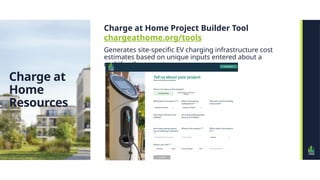
Charge at HomeProject Builder Tool
chargeathome.org/tools
Generates site-specific EV charging infrastructure cost
estimates based on unique inputs entered about a
multifamily property.
Charge at
Home
Resources
12.
Business
Owner and
Commercial
Resources
CALSTART’s Charge@Workproject builder tool
www.chargeatwork.org
A step-by-step guide to launching workplace EV
charging (WPC) projects. Designed for organizations
of all sizes, Charge@Work streamlines planning,
budgeting, and implementation to help you create a
sustainable, EV-friendly workplace.
Forth’s Electric Vehicle Adoption Leadership
certification program (EVAL)