Recommended
PPTX
PPTX
PPTX
LESSON 13 - Character and Characterization.pptx
PPT
Chapter 2 characterization powernotes
PPT
Characters (Antagonist Vs. Protagonist).ppt
PDF
character types and characterization .pdf
PPTX
characterandcharacterization-131113084352-phpapp01.pptx
PPT
character and characterization.jkji ' jppt
PPTX
english grade 8 lesson;week 1 day 2.pptx
PPTX
Characterization Overview
PPTX
Characterization in Literature for High School
PPTX
Character Presentation.pptx
PPTX
Types of Characters and Characterizations_ppt Jed.pptx
PPTX
Characters and Characterization PowerPoint Presentation
PPTX
power point presentation-The heart of storytelling.
PPTX
Character and characterization
KEY
PPTX
CHARACTERS AND CHARACTERIZATION IN PROSE.pptx
PPT
Direct and Indirect Characterization
PPT
PPT
PPTX
ENGLISH 8 QUARTER 1 WEEK 1 CHARACTER AND CHARACTERIZATION
PPTX
Lesson 1 continuation-story elements ppt.pptx
PPTX
PPTX
Characters in the Story and its different types
PPTX
Diving into Characterization How Writers Bring Characters to Life.pptx
DOCX
Characterization in literature
DOCX
Characterization in literature
PPTX
ENGLISH 8 q2 SUMMATIVE 1 questionnaire.pptx
PPTX
Parts of Persuasive Text for lecture discussion notes.pptx
More Related Content
PPTX
PPTX
PPTX
LESSON 13 - Character and Characterization.pptx
PPT
Chapter 2 characterization powernotes
PPT
Characters (Antagonist Vs. Protagonist).ppt
PDF
character types and characterization .pdf
PPTX
characterandcharacterization-131113084352-phpapp01.pptx
PPT
character and characterization.jkji ' jppt
Similar to Character_Characterization_Presentation.pptx
PPTX
english grade 8 lesson;week 1 day 2.pptx
PPTX
Characterization Overview
PPTX
Characterization in Literature for High School
PPTX
Character Presentation.pptx
PPTX
Types of Characters and Characterizations_ppt Jed.pptx
PPTX
Characters and Characterization PowerPoint Presentation
PPTX
power point presentation-The heart of storytelling.
PPTX
Character and characterization
KEY
PPTX
CHARACTERS AND CHARACTERIZATION IN PROSE.pptx
PPT
Direct and Indirect Characterization
PPT
PPT
PPTX
ENGLISH 8 QUARTER 1 WEEK 1 CHARACTER AND CHARACTERIZATION
PPTX
Lesson 1 continuation-story elements ppt.pptx
PPTX
PPTX
Characters in the Story and its different types
PPTX
Diving into Characterization How Writers Bring Characters to Life.pptx
DOCX
Characterization in literature
DOCX
Characterization in literature
More from StepsRom
PPTX
ENGLISH 8 q2 SUMMATIVE 1 questionnaire.pptx
PPTX
Parts of Persuasive Text for lecture discussion notes.pptx
PPTX
Diction and Style discussion notes .pptx
PPTX
Persuasive Techniques vs propaganda techniques.pptx
PPTX
Market Demands for Fruits and ways of marketing a product.pptx
PPTX
Famous Orchard Farms in the Country.pptx
PPTX
Elements to be observed in planting trees and fruit-bearing trees.pptx
PPT
DEMO 2 cot lesson demonstration files.ppt
PPTX
GIANGAN DEMO 1 COT lesson demonstration .pptx
PPTX
Claims and Types of Claims lecture notes.pptx
PPTX
ESP 9 Q1 week 1 lecture notes for discussion.pptx
PPTX
Filipino 9 MARTES QUIZ daily notes and activity.pptx
PPTX
2nd & 3rd Conditionals discussion notes.pptx
PPTX
SYMBOLISM in a literary txt ENGLISH 8.pptx
PPTX
Zero Conditional English 9 week 8 day 2.pptx
PPTX
Culture, short story and types (english 8).pptx
PPTX
Fiipino 9 Lunes note-taking( Ano ang opinyon).pptx
PPTX
ANO NGA BA ANG SANAYSAY presenWEEK 6.pptx
PPTX
Ang Ama ni Mauro R. Avena______notes.pptx
PPTX
Communicative_Styles......_English9.pptx
Recently uploaded
PDF
CAM, DHT11, GAS, ESP32, FLAME, IR, TEMP, LCD, PIR, SOIL, SOUND, RELAY, TURBID...
PPTX
Reimagining Academic Library Services through Artificial Intelligence: A Case...
PDF
APPSC APPSC AEE-AE GENERAL STUDIES QUESTION PAPER.pdf
PPTX
West Hatch High School - GCSE Art Presentation
PDF
Sharad Bisen_Irrigation Systems and Methods in Horticultural Crops.pdf
PDF
Information about the author Shashi Deshpande
PPTX
Guidelines for reporting social networks and personal networks data
PPTX
How to Track Team Performance Analysis in Odoo 18 Recruitment
PDF
Q4_LE_English 5_Lesson 1_Week 1.pdf learning instruction
PPTX
"Aristotle : Father Of Western Philosophy"
PDF
Radio Ceylon Finals (An Indian Subcontinent Quiz).pdf
PDF
Radio Ceylon Prelims (An Indian Subcontinent Quiz).pdf
PPTX
How to Create & Configure Rewards in Odoo 18 Referrals
PPTX
That long silence - Novel by Shashi Deshapande
PDF
Bishan_Singh_Presentation - Toba tek Singh
PPTX
How to Create & Automate Asset Model in Odoo 18 Accounting
PPTX
Toba Tek Singh - Visualising Partition through Manto's Lens
PDF
Schrodinger's Capital Finals (SciBiz Quiz).pdf
PPTX
West Hatch High School -- GCSE Geography
PDF
Types of Foot & Foot Modifications in Birds
Character_Characterization_Presentation.pptx 1. 2. What is a Character?
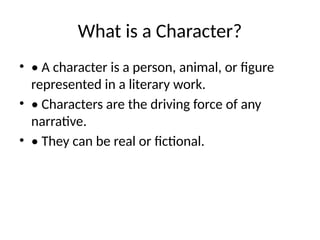
• • A character is a person, animal, or figure
represented in a literary work.
• • Characters are the driving force of any
narrative.
• • They can be real or fictional.
3. Types of Characters
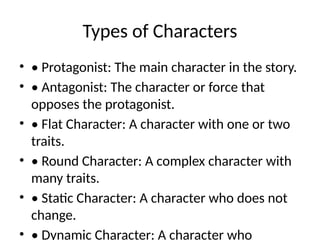
• • Protagonist: The main character in the story.
• • Antagonist: The character or force that
opposes the protagonist.
• • Flat Character: A character with one or two
traits.
• • Round Character: A complex character with
many traits.
• • Static Character: A character who does not
change.
• • Dynamic Character: A character who
4. What is Characterization?
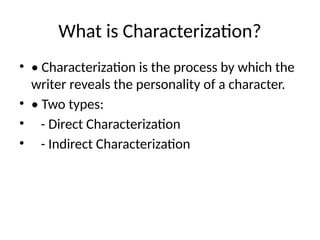
• • Characterization is the process by which the
writer reveals the personality of a character.
• • Two types:
• - Direct Characterization
• - Indirect Characterization
5. Direct vs. Indirect Characterization
• • Direct: The author tells the audience what
the personality of the character is.
• - Example: 'She was kind and generous.'
• • Indirect: The author shows things that reveal
the personality of a character.
• - Requires inference.
6. Methods of Indirect
Characterization (S.T.E.A.L.)
• • S – Speech: What does the character say?
• • T – Thoughts: What is revealed through the
character’s thoughts?
• • E – Effect on others: How do others react to
the character?
• • A – Actions: What does the character do?
• • L – Looks: What does the character look
like?
7. Practice Activity
• • Read an excerpt from a story.
• • Identify whether the characterization is
direct or indirect.
• • Use the S.T.E.A.L. method to describe the
character traits.