Part 2
Advantage of Charismatic Leadership
By: Joel Pedro
Increased Employee Loyalty
• Charismatic leaders are adapt at motivating and inspiring
employees, it is likely that leaders can encourage an
increase employee loyalty and commitment. Their goal is
to make employees feel that their work and talents matter.
Therefore, it is likely that employee engagement will
increase and turnover could decrease
Leader Creation
• Charismatic leaders and managers have an infectious
personality that can spur up-and-coming employees to
become leaders eventually. The qualities of these leaders
can take on a trickle-down effect and become a part of an
employee's eventual management style.
Higher Productivity
• These leaders are exceptionally skilled at gaining the trust
and respect of those who they manage. As a result,
employees are more likely to adhere to the high
expectations of charismatic leaders. The effects of this
have a high probability of spurring increased productivity
and better-quality work.
A move toward Innovation
• Charismatic leaders are driven toward change and
innovation that makes sense. Therefore, these individuals
will always look for opportunities to better the organization
and improve processes. This means the company can
always stay up-to-date on the latest trends and
organizational practices.
Establish a learning Culture
• of charismatic leadership are humility, effective
communication, and improvement. Because these leaders
have focused more on growth then punishment, mistakes
are treated as learning opportunities. Employees are
encouraged to find another solution to problems when the
original plan did not work. This could create a
settingwhere employees feel more comfortable taking a
risk and finding better solutions.
PART 3: Disadvantages of Charismatic
Leadership (Mistakes to Avoid)
> Wrong Focus - The
Wrong focus
• The main difference between charismatic and
transformational leadership is the focus on ethics.
Charismatic leadership can become more so about the
personality and belief system of the individual. Their
power to influence others could drive them to become
arrogant and shun humility or compassion.
The Creation of “yes-men’
• Because the personality of these leaders can turn
admirers into followers, it is easy for their big personalities
to create "yes-men." As a result, the ideas of a
charismatic leader could go unchallenged leading to the
implementation of plans that are less than favorable.
The company suffer if they leave
• To no of their own, a good and effective charismatic
leader may, have been the backbone of the business.
Their tenacity, drive, and leadership could have caused
many to depend on their ability without developing their
own. As a result, their departure could leave a hole that
no one has been trained to fill.
A Lack of Clarity
• If a leader has delivered more successes than failures
then they can start to rest on their charismatic abilities
and forget to employ tactics that are also responsible for
success: consulting the team, looking at previous
performance data, and remembering the mission and
vision of the company.
• While there are some cons attached to charismatic
leadership, many of the qualities are useful to leaders
who want to become influencers and motivate employees
to be their best selves.
PART 4: Charismatic Leadership: Best Practices
Become an active listener
Charismatic leaders are skilled in making others feel their
words matter, and they employ a lot of dynamic listening
techniques: asking questions, pausing before making
statements after their response and focusing on what they
are saying without forming a response.
Combine power with warmth
• Anyone can be powerful but it takes a unique type of
leader to combine the ability to influence others with
compassion and consideration. Those who want to
become charismatic leaders should show they care about
the needs of those they manage and strive to do what
they can encourage them to become their best selves
Work to Enhance Communication:
• Leaders who would like to employ a more charismatic
style should work on their public speaking skills, and take
notice of nonverbal cues like body language.
Don't Let Personality Overshadow Sound
Practice:
• As stated in the disadvantages, it is possible for leaders
who are charismatic to rely too heavily on their nature. It
is crucial for managers not to let arrogance take root and
always remember the value of criticism and sound
Create Opportunities for Honest Feedback:
• It is easy for allies to become "yes-men" when dealing
with an influential, charismatic leader. Leaders should
realize this and make sure they make a conscious effort
to courage people around be honest and truthful with
them about their ideas and proposals.
• Every leadership style has a benclits drawbacks, but a
valuable takeaway from charismatic leadership is
presence, influence, and consideration. Readers who
understand the importance of these three qualities can
become efficient
H. Other types of Leadership
• There are still unwritten types of leaderships aside from
those that are identified at discussed above. Like for
example, in the tribal communities. leaderships may not
fall under any of those that were discussed but these
tribal leaders wield power and authority granted to them
by the trust and confidence of their constituents. These
characteristics are either inherited or developed through
personal display of affection to the tribal community that
drives the entire community to to give their trust their
appointed leader.
Chapter 3
Dexter
Carandang
A. WHAT IS DECISION MAKING?
• The Decision-Making Process: Quite literally,
organizations operate by people making decisions. A
manager plans, organizes, staffs, leads, and controls her
team by executing decisions. The effectiveness and
quality of those decisions determine how successful a
manager will be.
• Managers are constantly called upon to make decisions in
order to solve problems. Decision making and problem
solving are ongoing processes of evaluating situations or
problems, considering alternatives, making choices, and
following them up with the necessary actions. Sometimes
the decision-making process is extremely short, and
mental reflection is essentially instantaneous. In other
situations, the process can drag on for weeks or even
months. The entire decision making process is dependent
upon the right information being available to the right
people at the right times.
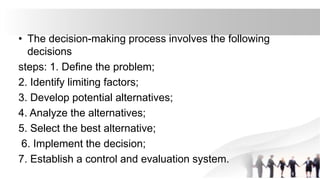
• The decision-making process involves the following
decisions
steps: 1. Define the problem;
2. Identify limiting factors;
3. Develop potential alternatives;
4. Analyze the alternatives;
5. Select the best alternative;
6. Implement the decision;
7. Establish a control and evaluation system.
• Define the problem: The decision-making process begins
when a manager identifies the real problem. The accurate
definition of the problem affects all the steps that follow; if
the problem is inaccurately defined, every step in the
decision-making process will be based on an incorrect
starting point. One way that a manager can help
determines the true problem in a situation is by identifying
the problem separately from its symptoms.
• The most obviously troubling situations found in an
organization can usually be identified as symptoms of
underlying problems. These symptoms all indicate that
something is wrong with an organization, but they don't
identify root causes. A successful manager doesn't just
attack symptoms; he works to uncover the factors that
cause these symptoms.
• All managers want to make the best decisions. To do so,
managers need to have the ideal resources information,
time, personnel, equipment, and supplies - and identify
any limiting factors. Realistically, managers operate in an
environment that normally doesn't provide ideal
resources. For example, they may lack the proper budget
or may not have the most accurate information or any
extra time. So, they must choose to satisfice- to make the
best decision possible with the information, resources,
and time available.
• Time pressures frequently cause a manager to move
forward after considering only the first or most obvious
answers. However, successful problem solving requires
thorough examination of the challenge, and a quick
answer may not result in a permanent solution. Thus, a
manager should think through and investigate several
alternative solutions to a single problem before making a
quick decision.
• One of the best known methods for developing
alternatives is through brainstorming, where a group
works together to generate ideas and alternative
solutions. The assumption behind brainstorming is that
the group dynamic stimulates thinking one person's ideas,
no matter how outrageous, can generate ideas from the
others in the group. Ideally, this spawning of ideas is
contagious, and before long, lots of suggestions and
ideas flow. Brainstorming usually requires 30 minutes to
an hour. The following specific rules should be followed
during brainstorming sessions:
• Concentrate on the problem at hand. This rule keeps the
discussion very specific and avoids the group's tendency
to address the events leading up to the current problem.
Entertain all ideas
• In fact the more ideas that comes up, the better. In other
words, there are no bad ideas Encouragement of the
group to freely offer all thoughts on the subject is
important. Participants should be encouraged to present
ideas no matter how ridiculous they seem, because such
ideas may spark is creative thought on the part of
someone else
Nominal group technique.
• This method involves the use of a highly structured
meeting, complete with an agenda, and restricts
discussion or interpersonal communication during the
decision-making process. This technique is useful
because it ensures that every group member has equal
input in the decision-making process. It also avoids some
of the pitfalls, such as pressure to conform, group
dominance, hostility, and conflict, that can plague a more
interactive, spontaneous, unstructured forum such as
brainstorming.
Delphi technique.
• With this technique, participants never meet, but a group
leader uses questionnaires to conduct the decision
making. written
• No matter what technique is used, group decision making
has clear advantages and disadvantages when compared
with individual decision making. The following are among
the advantages:
*Group provides a broader perspective
*Employees are more like to be satisfied and to support the
final decision
* Opportunities for discussion help to answer questions
and reduce uncertainties for the decision makers.
These points are among the
disadvantages:
• This method can be more time-consuming than
• one individual making the decision on his own. The
decision reached could be a compromise rather than the
optimal solution.
• Individuals become guilty of group think the ndency of
members of a group to conform to the evailing opinions of
the group.
• Groups may have difficuity performing tasks ecause the
group, rather than a single individual, akes the decision,
resulting in confusion when it mes time to implement and
Individuals become guilty of group think
• the tendency of members of a group to conform to the
evailing opinions of the group.
• Groups may have difficuity performing tasks ecause the
group, rather than a single individual, akes the decision,
resulting in confusion when it mes time to implement and
evaluate the decision.
• The results of dozens of individual-versus-group
erformance studies indicate that groups not only tend
make better decisions than a person acting alone, at also
that groups tend to inspire star performers to en higher
levels of productivity.
• So, are two for more) heads better than one? The swer
depends on several factors, such as the nature the task,
the abilities of the group members, and e form of
interaction. Because a manager often has choice between
making a decision independently or cluding others in the
decision making, she needs to derstand the advantages
and disadvantages of group cision making.
• The purpose of this step is to decide the relative merits of
each idea. Managers must identify the purpose of this
step is to decide the relative advantages and
disadvantages of each alternative caution before making
a final decision. aluating the alternatives can be done in
numerous
Evaluating the alternatives can be done in
numerous ways.
• Here are a few possibilities:
• ✓ Determine the pros and cons of each alternative.
Perform a cost-benefit analysis for each alternative.
• Weigh each factor important in the decision, ranking each
altenative relative to its ability to meet each factor and
then multiply by a probability factor to provide a final value
for each alternative.
Regardless of the method used, a manager needs to
evaluate each alternative in terms of its
Regardless of the method used, a manager needs to
evaluate each alternative in terms of its
✓ Feasibility - Can it be done?
✓ Effectiveness -How well does it resolve the
problem situation?
✓Consequences - What will be its costs (financial and nonfinancial) to the
organization?
Managers are paid to make decisions, but they are also paid to get results from
these decisions. Positive results must follow decisions. Everyone involved with
the decision must know his or her role in ensuring a successful outcome. To
make certain that employees understand el. roies, managers must thought
devise programs, procedures, rules, or policies
After a manager has analyzed all the alternatives, she must
decide on the best one. The best alternative is the one that
produces the most advantages and the fewest serious
disadvantages. Sometimes, the selection process can be
fairly straightforward, such as the alternative with the most
pros and fewest cons. Other times, the optimal solution is a
combination of several alternatives.
• Sometimes, though, the best alternative may not be
obvious. That's when a manager must decide which
alternative is the most feasible and effective, coupled with
which carries the lowest costs to the organization. (See
the preceding section.) Probability estimates, where
analysis of each alternative's chances of success takes
place, often come into play at this point in the decision
making process. In those cases, a manager simply
selects the alternative with the highest probability of
success.
• Managers are paid to make decisions, but they are also
paid to get results from these decisions. Positive results
must follow decisions. Everyone involved with the
decision must know his or her role in ensuring a
successful outcome. To make certain that employees
understand el. roies, managers must thought devise
programs, procedures, rules, or policies
• Ongoing actions need to be monitored. An evaluation
system should provide feedback on how well the decision
is being implemented, what the results are, and what
adjustments are necessary to get the results that were
intended when the solution was chosen.
• In order for a manager to evaluate his decision, he needs
to gather information to determine its effectiveness. Was
the original problem resolved? If not, is he closer to the
desired situation than he was at the beginning of the
decision-making process?
• If a manager's plan hasn't resolved the problem,
• he needs to figure out what went wrong. A manager may
• accomplish this by asking the following questions: Was
the wrong alternative selected? If so, one of the other
alternatives generated in the decision-making process
may be a wiser choice..
• Was the correct alternative selected, but implemented
improperly? If so, a manager should focus attention solely
on the implementation step to ensure that the chosen
alternative is implemented successfully. Was the original
problem identified incorrectly? If so, the decision-making
process needs to begin again, starting with a revised
identification stop.
• Has the implemented alternative been given enough time
to be successful? If not, a manager should give the
process more time and re-evaluate at a later date.
Make re-planning based on rests of evaluation.
Aerold A. Quitoras
Detailing types of plans
• Plans commit individuals, departments organizations for
the future. Effectively designed organizational goals fit
into hierarchy so that the achievement of goals at low
levels permits the attainment of high level goals. This
process is called means-ends chain because low level
goals lead to accomplisment of high level goals.
• Three major types of plans can help managers achieve
their organization's goals: strategic, tactical, and
operational. Operational plans lead to the achievement of
tactical plans, which in turn lead to the attainment of
strategic plans. In addition to these three types of plans,
managers should also develop a contingency plan in case
their original plans fail.
Operational Plans
• The specific results expected from departments, work
groups, and individuals are the operational goals. These
goals are precise and measurable. "Process of 150 sales
applications each week" or "Publish 20 books this
quarter" are examples of operational goals:
• An operational plan is one that a manager uses to
accomplish his or her job responsibilities. Supervisors,
team leaders, and facilitators develop operational plans to
support tactical plans (see the next section). Operational
plan can be a single use plan or an on going plan
• Single-use plans apply to activities that do not recur or
repeat. A one-time occurrence, such as a special sales
program, is a single-use plan because it deals with the
who, what, where, how, and how much of an activity A
budget is also a single-use plan because it predicts
sources and amounts of income and how much they are
used for a specific project.
• Continuing or ongoing plans are usually made once
and retain their value over a period of years while
undergoing periodic revisions and updates. The following
are examples of ongoing plans:
• A policy provides a broad guideline for managers to
follow when dealing with the important areas of decision
making. Policies are general how a manager should
attempt to handle routine management responsibilities.
Typical human resources policies, for example, address
such matters as employee hiring, terminations,
performance the appraisals, pay increases, and discipline.
• A procedure is a set of step by step directions that explains how
activities or tasks are to be carried out. Most organizations have
procedures for purchasing supplies and equipment, for example.
This procedure usually begins with a supervisor completing a
purchasing requisition. The requisition is then sent to the next
level of management for approval. The approved requisition is
forwarded to the purchasing department. Depending on the
amount of the request, the purchasing department may place an
ordes, or they may need to secure quotations and/or bids for
several vendors before placing the order. By defining the steps to
be taken and the order in which they are to be done. procedures
provide a standardized way of responding to a repetitive problem.
• A rule is an explicit statement that tells an employee what
he or she can and cannot do. Rules are "do" and "don't"
statements put into place to promote the safety of
employees and the uniform treatment and behavior of
employees. For example, rules about tardiness and
absenteeism permit supervisors to make discipline
decisions rapidly and with a high degree of airness.
Tactical Plans
• A tactical plan is concerned with what the lower level units within
each division must do, how they must do it, and who is in charge
at each level. Tactics are the means needed to activate a strategy
and make it work.
• Tactical plans are concerned with shorter time frames narrower
scopes than are strategic plans. These plans usually span one
year or less because they are considered short-term goals. Long-
term goals, in the other hand, can take several years or nore
accomplish. Normally, it is the middle manager's responsibility to
take the road strategic plan and identify specific tactical actions.
• is an outline of steps designed with the goals of the entire
organization as a whole in mind, rather than with the
goals of specific divisions or departments. Strategic
planning begins with an organization's mission.
A strategic plan
• Strategic plans look ahead over this next two, three, five, or even
more years to move the organization from where it currently is to
where it wants to be. Requiring multilevel involvement, these
plans demand harmony among all levels of management within
the organization, Top-level management develops the directional
objectives for the enure organization, while lower levels of
management develop compatible objectives and plans to achieve
them. Top management's strategic plan for the entire organization
becomes the frame work and sets dimensions for the lower level
planning.
Contingency Plans
• Intelligent and successful management depends upon a
constant pursuit of adaptation, flexibility, and mastery of
changing conditions. Strong management requires a
"keeping all options open" approach at all times that's
where contingency planning comes in.
• Contingency planning involves identifying alternative
courses of action that can be implemented if and when
the original plan proves inadequate because of changing
circumstances.
• Keep in mind that events beyond a manager's control
may cause even the most carefully prepared alternative
future scenarios to go awry. Unexpected problems and
events frequently occur. When they do, managers may
need to change their plans. Anticipating change during the
planning process is best in case things don't go as
expected management can then develop alternatives to
the existing plan and ready them for use when and if
circumstances

character formation.pptx

  • 1.
    Part 2 Advantage ofCharismatic Leadership By: Joel Pedro
  • 2.
    Increased Employee Loyalty •Charismatic leaders are adapt at motivating and inspiring employees, it is likely that leaders can encourage an increase employee loyalty and commitment. Their goal is to make employees feel that their work and talents matter. Therefore, it is likely that employee engagement will increase and turnover could decrease
  • 3.
    Leader Creation • Charismaticleaders and managers have an infectious personality that can spur up-and-coming employees to become leaders eventually. The qualities of these leaders can take on a trickle-down effect and become a part of an employee's eventual management style.
  • 4.
    Higher Productivity • Theseleaders are exceptionally skilled at gaining the trust and respect of those who they manage. As a result, employees are more likely to adhere to the high expectations of charismatic leaders. The effects of this have a high probability of spurring increased productivity and better-quality work.
  • 5.
    A move towardInnovation • Charismatic leaders are driven toward change and innovation that makes sense. Therefore, these individuals will always look for opportunities to better the organization and improve processes. This means the company can always stay up-to-date on the latest trends and organizational practices.
  • 6.
    Establish a learningCulture • of charismatic leadership are humility, effective communication, and improvement. Because these leaders have focused more on growth then punishment, mistakes are treated as learning opportunities. Employees are encouraged to find another solution to problems when the original plan did not work. This could create a settingwhere employees feel more comfortable taking a risk and finding better solutions.
  • 7.
    PART 3: Disadvantagesof Charismatic Leadership (Mistakes to Avoid) > Wrong Focus - The
  • 8.
    Wrong focus • Themain difference between charismatic and transformational leadership is the focus on ethics. Charismatic leadership can become more so about the personality and belief system of the individual. Their power to influence others could drive them to become arrogant and shun humility or compassion.
  • 9.
    The Creation of“yes-men’ • Because the personality of these leaders can turn admirers into followers, it is easy for their big personalities to create "yes-men." As a result, the ideas of a charismatic leader could go unchallenged leading to the implementation of plans that are less than favorable.
  • 10.
    The company sufferif they leave • To no of their own, a good and effective charismatic leader may, have been the backbone of the business. Their tenacity, drive, and leadership could have caused many to depend on their ability without developing their own. As a result, their departure could leave a hole that no one has been trained to fill.
  • 11.
    A Lack ofClarity • If a leader has delivered more successes than failures then they can start to rest on their charismatic abilities and forget to employ tactics that are also responsible for success: consulting the team, looking at previous performance data, and remembering the mission and vision of the company. • While there are some cons attached to charismatic leadership, many of the qualities are useful to leaders who want to become influencers and motivate employees to be their best selves.
  • 12.
    PART 4: CharismaticLeadership: Best Practices
  • 13.
    Become an activelistener Charismatic leaders are skilled in making others feel their words matter, and they employ a lot of dynamic listening techniques: asking questions, pausing before making statements after their response and focusing on what they are saying without forming a response.
  • 14.
    Combine power withwarmth • Anyone can be powerful but it takes a unique type of leader to combine the ability to influence others with compassion and consideration. Those who want to become charismatic leaders should show they care about the needs of those they manage and strive to do what they can encourage them to become their best selves
  • 15.
    Work to EnhanceCommunication: • Leaders who would like to employ a more charismatic style should work on their public speaking skills, and take notice of nonverbal cues like body language.
  • 16.
    Don't Let PersonalityOvershadow Sound Practice: • As stated in the disadvantages, it is possible for leaders who are charismatic to rely too heavily on their nature. It is crucial for managers not to let arrogance take root and always remember the value of criticism and sound
  • 17.
    Create Opportunities forHonest Feedback: • It is easy for allies to become "yes-men" when dealing with an influential, charismatic leader. Leaders should realize this and make sure they make a conscious effort to courage people around be honest and truthful with them about their ideas and proposals. • Every leadership style has a benclits drawbacks, but a valuable takeaway from charismatic leadership is presence, influence, and consideration. Readers who understand the importance of these three qualities can become efficient
  • 18.
    H. Other typesof Leadership • There are still unwritten types of leaderships aside from those that are identified at discussed above. Like for example, in the tribal communities. leaderships may not fall under any of those that were discussed but these tribal leaders wield power and authority granted to them by the trust and confidence of their constituents. These characteristics are either inherited or developed through personal display of affection to the tribal community that drives the entire community to to give their trust their appointed leader.
  • 19.
  • 20.
    A. WHAT ISDECISION MAKING? • The Decision-Making Process: Quite literally, organizations operate by people making decisions. A manager plans, organizes, staffs, leads, and controls her team by executing decisions. The effectiveness and quality of those decisions determine how successful a manager will be.
  • 21.
    • Managers areconstantly called upon to make decisions in order to solve problems. Decision making and problem solving are ongoing processes of evaluating situations or problems, considering alternatives, making choices, and following them up with the necessary actions. Sometimes the decision-making process is extremely short, and mental reflection is essentially instantaneous. In other situations, the process can drag on for weeks or even months. The entire decision making process is dependent upon the right information being available to the right people at the right times.
  • 22.
    • The decision-makingprocess involves the following decisions steps: 1. Define the problem; 2. Identify limiting factors; 3. Develop potential alternatives; 4. Analyze the alternatives; 5. Select the best alternative; 6. Implement the decision; 7. Establish a control and evaluation system.
  • 23.
    • Define theproblem: The decision-making process begins when a manager identifies the real problem. The accurate definition of the problem affects all the steps that follow; if the problem is inaccurately defined, every step in the decision-making process will be based on an incorrect starting point. One way that a manager can help determines the true problem in a situation is by identifying the problem separately from its symptoms.
  • 24.
    • The mostobviously troubling situations found in an organization can usually be identified as symptoms of underlying problems. These symptoms all indicate that something is wrong with an organization, but they don't identify root causes. A successful manager doesn't just attack symptoms; he works to uncover the factors that cause these symptoms.
  • 25.
    • All managerswant to make the best decisions. To do so, managers need to have the ideal resources information, time, personnel, equipment, and supplies - and identify any limiting factors. Realistically, managers operate in an environment that normally doesn't provide ideal resources. For example, they may lack the proper budget or may not have the most accurate information or any extra time. So, they must choose to satisfice- to make the best decision possible with the information, resources, and time available.
  • 26.
    • Time pressuresfrequently cause a manager to move forward after considering only the first or most obvious answers. However, successful problem solving requires thorough examination of the challenge, and a quick answer may not result in a permanent solution. Thus, a manager should think through and investigate several alternative solutions to a single problem before making a quick decision.
  • 27.
    • One ofthe best known methods for developing alternatives is through brainstorming, where a group works together to generate ideas and alternative solutions. The assumption behind brainstorming is that the group dynamic stimulates thinking one person's ideas, no matter how outrageous, can generate ideas from the others in the group. Ideally, this spawning of ideas is contagious, and before long, lots of suggestions and ideas flow. Brainstorming usually requires 30 minutes to an hour. The following specific rules should be followed during brainstorming sessions:
  • 28.
    • Concentrate onthe problem at hand. This rule keeps the discussion very specific and avoids the group's tendency to address the events leading up to the current problem.
  • 29.
    Entertain all ideas •In fact the more ideas that comes up, the better. In other words, there are no bad ideas Encouragement of the group to freely offer all thoughts on the subject is important. Participants should be encouraged to present ideas no matter how ridiculous they seem, because such ideas may spark is creative thought on the part of someone else
  • 30.
    Nominal group technique. •This method involves the use of a highly structured meeting, complete with an agenda, and restricts discussion or interpersonal communication during the decision-making process. This technique is useful because it ensures that every group member has equal input in the decision-making process. It also avoids some of the pitfalls, such as pressure to conform, group dominance, hostility, and conflict, that can plague a more interactive, spontaneous, unstructured forum such as brainstorming.
  • 31.
    Delphi technique. • Withthis technique, participants never meet, but a group leader uses questionnaires to conduct the decision making. written • No matter what technique is used, group decision making has clear advantages and disadvantages when compared with individual decision making. The following are among the advantages:
  • 32.
    *Group provides abroader perspective *Employees are more like to be satisfied and to support the final decision * Opportunities for discussion help to answer questions and reduce uncertainties for the decision makers.
  • 33.
    These points areamong the disadvantages: • This method can be more time-consuming than • one individual making the decision on his own. The decision reached could be a compromise rather than the optimal solution. • Individuals become guilty of group think the ndency of members of a group to conform to the evailing opinions of the group. • Groups may have difficuity performing tasks ecause the group, rather than a single individual, akes the decision, resulting in confusion when it mes time to implement and
  • 34.
    Individuals become guiltyof group think • the tendency of members of a group to conform to the evailing opinions of the group. • Groups may have difficuity performing tasks ecause the group, rather than a single individual, akes the decision, resulting in confusion when it mes time to implement and evaluate the decision. • The results of dozens of individual-versus-group erformance studies indicate that groups not only tend make better decisions than a person acting alone, at also that groups tend to inspire star performers to en higher levels of productivity.
  • 35.
    • So, aretwo for more) heads better than one? The swer depends on several factors, such as the nature the task, the abilities of the group members, and e form of interaction. Because a manager often has choice between making a decision independently or cluding others in the decision making, she needs to derstand the advantages and disadvantages of group cision making. • The purpose of this step is to decide the relative merits of each idea. Managers must identify the purpose of this step is to decide the relative advantages and disadvantages of each alternative caution before making a final decision. aluating the alternatives can be done in numerous
  • 36.
    Evaluating the alternativescan be done in numerous ways. • Here are a few possibilities: • ✓ Determine the pros and cons of each alternative. Perform a cost-benefit analysis for each alternative. • Weigh each factor important in the decision, ranking each altenative relative to its ability to meet each factor and then multiply by a probability factor to provide a final value for each alternative.
  • 37.
    Regardless of themethod used, a manager needs to evaluate each alternative in terms of its Regardless of the method used, a manager needs to evaluate each alternative in terms of its ✓ Feasibility - Can it be done? ✓ Effectiveness -How well does it resolve the problem situation? ✓Consequences - What will be its costs (financial and nonfinancial) to the organization? Managers are paid to make decisions, but they are also paid to get results from these decisions. Positive results must follow decisions. Everyone involved with the decision must know his or her role in ensuring a successful outcome. To make certain that employees understand el. roies, managers must thought devise programs, procedures, rules, or policies
  • 38.
    After a managerhas analyzed all the alternatives, she must decide on the best one. The best alternative is the one that produces the most advantages and the fewest serious disadvantages. Sometimes, the selection process can be fairly straightforward, such as the alternative with the most pros and fewest cons. Other times, the optimal solution is a combination of several alternatives.
  • 39.
    • Sometimes, though,the best alternative may not be obvious. That's when a manager must decide which alternative is the most feasible and effective, coupled with which carries the lowest costs to the organization. (See the preceding section.) Probability estimates, where analysis of each alternative's chances of success takes place, often come into play at this point in the decision making process. In those cases, a manager simply selects the alternative with the highest probability of success.
  • 40.
    • Managers arepaid to make decisions, but they are also paid to get results from these decisions. Positive results must follow decisions. Everyone involved with the decision must know his or her role in ensuring a successful outcome. To make certain that employees understand el. roies, managers must thought devise programs, procedures, rules, or policies
  • 41.
    • Ongoing actionsneed to be monitored. An evaluation system should provide feedback on how well the decision is being implemented, what the results are, and what adjustments are necessary to get the results that were intended when the solution was chosen. • In order for a manager to evaluate his decision, he needs to gather information to determine its effectiveness. Was the original problem resolved? If not, is he closer to the desired situation than he was at the beginning of the decision-making process?
  • 42.
    • If amanager's plan hasn't resolved the problem, • he needs to figure out what went wrong. A manager may • accomplish this by asking the following questions: Was the wrong alternative selected? If so, one of the other alternatives generated in the decision-making process may be a wiser choice..
  • 43.
    • Was thecorrect alternative selected, but implemented improperly? If so, a manager should focus attention solely on the implementation step to ensure that the chosen alternative is implemented successfully. Was the original problem identified incorrectly? If so, the decision-making process needs to begin again, starting with a revised identification stop. • Has the implemented alternative been given enough time to be successful? If not, a manager should give the process more time and re-evaluate at a later date.
  • 44.
    Make re-planning basedon rests of evaluation. Aerold A. Quitoras
  • 45.
    Detailing types ofplans • Plans commit individuals, departments organizations for the future. Effectively designed organizational goals fit into hierarchy so that the achievement of goals at low levels permits the attainment of high level goals. This process is called means-ends chain because low level goals lead to accomplisment of high level goals.
  • 46.
    • Three majortypes of plans can help managers achieve their organization's goals: strategic, tactical, and operational. Operational plans lead to the achievement of tactical plans, which in turn lead to the attainment of strategic plans. In addition to these three types of plans, managers should also develop a contingency plan in case their original plans fail.
  • 47.
    Operational Plans • Thespecific results expected from departments, work groups, and individuals are the operational goals. These goals are precise and measurable. "Process of 150 sales applications each week" or "Publish 20 books this quarter" are examples of operational goals: • An operational plan is one that a manager uses to accomplish his or her job responsibilities. Supervisors, team leaders, and facilitators develop operational plans to support tactical plans (see the next section). Operational plan can be a single use plan or an on going plan
  • 48.
    • Single-use plansapply to activities that do not recur or repeat. A one-time occurrence, such as a special sales program, is a single-use plan because it deals with the who, what, where, how, and how much of an activity A budget is also a single-use plan because it predicts sources and amounts of income and how much they are used for a specific project.
  • 49.
    • Continuing orongoing plans are usually made once and retain their value over a period of years while undergoing periodic revisions and updates. The following are examples of ongoing plans: • A policy provides a broad guideline for managers to follow when dealing with the important areas of decision making. Policies are general how a manager should attempt to handle routine management responsibilities. Typical human resources policies, for example, address such matters as employee hiring, terminations, performance the appraisals, pay increases, and discipline.
  • 50.
    • A procedureis a set of step by step directions that explains how activities or tasks are to be carried out. Most organizations have procedures for purchasing supplies and equipment, for example. This procedure usually begins with a supervisor completing a purchasing requisition. The requisition is then sent to the next level of management for approval. The approved requisition is forwarded to the purchasing department. Depending on the amount of the request, the purchasing department may place an ordes, or they may need to secure quotations and/or bids for several vendors before placing the order. By defining the steps to be taken and the order in which they are to be done. procedures provide a standardized way of responding to a repetitive problem.
  • 51.
    • A ruleis an explicit statement that tells an employee what he or she can and cannot do. Rules are "do" and "don't" statements put into place to promote the safety of employees and the uniform treatment and behavior of employees. For example, rules about tardiness and absenteeism permit supervisors to make discipline decisions rapidly and with a high degree of airness.
  • 52.
    Tactical Plans • Atactical plan is concerned with what the lower level units within each division must do, how they must do it, and who is in charge at each level. Tactics are the means needed to activate a strategy and make it work. • Tactical plans are concerned with shorter time frames narrower scopes than are strategic plans. These plans usually span one year or less because they are considered short-term goals. Long- term goals, in the other hand, can take several years or nore accomplish. Normally, it is the middle manager's responsibility to take the road strategic plan and identify specific tactical actions.
  • 53.
    • is anoutline of steps designed with the goals of the entire organization as a whole in mind, rather than with the goals of specific divisions or departments. Strategic planning begins with an organization's mission. A strategic plan
  • 54.
    • Strategic planslook ahead over this next two, three, five, or even more years to move the organization from where it currently is to where it wants to be. Requiring multilevel involvement, these plans demand harmony among all levels of management within the organization, Top-level management develops the directional objectives for the enure organization, while lower levels of management develop compatible objectives and plans to achieve them. Top management's strategic plan for the entire organization becomes the frame work and sets dimensions for the lower level planning.
  • 55.
    Contingency Plans • Intelligentand successful management depends upon a constant pursuit of adaptation, flexibility, and mastery of changing conditions. Strong management requires a "keeping all options open" approach at all times that's where contingency planning comes in. • Contingency planning involves identifying alternative courses of action that can be implemented if and when the original plan proves inadequate because of changing circumstances.
  • 56.
    • Keep inmind that events beyond a manager's control may cause even the most carefully prepared alternative future scenarios to go awry. Unexpected problems and events frequently occur. When they do, managers may need to change their plans. Anticipating change during the planning process is best in case things don't go as expected management can then develop alternatives to the existing plan and ready them for use when and if circumstances