Chapter 1
Introduction to Child Health and
Pediatric Nursing
Copyright © 2021 Wolters Kluwer • All Rights Reserved
Learning Objectives
Upon completion of the chapter, student will be able to:
1. discuss different methods of measuring child health.
2. Discus the philosophy of pediatric nursing care.
3. Identify the major roles and functions of pediatric nursing, including
the scope of practice and the professional standards for pediatric nurses.
4. Explain the components of the nursing process as they relate to
nursing practice for children and their families.
5. Identify ethical concepts related to providing nursing care to children
and their families.
6. Describe legal issues related to caring for children and their families.
Copyright © 2021 Wolters Kluwer • All Rights Reserved
Definitions of Health
Health definition
o In the past, defined as (Absence of disease)
o Health was measured by monitoring mortality and morbidity of a group.
Current definition
o Health has shifted in focus to
 Disease prevention
 Health promotion
 Wellness
Copyright © 2021 Wolters Kluwer • All Rights Reserved
World Health Organization Definition of Health (2018)
“A state of complete physical, mental, and social well-being, and not
merely the absence of disease or infirmity.”
Copyright © 2021 Wolters Kluwer • All Rights Reserved
History of Child Health and Child Health Care #1
Prior to the late 18th Century
o Children were viewed as commodities or property
o Their role was to increase population and help with workload
o High rates of child mortality were common because of inadequate and unsanitary
food, lack of childhood immunizations and harsh working conditions
Copyright © 2021 Wolters Kluwer • All Rights Reserved
End of 19th century
o They gained a better understanding of cause of illnesses
o New public health efforts
 Campaign for safe milk (Milk pasteurization)
 Compulsory vaccination programs
o Public schools were established
o Court viewed children as minors (not property!)
History of Child Health and Child Health Care #2
Copyright © 2021 Wolters Kluwer • All Rights Reserved
19th and early 20th centuries
o Urban public health improvements
 Improved sanitation, treated regional drinking water, and hygiene awareness
o Growth of public health initiatives
o Growing knowledge
 Nutrition, sanitation, bacteriology, pharmacology, and psychology
History of Child Health and Child Health Care #3
Copyright © 2021 Wolters Kluwer • All Rights Reserved
End of 20th century
o New antibiotics and vaccines
o Increased survival rates
o Increase in chronic versus acute illness
o Biotechnology and genetic research
History of Child Health and Child Health Care #4
Copyright © 2021 Wolters Kluwer • All Rights Reserved
Focus of National and International Organizations to
Protect Child Rights
Violence and abuse
Child labor and soldiering
Juvenile justice
Child immigrants and orphaned children
Abandoned or homeless children
Copyright © 2021 Wolters Kluwer • All Rights Reserved
Key Milestones in Federal Programs in Support of
Children’s Health
1909—First White House Conference on Care of Dependent Children
1935—The Social Security Act
1946—National School Lunch Program
1965—Medicaid Program (Title XIX)
1966—Women, Infants, Children (WIC) Program
1993—Family & Medical Leave Act (FMLA)
1995—Early Head Start Program
1997—Children’s Health Insurance Program (CHIP)
 Adapted from Yarrow, A. L. (2011). A history of federal child antipoverty and health policy in the United States
since 1900. Child Development Perspectives, 5(1), 66–72.
Copyright © 2021 Wolters Kluwer • All Rights Reserved
Question #1
 Is the following statement true or false?
 In 2018, the World Health Organization defined health solely as “an
absence of disease or infirmity.”
Copyright © 2021 Wolters Kluwer • All Rights Reserved
Answer to Question #1
False.
Rationale: In 2018, the World Health Organization defined health as
“a state of complete physical, mental, and social well-being, and not
merely the absence of disease or infirmity.”
Copyright © 2021 Wolters Kluwer • All Rights Reserved
Evolution of Pediatric Nursing
1870: First pediatric professorship awarded to Abraham Jacobim MD
1900: Henry Street Settlement House established by Lillian Wald RN
(first public health nurse)
1902: Lina Rogers, RN, appointed as first full-time public school nurse
(salary paid by the Henry Street Settlement)
1960s: Pediatric nurse practitioner role developed (first NPs)
1980s: Maternal and child health standards developed by ANA
Copyright © 2021 Wolters Kluwer • All Rights Reserved
Measurement of Health Status
1979 U.S. Surgeon General’s Report, Healthy People
o Provided agenda that identified most significant preventable threats to health
o Set national objectives and metrics for monitoring progress toward goals
o Revised every 10 years
Healthy People 2030
o Comprehensive health promotion and disease prevention agenda working to
improve quantity and quality of life for Americans
Copyright © 2021 Wolters Kluwer • All Rights Reserved
Overall Goals of Healthy People 2030
Eliminate preventable disease, disability, and injury and premature
death
Achieve health equity
Eliminate disparities and attain health literacy to improve the health
of all groups
Create physical, economic, and social environments that promote
good health
Promote healthy development and behaviors across every stage of
life (specific goals for each stage)
Engage leadership, the public and key constituents to take action and
develop policies that will improve the health of all
Copyright © 2021 Wolters Kluwer • All Rights Reserved
Mortality
o Number of individuals who have died over a specific period (can be overall
or from specific cause)
o Presented in rates per unit of population (usually 1,000 or more)
o Infant mortality often used as indirect measure of the general health of a
population
Key Concepts in Health Reporting: Mortality Versus
Morbidity #1
Copyright © 2021 Wolters Kluwer • All Rights Reserved
Morbidity
o Measure of prevalence of disease or degree of disability in a population at
a particular time (e.g., days lost from school due to a particular problem)
o Presented as a rate per unit of population
Key Concepts in Health Reporting: Mortality Versus
Morbidity #2
Copyright © 2021 Wolters Kluwer • All Rights Reserved
Question #2
Is the following statement true or false?
The nurse researcher would measure the number of cases of asthma in
children in an inner-city population to determine mortality.
Copyright © 2021 Wolters Kluwer • All Rights Reserved
Answer to Question #2
 False.
The nurse researcher would measure the number of cases of asthma in
children in an inner-city population to determine morbidity.
Rationale: Researching the number of deaths due to a specific cause
over a specific period would assess mortality.
Copyright © 2021 Wolters Kluwer • All Rights Reserved
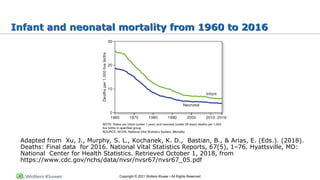
Infant and neonatal mortality from 1960 to 2016
Adapted from Xu, J., Murphy, S. L., Kochanek, K. D., Bastian, B., & Arias, E. (Eds.). (2018).
Deaths: Final data for 2016. National Vital Statistics Reports, 67(5), 1–76. Hyattsville, MD:
National Center for Health Statistics. Retrieved October 1, 2018, from
https://www.cdc.gov/nchs/data/nvsr/nvsr67/nvsr67_05.pdf
Copyright © 2021 Wolters Kluwer • All Rights Reserved
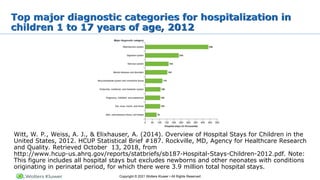
Top major diagnostic categories for hospitalization in
children 1 to 17 years of age, 2012
Witt, W. P., Weiss, A. J., & Elixhauser, A. (2014). Overview of Hospital Stays for Children in the
United States, 2012. HCUP Statistical Brief #187. Rockville, MD, Agency for Healthcare Research
and Quality. Retrieved October 13, 2018, from
http://www.hcup-us.ahrq.gov/reports/statbriefs/sb187-Hospital-Stays-Children-2012.pdf. Note:
This figure includes all hospital stays but excludes newborns and other neonates with conditions
originating in perinatal period, for which there were 3.9 million total hospital stays.
Copyright © 2021 Wolters Kluwer • All Rights Reserved
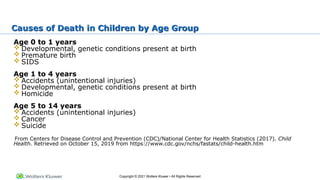
Causes of Death in Children by Age Group
Age 0 to 1 years
 Developmental, genetic conditions present at birth
 Premature birth
 SIDS
Age 1 to 4 years
 Accidents (unintentional injuries)
 Developmental, genetic conditions present at birth
 Homicide
Age 5 to 14 years
 Accidents (unintentional injuries)
 Cancer
 Suicide
From Centers for Disease Control and Prevention (CDC)/National Center for Health Statistics (2017). Child
Health. Retrieved on October 15, 2019 from https://www.cdc.gov/nchs/fastats/child-health.htm
Copyright © 2021 Wolters Kluwer • All Rights Reserved
Philosophy of Pediatric Nursing
To promote and assist the child in maintaining optimal levels of health
by:
Focusing on the family
o Providing family centered, culturally competent care
Providing atraumatic therapeutic care
o Minimizing physical and psychological stress for children and their parents
Using evidence-based practices
o Using research findings to establish a plan of care
Copyright © 2021 Wolters Kluwer • All Rights Reserved
Characteristics of Pediatric Care
Continuous
Comprehensive
Coordinated
Family centered
Compassionate
Culturally competent
Copyright © 2021 Wolters Kluwer • All Rights Reserved
Roles of the Pediatric Nurse
Providing direct nursing care to children and their families
Promote optimum growth and development of the child through health
education
Being an advocate, educator, and manager
Serving as a collaborator, care coordinator, and consultant
Copyright © 2021 Wolters Kluwer • All Rights Reserved
Role of the Nurse in Relationship to Morbidity and
Mortality in Children
Educating families and communities about:
o Developmentally appropriate child safety and preventative measures
o Utility of vaccinations in preventing childhood illnesses/morbidity and benefits of
preventative care
o Symptoms requiring health care visits
Goal
o Raise awareness of and provide guidance and counseling to prevent unnecessary
deaths/illnesses in children
Copyright © 2021 Wolters Kluwer • All Rights Reserved
Pediatric Nursing: Scope and Standards of Nursing
Practice #1
Defines guiding principles in pediatric nursing practice
Position statement about standards of practice and professional
performance of pediatric nurses
Jointly adopted upon by National Association of Pediatric Nurse
Practitioners (NAPNAP), Society of Pediatric Nurses, American Nurse’s
Association (ANA) Scope, and Standards of Pediatric Nursing Practice
Copyright © 2021 Wolters Kluwer • All Rights Reserved
Pediatric Nursing: Scope and Standards of Nursing
Practice #2
Standards of Practice: Nursing Process
 Assessment
 Nursing diagnosis
 Planning and expected outcomes
 Implementation
 Evaluation
Copyright © 2021 Wolters Kluwer • All Rights Reserved
Pediatric Nursing: Scope and Standards of Nursing
Practice #3
Standards of Professional Practice
Quality of practice
Professional practice evaluation
Education
Collegiality, communication and collaboration
Ethics, research, evidenced-based practice, and clinical scholarship
Resource utilization, environmental health, advocacy,
and leadership
Copyright © 2021 Wolters Kluwer • All Rights Reserved
Core Ethical Principles
Autonomy—freedom to choose and make decisions
Beneficence—actions that will benefit others
Nonmaleficence—avoiding causing harm (intentionally or
unintentionally)
Justice—acting fairly to all
Veracity—telling the truth
Fidelity—keeping promises, maintaining confidentiality
Copyright © 2021 Wolters Kluwer • All Rights Reserved
Balancing Ethical Components for Families of Different
Cultures and Religions
Identify the problem within the family’s cultural context
Gather information about the problem and the culture
Weigh risks against benefits
Choose solution based upon culturally competent care
Implement solution based within family values
Evaluate outcome of implementation
Copyright © 2021 Wolters Kluwer • All Rights Reserved
Key Elements of Informed Consent
The decision maker (person who consents) must be of legal age in
that state, with full civil rights and be competent
Information in the consent form must be simple, concise,
appropriate to the level of education and language of the decision
maker
Decision to participate must be voluntary, without coercion, force,
or influence of duress
Have a witness to the process of obtaining informed consent
Have that witness sign the consent form
Copyright © 2021 Wolters Kluwer • All Rights Reserved
Nurse’s Responsibility Related to Informed Consent
Determine whether parent/legal guardian understands what they are
signing
Ask specific questions to assess parent/legal guardian’s knowledge
related to the consent
Clarify and resolve knowledge deficits
Ensure the consent form is completed with signatures for parents or legal
guardians
Serve as a witness to the consent process
Children over the age of 8 may be asked to sign an assent form
Copyright © 2021 Wolters Kluwer • All Rights Reserved
Special Considerations Related to Informed Consent
Child not living with parent (biologic or adoptive)
Mature or emancipated minors
Parental consent after divorce
Consent for organ donation
Consent for medical experimentation
Psychiatric and reproductive health services (may be a different age of
consent than for other health care services)
Copyright © 2021 Wolters Kluwer • All Rights Reserved
Pediatric Assent
Affirms child’s participation in the decision-making process about health
care (child does not make final decision)
Helps the child to understand his or her health condition as developmentally
appropriate for the child
Informs the child of the treatment planned and discuss what he or she
should expect
Make sure he or she is not being unduly influenced to make a decision one
way or another
Ascertains the child’s willingness to participate in the treatment or
research
Copyright © 2021 Wolters Kluwer • All Rights Reserved
Advance Directives
Patient Self-Determination Act of 1990 established the concept
Determine and communicate the child’s and family’s wishes should life-
sustaining care become necessary
Parents are generally the surrogate decision makers for children; need
to take into consideration the views of the child when possible
Health care providers assist families in developing and implementing
advance directives
Related acronyms are: AND (Allow Natural Death) and DNAR (Do Not
Attempt Resuscitation)
Copyright © 2021 Wolters Kluwer • All Rights Reserved
HIPAA Regulations/Maintaining Confidentiality With
Electronic Records
Be aware of HIPAA regulations
Always maintain security of personal log-in information
Always log-off when leaving computer
Do not leave child’s information visible on computer
Use safeguards when using alternate communication
Know the exceptions to confidentiality (e.g., suspicion of child abuse; reporting
infections to health agencies; child threatens harm to self or others)
HIPAA is a federal law that protects the privacy and security of health information
in the US
Copyright © 2021 Wolters Kluwer • All Rights Reserved
References
 Kyle, T., & Carman, S. (2019). Essentials of Pediatric Nursing (4th ed.). Wolters Kluwer Health

ChapterChapterChapterChapterChaptervvChapterChapterChapter

  • 1.
    Chapter 1 Introduction toChild Health and Pediatric Nursing
  • 2.
    Copyright © 2021Wolters Kluwer • All Rights Reserved Learning Objectives Upon completion of the chapter, student will be able to: 1. discuss different methods of measuring child health. 2. Discus the philosophy of pediatric nursing care. 3. Identify the major roles and functions of pediatric nursing, including the scope of practice and the professional standards for pediatric nurses. 4. Explain the components of the nursing process as they relate to nursing practice for children and their families. 5. Identify ethical concepts related to providing nursing care to children and their families. 6. Describe legal issues related to caring for children and their families.
  • 3.
    Copyright © 2021Wolters Kluwer • All Rights Reserved Definitions of Health Health definition o In the past, defined as (Absence of disease) o Health was measured by monitoring mortality and morbidity of a group. Current definition o Health has shifted in focus to  Disease prevention  Health promotion  Wellness
  • 4.
    Copyright © 2021Wolters Kluwer • All Rights Reserved World Health Organization Definition of Health (2018) “A state of complete physical, mental, and social well-being, and not merely the absence of disease or infirmity.”
  • 5.
    Copyright © 2021Wolters Kluwer • All Rights Reserved History of Child Health and Child Health Care #1 Prior to the late 18th Century o Children were viewed as commodities or property o Their role was to increase population and help with workload o High rates of child mortality were common because of inadequate and unsanitary food, lack of childhood immunizations and harsh working conditions
  • 6.
    Copyright © 2021Wolters Kluwer • All Rights Reserved End of 19th century o They gained a better understanding of cause of illnesses o New public health efforts  Campaign for safe milk (Milk pasteurization)  Compulsory vaccination programs o Public schools were established o Court viewed children as minors (not property!) History of Child Health and Child Health Care #2
  • 7.
    Copyright © 2021Wolters Kluwer • All Rights Reserved 19th and early 20th centuries o Urban public health improvements  Improved sanitation, treated regional drinking water, and hygiene awareness o Growth of public health initiatives o Growing knowledge  Nutrition, sanitation, bacteriology, pharmacology, and psychology History of Child Health and Child Health Care #3
  • 8.
    Copyright © 2021Wolters Kluwer • All Rights Reserved End of 20th century o New antibiotics and vaccines o Increased survival rates o Increase in chronic versus acute illness o Biotechnology and genetic research History of Child Health and Child Health Care #4
  • 9.
    Copyright © 2021Wolters Kluwer • All Rights Reserved Focus of National and International Organizations to Protect Child Rights Violence and abuse Child labor and soldiering Juvenile justice Child immigrants and orphaned children Abandoned or homeless children
  • 10.
    Copyright © 2021Wolters Kluwer • All Rights Reserved Key Milestones in Federal Programs in Support of Children’s Health 1909—First White House Conference on Care of Dependent Children 1935—The Social Security Act 1946—National School Lunch Program 1965—Medicaid Program (Title XIX) 1966—Women, Infants, Children (WIC) Program 1993—Family & Medical Leave Act (FMLA) 1995—Early Head Start Program 1997—Children’s Health Insurance Program (CHIP)  Adapted from Yarrow, A. L. (2011). A history of federal child antipoverty and health policy in the United States since 1900. Child Development Perspectives, 5(1), 66–72.
  • 11.
    Copyright © 2021Wolters Kluwer • All Rights Reserved Question #1  Is the following statement true or false?  In 2018, the World Health Organization defined health solely as “an absence of disease or infirmity.”
  • 12.
    Copyright © 2021Wolters Kluwer • All Rights Reserved Answer to Question #1 False. Rationale: In 2018, the World Health Organization defined health as “a state of complete physical, mental, and social well-being, and not merely the absence of disease or infirmity.”
  • 13.
    Copyright © 2021Wolters Kluwer • All Rights Reserved Evolution of Pediatric Nursing 1870: First pediatric professorship awarded to Abraham Jacobim MD 1900: Henry Street Settlement House established by Lillian Wald RN (first public health nurse) 1902: Lina Rogers, RN, appointed as first full-time public school nurse (salary paid by the Henry Street Settlement) 1960s: Pediatric nurse practitioner role developed (first NPs) 1980s: Maternal and child health standards developed by ANA
  • 14.
    Copyright © 2021Wolters Kluwer • All Rights Reserved Measurement of Health Status 1979 U.S. Surgeon General’s Report, Healthy People o Provided agenda that identified most significant preventable threats to health o Set national objectives and metrics for monitoring progress toward goals o Revised every 10 years Healthy People 2030 o Comprehensive health promotion and disease prevention agenda working to improve quantity and quality of life for Americans
  • 15.
    Copyright © 2021Wolters Kluwer • All Rights Reserved Overall Goals of Healthy People 2030 Eliminate preventable disease, disability, and injury and premature death Achieve health equity Eliminate disparities and attain health literacy to improve the health of all groups Create physical, economic, and social environments that promote good health Promote healthy development and behaviors across every stage of life (specific goals for each stage) Engage leadership, the public and key constituents to take action and develop policies that will improve the health of all
  • 16.
    Copyright © 2021Wolters Kluwer • All Rights Reserved Mortality o Number of individuals who have died over a specific period (can be overall or from specific cause) o Presented in rates per unit of population (usually 1,000 or more) o Infant mortality often used as indirect measure of the general health of a population Key Concepts in Health Reporting: Mortality Versus Morbidity #1
  • 17.
    Copyright © 2021Wolters Kluwer • All Rights Reserved Morbidity o Measure of prevalence of disease or degree of disability in a population at a particular time (e.g., days lost from school due to a particular problem) o Presented as a rate per unit of population Key Concepts in Health Reporting: Mortality Versus Morbidity #2
  • 18.
    Copyright © 2021Wolters Kluwer • All Rights Reserved Question #2 Is the following statement true or false? The nurse researcher would measure the number of cases of asthma in children in an inner-city population to determine mortality.
  • 19.
    Copyright © 2021Wolters Kluwer • All Rights Reserved Answer to Question #2  False. The nurse researcher would measure the number of cases of asthma in children in an inner-city population to determine morbidity. Rationale: Researching the number of deaths due to a specific cause over a specific period would assess mortality.
  • 20.
    Copyright © 2021Wolters Kluwer • All Rights Reserved Infant and neonatal mortality from 1960 to 2016 Adapted from Xu, J., Murphy, S. L., Kochanek, K. D., Bastian, B., & Arias, E. (Eds.). (2018). Deaths: Final data for 2016. National Vital Statistics Reports, 67(5), 1–76. Hyattsville, MD: National Center for Health Statistics. Retrieved October 1, 2018, from https://www.cdc.gov/nchs/data/nvsr/nvsr67/nvsr67_05.pdf
  • 21.
    Copyright © 2021Wolters Kluwer • All Rights Reserved Top major diagnostic categories for hospitalization in children 1 to 17 years of age, 2012 Witt, W. P., Weiss, A. J., & Elixhauser, A. (2014). Overview of Hospital Stays for Children in the United States, 2012. HCUP Statistical Brief #187. Rockville, MD, Agency for Healthcare Research and Quality. Retrieved October 13, 2018, from http://www.hcup-us.ahrq.gov/reports/statbriefs/sb187-Hospital-Stays-Children-2012.pdf. Note: This figure includes all hospital stays but excludes newborns and other neonates with conditions originating in perinatal period, for which there were 3.9 million total hospital stays.
  • 22.
    Copyright © 2021Wolters Kluwer • All Rights Reserved Causes of Death in Children by Age Group Age 0 to 1 years  Developmental, genetic conditions present at birth  Premature birth  SIDS Age 1 to 4 years  Accidents (unintentional injuries)  Developmental, genetic conditions present at birth  Homicide Age 5 to 14 years  Accidents (unintentional injuries)  Cancer  Suicide From Centers for Disease Control and Prevention (CDC)/National Center for Health Statistics (2017). Child Health. Retrieved on October 15, 2019 from https://www.cdc.gov/nchs/fastats/child-health.htm
  • 23.
    Copyright © 2021Wolters Kluwer • All Rights Reserved Philosophy of Pediatric Nursing To promote and assist the child in maintaining optimal levels of health by: Focusing on the family o Providing family centered, culturally competent care Providing atraumatic therapeutic care o Minimizing physical and psychological stress for children and their parents Using evidence-based practices o Using research findings to establish a plan of care
  • 24.
    Copyright © 2021Wolters Kluwer • All Rights Reserved Characteristics of Pediatric Care Continuous Comprehensive Coordinated Family centered Compassionate Culturally competent
  • 25.
    Copyright © 2021Wolters Kluwer • All Rights Reserved Roles of the Pediatric Nurse Providing direct nursing care to children and their families Promote optimum growth and development of the child through health education Being an advocate, educator, and manager Serving as a collaborator, care coordinator, and consultant
  • 26.
    Copyright © 2021Wolters Kluwer • All Rights Reserved Role of the Nurse in Relationship to Morbidity and Mortality in Children Educating families and communities about: o Developmentally appropriate child safety and preventative measures o Utility of vaccinations in preventing childhood illnesses/morbidity and benefits of preventative care o Symptoms requiring health care visits Goal o Raise awareness of and provide guidance and counseling to prevent unnecessary deaths/illnesses in children
  • 27.
    Copyright © 2021Wolters Kluwer • All Rights Reserved Pediatric Nursing: Scope and Standards of Nursing Practice #1 Defines guiding principles in pediatric nursing practice Position statement about standards of practice and professional performance of pediatric nurses Jointly adopted upon by National Association of Pediatric Nurse Practitioners (NAPNAP), Society of Pediatric Nurses, American Nurse’s Association (ANA) Scope, and Standards of Pediatric Nursing Practice
  • 28.
    Copyright © 2021Wolters Kluwer • All Rights Reserved Pediatric Nursing: Scope and Standards of Nursing Practice #2 Standards of Practice: Nursing Process  Assessment  Nursing diagnosis  Planning and expected outcomes  Implementation  Evaluation
  • 29.
    Copyright © 2021Wolters Kluwer • All Rights Reserved Pediatric Nursing: Scope and Standards of Nursing Practice #3 Standards of Professional Practice Quality of practice Professional practice evaluation Education Collegiality, communication and collaboration Ethics, research, evidenced-based practice, and clinical scholarship Resource utilization, environmental health, advocacy, and leadership
  • 30.
    Copyright © 2021Wolters Kluwer • All Rights Reserved Core Ethical Principles Autonomy—freedom to choose and make decisions Beneficence—actions that will benefit others Nonmaleficence—avoiding causing harm (intentionally or unintentionally) Justice—acting fairly to all Veracity—telling the truth Fidelity—keeping promises, maintaining confidentiality
  • 31.
    Copyright © 2021Wolters Kluwer • All Rights Reserved Balancing Ethical Components for Families of Different Cultures and Religions Identify the problem within the family’s cultural context Gather information about the problem and the culture Weigh risks against benefits Choose solution based upon culturally competent care Implement solution based within family values Evaluate outcome of implementation
  • 32.
    Copyright © 2021Wolters Kluwer • All Rights Reserved Key Elements of Informed Consent The decision maker (person who consents) must be of legal age in that state, with full civil rights and be competent Information in the consent form must be simple, concise, appropriate to the level of education and language of the decision maker Decision to participate must be voluntary, without coercion, force, or influence of duress Have a witness to the process of obtaining informed consent Have that witness sign the consent form
  • 33.
    Copyright © 2021Wolters Kluwer • All Rights Reserved Nurse’s Responsibility Related to Informed Consent Determine whether parent/legal guardian understands what they are signing Ask specific questions to assess parent/legal guardian’s knowledge related to the consent Clarify and resolve knowledge deficits Ensure the consent form is completed with signatures for parents or legal guardians Serve as a witness to the consent process Children over the age of 8 may be asked to sign an assent form
  • 34.
    Copyright © 2021Wolters Kluwer • All Rights Reserved Special Considerations Related to Informed Consent Child not living with parent (biologic or adoptive) Mature or emancipated minors Parental consent after divorce Consent for organ donation Consent for medical experimentation Psychiatric and reproductive health services (may be a different age of consent than for other health care services)
  • 35.
    Copyright © 2021Wolters Kluwer • All Rights Reserved Pediatric Assent Affirms child’s participation in the decision-making process about health care (child does not make final decision) Helps the child to understand his or her health condition as developmentally appropriate for the child Informs the child of the treatment planned and discuss what he or she should expect Make sure he or she is not being unduly influenced to make a decision one way or another Ascertains the child’s willingness to participate in the treatment or research
  • 36.
    Copyright © 2021Wolters Kluwer • All Rights Reserved Advance Directives Patient Self-Determination Act of 1990 established the concept Determine and communicate the child’s and family’s wishes should life- sustaining care become necessary Parents are generally the surrogate decision makers for children; need to take into consideration the views of the child when possible Health care providers assist families in developing and implementing advance directives Related acronyms are: AND (Allow Natural Death) and DNAR (Do Not Attempt Resuscitation)
  • 37.
    Copyright © 2021Wolters Kluwer • All Rights Reserved HIPAA Regulations/Maintaining Confidentiality With Electronic Records Be aware of HIPAA regulations Always maintain security of personal log-in information Always log-off when leaving computer Do not leave child’s information visible on computer Use safeguards when using alternate communication Know the exceptions to confidentiality (e.g., suspicion of child abuse; reporting infections to health agencies; child threatens harm to self or others) HIPAA is a federal law that protects the privacy and security of health information in the US
  • 38.
    Copyright © 2021Wolters Kluwer • All Rights Reserved References  Kyle, T., & Carman, S. (2019). Essentials of Pediatric Nursing (4th ed.). Wolters Kluwer Health