Integrated Marketing Communication
Strategy
The marketing communication mix
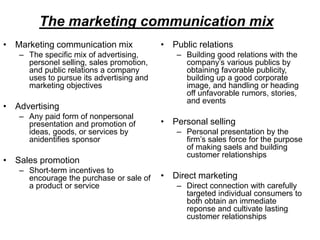
• Marketing communication mix
– The specific mix of advertising,
personel selling, sales promotion,
and public relations a company
uses to pursue its advertising and
marketing objectives
• Advertising
– Any paid form of nonpersonal
presentation and promotion of
ideas, goods, or services by
anidentifies sponsor
• Sales promotion
– Short-term incentives to
encourage the purchase or sale of
a product or service
• Public relations
– Building good relations with the
company’s various publics by
obtaining favorable publicity,
building up a good corporate
image, and handling or heading
off unfavorable rumors, stories,
and events
• Personal selling
– Personal presentation by the
firm’s sales force for the purpose
of making saels and building
customer relationships
• Direct marketing
– Direct connection with carefully
targeted individual consumers to
both obtain an immediate
reponse and cultivate lasting
customer relationships
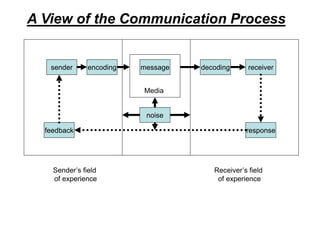
A View of the Communication Process
sender encoding
feedback
noise
response
Media
receiver
decoding
message
Sender’s field
of experience
Receiver’s field
of experience
A View of the Communication Process
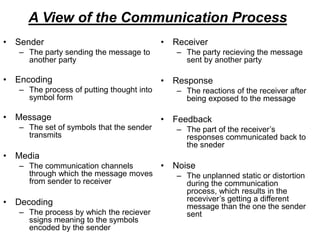
• Sender
– The party sending the message to
another party
• Encoding
– The process of putting thought into
symbol form
• Message
– The set of symbols that the sender
transmits
• Media
– The communication channels
through which the message moves
from sender to receiver
• Decoding
– The process by which the reciever
ssigns meaning to the symbols
encoded by the sender
• Receiver
– The party recieving the message
sent by another party
• Response
– The reactions of the receiver after
being exposed to the message
• Feedback
– The part of the receiver’s
responses communicated back to
the sneder
• Noise
– The unplanned static or distortion
during the communication
process, which results in the
receviver’s getting a different
message than the one the sender
sent
Steps in developing effective communication
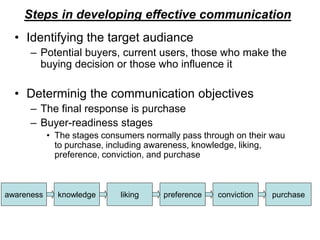
• Identifying the target audiance
– Potential buyers, current users, those who make the
buying decision or those who influence it
• Determinig the communication objectives
– The final response is purchase
– Buyer-readiness stages
• The stages consumers normally pass through on their wau
to purchase, including awareness, knowledge, liking,
preference, conviction, and purchase
awareness knowledge liking preference conviction purchase
Steps in developing effective communication
• Desinging a message
– The message should get attention, hold interest, arouse disire,
and obtain action
– Message content
• The communicator has to figure out an appeal or theme that
will produce the desired response.
• Three appeal types: rational, emotional, moral
– Message structure
• To draw a conclusion or leave it to the audiance
• To present a sided argument or two sided argument
• To present the strongest arguments first or last
– Message format
Steps in developing effective communication
– Choosing media
• Personal communication channels
– Channels through which two or more people communicate directly
with each other, including face to face, person to audiance, over the
television, or through the mail
– Word-of-mouth influnce: personal communication about a product
between target buyers and neighborship, friends, family members,
and associates
– Buzz marketing: cultivating opinion leaders and getting them to
spread information about a product or service to others in their
communities
• Nonpersonal communication channels
– Media that carry messages without personal contact or feedback,
including major media, atmospheres, and events
– Selecting the message source
– Collecting feedback

Integrated Marketing Communication strategyStrategy

  • 1.
  • 2.
    The marketing communicationmix • Marketing communication mix – The specific mix of advertising, personel selling, sales promotion, and public relations a company uses to pursue its advertising and marketing objectives • Advertising – Any paid form of nonpersonal presentation and promotion of ideas, goods, or services by anidentifies sponsor • Sales promotion – Short-term incentives to encourage the purchase or sale of a product or service • Public relations – Building good relations with the company’s various publics by obtaining favorable publicity, building up a good corporate image, and handling or heading off unfavorable rumors, stories, and events • Personal selling – Personal presentation by the firm’s sales force for the purpose of making saels and building customer relationships • Direct marketing – Direct connection with carefully targeted individual consumers to both obtain an immediate reponse and cultivate lasting customer relationships
  • 3.
    A View ofthe Communication Process sender encoding feedback noise response Media receiver decoding message Sender’s field of experience Receiver’s field of experience
  • 4.
    A View ofthe Communication Process • Sender – The party sending the message to another party • Encoding – The process of putting thought into symbol form • Message – The set of symbols that the sender transmits • Media – The communication channels through which the message moves from sender to receiver • Decoding – The process by which the reciever ssigns meaning to the symbols encoded by the sender • Receiver – The party recieving the message sent by another party • Response – The reactions of the receiver after being exposed to the message • Feedback – The part of the receiver’s responses communicated back to the sneder • Noise – The unplanned static or distortion during the communication process, which results in the receviver’s getting a different message than the one the sender sent
  • 5.
    Steps in developingeffective communication • Identifying the target audiance – Potential buyers, current users, those who make the buying decision or those who influence it • Determinig the communication objectives – The final response is purchase – Buyer-readiness stages • The stages consumers normally pass through on their wau to purchase, including awareness, knowledge, liking, preference, conviction, and purchase awareness knowledge liking preference conviction purchase
  • 6.
    Steps in developingeffective communication • Desinging a message – The message should get attention, hold interest, arouse disire, and obtain action – Message content • The communicator has to figure out an appeal or theme that will produce the desired response. • Three appeal types: rational, emotional, moral – Message structure • To draw a conclusion or leave it to the audiance • To present a sided argument or two sided argument • To present the strongest arguments first or last – Message format
  • 7.
    Steps in developingeffective communication – Choosing media • Personal communication channels – Channels through which two or more people communicate directly with each other, including face to face, person to audiance, over the television, or through the mail – Word-of-mouth influnce: personal communication about a product between target buyers and neighborship, friends, family members, and associates – Buzz marketing: cultivating opinion leaders and getting them to spread information about a product or service to others in their communities • Nonpersonal communication channels – Media that carry messages without personal contact or feedback, including major media, atmospheres, and events – Selecting the message source – Collecting feedback