The Collapse ofthe Hyatt Regency Kansas City
Walkways
•
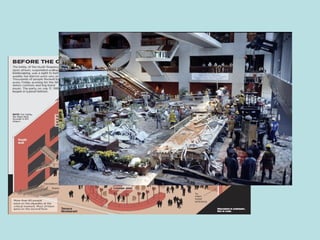
• In the 1970s, it became popular to design upscale hotels with large
atriums ( القاعات
المرتفعة ), some extending the entire height of the hotel,
a design element still in use today. This feature helps create very
dramatic architectural spaces in hotel lobbies. Many of these
designs also include walkways suspended over the atrium. One
hotel using this design was the Hyatt Regency Kansas City.
Development of this hotel began in 1976, and construction was
completed in the summer of 1980. One year later, in July 1981,
during a dance party in the atrium lobby, some of the walkways on
which people were dancing collapsed onto the crowded atrium floor,
leaving 114 people dead and 185 people injured.
4.
DC-9 Valujet
•On asunny afternoon in May of 1996, Valujet Flight 592 took
off from Miami International Airport, heading for Atlanta. Within
minutes of leaving the runway, the DC-9’s electrical systems
started to fail and the cockpit and passenger cabin began
filling with smoke. The pilots immediately called the Miami
tower for permission to return and began to descend and turn
back toward the airport. However, the situation worsened as
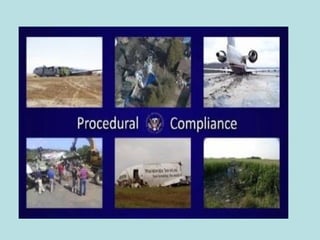
fire started melting control cables and the pilots became
overcome with smoke. Flight 592 rolled sharply to the right
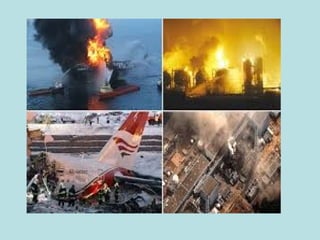
and, facing nose down, crashed into the Everglades (a vast
area of marshland and coastal mangrove in southern Florida,
part of which is protected as a national park.). The two pilots,
three flight attendants, and 105 passengers on board were
killed.
5.
*
No duty ofthe engineer is more important than duty
to protect the safety and well-being of the public
.
*
In this chapter, we will look into safety and risk
.
*
We will also examine the nature of accident and
try to determine what the engineer’s role is in
preventing accidents and ensuring the safety of
the public
.
6.
The engineering codesof ethics show that engineers have
a responsibility to society to produce product that are
safe
.
There is an implied warranty that products are safe to use
.
Nothing can be 100% safe, but engineers are required to
make products as safe as reasonably possible
.
Thus,safety should be an integral part af any
engineering design
.
7.
Safety is atthe same time a specific and a vague term
.
Vague because safety is a value judgment
Precise because in many cases we can readily distinguish a
safe design from an un safe one
*
It is impossible to discuss safety without including a
discussion of risk
*
Risk is a key element in any engineering design
*
it is impossible to design any thing to be completely risk free
.
8.
• Risk isthe possibility of suffering harm or
loss. ( Danger )
• Safety is freedom from risk, damage, or
injury.
9.
*
Safety and riskare essentially subjective and depend on many
factors
:
1
-
voluntary vs involuntary, Many consider something safer if
they knowingly take on the risk , but would find it unsafe if
forced to do
.
Ex: buy a house near a plant that emits low levels of a toxic
waste into the air
2
-
short-term vs long-term consequences . Something that
might cause a short illness or disability seems safer than
something that will result in permanent disability.( leg Vs
spinal)
10.
3
-
Expected probability. Manymight find a 1 in 1,000,000
chance of severe injury to be an acceptable risk ,
whereas a 50:50 chance of fairly minor injury might be
unacceptable (Swimming at a beach)
(
it is important to remember here that the expected
probability is only an educated guess
)
11.
5
-
Threshold levels forrisk. Something that is risky only at
fairly high exposures will seem safer than something
with a uniform exposure to risk.(automobile, nuclear
radiation)
*
if there is a threshold for the effect, generally there will be a
greater tolerance for risk
.
6
-
Delayed vs immediate risk, an activity whose harm is
delayed for many years will seem much less risky than
something with an immediate effect. (health effects of a
high-fat diet is acceptable Vs skydiving unacceptably
risky
12.
Thus, whether somethingis unsafe or risky often depends
on how asked , this create some confusion for the
engineer who decide ,so in making a decision ,some
analysis methods, especially line drawing and flow
charting, can be used to help the engineer to take right
decision for safety
.
13.
There is noimportant duty for an engineer more than the
safety of the public
.
Safety is an essential aspect of an engineering
responsibilities
.
To ensure the safety of an engineering design, four
criteria must be met
.
15.
The second rulesays that the acceptable design
must meet the standards of accepted
engineering practice
.
You can’t create a design that is less safe than
what everyone else in the profession
understands to be accessible
.
16.
An example onthe 2nd rule:
In a power supply design, the federal safety
laws might not require that the design be
inaccessible to a consumer who opens up a
computer
.
If manufactures designed the supplies so that no
lethal voltages can reach the user, then that
design is considered to be standard and to be
followed by all designer even if it increases the
cost
.
17.
The 3rd rulesays that any design alternatives
that are potentially safer must be explored
.
This requires some creativity in seeking
alternative solutions
.
With some creativity, you can discuss strategies
for the design with specialists in your field
and discover new strategies with them
18.
The 4th rulesays that the engineer must be aware
of potential product misuses by the users and
the design should be to avoid these misuses
.
As stated before, this requires some creativity
.
But if the user is too stupid to use the design, don’t
bother your self too much
!!
19.
Once the productis designed, both prototypes
and devices should be tested
.
This test ensures both functionality and safety of
the design
.
And to be aware, these tests should not be only for
testing and ensuring functionality
.
20.
Long terms Viewpointwill increase the cost
.
Will take a long time doing it
.
But: it will guarantee the best design
.
Improve the design
.
Decreases the injuries in the design
.
21.
There have beennumerous studied of accidents
and their causes with attempts to categorize
them.
Therefore understand the nature of accidents and
find the ways to prevent them. In order to
protect the safety of the public as the most
important mission for engineers.
They can be categorized in three types:
1. procedural, 2. engineered, and 3. systemic
[Langewiesche 1998].
24.
Example (in theairline industry)
:
It happens due to the misreading of an important gauge, by
“pilot or by air-traffic controllers
Flying when the weather should have dictated otherwise
.
Failure to follow regulations and procedures
it can also be committed by air-traffic controllers and
maintenance personnel
25.
• Engineers mustalso guard against
procedural problems that can lead to
accidents.
• Procedural accidents are fairly well
understood and are amenable to solution
through increased training, more
supervision, new laws or regulations,
26.
Caused by defectsin the design such as
:
Failures of materials
Devices that don’t perform as expected or don’t
perform well under all circumstances encountered
.
This accidents should be anticipated in the design
stage and corrected during test
.
28.
Example (turbines)
microrocks sometimesdevelop in turbine blades in
aircraft engines and when these microrocks become
severe enough the blade can fail and break apart
.
30.
Hard to understandand hard to control
.
Occurs in very complex technologies
.
Its difficult to be taken into account during design,
because there are many factors seeming
insignificant come into the play
.
31.
Example (airline industry)
Modernaircraft are very complicated systems so
that running them requires the work of many
individuals
.
These individuals may commit mistakes, one
mistake alone isn’t significant, but if several
individuals committed a series of mistakes, this
mistakes together may cause a major accident
.
![There have been numerous studied of accidents
and their causes with attempts to categorize
them.
Therefore understand the nature of accidents and
find the ways to prevent them. In order to
protect the safety of the public as the most
important mission for engineers.
They can be categorized in three types:
1. procedural, 2. engineered, and 3. systemic
[Langewiesche 1998].](https://image.slidesharecdn.com/chapter5-safetyupdated1-250829150455-64394497/85/Chapter5-Safety-updatedChapter5-Safety-updated-1-ppt-21-320.jpg)