C HA P T E R 2
Ol i v e r S c h u l t e
Intelligent Agents
Outline
Artificial Intelligence a modern approach
2
 Agents and environments
 Rationality
 PEAS (Performance measure, Environment,
Actuators, Sensors)
 Environment types
 Agent types
Artificial Intelligence a modern approach
3
The PEAS Model
Agents
Artificial Intelligence a modern approach
4
• An agent is anything that can be viewed as
perceiving its environment through sensors and
acting upon that environment through actuators
• Human agent:
– eyes, ears, and other organs for sensors;
– hands, legs, mouth, and other body parts for actuators
• Robotic agent:
– cameras and infrared range finders for sensors
– various motors for actuators
Agents and environments
Artificial Intelligence a modern approach
5
• The agent function maps from percept histories to
actions:
• [f: P*  A]
• The agent program runs on the physical architecture to
produce f
• agent = architecture + program
Vacuum-cleaner world
Artificial Intelligence a modern approach
6
 Percepts: location and contents, e.g., [A,Dirty]
 Actions: Left, Right, Suck, NoOp
 Agent’s function  look-up table
 For many agents this is a very large table
Demo With Open Source Code
Artificial Intelligence a modern approach
7
Multiple Choice Question (not graded)
A rational agent
1. finds a correct solution every time.
2. achieves optimal performance every time.
3. achieves the best performance on average.
4. achieves the best worst-case performance.
Pick one.
Rational agents
Artificial Intelligence a modern approach
8
• Rationality
– Performance measuring success
– Agents prior knowledge of environment
– Actions that agent can perform
– Agent’s percept sequence to date
• Rational Agent: For each possible percept sequence, a
rational agent should select an action that is expected to
maximize its performance measure, given the evidence
provided by the percept sequence and whatever built-in
knowledge the agent has.
• See File: intro-choice.doc
•
Rationality
Artificial Intelligence a modern approach
10
 Rational is different from omniscience
 Percepts may not supply all relevant information
 E.g., in card game, don’t know cards of others.
 Rational is different from being perfect
 Rationality maximizes expected outcome while perfection
maximizes actual outcome.
Autonomy in Agents
 Extremes
 No autonomy – ignores environment/data
 Complete autonomy – must act randomly/no program
 Example: baby learning to crawl
 Ideal: design agents to have some autonomy
 Possibly become more autonomous with experience
The autonomy of an agent is the extent to which its
behaviour is determined by its own experience,
rather than knowledge of designer.
Artificial Intelligence a modern approach
12
Multiple Choice Question
PEAS stands for
1. green vegetables.
2. Peace, Environment, Action, Service
3. Performance, Environment, Agent, Search.
4. Performance, Environment, Actuators, Sensors.
Check one.
PEAS
Artificial Intelligence a modern approach
13
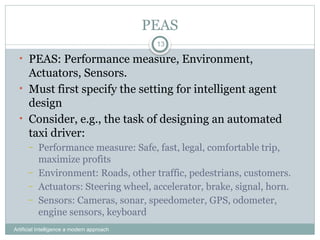
• PEAS: Performance measure, Environment,
Actuators, Sensors.
• Must first specify the setting for intelligent agent
design
• Consider, e.g., the task of designing an automated
taxi driver:
– Performance measure: Safe, fast, legal, comfortable trip,
maximize profits
– Environment: Roads, other traffic, pedestrians, customers.
– Actuators: Steering wheel, accelerator, brake, signal, horn.
– Sensors: Cameras, sonar, speedometer, GPS, odometer,
engine sensors, keyboard
PEAS
Artificial Intelligence a modern approach
14
 Agent: Part-picking robot
 Performance measure: Percentage of parts in correct
bins
 Environment: Conveyor belt with parts, bins
 Actuators: Jointed arm and hand
 Sensors: Camera, joint angle sensors
PEAS
Artificial Intelligence a modern approach
15
 Agent: Interactive English tutor
 Performance measure: Maximize student's score on
test
 Environment: Set of students
 Actuators: Screen display (exercises, suggestions,
corrections)
 Sensors: Keyboard
Artificial Intelligence a modern approach
16
Environments
Artificial Intelligence a modern approach
17
Multiple Choice Question (not graded)
In an episodic environment
1. outcomes do not depend on action history.
2. outcomes do depend on action history.
3. The environment does not change while the agent
is planning.
4. Other agents are involved in the episode.
Check one.
Environment types
Artificial Intelligence a modern approach
18
• Fully observable (vs. partially observable)
• Deterministic (vs. stochastic)
• Episodic (vs. sequential)
• Static (vs. dynamic)
• Discrete (vs. continuous)
• Single agent (vs. multiagent).
Fully observable (vs. partially observable)
Artificial Intelligence a modern approach
19
 Is everything an agent requires to choose its actions
available to it via its sensors?
 If so, the environment is fully accessible
 If not, parts of the environment are inaccessible
 Agent must make informed guesses about world.
Cross Word Backgammon Taxi driver Part picking robot
Poker Image analysis
Fully Fully Fully
Partially
Partially Partially
Deterministic (vs. stochastic)
Artificial Intelligence a modern approach
20
 Does the change in world state depend only on
current state and agent’s action?
 Non-deterministic environments
 Have aspects beyond the control of the agent
 Utility functions have to guess at changes in world
Cross Word Backgammon Taxi driver Part picking robot
Poker Image analysis
Cross Word Backgammon Taxi driver Part
Poker Image analysis
Deterministic Deterministic
Stochastic
Stochastic
Stochastic Stochastic
Episodic (vs. sequential):
Artificial Intelligence a modern approach
21
 Is the choice of current action
 Dependent on previous actions?
 If not, then the environment is episodic
 In sequential environments:
 Agent has to plan ahead:
 Current choice will affect future actions
Cross Word Backgammon Taxi driver Part picking robot
Poker Image analysis
Sequential
Sequential
Sequential
Sequential Episodic Episodic
Static (vs. dynamic):
Artificial Intelligence a modern approach
22
 Static environments don’t change
 While the agent is deliberating over what to do
 Dynamic environments do change
 So agent should/could consult the world when choosing actions
 Semidynamic: If the environment itself does not change
with the passage of time but the agent's performance
score does.
Static Static Static Dynamic
Cross Word Backgammon Taxi driver Part picking robot
Poker Image analysis
Dynamic Semi
Another example: off-line route planning vs. on-board
navigation system
Discrete (vs. continuous)
Artificial Intelligence a modern approach
23
 A limited number of distinct, clearly defined percepts and
actions vs. a range of values (continuous)
Cross Word Backgammon Taxi driver Part picking robot
Poker Image analysis
Discrete Discrete Discrete Conti Conti Conti
Single agent (vs. multiagent):
Artificial Intelligence a modern approach
24
 An agent operating by itself in an environment vs.
there are many agents working together
Cross Word Backgammon Taxi driver Part picking robot
Poker Image analysis
Single Single Single
Multi
Multi
Multi
Artificial Intelligence a modern approach
Summary.
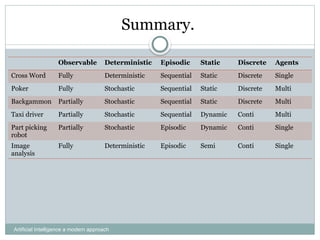
Observable Deterministic Episodic Static Discrete Agents
Cross Word Fully Deterministic Sequential Static Discrete Single
Poker Fully Stochastic Sequential Static Discrete Multi
Backgammon Partially Stochastic Sequential Static Discrete Multi
Taxi driver Partially Stochastic Sequential Dynamic Conti Multi
Part picking
robot
Partially Stochastic Episodic Dynamic Conti Single
Image
analysis
Fully Deterministic Episodic Semi Conti Single
Artificial Intelligence a modern approach
27
Agents
Artificial Intelligence a modern approach
28
Multiple Choice Question (not graded)
A goal-based agent
1. uses reflexes to reach a goal.
2. maximizes average performance.
3. selects actions to reach a goal given sensory input.
4. learns from its experience.
Select one.
Agent types
Artificial Intelligence a modern approach
29
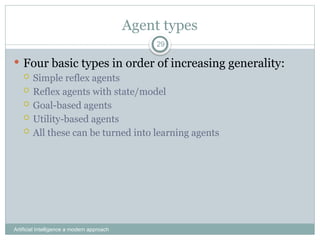
 Four basic types in order of increasing generality:
 Simple reflex agents
 Reflex agents with state/model
 Goal-based agents
 Utility-based agents
 All these can be turned into learning agents
Simple reflex agents
Artificial Intelligence a modern approach
30
Simple reflex agents
Artificial Intelligence a modern approach
31
 Simple but very limited intelligence.
 Action does not depend on percept history, only on
current percept.
 Thermostat.
Therefore no memory requirements.
 Infinite loops
 Suppose vacuum cleaner does not observe location. What
do you do given location = clean? Left on A or right on B -
> infinite loop.
 Fly buzzing around window or light.
 Possible Solution: Randomize action.
States: Beyond Reflexes
• Recall the agent function that maps from percept histories
to actions:
[f: P*  A]
 An agent program can implement an agent function by
maintaining an internal state.
 The internal state can contain information about the state
of the external environment.
 The state depends on the history of percepts and on the
history of actions taken:
[f: P*, A* S A] where S is the set of states.
Artificial Intelligence a modern approach
32
Model-based reflex agents
Artificial Intelligence a modern approach
34
 Know how world evolves
 Overtaking car gets closer from
behind
 How agents actions affect the
world
 Wheel turned clockwise takes you
right
 Model based agents update their
state
Goal-based agents
Artificial Intelligence a modern approach
35
• knowing state and environment? Enough?
– Taxi can go left, right, straight
• Have a goal
 A destination to get to
 Uses knowledge about a goal to guide its actions
 E.g., Search, planning
Goal-based agents
Artificial Intelligence a modern approach
36
• Reflex agent breaks when it sees brake lights. Goal based agent
reasons
– Brake light -> car in front is stopping -> I should stop -> I should use brake
Utility-based agents
Artificial Intelligence a modern approach
37
 Goals are not always enough
 Many action sequences get taxi to destination
 Consider other things. How fast, how safe…..
 A utility function maps a state onto a real number
which describes the associated degree of
“happiness”, “goodness”, “success”.
 Where does the utility measure come from?
 Economics: money.
 Biology: number of offspring.
 Your life?
Utility-based agents
Artificial Intelligence a modern approach
38
Learning agents
Artificial Intelligence a modern approach
39
 Performance element is
what was previously the
whole agent
 Input sensor
 Output action
 Learning element
 Modifies performance
element.
Learning agents (Taxi driver)
 Performance element
 How it currently drives
 Taxi driver Makes quick left turn across 3 lanes
 Critics observe shocking language by passenger and other drivers
and informs bad action
 Learning element tries to modify performance elements for future
 Problem generator suggests experiment: try out something called
Brakes on different Road conditions
 Exploration vs. Exploitation
 Learning experience can be costly in the short run
 shocking language from other drivers
 Less tip
 Fewer passengers
Artificial Intelligence a modern approach
41
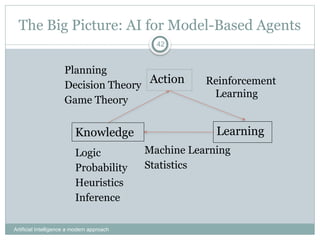
The Big Picture: AI for Model-Based Agents
Artificial Intelligence a modern approach
42
Action
Learning
Knowledge
Logic
Probability
Heuristics
Inference
Planning
Decision Theory
Game Theory
Reinforcement
Learning
Machine Learning
Statistics
The Picture for Reflex-Based Agents
Artificial Intelligence a modern approach
43
Action
Learning
Reinforcement
Learning
• Studied in AI, Cybernetics, Control Theory, Biology,
Psychology.
Discussion Question
 Model-based behaviour has a large overhead.
 Our large brains are very expensive from an
evolutionary point of view.
 Why would it be worthwhile to base behaviour on a
model rather than “hard-code” it?
 For what types of organisms in what type of
environments?
 What kind of agent is the Dyson cleaner?
Artificial Intelligence a modern approach
44
Summary
 Agents can be described by their PEAS.
 Environments can be described by several key properties:
64 Environment Types.
 A rational agent maximizes the performance measure for
their PEAS.
 The performance measure depends on the agent
function.
 The agent program implements the agent function.
 3 main architectures for agent programs.
 In this course we will look at some of the common and
useful combinations of environment/agent architecture.
Artificial Intelligence a modern approach
45

chapter2intelligence (AI) and machine learning (ML) .pptx

  • 1.
    C HA PT E R 2 Ol i v e r S c h u l t e Intelligent Agents
  • 2.
    Outline Artificial Intelligence amodern approach 2  Agents and environments  Rationality  PEAS (Performance measure, Environment, Actuators, Sensors)  Environment types  Agent types
  • 3.
    Artificial Intelligence amodern approach 3 The PEAS Model
  • 4.
    Agents Artificial Intelligence amodern approach 4 • An agent is anything that can be viewed as perceiving its environment through sensors and acting upon that environment through actuators • Human agent: – eyes, ears, and other organs for sensors; – hands, legs, mouth, and other body parts for actuators • Robotic agent: – cameras and infrared range finders for sensors – various motors for actuators
  • 5.
    Agents and environments ArtificialIntelligence a modern approach 5 • The agent function maps from percept histories to actions: • [f: P*  A] • The agent program runs on the physical architecture to produce f • agent = architecture + program
  • 6.
    Vacuum-cleaner world Artificial Intelligencea modern approach 6  Percepts: location and contents, e.g., [A,Dirty]  Actions: Left, Right, Suck, NoOp  Agent’s function  look-up table  For many agents this is a very large table Demo With Open Source Code
  • 7.
    Artificial Intelligence amodern approach 7 Multiple Choice Question (not graded) A rational agent 1. finds a correct solution every time. 2. achieves optimal performance every time. 3. achieves the best performance on average. 4. achieves the best worst-case performance. Pick one.
  • 8.
    Rational agents Artificial Intelligencea modern approach 8 • Rationality – Performance measuring success – Agents prior knowledge of environment – Actions that agent can perform – Agent’s percept sequence to date • Rational Agent: For each possible percept sequence, a rational agent should select an action that is expected to maximize its performance measure, given the evidence provided by the percept sequence and whatever built-in knowledge the agent has. • See File: intro-choice.doc •
  • 9.
    Rationality Artificial Intelligence amodern approach 10  Rational is different from omniscience  Percepts may not supply all relevant information  E.g., in card game, don’t know cards of others.  Rational is different from being perfect  Rationality maximizes expected outcome while perfection maximizes actual outcome.
  • 10.
    Autonomy in Agents Extremes  No autonomy – ignores environment/data  Complete autonomy – must act randomly/no program  Example: baby learning to crawl  Ideal: design agents to have some autonomy  Possibly become more autonomous with experience The autonomy of an agent is the extent to which its behaviour is determined by its own experience, rather than knowledge of designer.
  • 11.
    Artificial Intelligence amodern approach 12 Multiple Choice Question PEAS stands for 1. green vegetables. 2. Peace, Environment, Action, Service 3. Performance, Environment, Agent, Search. 4. Performance, Environment, Actuators, Sensors. Check one.
  • 12.
    PEAS Artificial Intelligence amodern approach 13 • PEAS: Performance measure, Environment, Actuators, Sensors. • Must first specify the setting for intelligent agent design • Consider, e.g., the task of designing an automated taxi driver: – Performance measure: Safe, fast, legal, comfortable trip, maximize profits – Environment: Roads, other traffic, pedestrians, customers. – Actuators: Steering wheel, accelerator, brake, signal, horn. – Sensors: Cameras, sonar, speedometer, GPS, odometer, engine sensors, keyboard
  • 13.
    PEAS Artificial Intelligence amodern approach 14  Agent: Part-picking robot  Performance measure: Percentage of parts in correct bins  Environment: Conveyor belt with parts, bins  Actuators: Jointed arm and hand  Sensors: Camera, joint angle sensors
  • 14.
    PEAS Artificial Intelligence amodern approach 15  Agent: Interactive English tutor  Performance measure: Maximize student's score on test  Environment: Set of students  Actuators: Screen display (exercises, suggestions, corrections)  Sensors: Keyboard
  • 15.
    Artificial Intelligence amodern approach 16 Environments
  • 16.
    Artificial Intelligence amodern approach 17 Multiple Choice Question (not graded) In an episodic environment 1. outcomes do not depend on action history. 2. outcomes do depend on action history. 3. The environment does not change while the agent is planning. 4. Other agents are involved in the episode. Check one.
  • 17.
    Environment types Artificial Intelligencea modern approach 18 • Fully observable (vs. partially observable) • Deterministic (vs. stochastic) • Episodic (vs. sequential) • Static (vs. dynamic) • Discrete (vs. continuous) • Single agent (vs. multiagent).
  • 18.
    Fully observable (vs.partially observable) Artificial Intelligence a modern approach 19  Is everything an agent requires to choose its actions available to it via its sensors?  If so, the environment is fully accessible  If not, parts of the environment are inaccessible  Agent must make informed guesses about world. Cross Word Backgammon Taxi driver Part picking robot Poker Image analysis Fully Fully Fully Partially Partially Partially
  • 19.
    Deterministic (vs. stochastic) ArtificialIntelligence a modern approach 20  Does the change in world state depend only on current state and agent’s action?  Non-deterministic environments  Have aspects beyond the control of the agent  Utility functions have to guess at changes in world Cross Word Backgammon Taxi driver Part picking robot Poker Image analysis Cross Word Backgammon Taxi driver Part Poker Image analysis Deterministic Deterministic Stochastic Stochastic Stochastic Stochastic
  • 20.
    Episodic (vs. sequential): ArtificialIntelligence a modern approach 21  Is the choice of current action  Dependent on previous actions?  If not, then the environment is episodic  In sequential environments:  Agent has to plan ahead:  Current choice will affect future actions Cross Word Backgammon Taxi driver Part picking robot Poker Image analysis Sequential Sequential Sequential Sequential Episodic Episodic
  • 21.
    Static (vs. dynamic): ArtificialIntelligence a modern approach 22  Static environments don’t change  While the agent is deliberating over what to do  Dynamic environments do change  So agent should/could consult the world when choosing actions  Semidynamic: If the environment itself does not change with the passage of time but the agent's performance score does. Static Static Static Dynamic Cross Word Backgammon Taxi driver Part picking robot Poker Image analysis Dynamic Semi Another example: off-line route planning vs. on-board navigation system
  • 22.
    Discrete (vs. continuous) ArtificialIntelligence a modern approach 23  A limited number of distinct, clearly defined percepts and actions vs. a range of values (continuous) Cross Word Backgammon Taxi driver Part picking robot Poker Image analysis Discrete Discrete Discrete Conti Conti Conti
  • 23.
    Single agent (vs.multiagent): Artificial Intelligence a modern approach 24  An agent operating by itself in an environment vs. there are many agents working together Cross Word Backgammon Taxi driver Part picking robot Poker Image analysis Single Single Single Multi Multi Multi
  • 24.
    Artificial Intelligence amodern approach Summary. Observable Deterministic Episodic Static Discrete Agents Cross Word Fully Deterministic Sequential Static Discrete Single Poker Fully Stochastic Sequential Static Discrete Multi Backgammon Partially Stochastic Sequential Static Discrete Multi Taxi driver Partially Stochastic Sequential Dynamic Conti Multi Part picking robot Partially Stochastic Episodic Dynamic Conti Single Image analysis Fully Deterministic Episodic Semi Conti Single
  • 25.
    Artificial Intelligence amodern approach 27 Agents
  • 26.
    Artificial Intelligence amodern approach 28 Multiple Choice Question (not graded) A goal-based agent 1. uses reflexes to reach a goal. 2. maximizes average performance. 3. selects actions to reach a goal given sensory input. 4. learns from its experience. Select one.
  • 27.
    Agent types Artificial Intelligencea modern approach 29  Four basic types in order of increasing generality:  Simple reflex agents  Reflex agents with state/model  Goal-based agents  Utility-based agents  All these can be turned into learning agents
  • 28.
    Simple reflex agents ArtificialIntelligence a modern approach 30
  • 29.
    Simple reflex agents ArtificialIntelligence a modern approach 31  Simple but very limited intelligence.  Action does not depend on percept history, only on current percept.  Thermostat. Therefore no memory requirements.  Infinite loops  Suppose vacuum cleaner does not observe location. What do you do given location = clean? Left on A or right on B - > infinite loop.  Fly buzzing around window or light.  Possible Solution: Randomize action.
  • 30.
    States: Beyond Reflexes •Recall the agent function that maps from percept histories to actions: [f: P*  A]  An agent program can implement an agent function by maintaining an internal state.  The internal state can contain information about the state of the external environment.  The state depends on the history of percepts and on the history of actions taken: [f: P*, A* S A] where S is the set of states. Artificial Intelligence a modern approach 32
  • 31.
    Model-based reflex agents ArtificialIntelligence a modern approach 34  Know how world evolves  Overtaking car gets closer from behind  How agents actions affect the world  Wheel turned clockwise takes you right  Model based agents update their state
  • 32.
    Goal-based agents Artificial Intelligencea modern approach 35 • knowing state and environment? Enough? – Taxi can go left, right, straight • Have a goal  A destination to get to  Uses knowledge about a goal to guide its actions  E.g., Search, planning
  • 33.
    Goal-based agents Artificial Intelligencea modern approach 36 • Reflex agent breaks when it sees brake lights. Goal based agent reasons – Brake light -> car in front is stopping -> I should stop -> I should use brake
  • 34.
    Utility-based agents Artificial Intelligencea modern approach 37  Goals are not always enough  Many action sequences get taxi to destination  Consider other things. How fast, how safe…..  A utility function maps a state onto a real number which describes the associated degree of “happiness”, “goodness”, “success”.  Where does the utility measure come from?  Economics: money.  Biology: number of offspring.  Your life?
  • 35.
  • 36.
    Learning agents Artificial Intelligencea modern approach 39  Performance element is what was previously the whole agent  Input sensor  Output action  Learning element  Modifies performance element.
  • 37.
    Learning agents (Taxidriver)  Performance element  How it currently drives  Taxi driver Makes quick left turn across 3 lanes  Critics observe shocking language by passenger and other drivers and informs bad action  Learning element tries to modify performance elements for future  Problem generator suggests experiment: try out something called Brakes on different Road conditions  Exploration vs. Exploitation  Learning experience can be costly in the short run  shocking language from other drivers  Less tip  Fewer passengers Artificial Intelligence a modern approach 41
  • 38.
    The Big Picture:AI for Model-Based Agents Artificial Intelligence a modern approach 42 Action Learning Knowledge Logic Probability Heuristics Inference Planning Decision Theory Game Theory Reinforcement Learning Machine Learning Statistics
  • 39.
    The Picture forReflex-Based Agents Artificial Intelligence a modern approach 43 Action Learning Reinforcement Learning • Studied in AI, Cybernetics, Control Theory, Biology, Psychology.
  • 40.
    Discussion Question  Model-basedbehaviour has a large overhead.  Our large brains are very expensive from an evolutionary point of view.  Why would it be worthwhile to base behaviour on a model rather than “hard-code” it?  For what types of organisms in what type of environments?  What kind of agent is the Dyson cleaner? Artificial Intelligence a modern approach 44
  • 41.
    Summary  Agents canbe described by their PEAS.  Environments can be described by several key properties: 64 Environment Types.  A rational agent maximizes the performance measure for their PEAS.  The performance measure depends on the agent function.  The agent program implements the agent function.  3 main architectures for agent programs.  In this course we will look at some of the common and useful combinations of environment/agent architecture. Artificial Intelligence a modern approach 45

Editor's Notes

  • #6 Only 2 locations
  • #19 Satellite image analysis. Some categories depend on definition of task. In decision theory: perfect information vs. imperfect information.
  • #22 Alternatively: anticipate the change during deliberation OR make decision very fast.
  • #25 How many environment types are there in total?
  • #26 Comparison to game theory. How can you have full observability with nondeterminism? E.g. GPS system: knows its state, but doesn’t know whether driver will follow its instructions. Can argue philosophically that nondeterminism involves partial observability because there must be hidden factors that determine outcome.
  • #29 http://www.ai.sri.com/~oreilly/aima3ejava/aima3ejavademos.html
  • #30 Based on sensors
  • #31 Chess – openings, endings Lookup table (not a good idea in general) 35100 entries required for the entire game Think of html protocol, fire and forget.
  • #32 If each internal state includes all information relevant to information making, the state space is Markovian.
  • #37 Example: why is it important to get a good grade in this course?
  • #39 Problem generator: acts in new ways, explores.
  • #45 AI is about finding the right agent architecture for the PEAS.