C. Eben Exceline, AP/AI&DS
Excel Engineering College
 Four basic types
◦ Simple reflex agents
◦ Reflex agents with state/model
◦ Goal-based agents
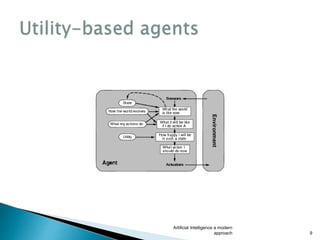
◦ Utility-based agents
Artificial Intelligence a modern
approach 2
Artificial Intelligence a modern
approach 3
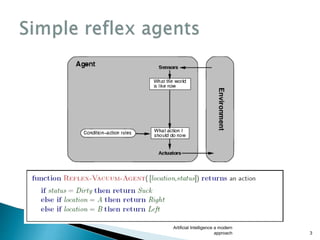
 Simple but very limited intelligence.
 Action does not depend on percept history, only on current
percept.
 Therefore no memory requirements.
 Infinite loops
Artificial Intelligence a modern
approach 4
Artificial Intelligence a modern
approach 5
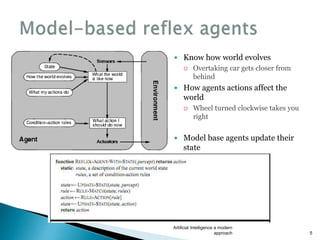
 Know how world evolves
 Overtaking car gets closer from
behind
 How agents actions affect the
world
 Wheel turned clockwise takes you
right
 Model base agents update their
state
• knowing state and environment? Enough?
– Taxi can go left, right, straight
• Have a goal
◦ A destination to get to
 Uses knowledge about a goal to guide its
actions
◦ E.g., Search, planning
Artificial Intelligence a modern
approach 6
Artificial Intelligence a modern
approach 7
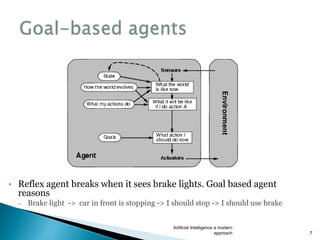
• Reflex agent breaks when it sees brake lights. Goal based agent
reasons
– Brake light -> car in front is stopping -> I should stop -> I should use brake
 Goals are not always enough
◦ Many action sequences get taxi to destination
◦ Consider other things. How fast, how safe…..
 A utility function maps a state onto a real
number which describes the associated
degree of “happiness”, “goodness”, “success”.
 Where does the utility measure come from?
◦ Economics: money.
◦ Biology: number of offspring.
◦ Your life?
Artificial Intelligence a modern
approach 8
Artificial Intelligence a modern
approach 9
Artificial Intelligence a modern
approach 10
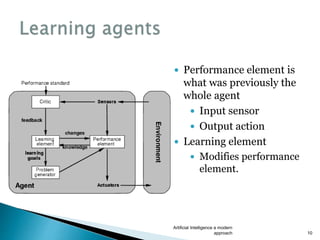
 Performance element is
what was previously the
whole agent
 Input sensor
 Output action
 Learning element
 Modifies performance
element.
Artificial Intelligence a modern
approach 11
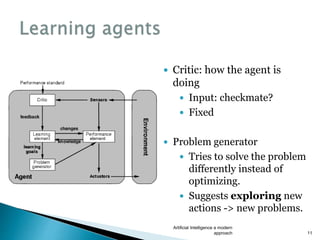
 Critic: how the agent is
doing
 Input: checkmate?
 Fixed
 Problem generator
 Tries to solve the problem
differently instead of
optimizing.
 Suggests exploring new
actions -> new problems.
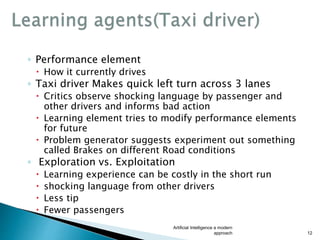
◦ Performance element
 How it currently drives
◦ Taxi driver Makes quick left turn across 3 lanes
 Critics observe shocking language by passenger and
other drivers and informs bad action
 Learning element tries to modify performance elements
for future
 Problem generator suggests experiment out something
called Brakes on different Road conditions
◦ Exploration vs. Exploitation
 Learning experience can be costly in the short run
 shocking language from other drivers
 Less tip
 Fewer passengers
Artificial Intelligence a modern
approach 12

Structure of Agents Presentation and its types

  • 1.
    C. Eben Exceline,AP/AI&DS Excel Engineering College
  • 2.
     Four basictypes ◦ Simple reflex agents ◦ Reflex agents with state/model ◦ Goal-based agents ◦ Utility-based agents Artificial Intelligence a modern approach 2
  • 3.
    Artificial Intelligence amodern approach 3
  • 4.
     Simple butvery limited intelligence.  Action does not depend on percept history, only on current percept.  Therefore no memory requirements.  Infinite loops Artificial Intelligence a modern approach 4
  • 5.
    Artificial Intelligence amodern approach 5  Know how world evolves  Overtaking car gets closer from behind  How agents actions affect the world  Wheel turned clockwise takes you right  Model base agents update their state
  • 6.
    • knowing stateand environment? Enough? – Taxi can go left, right, straight • Have a goal ◦ A destination to get to  Uses knowledge about a goal to guide its actions ◦ E.g., Search, planning Artificial Intelligence a modern approach 6
  • 7.
    Artificial Intelligence amodern approach 7 • Reflex agent breaks when it sees brake lights. Goal based agent reasons – Brake light -> car in front is stopping -> I should stop -> I should use brake
  • 8.
     Goals arenot always enough ◦ Many action sequences get taxi to destination ◦ Consider other things. How fast, how safe…..  A utility function maps a state onto a real number which describes the associated degree of “happiness”, “goodness”, “success”.  Where does the utility measure come from? ◦ Economics: money. ◦ Biology: number of offspring. ◦ Your life? Artificial Intelligence a modern approach 8
  • 9.
    Artificial Intelligence amodern approach 9
  • 10.
    Artificial Intelligence amodern approach 10  Performance element is what was previously the whole agent  Input sensor  Output action  Learning element  Modifies performance element.
  • 11.
    Artificial Intelligence amodern approach 11  Critic: how the agent is doing  Input: checkmate?  Fixed  Problem generator  Tries to solve the problem differently instead of optimizing.  Suggests exploring new actions -> new problems.
  • 12.
    ◦ Performance element How it currently drives ◦ Taxi driver Makes quick left turn across 3 lanes  Critics observe shocking language by passenger and other drivers and informs bad action  Learning element tries to modify performance elements for future  Problem generator suggests experiment out something called Brakes on different Road conditions ◦ Exploration vs. Exploitation  Learning experience can be costly in the short run  shocking language from other drivers  Less tip  Fewer passengers Artificial Intelligence a modern approach 12

Editor's Notes

  • #4 Based on sensors
  • #5 Another example: fly buzzing against window.
  • #9 Example: why is it important to get a good grade in this course?
  • #11 Problem generator: acts in new ways, explores.