Chapter 1
Introduction
Materials Selection in Mechanical Design, 4th Edition © 2010 Michael Ashby
Materials in Design
Design is the process of translating a new
idea or a market need into the detailed
information from which a product can be
manufactured
Each of its stages requires decisions about
the materials of which the product is to be
made and the process for making it
Materials Selection in Mechanical Design, 4th Edition © 2010 Michael Ashby
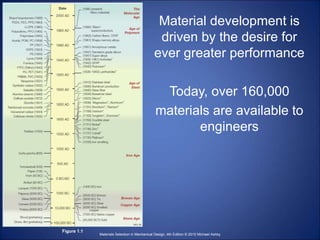
Material development is
driven by the desire for
ever greater performance
Today, over 160,000
materials are available to
engineers
Materials Selection in Mechanical Design, 4th Edition © 2010 Michael Ashby
Figure 1.1
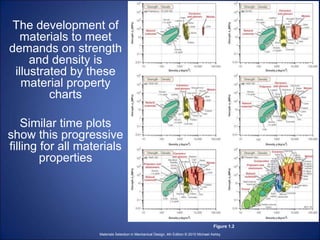
The development of
materials to meet
demands on strength
and density is
illustrated by these
material property
charts
Similar time plots
show this progressive
filling for all materials
properties
Materials Selection in Mechanical Design, 4th Edition © 2010 Michael Ashby
Figure 1.2
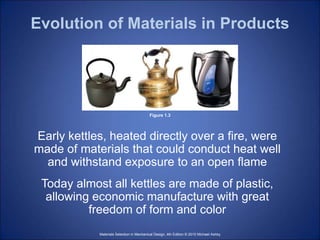
Evolution of Materials in Products
Early kettles, heated directly over a fire, were
made of materials that could conduct heat well
and withstand exposure to an open flame
Today almost all kettles are made of plastic,
allowing economic manufacture with great
freedom of form and color
Materials Selection in Mechanical Design, 4th Edition © 2010 Michael Ashby
Figure 1.3
The development of vacuum cleaners has been
rapid and driven by the use of new materials
Hand-powered cleaners made mostly of natural
materials have been replaced with high powered
motors and centrifugal filtration
Materials Selection in Mechanical Design, 4th Edition © 2010 Michael Ashby
Figure 1.4
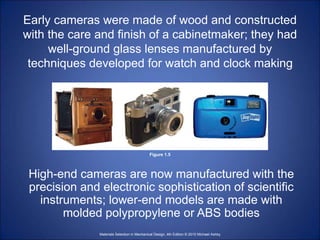
Early cameras were made of wood and constructed
with the care and finish of a cabinetmaker; they had
well-ground glass lenses manufactured by
techniques developed for watch and clock making
Materials Selection in Mechanical Design, 4th Edition © 2010 Michael Ashby
Figure 1.5
High-end cameras are now manufactured with the
precision and electronic sophistication of scientific
instruments; lower-end models are made with
molded polypropylene or ABS bodies
Early planes were made of low-density
woods, steel wire, and silk
Materials Selection in Mechanical Design, 4th Edition © 2010 Michael Ashby
Figure 1.6
The aluminum airframe provided high stiffness
and strength to allow planes to be bigger and
fly further
The future of airframes is exemplified by
Boeing’s 787 Dreamliner (80% carbon-fiber
reinforced plastic, claims to be 30% lighter per
seat than competing aircraft

Chapter_1.ppt

  • 1.
    Chapter 1 Introduction Materials Selectionin Mechanical Design, 4th Edition © 2010 Michael Ashby
  • 2.
    Materials in Design Designis the process of translating a new idea or a market need into the detailed information from which a product can be manufactured Each of its stages requires decisions about the materials of which the product is to be made and the process for making it Materials Selection in Mechanical Design, 4th Edition © 2010 Michael Ashby
  • 3.
    Material development is drivenby the desire for ever greater performance Today, over 160,000 materials are available to engineers Materials Selection in Mechanical Design, 4th Edition © 2010 Michael Ashby Figure 1.1
  • 4.
    The development of materialsto meet demands on strength and density is illustrated by these material property charts Similar time plots show this progressive filling for all materials properties Materials Selection in Mechanical Design, 4th Edition © 2010 Michael Ashby Figure 1.2
  • 5.
    Evolution of Materialsin Products Early kettles, heated directly over a fire, were made of materials that could conduct heat well and withstand exposure to an open flame Today almost all kettles are made of plastic, allowing economic manufacture with great freedom of form and color Materials Selection in Mechanical Design, 4th Edition © 2010 Michael Ashby Figure 1.3
  • 6.
    The development ofvacuum cleaners has been rapid and driven by the use of new materials Hand-powered cleaners made mostly of natural materials have been replaced with high powered motors and centrifugal filtration Materials Selection in Mechanical Design, 4th Edition © 2010 Michael Ashby Figure 1.4
  • 7.
    Early cameras weremade of wood and constructed with the care and finish of a cabinetmaker; they had well-ground glass lenses manufactured by techniques developed for watch and clock making Materials Selection in Mechanical Design, 4th Edition © 2010 Michael Ashby Figure 1.5 High-end cameras are now manufactured with the precision and electronic sophistication of scientific instruments; lower-end models are made with molded polypropylene or ABS bodies
  • 8.
    Early planes weremade of low-density woods, steel wire, and silk Materials Selection in Mechanical Design, 4th Edition © 2010 Michael Ashby Figure 1.6 The aluminum airframe provided high stiffness and strength to allow planes to be bigger and fly further The future of airframes is exemplified by Boeing’s 787 Dreamliner (80% carbon-fiber reinforced plastic, claims to be 30% lighter per seat than competing aircraft