Studocu is not sponsored or endorsed by any college or university
Chapter 1 Introduction TO Macro Perspective OF Tourism
AND Hospitality
Business (Saint Mary's University Philippines)
Studocu is not sponsored or endorsed by any college or university
Chapter 1 Introduction TO Macro Perspective OF Tourism
AND Hospitality
Business (Saint Mary's University Philippines)
Downloaded by Michelle Pahayculay (cheng214_luv@yahoo.com)
lOMoARcPSD|941645
Macro Perspective
of Tourism and
Hospitality
Chapter 1: Introduction to Macro Perspective of Tourism and
Hospitality
INTRODUCTION
The Tourism and Hospitality Industry: a powerful driver of the economic engine of nations. The
important roles of tourism and hospitality as the main instrument in socioeconomic development of
any nation cannot be overstated.
Tourism and hospitality has become one of the world’s largest and fastest growing industries and it
is because of the several factors, such as rising levels of income, improvements in transportation and
the low cost airline services, easier access to destinations by tourists and the diversification of the
industry with new market niches.
Learning Objectives:
At the end of this topic, students will be able to:
1. Understand the tourism and hospitality industry
2. Explain the relationship of tourism and hospitality.
3. Understand the various elements of travel used as criteria for defining tourists.
4. Differentiate tourists from excursionists.
Presentation of Contents
Definition of Tourism and Hospitality
The word Tourism is derived from the Hebrew word “torah” which means studying,
learning and searching.
Tourism is the act and process of spending time away from home in pursuit of recreation,
relaxation, and pleasure, while making use of the commercial provision of services. As such,
Downloaded by Michelle Pahayculay (cheng214_luv@yahoo.com)
lOMoARcPSD|941645
tourism is a product of modern social arrangements, beginning in Western Europe in the 17th
century, although it has antecedents in classical antiquity.
According to Goeldner and Ritchie: Tourism is the processes, activities, outcomes arising
from relationships and interaction among tourists, tourism suppliers, and surrounding
environment that are involve in attracting and hosting of visitors.
Hospitality
The term is derived from the latin word “ hospitare” which means “to receive a guest”.
Hospitality it implies whereby a guest who is away from home is welcomed by a host where basic
necessities are provided such as food, beverages, and lodging.
Hospitality
An industry comprises business entity of food, beverages, lodging or a combination of these
businesses to travellers during stay in a destination.
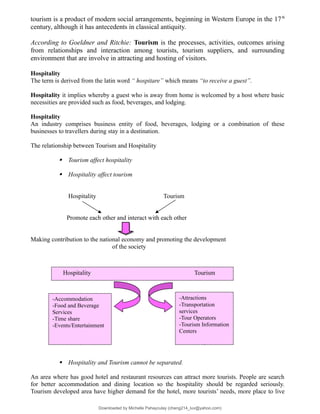
The relationship between Tourism and Hospitality
 Tourism affect hospitality
 Hospitality affect tourism
Hospitality Tourism
Promote each other and interact with each other
Making contribution to the national economy and promoting the development
of the society
 Hospitality and Tourism cannot be separated.
An area where has good hotel and restaurant resources can attract more tourists. People are search
for better accommodation and dining location so the hospitality should be regarded seriously.
Tourism developed area have higher demand for the hotel, more tourists’ needs, more place to live
Hospitality Tourism
-Attractions
-Transportation
services
-Tour Operators
-Tourism Information
Centers
-Accommodation
-Food and Beverage
Services
-Time share
-Events/Entertainment
Downloaded by Michelle Pahayculay (cheng214_luv@yahoo.com)
lOMoARcPSD|941645
and relax. These two industries not only can bring income to promote the national economy, but also
solve the problem of employment and with the development of the society, human’s activities
promote the development of many new industries. Hospitality and tourism are two of these
industries.
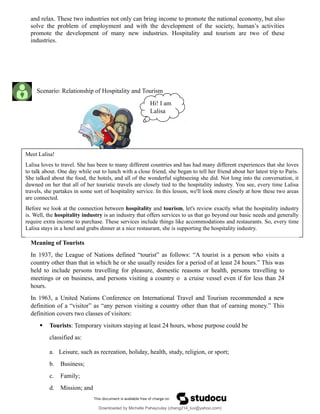
Scenario: Relationship of Hospitality and Tourism
Meaning of Tourists
In 1937, the League of Nations defined “tourist” as follows: “A tourist is a person who visits a
country other than that in which he or she usually resides for a period of at least 24 hours.” This was
held to include persons travelling for pleasure, domestic reasons or health, persons travelling to
meetings or on business, and persons visiting a country o a cruise vessel even if for less than 24
hours.
In 1963, a United Nations Conference on International Travel and Tourism recommended a new
definition of a “visitor” as “any person visiting a country other than that of earning money.” This
definition covers two classes of visitors:
 Tourists: Temporary visitors staying at least 24 hours, whose purpose could be
classified as:
a. Leisure, such as recreation, holiday, health, study, religion, or sport;
b. Business;
c. Family;
d. Mission; and
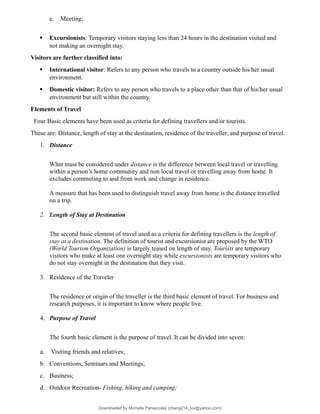
Hi! I am
Lalisa
Meet Lalisa!
Lalisa loves to travel. She has been to many different countries and has had many different experiences that she loves
to talk about. One day while out to lunch with a close friend, she began to tell her friend about her latest trip to Paris.
She talked about the food, the hotels, and all of the wonderful sightseeing she did. Not long into the conversation, it
dawned on her that all of her touristic travels are closely tied to the hospitality industry. You see, every time Lalisa
travels, she partakes in some sort of hospitality service. In this lesson, we'll look more closely at how these two areas
are connected.
Before we look at the connection between hospitality and tourism, let's review exactly what the hospitality industry
is. Well, the hospitality industry is an industry that offers services to us that go beyond our basic needs and generally
require extra income to purchase. These services include things like accommodations and restaurants. So, every time
Lalisa stays in a hotel and grabs dinner at a nice restaurant, she is supporting the hospitality industry.
Downloaded by Michelle Pahayculay (cheng214_luv@yahoo.com)
lOMoARcPSD|941645
e. Meeting;
 Excursionists: Temporary visitors staying less than 24 hours in the destination visited and
not making an overnight stay.
Visitors are further classified into:
 International visitor: Refers to any person who travels to a country outside his/her usual
environment.
 Domestic visitor: Refers to any person who travels to a place other than that of his/her usual
environment but still within the country.
Elements of Travel
Four Basic elements have been used as criteria for defining travellers and/or tourists.
These are: Distance, length of stay at the destination, residence of the traveller, and purpose of travel.
1. Distance
What must be considered under distance is the difference between local travel or travelling
within a person’s home community and non local travel or travelling away from home. It
excludes commuting to and from work and change in residence.
A measure that has been used to distinguish travel away from home is the distance travelled
on a trip.
2. Length of Stay at Destination
The second basic element of travel used as a criteria for defining travellers is the length of
stay at a destination. The definition of tourist and excursionist are proposed by the WTO
(World Tourism Organization) is largely teased on length of stay. Tourists are temporary
visitors who make at least one overnight stay while excursionists are temporary visitors who
do not stay overnight in the destination that they visit.
3. Residence of the Traveler
The residence or origin of the traveller is the third basic element of travel. For business and
research purposes, it is important to know where people live.
4. Purpose of Travel
The fourth basic element is the purpose of travel. It can be divided into seven:
a. Visiting friends and relatives;
b. Conventions, Seminars and Meetings;
c. Business;
d. Outdoor Recreation- Fishing, hiking and camping;
Downloaded by Michelle Pahayculay (cheng214_luv@yahoo.com)
lOMoARcPSD|941645
e. Entertainment-theatre and sports;
f. Personal-Family, medical and wedding
g. Others
The Nature of a Tour:
To analyze the nature of a tour systematically, it will be helpful to understand the difference between
domestic and international tourism, as well as independent and package tour.
Domestic Tourism: Travel taken exclusively within the national boundaries of the traveler’s country.
People find it easy to do so because there are no language, currency, nor documentation barriers.
International Tourism: involves the movement of people across international boundaries. It is more
difficult to travel outside one’s country because the country visited has a different language,
currency, and documentation requirements, such as passports, visas, and other conditions of entry to
be met by tourists.
A package tour, sometimes called inclusive tour, is an arrangement in which transport and
accommodation is bought by the tourist at an all-inclusive price and the price of the individual
elements cannot be determined by the tourist. The tour operator who organizes the package tour
purchases transport and hotel accommodation in advance, usually obtaining these at a lower price
because he or she is buying them in bulk. He or she then sells the tours individually to tourists direct
or through travel agents. On the other hand, an independent tour is an arrangement in which the
tourist buys these facilities separately, either making reservations in advance through a travel agent
or en route during his or her tour.
Tourists purchasing package tours may do so on the basis of either individual or group travel. An
independent inclusive tour is one in which the tourist travels to his or her destination individually,
while in the group inclusive tour, he or she travels in the company of other tourists. The
abbreviations IIT and GIT are used for individual inclusive tour and group inclusive tour
respectively.
-End of Chapter 1-
Downloaded by Michelle Pahayculay (cheng214_luv@yahoo.com)
lOMoARcPSD|941645

chapter-1-introduction-to-macro-perspective-of-tourism-and-hospitality.pdf

  • 1.
    Studocu is notsponsored or endorsed by any college or university Chapter 1 Introduction TO Macro Perspective OF Tourism AND Hospitality Business (Saint Mary's University Philippines) Studocu is not sponsored or endorsed by any college or university Chapter 1 Introduction TO Macro Perspective OF Tourism AND Hospitality Business (Saint Mary's University Philippines) Downloaded by Michelle Pahayculay (cheng214_luv@yahoo.com) lOMoARcPSD|941645
  • 2.
    Macro Perspective of Tourismand Hospitality Chapter 1: Introduction to Macro Perspective of Tourism and Hospitality INTRODUCTION The Tourism and Hospitality Industry: a powerful driver of the economic engine of nations. The important roles of tourism and hospitality as the main instrument in socioeconomic development of any nation cannot be overstated. Tourism and hospitality has become one of the world’s largest and fastest growing industries and it is because of the several factors, such as rising levels of income, improvements in transportation and the low cost airline services, easier access to destinations by tourists and the diversification of the industry with new market niches. Learning Objectives: At the end of this topic, students will be able to: 1. Understand the tourism and hospitality industry 2. Explain the relationship of tourism and hospitality. 3. Understand the various elements of travel used as criteria for defining tourists. 4. Differentiate tourists from excursionists. Presentation of Contents Definition of Tourism and Hospitality The word Tourism is derived from the Hebrew word “torah” which means studying, learning and searching. Tourism is the act and process of spending time away from home in pursuit of recreation, relaxation, and pleasure, while making use of the commercial provision of services. As such, Downloaded by Michelle Pahayculay (cheng214_luv@yahoo.com) lOMoARcPSD|941645
  • 3.
    tourism is aproduct of modern social arrangements, beginning in Western Europe in the 17th century, although it has antecedents in classical antiquity. According to Goeldner and Ritchie: Tourism is the processes, activities, outcomes arising from relationships and interaction among tourists, tourism suppliers, and surrounding environment that are involve in attracting and hosting of visitors. Hospitality The term is derived from the latin word “ hospitare” which means “to receive a guest”. Hospitality it implies whereby a guest who is away from home is welcomed by a host where basic necessities are provided such as food, beverages, and lodging. Hospitality An industry comprises business entity of food, beverages, lodging or a combination of these businesses to travellers during stay in a destination. The relationship between Tourism and Hospitality  Tourism affect hospitality  Hospitality affect tourism Hospitality Tourism Promote each other and interact with each other Making contribution to the national economy and promoting the development of the society  Hospitality and Tourism cannot be separated. An area where has good hotel and restaurant resources can attract more tourists. People are search for better accommodation and dining location so the hospitality should be regarded seriously. Tourism developed area have higher demand for the hotel, more tourists’ needs, more place to live Hospitality Tourism -Attractions -Transportation services -Tour Operators -Tourism Information Centers -Accommodation -Food and Beverage Services -Time share -Events/Entertainment Downloaded by Michelle Pahayculay (cheng214_luv@yahoo.com) lOMoARcPSD|941645
  • 4.
    and relax. Thesetwo industries not only can bring income to promote the national economy, but also solve the problem of employment and with the development of the society, human’s activities promote the development of many new industries. Hospitality and tourism are two of these industries. Scenario: Relationship of Hospitality and Tourism Meaning of Tourists In 1937, the League of Nations defined “tourist” as follows: “A tourist is a person who visits a country other than that in which he or she usually resides for a period of at least 24 hours.” This was held to include persons travelling for pleasure, domestic reasons or health, persons travelling to meetings or on business, and persons visiting a country o a cruise vessel even if for less than 24 hours. In 1963, a United Nations Conference on International Travel and Tourism recommended a new definition of a “visitor” as “any person visiting a country other than that of earning money.” This definition covers two classes of visitors:  Tourists: Temporary visitors staying at least 24 hours, whose purpose could be classified as: a. Leisure, such as recreation, holiday, health, study, religion, or sport; b. Business; c. Family; d. Mission; and Hi! I am Lalisa Meet Lalisa! Lalisa loves to travel. She has been to many different countries and has had many different experiences that she loves to talk about. One day while out to lunch with a close friend, she began to tell her friend about her latest trip to Paris. She talked about the food, the hotels, and all of the wonderful sightseeing she did. Not long into the conversation, it dawned on her that all of her touristic travels are closely tied to the hospitality industry. You see, every time Lalisa travels, she partakes in some sort of hospitality service. In this lesson, we'll look more closely at how these two areas are connected. Before we look at the connection between hospitality and tourism, let's review exactly what the hospitality industry is. Well, the hospitality industry is an industry that offers services to us that go beyond our basic needs and generally require extra income to purchase. These services include things like accommodations and restaurants. So, every time Lalisa stays in a hotel and grabs dinner at a nice restaurant, she is supporting the hospitality industry. Downloaded by Michelle Pahayculay (cheng214_luv@yahoo.com) lOMoARcPSD|941645
  • 5.
    e. Meeting;  Excursionists:Temporary visitors staying less than 24 hours in the destination visited and not making an overnight stay. Visitors are further classified into:  International visitor: Refers to any person who travels to a country outside his/her usual environment.  Domestic visitor: Refers to any person who travels to a place other than that of his/her usual environment but still within the country. Elements of Travel Four Basic elements have been used as criteria for defining travellers and/or tourists. These are: Distance, length of stay at the destination, residence of the traveller, and purpose of travel. 1. Distance What must be considered under distance is the difference between local travel or travelling within a person’s home community and non local travel or travelling away from home. It excludes commuting to and from work and change in residence. A measure that has been used to distinguish travel away from home is the distance travelled on a trip. 2. Length of Stay at Destination The second basic element of travel used as a criteria for defining travellers is the length of stay at a destination. The definition of tourist and excursionist are proposed by the WTO (World Tourism Organization) is largely teased on length of stay. Tourists are temporary visitors who make at least one overnight stay while excursionists are temporary visitors who do not stay overnight in the destination that they visit. 3. Residence of the Traveler The residence or origin of the traveller is the third basic element of travel. For business and research purposes, it is important to know where people live. 4. Purpose of Travel The fourth basic element is the purpose of travel. It can be divided into seven: a. Visiting friends and relatives; b. Conventions, Seminars and Meetings; c. Business; d. Outdoor Recreation- Fishing, hiking and camping; Downloaded by Michelle Pahayculay (cheng214_luv@yahoo.com) lOMoARcPSD|941645
  • 6.
    e. Entertainment-theatre andsports; f. Personal-Family, medical and wedding g. Others The Nature of a Tour: To analyze the nature of a tour systematically, it will be helpful to understand the difference between domestic and international tourism, as well as independent and package tour. Domestic Tourism: Travel taken exclusively within the national boundaries of the traveler’s country. People find it easy to do so because there are no language, currency, nor documentation barriers. International Tourism: involves the movement of people across international boundaries. It is more difficult to travel outside one’s country because the country visited has a different language, currency, and documentation requirements, such as passports, visas, and other conditions of entry to be met by tourists. A package tour, sometimes called inclusive tour, is an arrangement in which transport and accommodation is bought by the tourist at an all-inclusive price and the price of the individual elements cannot be determined by the tourist. The tour operator who organizes the package tour purchases transport and hotel accommodation in advance, usually obtaining these at a lower price because he or she is buying them in bulk. He or she then sells the tours individually to tourists direct or through travel agents. On the other hand, an independent tour is an arrangement in which the tourist buys these facilities separately, either making reservations in advance through a travel agent or en route during his or her tour. Tourists purchasing package tours may do so on the basis of either individual or group travel. An independent inclusive tour is one in which the tourist travels to his or her destination individually, while in the group inclusive tour, he or she travels in the company of other tourists. The abbreviations IIT and GIT are used for individual inclusive tour and group inclusive tour respectively. -End of Chapter 1- Downloaded by Michelle Pahayculay (cheng214_luv@yahoo.com) lOMoARcPSD|941645