Chapter Two
Developing Indicators
Outlines
 Definition: Indicators
 Guidelines for Developing Indicators
 Hierarchy of Indicators
 Setting Priorities for ME
 Selecting Indicators for ME
 Identifying Assumptions and Risks in ME
Definition: Indicators
 Indicators are signposts of change along the path to development
 They describe the way to track intended results and are critical for monitoring and evaluation
 Indicators are quantitative or qualitative factors or variables that provide a simple and reliable means
to
 measure achievement,
 reflect the changes connected to an intervention, or
 help assess the performance of a development actor
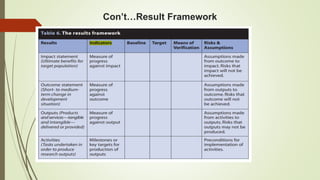
 Indicators define a measure of change for the objective statements at all levels of the results framework
(RF)
 Good performance indicators are a critical part of the results framework.
Con’t…Result Framework

Guidelines for Developing Indicators
Knowing the Importance
 Indicators can help to:
 Indicators ensure evidence-based decision-making, support a project’s adaptive capacity and advance learning.
 Measure progress and achievements, as understood by the different stakeholders
 Clarify consistency between activities, outputs, outcomes and impacts
 Ensure legitimacy and accountability to all stakeholders by demonstrating progress
 Assess project and staff performance.
 As such, indicators are at the heart of an effective project’s performance management system (PPMS)
or monitoring, evaluation, accountability and learning (MEAL) system.
 Indicators are the foundation of an effective MEAL system as they govern what will be measured, how,
when and by whom.
Indicators should be SMART
 SMART indicators
 Specific: Is the indicator specific enough to measure progress towards the results?
 Measurable: Is the indicator a reliable and clear measure of results?
 Attainable: Are the results in which the indicator seeks to chart progress realistic?
 Relevant: Is the indicator relevant to the intended outputs and outcomes?
 Time-bound: Are data available at reasonable cost and effort?
Developing Indicators: Who, When and How?
Who?
 The participation of partner, programming and MEAL staff is essential throughout all steps.
 Country or regional sector technical advisors should also be involved, especially in the early
stages of indicator development, to provide suggestions or feedback on an indicator’s:
 feasibility, appropriateness, timing, usefulness, etc.
 If stakeholders not consulted during design, be sure to involve them during the review of
design documents, prior to submission.
When?
 It is recommended that thinking about indicators begins as early as possible in the project
design process, ideally at the concept note development stage,
 Whereas, in some situations you may need to start with just an RF or a Proframe and the
implicit TOC that underlies them.
Con’t…
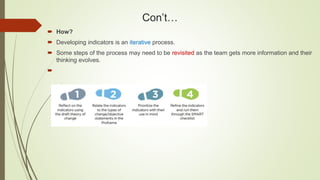
 How?
 Developing indicators is an iterative process.
 Some steps of the process may need to be revisited as the team gets more information and their
thinking evolves.

Hierarchy of Indicators
 Logical Framework Hierarchy:
 the desired outcomes or impacts are identified first,
 then the out puts needed to achieve those outcomes, and
 then the inputs and activities needed to deliver those outputs.
 Following result levels comes hierarchy/levels of Indicators
 Impact: The higher objective to be contributed
 Impact indicators describe the changes in people’s lives and development conditions
 Outcome: the changes in beneficiary behavior, systems or institutional performance caused by the
combined output strategy
 Outcome Indicators: measures that describe the accomplishment of the outcome; the value, benefit and
return on the investment
Con’t…
 Outputs: the actual deliverables; what the operation can be held accountable for producing
 Output indicators that measure the goods and services finally delivered by the operation
 Activities: the main activity clusters that must be undertaken in order to accomplish the outputs
 Activity indicators: Inputs/resources: budget by activity; monetary, physical and human resources required
to produce the outputs
 Each results hierarchy level represents a distinct and separate level
 The impact, outcome, activities, inputs and assumptions should be clearly stated, unambiguous and
measurable.
Con’t…Example
 Impact: Poverty reduction; Healthier Society; Education Quality
 Impact Indicators: Poverty rate, percentage of people living in poverty; longevity, infant mortality; pass rate,
percentage of student completing;
 Outcome: Increase asset, numbers of hospitals, numbers of teachers
 Outcome Indicators: numbers of livestock, percentage increase in hospital; level of teachers qualification
 Output: livestock, medicine, white board
 Output indicators: numbers or percentages of livestock delivered
 Activities: purchase goods, give trainings
 Activity Indicators: how much purchased
 Inputs: budgets, transport, human resource
Setting Priorities for Monitoring and Evaluation
 To determine what to monitor, evaluate and set monitoring priorities in a project, consider the following
guidelines:
 Define project objectives: Ensure that your monitoring efforts align with the project goals.
 Identify critical success factors: These may include deliverables, budget, resources, quality standards,
stakeholder satisfaction, and compliance requirements. Focus on monitoring these factors.
 Establish key performance indicators (KPIs): Define KPIs that are relevant, measurable, and aligned with
the project objectives.
 Prioritize risks and issues: Allocate monitoring resources to critical risks and issues that require regular
attention and mitigation strategies.
 Engage stakeholders: This ensures that your monitoring efforts are aligned with stakeholder priorities.
Con’t…
 Determine monitoring frequency: Some aspects may require continuous monitoring, while others
may be reviewed periodically or during specific project phases.
 Select monitoring methods and tools:This could include regular progress reports, data analysis,
surveys, feedback mechanisms, automated monitoring systems
 Establish reporting mechanisms: Ensure that the reports are concise, actionable, and provide
insights into project performance.
 Review and adapt: Assess whether the monitored aspects align with the project objectives and make
adjustments as necessary.
 Stay flexible and adapt your monitoring priorities based on emerging risks, changing project dynamics,
and stakeholder feedback.
Selecting Indicators to Monitor and Evaluate
 What type of indicator is best to use?
 The choice makes a difference.
 If the wrong thing is measured, or if it is measured in the wrong way, the data may be misleading and
the quality of decisions could be affected.
 The choice also may have unforeseen consequences—some positive some negative.
 Ex. when a police force changed its result indicator from number of arrests to number of convictions, for
example, constables became less inclined to detain people on the basis of vague suspicion.
 Ex. Education in Ethiopia
Con’t…the SMART way to select indicators
 The following criteria and questions may be helpful in selecting indicators.
Specific:
 Is it clear exactly what is being measured?
 Has the appropriate level of disaggregation been specified?
 Does it capture differences across areas and categories of people?
 Is the indicator specific enough to measure progress towards the result?
Measurable:
 Are changes objectively verifiable?
 Will the indicator show desirable change?
 Is it a reliable and clear measure of results?
 Do stakeholders agree on exactly what to measure?
Cont…
Attainable:
 What changes are anticipated as a result of the assistance?
 Are the result(s) realistic?
Relevant:
 Is it relevant to the intended outputs and outcome?
 Is the indicator plausibly associated with the sphere of activity?
Trackable:
 Are data actually available at reasonable cost and effort?
 Are data sources known?
 Does an indicator monitoring plan exist?
Cont…
 Be sensible and practical in applying these criteria.
 No one indicator will satisfy all criteria equally well.
 The selection of indicators is an iterative process, building on consultations between programme
managers, stakeholders and partners.
 Ultimately, the choice of indicator is determined through a holistic assessment of validity and
practicality.
Identifying Assumptions & Risks in ME
 Assumptions and risks are inevitable in any project, but how do you deal with them in your ME
plan?
 Assumptions are the conditions or factors that you expect to be true or present for your project to
achieve its objectives.
 Risks are the events or situations that may prevent or hinder your project from reaching its goals.
 Both assumptions and risks can be internal or external, positive or negative, and vary in their
likelihood and severity.
 In ME, you need to identify and analyze the assumptions and risks that are relevant to your project
process.
Con’t…identification AR
 Identifying assumptions and risks in ME can be done with a variety of methods and tools,
depending on the scope, complexity, and context of the project.
 Brainstorming with project teams, stakeholders, and beneficiaries
 Reviewing existing documents, such as project proposals or reports,
 conducting a stakeholder analysis to understand interests, expectations, and influences of different groups
or individuals involved in or affected by the project is important.
 Finally, frameworks or matrices such as the problem tree, logframe, risk register, or SWOT
analysis can help organize and categorize assumptions and risks according to their causes,
effects, levels, or dimensions
Con’t… prioritize AR
 After identifying your assumptions and risks, you need to prioritize them according to their
significance and urgency for your project's success.
 A common way to prioritize assumptions and risks is to use a scoring system that assesses their
probability and impact.
 You can assign numerical values or qualitative labels to each assumption or risk, such as high,
medium, or low, and plot them on a matrix or a chart.
 This will help you to identify the most critical assumptions and risks that require your attention and
action.
Con’t…mitigate and manage AR
 Mitigation reduces the probability or impact of a negative assumption or risk, while management
enhances the probability or impact of a positive assumption or risk.
 To do this, you should communicate and coordinate with your project team, stakeholders, and
beneficiaries to ensure clarity and alignment.
 You may need to adjust or revise your project's design, activities, indicators, or budget to
accommodate or address your assumptions and risks.
 Additionally, developing contingency plans or backup options can help cope with unforeseen or
unavoidable assumptions or risks.
Con’t…document and report AR
 Documenting and reporting your assumptions and risks in your ME plan and reports is essential for
transparency, accountability, and learning.
 Additionally, it can help to highlight the challenges, opportunities, and lessons learned from dealing
with the assumptions and risks.
 Furthermore, it provides recommendations for improvement or scaling up of the project based on
the assumptions and risks.

Chapter Two PME.pptx

  • 2.
  • 3.
    Outlines  Definition: Indicators Guidelines for Developing Indicators  Hierarchy of Indicators  Setting Priorities for ME  Selecting Indicators for ME  Identifying Assumptions and Risks in ME
  • 4.
    Definition: Indicators  Indicatorsare signposts of change along the path to development  They describe the way to track intended results and are critical for monitoring and evaluation  Indicators are quantitative or qualitative factors or variables that provide a simple and reliable means to  measure achievement,  reflect the changes connected to an intervention, or  help assess the performance of a development actor  Indicators define a measure of change for the objective statements at all levels of the results framework (RF)  Good performance indicators are a critical part of the results framework.
  • 5.
  • 6.
    Guidelines for DevelopingIndicators Knowing the Importance  Indicators can help to:  Indicators ensure evidence-based decision-making, support a project’s adaptive capacity and advance learning.  Measure progress and achievements, as understood by the different stakeholders  Clarify consistency between activities, outputs, outcomes and impacts  Ensure legitimacy and accountability to all stakeholders by demonstrating progress  Assess project and staff performance.  As such, indicators are at the heart of an effective project’s performance management system (PPMS) or monitoring, evaluation, accountability and learning (MEAL) system.  Indicators are the foundation of an effective MEAL system as they govern what will be measured, how, when and by whom.
  • 7.
    Indicators should beSMART  SMART indicators  Specific: Is the indicator specific enough to measure progress towards the results?  Measurable: Is the indicator a reliable and clear measure of results?  Attainable: Are the results in which the indicator seeks to chart progress realistic?  Relevant: Is the indicator relevant to the intended outputs and outcomes?  Time-bound: Are data available at reasonable cost and effort?
  • 8.
    Developing Indicators: Who,When and How? Who?  The participation of partner, programming and MEAL staff is essential throughout all steps.  Country or regional sector technical advisors should also be involved, especially in the early stages of indicator development, to provide suggestions or feedback on an indicator’s:  feasibility, appropriateness, timing, usefulness, etc.  If stakeholders not consulted during design, be sure to involve them during the review of design documents, prior to submission. When?  It is recommended that thinking about indicators begins as early as possible in the project design process, ideally at the concept note development stage,  Whereas, in some situations you may need to start with just an RF or a Proframe and the implicit TOC that underlies them.
  • 9.
    Con’t…  How?  Developingindicators is an iterative process.  Some steps of the process may need to be revisited as the team gets more information and their thinking evolves. 
  • 10.
    Hierarchy of Indicators Logical Framework Hierarchy:  the desired outcomes or impacts are identified first,  then the out puts needed to achieve those outcomes, and  then the inputs and activities needed to deliver those outputs.  Following result levels comes hierarchy/levels of Indicators  Impact: The higher objective to be contributed  Impact indicators describe the changes in people’s lives and development conditions  Outcome: the changes in beneficiary behavior, systems or institutional performance caused by the combined output strategy  Outcome Indicators: measures that describe the accomplishment of the outcome; the value, benefit and return on the investment
  • 11.
    Con’t…  Outputs: theactual deliverables; what the operation can be held accountable for producing  Output indicators that measure the goods and services finally delivered by the operation  Activities: the main activity clusters that must be undertaken in order to accomplish the outputs  Activity indicators: Inputs/resources: budget by activity; monetary, physical and human resources required to produce the outputs  Each results hierarchy level represents a distinct and separate level  The impact, outcome, activities, inputs and assumptions should be clearly stated, unambiguous and measurable.
  • 12.
    Con’t…Example  Impact: Povertyreduction; Healthier Society; Education Quality  Impact Indicators: Poverty rate, percentage of people living in poverty; longevity, infant mortality; pass rate, percentage of student completing;  Outcome: Increase asset, numbers of hospitals, numbers of teachers  Outcome Indicators: numbers of livestock, percentage increase in hospital; level of teachers qualification  Output: livestock, medicine, white board  Output indicators: numbers or percentages of livestock delivered  Activities: purchase goods, give trainings  Activity Indicators: how much purchased  Inputs: budgets, transport, human resource
  • 13.
    Setting Priorities forMonitoring and Evaluation  To determine what to monitor, evaluate and set monitoring priorities in a project, consider the following guidelines:  Define project objectives: Ensure that your monitoring efforts align with the project goals.  Identify critical success factors: These may include deliverables, budget, resources, quality standards, stakeholder satisfaction, and compliance requirements. Focus on monitoring these factors.  Establish key performance indicators (KPIs): Define KPIs that are relevant, measurable, and aligned with the project objectives.  Prioritize risks and issues: Allocate monitoring resources to critical risks and issues that require regular attention and mitigation strategies.  Engage stakeholders: This ensures that your monitoring efforts are aligned with stakeholder priorities.
  • 14.
    Con’t…  Determine monitoringfrequency: Some aspects may require continuous monitoring, while others may be reviewed periodically or during specific project phases.  Select monitoring methods and tools:This could include regular progress reports, data analysis, surveys, feedback mechanisms, automated monitoring systems  Establish reporting mechanisms: Ensure that the reports are concise, actionable, and provide insights into project performance.  Review and adapt: Assess whether the monitored aspects align with the project objectives and make adjustments as necessary.  Stay flexible and adapt your monitoring priorities based on emerging risks, changing project dynamics, and stakeholder feedback.
  • 15.
    Selecting Indicators toMonitor and Evaluate  What type of indicator is best to use?  The choice makes a difference.  If the wrong thing is measured, or if it is measured in the wrong way, the data may be misleading and the quality of decisions could be affected.  The choice also may have unforeseen consequences—some positive some negative.  Ex. when a police force changed its result indicator from number of arrests to number of convictions, for example, constables became less inclined to detain people on the basis of vague suspicion.  Ex. Education in Ethiopia
  • 16.
    Con’t…the SMART wayto select indicators  The following criteria and questions may be helpful in selecting indicators. Specific:  Is it clear exactly what is being measured?  Has the appropriate level of disaggregation been specified?  Does it capture differences across areas and categories of people?  Is the indicator specific enough to measure progress towards the result? Measurable:  Are changes objectively verifiable?  Will the indicator show desirable change?  Is it a reliable and clear measure of results?  Do stakeholders agree on exactly what to measure?
  • 17.
    Cont… Attainable:  What changesare anticipated as a result of the assistance?  Are the result(s) realistic? Relevant:  Is it relevant to the intended outputs and outcome?  Is the indicator plausibly associated with the sphere of activity? Trackable:  Are data actually available at reasonable cost and effort?  Are data sources known?  Does an indicator monitoring plan exist?
  • 18.
    Cont…  Be sensibleand practical in applying these criteria.  No one indicator will satisfy all criteria equally well.  The selection of indicators is an iterative process, building on consultations between programme managers, stakeholders and partners.  Ultimately, the choice of indicator is determined through a holistic assessment of validity and practicality.
  • 19.
    Identifying Assumptions &Risks in ME  Assumptions and risks are inevitable in any project, but how do you deal with them in your ME plan?  Assumptions are the conditions or factors that you expect to be true or present for your project to achieve its objectives.  Risks are the events or situations that may prevent or hinder your project from reaching its goals.  Both assumptions and risks can be internal or external, positive or negative, and vary in their likelihood and severity.  In ME, you need to identify and analyze the assumptions and risks that are relevant to your project process.
  • 20.
    Con’t…identification AR  Identifyingassumptions and risks in ME can be done with a variety of methods and tools, depending on the scope, complexity, and context of the project.  Brainstorming with project teams, stakeholders, and beneficiaries  Reviewing existing documents, such as project proposals or reports,  conducting a stakeholder analysis to understand interests, expectations, and influences of different groups or individuals involved in or affected by the project is important.  Finally, frameworks or matrices such as the problem tree, logframe, risk register, or SWOT analysis can help organize and categorize assumptions and risks according to their causes, effects, levels, or dimensions
  • 21.
    Con’t… prioritize AR After identifying your assumptions and risks, you need to prioritize them according to their significance and urgency for your project's success.  A common way to prioritize assumptions and risks is to use a scoring system that assesses their probability and impact.  You can assign numerical values or qualitative labels to each assumption or risk, such as high, medium, or low, and plot them on a matrix or a chart.  This will help you to identify the most critical assumptions and risks that require your attention and action.
  • 22.
    Con’t…mitigate and manageAR  Mitigation reduces the probability or impact of a negative assumption or risk, while management enhances the probability or impact of a positive assumption or risk.  To do this, you should communicate and coordinate with your project team, stakeholders, and beneficiaries to ensure clarity and alignment.  You may need to adjust or revise your project's design, activities, indicators, or budget to accommodate or address your assumptions and risks.  Additionally, developing contingency plans or backup options can help cope with unforeseen or unavoidable assumptions or risks.
  • 23.
    Con’t…document and reportAR  Documenting and reporting your assumptions and risks in your ME plan and reports is essential for transparency, accountability, and learning.  Additionally, it can help to highlight the challenges, opportunities, and lessons learned from dealing with the assumptions and risks.  Furthermore, it provides recommendations for improvement or scaling up of the project based on the assumptions and risks.