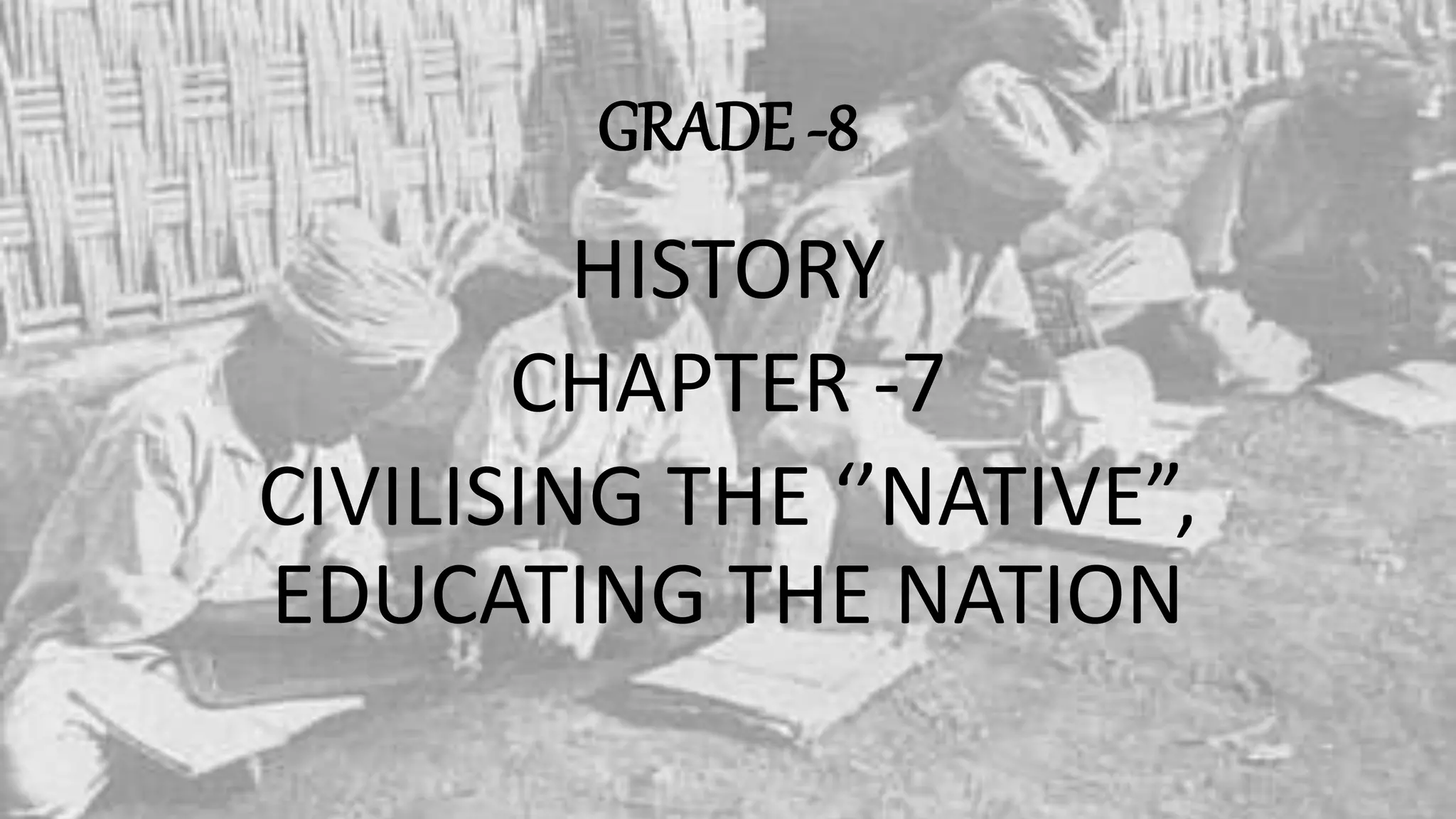
GRADE -8
HISTORY
CHAPTER -7
CIVILISING THE ‘’NATIVE”,
EDUCATING THE NATION
OBJECTIVES
•Civilizing the Native, Educating the Nation will help
students understand the implication British rule
had on the lives of students.
•The British in India wanted not only territorial
conquest and control over revenues.
•They also felt that they had a cultural mission: they
had to “civilise the natives”, change their customs
and values.
THE TRADITION OF ORIENTALISM
In 1783, William Jones arrived in Calcutta, appointed as a
junior judge at the Supreme Court. Jones was a linguist who
had studied Greek and Latin at Oxford and knew French,
English, Arabic and Persian. At Calcutta, he learnt the
subtleties of Sanskrit language, grammar and poetry from
pandits. He also studied ancient Indian texts on law,
philosophy, religion, politics, morality, arithmetic, medicine
and the other sciences.
THE TRADITION OF ORIENTALISM
Henry Thomas Colebrooke and Nathaniel Halhed
were also interested in the ancient Indian heritage,
to master the Indian languages and to translate
Sanskrit and Persian works into English. Jones along
with them set up the Asiatic Society of Bengal and
started a journal called Asiatick Researches.
THE TRADITION OF ORIENTALISM
Jones and Colebrooke felt that the Indian civilisation
had attained its glory in the ancient past, but had
subsequently declined. To understand India better, it
was necessary to discover the sacred and legal texts
that were produced in the ancient period. Jones and
Colebrooke went on discovering ancient texts,
understanding their meaning, translating them, and
making their findings known to others. This project will
help Indians rediscover their own heritage, and
understand the lost glories of their past.
THE TRADITION OF ORIENTALISM
•The Company officials felt that institutions should
encourage the study of ancient Indian texts and
Sanskrit and Persian literature and poetry. Hindus and
Muslims should learn what they were already familiar
with, and what they valued and treasured.
•In 1781, a madrasa was set up in Calcutta to promote
the study of Arabic, Persian and Islamic law; and the
Hindu College was established in Benaras in 1791 to
encourage the study of ancient Sanskrit texts that
would be useful for the administration of the country.
“GRAVE ERRORS OF THE EAST”
The British officials started criticising the Orientalist
vision of learning and said that knowledge of the East
was full of errors and unscientific thought. Eastern
literature was non-serious and light-hearted. James
Mill was one of those who attacked the Orientalists.
The aim of education should be to teach what was
useful and practical. So Indians should be familiar
with the scientific and technical advances that the
West had made.
“GRAVE ERRORS OF THE EAST”
Thomas Babington Macaulay saw India as an uncivilized
country that needed to be civilized. He urged that the British
government in India should stop wasting public money in
promoting Oriental learning, for it was of no practical use.
Macaulay thought English language would help Indians to read
some of the finest literature the world had produced; make
them aware of the developments in Western science and
philosophy. The English Education Act of 1835 was introduced
and English was made the medium of instruction for higher
education. English textbooks began to be produced for schools.
EDUCATION FOR COMMERCE
In 1854, the Court of Directors of the East India
Company in London sent an educational dispatch to the
Governor-General in India. It was issued by Charles
Wood, the President of the Board of Control of the
Company, known as Wood’s Despatch. It draws an
outline of the educational policy that was to be followed
in India, and emphasised on the practical benefits of a
system of European learning, as opposed to Oriental
knowledge.
EDUCATION FOR COMMERCE
European learning would enable Indians to
recognise the advantages of the expansion of
trade and commerce and the importance of
developing the resources of the country. By
adopting European ways of life, their tastes
and desires would change. European learning
would improve the moral character of
Indians.
EDUCATION FOR COMMERCE
The British introduced several measures, following the
1854 Despatch. Education departments of the
government were set up to extend control over all
matters regarding education. Steps were taken to
establish a system of university education. In 1857,
universities were being established in Calcutta, Madras
and Bombay. Attempts were also made to bring about
changes within the system of school education.
Aum Namashivaya!
TO be Continued……..

Chapter 7 history CBSE

  • 2.
    GRADE -8 HISTORY CHAPTER -7 CIVILISINGTHE ‘’NATIVE”, EDUCATING THE NATION
  • 3.
    OBJECTIVES •Civilizing the Native,Educating the Nation will help students understand the implication British rule had on the lives of students. •The British in India wanted not only territorial conquest and control over revenues. •They also felt that they had a cultural mission: they had to “civilise the natives”, change their customs and values.
  • 4.
    THE TRADITION OFORIENTALISM In 1783, William Jones arrived in Calcutta, appointed as a junior judge at the Supreme Court. Jones was a linguist who had studied Greek and Latin at Oxford and knew French, English, Arabic and Persian. At Calcutta, he learnt the subtleties of Sanskrit language, grammar and poetry from pandits. He also studied ancient Indian texts on law, philosophy, religion, politics, morality, arithmetic, medicine and the other sciences.
  • 5.
    THE TRADITION OFORIENTALISM Henry Thomas Colebrooke and Nathaniel Halhed were also interested in the ancient Indian heritage, to master the Indian languages and to translate Sanskrit and Persian works into English. Jones along with them set up the Asiatic Society of Bengal and started a journal called Asiatick Researches.
  • 6.
    THE TRADITION OFORIENTALISM Jones and Colebrooke felt that the Indian civilisation had attained its glory in the ancient past, but had subsequently declined. To understand India better, it was necessary to discover the sacred and legal texts that were produced in the ancient period. Jones and Colebrooke went on discovering ancient texts, understanding their meaning, translating them, and making their findings known to others. This project will help Indians rediscover their own heritage, and understand the lost glories of their past.
  • 7.
    THE TRADITION OFORIENTALISM •The Company officials felt that institutions should encourage the study of ancient Indian texts and Sanskrit and Persian literature and poetry. Hindus and Muslims should learn what they were already familiar with, and what they valued and treasured. •In 1781, a madrasa was set up in Calcutta to promote the study of Arabic, Persian and Islamic law; and the Hindu College was established in Benaras in 1791 to encourage the study of ancient Sanskrit texts that would be useful for the administration of the country.
  • 8.
    “GRAVE ERRORS OFTHE EAST” The British officials started criticising the Orientalist vision of learning and said that knowledge of the East was full of errors and unscientific thought. Eastern literature was non-serious and light-hearted. James Mill was one of those who attacked the Orientalists. The aim of education should be to teach what was useful and practical. So Indians should be familiar with the scientific and technical advances that the West had made.
  • 9.
    “GRAVE ERRORS OFTHE EAST” Thomas Babington Macaulay saw India as an uncivilized country that needed to be civilized. He urged that the British government in India should stop wasting public money in promoting Oriental learning, for it was of no practical use. Macaulay thought English language would help Indians to read some of the finest literature the world had produced; make them aware of the developments in Western science and philosophy. The English Education Act of 1835 was introduced and English was made the medium of instruction for higher education. English textbooks began to be produced for schools.
  • 10.
    EDUCATION FOR COMMERCE In1854, the Court of Directors of the East India Company in London sent an educational dispatch to the Governor-General in India. It was issued by Charles Wood, the President of the Board of Control of the Company, known as Wood’s Despatch. It draws an outline of the educational policy that was to be followed in India, and emphasised on the practical benefits of a system of European learning, as opposed to Oriental knowledge.
  • 11.
    EDUCATION FOR COMMERCE Europeanlearning would enable Indians to recognise the advantages of the expansion of trade and commerce and the importance of developing the resources of the country. By adopting European ways of life, their tastes and desires would change. European learning would improve the moral character of Indians.
  • 12.
    EDUCATION FOR COMMERCE TheBritish introduced several measures, following the 1854 Despatch. Education departments of the government were set up to extend control over all matters regarding education. Steps were taken to establish a system of university education. In 1857, universities were being established in Calcutta, Madras and Bombay. Attempts were also made to bring about changes within the system of school education.
  • 13.
    Aum Namashivaya! TO beContinued……..