ninth edition
STEPHEN P. ROBBINS
PowerPoint Presentation by Charlie Cook
The University of West Alabama
MARY COULTER
Organizational Culture
and Environment:
The Constraints
Chapter
5
© 2007 Prentice Hall, Inc. All rights reserved. 3–2
How Culture Affects Managers
• Cultural Constraints on Managers
Whatever managerial actions the organization
recognizes as proper or improper on its behalf
Whatever organizational activities the organization
values and encourages
The overall strength or weakness of the
organizational culture
Simple rule for getting ahead in an organization:
Find out what the organization rewards and do those things.
© 2007 Prentice Hall, Inc. All rights reserved. 3–3
Exhibit 3–5 How an Organization’s Culture Is Established
and Maintained
© 2007 Prentice Hall, Inc. All rights reserved. 3–4
Exhibit 3–6 Managerial Decisions Affected by Culture
• Planning
• The degree of risk that plans should contain
• Whether plans should be developed by individuals or teams
• The degree of environmental scanning in which management
will engage
• Organizing
• How much autonomy should be designed into employees’ jobs
• Whether tasks should be done by individuals or in teams
• The degree to which department managers interact with each
other
© 2007 Prentice Hall, Inc. All rights reserved. 3–5
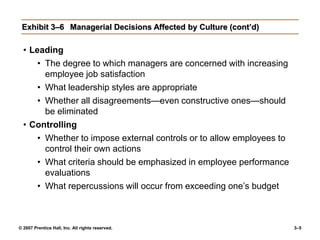
Exhibit 3–6 Managerial Decisions Affected by Culture (cont’d)
• Leading
• The degree to which managers are concerned with increasing
employee job satisfaction
• What leadership styles are appropriate
• Whether all disagreements—even constructive ones—should
be eliminated
• Controlling
• Whether to impose external controls or to allow employees to
control their own actions
• What criteria should be emphasized in employee performance
evaluations
• What repercussions will occur from exceeding one’s budget
© 2007 Prentice Hall, Inc. All rights reserved. 3–6
Organization Culture Issues
• Creating an Ethical
Culture
High in risk tolerance
Low to moderate
aggressiveness
Focus on means as
well as outcomes
• Creating an Innovative
Culture
Challenge and
involvement
Freedom
Trust and openness
Idea time
Playfulness/humor
Conflict resolution
Debates
Risk-taking
© 2007 Prentice Hall, Inc. All rights reserved. 3–7
Exhibit 3–7 Suggestions for Managers: Creating a More Ethical Culture
• Be a visible role model.
• Communicate ethical expectations.
• Provide ethics training.
• Visibly reward ethical acts and punish unethical
ones.
• Provide protective mechanisms so employees can
discuss ethical dilemmas and report unethical
behavior without fear.
© 2007 Prentice Hall, Inc. All rights reserved. 3–8
Organization Culture Issues (cont’d)
• Creating a Customer-Responsive Culture
Hiring the right type of employees (ones with a strong
interest in serving customers)
Having few rigid rules, procedures, and regulations
Using widespread empowerment of employees
Having good listening skills in relating to customers’
messages
Providing role clarity to employees to reduce
ambiguity and conflict and increase job satisfaction
Having conscientious, caring employees willing to
take initiative
© 2007 Prentice Hall, Inc. All rights reserved. 3–9
Exhibit 3–8 Suggestions for Managers: Creating a More Customer-
Responsive Culture
• Hire service-contact people with the personality and attitudes
consistent with customer service—friendliness, enthusiasm,
attentiveness, patience, concern about others, and listening skills.
• Train customer service people continuously by focusing on
improving product knowledge, active listening, showing patience,
and displaying emotions.
• Socialize new service-contact people to the organization’s goals and
values.
• Design customer-service jobs so that employees have as much
control as necessary to satisfy customers.
• Empower service-contact employees with the discretion to make
day-to-day decisions on job-related activities.
• As the leader, convey a customer-focused vision and demonstrate
through decisions and actions the commitment to customers.
© 2007 Prentice Hall, Inc. All rights reserved. 3–10
Spirituality and Organizational Culture
•Workplace Spirituality
The recognition that people have an inner life that
nourishes and is nourished by meaningful work that
takes place in the context of community.
•Characteristics of a Spiritual Organization
Strong sense of purpose
Focus on individual development
Trust and openness
Employee empowerment
Toleration of employees’ expression
© 2007 Prentice Hall, Inc. All rights reserved. 3–11
Benefits of Spirituality
• Improved employee productivity
• Reduction of employee turnover
• Stronger organizational performance
• Increased creativity
• Increased employee satisfaction
• Increased team performance
• Increased organizational performance
© 2007 Prentice Hall, Inc. All rights reserved. 3–12
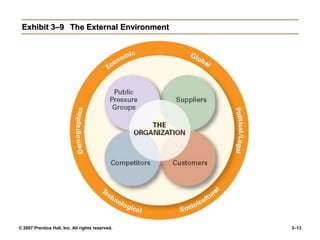
Defining the External Environment
• External Environment
Those factors and forces outside the organization that
affect the organization’s performance.
• Components of the External Environment
Specific environment: external forces that have a
direct and immediate impact on the organization.
General environment: broad economic, socio-
cultural, political/legal, demographic, technological,
and global conditions that may affect the organization.
© 2007 Prentice Hall, Inc. All rights reserved. 3–13
Exhibit 3–9 The External Environment
© 2007 Prentice Hall, Inc. All rights reserved. 3–14
Exhibit 3–10 Selected U.S. Legislation Affecting Business
• Occupational Safety and Health Act of 1970
• Consumer Product Safety Act of 1972
• Equal Employment Opportunity Act of 1972
• Worker Adjustment and Retraining Notification Act of 1988
• Americans with Disabilities Act of 1990
• Civil Rights Act of 1991
• Family and Medical Leave Act of 1993
• Child Safety Protection Act of 1994
• U.S. Economic Espionage Act of 1996
• Electronic Signatures in Global and National Commerce Act of 2000
• Sarbanes-Oxley Act of 2002
• Fair and Accurate Credit Transactions Act of 2003
© 2007 Prentice Hall, Inc. All rights reserved. 3–15
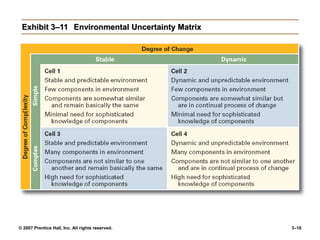
How the Environment Affects Managers
• Environmental Uncertainty
The extent to which managers have knowledge of
and are able to predict change their organization’s
external environment is affected by:
 Complexity of the environment: the number of components
in an organization’s external environment.
 Degree of change in environmental components: how
dynamic or stable the external environment is.
© 2007 Prentice Hall, Inc. All rights reserved. 3–16
Exhibit 3–11 Environmental Uncertainty Matrix
© 2007 Prentice Hall, Inc. All rights reserved. 3–17
Stakeholder Relationships
• Stakeholders
Any constituencies in the organization’s environment
that are affected by the organization’s decisions and
actions
• Why Manage Stakeholder Relationships?
It can lead to improved organizational performance.
It’s the “right” thing to do given the interdependence
of the organization and its external stakeholders.
© 2007 Prentice Hall, Inc. All rights reserved. 3–18
Managing Stakeholder Relationships
1. Identify the organization’s external
stakeholders.
2. Determine the particular interests and
concerns of the external stakeholders.
3. Decide how critical each external stakeholder
is to the organization.
4. Determine how to manage each individual
external stakeholder relationship.
© 2007 Prentice Hall, Inc. All rights reserved. 3–19
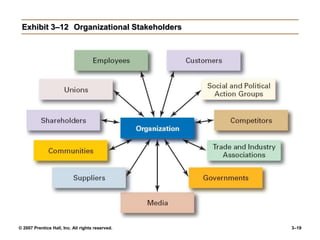
Exhibit 3–12 Organizational Stakeholders
© 2007 Prentice Hall, Inc. All rights reserved. 3–20
Terms to Know
• omnipotent view of
management
• symbolic view of
management
• organizational culture
• strong cultures
• socialization
• workplace spirituality
• external environment
• specific environment
• general environment
• environmental uncertainty
• environmental complexity
• stakeholders

Chapter 5.ppt

  • 1.
    ninth edition STEPHEN P.ROBBINS PowerPoint Presentation by Charlie Cook The University of West Alabama MARY COULTER Organizational Culture and Environment: The Constraints Chapter 5
  • 2.
    © 2007 PrenticeHall, Inc. All rights reserved. 3–2 How Culture Affects Managers • Cultural Constraints on Managers Whatever managerial actions the organization recognizes as proper or improper on its behalf Whatever organizational activities the organization values and encourages The overall strength or weakness of the organizational culture Simple rule for getting ahead in an organization: Find out what the organization rewards and do those things.
  • 3.
    © 2007 PrenticeHall, Inc. All rights reserved. 3–3 Exhibit 3–5 How an Organization’s Culture Is Established and Maintained
  • 4.
    © 2007 PrenticeHall, Inc. All rights reserved. 3–4 Exhibit 3–6 Managerial Decisions Affected by Culture • Planning • The degree of risk that plans should contain • Whether plans should be developed by individuals or teams • The degree of environmental scanning in which management will engage • Organizing • How much autonomy should be designed into employees’ jobs • Whether tasks should be done by individuals or in teams • The degree to which department managers interact with each other
  • 5.
    © 2007 PrenticeHall, Inc. All rights reserved. 3–5 Exhibit 3–6 Managerial Decisions Affected by Culture (cont’d) • Leading • The degree to which managers are concerned with increasing employee job satisfaction • What leadership styles are appropriate • Whether all disagreements—even constructive ones—should be eliminated • Controlling • Whether to impose external controls or to allow employees to control their own actions • What criteria should be emphasized in employee performance evaluations • What repercussions will occur from exceeding one’s budget
  • 6.
    © 2007 PrenticeHall, Inc. All rights reserved. 3–6 Organization Culture Issues • Creating an Ethical Culture High in risk tolerance Low to moderate aggressiveness Focus on means as well as outcomes • Creating an Innovative Culture Challenge and involvement Freedom Trust and openness Idea time Playfulness/humor Conflict resolution Debates Risk-taking
  • 7.
    © 2007 PrenticeHall, Inc. All rights reserved. 3–7 Exhibit 3–7 Suggestions for Managers: Creating a More Ethical Culture • Be a visible role model. • Communicate ethical expectations. • Provide ethics training. • Visibly reward ethical acts and punish unethical ones. • Provide protective mechanisms so employees can discuss ethical dilemmas and report unethical behavior without fear.
  • 8.
    © 2007 PrenticeHall, Inc. All rights reserved. 3–8 Organization Culture Issues (cont’d) • Creating a Customer-Responsive Culture Hiring the right type of employees (ones with a strong interest in serving customers) Having few rigid rules, procedures, and regulations Using widespread empowerment of employees Having good listening skills in relating to customers’ messages Providing role clarity to employees to reduce ambiguity and conflict and increase job satisfaction Having conscientious, caring employees willing to take initiative
  • 9.
    © 2007 PrenticeHall, Inc. All rights reserved. 3–9 Exhibit 3–8 Suggestions for Managers: Creating a More Customer- Responsive Culture • Hire service-contact people with the personality and attitudes consistent with customer service—friendliness, enthusiasm, attentiveness, patience, concern about others, and listening skills. • Train customer service people continuously by focusing on improving product knowledge, active listening, showing patience, and displaying emotions. • Socialize new service-contact people to the organization’s goals and values. • Design customer-service jobs so that employees have as much control as necessary to satisfy customers. • Empower service-contact employees with the discretion to make day-to-day decisions on job-related activities. • As the leader, convey a customer-focused vision and demonstrate through decisions and actions the commitment to customers.
  • 10.
    © 2007 PrenticeHall, Inc. All rights reserved. 3–10 Spirituality and Organizational Culture •Workplace Spirituality The recognition that people have an inner life that nourishes and is nourished by meaningful work that takes place in the context of community. •Characteristics of a Spiritual Organization Strong sense of purpose Focus on individual development Trust and openness Employee empowerment Toleration of employees’ expression
  • 11.
    © 2007 PrenticeHall, Inc. All rights reserved. 3–11 Benefits of Spirituality • Improved employee productivity • Reduction of employee turnover • Stronger organizational performance • Increased creativity • Increased employee satisfaction • Increased team performance • Increased organizational performance
  • 12.
    © 2007 PrenticeHall, Inc. All rights reserved. 3–12 Defining the External Environment • External Environment Those factors and forces outside the organization that affect the organization’s performance. • Components of the External Environment Specific environment: external forces that have a direct and immediate impact on the organization. General environment: broad economic, socio- cultural, political/legal, demographic, technological, and global conditions that may affect the organization.
  • 13.
    © 2007 PrenticeHall, Inc. All rights reserved. 3–13 Exhibit 3–9 The External Environment
  • 14.
    © 2007 PrenticeHall, Inc. All rights reserved. 3–14 Exhibit 3–10 Selected U.S. Legislation Affecting Business • Occupational Safety and Health Act of 1970 • Consumer Product Safety Act of 1972 • Equal Employment Opportunity Act of 1972 • Worker Adjustment and Retraining Notification Act of 1988 • Americans with Disabilities Act of 1990 • Civil Rights Act of 1991 • Family and Medical Leave Act of 1993 • Child Safety Protection Act of 1994 • U.S. Economic Espionage Act of 1996 • Electronic Signatures in Global and National Commerce Act of 2000 • Sarbanes-Oxley Act of 2002 • Fair and Accurate Credit Transactions Act of 2003
  • 15.
    © 2007 PrenticeHall, Inc. All rights reserved. 3–15 How the Environment Affects Managers • Environmental Uncertainty The extent to which managers have knowledge of and are able to predict change their organization’s external environment is affected by:  Complexity of the environment: the number of components in an organization’s external environment.  Degree of change in environmental components: how dynamic or stable the external environment is.
  • 16.
    © 2007 PrenticeHall, Inc. All rights reserved. 3–16 Exhibit 3–11 Environmental Uncertainty Matrix
  • 17.
    © 2007 PrenticeHall, Inc. All rights reserved. 3–17 Stakeholder Relationships • Stakeholders Any constituencies in the organization’s environment that are affected by the organization’s decisions and actions • Why Manage Stakeholder Relationships? It can lead to improved organizational performance. It’s the “right” thing to do given the interdependence of the organization and its external stakeholders.
  • 18.
    © 2007 PrenticeHall, Inc. All rights reserved. 3–18 Managing Stakeholder Relationships 1. Identify the organization’s external stakeholders. 2. Determine the particular interests and concerns of the external stakeholders. 3. Decide how critical each external stakeholder is to the organization. 4. Determine how to manage each individual external stakeholder relationship.
  • 19.
    © 2007 PrenticeHall, Inc. All rights reserved. 3–19 Exhibit 3–12 Organizational Stakeholders
  • 20.
    © 2007 PrenticeHall, Inc. All rights reserved. 3–20 Terms to Know • omnipotent view of management • symbolic view of management • organizational culture • strong cultures • socialization • workplace spirituality • external environment • specific environment • general environment • environmental uncertainty • environmental complexity • stakeholders