HR DEMAND
FORECASTING
–
QUALITATIVE
TECHNIQUES
DELIVERED BY
DR. PRATYUSH BANERJEE
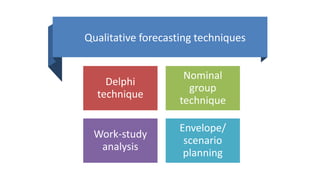
Qualitative forecasting techniques
Delphi
technique
Nominal
group
technique
Work-study
analysis
Envelope/
scenario
planning
Delphi Technique
• Delphi is a structured approach for reaching a consensus judgment
among experts about future developments in any area that might
affect a business, for example, a firm’s future demand for labor.
• In the Delphi technique, a panel of relevant people is chosen to
address an issue. The experts do not meet face to face.
• Experts are chosen based on their knowledge of internal factors that
might affect a business (e.g., projected retirement), their knowledge
of the general business plans of the organization, knowledge of the
external factors that might affect demand for the firm’s product and
service and hence its internal demand for labor.
• Experts may range from first-line supervisors to top-level managers.
Sometimes, outside experts are also used.
• Iteratively their suggestions are passed on through a moderator and
the most applicable solution is agreed upon
Nominal Group Method
The steps involved in nominal group based HRP are:
Step 1: Individuals are brought together & presented with a problem.
Step 2: They develop solutions independently, often writing them on cards.
Step 3: Their ideas are shared with others in a structured format,
Step 4: Brief-time is allotted so that questions can be asked – but only for clarification
ask the kinds of questions a unit manager can answer.
Step 5: Group members individually designate their preferences for the best
alternatives by secret ballot.
Step 6: The group “decision” is announced.
Envelope / Scenario Planning
• Since we can not have exhaustive knowledge of the future
courses of events, better to have options/ scenarios
• Scenario planning helps us in developing several what-if
possibilities and be prepared for different eventualities
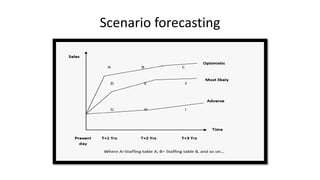
Steps in scenario planning process
1. Identify three business scenarios- most desirable, most likely
and least desirable
2. for each scenario, assess the firm’s readiness
3. assess over next 3-5 yrs what are the competitive challenges
for each scenario
4. identify HR initiatives to tackle corresponding challenges
Scenario forecasting
Source: Davenport, K. and Gray, J. Use of Scenario Planning to Develop Workforce Strategies following COVID-19. April 28, 2020. Available at:
https://www.scottmadden.com/insight/the-use-of-scenario-planning-to-develop-workforce-strategies-following-covid-19/
Using What-if Analysis for Scenario Planning
Use the Add button to
develop new scenarios
Work Study Analysis
• Work-study techniques can be used when it is possible to apply
work measurement to calculate length of operations and the
amount of labor required.
• The starting point in a manufacturing company is the production
budget, prepared in terms of volumes of saleable products for the
company as a whole, or volumes of output for individual
departments.
• The budgets of productive hours are then compiled using standard
hours for direct labor.
• The standard hours per unit of output are then multiplied by the
planned volume of units to be produced to give the total number
of planned hours for the period.
• This is then divided by the number of actual working hours for an
individual operator to show the number of operators required.
AN EXERCISE
• Suppose you are CHRO of a mid-sized firm in India
• Your firm is in the logistic transport and courier business such as DTDC
• The firm ranks fifth in terms of market share in India, total manpower headcount
being 1500 in 2021
• On an average the attrition level is 15 % in the firm and the firm has been expanding
at a rate of 10 % since 2019.
• The firm expects to downsize their manpower by 30 % in 2022 and retrench their
business operations by 20 %.
• Discuss possible business challenges for your firm in the post covid world using any
qualitative forecasting technique
• Discuss possible actions that should be taken to make the firm more immune to
similar future external shock events
THANK YOU

Chapter 6 - HR DEMAND FORECASTING – QUALITATIVE TECHNIQUES.pptx

  • 1.
  • 2.
  • 3.
    Delphi Technique • Delphiis a structured approach for reaching a consensus judgment among experts about future developments in any area that might affect a business, for example, a firm’s future demand for labor. • In the Delphi technique, a panel of relevant people is chosen to address an issue. The experts do not meet face to face. • Experts are chosen based on their knowledge of internal factors that might affect a business (e.g., projected retirement), their knowledge of the general business plans of the organization, knowledge of the external factors that might affect demand for the firm’s product and service and hence its internal demand for labor. • Experts may range from first-line supervisors to top-level managers. Sometimes, outside experts are also used. • Iteratively their suggestions are passed on through a moderator and the most applicable solution is agreed upon
  • 4.
    Nominal Group Method Thesteps involved in nominal group based HRP are: Step 1: Individuals are brought together & presented with a problem. Step 2: They develop solutions independently, often writing them on cards. Step 3: Their ideas are shared with others in a structured format, Step 4: Brief-time is allotted so that questions can be asked – but only for clarification ask the kinds of questions a unit manager can answer. Step 5: Group members individually designate their preferences for the best alternatives by secret ballot. Step 6: The group “decision” is announced.
  • 5.
    Envelope / ScenarioPlanning • Since we can not have exhaustive knowledge of the future courses of events, better to have options/ scenarios • Scenario planning helps us in developing several what-if possibilities and be prepared for different eventualities
  • 6.
    Steps in scenarioplanning process 1. Identify three business scenarios- most desirable, most likely and least desirable 2. for each scenario, assess the firm’s readiness 3. assess over next 3-5 yrs what are the competitive challenges for each scenario 4. identify HR initiatives to tackle corresponding challenges
  • 7.
  • 8.
    Source: Davenport, K.and Gray, J. Use of Scenario Planning to Develop Workforce Strategies following COVID-19. April 28, 2020. Available at: https://www.scottmadden.com/insight/the-use-of-scenario-planning-to-develop-workforce-strategies-following-covid-19/
  • 9.
    Using What-if Analysisfor Scenario Planning Use the Add button to develop new scenarios
  • 10.
    Work Study Analysis •Work-study techniques can be used when it is possible to apply work measurement to calculate length of operations and the amount of labor required. • The starting point in a manufacturing company is the production budget, prepared in terms of volumes of saleable products for the company as a whole, or volumes of output for individual departments. • The budgets of productive hours are then compiled using standard hours for direct labor. • The standard hours per unit of output are then multiplied by the planned volume of units to be produced to give the total number of planned hours for the period. • This is then divided by the number of actual working hours for an individual operator to show the number of operators required.
  • 11.
    AN EXERCISE • Supposeyou are CHRO of a mid-sized firm in India • Your firm is in the logistic transport and courier business such as DTDC • The firm ranks fifth in terms of market share in India, total manpower headcount being 1500 in 2021 • On an average the attrition level is 15 % in the firm and the firm has been expanding at a rate of 10 % since 2019. • The firm expects to downsize their manpower by 30 % in 2022 and retrench their business operations by 20 %. • Discuss possible business challenges for your firm in the post covid world using any qualitative forecasting technique • Discuss possible actions that should be taken to make the firm more immune to similar future external shock events
  • 12.