Planning Your Career and
EducationPlanning Your Career And Education
Employment Trends of the
Future
 Keep up with what is happening in the
world so that your career does not
become obsolete
Learn About Employment
Trends
 The Internet
 Newspaper
 News Programs
 Current Magazines
 Government Statistics and Publications
Some Trends for the Future
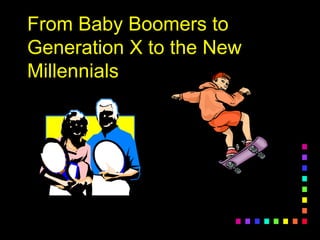
From Baby Boomers to
Generation X to the New
Millennials
Baby Boomers
 Born between 1946 and 1964
 Four out of every ten adults today
 The population is getting older
 How will the Baby Boom generation
affect careers of the future?
Generation X
 Born between 1965 and 1977
Advantages of Generation X
 More highly educated
 Greater demand for skilled workers
 Computer literate
 Good work ethic
 As Baby Boomers retire, more job
opportunities
The New Millennials
 Born between 1977 and 1995
The New Millennials
 Sometimes called the “Echo Boomers”
 By 2010, they will be the largest teen
population is U.S. history
 Will exceed the number of Baby
Boomers
 In the next 10 years, college
enrollments will increase by 300,000
students per year
 College admission will become
increasingly competitive.
The New Millennials
 The cyber generation
 Their most important values are
individuality and uniqueness
 Greatest concerns: terrorism and school
shootings
 Decreasing use of alcohol, drugs and
tobacco
 Have the promise of changing
institutions for the better
More Trends . . .
From Goods to Service and
Technology
 What are some service and technology
occupations?
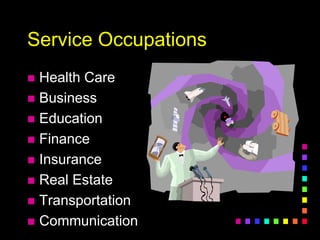
Service Occupations
 Health Care
 Business
 Education
 Finance
 Insurance
 Real Estate
 Transportation
 Communication
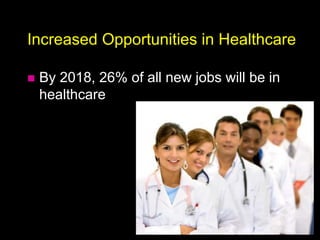
Increased Opportunities in Healthcare
 By 2018, 26% of all new jobs will be in
healthcare
Why the increase?
 Aging baby boomers
 Healthcare reform
 New pharmaceuticals
 New developments in medicine
More Assistants Needed
 Because of increased cost, we will need
more:
 Physician’s assistants
 Medical assistants
 Physical therapy assistants
 Dental assistants
Healthcare Workers + Technology
 Workers in medical fields will use more
technology
 Example: Nursing Informatics
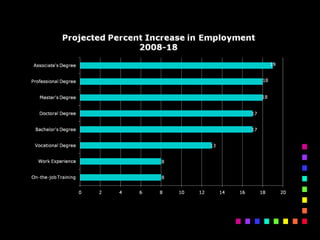
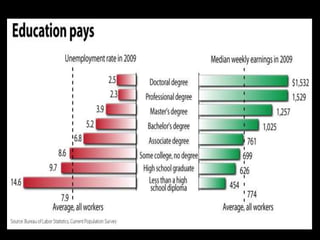
Increased Need for Education
Middle Class is Endangered
 More low pay, low skill jobs
 More high pay, high skill jobs
 Education will determine pay and class
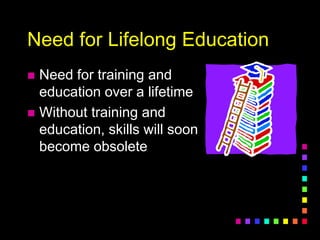
Need for Lifelong Education
 Need for training and
education over a lifetime
 Without training and
education, skills will soon
become obsolete
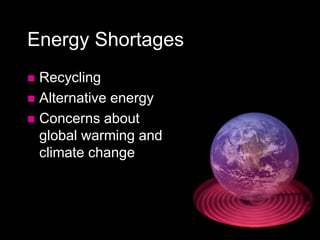
Energy Shortages
 Recycling
 Alternative energy
 Concerns about
global warming and
climate change
Going Green!
Going Green!
 As fossil fuels are depleted, look for
more:
 Wind turbines
 Solar panels
 Biofuels
 Emphasis on sustainability
 Taking care of the environment
Green Jobs
 Environmental
lawyer
 Green architect
 Sustainability
consultant
 Marine biologist
 Environmental
technician
 Energy efficiency
specialist
 Organic farmer
 Compliance
manager
 Product engineer
 Wind energy
engineer
 Solar Engineer
E-Commerce
E-commerce is changing the
way we do business
 Online sales are increasing 10-20% a
year while traditional retail sales are
stagnant
 Online marketing is used for most retail
sales
 E-commerce will become an important
part of business education
Increase in Entrepreneurship
 Starting your own business
 Taking advantage of technology to work
from home
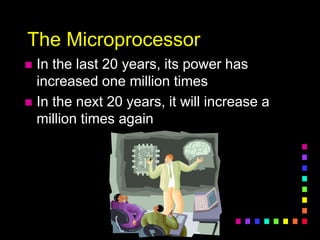
The Microprocessor
 In the last 20 years, its power has
increased one million times
 In the next 20 years, it will increase a
million times again
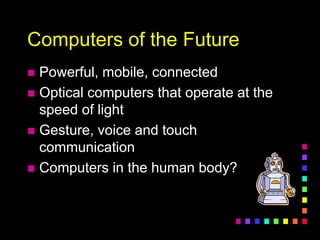
Computers of the Future
 Powerful, mobile, connected
 Optical computers that operate at the
speed of light
 Gesture, voice and touch
communication
 Computers in the human body?
Technology and Communication
 2 million new jobs in technology
 Computer systems designs will increase
by 34% by 2018
New Technology Jobs
 Computer network administrators
 Data communications analysts
 Web developers
 Data loss prevention
 Online security
Computer Science
 Computer science grads will be
especially marketable when combined
with traditional fields such as finance
and marketing
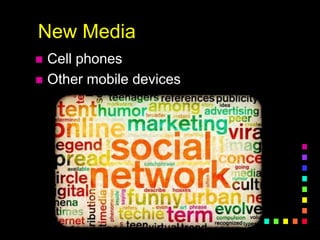
New Media
 Cell phones
 Other mobile devices
Diverse Workforce
 More older workers
 More women
 One third from diverse groups
 More immigrants
Advances in Technology
 Many new careers in technology
 Radiation and lasers
 Fiber optics and telecommunications
 Artificial intelligence
 Biotechnology
 Advances in medicine
Beware of Outsourcing
 Accounting
 Customer service
 Data entry
 Assembly line workers
 Software developers
 Technical support
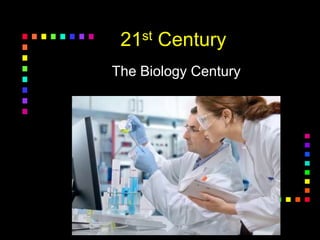
21st Century
The Biology Century
New Advances in Biology
 The 21st Century will
be the biology
century
 Human Genome
Project
 Biotechnology
 Biomedical
technology
Biotechnology
 Increasing important to:
 Combat disease
 Develop new surgical devices
 Increase food production
 Reduce pollution
 Improve recycling
 Tools for law enforcement
Biomedical Engineering
 Involves developing and testing
healthcare innovations
 Will increase 72% by 2018
Effect of Terrorism
 People are choosing to stay in the
safety of their homes, offices, cars, and
gated communities
 Less travel
 Increase in home remodeling and sales
of entertainment systems
 Increase in careers that provide value to
society and increased personal
satisfaction
Top Jobs for the Future
 Business
 Education
 Entertainment
 Health
 Information
Technology
 Travel/
Transportation
 Law/Law
enforcement
 Services
 Sports and related
 Technology
 Trades
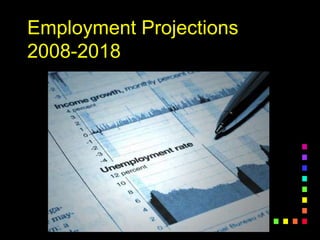
Employment Projections
2008-2018
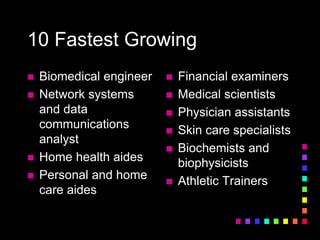
10 Fastest Growing
 Biomedical engineer
 Network systems
and data
communications
analyst
 Home health aides
 Personal and home
care aides
 Financial examiners
 Medical scientists
 Physician assistants
 Skin care specialists
 Biochemists and
biophysicists
 Athletic Trainers
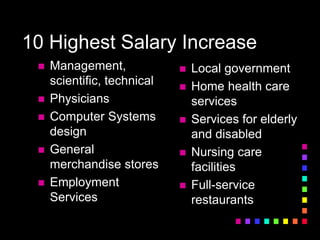
10 Highest Salary Increase
 Management,
scientific, technical
 Physicians
 Computer Systems
design
 General
merchandise stores
 Employment
Services
 Local government
 Home health care
services
 Services for elderly
and disabled
 Nursing care
facilities
 Full-service
restaurants
Top Paying Jobs
Require math and science
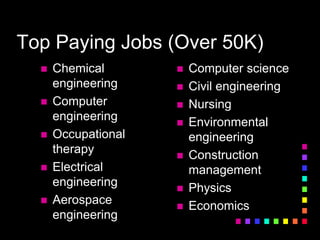
Top Paying Jobs (Over 50K)
 Chemical
engineering
 Computer
engineering
 Occupational
therapy
 Electrical
engineering
 Aerospace
engineering
 Computer science
 Civil engineering
 Nursing
 Environmental
engineering
 Construction
management
 Physics
 Economics
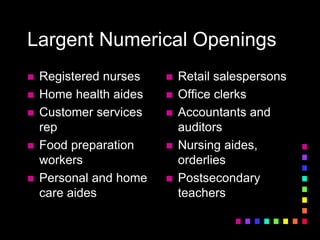
Largent Numerical Openings
 Registered nurses
 Home health aides
 Customer services
rep
 Food preparation
workers
 Personal and home
care aides
 Retail salespersons
 Office clerks
 Accountants and
auditors
 Nursing aides,
orderlies
 Postsecondary
teachers
Work Skills for the 21st
Century
Basic Skills
 Reading
 Math
 Writing
 Listening
 Speaking
 Computers
Thinking Skills
 Creative Thinking
 Decision Making
 Problem Solving
 Mental Visualization
 Knowing How to Learn
 Reasoning
Personal Qualities
 Responsibility
 Self-esteem
 Sociability
 Self-management
 Integrity and Honesty
Workplace Competencies
 Manage time and money
 Participate as a member of a team
 Use computers to access information
 Develop efficient management systems
 Use technology
How to Research Your Career
Career Description
 Nature of the work
 Working conditions
 Training
 Qualification
 Advancement
The Career Outlook
 Salary
 Availability of employment
 Will this career exist in the future?
To Research Your Career
 Use the College Success Web Site
 Visit the Career Center
 Use the library
Planning Your Education
Steps in Planning Your
Education
 Assessment tests
 Take English the first semester
 Start math classes early
 Take general education
 Prepare for your major
For Your Success
 See a counselor
 Develop an educational plan
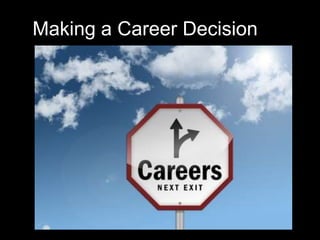
Making a Career Decision
There is a choice you have to make,
In everything you do.
And you must always keep in mind,
The choice you make, makes you.
Steps in Making a Career
Decision
 Self-assessment
 Personality, Interests, Values, Skills
 Explore Options
 Research careers
 Plan your education
 Make a commitment and take action
 Evaluate
 How is it working?
Kinds of Decisions
Dependent Decisions
 Someone else makes it for you
 For example, a doctor or parent makes
the decision for you
 What are the advantages and
disadvantages?
Intuitive Decisions
 Based on “gut feelings” or intuition
 For example, we might use this in
making a quick decision in an
emergency or when gambling
 What are the advantages and
disadvantages?
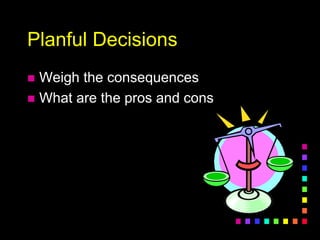
Planful Decisions
 Weigh the consequences
 What are the pros and cons
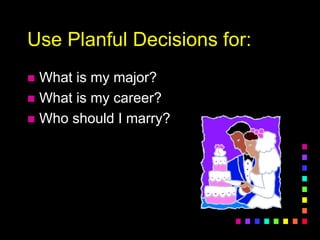
Use Planful Decisions for:
 What is my major?
 What is my career?
 Who should I marry?
Steps in Planful Decisions
 State the problem
 Consider your values
 What are your talents?
 Gather information
 Generate alternatives
 Evaluate the pros and cons of the
options
 Select the best alternative
 Take action
Group Activity: Planful
Decision
Writing a Resume
Your Resume
 A snapshot of your education and
experience
 Generally one page
Resume
 Contact information
 Name
 Address
 Telephone
 E-mail
Resume
 Career Objective
 Education
 Experience
 Special skills, honors, awards
 References
Good Resume
 Write clearly
 Be brief
 Be neat
 Be honest
 Print professionally or post online
 Your resume represents you!
Letters of Reference
 Ask for letters of reference from your
current employers and professors.
Keep them on file.
 Use them to apply for jobs and
scholarships.
Online Resumes
 Many jobs today will be posted on the
Internet and will require online resumes
Cover Letter
 State briefly the job you are interested
in.
 Briefly state how your education and
experience would be an asset to the
company.
 Ask for an interview.
 Attach your resume.
Assignment
 Complete a resume and cover letter for
your ideal job.
 Assume you have graduated from
college and are applying for that job that
motivated you to finish college.
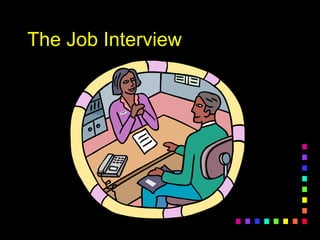
The Job Interview
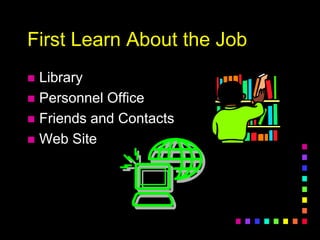
First Learn About the Job
 Library
 Personnel Office
 Friends and Contacts
 Web Site
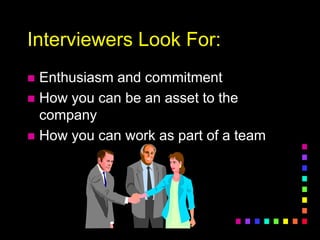
Interviewers Look For:
 Enthusiasm and commitment
 How you can be an asset to the
company
 How you can work as part of a team
Make a Good Impression
 Dress appropriately
 Relax
 Anticipate interview questions
 Smile and introduce yourself
 Maintain eye contact
Interview Questions
 Tell us about yourself.
 Why do you want this job?
 Why are you leaving your present job?
 What are your strengths and
weaknesses?
 Tell us about a difficulty or problem you
solved on the job.
Interview Questions
 Tell us about one of your achievements
on the job.
 What do you like best about your job?
 What do you like least?
 Are there any questions you would like
to ask?
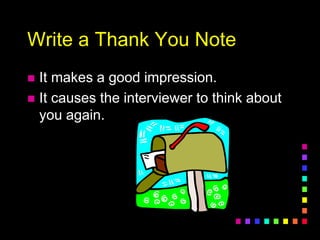
Write a Thank You Note
 It makes a good impression.
 It causes the interviewer to think about
you again.
Interview Worksheet
1. Answer the questions in 5
minutes
2. Practice the questions with
your partner
Keys to Success:
Life is a Dangerous
Opportunity
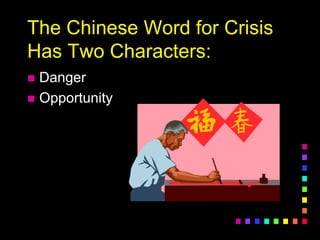
The Chinese Word for Crisis
Has Two Characters:
 Danger
 Opportunity
What is the danger?
What is the opportunity?
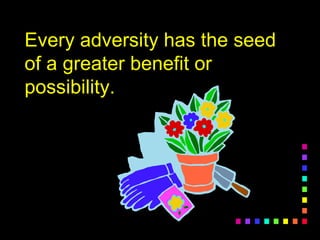
Every adversity has the seed
of a greater benefit or
possibility.
Assignment:
Complete
Rate Your Skills for Success in the
Workplace
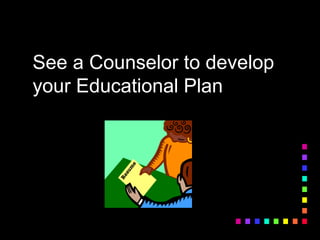
See a Counselor to develop
your Educational Plan
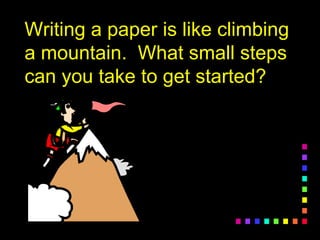
Writing a paper is like climbing
a mountain. What small steps
can you take to get started?
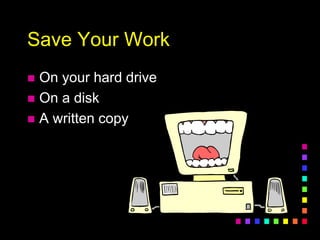
Save Your Work
 On your hard drive
 On a disk
 A written copy
The Introduction
 Contains the thesis statement
 Foundation for the paper
 Contains interesting points that motivate
the reader to read your paper
The Body of the Paper
 Good writing is clear thinking
 Use plain and understandable language
 Provide explanation and examples
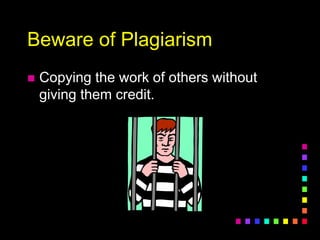
Beware of Plagiarism
 Copying the work of others without
giving them credit.
Avoid Plagiarism by:
 Using quotations and providing a
reference
 Thinking about the main ideas and then
looking away and writing them in your
own words
Write a Conclusion
 Summarizes topics
 Answers question posed in the thesis
statement
 Make it interesting and powerful
Include References
 Author
 Title of book
 Publisher of book
 City where the book was published
 The publication date
 The page number

Chapter 5 with essay

  • 1.
    Planning Your Careerand EducationPlanning Your Career And Education
  • 2.
    Employment Trends ofthe Future  Keep up with what is happening in the world so that your career does not become obsolete
  • 3.
    Learn About Employment Trends The Internet  Newspaper  News Programs  Current Magazines  Government Statistics and Publications
  • 4.
    Some Trends forthe Future
  • 5.
    From Baby Boomersto Generation X to the New Millennials
  • 6.
    Baby Boomers  Bornbetween 1946 and 1964  Four out of every ten adults today  The population is getting older  How will the Baby Boom generation affect careers of the future?
  • 7.
    Generation X  Bornbetween 1965 and 1977
  • 8.
    Advantages of GenerationX  More highly educated  Greater demand for skilled workers  Computer literate  Good work ethic  As Baby Boomers retire, more job opportunities
  • 9.
    The New Millennials Born between 1977 and 1995
  • 10.
    The New Millennials Sometimes called the “Echo Boomers”  By 2010, they will be the largest teen population is U.S. history  Will exceed the number of Baby Boomers  In the next 10 years, college enrollments will increase by 300,000 students per year  College admission will become increasingly competitive.
  • 11.
    The New Millennials The cyber generation  Their most important values are individuality and uniqueness  Greatest concerns: terrorism and school shootings  Decreasing use of alcohol, drugs and tobacco  Have the promise of changing institutions for the better
  • 12.
  • 13.
    From Goods toService and Technology  What are some service and technology occupations?
  • 14.
    Service Occupations  HealthCare  Business  Education  Finance  Insurance  Real Estate  Transportation  Communication
  • 15.
    Increased Opportunities inHealthcare  By 2018, 26% of all new jobs will be in healthcare
  • 16.
    Why the increase? Aging baby boomers  Healthcare reform  New pharmaceuticals  New developments in medicine
  • 17.
    More Assistants Needed Because of increased cost, we will need more:  Physician’s assistants  Medical assistants  Physical therapy assistants  Dental assistants
  • 18.
    Healthcare Workers +Technology  Workers in medical fields will use more technology  Example: Nursing Informatics
  • 19.
  • 22.
    Middle Class isEndangered  More low pay, low skill jobs  More high pay, high skill jobs  Education will determine pay and class
  • 23.
    Need for LifelongEducation  Need for training and education over a lifetime  Without training and education, skills will soon become obsolete
  • 24.
    Energy Shortages  Recycling Alternative energy  Concerns about global warming and climate change
  • 25.
  • 26.
    Going Green!  Asfossil fuels are depleted, look for more:  Wind turbines  Solar panels  Biofuels  Emphasis on sustainability  Taking care of the environment
  • 27.
    Green Jobs  Environmental lawyer Green architect  Sustainability consultant  Marine biologist  Environmental technician  Energy efficiency specialist  Organic farmer  Compliance manager  Product engineer  Wind energy engineer  Solar Engineer
  • 28.
  • 29.
    E-commerce is changingthe way we do business  Online sales are increasing 10-20% a year while traditional retail sales are stagnant  Online marketing is used for most retail sales  E-commerce will become an important part of business education
  • 30.
    Increase in Entrepreneurship Starting your own business  Taking advantage of technology to work from home
  • 31.
    The Microprocessor  Inthe last 20 years, its power has increased one million times  In the next 20 years, it will increase a million times again
  • 32.
    Computers of theFuture  Powerful, mobile, connected  Optical computers that operate at the speed of light  Gesture, voice and touch communication  Computers in the human body?
  • 33.
    Technology and Communication 2 million new jobs in technology  Computer systems designs will increase by 34% by 2018
  • 34.
    New Technology Jobs Computer network administrators  Data communications analysts  Web developers  Data loss prevention  Online security
  • 35.
    Computer Science  Computerscience grads will be especially marketable when combined with traditional fields such as finance and marketing
  • 36.
    New Media  Cellphones  Other mobile devices
  • 37.
    Diverse Workforce  Moreolder workers  More women  One third from diverse groups  More immigrants
  • 38.
    Advances in Technology Many new careers in technology  Radiation and lasers  Fiber optics and telecommunications  Artificial intelligence  Biotechnology  Advances in medicine
  • 39.
    Beware of Outsourcing Accounting  Customer service  Data entry  Assembly line workers  Software developers  Technical support
  • 40.
  • 41.
    New Advances inBiology  The 21st Century will be the biology century  Human Genome Project  Biotechnology  Biomedical technology
  • 42.
    Biotechnology  Increasing importantto:  Combat disease  Develop new surgical devices  Increase food production  Reduce pollution  Improve recycling  Tools for law enforcement
  • 43.
    Biomedical Engineering  Involvesdeveloping and testing healthcare innovations  Will increase 72% by 2018
  • 44.
    Effect of Terrorism People are choosing to stay in the safety of their homes, offices, cars, and gated communities  Less travel  Increase in home remodeling and sales of entertainment systems  Increase in careers that provide value to society and increased personal satisfaction
  • 45.
    Top Jobs forthe Future  Business  Education  Entertainment  Health  Information Technology  Travel/ Transportation  Law/Law enforcement  Services  Sports and related  Technology  Trades
  • 46.
  • 47.
    10 Fastest Growing Biomedical engineer  Network systems and data communications analyst  Home health aides  Personal and home care aides  Financial examiners  Medical scientists  Physician assistants  Skin care specialists  Biochemists and biophysicists  Athletic Trainers
  • 48.
    10 Highest SalaryIncrease  Management, scientific, technical  Physicians  Computer Systems design  General merchandise stores  Employment Services  Local government  Home health care services  Services for elderly and disabled  Nursing care facilities  Full-service restaurants
  • 49.
    Top Paying Jobs Requiremath and science
  • 50.
    Top Paying Jobs(Over 50K)  Chemical engineering  Computer engineering  Occupational therapy  Electrical engineering  Aerospace engineering  Computer science  Civil engineering  Nursing  Environmental engineering  Construction management  Physics  Economics
  • 51.
    Largent Numerical Openings Registered nurses  Home health aides  Customer services rep  Food preparation workers  Personal and home care aides  Retail salespersons  Office clerks  Accountants and auditors  Nursing aides, orderlies  Postsecondary teachers
  • 52.
    Work Skills forthe 21st Century
  • 53.
    Basic Skills  Reading Math  Writing  Listening  Speaking  Computers
  • 54.
    Thinking Skills  CreativeThinking  Decision Making  Problem Solving  Mental Visualization  Knowing How to Learn  Reasoning
  • 55.
    Personal Qualities  Responsibility Self-esteem  Sociability  Self-management  Integrity and Honesty
  • 56.
    Workplace Competencies  Managetime and money  Participate as a member of a team  Use computers to access information  Develop efficient management systems  Use technology
  • 57.
    How to ResearchYour Career
  • 58.
    Career Description  Natureof the work  Working conditions  Training  Qualification  Advancement
  • 59.
    The Career Outlook Salary  Availability of employment  Will this career exist in the future?
  • 60.
    To Research YourCareer  Use the College Success Web Site  Visit the Career Center  Use the library
  • 61.
  • 62.
    Steps in PlanningYour Education  Assessment tests  Take English the first semester  Start math classes early  Take general education  Prepare for your major
  • 63.
    For Your Success See a counselor  Develop an educational plan
  • 64.
  • 65.
    There is achoice you have to make, In everything you do. And you must always keep in mind, The choice you make, makes you.
  • 66.
    Steps in Makinga Career Decision  Self-assessment  Personality, Interests, Values, Skills  Explore Options  Research careers  Plan your education  Make a commitment and take action  Evaluate  How is it working?
  • 67.
  • 68.
    Dependent Decisions  Someoneelse makes it for you  For example, a doctor or parent makes the decision for you  What are the advantages and disadvantages?
  • 69.
    Intuitive Decisions  Basedon “gut feelings” or intuition  For example, we might use this in making a quick decision in an emergency or when gambling  What are the advantages and disadvantages?
  • 70.
    Planful Decisions  Weighthe consequences  What are the pros and cons
  • 71.
    Use Planful Decisionsfor:  What is my major?  What is my career?  Who should I marry?
  • 72.
    Steps in PlanfulDecisions  State the problem  Consider your values  What are your talents?  Gather information  Generate alternatives  Evaluate the pros and cons of the options  Select the best alternative  Take action
  • 73.
  • 74.
  • 75.
    Your Resume  Asnapshot of your education and experience  Generally one page
  • 76.
    Resume  Contact information Name  Address  Telephone  E-mail
  • 77.
    Resume  Career Objective Education  Experience  Special skills, honors, awards  References
  • 78.
    Good Resume  Writeclearly  Be brief  Be neat  Be honest  Print professionally or post online  Your resume represents you!
  • 79.
    Letters of Reference Ask for letters of reference from your current employers and professors. Keep them on file.  Use them to apply for jobs and scholarships.
  • 80.
    Online Resumes  Manyjobs today will be posted on the Internet and will require online resumes
  • 81.
    Cover Letter  Statebriefly the job you are interested in.  Briefly state how your education and experience would be an asset to the company.  Ask for an interview.  Attach your resume.
  • 82.
    Assignment  Complete aresume and cover letter for your ideal job.  Assume you have graduated from college and are applying for that job that motivated you to finish college.
  • 83.
  • 84.
    First Learn Aboutthe Job  Library  Personnel Office  Friends and Contacts  Web Site
  • 85.
    Interviewers Look For: Enthusiasm and commitment  How you can be an asset to the company  How you can work as part of a team
  • 86.
    Make a GoodImpression  Dress appropriately  Relax  Anticipate interview questions  Smile and introduce yourself  Maintain eye contact
  • 87.
    Interview Questions  Tellus about yourself.  Why do you want this job?  Why are you leaving your present job?  What are your strengths and weaknesses?  Tell us about a difficulty or problem you solved on the job.
  • 88.
    Interview Questions  Tellus about one of your achievements on the job.  What do you like best about your job?  What do you like least?  Are there any questions you would like to ask?
  • 89.
    Write a ThankYou Note  It makes a good impression.  It causes the interviewer to think about you again.
  • 90.
    Interview Worksheet 1. Answerthe questions in 5 minutes 2. Practice the questions with your partner
  • 91.
    Keys to Success: Lifeis a Dangerous Opportunity
  • 92.
    The Chinese Wordfor Crisis Has Two Characters:  Danger  Opportunity
  • 93.
    What is thedanger? What is the opportunity?
  • 94.
    Every adversity hasthe seed of a greater benefit or possibility.
  • 95.
    Assignment: Complete Rate Your Skillsfor Success in the Workplace
  • 96.
    See a Counselorto develop your Educational Plan
  • 97.
    Writing a paperis like climbing a mountain. What small steps can you take to get started?
  • 98.
    Save Your Work On your hard drive  On a disk  A written copy
  • 99.
    The Introduction  Containsthe thesis statement  Foundation for the paper  Contains interesting points that motivate the reader to read your paper
  • 100.
    The Body ofthe Paper  Good writing is clear thinking  Use plain and understandable language  Provide explanation and examples
  • 101.
    Beware of Plagiarism Copying the work of others without giving them credit.
  • 102.
    Avoid Plagiarism by: Using quotations and providing a reference  Thinking about the main ideas and then looking away and writing them in your own words
  • 103.
    Write a Conclusion Summarizes topics  Answers question posed in the thesis statement  Make it interesting and powerful
  • 104.
    Include References  Author Title of book  Publisher of book  City where the book was published  The publication date  The page number