Chapter 5
• When is it necessary for
citizens to rebel against
their government?
• Who were the Patriots? Who
were the Loyalists?
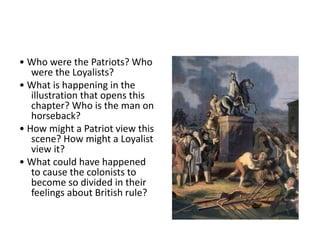
• What is happening in the
illustration that opens this
chapter? Who is the man on
horseback?
• How might a Patriot view this
scene? How might a Loyalist
view it?
• What could have happened
to cause the colonists to
become so divided in their
feelings about British rule?
Colonial Governments
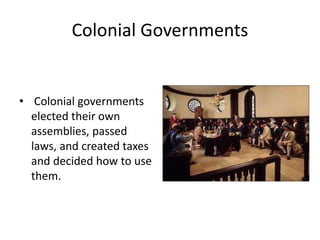
• Colonial governments
elected their own
assemblies, passed
laws, and created taxes
and decided how to use
them.
French and Indian War
• In 1754, Washington and his
men opened fire on a French
scouting party in the Ohio
Valley. This event began the
French and Indian War.
• In 1759, British troops
captured Canada. This was an
important turning point for
the Americans, who had
suffered many losses to the
French.
• The territory in North America
controlled by Great Britain
expanded greatly. Colonists
felt proud to be British and
hopeful for the future.
Proclamation of 1763
• Colonists were not
allowed to settle west
of the crest of the
Appalachian Mtns.
• The proclamation, in
effect, closed off the
frontier to colonial
expansion
For and Against
• For:
• If the colonists move
past the Appalachians,
Indians will attack
them.
• Against:
• The only new land
available for settlement
is on the other side of
the Appalachians.
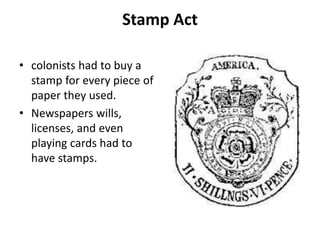
Stamp Act
• colonists had to buy a
stamp for every piece of
paper they used.
• Newspapers wills,
licenses, and even
playing cards had to
have stamps.
For and Against
• For:
• The colonists pay few
taxes compared to
other British citizens. It
is time for them to pay
their fair share for the
French and Indian War.
• Against:
• No taxation without
representation! You
have no right to tax us
without our consent.
Quartering Act
• colonial assemblies to
provide British troops
with quarters, or
housing
• The colonists were also
told to furnish the
soldiers with “candles,
firing, bedding, cooking
utensils, salt, vinegar,
and . . . beer or cider.”
For and Against
• For:
• Soldiers protect the
colonists in times of
trouble, so the colonists
should house them.
• Against:
• The soldiers take up
space and do nothing.
Why should we pay for
them?
Townshend Acts
• The Townshend Acts
placed a duty, or tax, on
certain goods the
colonists imported from
Great Britain. The acts
were passed to raise
money for Great
Britain’s army in the
colonies.
• glass, paint, paper, and
tea.
Boycotts
• Patriots pushed the
boycott of English
goods. Women refusing
to buy these goods
Result of Boycotts
• Lord North repealed the
Townshend Acts
because the taxes were
not raising enough
money to cover the
losses due to the
boycott.
• The tax on tea was left
out of the repeal.
Boston Massacre
• Paul Revere’s painting
showed:
• peaceful, unarmed colonists
and British soldiers opening
fire on them.
• Drawings from the Loyalist
point of view:
• might show colonists yelling
insults at British soldiers
and throwing ice balls and
rocks at them.
• John Adams defended
the British soldiers who
were accused of killing
colonists at the Boston
Massacre. He believed
in upholding the law
and that every person
had the right to a fair
trial.
Result of the Boston Massacre
• The Boston Massacre
did not cause new
protests against the
British government, and
the repeal of the
Townshend Acts led to a
period of calm in the
colonies.
For and Against
• Argument for the Tea
Act:
• It will lower the cost of
tea in the colonies. It
will keep the British East
India Company from
going bankrupt.
• Argument against the
Tea Act:
• It will create a
monopoly of the tea
trade. It will cause
colonists to worry that
the British government
will try to control other
trades.
Boston Tea Party
Perceptions of the Boston Tea Party
• Loyalists
• Loyalist would have seen
the Boston Tea Party as a
“Patriot Temper Tantrum
at Boston Harbor”
• Loyalists saw the Patriots
as rowdy, unreasonable,
and difficult to control.
• Patriots
• Patriots would have seen
the Boston Tea Party as a
“Magnificent Moment of
Defending Our Rights”:
Patriots believed this
destructive action was
necessary to defend their
rights of representation in
government.
• After the Boston Tea
Party, King George no
longer simply wanted to
collect taxes from the
colonists. He now
wanted to take control
of the colonies.
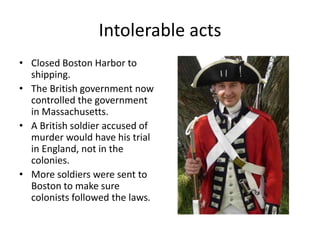
Intolerable acts
• Closed Boston Harbor to
shipping.
• The British government now
controlled the government
in Massachusetts.
• A British soldier accused of
murder would have his trial
in England, not in the
colonies.
• More soldiers were sent to
Boston to make sure
colonists followed the laws.
Response to the Intolerable Acts
• Merchants in other
colonies closed their
shops to oppose the
treatment of colonists in
Massachusetts.
• Virginians called for a
meeting of delegates
from all the colonies to
find a peaceful solution.
• Some towns and cities
began to organize militias.
First Continental Congress
• The First Continental
Congress decided to
send a message to King
George asking him to
recognize their rights.
• The Congress also called
for a new boycott of
British goods until the
Intolerable Acts were
repealed.
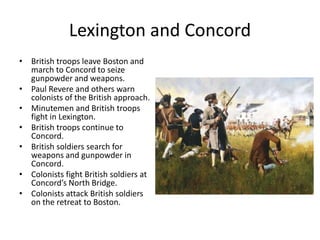
Lexington and Concord
• British troops leave Boston and
march to Concord to seize
gunpowder and weapons.
• Paul Revere and others warn
colonists of the British approach.
• Minutemen and British troops
fight in Lexington.
• British troops continue to
Concord.
• British soldiers search for
weapons and gunpowder in
Concord.
• Colonists fight British soldiers at
Concord’s North Bridge.
• Colonists attack British soldiers
on the retreat to Boston.

Chapter 5 Powerpoint (1).pptx

  • 1.
  • 2.
    • When isit necessary for citizens to rebel against their government?
  • 3.
    • Who werethe Patriots? Who were the Loyalists? • What is happening in the illustration that opens this chapter? Who is the man on horseback? • How might a Patriot view this scene? How might a Loyalist view it? • What could have happened to cause the colonists to become so divided in their feelings about British rule?
  • 4.
    Colonial Governments • Colonialgovernments elected their own assemblies, passed laws, and created taxes and decided how to use them.
  • 5.
    French and IndianWar • In 1754, Washington and his men opened fire on a French scouting party in the Ohio Valley. This event began the French and Indian War. • In 1759, British troops captured Canada. This was an important turning point for the Americans, who had suffered many losses to the French. • The territory in North America controlled by Great Britain expanded greatly. Colonists felt proud to be British and hopeful for the future.
  • 6.
    Proclamation of 1763 •Colonists were not allowed to settle west of the crest of the Appalachian Mtns. • The proclamation, in effect, closed off the frontier to colonial expansion
  • 7.
    For and Against •For: • If the colonists move past the Appalachians, Indians will attack them. • Against: • The only new land available for settlement is on the other side of the Appalachians.
  • 8.
    Stamp Act • colonistshad to buy a stamp for every piece of paper they used. • Newspapers wills, licenses, and even playing cards had to have stamps.
  • 9.
    For and Against •For: • The colonists pay few taxes compared to other British citizens. It is time for them to pay their fair share for the French and Indian War. • Against: • No taxation without representation! You have no right to tax us without our consent.
  • 10.
    Quartering Act • colonialassemblies to provide British troops with quarters, or housing • The colonists were also told to furnish the soldiers with “candles, firing, bedding, cooking utensils, salt, vinegar, and . . . beer or cider.”
  • 11.
    For and Against •For: • Soldiers protect the colonists in times of trouble, so the colonists should house them. • Against: • The soldiers take up space and do nothing. Why should we pay for them?
  • 12.
    Townshend Acts • TheTownshend Acts placed a duty, or tax, on certain goods the colonists imported from Great Britain. The acts were passed to raise money for Great Britain’s army in the colonies. • glass, paint, paper, and tea.
  • 13.
    Boycotts • Patriots pushedthe boycott of English goods. Women refusing to buy these goods
  • 14.
    Result of Boycotts •Lord North repealed the Townshend Acts because the taxes were not raising enough money to cover the losses due to the boycott. • The tax on tea was left out of the repeal.
  • 15.
    Boston Massacre • PaulRevere’s painting showed: • peaceful, unarmed colonists and British soldiers opening fire on them. • Drawings from the Loyalist point of view: • might show colonists yelling insults at British soldiers and throwing ice balls and rocks at them.
  • 16.
    • John Adamsdefended the British soldiers who were accused of killing colonists at the Boston Massacre. He believed in upholding the law and that every person had the right to a fair trial.
  • 17.
    Result of theBoston Massacre • The Boston Massacre did not cause new protests against the British government, and the repeal of the Townshend Acts led to a period of calm in the colonies.
  • 18.
    For and Against •Argument for the Tea Act: • It will lower the cost of tea in the colonies. It will keep the British East India Company from going bankrupt. • Argument against the Tea Act: • It will create a monopoly of the tea trade. It will cause colonists to worry that the British government will try to control other trades.
  • 19.
  • 20.
    Perceptions of theBoston Tea Party • Loyalists • Loyalist would have seen the Boston Tea Party as a “Patriot Temper Tantrum at Boston Harbor” • Loyalists saw the Patriots as rowdy, unreasonable, and difficult to control. • Patriots • Patriots would have seen the Boston Tea Party as a “Magnificent Moment of Defending Our Rights”: Patriots believed this destructive action was necessary to defend their rights of representation in government.
  • 21.
    • After theBoston Tea Party, King George no longer simply wanted to collect taxes from the colonists. He now wanted to take control of the colonies.
  • 22.
    Intolerable acts • ClosedBoston Harbor to shipping. • The British government now controlled the government in Massachusetts. • A British soldier accused of murder would have his trial in England, not in the colonies. • More soldiers were sent to Boston to make sure colonists followed the laws.
  • 23.
    Response to theIntolerable Acts • Merchants in other colonies closed their shops to oppose the treatment of colonists in Massachusetts. • Virginians called for a meeting of delegates from all the colonies to find a peaceful solution. • Some towns and cities began to organize militias.
  • 24.
    First Continental Congress •The First Continental Congress decided to send a message to King George asking him to recognize their rights. • The Congress also called for a new boycott of British goods until the Intolerable Acts were repealed.
  • 25.
    Lexington and Concord •British troops leave Boston and march to Concord to seize gunpowder and weapons. • Paul Revere and others warn colonists of the British approach. • Minutemen and British troops fight in Lexington. • British troops continue to Concord. • British soldiers search for weapons and gunpowder in Concord. • Colonists fight British soldiers at Concord’s North Bridge. • Colonists attack British soldiers on the retreat to Boston.