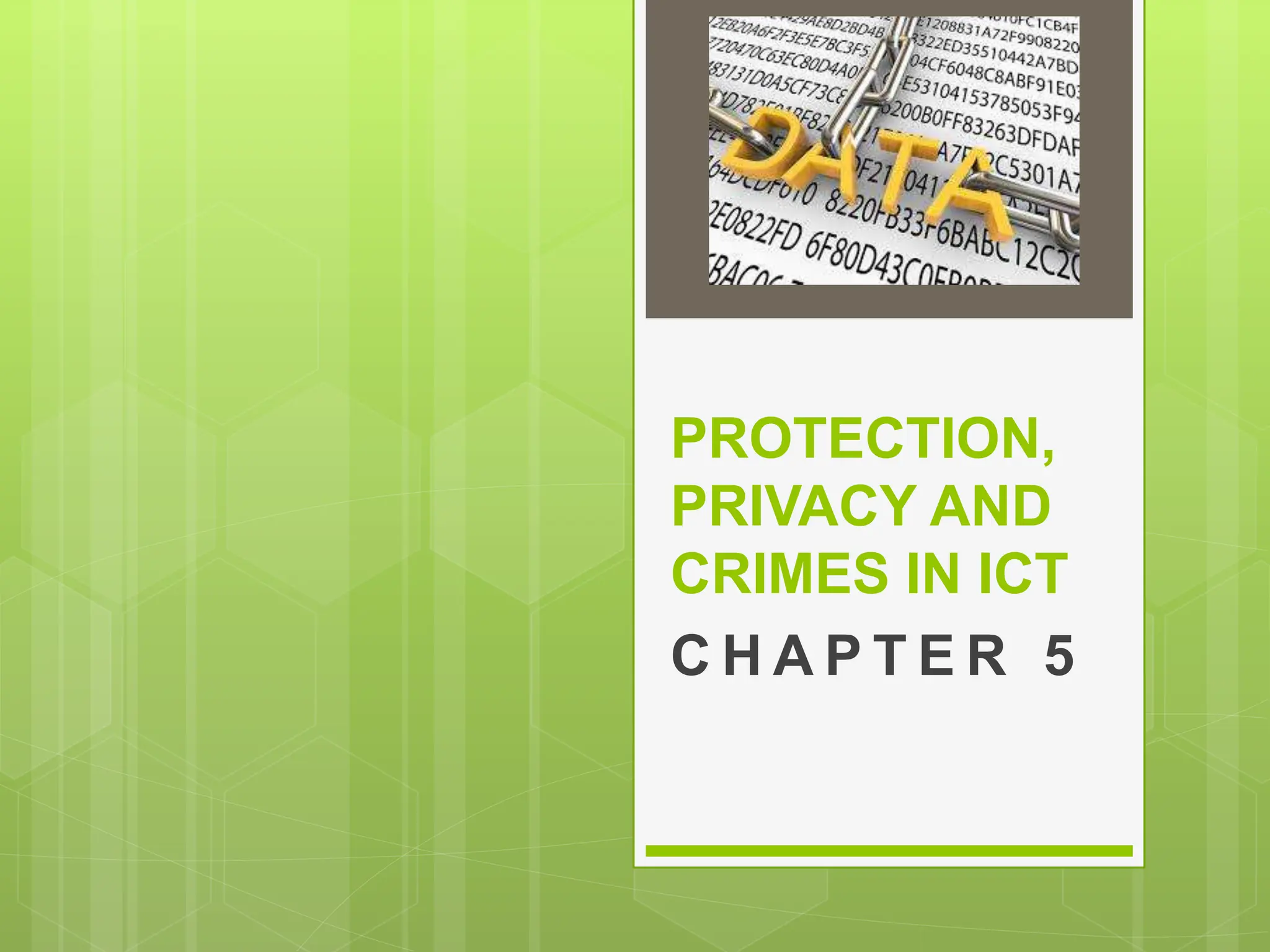
PROTECTION,
PRIVACY AND
CRIMES IN ICT
C H A P T E R 5
Data Protection
 Data Protection controls how your personal
information is used by organizations, businesses
or the government.
 Everyone responsible for using data has to follow
strict rules called ‘data protection principles’. They
must make sure the information is:
 used fairly and lawfully
 used for limited, specifically stated
purposes
 handled according to people’s data
protection rights
 kept safe and secure
Data Protection
There is stronger legal protection for more
sensitive information, such as:
 ethnic background
 political opinions
 religious beliefs
 health
 criminal records
Privacy
 The state or condition of being free from being
observed or disturbed by other people.
 The claim of individuals, groups and
institutions to determine for themselves,
when, how and to what extent information
about them is communicated to others
Privacy
 The state or condition of being free from being
observed or disturbed by other people.
 The claim of individuals, groups and
institutions to determine for themselves,
when, how and to what extent information
about them is communicated to others
Purpose of Data Protection and
Privacy
1. Collection Data
2. Storing Data
3. Transmitting Data
Purpose of Data Protection and
Privacy
1. Collection Data
be clear from the outset about why you
are collecting personal data and what
you intend to do with it;
ensure that if you wish to use or
disclose the personal data for any
purpose that is additional to or different
from the originally specified purpose
Purpose of Data Protection and
Privacy
1.Storing Data
 Never reveal personal data to third parties
without the consent of the individual
concerned or other reasonable justification.
 It should be specified that identification data
will be encrypted and strictly separated from
sensitive data
 A non-WAN connected computer server or
HARD disk should be preferred.
Purpose of Data Protection and
Privacy
1. Transmitting Data
 Each data controller must make its own judgments, based upon its own
particular circumstances, about the most suitable security measures to
implement.
 The transmission of personal data within an internal network, such as a
corporate 'intranet', should at minimum be subject to clear access
controls.
 Transmission over external networks, such as the internet, should
normally be subject to robust encryption.
 This requirement will be of particular relevance to e-commerce
businesses which record customer details on-line, e.g. via on-line booking
forms.
 Similarly, telecommunications service providers, which transmit personal
data over their networks, must take whatever technical measures are
necessary to keep such data secure from unauthorized interception
Personal Data Protection Act
2009
The proposed law seeks to regulate the
processing of personal data of
individuals involved in commercial
transactions.
his area of law specifically relates to
the dissemination and storage of
personal data of people and is related
to the law of privacy.
Communication and
Multimedia Act 1998
An Act to provide for and to regulate
the converging communications and
multimedia industries, and for
incidental matters.
Types Of Computer Crimes
hen any crime is committed over the Internet it
is referred to as a cyber crime. There are
many types of cyber crimes and the most
common ones are explained below:
Hacking
Theft
Cyber Stalking
Identity Theft
Malicious Software
Computer Crimes Act 1997
Created several offences relating to the
misuse of computers.
Among others, it deals with unauthorized
access to computer material, unauthorized
access with intent to commit other offences
and unauthorized modification of computer
contents.
It also makes provisions to facilitate
investigations for the enforcement of the Act.
Cyber Security Malaysia
Advise the Minister on all matters concerning
the national policy objectives for
communications and
multimedia activities;
Implement and enforce the provisions of the
communications and multimedia law;
Regulate all matters relating to
communications and multimedia activities not
provided for in the
communications and multimedia law;
Cyber Security Malaysia
Consider and recommend reforms to the
communications and multimedia law;
Supervise and monitor communications and
multimedia activities;
Encourage and promote the development of
the communications and multimedia industry;
Encourage and promote self-regulation in the
communications and multimedia industry;
Cyber Security Malaysia
 Promote and maintain the integrity of all persons
licenced or otherwise authorised under the
communications and multimedia industry;
 Render assistance in any form to, and to promote
coorperation and coordination amongst, persons
engaged in communications and multimedia activities.
 Carry out any function under any written law as may
be prescribed by the Minister by notification published
in the Gazette

CHAPTER 5 CYBER LAW / SECURITY MALAYSIA

  • 1.
  • 2.
    Data Protection  DataProtection controls how your personal information is used by organizations, businesses or the government.  Everyone responsible for using data has to follow strict rules called ‘data protection principles’. They must make sure the information is:  used fairly and lawfully  used for limited, specifically stated purposes  handled according to people’s data protection rights  kept safe and secure
  • 3.
    Data Protection There isstronger legal protection for more sensitive information, such as:  ethnic background  political opinions  religious beliefs  health  criminal records
  • 4.
    Privacy  The stateor condition of being free from being observed or disturbed by other people.  The claim of individuals, groups and institutions to determine for themselves, when, how and to what extent information about them is communicated to others
  • 5.
    Privacy  The stateor condition of being free from being observed or disturbed by other people.  The claim of individuals, groups and institutions to determine for themselves, when, how and to what extent information about them is communicated to others
  • 6.
    Purpose of DataProtection and Privacy 1. Collection Data 2. Storing Data 3. Transmitting Data
  • 7.
    Purpose of DataProtection and Privacy 1. Collection Data be clear from the outset about why you are collecting personal data and what you intend to do with it; ensure that if you wish to use or disclose the personal data for any purpose that is additional to or different from the originally specified purpose
  • 8.
    Purpose of DataProtection and Privacy 1.Storing Data  Never reveal personal data to third parties without the consent of the individual concerned or other reasonable justification.  It should be specified that identification data will be encrypted and strictly separated from sensitive data  A non-WAN connected computer server or HARD disk should be preferred.
  • 9.
    Purpose of DataProtection and Privacy 1. Transmitting Data  Each data controller must make its own judgments, based upon its own particular circumstances, about the most suitable security measures to implement.  The transmission of personal data within an internal network, such as a corporate 'intranet', should at minimum be subject to clear access controls.  Transmission over external networks, such as the internet, should normally be subject to robust encryption.  This requirement will be of particular relevance to e-commerce businesses which record customer details on-line, e.g. via on-line booking forms.  Similarly, telecommunications service providers, which transmit personal data over their networks, must take whatever technical measures are necessary to keep such data secure from unauthorized interception
  • 10.
    Personal Data ProtectionAct 2009 The proposed law seeks to regulate the processing of personal data of individuals involved in commercial transactions. his area of law specifically relates to the dissemination and storage of personal data of people and is related to the law of privacy.
  • 11.
    Communication and Multimedia Act1998 An Act to provide for and to regulate the converging communications and multimedia industries, and for incidental matters.
  • 12.
    Types Of ComputerCrimes hen any crime is committed over the Internet it is referred to as a cyber crime. There are many types of cyber crimes and the most common ones are explained below: Hacking Theft Cyber Stalking Identity Theft Malicious Software
  • 13.
    Computer Crimes Act1997 Created several offences relating to the misuse of computers. Among others, it deals with unauthorized access to computer material, unauthorized access with intent to commit other offences and unauthorized modification of computer contents. It also makes provisions to facilitate investigations for the enforcement of the Act.
  • 14.
    Cyber Security Malaysia Advisethe Minister on all matters concerning the national policy objectives for communications and multimedia activities; Implement and enforce the provisions of the communications and multimedia law; Regulate all matters relating to communications and multimedia activities not provided for in the communications and multimedia law;
  • 15.
    Cyber Security Malaysia Considerand recommend reforms to the communications and multimedia law; Supervise and monitor communications and multimedia activities; Encourage and promote the development of the communications and multimedia industry; Encourage and promote self-regulation in the communications and multimedia industry;
  • 16.
    Cyber Security Malaysia Promote and maintain the integrity of all persons licenced or otherwise authorised under the communications and multimedia industry;  Render assistance in any form to, and to promote coorperation and coordination amongst, persons engaged in communications and multimedia activities.  Carry out any function under any written law as may be prescribed by the Minister by notification published in the Gazette