Welcome
Ravi Singh Mahatra
CHAPTER : 4
SAMPLING
Definitions of
population
Syllabus:
01
Sampling error
and
non-sampling
error
03
Sample survey
v/s
census survey
02
Types of
sampling
04
SAMPLING
Sampling may be defined as the selection of part of an
aggregate or totality, based on which a judgment or
inference about the aggregate or totality is made.
It is a technique of selecting number of units for the
study from a pre-defined universe, so that it is an
integral part of collection process.
For example; a pathologist takes a few drops of blood
and test for any change in blood and test for any
change in blood of whole body.
Population/Universe
The groups of individuals under study are called population or
universe. It is an aggregate or collection of objects defined,
according to characteristics under study. The population may
be finite or infinite.
Sample
A finite number of subjects or individuals drawn from a population,
which represents that population is called a sample. In sampling
process, the individual in the sample are only observed for the
purpose of determining population characteristics, instead of
enumerating entire population. The sample characteristics are
utilized to approximately determined or estimate population.
Sampling unit
The population unit selected as a sample from the
population is called sampling units. In order words, the
units to be selected as sample are called sampling
units.
Population frame
It is a list of all the elements that are in the population from which the
sample units are selected. The list is also called frame. Frame/list of
population may not be readily available in all time. So it has been
prepared for the selection of the sample before conducting main survey.
The frame must be up to date, having full information of population, not
repeated and reliable.
Needs of sampling
• In all research activities the data collection from the
whole population is not practical hence, selection of
sample is an essential task for the investigation.
• If population is infinite complete enumeration is not
possible hence, sampling is used.
• Sampling is essentially useful to arrive at a conclusion on
population parameter on short period of time and in less
expense.
• If the characteristics of product is destructive in nature,
sampling only can prevent from destruction the whole
items of the production in the test procedure.
Census
A census is a study of every unit, everyone or everything, in
a population. That is, a census is the complete enumeration
or count of all units of the population for certain character of
the population.
The term census is used mostly in connection with National
population census and Housing Censuses and other
common censuses include agriculture census, business
census, Industrial census survey etc. Census requires
more money, manpower and time.
A sampling technique is appropriate
 When the universe is very large
 When the universe possess homogeneous characteristics
 When utmost accuracy is not required
 Where census is impossible i.e. in destructive/explosive
nature of testing.
Demerits of Sampling Technique:
 Less accuracy.
 Misleading conclusions.
 Need for specialized knowledge.
 It cannot be used if the information of each and every
unit of the population is required.
A census is appropriate when
o The universe is small
o The population is heterogeneous
o Hundred percent accuracy is required
o The population frame is incomplete
Demerits of Census
 Expensiveness
 Excessive time and effort.
 Not applicable for destructive testing.
 For infinite population, it is not possible.
Census Sampling
It takes each and every unit of the
population.
It takes representative part of the
population.
It is costly and time consuming. i.e. It
requires more money, manpower and
time.
It is less expensive and less time
consuming. i.e. It requires less money,
manpower and time.
It is more accurate. It is less accurate.
It has less scope. It has less a greater scope.
It is appropriate when the universe is
small.
It is appropriate when the universe is
large.
It is appropriate when the population is
heterogeneous.
It is appropriate when the universe
possess homogeneous characteristics.
Errors in Sampling
a. Sampling Errors
b. Non- Sampling Errors
Sampling Error
In the sampling method, instead of observing all the items the
individual in the sample are observed and the sample
characteristics are utilized to estimate the population. The
error of the deviation of the observed value from the true
value in such approximation is called a sampling error.
Sampling error arise due to the fact that only a part of
population has been utilized to estimate population parameter
and draw inference about the population.
Method of minimizing
This error can be minimized by increasing the size of
sample. The error can be completely eliminated by
increasing the sample to include every item in the
population.
Non-sampling Errors
It refers to the everything else beside the sampling error. These
errors primarily arise at every stage of sampling process. In the
sampling, it is very difficult task to identify and control non-
sampling error. The sources of non-sampling error are:
a. Faculty planning and definition
-If data and objective are mismatched.
-Error due to ill-designed questionnaire.
-Lack of trained and qualified investigator.
b. Response Error:
- Accidental response error.
- Prestige biased.
- Self interest.
- Biased due to interviewer.
- Failure of respondent memory/re-call bias.
c. Non-response error:
-Respondent not found at their place.
- Unable to get answer the information on the entire
question.
- Refuse to answer certain question.
d. Error in coverage:-
-Inclusion of unnecessary subjects.
- Exclusion of important subjects.
e. Compiling Error:
Error in editing and coding
f. Publication Error:
Error in printing.
Characteristics of a good sample
 A sample should be representative.
 The size of sample should be free from bias.
 It should have the confirmative to the objective of the
study.
Advantages of Sampling:
i) Reduce cost
Ii) Greater Speed
iii) Greater accuracy
iv) Mandatory in some cases
v) Save destruction
Limitation
-If sampling procedure is not perfect then, error occurs and
result may be inaccurate and misleading.
-Requires trained and qualified person for planning executions
and analysis.
-Complete enumeration may be better than any sampling
technique to get exact result.
In sampling theory, the method of selecting sample is the
fundamental important. The sampling method depend upon
the nature of data and types of enquire. The common used
sample techniques are:
1) Probability sampling (Random Sampling)
2) Non-Probability sampling (Non-random sampling)
Types of Sampling
1. Simple random sampling
2. Systematic sampling
3. Stratified sampling
4. Cluster sampling
5. Multi-stage sampling
Types of Random Sampling
(Probability Sampling)
In this sampling technique the samples are selected
randomly, It is a simple and common method of
sampling where samples are drawn unity unit with equal
probability of selection for each unit at each draw. It is a
technique of drawing a sample in such a way that each
unit of population has an equal and independent change
of being include the sample. There are two ways of
taking a simple random sampling:
Simple Random Sampling
a) Simple random sample with replacement:
In this method of sampling in which an item previously
drawn at replaced before the next drawn in which the
sample unit may be included more than one’s in the
sample.
b) Simple random sample without replacement:
The method of sampling in which an item previously drawn
is not repeated before the next draw in which all units in the
sample are distinct.
Demerits
• Expensive and time consuming especially when the population
is large.
• If the population is heterogeneous in nature, it may not give
accurate results.
• It requires completely up-to-date list of population units from
which samples to be drawn.
Merits:
• Each item has equal chance of being selected. So, it depends
upon the chance but not on the personal judgment.
• This method is quite economic and saves time and money as
compared to other if size of population is small.
• It is more representative of the population as compared to the
judgment or purposive sampling.
It is a type of probability sampling in which samples from
large population are drawn accordingly to a random starting
point after with a fixed, periodic interval. The interval is called
sampling interval and is calculated by dividing the population
size desired sample size.
Let, total population is N numbered from 1 to N in order to
select a sample of n units. The first unit is selected randomly
and rest of other units n-1 are selected using sampling
interval K where, K=N/n. This methods is easier to applied
and less likely to make mistake than simple random sample.
Systematic Sampling
Demerits:
 The sample selected may not be the representative of the
population in some cases.
 The items of the population must be arranged in some order
otherwise the result obtained will be misleading
Merits:
 This method is simple and convenient to use.
 In selecting the sample by this method, it takes less time and
labor.
 Most of the results obtained from this method are satisfactory.
 If the complete list of the population is available and if the items
are arranged systematically, this method is more efficient.
It is a type of sampling method in which heterogeneous
population is divided into non-overlapping smaller
homogeneous group called strata and from each strata
samples are selected proportionally. Samples from each strata
can be selected using SRS or systematic sampling.
In this method strata are formed such that within strata is
homogenous and between strata is heterogeneous.
Stratified Sampling
Demerits
 This method requires more time and cost.
 If each stratum of the population be not homogeneous the
result obtained may not be reliable.
 The samples from each stratum should be selected only
by the experts or experience persons.
Merits:
 The units selected represents whole universe.
 The estimation of population parameters is more efficient.
 For large and heterogeneous population, stratified
sampling is the best design.
This method is also used when the population is not
homogeneous. The population is divided into non
overlapping sub population called cluster. Mainly clusters
are divided geographically. Then some clusters are
selected using sample random sampling and the entire
elements belonging to the selected cluster are studied.
In this method construction of cluster are made in such a
way that the population with in cluster is heterogeneous
and between clusters is homogeneous.
Cluster Sampling:
Demerits
 The efficiency decreases with increase in cluster size.
 Enumeration of the sampling units within the selected clusters
is difficult when the population is large.
Merits
 It is less costly than simple random sampling and stratified
sampling.
 It is useful even when the sampling frame of elements may
not be available.
 Elements (units) selected by well-designed cluster sampling
procedures in easier , faster cheaper and more convenient
than simple random sampling and stratified sampling.
In cluster sampling after the selection of cluster, each and
every units of the selected cluster are enumerated. Instead
of enumerating all the units in the selected cluster one can
obtained better and more efficient result by sub sampling
within the cluster. Hence, the ,method of sampling in which
first the cluster are selected and then specified numbers of
element are select from each cluster is called sub sampling
or two stage sampling.
Multistage Sampling
Demerits:
• If the samples are not carefully taken from the different stages ,
it may give the faulty result.
• In this method, there is high chance of occurring sampling error
when the selected sampling units are decreased.
Merits:
• It is more convenient when area of investigation is very large.
• It is commonly used in large scale survey.
• This method is also more flexible than other sampling
methods.
• As sample size is reduced in each stage, this sampling
technique saves time and cost.
Non probability sampling
Non-probability sampling is the method of selecting
samples in which the choice of selection of sampling units
depends entirely on the discretion or judgment of sampler
or investigator.
This method is mainly used for opinion surveys but can not
be recommended for general use as it is subject to the
drawbacks of bias of the investigator.
Types of Non-probability sampling
 Judgement sampling
 Purposive sampling
 Convenience sampling
 Quota sampling
 Snowball sampling or network sampling
Judgment Sampling
In this sampling process the sample units are
selected According to personal judgment of
researcher or investigator. The investigator includes
only these units in the sample from the population
which they think most approximate for the study.
This method saves time and money.
Merits:
 It is the simple method of sampling for quick decision.
 It gives the better result when sample size is small.
Demerits:
 It gives unreliable conclusion if the investigator is
personally biased.
 Though simple, the method is not scientific and it is not in
general use.
Convenience Sampling
The sampling method in which the sample units are
selected, which are convenient to obtain is the
convenience sampling. This method is one of the
easiest method for selecting samples which saves
time and money. The result obtained by this
method cannot be generalized because of the lack
of representativeness of the entire population.
Merits
 It is useful for making pilot studies.
 It is the simple method of sampling for quick decision.
 When both time and money are limited, convenience
sampling is widely used i.e. it is less expensive and less
time consuming.
Demerits
 The results obtained by this method can hardly be
representative of the population.
 Sampling error cannot be estimated because it is also
not based on random sampling.
Purposive sampling
The method of sampling in which certain units are
selected from the population according to specific
purpose of researcher is called purposive sampling.
This method is useful when some of the units are
important and are to be included.
In this sampling samples are selected “on purpose”.
Merits
 It is cheap method.
 Small sample is representative of population.
Demerits
 The knowledge of population is required.
 It may be biased.
 Sampling error can not be calculated due to randomization.
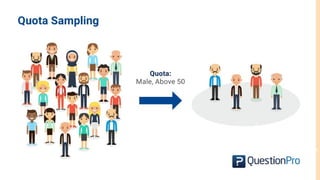
Quota sampling
It is the special case of stratified sampling without
use of probability. It is judgment sampling with
stratification. In this sampling quotas are set up
according to the personal judgment of the
investigator.
In this method sampling is continue until pre-
determined sample size are obtained from each
stratum.
Merits
 It saves time and money rather than other
sampling methods.
 It is stratified cum-purposive so investigator enjoys
the benefits of both.
Demerits
 It may biased because of the personal believes of
investigator.
 Sampling error cannot be estimated because it is
also not based on random sampling
Snowball Sampling
Snowball sampling technique is used by researcher to identify
potential subjects in studies where subject are hard to locate.
In this method survey subject are selected on reference from
other survey respondents. A respondent is identified according
to the objective of study and other respondents are identified
according to the referral from previous respondent. This
sampling technique is often used in hidden populations which
are difficult for researcher to access. For the example; drug
users, sex workers etc.
Merits
 This method is cheap, simple and cost –efficient.
 It is useful for rare populations for which no sampling
frames are readily available.
 The chain referral process allows the researcher to reach
populations that are difficult to sample when using other
sampling methods.
Demerits
 It is difficult to apply when the population is large.
 It does not ensure the inclusion of all elements in the list
THANK YOU

Chapter 4: Sampling and its different type.pptx

  • 1.
  • 2.
  • 3.
  • 4.
  • 5.
    Sampling may bedefined as the selection of part of an aggregate or totality, based on which a judgment or inference about the aggregate or totality is made. It is a technique of selecting number of units for the study from a pre-defined universe, so that it is an integral part of collection process. For example; a pathologist takes a few drops of blood and test for any change in blood and test for any change in blood of whole body.
  • 7.
    Population/Universe The groups ofindividuals under study are called population or universe. It is an aggregate or collection of objects defined, according to characteristics under study. The population may be finite or infinite. Sample A finite number of subjects or individuals drawn from a population, which represents that population is called a sample. In sampling process, the individual in the sample are only observed for the purpose of determining population characteristics, instead of enumerating entire population. The sample characteristics are utilized to approximately determined or estimate population.
  • 8.
    Sampling unit The populationunit selected as a sample from the population is called sampling units. In order words, the units to be selected as sample are called sampling units. Population frame It is a list of all the elements that are in the population from which the sample units are selected. The list is also called frame. Frame/list of population may not be readily available in all time. So it has been prepared for the selection of the sample before conducting main survey. The frame must be up to date, having full information of population, not repeated and reliable.
  • 9.
    Needs of sampling •In all research activities the data collection from the whole population is not practical hence, selection of sample is an essential task for the investigation. • If population is infinite complete enumeration is not possible hence, sampling is used. • Sampling is essentially useful to arrive at a conclusion on population parameter on short period of time and in less expense.
  • 10.
    • If thecharacteristics of product is destructive in nature, sampling only can prevent from destruction the whole items of the production in the test procedure.
  • 11.
    Census A census isa study of every unit, everyone or everything, in a population. That is, a census is the complete enumeration or count of all units of the population for certain character of the population. The term census is used mostly in connection with National population census and Housing Censuses and other common censuses include agriculture census, business census, Industrial census survey etc. Census requires more money, manpower and time.
  • 12.
    A sampling techniqueis appropriate  When the universe is very large  When the universe possess homogeneous characteristics  When utmost accuracy is not required  Where census is impossible i.e. in destructive/explosive nature of testing. Demerits of Sampling Technique:  Less accuracy.  Misleading conclusions.  Need for specialized knowledge.  It cannot be used if the information of each and every unit of the population is required.
  • 13.
    A census isappropriate when o The universe is small o The population is heterogeneous o Hundred percent accuracy is required o The population frame is incomplete Demerits of Census  Expensiveness  Excessive time and effort.  Not applicable for destructive testing.  For infinite population, it is not possible.
  • 14.
    Census Sampling It takeseach and every unit of the population. It takes representative part of the population. It is costly and time consuming. i.e. It requires more money, manpower and time. It is less expensive and less time consuming. i.e. It requires less money, manpower and time. It is more accurate. It is less accurate. It has less scope. It has less a greater scope. It is appropriate when the universe is small. It is appropriate when the universe is large. It is appropriate when the population is heterogeneous. It is appropriate when the universe possess homogeneous characteristics.
  • 15.
    Errors in Sampling a.Sampling Errors b. Non- Sampling Errors
  • 16.
    Sampling Error In thesampling method, instead of observing all the items the individual in the sample are observed and the sample characteristics are utilized to estimate the population. The error of the deviation of the observed value from the true value in such approximation is called a sampling error. Sampling error arise due to the fact that only a part of population has been utilized to estimate population parameter and draw inference about the population.
  • 17.
    Method of minimizing Thiserror can be minimized by increasing the size of sample. The error can be completely eliminated by increasing the sample to include every item in the population.
  • 18.
    Non-sampling Errors It refersto the everything else beside the sampling error. These errors primarily arise at every stage of sampling process. In the sampling, it is very difficult task to identify and control non- sampling error. The sources of non-sampling error are: a. Faculty planning and definition -If data and objective are mismatched. -Error due to ill-designed questionnaire. -Lack of trained and qualified investigator.
  • 19.
    b. Response Error: -Accidental response error. - Prestige biased. - Self interest. - Biased due to interviewer. - Failure of respondent memory/re-call bias. c. Non-response error: -Respondent not found at their place. - Unable to get answer the information on the entire question. - Refuse to answer certain question.
  • 20.
    d. Error incoverage:- -Inclusion of unnecessary subjects. - Exclusion of important subjects. e. Compiling Error: Error in editing and coding f. Publication Error: Error in printing.
  • 21.
    Characteristics of agood sample  A sample should be representative.  The size of sample should be free from bias.  It should have the confirmative to the objective of the study. Advantages of Sampling: i) Reduce cost Ii) Greater Speed iii) Greater accuracy iv) Mandatory in some cases v) Save destruction
  • 22.
    Limitation -If sampling procedureis not perfect then, error occurs and result may be inaccurate and misleading. -Requires trained and qualified person for planning executions and analysis. -Complete enumeration may be better than any sampling technique to get exact result.
  • 23.
    In sampling theory,the method of selecting sample is the fundamental important. The sampling method depend upon the nature of data and types of enquire. The common used sample techniques are: 1) Probability sampling (Random Sampling) 2) Non-Probability sampling (Non-random sampling) Types of Sampling
  • 24.
    1. Simple randomsampling 2. Systematic sampling 3. Stratified sampling 4. Cluster sampling 5. Multi-stage sampling Types of Random Sampling (Probability Sampling)
  • 25.
    In this samplingtechnique the samples are selected randomly, It is a simple and common method of sampling where samples are drawn unity unit with equal probability of selection for each unit at each draw. It is a technique of drawing a sample in such a way that each unit of population has an equal and independent change of being include the sample. There are two ways of taking a simple random sampling: Simple Random Sampling
  • 27.
    a) Simple randomsample with replacement: In this method of sampling in which an item previously drawn at replaced before the next drawn in which the sample unit may be included more than one’s in the sample. b) Simple random sample without replacement: The method of sampling in which an item previously drawn is not repeated before the next draw in which all units in the sample are distinct.
  • 28.
    Demerits • Expensive andtime consuming especially when the population is large. • If the population is heterogeneous in nature, it may not give accurate results. • It requires completely up-to-date list of population units from which samples to be drawn. Merits: • Each item has equal chance of being selected. So, it depends upon the chance but not on the personal judgment. • This method is quite economic and saves time and money as compared to other if size of population is small. • It is more representative of the population as compared to the judgment or purposive sampling.
  • 29.
    It is atype of probability sampling in which samples from large population are drawn accordingly to a random starting point after with a fixed, periodic interval. The interval is called sampling interval and is calculated by dividing the population size desired sample size. Let, total population is N numbered from 1 to N in order to select a sample of n units. The first unit is selected randomly and rest of other units n-1 are selected using sampling interval K where, K=N/n. This methods is easier to applied and less likely to make mistake than simple random sample. Systematic Sampling
  • 31.
    Demerits:  The sampleselected may not be the representative of the population in some cases.  The items of the population must be arranged in some order otherwise the result obtained will be misleading Merits:  This method is simple and convenient to use.  In selecting the sample by this method, it takes less time and labor.  Most of the results obtained from this method are satisfactory.  If the complete list of the population is available and if the items are arranged systematically, this method is more efficient.
  • 32.
    It is atype of sampling method in which heterogeneous population is divided into non-overlapping smaller homogeneous group called strata and from each strata samples are selected proportionally. Samples from each strata can be selected using SRS or systematic sampling. In this method strata are formed such that within strata is homogenous and between strata is heterogeneous. Stratified Sampling
  • 34.
    Demerits  This methodrequires more time and cost.  If each stratum of the population be not homogeneous the result obtained may not be reliable.  The samples from each stratum should be selected only by the experts or experience persons. Merits:  The units selected represents whole universe.  The estimation of population parameters is more efficient.  For large and heterogeneous population, stratified sampling is the best design.
  • 35.
    This method isalso used when the population is not homogeneous. The population is divided into non overlapping sub population called cluster. Mainly clusters are divided geographically. Then some clusters are selected using sample random sampling and the entire elements belonging to the selected cluster are studied. In this method construction of cluster are made in such a way that the population with in cluster is heterogeneous and between clusters is homogeneous. Cluster Sampling:
  • 37.
    Demerits  The efficiencydecreases with increase in cluster size.  Enumeration of the sampling units within the selected clusters is difficult when the population is large. Merits  It is less costly than simple random sampling and stratified sampling.  It is useful even when the sampling frame of elements may not be available.  Elements (units) selected by well-designed cluster sampling procedures in easier , faster cheaper and more convenient than simple random sampling and stratified sampling.
  • 38.
    In cluster samplingafter the selection of cluster, each and every units of the selected cluster are enumerated. Instead of enumerating all the units in the selected cluster one can obtained better and more efficient result by sub sampling within the cluster. Hence, the ,method of sampling in which first the cluster are selected and then specified numbers of element are select from each cluster is called sub sampling or two stage sampling. Multistage Sampling
  • 39.
    Demerits: • If thesamples are not carefully taken from the different stages , it may give the faulty result. • In this method, there is high chance of occurring sampling error when the selected sampling units are decreased. Merits: • It is more convenient when area of investigation is very large. • It is commonly used in large scale survey. • This method is also more flexible than other sampling methods. • As sample size is reduced in each stage, this sampling technique saves time and cost.
  • 41.
    Non probability sampling Non-probabilitysampling is the method of selecting samples in which the choice of selection of sampling units depends entirely on the discretion or judgment of sampler or investigator. This method is mainly used for opinion surveys but can not be recommended for general use as it is subject to the drawbacks of bias of the investigator.
  • 42.
    Types of Non-probabilitysampling  Judgement sampling  Purposive sampling  Convenience sampling  Quota sampling  Snowball sampling or network sampling
  • 43.
    Judgment Sampling In thissampling process the sample units are selected According to personal judgment of researcher or investigator. The investigator includes only these units in the sample from the population which they think most approximate for the study. This method saves time and money.
  • 44.
    Merits:  It isthe simple method of sampling for quick decision.  It gives the better result when sample size is small. Demerits:  It gives unreliable conclusion if the investigator is personally biased.  Though simple, the method is not scientific and it is not in general use.
  • 45.
    Convenience Sampling The samplingmethod in which the sample units are selected, which are convenient to obtain is the convenience sampling. This method is one of the easiest method for selecting samples which saves time and money. The result obtained by this method cannot be generalized because of the lack of representativeness of the entire population.
  • 47.
    Merits  It isuseful for making pilot studies.  It is the simple method of sampling for quick decision.  When both time and money are limited, convenience sampling is widely used i.e. it is less expensive and less time consuming. Demerits  The results obtained by this method can hardly be representative of the population.  Sampling error cannot be estimated because it is also not based on random sampling.
  • 48.
    Purposive sampling The methodof sampling in which certain units are selected from the population according to specific purpose of researcher is called purposive sampling. This method is useful when some of the units are important and are to be included. In this sampling samples are selected “on purpose”.
  • 50.
    Merits  It ischeap method.  Small sample is representative of population. Demerits  The knowledge of population is required.  It may be biased.  Sampling error can not be calculated due to randomization.
  • 51.
    Quota sampling It isthe special case of stratified sampling without use of probability. It is judgment sampling with stratification. In this sampling quotas are set up according to the personal judgment of the investigator. In this method sampling is continue until pre- determined sample size are obtained from each stratum.
  • 53.
    Merits  It savestime and money rather than other sampling methods.  It is stratified cum-purposive so investigator enjoys the benefits of both. Demerits  It may biased because of the personal believes of investigator.  Sampling error cannot be estimated because it is also not based on random sampling
  • 54.
    Snowball Sampling Snowball samplingtechnique is used by researcher to identify potential subjects in studies where subject are hard to locate. In this method survey subject are selected on reference from other survey respondents. A respondent is identified according to the objective of study and other respondents are identified according to the referral from previous respondent. This sampling technique is often used in hidden populations which are difficult for researcher to access. For the example; drug users, sex workers etc.
  • 56.
    Merits  This methodis cheap, simple and cost –efficient.  It is useful for rare populations for which no sampling frames are readily available.  The chain referral process allows the researcher to reach populations that are difficult to sample when using other sampling methods. Demerits  It is difficult to apply when the population is large.  It does not ensure the inclusion of all elements in the list
  • 57.