Threads, SMP, and Microkernels
Chapter 4
Operating Systems
© Dr. Ayman Abdel-Hamid, OS 1
© Dr. Ayman Abdel-Hamid, OS 2
Outline
•Section 4.1  Processes and Threads
Process so Far
© Dr. Ayman Abdel-Hamid, OS 3
• Resource ownership - process is
allocated a virtual address space to hold
the process image
• Scheduling/execution- follows an
execution path that may be interleaved
with other processes
• These two characteristics are treated
independently by the operating system
Process so Far
© Dr. Ayman Abdel-Hamid, OS 4
• Unit of dispatching is referred to as a
thread or lightweight process
• Unit of resource of ownership is referred
to as a process or task
Multithreading
© Dr. Ayman Abdel-Hamid, OS 5
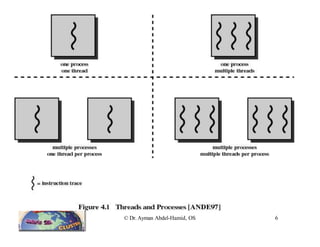
• Operating system supports multiple
threads of execution within a single
process
– MS-DOS supports a single thread
– Many flavors of UNIX support multiple user
processes but only support one thread per
process
– Windows 2000, Solaris, Linux, Mach, and
OS/2 support multiple threads
© Dr. Ayman Abdel-Hamid, OS 6
Process
© Dr. Ayman Abdel-Hamid, OS 7
• In a multithreaded environment, a process is
defined as the unit of resource allocation and a
unit of protection
• Associated with processes
– A virtual address space which holds the process
image
– Protected access to processors, other processes,
files, and I/O resources
• Within a process, there may be one or more
threads
Thread
© Dr. Ayman Abdel-Hamid, OS 8
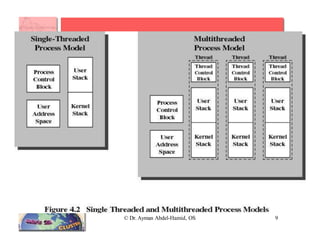
• An execution state (running, ready, etc.)
• Saved thread context when not running
• Has an execution stack
• Some per-thread static storage for local
variables
• Access to the memory and resources of its
process
– all threads of a process share this
– When one thread alters an item of data in memory,
other threads can see the result and access this item
© Dr. Ayman Abdel-Hamid, OS 9
Benefits of Threads
© Dr. Ayman Abdel-Hamid, OS 10
• Takes less time to create a new thread than a
process
• Less time to terminate a thread than a process
• Less time to switch between two threads
within the same process
• Since threads within the same process share
memory and files, they can communicate with
each other without invoking the kernel
• Threads and sharing versus Processes and
message passing
Uses of Threads in a Single-
User Multiprocessing System
© Dr. Ayman Abdel-Hamid, OS 11
• Foreground to background work
– One thread displays menus and reads user input,
while another thread executes user commands and
updates spreadsheet
• Asynchronous processing
– Periodic backup
• Speed execution
– Compute one batch of data while reading next
batch from a device
• Modular program structure
Threads
© Dr. Ayman Abdel-Hamid, OS 12
Scheduling and dispatching
• Suspending a process involves
suspending all threads of the process
since all threads share the same address
space
• Termination of a process, terminates all
threads within the process
Thread States
© Dr. Ayman Abdel-Hamid, OS 13
• Key states: Running, Ready, and Blocked
• 4 basic operations associated with a change in
thread state
– Spawn
• Spawn another thread
– Block
– Unblock
– Finish
• Deallocate register context and stacks
• Does the blocking of a thread result in the
blocking of the entire process?
14
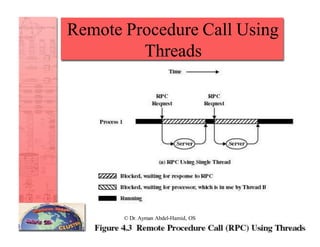
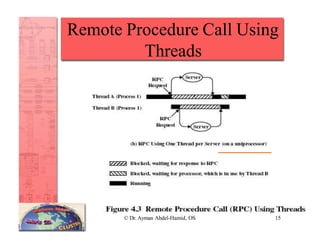
Remote Procedure Call Using
Threads
© Dr. Ayman Abdel-Hamid, OS
Remote Procedure Call Using
Threads
© Dr. Ayman Abdel-Hamid, OS 15
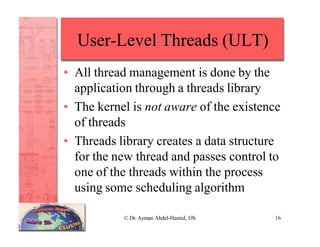
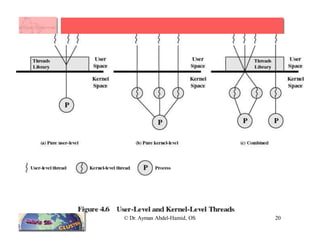
User-Level Threads (ULT)
© Dr. Ayman Abdel-Hamid, OS 16
• All thread management is done by the
application through a threads library
• The kernel is not aware of the existence
of threads
• Threads library creates a data structure
for the new thread and passes control to
one of the threads within the process
using some scheduling algorithm
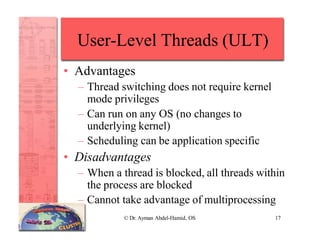
User-Level Threads (ULT)
© Dr. Ayman Abdel-Hamid, OS 17
• Advantages
– Thread switching does not require kernel
mode privileges
– Can run on any OS (no changes to
underlying kernel)
– Scheduling can be application specific
• Disadvantages
– When a thread is blocked, all threads within
the process are blocked
– Cannot take advantage of multiprocessing
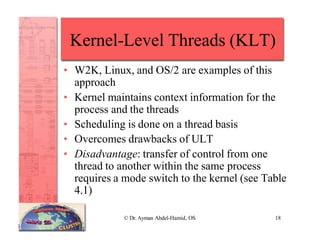
Kernel-Level Threads (KLT)
© Dr. Ayman Abdel-Hamid, OS 18
• W2K, Linux, and OS/2 are examples of this
approach
• Kernel maintains context information for the
process and the threads
• Scheduling is done on a thread basis
• Overcomes drawbacks of ULT
• Disadvantage: transfer of control from one
thread to another within the same process
requires a mode switch to the kernel (see Table
4.1)
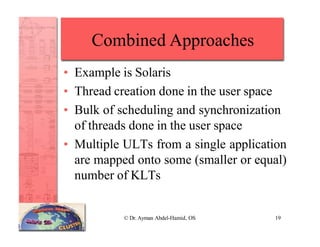
Combined Approaches
© Dr. Ayman Abdel-Hamid, OS 19
• Example is Solaris
• Thread creation done in the user space
• Bulk of scheduling and synchronization
of threads done in the user space
• Multiple ULTs from a single application
are mapped onto some (smaller or equal)
number of KLTs
© Dr. Ayman Abdel-Hamid, OS 20
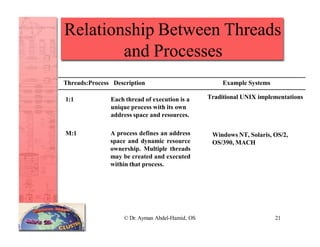
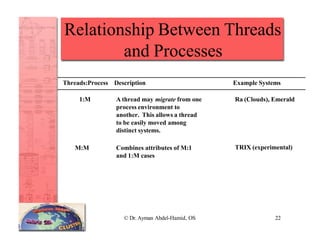
Relationship Between Threads
and Processes
Threads:Process Description
© Dr. Ayman Abdel-Hamid, OS 21
Example Systems
1:1 Each thread of execution is a
unique process with its own
address space and resources.
Traditional UNIX implementations
M:1 A process defines an address
space and dynamic resource
ownership. Multiple threads
may be created and executed
within that process.
Windows NT, Solaris, OS/2,
OS/390, MACH
Relationship Between Threads
and Processes
Threads:Process
© Dr. Ayman Abdel-Hamid, OS 22
Description Example Systems
1:M A thread may migrate from one
process environment to
another. This allows a thread
to be easily moved among
distinct systems.
Ra (Clouds), Emerald
M:M Combines attributes of M:1
and 1:M cases
TRIX (experimental)

CHAPter 4 operating system overview.pptx

  • 1.
    Threads, SMP, andMicrokernels Chapter 4 Operating Systems © Dr. Ayman Abdel-Hamid, OS 1
  • 2.
    © Dr. AymanAbdel-Hamid, OS 2 Outline •Section 4.1  Processes and Threads
  • 3.
    Process so Far ©Dr. Ayman Abdel-Hamid, OS 3 • Resource ownership - process is allocated a virtual address space to hold the process image • Scheduling/execution- follows an execution path that may be interleaved with other processes • These two characteristics are treated independently by the operating system
  • 4.
    Process so Far ©Dr. Ayman Abdel-Hamid, OS 4 • Unit of dispatching is referred to as a thread or lightweight process • Unit of resource of ownership is referred to as a process or task
  • 5.
    Multithreading © Dr. AymanAbdel-Hamid, OS 5 • Operating system supports multiple threads of execution within a single process – MS-DOS supports a single thread – Many flavors of UNIX support multiple user processes but only support one thread per process – Windows 2000, Solaris, Linux, Mach, and OS/2 support multiple threads
  • 6.
    © Dr. AymanAbdel-Hamid, OS 6
  • 7.
    Process © Dr. AymanAbdel-Hamid, OS 7 • In a multithreaded environment, a process is defined as the unit of resource allocation and a unit of protection • Associated with processes – A virtual address space which holds the process image – Protected access to processors, other processes, files, and I/O resources • Within a process, there may be one or more threads
  • 8.
    Thread © Dr. AymanAbdel-Hamid, OS 8 • An execution state (running, ready, etc.) • Saved thread context when not running • Has an execution stack • Some per-thread static storage for local variables • Access to the memory and resources of its process – all threads of a process share this – When one thread alters an item of data in memory, other threads can see the result and access this item
  • 9.
    © Dr. AymanAbdel-Hamid, OS 9
  • 10.
    Benefits of Threads ©Dr. Ayman Abdel-Hamid, OS 10 • Takes less time to create a new thread than a process • Less time to terminate a thread than a process • Less time to switch between two threads within the same process • Since threads within the same process share memory and files, they can communicate with each other without invoking the kernel • Threads and sharing versus Processes and message passing
  • 11.
    Uses of Threadsin a Single- User Multiprocessing System © Dr. Ayman Abdel-Hamid, OS 11 • Foreground to background work – One thread displays menus and reads user input, while another thread executes user commands and updates spreadsheet • Asynchronous processing – Periodic backup • Speed execution – Compute one batch of data while reading next batch from a device • Modular program structure
  • 12.
    Threads © Dr. AymanAbdel-Hamid, OS 12 Scheduling and dispatching • Suspending a process involves suspending all threads of the process since all threads share the same address space • Termination of a process, terminates all threads within the process
  • 13.
    Thread States © Dr.Ayman Abdel-Hamid, OS 13 • Key states: Running, Ready, and Blocked • 4 basic operations associated with a change in thread state – Spawn • Spawn another thread – Block – Unblock – Finish • Deallocate register context and stacks • Does the blocking of a thread result in the blocking of the entire process?
  • 14.
    14 Remote Procedure CallUsing Threads © Dr. Ayman Abdel-Hamid, OS
  • 15.
    Remote Procedure CallUsing Threads © Dr. Ayman Abdel-Hamid, OS 15
  • 16.
    User-Level Threads (ULT) ©Dr. Ayman Abdel-Hamid, OS 16 • All thread management is done by the application through a threads library • The kernel is not aware of the existence of threads • Threads library creates a data structure for the new thread and passes control to one of the threads within the process using some scheduling algorithm
  • 17.
    User-Level Threads (ULT) ©Dr. Ayman Abdel-Hamid, OS 17 • Advantages – Thread switching does not require kernel mode privileges – Can run on any OS (no changes to underlying kernel) – Scheduling can be application specific • Disadvantages – When a thread is blocked, all threads within the process are blocked – Cannot take advantage of multiprocessing
  • 18.
    Kernel-Level Threads (KLT) ©Dr. Ayman Abdel-Hamid, OS 18 • W2K, Linux, and OS/2 are examples of this approach • Kernel maintains context information for the process and the threads • Scheduling is done on a thread basis • Overcomes drawbacks of ULT • Disadvantage: transfer of control from one thread to another within the same process requires a mode switch to the kernel (see Table 4.1)
  • 19.
    Combined Approaches © Dr.Ayman Abdel-Hamid, OS 19 • Example is Solaris • Thread creation done in the user space • Bulk of scheduling and synchronization of threads done in the user space • Multiple ULTs from a single application are mapped onto some (smaller or equal) number of KLTs
  • 20.
    © Dr. AymanAbdel-Hamid, OS 20
  • 21.
    Relationship Between Threads andProcesses Threads:Process Description © Dr. Ayman Abdel-Hamid, OS 21 Example Systems 1:1 Each thread of execution is a unique process with its own address space and resources. Traditional UNIX implementations M:1 A process defines an address space and dynamic resource ownership. Multiple threads may be created and executed within that process. Windows NT, Solaris, OS/2, OS/390, MACH
  • 22.
    Relationship Between Threads andProcesses Threads:Process © Dr. Ayman Abdel-Hamid, OS 22 Description Example Systems 1:M A thread may migrate from one process environment to another. This allows a thread to be easily moved among distinct systems. Ra (Clouds), Emerald M:M Combines attributes of M:1 and 1:M cases TRIX (experimental)