CHAPTER 3
SERVICE AREA COMPETITION
ANALYSIS
COURSE INSTRUCTOR
DR. NOMAN PALEKAR
Learning Objectives
1. Understand what is service area and how the concept of service area analysis emerged.
2. Understand the relationship between general and health care environmental issue identification and
analysis and service area competitor analysis.
3. Define determinants of service area competitor analysis.
4. Understand the focus of competitor analysis and challenges faced by healthcare market.
5. Understand strategic groups and be able to map competitors’ strategies along important service and
market dimensions.
6. Understand the elements of service area competitor analysis and assess likely competitor strategies.
7. Understand and illustrate the process of service area competitor analysis.
8. Suggest several questions to initiate strategic thinking concerning the service area and competitors as a
part of managing the strategic momentum.
How Service Area Competitor
Analysis Emerged
During the past decade, because of fundamental changes within the
industry brought about by the influences of managed care, efforts to
reduce costs and increase efficiency, and the increased presence of
for-profit health care organizations, every segment of the industry
has become highly competitive.
The Service Area
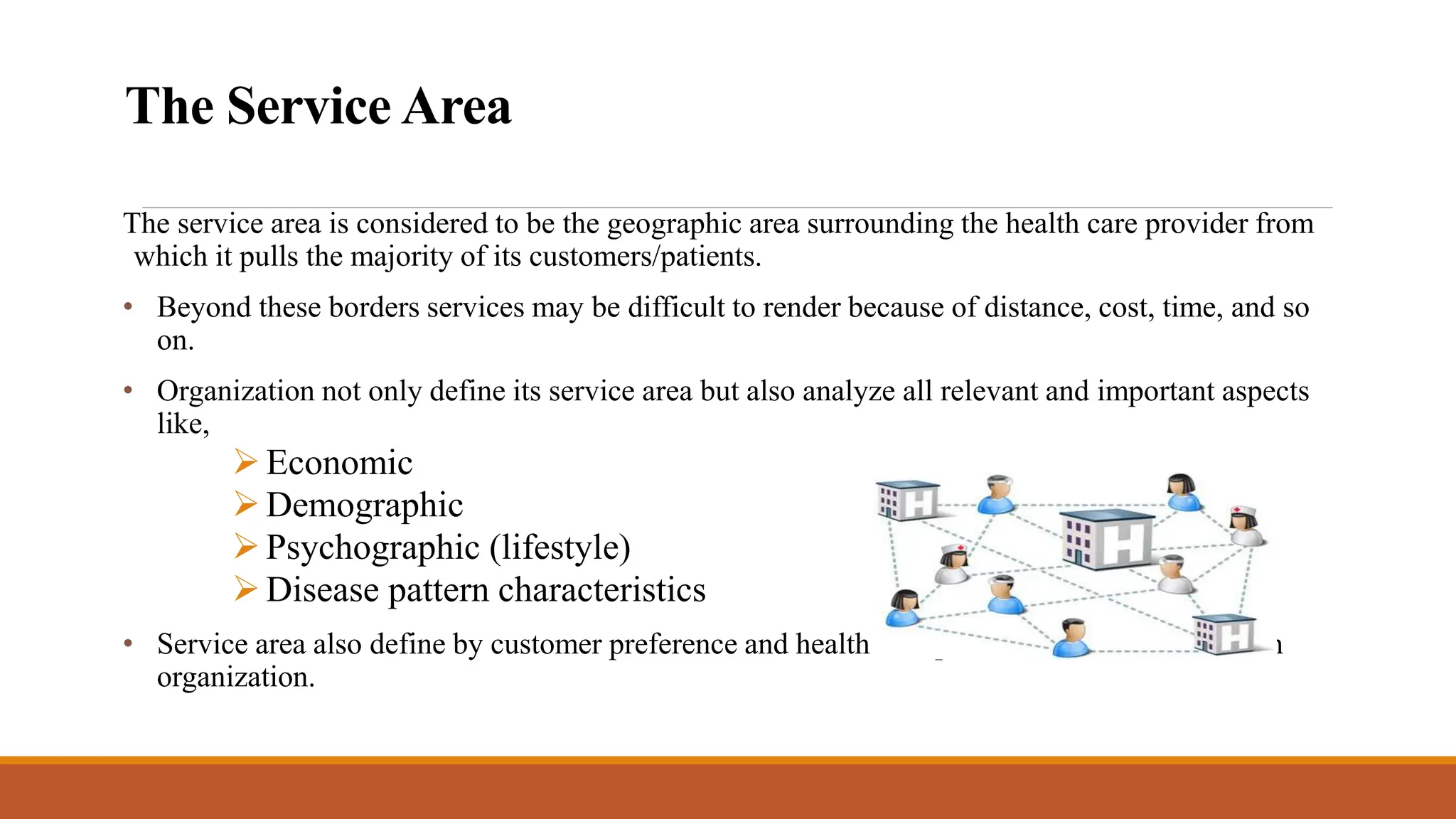
The service area is considered to be the geographic area surrounding the health care provider from
which it pulls the majority of its customers/patients.
• Beyond these borders services may be difficult to render because of distance, cost, time, and so
on.
• Organization not only define its service area but also analyze all relevant and important aspects
like,
Economic
Demographic
Psychographic (lifestyle)
Disease pattern characteristics
• Service area also define by customer preference and health care provider that are available in
organization.
Comprehensive EnvironmentalAnalysis
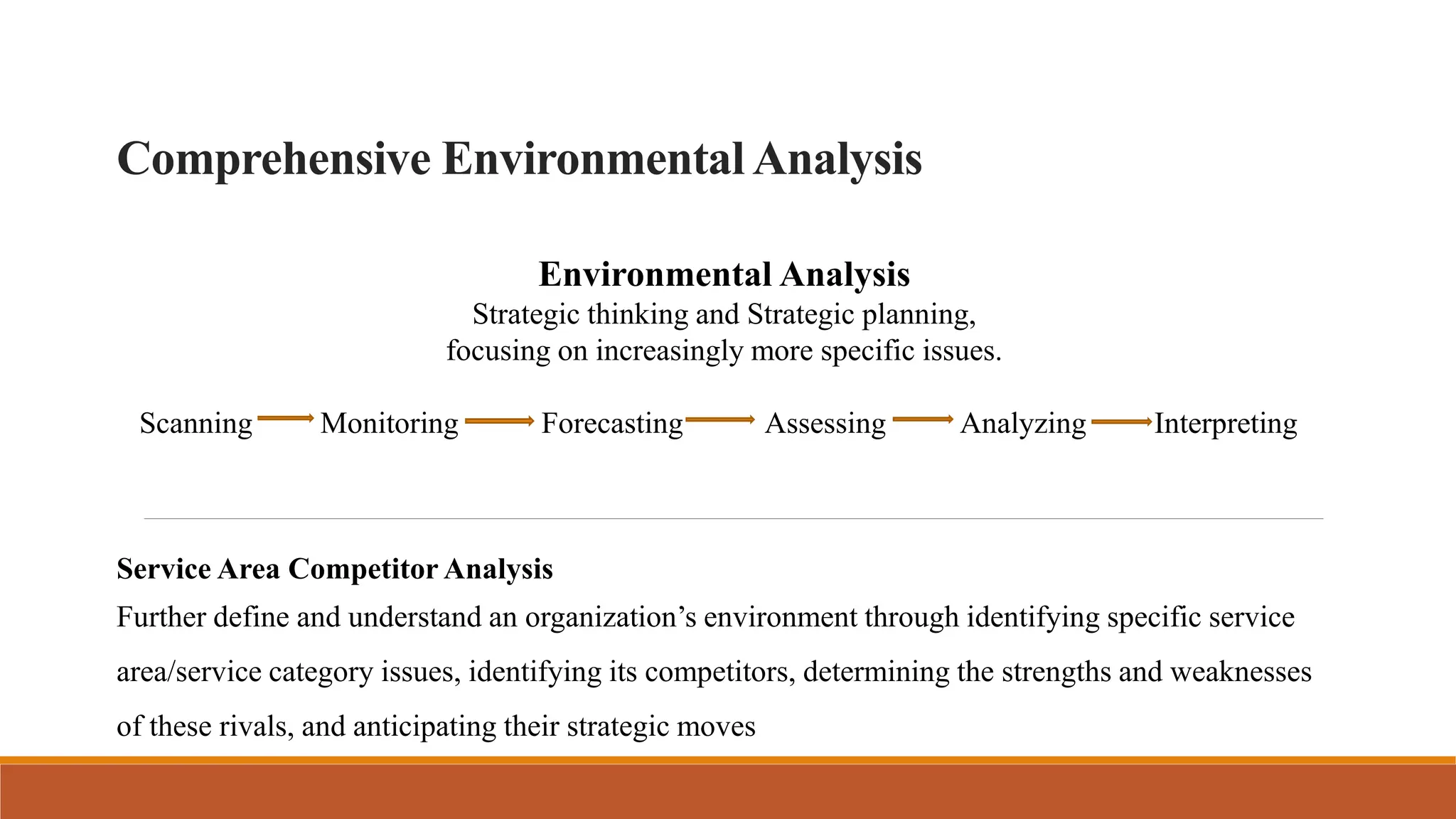
Environmental Analysis
Strategic thinking and Strategic planning,
focusing on increasingly more specific issues.
Scanning Monitoring Forecasting Assessing Analyzing Interpreting
Service Area Competitor Analysis
Further define and understand an organization’s environment through identifying specific service
area/service category issues, identifying its competitors, determining the strengths and weaknesses
of these rivals, and anticipating their strategic moves
Determinants Of Service Area CompetitorAnalysis
What is competition Analysis ?
Focus
• Identify competitors in a
service area, identify their
weaknesses, assess the
impact of own strategic
actions, and identify
potential responses
• Assists in identifying a clear
competitive advantage
Significance
• Competitor information is
essential for selecting
viable strategies that
position the organization
strongly within the market
• Necessary for survival, acts
like an interlinked radar grid
constantly monitoring
competitor activity,
information picked up by
external and internal
sources, processing it for
strategic significance, and
efficiently communicating
actionable intelligence
Impediments
• Misjudging industry and
service area boundaries
• Poor identification of the
competition
• Overemphasis on
competitors’ visible
competence
• Overemphasis on where,
rather than how, to
compete
• Faulty assumptions about
the competition
• paralysis by analysis
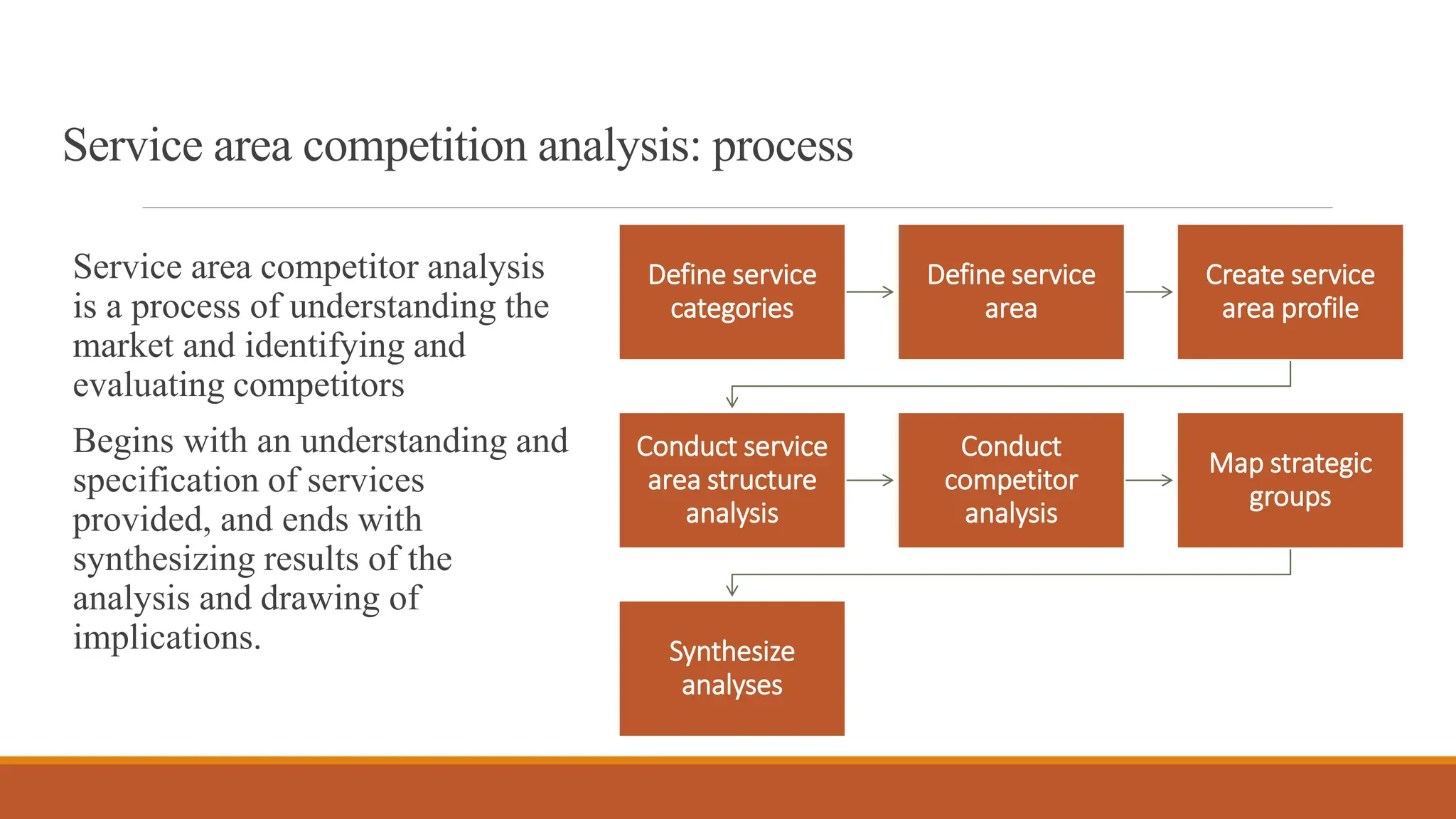
Service area competition analysis: process
Service area competitor analysis
is a process of understanding the
market and identifying and
evaluating competitors
Begins with an understanding and
specification of services
provided, and ends with
synthesizing results of the
analysis and drawing of
implications.
Define service
categories
Define service
area
Create service
area profile
Conduct service
area structure
analysis
Conduct
competitor
analysis
Map strategic
groups
Synthesize
analyses
1. Defining the service categories
The first step in service area competitor analysis is to specify the service category to be analyzed.
Many health care organizations have several service categories or products:
◦ Acute vs chronic care services
◦ Primary, secondary, tertiary level services
◦ Adults, pediatric, neonatal, geriatric
◦ Care services can be broken down into more specific subservices e.g. pediatrics can be divided
into well-baby care, infectious diseases, developmental pediatrics, pediatric hematology-
oncology
◦ Plastic surgery
◦ Reconstructive plastic surgeons
◦ Eye, ear, nose, and throat physicians as well as oral surgeons are performing some of the same
procedures
◦ Cosmetic plastic surgeons do reconstructive surgery, or specialize on the face, breast etc
◦ Specialization on the basis of procedures used, eg laser or liposuction
2. Determining service area boundaries
For a health care organization that offers several service categories, it may be necessary to conduct
several service area analyses
◦ E.g. for an acute care hospital, the service area for cardiac services may be the entire state or
region, whereas the service area for the emergency room might be only a few blocks
The opportunities and threats for each service area may be quite different; therefore, considerable effort
is directed toward understanding and analyzing the nature of the health care organization’s various
service areas
Determining the geographic boundaries of the service area may be subjective and is usually based on
patient histories, the reputation of the organization, available technology, physician recognition.
Also, geographic impediments such as a river, mountains, and limited access highways can influence
how the service area is defined
3. Service area profiling
Capturing the dimensions of a service area requires tapping and synthesizing information from various
sources:
◦ Quantitative and qualitative data
◦ Population-based health status data
◦ health services utilization data
The service area profile includes key competitively relevant economic, demographic, psychographic
(lifestyle), and community health status indicators; psychographic indicators are best predictors of patient
behavior
Medically conservative
Interested in drugs, therapies, and
diagnostics they are familiar with
Medically innovative
Willing to try new alternative
drugs, therapies, or diagnostics
Medically independent
High self-esteem and assertiveness,
question physician’s diagnosis and
seek second opinion
Medically dependent
Follow what the doctor prescribes
exactly and would never think of
questioning doctor’s orders
4. Service area structural analysis
Porter developed a five forces framework
for analyzing the external environment
through an examination of the competitive
nature of the industry
In Porter’s model, intensity is a function
of the threat of new entrants to the market,
the level of rivalry among existing
organizations, the threat of substitute
products and services, the bargaining
power of buyers (customers), and the
bargaining power of suppliers
4.1 Threat of new entrants
New entrants into a market are typically a threat to existing organizations because they increase the
intensity of competition. New entrants may have substantial resources and often attempt to rapidly gain
market share. Such actions may force prices and profits down
◦ Barriers to entry that protect organizations already serving a market:
1) Existing organizations’ economies of scale
2) Existing product or service differentiation
3) Capital requirements needed to compete
4) Switching costs – the one-time costs for buyers to switch from one provider to another
5) Access to distribution channels
6) Cost advantages (independent of scale) of established competitors
7) Government and legal constraints.
4.2 Threat of substitute products and services
For many products and services there are various substitutes that perform the same function as the
established products. Substitute products limit returns to an industry because at some price point,
consumers will switch to alternative products and services.
4.3 Threat of substitute products and services
Buyers of products and services attempt to obtain the lowest price possible while demanding high
quality and better service. If buyers are powerful, then the competitive rivalry will be high. Buyer
group is powerful if it:
1) Purchases large volumes
2) Concentrates purchases in an industry (service area)
3) Purchases products that are standard or undifferentiated
4) Has low switching costs
5) Poses a threat of backward integration;
6) Has low quality requirements
7) Has enough information to gain bargaining leverage
4.4 Bargaining power of suppliers
Much like the power of buyers, suppliers can affect the intensity of competition through their ability to
control prices and the quality of materials they supply. Suppliers tend to be powerful if:
1) There are few suppliers
2) There are few substitutes
3) The suppliers’ products are differentiated
4) The product or service supplied is important to the buyer’s business
5) The buyer’s industry is not considered an important customer
6) The suppliers pose a threat of forward integration (entering the industry)
Physicians and other health care professionals have been important and powerful “suppliers” to the industry
Other suppliers like those who supply general medical needs (bandages, suture materials, thermometers
etc.) tend not to exercise a great deal of control over the industry
5. Conducting competitor analysis
Evaluate the strengths and weakness of
competitors, characterize their strategies,
group competitors by the types of
strategies they have exhibited, and predict
competitive future moves or likely
responses to strategic issues and initiatives
by other organizations
This provides clues as to their future
strategies and to areas where competitive
advantage might be achieved.
But competitor information is not always
easy to obtain, and it's often necessary to
draw conclusions from sketchy information
6. Mapping strategic groups
Strategic group analysis concentrates on the
characteristics of the strategies of the
organizations competing within a given service
area
A strategic group is a number of organizations
within the same service category making
similar strategic decisions. Members of
a strategic group have similar “recipes” for
success or core strategies
Members of a strategic group primarily
compete with each other and do not compete
with organizations outside their strategic group
External stakeholders have an image of the
strategic group and develop an idea of the
group’s reputation. The reputation of
each strategic group differs because the identity
and strategy of each group differ
Implications for strategic group concept
Organizations
within a
strategic group
are each other’s
primary or
direct
competitors.
Organizations
most like yours
are the most
dangerous.
Strategic group
analysis can
indicate other
formulas for
success for a
service category.
Such insight
may broaden a
manager’s view
of important
market needs.
Strategic group
analysis may
indicate
important
market
dimensions or
niches that are
not being
capitalized on by
the existing
competitors
Map of strategic groups
In this map, there are 4 assisted-living organizations pursuing four
basic strategies:
High price with Highly specialized services (Strategic Group 1)
Low price with few ancillary services (Strategic Group 2)
Medium price with some (selected) services (Strategic Group3)
High price with many services (Strategic Group 4)
The primary (direct) competitors for these organizations are other
organizations within their own strategic group
Customers who seek the attributes of one strategic group, such as
highly specialized rehabilitation services, are unlikely to be
attracted to another strategic group.
Likely competitor actions/responses
Strategy formulation is future oriented, requiring that management anticipate the next strategic moves of
competitors
These moves may be projected through an evaluation of competitor strengths and weaknesses,
membership in strategic groups, and the characterization of past strategies. In many cases competitor
strategic goals are not difficult to project, given past behaviors of the organization
A thorough analysis of the key strategic decisions of competitors may reveal their strategic intent. A
strategic decision timeline can be helpful in showing the stream of decisions
Strategic response includes the likely strategic objectives and next strategic moves of competitors.
These may be anticipated because of their perceived strengths and weaknesses, past strategies, or
strategic group membership
7. Synthesizing the analyses
To be useful for strategy formulation, general and health care external environmental
analysis and service area competitor analysis must be synthesized and then conclusions
drawn
It is easy for strategic decision makers to be overwhelmed by information. To avoid
paralysis by analysis, external environmental analysis should be summarized into key
issues and trends, including their likely impact, and then service area competitor
analysis summarized
Summary and Conclusion
• Service area competitor analysis is an important element of environmental analysis and increases the focus
• Specifically, service area competitor analysis is the process of assessing service category/service area
issues, identifying competitors, determining the strengths and weaknesses of rivals, and anticipating their
moves. It provides a foundation for determining competitive advantage and subsequent strategy
formulation
• Health care organizations engage in service area competitor analysis to obtain competitor information and
for offensive and defensive reasons. However, analysts must be careful not to misjudge the service
area boundaries, do a poor job of competitor identification, overemphasize visible competence,
overemphasize where rather than how to compete, create faulty assumptions, or be paralyzed by analysis.
Thankyou

Chapter 3 SERVICE AREA COMPETITION ANALYSIS.pptx

  • 1.
    CHAPTER 3 SERVICE AREACOMPETITION ANALYSIS COURSE INSTRUCTOR DR. NOMAN PALEKAR
  • 2.
    Learning Objectives 1. Understandwhat is service area and how the concept of service area analysis emerged. 2. Understand the relationship between general and health care environmental issue identification and analysis and service area competitor analysis. 3. Define determinants of service area competitor analysis. 4. Understand the focus of competitor analysis and challenges faced by healthcare market. 5. Understand strategic groups and be able to map competitors’ strategies along important service and market dimensions. 6. Understand the elements of service area competitor analysis and assess likely competitor strategies. 7. Understand and illustrate the process of service area competitor analysis. 8. Suggest several questions to initiate strategic thinking concerning the service area and competitors as a part of managing the strategic momentum.
  • 3.
    How Service AreaCompetitor Analysis Emerged During the past decade, because of fundamental changes within the industry brought about by the influences of managed care, efforts to reduce costs and increase efficiency, and the increased presence of for-profit health care organizations, every segment of the industry has become highly competitive.
  • 4.
    The Service Area Theservice area is considered to be the geographic area surrounding the health care provider from which it pulls the majority of its customers/patients. • Beyond these borders services may be difficult to render because of distance, cost, time, and so on. • Organization not only define its service area but also analyze all relevant and important aspects like, Economic Demographic Psychographic (lifestyle) Disease pattern characteristics • Service area also define by customer preference and health care provider that are available in organization.
  • 5.
    Comprehensive EnvironmentalAnalysis Environmental Analysis Strategicthinking and Strategic planning, focusing on increasingly more specific issues. Scanning Monitoring Forecasting Assessing Analyzing Interpreting Service Area Competitor Analysis Further define and understand an organization’s environment through identifying specific service area/service category issues, identifying its competitors, determining the strengths and weaknesses of these rivals, and anticipating their strategic moves
  • 6.
    Determinants Of ServiceArea CompetitorAnalysis
  • 7.
    What is competitionAnalysis ? Focus • Identify competitors in a service area, identify their weaknesses, assess the impact of own strategic actions, and identify potential responses • Assists in identifying a clear competitive advantage Significance • Competitor information is essential for selecting viable strategies that position the organization strongly within the market • Necessary for survival, acts like an interlinked radar grid constantly monitoring competitor activity, information picked up by external and internal sources, processing it for strategic significance, and efficiently communicating actionable intelligence Impediments • Misjudging industry and service area boundaries • Poor identification of the competition • Overemphasis on competitors’ visible competence • Overemphasis on where, rather than how, to compete • Faulty assumptions about the competition • paralysis by analysis
  • 8.
    Service area competitionanalysis: process Service area competitor analysis is a process of understanding the market and identifying and evaluating competitors Begins with an understanding and specification of services provided, and ends with synthesizing results of the analysis and drawing of implications. Define service categories Define service area Create service area profile Conduct service area structure analysis Conduct competitor analysis Map strategic groups Synthesize analyses
  • 9.
    1. Defining theservice categories The first step in service area competitor analysis is to specify the service category to be analyzed. Many health care organizations have several service categories or products: ◦ Acute vs chronic care services ◦ Primary, secondary, tertiary level services ◦ Adults, pediatric, neonatal, geriatric ◦ Care services can be broken down into more specific subservices e.g. pediatrics can be divided into well-baby care, infectious diseases, developmental pediatrics, pediatric hematology- oncology ◦ Plastic surgery ◦ Reconstructive plastic surgeons ◦ Eye, ear, nose, and throat physicians as well as oral surgeons are performing some of the same procedures ◦ Cosmetic plastic surgeons do reconstructive surgery, or specialize on the face, breast etc ◦ Specialization on the basis of procedures used, eg laser or liposuction
  • 10.
    2. Determining servicearea boundaries For a health care organization that offers several service categories, it may be necessary to conduct several service area analyses ◦ E.g. for an acute care hospital, the service area for cardiac services may be the entire state or region, whereas the service area for the emergency room might be only a few blocks The opportunities and threats for each service area may be quite different; therefore, considerable effort is directed toward understanding and analyzing the nature of the health care organization’s various service areas Determining the geographic boundaries of the service area may be subjective and is usually based on patient histories, the reputation of the organization, available technology, physician recognition. Also, geographic impediments such as a river, mountains, and limited access highways can influence how the service area is defined
  • 11.
    3. Service areaprofiling Capturing the dimensions of a service area requires tapping and synthesizing information from various sources: ◦ Quantitative and qualitative data ◦ Population-based health status data ◦ health services utilization data The service area profile includes key competitively relevant economic, demographic, psychographic (lifestyle), and community health status indicators; psychographic indicators are best predictors of patient behavior Medically conservative Interested in drugs, therapies, and diagnostics they are familiar with Medically innovative Willing to try new alternative drugs, therapies, or diagnostics Medically independent High self-esteem and assertiveness, question physician’s diagnosis and seek second opinion Medically dependent Follow what the doctor prescribes exactly and would never think of questioning doctor’s orders
  • 12.
    4. Service areastructural analysis Porter developed a five forces framework for analyzing the external environment through an examination of the competitive nature of the industry In Porter’s model, intensity is a function of the threat of new entrants to the market, the level of rivalry among existing organizations, the threat of substitute products and services, the bargaining power of buyers (customers), and the bargaining power of suppliers
  • 13.
    4.1 Threat ofnew entrants New entrants into a market are typically a threat to existing organizations because they increase the intensity of competition. New entrants may have substantial resources and often attempt to rapidly gain market share. Such actions may force prices and profits down ◦ Barriers to entry that protect organizations already serving a market: 1) Existing organizations’ economies of scale 2) Existing product or service differentiation 3) Capital requirements needed to compete 4) Switching costs – the one-time costs for buyers to switch from one provider to another 5) Access to distribution channels 6) Cost advantages (independent of scale) of established competitors 7) Government and legal constraints.
  • 14.
    4.2 Threat ofsubstitute products and services For many products and services there are various substitutes that perform the same function as the established products. Substitute products limit returns to an industry because at some price point, consumers will switch to alternative products and services. 4.3 Threat of substitute products and services Buyers of products and services attempt to obtain the lowest price possible while demanding high quality and better service. If buyers are powerful, then the competitive rivalry will be high. Buyer group is powerful if it: 1) Purchases large volumes 2) Concentrates purchases in an industry (service area) 3) Purchases products that are standard or undifferentiated 4) Has low switching costs 5) Poses a threat of backward integration; 6) Has low quality requirements 7) Has enough information to gain bargaining leverage
  • 15.
    4.4 Bargaining powerof suppliers Much like the power of buyers, suppliers can affect the intensity of competition through their ability to control prices and the quality of materials they supply. Suppliers tend to be powerful if: 1) There are few suppliers 2) There are few substitutes 3) The suppliers’ products are differentiated 4) The product or service supplied is important to the buyer’s business 5) The buyer’s industry is not considered an important customer 6) The suppliers pose a threat of forward integration (entering the industry) Physicians and other health care professionals have been important and powerful “suppliers” to the industry Other suppliers like those who supply general medical needs (bandages, suture materials, thermometers etc.) tend not to exercise a great deal of control over the industry
  • 16.
    5. Conducting competitoranalysis Evaluate the strengths and weakness of competitors, characterize their strategies, group competitors by the types of strategies they have exhibited, and predict competitive future moves or likely responses to strategic issues and initiatives by other organizations This provides clues as to their future strategies and to areas where competitive advantage might be achieved. But competitor information is not always easy to obtain, and it's often necessary to draw conclusions from sketchy information
  • 17.
    6. Mapping strategicgroups Strategic group analysis concentrates on the characteristics of the strategies of the organizations competing within a given service area A strategic group is a number of organizations within the same service category making similar strategic decisions. Members of a strategic group have similar “recipes” for success or core strategies Members of a strategic group primarily compete with each other and do not compete with organizations outside their strategic group External stakeholders have an image of the strategic group and develop an idea of the group’s reputation. The reputation of each strategic group differs because the identity and strategy of each group differ Implications for strategic group concept Organizations within a strategic group are each other’s primary or direct competitors. Organizations most like yours are the most dangerous. Strategic group analysis can indicate other formulas for success for a service category. Such insight may broaden a manager’s view of important market needs. Strategic group analysis may indicate important market dimensions or niches that are not being capitalized on by the existing competitors
  • 18.
    Map of strategicgroups In this map, there are 4 assisted-living organizations pursuing four basic strategies: High price with Highly specialized services (Strategic Group 1) Low price with few ancillary services (Strategic Group 2) Medium price with some (selected) services (Strategic Group3) High price with many services (Strategic Group 4) The primary (direct) competitors for these organizations are other organizations within their own strategic group Customers who seek the attributes of one strategic group, such as highly specialized rehabilitation services, are unlikely to be attracted to another strategic group.
  • 19.
    Likely competitor actions/responses Strategyformulation is future oriented, requiring that management anticipate the next strategic moves of competitors These moves may be projected through an evaluation of competitor strengths and weaknesses, membership in strategic groups, and the characterization of past strategies. In many cases competitor strategic goals are not difficult to project, given past behaviors of the organization A thorough analysis of the key strategic decisions of competitors may reveal their strategic intent. A strategic decision timeline can be helpful in showing the stream of decisions Strategic response includes the likely strategic objectives and next strategic moves of competitors. These may be anticipated because of their perceived strengths and weaknesses, past strategies, or strategic group membership
  • 20.
    7. Synthesizing theanalyses To be useful for strategy formulation, general and health care external environmental analysis and service area competitor analysis must be synthesized and then conclusions drawn It is easy for strategic decision makers to be overwhelmed by information. To avoid paralysis by analysis, external environmental analysis should be summarized into key issues and trends, including their likely impact, and then service area competitor analysis summarized
  • 21.
    Summary and Conclusion •Service area competitor analysis is an important element of environmental analysis and increases the focus • Specifically, service area competitor analysis is the process of assessing service category/service area issues, identifying competitors, determining the strengths and weaknesses of rivals, and anticipating their moves. It provides a foundation for determining competitive advantage and subsequent strategy formulation • Health care organizations engage in service area competitor analysis to obtain competitor information and for offensive and defensive reasons. However, analysts must be careful not to misjudge the service area boundaries, do a poor job of competitor identification, overemphasize visible competence, overemphasize where rather than how to compete, create faulty assumptions, or be paralyzed by analysis.
  • 22.

Editor's Notes

  • #8 Focus: An organization engages in competitor analysis to gain a general understanding of the competitors in the service area, identify any vulnerabilities of the competitors, assess the impact of its own strategic actions against specific competitors, and identify potential moves that a competitor might make that would endanger the organization’s position in the market. Competitive advantage is the means by which the organization seeks to develop cost advantage or to differentiate itself from other organizations. Competitive advantage might be centered on image, high-quality services, an excellent and widely recognized staff, or efficiency and low cost, among others. Categorize competitor information as general, offensive and defensive info. General: avoid surprises in the marketplace, make everyone aware of significant and formidable competitors to whom the organization must respond, help the organization learn from rivals through benchmarking (specific measures comparing the organization with its competitors on a set of key variables). Offensive: identify market niches and discontinuities, select a viable strategy, contribute to the successful implementation of the strategy. Defensive: anticipating competitors’ moves, and shortening the time required to respond (countermoves) to a competitor’s moves. Depending on the intent of the competitor analysis, an organization might use all of these categories or just one or two. 2. Impediments: Monitoring the actions and understanding the intentions of competitors is often difficult;  Six common impediments or “blind spots” have been identified that slow an organization’s response to its competitors’ moves or even cause the selection of the wrong competitive approach: -visible competence: Less visible attributes and capabilities such as organizational structure, culture, human resources, service features, intellectual capital, management acumen, and strategy may cause misinterpretation of a competitor’s strengths or strategic intent. -service area boundaries: To avoid a focus that is too narrow, the industry, industry segment, and service area must be defined in the broadest terms that are useful.  In today’s health care environment, competition may come from very nontraditional competitors, and from non-regional areas like different states
  • #9 Services type:  health care that is preventive, diagnostic, alternative, routine, episodic, acute, or chronic Brand predisposition: indicates the consumer has a preference for some health care providers over others eg want specialists; others prefer a primary care doctor; still others prefer clinics that have primary care physicians and specialists; and, finally, some consumers prefer physician assistants or nurse practitioners Past experiences: eg if bad experience with primary care doctor, will prefer to go to another hospital with specialists Personal/social values: eg if community is pro-life and anti-abortion, setting up an abortion clinic there is useless
  • #12 Relevant economic information may include income distribution, major industries and employers, types of businesses and institutions, economic growth rate, seasonality of businesses, unemployment statistics, and so on. Demographic variables most commonly used in describing the service area include age, gender, race, marital status, education level, mobility, religious affiliation, and occupation. Psychographic variables are often better predictors of consumer behavior than demographic variables and include values, attitudes, lifestyle, social class, or personality
  • #13 Services type:  health care that is preventive, diagnostic, alternative, routine, episodic, acute, or chronic Brand predisposition: indicates the consumer has a preference for some health care providers over others eg want specialists; others prefer a primary care doctor; still others prefer clinics that have primary care physicians and specialists; and, finally, some consumers prefer physician assistants or nurse practitioners Past experiences: eg if bad experience with primary care doctor, will prefer to go to another hospital with specialists Personal/social values: eg if community is pro-life and anti-abortion, setting up an abortion clinic there is useless
  • #18 While service area analysis concentrates on the characteristics of the specific geographic market,