Introduction
■ Imperative languagesare abstractions of von Neumann architecture
– Memory: stores both instructions and data
– Processor: provides operations for modifying the contents of memory
■ Variables are characterized by a collection of properties or attributes
– The most important of which is type, a fundamental concept in programming
languages
– To design a type, must consider scope, lifetime, type checking, initialization, and
type compatibility
4.
Names
■ Design issues
–The following are the primary design issues for names
• Maximum length?
• Are names case sensitive?
• Are special words reserved words or keywords?
■ Name Forms
– A name is a string of characters used to identify some entity in a program.
– Length
• If too short, they cannot be connotative
– Language examples:
• FORTRAN I: maximum 6
• COBOL: maximum 30
• C# and Java: no limit, and all characters are significant
• C++: no limit, but implementers impose a length limitation due to performance reasons
5.
Names
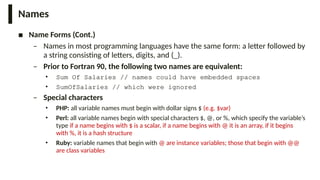
■ Name Forms(Cont.)
– Names in most programming languages have the same form: a letter followed by
a string consisting of letters, digits, and (_).
– Prior to Fortran 90, the following two names are equivalent:
• Sum Of Salaries // names could have embedded spaces
• SumOfSalaries // which were ignored
– Special characters
• PHP: all variable names must begin with dollar signs $ (e.g. $var)
• Perl: all variable names begin with special characters $, @, or %, which specify the variable’s
type if a name begins with $ is a scalar, if a name begins with @ it is an array, if it begins
with %, it is a hash structure
• Ruby: variable names that begin with @ are instance variables; those that begin with @@
are class variables
6.
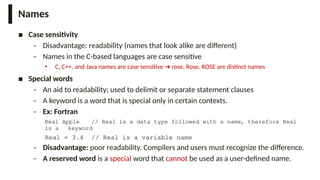
Names
■ Case sensitivity
–Disadvantage: readability (names that look alike are different)
– Names in the C-based languages are case sensitive
• C, C++, and Java names are case sensitive rose, Rose, ROSE are distinct names
➔
■ Special words
– An aid to readability; used to delimit or separate statement clauses
– A keyword is a word that is special only in certain contexts.
– Ex: Fortran
Real Apple // Real is a data type followed with a name, therefore Real
is a keyword
Real = 3.4 // Real is a variable name
– Disadvantage: poor readability. Compilers and users must recognize the difference.
– A reserved word is a special word that cannot be used as a user-defined name.
7.
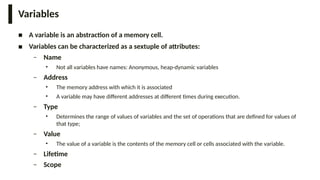
Variables
■ A variableis an abstraction of a memory cell.
■ Variables can be characterized as a sextuple of attributes:
– Name
• Not all variables have names: Anonymous, heap-dynamic variables
– Address
• The memory address with which it is associated
• A variable may have different addresses at different times during execution.
– Type
• Determines the range of values of variables and the set of operations that are defined for values of
that type;
– Value
• The value of a variable is the contents of the memory cell or cells associated with the variable.
– Lifetime
– Scope
8.
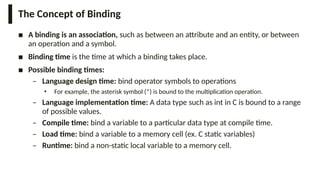
The Concept ofBinding
■ A binding is an association, such as between an attribute and an entity, or between
an operation and a symbol.
■ Binding time is the time at which a binding takes place.
■ Possible binding times:
– Language design time: bind operator symbols to operations
• For example, the asterisk symbol (*) is bound to the multiplication operation.
– Language implementation time: A data type such as int in C is bound to a range
of possible values.
– Compile time: bind a variable to a particular data type at compile time.
– Load time: bind a variable to a memory cell (ex. C static variables)
– Runtime: bind a non-static local variable to a memory cell.
9.
Type Bindings
■ StaticType Bindings
– If static, the type may be specified by either an explicit or an implicit declaration.
– An explicit declaration is a program statement used for declaring the types of variables.
– An implicit declaration is a default mechanism for specifying types of variables (the first
appearance of the variable in the program.)
– Both explicit and implicit declarations create static bindings to types.
– Type Inference:
• Some languages use type inferencing to determine types of variables (context)
• C# - a variable can be declared with var and an initial value. The initial value sets the type
var sum = 0; // sum is int
var total = 0.0; // total is float
var name = “Fred”; // name is string
• Visual Basic, ML, Haskell, and F# also use type inferencing. The context of the appearance of a
variable determines its type
10.
Type Bindings
■ DynamicType Bindings
– With dynamic type binding, the type of a variable is not specified by a
declaration statement, nor can it be determined by the spelling of its name.
Instead, the variable is bound to a type when it is assigned a value in an
assignment statement.
– In Python, Ruby, JavaScript, and PHP, type binding is dynamic
– Specified through an assignment statement
– Ex, JavaScript
• list = [2, 4.33, 6, 8]; single-dimensioned array
➔
• list = 47; scalar variable
➔
11.
Storage Bindings andLifetime
■ Allocation - getting a cell from some pool of available cells.
■ Deallocation - putting a cell back into the pool.
■ The lifetime of a variable is the time during which it is bound to a particular memory
cell. So the lifetime of a var begins when it is bound to a specific cell and ends when it
is unbound from that cell.
■ Categories of variables by lifetimes:
– Static
– stack-dynamic
– explicit heap-dynamic
– implicit heap-dynamic
12.
Scope
■ The scopeof a variable is the range of statements in which the variable is visible.
– A variable is visible in a statement if it can be referenced in that statement.
– Local variable is local in a program unit or block if it is declared there.
– Non-local variable of a program unit or block are those that are visible within the
program unit or block but are not declared there.
■ Static Scope
– Static scoping is named because the scope of a variable can be statically
determined – that is prior to execution.
– This permits a human program reader (and a compiler) to determine the type of
every variable in the program simply by examining its source code.
– There are two categories of static scoped languages:
• Nested Subprograms.
• Subprograms that cannot be nested.
13.
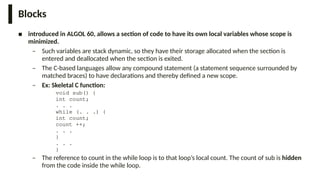
Blocks
■ introduced inALGOL 60, allows a section of code to have its own local variables whose scope is
minimized.
– Such variables are stack dynamic, so they have their storage allocated when the section is
entered and deallocated when the section is exited.
– The C-based languages allow any compound statement (a statement sequence surrounded by
matched braces) to have declarations and thereby defined a new scope.
– Ex: Skeletal C function:
void sub() {
int count;
. . .
while (. . .) {
int count;
count ++;
. . .
}
. . .
}
– The reference to count in the while loop is to that loop’s local count. The count of sub is hidden
from the code inside the while loop.
14.
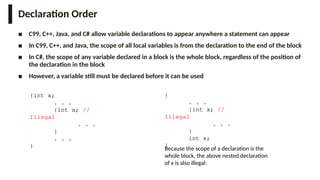
Declaration Order
■ C99,C++, Java, and C# allow variable declarations to appear anywhere a statement can appear
■ In C99, C++, and Java, the scope of all local variables is from the declaration to the end of the block
■ In C#, the scope of any variable declared in a block is the whole block, regardless of the position of
the declaration in the block
■ However, a variable still must be declared before it can be used
{int x;
. . .
{int x; //
Illegal
. . .
}
. . .
}
{
. . .
{int x; //
Illegal
. . .
}
int x;
}
Because the scope of a declaration is the
whole block, the above nested declaration
of x is also illegal:
15.
Declaration Order
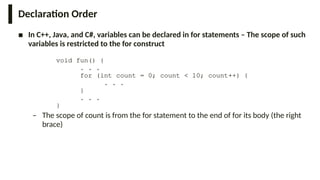
■ InC++, Java, and C#, variables can be declared in for statements – The scope of such
variables is restricted to the for construct
void fun() {
. . .
for (int count = 0; count < 10; count++) {
. . .
}
. . .
}
– The scope of count is from the for statement to the end of for its body (the right
brace)
16.
Global Scope
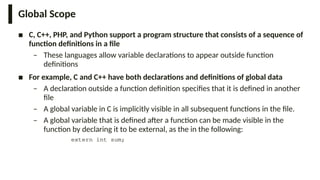
■ C,C++, PHP, and Python support a program structure that consists of a sequence of
function definitions in a file
– These languages allow variable declarations to appear outside function
definitions
■ For example, C and C++ have both declarations and definitions of global data
– A declaration outside a function definition specifies that it is defined in another
file
– A global variable in C is implicitly visible in all subsequent functions in the file.
– A global variable that is defined after a function can be made visible in the
function by declaring it to be external, as the in the following:
extern int sum;
17.
Global Scope
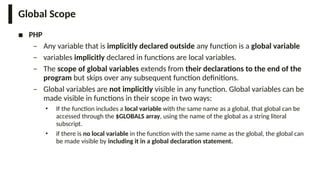
■ PHP
–Any variable that is implicitly declared outside any function is a global variable
– variables implicitly declared in functions are local variables.
– The scope of global variables extends from their declarations to the end of the
program but skips over any subsequent function definitions.
– Global variables are not implicitly visible in any function. Global variables can be
made visible in functions in their scope in two ways:
• If the function includes a local variable with the same name as a global, that global can be
accessed through the $GLOBALS array, using the name of the global as a string literal
subscript.
• if there is no local variable in the function with the same name as the global, the global can
be made visible by including it in a global declaration statement.
18.
Global Scope
■ PHP
$day= "Monday";
$month = "January";
function calendar() {
$day = "Tuesday";
global $month;
print "local day is $day ";
$gday = $GLOBALS['day'];
print "global day is $gday <br >";
print "global month is $month ";
}
calendar();
■ Interpretation of this code produces the following:
local day is Tuesday
global day is Monday
global month is January
19.
Evaluation of StaticScoping
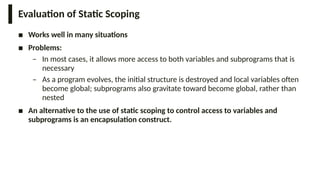
■ Works well in many situations
■ Problems:
– In most cases, it allows more access to both variables and subprograms that is
necessary
– As a program evolves, the initial structure is destroyed and local variables often
become global; subprograms also gravitate toward become global, rather than
nested
■ An alternative to the use of static scoping to control access to variables and
subprograms is an encapsulation construct.
20.
Dynamic Scope
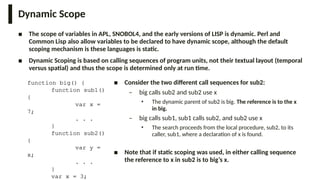
■ Thescope of variables in APL, SNOBOL4, and the early versions of LISP is dynamic. Perl and
Common Lisp also allow variables to be declared to have dynamic scope, although the default
scoping mechanism is these languages is static.
■ Dynamic Scoping is based on calling sequences of program units, not their textual layout (temporal
versus spatial) and thus the scope is determined only at run time.
function big() {
function sub1()
{
var x =
7;
. . .
}
function sub2()
{
var y =
x;
. . .
}
var x = 3;
■ Consider the two different call sequences for sub2:
– big calls sub2 and sub2 use x
• The dynamic parent of sub2 is big. The reference is to the x
in big.
– big calls sub1, sub1 calls sub2, and sub2 use x
• The search proceeds from the local procedure, sub2, to its
caller, sub1, where a declaration of x is found.
■ Note that if static scoping was used, in either calling sequence
the reference to x in sub2 is to big’s x.
21.
Scope and Lifetime
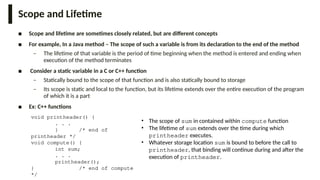
■Scope and lifetime are sometimes closely related, but are different concepts
■ For example, In a Java method – The scope of such a variable is from its declaration to the end of the method
– The lifetime of that variable is the period of time beginning when the method is entered and ending when
execution of the method terminates
■ Consider a static variable in a C or C++ function
– Statically bound to the scope of that function and is also statically bound to storage
– Its scope is static and local to the function, but its lifetime extends over the entire execution of the program
of which it is a part
■ Ex: C++ functions
• The scope of sum in contained within compute function
• The lifetime of sum extends over the time during which
printheader executes.
• Whatever storage location sum is bound to before the call to
printheader, that binding will continue during and after the
execution of printheader.
void printheader() {
. . .
} /* end of
printheader */
void compute() {
int sum;
. . .
printheader();
} /* end of compute
*/
22.
Named Constants
■ Itis a variable that is bound to a value only at the time it is bound to storage; its value cannot be
change by assignment or by an input statement.
■ Ex, Java
final int LEN = 100;
■ Advantages: readability and modifiability
■ Variable Initialization
– The binding of a variable to a value at the time it is bound to storage is called initialization.
– Initialization is often done on the declaration statement.
– Ex, C++
int sum = 0;
int* ptrSum = ∑
char name[] = “George Washington Carver”;
Editor's Notes
#7 A variable may have different addresses at different times during execution. If a subprogram has a local var that is allocated from the run time stack when the subprogram is called, different calls may result in that var having different addresses.
#9 Both explicit and implicit declarations create static bindings to types.
EX: –Fortran
an identifier that appears in a program that is not explicitly declared is implicitly declared according to the following convention:
I, J, K, L, M, or N or their lowercase versions is implicitly declared to be Integer type; otherwise, it is implicitly declared as Real type.

![Type Bindings
■ Dynamic Type Bindings
– With dynamic type binding, the type of a variable is not specified by a
declaration statement, nor can it be determined by the spelling of its name.
Instead, the variable is bound to a type when it is assigned a value in an
assignment statement.
– In Python, Ruby, JavaScript, and PHP, type binding is dynamic
– Specified through an assignment statement
– Ex, JavaScript
• list = [2, 4.33, 6, 8]; single-dimensioned array
➔
• list = 47; scalar variable
➔](https://image.slidesharecdn.com/chapter-53-250417212009-f75d2632/85/Chapter-3-pptx-10-320.jpg)
![Global Scope
■ PHP
$day = "Monday";
$month = "January";
function calendar() {
$day = "Tuesday";
global $month;
print "local day is $day ";
$gday = $GLOBALS['day'];
print "global day is $gday <br >";
print "global month is $month ";
}
calendar();
■ Interpretation of this code produces the following:
local day is Tuesday
global day is Monday
global month is January](https://image.slidesharecdn.com/chapter-53-250417212009-f75d2632/85/Chapter-3-pptx-18-320.jpg)
![Named Constants
■ It is a variable that is bound to a value only at the time it is bound to storage; its value cannot be
change by assignment or by an input statement.
■ Ex, Java
final int LEN = 100;
■ Advantages: readability and modifiability
■ Variable Initialization
– The binding of a variable to a value at the time it is bound to storage is called initialization.
– Initialization is often done on the declaration statement.
– Ex, C++
int sum = 0;
int* ptrSum = ∑
char name[] = “George Washington Carver”;](https://image.slidesharecdn.com/chapter-53-250417212009-f75d2632/85/Chapter-3-pptx-22-320.jpg)


