INTRODUCTION TO
ACCOUNTING
financial statements analysis
Page
14-2
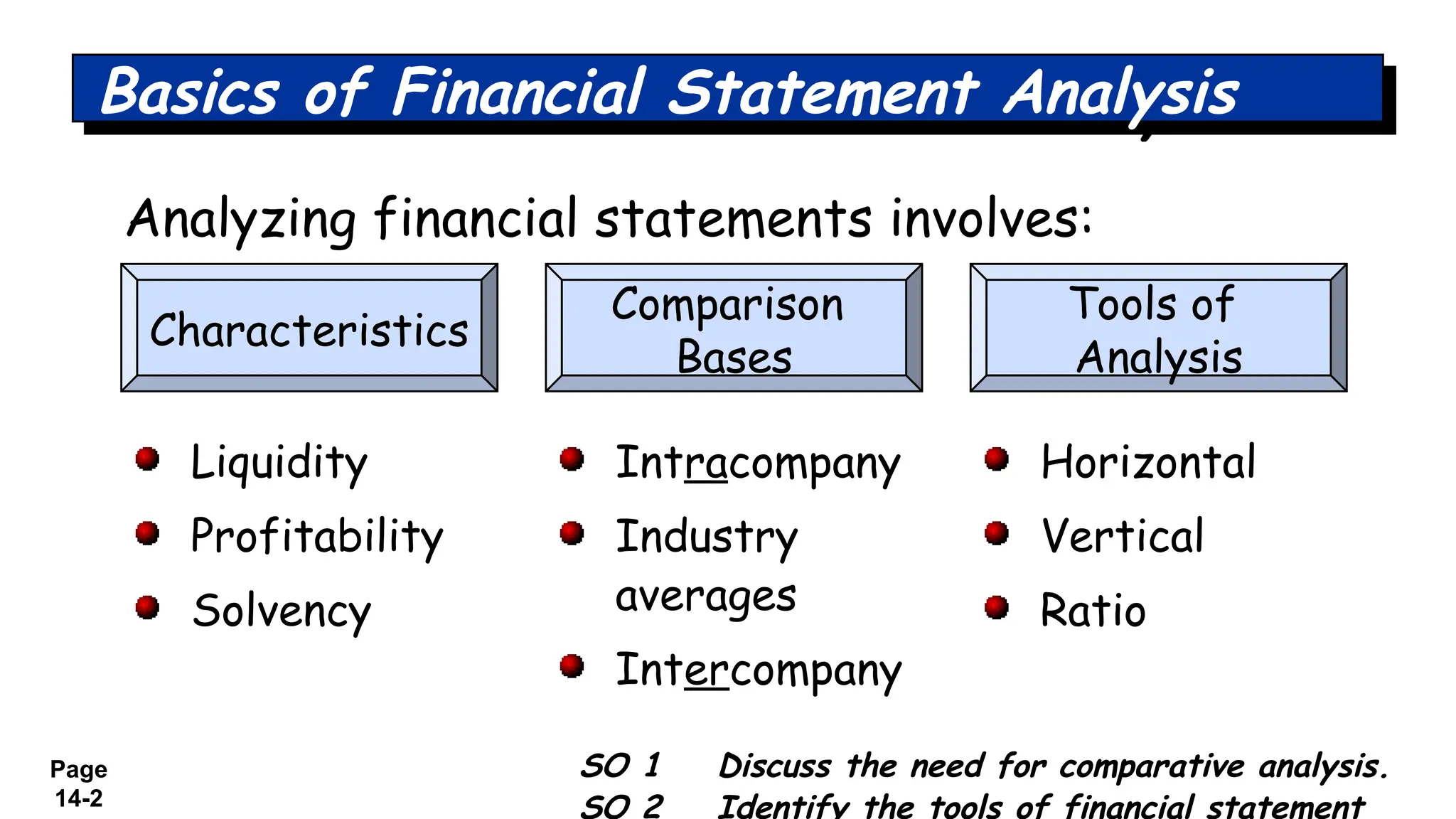
Analyzing financial statements involves:
Basics of Financial Statement Analysis
Characteristics
Comparison
Bases
Tools of
Analysis
Liquidity
Profitability
Solvency
Intracompany
Industry
averages
Intercompany
Horizontal
Vertical
Ratio
SO 1 Discuss the need for comparative analysis.
SO 2 Identify the tools of financial statement
Page
14-3 SO 3 Explain and apply horizontal analysis.
Horizontal Analysis
Horizontal analysis, also called trend analysis, is a
technique for evaluating a series of financial
statement data over a period of time.
Its purpose is to determine the increase or decrease
that has taken place.
Horizontal analysis is commonly applied to the balance
sheet, income statement, and statement of retained
earnings.
Page
14-4 SO 3 Explain and apply horizontal analysis.
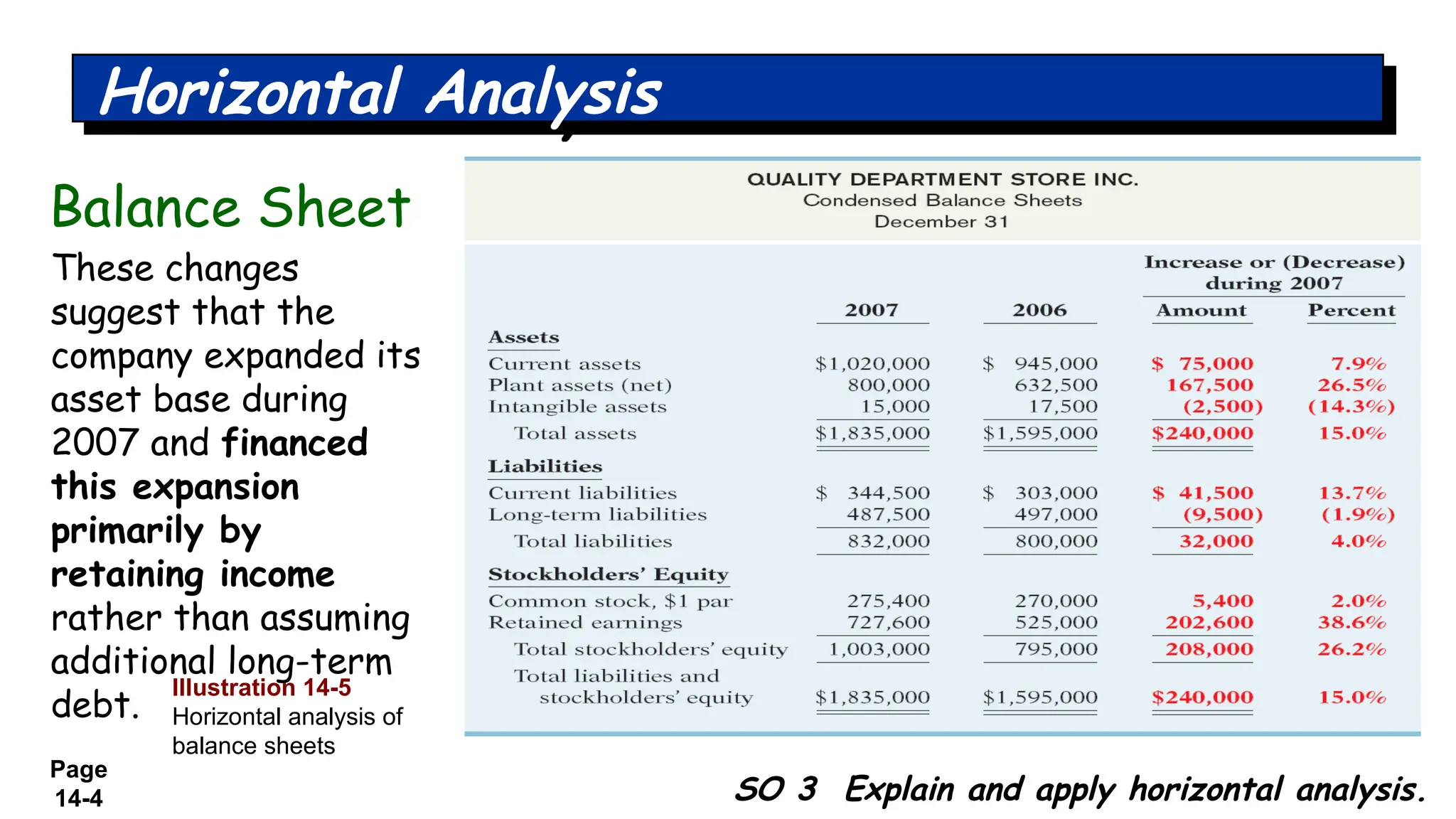
These changes
suggest that the
company expanded its
asset base during
2007 and financed
this expansion
primarily by
retaining income
rather than assuming
additional long-term
debt.
Horizontal Analysis
Balance Sheet
Illustration 14-5
Horizontal analysis of
balance sheets
Page
14-5 SO 3 Explain and apply horizontal analysis.
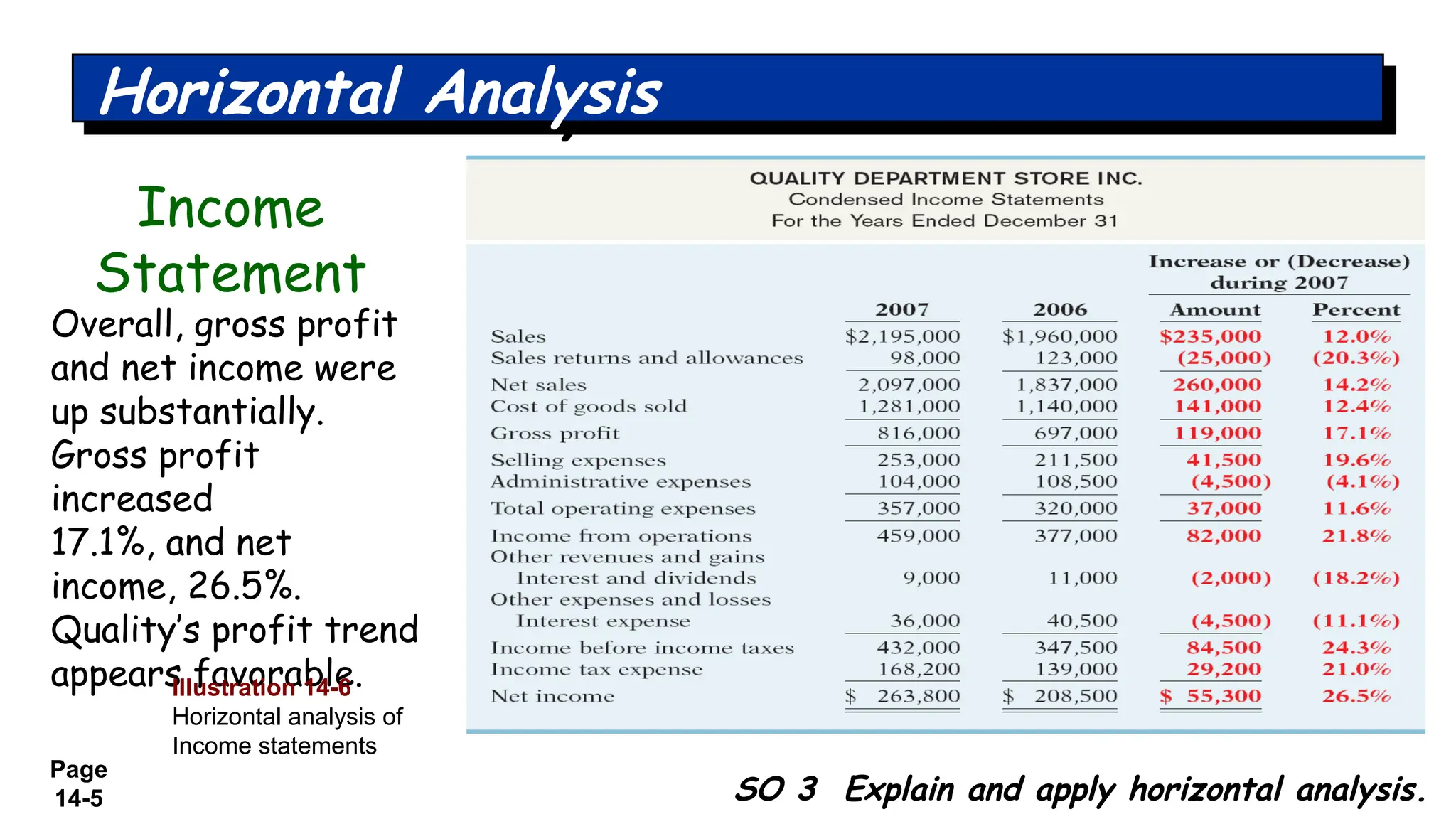
Overall, gross profit
and net income were
up substantially.
Gross profit
increased
17.1%, and net
income, 26.5%.
Quality’s profit trend
appears favorable.
Horizontal Analysis
Income
Statement
Illustration 14-6
Horizontal analysis of
Income statements
Page
14-6 SO 3 Explain and apply horizontal analysis.
We saw in the horizontal analysis of the balance sheet that ending retained
earnings increased 38.6%. As indicated earlier, the company retained a
significant portion of net income to finance additional plant facilities.
Horizontal Analysis
Illustration 14-7
Horizontal analysis of
retained earnings
statements
Retained
Earnings
Statement
Page
14-7
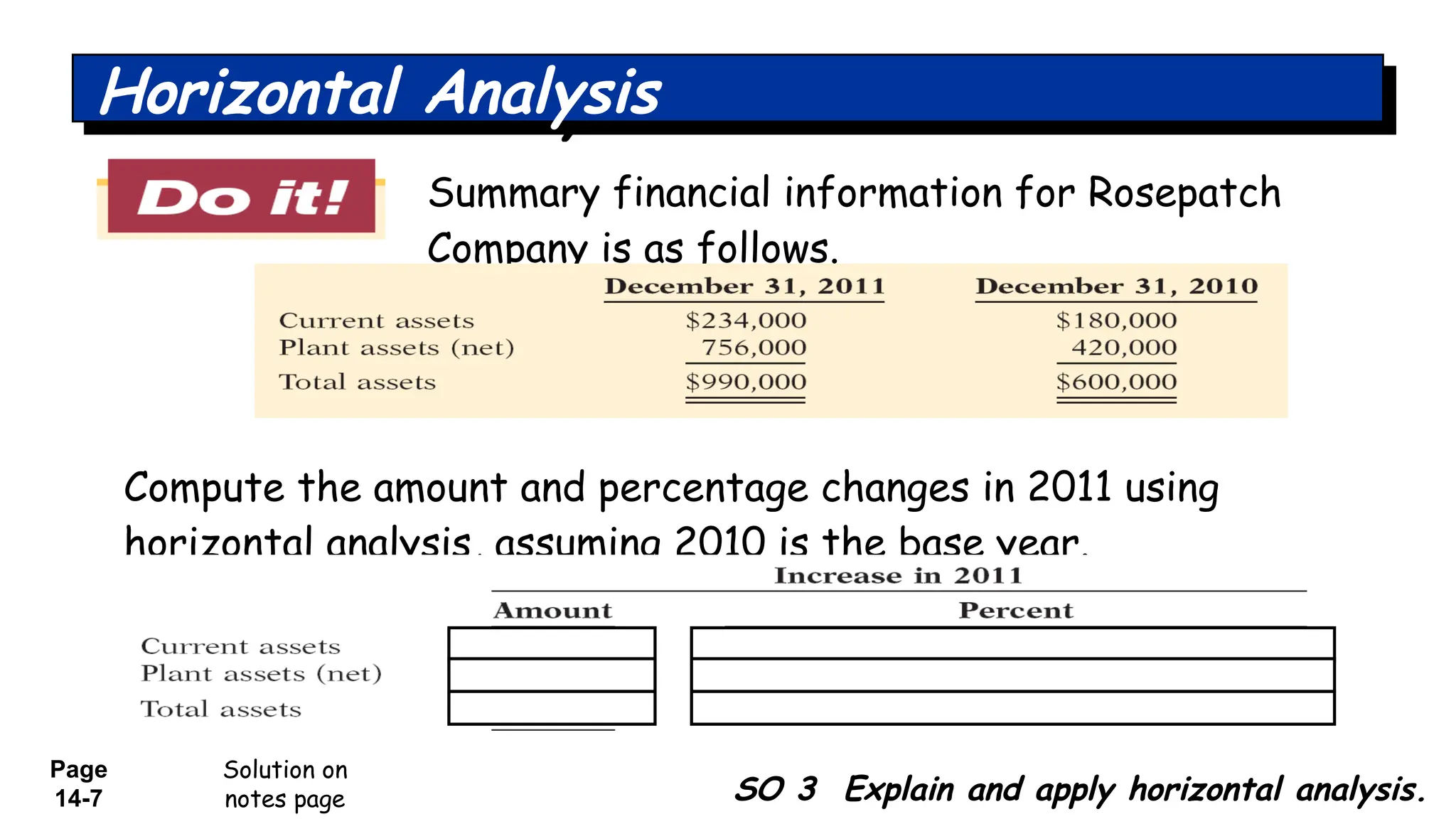
Summary financial information for Rosepatch
Company is as follows.
Solution on
notes page SO 3 Explain and apply horizontal analysis.
Horizontal Analysis
Compute the amount and percentage changes in 2011 using
horizontal analysis, assuming 2010 is the base year.
Page
14-8 SO 4 Describe and apply vertical analysis.
Vertical Analysis
Vertical analysis, also called common-size analysis, is
a technique that expresses each financial statement
item as a percent of a base amount.
On an income statement, we might say that selling
expenses are 16% of net sales.
Vertical analysis is commonly applied to the balance
sheet and the income statement.
Page
14-9
These results
reinforce the
earlier observations
that Quality is
choosing to finance
its growth through
retention of
earnings rather
than through
issuing additional
debt.
Balance Sheet
Illustration 14-8
Vertical analysis of
balance sheets
SO 4 Describe and apply vertical analysis.
Vertical Analysis
Page
14-10
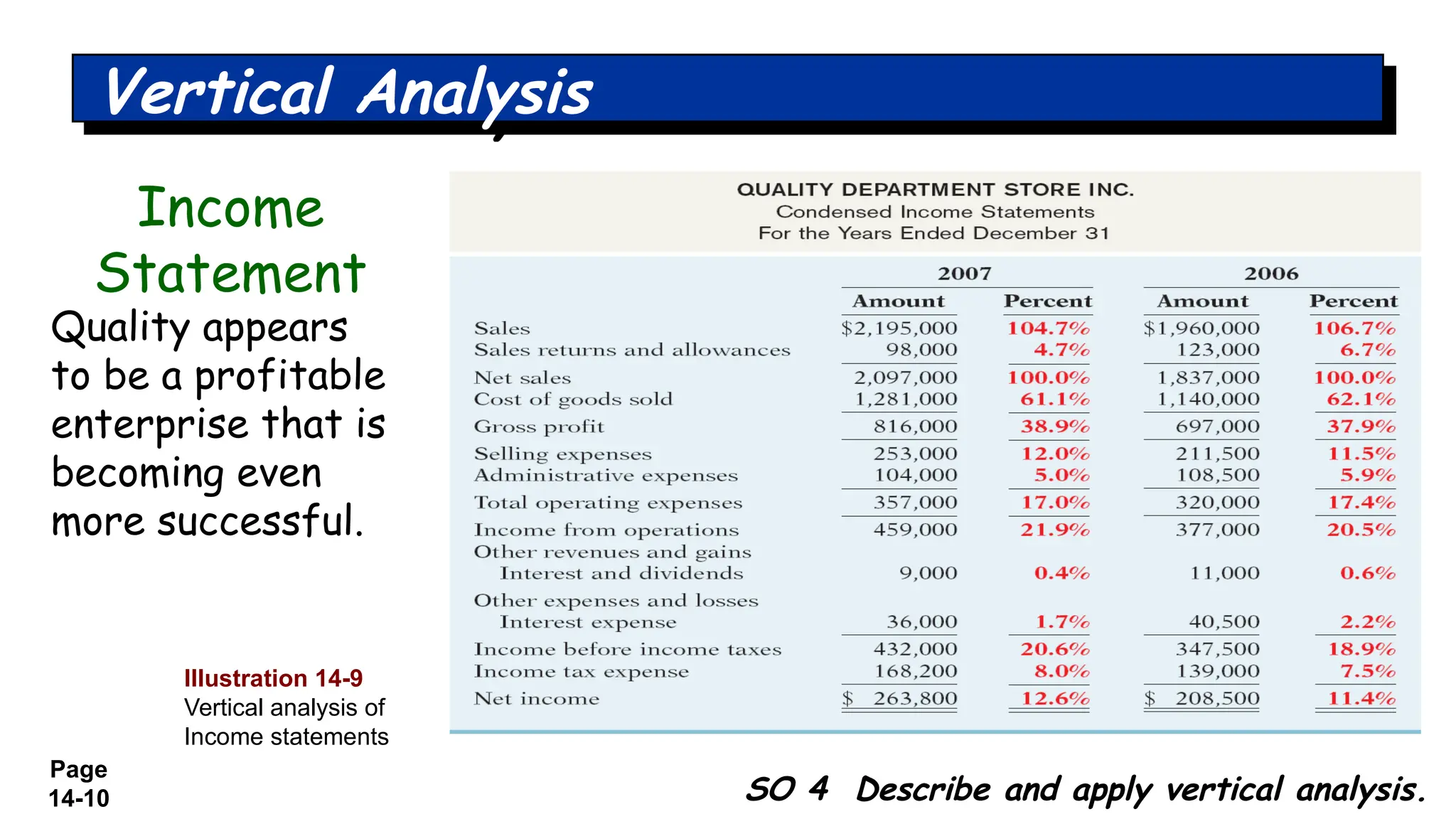
Quality appears
to be a profitable
enterprise that is
becoming even
more successful.
Income
Statement
Illustration 14-9
Vertical analysis of
Income statements
SO 4 Describe and apply vertical analysis.
Vertical Analysis
Page
14-11
Enables a comparison of companies of different sizes.
Illustration 14-10
Intercompany income
statement comparison
SO 4 Describe and apply vertical analysis.
Vertical Analysis
J.C. Penney earned net income more than 4,208 times larger than Quality’s, J.C.
Penney’s net income as a percent of each sales dollar (5.6%) is only 44% of
Quality’s (12.6%).
Basic Financial Analysis
 Ratio analysis involves methods of
calculating and interpreting
financial ratios to assess a firm’s
financial condition and
performance.
 It is of interest to shareholders,
creditors, and the firm’s own
management
BASIC FINANCIAL ANALYSIS
 Ratio analysis involves methods of calculating and
interpreting financial ratios to assess a firm’s
financial condition and performance.
 It is of interest to shareholders, creditors, and the
firm’s own management
Using Financial Ratios:
Types of Ratio Comparisons
 Trend or time-series analysis
 Used to evaluate a firm’s performance
over time
 Cross-sectional analysis
 Used to compare different firms at the same point in
time
Using Financial Ratios:
Types of Ratio Comparisons (cont.)
 Cross-sectional analysis
 Industry comparative analysis
 One specific type of cross sectional analysis. Used to compare one
firm’s financial performance to the industry’s average performance
 Benchmarking
 A type of cross sectional analysis in which the firm’s ratio values are
compared to those of a key competitor or group of competitors that it
wishes to emulate
Using Financial Ratios:
Types of Ratio Comparisons (cont.)
 Trend or time-series analysis
 Cross-sectional analysis
 Combined Analysis
 Combined analysis simply uses a combination of both
time series analysis and cross-sectional analysis
Ratio Analysis
 Liquidity Ratios – measures capacity to meet short term
obligation
 Activity Ratios – measures effective use of resources
 Leverage (gearing) Ratios – measures indebtedness
 Profitability Ratios – measures overall profitability
 Market Ratios – measures based on market price of shares -
important to investors
Copyright © 2009 Pearson Prentice Hall. All rights reserved.
2-18
The Four Key Financial Statements
Table 2.1 Bartlett
Company Income
Statements ($000)
Copyright © 2009 Pearson Prentice Hall. All rights reserved.
2-19
The Four Key Financial Statements
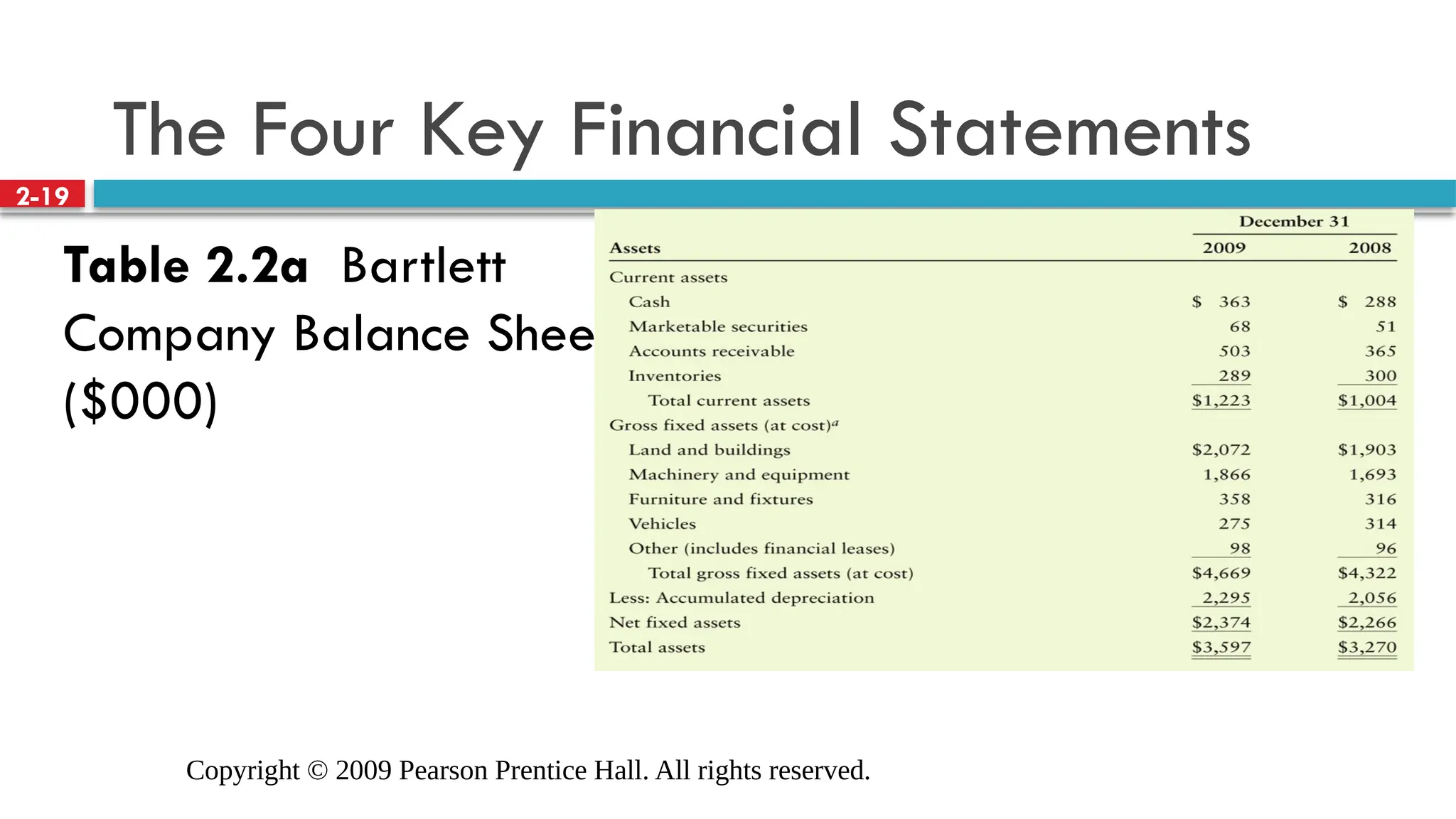
Table 2.2a Bartlett
Company Balance Sheets
($000)
Copyright © 2009 Pearson Prentice Hall. All rights reserved.
2-20
The Four Key
Financial Statements (cont.)
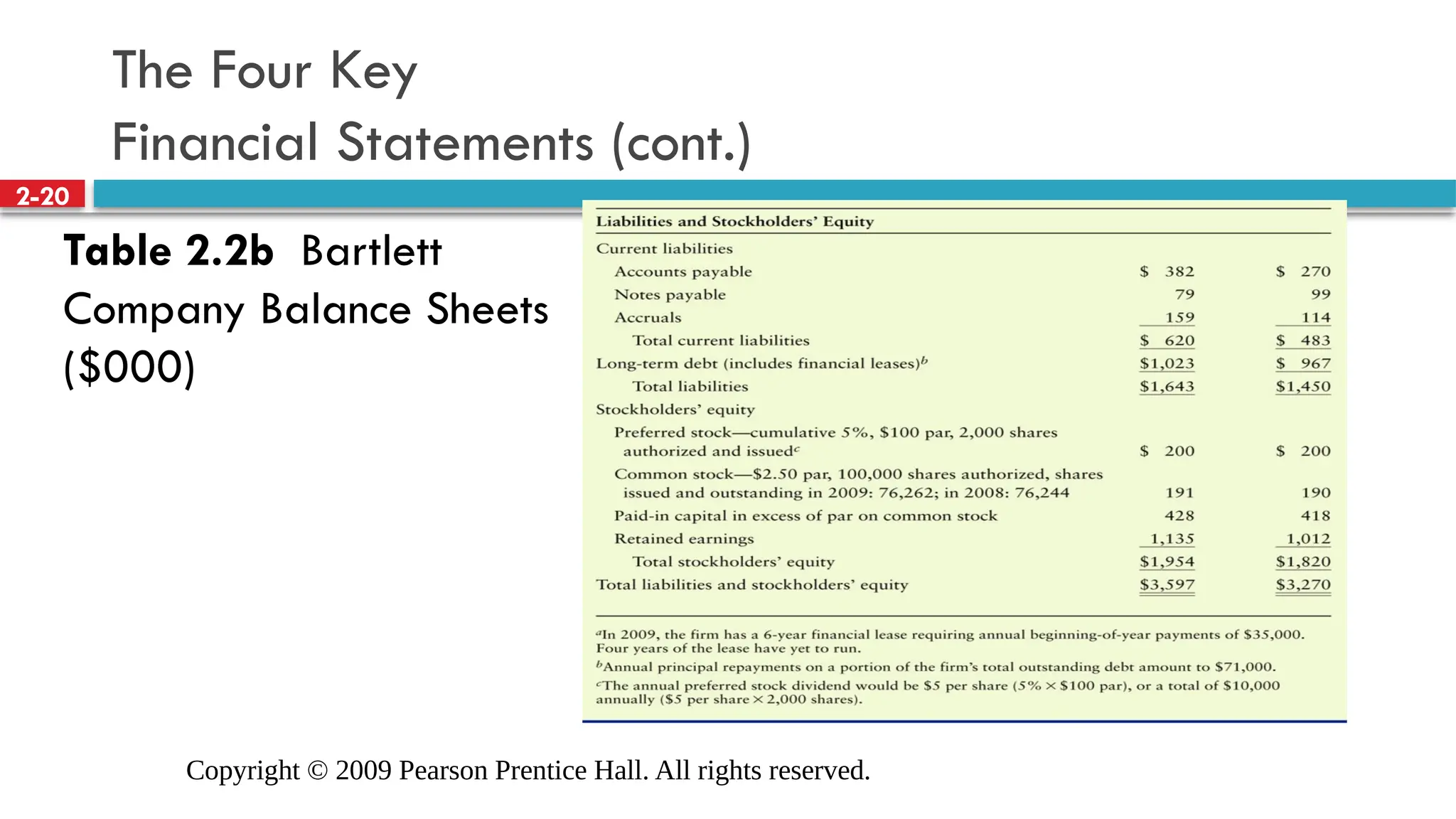
Table 2.2b Bartlett
Company Balance Sheets
($000)
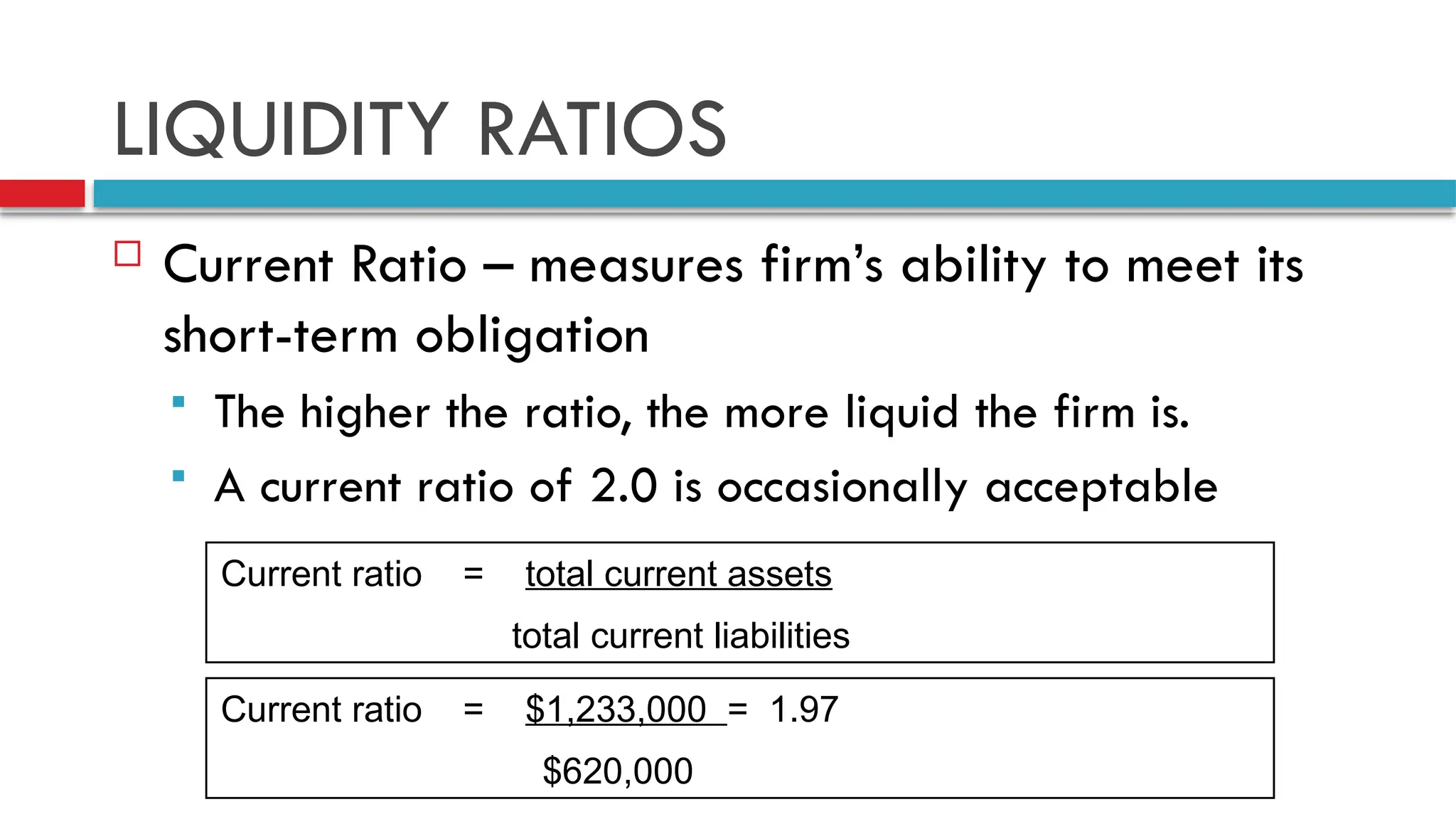
LIQUIDITY RATIOS
 Current Ratio – measures firm’s ability to meet its
short-term obligation
 The higher the ratio, the more liquid the firm is.
 A current ratio of 2.0 is occasionally acceptable
Current ratio = total current assets
total current liabilities
Current ratio = $1,233,000 = 1.97
$620,000
Liquidity Ratios – quick ratio
• Quick (acid-test) Ratio – similar to current ratio but excludes inventory and
prepaid expenses
 A quick ratio of 1.0 or greater is occasionally recommended – but
depends on the industry
Copyright © 2009 Pearson Prentice Hall. All rights reserved.
Quick ratio = Total Current Assets - Inventory
total current liabilities
Quick ratio = $1,233,000 - $289,000 = 1.51
$620,000
Copyright © 2009 Pearson Prentice Hall. All rights reserved.
Quick ratio = Total Current Assets - Inventory
total current liabilities
Quick ratio = $1,233,000 - $289,000 = 1.51
$620,000
Liquidity Ratios
– Quick Ratio
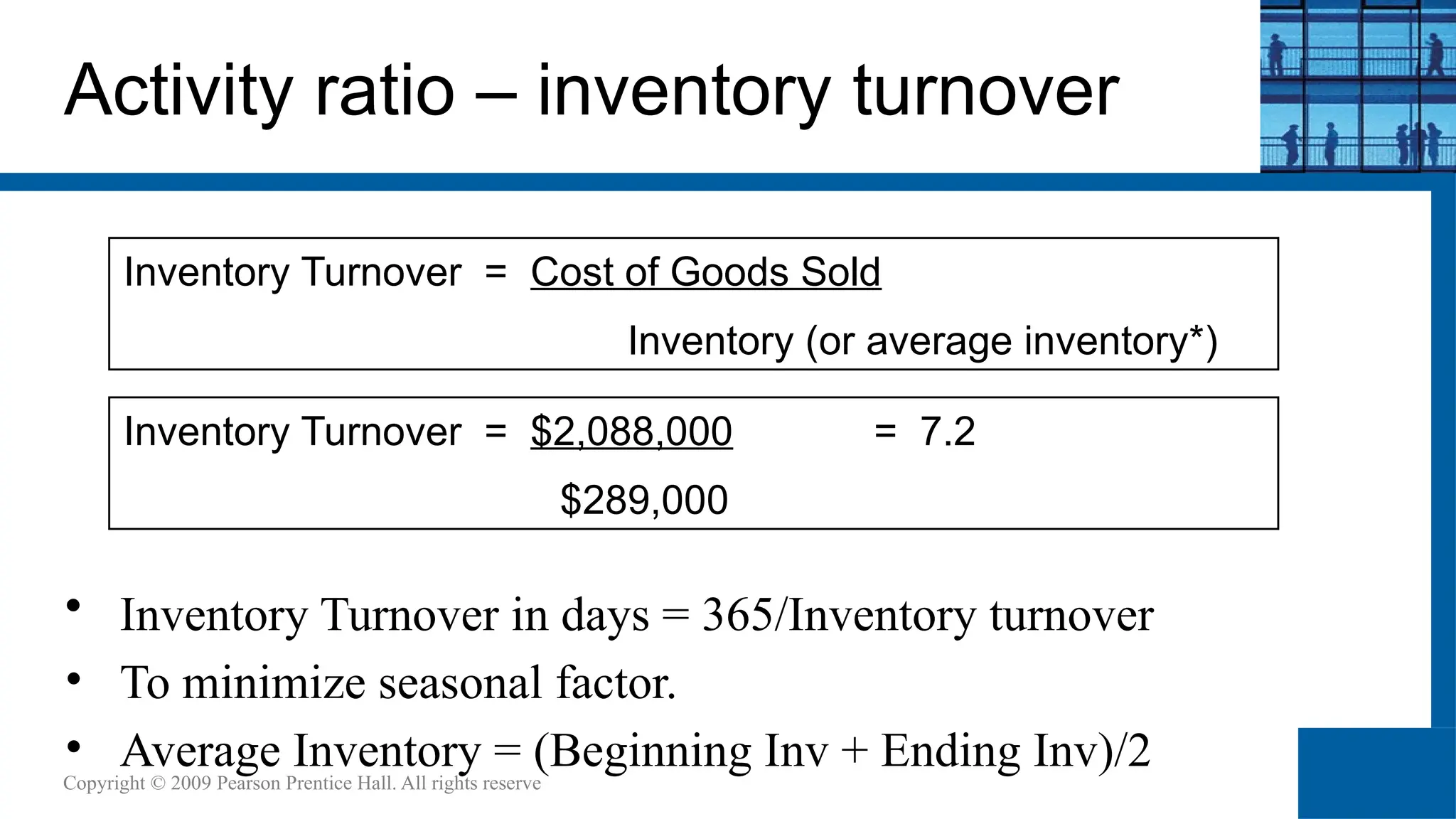
Activity ratio – inventory turnover
 Inventory Turnover – measures the
activity/liquidity of a firm’s inventory
 The higher the better but only meaningful if
compared with other firms in the same
industry (20 for grocery store, lower for an
art gallery)
Activity ratio – inventory turnover
• Inventory Turnover in days = 365/Inventory turnover
• To minimize seasonal factor.
• Average Inventory = (Beginning Inv + Ending Inv)/2
Copyright © 2009 Pearson Prentice Hall. All rights reserve
Inventory Turnover = Cost of Goods Sold
Inventory (or average inventory*)
Inventory Turnover = $2,088,000 = 7.2
$289,000
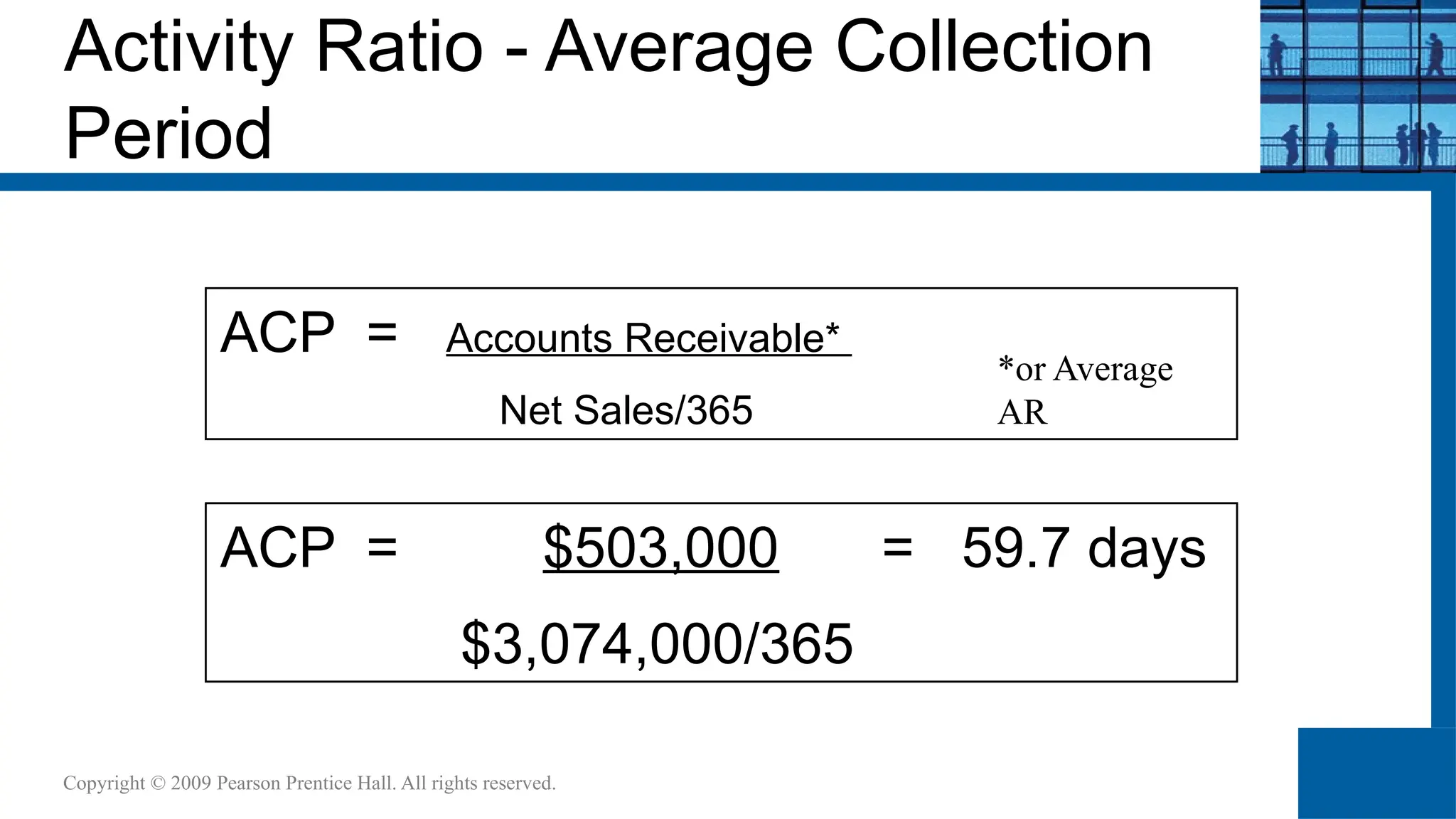
Activity Ratio - Average Collection
Period (AR Turnover)
 Average Collection Period – average amount of time
needed to collect accounts receivable
 Meaningful only in relation to the firm’s credit terms
(credit-terms 30 days and average collection period
60days – poorly managed credit)
Copyright © 2009 Pearson Prentice Hall. All rights reserved. 2-26
Activity Ratio - Average Collection
Period
Copyright © 2009 Pearson Prentice Hall. All rights reserved.
ACP = Accounts Receivable*
Net Sales/365
ACP = $503,000 = 59.7 days
$3,074,000/365
*or Average
AR
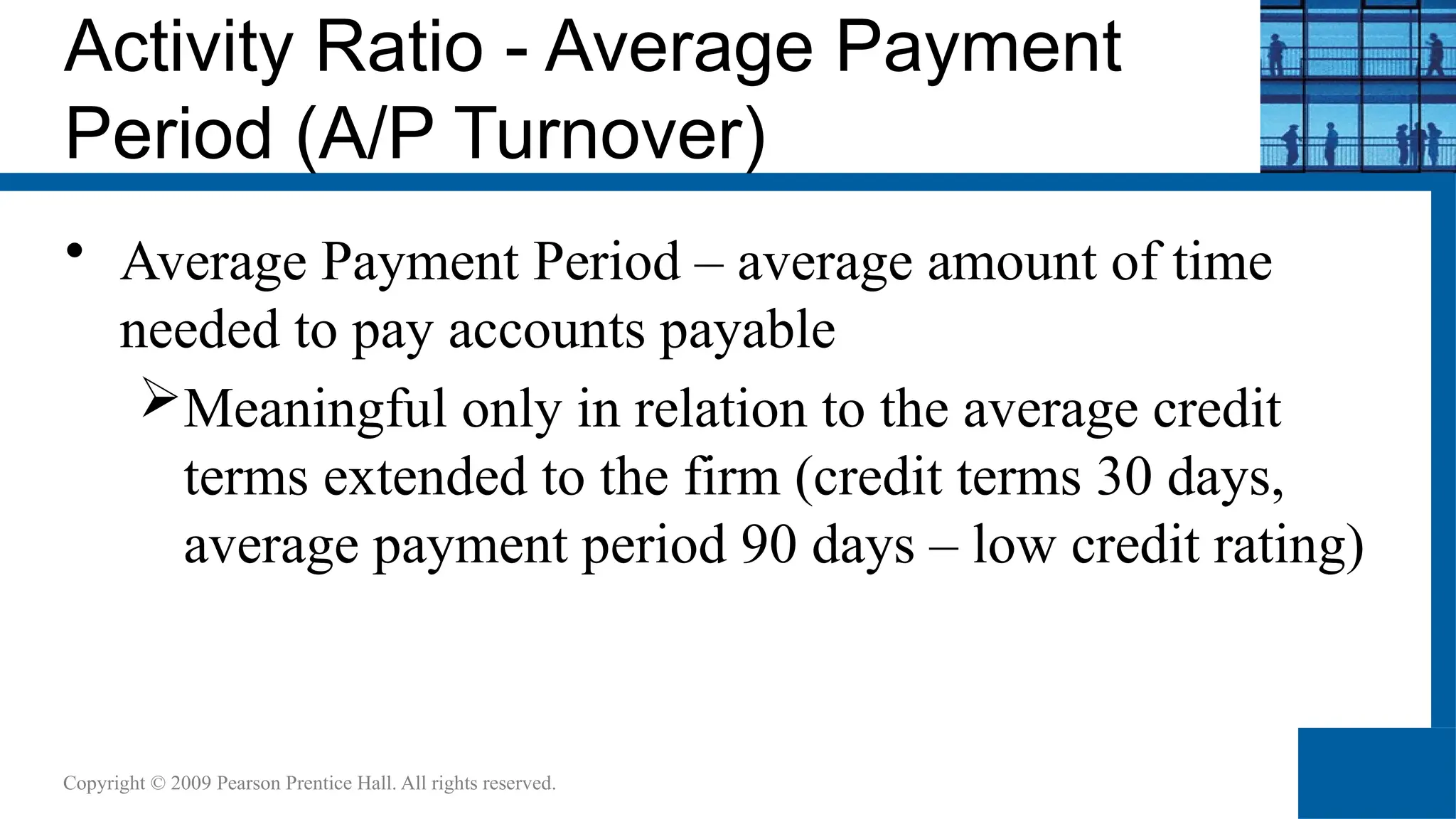
Activity Ratio - Average Payment
Period (A/P Turnover)
• Average Payment Period – average amount of time
needed to pay accounts payable
Meaningful only in relation to the average credit
terms extended to the firm (credit terms 30 days,
average payment period 90 days – low credit rating)
Copyright © 2009 Pearson Prentice Hall. All rights reserved.
APP = Accounts Payable
Annual Purchases/365
APP = $382,000 = 95.4 days
(.70 x $2,088,000)/365
Activity Ratio - Average Payment Period
AP Turnover in days=
Average AP
COGS/365
Activity ratio – Total Asset Turnover
• Total Asset Turnover – indicates the efficiency with which the firm uses its
assets to generate sales
 Generally, the higher the firm’s total asset turnover, the more efficiently its assets
have been used
Copyright © 2009 Pearson Prentice Hall. All rights reserved.
Total Asset Turnover = Net Sales
Total Assets *
Total Asset Turnover = $3,074,000 = .85
$3,597,000
* Or average TA
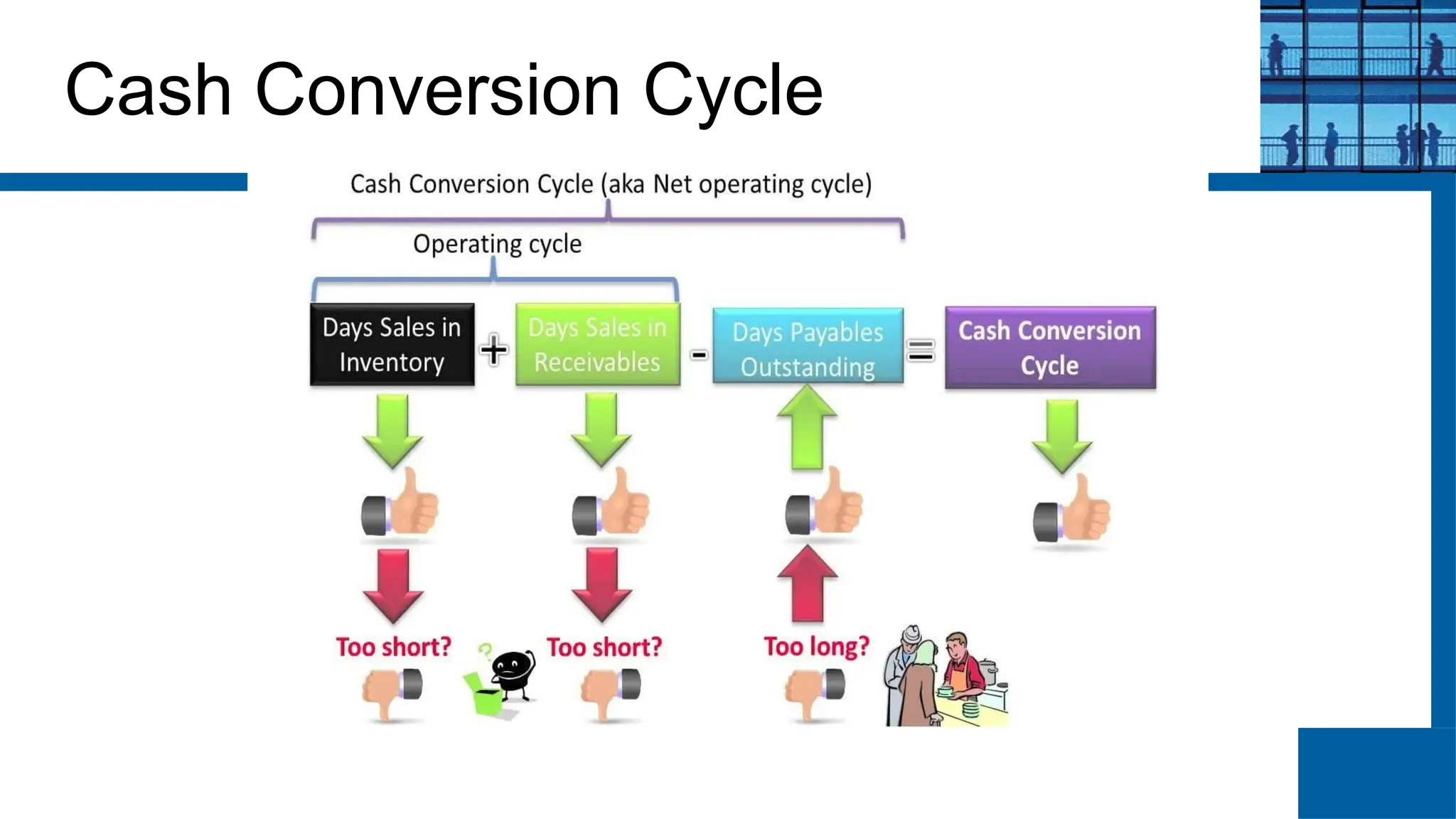
Cash Conversion Cycle (CCC)
• The length of time in days that it takes for a
company to convert resource inputs into cash
flow - It measures how fast a company can
convert cash on hand into even more cash on
hand (the shorter the better)
• CCC = Inventory turnover in days – A/P
turnover in days + A/R turnover in days
Copyright © 2009 Pearson Prentice Hall. All rights reserved.
Cash Conversion Cycle
Leverage Ratio - Debt Ratio
 Debt Ratio (Financial leverage ratio) – measures the
proportion of total assets financed by the firm’s creditors
 The higher this ratio, the greater the firms’ degree of
indebtedness, the more financial leverage it has
Debt Ratio = Total Liabilities/Total Assets
Debt Ratio = $1,643,000/$3,597,000 = 45.7%
Debt Ratio – Times Interest Earned Ratio
 Times Interest Earned Ratio (interest coverage) – measures
the firms’ ability to make contractual interest payments
 The higher the better – a value of at least 3.0 and
preferably closer to 5.0 is often suggested
Times Interest Earned = EBIT (Operating Income)/Interest
Times Interest Earned = $418,000/$93,000 = 4.5
Debt ratio - Fixed-Payment Coverage
 Fixed-Payment Coverage Ratio – measures the firms’
ability to meet all fixed-payment obligations (loan
interest and principal, lease payments, preferred stock
dividend)
 The higher, the better. Also measures risk, the lower the
ratio, the greater the risk to both lenders and owners
Copyright © 2009 Pearson Prentice Hall. All rights reserved.
2-37
FPCR = EBIT + Lease Payments________________
Interest + Lease Pymts + {(Princ Pymts + PSD) x [1/(1-t)]}
FPCR = $418,000 + $35,000 = 1.9
$93,000 + $35,000 + {($71,000 + $10,000) x [1/(1-.29)]}
Debt Ratio
 Fixed-Payment coverage Ratio (FPCR)
Debt-equity ratio
 Measures the relationship between the firm’s resources
provided through debt and those provided through
ownership (equity)
 The greater the D/E ratio is, the riskier the company is
as an investment
 Formula = Total Liabilities
Total stockholders’ equity
PROFITABILITY RATIOS
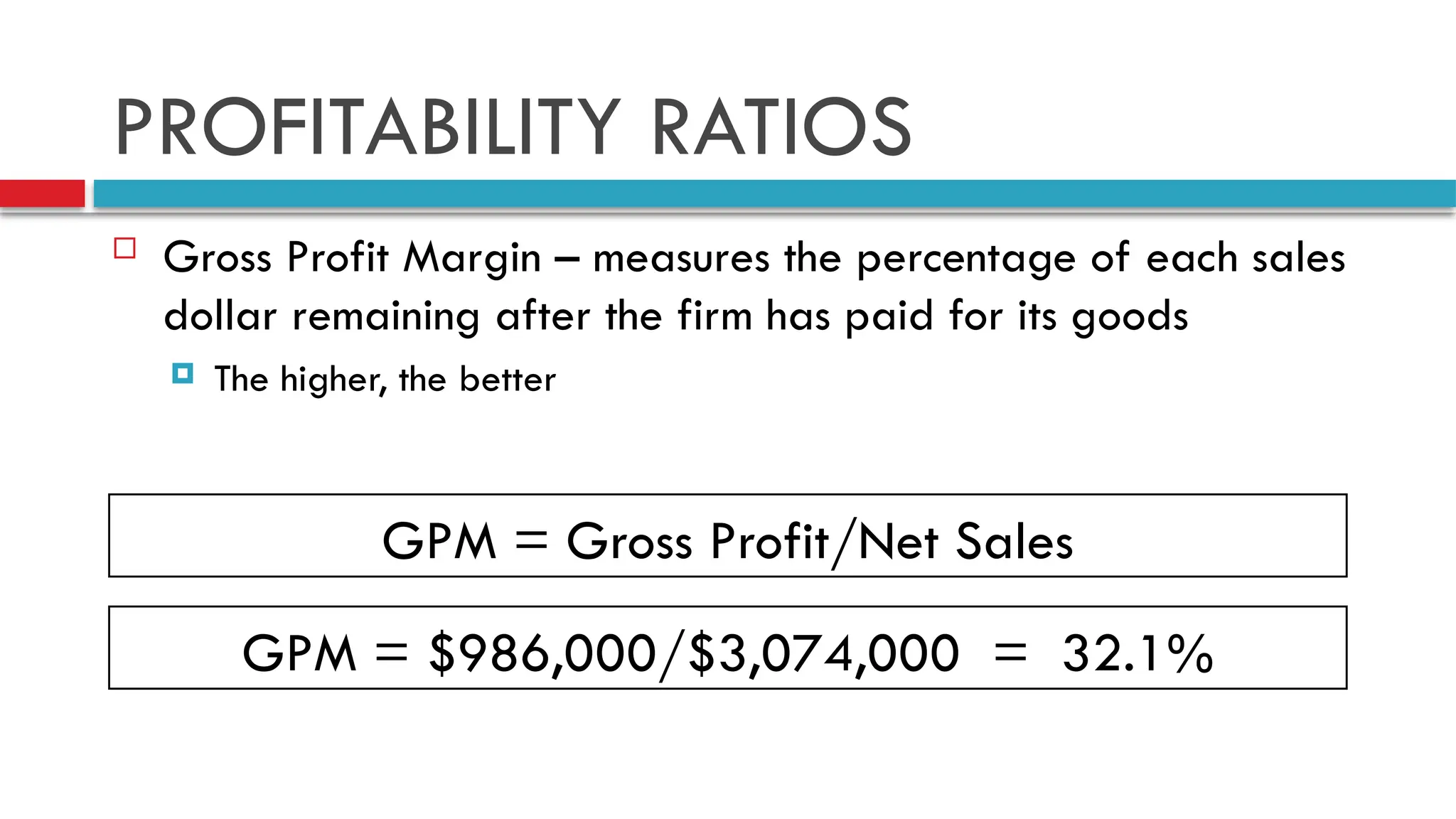
 Gross Profit Margin – measures the percentage of each sales
dollar remaining after the firm has paid for its goods
 The higher, the better
GPM = Gross Profit/Net Sales
GPM = $986,000/$3,074,000 = 32.1%
Copyright © 2009 Pearson Prentice Hall. All rights reserved.
2-40
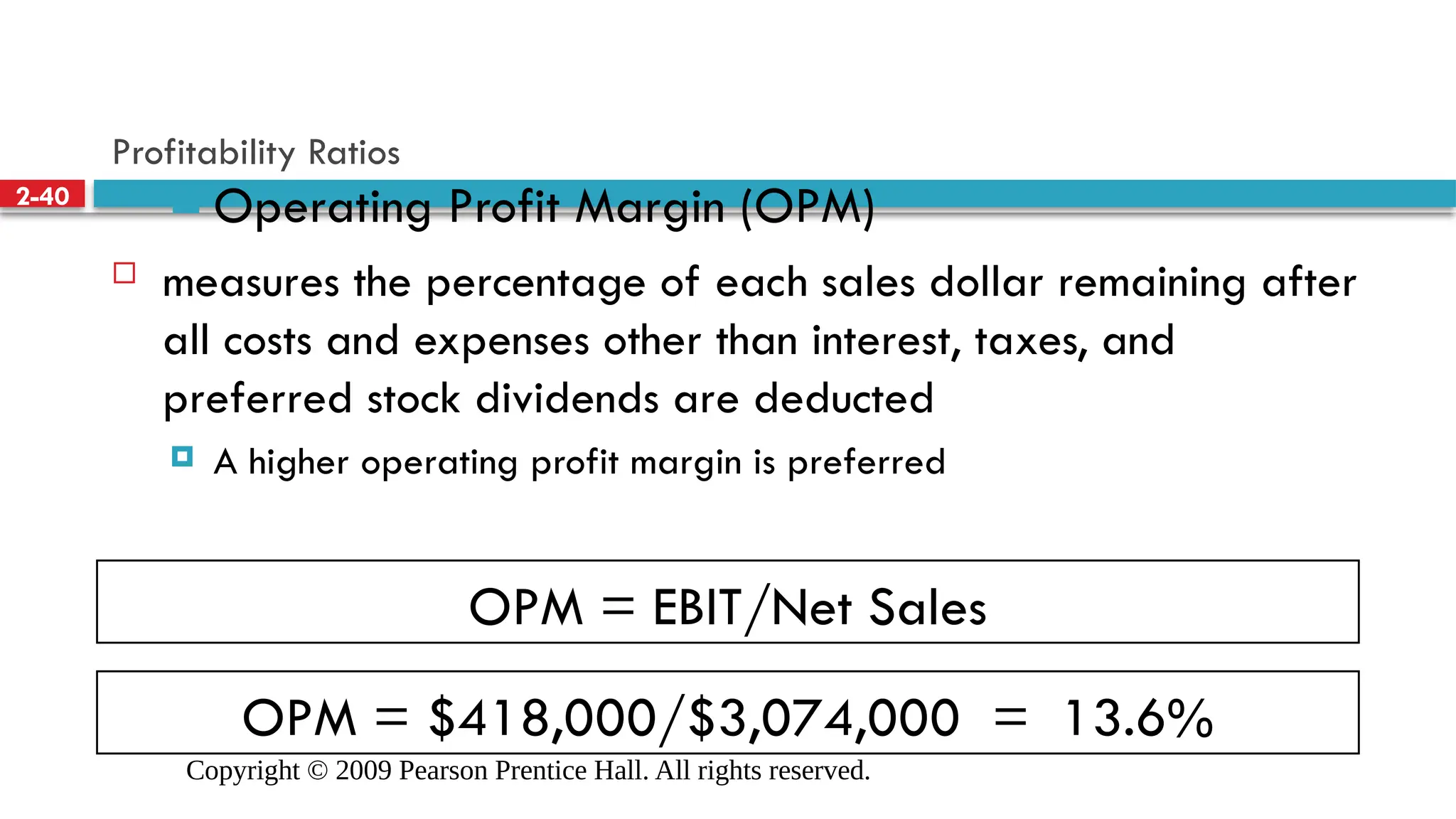
OPM = EBIT/Net Sales
OPM = $418,000/$3,074,000 = 13.6%
Profitability Ratios
 Operating Profit Margin (OPM)
 measures the percentage of each sales dollar remaining after
all costs and expenses other than interest, taxes, and
preferred stock dividends are deducted
 A higher operating profit margin is preferred
Copyright © 2009 Pearson Prentice Hall. All rights reserved.
2-41
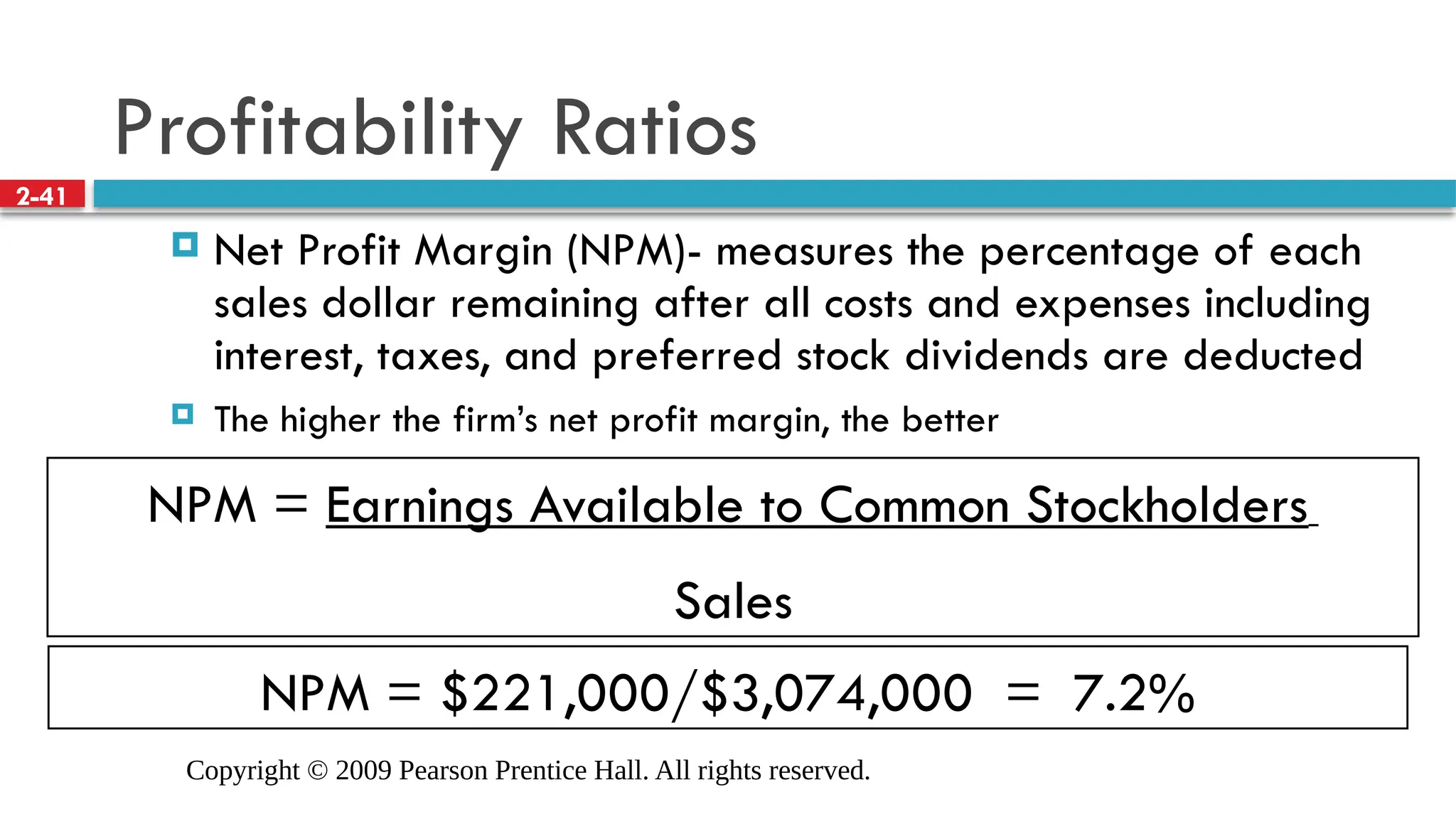
NPM = Earnings Available to Common Stockholders
Sales
NPM = $221,000/$3,074,000 = 7.2%
Profitability Ratios
 Net Profit Margin (NPM)- measures the percentage of each
sales dollar remaining after all costs and expenses including
interest, taxes, and preferred stock dividends are deducted
 The higher the firm’s net profit margin, the better
Copyright © 2009 Pearson Prentice Hall. All rights reserved.
2-42
EPS = Earnings Available to Common Stockholders
Number of Shares Outstanding
EPS = $221,000/76,262 = $2.90
Profitability Ratios
 Earnings Per Share (EPS)- represents the dollar amount
earned on behalf of each outstanding share of common
stock
 The higher, the better
Copyright © 2009 Pearson Prentice Hall. All rights reserved.
2-43
ROA = Earnings Available to Common Stockholders
Total Assets or Average TA
ROA = $221,000/$3,597,000 = 6.1%
Profitability Ratios
 Return on Total Assets (ROA) - measures the overall
effectiveness of management in generating profits with its
available assets – return on investment
 The higher, the better
Copyright © 2009 Pearson Prentice Hall. All rights reserved.
2-44
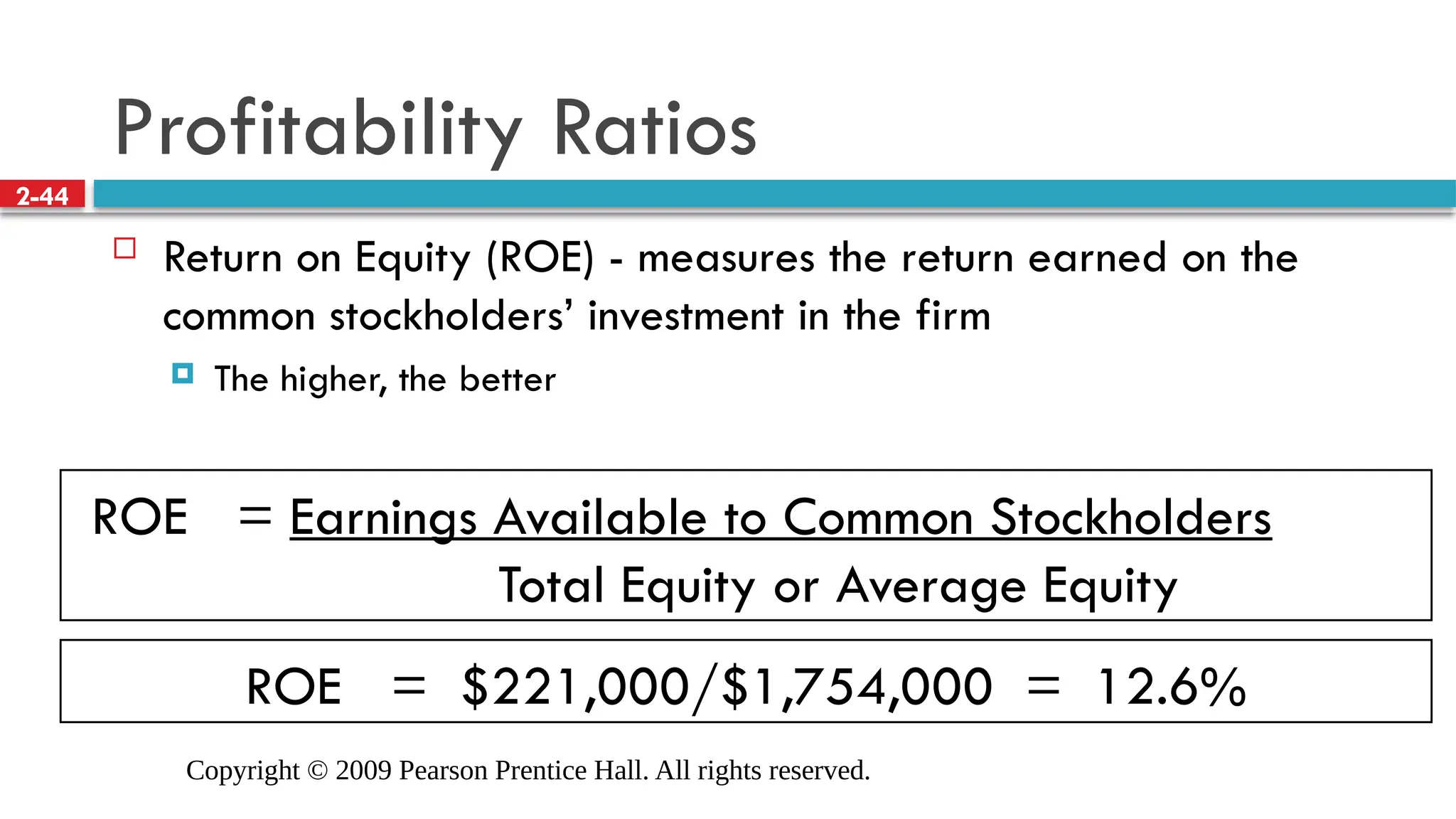
ROE = $221,000/$1,754,000 = 12.6%
ROE = Earnings Available to Common Stockholders
Total Equity or Average Equity
Profitability Ratios
 Return on Equity (ROE) - measures the return earned on the
common stockholders’ investment in the firm
 The higher, the better
Copyright © 2009 Pearson Prentice Hall. All rights reserved.
2-45
P/E = Market Price Per Share of Common Stock
Earnings Per Share
P/E = $32.25/$2.90 = 11.1
Market Ratios
 Price Earnings (P/E) Ratio - measures the amount that investors are willing
to pay for each dollar of a firm’s earnings
 Indicates the degree of confidence that investors have in the firm’s
future performance (the higher, the greater the confidence)
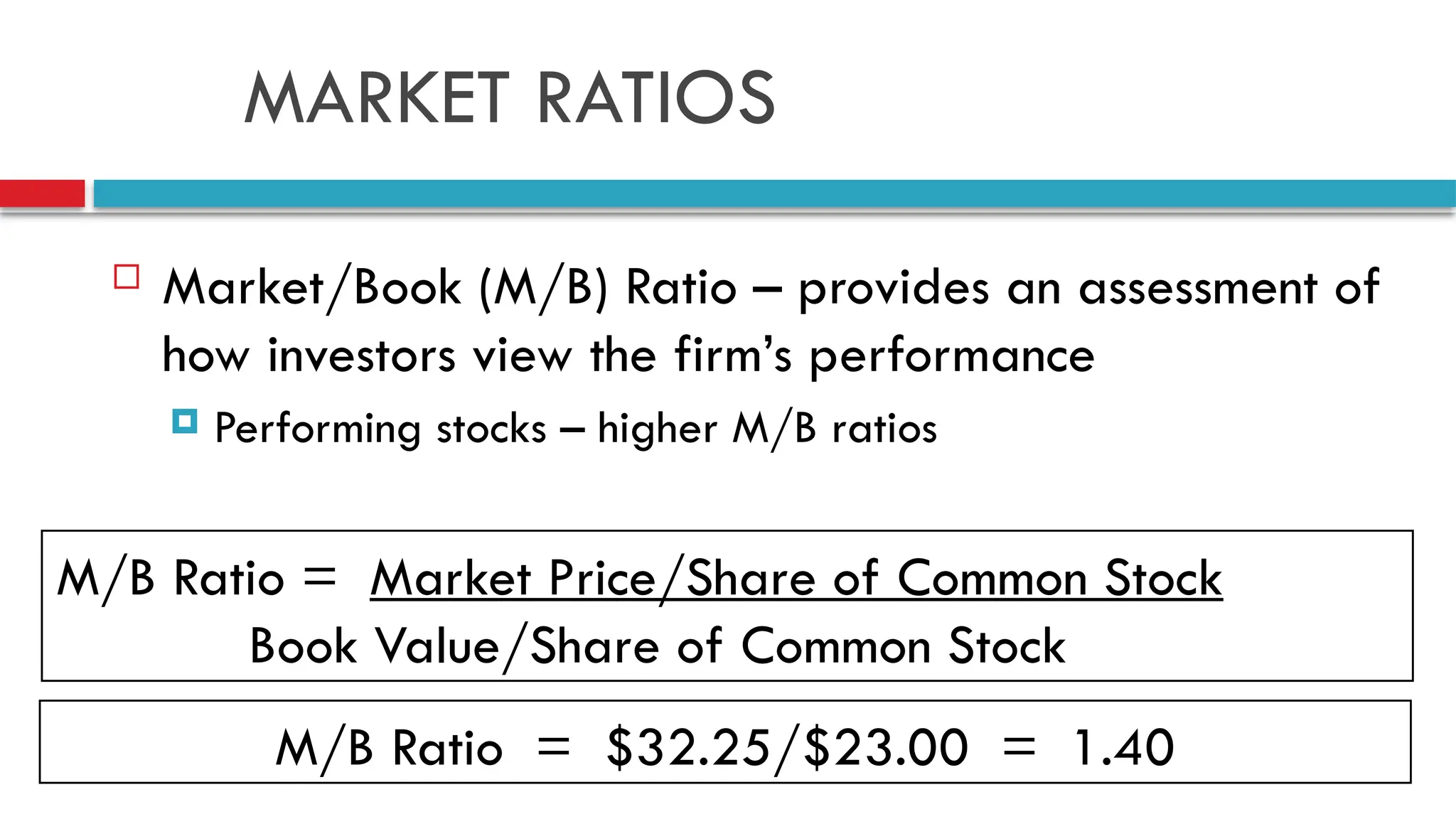
MARKET RATIOS
 Market/Book (M/B) Ratio – provides an assessment of
how investors view the firm’s performance
 Performing stocks – higher M/B ratios
M/B Ratio = Market Price/Share of Common Stock
Book Value/Share of Common Stock
M/B Ratio = $32.25/$23.00 = 1.40
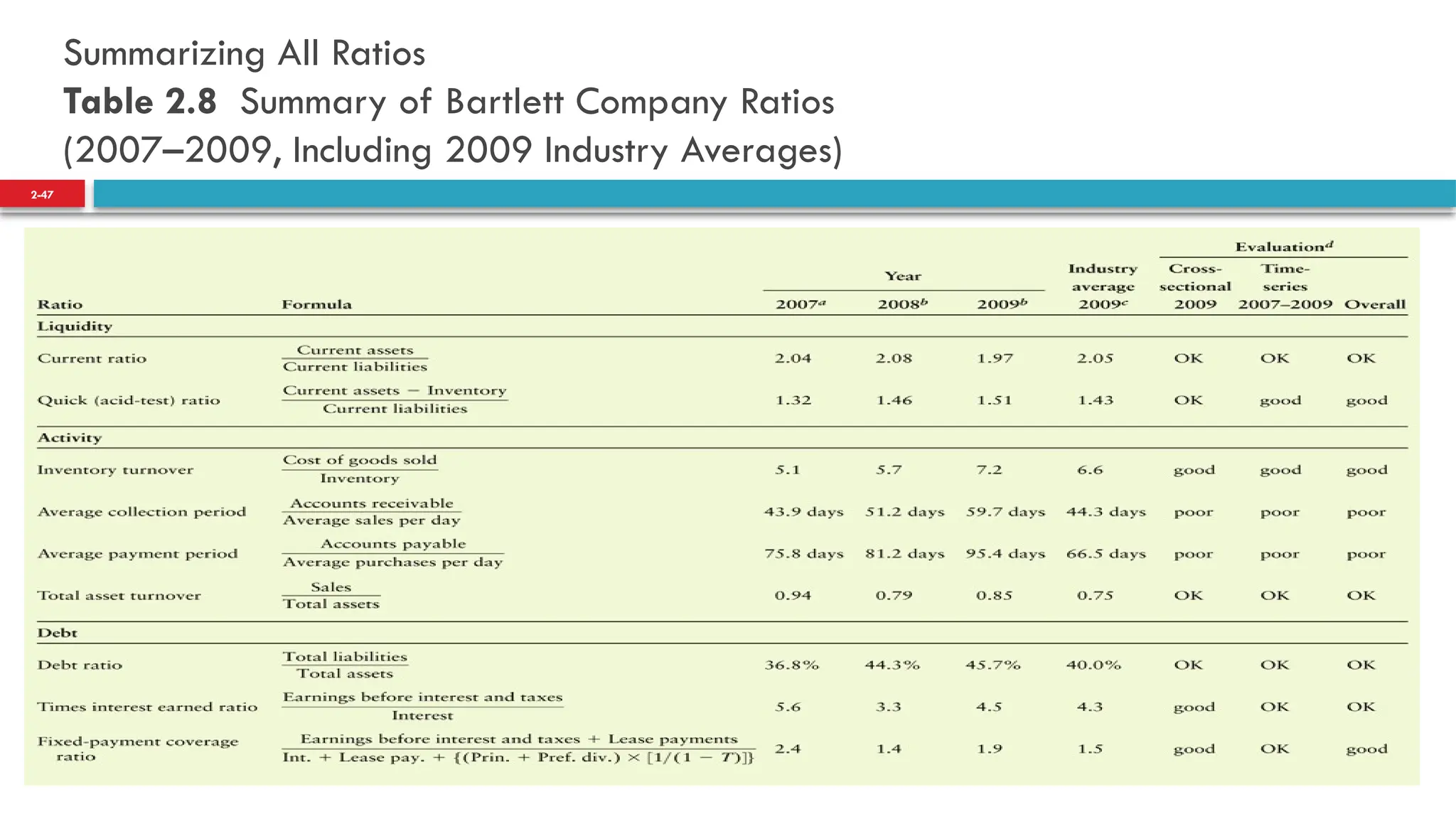
Summarizing All Ratios
Table 2.8 Summary of Bartlett Company Ratios
(2007–2009, Including 2009 Industry Averages)
2-47
Summarizing All Ratios (cont.)
Table 2.8 Summary of Bartlett Company Ratios
(2007–2009, Including 2009 Industry Averages)
2-48
Copyright © 2009 Pearson Prentice Hall. All rights reserved.
2-
49
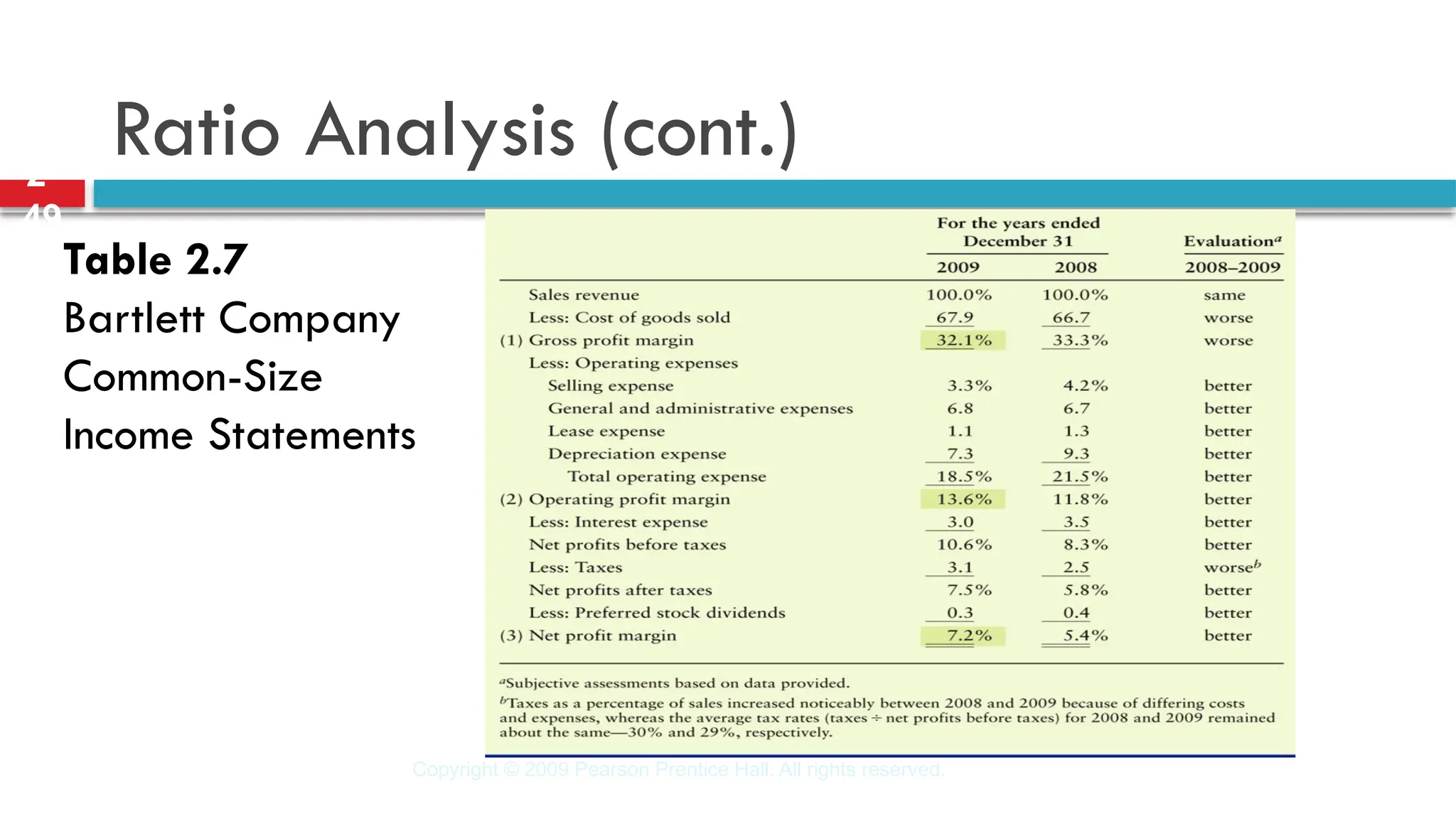
Ratio Analysis (cont.)
Table 2.7
Bartlett Company
Common-Size
Income Statements
Copyright © 2009 Pearson Prentice Hall. All rights reserved.
2-
50
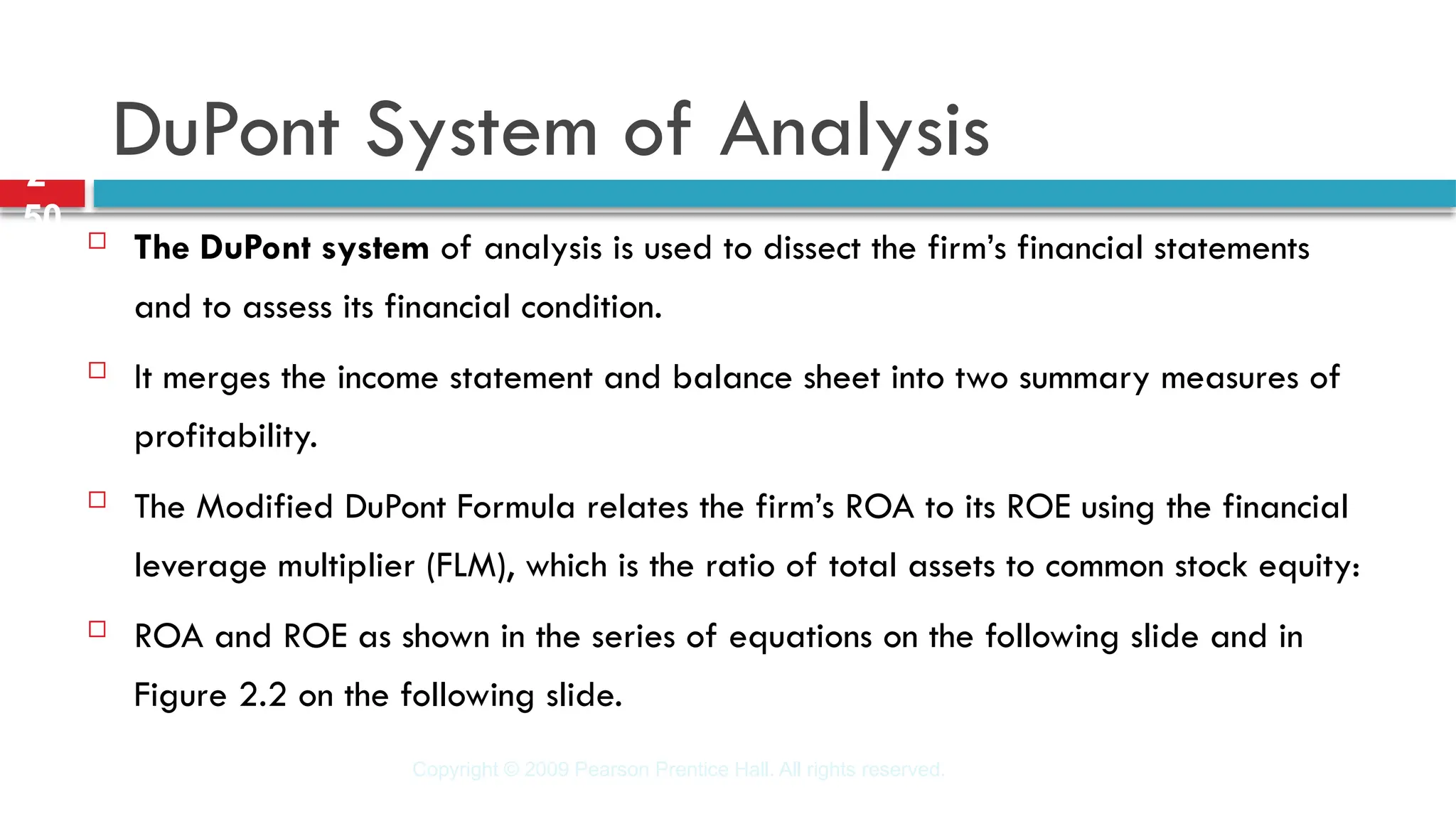
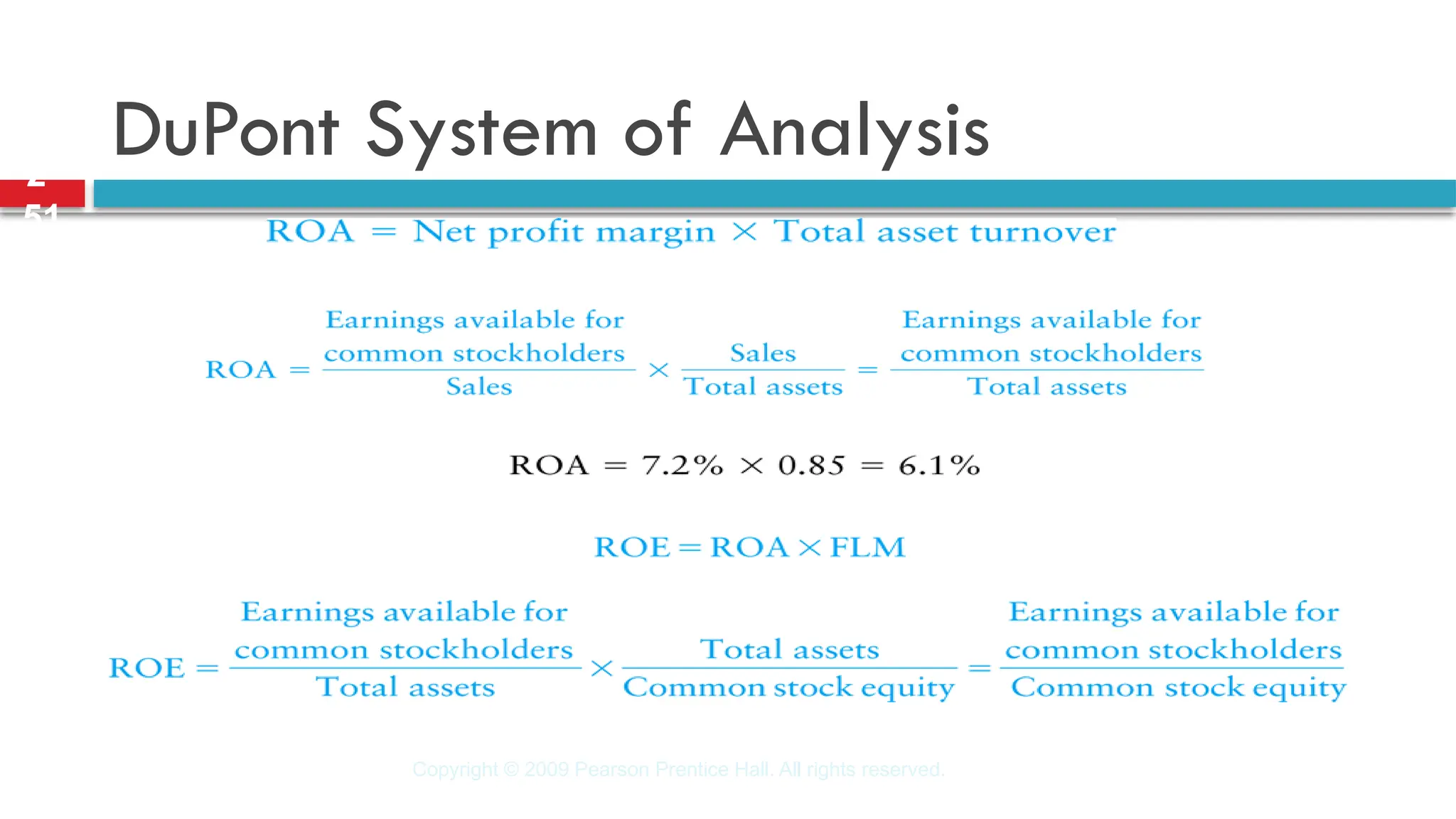
DuPont System of Analysis
 The DuPont system of analysis is used to dissect the firm’s financial statements
and to assess its financial condition.
 It merges the income statement and balance sheet into two summary measures of
profitability.
 The Modified DuPont Formula relates the firm’s ROA to its ROE using the financial
leverage multiplier (FLM), which is the ratio of total assets to common stock equity:
 ROA and ROE as shown in the series of equations on the following slide and in
Figure 2.2 on the following slide.
Copyright © 2009 Pearson Prentice Hall. All rights reserved.
2-
51
DuPont System of Analysis
Copyright © 2009 Pearson Prentice Hall. All rights reserved.
2-
52
DuPont System of Analysis (cont.)
Figure 2.2 DuPont
System of Analysis
Copyright © 2009 Pearson Prentice Hall. All rights reserved.
2-
53
ROE = 6.1% X 2.06 = 12.6%
Modified DuPont Formula (cont.)
 Use of the FLM to convert ROA into ROE reflects the
impact of financial leverage on the owner’s return.
 Substituting the values for Bartlett Company’s ROA of
6.1 percent calculated earlier, and Bartlett’s FLM of
2.06 ($3,597,000 total assets ÷ $1,754,000 common
stock equity) into the Modified DuPont formula yields:

Financial Statement Analysis - Annual Report Analysis

  • 1.
  • 2.
    Page 14-2 Analyzing financial statementsinvolves: Basics of Financial Statement Analysis Characteristics Comparison Bases Tools of Analysis Liquidity Profitability Solvency Intracompany Industry averages Intercompany Horizontal Vertical Ratio SO 1 Discuss the need for comparative analysis. SO 2 Identify the tools of financial statement
  • 3.
    Page 14-3 SO 3Explain and apply horizontal analysis. Horizontal Analysis Horizontal analysis, also called trend analysis, is a technique for evaluating a series of financial statement data over a period of time. Its purpose is to determine the increase or decrease that has taken place. Horizontal analysis is commonly applied to the balance sheet, income statement, and statement of retained earnings.
  • 4.
    Page 14-4 SO 3Explain and apply horizontal analysis. These changes suggest that the company expanded its asset base during 2007 and financed this expansion primarily by retaining income rather than assuming additional long-term debt. Horizontal Analysis Balance Sheet Illustration 14-5 Horizontal analysis of balance sheets
  • 5.
    Page 14-5 SO 3Explain and apply horizontal analysis. Overall, gross profit and net income were up substantially. Gross profit increased 17.1%, and net income, 26.5%. Quality’s profit trend appears favorable. Horizontal Analysis Income Statement Illustration 14-6 Horizontal analysis of Income statements
  • 6.
    Page 14-6 SO 3Explain and apply horizontal analysis. We saw in the horizontal analysis of the balance sheet that ending retained earnings increased 38.6%. As indicated earlier, the company retained a significant portion of net income to finance additional plant facilities. Horizontal Analysis Illustration 14-7 Horizontal analysis of retained earnings statements Retained Earnings Statement
  • 7.
    Page 14-7 Summary financial informationfor Rosepatch Company is as follows. Solution on notes page SO 3 Explain and apply horizontal analysis. Horizontal Analysis Compute the amount and percentage changes in 2011 using horizontal analysis, assuming 2010 is the base year.
  • 8.
    Page 14-8 SO 4Describe and apply vertical analysis. Vertical Analysis Vertical analysis, also called common-size analysis, is a technique that expresses each financial statement item as a percent of a base amount. On an income statement, we might say that selling expenses are 16% of net sales. Vertical analysis is commonly applied to the balance sheet and the income statement.
  • 9.
    Page 14-9 These results reinforce the earlierobservations that Quality is choosing to finance its growth through retention of earnings rather than through issuing additional debt. Balance Sheet Illustration 14-8 Vertical analysis of balance sheets SO 4 Describe and apply vertical analysis. Vertical Analysis
  • 10.
    Page 14-10 Quality appears to bea profitable enterprise that is becoming even more successful. Income Statement Illustration 14-9 Vertical analysis of Income statements SO 4 Describe and apply vertical analysis. Vertical Analysis
  • 11.
    Page 14-11 Enables a comparisonof companies of different sizes. Illustration 14-10 Intercompany income statement comparison SO 4 Describe and apply vertical analysis. Vertical Analysis J.C. Penney earned net income more than 4,208 times larger than Quality’s, J.C. Penney’s net income as a percent of each sales dollar (5.6%) is only 44% of Quality’s (12.6%).
  • 12.
    Basic Financial Analysis Ratio analysis involves methods of calculating and interpreting financial ratios to assess a firm’s financial condition and performance.  It is of interest to shareholders, creditors, and the firm’s own management
  • 13.
    BASIC FINANCIAL ANALYSIS Ratio analysis involves methods of calculating and interpreting financial ratios to assess a firm’s financial condition and performance.  It is of interest to shareholders, creditors, and the firm’s own management
  • 14.
    Using Financial Ratios: Typesof Ratio Comparisons  Trend or time-series analysis  Used to evaluate a firm’s performance over time  Cross-sectional analysis  Used to compare different firms at the same point in time
  • 15.
    Using Financial Ratios: Typesof Ratio Comparisons (cont.)  Cross-sectional analysis  Industry comparative analysis  One specific type of cross sectional analysis. Used to compare one firm’s financial performance to the industry’s average performance  Benchmarking  A type of cross sectional analysis in which the firm’s ratio values are compared to those of a key competitor or group of competitors that it wishes to emulate
  • 16.
    Using Financial Ratios: Typesof Ratio Comparisons (cont.)  Trend or time-series analysis  Cross-sectional analysis  Combined Analysis  Combined analysis simply uses a combination of both time series analysis and cross-sectional analysis
  • 17.
    Ratio Analysis  LiquidityRatios – measures capacity to meet short term obligation  Activity Ratios – measures effective use of resources  Leverage (gearing) Ratios – measures indebtedness  Profitability Ratios – measures overall profitability  Market Ratios – measures based on market price of shares - important to investors
  • 18.
    Copyright © 2009Pearson Prentice Hall. All rights reserved. 2-18 The Four Key Financial Statements Table 2.1 Bartlett Company Income Statements ($000)
  • 19.
    Copyright © 2009Pearson Prentice Hall. All rights reserved. 2-19 The Four Key Financial Statements Table 2.2a Bartlett Company Balance Sheets ($000)
  • 20.
    Copyright © 2009Pearson Prentice Hall. All rights reserved. 2-20 The Four Key Financial Statements (cont.) Table 2.2b Bartlett Company Balance Sheets ($000)
  • 21.
    LIQUIDITY RATIOS  CurrentRatio – measures firm’s ability to meet its short-term obligation  The higher the ratio, the more liquid the firm is.  A current ratio of 2.0 is occasionally acceptable Current ratio = total current assets total current liabilities Current ratio = $1,233,000 = 1.97 $620,000
  • 22.
    Liquidity Ratios –quick ratio • Quick (acid-test) Ratio – similar to current ratio but excludes inventory and prepaid expenses  A quick ratio of 1.0 or greater is occasionally recommended – but depends on the industry Copyright © 2009 Pearson Prentice Hall. All rights reserved. Quick ratio = Total Current Assets - Inventory total current liabilities Quick ratio = $1,233,000 - $289,000 = 1.51 $620,000
  • 23.
    Copyright © 2009Pearson Prentice Hall. All rights reserved. Quick ratio = Total Current Assets - Inventory total current liabilities Quick ratio = $1,233,000 - $289,000 = 1.51 $620,000 Liquidity Ratios – Quick Ratio
  • 24.
    Activity ratio –inventory turnover  Inventory Turnover – measures the activity/liquidity of a firm’s inventory  The higher the better but only meaningful if compared with other firms in the same industry (20 for grocery store, lower for an art gallery)
  • 25.
    Activity ratio –inventory turnover • Inventory Turnover in days = 365/Inventory turnover • To minimize seasonal factor. • Average Inventory = (Beginning Inv + Ending Inv)/2 Copyright © 2009 Pearson Prentice Hall. All rights reserve Inventory Turnover = Cost of Goods Sold Inventory (or average inventory*) Inventory Turnover = $2,088,000 = 7.2 $289,000
  • 26.
    Activity Ratio -Average Collection Period (AR Turnover)  Average Collection Period – average amount of time needed to collect accounts receivable  Meaningful only in relation to the firm’s credit terms (credit-terms 30 days and average collection period 60days – poorly managed credit) Copyright © 2009 Pearson Prentice Hall. All rights reserved. 2-26
  • 27.
    Activity Ratio -Average Collection Period Copyright © 2009 Pearson Prentice Hall. All rights reserved. ACP = Accounts Receivable* Net Sales/365 ACP = $503,000 = 59.7 days $3,074,000/365 *or Average AR
  • 28.
    Activity Ratio -Average Payment Period (A/P Turnover) • Average Payment Period – average amount of time needed to pay accounts payable Meaningful only in relation to the average credit terms extended to the firm (credit terms 30 days, average payment period 90 days – low credit rating) Copyright © 2009 Pearson Prentice Hall. All rights reserved.
  • 29.
    Copyright © 2009Pearson Prentice Hall. All rights reserved. APP = Accounts Payable Annual Purchases/365 APP = $382,000 = 95.4 days (.70 x $2,088,000)/365 Activity Ratio - Average Payment Period AP Turnover in days= Average AP COGS/365
  • 30.
    Activity ratio –Total Asset Turnover • Total Asset Turnover – indicates the efficiency with which the firm uses its assets to generate sales  Generally, the higher the firm’s total asset turnover, the more efficiently its assets have been used Copyright © 2009 Pearson Prentice Hall. All rights reserved. Total Asset Turnover = Net Sales Total Assets * Total Asset Turnover = $3,074,000 = .85 $3,597,000 * Or average TA
  • 31.
    Cash Conversion Cycle(CCC) • The length of time in days that it takes for a company to convert resource inputs into cash flow - It measures how fast a company can convert cash on hand into even more cash on hand (the shorter the better) • CCC = Inventory turnover in days – A/P turnover in days + A/R turnover in days Copyright © 2009 Pearson Prentice Hall. All rights reserved.
  • 32.
  • 33.
  • 34.
    Leverage Ratio -Debt Ratio  Debt Ratio (Financial leverage ratio) – measures the proportion of total assets financed by the firm’s creditors  The higher this ratio, the greater the firms’ degree of indebtedness, the more financial leverage it has Debt Ratio = Total Liabilities/Total Assets Debt Ratio = $1,643,000/$3,597,000 = 45.7%
  • 35.
    Debt Ratio –Times Interest Earned Ratio  Times Interest Earned Ratio (interest coverage) – measures the firms’ ability to make contractual interest payments  The higher the better – a value of at least 3.0 and preferably closer to 5.0 is often suggested Times Interest Earned = EBIT (Operating Income)/Interest Times Interest Earned = $418,000/$93,000 = 4.5
  • 36.
    Debt ratio -Fixed-Payment Coverage  Fixed-Payment Coverage Ratio – measures the firms’ ability to meet all fixed-payment obligations (loan interest and principal, lease payments, preferred stock dividend)  The higher, the better. Also measures risk, the lower the ratio, the greater the risk to both lenders and owners
  • 37.
    Copyright © 2009Pearson Prentice Hall. All rights reserved. 2-37 FPCR = EBIT + Lease Payments________________ Interest + Lease Pymts + {(Princ Pymts + PSD) x [1/(1-t)]} FPCR = $418,000 + $35,000 = 1.9 $93,000 + $35,000 + {($71,000 + $10,000) x [1/(1-.29)]} Debt Ratio  Fixed-Payment coverage Ratio (FPCR)
  • 38.
    Debt-equity ratio  Measuresthe relationship between the firm’s resources provided through debt and those provided through ownership (equity)  The greater the D/E ratio is, the riskier the company is as an investment  Formula = Total Liabilities Total stockholders’ equity
  • 39.
    PROFITABILITY RATIOS  GrossProfit Margin – measures the percentage of each sales dollar remaining after the firm has paid for its goods  The higher, the better GPM = Gross Profit/Net Sales GPM = $986,000/$3,074,000 = 32.1%
  • 40.
    Copyright © 2009Pearson Prentice Hall. All rights reserved. 2-40 OPM = EBIT/Net Sales OPM = $418,000/$3,074,000 = 13.6% Profitability Ratios  Operating Profit Margin (OPM)  measures the percentage of each sales dollar remaining after all costs and expenses other than interest, taxes, and preferred stock dividends are deducted  A higher operating profit margin is preferred
  • 41.
    Copyright © 2009Pearson Prentice Hall. All rights reserved. 2-41 NPM = Earnings Available to Common Stockholders Sales NPM = $221,000/$3,074,000 = 7.2% Profitability Ratios  Net Profit Margin (NPM)- measures the percentage of each sales dollar remaining after all costs and expenses including interest, taxes, and preferred stock dividends are deducted  The higher the firm’s net profit margin, the better
  • 42.
    Copyright © 2009Pearson Prentice Hall. All rights reserved. 2-42 EPS = Earnings Available to Common Stockholders Number of Shares Outstanding EPS = $221,000/76,262 = $2.90 Profitability Ratios  Earnings Per Share (EPS)- represents the dollar amount earned on behalf of each outstanding share of common stock  The higher, the better
  • 43.
    Copyright © 2009Pearson Prentice Hall. All rights reserved. 2-43 ROA = Earnings Available to Common Stockholders Total Assets or Average TA ROA = $221,000/$3,597,000 = 6.1% Profitability Ratios  Return on Total Assets (ROA) - measures the overall effectiveness of management in generating profits with its available assets – return on investment  The higher, the better
  • 44.
    Copyright © 2009Pearson Prentice Hall. All rights reserved. 2-44 ROE = $221,000/$1,754,000 = 12.6% ROE = Earnings Available to Common Stockholders Total Equity or Average Equity Profitability Ratios  Return on Equity (ROE) - measures the return earned on the common stockholders’ investment in the firm  The higher, the better
  • 45.
    Copyright © 2009Pearson Prentice Hall. All rights reserved. 2-45 P/E = Market Price Per Share of Common Stock Earnings Per Share P/E = $32.25/$2.90 = 11.1 Market Ratios  Price Earnings (P/E) Ratio - measures the amount that investors are willing to pay for each dollar of a firm’s earnings  Indicates the degree of confidence that investors have in the firm’s future performance (the higher, the greater the confidence)
  • 46.
    MARKET RATIOS  Market/Book(M/B) Ratio – provides an assessment of how investors view the firm’s performance  Performing stocks – higher M/B ratios M/B Ratio = Market Price/Share of Common Stock Book Value/Share of Common Stock M/B Ratio = $32.25/$23.00 = 1.40
  • 47.
    Summarizing All Ratios Table2.8 Summary of Bartlett Company Ratios (2007–2009, Including 2009 Industry Averages) 2-47
  • 48.
    Summarizing All Ratios(cont.) Table 2.8 Summary of Bartlett Company Ratios (2007–2009, Including 2009 Industry Averages) 2-48
  • 49.
    Copyright © 2009Pearson Prentice Hall. All rights reserved. 2- 49 Ratio Analysis (cont.) Table 2.7 Bartlett Company Common-Size Income Statements
  • 50.
    Copyright © 2009Pearson Prentice Hall. All rights reserved. 2- 50 DuPont System of Analysis  The DuPont system of analysis is used to dissect the firm’s financial statements and to assess its financial condition.  It merges the income statement and balance sheet into two summary measures of profitability.  The Modified DuPont Formula relates the firm’s ROA to its ROE using the financial leverage multiplier (FLM), which is the ratio of total assets to common stock equity:  ROA and ROE as shown in the series of equations on the following slide and in Figure 2.2 on the following slide.
  • 51.
    Copyright © 2009Pearson Prentice Hall. All rights reserved. 2- 51 DuPont System of Analysis
  • 52.
    Copyright © 2009Pearson Prentice Hall. All rights reserved. 2- 52 DuPont System of Analysis (cont.) Figure 2.2 DuPont System of Analysis
  • 53.
    Copyright © 2009Pearson Prentice Hall. All rights reserved. 2- 53 ROE = 6.1% X 2.06 = 12.6% Modified DuPont Formula (cont.)  Use of the FLM to convert ROA into ROE reflects the impact of financial leverage on the owner’s return.  Substituting the values for Bartlett Company’s ROA of 6.1 percent calculated earlier, and Bartlett’s FLM of 2.06 ($3,597,000 total assets ÷ $1,754,000 common stock equity) into the Modified DuPont formula yields: