Blue Ocean Strategy
By: Diana Duran, Candice Brewer, Lane Morgan, Johnathan Angell & Tony Polito
U.S. Wine Sales
•$20 billion industry
•California wine captures two-thirds of all U.S.
wine sales. Compete with imported wines.
•Top 8 companies produce 75% of wine in the
U.S., and 1,600 other companies make up
remaining 25%.
•Supply is increasing and demand is flat.
The Strategy Canvas
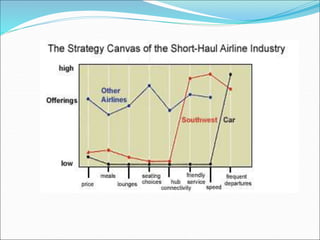
•The Strategy Canvas is a diagnostic and an
action framework for building a compelling
blue ocean strategy
•The Purpose:
- Captures the current state of play in the
known marketplace
Current State of Play in the
Marketplace
•Where the competition is investing
•The factors that the industry currently competes
on in products, service & delivery
•What customers receive from the existing
competitive offerings on the market
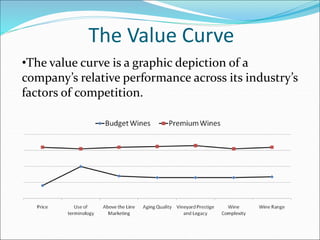
The Value Curve
•The value curve is a graphic depiction of a
company’s relative performance across its industry’s
factors of competition.
The Strategy Canvas Cont’d
•To shift the strategy canvas of an industry,
you must begin by reorienting your strategic
focus from competitors to alternatives, and
from customers to noncustomers of the
industry
•Do not worry about benchmarking
competitors and deciding between value and
cost…Shifting the strategy canvas will
eliminate the need for this.
•Example: Casella Wines
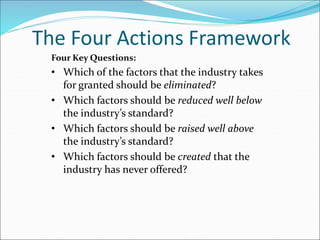
The Four Actions Framework
Four Key Questions:
• Which of the factors that the industry takes
for granted should be eliminated?
• Which factors should be reduced well below
the industry’s standard?
• Which factors should be raised well above
the industry’s standard?
• Which factors should be created that the
industry has never offered?
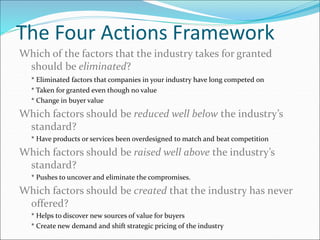
The Four Actions Framework
Which of the factors that the industry takes for granted
should be eliminated?
* Eliminated factors that companies in your industry have long competed on
* Taken for granted even though no value
* Change in buyer value
Which factors should be reduced well below the industry’s
standard?
* Have products or services been overdesigned to match and beat competition
Which factors should be raised well above the industry’s
standard?
* Pushes to uncover and eliminate the compromises.
Which factors should be created that the industry has never
offered?
* Helps to discover new sources of value for buyers
* Create new demand and shift strategic pricing of the industry
The Four Actions Framework
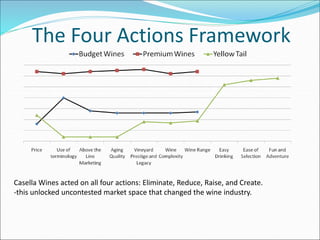
Casella Wines acted on all four actions: Eliminate, Reduce, Raise, and Create.
-this unlocked uncontested market space that changed the wine industry.
• The third tool that is key to creation of
blue oceans.
•Pushes companies to not only ask all four
questions but also act on all for to create a
new value curve.
The Eliminate-Reduce-Raise-Create Grid
 The grid gives companies four immediate benefits:
 It pushes them to pursue differentiation and low cost to
break the value-cost trade-off.
 It flags companies that are focused only on raising and
creating and thereby lifting their cost structure and
often overengineering products and services.
Eliminate-Reduce-Raise-Create
Grid
 It is easily understood by managers at any level, creating
a high level of engagement in its application.
 It drives companies to robustly scrutinize every factor
the industry competes on.
Eliminate-Reduce-Raise-Create
Grid: The Case of [yellow tail]
Eliminate
Enological terminology and
distinctions
Aging qualities
Above-the-line marketing
Raise
Price versus budget wines
Retail store involvement
Reduce
Wine complexity
Wine range
Vineyard prestige
Create
Easy drinking
Ease of selection
Fun and adventure
Three Characteristics of a Good
Strategy
• Does it have focus?
– [yellow tail] doesn’t diffuse its efforts across all key
factors of competition.
• Does it diverge from other players?
– [yellow tail]’s curve diverges: a result of not
benchmarking competitors but instead looking across
alternatives.
• Does it have a compelling tagline?
– [yellow tail]’s tagline: a fun and simple wine to be
enjoyed every day.
Presentation Take-Aways
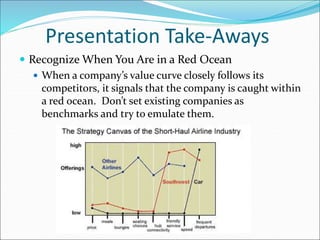
 Recognize When You Are in a Red Ocean
 When a company’s value curve closely follows its
competitors, it signals that the company is caught within
a red ocean. Don’t set existing companies as
benchmarks and try to emulate them.
Presentation Take-Aways
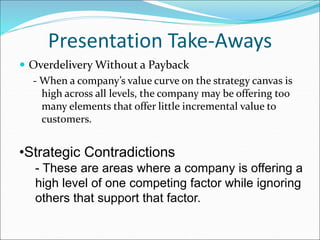
 Overdelivery Without a Payback
- When a company’s value curve on the strategy canvas is
high across all levels, the company may be offering too
many elements that offer little incremental value to
customers.
•Strategic Contradictions
- These are areas where a company is offering a
high level of one competing factor while ignoring
others that support that factor.
Presentation Take-Aways
 Three Characteristics of a Good Strategy
 Focus. You company cannot focus its efforts across all
competitive factors.
 Divergence. Do not form your value curve reactively
with other competitors.
 Compelling Tagline. You should be able to create a
tagline showing the differences between your and your
competitor’s values.

chapter 2.ppt

  • 1.
    Blue Ocean Strategy By:Diana Duran, Candice Brewer, Lane Morgan, Johnathan Angell & Tony Polito
  • 2.
    U.S. Wine Sales •$20billion industry •California wine captures two-thirds of all U.S. wine sales. Compete with imported wines. •Top 8 companies produce 75% of wine in the U.S., and 1,600 other companies make up remaining 25%. •Supply is increasing and demand is flat.
  • 3.
    The Strategy Canvas •TheStrategy Canvas is a diagnostic and an action framework for building a compelling blue ocean strategy •The Purpose: - Captures the current state of play in the known marketplace
  • 4.
    Current State ofPlay in the Marketplace •Where the competition is investing •The factors that the industry currently competes on in products, service & delivery •What customers receive from the existing competitive offerings on the market
  • 5.
    The Value Curve •Thevalue curve is a graphic depiction of a company’s relative performance across its industry’s factors of competition.
  • 6.
    The Strategy CanvasCont’d •To shift the strategy canvas of an industry, you must begin by reorienting your strategic focus from competitors to alternatives, and from customers to noncustomers of the industry •Do not worry about benchmarking competitors and deciding between value and cost…Shifting the strategy canvas will eliminate the need for this. •Example: Casella Wines
  • 7.
    The Four ActionsFramework Four Key Questions: • Which of the factors that the industry takes for granted should be eliminated? • Which factors should be reduced well below the industry’s standard? • Which factors should be raised well above the industry’s standard? • Which factors should be created that the industry has never offered?
  • 8.
    The Four ActionsFramework Which of the factors that the industry takes for granted should be eliminated? * Eliminated factors that companies in your industry have long competed on * Taken for granted even though no value * Change in buyer value Which factors should be reduced well below the industry’s standard? * Have products or services been overdesigned to match and beat competition Which factors should be raised well above the industry’s standard? * Pushes to uncover and eliminate the compromises. Which factors should be created that the industry has never offered? * Helps to discover new sources of value for buyers * Create new demand and shift strategic pricing of the industry
  • 9.
    The Four ActionsFramework Casella Wines acted on all four actions: Eliminate, Reduce, Raise, and Create. -this unlocked uncontested market space that changed the wine industry.
  • 10.
    • The thirdtool that is key to creation of blue oceans. •Pushes companies to not only ask all four questions but also act on all for to create a new value curve.
  • 11.
    The Eliminate-Reduce-Raise-Create Grid The grid gives companies four immediate benefits:  It pushes them to pursue differentiation and low cost to break the value-cost trade-off.  It flags companies that are focused only on raising and creating and thereby lifting their cost structure and often overengineering products and services.
  • 12.
    Eliminate-Reduce-Raise-Create Grid  It iseasily understood by managers at any level, creating a high level of engagement in its application.  It drives companies to robustly scrutinize every factor the industry competes on.
  • 13.
    Eliminate-Reduce-Raise-Create Grid: The Caseof [yellow tail] Eliminate Enological terminology and distinctions Aging qualities Above-the-line marketing Raise Price versus budget wines Retail store involvement Reduce Wine complexity Wine range Vineyard prestige Create Easy drinking Ease of selection Fun and adventure
  • 14.
    Three Characteristics ofa Good Strategy • Does it have focus? – [yellow tail] doesn’t diffuse its efforts across all key factors of competition. • Does it diverge from other players? – [yellow tail]’s curve diverges: a result of not benchmarking competitors but instead looking across alternatives. • Does it have a compelling tagline? – [yellow tail]’s tagline: a fun and simple wine to be enjoyed every day.
  • 16.
    Presentation Take-Aways  RecognizeWhen You Are in a Red Ocean  When a company’s value curve closely follows its competitors, it signals that the company is caught within a red ocean. Don’t set existing companies as benchmarks and try to emulate them.
  • 17.
    Presentation Take-Aways  OverdeliveryWithout a Payback - When a company’s value curve on the strategy canvas is high across all levels, the company may be offering too many elements that offer little incremental value to customers. •Strategic Contradictions - These are areas where a company is offering a high level of one competing factor while ignoring others that support that factor.
  • 18.
    Presentation Take-Aways  ThreeCharacteristics of a Good Strategy  Focus. You company cannot focus its efforts across all competitive factors.  Divergence. Do not form your value curve reactively with other competitors.  Compelling Tagline. You should be able to create a tagline showing the differences between your and your competitor’s values.