Detergents
Marketing in Practice Detergent Powders
Industry Structure
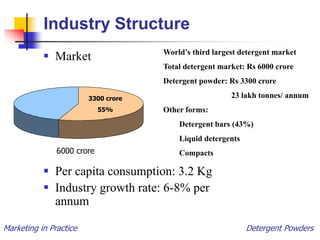
 Market
 Per capita consumption: 3.2 Kg
 Industry growth rate: 6-8% per
annum
World’s third largest detergent market
Total detergent market: Rs 6000 crore
Detergent powder: Rs 3300 crore
23 lakh tonnes/ annum
Other forms:
Detergent bars (43%)
Liquid detergents
Compacts
3300 crore
55%
6000 crore
Marketing in Practice Detergent Powders
Industry Structure
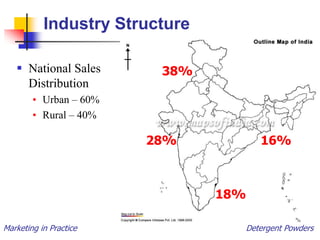
 National Sales
Distribution
• Urban – 60%
• Rural – 40%
38%
28%
18%
16%
Marketing in Practice Detergent Powders
Industry Structure
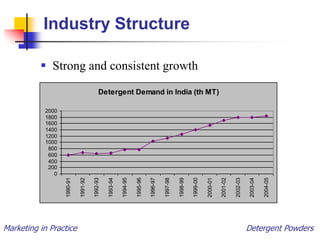
Detergent Demand in India (th MT)
0
200
400
600
800
1000
1200
1400
1600
1800
2000
1990-91
1991-92
1992-93
1993-94
1994-95
1995-96
1996-97
1997-98
1998-99
1999-00
2000-01
2001-02
2002-03
2003-04
2004-05
 Strong and consistent growth
Marketing in Practice Detergent Powders
Industry Structure
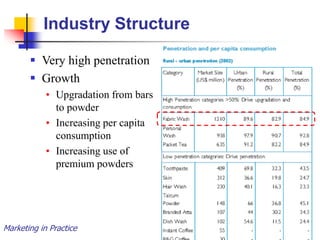
 Very high penetration
 Growth
• Upgradation from bars
to powder
• Increasing per capita
consumption
• Increasing use of
premium powders
Marketing in Practice Detergent Powders
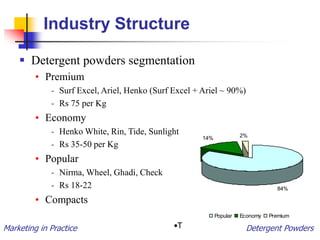
84%
14% 2%
Popular Economy Premium
Industry Structure
 Detergent powders segmentation
• Premium
- Surf Excel, Ariel, Henko (Surf Excel + Ariel ~ 90%)
- Rs 75 per Kg
• Economy
- Henko White, Rin, Tide, Sunlight
- Rs 35-50 per Kg
• Popular
- Nirma, Wheel, Ghadi, Check
- Rs 18-22
• Compacts
•T
Marketing in Practice Detergent Powders
Industry Structure
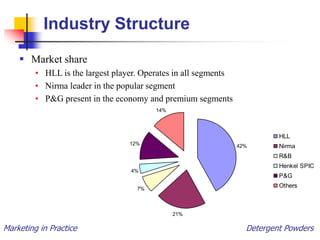
 Market share
• HLL is the largest player. Operates in all segments
• Nirma leader in the popular segment
• P&G present in the economy and premium segments
42%
21%
7%
4%
12%
14%
HLL
Nirma
R&B
Henkel SPIC
P&G
Others
Marketing in Practice Detergent Powders
Industry Trends
 Detergent market has good penetration – but slow growth
 Saturation hits urban areas
 Bar form of detergents are losing out. Premium quality synthetic
detergents are experiencing growth due to drop in unit price.
 Compact detergents meant for washing machines are getting
slow entry.
 Price competition among major manufacturers getting more
intense.
 South India offer good potential and growth.
 P&G has chosen an expans‫ﭩ‬绿キ럿strategy by lowering prices.
 HLL trying to build brand loyalty for Surf by innovative ad
campaign.
Marketing in Practice Detergent Powders
Consumer Behaviour
Across all segments:
 The main attributes that consumers look for in a detergent are:
• Value for money (how effective the detergent is in cleaning clothes vs
affordability)
• Ease of use (must dissolve fast) – this was specific to households which do
not have washing machines
 Apart from the cleansing action, detergents should also be easy on
the skin and must have a fragrance: Ariel Spring Clean (roses),
Ariel Fresh Clean (mogra)
 Main factor influencing consumers’ expectations:
• Improved affordability
• Ad campaigns
Marketing in Practice Detergent Powders
Consumer Behaviour
Within a segment:
 Very little perceived difference in a particular category and a price
point
 Consumers are more or less indifferent among leading brands as long
as prices are comparable
 This commoditization nature of detergent business that is forcing
players to fall in line with lower prices superior quality detergents at
an affordable price
Between two segments:
 With price cuts, upgradation
 With slowdown, downgradation
Marketing in Practice Detergent Powders
Major Players
 Premium
• Surf Excel
• Ariel
• Henko Stain Champion
 Economy/Mid Priced
• Tide
• Rin Shakti
• Henko Mr. White
 Popular
• Nirma
• Wheel
Marketing in Practice Detergent Powders
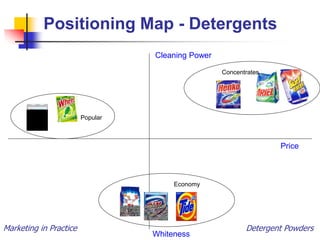
Positioning Map - Detergents
Price
Cleaning Power
Whiteness
Concentrates
Economy
Popular
Marketing in Practice Detergent Powders
Surf Excel
 ‘Surf’ launched in 1959: first in Indian detergent market
 Surf Excel launched in 1992
 Complete migration of Surf to Surf Excel Blue in 2004
 Premium segment: Market leader
 Positioned as very effective with any kind of stains: ‘Surf Excel Hai Na’
• Less effort in cleaning and lower water consumption
 Focus on building brand loyalty through emotional connect: ‘Daag Acche
Hain’campaign
• Positioned against generic hate stains attitude
• Assurance: Go ahead and get dirty
• Latest campaign: Colour
 Variants:
• Surf Excelmatic: Specially for washing machines
• Surf Excel Blue: Stain removal with fabric care (midpriced segment)
• Surf Excel Liquid: Liquid concentrate
Marketing in Practice Detergent Powders
Ariel
 Launched by P&G in India in 1991
 First to bring compact detergent technology
 Premium: Positioned as a stain remover that is easy to use
P&G: Slashing prices of Ariel to expand its consumer base, more
affordable.
 Two variants, Ariel Spring clean and Fresh clean (scented)
 “A to Z daag ke liye jo de taaza khushboo”.
• A man cooks dinner for his wife, who is away. He stains his shirt in the
process, but uses Ariel to remove the stain
• Key emphasis: Ease of use, fragrance, stain removal
 Target segment: Women, age group 25-35 years
 Variant: Ariel Front-o-Mat (front loaded washing machines)
Marketing in Practice Detergent Powders
Henko Stain Champion
 Launched in ’94 in the South: Direct competition to Surf
 Top end premium: Market share ~9%
 Focused on stain removal (highest order need for Indian consumer):
Pre-treater powerpearls (proprietary technology)
 High-on-quality, relatively low-on-price proposition
 Earlier campaigns: Positioning Henko as a better option (usage of
Surf was more a habit than conviction)
• Celebrities; Freebies; Regional association to strike emotional chord
 “Iske power pearls kapro mein geheraee tak jaye aur daag ko jar se
nikal”
• Focus on product performance superior as compared to rivals
• Technological aspect: No social/emotional angle as such
Marketing in Practice Detergent Powders
Tide
 Launched in 2000: Mid priced ; Price cuts: moved to
popular
 “Fastest growing and one of the most deeply penetrated
detergents in households across India” – ORG-AC
Nielsen
 Target: "superior whiteness" and "whiteness
maintenance" laundry needs of a homemaker in India
 “Chaunk gaye? White ho to Tide ho…”
• Showcase its cleaning power; superior whitening
• Focus on value proposition: High performance at low cost
• No emotional aspect: Beg stage of PLC
• Social consciousness of white clothes
Marketing in Practice Detergent Powders
Rin Shakti
 Re-launched in 2004 as Rin Advanced to counter Tide
 Mid-priced brand
 May lead to cannibalization of other HLL customers due to
forced price cuts of Surf Excel Blue
 “Double safedi”
• Focus on whitening: Direct competition with Tide
• Pure clean technology: Absence of residue
• Social acceptability due to white clothes
• Focus different from Surf Excel Blue: However, does not completely
eliminate cannibalization given similar prices
Marketing in Practice Detergent Powders
Henkel Mr White
 Mid priced: Market share ~14%; No 2 in segment
 Only eco-friendly detergent in its segment: not emphasized
 Promises superior product performance;unique dazzling whiteness
• Mr White - personifying the brand clearly
 Relaunched this year: enhanced formulation, a fresh new fragrance,
in an all-new pack
 “Thoda sa green thoda sa blue. Thoda sa jadoo. Mr. White. Sabse
white”.
• Social consciousness: Ensure that clothes are the whitest
• Uses expert: Research on voices of authority
• Promises the “Power of 2 - Lime + Blue”
• Focus on premium values: Good quality at a reasonable price
Marketing in Practice Detergent Powders
Wheel
 Launched in 1987 by HLL to counter Nirma
 Single largest detergent brand by value
 Popular segment: Mass market
 Superior formulation to Nirma
• Promise: Clean tough stains easily; not harmful to hands
• Lemon fragrance
 ‘Mehnat kum, phir bhi dhulai No. 1’.
• Positioned as the smart housewife’s choice for the mass market
 Introduced a fresh fragrance along with Wheel Green: “Naya
khushboodaar Wheel. Mehengi wali dhulai, budget mein samayi”.
 Premium variant: Active Wheel
• Quality Clean and Care at affordable price
• Brightness of coloured clothes, fresh fragrance
Marketing in Practice Detergent Powders
Nirma
 Caused a marketing miracle when introduced
• Targets bottom of the pyramid
• Priced 1/3rd of competitors; caused immediate trial
• Unique environment-friendly, phosphate-free formulation—
consumers become loyal
• 0% of the market share in 1976 to 61.6% of market share in 1987
• HLL launches Project STING
 Unique marketing mix: Lowest pricing, distribution
through small retailers and heavy advertising
 Communication of Value: Simple messages and catchy
jingles
 Has a variant in the premium segment
• Priced almost 40% lesser - 25g, 500g, 1000g
Marketing in Practice Detergent Powders
Future Trends
 Detergent industry set to grow at 10% per annum
 With penetration already high, growth to come largely
from:
• Upgradation from bars to powder
• Increasing per capita consumption
• Increasing use of premium powders
 Effort by firms to avoid the commoditization of the
product
 Greater stress on branding and emotional connect

Chapter 20 (Detergents).ppt

  • 1.
  • 2.
    Marketing in PracticeDetergent Powders Industry Structure  Market  Per capita consumption: 3.2 Kg  Industry growth rate: 6-8% per annum World’s third largest detergent market Total detergent market: Rs 6000 crore Detergent powder: Rs 3300 crore 23 lakh tonnes/ annum Other forms: Detergent bars (43%) Liquid detergents Compacts 3300 crore 55% 6000 crore
  • 3.
    Marketing in PracticeDetergent Powders Industry Structure  National Sales Distribution • Urban – 60% • Rural – 40% 38% 28% 18% 16%
  • 4.
    Marketing in PracticeDetergent Powders Industry Structure Detergent Demand in India (th MT) 0 200 400 600 800 1000 1200 1400 1600 1800 2000 1990-91 1991-92 1992-93 1993-94 1994-95 1995-96 1996-97 1997-98 1998-99 1999-00 2000-01 2001-02 2002-03 2003-04 2004-05  Strong and consistent growth
  • 5.
    Marketing in PracticeDetergent Powders Industry Structure  Very high penetration  Growth • Upgradation from bars to powder • Increasing per capita consumption • Increasing use of premium powders
  • 6.
    Marketing in PracticeDetergent Powders 84% 14% 2% Popular Economy Premium Industry Structure  Detergent powders segmentation • Premium - Surf Excel, Ariel, Henko (Surf Excel + Ariel ~ 90%) - Rs 75 per Kg • Economy - Henko White, Rin, Tide, Sunlight - Rs 35-50 per Kg • Popular - Nirma, Wheel, Ghadi, Check - Rs 18-22 • Compacts •T
  • 7.
    Marketing in PracticeDetergent Powders Industry Structure  Market share • HLL is the largest player. Operates in all segments • Nirma leader in the popular segment • P&G present in the economy and premium segments 42% 21% 7% 4% 12% 14% HLL Nirma R&B Henkel SPIC P&G Others
  • 8.
    Marketing in PracticeDetergent Powders Industry Trends  Detergent market has good penetration – but slow growth  Saturation hits urban areas  Bar form of detergents are losing out. Premium quality synthetic detergents are experiencing growth due to drop in unit price.  Compact detergents meant for washing machines are getting slow entry.  Price competition among major manufacturers getting more intense.  South India offer good potential and growth.  P&G has chosen an expans‫ﭩ‬绿キ럿strategy by lowering prices.  HLL trying to build brand loyalty for Surf by innovative ad campaign.
  • 9.
    Marketing in PracticeDetergent Powders Consumer Behaviour Across all segments:  The main attributes that consumers look for in a detergent are: • Value for money (how effective the detergent is in cleaning clothes vs affordability) • Ease of use (must dissolve fast) – this was specific to households which do not have washing machines  Apart from the cleansing action, detergents should also be easy on the skin and must have a fragrance: Ariel Spring Clean (roses), Ariel Fresh Clean (mogra)  Main factor influencing consumers’ expectations: • Improved affordability • Ad campaigns
  • 10.
    Marketing in PracticeDetergent Powders Consumer Behaviour Within a segment:  Very little perceived difference in a particular category and a price point  Consumers are more or less indifferent among leading brands as long as prices are comparable  This commoditization nature of detergent business that is forcing players to fall in line with lower prices superior quality detergents at an affordable price Between two segments:  With price cuts, upgradation  With slowdown, downgradation
  • 11.
    Marketing in PracticeDetergent Powders Major Players  Premium • Surf Excel • Ariel • Henko Stain Champion  Economy/Mid Priced • Tide • Rin Shakti • Henko Mr. White  Popular • Nirma • Wheel
  • 12.
    Marketing in PracticeDetergent Powders Positioning Map - Detergents Price Cleaning Power Whiteness Concentrates Economy Popular
  • 13.
    Marketing in PracticeDetergent Powders Surf Excel  ‘Surf’ launched in 1959: first in Indian detergent market  Surf Excel launched in 1992  Complete migration of Surf to Surf Excel Blue in 2004  Premium segment: Market leader  Positioned as very effective with any kind of stains: ‘Surf Excel Hai Na’ • Less effort in cleaning and lower water consumption  Focus on building brand loyalty through emotional connect: ‘Daag Acche Hain’campaign • Positioned against generic hate stains attitude • Assurance: Go ahead and get dirty • Latest campaign: Colour  Variants: • Surf Excelmatic: Specially for washing machines • Surf Excel Blue: Stain removal with fabric care (midpriced segment) • Surf Excel Liquid: Liquid concentrate
  • 14.
    Marketing in PracticeDetergent Powders Ariel  Launched by P&G in India in 1991  First to bring compact detergent technology  Premium: Positioned as a stain remover that is easy to use P&G: Slashing prices of Ariel to expand its consumer base, more affordable.  Two variants, Ariel Spring clean and Fresh clean (scented)  “A to Z daag ke liye jo de taaza khushboo”. • A man cooks dinner for his wife, who is away. He stains his shirt in the process, but uses Ariel to remove the stain • Key emphasis: Ease of use, fragrance, stain removal  Target segment: Women, age group 25-35 years  Variant: Ariel Front-o-Mat (front loaded washing machines)
  • 15.
    Marketing in PracticeDetergent Powders Henko Stain Champion  Launched in ’94 in the South: Direct competition to Surf  Top end premium: Market share ~9%  Focused on stain removal (highest order need for Indian consumer): Pre-treater powerpearls (proprietary technology)  High-on-quality, relatively low-on-price proposition  Earlier campaigns: Positioning Henko as a better option (usage of Surf was more a habit than conviction) • Celebrities; Freebies; Regional association to strike emotional chord  “Iske power pearls kapro mein geheraee tak jaye aur daag ko jar se nikal” • Focus on product performance superior as compared to rivals • Technological aspect: No social/emotional angle as such
  • 16.
    Marketing in PracticeDetergent Powders Tide  Launched in 2000: Mid priced ; Price cuts: moved to popular  “Fastest growing and one of the most deeply penetrated detergents in households across India” – ORG-AC Nielsen  Target: "superior whiteness" and "whiteness maintenance" laundry needs of a homemaker in India  “Chaunk gaye? White ho to Tide ho…” • Showcase its cleaning power; superior whitening • Focus on value proposition: High performance at low cost • No emotional aspect: Beg stage of PLC • Social consciousness of white clothes
  • 17.
    Marketing in PracticeDetergent Powders Rin Shakti  Re-launched in 2004 as Rin Advanced to counter Tide  Mid-priced brand  May lead to cannibalization of other HLL customers due to forced price cuts of Surf Excel Blue  “Double safedi” • Focus on whitening: Direct competition with Tide • Pure clean technology: Absence of residue • Social acceptability due to white clothes • Focus different from Surf Excel Blue: However, does not completely eliminate cannibalization given similar prices
  • 18.
    Marketing in PracticeDetergent Powders Henkel Mr White  Mid priced: Market share ~14%; No 2 in segment  Only eco-friendly detergent in its segment: not emphasized  Promises superior product performance;unique dazzling whiteness • Mr White - personifying the brand clearly  Relaunched this year: enhanced formulation, a fresh new fragrance, in an all-new pack  “Thoda sa green thoda sa blue. Thoda sa jadoo. Mr. White. Sabse white”. • Social consciousness: Ensure that clothes are the whitest • Uses expert: Research on voices of authority • Promises the “Power of 2 - Lime + Blue” • Focus on premium values: Good quality at a reasonable price
  • 19.
    Marketing in PracticeDetergent Powders Wheel  Launched in 1987 by HLL to counter Nirma  Single largest detergent brand by value  Popular segment: Mass market  Superior formulation to Nirma • Promise: Clean tough stains easily; not harmful to hands • Lemon fragrance  ‘Mehnat kum, phir bhi dhulai No. 1’. • Positioned as the smart housewife’s choice for the mass market  Introduced a fresh fragrance along with Wheel Green: “Naya khushboodaar Wheel. Mehengi wali dhulai, budget mein samayi”.  Premium variant: Active Wheel • Quality Clean and Care at affordable price • Brightness of coloured clothes, fresh fragrance
  • 20.
    Marketing in PracticeDetergent Powders Nirma  Caused a marketing miracle when introduced • Targets bottom of the pyramid • Priced 1/3rd of competitors; caused immediate trial • Unique environment-friendly, phosphate-free formulation— consumers become loyal • 0% of the market share in 1976 to 61.6% of market share in 1987 • HLL launches Project STING  Unique marketing mix: Lowest pricing, distribution through small retailers and heavy advertising  Communication of Value: Simple messages and catchy jingles  Has a variant in the premium segment • Priced almost 40% lesser - 25g, 500g, 1000g
  • 21.
    Marketing in PracticeDetergent Powders Future Trends  Detergent industry set to grow at 10% per annum  With penetration already high, growth to come largely from: • Upgradation from bars to powder • Increasing per capita consumption • Increasing use of premium powders  Effort by firms to avoid the commoditization of the product  Greater stress on branding and emotional connect