Analysis OF Algorithm
Learning outcomes
• Space Complexity
• Time Complexity
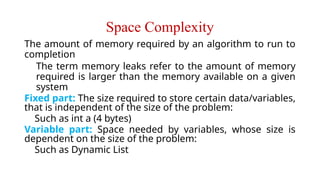
Space Complexity
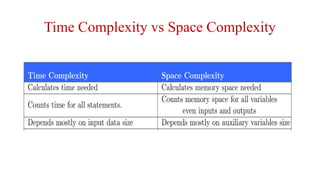
The amount of memory required by an algorithm to run to
completion
The term memory leaks refer to the amount of memory
required is larger than the memory available on a given
system
Fixed part: The size required to store certain data/variables,
that is independent of the size of the problem:
Such as int a (4 bytes)
Variable part: Space needed by variables, whose size is
dependent on the size of the problem:
Such as Dynamic List
Time Complexity
• the time complexity is the number of operations an
algorithm performs to complete its task.
Time Complexity vs Space Complexity
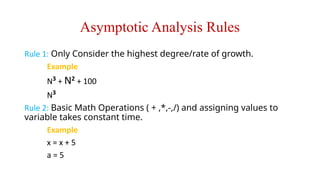
Asymptotic Analysis Rules
Rule 1: Only Consider the highest degree/rate of growth.
Example
N3
+ N2
+ 100
N3
Rule 2: Basic Math Operations ( + ,*,-,/) and assigning values to
variable takes constant time.
Example
x = x + 5
a = 5
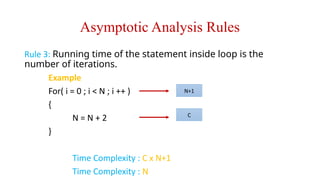
Asymptotic Analysis Rules
Rule 3: Running time of the statement inside loop is the
number of iterations.
Example
For( i = 0 ; i < N ; i ++ )
{
N = N + 2
}
Time Complexity : C x N+1
Time Complexity : N
N+1
C
Asymptotic Analysis Rules
Rule 4: Nested Loop
Example
For( i = 0 ; i < N ; i ++ )
{
For( j = 0 ; j < N ; j ++ )
{
statements;
}
}
Time Complexity : (N+1) + [N x (N+1)] + C
Time Complexity : N2
N+1
N x (N+1)
C
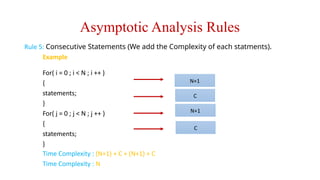
Asymptotic Analysis Rules
Rule 5: Consecutive Statements (We add the Complexity of each statments).
Example
For( i = 0 ; i < N ; i ++ )
{
statements;
}
For( j = 0 ; j < N ; j ++ )
{
statements;
}
Time Complexity : (N+1) + C + (N+1) + C
Time Complexity : N
N+1
C
N+1
C
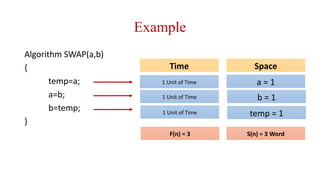
Algorithm SWAP(a,b)
{
temp=a;
a=b;
b=temp;
}
1 Unit of Time
1 Unit of Time
1 Unit of Time
F(n) = 3
Time Space
a = 1
b = 1
temp = 1
S(n) = 3 Word
Example
Example
Algorithm SUM(A,n)
{
S = 0;
for ( i = 0 ; i < n ; i ++)
{
S = S + A[ i ];
}
return S;
}
8 3 9 7 2
A
0 1 2 3 4
N = 5
1 N+1 N
i = 0
i = 1
i = 2
i = 3
i = 4
i = 5
Time Space
1 Unit of Time S = 1
N+1 Unit of Time N = 1
N Unit of Time A = N
1 Unit of Time i = 1
F(n) = 2N + 3 =N S(n) = N+3 =N Word
Example
Algorithm ADD( A, B, n)
{
for( i = 0 ; i <n ; i ++)
{
for( j = 0 ; j < n ; j ++)
{
C[ i ] [ j ]=A [ i ] [ j ] + B [ i ] [ j ];
}
}
}
Time Space
N+1
N
N
(N + 1)
N
A = N
B = N
C = N
i = 1
j = 1
n = 1
F(n) = 2N2
+ 2N +1 =N2
S(n) = 3N2
+ 3 =N2
Example
Algorithm MULTIPLY(A, B, n)
{
for(i = 0 ; i < n ; i++){
for(j = 0; j < n ; j++){
C[i , j] = 0;
for(k = 0; k < n ; k++){
C[i , j] = C[i , j] + A[i , k] * B [k, j];
}
}
}
}
Time Space
N+1
N N + 1
N N
N N N + 1
N N N
F(n)=2N3
+3N2
+2N+1=N3
A = N
B = N
C = N
N = 1
i = 1
j = 1
k = 1
F(n)=3N2
+4=N2
Thank You!!!

Chapter #2 (Time Complexity & Space Complexity).pptx

  • 1.
  • 2.
    Learning outcomes • SpaceComplexity • Time Complexity
  • 3.
    Space Complexity The amountof memory required by an algorithm to run to completion The term memory leaks refer to the amount of memory required is larger than the memory available on a given system Fixed part: The size required to store certain data/variables, that is independent of the size of the problem: Such as int a (4 bytes) Variable part: Space needed by variables, whose size is dependent on the size of the problem: Such as Dynamic List
  • 4.
    Time Complexity • thetime complexity is the number of operations an algorithm performs to complete its task.
  • 5.
    Time Complexity vsSpace Complexity
  • 6.
    Asymptotic Analysis Rules Rule1: Only Consider the highest degree/rate of growth. Example N3 + N2 + 100 N3 Rule 2: Basic Math Operations ( + ,*,-,/) and assigning values to variable takes constant time. Example x = x + 5 a = 5
  • 7.
    Asymptotic Analysis Rules Rule3: Running time of the statement inside loop is the number of iterations. Example For( i = 0 ; i < N ; i ++ ) { N = N + 2 } Time Complexity : C x N+1 Time Complexity : N N+1 C
  • 8.
    Asymptotic Analysis Rules Rule4: Nested Loop Example For( i = 0 ; i < N ; i ++ ) { For( j = 0 ; j < N ; j ++ ) { statements; } } Time Complexity : (N+1) + [N x (N+1)] + C Time Complexity : N2 N+1 N x (N+1) C
  • 9.
    Asymptotic Analysis Rules Rule5: Consecutive Statements (We add the Complexity of each statments). Example For( i = 0 ; i < N ; i ++ ) { statements; } For( j = 0 ; j < N ; j ++ ) { statements; } Time Complexity : (N+1) + C + (N+1) + C Time Complexity : N N+1 C N+1 C
  • 10.
    Algorithm SWAP(a,b) { temp=a; a=b; b=temp; } 1 Unitof Time 1 Unit of Time 1 Unit of Time F(n) = 3 Time Space a = 1 b = 1 temp = 1 S(n) = 3 Word Example
  • 11.
    Example Algorithm SUM(A,n) { S =0; for ( i = 0 ; i < n ; i ++) { S = S + A[ i ]; } return S; } 8 3 9 7 2 A 0 1 2 3 4 N = 5 1 N+1 N i = 0 i = 1 i = 2 i = 3 i = 4 i = 5 Time Space 1 Unit of Time S = 1 N+1 Unit of Time N = 1 N Unit of Time A = N 1 Unit of Time i = 1 F(n) = 2N + 3 =N S(n) = N+3 =N Word
  • 12.
    Example Algorithm ADD( A,B, n) { for( i = 0 ; i <n ; i ++) { for( j = 0 ; j < n ; j ++) { C[ i ] [ j ]=A [ i ] [ j ] + B [ i ] [ j ]; } } } Time Space N+1 N N (N + 1) N A = N B = N C = N i = 1 j = 1 n = 1 F(n) = 2N2 + 2N +1 =N2 S(n) = 3N2 + 3 =N2
  • 13.
    Example Algorithm MULTIPLY(A, B,n) { for(i = 0 ; i < n ; i++){ for(j = 0; j < n ; j++){ C[i , j] = 0; for(k = 0; k < n ; k++){ C[i , j] = C[i , j] + A[i , k] * B [k, j]; } } } } Time Space N+1 N N + 1 N N N N N + 1 N N N F(n)=2N3 +3N2 +2N+1=N3 A = N B = N C = N N = 1 i = 1 j = 1 k = 1 F(n)=3N2 +4=N2
  • 14.