Year : Final Year Div : A SEM- VII
Subject : Pharmaceutical Jurisprudence
CHAPTER 2
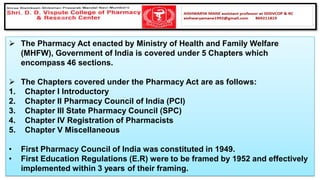
➢ The Pharmacy Act enacted by Ministry of Health and Family Welfare
(MHFW), Government of India is covered under 5 Chapters which
encompass 46 sections.
➢ The Chapters covered under the Pharmacy Act are as follows:
1. Chapter I Introductory
2. Chapter II Pharmacy Council of India (PCI)
3. Chapter III State Pharmacy Council (SPC)
4. Chapter IV Registration of Pharmacists
5. Chapter V Miscellaneous
• First Pharmacy Council of India was constituted in 1949.
• First Education Regulations (E.R) were to be framed by 1952 and effectively
implemented within 3 years of their framing.
Chapter I
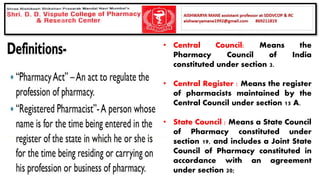
• Central Council: Means the
Pharmacy Council of India
constituted under section 3.
• Central Register : Means the register
of pharmacists maintained by the
Central Council under section 15 A.
• State Council : Means a State Council
of Pharmacy constituted under
section 19, and includes a Joint State
Council of Pharmacy constituted in
accordance with an agreement
under section 20;
• Medical practitioner" means a person :
(i) Holding a qualification granted by an authority specified or notified under section 3 of the Indian
Medical Degrees Act, 1916 (7 of 1916), or specified in the Schedules to the Indian Medical Council Act, 1956
(102 of 1956); or
(ii) Registered or eligible for registration in a medical register of a State meant for the registration of
persons practicing the modern scientific system of medicine; or
(iii) Registered in a medical register of a State, who, although not falling within sub-clause(i) or sub-
clause (ii) is declared by a general or special order made by the State Government in this behalf as a
person practising the modern scientific system of medicine for the purposes of this Act; or
(iv) Registered or eligible for registration in the register of dentists for a State under the Dentists Act, 1948
(16 of 1948); or
(v) Who is engaged in the practise of veterinary medicine and who possesses qualifications approved
by the State Government.
• Register: Means a register of pharmacists prepared and maintained under Chapter IV
• University Grants Commission: Means the University Grants Commission established under section 4 of
the University Grants Commission Act, 1956 (3 of 1956).
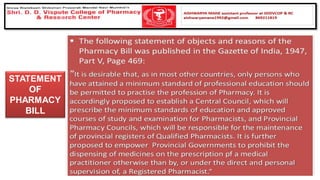
STATEMENT
OF
PHARMACY
BILL
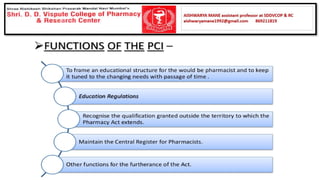
On 9th March, 1949, the Pharmacy Council of India (PCI) was constituted to fulfil the
objectives of the Pharmacy Act, 1948 by way of:
(i) Prescribing the minimum standard of education required for qualifying as a pharmacist
i.e., framing of Education Regulations prescribing the conditions to be fulfilled by the
institutions seeking approval of the PCI for imparting education in Pharmacy.
(ii) Ensuring uniform implementation of the educational standards throughout the country.
(iii) Approving the courses of study and examination for pharmacists i.e.,approval of the
academic training institutions providing pharmacy courses.
(iv) Withdrawing approval, if the course of study does not continue to be in conformity with
the educational standards prescribed by the PCI.
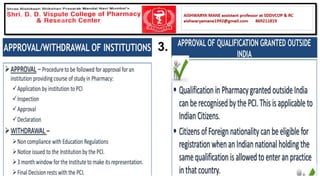
(v) Approving qualifications granted outside the territories to which the Pharmacy Act, 1948
extends i.e., the approval of foreign qualification.
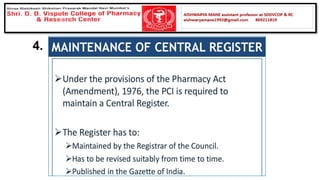
(vi) Maintaining Central Register of Pharmacists.
OBJECTIVES
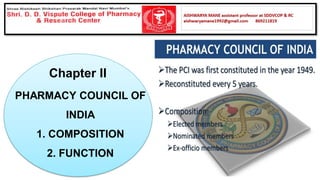
PHARMACY COUNCIL OF
INDIA
1. COMPOSITION
2. FUNCTION
Chapter II
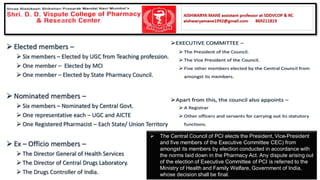
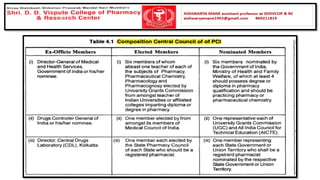
➢ The Central Council of PCI elects the President, Vice-President
and five members of the Executive Committee CEC) from
amongst its members by election conducted in accordance with
the norms laid down in the Pharmacy Act. Any dispute arising out
of the election of Executive Committee of PCI is referred to the
Ministry of Health and Family Welfare, Government of India,
whose decision shall be final.
1.Minimum Qualification for Registration as a
Pharmacist in India:
✓ The minimum qualification for registration as a pharmacist in India is a
pass in "Diploma course in pharmacy" from an institution recognized by
the PCI.
✓ Persons holding "Degree in Pharmacy" from an institution recognized
by the PCI are also eligible for registration as a pharmacist.
✓ Section 10 of the Pharmacy Act empowers the PCI to frame regulations
called Education Regulations (E R) prescribing the minimum standard
of education required for qualification as a pharmacist.
2. Education Regulations Framed by the Pharmacy Council of India under
Section 10 of the Pharmacy Act, 1948
➢ Education Regulation (ER) basically Prescribes-
(i) the standard of education for qualification as a pharmacist i.e. minimum
qualification for admission to the course, duration of the course, the syllabus,
mode of examination, minimum marks for passing the examination, nature and
duration of practical training, etc.
(ii) Minimum conditions which an institution has to provide for seeking approval of the
PCI for conducting a course of study for pharmacists.
(iii) conditions to be fulfilled by the Examining Authority for approval for conduct of
examinations.
(iv) conditions to be fulfilled by the institutions to be recognized for giving the practical
training.
(v) Practical training contract forms for the pharmacists.
Requirements as per ER 1991:
1. Physical Facilities :
✓ For an intake of 60 in first year D. Pharm atleast, 4 laboratories, one each for pharmaceutics,
pharmaceutical chemistry, biochemistry and clinical pathology, and pharmacognosy/ APH.
✓ The classrooms, (atleast two), aspectic room, balance room, animal house, drug-museum,
machine room, Principal's office, girls and boys common rooms, etc., should be provided.
✓ The laboratory should be minimum 500 sq. ft in area. Equipments, instruments and
glassware's as given in E R should be purchased.
2. Staff :
(i) Principal/Director/Head of Department should be of the rank of professor or reader with M.
Pharm. and minimum of 5 years teaching experience.
(ii) Senior lecturer or lecturer: M. Pharm in the concerned subject or B. Pharm with 3 years
professional experience. For the subjects like clinical pathology, toxicology, pharmacology,
clinical pharmacy even MBBS qualification is permitted.
3. Instructions:
(i) A minimum of 180 working days including time spent for sessional exams.
(ii) In a week a minimum of 36 hrs of teaching preferably, 6 hrs per day.
(iii) Staff/Student ratio in theory classes 1: 60
(iv) Staff/Student ratio in practicals 1 : 20. A practical batch should not have more than 30 students
where in two staff members are required; for a batch upto 20 student, one staff member is needed.
(v) There should be not more than 2 classes in the same subject by particular teacher on the same day.
(vi) A minimum of 75% attendance is compulsory separately in theory and practicals.
4. Examinations:
i. There should be atleast two sessional exams. Average of best two is taken into consideration.
ii. Each paper carries 100 marks of which 20 are for sessional and 80 for annual examination.
iii. In case of the practical sessional examination of 20, 10 marks are for the day-to-day work and
record and other 10 marks for actual performance in examinations.
iv. Under E.R 1991 the minimum passing marks are 40% in each paper inclusive of sessional marks. A
candidate securing 60% or more and less than 75% is declared first class.
v. The distinction is awarded to a candidate scoring 75% or more.
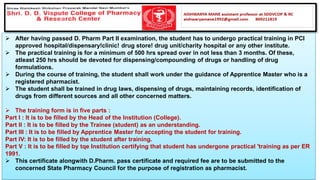
➢ After having passed D. Pharm Part II examination, the student has to undergo practical training in PCI
approved hospital/dispensary!clinic! drug store! drug unit/charity hospital or any other institute.
➢ The practical training is for a minimum of 500 hrs spread over in not less than 3 months. Of these,
atleast 250 hrs should be devoted for dispensing/compounding of drugs or handling of drug
formulations.
➢ During the course of training, the student shall work under the guidance of Apprentice Master who is a
registered pharmacist.
➢ The student shall be trained in drug laws, dispensing of drugs, maintaining records, identification of
drugs from different sources and all other concerned matters.
➢ The training form is in five parts :
Part I : It is to be filled by the Head of the Institution (College).
Part II : It is to be filled by the Trainee (student) as an understanding.
Part III : It is to be filled by Apprentice Master for accepting the student for training.
Part IV: It is to be filled by the student after training.
Part V : It is to be filled by tqe Institution certifying that student has undergone practical 'training as per ER
1991.
➢ This certificate alongwith D.Pharm. pass certificate and required fee are to be submitted to the
concerned State Pharmacy Council for the purpose of registration as pharmacist.
3.
4.
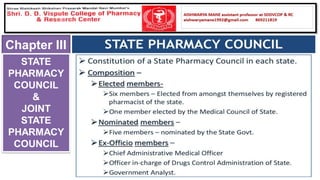
Chapter III
STATE
PHARMACY
COUNCIL
&
JOINT
STATE
PHARMACY
COUNCIL
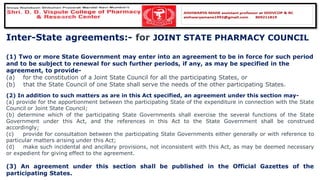
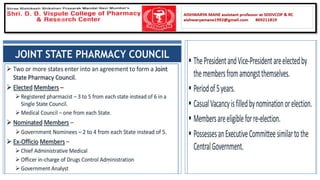
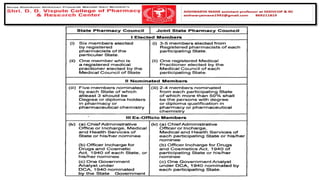
Inter-State agreements:- for JOINT STATE PHARMACY COUNCIL
(1) Two or more State Government may enter into an agreement to be in force for such period
and to be subject to renewal for such further periods, if any, as may be specified in the
agreement, to provide-
(a) for the constitution of a Joint State Council for all the participating States, or
(b) that the State Council of one State shall serve the needs of the other participating States.
(2) In addition to such matters as are in this Act specified, an agreement under this section may-
(a) provide for the apportionment between the participating State of the expenditure in connection with the State
Council or Joint State Council;
(b) determine which of the participating State Governments shall exercise the several functions of the State
Government under this Act, and the references in this Act to the State Government shall be construed
accordingly;
(c) provide for consultation between the participating State Governments either generally or with reference to
particular matters arising under this Act;
(d) make such incidental and ancillary provisions, not inconsistent with this Act, as may be deemed necessary
or expedient for giving effect to the agreement.
(3) An agreement under this section shall be published in the Official Gazettes of the
participating States.
Chapter IV: Registration of Pharmacists
1. First Register of Pharmacist: Immediately after
independence until SPC was constituted.
2. Subsequent Register: During the period of implementation
of Pharmacy Act and framing of Educational Registrations.
3. Regular Register: After Education Regulations came into
force.
➢ The register shall include the following particulars, namely:-
(a) the full name and residential address of the registered person;
(b) the date of his first admission to the register;
(c) his qualifications for registration;
(d) his professional address, and if he is employed by any person, the name of such
person;
(e) such further particulars as may be prescribed.
➢ Preparation of first register:-
(1) For the purpose of preparing the first register, the State Government shall by
notification in the Official Gazette constitute a Registration Tribunal consisting of three
persons, and shall also appoint a Registrar who shall act as Secretary of the Registration
Tribunal.
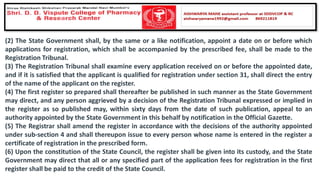
(2) The State Government shall, by the same or a like notification, appoint a date on or before which
applications for registration, which shall be accompanied by the prescribed fee, shall be made to the
Registration Tribunal.
(3) The Registration Tribunal shall examine every application received on or before the appointed date,
and if it is satisfied that the applicant is qualified for registration under section 31, shall direct the entry
of the name of the applicant on the register.
(4) The first register so prepared shall thereafter be published in such manner as the State Government
may direct, and any person aggrieved by a decision of the Registration Tribunal expressed or implied in
the register as so published may, within sixty days from the date of such publication, appeal to an
authority appointed by the State Government in this behalf by notification in the Official Gazette.
(5) The Registrar shall amend the register in accordance with the decisions of the authority appointed
under sub-section 4 and shall thereupon issue to every person whose name is entered in the register a
certificate of registration in the prescribed form.
(6) Upon the constitution of the State Council, the register shall be given into its custody, and the State
Government may direct that all or any specified part of the application fees for registration in the first
register shall be paid to the credit of the State Council.
➢ Qualifications for entry on first register:-
1. A person who has attained the age of eighteen years shall be entitled] on payment of the prescribed fee to
have his name entered in the first register if he resides, or carries on the business or profession of
pharmacy, in the State and if he-
(a)holds a degree or diploma in pharmacy or pharmaceutical chemistry or a chemist and druggist diploma of an Indian
University or a State Government, as the case may be, or a prescribed qualification granted by an authority
outside India, or
(b)holds a degree of an Indian University other than a degree in pharmacy or pharmaceutical chemistry, and has been
engaged in the compounding of drugs in a hospital or dispensary or other place in which drugs are regularly dispensed
on prescriptions of medical practitioners for a total period of not less than three years, or
(c)has passed an examination recognised as adequate by the State Government for compounders or dispensers, or
(d)has been engaged in the compounding of drugs in a hospital or dispensary or other place in which drugs are
regularly dispensed on prescriptions of medical practitioners for a total period of not less than five years prior to the
date notified under sub-section (2) of section 30.
➢Qualifications for subsequent registration :
(1)After the date appointed under sub-section 2 of section 30 and before the Education Regulations have, by or
under section 11, taken effect in the State, [a person who has attained the age of eighteen years shall on
payment of the prescribed fee] be entitled to have his name entered in the register if he resides or carries on
the business or profession of pharmacy in the State and if he-
(a) satisfies the conditions prescribed with the prior approval of the Central Council, or where no conditions have been
prescribed, the conditions entitling a person to have his name entered on the first register as set out in section 31, or
(b) is a registered pharmacist in another State, or
(c) possesses a qualification approved under section 14:
Provided that no person shall be entitled [under clause (a) of clause (c)] to have his name entered on the register unless
he has passed a matriculation examination or an examination prescribed as being equivalent to a matriculation
examination.
(2.) After the Education Regulations have by or under section 11 taken effect in the State, a person shall on payment of
the prescribed fee be entitled to have his name entered on the register if he has attained the age of [eighteen years], if
he resides, or carries on the business or profession of pharmacy, in the State and if he has passed an approved
examination or possesses a qualification approved under section 14 [or is a registered pharmacist in another State.
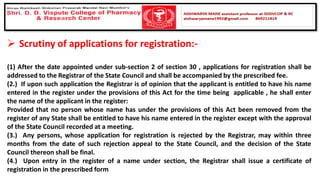
➢ Scrutiny of applications for registration:-
(1) After the date appointed under sub-section 2 of section 30 , applications for registration shall be
addressed to the Registrar of the State Council and shall be accompanied by the prescribed fee.
(2.) If upon such application the Registrar is of opinion that the applicant is entitled to have his name
entered in the register under the provisions of this Act for the time being applicable , he shall enter
the name of the applicant in the register:
Provided that no person whose name has under the provisions of this Act been removed from the
register of any State shall be entitled to have his name entered in the register except with the approval
of the State Council recorded at a meeting.
(3.) Any persons, whose application for registration is rejected by the Registrar, may within three
months from the date of such rejection appeal to the State Council, and the decision of the State
Council thereon shall be final.
(4.) Upon entry in the register of a name under section, the Registrar shall issue a certificate of
registration in the prescribed form
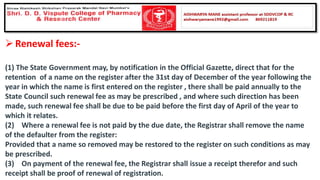
➢Renewal fees:-
(1) The State Government may, by notification in the Official Gazette, direct that for the
retention of a name on the register after the 31st day of December of the year following the
year in which the name is first entered on the register , there shall be paid annually to the
State Council such renewal fee as may be prescribed , and where such direction has been
made, such renewal fee shall be due to be paid before the first day of April of the year to
which it relates.
(2) Where a renewal fee is not paid by the due date, the Registrar shall remove the name
of the defaulter from the register:
Provided that a name so removed may be restored to the register on such conditions as may
be prescribed.
(3) On payment of the renewal fee, the Registrar shall issue a receipt therefor and such
receipt shall be proof of renewal of registration.
35. Entry of additional qualifications:- A registered pharmacist shall on payment of the
prescribed fee be entitled to have entered in the register any further degrees or diplomas in
pharmacy on pharmaceutical chemistry which he may obtain.
36. Removal from register:-
➢ Subject to the provisions of this section, the Executive Committee may order that the name of a registered
pharmacist shall be removed from the register, where it is satisfied, after giving him a reasonable opportunity of
being heard and after such further inquiry, if any, as it may think fit to make,-
(i) that his name has been entered into the register by error or on account of misrepresentation or suppression of a
material fact, or
(ii) that he has been convicted of any offence or has been guilty of any infamous conduct in any professional respect
which in the opinion of the Executive Committee, renders him unfit to be kept in the register, or
(iii) that a person employed by him for the purposes of his business of pharmacy [or employed to work under him in
connection with any business of pharmacy] has been convicted of any such offence or has been guilty of any such
infamous conduct
CHAPTER 5 : MISCELLANEOUS
➢SPECIAL PROVISIONS AND AMENDMENTS
OF THE ACT
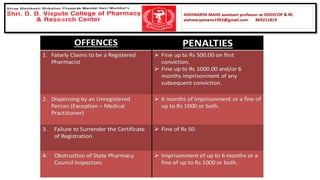
➢OFFENCES & PENALTIES
1. Penalty for falsely claiming to be registered:-
(a) If any person whose name is not for the time being entered into the register of the State falsely
pretends that it is so entered or uses in connection with his name or title any words or letters reasonably
calculated to suggest that his name is so entered, he shall be punishable on first conviction with fine which
may extend to five hundred rupees and on any subsequent conviction with imprisonment extending to six
months or with fine not exceeding one thousand rupees or with both:
Provided that it shall be a defence to show that the name of the accused is entered in the register
of another State and that at the time of the alleged offence under this section an application for
registration in the State had been made.
(b) For the purposes of this section;
The use of the description "pharmacist", "chemist", "druggist", "pharmaceutist", "dispenser",
"dispensing chemist", or any combination of such words or of any such word with any other word shall be
deemed to be reasonably calculated to suggest that the person using such description is a person whose
name is for the time being entered in the resister of the State
2. Dispensing by unregistered persons:-
(a).On or after such date as the State Government may by notification
in the Official Gazette appoint in this behalf, no person other than a
registered pharmacist shall compound, prepare, mix, or dispense any
medicine on the prescription of a medical practitioner
(b). Whoever contravenes the provisions of sub-section (1) shall be
punishable with imprisonment for a term which may extend to six
months, or with fine not exceeding one thousand rupees or with both.
3.Failure to surrender certificate of registration:-
(a) If any person whose name has been removed from the register fails
without sufficient cause forthwith to surrender his certificate of
registration he shall be punishable with fine which may extend to fifty
rupees.
(b) Cognizance of an offence punishable under this section shall not be
taken except upon complaint made by an order of the Executive
Committee.
Chapter 2 Pharmacy act 1948

Chapter 2 Pharmacy act 1948

  • 1.
    Year : FinalYear Div : A SEM- VII Subject : Pharmaceutical Jurisprudence CHAPTER 2
  • 3.
    ➢ The PharmacyAct enacted by Ministry of Health and Family Welfare (MHFW), Government of India is covered under 5 Chapters which encompass 46 sections. ➢ The Chapters covered under the Pharmacy Act are as follows: 1. Chapter I Introductory 2. Chapter II Pharmacy Council of India (PCI) 3. Chapter III State Pharmacy Council (SPC) 4. Chapter IV Registration of Pharmacists 5. Chapter V Miscellaneous • First Pharmacy Council of India was constituted in 1949. • First Education Regulations (E.R) were to be framed by 1952 and effectively implemented within 3 years of their framing.
  • 4.
  • 5.
    • Central Council:Means the Pharmacy Council of India constituted under section 3. • Central Register : Means the register of pharmacists maintained by the Central Council under section 15 A. • State Council : Means a State Council of Pharmacy constituted under section 19, and includes a Joint State Council of Pharmacy constituted in accordance with an agreement under section 20;
  • 6.
    • Medical practitioner"means a person : (i) Holding a qualification granted by an authority specified or notified under section 3 of the Indian Medical Degrees Act, 1916 (7 of 1916), or specified in the Schedules to the Indian Medical Council Act, 1956 (102 of 1956); or (ii) Registered or eligible for registration in a medical register of a State meant for the registration of persons practicing the modern scientific system of medicine; or (iii) Registered in a medical register of a State, who, although not falling within sub-clause(i) or sub- clause (ii) is declared by a general or special order made by the State Government in this behalf as a person practising the modern scientific system of medicine for the purposes of this Act; or (iv) Registered or eligible for registration in the register of dentists for a State under the Dentists Act, 1948 (16 of 1948); or (v) Who is engaged in the practise of veterinary medicine and who possesses qualifications approved by the State Government. • Register: Means a register of pharmacists prepared and maintained under Chapter IV • University Grants Commission: Means the University Grants Commission established under section 4 of the University Grants Commission Act, 1956 (3 of 1956).
  • 7.
  • 9.
    On 9th March,1949, the Pharmacy Council of India (PCI) was constituted to fulfil the objectives of the Pharmacy Act, 1948 by way of: (i) Prescribing the minimum standard of education required for qualifying as a pharmacist i.e., framing of Education Regulations prescribing the conditions to be fulfilled by the institutions seeking approval of the PCI for imparting education in Pharmacy. (ii) Ensuring uniform implementation of the educational standards throughout the country. (iii) Approving the courses of study and examination for pharmacists i.e.,approval of the academic training institutions providing pharmacy courses. (iv) Withdrawing approval, if the course of study does not continue to be in conformity with the educational standards prescribed by the PCI. (v) Approving qualifications granted outside the territories to which the Pharmacy Act, 1948 extends i.e., the approval of foreign qualification. (vi) Maintaining Central Register of Pharmacists. OBJECTIVES
  • 10.
    PHARMACY COUNCIL OF INDIA 1.COMPOSITION 2. FUNCTION Chapter II
  • 11.
    ➢ The CentralCouncil of PCI elects the President, Vice-President and five members of the Executive Committee CEC) from amongst its members by election conducted in accordance with the norms laid down in the Pharmacy Act. Any dispute arising out of the election of Executive Committee of PCI is referred to the Ministry of Health and Family Welfare, Government of India, whose decision shall be final.
  • 14.
    1.Minimum Qualification forRegistration as a Pharmacist in India: ✓ The minimum qualification for registration as a pharmacist in India is a pass in "Diploma course in pharmacy" from an institution recognized by the PCI. ✓ Persons holding "Degree in Pharmacy" from an institution recognized by the PCI are also eligible for registration as a pharmacist. ✓ Section 10 of the Pharmacy Act empowers the PCI to frame regulations called Education Regulations (E R) prescribing the minimum standard of education required for qualification as a pharmacist.
  • 15.
    2. Education RegulationsFramed by the Pharmacy Council of India under Section 10 of the Pharmacy Act, 1948 ➢ Education Regulation (ER) basically Prescribes- (i) the standard of education for qualification as a pharmacist i.e. minimum qualification for admission to the course, duration of the course, the syllabus, mode of examination, minimum marks for passing the examination, nature and duration of practical training, etc. (ii) Minimum conditions which an institution has to provide for seeking approval of the PCI for conducting a course of study for pharmacists. (iii) conditions to be fulfilled by the Examining Authority for approval for conduct of examinations. (iv) conditions to be fulfilled by the institutions to be recognized for giving the practical training. (v) Practical training contract forms for the pharmacists.
  • 16.
    Requirements as perER 1991: 1. Physical Facilities : ✓ For an intake of 60 in first year D. Pharm atleast, 4 laboratories, one each for pharmaceutics, pharmaceutical chemistry, biochemistry and clinical pathology, and pharmacognosy/ APH. ✓ The classrooms, (atleast two), aspectic room, balance room, animal house, drug-museum, machine room, Principal's office, girls and boys common rooms, etc., should be provided. ✓ The laboratory should be minimum 500 sq. ft in area. Equipments, instruments and glassware's as given in E R should be purchased. 2. Staff : (i) Principal/Director/Head of Department should be of the rank of professor or reader with M. Pharm. and minimum of 5 years teaching experience. (ii) Senior lecturer or lecturer: M. Pharm in the concerned subject or B. Pharm with 3 years professional experience. For the subjects like clinical pathology, toxicology, pharmacology, clinical pharmacy even MBBS qualification is permitted.
  • 17.
    3. Instructions: (i) Aminimum of 180 working days including time spent for sessional exams. (ii) In a week a minimum of 36 hrs of teaching preferably, 6 hrs per day. (iii) Staff/Student ratio in theory classes 1: 60 (iv) Staff/Student ratio in practicals 1 : 20. A practical batch should not have more than 30 students where in two staff members are required; for a batch upto 20 student, one staff member is needed. (v) There should be not more than 2 classes in the same subject by particular teacher on the same day. (vi) A minimum of 75% attendance is compulsory separately in theory and practicals. 4. Examinations: i. There should be atleast two sessional exams. Average of best two is taken into consideration. ii. Each paper carries 100 marks of which 20 are for sessional and 80 for annual examination. iii. In case of the practical sessional examination of 20, 10 marks are for the day-to-day work and record and other 10 marks for actual performance in examinations. iv. Under E.R 1991 the minimum passing marks are 40% in each paper inclusive of sessional marks. A candidate securing 60% or more and less than 75% is declared first class. v. The distinction is awarded to a candidate scoring 75% or more.
  • 18.
    ➢ After havingpassed D. Pharm Part II examination, the student has to undergo practical training in PCI approved hospital/dispensary!clinic! drug store! drug unit/charity hospital or any other institute. ➢ The practical training is for a minimum of 500 hrs spread over in not less than 3 months. Of these, atleast 250 hrs should be devoted for dispensing/compounding of drugs or handling of drug formulations. ➢ During the course of training, the student shall work under the guidance of Apprentice Master who is a registered pharmacist. ➢ The student shall be trained in drug laws, dispensing of drugs, maintaining records, identification of drugs from different sources and all other concerned matters. ➢ The training form is in five parts : Part I : It is to be filled by the Head of the Institution (College). Part II : It is to be filled by the Trainee (student) as an understanding. Part III : It is to be filled by Apprentice Master for accepting the student for training. Part IV: It is to be filled by the student after training. Part V : It is to be filled by tqe Institution certifying that student has undergone practical 'training as per ER 1991. ➢ This certificate alongwith D.Pharm. pass certificate and required fee are to be submitted to the concerned State Pharmacy Council for the purpose of registration as pharmacist.
  • 19.
  • 20.
  • 21.
  • 25.
    Inter-State agreements:- forJOINT STATE PHARMACY COUNCIL (1) Two or more State Government may enter into an agreement to be in force for such period and to be subject to renewal for such further periods, if any, as may be specified in the agreement, to provide- (a) for the constitution of a Joint State Council for all the participating States, or (b) that the State Council of one State shall serve the needs of the other participating States. (2) In addition to such matters as are in this Act specified, an agreement under this section may- (a) provide for the apportionment between the participating State of the expenditure in connection with the State Council or Joint State Council; (b) determine which of the participating State Governments shall exercise the several functions of the State Government under this Act, and the references in this Act to the State Government shall be construed accordingly; (c) provide for consultation between the participating State Governments either generally or with reference to particular matters arising under this Act; (d) make such incidental and ancillary provisions, not inconsistent with this Act, as may be deemed necessary or expedient for giving effect to the agreement. (3) An agreement under this section shall be published in the Official Gazettes of the participating States.
  • 28.
    Chapter IV: Registrationof Pharmacists 1. First Register of Pharmacist: Immediately after independence until SPC was constituted. 2. Subsequent Register: During the period of implementation of Pharmacy Act and framing of Educational Registrations. 3. Regular Register: After Education Regulations came into force.
  • 29.
    ➢ The registershall include the following particulars, namely:- (a) the full name and residential address of the registered person; (b) the date of his first admission to the register; (c) his qualifications for registration; (d) his professional address, and if he is employed by any person, the name of such person; (e) such further particulars as may be prescribed. ➢ Preparation of first register:- (1) For the purpose of preparing the first register, the State Government shall by notification in the Official Gazette constitute a Registration Tribunal consisting of three persons, and shall also appoint a Registrar who shall act as Secretary of the Registration Tribunal.
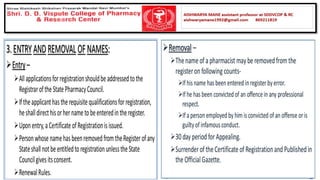
  • 30.
    (2) The StateGovernment shall, by the same or a like notification, appoint a date on or before which applications for registration, which shall be accompanied by the prescribed fee, shall be made to the Registration Tribunal. (3) The Registration Tribunal shall examine every application received on or before the appointed date, and if it is satisfied that the applicant is qualified for registration under section 31, shall direct the entry of the name of the applicant on the register. (4) The first register so prepared shall thereafter be published in such manner as the State Government may direct, and any person aggrieved by a decision of the Registration Tribunal expressed or implied in the register as so published may, within sixty days from the date of such publication, appeal to an authority appointed by the State Government in this behalf by notification in the Official Gazette. (5) The Registrar shall amend the register in accordance with the decisions of the authority appointed under sub-section 4 and shall thereupon issue to every person whose name is entered in the register a certificate of registration in the prescribed form. (6) Upon the constitution of the State Council, the register shall be given into its custody, and the State Government may direct that all or any specified part of the application fees for registration in the first register shall be paid to the credit of the State Council.
  • 31.
    ➢ Qualifications forentry on first register:- 1. A person who has attained the age of eighteen years shall be entitled] on payment of the prescribed fee to have his name entered in the first register if he resides, or carries on the business or profession of pharmacy, in the State and if he- (a)holds a degree or diploma in pharmacy or pharmaceutical chemistry or a chemist and druggist diploma of an Indian University or a State Government, as the case may be, or a prescribed qualification granted by an authority outside India, or (b)holds a degree of an Indian University other than a degree in pharmacy or pharmaceutical chemistry, and has been engaged in the compounding of drugs in a hospital or dispensary or other place in which drugs are regularly dispensed on prescriptions of medical practitioners for a total period of not less than three years, or (c)has passed an examination recognised as adequate by the State Government for compounders or dispensers, or (d)has been engaged in the compounding of drugs in a hospital or dispensary or other place in which drugs are regularly dispensed on prescriptions of medical practitioners for a total period of not less than five years prior to the date notified under sub-section (2) of section 30.
  • 32.
    ➢Qualifications for subsequentregistration : (1)After the date appointed under sub-section 2 of section 30 and before the Education Regulations have, by or under section 11, taken effect in the State, [a person who has attained the age of eighteen years shall on payment of the prescribed fee] be entitled to have his name entered in the register if he resides or carries on the business or profession of pharmacy in the State and if he- (a) satisfies the conditions prescribed with the prior approval of the Central Council, or where no conditions have been prescribed, the conditions entitling a person to have his name entered on the first register as set out in section 31, or (b) is a registered pharmacist in another State, or (c) possesses a qualification approved under section 14: Provided that no person shall be entitled [under clause (a) of clause (c)] to have his name entered on the register unless he has passed a matriculation examination or an examination prescribed as being equivalent to a matriculation examination. (2.) After the Education Regulations have by or under section 11 taken effect in the State, a person shall on payment of the prescribed fee be entitled to have his name entered on the register if he has attained the age of [eighteen years], if he resides, or carries on the business or profession of pharmacy, in the State and if he has passed an approved examination or possesses a qualification approved under section 14 [or is a registered pharmacist in another State.
  • 33.
    ➢ Scrutiny ofapplications for registration:- (1) After the date appointed under sub-section 2 of section 30 , applications for registration shall be addressed to the Registrar of the State Council and shall be accompanied by the prescribed fee. (2.) If upon such application the Registrar is of opinion that the applicant is entitled to have his name entered in the register under the provisions of this Act for the time being applicable , he shall enter the name of the applicant in the register: Provided that no person whose name has under the provisions of this Act been removed from the register of any State shall be entitled to have his name entered in the register except with the approval of the State Council recorded at a meeting. (3.) Any persons, whose application for registration is rejected by the Registrar, may within three months from the date of such rejection appeal to the State Council, and the decision of the State Council thereon shall be final. (4.) Upon entry in the register of a name under section, the Registrar shall issue a certificate of registration in the prescribed form
  • 34.
    ➢Renewal fees:- (1) TheState Government may, by notification in the Official Gazette, direct that for the retention of a name on the register after the 31st day of December of the year following the year in which the name is first entered on the register , there shall be paid annually to the State Council such renewal fee as may be prescribed , and where such direction has been made, such renewal fee shall be due to be paid before the first day of April of the year to which it relates. (2) Where a renewal fee is not paid by the due date, the Registrar shall remove the name of the defaulter from the register: Provided that a name so removed may be restored to the register on such conditions as may be prescribed. (3) On payment of the renewal fee, the Registrar shall issue a receipt therefor and such receipt shall be proof of renewal of registration.
  • 35.
    35. Entry ofadditional qualifications:- A registered pharmacist shall on payment of the prescribed fee be entitled to have entered in the register any further degrees or diplomas in pharmacy on pharmaceutical chemistry which he may obtain. 36. Removal from register:- ➢ Subject to the provisions of this section, the Executive Committee may order that the name of a registered pharmacist shall be removed from the register, where it is satisfied, after giving him a reasonable opportunity of being heard and after such further inquiry, if any, as it may think fit to make,- (i) that his name has been entered into the register by error or on account of misrepresentation or suppression of a material fact, or (ii) that he has been convicted of any offence or has been guilty of any infamous conduct in any professional respect which in the opinion of the Executive Committee, renders him unfit to be kept in the register, or (iii) that a person employed by him for the purposes of his business of pharmacy [or employed to work under him in connection with any business of pharmacy] has been convicted of any such offence or has been guilty of any such infamous conduct
  • 36.
    CHAPTER 5 :MISCELLANEOUS ➢SPECIAL PROVISIONS AND AMENDMENTS OF THE ACT ➢OFFENCES & PENALTIES
  • 38.
    1. Penalty forfalsely claiming to be registered:- (a) If any person whose name is not for the time being entered into the register of the State falsely pretends that it is so entered or uses in connection with his name or title any words or letters reasonably calculated to suggest that his name is so entered, he shall be punishable on first conviction with fine which may extend to five hundred rupees and on any subsequent conviction with imprisonment extending to six months or with fine not exceeding one thousand rupees or with both: Provided that it shall be a defence to show that the name of the accused is entered in the register of another State and that at the time of the alleged offence under this section an application for registration in the State had been made. (b) For the purposes of this section; The use of the description "pharmacist", "chemist", "druggist", "pharmaceutist", "dispenser", "dispensing chemist", or any combination of such words or of any such word with any other word shall be deemed to be reasonably calculated to suggest that the person using such description is a person whose name is for the time being entered in the resister of the State
  • 39.
    2. Dispensing byunregistered persons:- (a).On or after such date as the State Government may by notification in the Official Gazette appoint in this behalf, no person other than a registered pharmacist shall compound, prepare, mix, or dispense any medicine on the prescription of a medical practitioner (b). Whoever contravenes the provisions of sub-section (1) shall be punishable with imprisonment for a term which may extend to six months, or with fine not exceeding one thousand rupees or with both.
  • 40.
    3.Failure to surrendercertificate of registration:- (a) If any person whose name has been removed from the register fails without sufficient cause forthwith to surrender his certificate of registration he shall be punishable with fine which may extend to fifty rupees. (b) Cognizance of an offence punishable under this section shall not be taken except upon complaint made by an order of the Executive Committee.