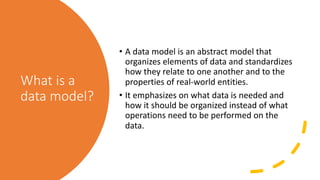
What is a
datamodel?
• A data model is an abstract model that
organizes elements of data and standardizes
how they relate to one another and to the
properties of real-world entities.
• It emphasizes on what data is needed and
how it should be organized instead of what
operations need to be performed on the
data.
3.
How data modelsand abstraction are related?
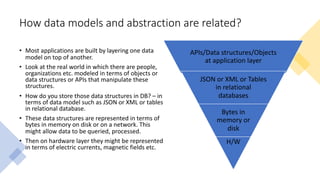
• Most applications are built by layering one data
model on top of another.
• Look at the real world in which there are people,
organizations etc. modeled in terms of objects or
data structures or APIs that manipulate these
structures.
• How do you store those data structures in DB? – in
terms of data model such as JSON or XML or tables
in relational database.
• These data structures are represented in terms of
bytes in memory on disk or on a network. This
might allow data to be queried, processed.
• Then on hardware layer they might be represented
in terms of electric currents, magnetic fields etc.
APIs/Data structures/Objects
at application layer
JSON or XML or Tables
in relational
databases
Bytes in
memory or
disk
H/W
4.
Data models usedfor
data storage and querying
Relational
Models
NoSQL aka Not
only SQL
models
5.
Relational
Model
• Data isorganized into
relations called tables.
• Each relation is an
unordered collection of
tuples(rows)
• Schema on write – schema
is explicit and database
ensures all written data
conforms to it. – static
compile time checking
6.
How to find
allthe items
ordered by a
customer?
Select
p.Name,oi.quantity
from Customer c
JOIN Order o on c.CID = o.Customer_ID
JOIN Order_items oi on oi.OID = o.OID
JOIN Product p on p.PID=oi.Product_ID;
7.
More into Relationalmodels
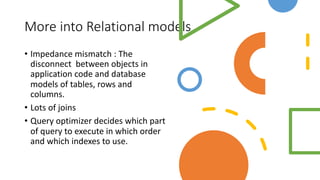
• Impedance mismatch : The
disconnect between objects in
application code and database
models of tables, rows and
columns.
• Lots of joins
• Query optimizer decides which part
of query to execute in which order
and which indexes to use.
8.
NoSQL aka Not
OnlySQL
• NoSQL databases allows “unstructured data.”
• Follows schema-on-read(structure of data is
implicit and interpreted when data is read) –
dynamic type checking
• NoSQL databases can be document based,
graph databases, key-value pairs, or wide-
column stores.
More into NoSQL
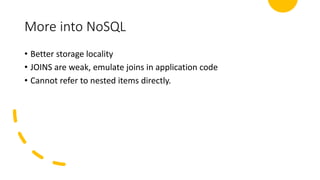
•Better storage locality
• JOINS are weak, emulate joins in application code
• Cannot refer to nested items directly.
11.
Which is better
then?
•If data has one to many relationships where
a tree can be loaded at once, then document
structure is better.
• Relational technique of shredding- creating a
document like structure into multiple tables
can lead to cumbersome schemas.
• If there comes a situation where a customer
first name and last name is currently being
stored in one column and we have to
separate them.
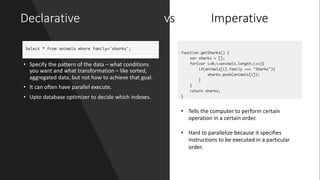
Declarative vs Imperative
•Specify the pattern of the data – what conditions
you want and what transformation – like sorted,
aggregated data, but not how to achieve that goal.
• It can often have parallel execute.
• Upto database optimizer to decide which indexes.
• Tells the computer to perform certain
operation in a certain order.
• Hard to parallelize because it specifies
instructions to be executed in a particular
order.
14.
Declarative queries onthe Web
<ul>
<li class = “selected”> <p> Sharks</p> </li>
<li> Whales</li>
<li> Fish </li
</ul>
li.selected > p {
background-color:blue;
}
15.
Imperative example
var liElements= document.getElementByTagName(“li”);
for(var i=0;i<liElements.length;i++){
if(liElements[i].className == “selected”{
var children = liElements[i].childNodes;
for(int j=0;j<children.length;j++){
if(children[j].nodeType == ELEMENT_NODE &&
children[j].tagName == “P”){
child.setAttribute(“style”,”background-color:blue”);
}
}
}
}
16.
Graph like datamodels
• Vertices ( nodes or entities)
• Edges ( relationships or arcs)
• Examples:
• Social graphs
• Web graphs
• Roads or rail networks
17.
Social graph example
JohnKate
Comment
Post
Friends
Comments on John’s post
Likes Kate’s comment
Posts on FB
Likes John’s post






![Imperative example
var liElements = document.getElementByTagName(“li”);
for(var i=0;i<liElements.length;i++){
if(liElements[i].className == “selected”{
var children = liElements[i].childNodes;
for(int j=0;j<children.length;j++){
if(children[j].nodeType == ELEMENT_NODE &&
children[j].tagName == “P”){
child.setAttribute(“style”,”background-color:blue”);
}
}
}
}](https://image.slidesharecdn.com/chapter2datamodelandquerylanguagessqlnonsql-250929133058-9736eb91/85/Chapter-2-Data-model-and-query-languages-SQL-NonSQL-pdf-15-320.jpg)


![Database System Concepts AND architecture [Autosaved].pptx](https://cdn.slidesharecdn.com/ss_thumbnails/databasesystemconceptsandarchitectureautosaved-230817173311-be7f8590-thumbnail.jpg?width=640&height=640&fit=bounds)


