Cost determination
• Itinvolves calculating the cost of resource
inputs like materials, labor, and overhead,
which is essential for pricing, profit
assessment, and cost control.
3.
2.1 Materials
Accounting forstock (inventory) cost movements
❑Commonly Used Classifications of Manufacturing Costs
● Three terms commonly used when describing manufacturing costs
are direct material costs, direct manufacturing labor costs, and
indirect manufacturing costs.
1. Direct material costs are the acquisition costs of all materials that
eventually become part of the cost object (work in process and then
finished goods) and can be traced to the cost object in an
economically feasible way.
● Acquisition costs of direct materials include purchase price, freight in
charges, sales taxes, and custom duties etc.
4.
Cont.
2. Direct manufacturinglabor costs include the compensation of
all manufacturing labor that can be traced to the cost object (work
in process and then finished goods) in an economically feasible
way. Examples include wage or salary paid to machine operators
and assembly-line workers who convert direct materials purchased
to finished goods.
3.Indirect manufacturing costs are all manufacturing costs
that are related to the cost object (work in process and then
finished goods) but cannot be traced to that cost object in an
economically feasible way.
5.
Cont.
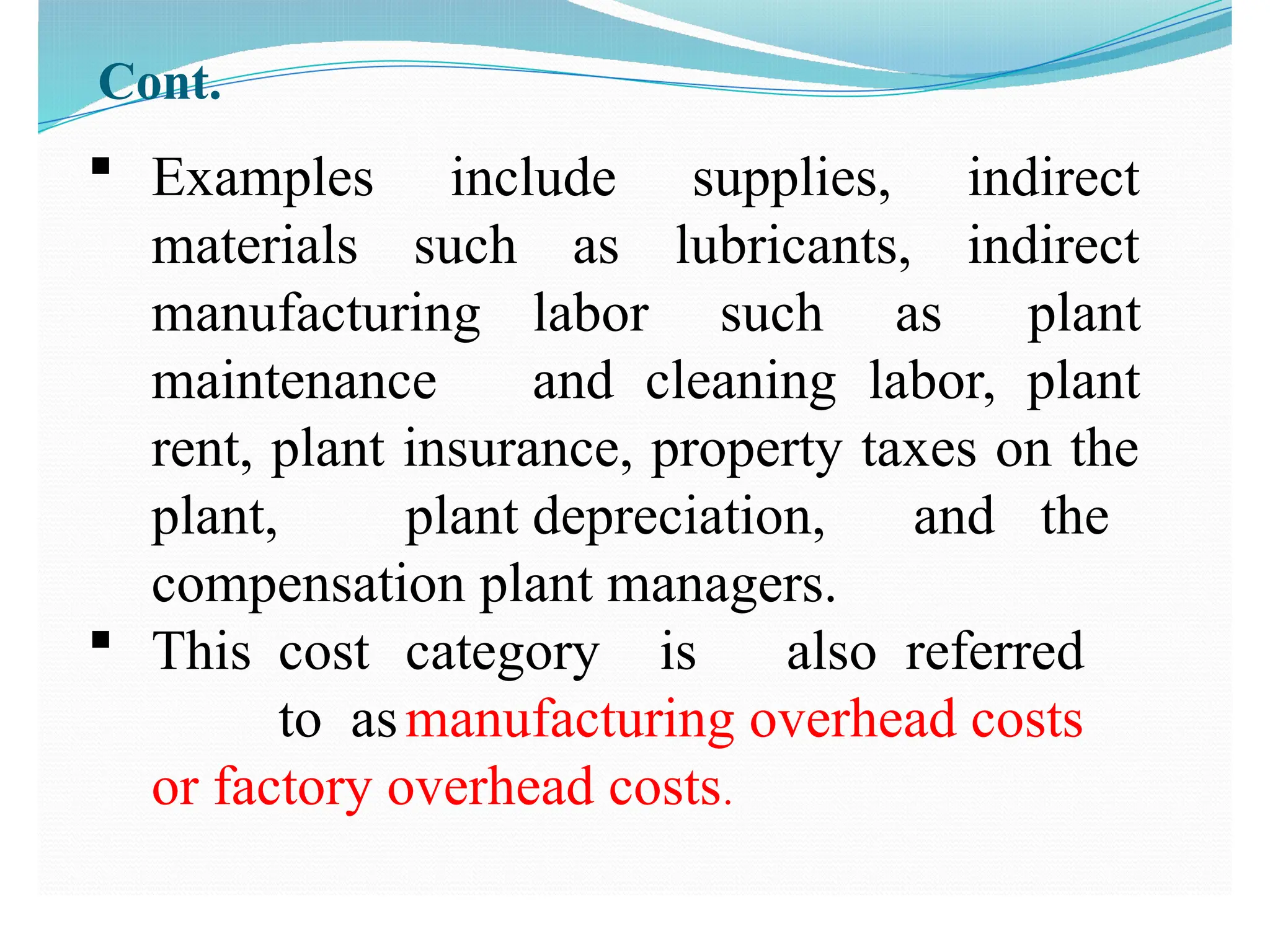
Examples includesupplies, indirect
materials such as lubricants, indirect
manufacturing labor such as plant
maintenance and cleaning labor, plant
rent, plant insurance, property taxes on the
plant, plant depreciation, and the
compensation plant managers.
This cost category is also referred
to asmanufacturing overhead costs
or factory overhead costs.
6.
The Flow ofInventoriable Costs and Period Costs
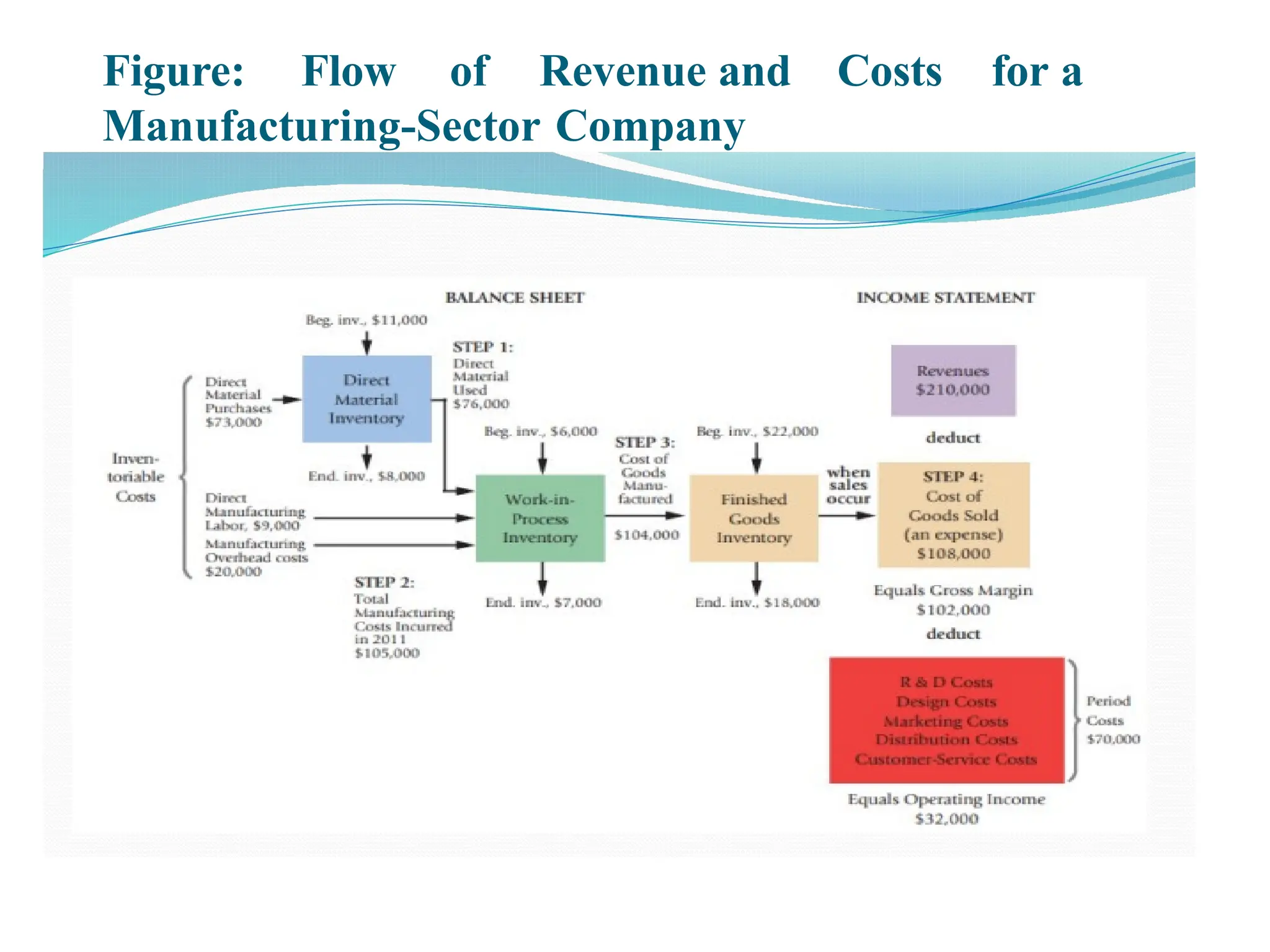
● Manufacturing-Sector Example- To illustrate the flow of
inventoriable costs and period costs through the balance
sheet and income statement of a manufacturing company,
the cost data for ABC manufacturing company is taken.
● Inventorable costs go through the balance sheet accounts of
work-in-process inventory and finished goods inventory before
entering cost of goods sold in the income statement.
● Period costs are expensed directly in the income statement
7.
Figure: Flow ofRevenue and Costs for a
Manufacturing-Sector Company
8.
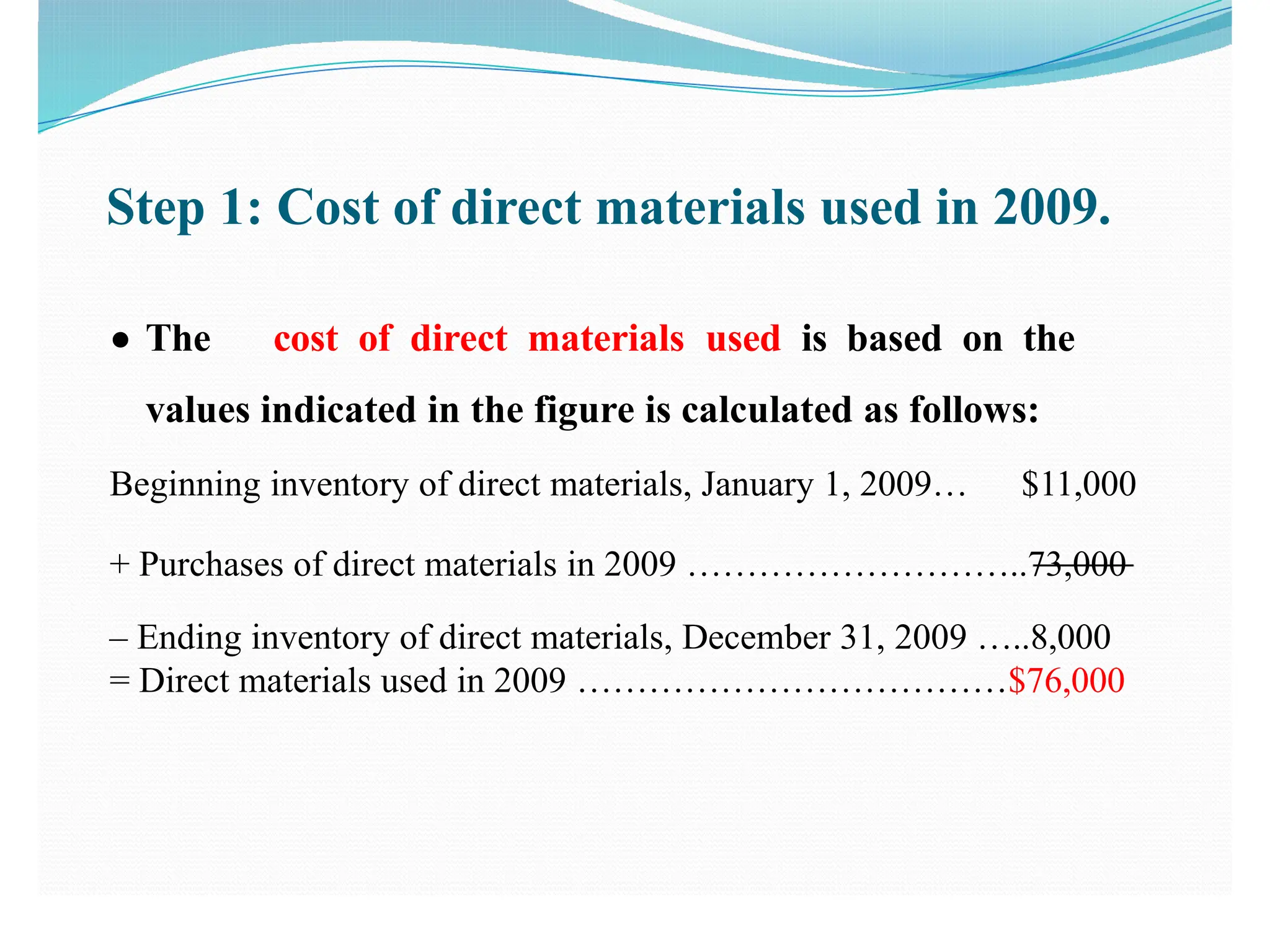
Step 1: Costof direct materials used in 2009.
● The cost of direct materials used is based on the
values indicated in the figure is calculated as follows:
Beginning inventory of direct materials, January 1, 2009… $11,000
+ Purchases of direct materials in 2009 ………………………..73,000
– Ending inventory of direct materials, December 31, 2009 …..8,000
= Direct materials used in 2009 ………………………………$76,000
9.
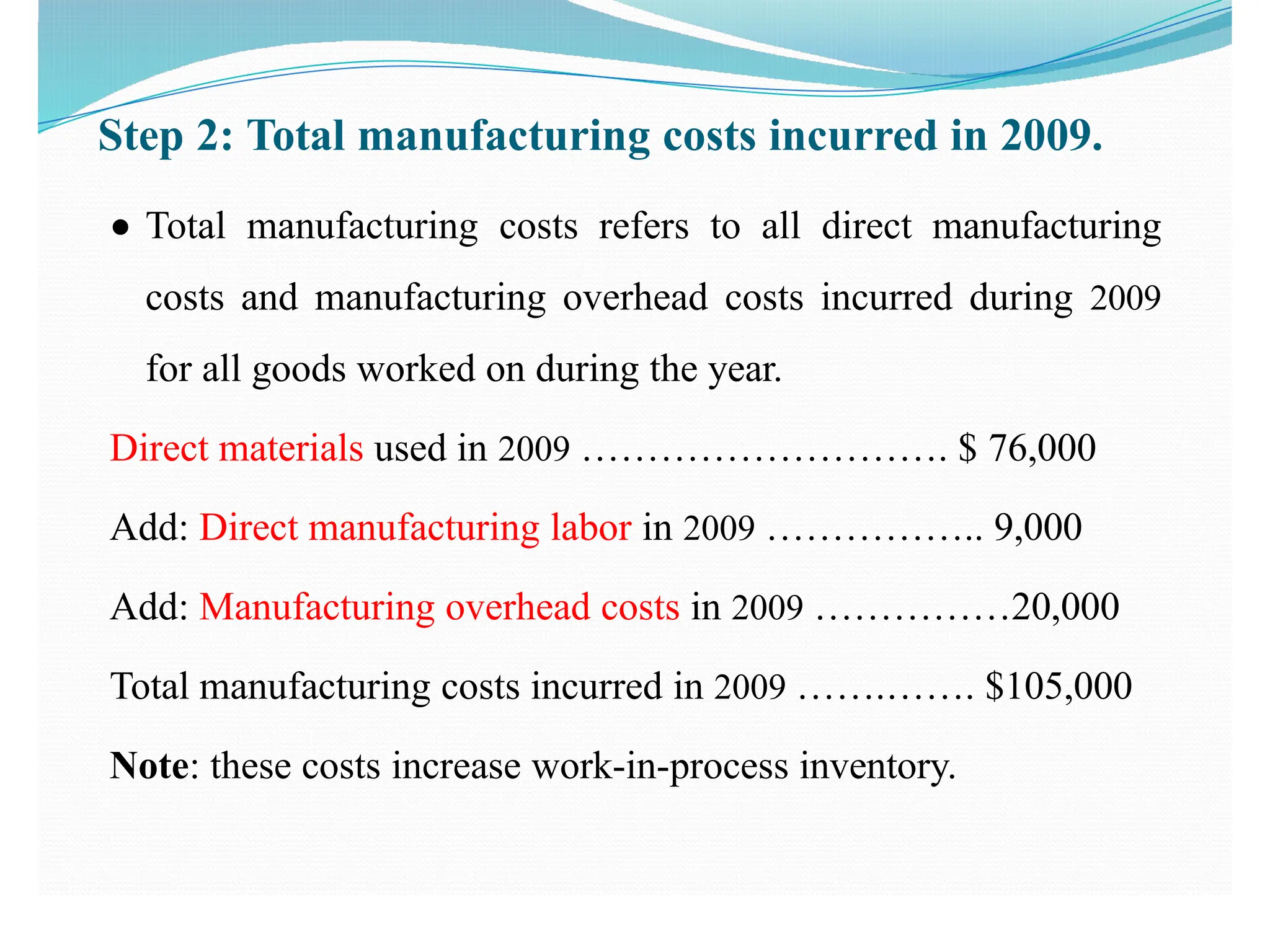
Step 2: Totalmanufacturing costs incurred in 2009.
● Total manufacturing costs refers to all direct manufacturing
costs and manufacturing overhead costs incurred during 2009
for all goods worked on during the year.
Direct materials used in 2009 ………………………. $ 76,000
Add: Direct manufacturing labor in 2009 …………….. 9,000
Add: Manufacturing overhead costs in 2009 ……………20,000
Total manufacturing costs incurred in 2009 …….……. $105,000
Note: these costs increase work-in-process inventory.
10.
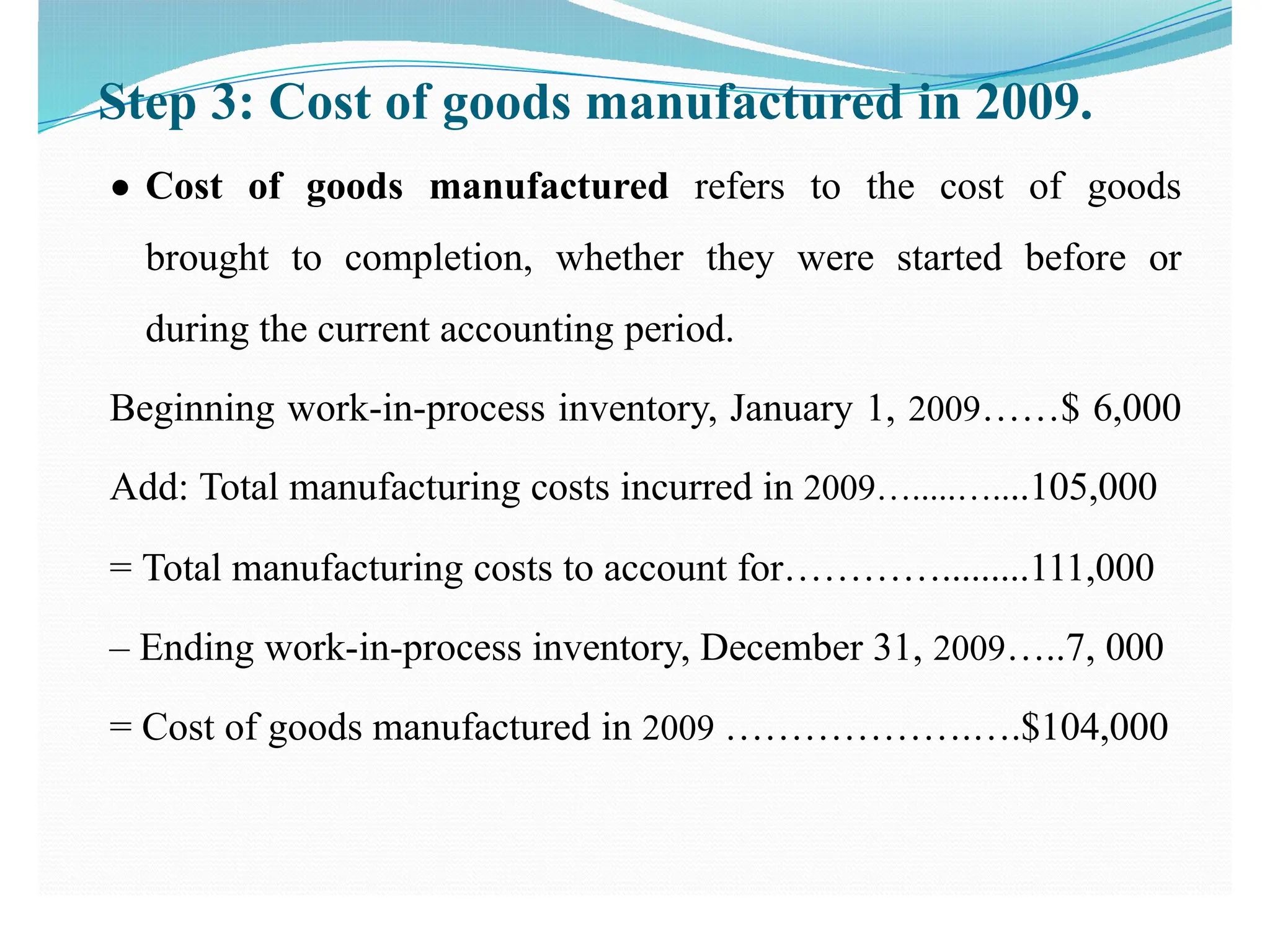
Step 3: Costof goods manufactured in 2009.
● Cost of goods manufactured refers to the cost of goods
brought to completion, whether they were started before or
during the current accounting period.
Beginning work-in-process inventory, January 1, 2009……$ 6,000
Add: Total manufacturing costs incurred in 2009….....…....105,000
= Total manufacturing costs to account for………….........111,000
– Ending work-in-process inventory, December 31, 2009…..7, 000
= Cost of goods manufactured in 2009 ……………….….$104,000
11.
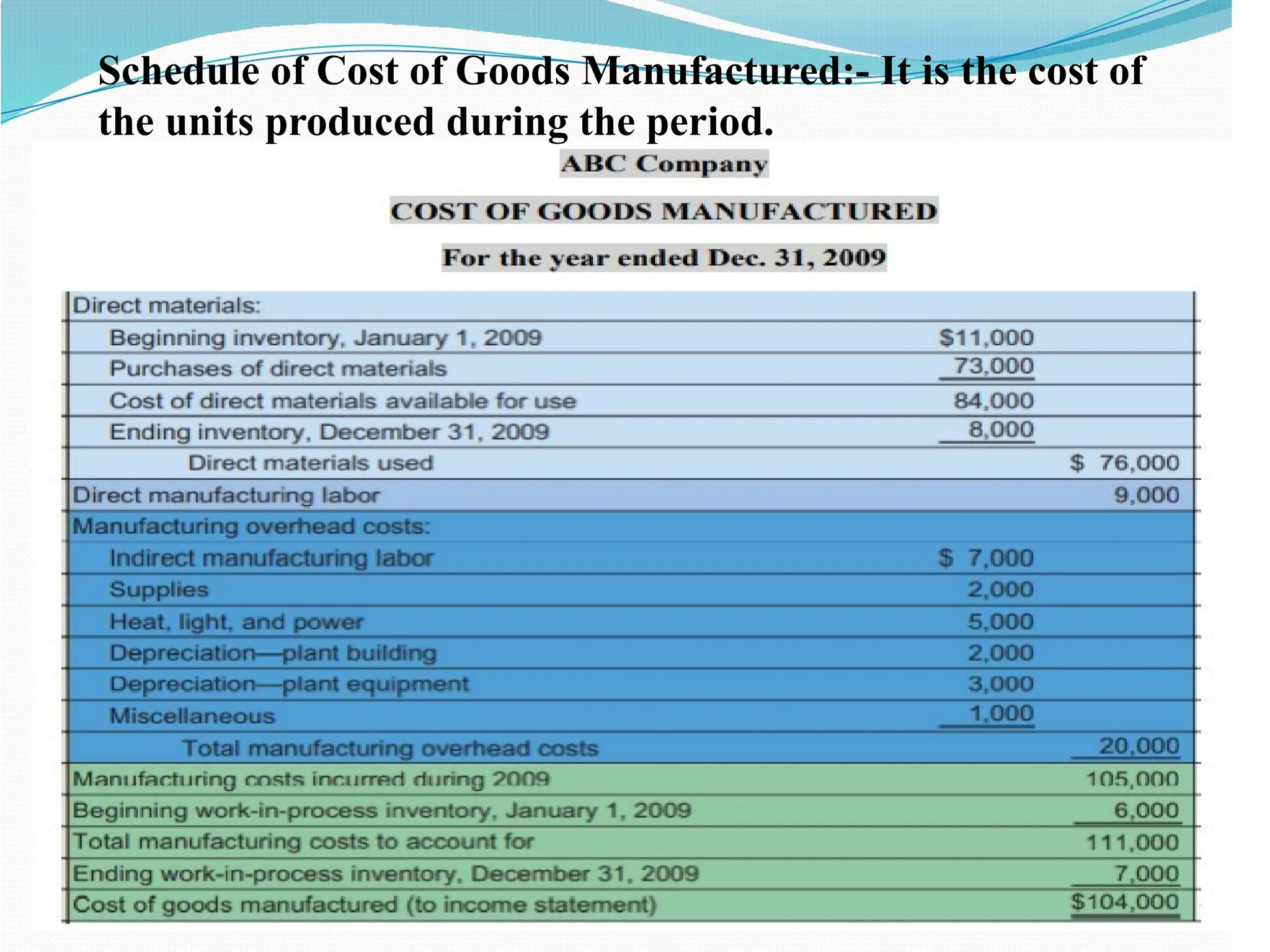
Schedule of Costof Goods Manufactured:- It is the cost of
the units produced during the period.
12.
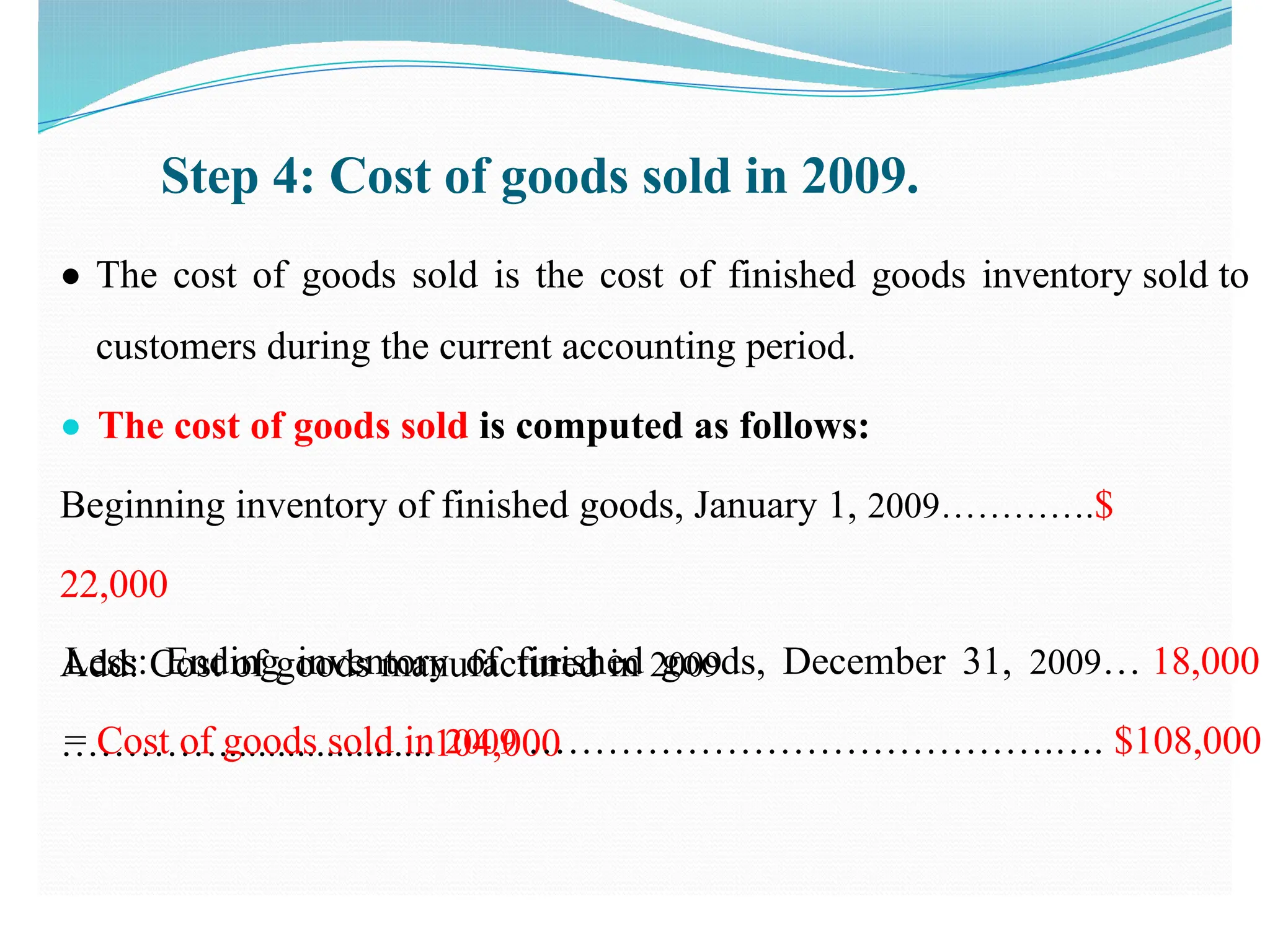
Step 4: Costof goods sold in 2009.
● The cost of goods sold is the cost of finished goods inventory sold to
customers during the current accounting period.
● The cost of goods sold is computed as follows:
Beginning inventory of finished goods, January 1, 2009………….$
22,000
Add: Cost of goods manufactured in 2009
…………......................104,000
Less: Ending inventory of finished goods, December 31, 2009… 18,000
= Cost of goods sold in 2009 ………………………………….…. $108,000
13.
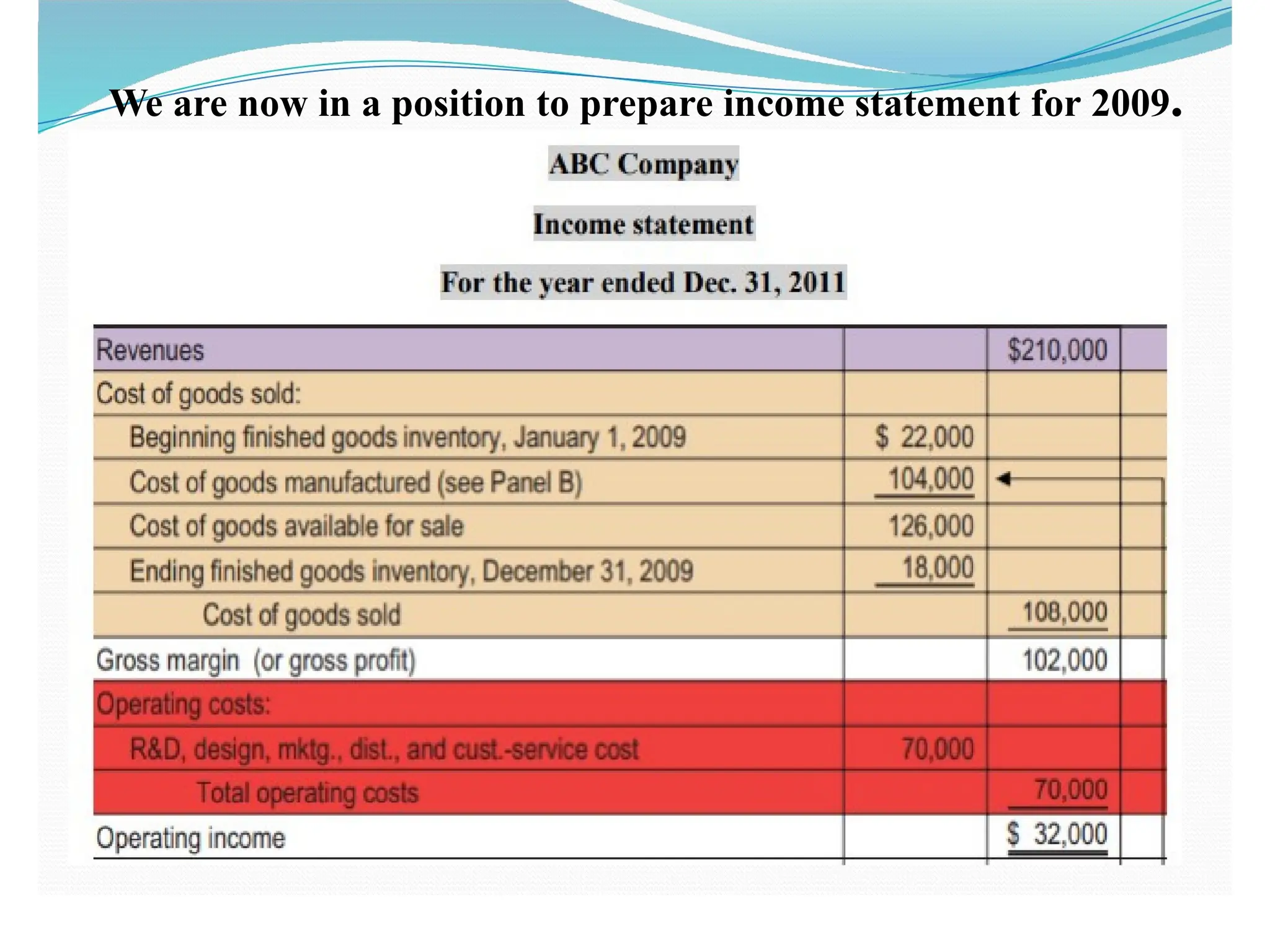
We are nowin a position to prepare income statement for 2009.
14.
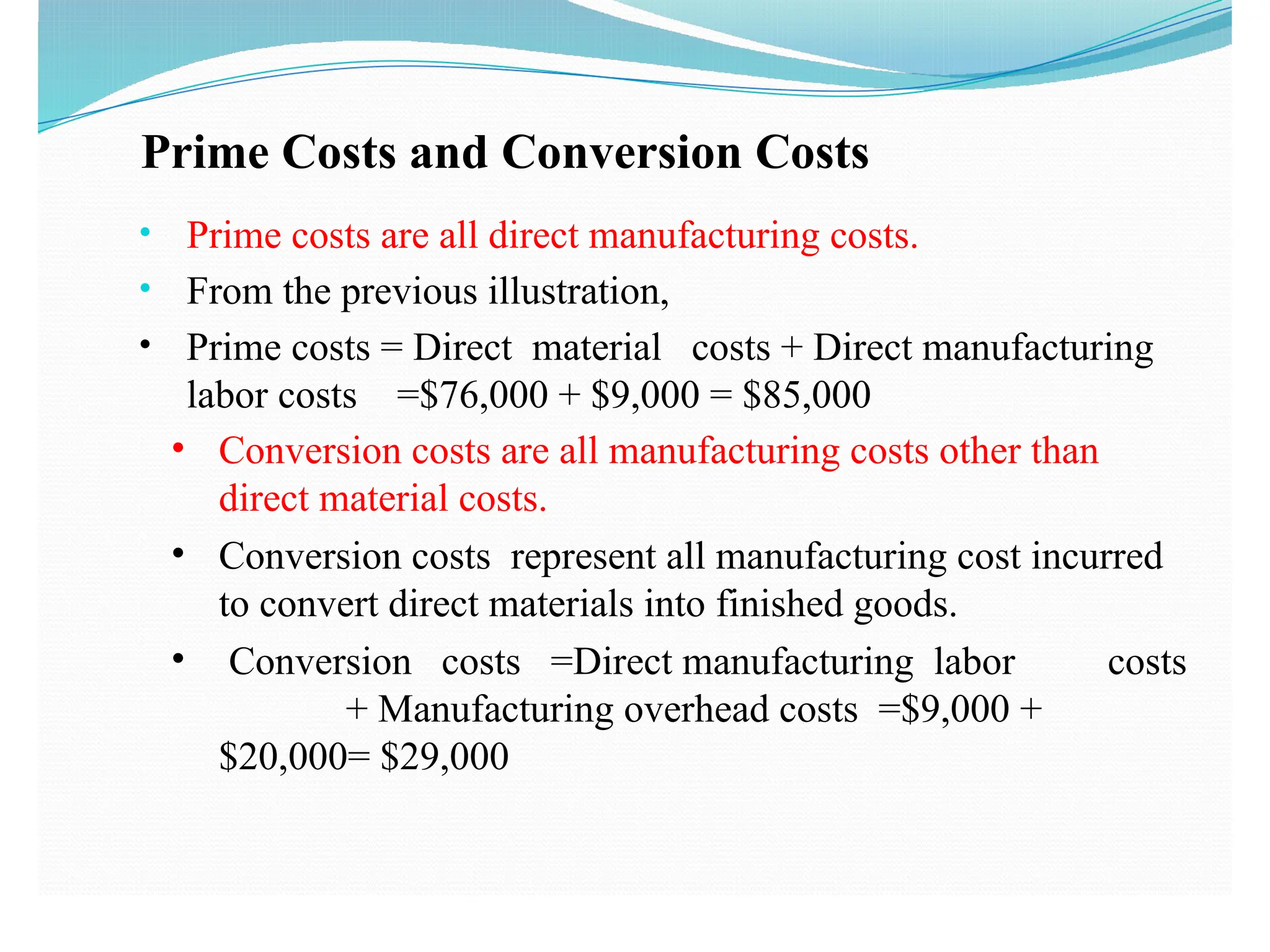
Prime Costs andConversion Costs
• Prime costs are all direct manufacturing costs.
• From the previous illustration,
• Prime costs = Direct material costs + Direct manufacturing
labor costs =$76,000 + $9,000 = $85,000
• Conversion costs are all manufacturing costs other than
direct material costs.
• Conversion costs represent all manufacturing cost incurred
to convert direct materials into finished goods.
• Conversion costs =Direct manufacturing labor costs
+ Manufacturing overhead costs =$9,000 +
$20,000= $29,000
15.
Types of ManufacturingInventories
● Manufacturing companies have at least three inventories. These
are the raw materials inventory, the work-in-process inventory and
the finished goods inventory.
1. Raw materials inventories
This refers to all materials purchased to be used in the
production process.
The purchase of raw materials is recorded at cost in raw
material inventory account.
The cost of the raw material inventory is composed of:
The invoice price of the material, taxes, the transportation cost, the
insurance in transit cost of the material, loading and
unloading costs, handling costs all other costs incurred on the
raw materials to make ready for consumption
16.
2.Work-in-process inventory
❑ Thework-in- process inventory refers to all items that
are still in process on the date of reporting.
❑ These items are not completed to be reported
as finished goods inventory.
❑ The cost of work-in-process inventory
account consists of
ii. The cost of raw material charged to production
iii. the cost of labour incurred on items in process
iv. the manufacturing overhead costs on items in process
17.
3. Finished goods
inventory
●The finished goods inventory account is used to record
cost of fully completed goods but not yet sold to
customers.
The cost of finished goods inventory is composed of:-
i. applicable cost of raw materials
ii. applicable cost of labour
iii. applicable cost of manufacturing overheads
● Note that these costs are the total required costs
to complete the production process.
18.
15-17
Balance Sheet
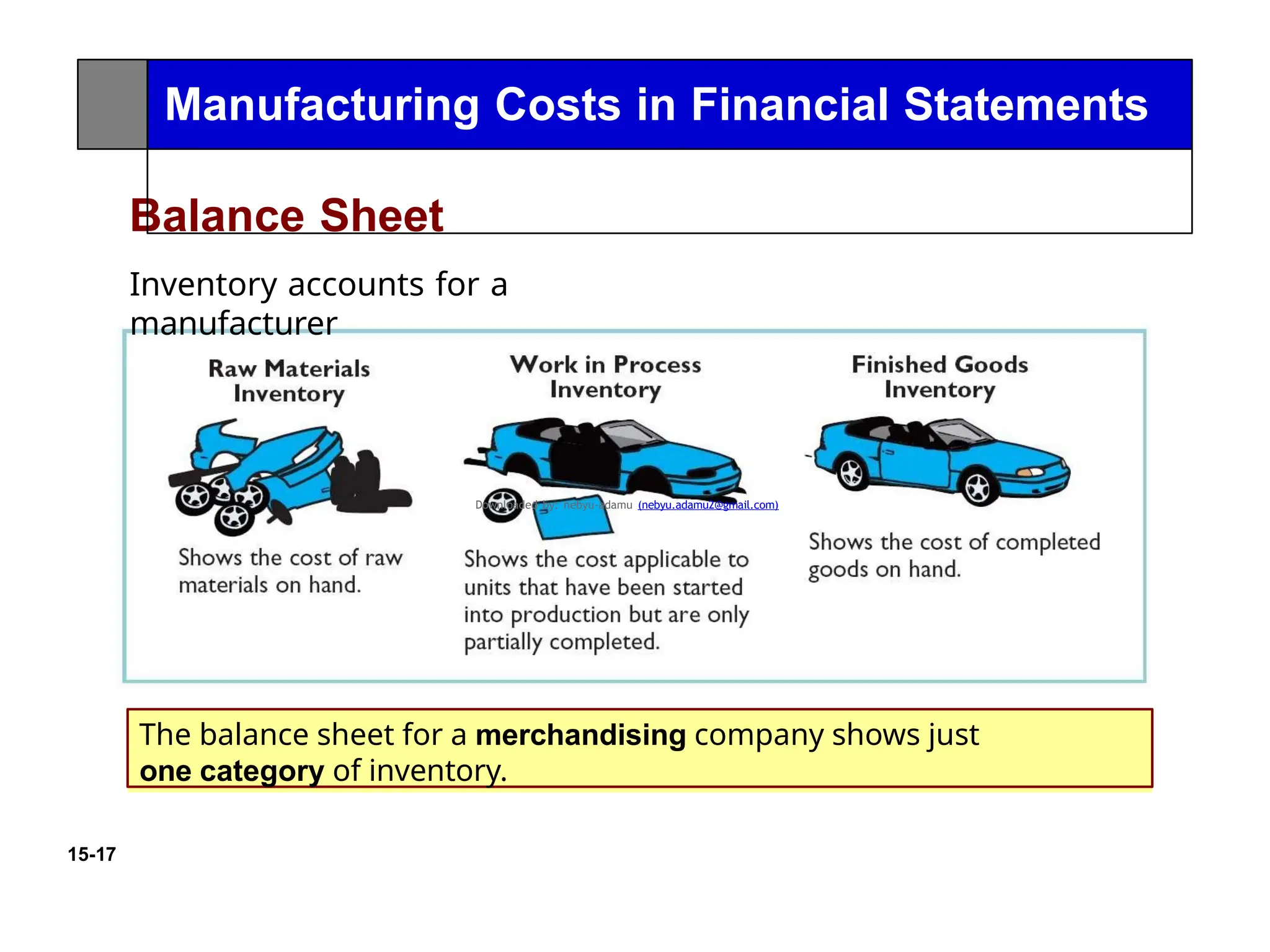
Inventory accountsfor a
manufacturer
The balance sheet for a merchandising company shows just
one category of inventory.
Manufacturing Costs in Financial Statements
Downloaded by: nebyu-adamu (nebyu.adamu2@gmail.com)
19.
1.Accounting for materials
●As you know manufacturing process involves conversion of
raw materials in to completed finished goods.
● Accounting for materials is, therefore, critical to determine the
proper cost of a product.
● There are two major group of materials used in manufacturing
process, the direct materials and indirect materials.
● Accounting for materials involves making entries for the
purchase of raw materials, the return of defective materials to
the suppliers and the issuance of raw materials in to production.
20.
Purchasing raw materials
A purchase requisition is a form that records a
request for materials to be purchased.
This form must indicate at least the following
information:-
• Product description and quantity
• The purpose that the material is purchased,
• Price
• Name of the supplier etc.
21.
Cont.
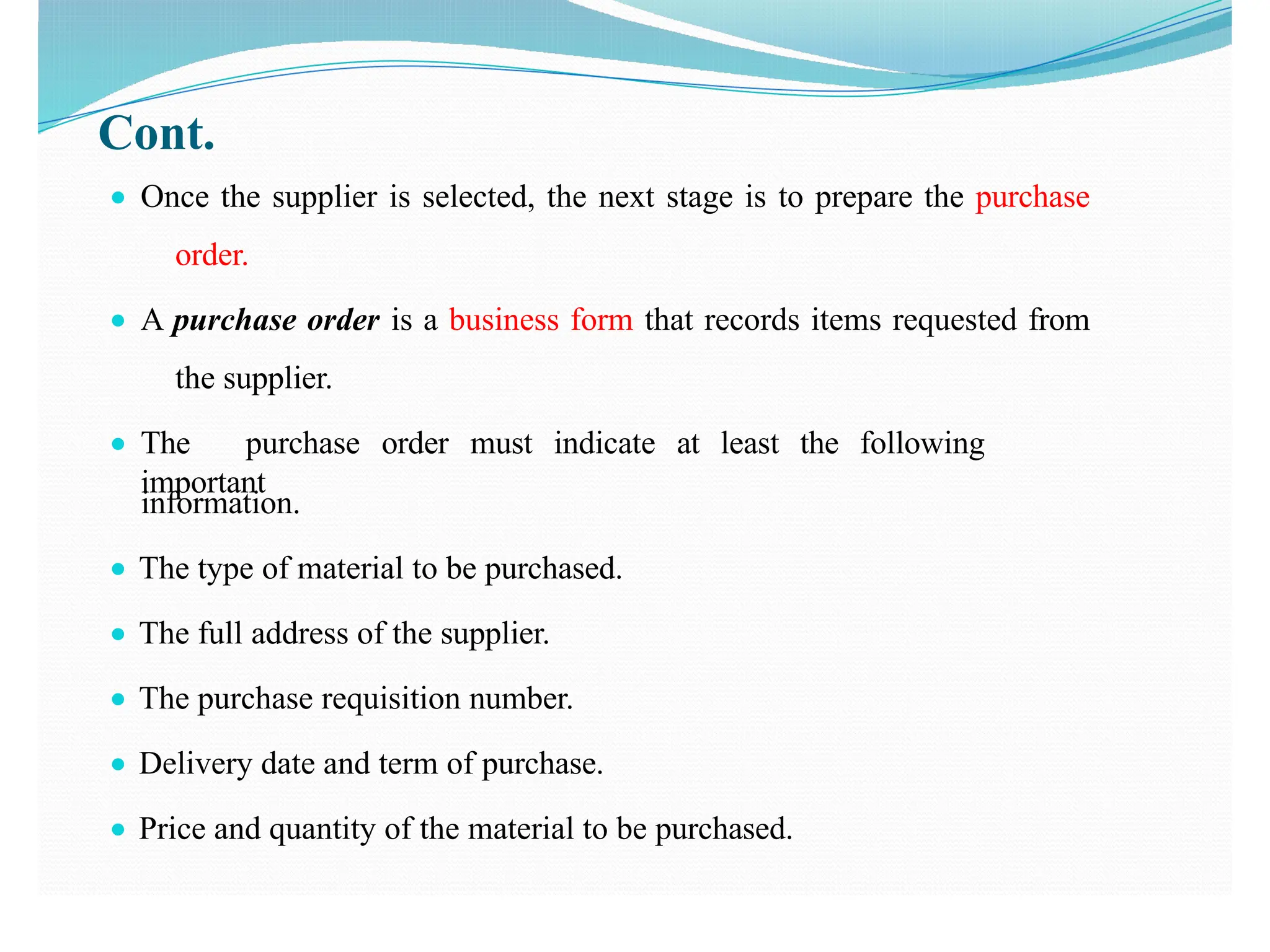
● Once thesupplier is selected, the next stage is to prepare the purchase
order.
● A purchase order is a business form that records items requested from
the supplier.
● The purchase order must indicate at least the following
important
information.
● The type of material to be purchased.
● The full address of the supplier.
● The purchase requisition number.
● Delivery date and term of purchase.
● Price and quantity of the material to be purchased.
22.
Cont.
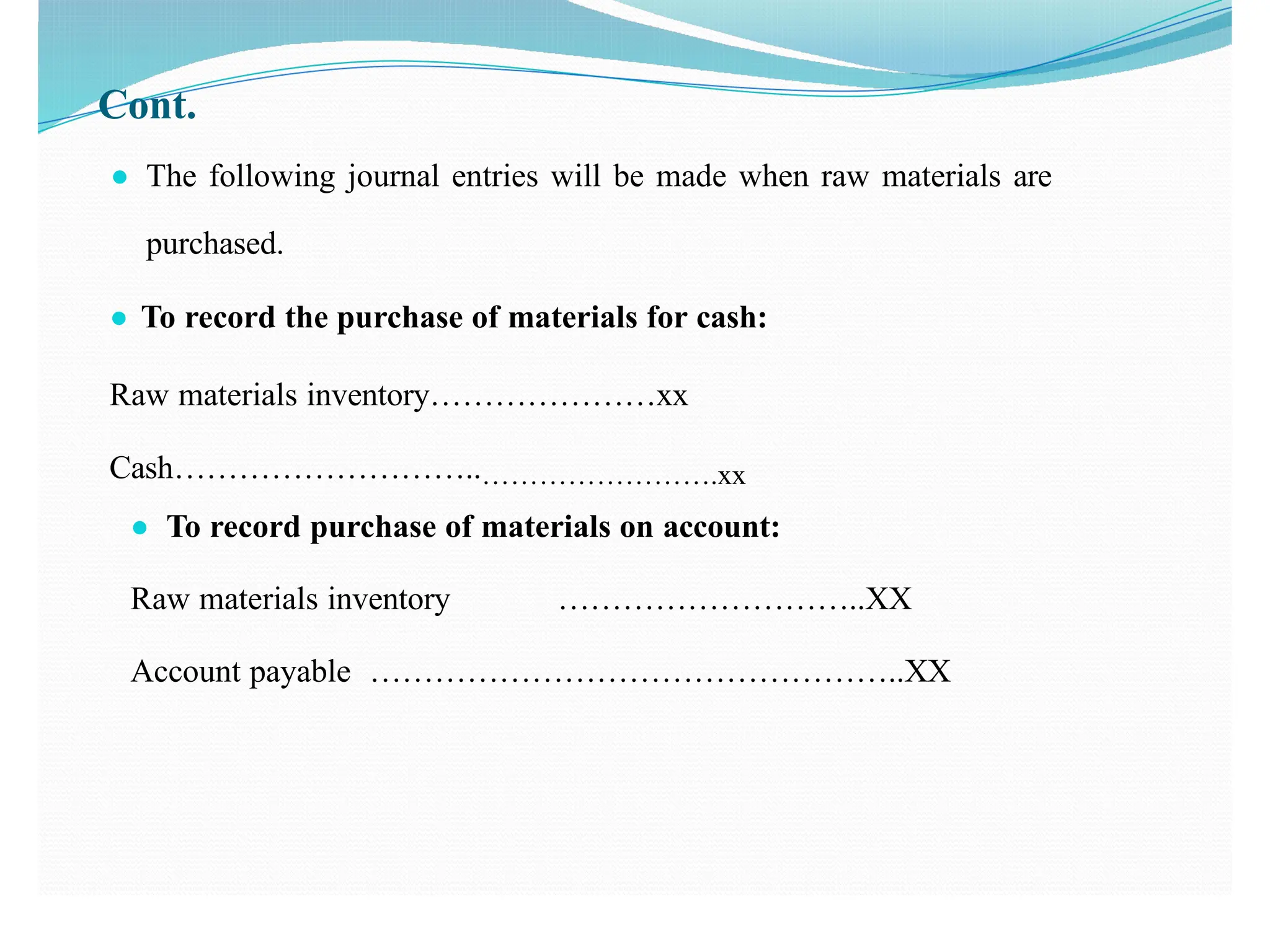
● The followingjournal entries will be made when raw materials are
purchased.
● To record the purchase of materials for cash:
Raw materials inventory…………………xx
Cash………………………..…………………….xx
● To record purchase of materials on account:
Raw materials inventory ………………………..XX
Account payable …………………………………………..XX
23.
Issuing materials toproduction
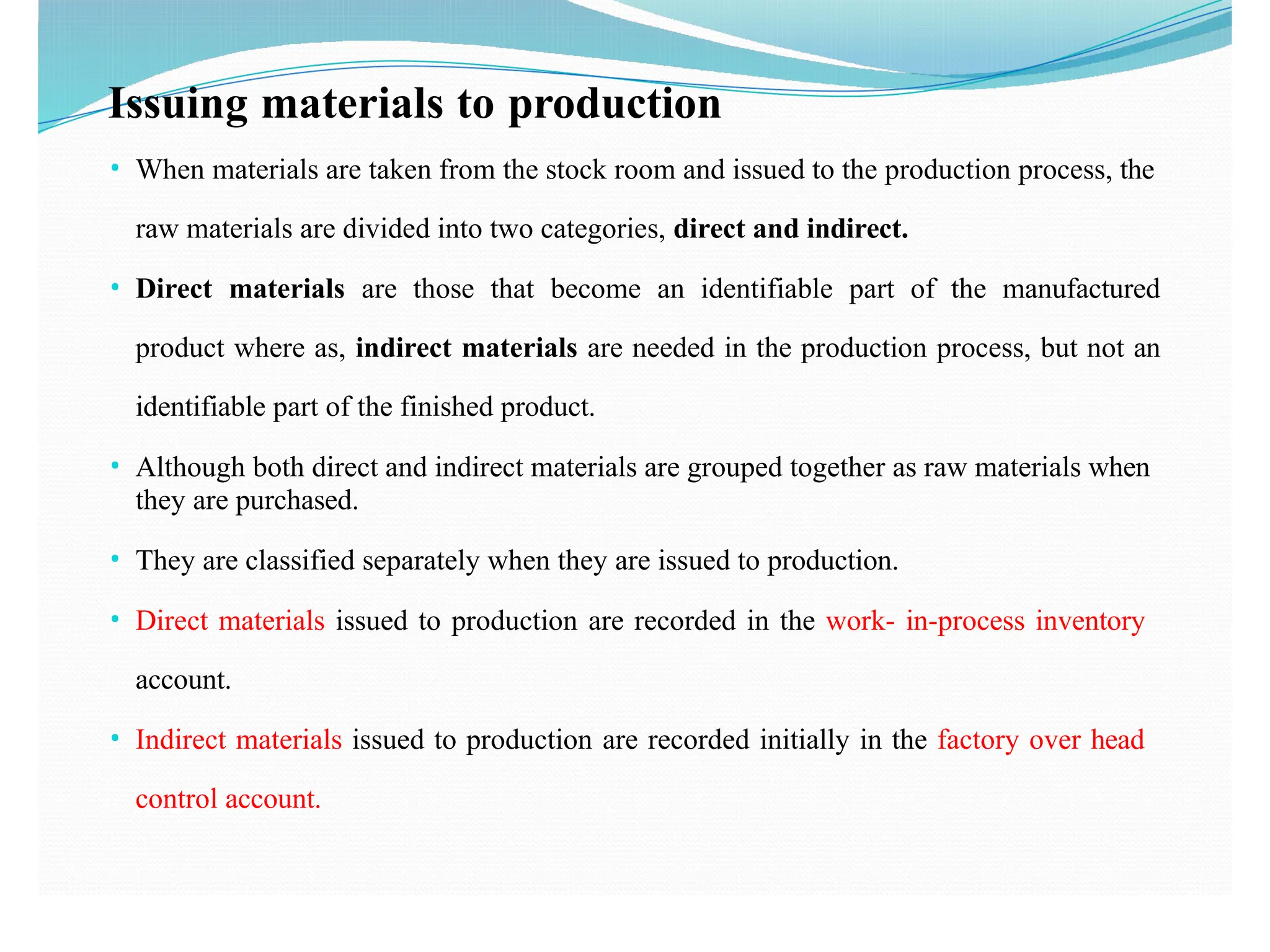
• When materials are taken from the stock room and issued to the production process, the
raw materials are divided into two categories, direct and indirect.
• Direct materials are those that become an identifiable part of the manufactured
product where as, indirect materials are needed in the production process, but not an
identifiable part of the finished product.
• Although both direct and indirect materials are grouped together as raw materials when
they are purchased.
• They are classified separately when they are issued to production.
• Direct materials issued to production are recorded in the work- in-process inventory
account.
• Indirect materials issued to production are recorded initially in the factory over head
control account.
24.
Cont.
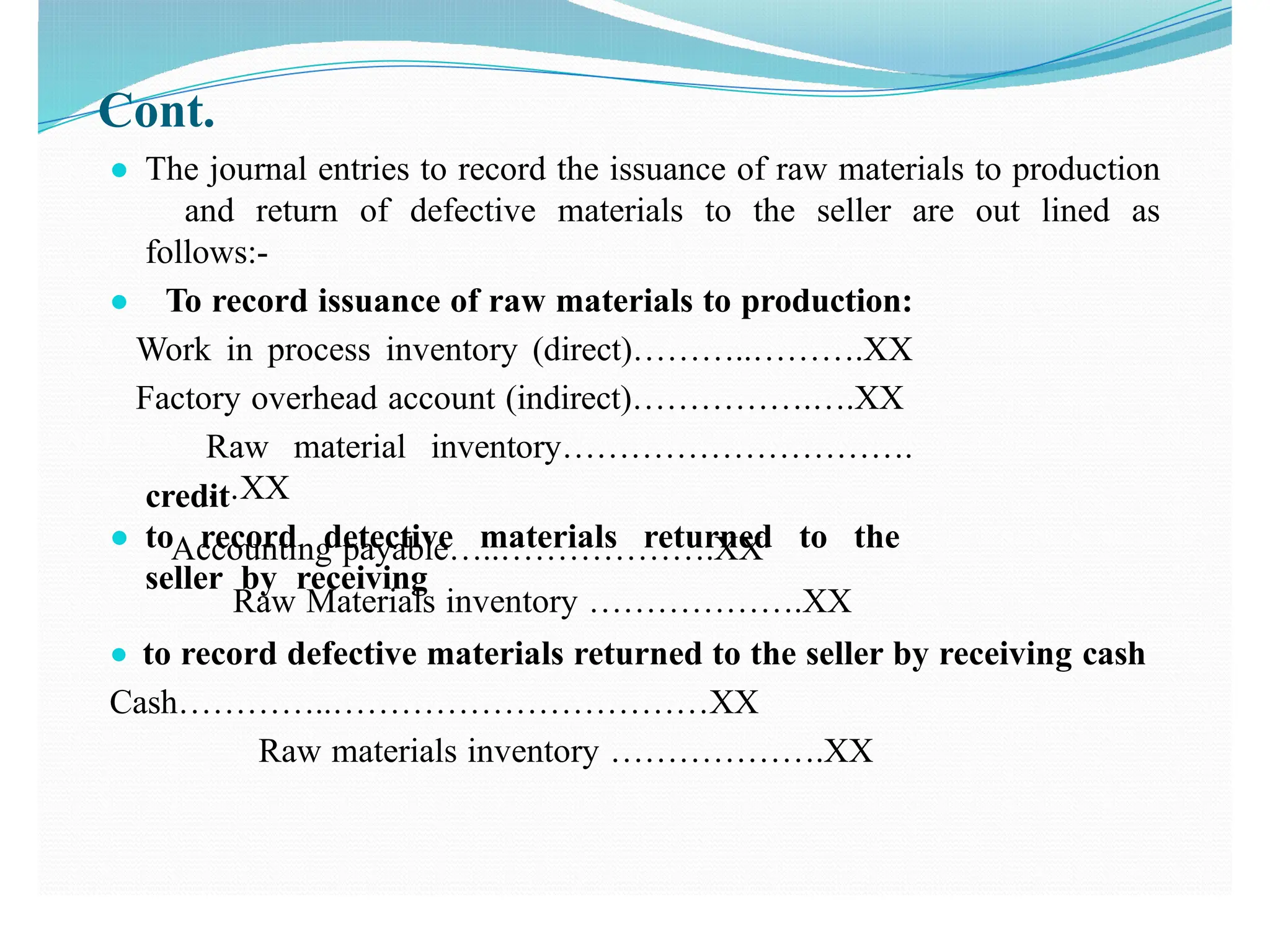
● The journalentries to record the issuance of raw materials to production
and return of defective materials to the seller are out lined as
follows:-
● To record issuance of raw materials to production:
Work in process inventory (direct)………..……….XX
Factory overhead account (indirect)…………….….XX
Raw material inventory………………………….
…XX
● to record detective materials returned to the
seller by receiving
credit
Accounting payable…..……………….XX
Raw Materials inventory ……………….XX
● to record defective materials returned to the seller by receiving cash
Cash…………..……………………………XX
Raw materials inventory ……………….XX
25.
Material Control
● Materialcontrol is a system which ensures that right quality of
material is available in the right quantity at the right time and
right place with the right amount of investment.
● The two basic aspects of materials control are (1) the physical
control or safeguarding of materials and (2) control over
the investment in materials.
● Physical control protects materials from misuse or
misappropriation. Controlling the investment in materials
maintains
i. Limited access:-Only authorized personnel should have
access to materials storage areas.
ii. Segregation of duties:-the following functions should be segregated:
purchasing, receiving, storage, use, and recording.
iii. Accuracy in recording:-accurate recording of the purchase
and issuance of materials.
appropriate quantities of materials in inventory.
❑Physical Control of Materials
26.
Cont.
❑Controlling the Investmentin Materials:-An inventory of sufficient
size and variety for efficient operations must be maintained, but
the size should not be excessive in relation to scheduled
production needs.
❑To determine the quantity to be ordered, the cost of placing an order
(order costs) and the cost of carrying inventory in stock (carrying
costs) must be considered.
• To decide how much to order, you need to account for the ordering
costs and the inventory holding costs.
● Effective materials planning and control involve analyzing these factors
to decide:
i. When to place orders, and
ii. How many units to order.
27.
Accounting for StockLosses
• At some point, you're going to lose inventory due to
theft, damage or obsolescence.
• When this happens, the inventory loss should be recorded
a company's accounting book.
• To record the loss of inventory:
Loss on inventory……….………………xx
Inventory……………………………….xx
28.
1.Accounting for Labour
•In a manufacturing process, the raw materials are
converted into completed finished goods using labour and
manufacturing overheads.
• Accounting for labour is therefore, critical to determine
the proper cost of a product
• Labour cost is part of the cost of producing products of
an organization.
• It is necessary to know the amount or the cost of the labour
time spent on each product to determine the cost of a product.
29.
Cont.
• Documentation, calculationsand analysis of labour
costs are necessary for the following three main
reasons.
ii.
iii. For management accounting and inventory
valuations we need to allocate the labour cost of the
period to the products produced.
i. To calculate the correct gross pay and net pay for each
employee
For financial accountingpurposes
30.
Cont.
●There are differenttypes of documents used to identify labor
cost. The common ones are presented below.
●Clock cards:- is a document on
which the starting and finishing times of an employee
are recorded to ascertain total
actual attendance.
●Job card: - is a record of time spent on a job/product. it will
usually show the cost of labour hour incurred on a job/product
●A timesheet:- is a method for
recording the amount of a worker's time
spent on each job/product.
31.
Method Of RemunerationOf Workers
● The following methods are in use for the remuneration of workers:
i. Fixed salary
ii. Time rate or day rate:-This is a method of calculating wages based
on the hours of works put at work by each worker. Workers paid
according to the effective hours worked.
iii. Piece rate or piece Work. This is the method of remunerating workers
based on the number of work or piece of work done. This method
does not consider the time spent on the work.
iv. Differential piece work:-Taylor’s Differential Piece-Rate System
was introduced by F.W. Taylor, who believed that the workers should
be paid on the basis of their degree of efficiencies.
Remuneration of workers refers to the total compensation or payment
that employees receive in exchange for their work.
32.
Cont.
• Accounting forlabour in a cost accounting system
involves two procedures, recording the payroll and charging
the labour costs to production.
• To record a factory payroll, we debiting an account
called payroll account.
it is
• To charge labour costs to the production
process, necessary to determine the direct and indirect
labour costs.
33.
Cont.
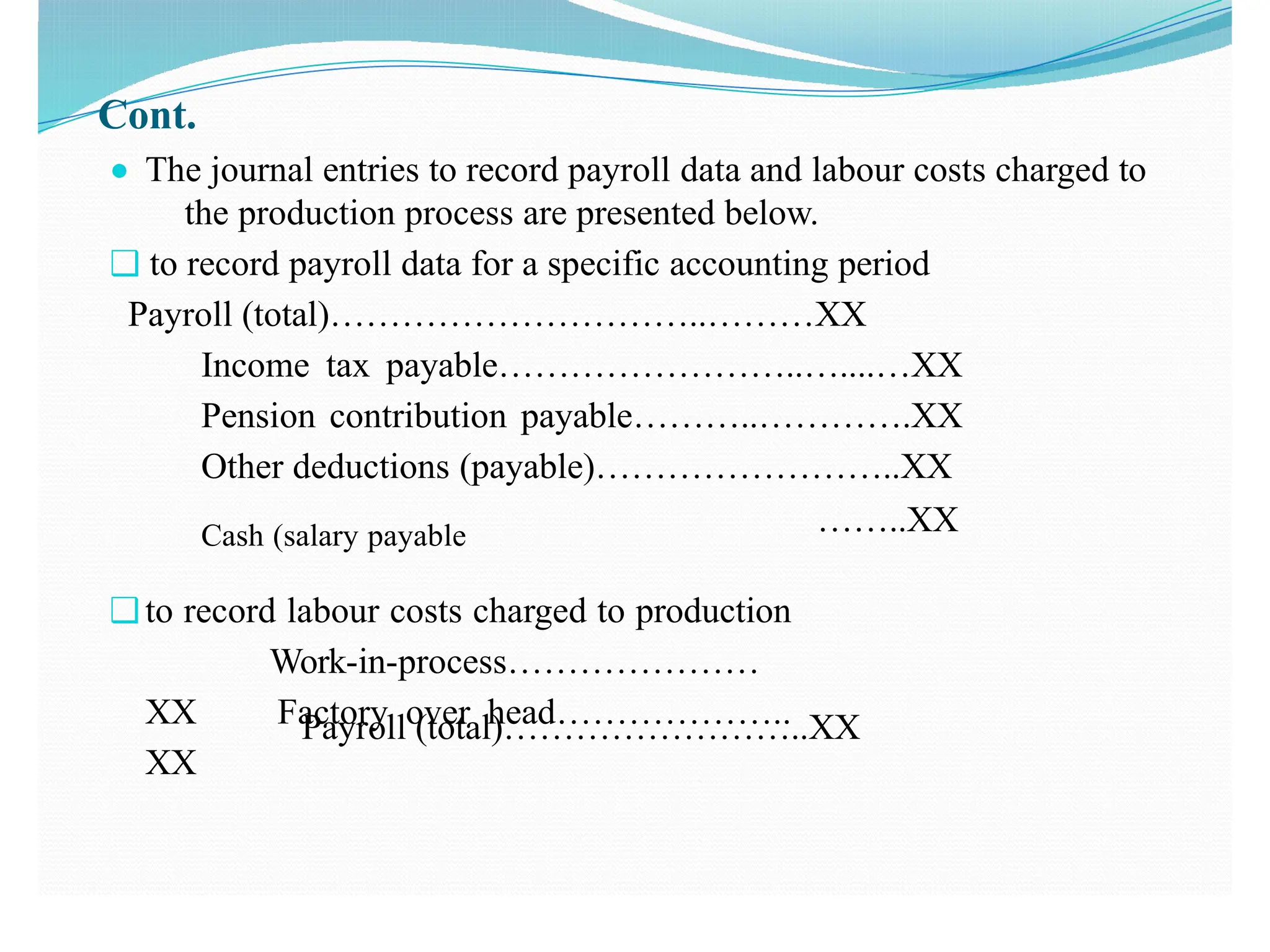
● The journalentries to record payroll data and labour costs charged to
the production process are presented below.
❑ to record payroll data for a specific accounting period
Payroll (total)…………………………..………XX
Income tax payable……………………..…....…XX
Pension contribution payable………..………….XX
Other deductions (payable)……………………..XX
……..XX
Payroll (total)……………………..XX
Cash (salary payable
❑ to record labour costs charged to production
Work-in-process…………………
XX Factory over head………………..
XX
34.
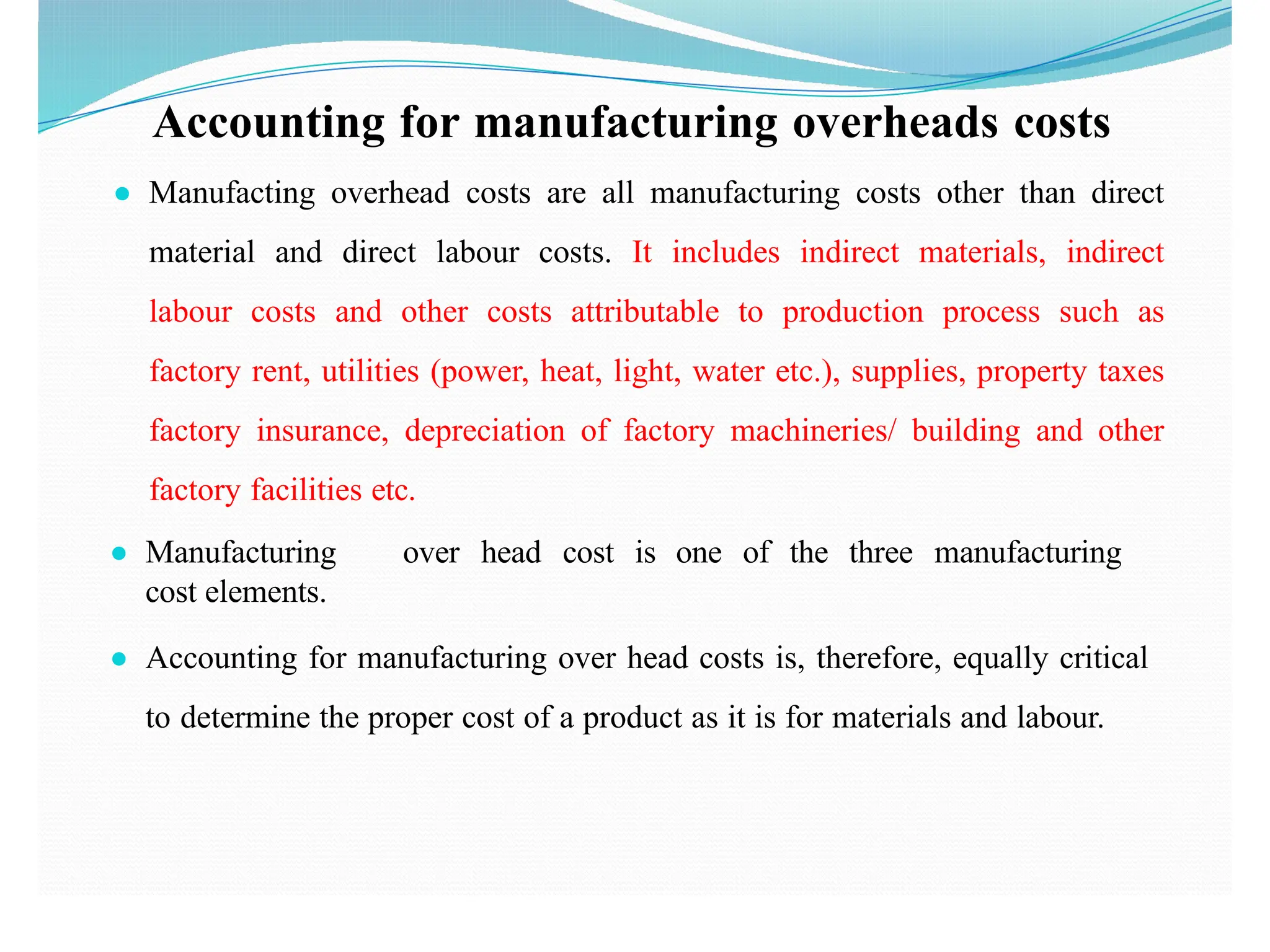
Accounting for manufacturingoverheads costs
● Manufacting overhead costs are all manufacturing costs other than direct
material and direct labour costs. It includes indirect materials, indirect
labour costs and other costs attributable to production process such as
factory rent, utilities (power, heat, light, water etc.), supplies, property taxes
factory insurance, depreciation of factory machineries/ building and other
factory facilities etc.
● Manufacturing over head cost is one of the three manufacturing
cost elements.
● Accounting for manufacturing over head costs is, therefore, equally critical
to determine the proper cost of a product as it is for materials and labour.
35.
Cont.
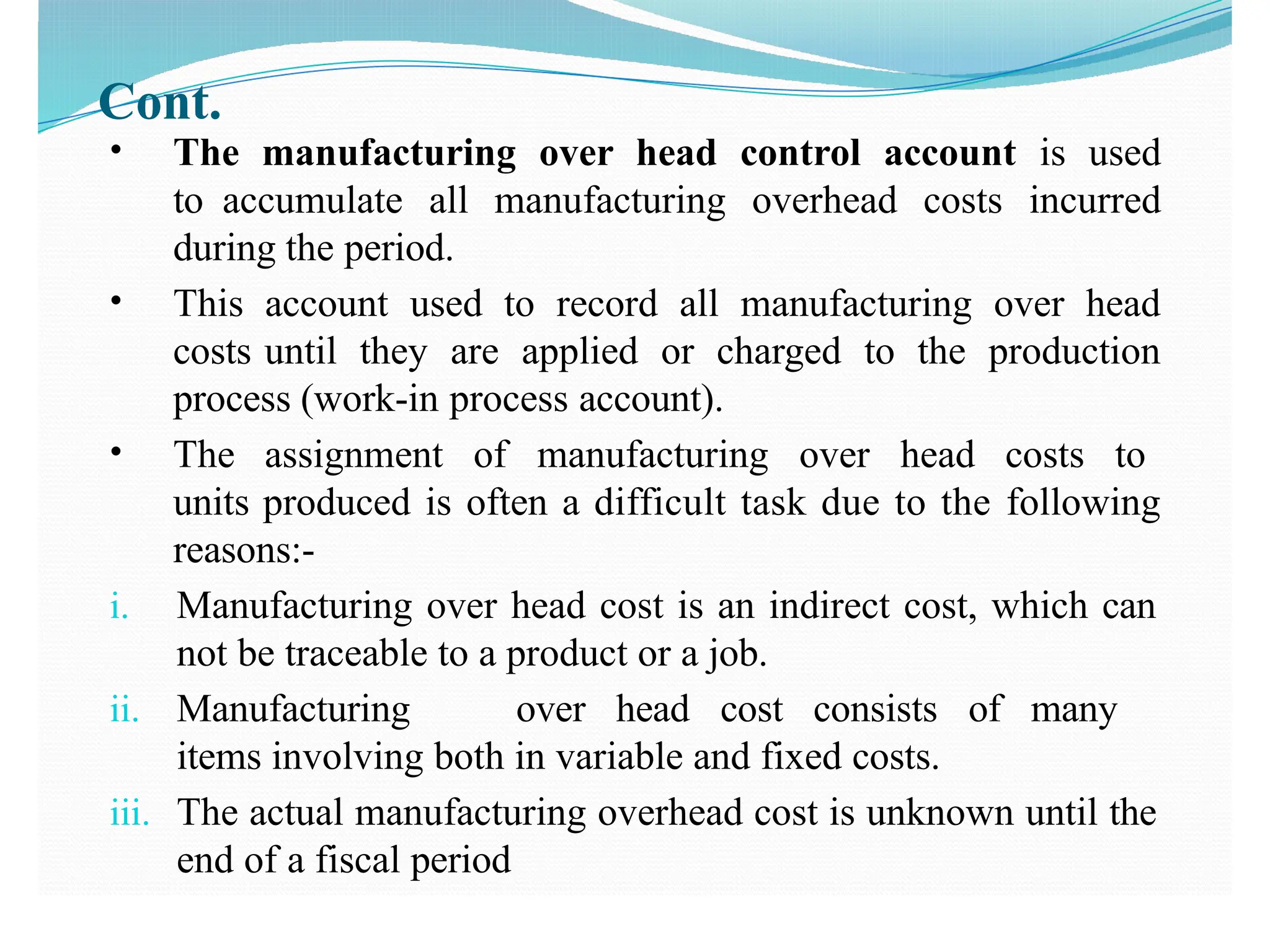
• The manufacturingover head control account is used
to accumulate all manufacturing overhead costs incurred
during the period.
• This account used to record all manufacturing over head
costs until they are applied or charged to the production
process (work-in process account).
• The assignment of manufacturing over head costs to
units produced is often a difficult task due to the following
reasons:-
i. Manufacturing over head cost is an indirect cost, which can
not be traceable to a product or a job.
ii. Manufacturing over head cost consists of many
items involving both in variable and fixed costs.
iii. The actual manufacturing overhead cost is unknown until the
end of a fiscal period
36.
15-35
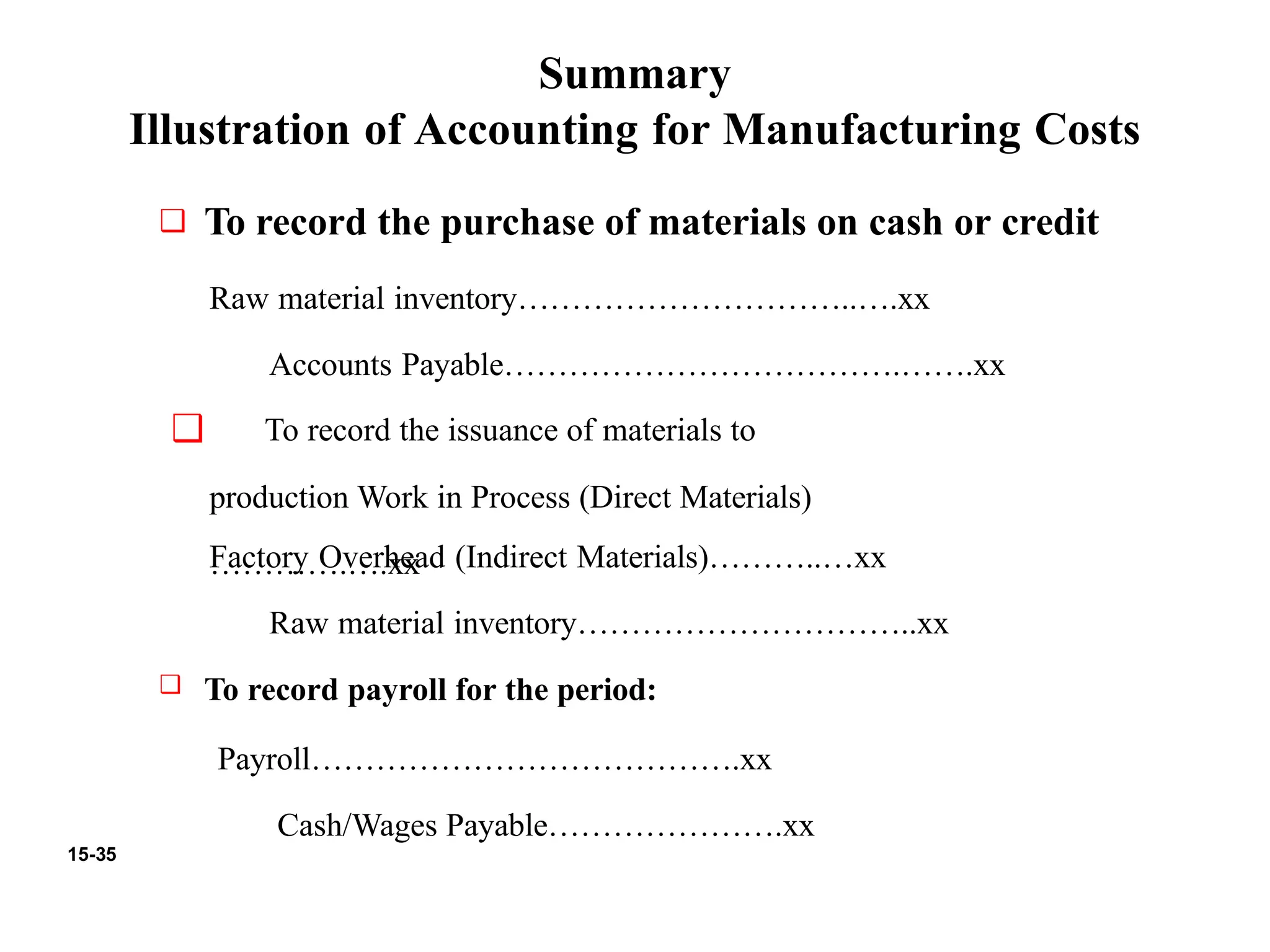
Summary
Illustration of Accountingfor Manufacturing Costs
❑ To record the purchase of materials on cash or credit
Raw material inventory…………………………..….xx
Accounts Payable……………………………….…….xx
❑ To record the issuance of materials to
production Work in Process (Direct Materials)
………….….xx
Factory Overhead (Indirect Materials)………..…xx
Raw material inventory…………………………..xx
❑ To record payroll for the period:
Payroll………………………………….xx
Cash/Wages Payable………………….xx
37.
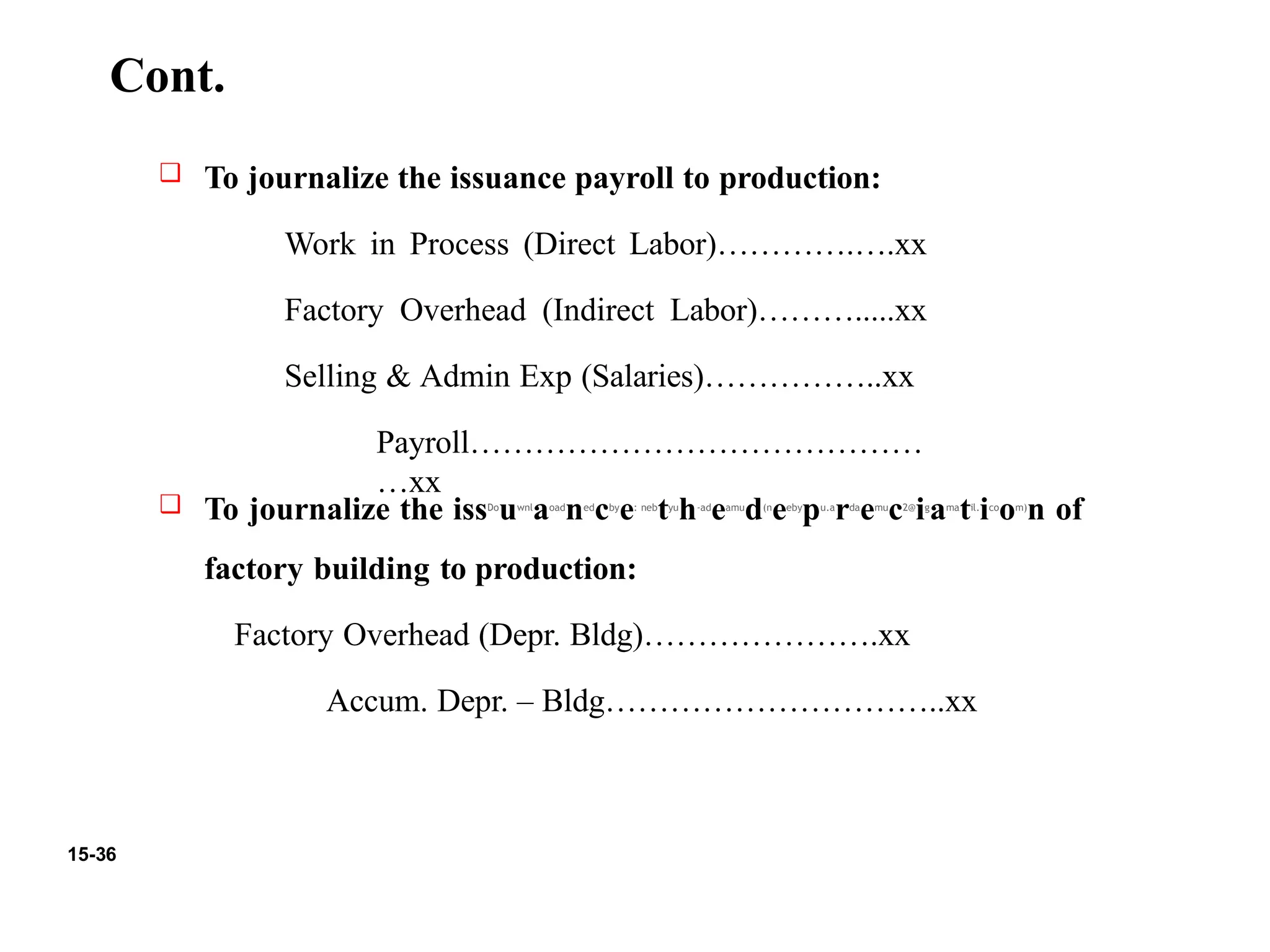
15-36
Cont.
To journalize theissDo
uwnl
aoad
ned
cby
e: neb
tyu
h-ad
eamu
d(n
eeby
pu.a
rda
emu
c2@
ig
ama
til.
ico
om)
n of
factory building to production:
Factory Overhead (Depr. Bldg)………………….xx
Accum. Depr. – Bldg…………………………..xx
❑ To journalize the issuance payroll to production:
Work in Process (Direct Labor)………….….xx
Factory Overhead (Indirect Labor)……….....xx
Selling & Admin Exp (Salaries)……………..xx
Payroll……………………………………
…xx
❑
38.
15-37
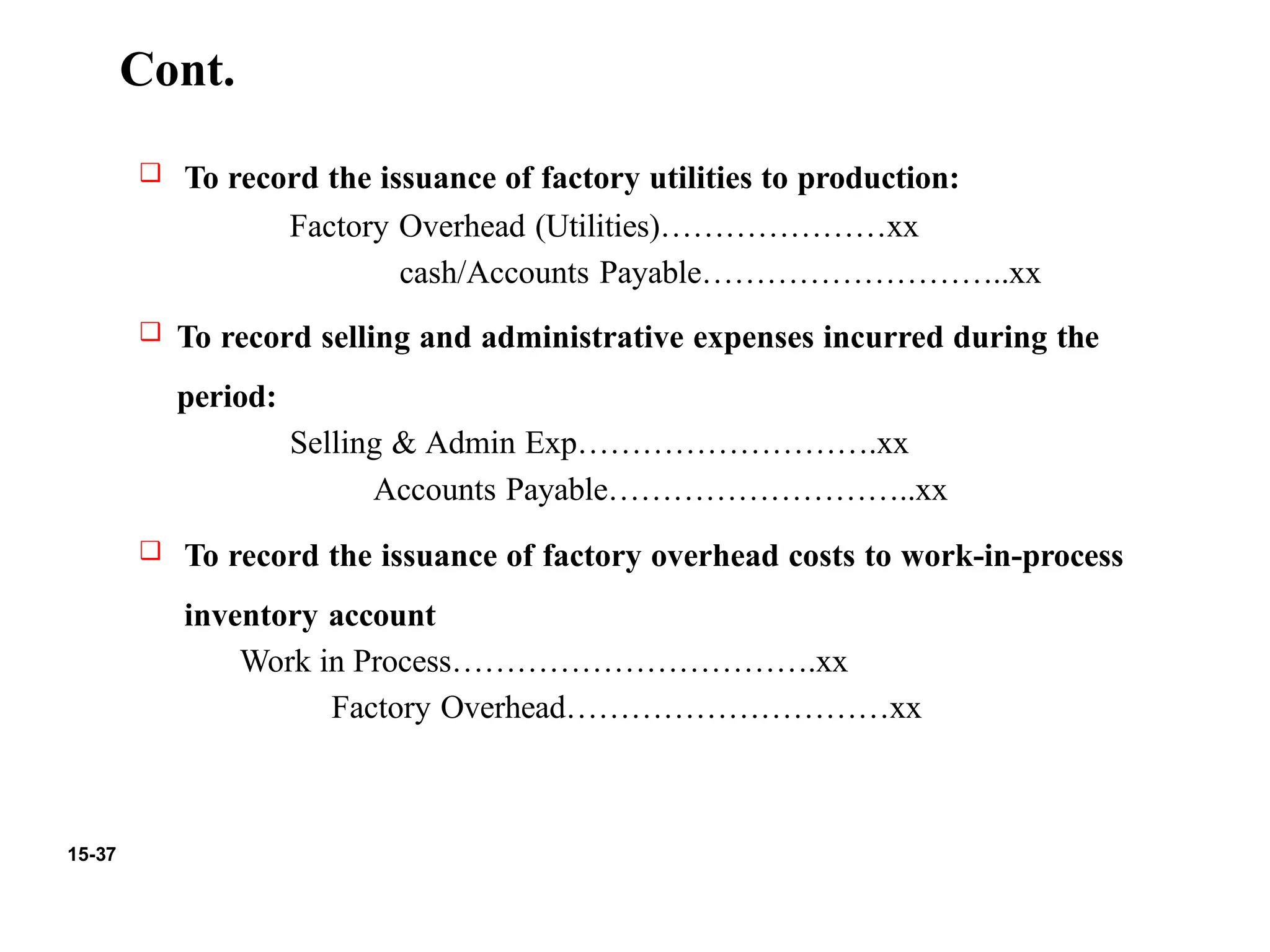
Cont.
❑ To recordthe issuance of factory utilities to production:
Factory Overhead (Utilities)…………………xx
cash/Accounts Payable………………………..xx
❑ To record selling and administrative expenses incurred during the
period:
Selling & Admin Exp……………………….xx
Accounts Payable………………………..xx
❑ To record the issuance of factory overhead costs to work-in-process
inventory account
Work in Process…………………………….xx
Factory Overhead…………………………xx
39.
15-38
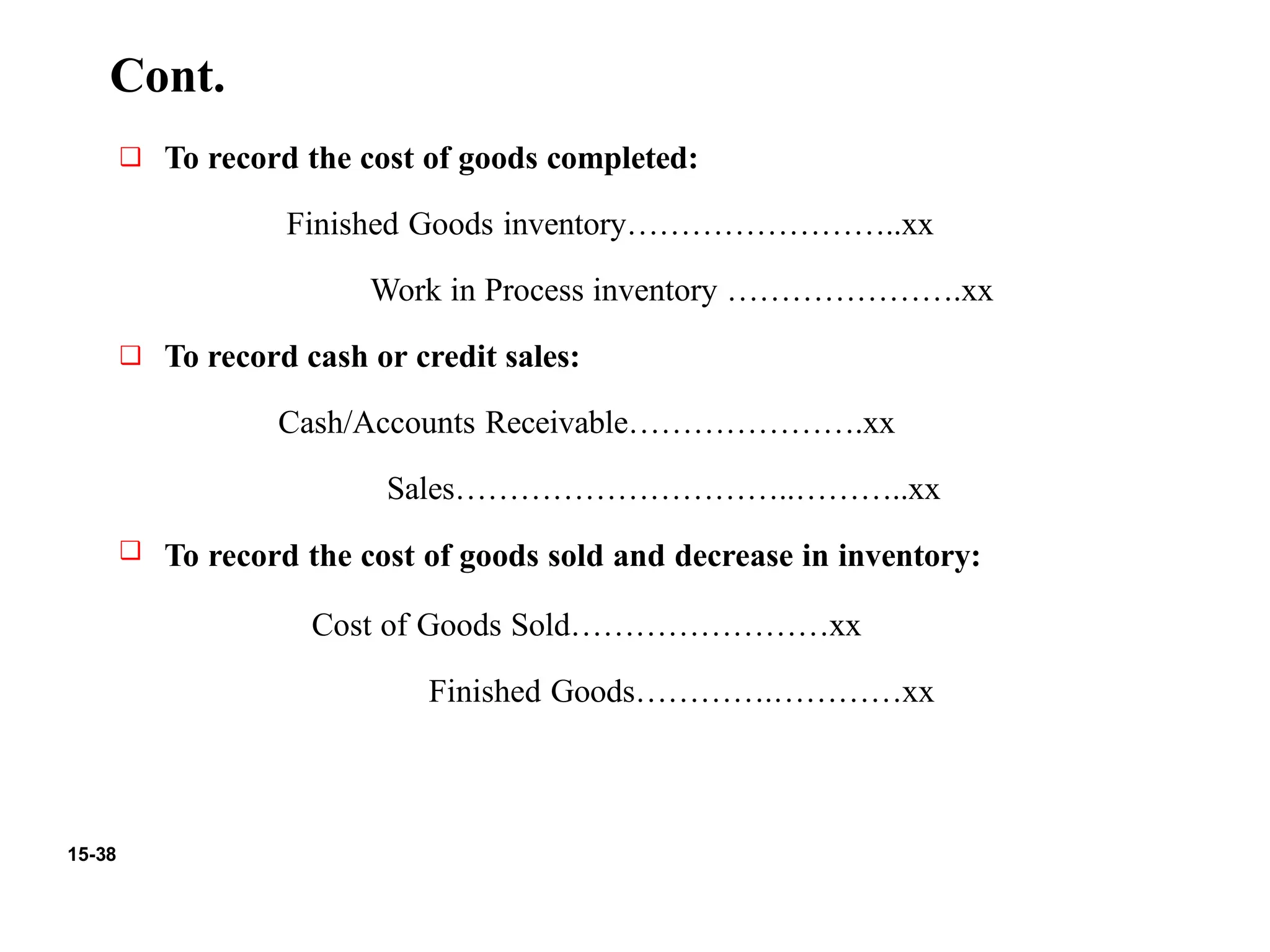
Cont.
❑ To recordthe cost of goods completed:
Finished Goods inventory……………………..xx
Work in Process inventory ………………….xx
❑ To record cash or credit sales:
Cash/Accounts Receivable………………….xx
Sales…………………………..………..xx
❑ To record the cost of goods sold and decrease in inventory:
Cost of Goods Sold……………………xx
Finished Goods………….…………xx