Learning Outcomes:
At theend of the lesson, the students will be able to:
1. Differentiate moral standards to non-moral standards
2. Recall rules you have to follow and differentiate from
moral standards.
3. Explain the importance of rules and moral standards.
3.
Ethics
is a branchof philosophy that
studies morality or the
righteousness or wrongness of
human conduct.
4.
Ethics
As a branchof philosophy,
ethics stands to queries about
what there is reason
to do. Dealing with human
actions and reasons for action,
ethics is also
concerned with character.
5.
Some questions thatare ethical in nature
are:
1. What is good?
2. Who is a moral person?
3. What are the virtues of a human being?
4. What makes an act right?
5. What duties do we have for each other?
6.
Morality
The word 'moral'is derived from the Latin
word mores, which means 'convention', or
'practice
Cambridge Dictionary:
a set of personal or social standards for
good or bad behavior and character
7.
Morality
descriptively to referto certain codes of conduct put
forward by a society or a group (such as a religion),
or accepted by an individual for her own behavior
normatively to refer to a code of conduct that, given
specified conditions, would be put forward by all
rational people.
8.
Key Features of
Morality
1.Peopleexperience a sense
of moral obligation and
accountability
2. Moral values and moral
absolutes exist
Rules in aSociety
Refer to explicit or understood
regulations or principles governing
conduct within a specific activity or
sphere.
It tell us what is or not allowed in a
particular context or situation. It may
serve as a foundation for any healthy
society
12.
Usual rules:
1. Etiquette-standards by which we judge
manners to be good or bad; normally dict ated
by socio-economic elite.
Example: a. Using proper greetings, greetings,
using polite phrases such as please and thank
you when requesting something, and dressing
appropriately for each occasion and social
context.
13.
Usual rules:
2. Legal– standards by which we judge legal
right; in a democracy, formulated by
representatives of the people.
Examples:
a. Criminal Law,
b. Civil Law
c. Administrative Law
d. International Law
14.
Usual rules:
3. Language– standards by which we judge
what is grammatically right or wrong; evolve
through use.
What are common language rules?
- All sentences should begin with a capital
letter
- A sentence must have a subject and a verb
(an object is optional).
15.
Usual rules:
4. Aesthetics– standards by which we judge
good and bad art; usually dictated by a small
circle of art connoisseurs.
Imperative to maintain that pleasant
appearance and professional looking
environment.
16.
Usual rules:
5. Athletics– standards by which we judge good
how good or bad a game is played; usually
formulated by governing bodies.
Example: Rules in playing basketball, volleyball
MORAL STANDARDS
Refers tothe norms which we have
about the types of actions which we
believe to be morally acceptable and
unacceptable.
Deal with matters which can either
seriously harm or seriously benefit
human beings.
Some ethicists equate moral
standards with moral values and
moral principles.
22.
Are principles thatguide
behavior based on what is
considered right and wrong.
These principles are often
considered universal, meaning
they apply to all people
regardless of their culture or
background
MORAL STANDARDS
23.
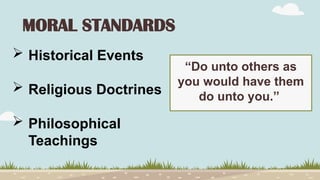
MORAL STANDARDS
HistoricalEvents
Religious Doctrines
Philosophical
Teachings
“Do unto others as
you would have them
do unto you.”
24.
Characteristics of MoralStandard
1. Moral standards involve serious wrongs or
significant benefits.
2. Moral standards ought to be preferred to other
values.
3. Moral standards are not established by authority
figures.
25.
Characteristics of MoralStandard
4. Moral standards have the trait of universalizability
5. Moral standards are based on impartial
considerations.
6. Moral standards are associated with special
emotions and vocabulary
26.
NON-MORAL STANDARDS
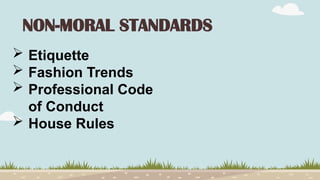
Are guidelinesthat do not relate to
question of right and wrong but
rather to personal or social
preferences, rule, and expectations
Refers to rules that are unrelated to
moral or ethical considerations.
Either these standards are not
necessarily linked to morality or by
nature lack ethical sense.