Chapter 15
Workbook Answers
15.2 ~ The Government of
Imperial China
15.2 The Government of Imperial
China
• 1. According to the Mandate of
Heaven, when can people
overthrow the emperor?
• People can overthrow an
emperor when he rules
badly.
15.2 The Government of Imperial
China
• 2. What is a bureaucracy? What
happened when the bureaucracy in
China became corrupt?
• A bureaucracy is an organized
group of government officials.
When the bureaucracy became
corrupt, people suffered from high
taxes, forced labor, and attacks by
bandits.
15.2 The Government of Imperial
China
• 3. What happened to China when
the Han dynasty lost the Mandate
of Heaven? Who reunited China?
• When the Han dynasty fell,
China broke into separate
kingdoms. It was reunited by
the Sui dynasty.
15.3 ~ Aristocracy:
The Tang Dynasty
15.3 Aristocracy: The Tang
Dynasty
• 1. Who were scholar-
officials?
• Scholar-officials were
scholars who got
government jobs through
examinations.
15.3 Aristocracy: The Tang
Dynasty
• 2. What was the
examination for scholar-
officials primarily based on?
• The examination was
primarily based on the
teachings of Confucius.
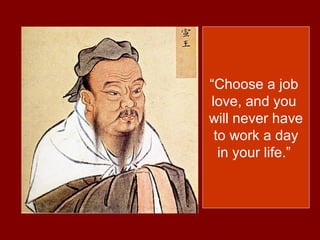
“Choose a job
love, and you
will never have
to work a day
in your life.”
15.3 Aristocracy: The Tang
Dynasty
• 3. Why did aristocrats continue
to hold most offices?
• Only the wealthy could
afford the tutors, books, and
time to study needed to
prepare for the exams.
15.4 ~ Meritocracy:
The Song Dynasty
15.4 Meritocracy: The Song
Dynasty
• 1. According to emperors and
scholars, knowledge of Confucius
would produce what type of
government official?
• Government officials who had
studied Confucius would be
rational, moral, and able to
maintain order.
15.4 Meritocracy: The Song
Dynasty
• 2. What new group of people
was allowed to become
government officials during the
Song period?
• People from lower classes
were allowed to become
government officials.
15.4 Meritocracy: The Song
Dynasty
• 3. Why did people want
government jobs?
• People wanted these jobs
because government
officials were respected and
were excused from taxes
and military service.
15.5 ~ Government by
Foreigners:
The Period of Mongol Rule
15.5 Government by Foreigners:
The Period of Mongol Rule
• 1. Whom did Kublai Khan
choose to fill important
government positions?
• He appointed relatives, other
Mongols, and trusted
foreigners.
15.5 Government by Foreigners:
The Period of Mongol Rule
• 2. What happened to Chinese
scholars during the Mongol
rule?
• Chinese scholars worked
only as teachers and minor
government officials.
15.6 ~ The Revival of the
Civil Service System
15.6 The Revival of the Civil
Service System
• 1. How did hiring scholars help China?
• Hiring scholars emphasized moral
behavior, justice, kindness, loyalty to
the emperor, proper conduct, and the
importance of family. It insured that
officials were trained and talented, and
it allowed the ambitious and hard
working from all classes the chance to
succeed.
15.6 The Revival of the Civil
Service System
• 2. How did hiring scholars hurt
China?
• People who knew science,
mathematics, or engineering were
kept out of government.
• Because Confucian scholars had
little respect for merchants, trade
and business were not
encouraged.
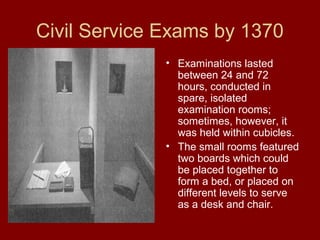
Civil Service Exams by 1370
• Examinations lasted
between 24 and 72
hours, conducted in
spare, isolated
examination rooms;
sometimes, however, it
was held within cubicles.
• The small rooms featured
two boards which could
be placed together to
form a bed, or placed on
different levels to serve
as a desk and chair.
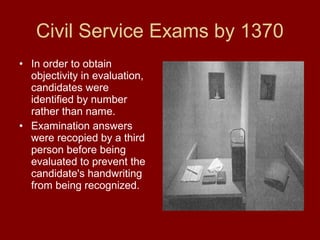
Civil Service Exams by 1370
• In order to obtain
objectivity in evaluation,
candidates were
identified by number
rather than name.
• Examination answers
were recopied by a third
person before being
evaluated to prevent the
candidate's handwriting
from being recognized.

Chapter 15 workbook answers

  • 1.
  • 2.
    15.2 ~ TheGovernment of Imperial China
  • 3.
    15.2 The Governmentof Imperial China • 1. According to the Mandate of Heaven, when can people overthrow the emperor? • People can overthrow an emperor when he rules badly.
  • 4.
    15.2 The Governmentof Imperial China • 2. What is a bureaucracy? What happened when the bureaucracy in China became corrupt? • A bureaucracy is an organized group of government officials. When the bureaucracy became corrupt, people suffered from high taxes, forced labor, and attacks by bandits.
  • 5.
    15.2 The Governmentof Imperial China • 3. What happened to China when the Han dynasty lost the Mandate of Heaven? Who reunited China? • When the Han dynasty fell, China broke into separate kingdoms. It was reunited by the Sui dynasty.
  • 6.
  • 7.
    15.3 Aristocracy: TheTang Dynasty • 1. Who were scholar- officials? • Scholar-officials were scholars who got government jobs through examinations.
  • 8.
    15.3 Aristocracy: TheTang Dynasty • 2. What was the examination for scholar- officials primarily based on? • The examination was primarily based on the teachings of Confucius.
  • 9.
    “Choose a job love,and you will never have to work a day in your life.”
  • 10.
    15.3 Aristocracy: TheTang Dynasty • 3. Why did aristocrats continue to hold most offices? • Only the wealthy could afford the tutors, books, and time to study needed to prepare for the exams.
  • 11.
  • 12.
    15.4 Meritocracy: TheSong Dynasty • 1. According to emperors and scholars, knowledge of Confucius would produce what type of government official? • Government officials who had studied Confucius would be rational, moral, and able to maintain order.
  • 13.
    15.4 Meritocracy: TheSong Dynasty • 2. What new group of people was allowed to become government officials during the Song period? • People from lower classes were allowed to become government officials.
  • 14.
    15.4 Meritocracy: TheSong Dynasty • 3. Why did people want government jobs? • People wanted these jobs because government officials were respected and were excused from taxes and military service.
  • 15.
    15.5 ~ Governmentby Foreigners: The Period of Mongol Rule
  • 16.
    15.5 Government byForeigners: The Period of Mongol Rule • 1. Whom did Kublai Khan choose to fill important government positions? • He appointed relatives, other Mongols, and trusted foreigners.
  • 17.
    15.5 Government byForeigners: The Period of Mongol Rule • 2. What happened to Chinese scholars during the Mongol rule? • Chinese scholars worked only as teachers and minor government officials.
  • 18.
    15.6 ~ TheRevival of the Civil Service System
  • 19.
    15.6 The Revivalof the Civil Service System • 1. How did hiring scholars help China? • Hiring scholars emphasized moral behavior, justice, kindness, loyalty to the emperor, proper conduct, and the importance of family. It insured that officials were trained and talented, and it allowed the ambitious and hard working from all classes the chance to succeed.
  • 20.
    15.6 The Revivalof the Civil Service System • 2. How did hiring scholars hurt China? • People who knew science, mathematics, or engineering were kept out of government. • Because Confucian scholars had little respect for merchants, trade and business were not encouraged.
  • 21.
    Civil Service Examsby 1370 • Examinations lasted between 24 and 72 hours, conducted in spare, isolated examination rooms; sometimes, however, it was held within cubicles. • The small rooms featured two boards which could be placed together to form a bed, or placed on different levels to serve as a desk and chair.
  • 22.
    Civil Service Examsby 1370 • In order to obtain objectivity in evaluation, candidates were identified by number rather than name. • Examination answers were recopied by a third person before being evaluated to prevent the candidate's handwriting from being recognized.