Glencoe Health
Lesson 1
Benefits of
Physical Activity
Physical Activity and Your Health
Main Idea
Physical activity benefits all aspects of your
health triangle.
Teens should try to get at least 60 minutes of physical
activity every day.
Glencoe Health Chapter 12 Physical Activity and Fitness
LESSON 1 Benefits of Physical Activity
Lesson Home
Physical Activity and Your Health
Physical activity includes all kinds of activities
that you do every day.
physical activity
Any form of movement that causes your body to
use energy.
New Vocabulary
Glencoe Health Chapter 12 Physical Activity and Fitness
LESSON 1 Benefits of Physical Activity
Lesson Home
Physical Benefits
Being active on a regular basis improves your
physical fitness.
physical fitness
The ability to carry out daily tasks easily and have
enough reserve energy to respond to
unexpected demands.
New Vocabulary
Glencoe Health Chapter 12 Physical Activity and Fitness
LESSON 1 Benefits of Physical Activity
Lesson Home
Physical Benefits
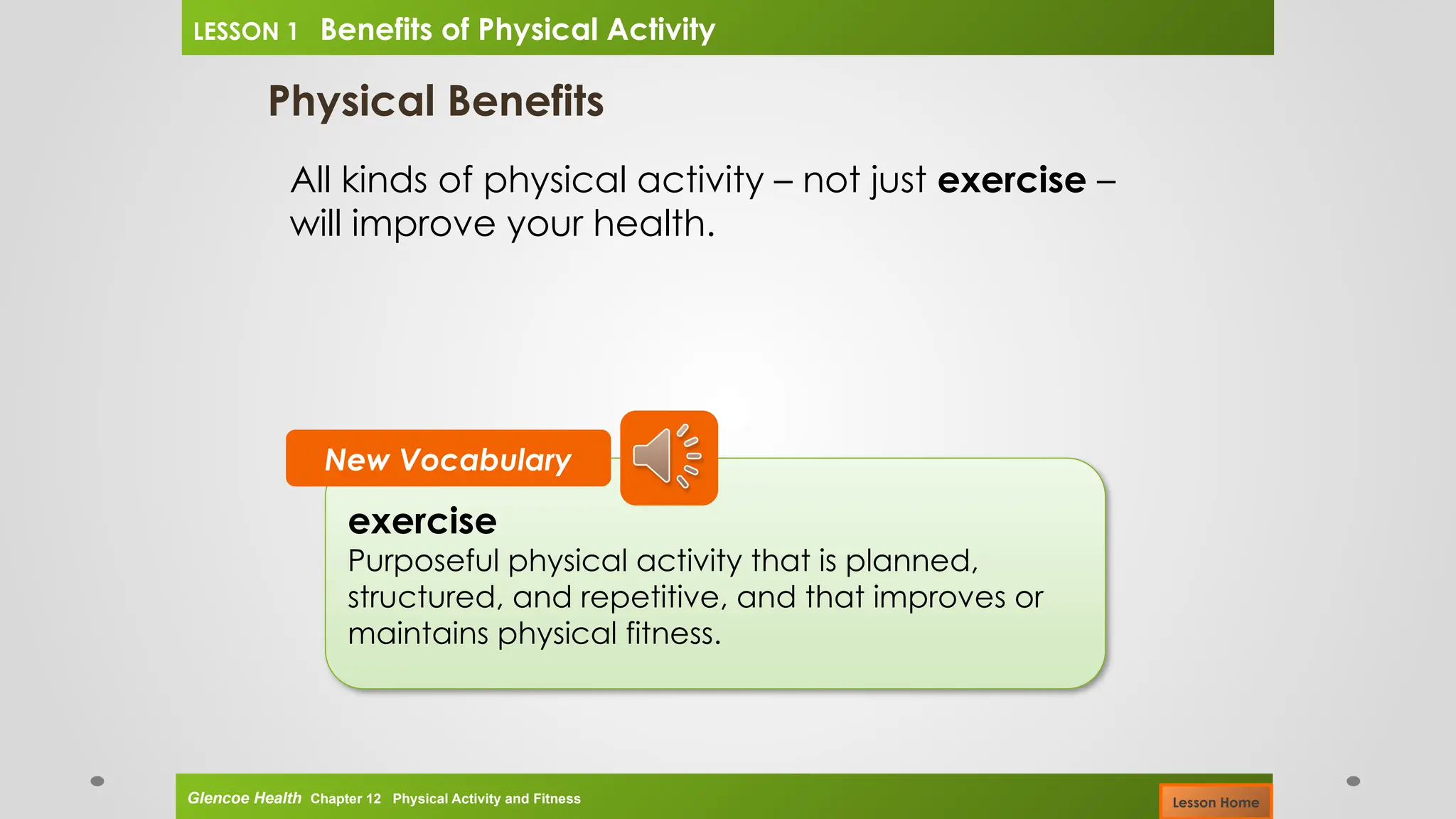
All kinds of physical activity – not just exercise –
will improve your health.
exercise
Purposeful physical activity that is planned,
structured, and repetitive, and that improves or
maintains physical fitness.
New Vocabulary
Glencoe Health Chapter 12 Physical Activity and Fitness
LESSON 1 Benefits of Physical Activity
Lesson Home
Physical Benefits
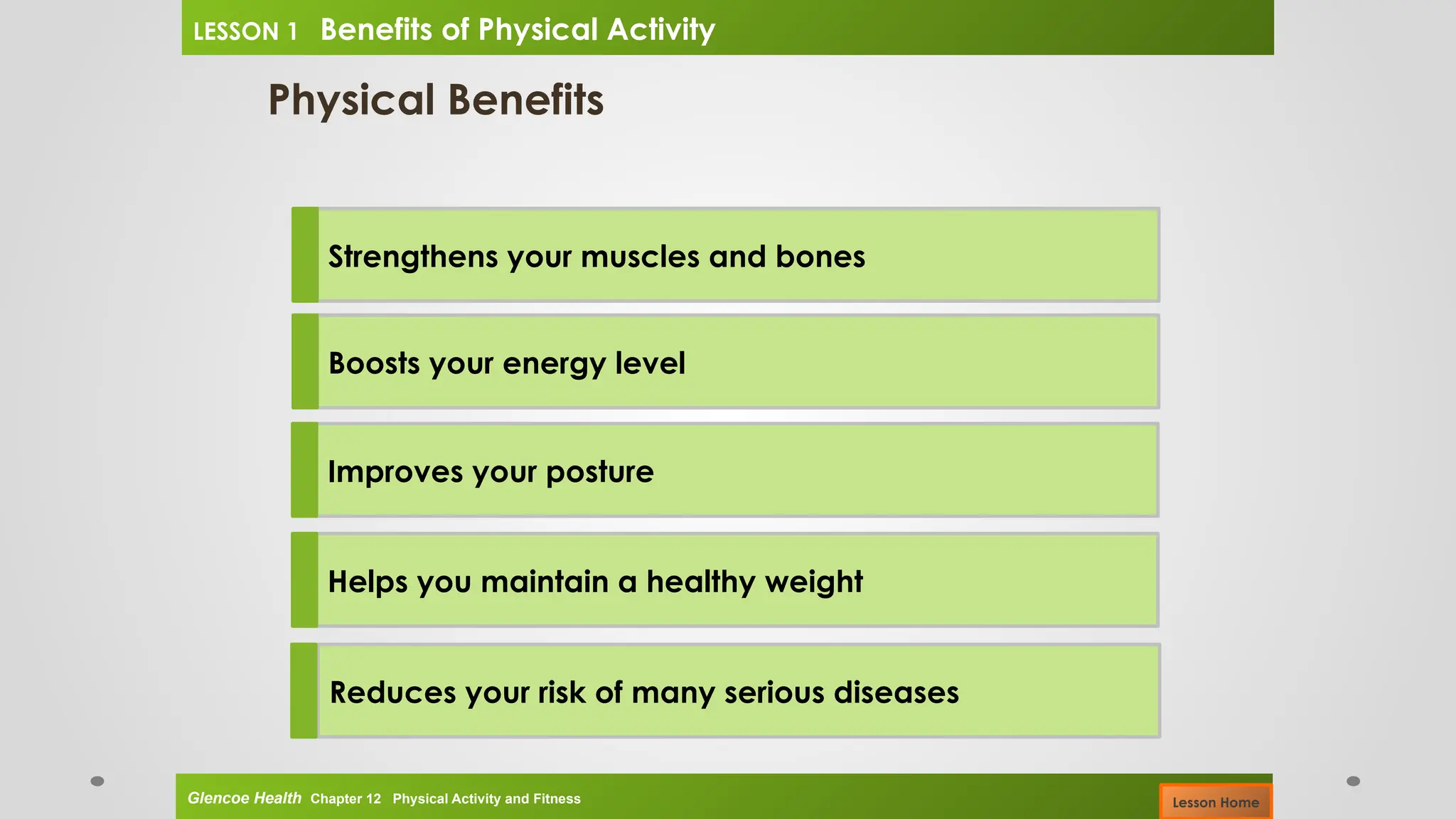
Boosts your energy level
Improves your posture
Helps you maintain a healthy weight
Strengthens your muscles and bones
Reduces your risk of many serious diseases
Glencoe Health Chapter 12 Physical Activity and Fitness
LESSON 1 Benefits of Physical Activity
Lesson Home
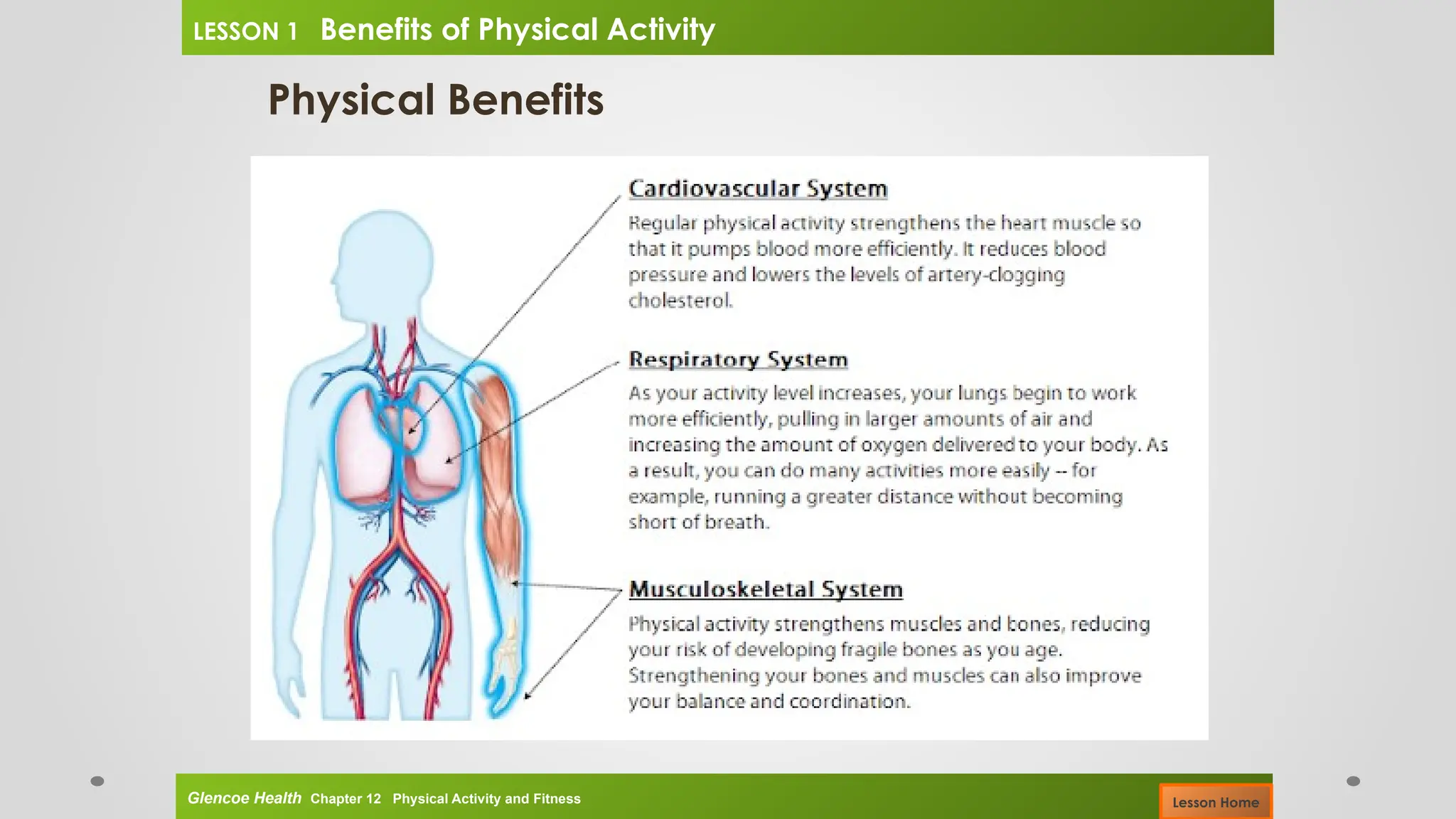
Physical Benefits
Glencoe Health Chapter 12 Physical Activity and Fitness
LESSON 1 Benefits of Physical Activity
Lesson Home
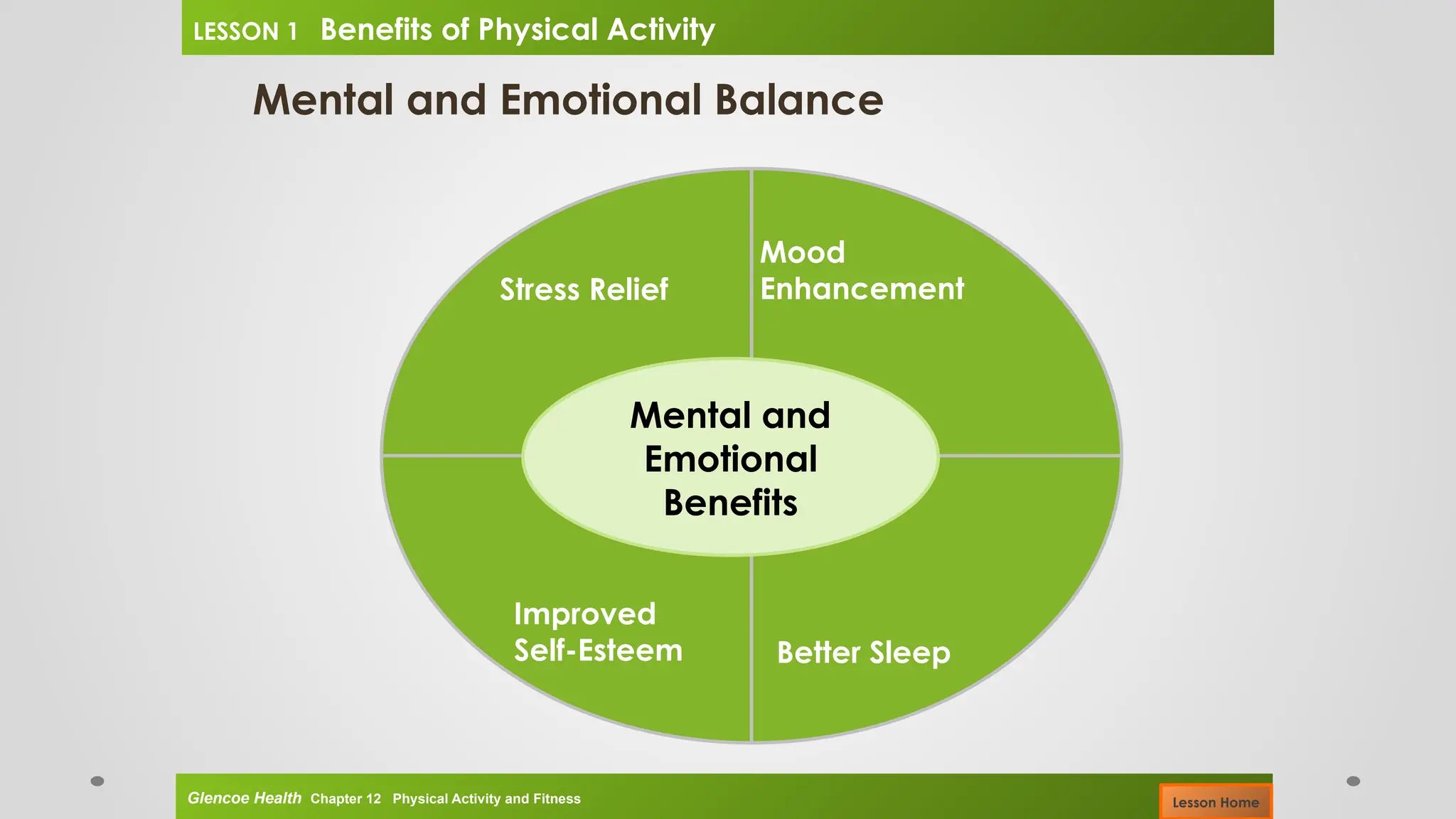
Mental and Emotional Balance
Mental and
Emotional
Benefits
Stress Relief
Mood
Enhancement
Improved
Self-Esteem Better Sleep
Glencoe Health Chapter 12 Physical Activity and Fitness
LESSON 1 Benefits of Physical Activity
Lesson Home
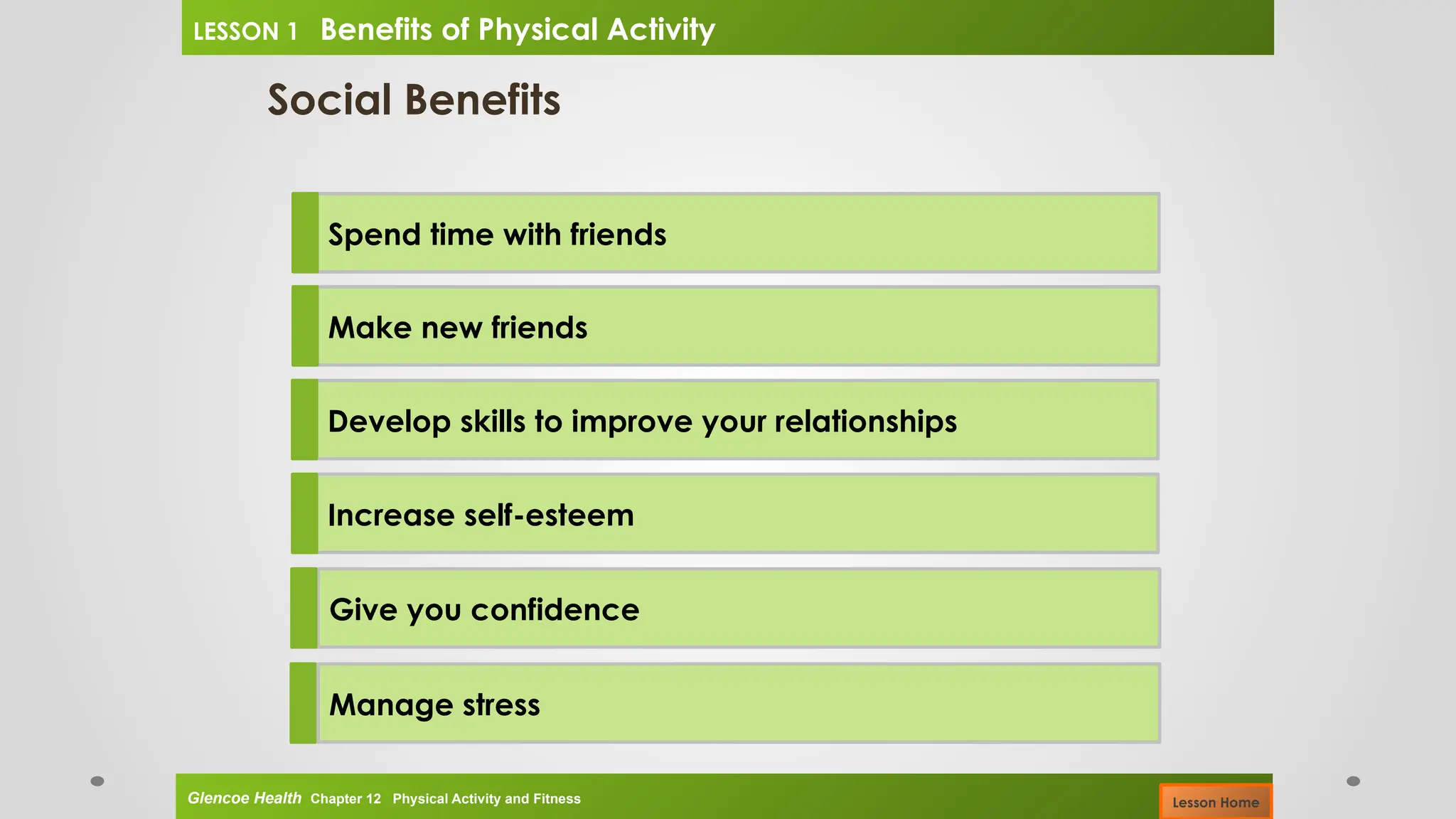
Social Benefits
Make new friends
Develop skills to improve your relationships
Increase self-esteem
Spend time with friends
Give you confidence
Manage stress
Glencoe Health Chapter 12 Physical Activity and Fitness
LESSON 1 Benefits of Physical Activity
Lesson Home
Risks of Being Inactive
Main Idea
An inactive lifestyle puts you at risk for a variety
of health problems.
Examples of sedentary activities include
watching TV, surfing the internet, and playing
video games.
Glencoe Health Chapter 12 Physical Activity and Fitness
LESSON 1 Benefits of Physical Activity
Lesson Home
Risks of Being Inactive
Being sedentary puts you at risk for a variety of
health problems.
sedentary
Involving little physical activity.
New Vocabulary
Glencoe Health Chapter 12 Physical Activity and Fitness
LESSON 1 Benefits of Physical Activity
Lesson Home
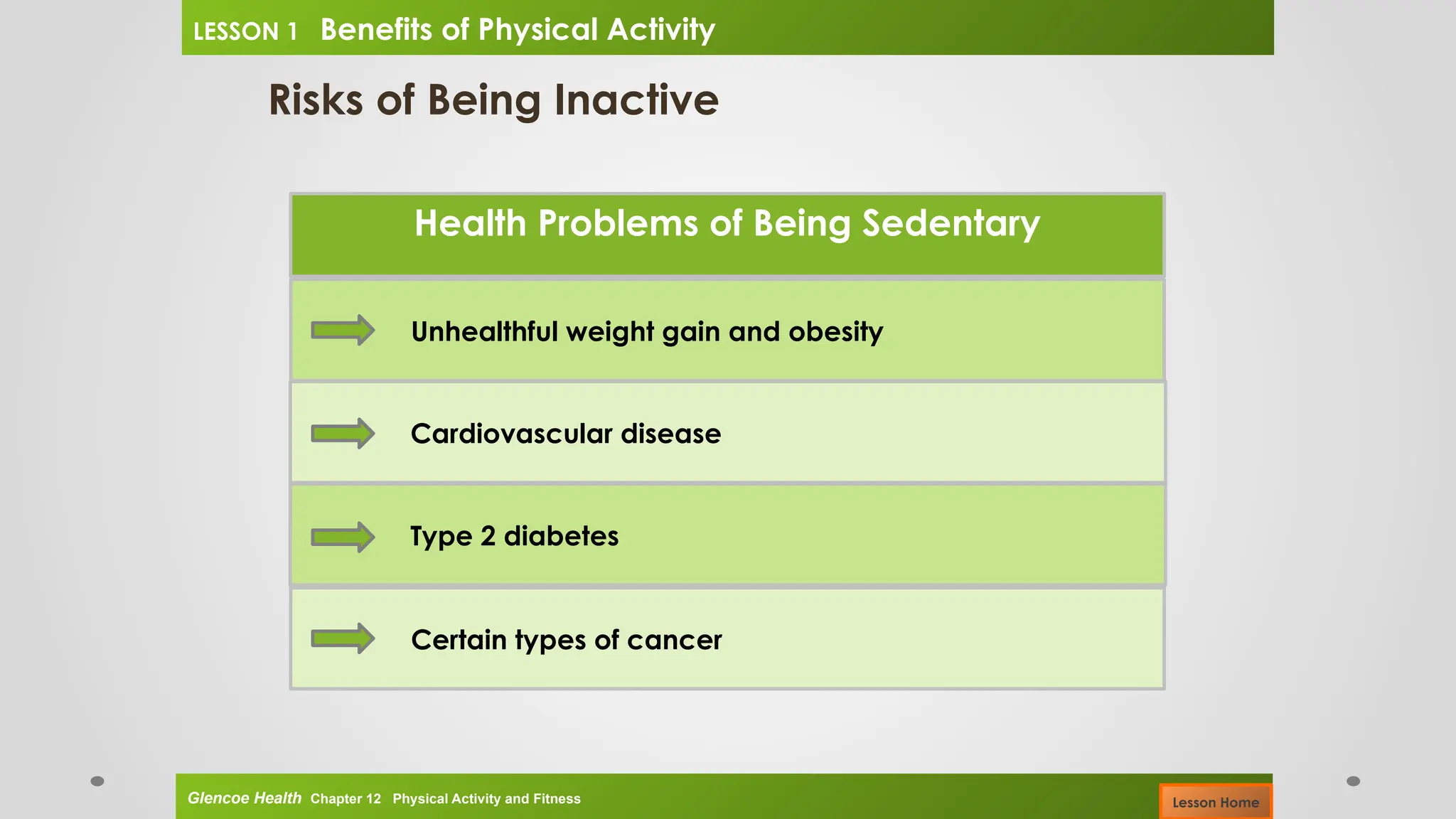
Certain types of cancer
Type 2 diabetes
Cardiovascular disease
Unhealthful weight gain and obesity
Risks of Being Inactive
Health Problems of Being Sedentary
Glencoe Health Chapter 12 Physical Activity and Fitness
LESSON 1 Benefits of Physical Activity
Lesson Home
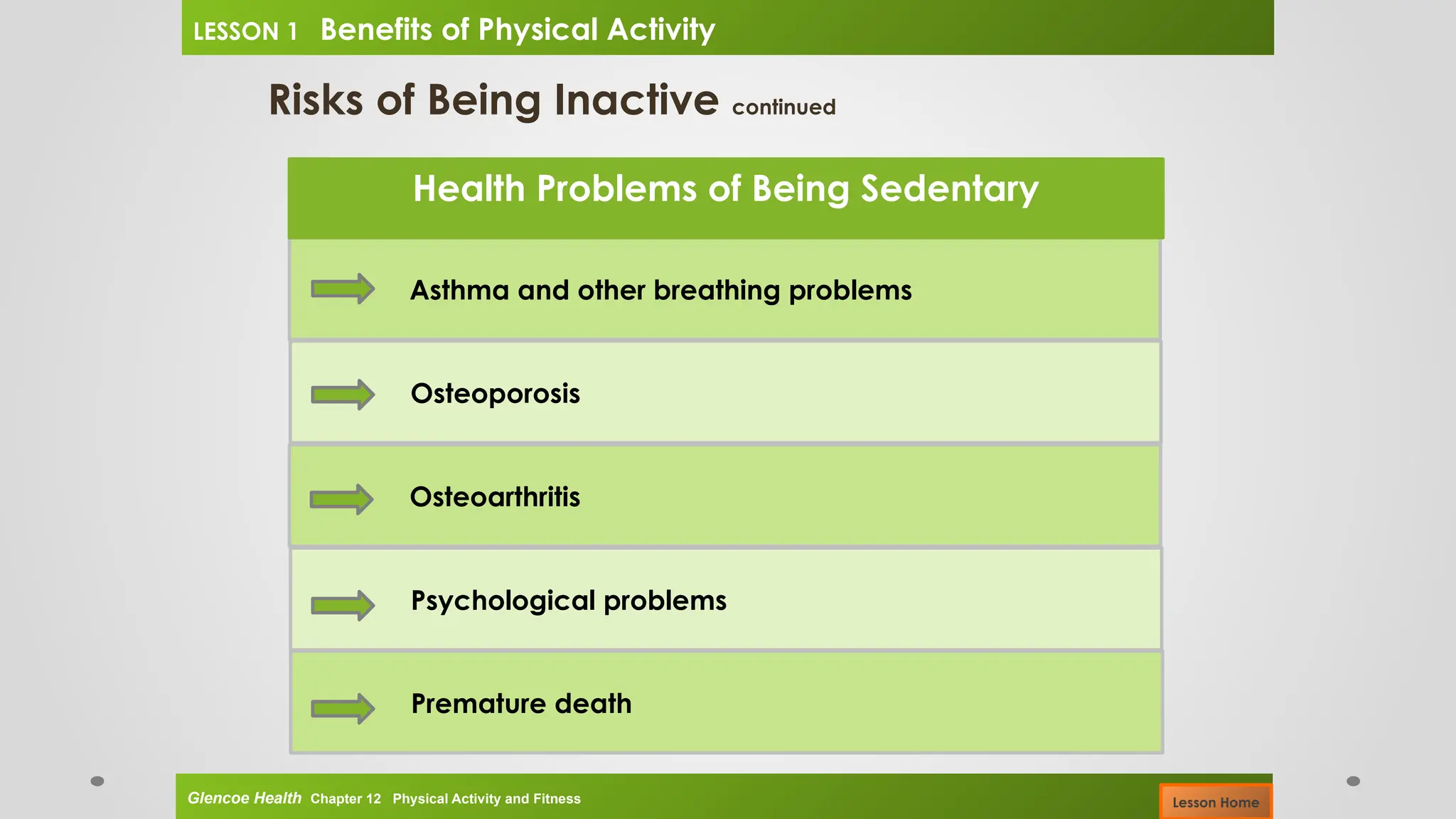
Psychological problems
Osteoarthritis
Osteoporosis
Asthma and other breathing problems
Risks of Being Inactive continued
Health Problems of Being Sedentary
Premature death
Glencoe Health Chapter 12 Physical Activity and Fitness
LESSON 1 Benefits of Physical Activity
Lesson Home
Making Time for Physical Activity
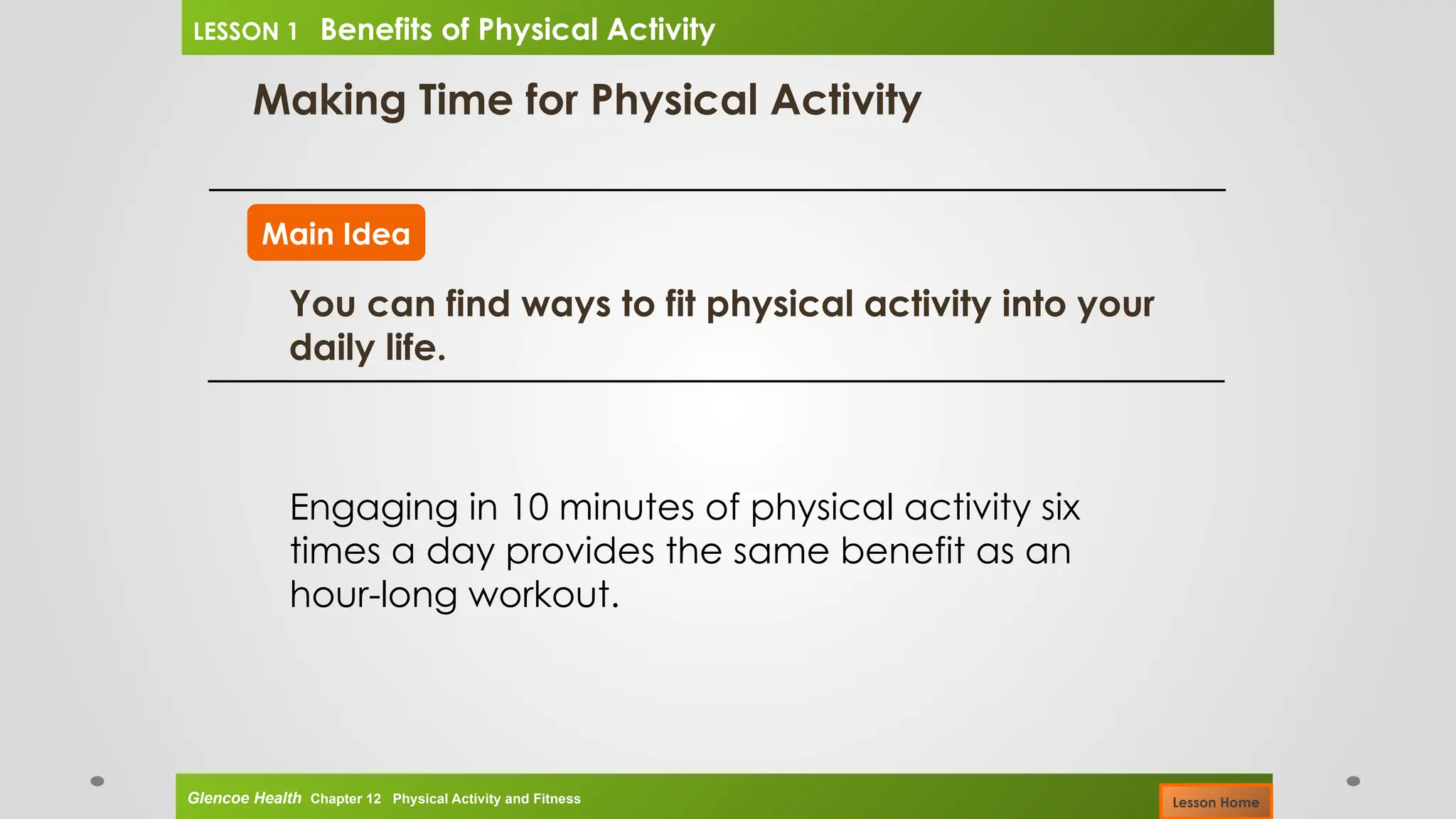
Main Idea
You can find ways to fit physical activity into your
daily life.
Engaging in 10 minutes of physical activity six
times a day provides the same benefit as an
hour-long workout.
Glencoe Health Chapter 12 Physical Activity and Fitness
LESSON 1 Benefits of Physical Activity
Lesson Home
Making Time for Physical Activity
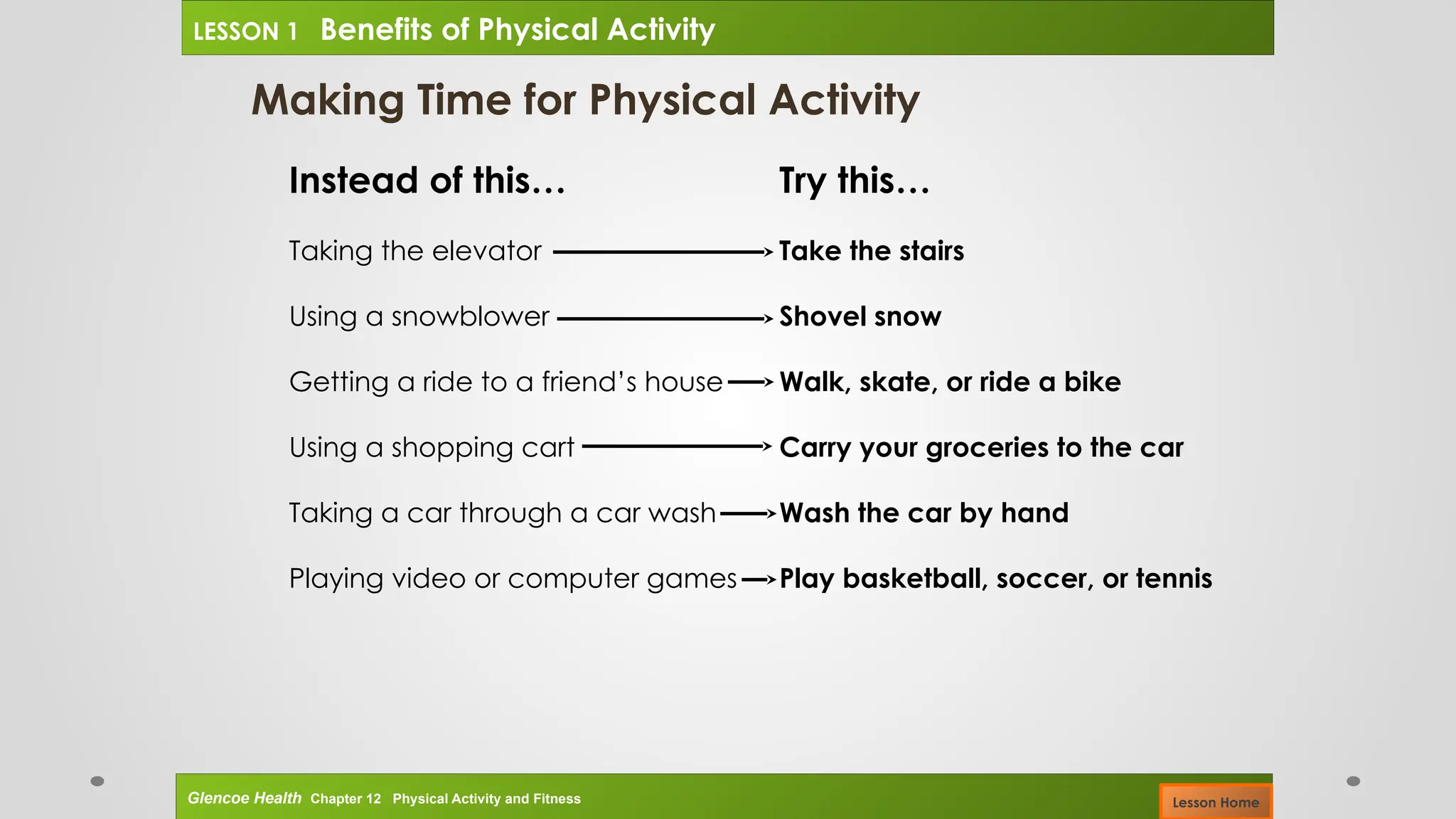
Instead of this…
Taking the elevator
Using a snowblower
Getting a ride to a friend’s house
Using a shopping cart
Taking a car through a car wash
Playing video or computer games
Try this…
Take the stairs
Shovel snow
Walk, skate, or ride a bike
Carry your groceries to the car
Wash the car by hand
Play basketball, soccer, or tennis
Glencoe Health Chapter 12 Physical Activity and Fitness
LESSON 1 Benefits of Physical Activity
Lesson Home
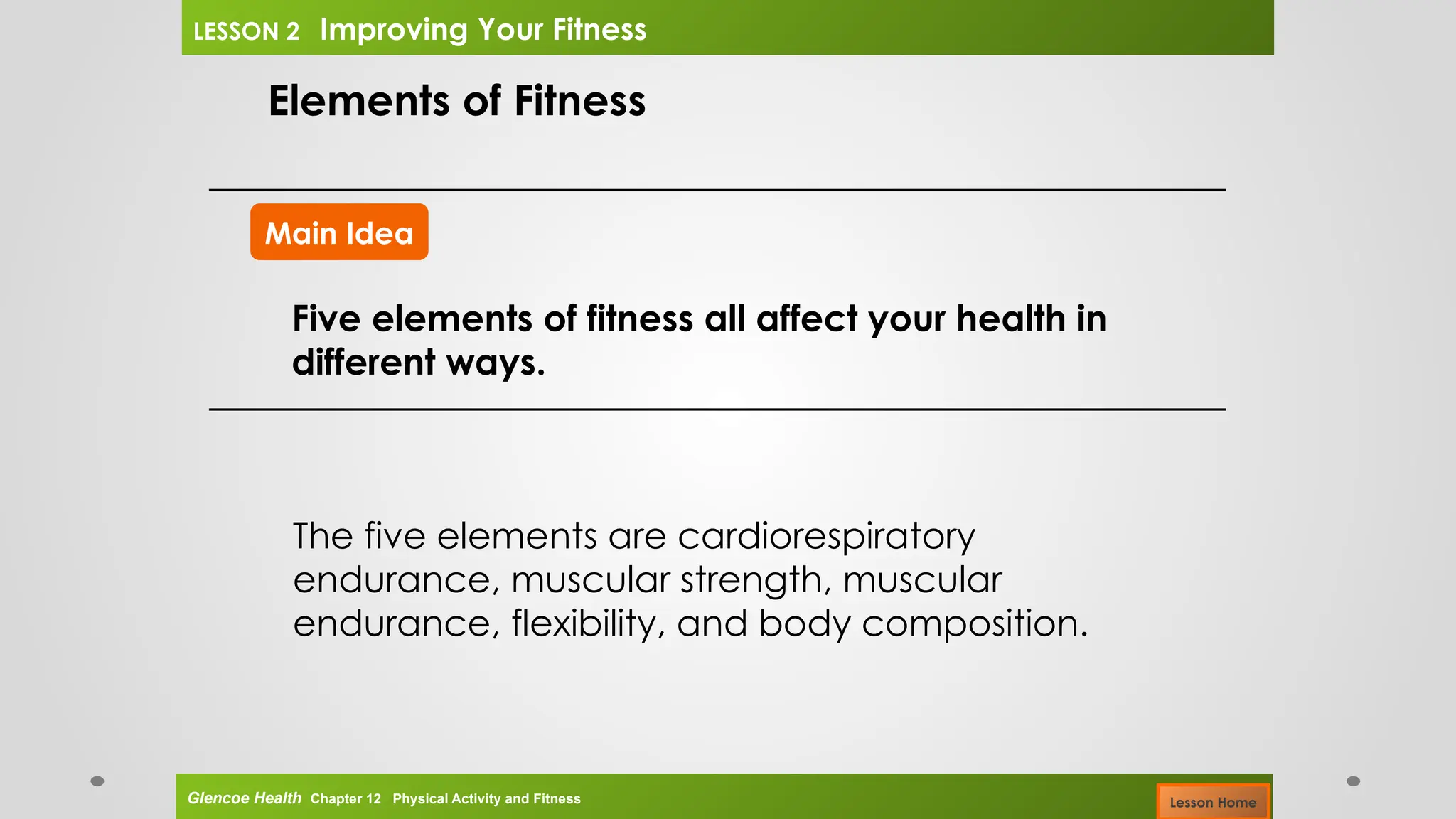
Main Idea
Elements of Fitness
Five elements of fitness all affect your health in
different ways.
The five elements are cardiorespiratory
endurance, muscular strength, muscular
endurance, flexibility, and body composition.
Glencoe Health Chapter 12 Physical Activity and Fitness
LESSON 2 Improving Your Fitness
Lesson Home
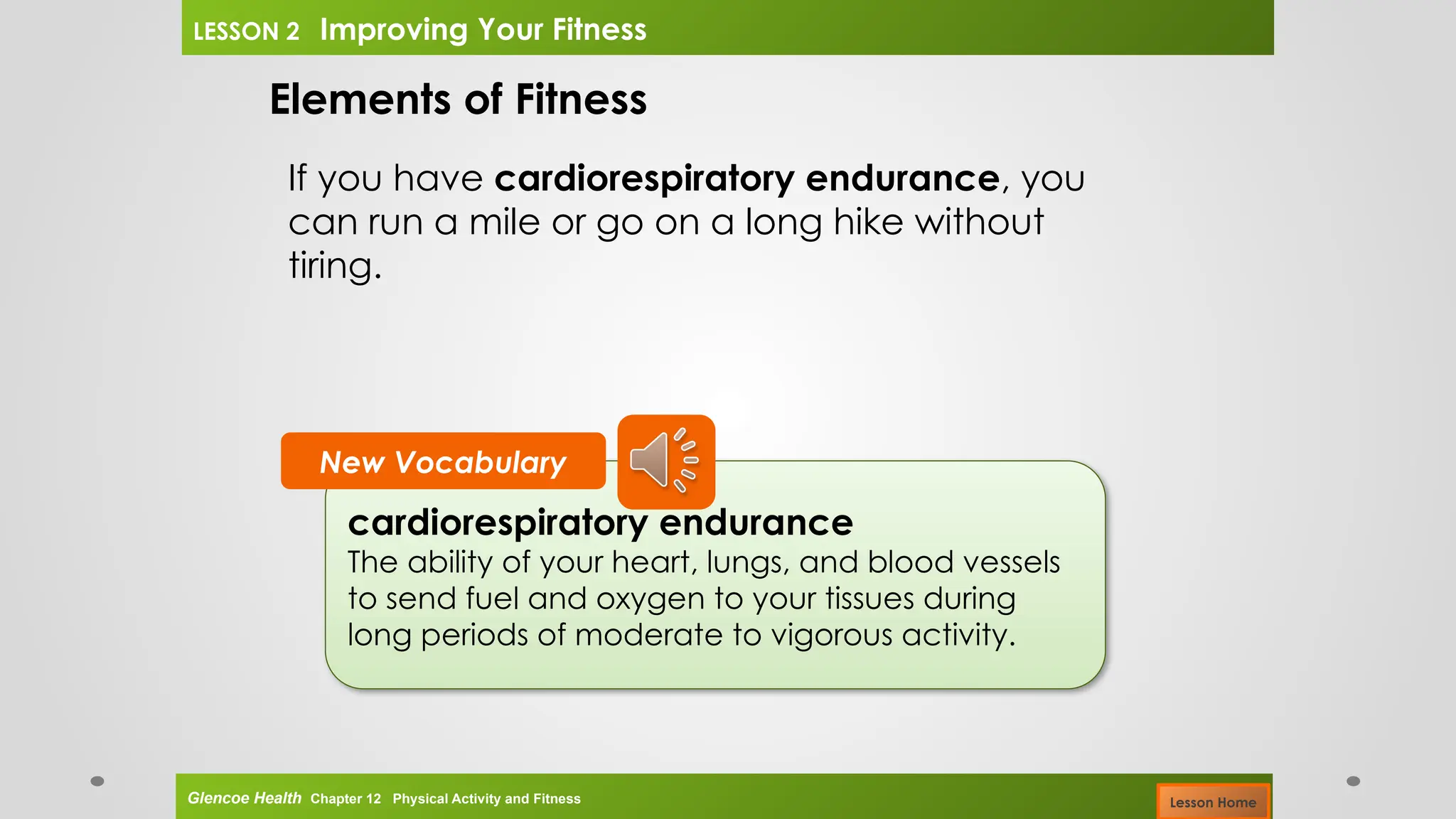
cardiorespiratory endurance
The ability of your heart, lungs, and blood vessels
to send fuel and oxygen to your tissues during
long periods of moderate to vigorous activity.
New Vocabulary
Elements of Fitness
If you have cardiorespiratory endurance, you
can run a mile or go on a long hike without
tiring.
Glencoe Health Chapter 12 Physical Activity and Fitness
LESSON 2 Improving Your Fitness
Lesson Home
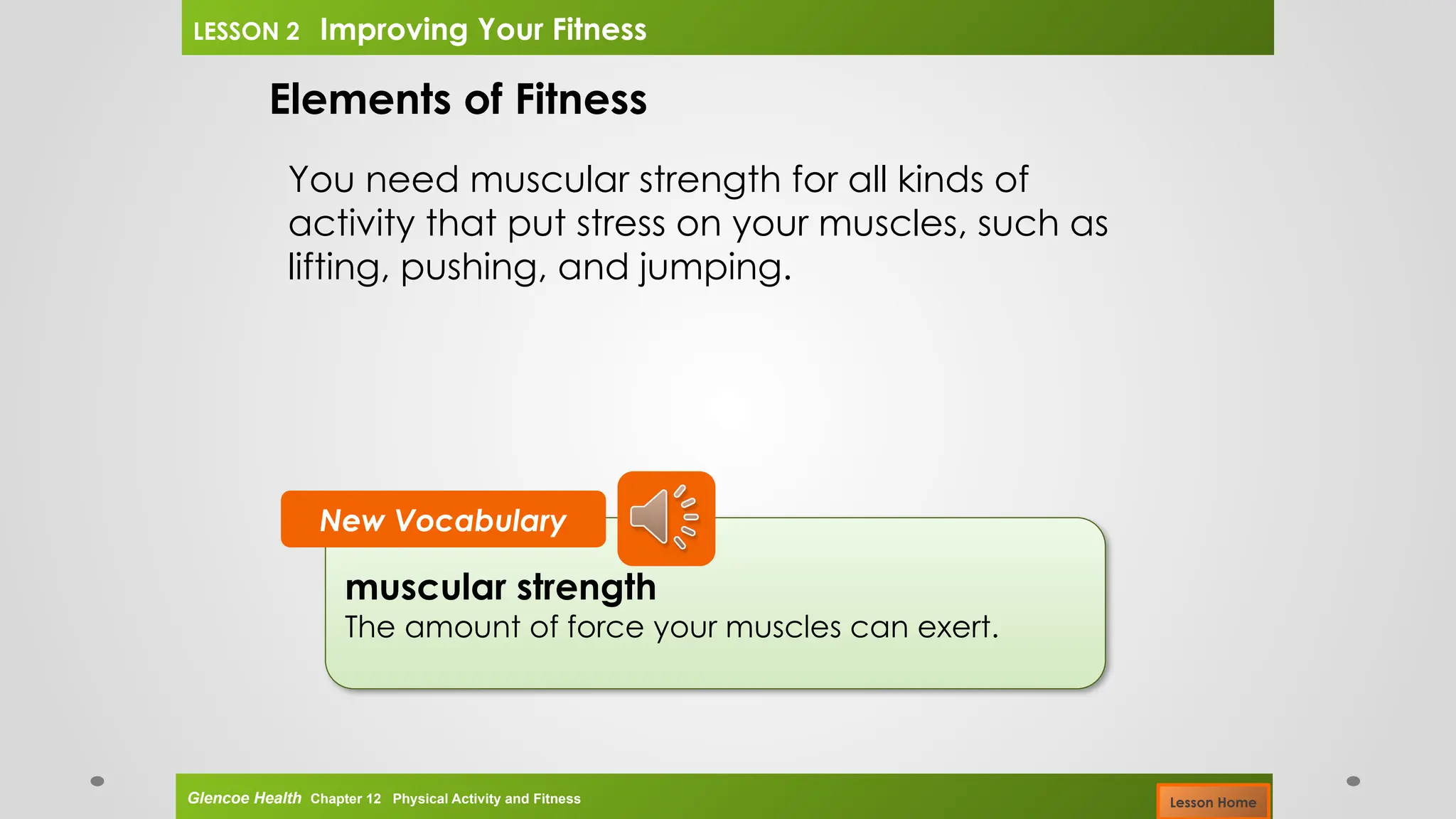
muscular strength
The amount of force your muscles can exert.
New Vocabulary
Elements of Fitness
You need muscular strength for all kinds of
activity that put stress on your muscles, such as
lifting, pushing, and jumping.
Glencoe Health Chapter 12 Physical Activity and Fitness
LESSON 2 Improving Your Fitness
Lesson Home
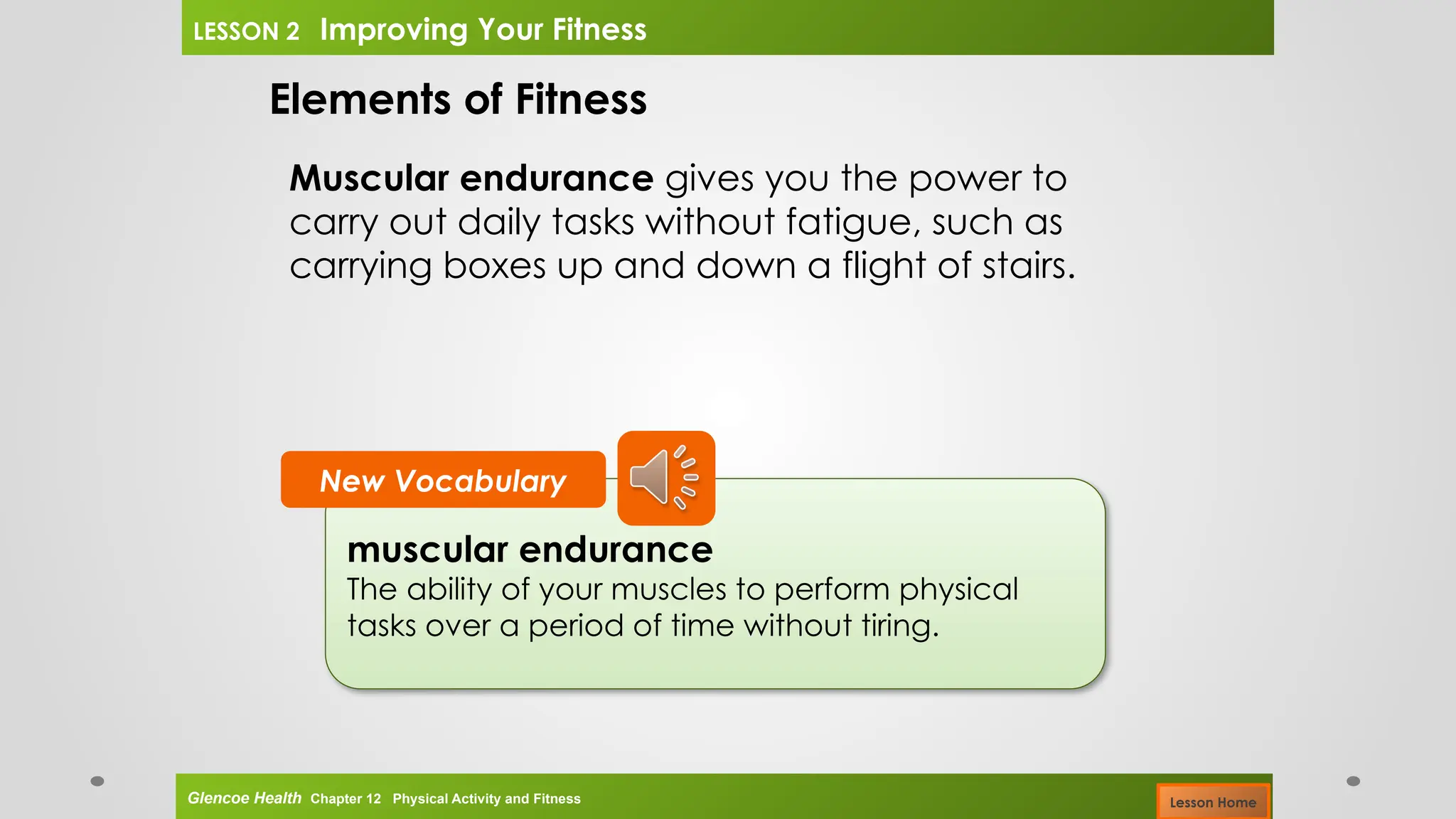
muscular endurance
The ability of your muscles to perform physical
tasks over a period of time without tiring.
New Vocabulary
Elements of Fitness
Muscular endurance gives you the power to
carry out daily tasks without fatigue, such as
carrying boxes up and down a flight of stairs.
Glencoe Health Chapter 12 Physical Activity and Fitness
LESSON 2 Improving Your Fitness
Lesson Home
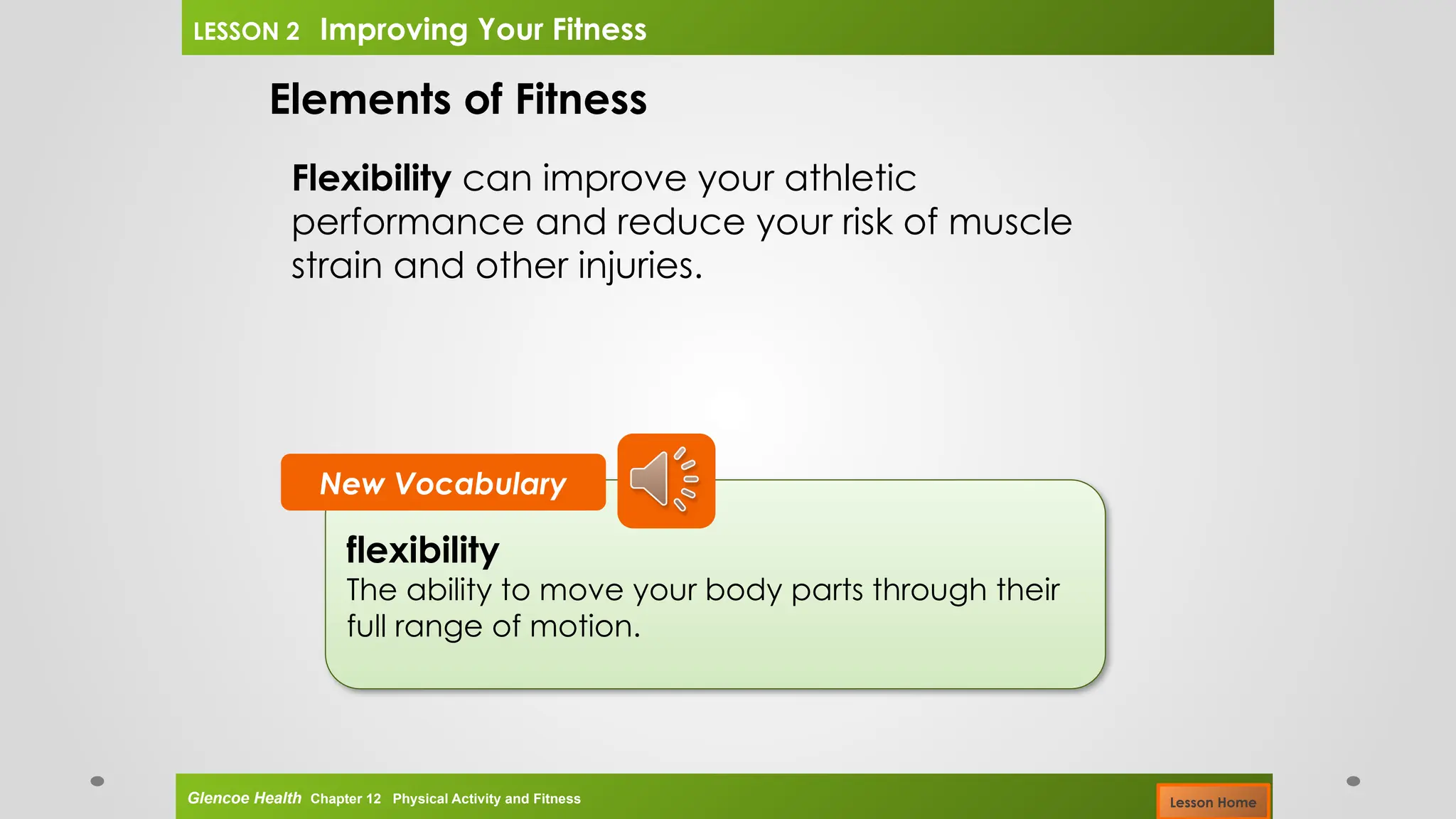
flexibility
The ability to move your body parts through their
full range of motion.
New Vocabulary
Elements of Fitness
Flexibility can improve your athletic
performance and reduce your risk of muscle
strain and other injuries.
Glencoe Health Chapter 12 Physical Activity and Fitness
LESSON 2 Improving Your Fitness
Lesson Home
Elements of Fitness
Your body composition is the ratio of fat to lean
tissue in your body.
Having low overall body fat reduces your risk of
cardiovascular disease and other health
problems associated with being overweight.
Glencoe Health Chapter 12 Physical Activity and Fitness
LESSON 2 Improving Your Fitness
Lesson Home
Main Idea
Evaluating Your Fitness
You can use different tests to evaluate each
element of your fitness.
You can use tests to measure your
cardiorespiratory endurance, muscular strength,
and endurance, and flexibility.
Glencoe Health Chapter 12 Physical Activity and Fitness
LESSON 2 Improving Your Fitness
Lesson Home
Measuring Muscular Strength and Endurance
You can measure the strength and endurance
of your abdominal muscles by doing a partial
curl-up test.
Glencoe Health Chapter 12 Physical Activity and Fitness
LESSON 2 Improving Your Fitness
Lesson Home
Measuring Muscular Strength and Endurance
You can measure the strength and endurance
of your upper body by doing a right-angle push-
up test.
Glencoe Health Chapter 12 Physical Activity and Fitness
LESSON 2 Improving Your Fitness
Lesson Home
Measuring Cardiorespiratory Endurance
You can evaluate your cardiorespiratory
endurance by doing a three-minute step test.
Glencoe Health Chapter 12 Physical Activity and Fitness
LESSON 2 Improving Your Fitness
Lesson Home
Measuring Flexibility
The sit-and-reach test measures the flexibility of
your lower back and hamstring muscles.
Glencoe Health Chapter 12 Physical Activity and Fitness
LESSON 2 Improving Your Fitness
Lesson Home
Main Idea
Getting Fit
Use different forms of exercise to improve the
various elements of your fitness.
Most exercises and activities fit into two basic
categories: aerobic and anaerobic.
Glencoe Health Chapter 12 Physical Activity and Fitness
LESSON 2 Improving Your Fitness
Lesson Home
aerobic exercise
All rhythmic activities that use large muscle
groups for an extended period of time.
New Vocabulary
Getting Fit
Aerobic exercise raises your heart rate and
increases your body’s use of oxygen. Jogging,
swimming, and riding a bicycle are examples.
Glencoe Health Chapter 12 Physical Activity and Fitness
LESSON 2 Improving Your Fitness
Lesson Home
anaerobic exercise
Intense, short bursts of activity in which the
muscles work so hard that they produce energy
without using oxygen.
New Vocabulary
Getting Fit
Sprinting and lifting weights are examples of
anaerobic exercise.
Glencoe Health Chapter 12 Physical Activity and Fitness
LESSON 2 Improving Your Fitness
Lesson Home
Improving Cardiorespiratory Endurance
Aerobic exercise increases your heart rate and
pumps more blood throughout your body.
Over time, your heart and lungs adapt to the
demands made by aerobic activity by working
more efficiently.
Glencoe Health Chapter 12 Physical Activity and Fitness
LESSON 2 Improving Your Fitness
Lesson Home
Improving Cardiorespiratory Endurance
Anaerobic exercises improve muscular strength
and endurance.
Exercises like lifting weights strengthen the
muscles and are known as resistance or strength
training.
Glencoe Health Chapter 12 Physical Activity and Fitness
LESSON 2 Improving Your Fitness
Lesson Home
Improving Muscular Strength and Endurance
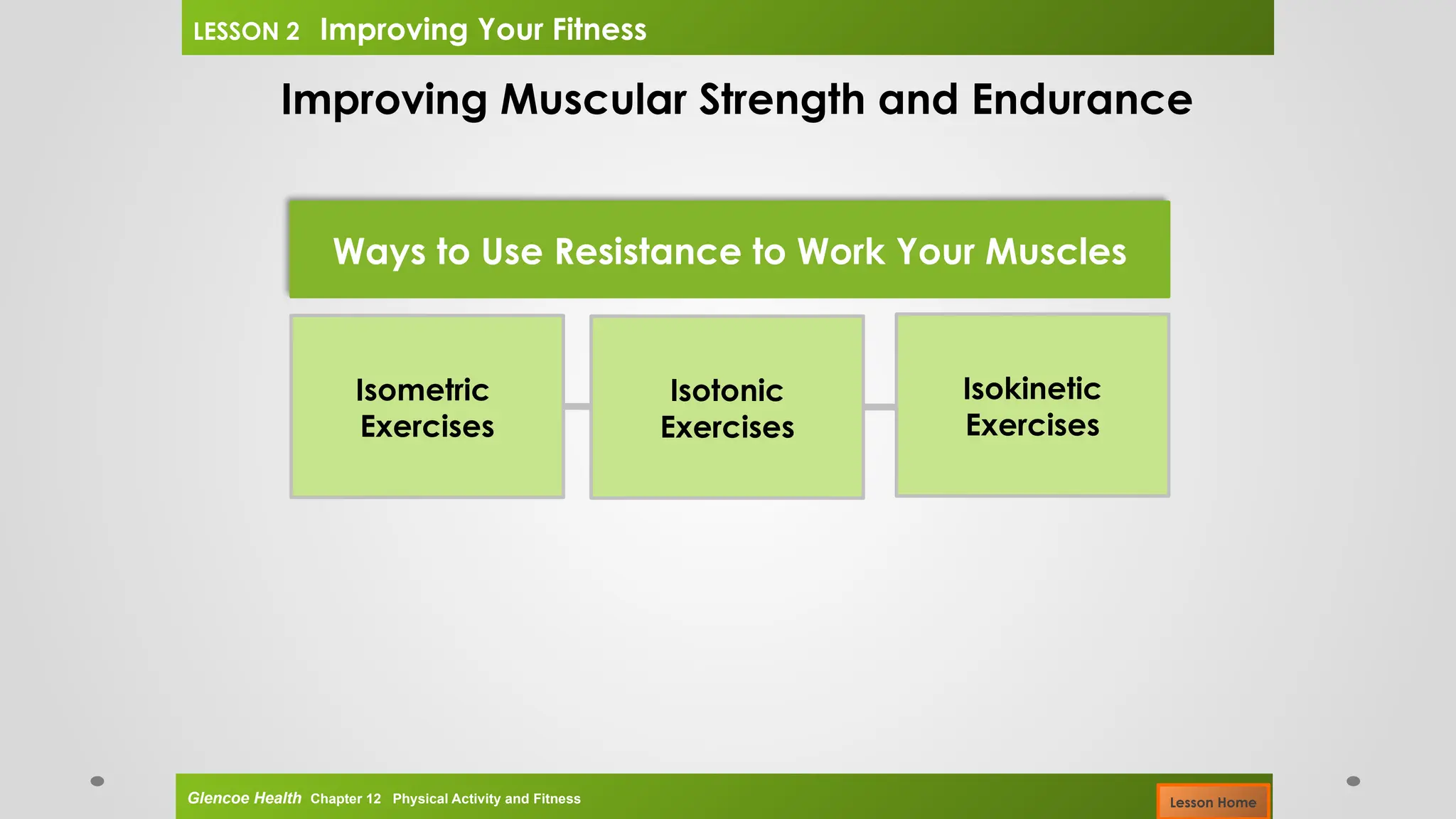
Ways to Use Resistance to Work Your Muscles
Isometric
Exercises
Isokinetic
Exercises
Isotonic
Exercises
Glencoe Health Chapter 12 Physical Activity and Fitness
LESSON 2 Improving Your Fitness
Lesson Home
Improving Muscular Strength and Endurance
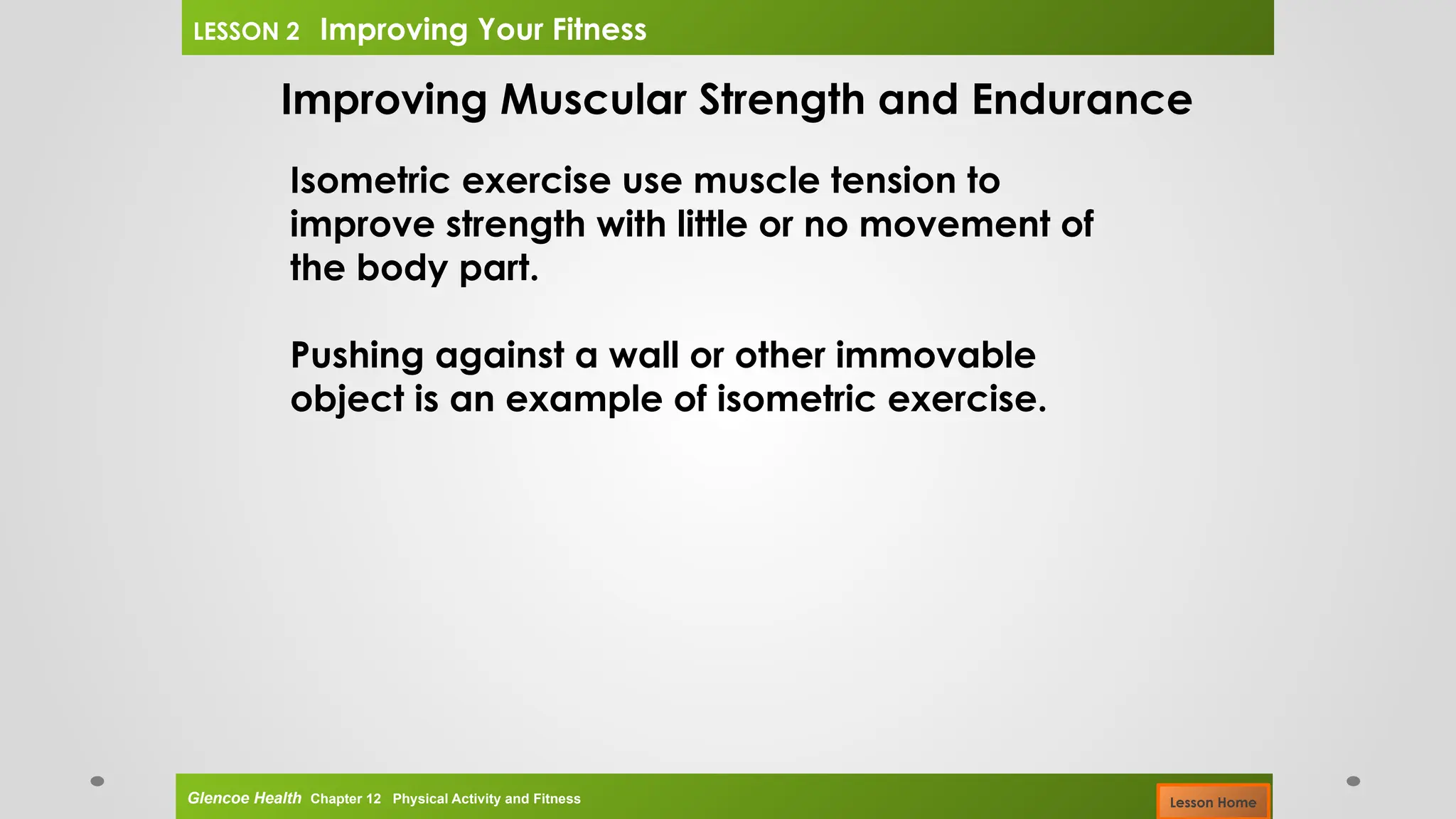
Isometric exercise use muscle tension to
improve strength with little or no movement of
the body part.
Pushing against a wall or other immovable
object is an example of isometric exercise.
Glencoe Health Chapter 12 Physical Activity and Fitness
LESSON 2 Improving Your Fitness
Lesson Home
Improving Muscular Strength and Endurance
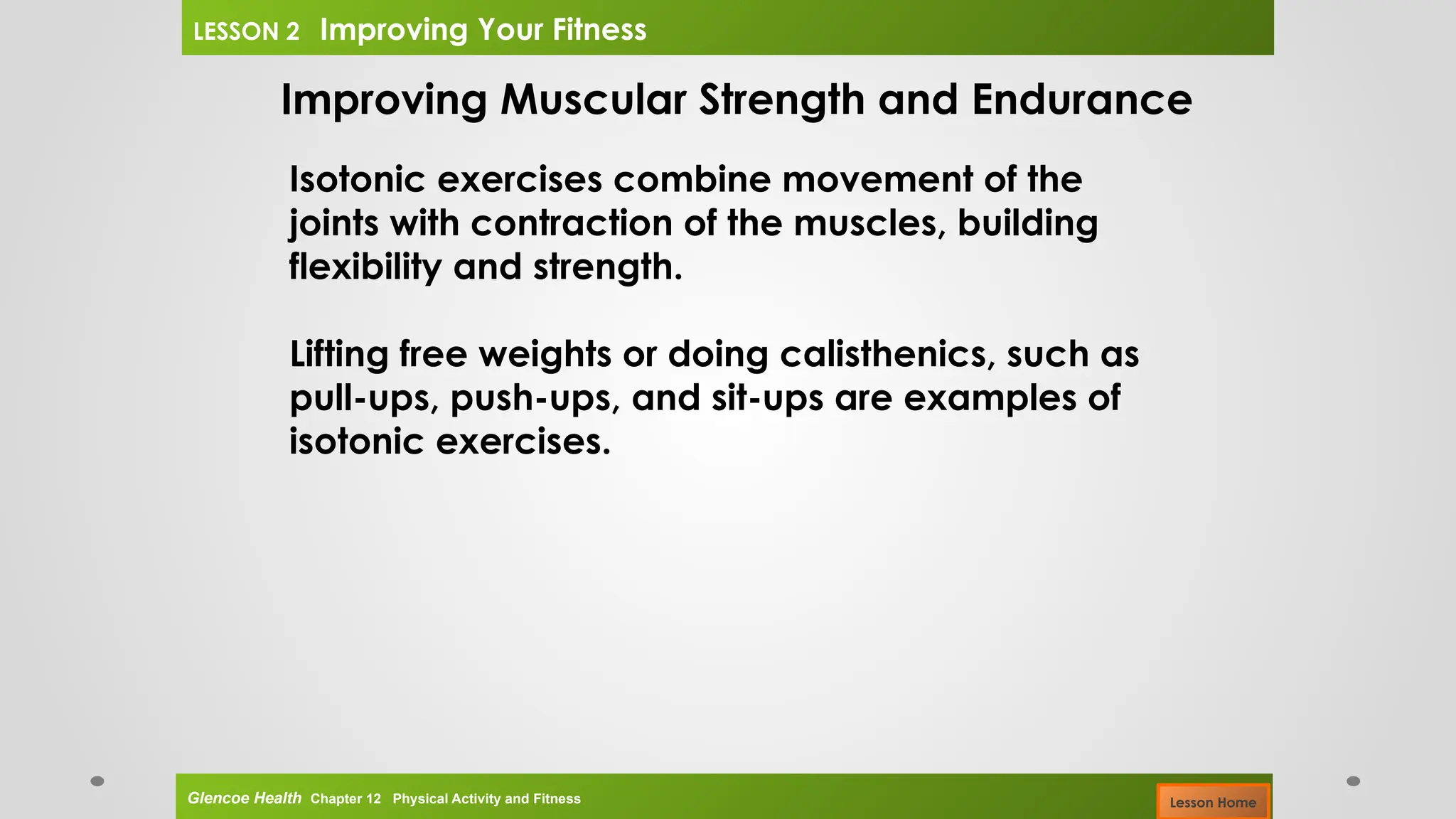
Isotonic exercises combine movement of the
joints with contraction of the muscles, building
flexibility and strength.
Lifting free weights or doing calisthenics, such as
pull-ups, push-ups, and sit-ups are examples of
isotonic exercises.
Glencoe Health Chapter 12 Physical Activity and Fitness
LESSON 2 Improving Your Fitness
Lesson Home
Improving Muscular Strength and Endurance
Isokinetic exercises exert resistance against a
muscle as it moves through a range of motion at
a steady rate of speed.
Various types of weight machines and other
exercise equipment provide isokinetic exercise.
Glencoe Health Chapter 12 Physical Activity and Fitness
LESSON 2 Improving Your Fitness
Lesson Home
Improving Flexibility
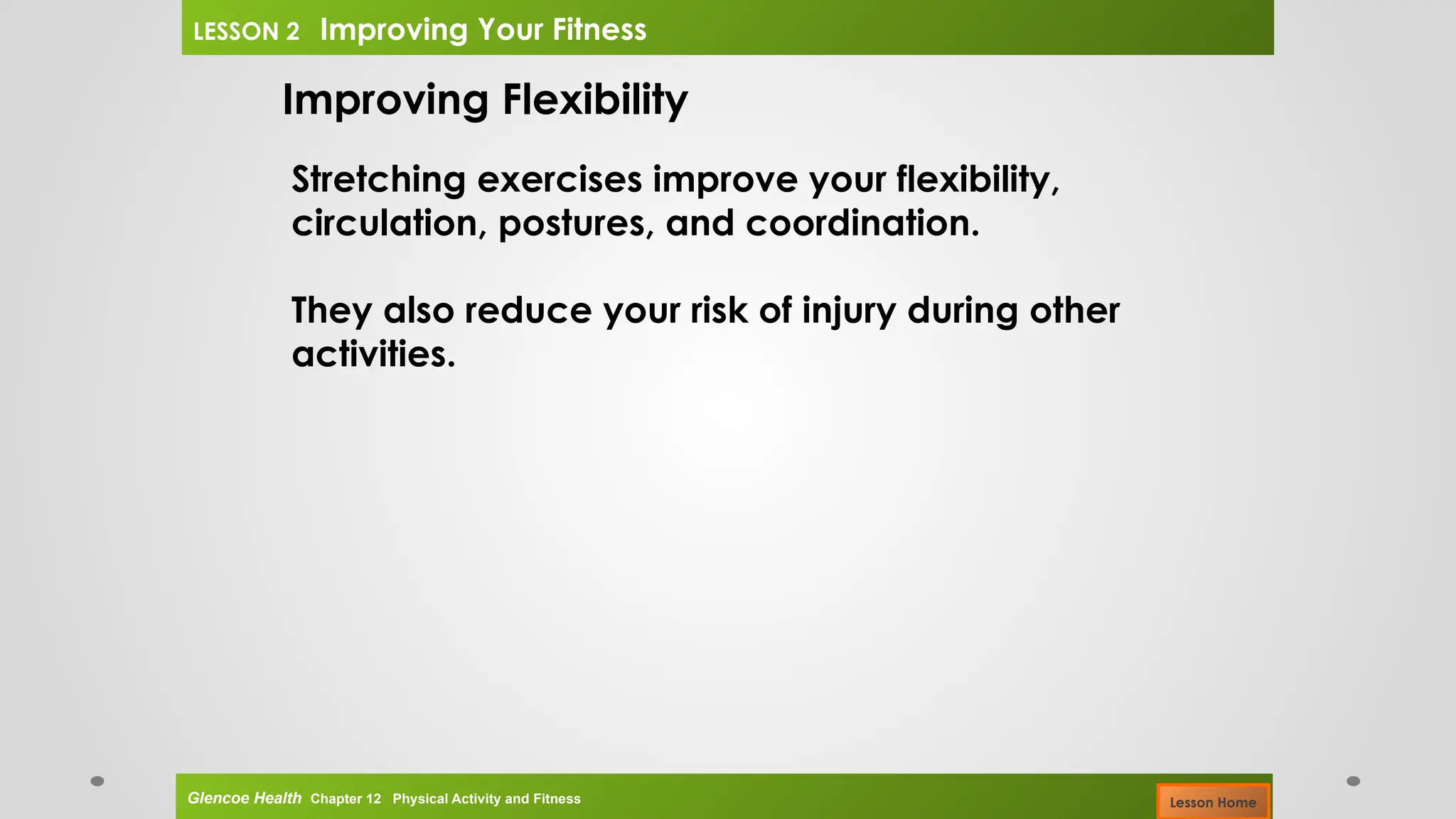
Stretching exercises improve your flexibility,
circulation, postures, and coordination.
They also reduce your risk of injury during other
activities.
Glencoe Health Chapter 12 Physical Activity and Fitness
LESSON 2 Improving Your Fitness
Lesson Home
Improving Flexibility
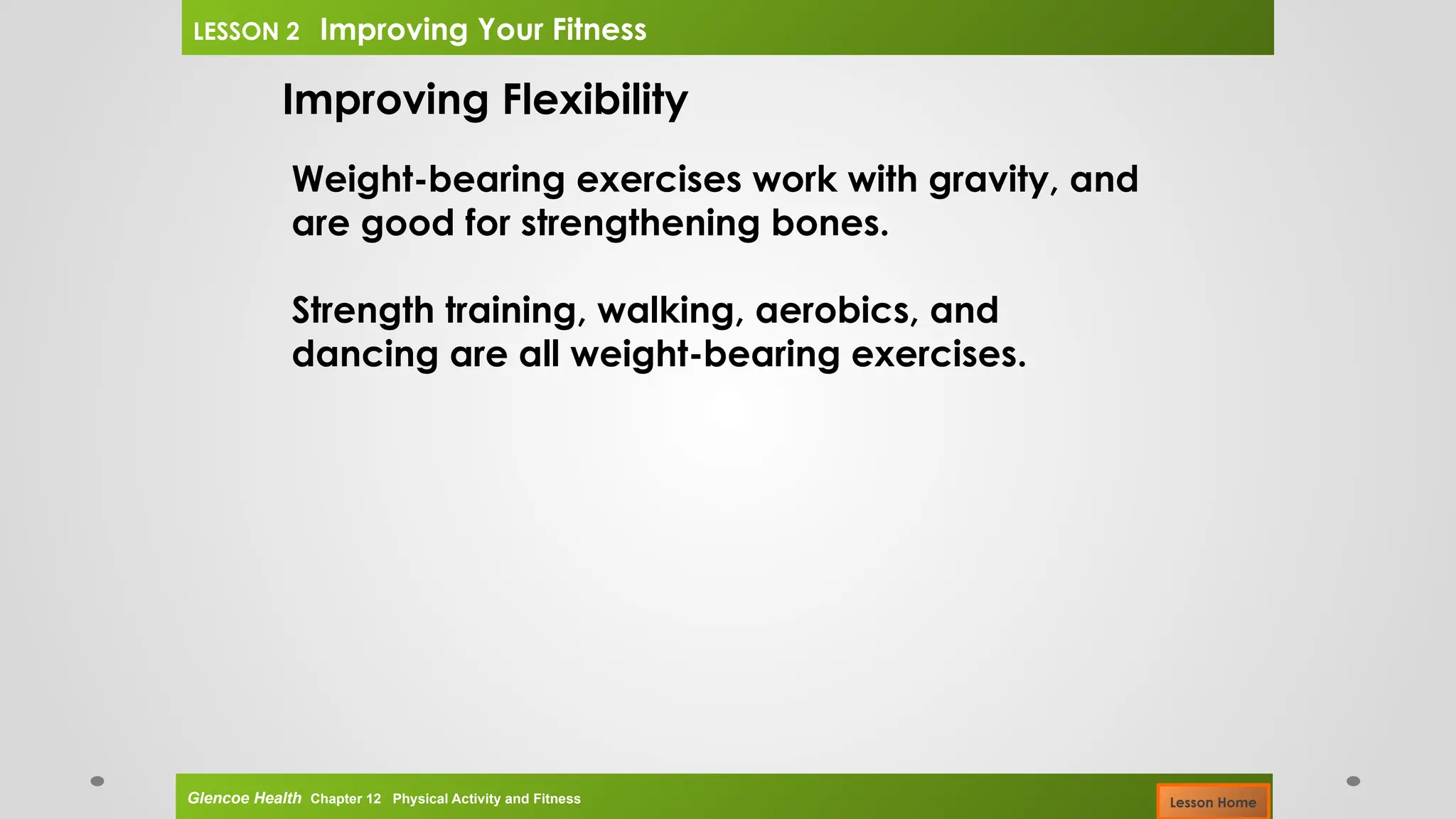
Weight-bearing exercises work with gravity, and
are good for strengthening bones.
Strength training, walking, aerobics, and
dancing are all weight-bearing exercises.
Glencoe Health Chapter 12 Physical Activity and Fitness
LESSON 2 Improving Your Fitness
Lesson Home
Your Fitness Plan
The physical activity you choose depends on
factors such as your fitness goals and activities
you like
Glencoe Health Chapter 12 Physical Activity and Fitness
LESSON 3 Planning a Personal Activity Program
Lesson Home
Personal Fitness Needs
The following factors may affect your activity
choices:
1. Cost
2. Where you live – flat or hilly, weather
3. Your schedule
4. Your fitness level
5. Your overall health
6. Personal safety
Glencoe Health Chapter 12 Physical Activity and Fitness
LESSON 3 Planning a Personal Activity Program
Lesson Home
Types of activities
Select different types of activities to meet
specific fitness goals and prevent boredom
1. Moderate intensity physical activity – walking
climbing stairs, yard work
2. Aerobic activities – raise heart rate, cycling,
brisk walking running, dancing team sports
3. Strength Training – develops muscle tone ,
push ups, pulls ups, abdominal crunches
4. Flexibility exercises – stretching 10-12 minutes
a day
Glencoe Health Chapter 12 Physical Activity and Fitness
LESSON 3 Planning a Personal Activity Program
Lesson Home
Principles of building fitness
Effective fitness plans focus on 4 principles
1. Specificity – choosing the right types of
activities to improve a given element of
fitness
2. Overload– exercising at a level that’s beyond
your regular daily activities – grow stronger
3. Progression– gradually increasing the
demands on your body – working harder and
longer each time
4. Regularity – working out on a regular basis
Glencoe Health Chapter 12 Physical Activity and Fitness
LESSON 3 Planning a Personal Activity Program
Lesson Home
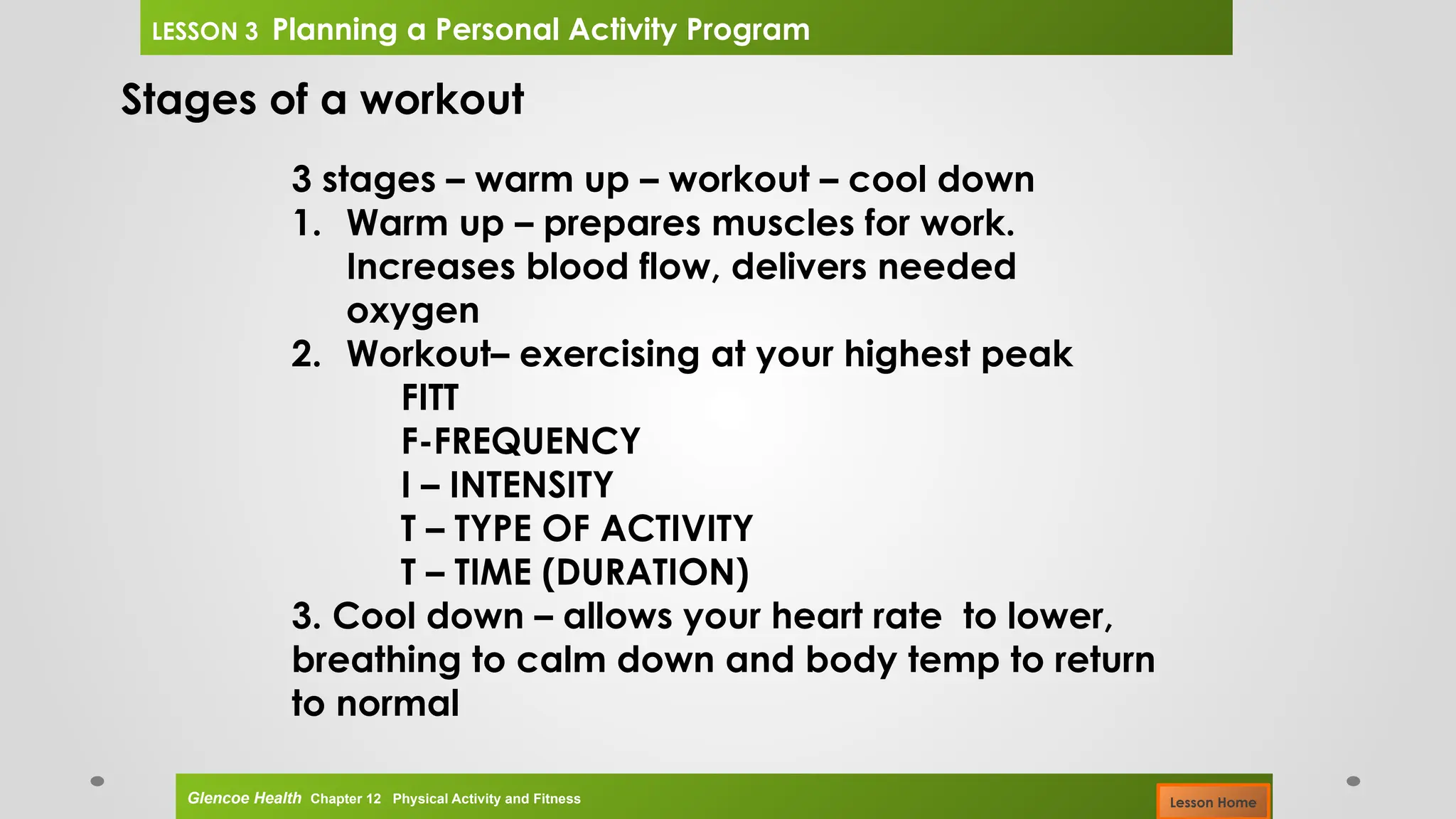
Stages of a workout
3 stages – warm up – workout – cool down
1. Warm up – prepares muscles for work.
Increases blood flow, delivers needed
oxygen
2. Workout– exercising at your highest peak
FITT
F-FREQUENCY
I – INTENSITY
T – TYPE OF ACTIVITY
T – TIME (DURATION)
3. Cool down – allows your heart rate to lower,
breathing to calm down and body temp to return
to normal
Glencoe Health Chapter 12 Physical Activity and Fitness
LESSON 3 Planning a Personal Activity Program
Lesson Home
Safety First
Safety precautions can help you avoid injuries during physical
activity
-use correct equipment
-play attention to weather and objects
-warm up before exercise
-stay within areas given for physical activity
-obey all rules and restrictions
-practice good sportsmanship
Glencoe Health Chapter 12 Physical Activity and Fitness
LESSON 4 Fitness Safety and Avoiding Injuries
Lesson Home
Safety First
Safety precautions can help you avoid injuries during
physical activity
-use correct equipment
-play attention to weather and objects
-warm up before exercise
-stay within areas given for physical activity
-obey all rules and restrictions
-practice good sportsmanship
Glencoe Health Chapter 12 Physical Activity and Fitness
LESSON 4 Fitness Safety and Avoiding Injuries
Lesson Home
Safety First
-use correct equipment
-page 338 guidelines for the right
equipment
Glencoe Health Chapter 12 Physical Activity and Fitness
LESSON 4 Fitness Safety and Avoiding Injuries
Lesson Home
Safety First
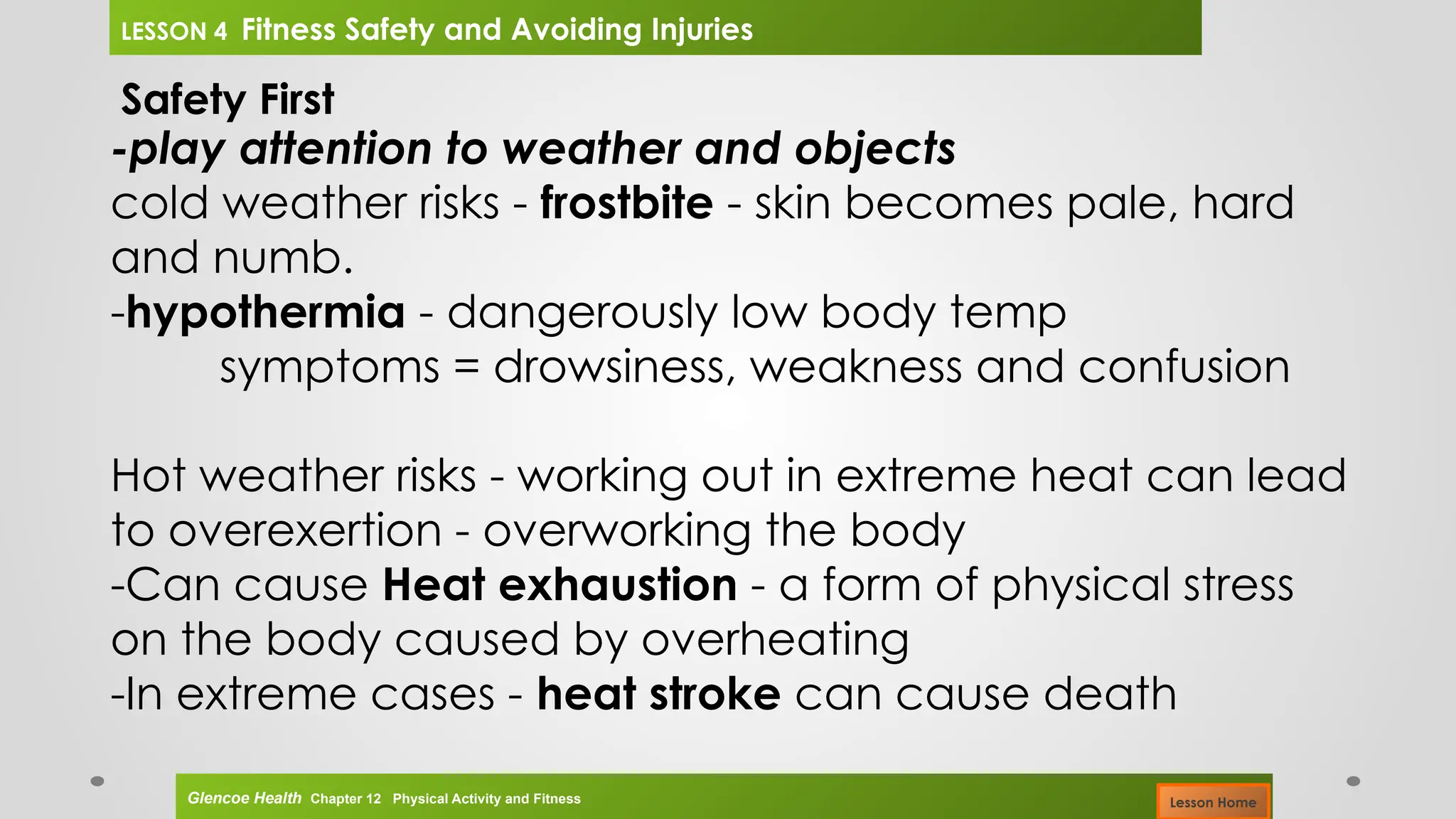
-play attention to weather and objects
cold weather risks - frostbite - skin becomes pale, hard
and numb.
-hypothermia - dangerously low body temp
symptoms = drowsiness, weakness and confusion
Hot weather risks - working out in extreme heat can lead
to overexertion - overworking the body
-Can cause Heat exhaustion - a form of physical stress
on the body caused by overheating
-In extreme cases - heat stroke can cause death
Glencoe Health Chapter 12 Physical Activity and Fitness
LESSON 4 Fitness Safety and Avoiding Injuries
Lesson Home
Safety First
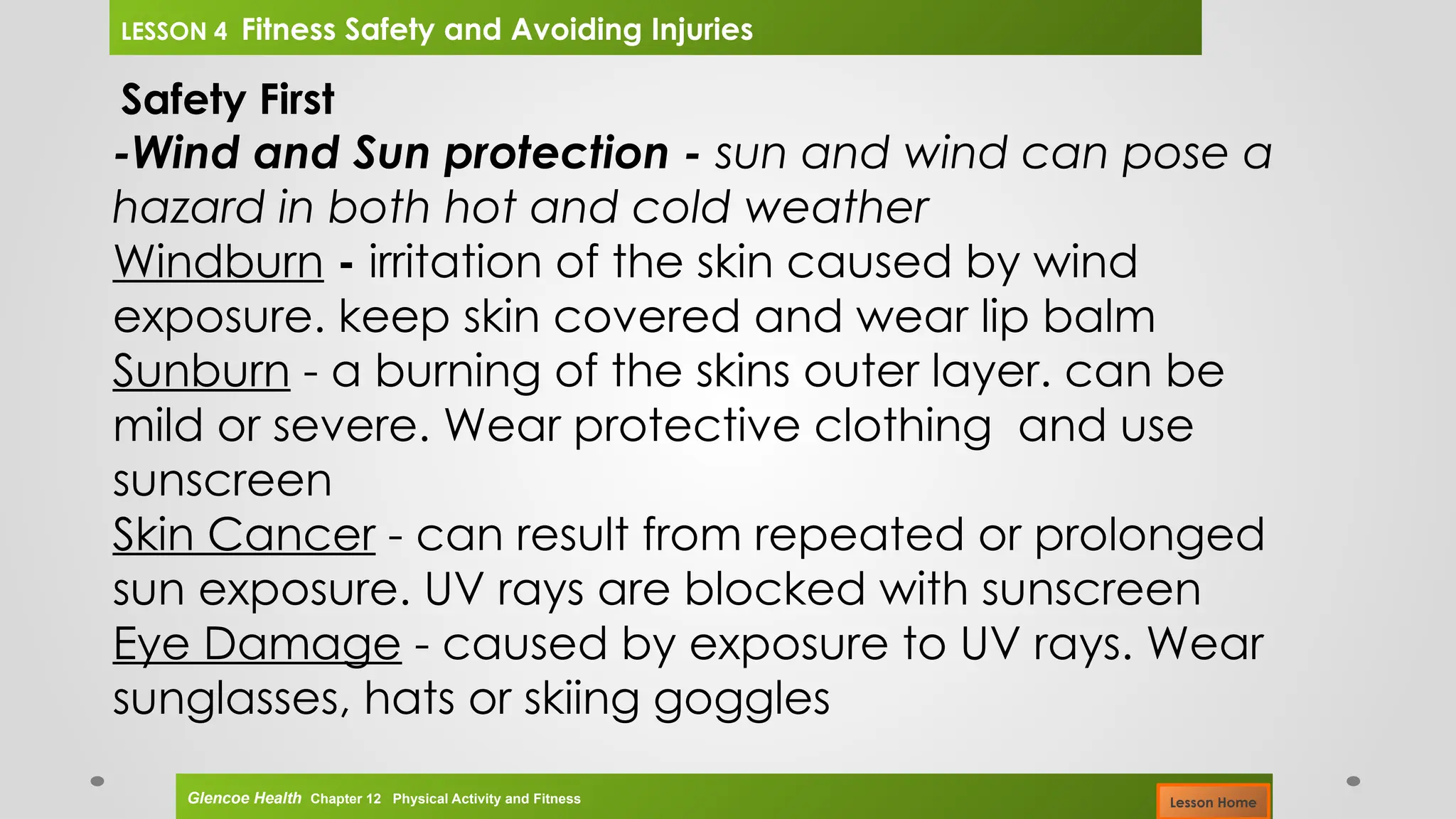
-Wind and Sun protection - sun and wind can pose a
hazard in both hot and cold weather
Windburn - irritation of the skin caused by wind
exposure. keep skin covered and wear lip balm
Sunburn - a burning of the skins outer layer. can be
mild or severe. Wear protective clothing and use
sunscreen
Skin Cancer - can result from repeated or prolonged
sun exposure. UV rays are blocked with sunscreen
Eye Damage - caused by exposure to UV rays. Wear
sunglasses, hats or skiing goggles
Glencoe Health Chapter 12 Physical Activity and Fitness
LESSON 4 Fitness Safety and Avoiding Injuries
Lesson Home
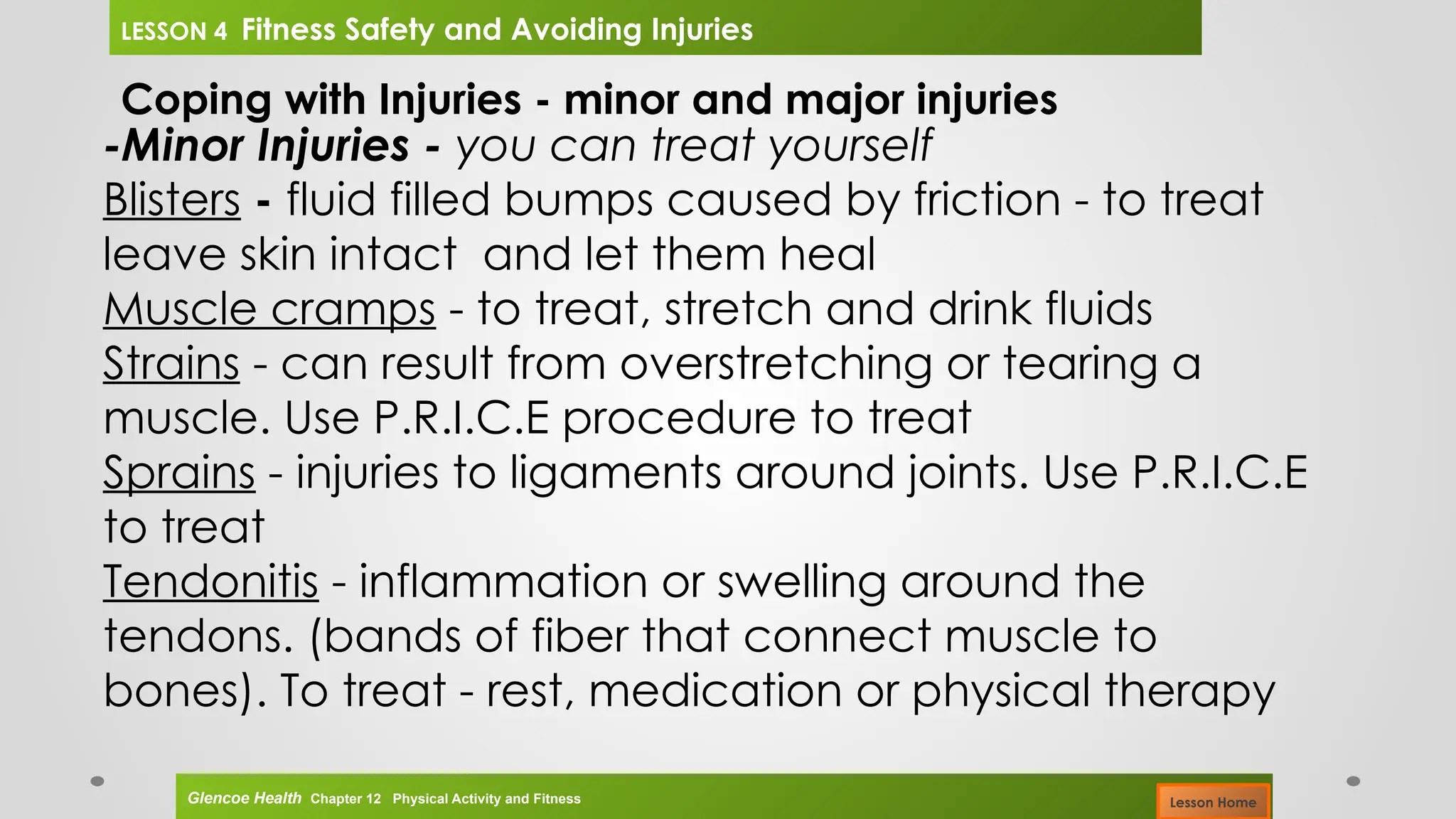
Coping with Injuries - minor and major injuries
-Minor Injuries - you can treat yourself
Blisters - fluid filled bumps caused by friction - to treat
leave skin intact and let them heal
Muscle cramps - to treat, stretch and drink fluids
Strains - can result from overstretching or tearing a
muscle. Use P.R.I.C.E procedure to treat
Sprains - injuries to ligaments around joints. Use P.R.I.C.E
to treat
Tendonitis - inflammation or swelling around the
tendons. (bands of fiber that connect muscle to
bones). To treat - rest, medication or physical therapy
Glencoe Health Chapter 12 Physical Activity and Fitness
LESSON 4 Fitness Safety and Avoiding Injuries
Lesson Home
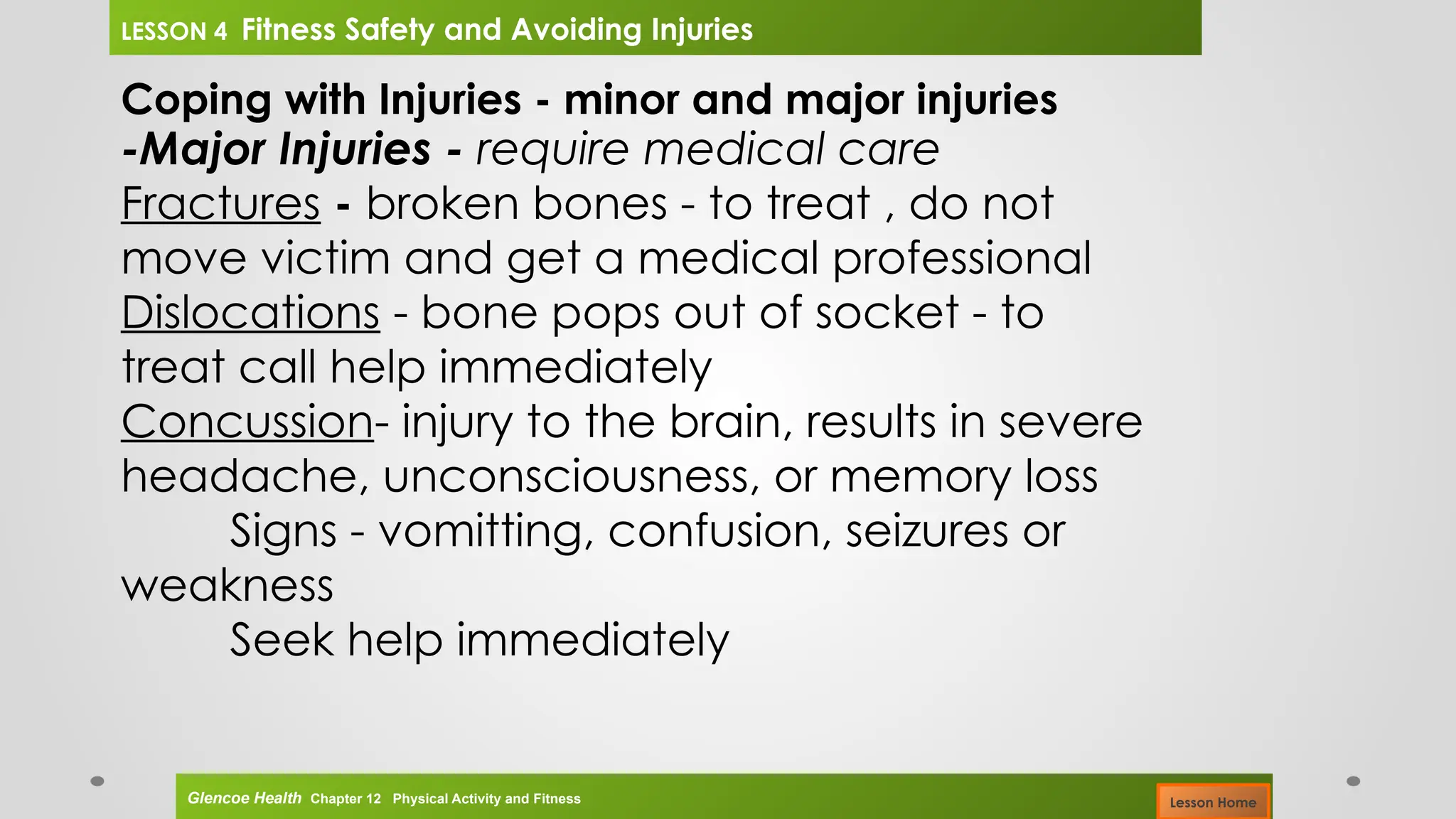
Coping with Injuries - minor and major injuries
-Major Injuries - require medical care
Fractures - broken bones - to treat , do not
move victim and get a medical professional
Dislocations - bone pops out of socket - to
treat call help immediately
Concussion- injury to the brain, results in severe
headache, unconsciousness, or memory loss
Signs - vomitting, confusion, seizures or
weakness
Seek help immediately
Glencoe Health Chapter 12 Physical Activity and Fitness
LESSON 4 Fitness Safety and Avoiding Injuries
Lesson Home

Chapter 12 powerpoint presentation of gryffindor

  • 1.
  • 2.
    Physical Activity andYour Health Main Idea Physical activity benefits all aspects of your health triangle. Teens should try to get at least 60 minutes of physical activity every day. Glencoe Health Chapter 12 Physical Activity and Fitness LESSON 1 Benefits of Physical Activity Lesson Home
  • 3.
    Physical Activity andYour Health Physical activity includes all kinds of activities that you do every day. physical activity Any form of movement that causes your body to use energy. New Vocabulary Glencoe Health Chapter 12 Physical Activity and Fitness LESSON 1 Benefits of Physical Activity Lesson Home
  • 4.
    Physical Benefits Being activeon a regular basis improves your physical fitness. physical fitness The ability to carry out daily tasks easily and have enough reserve energy to respond to unexpected demands. New Vocabulary Glencoe Health Chapter 12 Physical Activity and Fitness LESSON 1 Benefits of Physical Activity Lesson Home
  • 5.
    Physical Benefits All kindsof physical activity – not just exercise – will improve your health. exercise Purposeful physical activity that is planned, structured, and repetitive, and that improves or maintains physical fitness. New Vocabulary Glencoe Health Chapter 12 Physical Activity and Fitness LESSON 1 Benefits of Physical Activity Lesson Home
  • 6.
    Physical Benefits Boosts yourenergy level Improves your posture Helps you maintain a healthy weight Strengthens your muscles and bones Reduces your risk of many serious diseases Glencoe Health Chapter 12 Physical Activity and Fitness LESSON 1 Benefits of Physical Activity Lesson Home
  • 7.
    Physical Benefits Glencoe HealthChapter 12 Physical Activity and Fitness LESSON 1 Benefits of Physical Activity Lesson Home
  • 8.
    Mental and EmotionalBalance Mental and Emotional Benefits Stress Relief Mood Enhancement Improved Self-Esteem Better Sleep Glencoe Health Chapter 12 Physical Activity and Fitness LESSON 1 Benefits of Physical Activity Lesson Home
  • 9.
    Social Benefits Make newfriends Develop skills to improve your relationships Increase self-esteem Spend time with friends Give you confidence Manage stress Glencoe Health Chapter 12 Physical Activity and Fitness LESSON 1 Benefits of Physical Activity Lesson Home
  • 10.
    Risks of BeingInactive Main Idea An inactive lifestyle puts you at risk for a variety of health problems. Examples of sedentary activities include watching TV, surfing the internet, and playing video games. Glencoe Health Chapter 12 Physical Activity and Fitness LESSON 1 Benefits of Physical Activity Lesson Home
  • 11.
    Risks of BeingInactive Being sedentary puts you at risk for a variety of health problems. sedentary Involving little physical activity. New Vocabulary Glencoe Health Chapter 12 Physical Activity and Fitness LESSON 1 Benefits of Physical Activity Lesson Home
  • 12.
    Certain types ofcancer Type 2 diabetes Cardiovascular disease Unhealthful weight gain and obesity Risks of Being Inactive Health Problems of Being Sedentary Glencoe Health Chapter 12 Physical Activity and Fitness LESSON 1 Benefits of Physical Activity Lesson Home
  • 13.
    Psychological problems Osteoarthritis Osteoporosis Asthma andother breathing problems Risks of Being Inactive continued Health Problems of Being Sedentary Premature death Glencoe Health Chapter 12 Physical Activity and Fitness LESSON 1 Benefits of Physical Activity Lesson Home
  • 14.
    Making Time forPhysical Activity Main Idea You can find ways to fit physical activity into your daily life. Engaging in 10 minutes of physical activity six times a day provides the same benefit as an hour-long workout. Glencoe Health Chapter 12 Physical Activity and Fitness LESSON 1 Benefits of Physical Activity Lesson Home
  • 15.
    Making Time forPhysical Activity Instead of this… Taking the elevator Using a snowblower Getting a ride to a friend’s house Using a shopping cart Taking a car through a car wash Playing video or computer games Try this… Take the stairs Shovel snow Walk, skate, or ride a bike Carry your groceries to the car Wash the car by hand Play basketball, soccer, or tennis Glencoe Health Chapter 12 Physical Activity and Fitness LESSON 1 Benefits of Physical Activity Lesson Home
  • 16.
    Main Idea Elements ofFitness Five elements of fitness all affect your health in different ways. The five elements are cardiorespiratory endurance, muscular strength, muscular endurance, flexibility, and body composition. Glencoe Health Chapter 12 Physical Activity and Fitness LESSON 2 Improving Your Fitness Lesson Home
  • 17.
    cardiorespiratory endurance The abilityof your heart, lungs, and blood vessels to send fuel and oxygen to your tissues during long periods of moderate to vigorous activity. New Vocabulary Elements of Fitness If you have cardiorespiratory endurance, you can run a mile or go on a long hike without tiring. Glencoe Health Chapter 12 Physical Activity and Fitness LESSON 2 Improving Your Fitness Lesson Home
  • 18.
    muscular strength The amountof force your muscles can exert. New Vocabulary Elements of Fitness You need muscular strength for all kinds of activity that put stress on your muscles, such as lifting, pushing, and jumping. Glencoe Health Chapter 12 Physical Activity and Fitness LESSON 2 Improving Your Fitness Lesson Home
  • 19.
    muscular endurance The abilityof your muscles to perform physical tasks over a period of time without tiring. New Vocabulary Elements of Fitness Muscular endurance gives you the power to carry out daily tasks without fatigue, such as carrying boxes up and down a flight of stairs. Glencoe Health Chapter 12 Physical Activity and Fitness LESSON 2 Improving Your Fitness Lesson Home
  • 20.
    flexibility The ability tomove your body parts through their full range of motion. New Vocabulary Elements of Fitness Flexibility can improve your athletic performance and reduce your risk of muscle strain and other injuries. Glencoe Health Chapter 12 Physical Activity and Fitness LESSON 2 Improving Your Fitness Lesson Home
  • 21.
    Elements of Fitness Yourbody composition is the ratio of fat to lean tissue in your body. Having low overall body fat reduces your risk of cardiovascular disease and other health problems associated with being overweight. Glencoe Health Chapter 12 Physical Activity and Fitness LESSON 2 Improving Your Fitness Lesson Home
  • 22.
    Main Idea Evaluating YourFitness You can use different tests to evaluate each element of your fitness. You can use tests to measure your cardiorespiratory endurance, muscular strength, and endurance, and flexibility. Glencoe Health Chapter 12 Physical Activity and Fitness LESSON 2 Improving Your Fitness Lesson Home
  • 23.
    Measuring Muscular Strengthand Endurance You can measure the strength and endurance of your abdominal muscles by doing a partial curl-up test. Glencoe Health Chapter 12 Physical Activity and Fitness LESSON 2 Improving Your Fitness Lesson Home
  • 24.
    Measuring Muscular Strengthand Endurance You can measure the strength and endurance of your upper body by doing a right-angle push- up test. Glencoe Health Chapter 12 Physical Activity and Fitness LESSON 2 Improving Your Fitness Lesson Home
  • 25.
    Measuring Cardiorespiratory Endurance Youcan evaluate your cardiorespiratory endurance by doing a three-minute step test. Glencoe Health Chapter 12 Physical Activity and Fitness LESSON 2 Improving Your Fitness Lesson Home
  • 26.
    Measuring Flexibility The sit-and-reachtest measures the flexibility of your lower back and hamstring muscles. Glencoe Health Chapter 12 Physical Activity and Fitness LESSON 2 Improving Your Fitness Lesson Home
  • 27.
    Main Idea Getting Fit Usedifferent forms of exercise to improve the various elements of your fitness. Most exercises and activities fit into two basic categories: aerobic and anaerobic. Glencoe Health Chapter 12 Physical Activity and Fitness LESSON 2 Improving Your Fitness Lesson Home
  • 28.
    aerobic exercise All rhythmicactivities that use large muscle groups for an extended period of time. New Vocabulary Getting Fit Aerobic exercise raises your heart rate and increases your body’s use of oxygen. Jogging, swimming, and riding a bicycle are examples. Glencoe Health Chapter 12 Physical Activity and Fitness LESSON 2 Improving Your Fitness Lesson Home
  • 29.
    anaerobic exercise Intense, shortbursts of activity in which the muscles work so hard that they produce energy without using oxygen. New Vocabulary Getting Fit Sprinting and lifting weights are examples of anaerobic exercise. Glencoe Health Chapter 12 Physical Activity and Fitness LESSON 2 Improving Your Fitness Lesson Home
  • 30.
    Improving Cardiorespiratory Endurance Aerobicexercise increases your heart rate and pumps more blood throughout your body. Over time, your heart and lungs adapt to the demands made by aerobic activity by working more efficiently. Glencoe Health Chapter 12 Physical Activity and Fitness LESSON 2 Improving Your Fitness Lesson Home
  • 31.
    Improving Cardiorespiratory Endurance Anaerobicexercises improve muscular strength and endurance. Exercises like lifting weights strengthen the muscles and are known as resistance or strength training. Glencoe Health Chapter 12 Physical Activity and Fitness LESSON 2 Improving Your Fitness Lesson Home
  • 32.
    Improving Muscular Strengthand Endurance Ways to Use Resistance to Work Your Muscles Isometric Exercises Isokinetic Exercises Isotonic Exercises Glencoe Health Chapter 12 Physical Activity and Fitness LESSON 2 Improving Your Fitness Lesson Home
  • 33.
    Improving Muscular Strengthand Endurance Isometric exercise use muscle tension to improve strength with little or no movement of the body part. Pushing against a wall or other immovable object is an example of isometric exercise. Glencoe Health Chapter 12 Physical Activity and Fitness LESSON 2 Improving Your Fitness Lesson Home
  • 34.
    Improving Muscular Strengthand Endurance Isotonic exercises combine movement of the joints with contraction of the muscles, building flexibility and strength. Lifting free weights or doing calisthenics, such as pull-ups, push-ups, and sit-ups are examples of isotonic exercises. Glencoe Health Chapter 12 Physical Activity and Fitness LESSON 2 Improving Your Fitness Lesson Home
  • 35.
    Improving Muscular Strengthand Endurance Isokinetic exercises exert resistance against a muscle as it moves through a range of motion at a steady rate of speed. Various types of weight machines and other exercise equipment provide isokinetic exercise. Glencoe Health Chapter 12 Physical Activity and Fitness LESSON 2 Improving Your Fitness Lesson Home
  • 36.
    Improving Flexibility Stretching exercisesimprove your flexibility, circulation, postures, and coordination. They also reduce your risk of injury during other activities. Glencoe Health Chapter 12 Physical Activity and Fitness LESSON 2 Improving Your Fitness Lesson Home
  • 37.
    Improving Flexibility Weight-bearing exerciseswork with gravity, and are good for strengthening bones. Strength training, walking, aerobics, and dancing are all weight-bearing exercises. Glencoe Health Chapter 12 Physical Activity and Fitness LESSON 2 Improving Your Fitness Lesson Home
  • 38.
    Your Fitness Plan Thephysical activity you choose depends on factors such as your fitness goals and activities you like Glencoe Health Chapter 12 Physical Activity and Fitness LESSON 3 Planning a Personal Activity Program Lesson Home
  • 39.
    Personal Fitness Needs Thefollowing factors may affect your activity choices: 1. Cost 2. Where you live – flat or hilly, weather 3. Your schedule 4. Your fitness level 5. Your overall health 6. Personal safety Glencoe Health Chapter 12 Physical Activity and Fitness LESSON 3 Planning a Personal Activity Program Lesson Home
  • 40.
    Types of activities Selectdifferent types of activities to meet specific fitness goals and prevent boredom 1. Moderate intensity physical activity – walking climbing stairs, yard work 2. Aerobic activities – raise heart rate, cycling, brisk walking running, dancing team sports 3. Strength Training – develops muscle tone , push ups, pulls ups, abdominal crunches 4. Flexibility exercises – stretching 10-12 minutes a day Glencoe Health Chapter 12 Physical Activity and Fitness LESSON 3 Planning a Personal Activity Program Lesson Home
  • 41.
    Principles of buildingfitness Effective fitness plans focus on 4 principles 1. Specificity – choosing the right types of activities to improve a given element of fitness 2. Overload– exercising at a level that’s beyond your regular daily activities – grow stronger 3. Progression– gradually increasing the demands on your body – working harder and longer each time 4. Regularity – working out on a regular basis Glencoe Health Chapter 12 Physical Activity and Fitness LESSON 3 Planning a Personal Activity Program Lesson Home
  • 42.
    Stages of aworkout 3 stages – warm up – workout – cool down 1. Warm up – prepares muscles for work. Increases blood flow, delivers needed oxygen 2. Workout– exercising at your highest peak FITT F-FREQUENCY I – INTENSITY T – TYPE OF ACTIVITY T – TIME (DURATION) 3. Cool down – allows your heart rate to lower, breathing to calm down and body temp to return to normal Glencoe Health Chapter 12 Physical Activity and Fitness LESSON 3 Planning a Personal Activity Program Lesson Home
  • 43.
    Safety First Safety precautionscan help you avoid injuries during physical activity -use correct equipment -play attention to weather and objects -warm up before exercise -stay within areas given for physical activity -obey all rules and restrictions -practice good sportsmanship Glencoe Health Chapter 12 Physical Activity and Fitness LESSON 4 Fitness Safety and Avoiding Injuries Lesson Home
  • 44.
    Safety First Safety precautionscan help you avoid injuries during physical activity -use correct equipment -play attention to weather and objects -warm up before exercise -stay within areas given for physical activity -obey all rules and restrictions -practice good sportsmanship Glencoe Health Chapter 12 Physical Activity and Fitness LESSON 4 Fitness Safety and Avoiding Injuries Lesson Home
  • 45.
    Safety First -use correctequipment -page 338 guidelines for the right equipment Glencoe Health Chapter 12 Physical Activity and Fitness LESSON 4 Fitness Safety and Avoiding Injuries Lesson Home
  • 46.
    Safety First -play attentionto weather and objects cold weather risks - frostbite - skin becomes pale, hard and numb. -hypothermia - dangerously low body temp symptoms = drowsiness, weakness and confusion Hot weather risks - working out in extreme heat can lead to overexertion - overworking the body -Can cause Heat exhaustion - a form of physical stress on the body caused by overheating -In extreme cases - heat stroke can cause death Glencoe Health Chapter 12 Physical Activity and Fitness LESSON 4 Fitness Safety and Avoiding Injuries Lesson Home
  • 47.
    Safety First -Wind andSun protection - sun and wind can pose a hazard in both hot and cold weather Windburn - irritation of the skin caused by wind exposure. keep skin covered and wear lip balm Sunburn - a burning of the skins outer layer. can be mild or severe. Wear protective clothing and use sunscreen Skin Cancer - can result from repeated or prolonged sun exposure. UV rays are blocked with sunscreen Eye Damage - caused by exposure to UV rays. Wear sunglasses, hats or skiing goggles Glencoe Health Chapter 12 Physical Activity and Fitness LESSON 4 Fitness Safety and Avoiding Injuries Lesson Home
  • 48.
    Coping with Injuries- minor and major injuries -Minor Injuries - you can treat yourself Blisters - fluid filled bumps caused by friction - to treat leave skin intact and let them heal Muscle cramps - to treat, stretch and drink fluids Strains - can result from overstretching or tearing a muscle. Use P.R.I.C.E procedure to treat Sprains - injuries to ligaments around joints. Use P.R.I.C.E to treat Tendonitis - inflammation or swelling around the tendons. (bands of fiber that connect muscle to bones). To treat - rest, medication or physical therapy Glencoe Health Chapter 12 Physical Activity and Fitness LESSON 4 Fitness Safety and Avoiding Injuries Lesson Home
  • 49.
    Coping with Injuries- minor and major injuries -Major Injuries - require medical care Fractures - broken bones - to treat , do not move victim and get a medical professional Dislocations - bone pops out of socket - to treat call help immediately Concussion- injury to the brain, results in severe headache, unconsciousness, or memory loss Signs - vomitting, confusion, seizures or weakness Seek help immediately Glencoe Health Chapter 12 Physical Activity and Fitness LESSON 4 Fitness Safety and Avoiding Injuries Lesson Home