Development Management And Finance | 1
MASTER OF CITY PLANNING (2012-14), DEPT. OF ARCHITECTURE & REGIONAL PLANNING, IIT KHARAGPUR
11. DEVELOPMENT MANAGEMENT AND FINANCE
11.1 Municipal Boundary
11.1.1 New Municipal Boundary
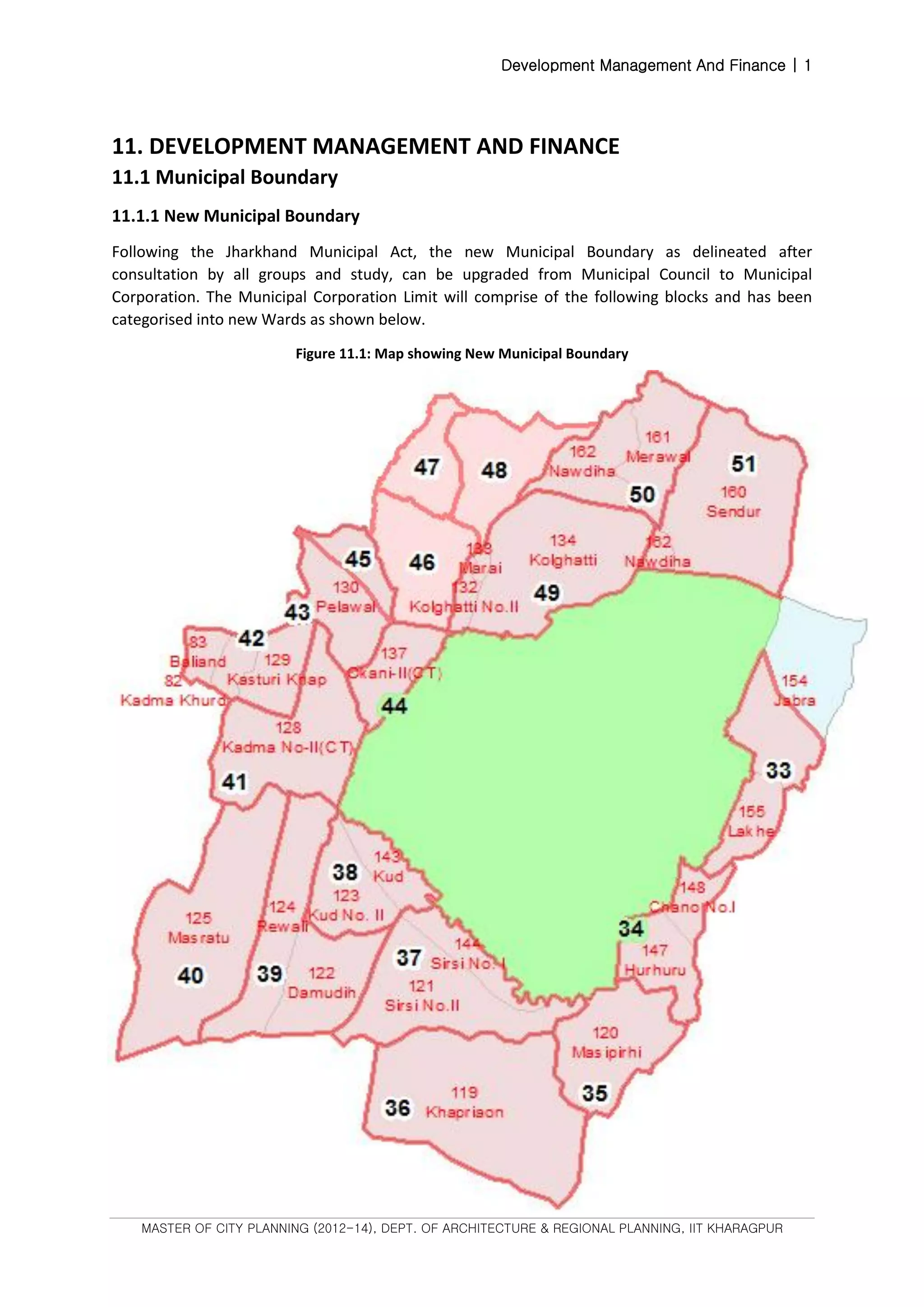
Following the Jharkhand Municipal Act, the new Municipal Boundary as delineated after
consultation by all groups and study, can be upgraded from Municipal Council to Municipal
Corporation. The Municipal Corporation Limit will comprise of the following blocks and has been
categorised into new Wards as shown below.
Figure 11.1: Map showing New Municipal Boundary
New Wards
Development Management And Finance | 2
MASTER OF CITY PLANNING (2012-14), DEPT. OF ARCHITECTURE & REGIONAL PLANNING, IIT KHARAGPUR
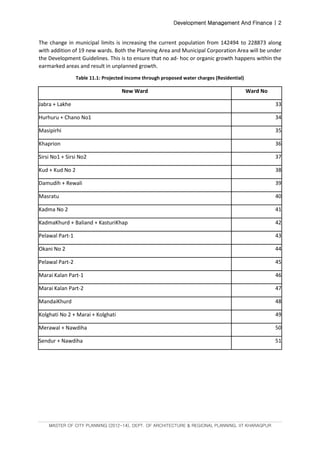
The change in municipal limits is increasing the current population from 142494 to 228873 along
with addition of 19 new wards. Both the Planning Area and Municipal Corporation Area will be under
the Development Guidelines. This is to ensure that no ad- hoc or organic growth happens within the
earmarked areas and result in unplanned growth.
Table 11.1: Projected income through proposed water charges (Residential)
New Ward Ward No
Jabra + Lakhe 33
Hurhuru + Chano No1 34
Masipirhi 35
Khaprion 36
Sirsi No1 + Sirsi No2 37
Kud + Kud No 2 38
Damudih + Rewali 39
Masratu 40
Kadma No 2 41
KadmaKhurd + Baliand + KasturiKhap 42
Pelawal Part-1 43
Okani No 2 44
Pelawal Part-2 45
Marai Kalan Part-1 46
Marai Kalan Part-2 47
MandaiKhurd 48
Kolghati No 2 + Marai + Kolghati 49
Merawal + Nawdiha 50
Sendur + Nawdiha 51
Development Management And Finance | 3
MASTER OF CITY PLANNING (2012-14), DEPT. OF ARCHITECTURE & REGIONAL PLANNING, IIT KHARAGPUR
11.1.2 Organization Structure
In Hazaribagh, there is acute shortage of sub-ordinate staff. This could be filled up with the proper
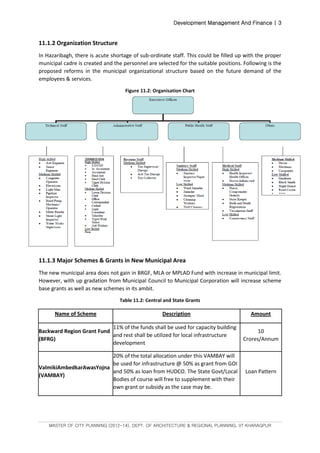
municipal cadre is created and the personnel are selected for the suitable positions. Following is the
proposed reforms in the municipal organizational structure based on the future demand of the
employees & services.
Figure 11.2: Organisation Chart
11.1.3 Major Schemes & Grants in New Municipal Area
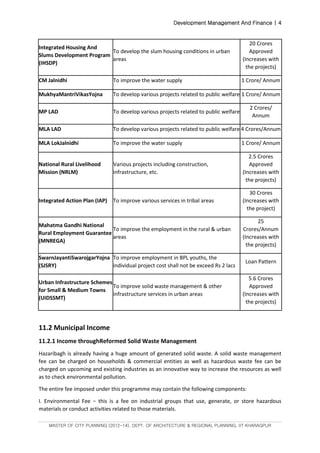
The new municipal area does not gain in BRGF, MLA or MPLAD Fund with increase in municipal limit.
However, with up gradation from Municipal Council to Municipal Corporation will increase scheme
base grants as well as new schemes in its ambit.
Table 11.2: Central and State Grants
Name of Scheme Description Amount
Backward Region Grant Fund
(BFRG)
11% of the funds shall be used for capacity building
and rest shall be utilized for local infrastructure
development
10
Crores/Annum
ValmikiAmbedkarAwasYojna
(VAMBAY)
20% of the total allocation under this VAMBAY will
be used for infrastructure @ 50% as grant from GOI
and 50% as loan from HUDCO. The State Govt/Local
Bodies of course will free to supplement with their
own grant or subsidy as the case may be.
Loan Pattern
Development Management And Finance | 4
MASTER OF CITY PLANNING (2012-14), DEPT. OF ARCHITECTURE & REGIONAL PLANNING, IIT KHARAGPUR
Integrated Housing And
Slums Development Program
(IHSDP)
To develop the slum housing conditions in urban
areas
20 Crores
Approved
(Increases with
the projects)
CM Jalnidhi To improve the water supply 1 Crore/ Annum
MukhyaMantriVikasYojna To develop various projects related to public welfare 1 Crore/ Annum
MP LAD To develop various projects related to public welfare
2 Crores/
Annum
MLA LAD To develop various projects related to public welfare 4 Crores/Annum
MLA LokJalnidhi To improve the water supply 1 Crore/ Annum
National Rural Livelihood
Mission (NRLM)
Various projects including construction,
infrastructure, etc.
2.5 Crores
Approved
(Increases with
the projects)
Integrated Action Plan (IAP) To improve various services in tribal areas
30 Crores
(Increases with
the project)
Mahatma Gandhi National
Rural Employment Guarantee
(MNREGA)
To improve the employment in the rural & urban
areas
25
Crores/Annum
(Increases with
the projects)
SwarnJayantiSwarojgarYojna
(SJSRY)
To improve employment in BPL youths, the
individual project cost shall not be exceed Rs 2 lacs
Loan Pattern
Urban Infrastructure Schemes
for Small & Medium Towns
(UIDSSMT)
To improve solid waste management & other
infrastructure services in urban areas
5.6 Crores
Approved
(Increases with
the projects)
11.2 Municipal Income
11.2.1 Income throughReformed Solid Waste Management
Hazaribagh is already having a huge amount of generated solid waste. A solid waste management
fee can be charged on households & commercial entities as well as hazardous waste fee can be
charged on upcoming and existing industries as an innovative way to increase the resources as well
as to check environmental pollution.
The entire fee imposed under this programme may contain the following components:
I. Environmental Fee − this is a fee on industrial groups that use, generate, or store hazardous
materials or conduct activities related to those materials.
Development Management And Finance | 5
MASTER OF CITY PLANNING (2012-14), DEPT. OF ARCHITECTURE & REGIONAL PLANNING, IIT KHARAGPUR
II. Waste Generator Fee − this is a fee imposed on the house-owners & commercial entities for the
collection of generated solid waste.
III. Disposal Fee − the disposal fee applies to any waste disposed of by depositing the waste on or
into land in any district or town.
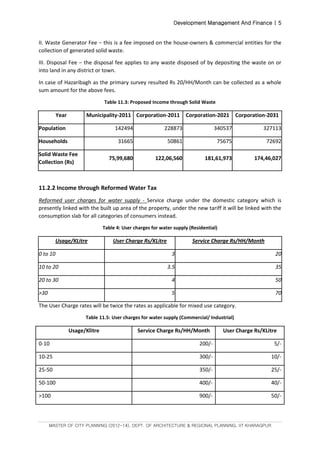
In case of Hazaribagh as the primary survey resulted Rs 20/HH/Month can be collected as a whole
sum amount for the above fees.
Table 11.3: Proposed Income through Solid Waste
Year Municipality-2011 Corporation-2011 Corporation-2021 Corporation-2031
Population 142494 228873 340537 327113
Households 31665 50861 75675 72692
Solid Waste Fee
Collection (Rs)
75,99,680 122,06,560 181,61,973 174,46,027
11.2.2 Income through Reformed Water Tax
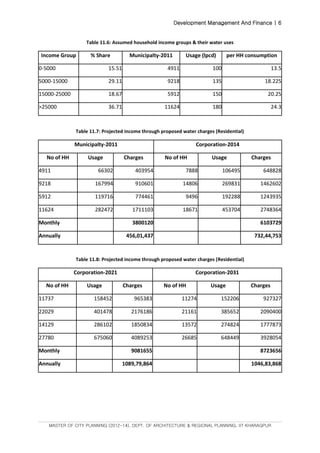
Reformed user charges for water supply - Service charge under the domestic category which is
presently linked with the built up area of the property, under the new tariff it will be linked with the
consumption slab for all categories of consumers instead.
Table 4: User charges for water supply (Residential)
Usage/KLitre User Charge Rs/KLitre Service Charge Rs/HH/Month
0 to 10 3 20
10 to 20 3.5 35
20 to 30 4 50
>30 5 70
The User Charge rates will be twice the rates as applicable for mixed use category.
Table 11.5: User charges for water supply (Commercial/ Industrial)
Usage/Klitre Service Charge Rs/HH/Month User Charge Rs/KLitre
0-10 200/- 5/-
10-25 300/- 10/-
25-50 350/- 25/-
50-100 400/- 40/-
>100 900/- 50/-
Development Management And Finance | 6
MASTER OF CITY PLANNING (2012-14), DEPT. OF ARCHITECTURE & REGIONAL PLANNING, IIT KHARAGPUR
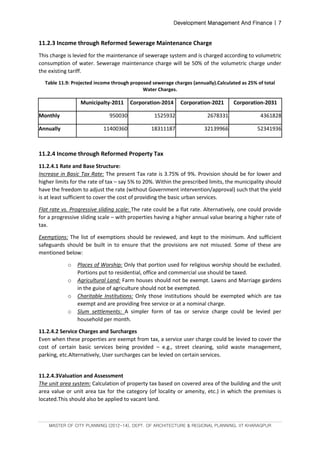
Table 11.6: Assumed household income groups & their water uses
Income Group % Share Municipalty-2011 Usage (lpcd) per HH consumption
0-5000 15.51 4911 100 13.5
5000-15000 29.11 9218 135 18.225
15000-25000 18.67 5912 150 20.25
>25000 36.71 11624 180 24.3
Table 11.7: Projected income through proposed water charges (Residential)
Municipalty-2011 Corporation-2014
No of HH Usage Charges No of HH Usage Charges
4911 66302 403954 7888 106495 648828
9218 167994 910601 14806 269831 1462602
5912 119716 774461 9496 192288 1243935
11624 282472 1711103 18671 453704 2748364
Monthly 3800120 6103729
Annually 456,01,437 732,44,753
Table 11.8: Projected income through proposed water charges (Residential)
Corporation-2021 Corporation-2031
No of HH Usage Charges No of HH Usage Charges
11737 158452 965383 11274 152206 927327
22029 401478 2176186 21161 385652 2090400
14129 286102 1850834 13572 274824 1777873
27780 675060 4089253 26685 648449 3928054
Monthly 9081655 8723656
Annually 1089,79,864 1046,83,868
Development Management And Finance | 7
MASTER OF CITY PLANNING (2012-14), DEPT. OF ARCHITECTURE & REGIONAL PLANNING, IIT KHARAGPUR
11.2.3 Income through Reformed Sewerage Maintenance Charge
This charge is levied for the maintenance of sewerage system and is charged according to volumetric
consumption of water. Sewerage maintenance charge will be 50% of the volumetric charge under
the existing tariff.
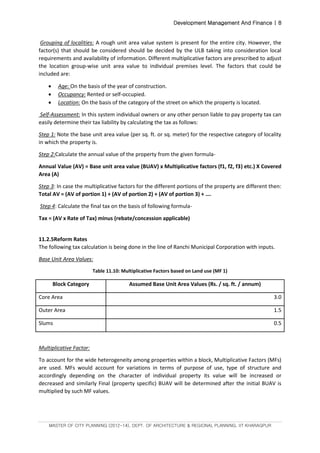
Table 11.9: Projected income through proposed sewerage charges (annually).Calculated as 25% of total
Water Charges.
Municipalty-2011 Corporation-2014 Corporation-2021 Corporation-2031
Monthly 950030 1525932 2678331 4361828
Annually 11400360 18311187 32139966 52341936
11.2.4 Income through Reformed Property Tax
11.2.4.1 Rate and Base Structure:
Increase in Basic Tax Rate: The present Tax rate is 3.75% of 9%. Provision should be for lower and
higher limits for the rate of tax – say 5% to 20%. Within the prescribed limits, the municipality should
have the freedom to adjust the rate (without Government intervention/approval) such that the yield
is at least sufficient to cover the cost of providing the basic urban services.
Flat rate vs. Progressive sliding scale: The rate could be a flat rate. Alternatively, one could provide
for a progressive sliding scale – with properties having a higher annual value bearing a higher rate of
tax.
Exemptions: The list of exemptions should be reviewed, and kept to the minimum. And sufficient
safeguards should be built in to ensure that the provisions are not misused. Some of these are
mentioned below:
o Places of Worship: Only that portion used for religious worship should be excluded.
Portions put to residential, office and commercial use should be taxed.
o Agricultural Land: Farm houses should not be exempt. Lawns and Marriage gardens
in the guise of agriculture should not be exempted.
o Charitable Institutions: Only those institutions should be exempted which are tax
exempt and are providing free service or at a nominal charge.
o Slum settlements: A simpler form of tax or service charge could be levied per
household per month.
11.2.4.2 Service Charges and Surcharges
Even when these properties are exempt from tax, a service user charge could be levied to cover the
cost of certain basic services being provided – e.g., street cleaning, solid waste management,
parking, etc.Alternatively, User surcharges can be levied on certain services.
11.2.4.3Valuation and Assessment
The unit area system: Calculation of property tax based on covered area of the building and the unit
area value or unit area tax for the category (of locality or amenity, etc.) in which the premises is
located.This should also be applied to vacant land.
Development Management And Finance | 8
MASTER OF CITY PLANNING (2012-14), DEPT. OF ARCHITECTURE & REGIONAL PLANNING, IIT KHARAGPUR
Grouping of localities: A rough unit area value system is present for the entire city. However, the
factor(s) that should be considered should be decided by the ULB taking into consideration local
requirements and availability of information. Different multiplicative factors are prescribed to adjust
the location group-wise unit area value to individual premises level. The factors that could be
included are:
 Age: On the basis of the year of construction.
 Occupancy: Rented or self-occupied.
 Location: On the basis of the category of the street on which the property is located.
Self-Assessment: In this system individual owners or any other person liable to pay property tax can
easily determine their tax liability by calculating the tax as follows:
Step 1: Note the base unit area value (per sq. ft. or sq. meter) for the respective category of locality
in which the property is.
Step 2:Calculate the annual value of the property from the given formula-
Annual Value (AV) = Base unit area value (BUAV) x Multiplicative factors (f1, f2, f3) etc.) X Covered
Area (A)
Step 3: In case the multiplicative factors for the different portions of the property are different then:
Total AV = (AV of portion 1) + (AV of portion 2) + (AV of portion 3) + ….
Step 4: Calculate the final tax on the basis of following formula-
Tax = (AV x Rate of Tax) minus (rebate/concession applicable)
11.2.5Reform Rates
The following tax calculation is being done in the line of Ranchi Municipal Corporation with inputs.
Base Unit Area Values:
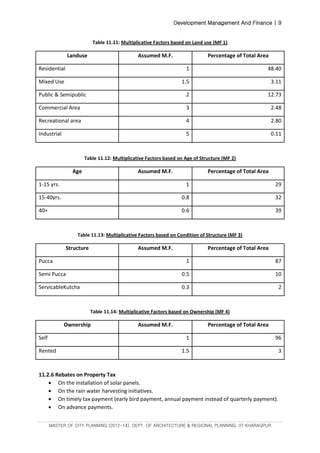
Table 11.10: Multiplicative Factors based on Land use (MF 1)
Block Category Assumed Base Unit Area Values (Rs. / sq. ft. / annum)
Core Area 3.0
Outer Area 1.5
Slums 0.5
Multiplicative Factor:
To account for the wide heterogeneity among properties within a block, Multiplicative Factors (MFs)
are used. MFs would account for variations in terms of purpose of use, type of structure and
accordingly depending on the character of individual property its value will be increased or
decreased and similarly Final (property specific) BUAV will be determined after the initial BUAV is
multiplied by such MF values.
Development Management And Finance | 9
MASTER OF CITY PLANNING (2012-14), DEPT. OF ARCHITECTURE & REGIONAL PLANNING, IIT KHARAGPUR
Table 11.11: Multiplicative Factors based on Land use (MF 1)
Landuse Assumed M.F. Percentage of Total Area
Residential 1 48.40
Mixed Use 1.5 3.11
Public & Semipublic 2 12.73
Commercial Area 3 2.48
Recreational area 4 2.80
Industrial 5 0.11
Table 11.12: Multiplicative Factors based on Age of Structure (MF 2)
Age Assumed M.F. Percentage of Total Area
1-15 yrs. 1 29
15-40yrs. 0.8 32
40+ 0.6 39
Table 11.13: Multiplicative Factors based on Condition of Structure (MF 3)
Structure Assumed M.F. Percentage of Total Area
Pucca 1 87
Semi Pucca 0.5 10
ServicableKutcha 0.3 2
Table 11.14: Multiplicative Factors based on Ownership (MF 4)
Ownership Assumed M.F. Percentage of Total Area
Self 1 96
Rented 1.5 3
11.2.6 Rebates on Property Tax
 On the installation of solar panels.
 On the rain water harvesting initiatives.
 On timely tax payment (early bird payment, annual payment instead of quarterly payment).
 On advance payments.
Development Management And Finance | 10
MASTER OF CITY PLANNING (2012-14), DEPT. OF ARCHITECTURE & REGIONAL PLANNING, IIT KHARAGPUR
11.2.7 Penalties on Property Tax
 On failing to pay the tax.
 On illegal construction.
 On illegal installation without sanction.
 On encroachments.
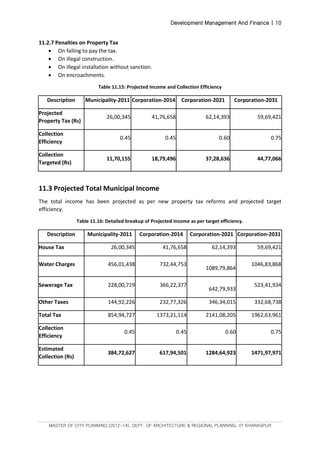
Table 11.15: Projected Income and Collection Efficiency
Description Municipality-2011 Corporation-2014 Corporation-2021 Corporation-2031
Projected
Property Tax (Rs)
26,00,345 41,76,658 62,14,393 59,69,421
Collection
Efficiency
0.45 0.45 0.60 0.75
Collection
Targeted (Rs)
11,70,155 18,79,496 37,28,636 44,77,066
11.3 Projected Total Municipal Income
The total income has been projected as per new property tax reforms and projected target
efficiency.
Table 11.16: Detailed breakup of Projected Income as per target efficiency.
Description Municipality-2011 Corporation-2014 Corporation-2021 Corporation-2031
House Tax 26,00,345 41,76,658 62,14,393 59,69,421
Water Charges 456,01,438 732,44,753
1089,79,864
1046,83,868
Sewerage Tax 228,00,719 366,22,377
642,79,933
523,41,934
Other Taxes 144,92,226 232,77,326 346,34,015 332,68,738
Total Tax 854,94,727 1373,21,114 2141,08,205 1962,63,961
Collection
Efficiency
0.45 0.45 0.60 0.75
Estimated
Collection (Rs)
384,72,627 617,94,501 1284,64,923 1471,97,971
Development Management And Finance | 11
MASTER OF CITY PLANNING (2012-14), DEPT. OF ARCHITECTURE & REGIONAL PLANNING, IIT KHARAGPUR
11.4 Non Tax Revenue
The tax revenue sources are very limited. Non tax revenue forms an essential part of Municipality’s
income. Various Non-tax revenues can be collected in Hazaribagh from following sources:
11.4.1 Revenues from use of the municipal property
 Revenues from parking of vehicles
 Revenues from the sale of Municipal property
 Revenues from use of the land
11.4.2 Revenues from sales of services
 Inspection of the environment
 Revenue from building permits
 Payments for the change in land usage
 Issuance of construction licenses
 Demolition license
11.4.3 Revenues from administrative tax
 Fees from the registration of vehicles
 Issuance of driving licenses
 Tender participations
 Road tax
 Certificate of the registrar (birth, marriage, death etc.)
 Tax for request forms.
11.4.4 Citizen Participation (Health and Education)
 Revenue from health services
 Revenues from secondary Education
11.5 Upcoming Projects
11.5.1 Physical Infrastructure
11.5.1.1 Project: Water Supply
Project Detail: Water treatment plant of 65 MLD.
10 Overhead reservoirs.
Estimated Total Cost = 260 Cr
For the project the loan can be taken either from ADB at existing rates for a period of 20 years and
an additional 5 years of grace period, alternatively with association exploring JUSCO for the BOT
mechanism.
Development Management And Finance | 12
MASTER OF CITY PLANNING (2012-14), DEPT. OF ARCHITECTURE & REGIONAL PLANNING, IIT KHARAGPUR
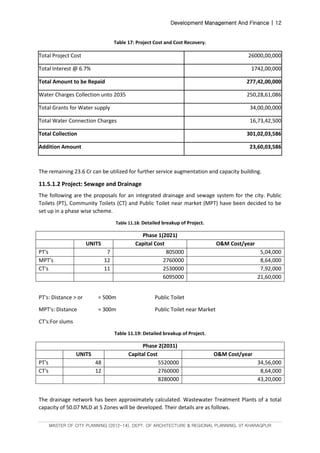
Table 17: Project Cost and Cost Recovery.
Total Project Cost 26000,00,000
Total Interest @ 6.7% 1742,00,000
Total Amount to be Repaid 277,42,00,000
Water Charges Collection unto 2035 250,28,61,086
Total Grants for Water supply 34,00,00,000
Total Water Connection Charges 16,73,42,500
Total Collection 301,02,03,586
Addition Amount 23,60,03,586
The remaining 23.6 Cr can be utilized for further service augmentation and capacity building.
11.5.1.2 Project: Sewage and Drainage
The following are the proposals for an integrated drainage and sewage system for the city. Public
Toilets (PT), Community Toilets (CT) and Public Toilet near market (MPT) have been decided to be
set up in a phase wise scheme.
Table 11.18: Detailed breakup of Project.
Phase 1(2021)
UNITS Capital Cost O&M Cost/year
PT's 7 805000 5,04,000
MPT's 12 2760000 8,64,000
CT's 11 2530000 7,92,000
6095000 21,60,000
PT's: Distance > or = 500m Public Toilet
MPT's: Distance = 300m Public Toilet near Market
CT's:For slums
Table 11.19: Detailed breakup of Project.
Phase 2(2031)
UNITS Capital Cost O&M Cost/year
PT's 48 5520000 34,56,000
CT's 12 2760000 8,64,000
8280000 43,20,000
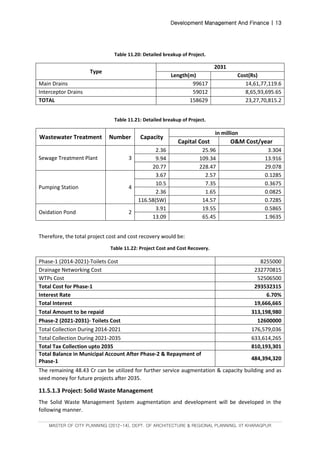
The drainage network has been approximately calculated. Wastewater Treatment Plants of a total
capacity of 50.07 MLD at 5 Zones will be developed. Their details are as follows.
Development Management And Finance | 13
MASTER OF CITY PLANNING (2012-14), DEPT. OF ARCHITECTURE & REGIONAL PLANNING, IIT KHARAGPUR
Table 11.20: Detailed breakup of Project.
Type
2031
Length(m) Cost(Rs)
Main Drains 99617 14,61,77,119.6
Interceptor Drains 59012 8,65,93,695.65
TOTAL 158629 23,27,70,815.2
Table 11.21: Detailed breakup of Project.
Wastewater Treatment Number Capacity
in million
Capital Cost O&M Cost/year
Sewage Treatment Plant 3
2.36 25.96 3.304
9.94 109.34 13.916
20.77 228.47 29.078
Pumping Station 4
3.67 2.57 0.1285
10.5 7.35 0.3675
2.36 1.65 0.0825
116.58(SW) 14.57 0.7285
Oxidation Pond 2
3.91 19.55 0.5865
13.09 65.45 1.9635
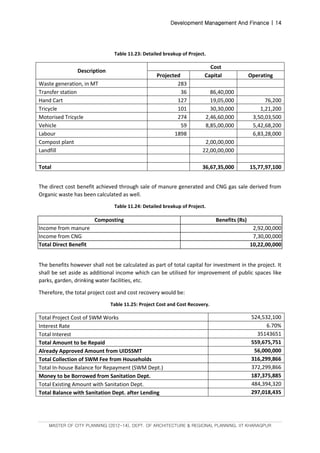
Therefore, the total project cost and cost recovery would be:
Table 11.22: Project Cost and Cost Recovery.
Phase-1 (2014-2021)-Toilets Cost 8255000
Drainage Networking Cost 232770815
WTPs Cost 52506500
Total Cost for Phase-1 293532315
Interest Rate 6.70%
Total Interest 19,666,665
Total Amount to be repaid 313,198,980
Phase-2 (2021-2031)- Toilets Cost 12600000
Total Collection During 2014-2021 176,579,036
Total Collection During 2021-2035 633,614,265
Total Tax Collection upto 2035 810,193,301
Total Balance in Municipal Account After Phase-2 & Repayment of
Phase-1 484,394,320
The remaining 48.43 Cr can be utilized for further service augmentation & capacity building and as
seed money for future projects after 2035.
11.5.1.3 Project: Solid Waste Management
The Solid Waste Management System augmentation and development will be developed in the
following manner.
Development Management And Finance | 14
MASTER OF CITY PLANNING (2012-14), DEPT. OF ARCHITECTURE & REGIONAL PLANNING, IIT KHARAGPUR
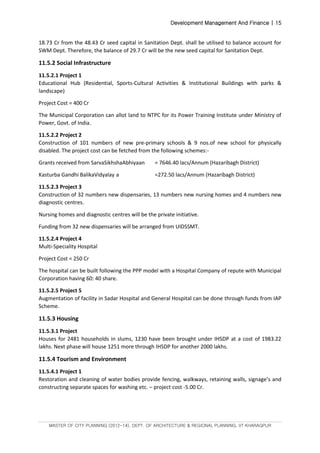
Table 11.23: Detailed breakup of Project.
Description
Cost
Projected Capital Operating
Waste generation, in MT 283
Transfer station 36 86,40,000
Hand Cart 127 19,05,000 76,200
Tricycle 101 30,30,000 1,21,200
Motorised Tricycle 274 2,46,60,000 3,50,03,500
Vehicle 59 8,85,00,000 5,42,68,200
Labour 1898 6,83,28,000
Compost plant 2,00,00,000
Landfill 22,00,00,000
Total 36,67,35,000 15,77,97,100
The direct cost benefit achieved through sale of manure generated and CNG gas sale derived from
Organic waste has been calculated as well.
Table 11.24: Detailed breakup of Project.
The benefits however shall not be calculated as part of total capital for investment in the project. It
shall be set aside as additional income which can be utilised for improvement of public spaces like
parks, garden, drinking water facilities, etc.
Therefore, the total project cost and cost recovery would be:
Table 11.25: Project Cost and Cost Recovery.
Total Project Cost of SWM Works 524,532,100
Interest Rate 6.70%
Total Interest 35143651
Total Amount to be Repaid 559,675,751
Already Approved Amount from UIDSSMT 56,000,000
Total Collection of SWM Fee from Households 316,299,866
Total In-house Balance for Repayment (SWM Dept.) 372,299,866
Money to be Borrowed from Sanitation Dept. 187,375,885
Total Existing Amount with Sanitation Dept. 484,394,320
Total Balance with Sanitation Dept. after Lending 297,018,435
Composting Benefits (Rs)
Income from manure 2,92,00,000
Income from CNG 7,30,00,000
Total Direct Benefit 10,22,00,000
Development Management And Finance | 15
MASTER OF CITY PLANNING (2012-14), DEPT. OF ARCHITECTURE & REGIONAL PLANNING, IIT KHARAGPUR
18.73 Cr from the 48.43 Cr seed capital in Sanitation Dept. shall be utilised to balance account for
SWM Dept. Therefore, the balance of 29.7 Cr will be the new seed capital for Sanitation Dept.
11.5.2 Social Infrastructure
11.5.2.1 Project 1
Educational Hub (Residential, Sports-Cultural Activities & Institutional Buildings with parks &
landscape)
Project Cost = 400 Cr
The Municipal Corporation can allot land to NTPC for its Power Training Institute under Ministry of
Power, Govt. of India.
11.5.2.2 Project 2
Construction of 101 numbers of new pre-primary schools & 9 nos.of new school for physically
disabled. The project cost can be fetched from the following schemes:-
Grants received from SarvaSikhshaAbhiyaan = 7646.40 lacs/Annum (Hazaribagh District)
Kasturba Gandhi BalikaVidyalay a =272.50 lacs/Annum (Hazaribagh District)
11.5.2.3 Project 3
Construction of 32 numbers new dispensaries, 13 numbers new nursing homes and 4 numbers new
diagnostic centres.
Nursing homes and diagnostic centres will be the private initiative.
Funding from 32 new dispensaries will be arranged from UIDSSMT.
11.5.2.4 Project 4
Multi-Speciality Hospital
Project Cost = 250 Cr
The hospital can be built following the PPP model with a Hospital Company of repute with Municipal
Corporation having 60: 40 share.
11.5.2.5 Project 5
Augmentation of facility in Sadar Hospital and General Hospital can be done through funds from IAP
Scheme.
11.5.3 Housing
11.5.3.1 Project
Houses for 2481 households in slums, 1230 have been brought under IHSDP at a cost of 1983.22
lakhs. Next phase will house 1251 more through IHSDP for another 2000 lakhs.
11.5.4 Tourism and Environment
11.5.4.1 Project 1
Restoration and cleaning of water bodies provide fencing, walkways, retaining walls, signage’s and
constructing separate spaces for washing etc. – project cost -5.00 Cr.
Development Management And Finance | 16
MASTER OF CITY PLANNING (2012-14), DEPT. OF ARCHITECTURE & REGIONAL PLANNING, IIT KHARAGPUR
11.5.4.2 Project 2
Road side plantation, green buffers, Urban Landscape, Signage’s and conducting public awareness
programs. Project cost -2.00 Cr.
11.5.4.3 Project 3
Infrastructure development in tourism spots - project cost -5.00 Cr.
11.5.4.4 Project 4
Recreational spaces, parks and open areas development - project cost -8.00 Cr.
Total Project Cost = 20 Cr.
This can be developed under CSR of large companies that are setting up industries like NTPC,
Reliance, GVK, CCL, etc. whose projects will benefit from the resources of Hazaribagh.
11.5.5 Transport
11.5.5.1 Project 1
Parking Space of 26200 Sqmt.
Project Cost = 1.27 Cr
Project shall be developed and operated under contract with agency through bid.
11.5.5.2 Project 2
Construction of 21 km long new cycle track.
Project Cost = 1.08 Cr
11.5.5.3 Project 3
Construction of 16 km long footpaths
Project Cost = 2.44 Cr
11.5.5.4 Project 4
Construction of various roads of approximately 21 km of total length.
Project Cost = 22.82 Cr
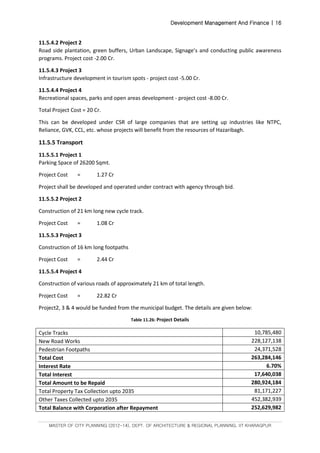
Project2, 3 & 4 would be funded from the municipal budget. The details are given below:
Table 11.26: Project Details
Cycle Tracks 10,785,480
New Road Works 228,127,138
Pedestrian Footpaths 24,371,528
Total Cost 263,284,146
Interest Rate 6.70%
Total Interest 17,640,038
Total Amount to be Repaid 280,924,184
Total Property Tax Collection upto 2035 81,171,227
Other Taxes Collected upto 2035 452,382,939
Total Balance with Corporation after Repayment 252,629,982
Development Management And Finance | 17
MASTER OF CITY PLANNING (2012-14), DEPT. OF ARCHITECTURE & REGIONAL PLANNING, IIT KHARAGPUR
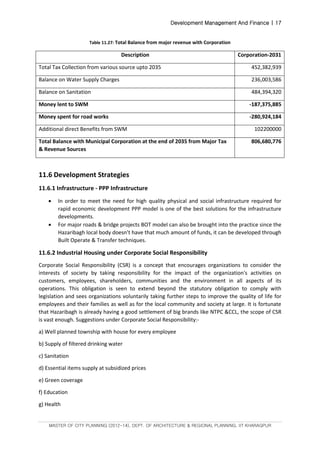
Table 11.27: Total Balance from major revenue with Corporation
Description Corporation-2031
Total Tax Collection from various source upto 2035 452,382,939
Balance on Water Supply Charges 236,003,586
Balance on Sanitation 484,394,320
Money lent to SWM -187,375,885
Money spent for road works -280,924,184
Additional direct Benefits from SWM 102200000
Total Balance with Municipal Corporation at the end of 2035 from Major Tax
& Revenue Sources
806,680,776
11.6 Development Strategies
11.6.1 Infrastructure - PPP Infrastructure
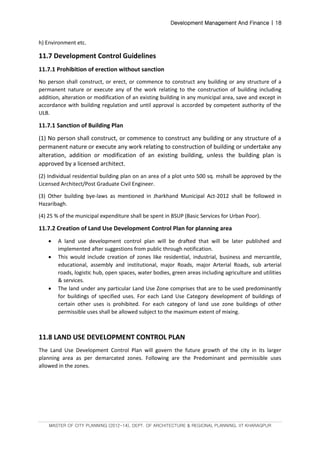
 In order to meet the need for high quality physical and social infrastructure required for
rapid economic development PPP model is one of the best solutions for the infrastructure
developments.
 For major roads & bridge projects BOT model can also be brought into the practice since the
Hazaribagh local body doesn’t have that much amount of funds, it can be developed through
Built Operate & Transfer techniques.
11.6.2 Industrial Housing under Corporate Social Responsibility
Corporate Social Responsibility (CSR) is a concept that encourages organizations to consider the
interests of society by taking responsibility for the impact of the organization's activities on
customers, employees, shareholders, communities and the environment in all aspects of its
operations. This obligation is seen to extend beyond the statutory obligation to comply with
legislation and sees organizations voluntarily taking further steps to improve the quality of life for
employees and their families as well as for the local community and society at large. It is fortunate
that Hazaribagh is already having a good settlement of big brands like NTPC &CCL, the scope of CSR
is vast enough. Suggestions under Corporate Social Responsibility:-
a) Well planned township with house for every employee
b) Supply of filtered drinking water
c) Sanitation
d) Essential items supply at subsidized prices
e) Green coverage
f) Education
g) Health
Development Management And Finance | 18
MASTER OF CITY PLANNING (2012-14), DEPT. OF ARCHITECTURE & REGIONAL PLANNING, IIT KHARAGPUR
h) Environment etc.
11.7 Development Control Guidelines
11.7.1 Prohibition of erection without sanction
No person shall construct, or erect, or commence to construct any building or any structure of a
permanent nature or execute any of the work relating to the construction of building including
addition, alteration or modification of an existing building in any municipal area, save and except in
accordance with building regulation and until approval is accorded by competent authority of the
ULB.
11.7.1 Sanction of Building Plan
(1) No person shall construct, or commence to construct any building or any structure of a
permanent nature or execute any work relating to construction of building or undertake any
alteration, addition or modification of an existing building, unless the building plan is
approved by a licensed architect.
(2) Individual residential building plan on an area of a plot unto 500 sq. mshall be approved by the
Licensed Architect/Post Graduate Civil Engineer.
(3) Other building bye-laws as mentioned in Jharkhand Municipal Act-2012 shall be followed in
Hazaribagh.
(4) 25 % of the municipal expenditure shall be spent in BSUP (Basic Services for Urban Poor).
11.7.2 Creation of Land Use Development Control Plan for planning area
 A land use development control plan will be drafted that will be later published and
implemented after suggestions from public through notification.
 This would include creation of zones like residential, industrial, business and mercantile,
educational, assembly and institutional, major Roads, major Arterial Roads, sub arterial
roads, logistic hub, open spaces, water bodies, green areas including agriculture and utilities
& services.
 The land under any particular Land Use Zone comprises that are to be used predominantly
for buildings of specified uses. For each Land Use Category development of buildings of
certain other uses is prohibited. For each category of land use zone buildings of other
permissible uses shall be allowed subject to the maximum extent of mixing.
11.8 LAND USE DEVELOPMENT CONTROL PLAN
The Land Use Development Control Plan will govern the future growth of the city in its larger
planning area as per demarcated zones. Following are the Predominant and permissible uses
allowed in the zones.
Development Management And Finance | 19
MASTER OF CITY PLANNING (2012-14), DEPT. OF ARCHITECTURE & REGIONAL PLANNING, IIT KHARAGPUR
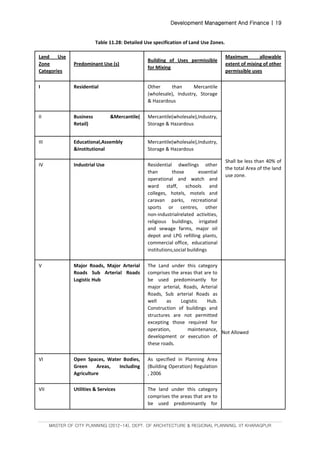
Table 11.28: Detailed Use specification of Land Use Zones.
Land Use
Zone
Categories
Predominant Use (s)
Building of Uses permissible
for Mixing
Maximum allowable
extent of mixing of other
permissible uses
I Residential Other than Mercantile
(wholesale), Industry, Storage
& Hazardous
Shall be less than 40% of
the total Area of the land
use zone.
II Business &Mercantile(
Retail)
Mercantile(wholesale),Industry,
Storage & Hazardous
III Educational,Assembly
&Institutional
Mercantile(wholesale),Industry,
Storage & Hazardous
IV Industrial Use Residential dwellings other
than those essential
operational and watch and
ward staff, schools and
colleges, hotels, motels and
caravan parks, recreational
sports or centres, other
non‐industrialrelated activities,
religious buildings, irrigated
and sewage farms, major oil
depot and LPG refilling plants,
commercial office, educational
institutions,social buildings
V Major Roads, Major Arterial
Roads Sub Arterial Roads
Logistic Hub
The Land under this category
comprises the areas that are to
be used predominantly for
major arterial, Roads, Arterial
Roads, Sub arterial Roads as
well as Logistic Hub.
Construction of buildings and
structures are not permitted
excepting those required for
operation, maintenance,
development or execution of
these roads.
Not Allowed
VI Open Spaces, Water Bodies,
Green Areas, Including
Agriculture
As specified in Planning Area
(Building Operation) Regulation
, 2006
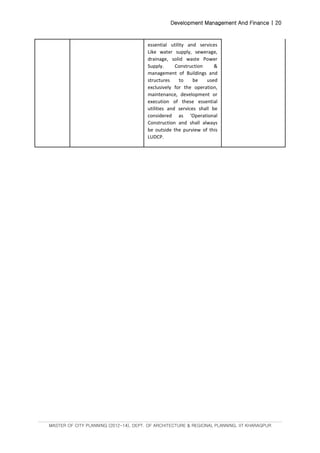
VII Utilities & Services The land under this category
comprises the areas that are to
be used predominantly for
Development Management And Finance | 20
MASTER OF CITY PLANNING (2012-14), DEPT. OF ARCHITECTURE & REGIONAL PLANNING, IIT KHARAGPUR
essential utility and services
Like water supply, sewerage,
drainage, solid waste Power
Supply. Construction &
management of Buildings and
structures to be used
exclusively for the operation,
maintenance, development or
execution of these essential
utilities and services shall be
considered as ‘Operational
Construction and shall always
be outside the purview of this
LUDCP.

Chapter 11_DMF_Proposals

  • 1.
    Development Management AndFinance | 1 MASTER OF CITY PLANNING (2012-14), DEPT. OF ARCHITECTURE & REGIONAL PLANNING, IIT KHARAGPUR 11. DEVELOPMENT MANAGEMENT AND FINANCE 11.1 Municipal Boundary 11.1.1 New Municipal Boundary Following the Jharkhand Municipal Act, the new Municipal Boundary as delineated after consultation by all groups and study, can be upgraded from Municipal Council to Municipal Corporation. The Municipal Corporation Limit will comprise of the following blocks and has been categorised into new Wards as shown below. Figure 11.1: Map showing New Municipal Boundary New Wards
  • 2.
    Development Management AndFinance | 2 MASTER OF CITY PLANNING (2012-14), DEPT. OF ARCHITECTURE & REGIONAL PLANNING, IIT KHARAGPUR The change in municipal limits is increasing the current population from 142494 to 228873 along with addition of 19 new wards. Both the Planning Area and Municipal Corporation Area will be under the Development Guidelines. This is to ensure that no ad- hoc or organic growth happens within the earmarked areas and result in unplanned growth. Table 11.1: Projected income through proposed water charges (Residential) New Ward Ward No Jabra + Lakhe 33 Hurhuru + Chano No1 34 Masipirhi 35 Khaprion 36 Sirsi No1 + Sirsi No2 37 Kud + Kud No 2 38 Damudih + Rewali 39 Masratu 40 Kadma No 2 41 KadmaKhurd + Baliand + KasturiKhap 42 Pelawal Part-1 43 Okani No 2 44 Pelawal Part-2 45 Marai Kalan Part-1 46 Marai Kalan Part-2 47 MandaiKhurd 48 Kolghati No 2 + Marai + Kolghati 49 Merawal + Nawdiha 50 Sendur + Nawdiha 51
  • 3.
    Development Management AndFinance | 3 MASTER OF CITY PLANNING (2012-14), DEPT. OF ARCHITECTURE & REGIONAL PLANNING, IIT KHARAGPUR 11.1.2 Organization Structure In Hazaribagh, there is acute shortage of sub-ordinate staff. This could be filled up with the proper municipal cadre is created and the personnel are selected for the suitable positions. Following is the proposed reforms in the municipal organizational structure based on the future demand of the employees & services. Figure 11.2: Organisation Chart 11.1.3 Major Schemes & Grants in New Municipal Area The new municipal area does not gain in BRGF, MLA or MPLAD Fund with increase in municipal limit. However, with up gradation from Municipal Council to Municipal Corporation will increase scheme base grants as well as new schemes in its ambit. Table 11.2: Central and State Grants Name of Scheme Description Amount Backward Region Grant Fund (BFRG) 11% of the funds shall be used for capacity building and rest shall be utilized for local infrastructure development 10 Crores/Annum ValmikiAmbedkarAwasYojna (VAMBAY) 20% of the total allocation under this VAMBAY will be used for infrastructure @ 50% as grant from GOI and 50% as loan from HUDCO. The State Govt/Local Bodies of course will free to supplement with their own grant or subsidy as the case may be. Loan Pattern
  • 4.
    Development Management AndFinance | 4 MASTER OF CITY PLANNING (2012-14), DEPT. OF ARCHITECTURE & REGIONAL PLANNING, IIT KHARAGPUR Integrated Housing And Slums Development Program (IHSDP) To develop the slum housing conditions in urban areas 20 Crores Approved (Increases with the projects) CM Jalnidhi To improve the water supply 1 Crore/ Annum MukhyaMantriVikasYojna To develop various projects related to public welfare 1 Crore/ Annum MP LAD To develop various projects related to public welfare 2 Crores/ Annum MLA LAD To develop various projects related to public welfare 4 Crores/Annum MLA LokJalnidhi To improve the water supply 1 Crore/ Annum National Rural Livelihood Mission (NRLM) Various projects including construction, infrastructure, etc. 2.5 Crores Approved (Increases with the projects) Integrated Action Plan (IAP) To improve various services in tribal areas 30 Crores (Increases with the project) Mahatma Gandhi National Rural Employment Guarantee (MNREGA) To improve the employment in the rural & urban areas 25 Crores/Annum (Increases with the projects) SwarnJayantiSwarojgarYojna (SJSRY) To improve employment in BPL youths, the individual project cost shall not be exceed Rs 2 lacs Loan Pattern Urban Infrastructure Schemes for Small & Medium Towns (UIDSSMT) To improve solid waste management & other infrastructure services in urban areas 5.6 Crores Approved (Increases with the projects) 11.2 Municipal Income 11.2.1 Income throughReformed Solid Waste Management Hazaribagh is already having a huge amount of generated solid waste. A solid waste management fee can be charged on households & commercial entities as well as hazardous waste fee can be charged on upcoming and existing industries as an innovative way to increase the resources as well as to check environmental pollution. The entire fee imposed under this programme may contain the following components: I. Environmental Fee − this is a fee on industrial groups that use, generate, or store hazardous materials or conduct activities related to those materials.
  • 5.
    Development Management AndFinance | 5 MASTER OF CITY PLANNING (2012-14), DEPT. OF ARCHITECTURE & REGIONAL PLANNING, IIT KHARAGPUR II. Waste Generator Fee − this is a fee imposed on the house-owners & commercial entities for the collection of generated solid waste. III. Disposal Fee − the disposal fee applies to any waste disposed of by depositing the waste on or into land in any district or town. In case of Hazaribagh as the primary survey resulted Rs 20/HH/Month can be collected as a whole sum amount for the above fees. Table 11.3: Proposed Income through Solid Waste Year Municipality-2011 Corporation-2011 Corporation-2021 Corporation-2031 Population 142494 228873 340537 327113 Households 31665 50861 75675 72692 Solid Waste Fee Collection (Rs) 75,99,680 122,06,560 181,61,973 174,46,027 11.2.2 Income through Reformed Water Tax Reformed user charges for water supply - Service charge under the domestic category which is presently linked with the built up area of the property, under the new tariff it will be linked with the consumption slab for all categories of consumers instead. Table 4: User charges for water supply (Residential) Usage/KLitre User Charge Rs/KLitre Service Charge Rs/HH/Month 0 to 10 3 20 10 to 20 3.5 35 20 to 30 4 50 >30 5 70 The User Charge rates will be twice the rates as applicable for mixed use category. Table 11.5: User charges for water supply (Commercial/ Industrial) Usage/Klitre Service Charge Rs/HH/Month User Charge Rs/KLitre 0-10 200/- 5/- 10-25 300/- 10/- 25-50 350/- 25/- 50-100 400/- 40/- >100 900/- 50/-
  • 6.
    Development Management AndFinance | 6 MASTER OF CITY PLANNING (2012-14), DEPT. OF ARCHITECTURE & REGIONAL PLANNING, IIT KHARAGPUR Table 11.6: Assumed household income groups & their water uses Income Group % Share Municipalty-2011 Usage (lpcd) per HH consumption 0-5000 15.51 4911 100 13.5 5000-15000 29.11 9218 135 18.225 15000-25000 18.67 5912 150 20.25 >25000 36.71 11624 180 24.3 Table 11.7: Projected income through proposed water charges (Residential) Municipalty-2011 Corporation-2014 No of HH Usage Charges No of HH Usage Charges 4911 66302 403954 7888 106495 648828 9218 167994 910601 14806 269831 1462602 5912 119716 774461 9496 192288 1243935 11624 282472 1711103 18671 453704 2748364 Monthly 3800120 6103729 Annually 456,01,437 732,44,753 Table 11.8: Projected income through proposed water charges (Residential) Corporation-2021 Corporation-2031 No of HH Usage Charges No of HH Usage Charges 11737 158452 965383 11274 152206 927327 22029 401478 2176186 21161 385652 2090400 14129 286102 1850834 13572 274824 1777873 27780 675060 4089253 26685 648449 3928054 Monthly 9081655 8723656 Annually 1089,79,864 1046,83,868
  • 7.
    Development Management AndFinance | 7 MASTER OF CITY PLANNING (2012-14), DEPT. OF ARCHITECTURE & REGIONAL PLANNING, IIT KHARAGPUR 11.2.3 Income through Reformed Sewerage Maintenance Charge This charge is levied for the maintenance of sewerage system and is charged according to volumetric consumption of water. Sewerage maintenance charge will be 50% of the volumetric charge under the existing tariff. Table 11.9: Projected income through proposed sewerage charges (annually).Calculated as 25% of total Water Charges. Municipalty-2011 Corporation-2014 Corporation-2021 Corporation-2031 Monthly 950030 1525932 2678331 4361828 Annually 11400360 18311187 32139966 52341936 11.2.4 Income through Reformed Property Tax 11.2.4.1 Rate and Base Structure: Increase in Basic Tax Rate: The present Tax rate is 3.75% of 9%. Provision should be for lower and higher limits for the rate of tax – say 5% to 20%. Within the prescribed limits, the municipality should have the freedom to adjust the rate (without Government intervention/approval) such that the yield is at least sufficient to cover the cost of providing the basic urban services. Flat rate vs. Progressive sliding scale: The rate could be a flat rate. Alternatively, one could provide for a progressive sliding scale – with properties having a higher annual value bearing a higher rate of tax. Exemptions: The list of exemptions should be reviewed, and kept to the minimum. And sufficient safeguards should be built in to ensure that the provisions are not misused. Some of these are mentioned below: o Places of Worship: Only that portion used for religious worship should be excluded. Portions put to residential, office and commercial use should be taxed. o Agricultural Land: Farm houses should not be exempt. Lawns and Marriage gardens in the guise of agriculture should not be exempted. o Charitable Institutions: Only those institutions should be exempted which are tax exempt and are providing free service or at a nominal charge. o Slum settlements: A simpler form of tax or service charge could be levied per household per month. 11.2.4.2 Service Charges and Surcharges Even when these properties are exempt from tax, a service user charge could be levied to cover the cost of certain basic services being provided – e.g., street cleaning, solid waste management, parking, etc.Alternatively, User surcharges can be levied on certain services. 11.2.4.3Valuation and Assessment The unit area system: Calculation of property tax based on covered area of the building and the unit area value or unit area tax for the category (of locality or amenity, etc.) in which the premises is located.This should also be applied to vacant land.
  • 8.
    Development Management AndFinance | 8 MASTER OF CITY PLANNING (2012-14), DEPT. OF ARCHITECTURE & REGIONAL PLANNING, IIT KHARAGPUR Grouping of localities: A rough unit area value system is present for the entire city. However, the factor(s) that should be considered should be decided by the ULB taking into consideration local requirements and availability of information. Different multiplicative factors are prescribed to adjust the location group-wise unit area value to individual premises level. The factors that could be included are:  Age: On the basis of the year of construction.  Occupancy: Rented or self-occupied.  Location: On the basis of the category of the street on which the property is located. Self-Assessment: In this system individual owners or any other person liable to pay property tax can easily determine their tax liability by calculating the tax as follows: Step 1: Note the base unit area value (per sq. ft. or sq. meter) for the respective category of locality in which the property is. Step 2:Calculate the annual value of the property from the given formula- Annual Value (AV) = Base unit area value (BUAV) x Multiplicative factors (f1, f2, f3) etc.) X Covered Area (A) Step 3: In case the multiplicative factors for the different portions of the property are different then: Total AV = (AV of portion 1) + (AV of portion 2) + (AV of portion 3) + …. Step 4: Calculate the final tax on the basis of following formula- Tax = (AV x Rate of Tax) minus (rebate/concession applicable) 11.2.5Reform Rates The following tax calculation is being done in the line of Ranchi Municipal Corporation with inputs. Base Unit Area Values: Table 11.10: Multiplicative Factors based on Land use (MF 1) Block Category Assumed Base Unit Area Values (Rs. / sq. ft. / annum) Core Area 3.0 Outer Area 1.5 Slums 0.5 Multiplicative Factor: To account for the wide heterogeneity among properties within a block, Multiplicative Factors (MFs) are used. MFs would account for variations in terms of purpose of use, type of structure and accordingly depending on the character of individual property its value will be increased or decreased and similarly Final (property specific) BUAV will be determined after the initial BUAV is multiplied by such MF values.
  • 9.
    Development Management AndFinance | 9 MASTER OF CITY PLANNING (2012-14), DEPT. OF ARCHITECTURE & REGIONAL PLANNING, IIT KHARAGPUR Table 11.11: Multiplicative Factors based on Land use (MF 1) Landuse Assumed M.F. Percentage of Total Area Residential 1 48.40 Mixed Use 1.5 3.11 Public & Semipublic 2 12.73 Commercial Area 3 2.48 Recreational area 4 2.80 Industrial 5 0.11 Table 11.12: Multiplicative Factors based on Age of Structure (MF 2) Age Assumed M.F. Percentage of Total Area 1-15 yrs. 1 29 15-40yrs. 0.8 32 40+ 0.6 39 Table 11.13: Multiplicative Factors based on Condition of Structure (MF 3) Structure Assumed M.F. Percentage of Total Area Pucca 1 87 Semi Pucca 0.5 10 ServicableKutcha 0.3 2 Table 11.14: Multiplicative Factors based on Ownership (MF 4) Ownership Assumed M.F. Percentage of Total Area Self 1 96 Rented 1.5 3 11.2.6 Rebates on Property Tax  On the installation of solar panels.  On the rain water harvesting initiatives.  On timely tax payment (early bird payment, annual payment instead of quarterly payment).  On advance payments.
  • 10.
    Development Management AndFinance | 10 MASTER OF CITY PLANNING (2012-14), DEPT. OF ARCHITECTURE & REGIONAL PLANNING, IIT KHARAGPUR 11.2.7 Penalties on Property Tax  On failing to pay the tax.  On illegal construction.  On illegal installation without sanction.  On encroachments. Table 11.15: Projected Income and Collection Efficiency Description Municipality-2011 Corporation-2014 Corporation-2021 Corporation-2031 Projected Property Tax (Rs) 26,00,345 41,76,658 62,14,393 59,69,421 Collection Efficiency 0.45 0.45 0.60 0.75 Collection Targeted (Rs) 11,70,155 18,79,496 37,28,636 44,77,066 11.3 Projected Total Municipal Income The total income has been projected as per new property tax reforms and projected target efficiency. Table 11.16: Detailed breakup of Projected Income as per target efficiency. Description Municipality-2011 Corporation-2014 Corporation-2021 Corporation-2031 House Tax 26,00,345 41,76,658 62,14,393 59,69,421 Water Charges 456,01,438 732,44,753 1089,79,864 1046,83,868 Sewerage Tax 228,00,719 366,22,377 642,79,933 523,41,934 Other Taxes 144,92,226 232,77,326 346,34,015 332,68,738 Total Tax 854,94,727 1373,21,114 2141,08,205 1962,63,961 Collection Efficiency 0.45 0.45 0.60 0.75 Estimated Collection (Rs) 384,72,627 617,94,501 1284,64,923 1471,97,971
  • 11.
    Development Management AndFinance | 11 MASTER OF CITY PLANNING (2012-14), DEPT. OF ARCHITECTURE & REGIONAL PLANNING, IIT KHARAGPUR 11.4 Non Tax Revenue The tax revenue sources are very limited. Non tax revenue forms an essential part of Municipality’s income. Various Non-tax revenues can be collected in Hazaribagh from following sources: 11.4.1 Revenues from use of the municipal property  Revenues from parking of vehicles  Revenues from the sale of Municipal property  Revenues from use of the land 11.4.2 Revenues from sales of services  Inspection of the environment  Revenue from building permits  Payments for the change in land usage  Issuance of construction licenses  Demolition license 11.4.3 Revenues from administrative tax  Fees from the registration of vehicles  Issuance of driving licenses  Tender participations  Road tax  Certificate of the registrar (birth, marriage, death etc.)  Tax for request forms. 11.4.4 Citizen Participation (Health and Education)  Revenue from health services  Revenues from secondary Education 11.5 Upcoming Projects 11.5.1 Physical Infrastructure 11.5.1.1 Project: Water Supply Project Detail: Water treatment plant of 65 MLD. 10 Overhead reservoirs. Estimated Total Cost = 260 Cr For the project the loan can be taken either from ADB at existing rates for a period of 20 years and an additional 5 years of grace period, alternatively with association exploring JUSCO for the BOT mechanism.
  • 12.
    Development Management AndFinance | 12 MASTER OF CITY PLANNING (2012-14), DEPT. OF ARCHITECTURE & REGIONAL PLANNING, IIT KHARAGPUR Table 17: Project Cost and Cost Recovery. Total Project Cost 26000,00,000 Total Interest @ 6.7% 1742,00,000 Total Amount to be Repaid 277,42,00,000 Water Charges Collection unto 2035 250,28,61,086 Total Grants for Water supply 34,00,00,000 Total Water Connection Charges 16,73,42,500 Total Collection 301,02,03,586 Addition Amount 23,60,03,586 The remaining 23.6 Cr can be utilized for further service augmentation and capacity building. 11.5.1.2 Project: Sewage and Drainage The following are the proposals for an integrated drainage and sewage system for the city. Public Toilets (PT), Community Toilets (CT) and Public Toilet near market (MPT) have been decided to be set up in a phase wise scheme. Table 11.18: Detailed breakup of Project. Phase 1(2021) UNITS Capital Cost O&M Cost/year PT's 7 805000 5,04,000 MPT's 12 2760000 8,64,000 CT's 11 2530000 7,92,000 6095000 21,60,000 PT's: Distance > or = 500m Public Toilet MPT's: Distance = 300m Public Toilet near Market CT's:For slums Table 11.19: Detailed breakup of Project. Phase 2(2031) UNITS Capital Cost O&M Cost/year PT's 48 5520000 34,56,000 CT's 12 2760000 8,64,000 8280000 43,20,000 The drainage network has been approximately calculated. Wastewater Treatment Plants of a total capacity of 50.07 MLD at 5 Zones will be developed. Their details are as follows.
  • 13.
    Development Management AndFinance | 13 MASTER OF CITY PLANNING (2012-14), DEPT. OF ARCHITECTURE & REGIONAL PLANNING, IIT KHARAGPUR Table 11.20: Detailed breakup of Project. Type 2031 Length(m) Cost(Rs) Main Drains 99617 14,61,77,119.6 Interceptor Drains 59012 8,65,93,695.65 TOTAL 158629 23,27,70,815.2 Table 11.21: Detailed breakup of Project. Wastewater Treatment Number Capacity in million Capital Cost O&M Cost/year Sewage Treatment Plant 3 2.36 25.96 3.304 9.94 109.34 13.916 20.77 228.47 29.078 Pumping Station 4 3.67 2.57 0.1285 10.5 7.35 0.3675 2.36 1.65 0.0825 116.58(SW) 14.57 0.7285 Oxidation Pond 2 3.91 19.55 0.5865 13.09 65.45 1.9635 Therefore, the total project cost and cost recovery would be: Table 11.22: Project Cost and Cost Recovery. Phase-1 (2014-2021)-Toilets Cost 8255000 Drainage Networking Cost 232770815 WTPs Cost 52506500 Total Cost for Phase-1 293532315 Interest Rate 6.70% Total Interest 19,666,665 Total Amount to be repaid 313,198,980 Phase-2 (2021-2031)- Toilets Cost 12600000 Total Collection During 2014-2021 176,579,036 Total Collection During 2021-2035 633,614,265 Total Tax Collection upto 2035 810,193,301 Total Balance in Municipal Account After Phase-2 & Repayment of Phase-1 484,394,320 The remaining 48.43 Cr can be utilized for further service augmentation & capacity building and as seed money for future projects after 2035. 11.5.1.3 Project: Solid Waste Management The Solid Waste Management System augmentation and development will be developed in the following manner.
  • 14.
    Development Management AndFinance | 14 MASTER OF CITY PLANNING (2012-14), DEPT. OF ARCHITECTURE & REGIONAL PLANNING, IIT KHARAGPUR Table 11.23: Detailed breakup of Project. Description Cost Projected Capital Operating Waste generation, in MT 283 Transfer station 36 86,40,000 Hand Cart 127 19,05,000 76,200 Tricycle 101 30,30,000 1,21,200 Motorised Tricycle 274 2,46,60,000 3,50,03,500 Vehicle 59 8,85,00,000 5,42,68,200 Labour 1898 6,83,28,000 Compost plant 2,00,00,000 Landfill 22,00,00,000 Total 36,67,35,000 15,77,97,100 The direct cost benefit achieved through sale of manure generated and CNG gas sale derived from Organic waste has been calculated as well. Table 11.24: Detailed breakup of Project. The benefits however shall not be calculated as part of total capital for investment in the project. It shall be set aside as additional income which can be utilised for improvement of public spaces like parks, garden, drinking water facilities, etc. Therefore, the total project cost and cost recovery would be: Table 11.25: Project Cost and Cost Recovery. Total Project Cost of SWM Works 524,532,100 Interest Rate 6.70% Total Interest 35143651 Total Amount to be Repaid 559,675,751 Already Approved Amount from UIDSSMT 56,000,000 Total Collection of SWM Fee from Households 316,299,866 Total In-house Balance for Repayment (SWM Dept.) 372,299,866 Money to be Borrowed from Sanitation Dept. 187,375,885 Total Existing Amount with Sanitation Dept. 484,394,320 Total Balance with Sanitation Dept. after Lending 297,018,435 Composting Benefits (Rs) Income from manure 2,92,00,000 Income from CNG 7,30,00,000 Total Direct Benefit 10,22,00,000
  • 15.
    Development Management AndFinance | 15 MASTER OF CITY PLANNING (2012-14), DEPT. OF ARCHITECTURE & REGIONAL PLANNING, IIT KHARAGPUR 18.73 Cr from the 48.43 Cr seed capital in Sanitation Dept. shall be utilised to balance account for SWM Dept. Therefore, the balance of 29.7 Cr will be the new seed capital for Sanitation Dept. 11.5.2 Social Infrastructure 11.5.2.1 Project 1 Educational Hub (Residential, Sports-Cultural Activities & Institutional Buildings with parks & landscape) Project Cost = 400 Cr The Municipal Corporation can allot land to NTPC for its Power Training Institute under Ministry of Power, Govt. of India. 11.5.2.2 Project 2 Construction of 101 numbers of new pre-primary schools & 9 nos.of new school for physically disabled. The project cost can be fetched from the following schemes:- Grants received from SarvaSikhshaAbhiyaan = 7646.40 lacs/Annum (Hazaribagh District) Kasturba Gandhi BalikaVidyalay a =272.50 lacs/Annum (Hazaribagh District) 11.5.2.3 Project 3 Construction of 32 numbers new dispensaries, 13 numbers new nursing homes and 4 numbers new diagnostic centres. Nursing homes and diagnostic centres will be the private initiative. Funding from 32 new dispensaries will be arranged from UIDSSMT. 11.5.2.4 Project 4 Multi-Speciality Hospital Project Cost = 250 Cr The hospital can be built following the PPP model with a Hospital Company of repute with Municipal Corporation having 60: 40 share. 11.5.2.5 Project 5 Augmentation of facility in Sadar Hospital and General Hospital can be done through funds from IAP Scheme. 11.5.3 Housing 11.5.3.1 Project Houses for 2481 households in slums, 1230 have been brought under IHSDP at a cost of 1983.22 lakhs. Next phase will house 1251 more through IHSDP for another 2000 lakhs. 11.5.4 Tourism and Environment 11.5.4.1 Project 1 Restoration and cleaning of water bodies provide fencing, walkways, retaining walls, signage’s and constructing separate spaces for washing etc. – project cost -5.00 Cr.
  • 16.
    Development Management AndFinance | 16 MASTER OF CITY PLANNING (2012-14), DEPT. OF ARCHITECTURE & REGIONAL PLANNING, IIT KHARAGPUR 11.5.4.2 Project 2 Road side plantation, green buffers, Urban Landscape, Signage’s and conducting public awareness programs. Project cost -2.00 Cr. 11.5.4.3 Project 3 Infrastructure development in tourism spots - project cost -5.00 Cr. 11.5.4.4 Project 4 Recreational spaces, parks and open areas development - project cost -8.00 Cr. Total Project Cost = 20 Cr. This can be developed under CSR of large companies that are setting up industries like NTPC, Reliance, GVK, CCL, etc. whose projects will benefit from the resources of Hazaribagh. 11.5.5 Transport 11.5.5.1 Project 1 Parking Space of 26200 Sqmt. Project Cost = 1.27 Cr Project shall be developed and operated under contract with agency through bid. 11.5.5.2 Project 2 Construction of 21 km long new cycle track. Project Cost = 1.08 Cr 11.5.5.3 Project 3 Construction of 16 km long footpaths Project Cost = 2.44 Cr 11.5.5.4 Project 4 Construction of various roads of approximately 21 km of total length. Project Cost = 22.82 Cr Project2, 3 & 4 would be funded from the municipal budget. The details are given below: Table 11.26: Project Details Cycle Tracks 10,785,480 New Road Works 228,127,138 Pedestrian Footpaths 24,371,528 Total Cost 263,284,146 Interest Rate 6.70% Total Interest 17,640,038 Total Amount to be Repaid 280,924,184 Total Property Tax Collection upto 2035 81,171,227 Other Taxes Collected upto 2035 452,382,939 Total Balance with Corporation after Repayment 252,629,982
  • 17.
    Development Management AndFinance | 17 MASTER OF CITY PLANNING (2012-14), DEPT. OF ARCHITECTURE & REGIONAL PLANNING, IIT KHARAGPUR Table 11.27: Total Balance from major revenue with Corporation Description Corporation-2031 Total Tax Collection from various source upto 2035 452,382,939 Balance on Water Supply Charges 236,003,586 Balance on Sanitation 484,394,320 Money lent to SWM -187,375,885 Money spent for road works -280,924,184 Additional direct Benefits from SWM 102200000 Total Balance with Municipal Corporation at the end of 2035 from Major Tax & Revenue Sources 806,680,776 11.6 Development Strategies 11.6.1 Infrastructure - PPP Infrastructure  In order to meet the need for high quality physical and social infrastructure required for rapid economic development PPP model is one of the best solutions for the infrastructure developments.  For major roads & bridge projects BOT model can also be brought into the practice since the Hazaribagh local body doesn’t have that much amount of funds, it can be developed through Built Operate & Transfer techniques. 11.6.2 Industrial Housing under Corporate Social Responsibility Corporate Social Responsibility (CSR) is a concept that encourages organizations to consider the interests of society by taking responsibility for the impact of the organization's activities on customers, employees, shareholders, communities and the environment in all aspects of its operations. This obligation is seen to extend beyond the statutory obligation to comply with legislation and sees organizations voluntarily taking further steps to improve the quality of life for employees and their families as well as for the local community and society at large. It is fortunate that Hazaribagh is already having a good settlement of big brands like NTPC &CCL, the scope of CSR is vast enough. Suggestions under Corporate Social Responsibility:- a) Well planned township with house for every employee b) Supply of filtered drinking water c) Sanitation d) Essential items supply at subsidized prices e) Green coverage f) Education g) Health
  • 18.
    Development Management AndFinance | 18 MASTER OF CITY PLANNING (2012-14), DEPT. OF ARCHITECTURE & REGIONAL PLANNING, IIT KHARAGPUR h) Environment etc. 11.7 Development Control Guidelines 11.7.1 Prohibition of erection without sanction No person shall construct, or erect, or commence to construct any building or any structure of a permanent nature or execute any of the work relating to the construction of building including addition, alteration or modification of an existing building in any municipal area, save and except in accordance with building regulation and until approval is accorded by competent authority of the ULB. 11.7.1 Sanction of Building Plan (1) No person shall construct, or commence to construct any building or any structure of a permanent nature or execute any work relating to construction of building or undertake any alteration, addition or modification of an existing building, unless the building plan is approved by a licensed architect. (2) Individual residential building plan on an area of a plot unto 500 sq. mshall be approved by the Licensed Architect/Post Graduate Civil Engineer. (3) Other building bye-laws as mentioned in Jharkhand Municipal Act-2012 shall be followed in Hazaribagh. (4) 25 % of the municipal expenditure shall be spent in BSUP (Basic Services for Urban Poor). 11.7.2 Creation of Land Use Development Control Plan for planning area  A land use development control plan will be drafted that will be later published and implemented after suggestions from public through notification.  This would include creation of zones like residential, industrial, business and mercantile, educational, assembly and institutional, major Roads, major Arterial Roads, sub arterial roads, logistic hub, open spaces, water bodies, green areas including agriculture and utilities & services.  The land under any particular Land Use Zone comprises that are to be used predominantly for buildings of specified uses. For each Land Use Category development of buildings of certain other uses is prohibited. For each category of land use zone buildings of other permissible uses shall be allowed subject to the maximum extent of mixing. 11.8 LAND USE DEVELOPMENT CONTROL PLAN The Land Use Development Control Plan will govern the future growth of the city in its larger planning area as per demarcated zones. Following are the Predominant and permissible uses allowed in the zones.
  • 19.
    Development Management AndFinance | 19 MASTER OF CITY PLANNING (2012-14), DEPT. OF ARCHITECTURE & REGIONAL PLANNING, IIT KHARAGPUR Table 11.28: Detailed Use specification of Land Use Zones. Land Use Zone Categories Predominant Use (s) Building of Uses permissible for Mixing Maximum allowable extent of mixing of other permissible uses I Residential Other than Mercantile (wholesale), Industry, Storage & Hazardous Shall be less than 40% of the total Area of the land use zone. II Business &Mercantile( Retail) Mercantile(wholesale),Industry, Storage & Hazardous III Educational,Assembly &Institutional Mercantile(wholesale),Industry, Storage & Hazardous IV Industrial Use Residential dwellings other than those essential operational and watch and ward staff, schools and colleges, hotels, motels and caravan parks, recreational sports or centres, other non‐industrialrelated activities, religious buildings, irrigated and sewage farms, major oil depot and LPG refilling plants, commercial office, educational institutions,social buildings V Major Roads, Major Arterial Roads Sub Arterial Roads Logistic Hub The Land under this category comprises the areas that are to be used predominantly for major arterial, Roads, Arterial Roads, Sub arterial Roads as well as Logistic Hub. Construction of buildings and structures are not permitted excepting those required for operation, maintenance, development or execution of these roads. Not Allowed VI Open Spaces, Water Bodies, Green Areas, Including Agriculture As specified in Planning Area (Building Operation) Regulation , 2006 VII Utilities & Services The land under this category comprises the areas that are to be used predominantly for
  • 20.
    Development Management AndFinance | 20 MASTER OF CITY PLANNING (2012-14), DEPT. OF ARCHITECTURE & REGIONAL PLANNING, IIT KHARAGPUR essential utility and services Like water supply, sewerage, drainage, solid waste Power Supply. Construction & management of Buildings and structures to be used exclusively for the operation, maintenance, development or execution of these essential utilities and services shall be considered as ‘Operational Construction and shall always be outside the purview of this LUDCP.