The Manager and Management Accounting

© 2012 Pearson Prentice Hall. All rights reserved.
Accounting Discipline Overview
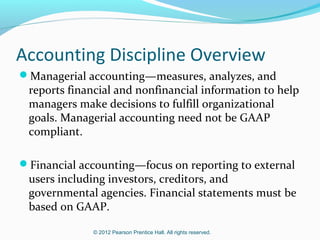
Managerial accounting—measures, analyzes, and

reports financial and nonfinancial information to help
managers make decisions to fulfill organizational
goals. Managerial accounting need not be GAAP
compliant.

Financial accounting—focus on reporting to external

users including investors, creditors, and
governmental agencies. Financial statements must be
based on GAAP.
© 2012 Pearson Prentice Hall. All rights reserved.
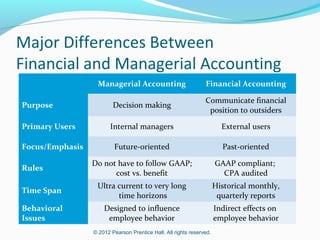
Major Differences Between
Financial and Managerial Accounting
Managerial Accounting

Financial Accounting

Decision making

Communicate financial
position to outsiders

Internal managers

External users

Future-oriented

Past-oriented

Do not have to follow GAAP;
cost vs. benefit

GAAP compliant;
CPA audited

Time Span

Ultra current to very long
time horizons

Historical monthly,
quarterly reports

Behavioral
Issues

Designed to influence
employee behavior

Indirect effects on
employee behavior

Purpose
Primary Users
Focus/Emphasis
Rules

© 2012 Pearson Prentice Hall. All rights reserved.
Strategy and Management Accounting
Strategy—specifies how an organization matches its

own capabilities with the opportunities in the
marketplace to accomplish its objectives
Strategic cost management—focuses specifically on
the cost dimension within a firm’s overall strategy

© 2012 Pearson Prentice Hall. All rights reserved.
Strategy and Management Accounting
Management accounting helps answer important

questions such as:

Who are our most important customers, and how do

we deliver value to them?
What substitute products exist in the marketplace, and
how do they differ from our own?
What is our critical capability?
Will we have enough cash to support our strategy or
will we need to seek additional sources?
© 2012 Pearson Prentice Hall. All rights reserved.
Management Accounting and Value
Creating value is an important part of planning and

implementing strategy.
Value is the usefulness a customer gains from a
company’s product or service.

© 2012 Pearson Prentice Hall. All rights reserved.
Management Accounting and Value
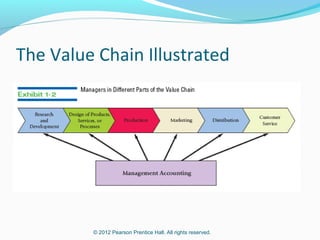
Value chain is the sequence of business functions

in which customer usefulness is added to products
or services.
The Value chain consists of:
Research & development
2. Design
3. Production
4. Marketing
5. Distribution
6. Customer service
1.

© 2012 Pearson Prentice Hall. All rights reserved.
Key Success Factors
The dimensions of performance that customers

expect, and that are key to the success of a company
include:
Cost and efficiency
Quality
Time
Innovation

© 2012 Pearson Prentice Hall. All rights reserved.
Planning and Control Systems
Planning selects goals, predicts results, decides how

to attain goals, and communicates this to the
organization.
Budget—the most important planning tool

Control takes actions that implement the planning

decision, decides how to evaluate performance, and
provides feedback to the organization.

© 2012 Pearson Prentice Hall. All rights reserved.
A Five-Step Decision Making Process in
Planning and Control
1.
2.
3.
4.
5.

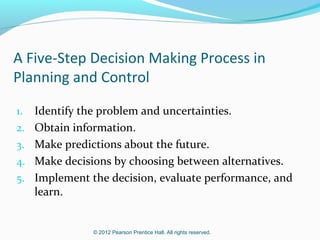
Identify the problem and uncertainties.
Obtain information.
Make predictions about the future.
Make decisions by choosing between alternatives.
Implement the decision, evaluate performance, and
learn.

© 2012 Pearson Prentice Hall. All rights reserved.
Management Accounting Guidelines
Cost–benefit approach is commonly used: benefits

generally must exceed costs as a basic decision rule.
Behavioral and technical considerations—people are
involved in decisions, not just dollars and cents.
Managers use alternative ways to compute costs in
different decision-making situations.

© 2012 Pearson Prentice Hall. All rights reserved.
Professional Ethics
The four standards of ethical conduct for

management accountants as advanced by the
Institute of Management Accountants:
Competence
Confidentiality
Integrity
Objectivity

© 2012 Pearson Prentice Hall. All rights reserved.

Chapter 1 power point presentation

  • 1.
    The Manager andManagement Accounting © 2012 Pearson Prentice Hall. All rights reserved.
  • 2.
    Accounting Discipline Overview Managerialaccounting—measures, analyzes, and reports financial and nonfinancial information to help managers make decisions to fulfill organizational goals. Managerial accounting need not be GAAP compliant. Financial accounting—focus on reporting to external users including investors, creditors, and governmental agencies. Financial statements must be based on GAAP. © 2012 Pearson Prentice Hall. All rights reserved.
  • 3.
    Major Differences Between Financialand Managerial Accounting Managerial Accounting Financial Accounting Decision making Communicate financial position to outsiders Internal managers External users Future-oriented Past-oriented Do not have to follow GAAP; cost vs. benefit GAAP compliant; CPA audited Time Span Ultra current to very long time horizons Historical monthly, quarterly reports Behavioral Issues Designed to influence employee behavior Indirect effects on employee behavior Purpose Primary Users Focus/Emphasis Rules © 2012 Pearson Prentice Hall. All rights reserved.
  • 4.
    Strategy and ManagementAccounting Strategy—specifies how an organization matches its own capabilities with the opportunities in the marketplace to accomplish its objectives Strategic cost management—focuses specifically on the cost dimension within a firm’s overall strategy © 2012 Pearson Prentice Hall. All rights reserved.
  • 5.
    Strategy and ManagementAccounting Management accounting helps answer important questions such as: Who are our most important customers, and how do we deliver value to them? What substitute products exist in the marketplace, and how do they differ from our own? What is our critical capability? Will we have enough cash to support our strategy or will we need to seek additional sources? © 2012 Pearson Prentice Hall. All rights reserved.
  • 6.
    Management Accounting andValue Creating value is an important part of planning and implementing strategy. Value is the usefulness a customer gains from a company’s product or service. © 2012 Pearson Prentice Hall. All rights reserved.
  • 7.
    Management Accounting andValue Value chain is the sequence of business functions in which customer usefulness is added to products or services. The Value chain consists of: Research & development 2. Design 3. Production 4. Marketing 5. Distribution 6. Customer service 1. © 2012 Pearson Prentice Hall. All rights reserved.
  • 8.
    Key Success Factors Thedimensions of performance that customers expect, and that are key to the success of a company include: Cost and efficiency Quality Time Innovation © 2012 Pearson Prentice Hall. All rights reserved.
  • 9.
    Planning and ControlSystems Planning selects goals, predicts results, decides how to attain goals, and communicates this to the organization. Budget—the most important planning tool Control takes actions that implement the planning decision, decides how to evaluate performance, and provides feedback to the organization. © 2012 Pearson Prentice Hall. All rights reserved.
  • 10.
    A Five-Step DecisionMaking Process in Planning and Control 1. 2. 3. 4. 5. Identify the problem and uncertainties. Obtain information. Make predictions about the future. Make decisions by choosing between alternatives. Implement the decision, evaluate performance, and learn. © 2012 Pearson Prentice Hall. All rights reserved.
  • 11.
    Management Accounting Guidelines Cost–benefitapproach is commonly used: benefits generally must exceed costs as a basic decision rule. Behavioral and technical considerations—people are involved in decisions, not just dollars and cents. Managers use alternative ways to compute costs in different decision-making situations. © 2012 Pearson Prentice Hall. All rights reserved.
  • 12.
    Professional Ethics The fourstandards of ethical conduct for management accountants as advanced by the Institute of Management Accountants: Competence Confidentiality Integrity Objectivity © 2012 Pearson Prentice Hall. All rights reserved.
  • 13.
    © 2012 PearsonPrentice Hall. All rights reserved.