Physical agents &
Electrotherapy
Semester 5th
Dr. Afifa Latif
• PHYSICAL AGENTS & ELECTROTHERAPY - I
• CREDIT HOURS: 3 (2-1)
COURSE DESCRIPTION
• This course tends to explore fundamental skills in application of
electromodalities and knowledge of indications, contraindications
and physiological principles needed for appropriate patient care.
• It includes topics such as electric stimulation, T.E.N.S.
Iontophoresis, ultrasound /Phonophoresis, diathermy and electro
diagnostic testing etc.
COURSE OUTLINE:
• INTRODUCTION & GENERAL CONSIDERATION OF ELECTROTHERAPY
• TYPES OF CURRENT USED
• Low frequency current
• Medium frequency current.
• LOW FREQUENCY CURRENT
•  Faradic current
•  Sinusoidal current
•  Galvanic current
•  constant galvanic current
•  modified galvanic current
•  Superimposed currents
•  Transcutaneous electrical nerve stimulation (TENS)
•  Dia-dynamic currents.
• MEDIUM FREQUENCY CURRENT
•  Interferential Current
•  Introduction, physical principles, electro-physiological effects
•  Clinical applications, methods of application
•  Treatment consideration & contraindications.
PRACTICAL TRAINING/ LAB WORK:
• Location of motor points
• Faradic & I.D.C test
• Strength duration curve, determination of Rheobase and Chronaxie
•  Accommodity test
•  Electromyography
•  Definition, method, value, uses of E.M.G, Electromyography & temperature, feed back technique
•  Practical application of TENS in physical therapy treatment ward
•  Reflective clinical case studies
•  Iontophoresis
•  Demonstration of techniques during practical classes, later on techniques practiced by students on patients attending the
department under supervision of trained physiotherapists.
• Note:
• The students are expected to make a record of his/her achievements in the log book. The log book is a collection of evidence that
learning has taken place. It is a reflective record of achievements. The log book shall also contain a record of the procedures which
student would have performed/observed.
RECOMMENDED TEXT BOOKS:
1. Clayton’s Electrotherapy and Actinotherapy, 10th edition by PM
Scott.
2. Electrotherapy: Evidence based Practice, 11th edition by Shelia
Kitchen.
3. Michelle H Cameron’s Physical Agent in Rehabilitation: From
research to Practice.
4. Electrotherapy and Electrodiagnosis by S. Lient.
5. Applications of Shortwave Diathermy by P.M. Scott.
6. Practical Electrotherapy by Savage.
• Physiotherapy /Physical Therapy Definition
Physiotherapy/Physical Therapy Definition
• Physiotherapy, or Physical Therapy, is a Health Care
profession concerned with the assessment, maintenance, and
restoration of the physical function and performance of the body.
• It is a distinct form of care, which can be performed either in
isolation or in conjunction with other types of medical management.
• In simple form we can say , it is the means of treating disorders by
physical means.
• Electrotherapy is an integral part of physiotherapy.
Electrotherapy Definition
• Electrotherapy is the “Application of electrical energy to the living tissue for
remedial/therapeutic purposes is known as electrotherapy.
OR
“Electrotherapy is the use of electrical energy in the treatment of impairments of health and a
conditions of abnormal functioning”
• Electrotherapy or EPA (Electro physical agent) is the therapeutic application of
various physical agents like heat, cold , water , pressure, sound, electromagnetic radiations,
and electrical currents to patient for therapeutic purpose.
Physical Agent and Electrotherapy/EPA
• Physical agents are various forms and means of applying
of energy and materials to patients.
• Physical agents include heat, cold, water, pressure, sound,
electromagnetrc radratron, and electncal currents.
• Electrotherapy or EPA (Electro physical agent) is the
therapeutic application of various physical agents like heat, cold ,
water , pressure, sound, electromagnetic radiations, and electrical
currents to patient for therapeutic purpose.
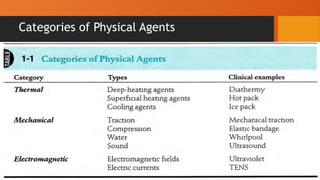
CATEGORIES OF PHYSICAL AGENTS
• Physical agents are most readily categorized as Thermal,
Mechanical, or Electromagnetic .
• Thermal agents include deep-heating agents, superficial
heating agents, and superficial cooling agents.
• Mechanical agents include traction, compression, water, and
sound.
• Electromagnetic agents include electromagnetic fields and
electrical currents
Thermal Agents
• Thermal agents transfer energy to a patient to produce an increase or
decrease in tissue temperature.
• Different thermal agents produce the greatest change in temperature in
different types and areas of tissue.
• For example, a hot pack produces the greatest temperature increase in
superficial tissues with high thermal conductivity in the area directly
below it.
• In contrast, an ultrasound produces the most heat in tissues with high
ultrasound absorption coefficients, such as tendon and bone.
• It produces this effect up to a depth of 5 cm but only in a small area,
approximately twice that of the effective radiating area of the transducer
Mechanical Agents
• Mechanical agents apply mechanical force to increase or decrease
pressure in or on the body.
• Water provides resistance to increase local pressure, hydrostatic
pressure to increase circumferential pressure, and buoyancy to
decrease pressure on weight-bearing structures.
• Traction decreases the pressure between structures, and compression
increases the Pressure between structures.
Water can be applied by immersion or non-immersion techniques. The
therapeutic application of water is known as hydrotherapy
• Traction is most commonly used to alleviate pressure on
structures, such as nerves or joints that produce pain or other
sensory changes or that become inflamed when compressed.
• Compression is used to counteract fluid pressure and control or
reverse edema. The force, duration, and means of application of
compression can be varied to control the magnitude of the effect
and to accommodate different patient needs
Electromagnetic Agents
• Electromagnetic agents apply electromagnetic energy in the form
of electromagnetic radiation or an electrical current.
• Variation of the frequency and intensity of electromagnetic
radiation changes its effects and depth of penetration
Currents
• The effects and clinical applications of electrical currents vary
according to the waveform, intensify duration, and direction of
the current flow and according to the type of tissue to which the
current is applied.
• Electrical currents of sufficient intensify and duration can
depolarize nerves, causing sensory or motor responses that may be
used to control pain or increase muscle strength and control.
Categories of Physical Agents
General Physiological effects of
Electrotherapy
General Physiological effects of
Electrotherapy
1. Increases joint ROM
2. Muscle group Contraction
3. Retards muscle atrophy
4. Increases muscle strength
5. Increases circulation
6. Decreases muscle spasm
7. Decreases spasticity
8. Promotes wound healing
9. Induces osteogenesis—tissue regeneration, remodeling
10. Inhibits pain fibers—stimulates large myelinated type A nerve fibers (gate control
theory)
11. Drives medicated ions across the skin
Indications
• These are general indications:
1) Pain management (Acute and Chronic )
2) Treatment of neuromuscular dysfunction
3) Muscle disuse atrophy
4) Tissue repair , wound healing, dermal ulcers.
5) Acute and chronic edema
6) Circulatory disorders—neurovascular disorders, venous insufficiency.
7) Urine and fecal incontinence
8) Arthritis: Osteoarthritis, Rheumatoid arthritis etc.
Contraindications
1. Circulatory impairment: arterial or venous thrombosis.
2. Stimulation over the carotid sinus.
3. Stimulation across the heart: especially if patient has pacemaker.
4. Pregnancy.
5. Seizure disorder.
6. Fresh fracture.
7. Active hemorrhage.
8. Malignancy.
9. Decreased sensation—direct current can cause burns (electrochemical).
10. Atrophic skin.
11. Patients inability to report stimulation-induced pain.
12. Known allergies to gel or pads.
Facts of Electrotherapy
• All electrotherapy modalities involve the
introduction of some physical energy into a
biologic system. (Human tissue / Body)
• This energy brings about the one or more
Physiological changes, which are used for
Therapeutic benefit.
• In the Clinical environment, firstly to select the
most appropriate dose & secondly to apply the
treatment.
TYPES OF CURRENT USED ACCORDING TO
FREQUENCY
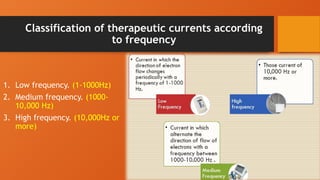
Classification of therapeutic currents according
to frequency
1. Low frequency. (1-1000Hz)
2. Medium frequency. (1000-
10,000 Hz)
3. High frequency. (10,000Hz or
more)
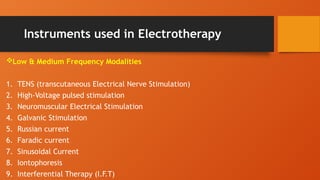
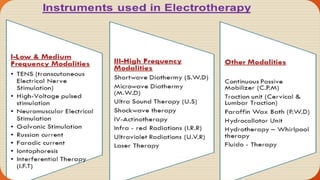
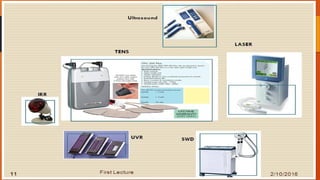
Instruments used in Electrotherapy
Low & Medium Frequency Modalities
1. TENS (transcutaneous Electrical Nerve Stimulation)
2. High-Voltage pulsed stimulation
3. Neuromuscular Electrical Stimulation
4. Galvanic Stimulation
5. Russian current
6. Faradic current
7. Sinusoidal Current
8. Iontophoresis
9. Interferential Therapy (I.F.T)
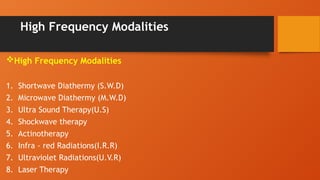
High Frequency Modalities
High Frequency Modalities
1. Shortwave Diathermy (S.W.D)
2. Microwave Diathermy (M.W.D)
3. Ultra Sound Therapy(U.S)
4. Shockwave therapy
5. Actinotherapy
6. Infra - red Radiations(I.R.R)
7. Ultraviolet Radiations(U.V.R)
8. Laser Therapy
Other Modalities
Other Modalities
1. Continuous Passive Mobilizer (C.P.M)
2. Traction unit (Cervical & Lumbar Traction)
3. Paraffin Wax Bath (P.W.D)
4. Hydro collator Unit
5. Hydrotherapy –
6. Whirlpool therapy
7. Fluido - Therapy
Electrical
safety rules
HISTORY OF ELCTROTHERAPY
HISTORY OF THE USE OF PHYSICAL AGENTS IN
MEDICINE AND REHABILITATION
• Physical agents have been a component of medical and
rehabilitation treatment for many centuries and are used across a
wide variety of cultures.
• For example, the remains of original bath houses with steam
rooms and pools of hot and cold water that can still be seen in
many major cities of the ancient Romans and Greeks provide
evidence that these cultures used heat and water to maintain
health and treat various musculoskeletal and respiratory problems.
• The health benefits of soaking and exercising in hot water
regained popularity many centuries later with the advent of health
spas in Europe in the late 19th century in areas of natural hot
springs.
• Today, the practices of soaking and exercising in water continue to
be popular throughout the world because they provide resistance,
thereby allowing the development of strength, endurance, and
buoyancy, and reducing weight bearing on compression-sensitive
joints
• Other examples of the historic use of physical agents include the
use of torpedo fish, in approximately 400 B.c., to apply electric
shocks to the head and feet to treat headaches and arthritis, and
the use of amber in the 17th century to generate static electricity
for the treatment of skin diseases, inflammation, and hemorrhage.
• There are also reports from the 17th century of charged gold leaf
being used to prevent scarring from smallpox lesions
• Before the widespread availability of antibiotics and effective
analgesic and anti-inflammatory drugs, physical agents were
commonly used to treat infection, pain, and inflammation.
• Examples of such applications include the use of sunlight for the
treatment of tuberculosis, bone and joint diseases, and
dermatologic disorders and infections,
• And the use of warm Epsom salt baths for the treatment of sore or
swollen limbs.
• The evolution of electricity for therapeutic purposes starts way
back in 1646 when Thomas Rown coined the term Electricity.
• After this period there was a rapid development in the field of
electricity. It became possible to store electricity for experiments.
• The important names during this period that contributed to these
achievements included Pieter Van of Leyden, Benjamin Franklin of
Philadelphia and Luigi Galvani of Bologna (Cherington et al. 1994).
• Benjamin Franklin was a great thinker and statesman at the time
of the American revolution. In 1752, he conducted famous kite
experiment.
• Franklin charged his Leyden jar by using a kite during electrical
storms. During that period, electricity has become a source of
Astonishment and Amusement. Franklin’s analysis of Leyden jar
lead to the discovery of the law of electrostatic induction.
• He postulated the two opposing forces of electricity, i.e. positive
and negative charges.
• In 1826 George Simon Ohm establishes the result which is now
known as Ohm’s law.
• He stated that the current flowing through a metallic conductor is
proportional to the potential difference across its ends, provided
the physical conditions remain constant
• In 1833 Guillaume Duchenne demonstrated that the muscle can be
stimulated percutaneously.
• He was the first to systematically study the neuromuscular
diseases and was first to study the muscular dystrophies.
• Duchenne was considered as the inventor of muscle nerve
electricity or “localized faradizations” and considered as father of
modern Electrotherapy.
• In 1840 England’s first Electrotherapy department was established
at Guy’s Hospital under Dr. Golding Bird.
• The use of Galvanic currents were first documented there.
• In 1843 Emil Du Bois Reymond introduced the technique of
stimulating nerve and muscle by means of a short duration
(faradic) current from the modified induction coil.
• He was the first to demonstrate that there is change in polarity of
nerve when it is stimulated. He is considered as father of modern
electrophysiology.
• In 1849 LeDuc introduced interrupted direct current.
• In 1858 Remak discovered that the points where the nerve enters into a
muscle were easy to stimulate.
• In 1859 Baierlacher reported that a paralyzed muscle responded to
galvanic but not faradic current.
• In 1861 Erb introduced the method of electro diagnosis based on faradic
and galvanic currents.
• Erb was the first to demonstrate increase electrical irritability of motor
nerves in tetany which in known as Erb’s phenomenon. He was also the
first to electrically stimulate the brachial plexus. This is how evolution
of electricity in the use of nerve muscle stimulation has taken place.
• In 1864 Keningsberg reported the important role of duration of
current in eliciting the muscle contraction. He developed a
mechanical device which could rapidly interrupt the current; if the
rate of interruption exceeded the limit, there was no muscle
contraction.
• In 1891 Nicola Tesla presented a paper in ‘Electrical Engineer’
about medical application of High Frequency Currents.
• He observed when the body is trans versed by alternating currents
above a certain frequency, heat is perceived.
• In 1892 Arsene D’ Arsonval of France developed an apparatus
capable of producing High Frequency Currents, he was the first
person to study the effects of High Frequency Currents on humans.
• In a communication to Biological Society of France he wrote that
a current with frequency greater than 10,000 Hz can be passed
through a body without producing any other sensation other than
heat
• In 1908 Nagel Schmidt was the first person to coin the term Diathermy.
He performed several experiments independently over animal models
and demonstrated the deep heating effects of diathermy.
• In 1910 Langevin produced the first piezoelectric generator for emitting
ultrasound.
• In 1916 Adrian was the first to demonstrate strength duration curve. He
noted that healthy muscles showed a fairly constant curve.
• There was a predictable shift of the curves during muscle degeneration
as well as in different phases of recovery.
• In 1928 A W Hull invented the magnetron.
• In 1946 Frank H Krusen and his coworkers reported first clinical
use of microwave diathermy.
• In 1965 Melzack and Wall first postulated the pain gate theory.
• In 1972 Meyer and Fields were the first to report the clinical use of
TENS for relief of chronic pain.
• In 1982 Melzack and Wall further modified their famous pain gate
theory.
• In 1985 Cummings performed several experiments on rat to see
the effects of LASER. His experiments suggested the use of LASER
on wounds and ulcer healing.
• In 1991 Erwin Neher and Bert Sakmann developed a technique that
detects electrical currents in the membrane of the cell,
establishing the existence of ion channels.
• They developed a device called Patch-clamp apparatus to record
the small electrical potential of the cell. They were awarded
Nobel prize in Physiology and Medicine for their discoveries.
THANK YOU

CHAPTER 1. Lecture 1 new.pptx for Electrotherapy

  • 1.
  • 2.
    • PHYSICAL AGENTS& ELECTROTHERAPY - I • CREDIT HOURS: 3 (2-1)
  • 3.
    COURSE DESCRIPTION • Thiscourse tends to explore fundamental skills in application of electromodalities and knowledge of indications, contraindications and physiological principles needed for appropriate patient care. • It includes topics such as electric stimulation, T.E.N.S. Iontophoresis, ultrasound /Phonophoresis, diathermy and electro diagnostic testing etc.
  • 4.
    COURSE OUTLINE: • INTRODUCTION& GENERAL CONSIDERATION OF ELECTROTHERAPY • TYPES OF CURRENT USED • Low frequency current • Medium frequency current. • LOW FREQUENCY CURRENT •  Faradic current •  Sinusoidal current •  Galvanic current •  constant galvanic current •  modified galvanic current •  Superimposed currents •  Transcutaneous electrical nerve stimulation (TENS) •  Dia-dynamic currents.
  • 5.
    • MEDIUM FREQUENCYCURRENT •  Interferential Current •  Introduction, physical principles, electro-physiological effects •  Clinical applications, methods of application •  Treatment consideration & contraindications.
  • 6.
    PRACTICAL TRAINING/ LABWORK: • Location of motor points • Faradic & I.D.C test • Strength duration curve, determination of Rheobase and Chronaxie •  Accommodity test •  Electromyography •  Definition, method, value, uses of E.M.G, Electromyography & temperature, feed back technique •  Practical application of TENS in physical therapy treatment ward •  Reflective clinical case studies •  Iontophoresis •  Demonstration of techniques during practical classes, later on techniques practiced by students on patients attending the department under supervision of trained physiotherapists. • Note: • The students are expected to make a record of his/her achievements in the log book. The log book is a collection of evidence that learning has taken place. It is a reflective record of achievements. The log book shall also contain a record of the procedures which student would have performed/observed.
  • 7.
    RECOMMENDED TEXT BOOKS: 1.Clayton’s Electrotherapy and Actinotherapy, 10th edition by PM Scott. 2. Electrotherapy: Evidence based Practice, 11th edition by Shelia Kitchen. 3. Michelle H Cameron’s Physical Agent in Rehabilitation: From research to Practice. 4. Electrotherapy and Electrodiagnosis by S. Lient. 5. Applications of Shortwave Diathermy by P.M. Scott. 6. Practical Electrotherapy by Savage.
  • 8.
    • Physiotherapy /PhysicalTherapy Definition
  • 9.
    Physiotherapy/Physical Therapy Definition •Physiotherapy, or Physical Therapy, is a Health Care profession concerned with the assessment, maintenance, and restoration of the physical function and performance of the body. • It is a distinct form of care, which can be performed either in isolation or in conjunction with other types of medical management. • In simple form we can say , it is the means of treating disorders by physical means. • Electrotherapy is an integral part of physiotherapy.
  • 10.
    Electrotherapy Definition • Electrotherapyis the “Application of electrical energy to the living tissue for remedial/therapeutic purposes is known as electrotherapy. OR “Electrotherapy is the use of electrical energy in the treatment of impairments of health and a conditions of abnormal functioning” • Electrotherapy or EPA (Electro physical agent) is the therapeutic application of various physical agents like heat, cold , water , pressure, sound, electromagnetic radiations, and electrical currents to patient for therapeutic purpose.
  • 11.
    Physical Agent andElectrotherapy/EPA • Physical agents are various forms and means of applying of energy and materials to patients. • Physical agents include heat, cold, water, pressure, sound, electromagnetrc radratron, and electncal currents. • Electrotherapy or EPA (Electro physical agent) is the therapeutic application of various physical agents like heat, cold , water , pressure, sound, electromagnetic radiations, and electrical currents to patient for therapeutic purpose.
  • 12.
    CATEGORIES OF PHYSICALAGENTS • Physical agents are most readily categorized as Thermal, Mechanical, or Electromagnetic . • Thermal agents include deep-heating agents, superficial heating agents, and superficial cooling agents. • Mechanical agents include traction, compression, water, and sound. • Electromagnetic agents include electromagnetic fields and electrical currents
  • 13.
    Thermal Agents • Thermalagents transfer energy to a patient to produce an increase or decrease in tissue temperature. • Different thermal agents produce the greatest change in temperature in different types and areas of tissue. • For example, a hot pack produces the greatest temperature increase in superficial tissues with high thermal conductivity in the area directly below it. • In contrast, an ultrasound produces the most heat in tissues with high ultrasound absorption coefficients, such as tendon and bone. • It produces this effect up to a depth of 5 cm but only in a small area, approximately twice that of the effective radiating area of the transducer
  • 14.
    Mechanical Agents • Mechanicalagents apply mechanical force to increase or decrease pressure in or on the body. • Water provides resistance to increase local pressure, hydrostatic pressure to increase circumferential pressure, and buoyancy to decrease pressure on weight-bearing structures. • Traction decreases the pressure between structures, and compression increases the Pressure between structures. Water can be applied by immersion or non-immersion techniques. The therapeutic application of water is known as hydrotherapy
  • 15.
    • Traction ismost commonly used to alleviate pressure on structures, such as nerves or joints that produce pain or other sensory changes or that become inflamed when compressed. • Compression is used to counteract fluid pressure and control or reverse edema. The force, duration, and means of application of compression can be varied to control the magnitude of the effect and to accommodate different patient needs
  • 16.
    Electromagnetic Agents • Electromagneticagents apply electromagnetic energy in the form of electromagnetic radiation or an electrical current. • Variation of the frequency and intensity of electromagnetic radiation changes its effects and depth of penetration
  • 17.
    Currents • The effectsand clinical applications of electrical currents vary according to the waveform, intensify duration, and direction of the current flow and according to the type of tissue to which the current is applied. • Electrical currents of sufficient intensify and duration can depolarize nerves, causing sensory or motor responses that may be used to control pain or increase muscle strength and control.
  • 18.
  • 19.
  • 20.
    General Physiological effectsof Electrotherapy 1. Increases joint ROM 2. Muscle group Contraction 3. Retards muscle atrophy 4. Increases muscle strength 5. Increases circulation 6. Decreases muscle spasm 7. Decreases spasticity 8. Promotes wound healing 9. Induces osteogenesis—tissue regeneration, remodeling 10. Inhibits pain fibers—stimulates large myelinated type A nerve fibers (gate control theory) 11. Drives medicated ions across the skin
  • 21.
    Indications • These aregeneral indications: 1) Pain management (Acute and Chronic ) 2) Treatment of neuromuscular dysfunction 3) Muscle disuse atrophy 4) Tissue repair , wound healing, dermal ulcers. 5) Acute and chronic edema 6) Circulatory disorders—neurovascular disorders, venous insufficiency. 7) Urine and fecal incontinence 8) Arthritis: Osteoarthritis, Rheumatoid arthritis etc.
  • 22.
    Contraindications 1. Circulatory impairment:arterial or venous thrombosis. 2. Stimulation over the carotid sinus. 3. Stimulation across the heart: especially if patient has pacemaker. 4. Pregnancy. 5. Seizure disorder. 6. Fresh fracture. 7. Active hemorrhage. 8. Malignancy. 9. Decreased sensation—direct current can cause burns (electrochemical). 10. Atrophic skin. 11. Patients inability to report stimulation-induced pain. 12. Known allergies to gel or pads.
  • 23.
    Facts of Electrotherapy •All electrotherapy modalities involve the introduction of some physical energy into a biologic system. (Human tissue / Body) • This energy brings about the one or more Physiological changes, which are used for Therapeutic benefit. • In the Clinical environment, firstly to select the most appropriate dose & secondly to apply the treatment.
  • 24.
    TYPES OF CURRENTUSED ACCORDING TO FREQUENCY
  • 25.
    Classification of therapeuticcurrents according to frequency 1. Low frequency. (1-1000Hz) 2. Medium frequency. (1000- 10,000 Hz) 3. High frequency. (10,000Hz or more)
  • 26.
    Instruments used inElectrotherapy Low & Medium Frequency Modalities 1. TENS (transcutaneous Electrical Nerve Stimulation) 2. High-Voltage pulsed stimulation 3. Neuromuscular Electrical Stimulation 4. Galvanic Stimulation 5. Russian current 6. Faradic current 7. Sinusoidal Current 8. Iontophoresis 9. Interferential Therapy (I.F.T)
  • 27.
    High Frequency Modalities HighFrequency Modalities 1. Shortwave Diathermy (S.W.D) 2. Microwave Diathermy (M.W.D) 3. Ultra Sound Therapy(U.S) 4. Shockwave therapy 5. Actinotherapy 6. Infra - red Radiations(I.R.R) 7. Ultraviolet Radiations(U.V.R) 8. Laser Therapy
  • 28.
    Other Modalities Other Modalities 1.Continuous Passive Mobilizer (C.P.M) 2. Traction unit (Cervical & Lumbar Traction) 3. Paraffin Wax Bath (P.W.D) 4. Hydro collator Unit 5. Hydrotherapy – 6. Whirlpool therapy 7. Fluido - Therapy
  • 31.
  • 32.
  • 33.
    HISTORY OF THEUSE OF PHYSICAL AGENTS IN MEDICINE AND REHABILITATION • Physical agents have been a component of medical and rehabilitation treatment for many centuries and are used across a wide variety of cultures. • For example, the remains of original bath houses with steam rooms and pools of hot and cold water that can still be seen in many major cities of the ancient Romans and Greeks provide evidence that these cultures used heat and water to maintain health and treat various musculoskeletal and respiratory problems.
  • 34.
    • The healthbenefits of soaking and exercising in hot water regained popularity many centuries later with the advent of health spas in Europe in the late 19th century in areas of natural hot springs. • Today, the practices of soaking and exercising in water continue to be popular throughout the world because they provide resistance, thereby allowing the development of strength, endurance, and buoyancy, and reducing weight bearing on compression-sensitive joints
  • 35.
    • Other examplesof the historic use of physical agents include the use of torpedo fish, in approximately 400 B.c., to apply electric shocks to the head and feet to treat headaches and arthritis, and the use of amber in the 17th century to generate static electricity for the treatment of skin diseases, inflammation, and hemorrhage. • There are also reports from the 17th century of charged gold leaf being used to prevent scarring from smallpox lesions
  • 36.
    • Before thewidespread availability of antibiotics and effective analgesic and anti-inflammatory drugs, physical agents were commonly used to treat infection, pain, and inflammation. • Examples of such applications include the use of sunlight for the treatment of tuberculosis, bone and joint diseases, and dermatologic disorders and infections, • And the use of warm Epsom salt baths for the treatment of sore or swollen limbs.
  • 37.
    • The evolutionof electricity for therapeutic purposes starts way back in 1646 when Thomas Rown coined the term Electricity. • After this period there was a rapid development in the field of electricity. It became possible to store electricity for experiments. • The important names during this period that contributed to these achievements included Pieter Van of Leyden, Benjamin Franklin of Philadelphia and Luigi Galvani of Bologna (Cherington et al. 1994).
  • 38.
    • Benjamin Franklinwas a great thinker and statesman at the time of the American revolution. In 1752, he conducted famous kite experiment. • Franklin charged his Leyden jar by using a kite during electrical storms. During that period, electricity has become a source of Astonishment and Amusement. Franklin’s analysis of Leyden jar lead to the discovery of the law of electrostatic induction. • He postulated the two opposing forces of electricity, i.e. positive and negative charges.
  • 39.
    • In 1826George Simon Ohm establishes the result which is now known as Ohm’s law. • He stated that the current flowing through a metallic conductor is proportional to the potential difference across its ends, provided the physical conditions remain constant
  • 40.
    • In 1833Guillaume Duchenne demonstrated that the muscle can be stimulated percutaneously. • He was the first to systematically study the neuromuscular diseases and was first to study the muscular dystrophies. • Duchenne was considered as the inventor of muscle nerve electricity or “localized faradizations” and considered as father of modern Electrotherapy.
  • 41.
    • In 1840England’s first Electrotherapy department was established at Guy’s Hospital under Dr. Golding Bird. • The use of Galvanic currents were first documented there. • In 1843 Emil Du Bois Reymond introduced the technique of stimulating nerve and muscle by means of a short duration (faradic) current from the modified induction coil. • He was the first to demonstrate that there is change in polarity of nerve when it is stimulated. He is considered as father of modern electrophysiology.
  • 42.
    • In 1849LeDuc introduced interrupted direct current. • In 1858 Remak discovered that the points where the nerve enters into a muscle were easy to stimulate. • In 1859 Baierlacher reported that a paralyzed muscle responded to galvanic but not faradic current. • In 1861 Erb introduced the method of electro diagnosis based on faradic and galvanic currents. • Erb was the first to demonstrate increase electrical irritability of motor nerves in tetany which in known as Erb’s phenomenon. He was also the first to electrically stimulate the brachial plexus. This is how evolution of electricity in the use of nerve muscle stimulation has taken place.
  • 43.
    • In 1864Keningsberg reported the important role of duration of current in eliciting the muscle contraction. He developed a mechanical device which could rapidly interrupt the current; if the rate of interruption exceeded the limit, there was no muscle contraction. • In 1891 Nicola Tesla presented a paper in ‘Electrical Engineer’ about medical application of High Frequency Currents. • He observed when the body is trans versed by alternating currents above a certain frequency, heat is perceived.
  • 44.
    • In 1892Arsene D’ Arsonval of France developed an apparatus capable of producing High Frequency Currents, he was the first person to study the effects of High Frequency Currents on humans. • In a communication to Biological Society of France he wrote that a current with frequency greater than 10,000 Hz can be passed through a body without producing any other sensation other than heat
  • 45.
    • In 1908Nagel Schmidt was the first person to coin the term Diathermy. He performed several experiments independently over animal models and demonstrated the deep heating effects of diathermy. • In 1910 Langevin produced the first piezoelectric generator for emitting ultrasound. • In 1916 Adrian was the first to demonstrate strength duration curve. He noted that healthy muscles showed a fairly constant curve. • There was a predictable shift of the curves during muscle degeneration as well as in different phases of recovery.
  • 46.
    • In 1928A W Hull invented the magnetron. • In 1946 Frank H Krusen and his coworkers reported first clinical use of microwave diathermy. • In 1965 Melzack and Wall first postulated the pain gate theory. • In 1972 Meyer and Fields were the first to report the clinical use of TENS for relief of chronic pain. • In 1982 Melzack and Wall further modified their famous pain gate theory.
  • 47.
    • In 1985Cummings performed several experiments on rat to see the effects of LASER. His experiments suggested the use of LASER on wounds and ulcer healing. • In 1991 Erwin Neher and Bert Sakmann developed a technique that detects electrical currents in the membrane of the cell, establishing the existence of ion channels. • They developed a device called Patch-clamp apparatus to record the small electrical potential of the cell. They were awarded Nobel prize in Physiology and Medicine for their discoveries.
  • 48.