 Home Self-Assessment Multiple Choice Quiz Chapter 1
1
2
Self-Assessment Multiple Choice Quiz
Chapter 1: Computer Networks and the Internet
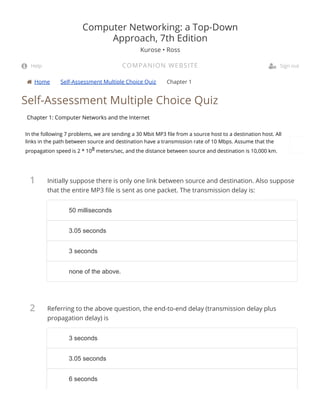
In the following 7 problems, we are sending a 30 Mbit MP3 le from a source host to a destination host. All
links in the path between source and destination have a transmission rate of 10 Mbps. Assume that the
propagation speed is 2 * 108 meters/sec, and the distance between source and destination is 10,000 km.
Initially suppose there is only one link between source and destination. Also suppose
that the entire MP3 le is sent as one packet. The transmission delay is:
Referring to the above question, the end-to-end delay (transmission delay plus
propagation delay) is
Computer Networking: a Top-Down
Approach, 7th Edition
Kurose • Ross
COMPANION WEBSITE Help  Sign out
50 milliseconds50 milliseconds
3.05 seconds3.05 seconds
3 seconds3 seconds
none of the above.none of the above.
3 seconds3 seconds
3.05 seconds3.05 seconds
6 seconds6 seconds
3
4
5
Referring to the above question, how many bits will the source have transmitted
when the rst bit arrives at the destination.
Now suppose there are two links between source and destination, with one router
connecting the two links. Each link is 5,000 km long. Again suppose the MP3 le is
sent as one packet. Suppose there is no congestion, so that the packet is transmitted
onto the second link as soon as the router receives the entire packet. The end-to-end
delay is
Now suppose that the MP3 le is broken into 3 packets, each of 10 Mbits. Ignore
headers that may be added to these packets. Also ignore router processing delays.
Assuming store and forward packet switching at the router, the total delay is
none of the abovenone of the above
1 bit1 bit
30,000,000 bits30,000,000 bits
500,000 bits500,000 bits
none of the abovenone of the above
3.05 seconds3.05 seconds
6.05 seconds6.05 seconds
6.1 seconds6.1 seconds
none of the abovenone of the above
3.05 seconds3.05 seconds
6
7
8
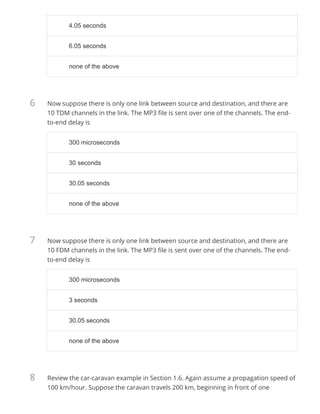
Now suppose there is only one link between source and destination, and there are
10 TDM channels in the link. The MP3 le is sent over one of the channels. The end-
to-end delay is
Now suppose there is only one link between source and destination, and there are
10 FDM channels in the link. The MP3 le is sent over one of the channels. The end-
to-end delay is
Review the car-caravan example in Section 1.6. Again assume a propagation speed of
100 km/hour. Suppose the caravan travels 200 km, beginning in front of one
4.05 seconds4.05 seconds
6.05 seconds6.05 seconds
none of the abovenone of the above
300 microseconds300 microseconds
30 seconds30 seconds
30.05 seconds30.05 seconds
none of the abovenone of the above
300 microseconds300 microseconds
3 seconds3 seconds
30.05 seconds30.05 seconds
none of the abovenone of the above
9
10
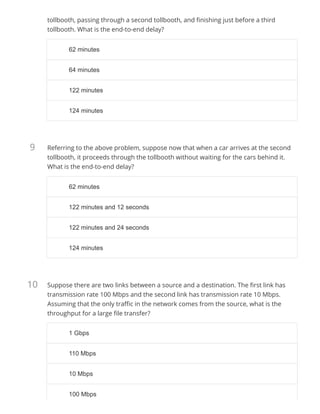
tollbooth, passing through a second tollbooth, and nishing just before a third
tollbooth. What is the end-to-end delay?
Referring to the above problem, suppose now that when a car arrives at the second
tollbooth, it proceeds through the tollbooth without waiting for the cars behind it.
What is the end-to-end delay?
Suppose there are two links between a source and a destination. The rst link has
transmission rate 100 Mbps and the second link has transmission rate 10 Mbps.
Assuming that the only tra c in the network comes from the source, what is the
throughput for a large le transfer?
62 minutes62 minutes
64 minutes64 minutes
122 minutes122 minutes
124 minutes124 minutes
62 minutes62 minutes
122 minutes and 12 seconds122 minutes and 12 seconds
122 minutes and 24 seconds122 minutes and 24 seconds
124 minutes124 minutes
1 Gbps1 Gbps
110 Mbps110 Mbps
10 Mbps10 Mbps
100 Mbps100 Mbps
11
Pearson Higher Education
About Us
Educators
Academic Executives
Students
Other Customers
Browse our Catalog
Pearson Higher Education
Contact a Rep
Find your Pearson rep
Technical Help
Pearson Technical Support
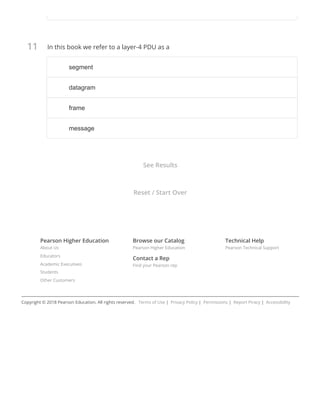
In this book we refer to a layer-4 PDU as a
Copyright © 2018 Pearson Education. All rights reserved.   Terms of Use |  Privacy Policy |  Permissions |  Report Piracy |  Accessibility
See Results
Reset / Start Over
segmentsegment
datagramdatagram
frameframe
messagemessage

Chapter 1 - Computer Networks and the Internet 2

  • 1.
     Home Self-AssessmentMultiple Choice Quiz Chapter 1 1 2 Self-Assessment Multiple Choice Quiz Chapter 1: Computer Networks and the Internet In the following 7 problems, we are sending a 30 Mbit MP3 le from a source host to a destination host. All links in the path between source and destination have a transmission rate of 10 Mbps. Assume that the propagation speed is 2 * 108 meters/sec, and the distance between source and destination is 10,000 km. Initially suppose there is only one link between source and destination. Also suppose that the entire MP3 le is sent as one packet. The transmission delay is: Referring to the above question, the end-to-end delay (transmission delay plus propagation delay) is Computer Networking: a Top-Down Approach, 7th Edition Kurose • Ross COMPANION WEBSITE Help  Sign out 50 milliseconds50 milliseconds 3.05 seconds3.05 seconds 3 seconds3 seconds none of the above.none of the above. 3 seconds3 seconds 3.05 seconds3.05 seconds 6 seconds6 seconds
  • 2.
    3 4 5 Referring to theabove question, how many bits will the source have transmitted when the rst bit arrives at the destination. Now suppose there are two links between source and destination, with one router connecting the two links. Each link is 5,000 km long. Again suppose the MP3 le is sent as one packet. Suppose there is no congestion, so that the packet is transmitted onto the second link as soon as the router receives the entire packet. The end-to-end delay is Now suppose that the MP3 le is broken into 3 packets, each of 10 Mbits. Ignore headers that may be added to these packets. Also ignore router processing delays. Assuming store and forward packet switching at the router, the total delay is none of the abovenone of the above 1 bit1 bit 30,000,000 bits30,000,000 bits 500,000 bits500,000 bits none of the abovenone of the above 3.05 seconds3.05 seconds 6.05 seconds6.05 seconds 6.1 seconds6.1 seconds none of the abovenone of the above 3.05 seconds3.05 seconds
  • 3.
    6 7 8 Now suppose thereis only one link between source and destination, and there are 10 TDM channels in the link. The MP3 le is sent over one of the channels. The end- to-end delay is Now suppose there is only one link between source and destination, and there are 10 FDM channels in the link. The MP3 le is sent over one of the channels. The end- to-end delay is Review the car-caravan example in Section 1.6. Again assume a propagation speed of 100 km/hour. Suppose the caravan travels 200 km, beginning in front of one 4.05 seconds4.05 seconds 6.05 seconds6.05 seconds none of the abovenone of the above 300 microseconds300 microseconds 30 seconds30 seconds 30.05 seconds30.05 seconds none of the abovenone of the above 300 microseconds300 microseconds 3 seconds3 seconds 30.05 seconds30.05 seconds none of the abovenone of the above
  • 4.
    9 10 tollbooth, passing througha second tollbooth, and nishing just before a third tollbooth. What is the end-to-end delay? Referring to the above problem, suppose now that when a car arrives at the second tollbooth, it proceeds through the tollbooth without waiting for the cars behind it. What is the end-to-end delay? Suppose there are two links between a source and a destination. The rst link has transmission rate 100 Mbps and the second link has transmission rate 10 Mbps. Assuming that the only tra c in the network comes from the source, what is the throughput for a large le transfer? 62 minutes62 minutes 64 minutes64 minutes 122 minutes122 minutes 124 minutes124 minutes 62 minutes62 minutes 122 minutes and 12 seconds122 minutes and 12 seconds 122 minutes and 24 seconds122 minutes and 24 seconds 124 minutes124 minutes 1 Gbps1 Gbps 110 Mbps110 Mbps 10 Mbps10 Mbps 100 Mbps100 Mbps
  • 5.
    11 Pearson Higher Education AboutUs Educators Academic Executives Students Other Customers Browse our Catalog Pearson Higher Education Contact a Rep Find your Pearson rep Technical Help Pearson Technical Support In this book we refer to a layer-4 PDU as a Copyright © 2018 Pearson Education. All rights reserved.   Terms of Use |  Privacy Policy |  Permissions |  Report Piracy |  Accessibility See Results Reset / Start Over segmentsegment datagramdatagram frameframe messagemessage