CHAOS ENGINEERING WITH NEO4J
JANOS SZENDI-VARGA
JANOS SZENDI-VARGA
ABOUT ME
▸ I am an IT engineer
▸ I live in Budapest, Hungary
▸ I work for Graph Coding
▸ Graph Technology Landscape 2019
▸ I have been in the Neo4j community since 2013
▸ I am the main organiser of the Neo4j Budapest Meetup
Group
▸ @szenyo
▸ janos@graphcoding.com
2
CHAOS ENGINEERING WITH NEO4J
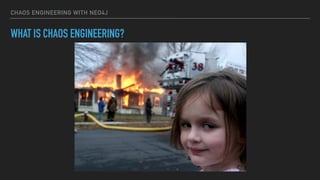
WHAT IS CHAOS ENGINEERING?
CHAOS ENGINEERING WITH NEO4J
HISTORY
▸ Jessie Robbins https://en.wikipedia.org/wiki/Jesse_Robbins
▸ “Master of Disaster”
▸ GameDay: increase reliability by purposefully creating major failures on a regular basis
▸ Adopted by the large organisations
▸ ”Netflix does it and thinks you should too”
▸ 2016: Principles of Chaos Engineering http://principlesofchaos.org
▸ 2017: Chaos Engineering book from O’Reilly byCasey Rosenthal, Lorin Hochstein,, Aaron
Blohowiak, Nora Jones,, Ali Basiri
CHAOS ENGINEERING WITH NEO4J
EXPERIMENTS STEPS (PRINCIPLESOFCHAOS.ORG):
1. Define a ‘steady state’ as some measurable output of a system that indicates
normal behaviour.
2. Hypothesise that this steady state will continue in both the control group and
the experimental group.
3. Introduce variables that reflect real world events like servers that crash, hard
drives that malfunction, network connections that are severed, etc.
4. Try to disprove the hypothesis by looking for a difference in steady state
between the control group and the experimental group.
0. PLANNING
EXECUTION ORDER
▸ Known Knowns - Things you are aware of and
understand
▸ Known Unknowns - Things you are aware of but
don’t fully understand
▸ Unknown Knowns - Things you understand but
are not aware of
▸ Unknown Unknowns - Things you are neither
aware of nor fully understand
1. DEFINE A “STEADY STATE”
OMTM, ONE METRIC THAT MATTERS - MEASURING THE IMPACT
▸ Typical use case of Neo4j:
▸ recommendation system
▸ fraud detection
▸ identity management
▸ master data management
1. DEFINE A “STEADY STATE”
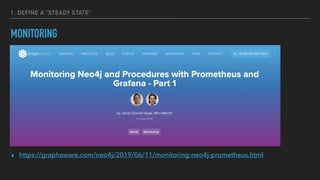
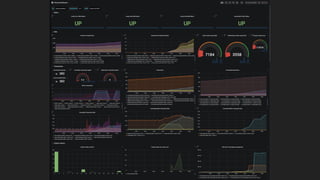
MONITORING
▸ https://graphaware.com/neo4j/2019/06/11/monitoring-neo4j-prometheus.html
2. BREAKING THINGS
▸ Simulating the failure of an entire region or datacenter.
▸ Partially deleting Kafka topics over a variety of instances to recreate an issue that occurred in production.
▸ DNS unavailability
▸ Injecting latency between services for a select percentage of traffic
▸ Function-based chaos (runtime injection): Randomly causing functions to throw exceptions.
▸ Code insertion: Adding instructions to the target program and allowing fault injection to occur prior to
certain instructions.
▸ Time travel: Forcing system clocks out of sync with each other.
▸ Executing a routine in driver code emulating I/O errors.
▸ Maxing out CPU cores on a cluster.

2. BREAKING THINGS
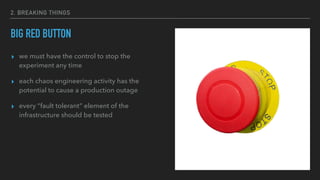
BIG RED BUTTON
▸ we must have the control to stop the
experiment any time
▸ each chaos engineering activity has the
potential to cause a production outage
▸ every “fault tolerant” element of the
infrastructure should be tested
2. BREAKING THINGS
TOOLS YOU CAN USE
▸ Chaos Monkey (https://github.com/Netflix/chaosmonkey)
▸ Mangle (https://vmware.github.io/mangle/)
▸ https://github.com/asatarin/testing-distributed-systems
▸ https://github.com/dastergon/awesome-chaos-engineering
▸ Chaos Toolkit (https://github.com/chaostoolkit/chaostoolkit/ )
▸ CM4SB https://github.com/codecentric/chaos-monkey-spring-boot
▸ Latency Assault
▸ Exception Assault
▸ AppKiller Assault
▸ Memory Assault
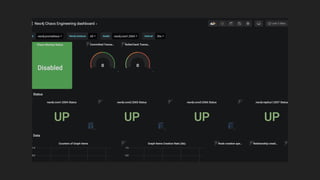
▸ Visualise your Chaos Engineering Experiments with Grafana https://www.youtube.com/watch?v=Gua-QcdoivU
2. BREAKING THINGS
LET’S DO CHAOS IN YOUR NEO4J
▸ Simulating failure in your Neo4j cluster
▸ Kill one instance from the cluster (Known Knowns)
▸ Ingestion problems
▸ Time travel: Forcing system clocks out of sync with each other.
▸ Injecting latency between services for a select percentage of traffic over a
predetermined period of time.
▸ Failure Injection Testing (FIT): Randomly causing faults in your Neo4j transactions
and "see what happens."
FAILURE INJECTION TESTING (FIT) AND LATENCY
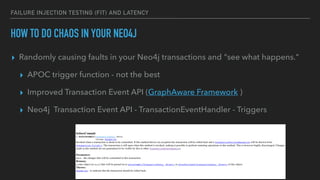
HOW TO DO CHAOS IN YOUR NEO4J
▸ Randomly causing faults in your Neo4j transactions and "see what happens."
▸ APOC trigger function - not the best
▸ Improved Transaction Event API (GraphAware Framework )
▸ Neo4j Transaction Event API - TransactionEventHandler - Triggers
beforeCommit
T beforeCommit(TransactionData data)
throws Exception
Invoked when a transaction is about to be committed. If this method throws an exception the transaction will be rolled back and a TransactionFailureException will be thrown from
Transaction.finish(). The transaction is still open when this method is invoked, making it possible to perform mutating operations in this method. This is however highly discouraged. Changes
made in this method are not guaranteed to be visible by this or other TransactionEventHandlers.
Parameters:
data - the changes that will be committed in this transaction.
Returns:
a state object (or null) that will be passed on to afterCommit(TransactionData, Object) or afterRollback(TransactionData, Object) of this object.
Throws:
Exception - to indicate that the transaction should be rolled back.
CHAOS ENGINEERING WITH NEO4J
THANK YOU!
▸ @szenyo (Twitter)
▸ janos@graphcoding.com
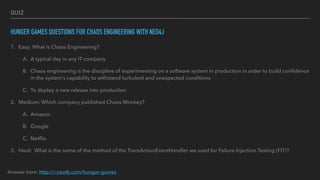
QUIZ
HUNGER GAMES QUESTIONS FOR CHAOS ENGINEERING WITH NEO4J
1. Easy: What is Chaos Engineering?
A. A typical day in any IT company
B. Chaos engineering is the discipline of experimenting on a software system in production in order to build confidence
in the system's capability to withstand turbulent and unexpected conditions
C. To deploy a new release into production
2. Medium: Which company published Chaos Monkey?
A. Amazon
B. Google
C. Netflix
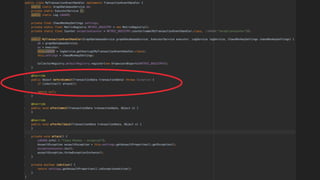
3. Hard: What is the name of the method of the TransActionEventHandler we used for Failure Injection Testing (FIT)?
Answer here: http://r.neo4j.com/hunger-games

Chaos Engineering with Neo4j

  • 1.
    CHAOS ENGINEERING WITHNEO4J JANOS SZENDI-VARGA
  • 2.
    JANOS SZENDI-VARGA ABOUT ME ▸I am an IT engineer ▸ I live in Budapest, Hungary ▸ I work for Graph Coding ▸ Graph Technology Landscape 2019 ▸ I have been in the Neo4j community since 2013 ▸ I am the main organiser of the Neo4j Budapest Meetup Group ▸ @szenyo ▸ janos@graphcoding.com 2
  • 3.
    CHAOS ENGINEERING WITHNEO4J WHAT IS CHAOS ENGINEERING?
  • 4.
  • 5.
    CHAOS ENGINEERING WITHNEO4J HISTORY ▸ Jessie Robbins https://en.wikipedia.org/wiki/Jesse_Robbins ▸ “Master of Disaster” ▸ GameDay: increase reliability by purposefully creating major failures on a regular basis ▸ Adopted by the large organisations ▸ ”Netflix does it and thinks you should too” ▸ 2016: Principles of Chaos Engineering http://principlesofchaos.org ▸ 2017: Chaos Engineering book from O’Reilly byCasey Rosenthal, Lorin Hochstein,, Aaron Blohowiak, Nora Jones,, Ali Basiri
  • 6.
    CHAOS ENGINEERING WITHNEO4J EXPERIMENTS STEPS (PRINCIPLESOFCHAOS.ORG): 1. Define a ‘steady state’ as some measurable output of a system that indicates normal behaviour. 2. Hypothesise that this steady state will continue in both the control group and the experimental group. 3. Introduce variables that reflect real world events like servers that crash, hard drives that malfunction, network connections that are severed, etc. 4. Try to disprove the hypothesis by looking for a difference in steady state between the control group and the experimental group.
  • 7.
    0. PLANNING EXECUTION ORDER ▸Known Knowns - Things you are aware of and understand ▸ Known Unknowns - Things you are aware of but don’t fully understand ▸ Unknown Knowns - Things you understand but are not aware of ▸ Unknown Unknowns - Things you are neither aware of nor fully understand
  • 8.
    1. DEFINE A“STEADY STATE” OMTM, ONE METRIC THAT MATTERS - MEASURING THE IMPACT ▸ Typical use case of Neo4j: ▸ recommendation system ▸ fraud detection ▸ identity management ▸ master data management
  • 9.
    1. DEFINE A“STEADY STATE” MONITORING ▸ https://graphaware.com/neo4j/2019/06/11/monitoring-neo4j-prometheus.html
  • 11.
    2. BREAKING THINGS ▸Simulating the failure of an entire region or datacenter. ▸ Partially deleting Kafka topics over a variety of instances to recreate an issue that occurred in production. ▸ DNS unavailability ▸ Injecting latency between services for a select percentage of traffic ▸ Function-based chaos (runtime injection): Randomly causing functions to throw exceptions. ▸ Code insertion: Adding instructions to the target program and allowing fault injection to occur prior to certain instructions. ▸ Time travel: Forcing system clocks out of sync with each other. ▸ Executing a routine in driver code emulating I/O errors. ▸ Maxing out CPU cores on a cluster.

  • 12.
    2. BREAKING THINGS BIGRED BUTTON ▸ we must have the control to stop the experiment any time ▸ each chaos engineering activity has the potential to cause a production outage ▸ every “fault tolerant” element of the infrastructure should be tested
  • 13.
    2. BREAKING THINGS TOOLSYOU CAN USE ▸ Chaos Monkey (https://github.com/Netflix/chaosmonkey) ▸ Mangle (https://vmware.github.io/mangle/) ▸ https://github.com/asatarin/testing-distributed-systems ▸ https://github.com/dastergon/awesome-chaos-engineering ▸ Chaos Toolkit (https://github.com/chaostoolkit/chaostoolkit/ ) ▸ CM4SB https://github.com/codecentric/chaos-monkey-spring-boot ▸ Latency Assault ▸ Exception Assault ▸ AppKiller Assault ▸ Memory Assault ▸ Visualise your Chaos Engineering Experiments with Grafana https://www.youtube.com/watch?v=Gua-QcdoivU
  • 14.
    2. BREAKING THINGS LET’SDO CHAOS IN YOUR NEO4J ▸ Simulating failure in your Neo4j cluster ▸ Kill one instance from the cluster (Known Knowns) ▸ Ingestion problems ▸ Time travel: Forcing system clocks out of sync with each other. ▸ Injecting latency between services for a select percentage of traffic over a predetermined period of time. ▸ Failure Injection Testing (FIT): Randomly causing faults in your Neo4j transactions and "see what happens."
  • 15.
    FAILURE INJECTION TESTING(FIT) AND LATENCY HOW TO DO CHAOS IN YOUR NEO4J ▸ Randomly causing faults in your Neo4j transactions and "see what happens." ▸ APOC trigger function - not the best ▸ Improved Transaction Event API (GraphAware Framework ) ▸ Neo4j Transaction Event API - TransactionEventHandler - Triggers beforeCommit T beforeCommit(TransactionData data) throws Exception Invoked when a transaction is about to be committed. If this method throws an exception the transaction will be rolled back and a TransactionFailureException will be thrown from Transaction.finish(). The transaction is still open when this method is invoked, making it possible to perform mutating operations in this method. This is however highly discouraged. Changes made in this method are not guaranteed to be visible by this or other TransactionEventHandlers. Parameters: data - the changes that will be committed in this transaction. Returns: a state object (or null) that will be passed on to afterCommit(TransactionData, Object) or afterRollback(TransactionData, Object) of this object. Throws: Exception - to indicate that the transaction should be rolled back.
  • 18.
    CHAOS ENGINEERING WITHNEO4J THANK YOU! ▸ @szenyo (Twitter) ▸ janos@graphcoding.com
  • 19.
    QUIZ HUNGER GAMES QUESTIONSFOR CHAOS ENGINEERING WITH NEO4J 1. Easy: What is Chaos Engineering? A. A typical day in any IT company B. Chaos engineering is the discipline of experimenting on a software system in production in order to build confidence in the system's capability to withstand turbulent and unexpected conditions C. To deploy a new release into production 2. Medium: Which company published Chaos Monkey? A. Amazon B. Google C. Netflix 3. Hard: What is the name of the method of the TransActionEventHandler we used for Failure Injection Testing (FIT)? Answer here: http://r.neo4j.com/hunger-games