Changing HE / higher skills provision
22nd March 2013


Louis Coiffait, Head of Research
@LouisMMCoiffait


The Pearson Think Tank
thepearsonthinktank.com
The Pearson Think Tank
Who are we and what do we do?
   Independent think tank focused on education access and quality

   Ongoing programme of research and thought-leadership
     The Academies Commission (with the RSA)
     Enterprise and Entrepreneurship Education
     pearsonblueskies.com, on the future of higher education
     Careers2020
     University admissions
     Tuition fees


   Policy intelligence, analysis and comment e.g. Policy Watch, blogs

   All of our content and activities are free
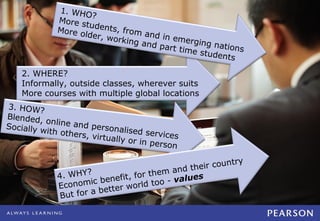
The future of HE?
1. WHO
                      ?
             More s
                    tudent
             More o        s,
                   lder, w from and in e
                           orking          mergin
                                  and pa          g natio
                                        rt time          n
                                                studen s
                                                       ts

    2. WHERE?
    Informally, outside classes, wherever suits
    More courses with multiple global locations
3. HOW?
Blended,
          onl
Socially w ine and personali
          ith others             sed servi
                     , virtually           ces
                                 or in pers
                                           on

                                                        ntry
                                             dtheir cou
             4. W H Y?            for them an es
                      ic benefit, d too - valu
             Econom              orl
                      a  better w
              But for
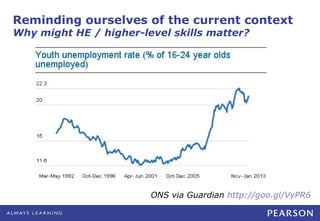
Reminding ourselves of the current context
Why might HE / higher-level skills matter?
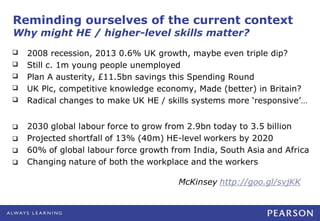
   2008 recession, 2013 0.6% UK growth, maybe even triple dip?
   Still c. 1m young people unemployed
   Plan A austerity, £11.5bn savings this Spending Round
   UK Plc, competitive knowledge economy, Made (better) in Britain?
   Radical changes to make UK HE / skills systems more ‘responsive’…
Reminding ourselves of the current context
Why might HE / higher-level skills matter?


                        ONS via Guardian http://goo.gl/VyPR6
Trends in UK HE / higher skills provision
What is currently happening on the ground?
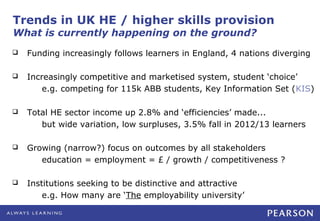
   Funding increasingly follows learners in England, 4 nations diverging

   Increasingly competitive and marketised system, student ‘choice’
        e.g. competing for 115k ABB students, Key Information Set (KIS)

   Total HE sector income up 2.8% and ‘efficiencies’ made...
       but wide variation, low surpluses, 3.5% fall in 2012/13 learners

   Growing (narrow?) focus on outcomes by all stakeholders
       education = employment = £ / growth / competitiveness ?

   Institutions seeking to be distinctive and attractive
        e.g. How many are ‘The employability university’
Changing UK HE / higher skills
What alternatives are emerging, other than work?
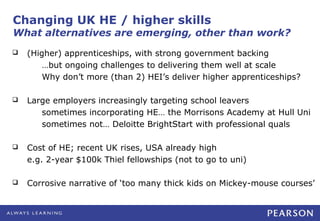
   (Higher) apprenticeships, with strong government backing
        …but ongoing challenges to delivering them well at scale
        Why don’t more (than 2) HEI’s deliver higher apprenticeships?

   Large employers increasingly targeting school leavers
       sometimes incorporating HE… the Morrisons Academy at Hull Uni
       sometimes not… Deloitte BrightStart with professional quals

   Cost of HE; recent UK rises, USA already high
    e.g. 2-year $100k Thiel fellowships (not to go to uni)

   Corrosive narrative of ‘too many thick kids on Mickey-mouse courses’
Changing UK HE / higher skills
How is part-time provision changing?
   -40% since 2010 (105k decline) - more sensitive to fees?

   Hard to measure, highly variable provision, blurred definitions

   Lower completion / achievement - impact on rankings

   A complex picture, needs careful institutional / national focus

   IES identified four types; career enhancers, career changers, non-
    career learners and career entrants and suggested FE and private
    providers have the most expansion potential

       Institute for Employment Studies (IES) http://goo.gl/ibV15
Changing UK HE / higher skills
Can provision change to target/support other groups?
   How do these groups overlap with part-time learners?

       Mature learners

       Postgrads

       International students

   Opportunities for institutional and course specialisation?
Changing UK HE / higher skills
How is online provision changing?
   MOOCs MOOCs MOOCs MOOCs MOOCs MOOCs MOOCs (hype?)
     Face-to-face interaction can never be replaced, only augmented
     It is an acceleration of change, but the debate often too polarised
     Tends to miss the c.40 year history of distance and open learning
     Unclear where it leads the sector yet (though I’m pretty hopeful)


   Stupid name, soon MOOCs will just be known as … courses
    (appropriately blended and personalised for the learner)

   Open up access. Make provision cheaper, flexible, data-supported

   How are institutions using technology to support their mission?
       …and to target / support different specific groups?
Thank you!


thepearsonthinktank.com

@louismmcoiffait


                          …any questions?

Changing higher education provision

  • 1.
    Changing HE /higher skills provision 22nd March 2013 Louis Coiffait, Head of Research @LouisMMCoiffait The Pearson Think Tank thepearsonthinktank.com
  • 2.
    The Pearson ThinkTank Who are we and what do we do?  Independent think tank focused on education access and quality  Ongoing programme of research and thought-leadership  The Academies Commission (with the RSA)  Enterprise and Entrepreneurship Education  pearsonblueskies.com, on the future of higher education  Careers2020  University admissions  Tuition fees  Policy intelligence, analysis and comment e.g. Policy Watch, blogs  All of our content and activities are free
  • 3.
  • 4.
    1. WHO ? More s tudent More o s, lder, w from and in e orking mergin and pa g natio rt time n studen s ts 2. WHERE? Informally, outside classes, wherever suits More courses with multiple global locations 3. HOW? Blended, onl Socially w ine and personali ith others sed servi , virtually ces or in pers on ntry dtheir cou 4. W H Y? for them an es ic benefit, d too - valu Econom orl a better w But for
  • 5.
    Reminding ourselves ofthe current context Why might HE / higher-level skills matter?  2008 recession, 2013 0.6% UK growth, maybe even triple dip?  Still c. 1m young people unemployed  Plan A austerity, £11.5bn savings this Spending Round  UK Plc, competitive knowledge economy, Made (better) in Britain?  Radical changes to make UK HE / skills systems more ‘responsive’…
  • 6.
    Reminding ourselves ofthe current context Why might HE / higher-level skills matter? ONS via Guardian http://goo.gl/VyPR6
  • 7.
    Trends in UKHE / higher skills provision What is currently happening on the ground?  Funding increasingly follows learners in England, 4 nations diverging  Increasingly competitive and marketised system, student ‘choice’ e.g. competing for 115k ABB students, Key Information Set (KIS)  Total HE sector income up 2.8% and ‘efficiencies’ made... but wide variation, low surpluses, 3.5% fall in 2012/13 learners  Growing (narrow?) focus on outcomes by all stakeholders education = employment = £ / growth / competitiveness ?  Institutions seeking to be distinctive and attractive e.g. How many are ‘The employability university’
  • 8.
    Changing UK HE/ higher skills What alternatives are emerging, other than work?  (Higher) apprenticeships, with strong government backing …but ongoing challenges to delivering them well at scale Why don’t more (than 2) HEI’s deliver higher apprenticeships?  Large employers increasingly targeting school leavers sometimes incorporating HE… the Morrisons Academy at Hull Uni sometimes not… Deloitte BrightStart with professional quals  Cost of HE; recent UK rises, USA already high e.g. 2-year $100k Thiel fellowships (not to go to uni)  Corrosive narrative of ‘too many thick kids on Mickey-mouse courses’
  • 9.
    Changing UK HE/ higher skills How is part-time provision changing?  -40% since 2010 (105k decline) - more sensitive to fees?  Hard to measure, highly variable provision, blurred definitions  Lower completion / achievement - impact on rankings  A complex picture, needs careful institutional / national focus  IES identified four types; career enhancers, career changers, non- career learners and career entrants and suggested FE and private providers have the most expansion potential Institute for Employment Studies (IES) http://goo.gl/ibV15
  • 10.
    Changing UK HE/ higher skills Can provision change to target/support other groups?  How do these groups overlap with part-time learners?  Mature learners  Postgrads  International students  Opportunities for institutional and course specialisation?
  • 11.
    Changing UK HE/ higher skills How is online provision changing?  MOOCs MOOCs MOOCs MOOCs MOOCs MOOCs MOOCs (hype?)  Face-to-face interaction can never be replaced, only augmented  It is an acceleration of change, but the debate often too polarised  Tends to miss the c.40 year history of distance and open learning  Unclear where it leads the sector yet (though I’m pretty hopeful)  Stupid name, soon MOOCs will just be known as … courses (appropriately blended and personalised for the learner)  Open up access. Make provision cheaper, flexible, data-supported  How are institutions using technology to support their mission? …and to target / support different specific groups?
  • 12.

Editor's Notes

  • #2 Research not in scope
  • #4 If nothing else, remember this picture, it tells you the three key things you need to know about the future of higher education. With one exception, two of the three men should be women.
  • #8 US/UK trends, what about Europe?
  • #9 Part-time foundation degree in supermarket operations in partnership with Hull University's business school