Coco Chanel
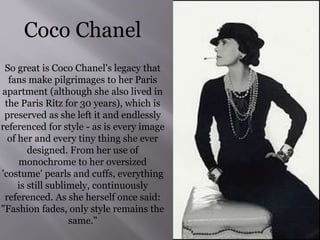
So great is Coco Chanel's legacy that
fans make pilgrimages to her Paris
apartment (although she also lived in
the Paris Ritz for 30 years), which is
preserved as she left it and endlessly
referenced for style - as is every image
of her and every tiny thing she ever
designed. From her use of
monochrome to her oversized
'costume' pearls and cuffs, everything
is still sublimely, continuously
referenced. As she herself once said:
"Fashion fades, only style remains the
same."
“Fashion is not something that exists in dresses
only. Fashion is in the sky, in the street, fashion has
to do with ideas, the way we live, what is
happening.”
– Coco Chanel
Coco Chanel was a leading French modernist
designer, whose patterns of simplicity and style
revolutionised women’s clothing. She was the only
designer to be listed in the Time 100 most
influential people of the Twentieth Century.
Coco Chanel was born Gabrielle Bonheur Chanel on
August 19, 1883, in Saumur, France. After her
mother’s death, Chanel was put in an orphanage by
her father, who worked as a peddler. She was raised
by nuns who taught her how to sew—a skill that
would lead to her life’s work.
Her nickname came from another occupation
entirely. During her brief career as a singer, Chanel
performed in clubs in Vichy and Moulins where she
was called “Coco.” Some say that the name comes
from one of the songs she used to sing, and Chanel
herself said that it was a “shortened version of
cocotte, the French word for 'kept woman,'”
according to an article in The Atlantic.
Around the age of 20, Chanel became involved with
Etienne Balsan, who offered to help her start a
millinery business in Paris. She soon left him for one of
his even wealthier friends, Arthur “Boy” Capel. Both
men were instrumental in Chanel’s first fashion
venture.
Opening her first shop on Paris’s Rue Cambon in 1910,
Chanel started out selling hats. She later added stores
in Deauville and Biarritz and began making clothes.
Her first taste of clothing success came from a dress
she fashioned out of an old jersey on a chilly day. In
response to the many people who asked about where
she got the dress, she offered to make one for them.
“My fortune is built on that old jersey that I’d put on
because it was cold in Deauville,” she once told author
Paul Morand.
In the 1920s, Chanel
took her thriving
business to new heights.
She launched her first
perfume, Chanel No. 5,
which was the first to
feature a designer’s
name. Perfume “is the
unseen, unforgettable,
ultimate accessory of
fashion. . . . that heralds
your arrival and
prolongs your
departure,” Chanel once
explained.
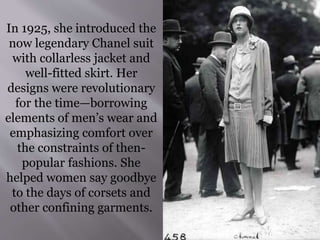
In 1925, she introduced the
now legendary Chanel suit
with collarless jacket and
well-fitted skirt. Her
designs were revolutionary
for the time—borrowing
elements of men’s wear and
emphasizing comfort over
the constraints of then-
popular fashions. She
helped women say goodbye
to the days of corsets and
other confining garments.
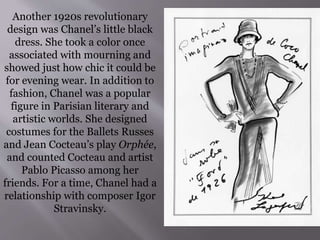
Another 1920s revolutionary
design was Chanel’s little black
dress. She took a color once
associated with mourning and
showed just how chic it could be
for evening wear. In addition to
fashion, Chanel was a popular
figure in Parisian literary and
artistic worlds. She designed
costumes for the Ballets Russes
and Jean Cocteau’s play Orphée,
and counted Cocteau and artist
Pablo Picasso among her
friends. For a time, Chanel had a
relationship with composer Igor
Stravinsky.
The international economic
depression of the 1930s had a
negative impact on her company,
but it was the outbreak of World
War II that led Chanel to close her
business. She fired her workers
and shut down her shops.
At the age of 70, Chanel made a
triumphant return to the fashion
world. She first received scathing
reviews from critics, but her
feminine and easy-fitting designs
soon won over shoppers around
the world.
Coco Chanel died on January 10, 1971, at her apartment
in the Hotel Ritz. She never married, having once said “I
never wanted to weigh more heavily on a man than a
bird.” Hundreds crowded together at the Church of the
Madeleine to bid farewell to the fashion icon. In tribute,
many of the mourners wore Chanel suits.
A little more than a decade after her death, designer Karl
Lagerfeld took the reins at her company to continue the
Chanel legacy. Today her namesake company is held
privately by the Wertheimer family and continues to
thrive, believed to generate hundreds of millions in sales
each year.

Chanel

  • 1.
    Coco Chanel So greatis Coco Chanel's legacy that fans make pilgrimages to her Paris apartment (although she also lived in the Paris Ritz for 30 years), which is preserved as she left it and endlessly referenced for style - as is every image of her and every tiny thing she ever designed. From her use of monochrome to her oversized 'costume' pearls and cuffs, everything is still sublimely, continuously referenced. As she herself once said: "Fashion fades, only style remains the same."
  • 2.
    “Fashion is notsomething that exists in dresses only. Fashion is in the sky, in the street, fashion has to do with ideas, the way we live, what is happening.” – Coco Chanel Coco Chanel was a leading French modernist designer, whose patterns of simplicity and style revolutionised women’s clothing. She was the only designer to be listed in the Time 100 most influential people of the Twentieth Century.
  • 3.
    Coco Chanel wasborn Gabrielle Bonheur Chanel on August 19, 1883, in Saumur, France. After her mother’s death, Chanel was put in an orphanage by her father, who worked as a peddler. She was raised by nuns who taught her how to sew—a skill that would lead to her life’s work. Her nickname came from another occupation entirely. During her brief career as a singer, Chanel performed in clubs in Vichy and Moulins where she was called “Coco.” Some say that the name comes from one of the songs she used to sing, and Chanel herself said that it was a “shortened version of cocotte, the French word for 'kept woman,'” according to an article in The Atlantic.
  • 4.
    Around the ageof 20, Chanel became involved with Etienne Balsan, who offered to help her start a millinery business in Paris. She soon left him for one of his even wealthier friends, Arthur “Boy” Capel. Both men were instrumental in Chanel’s first fashion venture. Opening her first shop on Paris’s Rue Cambon in 1910, Chanel started out selling hats. She later added stores in Deauville and Biarritz and began making clothes. Her first taste of clothing success came from a dress she fashioned out of an old jersey on a chilly day. In response to the many people who asked about where she got the dress, she offered to make one for them. “My fortune is built on that old jersey that I’d put on because it was cold in Deauville,” she once told author Paul Morand.
  • 5.
    In the 1920s,Chanel took her thriving business to new heights. She launched her first perfume, Chanel No. 5, which was the first to feature a designer’s name. Perfume “is the unseen, unforgettable, ultimate accessory of fashion. . . . that heralds your arrival and prolongs your departure,” Chanel once explained.
  • 6.
    In 1925, sheintroduced the now legendary Chanel suit with collarless jacket and well-fitted skirt. Her designs were revolutionary for the time—borrowing elements of men’s wear and emphasizing comfort over the constraints of then- popular fashions. She helped women say goodbye to the days of corsets and other confining garments.
  • 7.
    Another 1920s revolutionary designwas Chanel’s little black dress. She took a color once associated with mourning and showed just how chic it could be for evening wear. In addition to fashion, Chanel was a popular figure in Parisian literary and artistic worlds. She designed costumes for the Ballets Russes and Jean Cocteau’s play Orphée, and counted Cocteau and artist Pablo Picasso among her friends. For a time, Chanel had a relationship with composer Igor Stravinsky.
  • 8.
    The international economic depressionof the 1930s had a negative impact on her company, but it was the outbreak of World War II that led Chanel to close her business. She fired her workers and shut down her shops. At the age of 70, Chanel made a triumphant return to the fashion world. She first received scathing reviews from critics, but her feminine and easy-fitting designs soon won over shoppers around the world.
  • 9.
    Coco Chanel diedon January 10, 1971, at her apartment in the Hotel Ritz. She never married, having once said “I never wanted to weigh more heavily on a man than a bird.” Hundreds crowded together at the Church of the Madeleine to bid farewell to the fashion icon. In tribute, many of the mourners wore Chanel suits. A little more than a decade after her death, designer Karl Lagerfeld took the reins at her company to continue the Chanel legacy. Today her namesake company is held privately by the Wertheimer family and continues to thrive, believed to generate hundreds of millions in sales each year.